Saving Democracy From Itself: The Democratic National Committee Moves To Block Third Party Candidates

Saving Democracy From Itself: The Democratic National Committee Moves To Block Third Party Candidates

Authored by Jonathan Turley,

Below is my column in the New York Post on reported plan of the Democratic National Committee and allied groups to try to block third-party candidates from the 2024 ballot. The contradiction is stunning as these groups raise money to “save democracy” by limiting democratic choice.

Here is the column:

The last time that the Chicago Democratic Convention was held in Chicago in 1968, the resulting riots led to one of the greatest Freudian slips in American politics. Mayor Richard Daley declared “the policeman isn’t there to create disorder; the policeman is there to preserve disorder.”

The Democratic National Committee has now added its own gem: the Democratic Party is not here to preserve democracy, it is here to prevent democracy.

That’s because the DNC is seeking to block third party candidates from ballots — Robert Kennedy Jr., Cornell West, and Jill Stein. All three are liberal and are considered a threat to Joe Biden.

This effort will likely include any ticket put forward by the No Labels group, seeking a moderate alternative to the two parties.

Mary Beth Cahill, the former interim DNC CEO, and long-time DNC staffer Ramsey Reid  will lead this effort. According to media reports, former Buttigieg campaign aide to Lis Smith will lead the effort with another Buttigieg alumni, Matt Corridoni. This effort includes not just a public campaign against Kennedy and Stein as spoilers, but “legal action” to solve the problem by denying voters a choice.

The media does not appear at all alarmed or critical of the effort to limit democratic choice. The Washington Post stated clinically “Democrats are taking third-party threats seriously this time.” Taking it seriously appears to mean using legal means to keep them from the ballots.

It is true that the main political parties have challenged qualification signatures and paperwork in the past. However, the reports indicate a systemic effort geared toward reducing the choices for voters. What is striking is that this is coming from democratic groups and the DNC, which are raising money on the “save democracy” narrative.

The contradiction is spellbinding. On the same sites promising to oppose the third party candidates, the DNC and other groups push the narrative that only the Democrats are working to protect the right to vote.

The Post reports that Democrats have studied the Hillary Clinton campaign and vowed not to allow third party candidates to drain away millions of voters as they did in 2016. Of course, the comparison is particularly telling because in both 2016 and 2024, the DNC had the least popular Democratic candidates. Polls showed that Clinton was the worst possible candidate for the party, but the Clintons had control over the DNC and state party organizations.

Of particular concern is the fact that Trump beat Hillary Clinton in Pennsylvania, Wisconsin and Michigan by only 67,000 votes. In just those states, Libertarian Gary Johnson and the Green Party’s Stein received more than half a million votes.

Rather than actually pick a candidate that most citizens want, the DNC wants to replay the 2016 strategy of forcing the choice between two evils in a Biden-Trump choice. That can only work reliably if there is no other choice for citizens tired of the duopoly and the political (and media) establishment. So Kennedy, Cornell, and Stein just have to go.

I am one of those misguided voters. Years ago, I wrote a column saying that I was tired of voting for the lesser of two evils — leaving every election as a moral hazard. I am prepared to vote for candidates from the two main parties in any given election, but I will only vote for the candidate who I believe is the best of candidates to be president. We are played as chumps by a political and media establishment in every election system. Over two decades ago, I pledged to vote for the best candidate, even if they are with a third party.

The DNC is reportedly to be joined in this effort by a well-financed array of groups including the liberal think tank Third Way (which has filed complaints with secretaries of states); American Bridge (a Democratic opposition operation), and Clear Choice (a super PAC composed of “allies of President Biden”).

While these groups work to limit the choice of voters, the effort continues in Florida, Georgia, Washington, and New York to keep Trump in court until the election, including a possible trial running up to or even through the election.

There is hope that this multi-front effort will be the winning ticket, particularly if the ultimate ticket denies voters any other choice.

The open discussion of these efforts in the media illustrates the contempt for voters, who need to be protected from their bad choices. I have previously compared the underlying assumptions to a type of electoral Big Gulp law. Before they were also struck down, these laws sought to take away the dietary choices of citizens because they were making the wrong choice in the view of experts.

Now activists are now big gulping the election. Voters cannot be trusted with something as important as democracy.

President Biden has said “make no mistake: Democracy is on the ballot for all of us.” Of course, he could end this effort by denouncing further ballot cleansing (something he refused to do when Trump was removed by the Colorado and Maine ballots). It appears that the last thing that democracy needs is free democratic choice.

Tyler Durden
Tue, 03/26/2024 – 13:05

via ZeroHedge News https://ift.tt/0APVNBW Tyler Durden
Trump To Own Nearly 80 Million ‘DJT’ Shares – Here’s What Price Makes Him The World’s First Trillionaire

Trump To Own Nearly 80 Million ‘DJT’ Shares – Here’s What Price Makes Him The World’s First Trillionaire

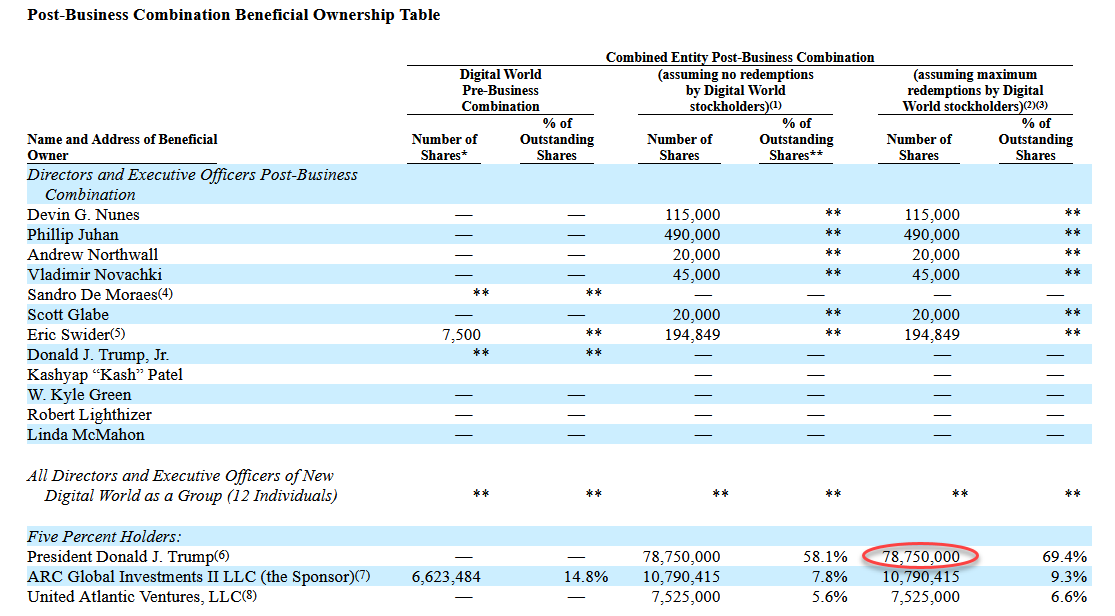
Following the merger between Digital World Acquisition Corp and Trump Media & Technology Group, former President Donald Trump is expected to own 78,750,000 shares of the combined company, which is trading under the symbol “DJT.”

Assuming maximum redemptions by DWAC shareholders, this would represent 69.4% of outstanding shares, according to the latest S-4 filing with the SEC, MarketWatch reports.

Trump would be by far the largest shareholder. Why not, the company’s stock ticker post-merger will be his initials, “DJT.”

ARC Global Investments, which is the investment vehicle of former Chief Executive Patrick Orlando. is expected to be the second-largest shareholder, with 10,790,415 shares, or 9.3% of the shares outstanding.

Devin Nunes, CEO, is slated to own 115,000 shares, or less than 1%.

Trillionaire?

This week’s merger added roughly $3.5 billion to Trump’s net worth, bringing it up to $6.4 billion. The boost was enough to include Trump in the Bloomberg Billionaires Index, which tracks the top 500 wealthiest people in the world.

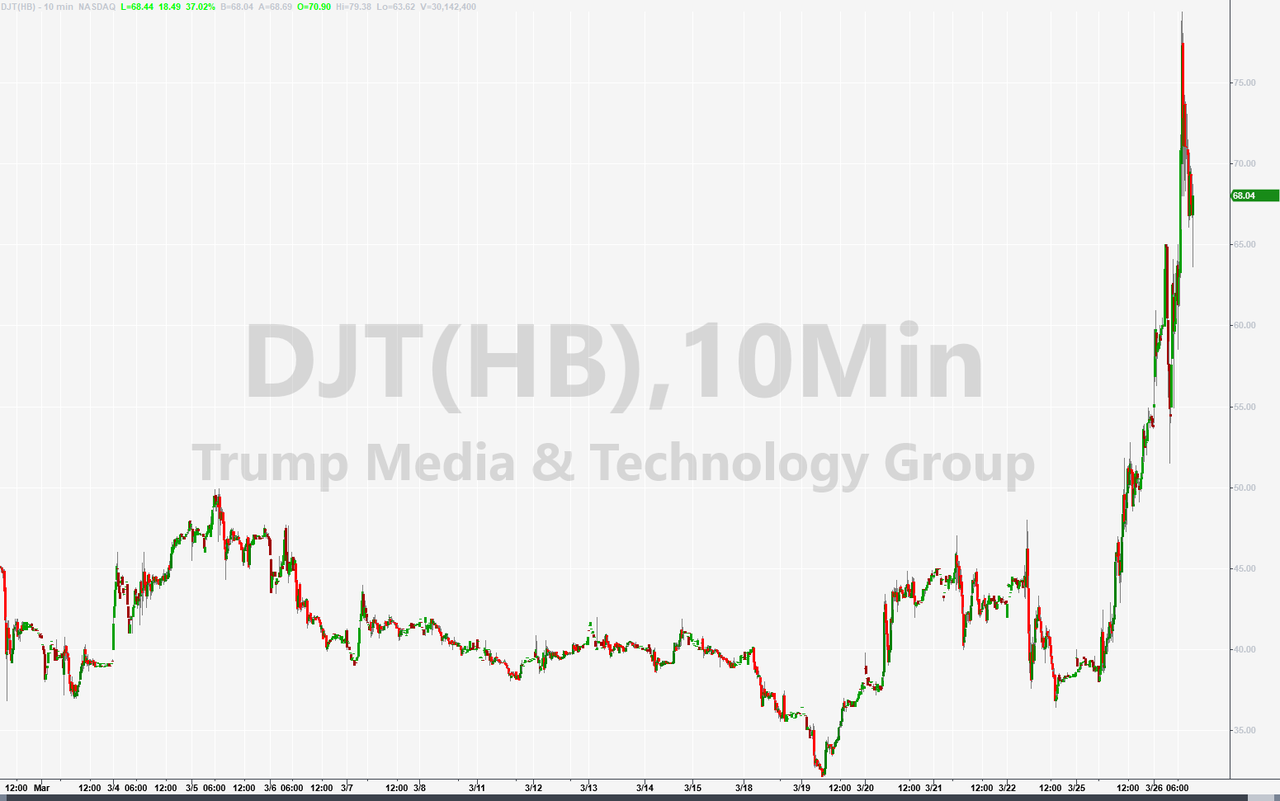
So as a fun thought experiment (why not?), what price does $DJT need to hit to make Trump the world’s first (documented) trillionaire?

$1 trillion / 78,750,000 shares = $12,700

So, just $12,635 or so to go!

Tyler Durden
Tue, 03/26/2024 – 12:45

via ZeroHedge News https://ift.tt/vHgo6XM Tyler Durden

“So It Goes”… Just Not Towards Low CPI Or Neutral Rates

“So It Goes”… Just Not Towards Low CPI Or Neutral Rates

By Michael Every of Rabobank

Yesterday’s Global Daily underlined we shouldn’t look to central banks or markets for clear answers on where long-run inflation and neutral rates will sit. Meanwhile, politics and geopolitics echo Kurt Vonnegut’s “So it goes” – just not towards low CPI and neutral rates (R*).

Americas:

  • The Mexican president gave an interview to ‘60 Minutes’ in which he suggested the US could solve its migrant crisis by changing its immigration and foreign policy: granting green cards to all Mexicans in America illegally (only Mexicans?); sending $20bn annual economic aid to poor Latin American countries; ending the embargo of communist Cuba; and removing sanctions on Russia-, Iran- and China-ally Venezuela. Central banks and markets grudgingly admit immigration can impact on wage inflation, which links economics to politics: they may now have to admit that economics and geopolitics are also linked.

  • Brazil’s President Lula is getting more involved in state enterprises such as Petrobas and Vale, alarming markets – especially in calling them, “a voracious dinosaur.” This is hardly a new pattern of behaviour in Latin America: it’s just that others do it elsewhere now too.

  • A New York appeals court slashed the size of the bond former President Trump has to place to appeal the ruling finding him liable for a near-half billion dollar fine for having inflated the value of his properties. Together with Trump’s sudden $3.5bn increase in paper wealth alongside the launch of his tech-linked SPAC, that smaller bond should be payable by the deadline in April, and as some legal observers suggest the ruling points to the case being overturned on appeal. That keeps a Trump 2 presidency, and Trump tariffs 2.0, pencilled in for 2025 – which our Fed-watcher Philip Marey sees as inflationary.

  • The US just passed another $1.2 trillion pork-barrel spending bill, keeping the fiscal-dominance Treasury ‘roll-up, roll-up!’ economic circus rolling towards November; and the congressional Republican circus started a new round of circular firing squad as a result.

Russia/Ukraine:

  • Russia linked the ISIS-K terror attack on Moscow to Ukraine (as the web says it was the CIA, Mossad, or the FSB). That awful loss of life has seen terror alerts across the West but might also trigger full Russian military mobilization vs. Ukraine. Shadow-boxer French President Macron would then have to stand up as the ‘Raging Bull’ he is presenting as or be shown as a Bull sitter. The stakes and fat tail risks should be clear.

  • The US told Ukraine not to attack Russian energy infrastructure for fear of “escalation,” meaning ‘high US oil prices in an election year’. Yet Ukraine’s drone attacks aim at stopping inputs into Russian missiles, not US autos, and Russia attacks Ukraine’s energy. Indeed, the US is now not arming an out-gunned Ukraine sufficiently to win, telling it not to match grey-zone tactics either, while saying a Ukraine defeat would have appalling consequences. Unsurprisingly, Kyiv has denied US pressure and carried out more attacks on Russian refineries; and the US has laid itself open to “arms or less oil” pressure going forwards – both are inflationary.

  • Baltic leaders are telling NATO members to bring back conscription. With unemployment where it is now, that would certainly be inflationary, unless we echo the Romans/Starship Troopers in saying “service guarantees citizenship” – would you like to know more?

Middle East:

  • The US abstained on a UN Security Council ceasefire resolution on the Israel-Hamas war, which passed, a slap to Israel’s hardline government. PM Netanyahu had threatened not to send a delegation to the White House unless it vetoed, and cancelled their departure afterwards, but only showed his impotence, as he also struggles over the domestic issue of which citizens serve. That said, the US insists its position on the conflict is unchanged; Netanyahu says he will still go into Rafah; and Hamas just rejected another ceasefire involving an exchange of 800 prisoners for 40 Israeli hostages because they insist the war must end completely (because they are losing). In short, further fighting looks likely regardless of the UN.

  • China and Russia agreed a deal with the Houthis to not attack their ships near Suez(!); both vetoed an earlier Gaza ceasefire UN resolution, to no outrage from Ivy League Maoists; and Hamas sent condolences to Russia for the ISIS-K attack on Moscow. Yet a Chinese tanker was then attacked multiple times by the Houthis: are they just poor shots, or poor allies?

  • The US also just attacked Iranian targets in Syria once againslaps to ally and enemy alike?

Asia:

  • China is today alleged to have hacked business and political data in the US, and in the UK, and in NZ. Either China did it, not good for relations, or three Anglo economies all fabricated similar charges at the same time, not good for relations either. China also fired water cannon at Filipino coast guard ships in a dangerous manner in internationally recognised Philippines’ territory which Beijing claims as its own.

The Economy/Markets:

  • Food prices will climb everywhere as temperatures rise due to climate change, with food price inflation seen increasing by 0.9 – 3.2ppts per year by 2035, and the same warming causing overall inflation to be 0.3 – 1.2ppts higher. That’s as Nikkei Asia says Greenflation causes Indonesia and Vietnam to retreat on their use of renewables.

  • Legoland UK is to introduce surge pricing, with higher ticket prices at peak times such as summer weekends. Economists will average this with lower ticket prices in the middle of the night on a wet Tuesday in January and say the effective price for consumers remains the same; and then not be able to take their kids to Legoland.

  • Noah Smith underlines the looming scale of the next China Shock, as it looks to dominate global manufacturing further, as Bloomberg argues it’s realistic for it to see a huge shift from property investment to high-tech output. That would be deflationary – if the rest of the world buys it. Which it won’t. The G7, if not G20, are likely to push back with tariffs and industrial policies rather than be hollowed out by Chinese over-production. Then we get an inflation shock.

  • China is to block the use of US made chips from Intel and AMD, as it moves to create its own separate tech supply chain. This is called decoupling, not derisking.

  • Bloomberg’s John Authors notes we are “trundling toward a polarized investment world where clients can choose between left- and right-wing money managers. It’s a horrible prospect.” Wait for the truly polarized geopolitical investment environment!

  • FX markets are trying to decide why the PBOC let CNY slide, then backed it with stronger fixing and state-bank dollar sales. At 7.2464 now, and after strong comments from Japan too, we aren’t in the JPY – CNY race to the bottom some feared – yet.

  • The EU is targeting US Big Tech in an antitrust probe, just as the US does the same. Coincidence or coordination?

  • The Boeing CEO is stepping down as the firm’s reputation nose-dives and its main union is pushing to get a Boeing board seat, which is something one usually sees in Europe, not the US. Does the departing CEO get a golden parachute?

Tyler Durden
Tue, 03/26/2024 – 12:25

via ZeroHedge News https://ift.tt/1HMyZiO Tyler Durden

Zelensky Fires Security Chief As Defense Shake-Up Continues

Zelensky Fires Security Chief As Defense Shake-Up Continues

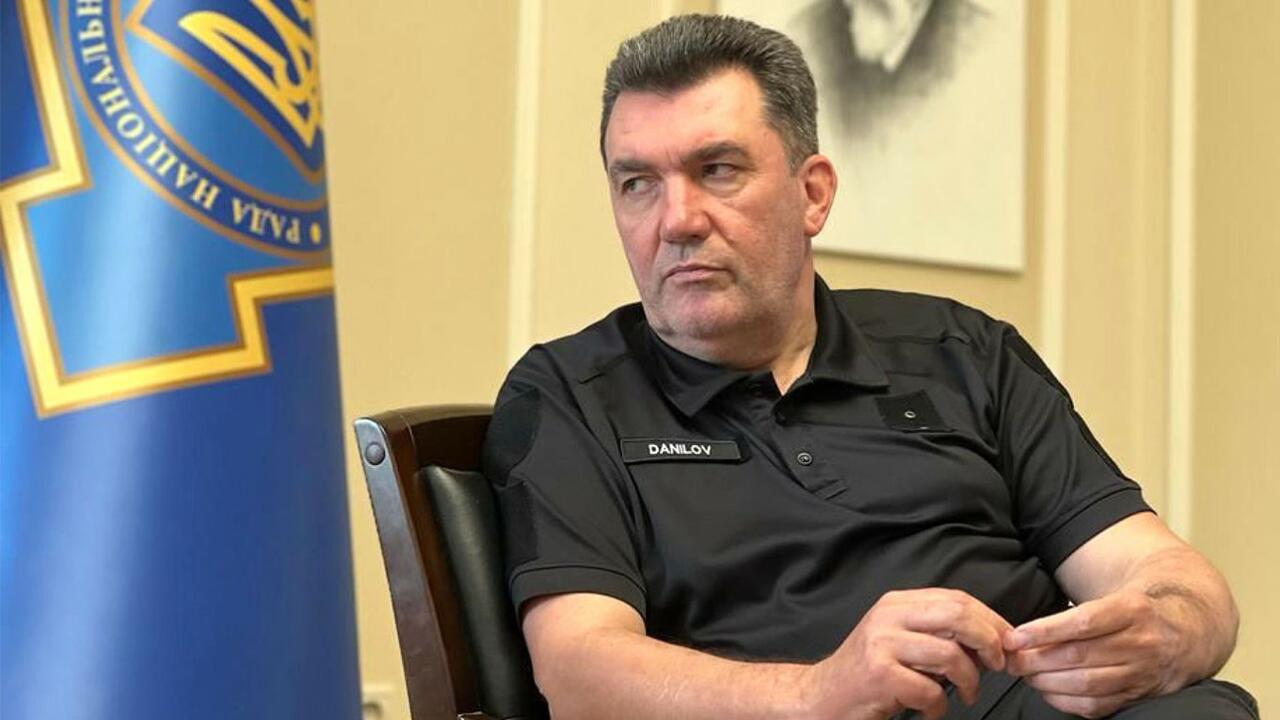
In an apparent continuing shake-up of his defense leadership, Ukraine’s President Zelensky has fired the the head of the Ukrainian National Security and Defense Council (SNBO), Oleksiy Danilov.

A decree confirming his removal was published to the Ukrainian presidency’s official website, however, it provided no reason or explanation for the decision. Danilov had been installed in the top national security office in October 2019.

Oleksiy Danilov, via Moscow Times

The Kyiv correspondent for the Financial Times, Christopher Miller, has also confirmed the high level removal…

“Another big and expected shakeup in Kyiv. Zelensky has dismissed Oleksiy Danilov from the post of head of Ukraine’s National Security and Defense Council and replaced him with Oleksandr Lytvynenko, who has been serving at Chief of the Foreign Intelligence Service,” writes Miller.

This is but the latest in a major shake-up of top defense ranks which began in early February. At that time Ukraine’s top general and commander of the armed forces, Gen. Valery Zaluzhny, was booted out despite his widely reported popularity among military ranks.

Zelensky had said at the time that it is “time for renewal” at a moment Western press began to increasingly acknowledge that Ukraine forces are being beaten by the greater manpower and artillery of the Russian military machine.

President Biden too has long acknowledged Ukraine is in “dire straights”, also after Zelensky has struggled to attract more weaponry, and amid war weary Western publics, and European nations which have seen their own stockpiles greatly diminished.

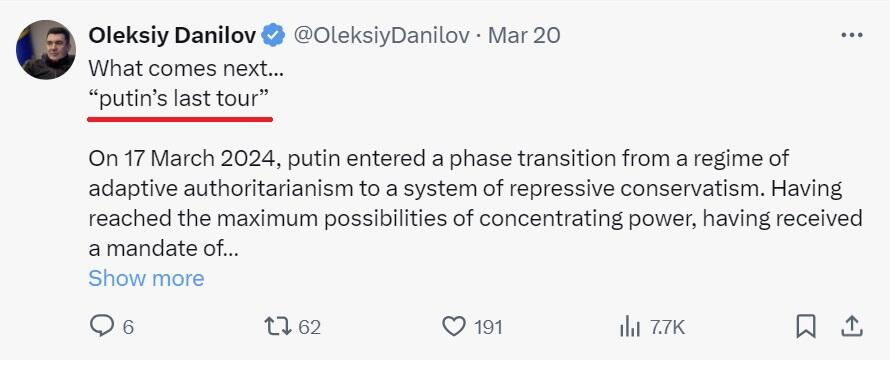
Ironically this was Danilov’s last tweet… As Putin gets re-elected to office the longtime Ukraine national security chief gets sacked.

Likely it is too late for any major turn-around for Kiev forces, though the Zelensky administration has lately been teasing the potential for a large new military mobilization of hundreds of thousands, which is sure to be hugely unpopular and controversial among the Ukrainian population. Officials have indicated the military needs some 300,000 to 500,000 more men just to hold the front lines and stave off Russian advance.

Tyler Durden
Tue, 03/26/2024 – 12:05

via ZeroHedge News https://ift.tt/7mnYE4W Tyler Durden

Rate-Cut Signals Bolster Buy-And-Hold Strategies

Rate-Cut Signals Bolster Buy-And-Hold Strategies

By Michael Miska, Bloomberg Markets Reporter and strategist

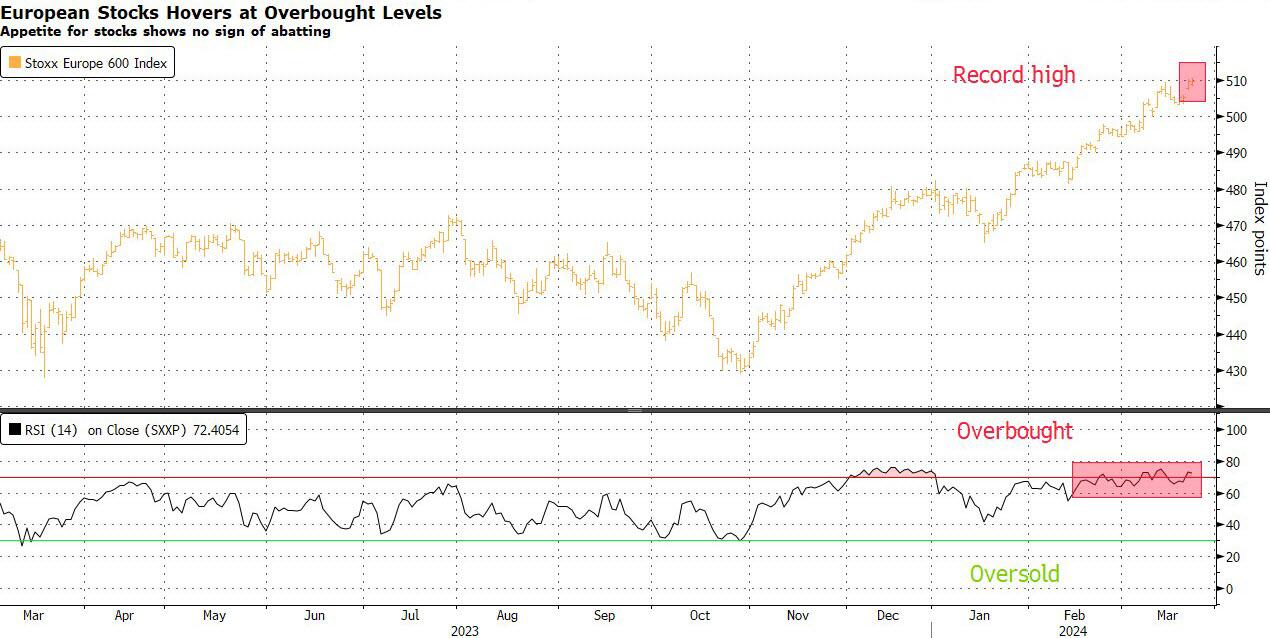
Stock market optimism is at full throttle after central banks’ rate-cut reassurances, leaving investors with no reason to sell and bears with little to do but await catalysts that might derail this rally.

The Federal Reserve’s signal that three interest-rate cuts are still on the cards for this year has just propelled Europe’s Stoxx 600 index to its ninth straight week of gains, the longest winning streak in 12 years. While the Stoxx and its blue-chip counterpart the Euro Stoxx 50 may look a tad overbought, there is no real sign of the excesses that would trigger technical red flags.

“The Fed delivered the best possible speech for equities,” DayByDay technical analyst Valerie Gastaldy says. Short-and-long trends are still bullish, implying that most bad news will be quickly overcome and new highs will be scaled, she adds. “No method can beat the buy-and-hold in those periods.”

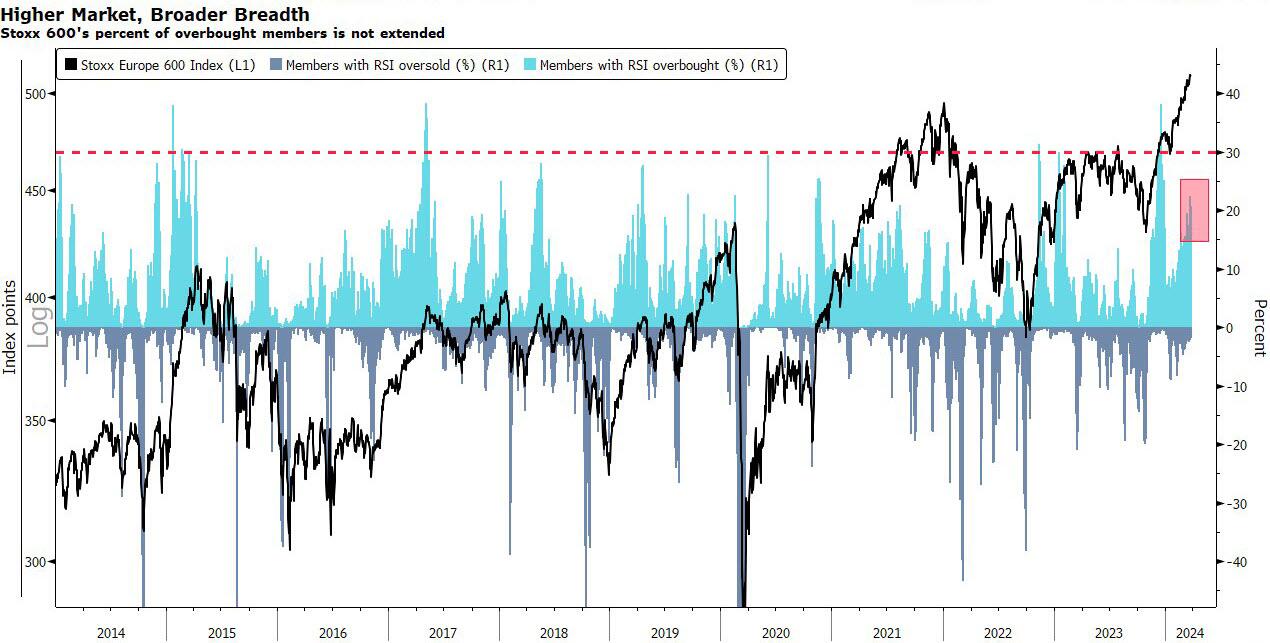
While it may seem like markets are overheating, in fact less than 30% of Stoxx 600 constituents currently look overbought, below the threshold that has signaled exuberance over the past 10 years.

That leaves scope for further gains, especially after last week’s central bank green light. The Bank of England’s meeting outcome gave traders confidence that policy-easing could start June, the same month as the European Central Bank. Switzerland has already made its move. And the Fed indicated it’s willing to look past strong economic data that had raised the prospect of a further rate-cut delay.

That’s a “Fed put” in play, for Barclays strategist Emmanuel Cau. “The Fed communication clearly suggests it wants to cut rates, which tilts the risk-reward positively for risk markets,” Cau says. “History shows that when central banks’ cuts come without a recession ensuing, like in 1995, it typically puts us into a ‘mid-cycle’ situation: the economic cycle tends to get extended as growth is stimulated by the cuts.”

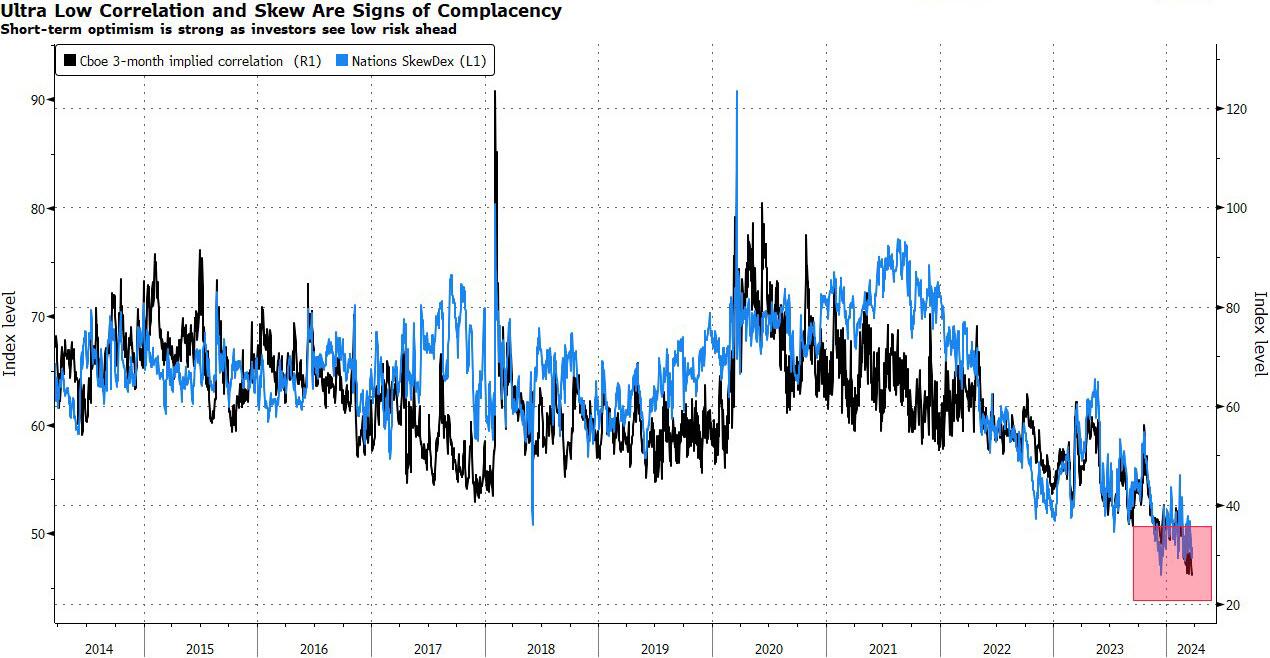
Which is not to say markets are not vulnerable to short-term setbacks. For one, elevated positioning of systematic strategies could be seen as a contrarian indicator. Volatility skew at ultra-low levels suggests there is no appetite for hedging, in itself a potential risk. Current bull/bear and call-to-put option premiums, together with low intraday correlations, hint at abnormally optimistic sentiment, bordering on complacency, according to UBS strategists led by Andrew Garthwaite.

“Our aggregate tactical indicators are extreme and at levels where the market normally falls modestly,” Garthwaite says, citing the most overbought areas, such as construction materials and capital goods, as likely the most vulnerable. Yet according to the UBS model, there is only a small chance of a retracement greater than 5%. “We don’t see this as being a major correction,” he adds.

Given the amount of time that’s passed without a market pullback, the likelihood of a “down week” soon looks pretty high, reckons Carl Dooley, the head of EMEA trading at TD Cowen. But while agreeing that some warning signals are flashing, Dooley expects bears to remain on the backfoot. The reason? “Zooming out, I think shorting a new all-time high continues to be the more dangerous play,” he says.

Tyler Durden
Tue, 03/26/2024 – 11:45

via ZeroHedge News https://ift.tt/vNBPVjp Tyler Durden

“We Need Somebody Disruptive”: Alex Jones, Former Bush Official Clash In Trump ZeroHedge Debate

“We Need Somebody Disruptive”: Alex Jones, Former Bush Official Clash In Trump ZeroHedge Debate

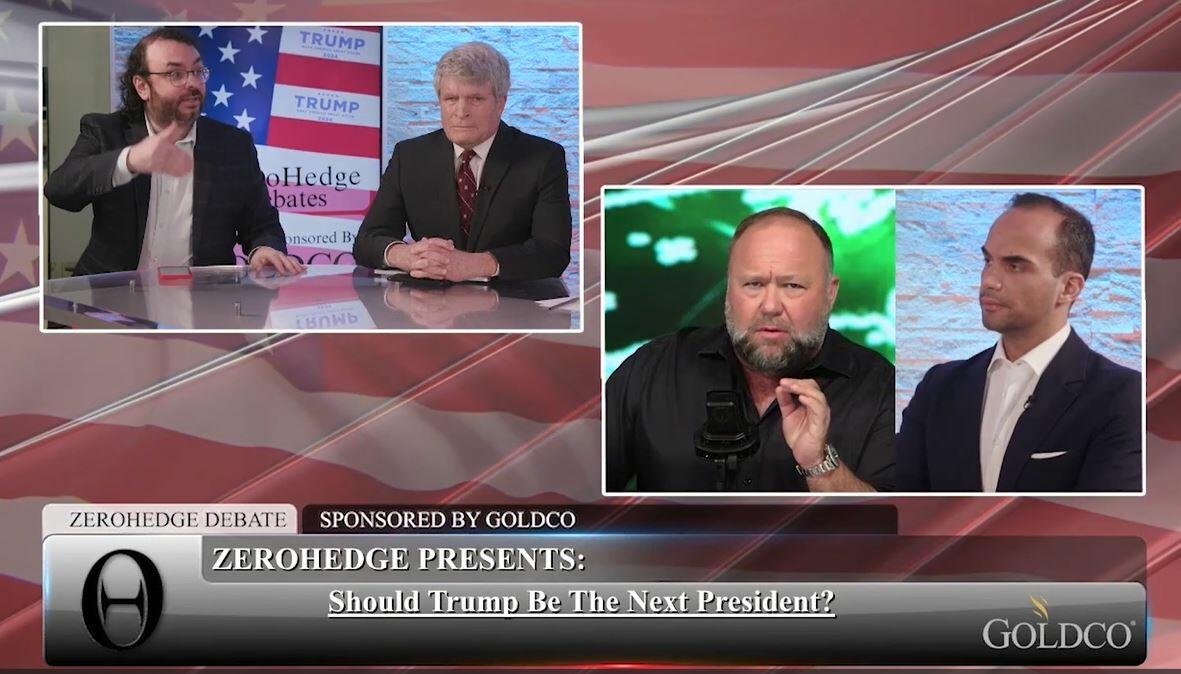
Last night kicked off the fifth ZeroHedge debate on the question: “Should Donald Trump be the next U.S. President?

The debate featured Infowars host Alex Jones and former Trump campaign foreign policy adviser George Papadopoulos vs. independent journalist Michael Tracy and former George W. Bush White House ethics lawyer Richard Painter.

Tracey came in hot, accusing Trump of being two-faced for bashing special interests during the primary, while courting the donor class during the general election:

“[Trump] was calling out to Miriam Adelson — who’s the widow of Sheldon Adelson — and having private soirees with her, and she’s excepted to give millions of dollars to Trump’s next campaign. He even said it outright. He said because of Miriam’s late husband, [Trump] was compelled to move the U.S. embassy from Tel Aviv in Israel to Jerusalem.

In an enemy-of-my-enemy-is-my-friend spirit, Alex Jones argued that entrenched bureaucratic powers within the U.S. pose an existential threat. Thus, given that Donald Trump is the primary force standing in their way, he deserves mass support.

We need somebody disruptive,” said Jones.

“Trump is the first President who has refused to follow the Constitution.”

Former chief ethics lawyer of the George W. Bush White House, Richard Painter, accused Trump of being the first President to disregard the Constitution regarding the transfer of power after the 2020 US election.

The comment did not go over well…

Papadopoulos, meanwhile, offered an international perspective in favor of Trump – who he says keept US adversaries at bay. The former Trump adviser attributes this to siloing Russian exports and increasing NATO funding — while unleashing “the shale renaissance in the United States.”

Tracey hit back – arguing that such moves were in fact escalatory:

“Go read Putin’s speech before he launched the invasion of Ukraine in 2022, he cites multiple grievances with the U.S. administration, and half of them are to do with Trump… He hyper escalated tensions with Russia under the auspices of John Bolton, Mike Pompeo, and all the other hard-liners.

Watch the full debate here and decide who won:

Tyler Durden
Tue, 03/26/2024 – 11:25

via ZeroHedge News https://ift.tt/egI2Jyz Tyler Durden

RFK Jr Picks Nicole Shanahan As VP, May Seek Libertarian Nomination

RFK Jr Picks Nicole Shanahan As VP, May Seek Libertarian Nomination

The Wall Street Journal reports that Robert F. Kennedy Jr. has picked Nicole Shanahan, a California-based attorney who was previously married to Google co-founder Sergey Brin, as his running mate for his long-shot presidential bid, according to people familiar with the decision.

Shanahan, 38, also runs a foundation focused on reproductive rights, criminal justice and the environment.

Before backing Kennedy’s independent bid, Shanahan had previously been a donor to Democratic campaigns, including supporting Joe Biden’s election in 2020.

Kennedy was slated to announce his choice Tuesday in Oakland, Calif., where Shanahan grew up.

Shanahan, a political novice, was thrust into the spotlight over her public split with Brin amid a brief alleged affair she had with Elon Musk in 2021 that ruptured the billionaires’ long friendshipThe Wall Street Journal reported.

After the article published, Musk denied the allegations and Shanahan later followed suit.

It isn’t clear yet whether Shanahan plans to assist by tapping into her own wealth.

The Kennedy campaign declined to comment. 

Shanahan didn’t respond to requests for comment.

Ahead of the announcement, Kennedy’s campaign manager confirmed on X that Shanahan was under consideration, along with several others including New York Jets quarterback Aaron Rodgers and Mike Rowe, host of Discovery Channel’s Dirty Jobs.

Meanwhile, lured by the promise of turnkey ballot access across the country, Robert F. Kennedy, Jr is seriously considering a run to win the Libertarian Party presidential nomination. However, his stance on the Israel-Gaza war and other issues could make his candidacy a tough sell with non-interventionist libertarians. 

Navigating the varied and complex patchwork of state ballot-access qualifying rules is one of the most grueling and expensive impediments to anyone seeking to challenge America’s two-party duopoly — to say nothing of the legal challenges filed by the Republican and Democratic parties along the way. So far, reports PoliticoKennedy’s backers say they’ve cleared the key hurdles in just eight states.  Meanwhile, it’s already pretty much a given that the Libertarian Party will be on the ballot in all 50.   

The top ticket will be selected by delegates at the party’s national convention in Washington DC over Memorial Day weekend. Selected by state conventions, those delegates are free to vote for whomever they like at the national convention. 

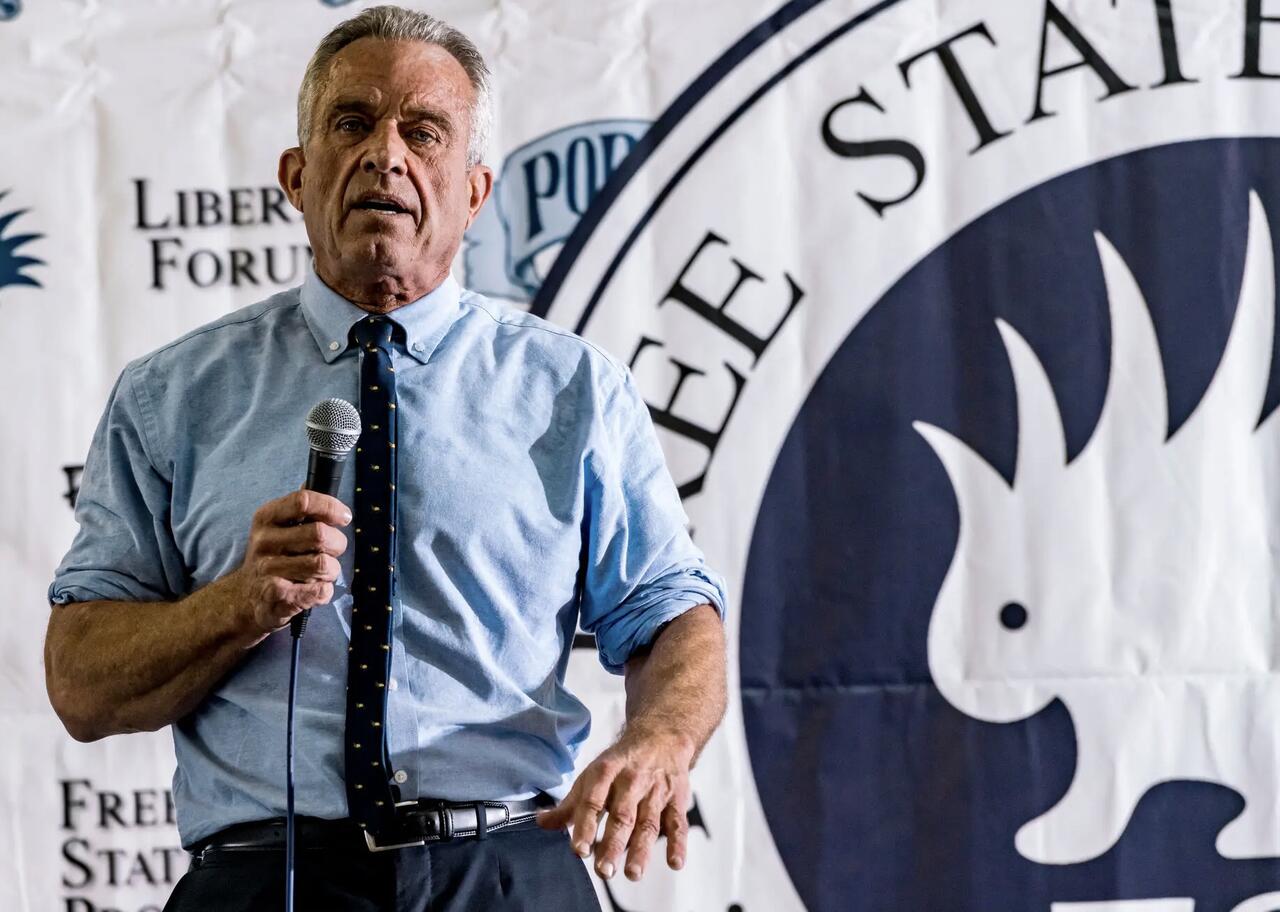
Kennedy spoke at the the Free State Project’s annual “PorcFest” last summer (Ryan David Brown for New York Times

Kennedy’s flirtation with Libertarian Party members has been simmering since last year, and has included appearances on libertarian podcasts and an interview with Reason magazine. His most direct outreach came with a February appearance at the party’s California state convention, which has been credited for helping set a new California Libertarian convention attendance record.  

“I’ve always been aligned with libertarians on most issues,” Kennedy told Reason last summer. “I mean, there’s tweaks that I have.” 

Some of those tweaks are doozies. For example, Kennedy said if Congress passed a so-called assault weapon ban, “I would sign it.” (On the other hand, he also said, “Anybody who tells you that they’re going to be able to reduce gun violence through gun control at this point, I don’t think is being realistic.”) He’s also called for a $15 national minimum wage, more free childcare, and abolishing interest on all federal student loans  

However, it’s Kennedy’s statements on Israel-Palestine that seem to have caused the most damage to his prospects with staunchly non-interventionist libertarians — which is to say, most libertarians — who oppose entangling alliances, foreign aid, and US-enabled warfare.

Kennedy has called for the United States to arm the “moral nation” of Israel, has expressed skepticism about a ceasefire in Gaza, and said “the Palestinian people are arguably the most pampered people by international aid organizations in the world.” Some libertarians are also put off by Kennedy’s embrace of controversial Israel advocate Shmuley Boteach.  

In December, one of Kennedy’s campaign staffers resigned, criticizing him for, among other things, saying that collective punishment in Gaza is “ok” because “for ten years we did collective punishment of Iraq.” 

On the other side of the ledger, Kennedy’s opposition to Covid vaccine mandates resonated with libertarians. He’s also pushed for more border security, accused the government of using Ukraine as a pawn to weaken Russia,” and promised to  “unwind” the US empire.  

RFK Jr’s few overlaps with libertarian philosophy aren’t likely to be enough, nor are arguments that Kennedy’s name recognition would result in higher national vote counts for the party and thus easier ballot access going forward.

That’s because, in 2022, the Libertarian Party was taken over by members of the Mises Caucus, a group that counts Ron Paul, Friedrich Hayek, Murray Rothbard and Ludwig von Mises among its chief philosophical influencers. 

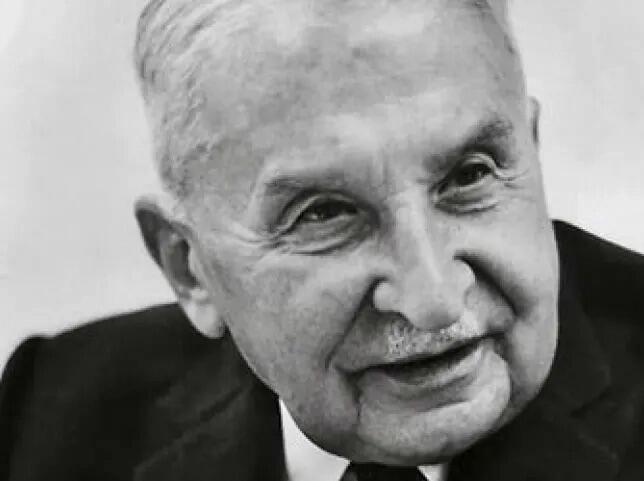
Austrian School economist Ludwig von Mises (Mises Institute)

In February, the Mises Caucus issued a statement flatly refuting any suggestion that it was open to considering Kennedy as a presidential candidate:

“We firmly oppose any strategy that would ‘rent out’ our party’s place on any state’s ballot to RFK, or indeed any candidate who has so many disqualifying deviations from the essential principles of libertarianism.”

The group also reiterated its endorsement of Michael Rectenwald for president and Clint Russell for vice president. Meanwhile, in a fiery but mostly peaceful February tweet, author, podcaster and Libertarian Institute director Scott Horton urged party members to prevent Kennedy from become the Libertarian Party’s standard-bearer: 

“Jeffrey Epstein’s blood-guzzling friend RFK Jr. must be stopped. Can you imagine OUR candidate out their shilling for Israel in the middle of a massive ethnic cleansing campaign? Our party back in the hands of those who want to fight Russia and China over not being trans enough?

The LP in the hands of libertarians can be the one of the most effective vehicles we have for obstructing the state and spreading the message of liberty. Let’s not blow it now after we’ve already won.”

Others have expressed their own opposition…

Tyler Durden
Tue, 03/26/2024 – 11:05

via ZeroHedge News https://ift.tt/o1JeVMY Tyler Durden

Trump Says Israel Has To ‘Finish The War’ As It’s ‘Losing A Lot Of Support’

Trump Says Israel Has To ‘Finish The War’ As It’s ‘Losing A Lot Of Support’

Authored by Dave DeCamp via AntiWar.com,

Former President Trump said in an interview with Israel Hayom over the weekend that Israel made a “big mistake” by broadcasting images and videos of the destruction in the Gaza Strip, saying it’s losing Israel “a lot of support.”

Trump said he would have done the same thing as Israel in response to the October 7 Hamas attack on southern Israel but said it was time to “finish your war” as global opinion is turning on Israel.

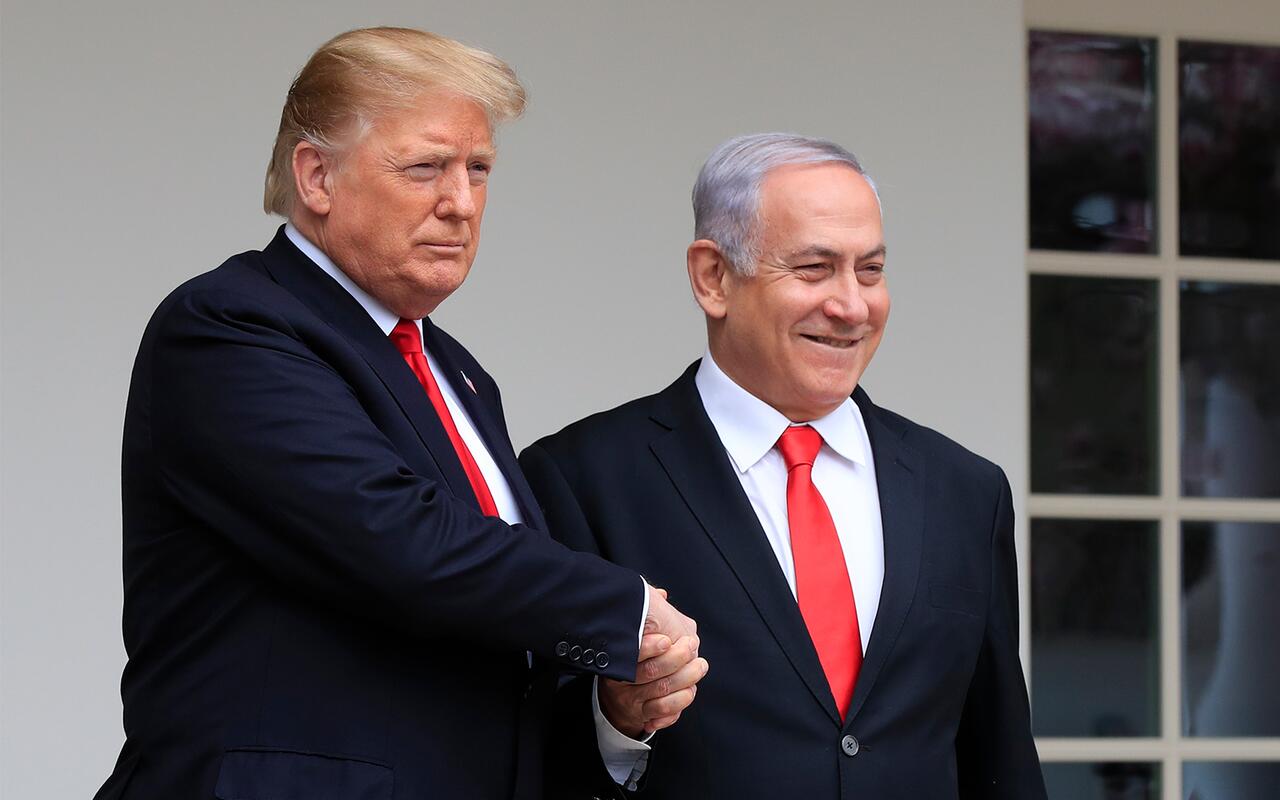
Via Associated Press

You gotta get it done. And, I am sure you will do that. And we gotta get to peace, we can’t have this going on. And I will say, Israel has to be very careful, because you’re losing a lot of the world, you’re losing a lot of support, you have to finish up, you have to get the job done,” Trump said.

When asked by the interviewer about how he would respond to the “wave of anti-Semitism” since October 7, Trump replied, “Well, that’s because you fought back. And I think Israel made a very big mistake. I wanted to call [Israel] and say don’t do it. These photos and shots. I mean, moving shots of bombs being dropped into buildings in Gaza. And I said, oh, that’s a terrible portrait. It’s a very bad picture for the world. The world is seeing this…every night, I would watch buildings pour down on people,” Trump said.

The interviewer then claimed that “terrorists” were hiding in the buildings. Trump replied as follows:

Go and do what you have to do. But you don’t do that. And I think that’s one of the reasons that there has been a lot of kickback. If people didn’t see that, every single night I’ve watched every single one of those. And I think Israel wanted to show that it’s tough, but sometimes you shouldn’t be doing that.”

Trump also took shots at Democrats for the growing criticism of Israel from within the party. “Some 15 years ago, Israel had the strongest lobby. If you were a politician, you couldn’t say anything bad about Israel, that would be like the end of your political career. Today, it’s almost the opposite. I’ve never seen you have AOC plus three, these lunatics, frankly. But you have AOC plus three plus plenty of others. And all they do is talk badly about Israel, and they hate Israel, and they hate the Jewish people,” he said.

Trump said the Hamas attack on Israel wouldn’t have happened if he was still president, something he has repeatedly claimed in recent interviews. “It was an attack that I blame on Biden because they [Hamas] have no respect for him. He can’t put two sentences together. He can’t talk. He’s a very dumb person,” he said.

During his time in office, Trump was extremely pro-Israel and carried out policies to support Israeli claims to occupied land, which all played a role in escalating tensions between Israel and the Palestinians. His administration recognized the Golan Heights as Israeli territory and declared that illegal Israeli settlements in the West Bank do not violate international law.

Trump’s administration moved the US embassy from Tel Aviv to Jerusalem and unveiled a so-called “peace plan” that would have seen Israel annex large swathes of the West Bank. Trump also brokered the Abraham Accords, deals that resulted in Israel normalizing ties with the UAE and Bahrain. Jared Kushner, who was Trump’s point man on Israel, recently said Gaza’s “waterfront property could be very valuable.”

Tyler Durden
Tue, 03/26/2024 – 10:50

via ZeroHedge News https://ift.tt/P7SsenT Tyler Durden

India Suspends Venezuela Oil Purchases Fearing U.S. Sanctions Return, Stops Accepting Russian Oil Tankers

India Suspends Venezuela Oil Purchases Fearing U.S. Sanctions Return, Stops Accepting Russian Oil Tankers

Is India starting to get cold feet about breaching US sanctions?

On Tuesday, Indian state and private refiners suspended purchases of crude from Venezuela as the U.S. sanctions waiver on Venezuela’s oil exports expires on April 18 and could lead to complications if not renewed, Bloomberg reported citing sources familiar.

As OilPrice adds, private refiner Reliance Industries, which is India’s largest buyer of Venezuelan crude grade Merey, looks to avoid complications with cargoes if the U.S. were to re-impose the sanctions that were temporarily lifted for six months in the middle of October 2023. As the deadline for the waiver expiry nears, state refiner Indian Oil Corporation has also halted buying Venezuelan crude.

At the end of last year, the U.S. introduced a temporary sanctions relief from October 2023 to April 2024, which now allows the production, lifting, sale, and exportation of oil or gas from Venezuela, and the provision of related goods and services, as well as payment of invoices for goods or services related to oil or gas sector operations in Venezuela.

As a result, the top international oil trading houses are back in the business of trading with oil from Venezuela, and refiners in India returned at the end of last year to the market of purchasing Venezuela’s crude.

In December, India resumed imports of crude oil from Venezuela for the first purchases since 2020 after the U.S. lifted most of the sanctions on Venezuela’s oil industry in October.

For India, the world’s third-largest crude oil importer, Venezuelan oil is welcome as some refineries are designed to process the South American country’s heavy crude. The biggest refiners, including Reliance Industries, Indian Oil Corporation, and HPCL-Mittal Energy started securing crude cargoes from Venezuela as soon as the sanctions were lifted temporarily in October.  

Most refiners have resumed the purchases via intermediaries, sources familiar with the development told Reuters at the time. Reliance is also looking to discuss direct sales with Venezuela’s state-owned oil firm PDVSA, according to Reuters’ sources.  

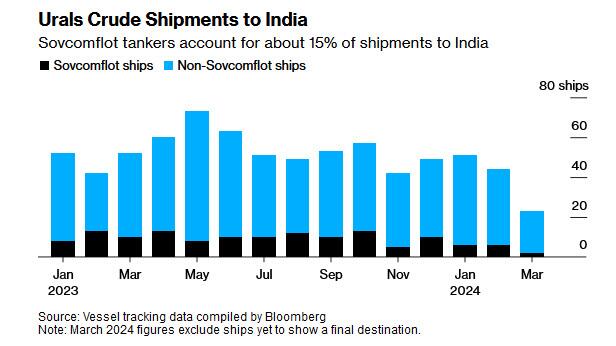
It’s not just Venezuela, however: last week Bloomberg also reported that all of India’s oil refineries have stopped accepting Russian crude oil delivered by tankers operated by Sovcomflot, Russia’s largest commercial shipping company that has been sanctioned by the US, potentially dealing a blow to Moscow’s economy as India is one of the largest importers of its fossil fuels since the start of the Ukraine war.

According to the report, private and state-run processors including the biggest – Indian Oil – have stopped taking cargoes if they’re on Sovcomflot tankers, as refiners scrutinize the ownership of each ship to make sure they’re not affiliated with the company, or other sanctioned groups.

About 1.5 million barrels of Urals crude were shipped so far on Sovcomflot vessels in March, down from 4.4 million barrels in January and 4.7 million barrels in February.

India has been a major buyer of Russian oil since the invasion of Ukraine, but tighter enforcement of US sanctions has disrupted the trade and led to refiners seeking more expensive crude from other regions such as the US. Sovcomflot said this week that the penalties were putting pressure on its operations.

The Sovcomflot issue means there are fewer tankers to deliver Russian crude, which has led to discounts for the nation’s oil narrowing to compensate for higher freight costs. Of course, the end result of this supply congestion will be higher oil prices which is precisely the opposite of what Biden needs with elections looming, so we would not be surprise if Venezuela’s sanctions are indefinitely postponed while the White House quietly backchannels with India to advise them that Russian oil remains perfectly eligible for under the table purchases.

Tyler Durden
Tue, 03/26/2024 – 10:35

via ZeroHedge News https://ift.tt/D0uY6H2 Tyler Durden

Long Volatility Trade May Be A Widow-Maker No More

Long Volatility Trade May Be A Widow-Maker No More

Authored by Simon White, Bloomberg macro strategist,

An unusual combination of divergences in the stock-market volatility space suggests the VIX is at elevated risk of pricing higher, and this may even happen with rising rather than falling equity prices. Volatility of volatility is near 10-year lows making call options on the VIX cheap.

Buying the VIX is the quintessential widow-maker trade. It is rare for the gauge to rise, with most of such instances over the last 20 years episodic and occurring when the market was falling. Most of the time, the market rises and volatility falls – there is an entire sub-industry devoted to exploiting and perpetuating this, which has swollen further in size in recent years with the boom in zero-days-to-expiry (0DTE) trading.

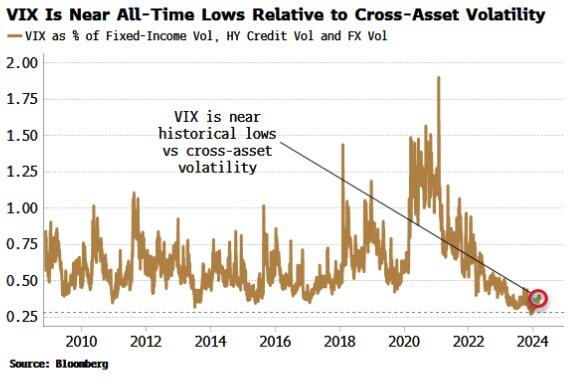
Not only is the VIX near its post-pandemic lows, it has also never been more out of step with cross-asset volatility – FX, fixed-income and credit (which is saying something as FX and credit vol are themselves near historic lows).

Markets are interlinked: rates impact stock valuations, high-yield credit sits just above equity in the capital structure, and so on. The question is how long can equity volatility remain the relative outlier?

There’s always a risk of becoming the next widow, but there are enough factors in play to suggest a heightened risk of a rise in the VIX.

Three trends suggest that a turning point in equity volatility is near:

  1. Divergence between the VIX and skew structure;

  2. Implied and realized correlation nearing their effective lower bound; and

  3. Stresses in state-by-state US unemployment.

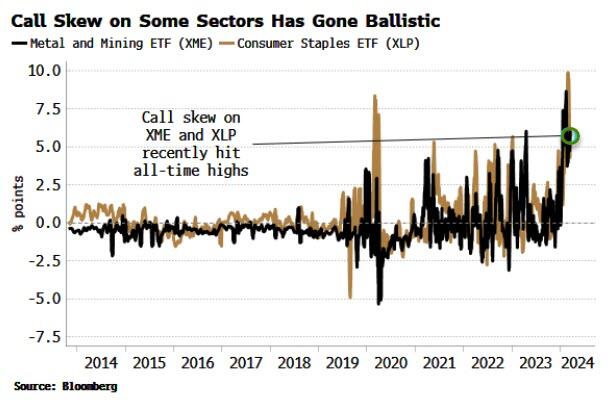
The market has become increasingly bullish in recent months, especially so after making new highs. That’s led to leveraged market chasing – call buying – and reduced hedging activity, i.e. less put buying. The rally chasing spurred some truly epic moves in the call skew of certain sectors. The metals and mining and staples sectors saw the biggest rises in their call skews, with both hitting series highs.

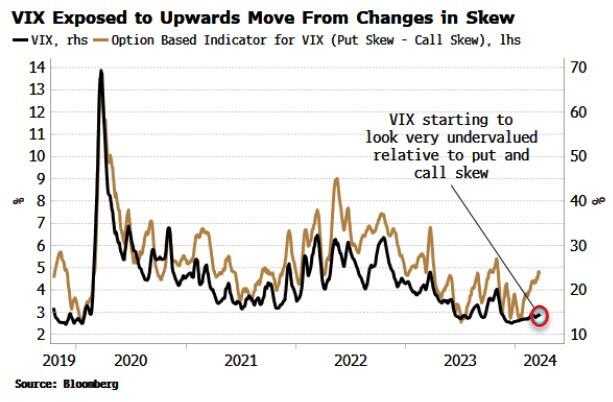
However, since 2020, it’s the relationship between call and put skew that’s tracked the VIX almost perfectly, with the index typically falling when call skew is outpacing put skew. In other words, when there is more leveraged activity in calls relative to puts, the VIX tends to be repressed (the VIX is a weighted-average of implied volatility in the S&P across all strikes).

Now, though, put skew is outperforming call skew. As the chart above shows, that typically coincides with a rising VIX.

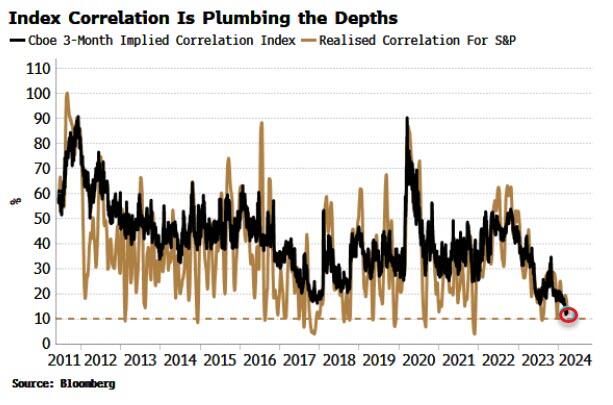
At the same time, the realized and implied correlation of the S&P is very depressed. Realized correlation is close to going below 10%, a level it rarely breaches, and when it does it is typically followed by a sharp move higher. Moreover, implied correlation – so called as it is implied from the Markowitz portfolio model – has never been lower.

Correlation is being driven lower by the dominance of the largest stocks and by dispersion selling. The latter involves selling volatility on the index versus buying vol on individual stocks. As the Magnificent Seven – or whatever your favored cohort of AI-related stocks is – drive higher, the dispersion selling has the effect of pinning the index. The biggest stocks go up, while the rest are impaired by how much they can move, pushing correlation down.

In theory, index correlation could go negative, but it has never happened. The reason is that stocks are not completely random and are driven by common macro-based factors, such as interest rates. Correlation is thus so low today that it can only really go one way, and when it does, history shows the move is likely to be abrupt. Something has to give.

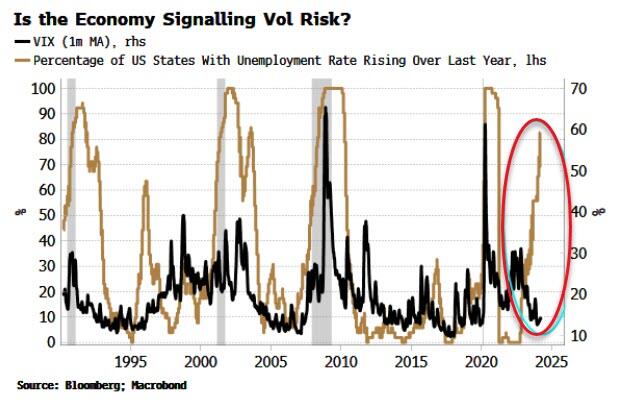
It’s not only the market sounding a warning about stock-market vol, but the economy too. A fairly reliable indication of rising equity volatility has been when we see a number of US states experiencing stress in their employment markets at the same time.

The chart below shows the percentage of US states whose unemployment rate is higher over the past year. As we can see, while increases in equity vol don’t always coincide with rising state unemployment, almost all the spikes higher in the percentage of states experiencing worsening unemployment coincide with episodes of higher VIX.

Today is – so far, along with the mid 1990s – an outlier, with more than half of US states seeing rising unemployment while the VIX remains near its lows.

There is a proviso here. The household survey, from which the unemployment rate is derived, may be under-reporting employment growth due to underestimating immigration. A recent Brookings paper suggests that the household survey is using too low an estimate for the civilian population, which could well explain its divergence from the establishment survey (payrolls). It might also bias state unemployment rates too high if estimates of the size of the workforce are too low.

Nonetheless, this measure bears close scrutiny, especially in confluence with the endogenous market-based signs of higher equity vol mentioned above.

Being long volatility is rarely comfortable. Given the structure of the market, the path of least resistance is down. This also means the volatility curve is typically steep – as it is today – meaning an investor wears negative carry to hold the position. One way to mitigate this is through call options on the VIX. These are relatively cheap, with the VVIX – the vol of vol – near 10-year lows.

The reflex is to expect higher equity vol to come with lower stock prices. But the two had a positive correlation for much of the second half of the 1990s. The current backdrop of still-supportive liquidity, a non-recessionary economy and investor call buying could lead to a situation of rising volatility and higher equity prices. That might make long volatility trades a less likely money-losing proposition.

Tyler Durden
Tue, 03/26/2024 – 10:15

via ZeroHedge News https://ift.tt/askYyNf Tyler Durden