Conference Board Consumer Confidence Slides, Revised Down For 5th Straight Month

Conference Board Consumer Confidence Slides, Revised Down For 5th Straight Month

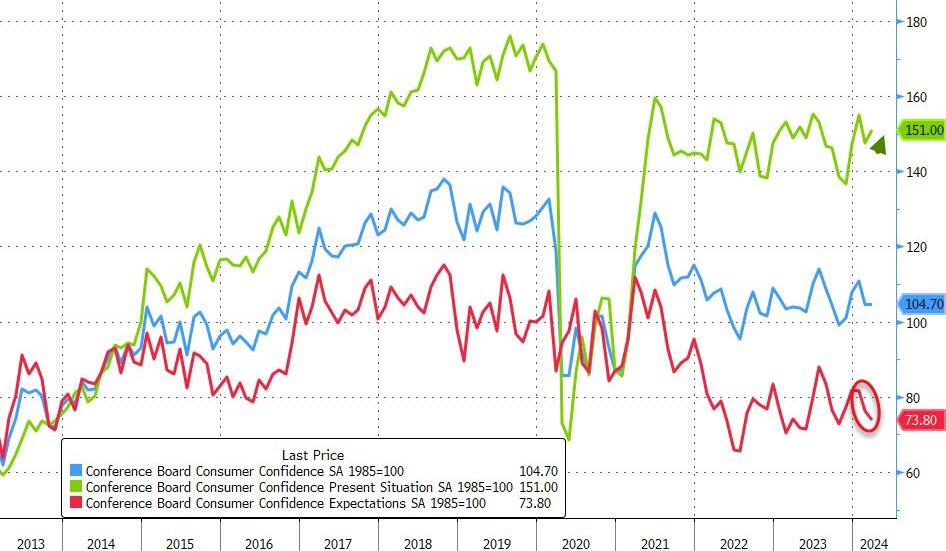
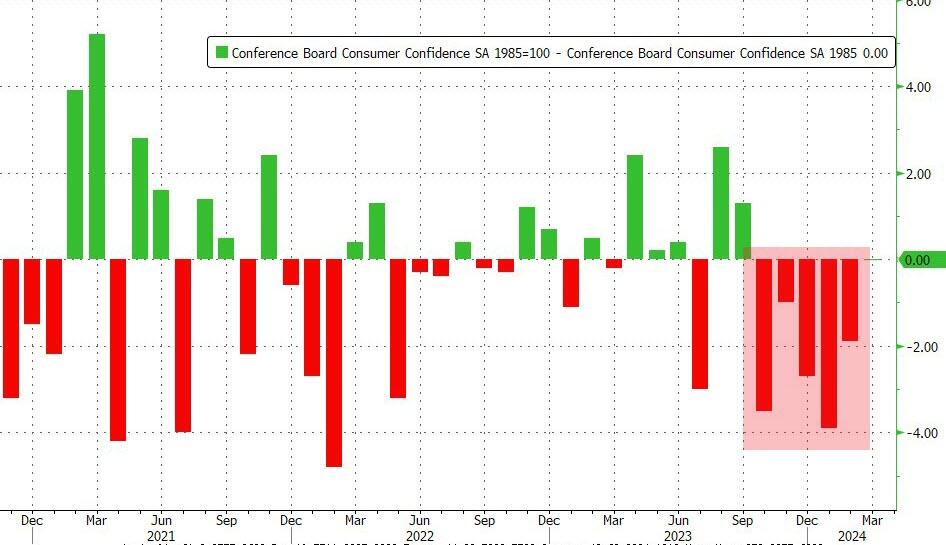
After declining in February, analysts expected a small rebound in The Conference Board’s consumer confidence print in March, but instead it dropped further to 104.7 (vs 107.0 exp) from 106.7 as expectations plunged but current conditions improved

Source: Bloomberg

However, for the 5th straight month, the conference board’s headline confidence print was revised downward…

Source: Bloomberg

That is 13pts of ‘confidence’ erased in the last five months… to which we ask again – …how do you revise consumer confidence?

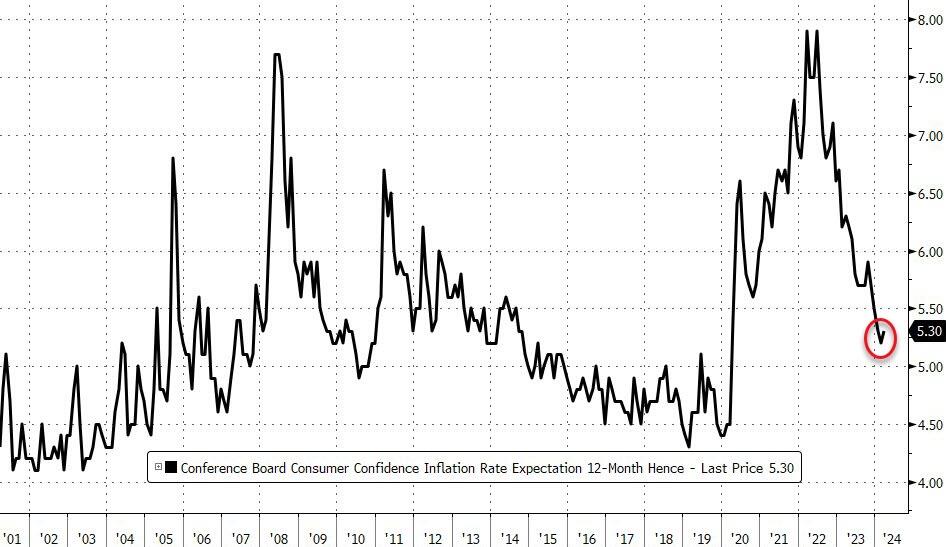
The Conference Board’s indicator inflation expectations rebounded modestly to +5.3% – still notably high but trend in the right direction…

Source: Bloomberg

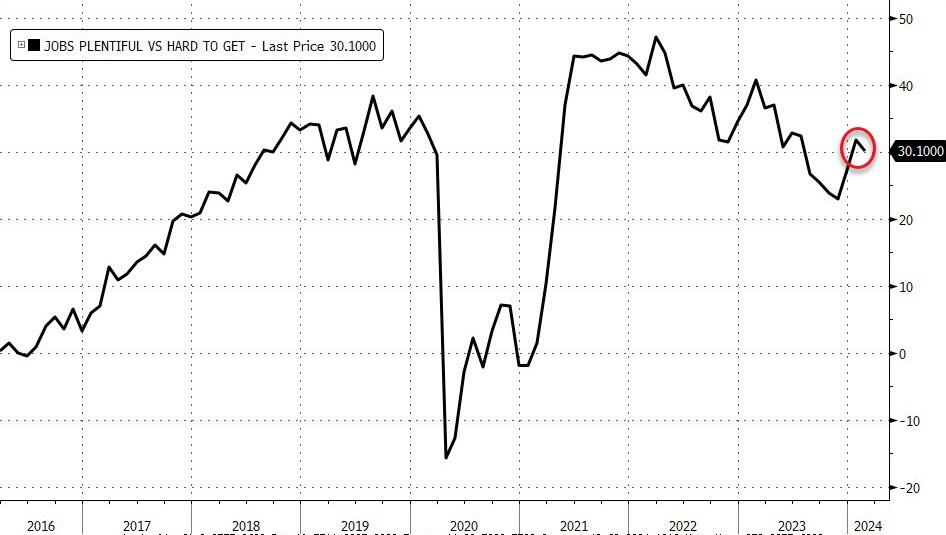
The Board’s labor market indicator trended modestly weaker (after being revised higher)….

Source: Bloomberg

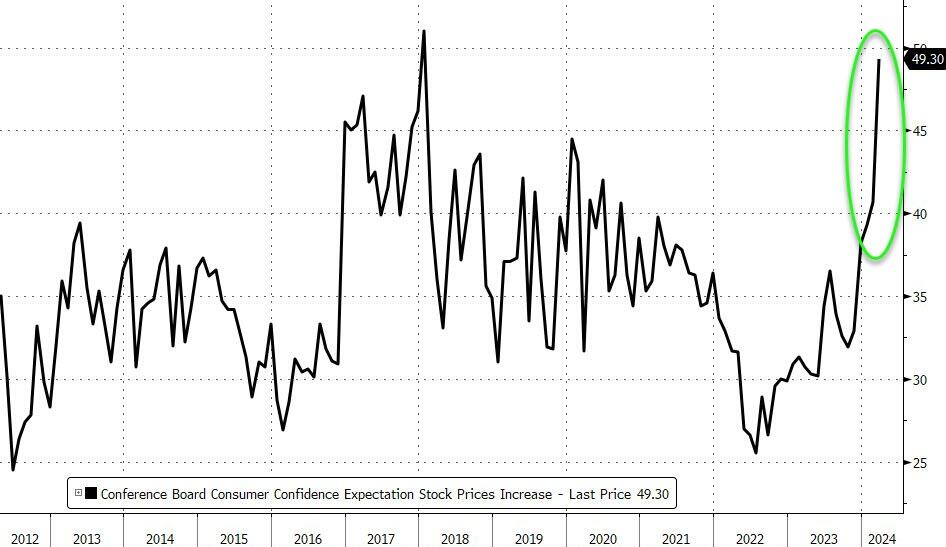
And finally, expectations for stocks to increase from here are at their highest since Jan 2018…

Source: Bloomberg

…that did not end well for stocks.

Tyler Durden
Tue, 03/26/2024 – 10:11

via ZeroHedge News https://ift.tt/Mar8dLJ Tyler Durden

With The Tip Credit Falling, Full-Service D.C. Restaurants Cut 3,700 Jobs

With The Tip Credit Falling, Full-Service D.C. Restaurants Cut 3,700 Jobs

By Peter Romeo of Restaurant Business Online

Full-service restaurants in Washington, D.C., have cut 3,700 jobs – about 12% of their workforce – since the jurisdiction began rolling back its tip credit in May 2023, according to data newly released by the U.S. Bureau of Labor Statistics.

The federal agency did not draw a correlation between the drop in jobs and the reduction in the credit, which fell in May and then again in July of last year. Restaurants there have also been affected by a slow return of government workers and employees of companies that interact with the government to their downtown offices. Operators say traffic has also been dampened by fears about rising nighttime crime.

But restaurants without table service have not cut jobs nearly as aggressively as their full-service counterparts have. Between May 1 of last year and the end of January 24, limited-service places have eliminated 400 positions, or just 1.7% of their collective payrolls.

In addition, downtown offices were even emptier during the corresponding eight months of a year earlier, yet full-service places added 1,200 positions during that timeframe, an increase in their workforce of 4.5%, according to the BLS’ numbers.

Industry advocates say the numbers underscore the damage that has been done to the local restaurant market by the ongoing phase-out of the tip credit.

“In just seven months, the city’s full-service restaurant employment has been gutted by the change,” Sean Kennedy, EVP of public affairs for the National Restaurant Association, said in a statement. “Higher labor costs mean higher menu prices. That means diners are eating out less and tipping less, which in turn means less income for servers and operators.”

The data comes to light as opponents of the tip credit are pushing to eliminate the employer concession in a number of other states, including Illinois, New York, Massachusetts and Ohio.

The efforts there are being led by One Fair Wage, the labor advocacy group that was a major force behind the tip credit’s phase-out in Washington. The group, which receives funding from the Service Employees International Union, argues that tipping is an abomination that routinely exposes servers and other tipped employees to sexual harassment and other types of abuse. It contends that workers can’t push back against the abusers without risking the loss of tip income.

The District’s tip credit was set on a sunset course by local voters’ approval of a referendum on the November 2022 ballot. The measure called for the credit to be dropped in stages until it hits zero in July 2027, meaning servers, bartenders and other tipped employees will receive the same direct wage as their non-tipped colleagues as of that date.

Until May 1 of last year, restaurants were obliged to pay servers and other regularly tipped employees just $5.35 an hour if tips brought their income up to $16.10. The $10.75 that came from gratuities was the tip credit.

The direct payment required of a tipped worker’s employer rose to $6 an hour in May and $8 in June, and will rise to $10 on July 1 of this year.

With more of tipped employees’ income coming directly from their employers, many full-service restaurants in the Districts have tried to preserve margins by adding surcharges to their bills as well as by raising prices. According to the Employment Policies Institute, 70% of local sit-down establishments either have already tacked on service fees or plan to do so as the tip credit ebbs.

All told, 96% of full-service places in the District have raised prices since the rollback of the credit began last year, according to the Restaurant Association of Metropolitan Washington (RAMW). It pegged the average increase at 16%.

The trade group also found last winter that labor costs for restaurants in the District had risen by a mean of 25%.

The use of service fees has become so routine in the District that the City Council recently set regulations for how the surcharges can be levied. Among other things, the guidelines specify that restaurants can assess no more than 20% of a patron’s bill as a surcharge.

The package of concessions also included a measure intended to bring down liquor-liability insurance rates as an offset to the local drop in restaurant revenues.

Areas outside the District still allow restaurants to use a tip credit, though labor advocates in Maryland and Virginia have tried to kill the convention there.  According to the RAMW, about 32% of Washingtonians are now dining more often in those states, which lie just outside the capital’s borders.

As of last November, restaurants within Washington were closing at the rate of roughly one per week, the RAMW said at the time.

“What we’re learning from the D.C. experience is that eliminating the tip credit will only reduce income, choices, and opportunities,” said the NRA’s Kennedy.

He called the elimination of the tip credit “a lose-lose-lose for any community.”

Tyler Durden
Tue, 03/26/2024 – 09:45

via ZeroHedge News https://ift.tt/FJUZ0Wr Tyler Durden

Apple Shares Fall On Chinese Report That iPhone Shipments Plunged 33%  

Apple Shares Fall On Chinese Report That iPhone Shipments Plunged 33%  

Apple shares fell in premarket trading in New York after official Chinese data showed iPhone shipments plunged 33% in February, compared with the same month last year, in the world’s second-largest economy—or the world’s largest smartphone market. These institutional desks, BarclaysPiper Sandlerand Jefferies, first warned of this downturn in iPhone sales in early January.  

Bloomberg cites Academy of Information and Communications Technology figures that show foreign smartphone makers only shipped 2.4 million smartphones last month. Apple was a majority of these shipments. This decline marks the second consecutive month of lower shipments. 

According to the data, Apple shipped 5.5 million units in January, or about 39% fewer handsets than in the prior year. 

“Apple’s retail channels in China are still digesting the shipment from the fourth quarter of 2023, which could explain the drop in recent months,” Nicole Peng, an analyst at Canalys, wrote in a note. 

Peng continued:

“But it’s a sign of a slowing trend for the upcoming months for Apple in China, especially when the Chinese peers are driving very aggressively the AI smartphone messages.”

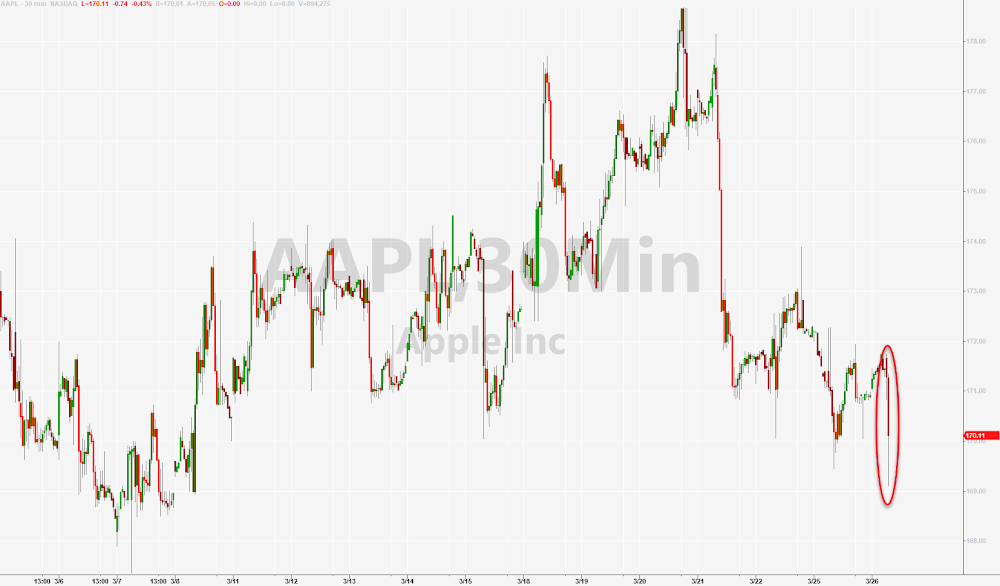
Shares of Apple fell slightly on the report. 

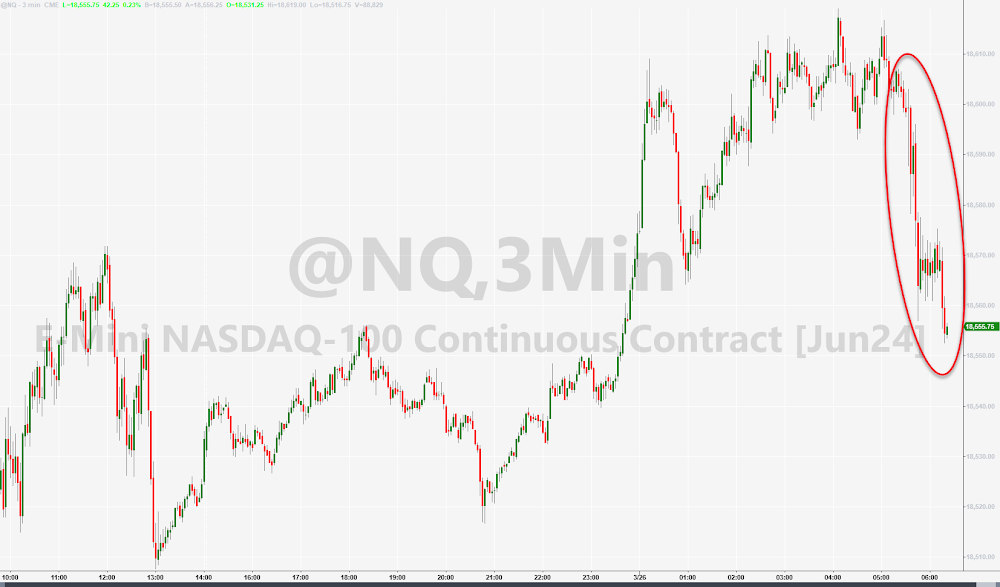
Nasdaq futures reversed overnight gains. 

Bloomberg pointed out, “The overall Chinese smartphone market also contracted by almost a third in February, illustrating a wider consumer reluctance to spend on discretionary items.” 

At the start of the year, Barclays analyst Tim Long slashed Apple from “Equal-Weight” to “Underweight” with a slight downshift in price target, from $161 to $160, based on the thesis of a slowdown in iPhone and MacBook sales.  

Piper Sandler analysts led by Harsh Kumar also downgraded Apple from “Overweight” to “Neutral” with a price target of $205, down from $220 in early January—the reason: deteriorating outlook for iPhone sales and macro weakness.

And Jeffries analyst Edison Lee also outlined months ago about the iPhone sales slump in China. 

Apple also faces rising competitive pressures from domestic brands, such as Huawei, spurred by “patriotic fervor” amid the tech war with the US. 

Tyler Durden
Tue, 03/26/2024 – 09:25

via ZeroHedge News https://www.zerohedge.com/markets/apple-shares-fall-chinese-report-iphone-shipments-plunged-33 Tyler Durden

Technical Measures And Valuations – Does Any Of It Matter?

Technical Measures And Valuations – Does Any Of It Matter?

Authored by Lance Roberts via RealInvestmentAdvice.com,

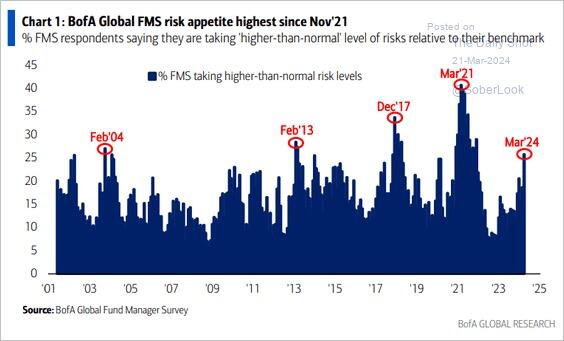
Technical measures and valuations all suggest the market is expensive, overbought, and exuberant. However, none of it seems to matter as investors pile into equities to chase risk assets higher. A recent BofA report shows that the increase in risk appetite has been the largest since March 2021.

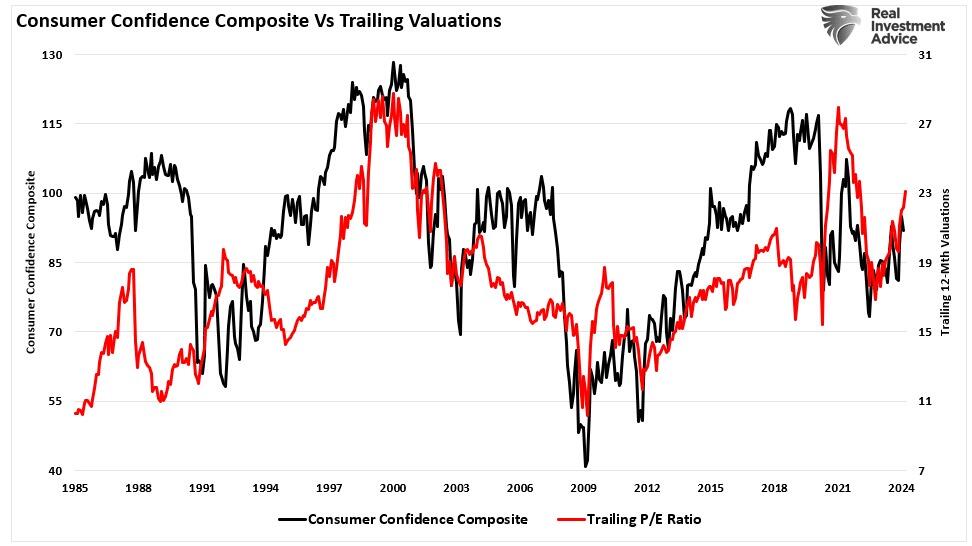
Of course, as prices increase faster than underlying earnings growth, valuations also increase. However, as discussed in “Valuations Suggest Caution,” valuations are a better measure of psychology in the short term. To wit:

“Valuation metrics are just that – a measure of current valuation. More importantly, when valuation metrics are excessive, it is a better measure of ‘investor psychology’ and the manifestation of the ‘greater fool theory.’ As shown, there is a high correlation between our composite consumer confidence index and trailing 1-year S&P 500 valuations.”

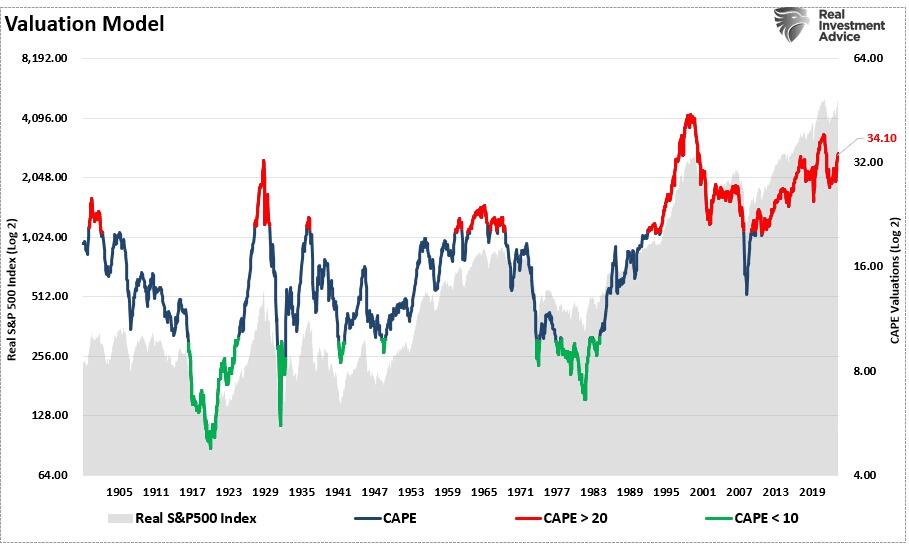
When investors are exuberant and willing to overpay for future earnings growth, valuations increase. The increase in valuations, also known as “multiple expansion,” is a crucial support for bull markets. As shown, the increase in multiples coincides with rising markets. Of course, the opposite, known as “multiple contractions,” is also true. With a current Shiller CAPE valuation multiple of 34x earnings, such suggests that investor confidence is elevated.

As noted, valuations are terrible market timing indicators and should not be used for such. While valuations provide the basis for calculating future returns, technical measures are more critical for managing near-term portfolio risk.

Technical Measures Are Getting Extreme

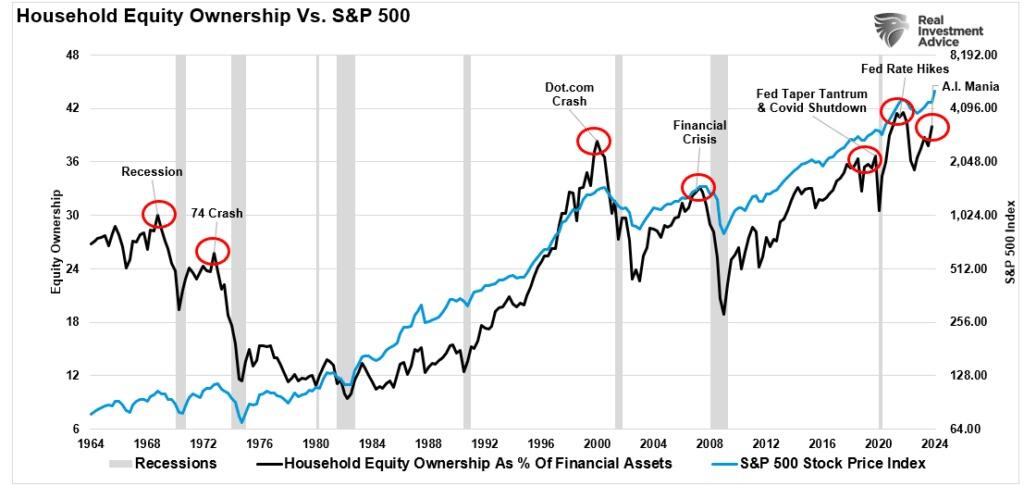
As noted, investors are again becoming exuberant over stock ownership. Such is vital to creating multiple expansions and fueling bull market advances. High valuations, bullish sentiment, and leverage are meaningless if the underlying equities are not owned. As discussed in Household Equity Allocations,” the current levels of household equity ownership have reverted to near-record levels. Historically, such exuberance has been the mark of more important market cycle peaks.

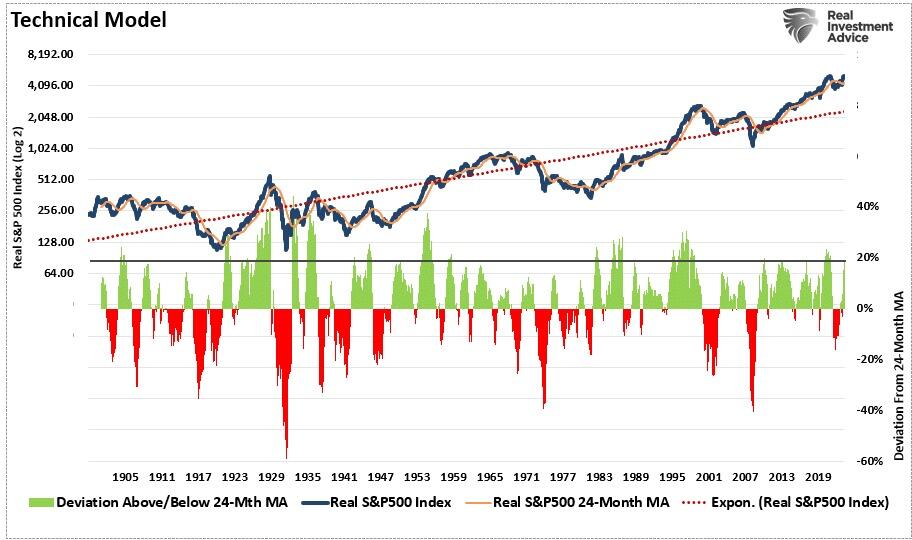
While household equity ownership is critical to expanding the bull market, the technical measures provide an understanding of when excesses are reached. One measure we focus on is the deviation of price from long-term means. The reason is that markets are bound to long-term means over time. For a “mean” or “average” to exist, prices must trade above and below that price over time. Therefore, we can determine when deviations are approaching more extreme levels by viewing past deviations. Currently, the deviation of the market from its underlying 2-year average is one of the largest in history. Notably, there have certainly been more significant deviations in the past, suggesting the current deviation from the mean can grow further. However, such deviations have crucially been a precursor to an eventual mean-reverting event.

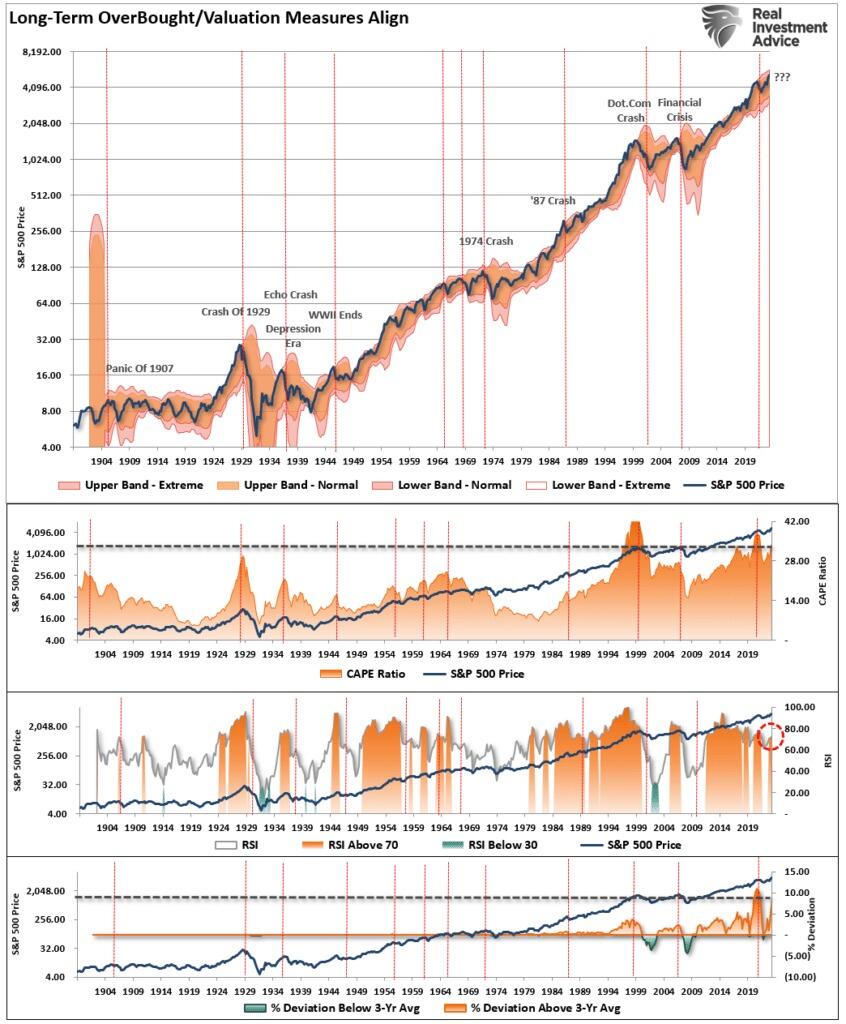
The following analysis uses quarter data and evaluates the market using valuation and technical measures. From a long-term perspective, the market is trading at more extreme levels. The quarterly Relative Strength (RSI) measure is above 70, the deviation is close to a historical record, and the market trades nearly 3 standard deviations above its quarterly mean. As noted, while these valuation and technical measures can undoubtedly become more extreme, the ingredients for an eventual mean reverting event are present.

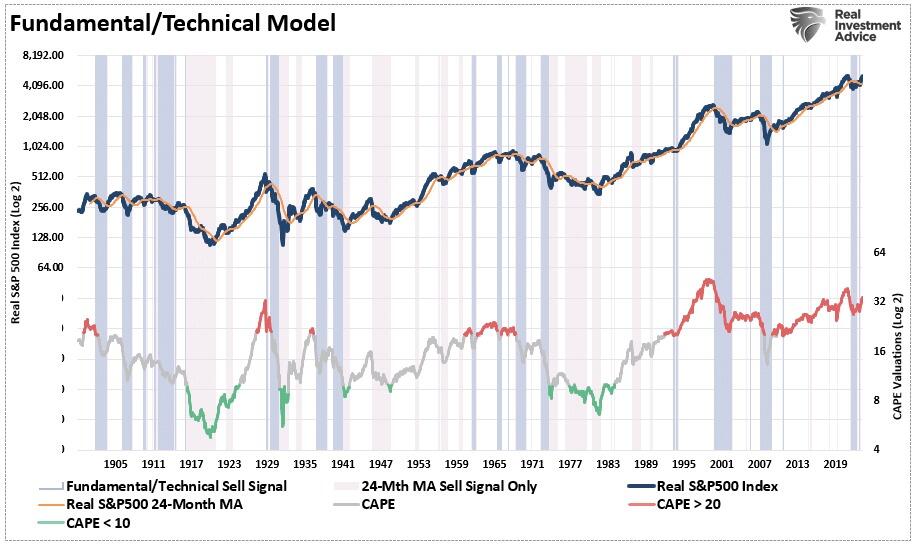
Of course, the inherent problem with long-term analysis is that while valuations and long-term technical measures are more extreme, they can remain that way for much longer than logic suggests. However, we can construct a valuation and technical measures model using the data above. As shown, the model triggered a “risk off” warning in early 2022 when high valuations collided with an extreme deviation of the market above the 24-month moving average. That signal was reversed in January 2023, as the market began to recover. While a new signal has not yet been triggered, the ingredients of valuations and deviations are present.

The Ingredients Are Missing A Catalyst

The problem with long-term technical measures and valuations is that they move slowly. Therefore, the general assumption is that if high valuations do not lead to an immediate market correction, the measure is flawed.

In the short term, “valuations” have little relevance to what positions you should buy or sell. It is only momentum, the direction of the price, that matters. Managing money, either “professionally” or “individually,” is a complicated process over the long term. It seems exceedingly easy in the short term, particularly amid a speculative mania. However, as with every bull market, a strongly advancing market forgives investors’ many investing mistakes. The ensuing bear market reveals them in the most brutal and unforgiving of outcomes. 

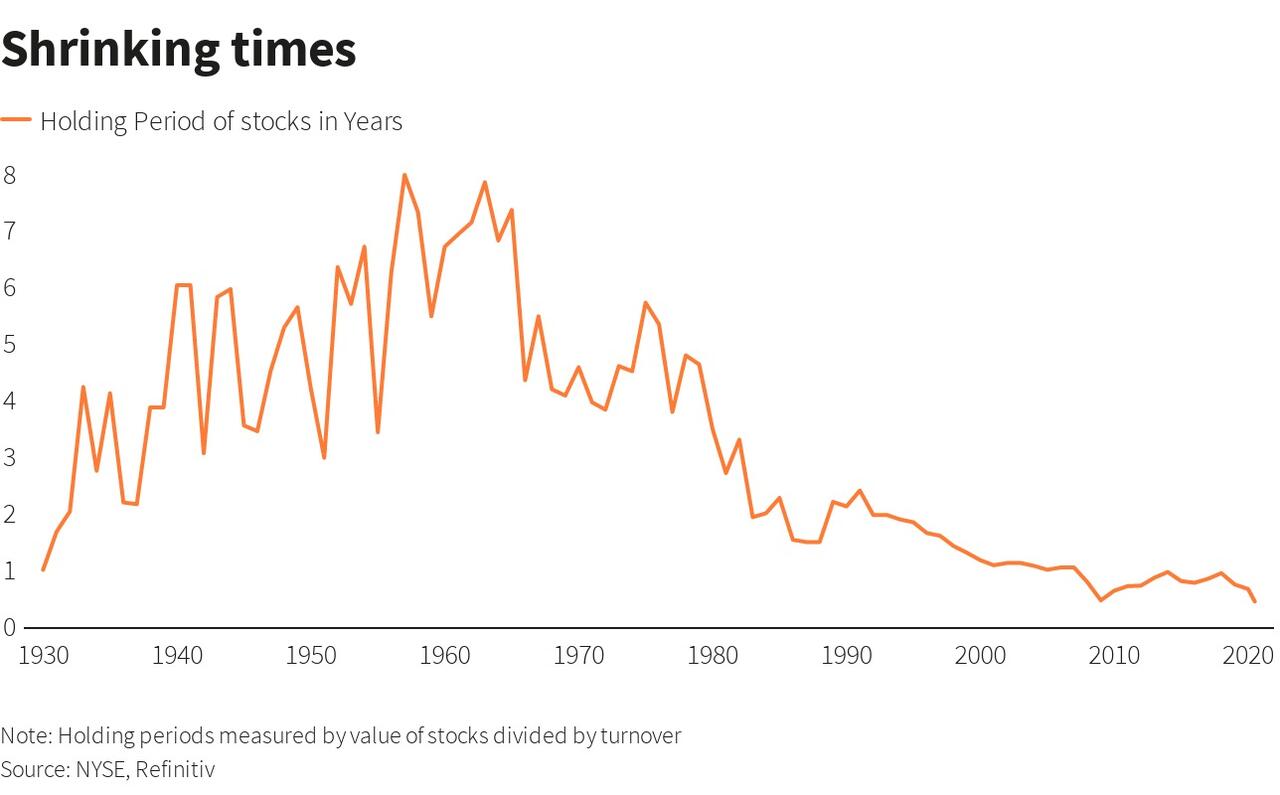
There is a clear advantage to providing risk management to portfolios over time. The problem is that most individuals cannot manage their own money because of “short-termism.” As shown by shrinking holding periods.

While “short-termism” currently dominates the investor mindset, the ingredients for a reversion exist. However, that does not mean one will happen tomorrow, next month, or even this year.

Think about it this way. If I gave you a bunch of ingredients such as nitrogen, glycerol, sand, and shell, you would probably stick them in the garbage and think nothing of it. They are innocuous ingredients and pose little real danger by themselves. However, you make dynamite using a process to combine and bind them. However, even dynamite is safe as long as it is stored properly. Only when dynamite comes into contact with the appropriate catalyst does it become a problem. 

“Mean reverting events,” bear markets, and financial crises result from a combined set of ingredients to which a catalyst ignites. Looking back through history, we find similar elements every time.

Like dynamite, the individual ingredients are relatively harmless but dangerous when combined.

Leverage + Valuations + Psychology + Ownership + Momentum = “Mean Reverting Event”

Importantly, this particular formula remains supportive of higher asset prices in the short term. Of course, the more prices rise, the more optimistic investors become.

While the combination of ingredients is dangerous, they remain “inert” until exposed to the right catalyst.

What causes the next “liquidation cycle” is currently unknown. It is always an unexpected, exogenous event that triggers a “rush for the exits.”

Many believe that “bear markets” are now a relic of the past, given the massive support provided by Central Banks. Maybe that is the case. However, remembering that such beliefs were always present before more severe mean-reverting events is worth remembering.

To quote Irving Fisher in 1929, “Stocks are at a permanently high plateau.” 

Tyler Durden
Tue, 03/26/2024 – 09:15

via ZeroHedge News https://ift.tt/2ZE8pCb Tyler Durden

US Home Prices Rose For 12th Straight Month In January, Despite Soaring Rates

US Home Prices Rose For 12th Straight Month In January, Despite Soaring Rates

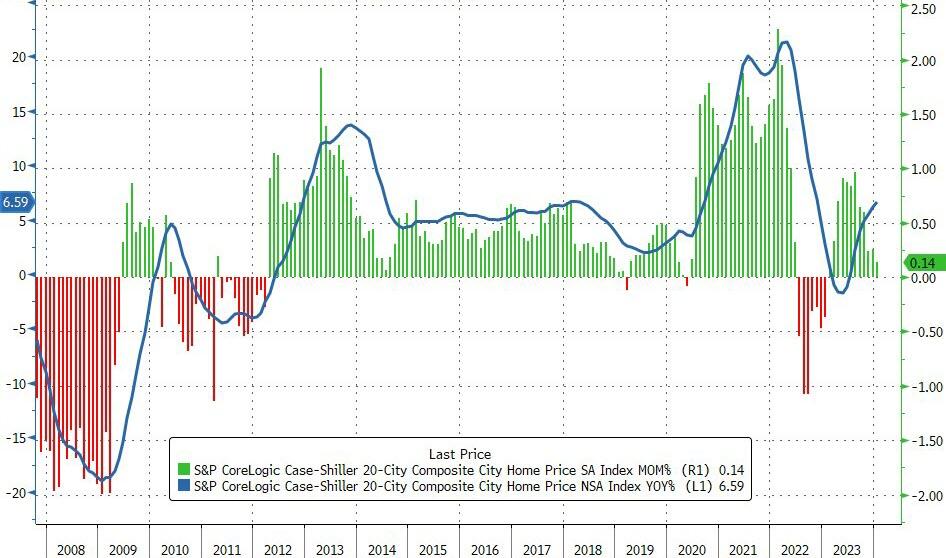
Home prices in America’s 20 largest cities rose for the 12th straight month in January (the latest data released by S&P Global Case-Shiller today), up 0.14% MoM (less than the 0.2% exp)

Source: Bloomberg

That pushed the YoY price up to +6.59% (in line with the +6.60% exp).

“Our National Composite rose by 6% in January, the fastest annual rate since 2022.” According to Brian D. Luke, Head of Commodities, Real & Digital Assets at S&P Dow Jones Indices.

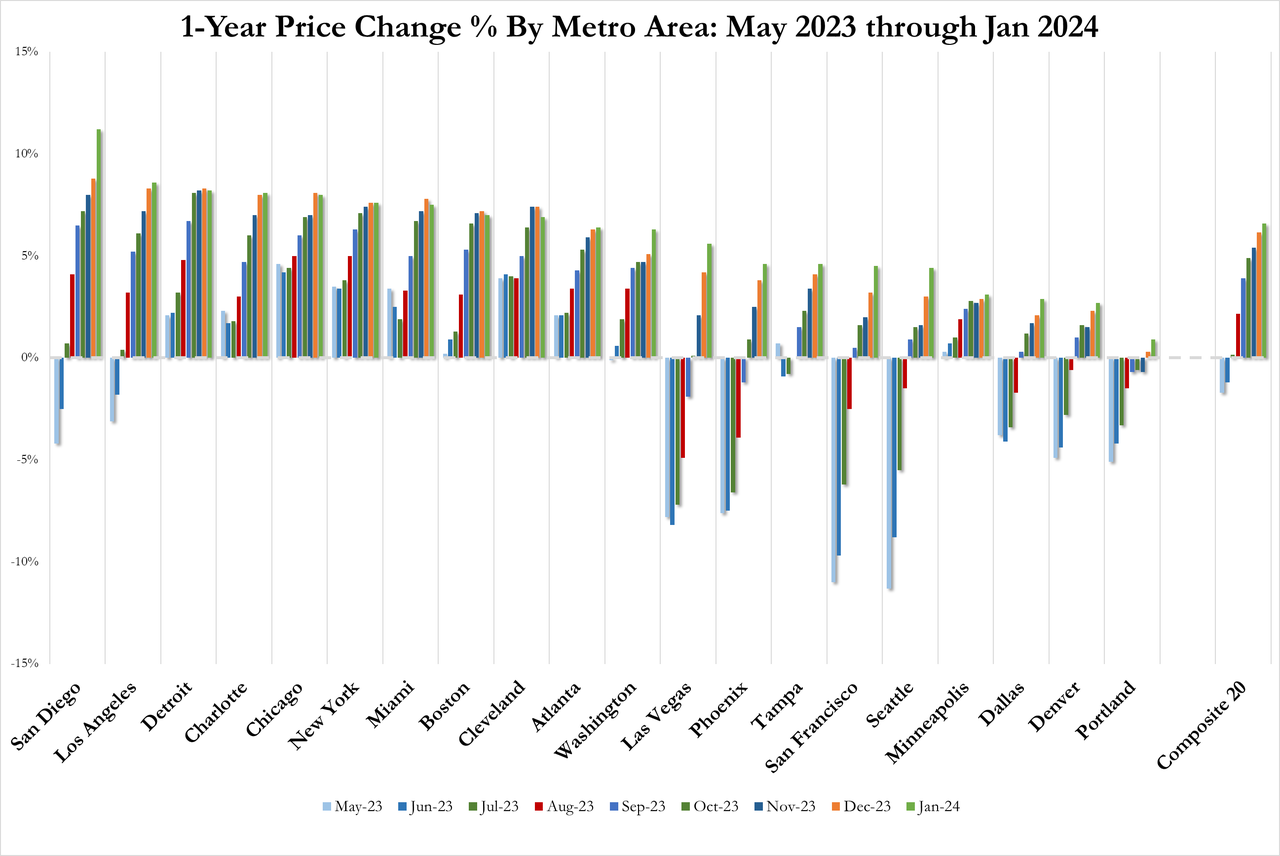
“For the second consecutive month, all cities reported increases in annual prices, with San Diego surging 11.2%”

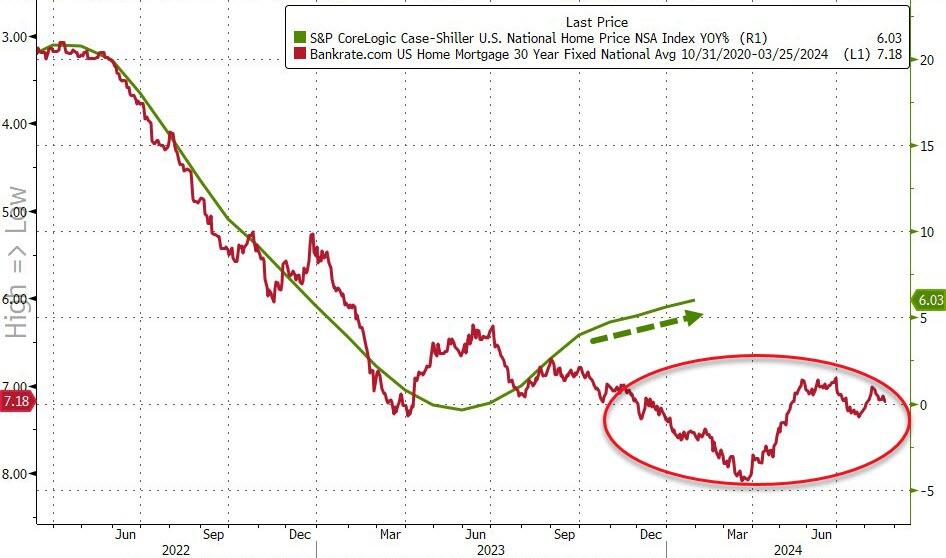
Given the smoothing and heavy lag in the Case-Shiller data, it’s hard to find a causal relationship between prices and mortgage rates, but with rates remaining above 7%, it seems hard to believe prices can continue their advance…

Source: Bloomberg

…and we just saw median new home prices tumble (though median existing home prices did increase).

How is Powell going to cut rates when home prices are rising at over 6% per year?

Tyler Durden
Tue, 03/26/2024 – 09:04

via ZeroHedge News https://ift.tt/067ufMI Tyler Durden

Assange Wins Temporary Reprieve As Court Seeks US ‘Assurances’ Over Extradition

Assange Wins Temporary Reprieve As Court Seeks US ‘Assurances’ Over Extradition

Tuesday’s much anticipated London High Court ruling has gone mostly in Julian Assange’s favor, as he has been granted permission to continue to appeal his extradition to the United States, where he would face espionage and related charges for publishing state secrets. However, this is not yet a ‘win’ for Assange and his team, but more of another delay.

The court ruled that the WikiLeaks founder will be not be extradited immediately and said the US still has opportunity to provide “satisfactory assurances” related to his grounds of appeal. What has happened Tuesday is tantamount to Assange’s ability to challenge the extradition request being slightly extended, and is a temporary reprieve, extending the whole process yet further.

But this is the part that is not looking good for Assange, as explained by WikiLeaks: “The court has given US Gov 3 weeks to give satisfactory assurances: That Mr. Assange is permitted to rely on the First Amendment to the US constitution; not prejudiced at trial by reason of his nationality; and that the death penalty is not imposed.”

Via Reuters

A May 20 hearing which has been scheduled is expected to take up whether the US ‘assurances’ are satisfactory. An Al Jazeera correspondent has explained the decision as follows:

It was a highly nuanced decision in the end. The judges haven’t thrown out the grounds for an appeal hearing, they have essentially upheld them.

They basically said, “Yes, we understand that there is a basis here for an appeal – however, we are going to defer a decision on that until May 20”, when they called for a second hearing.

According to the judge’s statement, “We had an explicit statutory obligation not to order the applicant’s extradition if he could be sentenced to death for the offense concerned or if he could be charged with an extradition offense disclosed by the same facts in respect of which a sentence of death could be imposed.”

The statement reads further, “If assurances are given, then we will give the parties an opportunity to make further submissions before we make a final decision on the application for leave to appeal.”

Stella Assange, his wife, has warned that if the court rules against Assange, he could be on a plane to US soil days following. He would be removed from the high security Belmarsh prison for a trial in the US on espionage-related charges and publishing state secrets, where a 175 year jail sentence would await him, likely at a federal ‘supermax’ prison.

WikiLeaks has been urging all Americans to put pressure on the Biden administration to drop its case against Assange by calling House representatives and telling them to support H.Res.934. The bill, introduced by Rep. Paul Gosar (R-AZ) requests that the Biden White House halt the proceedings against Assange.

The bill reads: “This resolution expresses the sense of the House of Representatives that regular journalistic activities, including the obtainment and publication of information, are protected under the First Amendment and that the federal government should drop all charges against and attempts to extradite Julian Assange.”

Editor-in-chief of WikiLeaks Kristinn Hrafnsson has commented on what Assange’s prosecution and possible extradition means for the future of press freedoms.”It cannot be underestimated, the effect that it will have,” he said. “If an Australian citizen publishing in Europe can face prison time in the United States, that means no journalists anywhere are safe in the future.”

However, as we detailed last week, the Biden administration might be looking for a way to bring the 14-year long legal drama to an end. A last Wednesday WSJ report said, “The U.S. Justice Department is considering whether to allow Julian Assange to plead guilty to a reduced charge of mishandling classified information, according to people familiar with the matter, opening the possibility of a deal that would end a lengthy legal saga triggered by one of the biggest classified intelligence leaks in American history.”

A plea deal means the whole crisis for him and his family could finally come to an acceptable and peaceful end after all of these years. But Assange’s legal team has not given any level of confirmation to the WSJ reporting.

Tyler Durden
Tue, 03/26/2024 – 08:45

via ZeroHedge News https://ift.tt/onXtJ6V Tyler Durden

Durable Goods Orders Rebound In Feb From January Collapse, Defense Spending Slides

Durable Goods Orders Rebound In Feb From January Collapse, Defense Spending Slides

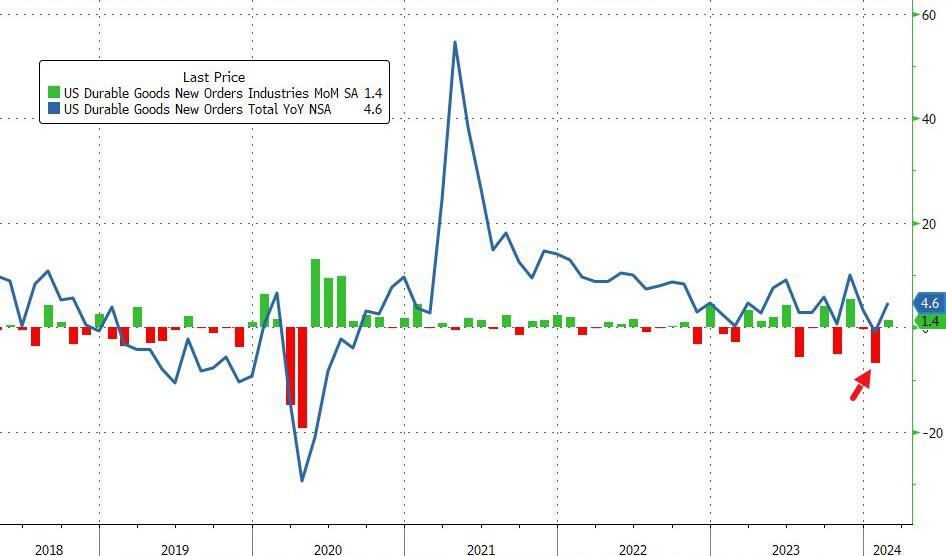
After crashing in January (driven by the collapse in Boeing orders), durable goods orders (preliminary) for February rose 1.4% MoM (better than the +1.0% MoM exp), and notably swinging from a downwardly revised 6.9% MoM plunge in January (from -6.2%)…

Source: Bloomberg

That dragged the headline orders up 4.6% YoY. Ex-Transports also beat, rising 0.5% MoM (vs +0.4% exp) and up 1.3% YoY.

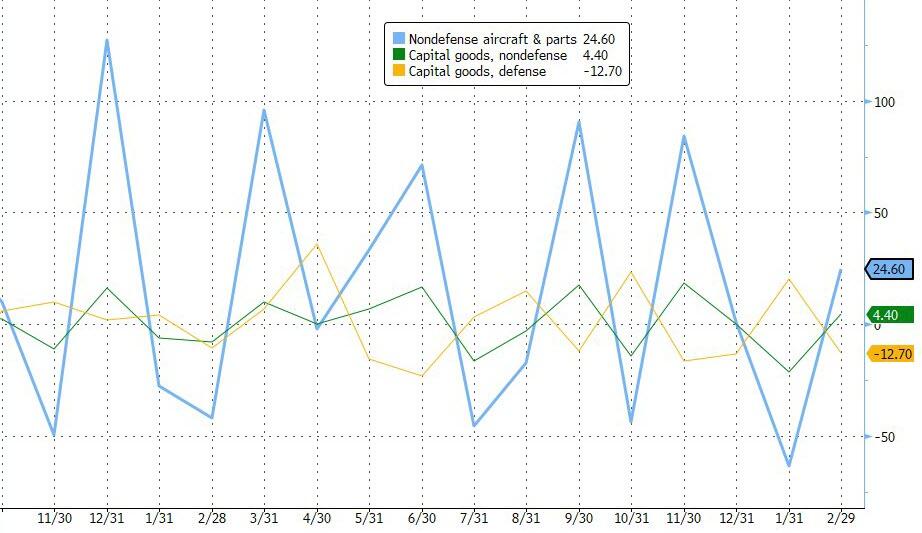
Non-defense aircraft orders jumped 24.6% MoM as it seems people are ordering Boeings again? Defense spending tumbled 12.7% MoM…

Source: Bloomberg

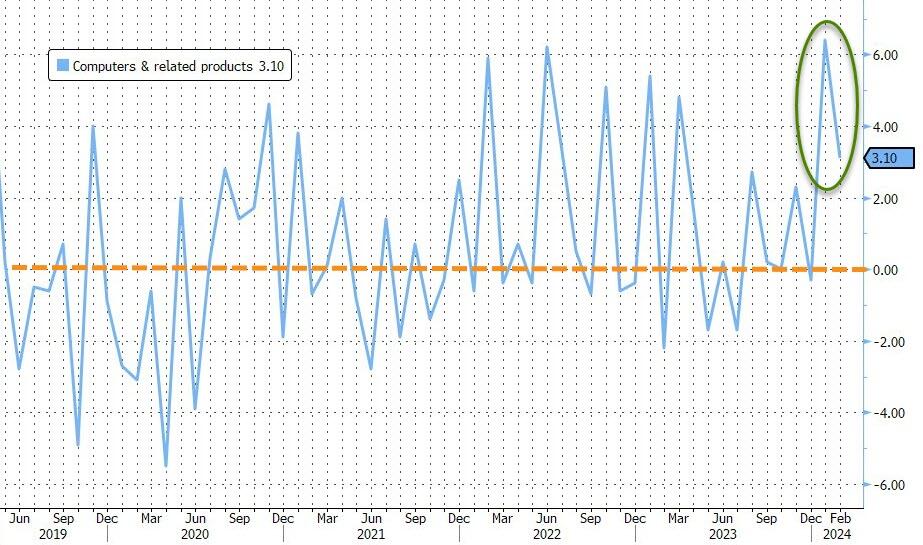
Computer & related products saw another big MoM rise as perhaps this is the AI cycle showing up in the data…

Source: Bloomberg

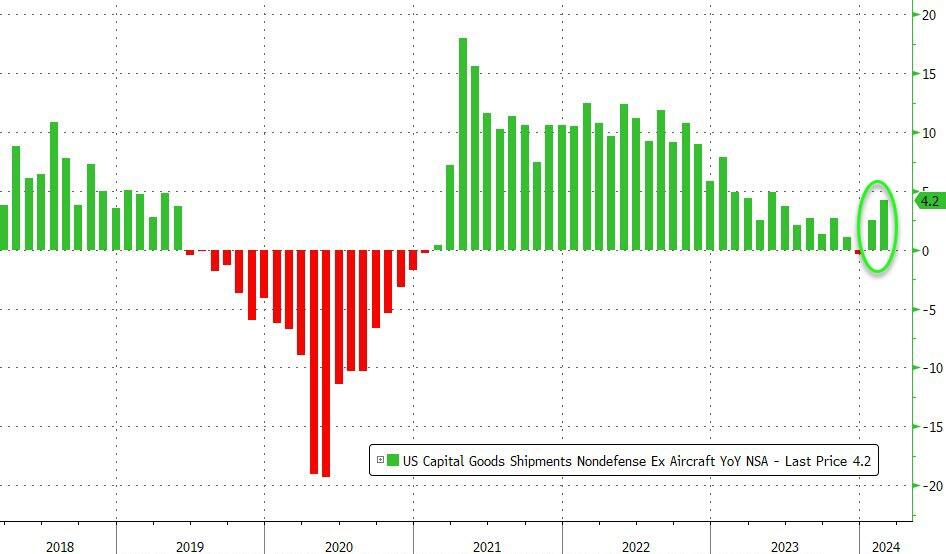
On the bright side, core capital goods shipments, a figure that is used to help calculate equipment investment in the government’s gross domestic product report, continued its strong bounce back from YoY contraction in December. However, on a seasonally-adjusted basis, core capital goods shipments fell 0.4% MoM

Source: Bloomberg

The YoY rebound is not exactly a signal that portends rate cuts!

Tyler Durden
Tue, 03/26/2024 – 08:38

via ZeroHedge News https://ift.tt/oDncR49 Tyler Durden

US Futures Rebound Ahead Of Busy Data Calendar As New Record High Looms

US Futures Rebound Ahead Of Busy Data Calendar As New Record High Looms

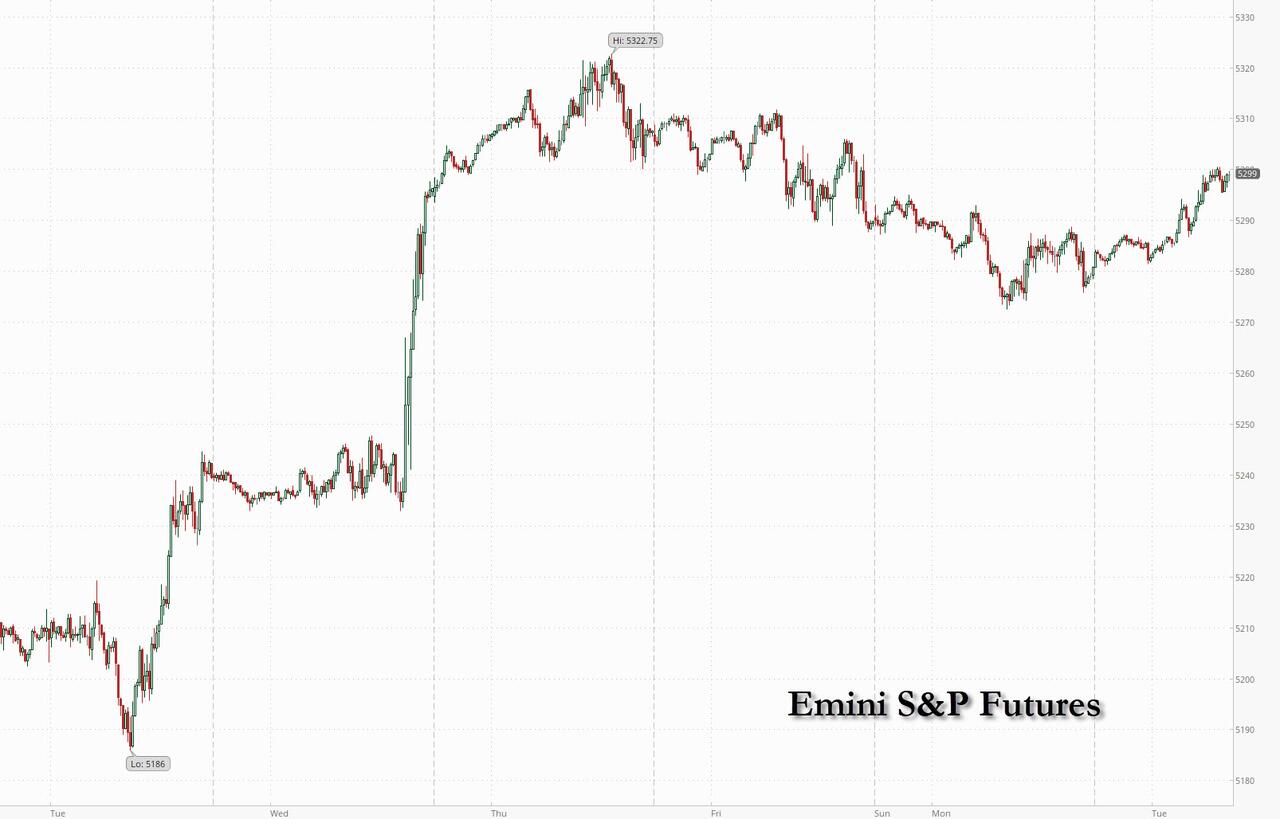
It’s as if Monday’s modest dip never happened: S&P futures are trading are higher, surpassing Monday’s highs, with both Tech and small-caps outperforming, as investors keep a close eye on any potential market impact from the collapse of a major commuter bridge in Baltimore after it was rammed by a container ship. As of 8:00am ET, S&P futures were 0.4% higher, erasing Monday’s 0.3% drop, while Nasdaq futures gained 0.5%. Europe’s Estoxx 50 is similar, trading at multiyear high with utilities and financials outperforming. According to a JPM morning note, it is unclear if yesterday’s moves were tied to month-end/quarter-end rebalancing but generally those flows occur before the last day of the period. USD weakness continues as the yen just refused to drop no matter what; commodity performance is mixed with gold approaching ATHs and oil trading at a 5 month high. Today’s macro data calendar is busy with focus on Durable/Cap Goods, Home price indices, Consumer Confidence, and regional activity indicators (Dallas, Philly, and Richmond); we also get a $67BN 5Y bond auction; let’s see if it goes as smoothly as yesterday’s 2Y auction.
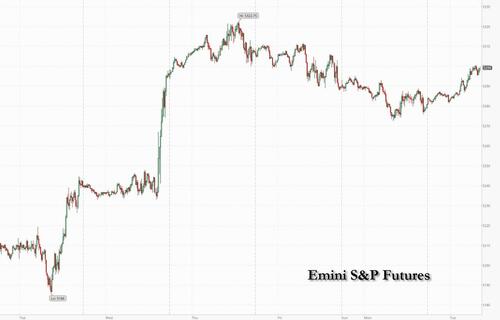
In premarket trading, both Mag 7 and Semis are higher (as usual) with TSLA +3.2%. USD weakness continues but commodity performance is mixed with gold approaching ATHs. Shares of Donald Trump’s social media startup surged around 20% in premarket trading after it completed a merger with Digital World Acquisition Corp. Tesla climbed 3%, set to extend gains for a second consecutive session. Italian newspaper Il Sole 24 Ore reports that officials at the country’s Industry Ministry contacted the company about potential production of electric trucks. Here are some other notable premarket movers:

  • Dada Nexus ADRs fall 9% after the delivery company reported an unexpected 4Q net loss.
  • Krispy Kreme jumps 15% after announcing that its doughnuts would be sold at McDonald’s restaurants across the US.
  • Reddit rises 5%, putting the stock on track to extend gains for a second day after the social media company rallied 30% on Monday.
  • Seagate climbs 4% as Morgan Stanley raises its recommendation on the computer hardware and storage company to overweight, predicting a period of “structurally stronger gross margins.”
  • Stoke Therapeutics soars 90% after the company said data from studies on its STK-001 treatment in Dravet syndrome showed clinically meaningful effects in seizure reduction.
  • Trump Media & Technology Group Corp gains 11% after completing a merger with Digital World Acquisition Corp.

As Bloomberg notes, concern about a disconnect between earnings expectations and share prices has grown this week. US durable goods and consumer confidence data are due today ahead of the government’s closely followed personal consumption expenditures price index on Friday when many markets will be closed for Easter holidays. Federal Reserve Chair Jerome Powell is also due to speak the same day.

For Vincent Juvyns, global market strategist at JPMorgan Asset Management, better visibility on the economy means that that focus is turning back to earnings going into the second quarter. “Markets are expensive, not too expensive, but it would be dangerous to bet on further upside without earnings driving it,” he said.

As has been the case for the past 18 months, bearish Morgan Stanley and JPMorgan strategists – Michael Wilson and Marko Kolanovic – were the latest to warn that lofty valuations will be hard to justify if they’re not accompanied by an acceleration in company profits. Or, as we said in Jan 2023, the rally won’t end until they finally throw in the towel and turn bullish. Meanwhile, the S&P 500 is up almost 10% this year on a combination of healthy US economic data, Fed rate-cut wagers and optimism about artificial intelligence.

Meanwhile, the Financial Times cited Chief Investment Officer Andrew Balls as saying Pimco is holding a smaller-than-usual position in US Treasuries and prefers the bonds of countries such as the UK and Canada. Pimco believes inflationary pressures may lead the Federal Reserve to cut interest rates more slowly than other major central banks, according to the report.

European stocks also rose, with Stoxx 600 gaining 0.4%, even as miners slumped after iron ore futures tumbled over deepening anxiety regarding Chinese demand. Consumer products and services also underperformed, while the travel and leisure and banking sectors lead the regional index. Among individual stock moves in Europe, A.P. Moller-Maersk A/S fell after the shipping giant said that it chartered a container vessel that hit the Francis Scott Key Bridge in Baltimore on Tuesday. Ocado Group Plc rose after sales at its online grocery business got a boost from price cuts, while BNP Paribas SA gained after Goldman Sachs Group Inc. upgraded the French bank to a buy rating thanks to a better operating backdrop. Here are the most notable European movers:

  • BNP Paribas jumps as much as 2.4% after Goldman upgrades the lender to buy from neutral, saying operating backdrop should improve over the coming years
  • Rubis gains as much as 4.2% after Oddo upgrades its recommendation on the energy company to outperform after a “surprise” stake purchase by Bollore
  • Santander rises as much as 1.4% after a Barclays upgrade to overweight on discounted valuation and most favorable EPS progression into 2025
  • Flutter rises as much as 4% as the casino operator’s strong year-to-date US trading and 2024 guidance impress analysts, while its 2023 results were in line
  • Lonza rises as much as 1.1% after Mirabaud Securities raised its recommendation to buy, saying a facility acquisition should enable it to meet 2028 margin guidance
  • Defense stocks extend Monday’s gains as JPMorgan says it sees potential for the sector to re-rate further as the region’s rearmament cycle continues
  • Asos jumps as much as 5.6% after the online retailer’s trading update showed progress on reducing inventory. Berenberg says Asos is delivering on its strategy
  • RAI Way rises to as much as 6.4% after a report that the Italian government may approve a decree to allow state TV operator Rai to drop below a 30% stake
  • Mobico drops as much as 6.7% after RBC lowers its rating to sector perform, snapping the stock’s clean sweep of positive analyst ratings
  • Atos falls as much as 10% after it reported entering a conciliation procedure that will give it time to reach a debt restructuring deal with banks and creditors
  • Auto Trader falls as much as 5.5% as JPMorgan places the digital marketplace for vehicles on negative catalyst watch, citing “further legs” to a recent underperformance
  • Baloise falls as much as 2.4% after the Swiss insurer reported a miss on full-year net profit due to weakness in its life insurance business

Earlier in the session,  Asian stocks were mixed, as Korean stocks rallied and Hong Kong equities erased earlier gains, with the regional benchmark poised for a second quarterly advance. The MSCI Asia Pacific Index was little changed, erasing a gain of as much as 0.5%. South Korea’s Kospi headed for its highest close in almost two years as foreign investors bought local chip stocks following US memory maker Micron’s surge.

Stocks in Hong Kong and mainland China erased earlier gains. Elsewhere, Japanese equities fluctuated as the weak yen supported exporters but prompted warnings from officials. Australian and New Zealand stocks declined. Australia’s ASX 200 declined as tech losses clouded over the outperformance in the energy sector, while weaker Consumer Confidence added to the glum mood.

In FX, a gauge of the dollar fell for the second straight session and front-end Treasuries rose ahead of a string of US economic data. The Bloomberg Dollar Spot Index dropped 0.1%, while front-end Treasuries rose; two-year yields dropped 4bps to 4.59%

  • GBP/USD rose as much as 0.2% to 1.2664, after the BOE’s Mann said markets are pricing in “too many cuts” for this year; Traders are betting the Bank of England will likely start rate cuts before the Fed or ECB
  • USD/CNY rose as much as 0.1% to 7.2203, as China’s central bank boosted its support for the currency by the most since January; New Zealand dollar, Swedish krona and Australian dollar led G-10 gains on bolstered risk sentiment
  • EUR/USD ticked up as much as 0.2% to 1.0856 on the back of broad dollar weakness; ECB’s Muller said by June there might be “enough confidence” to start easing policy and hedge funds are betting the euro will weaken, according to options pricing
  • USD/JPY was flat at 151.35 after Japan’s Finance Minister Shunichi Suzuki said Tuesday the government will take appropriate steps against excessive currency moves, without ruling out any measures.  Dollar-yen is likely to stay above 150, according to Mitul Kotecha, head of foreign exchange and emerging market macro strategy Asia at Barclays Bank Plc in Singapore. “Intervention will really depend on when we get through big levels,” he said on Bloomberg Television. “You’d imagine that once we start breaking through big levels such as 155 or 160, for instance, you’d see more of an aggressive stance from the Japanese authorities.”
  • The offshore yuan strengthened for a second day after China’s central bank reinforced its support for the currency.

In rates, treasuries were richer by up to 2bp across long-end of the curve, led by bigger gains in gilts as traders look past comments from BOE’s Mann who said markets are pricing in too many interest-rate cuts this year.  10-year TSY yields are richer by around 1.8bp on the day at 4.23% with gilts outperforming by 3bp in the sector; long-end outperforms slightly over the session, with 5s30s near lows of the day and flatter by 1bp vs Monday’s close. The US session has packed data slate headed by durable goods orders and consumer confidence. Auction cycle continues with $67 billion 5-year note sale. The holiday-accelerated auction cycle resumes with $67b 5-year note sale at 1pm, follows 0.5bp tail for 2-year sale on Monday. This week’s sales conclude with $43b 7-year Wednesday

In commodities, oil was little changed after the biggest gain in a week, with OPEC+ set to affirm its policy of production cuts amid tensions in the Middle East and Russia. Gold hovered near a record high.

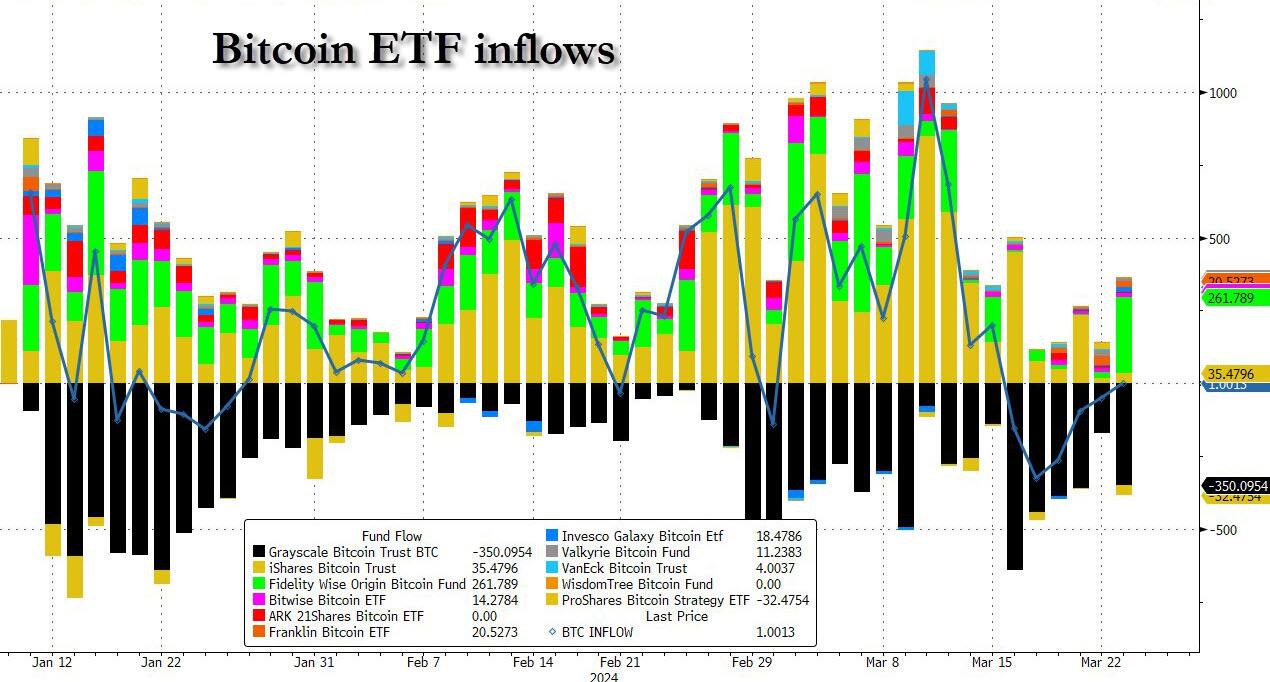
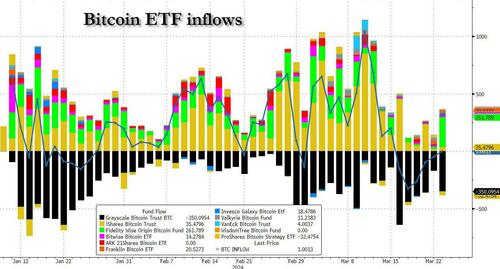
Bitcoin holds above $71k, with Ethereum now back above $3.5k. On Monday, spot bitcoin ETFs registered inflows totalling USD 15.4mln on Monday, ending a five-day run of outflows.
Looking at today’s calendar, the US economic schedule includes March Philadelphia Fed non-manufacturing activity and February durable goods orders (8:30am), January FHFA house price index, S&P CoreLogic home prices (9am), March consumer confidence and Richmond Fed manufacturing index (10am) and March Dallas Fed services activity (10:30am); no Fed speakers scheduled.

Market Snapshot

  • S&P 500 futures up 0.2% to 5,290.50
  • STOXX Europe 600 down 0.2% to 509.03
  • MXAP up 0.3% to 176.92
  • MXAPJ up 0.3% to 535.99
  • Nikkei little changed at 40,398.03
  • Topix up 0.1% to 2,780.80
  • Hang Seng Index up 0.9% to 16,618.32
  • Shanghai Composite up 0.2% to 3,031.48
  • Sensex down 0.3% to 72,584.51
  • Australia S&P/ASX 200 down 0.4% to 7,780.23
  • Kospi up 0.7% to 2,757.09
  • German 10Y yield little changed at 2.37%
  • Euro up 0.1% to $1.0849
  • Brent Futures down 0.1% to $86.64/bbl
  • Gold spot up 0.3% to $2,178.34
  • US Dollar Index little changed at 104.14

Top Overnight News

  • Japan’s BOJ isn’t as dovish as markets think as the central bank adopts a “data dependent” outlook rather than one that’s committed to sustaining policy accommodation regardless of economic conditions. RTRS
  • China’s central bank reinforced its support for the under-pressure yuan by strengthening its daily reference rate for the managed currency by the most since January. BBG
  • Some US executives in Beijing for a business summit are rejigging their schedules after being invited to meet tomorrow with a top Chinese leader – widely expected to be Xi Jinping. Tim Cook described China as “vibrant and so dynamic,” and pledged fresh investment in applied research. BBG
  • The US faces a Liz Truss-style market shock if the government ignores the country’s ballooning federal debt, the head of Congress’s independent fiscal watchdog has warned. Phillip Swagel, director of the Congressional Budget Office, said the mounting US fiscal burden was on an “unprecedented” trajectory, risking a crisis of the kind that sparked a run on the pound and the collapse of Truss’s government in the UK in 2022. FT
  • US gas prices are set to hit the highest level in two years just ahead of the summer driving season, creating a fresh headwind for the consumer. BBG
  • The Francis Scott Key Bridge in Baltimore collapsed after a container vessel rammed into it early Tuesday, sending vehicles plunging into the water. The disaster will probably cause chaos, both for shipping at one of the busiest ports on the US East Coast and on the roads. Rescuers are searching for at least seven people believed to be in the water. BBG
  • The world faces a looming “retirement crisis” that requires a rethink of pensions and working patterns as medical breakthroughs boost longevity, BlackRock chief executive Larry Fink warned on Tuesday in his closely watched annual letter to chief executives and investors. FT
  • Bond fund giant Pimco is holding a smaller than usual position in US Treasuries and prefers the bonds of countries such as the UK and Canada, as it believes inflationary pressures may lead the Federal Reserve to cut interest rates more slowly than other major central banks. FT
  • Adam Neumann, the former chief executive and co-founder of WeWork, recently submitted an offer to buy the bankrupt co-working company for more than $500 million, according to people familiar with the matter. WSJ

A more detailed look at global markets courtesy of Newsquawk

APAC stocks were choppy after a similarly subdued handover from Wall St owing to early tech headwinds and ahead of month-end. ASX 200 declined as tech losses clouded over the outperformance in the energy sector, while weaker Consumer Confidence added to the glum mood. Nikkei 225 swung between gains and losses amid an indecisive currency and inconclusive Services PPI data. Hang Seng and Shanghai Comp. saw two-way price action with earnings releases in focus, while the mainland failed to sustain early optimism from the PBoC’s more forceful liquidity operation.

Top Asian News

  • Chinese Vice President Han said it is important to promote economic globalisation and smooth global industrial and supply chains, while they will accelerate the development of new productive forces and provide stability and security for the global economy.
  • Japanese Finance Minister Suzuki said it is important for currencies to move in a stable manner reflecting fundamentals and rapid FX moves are undesirable, while he won’t rule out any steps to respond to disorderly FX moves.
  • Japan’s Business Lobby Chief says USD/JPY beyond 150.00 is excessive, according to Kyodo (USD/JPY currently at 151.32).
  • China’s Deputy Head FX regulator says volatility in FDI inflows is normal.
  • Shipments of smartphones within China -31.3% Y/Y at 14mln (prev. 29.5mln M/M) handsets in Feb, via CAICT.
  • China has initiated WTO dispute settlement proceedings against the US over interests in the EV industry.

European equities, Stoxx600 (+0.1%), began the session without direction, though caught a bid alongside strength in US equity futures; however, the FTSE 100 (-0.1%) lags, given the underperformance in the Basic Resources sector. European sectors hold a negative tilt; Banks is found at the top of the pile, propped up by BNP Paribas (+1.9%), which benefits from a broker upgrade. Basic Resources is hampered by broader weakness in base metals. US equity futures (ES +0.3%, NQ +0.4%, RTY +0.4%) are entirely in the green, attempting to pare back some of the weakness seen in the prior session.

Top European News

  • BoE’s Mann says she switched to an unchanged rate vote based on consumer behaviour, labour demand & supply and the financial market curve. Can hold the bank rate for quite some time. Markets are perhaps a bit too complacent when it comes to how long the BoE can hold rates. Markets are pricing in too many rate cuts. In some ways does not have to cut because the market already is. Avoids giving a prediction on the number of 2024 rate cuts.
  • ECB’s Muller says data can confirm inflation trend for ECB’s June meeting, ECB is closer to the point of cutting rates.
  • UK MPs warned that pension rules risk ‘finishing off’ the remaining defined-benefit plans and noted concerns that the new funding regime would require schemes to de-risk inappropriately, according to FT.
  • Kantar UK Supermarket update (Mar): Grocery price inflation eased to 4.5% over the four weeks to 17 March, the lowest level since February 2022. Take-home grocery sales rose by 4.6% over the four weeks to 17 March, with an early Easter boosting sales of seasonal treats in the first three months of 2024.
  • Sweden’s NIER sees 2024 GDP +0.8% (prev. 1.0%), sees 2024 headline inflation 1.9% (prev. 1.7%), End-2024 repo rate 3.00% (prev. 3.30%); Expects Riksbank to start cutting rates in June.

FX

  • DXY is marginally softer but holding just above the 104 mark with not much in the way of fresh newsflow. If 104.00 is breached, Friday’s low sits at 103.92.
  • EUR is trivially firmer vs. the USD with a high print of 1.0853 after moving above 200 and 50DMAs at 1.0836 and 1.0839 respectively.
  • GBP is edging higher vs. the USD but yet to test last Friday’s high at 1.2675 or 50DMA at 1.2679. Comments from BoE’s Mann reasserts her hawkish position on the MPC despite voting unchanged last week.
  • JPY is a touch firmer but the USD but only marginally so as Japanese officials continue to try and defend the Yen.
  • Antipodeans are both a touch firmer vs. the USD but NZD more so; newsflow very quiet. AUD/USD currently eyeing its 50 and 200DMAs which both sit at 0.6550.
  • PBoC set USD/CNY mid-point at 7.0943 vs exp. 7.2037 (prev. 7.0996).

Fixed Income

  • USTs are incrementally firmer but with action more contained than in Europe ahead of a handful of data points before the 5yr auction. No concession ahead of the auction yet, and within a 6 tick range between Monday’s 110-15 to 110-30 parameters.
  • Bunds are modestly firmer as EGBs unwind some of the slight pressure seen on Monday, sparked by Bostic/2yr supply concession; usual hawkish-leaning rhetoric from ECB’s Muller and a less-downbeat German GfK spurred no real reaction; currently higher by around 22 ticks at 132.84.
  • Gilts initially conformed to the broader positive sentiment in the fixed complex, subsequent hawkish commentary from BoE’s Mann did little to cap the upside. The outspoken hawk mentioned that rates can be held at the current level for “quite some time”; Gilts at a fresh 99.70 peak, seemingly driven by Mann’s remarks underscoring her shift to be in-line with the majority but on the hawkish end of this. Little reaction seen following the UK auction.
  • UK sell GBP 3bln 4.50% 2028 Gilt: b/c 3.48x (prev. 3.34x), average yield 3.928% (prev. 4.095%) & tail 0.3bps (prev. 0.4bps)

Commodities

  • Crude price action has been contained and near recent highs despite a quiet European morning, following several geopolitical headlines over the weekend; Brent currently around USD 86.60/bbl.
  • Relatively uneventful trade in precious metals thus far in European hours with the Dollar contained and news flow light in a holiday-thinned week ahead of month end. XAU caught a bid in recent trade and now at session highs around USD 2190/oz.
  • Base metals are mixed and within confined ranges on Monday amid a lack of macro narrative to drive price action.
  • Head of Venezuela’s opposition coalition said it was not possible to register a candidate for the presidential election.
  • Brazilian miner Vale said it was selected by the US government to begin negotiations for financing related to an iron ore briquette plant and it will negotiate for an award of up to USD 282.9mln for the US project.
  • Japan’s Eneos says shut Kawasaki No.3 CDU (77k BPD) for maintenance on March 22.

Geopolitics: Middle East

  • US Secretary of State Blinken underscored to Israel’s Defence Minister Gallant that alternatives exist to a ground invasion of Rafah that would both better ensure Israel’s security and protect Palestinian civilians, while it was also reported that White House’s Sullivan had a constructive discussion with Israel’s Gallant.
  • “Israeli sources: The Israeli delegation leaves Doha after Hamas rejected the US proposal approved by Israel”, according to Sky News Arabia. Subsequent reports said, Gaza ceasefire and hostage release talks continue and Mossad officials remain in Doha, according to Reuters sources; Mossad team is returning to Israel for consultations on developments

Geopolitics: Other

  • New Zealand Foreign Minister Peters confirmed that New Zealand’s concerns about cyber activity have been conveyed directly to the Chinese government and he directed senior foreign ministry officials to speak to the Chinese ambassador, according to Reuters.

US Event Calendar

  • 08:30: Feb. Durable Goods Orders, est. 1.0%, prior -6.2%
    • Feb. Durables-Less Transportation, est. 0.4%, prior -0.4%
    • Feb. Cap Goods Orders Nondef Ex Air, est. 0.1%, prior 0%
    • Feb. Cap Goods Ship Nondef Ex Air, est. 0.1%, prior 0.9%
  • 08:30: March Philadelphia Fed Non-Manufactu, prior -8.8
  • 09:00: Jan. S&P/CS 20 City MoM SA, est. 0.20%, prior 0.21%
    • Jan. S&P CS Composite-20 YoY, est. 6.60%, prior 6.13%
    • Jan. FHFA House Price Index MoM, est. 0.3%, prior 0.1%
  • 10:00: March Conf. Board Consumer Confidenc, est. 107.0, prior 106.7
    • March Conf. Board Present Situation, prior 147.2
    • March Conf. Board Expectations, prior 79.8
  • 10:00: March Richmond Fed Index, est. -5, prior -5
  • 10:30: March Dallas Fed Services Activity, prior -3.9

DB’s Jim Reid concludes the overnight wrap

I’ll be off skiing on Friday, although with the forecast and recent lack of snow it may as well be water skiing. It felt like the market had left for their hols early yesterday as we started what is an Easter shortened week. The most interesting theme of the day was a steady but notable global rates sell-off that, for example, wiped out nearly half of last week’s -10.8bps fall in 10yr UST yields. There was no obvious catalyst so maybe thin trading played a part? As we’ll see below, there was a little hawkishness in the Fed speak but the moves were steady through the day rather than directly related to any headlines.

10yr US yields closed +4.7bps higher at 4.25% with 2yrs +3.6bps at 4.63%. Markets also trimmed the amount of Fed rate cuts they are expecting this year by -4.7bps to 80bps. We also saw the expected probability of a June cut fall to 79%, down from nearly 86% at the peak last week. It was real yields that drove the sell-off, with the 10yr real yield up +5.9bps after falling for the previous four sessions. The yield increases levelled off following a decent 2yr auction. Bonds totaling $66bn were issued 0.5bps above the pre-sale yield, but with the indirect bidder share reaching its highest level since June. We still have $110bn in Treasury supply to come this week, with a record $67bn 5yr auction later today, so something to keep an eye on.

The rates and yield sell-off was seen across the board with the amount of ECB cuts priced by December coming down -6.1bps to 88bps, with 2yr and 10yr German bund yields climbing +5.6bps and +4.9bps, respectively. The sell-off was marginally larger for 10yr OATs (+5.0bps) and Gilts (+6.0bps).

There was some Fed speak of note with a little caution expressed regarding expectations of Fed cuts. Atlanta Fed President Bostic repeated weekend remarks that he now expected only one rate cut this year (versus two before), suggesting the Fed could be patient if the economy was holding up. Meanwhile, Chicago Fed President Goolsbee said he continued to see three rate cuts in 2024 but highlighted the need to see housing inflation moderate more. And Fed Governor Cook noted that “fully restoring price stability may take a cautious approach to easing monetary policy”. While being mostly consistent with Powell’s narrative last week, these comments underlined the upward narrowing of end-2024 rate expectations we saw in the FOMC dot plot last week (even as the median dot was unchanged at three cuts).

We also heard from a number of ECB officials over in Europe, including the ECB’s Panetta, a known dove, who remarked “ EU inflation [was] quickly falling towards the 2% target”, with the inflation decline allowing “for possible cut in rates.” We also heard from the ECB’s Chief Economist Lane, who reiterated that “we’re seeing good progress on inflation” and was “confident wage normalisation process is on track.” Although relatively dovish, these comments did nothing to suggest that an ECB rate cut could come any earlier than June, which appears to be the baseline based on other recent ECB commentary.

Equity markets had a quiet session with the S&P 500 starting the week on the back foot (-0.31%), and with similar moves in the Dow Jones (-0.41%) and the Nasdaq (-0.27%). The last two sessions have seen the narrowest trading ranges for the S&P 500 since early February, with only one of its 24 industry groups seeing a move of more than 1% yesterday (-1.06% for software & services).

The Magnificent Seven (-0.22%) outperformed marginally even as it was reported that Apple (-0.83%), Alphabet (-0.46%) and Meta (-1.29%) could be at risk of significant fines in the EU amid a new investigation into the firms’ compliance with the Digital Markets Act. The Act looks to restrict the dominance of the biggest online platforms and came into effect earlier this month. Nvidia (+0.76%) managed to secure its sixth day of consecutive gains but the Philadelphia Semiconductor Index fell -0.34% amid a Financial Times report that China had adopted new guidance to limit the use of US-made semiconductors, including those produced by Intel (-1.74%) and AMD (-0.57%), in government computers. Over in Europe, the STOXX 600 (+0.04%) moved sideways, while the German Dax (+0.30%) hit a fresh all-time high.

Credit markets saw a mixed day, with high-yield spreads narrowing in Europe but US IG (+2bps) and high-yield (+4bps) spreads widening modestly after reaching two-year lows last Thursday. On this topic, my credit strategy team have revised their spread targets for US and Europe tighter. You can read more here.

Asian equity markets are fairly quiet this morning with the KOSPI (+0.83%) leading gains powered by chipmaking stocks. TheHang Seng (+0.30%) has bounced after the lunch break but the Shanghai Comp (-0.58%) is struggling after a second day of a stronger Yuan fix. 10yr US yields are a basis point lower with S&P (+0.16%) and Nasdaq (+0.19%) futures both higher.

The limited US data releases yesterday were slightly on the softer side. The Dallas Fed manufacturing index for March came in at -14.4 (vs -10.0 expected), down from -11.3 in February. New home sales were unexpectedly down in February, falling from 664k to 662k (vs 677k expected). On the other hand, the Chicago Fed national activity index improved to 0.05 (vs -0.34 expected), continuing to oscillate around trend levels.

Now to the day ahead. In terms of data, we have the US March Conference Board consumer confidence, the Richmond Fed manufacturing index and business conditions, the Philadelphia Fed non-manufacturing activity, the Dallas Fed services activity, the February durable goods orders and the January FHFA house price index. Outside the US, we have Germany GfK consumer confidence. Lastly, we have a record $67bn US 5yr notes auction.
Tyler Durden
Tue, 03/26/2024 – 08:19

via ZeroHedge News https://ift.tt/hXu6MQZ Tyler Durden

Cocoa Hyperinflation Strikes Before Easter, Prices Surge To New Record High

Cocoa Hyperinflation Strikes Before Easter, Prices Surge To New Record High

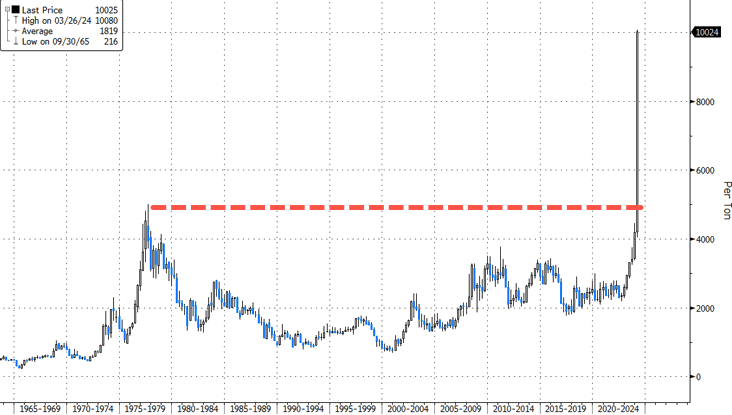
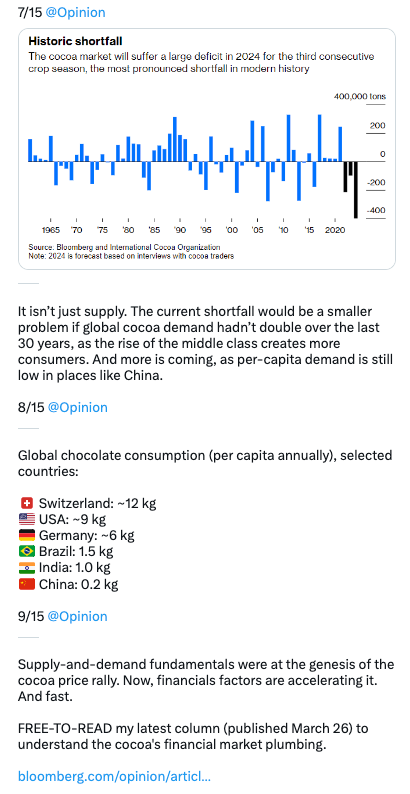
As the Easter holiday weekend nears, Cocoa futures soared to new record highs on Tuesday as the worsening supply crunch forces chocolate makers to hunt for beans. 

Futures in New York jumped as high as $10,047 per ton, or about 4.1% on the session. This is the fifth straight day of gains and about a 150% surge since the start of the year. 

Fueling this week’s gains is news about funding challenges in Ghana, the world’s second-largest grower. 

“The country is set to lose access to a key funding facility as a crisis in its cocoa crop has left it without enough beans to secure the money. The Ghana Cocoa Board, the industry regulator known as Cocobod, relies on foreign financing to pay cocoa farmers for their beans,” Bloomberg reports. 

The cocoa market has already been reeling from poor harvests due to bad weather and crop disease across West Africa, the world’s top cocoa-growing region. 

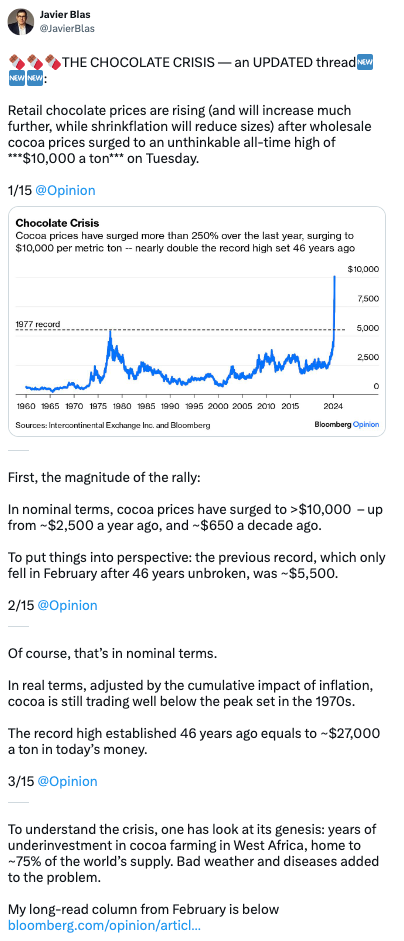
Further insights into the cocoa crisis provided by Bloomberg’s Javier Blas on X

Cocoa’s price surge will result in higher chocolate costs for consumers. The first noticeable price jump will be chocolate eggs for this weekend’s Easter holiday. 

And chocolate inflation is only going to get worse from here:

“Chocolate may be even more expensive in Easter 2025, if cocoa-tree diseases and inclement weather prolong the deficit amid high sugar prices,” Bloomberg Intelligence analyst Diana Gomes said in a note on Friday.

Bad news for those of us with a sweet tooth… 

It’s only a matter of time before Biden’s PR team of woke college grads blames Putin for candyflation. 

Tyler Durden
Tue, 03/26/2024 – 07:55

via ZeroHedge News https://ift.tt/DNmGEy9 Tyler Durden

Priced-In Fed Rate-Cuts Are On Shakier Ground Than In UK And Europe

Priced-In Fed Rate-Cuts Are On Shakier Ground Than In UK And Europe

Authored by Simon White, Bloomberg macro strategist,

Greater inflation expectations and receding recession risk leave the interest rate cuts priced in for the Federal Reserve more vulnerable than in the UK or Europe.

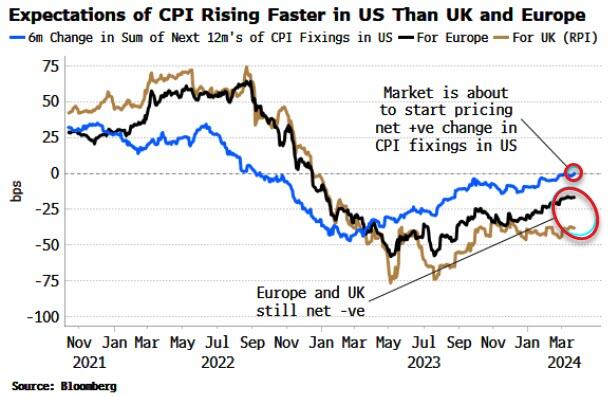
The market currently sees a similar amount of rate cuts in 2024 for the US, UK and euro area, with ~80 bps seen for the Fed and BOE and just over 90 bps expected for the ECB. The US is more exposed to rising inflation, which is beginning to be reflected in the market’s expectations. The CPI-fixing market has started marking up its estimates of where inflation is anticipated to be over the next 12 months after a protracted period of marking them down.

We can take the six-month change in the sum of the next 12 months of fixings and compare this across regions to get an idea of how different inflation expectations are evolving.

As the chart below shows, inflation expectations are being marked up by more in the US than in the UK and Europe.

This comes when recession risks continue to recede in the US.

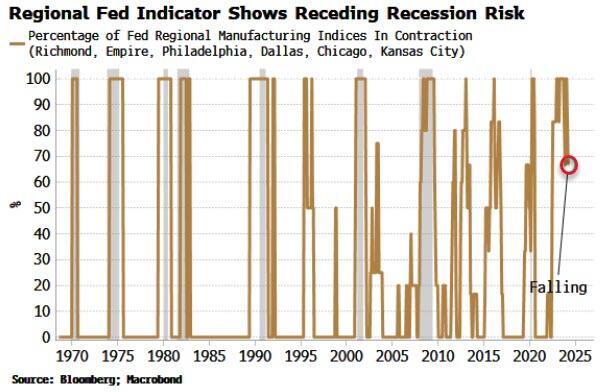
The Dallas Fed Manufacturing Index for March was just released, coming in weaker than expected. But the Fed regional indexes are quite useless individually as they are too volatile. However, we can improve the signal by looking at a diffusion of them.

When all of them are contracting it is not a bad recession indicator.

They had all been in contraction territory on a three-month smoothed basis for most of the last year, but now fewer than 70% of them are in the negative zone (gray bars are recessions in the chart below).

The Fed has made its life difficult when it de facto pivoted in December.

As long as the data keeps coming in solidly, and inflation inches higher, the amount of cuts expected in the US – especially relative to the UK and Europe – is at risk.

Powell stated at last week’s Fed meeting a surprise weakening in unemployment would prompt them to cut rates, but net conditions are already very loose.

The market may end reversing its position of last year – where further hikes that were telegraphed prompted more cuts to be priced, given the expected damage to the economy – and instead see cuts telegraphed as a policy mistake, and price in subsequent rate hikes.

Tyler Durden
Tue, 03/26/2024 – 07:20

via ZeroHedge News https://ift.tt/O4ywp16 Tyler Durden