US New Home Sales Unexpectedly Dropped In Feb As Prices Tumbled

US New Home Sales Unexpectedly Dropped In Feb As Prices Tumbled

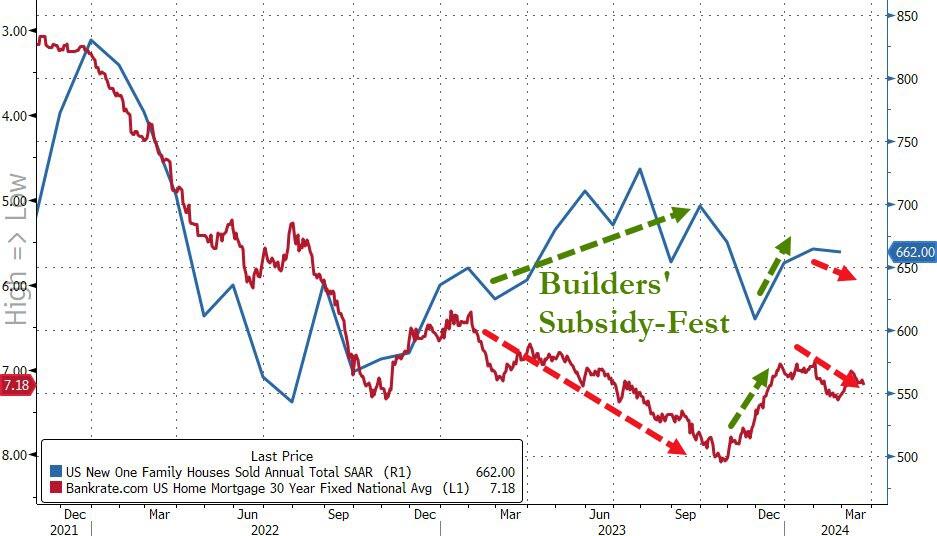
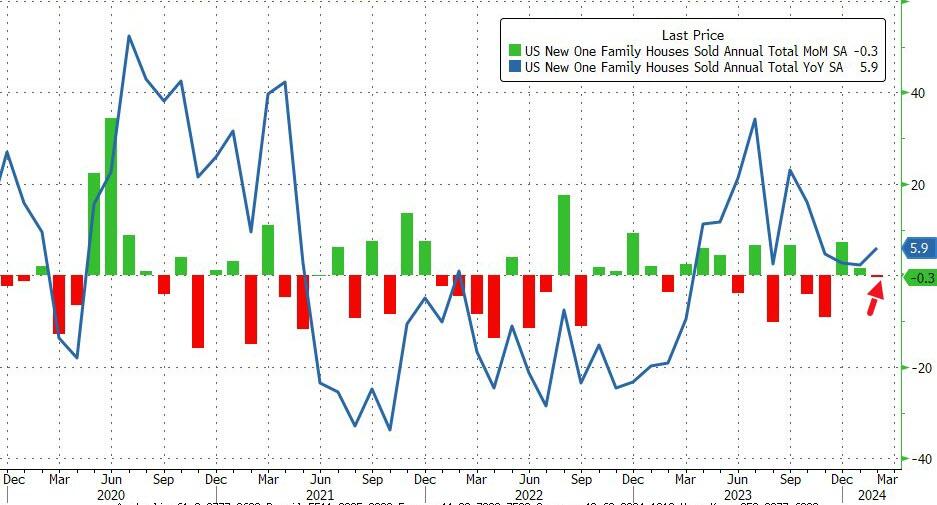
After a big surprise surge in existing home sales, new home sales in February disappointed, dropping 0.3% MoM (vs an expected 2.3% increase).

Source: Bloomberg

Despite the decline, new home sales are up 5.9%.

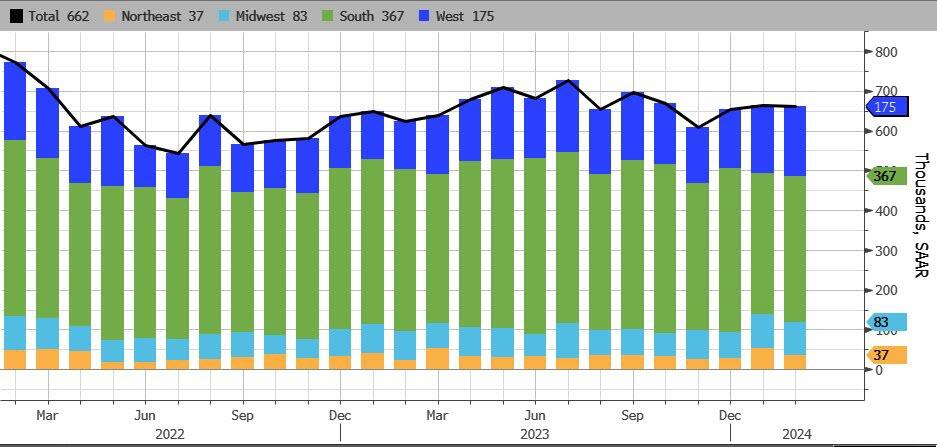
Sales declined in the Northeast and Midwest…

Source: Bloomberg

While homebuilders are buying down rates, we note that mortgage rates jumped back above 7% in February and likely was the driver of the unexpected weakness (despite NAHB sentiment surging).

“Buyers have largely adjusted to the rate environment and we are encouraged by the demand we’re seeing that the onset of the spring selling season,” Jeffrey Mezger, KBHome’s chief executive officer, said on the company’s recent earnings call.

Not sure we can trust the words coming out of your mouth mate…

Source: Bloomberg

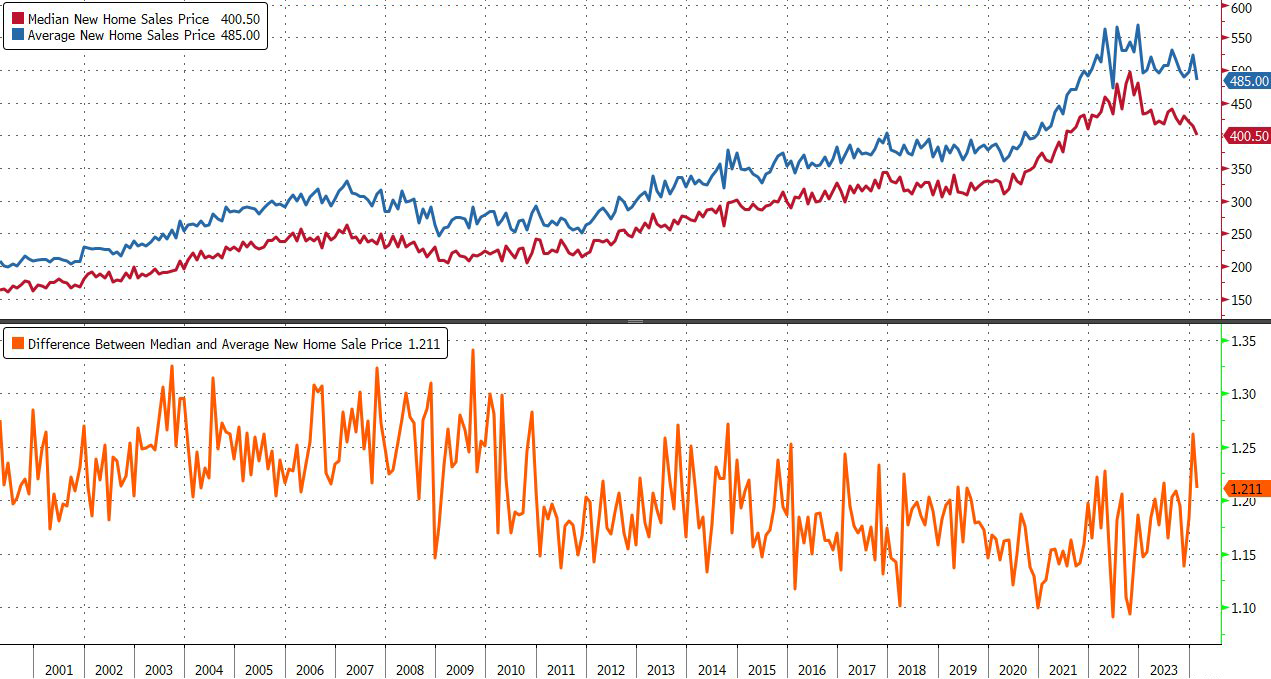
Median new home price fell 7.6% y/y to $400,500; average selling price at $485,000..

Source: Bloomberg

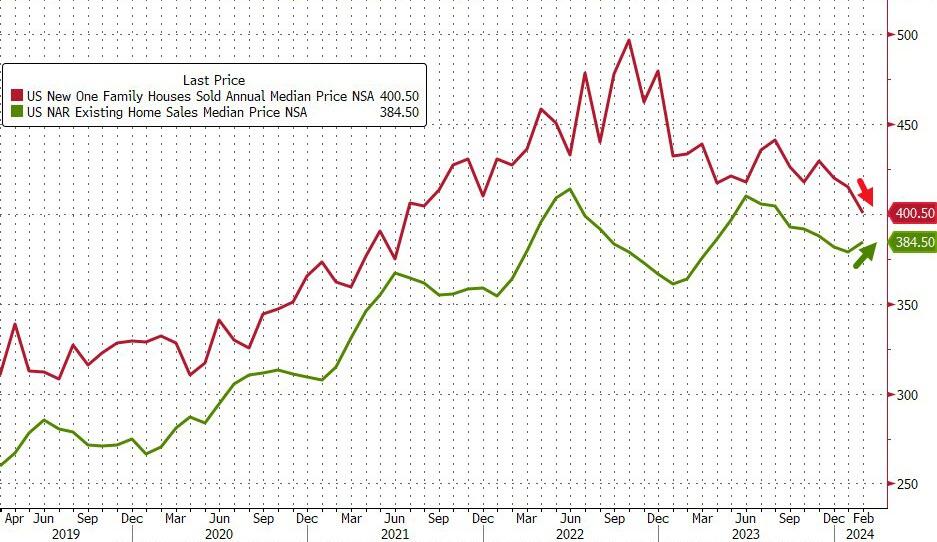
That is the lowest median new home price since June 2021… as existing home prices rose in Feb…

Source: Bloomberg

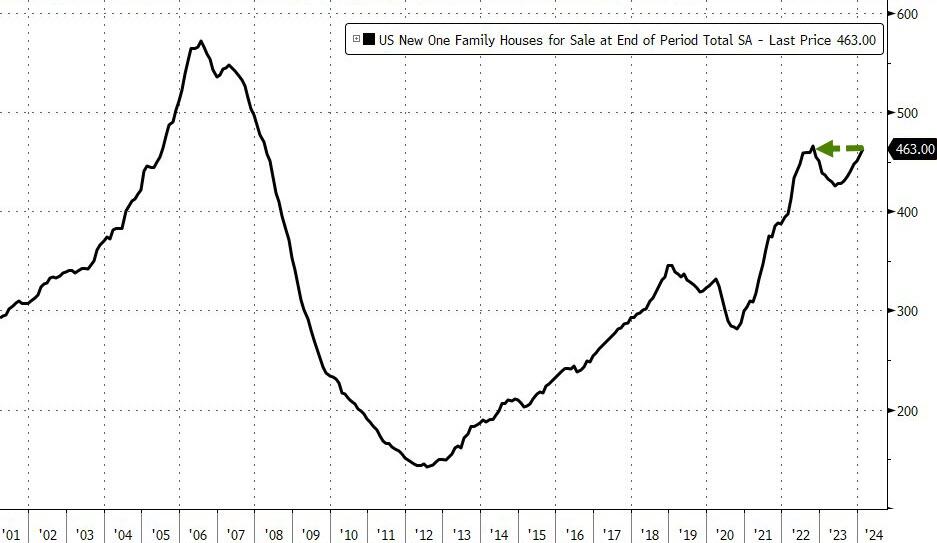
The supply of new homes rose to 463,000 during the month, the highest since October 2022.

Source: Bloomberg

Are builders still banking on Powell folding like broken lawn chair in this election year and saving the world? The price decline is notable though.

Tyler Durden
Mon, 03/25/2024 – 10:13

via ZeroHedge News https://ift.tt/BP02eHU Tyler Durden

Key Events This Week: Core PCE Released When Markets Are Closed

Key Events This Week: Core PCE Released When Markets Are Closed

After last week’s central bank fireworks, the most exciting event of the otherwise quiet and holiday-shortened week will happen once markets are actually closed for the month and Q1 is done and dusted in performance terms: as DB’s Jim Reid reminds us, the monthly US personal income and spending report, which contains the crucial core PCE, is released on Good Friday when bond and equity markets are closed. The flash CPIs in Italy and France also come out on Friday, with the Spanish print due on Wednesday. Staying on the inflation theme, Tokyo CPI is out on Thursday, with the summary of opinions from last week’s BoJ meeting on Wednesday. This will garner some attention given the once-in-a-generation shift in policy. Australian CPI is out on Wednesday.

Staying with central banks, there are lots of Fed speakers this week that can add some color to last week’s generally dovish FOMC. They are listed in the day-by-day week ahead at the end.

In terms of the key US data, today sees new home sales, tomorrow sees durable goods and consumer confidence, Wednesday the final consumer sentiment reading and pending home sales, while Thursday sees the final release of Q4 GDP, trade data, the Chicago PMI and, of course, initial jobless claims.

In terms of that core PCE print on Good Friday, DB economists expect +0.27% vs. 0.42% last month. In Powell’s press conference, he remarked that the month-over-month print for core PCE could be “well below 30bps” at the end of the month. Taking him at his word does offer downside risk to the economists’ forecast who believe upward revisions to the January healthcare services prices could square these two numbers.

In Europe, DB’s European economists’ inflation chartbook covers recent trends and their forecasts here. For March readings, they expect the headline Eurozone index to come in at 2.5% (vs 2.6% in February) and core at 3.1% (3.1%). On a country level, their projections include 2.4% for Germany (2.8% next week), 2.5% for France (3.2% Friday), 1.3% in Italy (0.8% Friday) and 3.5% in Spain (3.0% Wednesday).

Courtesy of DB, here is a day-by-day calendar of events

Monday March 25

  • Data: US March Dallas Fed manufacturing activity, February new home sales, Chicago Fed national activity index, Japan February services PPI
  • Central banks: Fed’s Bostic and Cook speak, ECB’s Holzmann speaks, BoE’s Mann speaks
  • Auctions: US 2-yr Notes ($66bn)

Tuesday March 26

  • Data: US March Conference Board consumer confidence, Richmond Fed manufacturing index, Richmond Fed business conditions, Philadelphia Fed non-manufacturing activity, Dallas Fed services activity, February durable goods orders, January FHFA house price index, Germany April GfK consumer confidence
  • Auctions: US 5-yr Notes ($67bn)

Wednesday March 27

  • Data: UK March Lloyds business barometer, China February industrial profits, France March consumer confidence, Eurozone March services, industrial and economic confidence
  • Central banks: BoJ’s summary of opinions (March MPM), Tamura speaks, Fed’s Waller speaks, ECB’s Cipollone speaks
  • Auctions: US 2-yr FRN ($28bn, reopening), 7-yr Notes ($43bn)

Thursday March 28

  • Data: US March MNI Chicago PMI, Kansas City Fed manufacturing activity, February pending home sales, initial jobless claims, UK Q4 current account balance, Japan March Tokyo CPI, February retail sales, job-to-applicant ratio, jobless rate, industrial production, Italy March manufacturing and consumer confidence, economic sentiment, February PPI, Germany March unemployment claims rate, Eurozone February M3, Canada January GDP
  • Central banks: ECB’s Villeroy speaks

Friday March 29

  • Data: US March Kansas City Fed services activity, February personal spending and income, PCE deflator, retail inventories, advance goods trade balance, Japan February housing starts, Italy March CPI, France March CPI, February PPI, consumer spending
  • Central banks: Fed’s Powell speaks

Finally, looking at just the US, Goldman writes that the key economic data releases this week are the durable goods report on Tuesday and the core PCE inflation report on Friday. There are several speaking engagements from Fed officials this week, including an event with Governor Waller at the Economic Club of New York on Wednesday and a discussion with Chair Powell hosted by the San Francisco Fed on Friday.

Monday, March 25

  • 08:25 AM Atlanta Fed President Bostic (FOMC voter) speaks: Atlanta Fed President Raphael Bostic will participate in a discussion on equity and economic development at the University of Cincinnati Real Estate Center’s March Roundtable. Q&A is expected. On March 22nd, President Bostic noted that he only expected the FOMC to cut the fed funds rate once in 2024. President Bostic said he was “less confident than … in December” that inflation would continue to decline toward the Fed’s 2% target, and that the recent data on inflation showed “some troubling things.” Still, President Bostic noted that his baseline forecast was “a close call,” and that the FOMC would “have to see how the data come in over the next several weeks.”
  • 09:05 AM Chicago Fed President Goolsbee (FOMC non-voter) speaks: Chicago Fed President Austan Goolsbee will give an interview to Yahoo Finance. On February 29th, President Goolsbee noted that the fed funds rate was “pretty restrictive” and urged the FOMC to “think about how long we want to remain in this restrictive territory.” President Goolsbee said he expected there was still “supply benefit coming through the system both on the supply chain and the impact of labor supply.”
  • 10:00 AM New home sales, February (GS +6.5%, consensus +2.1%, last +1.5%)
  • 10:30 AM Fed Governor Cook speaks: Fed Governor Lisa Cook will deliver a speech at Harvard University on the Fed’s dual mandate and the balance of risks. Text and Q&A are expected. On February 22nd, Governor Cook said that she would like to have “greater confidence that inflation is converging to 2% before beginning to cut the policy rate.” Governor Cook also noted that she saw “an eventual rate cut as adjusting policy to reflect a shifting balance of risks” and that she believed “the risks to achieving our employment and inflation goals” were “moving into better balance after being weighted toward excessive inflation.”

Tuesday, March 26

  • 08:30 AM Durable goods orders, February preliminary (GS +0.4%, consensus +1.2%, last -6.2%); Durable goods orders ex-transportation, February preliminary (GS +0.9%, consensus +0.4%, last -0.4%); Core capital goods orders, February preliminary (GS +0.7%, consensus +0.1%, last flat); Core capital goods shipments, February preliminary (GS +0.4%, consensus flat, last +0.9%): We estimate that durable goods orders rose 0.4% in the preliminary February report (mom sa), reflecting further weakness in commercial aircraft orders but strong core measures. Specifically, we forecast a 0.7% increase in core capital goods orders following above-normal order cancellations in January, and we forecast a 0.4% increase in core capital goods shipments reflecting strong industrial production data and the rebound in foreign manufacturing activity.
  • 09:00 AM FHFA house price index, January (consensus +0.3%, last +0.1%)
  • 09:00 AM S&P Case-Shiller 20-city home price index, January (GS +0.2%, consensus +0.2%, last +0.21%)
  • 10:00 AM Conference Board consumer confidence, March (GS 107.1, consensus 106.9, last 106.7)

Wednesday, March 27

  • There are no major economic data releases scheduled.
  • 06:00 PM Fed Governor Waller speaks: Fed Governor Christopher Waller will speak at an event hosted by the Economic Club of New York. Text and Q&A are expected. On February 22nd, Governor Waller noted that recent data had “reinforced my view that we need to verify that the progress on inflation we saw in the last half of 2023 will continue, and this means there is no rush to begin cutting interest rates to normalize monetary policy.” Governor Waller noted that he still expected it would “be appropriate sometime this year to begin easing monetary policy, but the start of policy easing and number of rate cuts will depend on the incoming data.”

Thursday, March 28

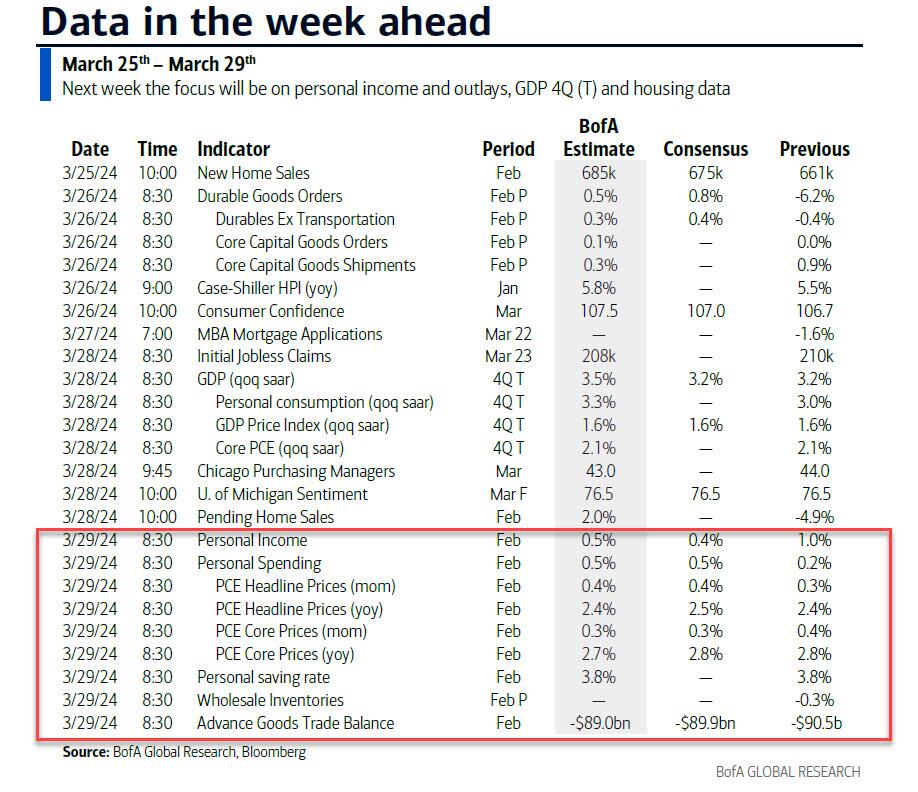
  • 08:30 AM GDP, Q4 third release (GS +3.2%, consensus +3.2%, last +3.2%); Personal consumption, Q4 third release (GS +3.0%, consensus +3.0%, last +3.0%); We estimate no revision to Q4 GDP growth, at +3.2% (qoq ar).; 08:30 AM Initial jobless claims, week ended March 23 (GS 205k, consensus 213k, last 210k); Continuing jobless claims, week ended March 16 (consensus 1,816k, last 1,807k): We expect initial jobless claims to decline by 5k to 205k. The BLS included an annual update of the seasonal factors in the jobless claims report from two weeks ago that substantially reduced the seasonal distortions that had been introduced by pandemic volatility.
  • 09:45 AM Chicago PMI, March (GS 47.5, consensus 46.0, last 44.0): We estimate that the Chicago PMI rose by 3.5pt to 47.5 in March, reflecting the rebound in foreign manufacturing activity and the pickup in US production and freight activity.
  • 10:00 AM Pending home sales, February (GS +2.1%, consensus +1.3%, last -4.9%)
  • 10:00 AM University of Michigan consumer sentiment, March final (GS 76.8, consensus 76.5, last 76.5); University of Michigan 5-10-year inflation expectations, March final (GS 2.9%, consensus 2.9%, last 2.9%): We estimate the University of Michigan consumer sentiment index increased to 76.8 in the final March reading and estimate the report’s measure of long-term inflation expectations was unrevised at 2.9%.

Friday, March 29

  • 08:30 AM Personal income, February (GS +0.4%, consensus +0.4%, last +1.0%); Personal spending, February (GS +0.5%, consensus +0.5%, last + 0.2%); PCE price index, February (GS +0.36%, consensus +0.4, last +0.34%); PCE price index (yoy), February (GS +2.47%, consensus +2.5%, last +2.4%); Core PCE price index, February (GS +0.29%, consensus +0.3%, last +0.42%); Core PCE price index (yoy), February (GS +2.81%, consensus +2.8%, last +2.8%): We estimate personal income increased 0.4% and personal spending increased 0.5% in February. We estimate that the core PCE price index rose +0.29%, corresponding to a year-over-year rate of 2.81%. Additionally, we expect that the headline PCE price index increased by 0.36% from the prior month, corresponding to a year-over-year rate of 2.47%. Our forecast is consistent with a 0.33% increase in our trimmed core PCE measure (vs. 0.41% in January and 0.35% in December).
  • 08:30 AM Advance goods trade balance, February (GS -$92.0bn, consensus -$89.7bn, last -$90.2bn)
  • 08:30 AM Wholesale inventories, February preliminary (consensus +0.2%, last -0.3%)
  • 11:15 AM Fed Chair Powell and San Francisco Fed President Daly (FOMC voter) speak: San Francisco Fed President Mary Daly will deliver opening remarks and Fed Chair Jerome Powell will participate in a moderated discussion at the San Francisco Fed’s Macroeconomics and Monetary Policy Conference. As noted in our FOMC recap, Chair Powell did not seem concerned by the firmer January and February inflation data. He noted that there was reason to think that seasonal effects could have boosted the January number and that the Fed staff expected core PCE inflation to be “well below” 30bp in February, “which is not terribly high.” Chair Powell also noted that stronger growth had been made possible by faster growth of labor supply and was therefore not an argument against rate cuts, and that FOMC participants thought it would be appropriate to slow the pace of balance sheet runoff “fairly soon.” On February 16th, President Daly noted that “the median [of three cuts in the December SEP seemed] like a reasonable baseline to me.”

Soruce: DB, Goldman, BofA

Tyler Durden
Mon, 03/25/2024 – 09:45

via ZeroHedge News https://ift.tt/W43y80t Tyler Durden

Jordan Subpoenas Biden’s Ghostwriter In Continuing Classified Records Probe

Jordan Subpoenas Biden’s Ghostwriter In Continuing Classified Records Probe

Authored by Ryan Morgan via The Epoch Times (emphasis ours),

House Judiciary Committee Chairman Jim Jordan (R-Ohio) subpoenaed President Joe Biden’s ghostwriter, Mark Zwonitzer, on Friday, pressing for details about the president’s handling of classified documents.

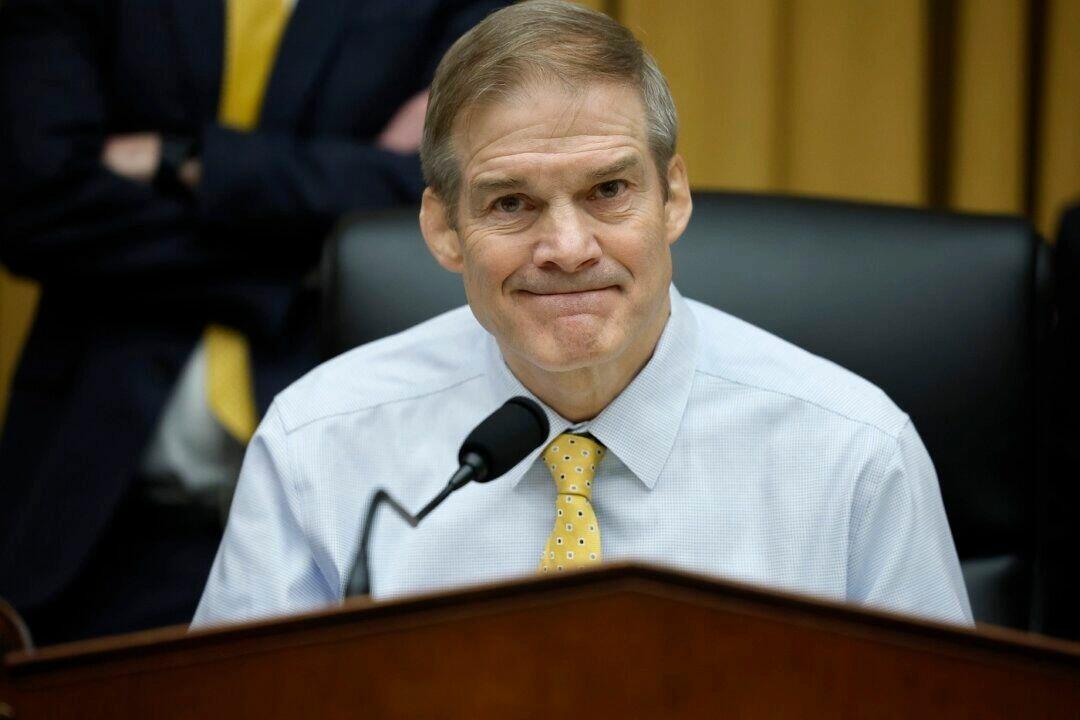
Chairman of the House Judiciary Committee Rep. Jim Jordan (R-Ohio) delivers his opening statement as former Special Counsel Robert K. Hur testifies before the House Judiciary Committee in Washington, on March 12, 2024. (Chip Somodevilla/Getty Images)

Last month, Special Counsel Robert Hur published his findings from his investigation into President Biden’s handling of classified documents. Among the findings, Mr. Hur said in 2016 then-Vice President Biden read off notebook entries, including several that covered classified materials, as he and Mr. Zwonitzer prepared his book “Promise Me Dad,” published in 2017.

The special counsel report, released on Feb. 8, further alleges Mr. Zwonitzer deleted some of his audio recordings with President Biden at some point during the special counsel investigation.

Mr. Jordan’s subpoena brings legal force to Republican efforts to compel Mr. Zwonitzer to share any audio or video recordings or transcripts he has from his conversations with President Biden.

House Republicans had initially reached out to Mr. Zwonitzer on Feb. 14, asking for his records ghostwriting the president’s book.

According to Mr. Jordan’s account, the ghostwriter’s lawyer initially indicated his client would turn over the requested documents by March 8. But by March 7, Mr. Zwonitzer’s lawyer sent a new notice delaying the document production and informing the committee he would need to follow up with his client. Mr. Zwonitzer’s lawyer then sent a follow-up March 11 notice informing the committee that his client would not turn over the requested documents unless he was subpoenaed.

In his Feb. 14 letter, Mr. Jordan requested documents and records from Mr. Zwonitzer’s ghostwriting work on “Promise Me Dad” as well as a biography he had written with then-Sen. Biden published in 2008 called “Promises to Keep.” The Feb. 14 letter also requested any records of contracts or agreements Mr. Zwonitzer had for the ghostwriting work he did. Republicans had also asked Mr. Zwonitzer to provide any documents and communications shared between him and President Biden or his staff relating to Mr. Hur’s special counsel investigation.

Biden VP Staff Advised Security Controls With Ghostwriter: Special Counsel Report

The special counsel report states Mr. Zwonitzer has never held a security clearance or become familiar with the restrictions on the handling of classified materials.

The report states then-Vice President Biden knew about Mr. Zwonitzer’s lack of security clearance in 2011 when he proposed hiring the writer as an official historian for the Office of the Vice President. White House attorney Cynthia Hogan authored a memorandum assessing the idea of hiring Mr. Zwonitzer and noting some issues that could arise from his lack of security clearance.

Ms. Hogan specifically warned Mr. Zwonitzer “will likely need a security clearance” and any discussions of cover classified topics would have to “occur in a secure facility.” She also warned any notes or materials that contained “classified information must be maintained in secure safes, produced on a classified computer, and stored in a secure facility.”

The special counsel report states Mr. Zwonitzer’s ghostwriting work included interviews with the president that began in April 2016 in the final months of his vice presidential term, and continued through 2017 after he left office.

The report states “Mr. Biden read from notes he took during a meeting in the Situation Room in the summer of 2015” during an interview on Feb. 16, 2017, at his Virginia rental home, weeks after his time as vice president had ended. The report states those notes included “information that remains classified up to the Secret level.”

In another April 2017 interaction with Mr. Zwonitzer, the president reportedly explained that, contrary to the views of his staff, he did not think he was required to turn his notes over to the National Archive.

Hur’s ‘Best Case’ for Charges

During their Feb. 16, 2017 interaction, the president also allegedly remarked that he “just found all the classified stuff downstairs.” The report asserts this reference was to classified documents relating to American military and foreign policy efforts in Afghanistan.

Though he declined to press charges against the president for his handling of classified information, Mr. Hur said this Feb. 16, 2017, exchange provides “the base case for charges” of those he had uncovered in his investigation.

NTD News reached out to the House Judiciary Committee’s Democratic minority for comment on the new subpoena but did not receive a response by press time.

The White House also did not respond to a request for comment by press time.

Mr. Hur addressed questions about his investigative efforts during a joint House hearing on March 12. At this hearing, House Judiciary Committee ranking member Jerrold Nadler (D-N.Y.) described Mr. Hur’s findings as a “complete and total exoneration” of President Biden’s handling of classified documents. Rep. Pramila Jayapal (D-Wash.) also described Mr. Hur’s report as a “complete exoneration.”

Mr. Hur pushed back on those “exoneration” remarks during an exchange in which Ms. Jayapal repeatedly talked over him. He said the word “exoneration” did not appear at any point in his report and insisted his task as the special counsel was to determine whether sufficient evidence existed that he could secure a conviction if he proceeded with charges.

From NTD News

Tyler Durden
Mon, 03/25/2024 – 09:25

via ZeroHedge News https://ift.tt/RpcD4E7 Tyler Durden

Japan’s Top FX Official Threatens “Appropriate Action” Against ‘Short Speculators’ As Yen Craters After Rate-Hike

Japan’s Top FX Official Threatens “Appropriate Action” Against ‘Short Speculators’ As Yen Craters After Rate-Hike

A quick glimpse at the the Japanese Yen’s price action (against the USD) since the BoJ ‘s decision to hike rates for the first time in 17 years and one could be forgiven for being confused as the ‘hawkish’ move has prompted aggressive ‘dovish’ weakening of the currency, However, as a reminder, this was one of the most dovish rate-hike we’ve seen with endless promises of support if the SHTF and continued JGB buying (despite ending YCC).

Even more notably, the risk of intervention by Japanese officials in the spot market could cap expectations for any further weakness:

“The current weakening of the yen is not in line with fundamentals and is clearly driven by speculation,” vice finance minister for international affairs Masato Kanda told reporters Monday.

“We will take appropriate action against excessive fluctuations, without ruling out any options.”

“We are always prepared,” Kanda said when asked about a possible direct intervention in the currency market.

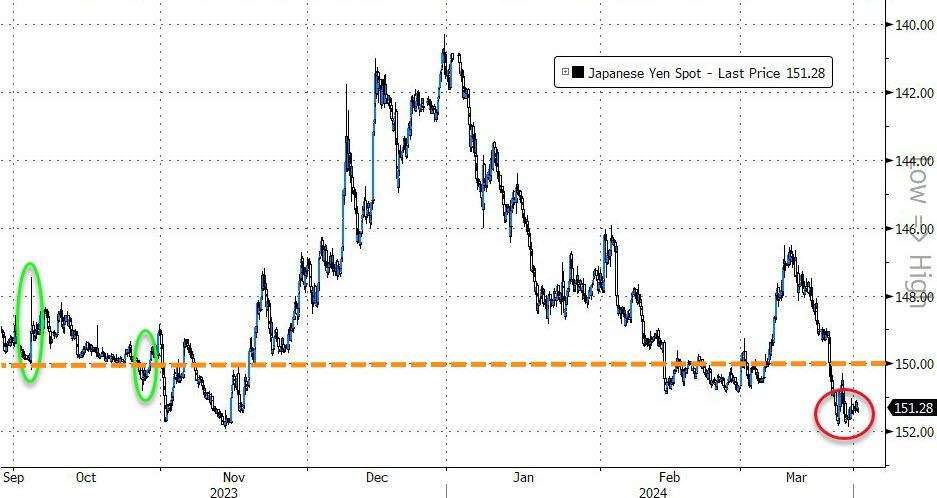
USDJPY is testing level that saw significant interventions to support the Yen (green ovals below) in Sept/Oct 2022…

Source: Bloomberg

Kanda’s warnings on the currency were his first since February.

“We have seen a large fluctuation of 4% in just two weeks in the dollar-yen, a move that isn’t reflecting fundamentals and I find this unusual,” Kanda said.

It’s always the speculators that get the blame (and in this case there are sizable short spec positions).

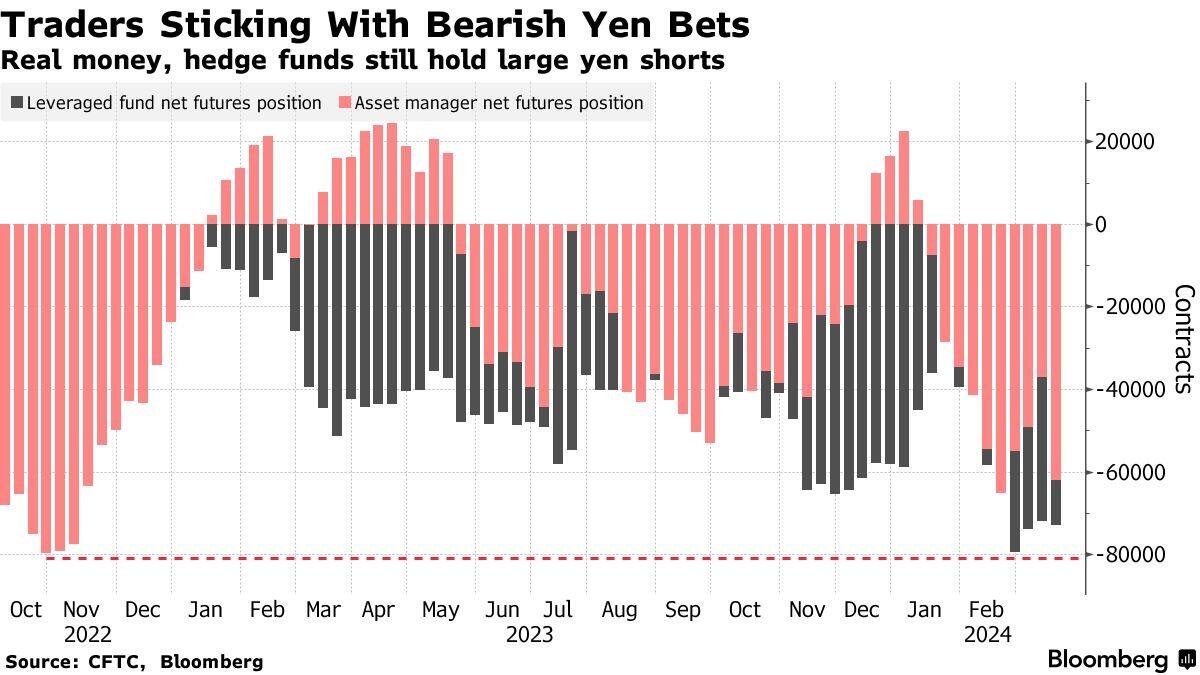
Bloomberg reports that hedge funds ramped up bearish yen wagers in the week stretching through the BOJ’s March meeting. Leveraged speculators in the currency market increased their holdings of contracts tied to bets the yen will fall to 80,805, approaching the six-year high of 83,562 reached last month, according to data through March 19 from the Commodity Futures Trading Commission.

Source: Bloomberg

The irony here, of course, is that quietly behind the scenes, Japanese officials wouldn’t mind a weaker Yen, to juice the economy somewhat, although the more the yen drops, the higher the imported inflation, the more the BOJ will have to hike to contain it, and so on.

“The tone of verbal intervention is intensifying and the yen may draw short-term support amid growing risk of real action,” said Takeshi Ishida, a strategist at Resona Holdings Inc. in Tokyo.

“Kanda acknowledges the move is speculative and seems to pay close attention to the 152 line for the currency pair.”

But this is not a unilateral game and the weakness in the Japanese yen appears to have worried Chinese authorities given the two countries’ “competitive export business,” according to Saxo Markets.

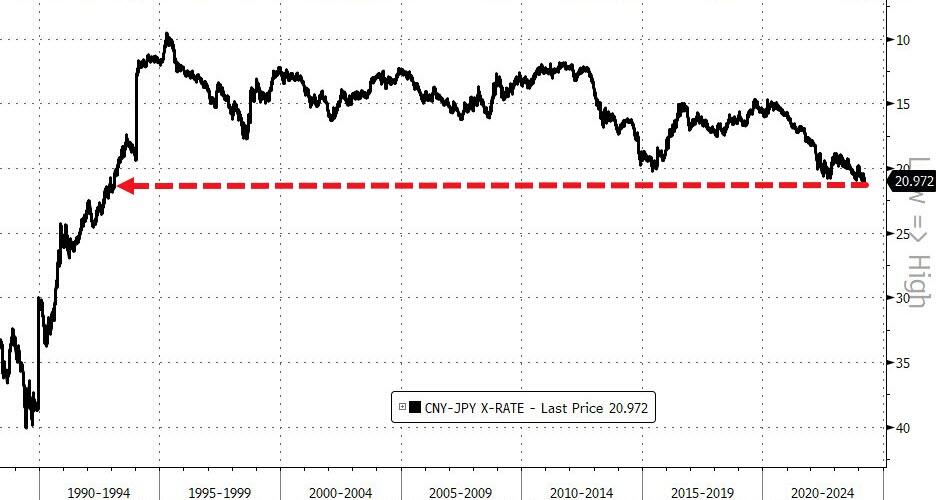
The yen is at a 30-year low against the renminbi…

Source: Bloomberg

“I do think JPY has been the biggest concern for Chinese authorities for now,” says Charu Chanana, head of FX strategy in Singapore.

“If the USD/JPY broke above 152, we could likely see the PBOC letting the onshore yuan weaken further towards 7.25.”

PBOC does not have a steady weakening bias for the yuan for now; market’s reaction to Friday’s weak fix likely “alerted authorities against playing this game”

“Too must bearishness isn’t good for a currency that has goals to be the reserve currency.”

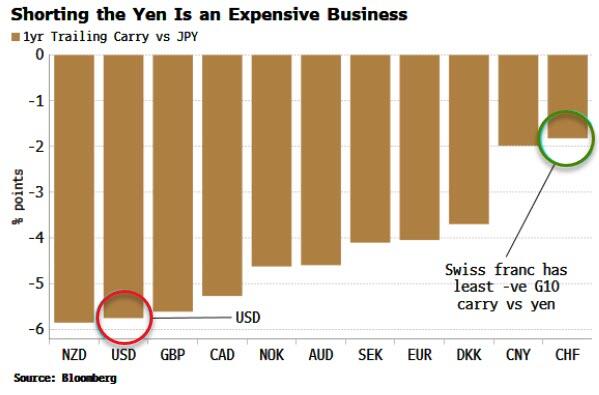
Of course, much of the recent movement in USDJPY has been driven by the lass-dovish sentiment from The Fed (stronger dollar, rather than weaker yen) and we also note that despite the rate-hike by The BoJ, the yen-carry trade (which implicitly weighs on the yen versus the dollar) continues to offer solid returns (among the highest among the majors)…

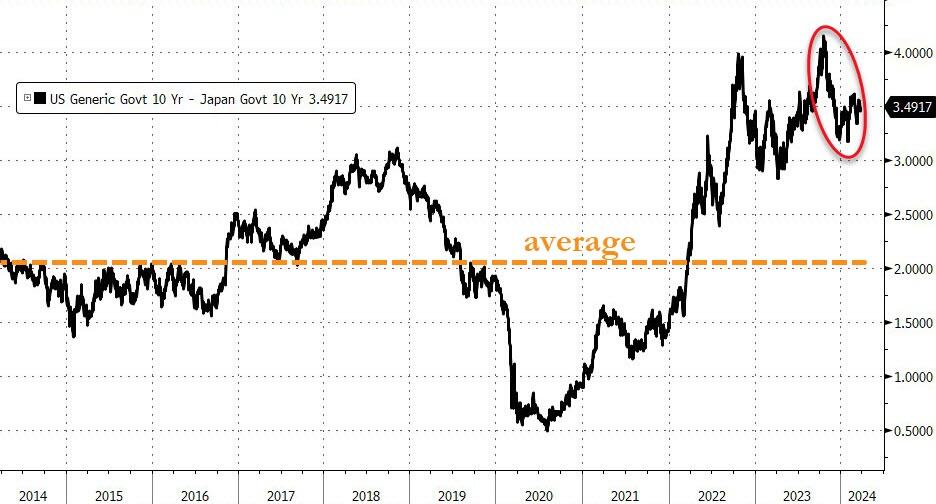
And while the 10Y TSY yield is 50bps or so off its highs relative to 10Y JGBs, it remains extremely high relative to the last decade…

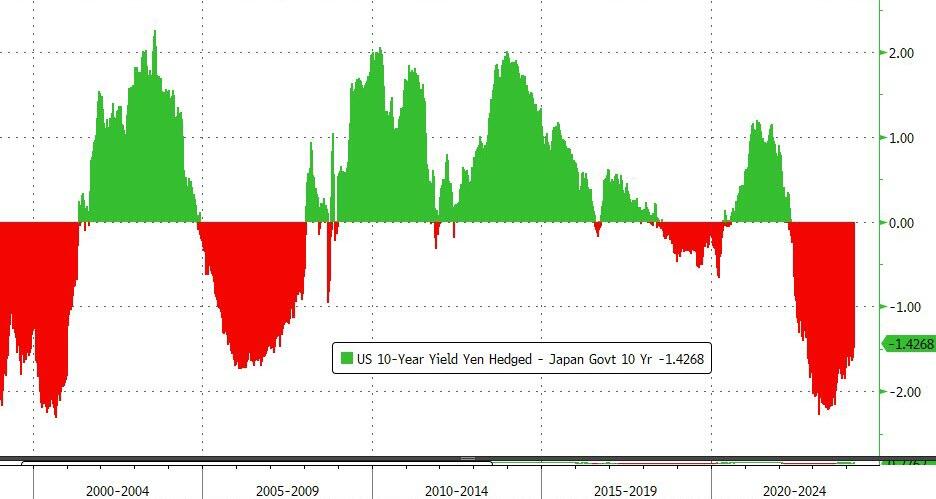
However, the cost of 100% hedging the FX risk makes the switch still unpalatable…

For now, Japanese investors may refrain from repatriating capital until the central bank becomes more hawkish, or the Fed gets closer to cutting rates.

So while USDJPY may be all about trading familiar ranges for the foreseeable future, in the longer run it is going much lower.

Tyler Durden
Mon, 03/25/2024 – 09:10

via ZeroHedge News https://ift.tt/6FURDYf Tyler Durden

“As A Trader It’s Not Your Job To Be Right, It Is To Figure Out What Others Will Do”

“As A Trader It’s Not Your Job To Be Right, It Is To Figure Out What Others Will Do”

By Eric Peters, CIO of One River Asset Management

“Why do people feel that to be a good leader, they must absolutely believe in one direction over another, one path over another, one person over another?” asked the investor, an allocator.

“Why do most people feel they have to live in a world of absolutes?” We were discussing the illusion of certainty.

“We live in a world filled with questions. And the best traders I’ve known have never been sure of anything.”

The blessing and curse of this business is that it forces us to come to terms with how little we know.

It is at once terribly humbling and awe inspiring, in that to maintain your balance you must continually seek to define a wide range of possible outcomes, possibilities.

Which is an exciting journey, requiring imagination, and a recognition that world history is the story of chance, surprise.

“The most successful traders speak in probabilities of one thing over another. Not one dares pound the table and state something with absolute certainty.”

I have friends who can change their minds twice in the same sentence. They’re the survivors. In their wake are those who needed to be right.

“Something in our nature, or perhaps society, leads us to believe that to have gravitas we need to make grand pronouncements, appear definitive. Such statements are almost always wrong.”

Yet we continue to listen, in a hopeless pursuit of certainty.

“The best leaders amongst us seem to understand that their gift is not in pointing the way, it’s in taking input, maintaining flexibility, openness, adjusting enroute,” he said.

“And as a trader, your job is to figure out what others will do because of their political and financial orientation, in a world that is unknowable, forever changing, and then make money with that.”

Tyler Durden
Mon, 03/25/2024 – 08:55

via ZeroHedge News https://ift.tt/yjsr61W Tyler Durden

Futures Slump, Dragged By Semis As Global Chip War Escalates

Futures Slump, Dragged By Semis As Global Chip War Escalates

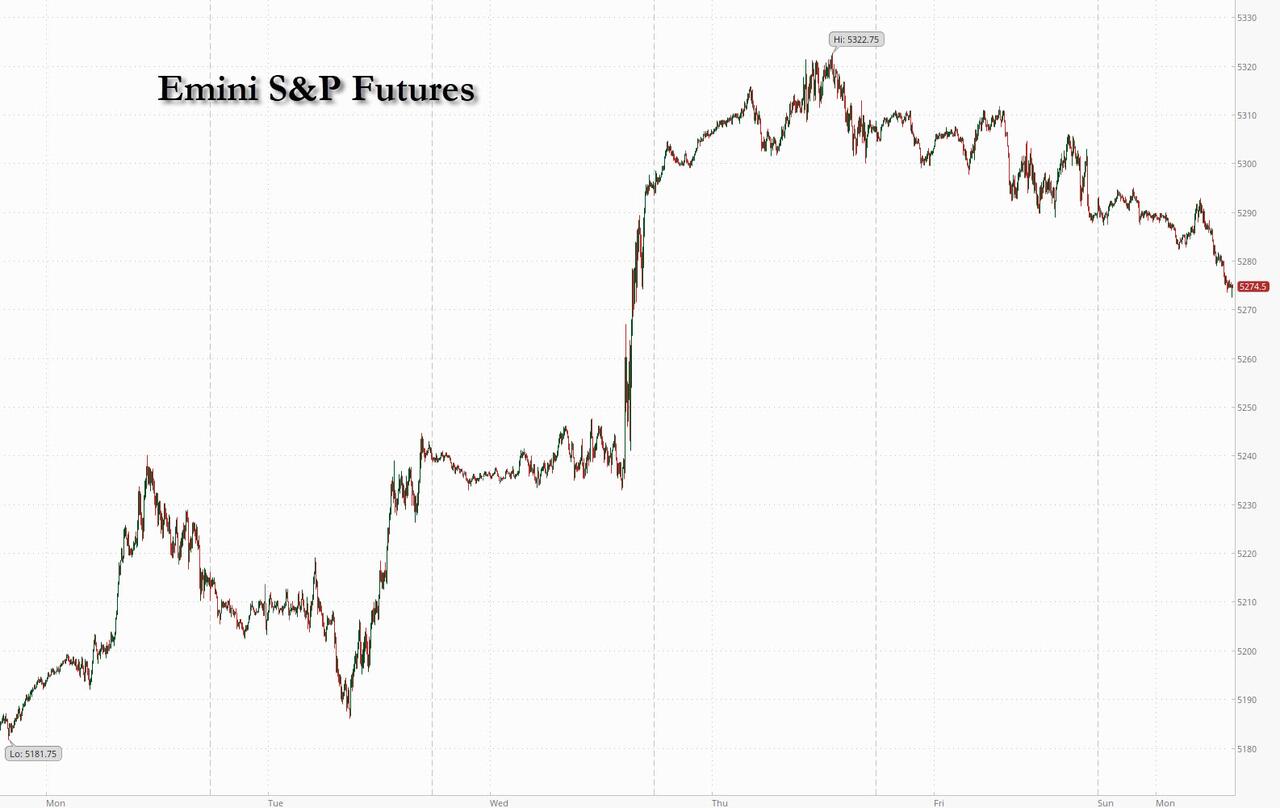
Futs are lower following the S&P’s best weekly performance of the year (sparked by dovish comments by Fed chair Powell during the last FOMC) which sent the market up +2.3%. At 7:50am, S&P futures were 0.4% lower and Nasdaq futures dropped 0.6%, dragged by MegaCap tech names which were mostly lower with AMD and Intel down more than 2% after the FT reported they are being banned from Chinese government computers; NVDA swung from gains to losses after a report that Google, Intel and QCOM execs plan on battling NVDA on AI dominance (well what else can they do?). Meanwhile, JPM says to keep an eye on NFLX on bullish headlines; stock is +29% YTD which would be third among Mag7 names. Europe’s Stoxx Europe 600 dipped following nine straight weeks of gains, the longest run in 12 years. Elsewhere, treasury yields ticked higher and the Bloomberg dollar spot index was slightly lower with the yen a tad stronger after some aggressive jawboning by cartoonish Japanese officials. Oil gained on escalating geopolitical unrest following the Moscow concert hall attack on Friday that killed at least 137 people. The next 2 weeks have a lighter macro data calendar so keep an eye on Fedspeak (3x this week) and bond auctions for bond yield catalysts which could Equity sector performance. Month-end/Quarter-end rebalancing could also pressure stocks.
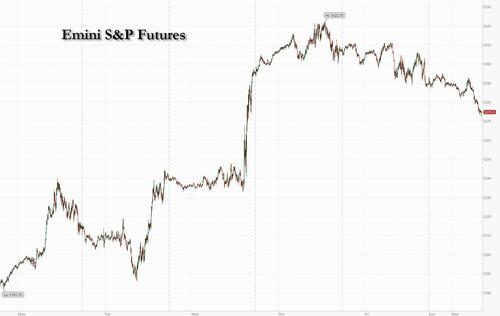
In premarket trading, Intel and AMD declined after a FT report said China was seeking to limit the use of US-made chips in government computers. United Airlines shares fell as US aviation authorities mull measures to curb growth at the carrier following a series of safety incidents. Here are some other premarket movers:

  • Canopy Growth (CGC US) rose 13%, set to extend gains for a seventh consecutive session — its longest streak since January 2019.
  • Walt Disney (DIS US) rose 1.3% after Barclays upgraded the media company to overweight from equal-weight, saying that a “narrative reset” since first-quarter results should be followed by positive estimate revisions.

As we enter a quiet week after multiple central bank shockers, traders are in wait-and-see mode ahead of economic data that will include the Fed’s preferred inflation gauge due Friday, when many markets will be closed for a holiday. While conviction has grown that the Fed will cut rates this year following dovish comments by Chair Jerome Powell last week, investors are becoming uneasy about stock valuations after the recent rally.

“When upward catalysts get rare and valuations are rich, risks become visible,” said Jeanne Asseraf-Bitton, head of research and strategy at BFT IM in Paris. “The coming weeks will be more complicated.”

European stocks slipped after a ninth straight week of gains for the index, the longest winning streak in nearly 12 years; the Stoxx slid 0.4% led by consumer product, retail and media shares which were the worst performers. Shares in European defense firms rose following a terrorist attack in Moscow on Friday evening that killed at least 137 people, in an assault claimed by the Islamic State. Dassault Aviation SA climbed 4.5% and Rheinmetall AG was up 3.6%. Swedish landlord SBB jumped after buying back a batch of bonds at a 60% discount, while Direct Line Insurance Group Plc plunged after Ageas said on Friday it won’t make a third takeover offer. Even after this year’s gains, European equity valuations are not yet over-stretched, according to Goldman Sachs Group Inc. strategists who forecast the Stoxx Europe 600 could still rise about 6% over the next 12 months. Here are some of the the biggest movers in Europe on Monday:

  • European defense stocks including Rheinmetall and Leonardo gain after a terrorist attack in Moscow on Friday evening killed at least 137 people, in an assault claimed by the Islamic State.
  • Zalando gains as much as 1.2% after Deutsche Bank raises its price target, citing the German online retailer’s balance of sales growth and margin expansion.
  • Tullow Oil rises as much as 8.1% after BofA upgrades the UK energy firm to buy after it “reached an inflection point in its deleveraging journey.”
  • Believe gains as much as 6.7% after the board invited Warner Music Group to submit a binding, unconditional and fully financed offer after its expression of interest.
  • SBB soars as much as 17% after buying back hybrid securities and notes with a total aggregate principal amount of about €408 million, at a 60% discount.
  • Inwido gains as much as 4.6% after Nordea reinitiated coverage of the Swedish window manufacturing group with a buy recommendation.
  • Gamma Communications rises as much as 4.7% after it announced a new £35 million share buyback and delivered in-line annual earnings.
  • Direct Line falls as much as 16% after Belgium’s Ageas said it will halt its pursuit of the insurer after two takeover proposals were rejected this year.
  • Kingfisher shares drop as much as 4.6% after the retailer’s full-year sales missed expectations and its 2025 outlook also disappointed.
  • Shelf Drilling and Borr Drilling both slide after DNB flagged the new “indirect risk” from Saudi Aramco scaling back its drilling.

Earlier in the session Asian stocks edged lower, dragged by selloffs in Japan and South Korea after last week’s strong rallies, while Chinese stocks advanced. The MSCI Asia Pacific Index dipped as much as 0.3%, erasing an early gain. Sony and Samsung were among the biggest drags, while China delivery firm Meituan gained after it reported better-than-expected earnings. Japanese equities declined as some investors took profit following the Nikkei 225 Stock Average’s ascent to a record high last week even as the central bank ended its negative-rate policy.

  • Hang Seng and Shanghai Comp. were initially indecisive as participants digested recent earnings releases, although eventually strengthened after the slew of rhetoric from Chinese officials including Premier Li who noted relatively big room for macro policy.
  • Nikkei 225 pulled back from record highs as investors booked profits amid some mild yen strength.
  • ASX 200 finished higher with early outperformance in property and tech owing to softer yields.

In FX, the Bloomberg Dollar Spot Index dropped 0.1%, while the yen strengthened after Japan’s top currency official warned about excessive currency speculation. The focus remains on China’s yuan after the central bank signaled its support for the managed currency. The onshore yuan rose as much as 0.5% to 7.1902 per dollar, the most since December

  • USD/JPY fell as much as 0.2% to 151.05, after Japan’s top currency official warned against speculative moves in the yen
  • USD/CNY fell as much as 0.5% to 7.19, after a stronger-than-expected daily fixing
  • Risk-sensitive currencies including the Norwegian krone, New Zealand dollar and Australian dollar led Group-of-10 gains

In rates, treasuries were slightly cheaper across the curve following similar price action across core European rates, with rate futures near lows of the day.  Treasury yields cheaper by 2bp to 3.5bp across the curve with losses led by belly, flattening 5s30s spread by 1.2bp on the day; 10-year yields around 4.23%, cheaper by 3bp with bunds and gilts marginally outperforming in the sector. The holiday-shortened week’s auction cycle begins with $66b 2-year note sale at 1pm; $67b 5-year and $43b 7-year follow Tuesday and Wednesday. WI 2-year yield at around 4.58% is ~11bp richer than February’s, which tailed the WI by 0.2bp

In commodities, oil gained on escalating geopolitical unrest following the Moscow concert hall attack on Friday that killed at least 137 people.

Bitcoin climbs higher and back on a USD 67k handle, whilst Ethereum sits just shy of USD 3.5k.

Looking at today’s calendar, the US economic data schedule includes February Chicago national activity index (8:30am), new home sales (10am) and March Dallas Fed manufacturing activity (10:30am). Later this week we get data on durable goods orders, consumer confidence, 4Q GDP revision, University of Michigan sentiment, and personal income/spending with PCE deflators. Fed speakers scheduled include Bostic (8:25am), Goolsbee (9:05am) and Cook (10:30am). Waller, Daly and Powell are slated to appear later this week

Market Snapshot

  • S&P 500 futures little changed at 5,292.75
  • STOXX Europe 600 little changed at 510.02
  • MXAP down 0.5% to 176.50
  • MXAPJ down 0.1% to 534.29
  • Nikkei down 1.2% to 40,414.12
  • Topix down 1.3% to 2,777.64
  • Hang Seng Index down 0.2% to 16,473.64
  • Shanghai Composite down 0.7% to 3,026.31
  • Sensex up 0.3% to 72,831.94
  • Australia S&P/ASX 200 up 0.5% to 7,811.94
  • Kospi down 0.4% to 2,737.57
  • German 10Y yield little changed at 2.32%
  • Euro little changed at $1.0817
  • Brent Futures up 0.4% to $85.74/bbl
  • Gold spot up 0.1% to $2,166.70
  • US Dollar Index little changed at 104.36

Top Overnight News

  • Chinese Premier Li says the country has further room to broader policy support given subdued inflation and low levels of gov’t debt. BBG
  • China has introduced new guidelines that will mean US microprocessors from Intel and AMD are phased out of government PCs and servers, as Beijing ramps up a campaign to replace foreign technology with homegrown solutions. As markets hit record highs, the ratio of corporate insider selling to insider buying is at the highest level since the first quarter of 2021, according to Verity LLC, which tracks insider trading disclosures. FT
  • The US and Japan are planning the biggest upgrade to their security alliance since they signed a mutual defense treaty in 1960 in a move to counter China. President Biden and Prime Minister Kishida will announce plans to restructure the US military command in Japan to strengthen operational planning and exercises between the nations. They will unveil the plan when Biden hosts Kishida at the White House on April 10. FT
  • The Islamic State claimed responsibility for the terror attack in Russia (and the US said it has no reason to doubt the authenticity of that claim), but Moscow/Putin suggested Ukraine could have some culpability. NYT
  • The Russian oil-export machine funding the Kremlin’s war in Ukraine is finally getting some grit in its gears. Indian oil refiners — Moscow’s second-biggest customers after China since the 2022 invasion — will no longer accept tankers owned by state-run Sovcomflot PJSC because of the risk posed by sanctions. BBG
  • Treasury issuance has expanded in recent years, sending the size of the US gov’t bond market to a record ~$27T (up ~70% since the end of ’19 and nearly 6x larger than before the ’08-’09 financial crisis). WSJ
  • Peter Thiel, Jeff Bezos and Mark Zuckerberg are leading a parade of corporate insiders who have sold hundreds of millions of dollars of their companies’ shares this quarter, in a signal that recent stock market exuberance could be peaking. FT
  • Atlanta Fed President Bostic now anticipates just one rate cut this year (his prior outlook was for two cuts), and forecasts it happening later than previously assumed. BBG
  • United is said to face temporary FAA limits on adding routes and flying customers on newly delivered aircraft after safety issues. BBG

A more detailed look at global markets courtesy of Newsquawk

APAC stocks traded mixed amid a lack of major macro drivers heading into month-end and a slew of data releases. ASX 200 finished higher with early outperformance in property and tech owing to softer yields. Nikkei 225 pulled back from record highs as investors booked profits amid some mild yen strength. Hang Seng and Shanghai Comp. were initially indecisive as participants digested recent earnings releases, although eventually strengthened after the slew of rhetoric from Chinese officials including Premier Li who noted relatively big room for macro policy.

Top Asian News

  • Chinese Premier Li said China’s economic rebound momentum continues to consolidate and strengthen with economic development off to a good start judging by the first two months and though the economy sees some fluctuations, the long-term trend of the economy turning for the better won’t be changed. Premier Li said they will carefully study the issues of market access, match of supply and demand, as well as cross-border data flows, while there will be some regulations in some of these areas soon. Furthermore, Li said China will strive to boost domestic demand and that there is relatively big room for macro policy, according to Reuters.
  • China’s Finance Minister said the government is confident and capable of achieving full-year economic and development goals, while China will prioritise support for sci-tech innovation and manufacturing development and allocate more fiscal resources to ensure employment, according to Reuters.
  • China’s Industry Minister said they will accelerate new industrialisation, promote continuous optimisation and upgrading of industrial supply chains, while they will accelerate the modernisation of the industrial system, fully abolish restrictions on foreign investment access in the manufacturing sector, and deepen in-depth cooperation with enterprises from all countries.
  • China NDRC head said the state planner will implement a batch of major sci-tech projects based on the development of new productive forces, while it will crack down on monopolies and unfair competition activity, as well as publish a new version of a negative list for market access, according to Reuters.
  • China’s Vice Commerce Minister said they will further expand high-level opening up to the outside world and create more market opportunities by opening up for development, while China will continue to tap and unleash the potential of domestic demand, providing more trade and investment opportunities.
  • China’s Commerce Minister met with Micron’s (MU) president and said that they welcome the Co. to expand its footprint in the Chinese market and ramp up investment projects while firmly obeying China’s laws and regulations, while China’s Commerce Minister also met with the chairmen of AMD (AMD), Exxon (XOM) and Medtronic (MDT), according to Reuters.
  • China blocked the use of Intel (INTC) and AMD (AMD) chips in government computers.
  • US Treasury Secretary Yellen will travel to China in April, according to POLITICO.
  • US Secretary of State Blinken said the US expresses deep concern over Hong Kong’s security law.
  • BoJ January meeting minutes noted that members said the likelihood of reaching the price goal was gradually rising and members discussed the positive and side effects of the Bank’s unconventional monetary policy. Members also agreed that Japan’s economy had recovered moderately and shared the recognition that, although exports and production had been affected by the slowdown in the pace of recovery in overseas economies, they had been more or less flat.
  • Japan’s top currency diplomat Kanda said they have been closely watching FX moves with a high sense of urgency and will take appropriate steps to respond to an excessive weakening of the yen without excluding any measures, while he added the current yen weakness does not reflect fundamentals and is due to speculation.
  • China’s STCN reports that “there are market rumours that real estate-related documents will be issued soon, which will focus on two directions” (cont)
  • Nissan (7201 JT) targets an additional 1mln units in sales by end-FY2026 vs FY2023; 30 new Models to be launched by FY26, of which 16 will be electrified; dividend and buyback to target total shareholder return of over 30%. Executive says the global EV market is not stopping but starting to plateau to more normal cadence of growth

European bourses, Stoxx600 (-0.2%) initially struggled to find direction, though succumbed to slight selling pressure as the session progressed. European sectors are mostly lower; Energy benefits from broader strength in the crude sector, whilst Kingfisher (-2.5%) weighs on Retail. US equity futures (ES -0.2%, NQ -0.3%, RTY U/C) are mostly but modestly lower, in-fitting with price action seen in Europe; AMD (-2.1%)/ Intel (-2.5%) suffer in the pre-market after China blocked the use of AMD/INTC chips in government computers. Modest pressure in Apple (AAPL), Alphabet (GOOG), and Meta (META) following the EU Commission announcing a digital-market probe into the names.

Top European News

  • UK Chancellor Hunt said the Conservative Party will keep the triple lock for pension increases in its election manifesto, according to Reuters.
  • BoE announced Q2 QT schedule on Friday in which it will sell short-dated Gilts across four auctions of GBP 800mln and will sell medium-dated Gilts across four auctions of GBP 750mln, while it will sell long-dated Gilts across three auctions of GBP 600mln with its total sales at GBP 8bln in Q2.

FX

  • USD is a touch softer vs. peers but with price action in the FX space broadly contained as newsflow has proved to be non-incremental. Current high of 104.47 is just below Friday’s 104.49 peak.
  • EUR is contained with catalysts currently lacking to inspire price action. EUR/USD holding above Friday’s 1.0801 low. June 25bps ECB cut price at ~87%.
  • Jawboning from Kanda failed to see the JPY regain much ground vs. the USD with the pair not far off the 2023 high at 151.91 and 2022 high at 151.94.
  • Antipodeans are both a touch firmer vs. the USD with not much in the way of pertinent newsflow. AUD/USD briefly pierced Friday’s low at 0.65101 but has stopped shy of testing last week’s low at 0.6503 which lies just ahead of the 0.65 mark.
  • Yuan regaining some ground vs. USD with Chinese banks said to be selling dollars and a firmer fix from the PBoC. USD/CNH down as low as 7.2327 but yet to test Friday’s 7.2175 low.
  • PBoC set USD/CNY mid-point at 7.0996 vs exp. 7.2267 (prev. 7.1004).
  • Chinese major state-owned banks were seen selling dollars for yuan in the onshore FX market to stabilise the Chinese currency, according to sources cited by Reuters.

Fixed Income

  • USTs are slightly softer ahead of a handful of speakers, New Home sales and then a 2yr sale which is potentially incrementally weighing on the fixed space; currently near lows around 110-22.
  • A relatively contained start to the week for Bunds with the docket thin on the data front, though action could stem from a handful of ECB speakers later today. The calendar doesn’t pick up within Europe until Wednesday’s Flash HICP before the EZ number post-Easter; modest downside has been seen in Bunds, to a low of 132.84 thus far.
  • Gilt price action mirrors EGBs, awaiting fresh fundamentals following the “dovish” shift by the BoE. BoE’s Mann (Hawk) will be closely watched to see if she has entirely abandoned her long-held call for further tightening; currently around 99.80.

Commodities

  • Crude is firmer despite a lack of fresh fundamental headlines, albeit remains within overnight ranges; Brent May is back around USD 86.00/bbl.
  • Weakness across precious metals as the stronger Dollar exerted pressure while Friday newsflow remains quiet; XAU dipped under yesterday’s low (2,166.45/oz) and trades within a current USD 2,162.64-2,186.13/oz range.
  • Base metals are softer across the board following the risk aversion from Chinese markets overnight coupled with the recovery in the Greenback.
  • Iraq Oil Ministry blamed foreign companies operating in Iraqi Kurdistan for a delay in the restart of crude exports from the region, while it added that OPEC and secondary sources reports show crude production between 200k-225k bpd in the region without the knowledge or approval of the ministry, according to Reuters.
  • Russia’s Kuibyshev oil refinery halts primary unit CDU-5 (70k bpd) after weekend drone attack, via Reuters citing sources.

Geopolitics: Middle East

  • A leading Hamas source said Israeli media leaks about concessions and compromises offered to Hamas are miserable propaganda aiming to cover up its intransigence and evade responsibility for obstructing the agreement in front of the families of its prisoners, according to Al Jazeera.
  • US Vice President Harris said an Israeli assault on Rafah ‘would be a huge mistake’ and she did not rule out ‘consequences’ if Israel invades Rafah, according to an interview with ABC News.
  • UN Secretary-General Guterres visited Rafah and said it is time for an immediate humanitarian ceasefire, while he added there is a clear international consensus that any ground intervention in Rafah will cause a humanitarian catastrophe.
  • UKMTO said a vessel was struck by an unidentified projectile 23NM west of Yemen’s Mukha and the resulting fire was extinguished by the crew, while the crew were reported safe.
  • “Israel Broadcasting Corporation: Truce negotiations have reached an impasse due to Hamas’ demands”, according to Al Arabiya.

Geopolitics: Moscow Terror Attack

  • The death toll from the Moscow concert hall attack on Friday was at least 137, while Russian President Putin declared a day of mourning on Sunday and said all attackers have been found and detained, according to Reuters.
  • Russia’s FSB said the perpetrators of the Moscow attack were heading towards the Russia-Ukraine border and had contacts on the – Ukrainian side, according to IFAX. There were also comments from Russian lawmaker Kartapolov who said there should be a clear answer on the battlefield if Ukraine is found to be behind the Moscow attack, according to RIA.
  • Ukrainian President Zelensky said Russian President Putin and others seek to divert blame for the Moscow concert massacre and that Putin could use the terrorists he sent to their deaths in Ukraine to stop terrorism in Russia.
  • US National Security Council spokesperson said the US government shared information with Russia earlier this month about a planned attack on Moscow, while the spokesperson added that Ukraine has no involvement in the attack on Russia and Islamic State bears sole responsibility for the attack. It was also reported that Islamic State released footage of the attack on the concert hall.
  • France raised its security alert after the attack on Moscow, according to reports citing the French PM.

Geopolitics: Other

  • Ukraine’s military said it hit two Russian large landing ships, as well as a communications centre and infrastructure used by Russia’s Black Sea fleet during strikes on Crimea.
  • Russia violated Poland’s airspace with a cruise missile attack on western Ukraine, while it was later reported that Russia’s air strike hit a Ukrainian facility in the western Lviv region and took control of the village of Krasnoye in the Donetsk region, according to IFAX.
  • Russia scrambled a MiG-31 jet after US bombers approached near the Russian border over the Barents Sea, according to RIA.
  • Gunmen reportedly stormed a police station in the Armenian capital of Yerevan, according to TASS.
  • China’s coastguard used water cannons against Philippine ships in the South China Sea, while China’s Defence Ministry warned the Philippines against provocative actions and to stop infringing and making any remarks that may lead to the intensification of conflicts and escalation of the situation. Furthermore, the Defence Ministry said China will continue to take decisive measures to firmly safeguard its territorial sovereignty and maritime rights and interests if the Philippines repeatedly challenges China’s bottom lines.
  • Philippines’ Foreign Ministry summoned the Chinese Embassy’s Charge D’Affaires and protested against aggressive actions by China’s Coast Guard and maritime militia against rotation and resupply mission over the weekend, while it added that China has no right to be in Second Thomas Shoal and demanded that Chinese vessels leave the vicinity of Second Thomas Shoal and the Philippine Exclusive Economic Zone immediately.
  • US State Department said the US stands with the Philippines and condemns dangerous actions by China in the South China Sea. This was after China said it took control measures on Philippine vessels that ‘intruded’ into the Second Thomas Shoal waters on March 23rd.
  • US and Japan plan the biggest upgrade to security pact in more than 60 years, according to FT. It was also separately reported that the US military command in Japan will be revamped, while Japan’s Chief Cabinet Secretary Hayashi said they are discussing ways to strengthen military cooperation with the US amid a move to a joint command structure in Japan but nothing decided yet.
  • North Korean leader Kim visited a tank unit and called for airtight combat readiness. It was also reported that North Korean leader Kim’s sister said bilateral relations depend on Japan’s political decision and that Japanese PM Kishida showed intention to meet with North Korea’s leader recently, according to KCNA.

US Event Calendar

  • 08:30: Feb. Chicago Fed Nat Activity Index, est. -0.34, prior -0.30
  • 09:00: Bloomberg March United States Economic Survey
  • 10:00: Feb. New Home Sales MoM, est. 2.1%, prior 1.5%
  • 10:00: Feb. New Home Sales, est. 675,000, prior 661,000
  • 10:30: March Dallas Fed Manf. Activity, est. -11.5, prior -11.3

Central Banks

  • 08:25: Fed’s Bostic Participates in Moderated Conversation
  • 09:05: Fed’s Goolsbee Appears on Yahoo Finance
  • 10:30: Fed’s Cook Speaks on Dual Mandate

DB’s Jim Reid concludes the overnight wrap

This morning we’ll publish the results of our latest Global Financial Market Survey. One of the most interesting implied threads running through it is that a “no landing” edges out “soft landing” as the most likely path for the US economy by YE 2024 with “hard landing” now a distant third. However, why aren’t markets more concerned about a “no landing” at the moment? One possibility is that respondents seem happy for central banks to tolerate an extended period of above-target inflation while macro volatility is high. They feel comfortable with this perhaps due to the fact that their 5yr inflation expectations continue to edge down. So you could say a Goldilocks “no landing” for now with the economy running hot but with central banks not leaning against it! Whether that proves too optimistic time will tell but as you’ll see at the end, US equities had their best week of the year last week largely because the FOMC seems very confident of their ability to cut rates in June even with recent hot inflation prints.

On a very related theme, the most exciting event of the week happens once markets are actually closed for the month and Q1 is done and dusted in performance terms. Strangely, the monthly US personal income and spending report, which contains the crucial core PCE, is released on Good Friday when bond and equity markets are closed. The flash CPIs in Italy and France also come out on Friday, with the Spanish print due on Wednesday. Staying on the inflation theme, Tokyo CPI is out on Thursday, with the summary of opinions from last week’s BoJ meeting on Wednesday. This will garner some attention given the once-in-a-generation shift in policy. Australian CPI is out on Wednesday.

Staying with central banks, there are lots of Fed speakers this week that can add some colour to last week’s generally dovish FOMC. They are listed in the day-by-day week ahead at the end. In terms of the key US data, today sees new home sales, tomorrow sees durable goods and consumer confidence, Wednesday the final consumer sentiment reading and pending home sales, while Thursday sees the final release of Q4 GDP, trade data, the Chicago PMI and, of course, initial jobless claims.

In terms of that core PCE print on Good Friday, DB expects +0.27% vs. 0.42% last month. In Powell’s press conference, he remarked that the month-over-month print for core PCE could be “well below 30bps” at the end of the month. Taking him at his word does offer downside risk to our economists’ forecast. They believe upward revisions to the January healthcare services prices could square these two numbers.

In Europe, our European economists’ inflation chartbook covers recent trends and their forecasts here. For March readings, they expect the headline Eurozone index to come in at 2.5% (vs 2.6% in February) and core at 3.1% (3.1%). On a country level, their projections include 2.4% for Germany (2.8% next week), 2.5% for France (3.2% Friday), 1.3% in Italy (0.8% Friday) and 3.5% in Spain (3.0% Wednesday).

In Asia, the Nikkei (-0.64%) is the worst performer, retreating from its all-time high set on Friday as the Japanese yen saw some stabilisation after the nation’s top currency diplomat offered a verbal warning on potential intervention by the government (more below). Elsewhere, the KOSPI (-0.48%) is also losing ground after opening higher while Chinese stocks are bucking the regional trend with the Hang Seng (+0.48%), the CSI (+0.38%) and the Shanghai Composite (+0.44%) edging higher. S&P 500 (-0.12%) and Nasdaq futures (-0.11%) are slightly lower. 10yr UST yields (+1.2bps) are slightly higher at 4.21% as I type.

Coming back to Japan, top currency official Masato Kanda warned against the yen’s recent weakness, commenting that it is not in line with fundamentals and is clearly driven by speculation. He added that the government is closely watching currency moves and stands ready to take appropriate action against excessive fluctuations.

Staying with Asian FX, the onshore yuan rose as much as +0.48% to 7.1943 per dollar, after the PBoC signaled its support for the currency via a stronger-than-expected daily reference rate, marking the largest strengthening bias since November.

Recapping last week now, the S&P 500 had the best week of the year, rising +2.29% amid growing optimism that rate cuts by many major central banks are now on their way. The index saw a marginal retreat on Friday (-0.14%) after hitting record highs for three consecutive sessions. Tech stocks led the gains, as the NASDAQ rose +2.85% (and +0.16% on Friday) and the Magnificent Seven jumped +4.31% (+0.89% Friday). That said, the rally in equity was still fairly broad, as the equal-weighted S&P 500 index rose +1.78% (-0.64% on Friday).

Global equities were also on the stronger side. The STOXX 600 gained +0.96% (-0.03% on Friday), whilst the DAX and FTSE 100 rose +1.50% and +2.63%, respectively. For the former, this was another record high, and for the latter, the largest weekly increase since September. Otherwise, the Nikkei was a key outperformer, soaring +5.63% (and +0.18% on Friday), after the BoJ decided to end negative rates earlier in the week without any negativity, quite the opposite as the country went a step closer to normality. The Yen fell -1.55% during the week (-0.14% on Friday) as the BoJ were seen as relatively dovish and at 151.41 closed the week within a whisker of 34 year lows.

This broader risk asset strength was driven by investors increasing their bets on the amount of expected rate cuts for this year, particularly after the relatively dovish central bank meetings across both sides of the Atlantic, including the first G10 rate cut of the cycle being delivered by the SNB. The amount of Fed cuts expected by December rose +12.4bps (and +4.4bps on Friday) to 84.5bps. The expected probability of a June cut is now 86%, up from just over 60% at the start of the week. Over in Europe, it was a similar story, with the amount of cuts priced in by year-end rising by +4.7bps for the ECB and by +18.9bps for the BoE.

The dovish backdrop drove a sharp decline in global sovereign bond yields last week. US 10yr yields fell -10.8bps on the week, including a -6.9bps fall on Friday, while 2yr yields were down -13.9bps (-4.7bps Friday). German bunds outperformed, with yields falling -11.9bps (and -8.2bps on Friday), as strong data in the latter half of the week limited the rally in US Treasuries.

The risk-on sentiment also supported a rally in other asset classes. US IG and high-yield spreads fell -1bps and -6bps, respectively, seeing their lowest weekly close since November 2021 and January 2022, respectively. In commodities, gold hit a record of $2,181/oz earlier on Thursday but fell -0.71% on Friday to $2,165/oz, although prices were still up +0.44% on the week.
Tyler Durden
Mon, 03/25/2024 – 08:38

via ZeroHedge News https://ift.tt/mp52HL7 Tyler Durden

Boeing CEO Dave Calhoun Plans To Step Down Following 737 Max Crisis 

Boeing CEO Dave Calhoun Plans To Step Down Following 737 Max Crisis 

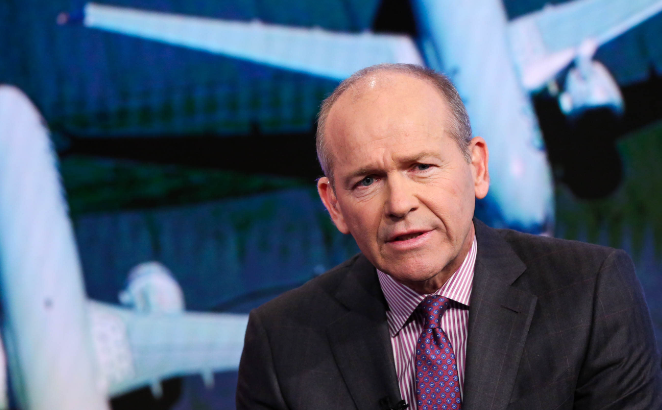
After a series of aviation mishaps, including the door plug that ripped off an Alaska Airlines Boeing 737 Max jet earlier this year and other 737 and 777 incidents in recent weeks, coupled with intensified oversight from federal regulatory bodies, Boeing CEO Dave Calhoun is stepping down at the end of the year

“As you all know, the Alaska Airlines Flight 1282 accident was a watershed moment for Boeing,” Calhoun wrote in a letter to employees. 

Calhoun continued: My decision to step down as CEO at the end of this year is one the board has been prepared for and will result in a number of changes at a management and governance level moving forward.” 

He also noted that the board’s chairman, Larry Kellner, will be stepping down at Boeing’s annual meeting in May. The board has elected Steve Mollenkopf to succeed Kellner as chair. 

In addition to these major leadership changes, Stan Deal, president and CEO of Boeing Commercial Airplanes, will retire from the company, and Stephanie Pope will lead the commercial airplanes segment. 

Last week, executives from major airlines spoke with Boeing’s board to express frustrations over quality control issues in the manufacturing process. 

Calhoun has been on a mea culpa tour, acknowledging his company’s quality control issues. He has promised investors, airline customers, and the general public about the struggles and potential changes to the company. 

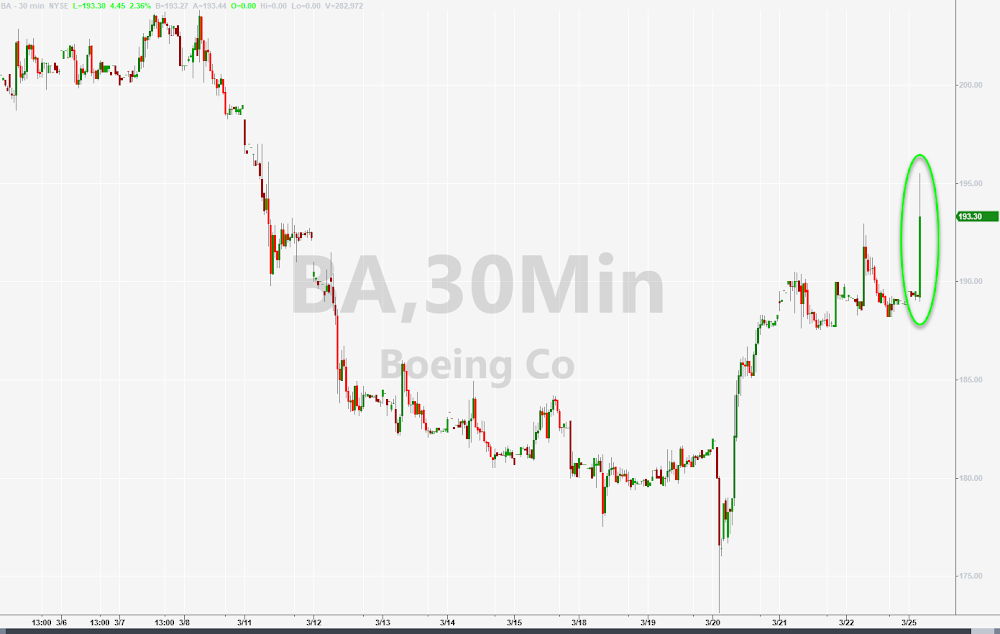
Boeing shares are up 4% in premarket trading in New York on the major shakeup. 

Calhoun replaced Dennis Muilenburg in 2019 for mishandling two deadly 737 Max crashes. 

* * *

Here’s Boeing CEO Dave Calhoun’s full letter to employees: 

Team,

As you all know, the Alaska Airlines Flight 1282 accident was a watershed moment for Boeing. We must continue to respond to this accident with humility and complete transparency. We also must inculcate a total commitment to safety and quality at every level of our company.

The eyes of the world are on us, and I know we will come through this moment a better company, building on all the learnings we accumulated as we worked together to rebuild Boeing over the last number of years.

I want to thank each and every one of you for how you have stepped up to this challenge and for the work now underway to make sure we demonstrate to all stakeholders that the Boeing of the future is everything they should expect it to be. We have been working together for the last five years to address some of the most significant challenges our company and industry have ever faced in our 108-year history. I am confident that the way we have confronted these challenges, and how we are responding to this specific moment, is establishing standards for future generations of employees and will be woven into the fabric of how we operate for decades to come.

It is the future of our company that is the subject of my letter to you today. I have been considering for some time, in discussion with our board of directors, the right time for a CEO transition at Boeing. I want to share with you that I have decided this will be my last year as CEO of our great company, and I have notified the board of that decision.

I originally agreed to take on the role of CEO of Boeing at the board’s request, stepping down as board chair in the process, because of the unprecedented circumstances the company was facing at that time. It has been the greatest privilege of my life to serve in both roles and I will only feel the journey has been properly completed when we finish the job that we need to do. We are going to fix what isn’t working, and we are going to get our company back on the track towards recovery and stability.

My decision to step down as CEO at the end of this year is one the board has been prepared for and will result in a number of changes at a management and governance level moving forward. My long-time partner in all things Boeing, our Chair Larry Kellner, has advised the board and me that he does not intend to stand for re-election at our upcoming Annual Meeting of Shareholders. The board has elected Steve Mollenkopf to succeed Larry as chair. Steve will lead the board process of selecting my successor as CEO. Larry, too, had been considering the appropriate moment to turn over the reins after more than four years as chair and 13 years on our board, and concluded that the CEO selection process should be led by a chair who will stay at the helm as a partner to the new CEO.

I want to express my deepest personal thanks to Larry for his outstanding leadership over the last number of years, and I know I speak for everyone at the company when I say, nobody could have worked harder or longer hours in dedication to his duties. Perhaps first, among the many legacies of his tenure, is profoundly strengthened governance at our company, including through his recruitment of several superb new board members, and his work with others on the board to establish our independent standing board aerospace safety committee. Larry is a professional in every way and someone to whom Boeing owes a great debt of gratitude.  

I also want to thank Steve for his willingness to take on the role as chair. Steve has had a long and extraordinarily successful career with decades of experience as both a CEO of Qualcomm and a board member of several important public companies. Since joining the Boeing board, his contribution has been extremely valuable and his professional background as an engineer will serve him and the company well in this new role. I look forward to working with him for the remainder of this year to ensure a smooth transition.

In addition to these changes, Boeing Commercial Airplanes President and Chief Executive Officer Stan Deal will retire from the company and Stephanie Pope will lead our BCA business, effective today. I want to thank Stan for his many contributions and dedication since first joining our ranks 38 years ago, and for his tireless service as our BCA leader during an uncommonly difficult period for our company and for our industry.

I also want to thank Stephanie for taking on this critical role. With nearly 30 years of experience at Boeing, including her successful tenure leading our global services business, Stephanie knows our company inside and out and has a proven track record of superb leadership, including an innate talent for listening and responding to our people. Stephanie is a third-generation Boeing employee. She is deeply committed to our company, to our employees and to our shared future; and she is the perfect person to take on the leadership of our commercial airplanes business at this moment.

As we begin this period of transition, I want to assure you, we will remain squarely focused on completing the work we have done together to return our company to stability after the extraordinary challenges of the past five years, with safety and quality at the forefront of everything that we do.  

Thank you,

Dave

Tyler Durden
Mon, 03/25/2024 – 08:28

via ZeroHedge News https://ift.tt/Mpro4uP Tyler Durden

NYC Mayor Adams Abruptly Cancels Border Trip After DHS Warns Of “Safety Concerns” 

NYC Mayor Adams Abruptly Cancels Border Trip After DHS Warns Of “Safety Concerns” 

Mayor Eric Adams abruptly canceled his trip to the southern border on Sunday after the US State Department flagged “safety concerns” amid a worsening border crisis. 

Local media outlet ABC 7 NY reports Adams was expected to leave Saturday night to tour the border area of Brownsville and McAllen, Texas, on Sunday. But DHS’ intel warned the mayor against going. 

The spokesperson for NY City Hall told the media outlet: 

“Due to safety concerns at one of the cities we were going to visit in Mexico flagged by the US Department of State we have decided to pause this visit at this time. 

“We hope to continue our partnership with these nationally-recognized Latino leaders and organizations as we look for concrete solutions to resolve the crisis at the border.”

Adams announced the trip last Thursday shortly after the nation was shocked by footage that showed a massive swarm of angry illegal aliens toppling a US National Guard checkpoint in El Paso. 

Since last summer, NYC City Hall has been ramping up efforts to show how the migrant influx in the five boroughs, swamped with 180,000 illegals, has sparked a massive financial burden for the metro area. Adams has pleaded with the Biden administration for financial assistance. The mayor even made it down to the Darien Gap, one of the world’s most dangerous migration routes in South America, last fall, which was an attempt (all for optics) by his administration to dissuade migrants from coming to American cities.

The southern border is a disaster, but while everyone focuses on that, New York’s northern border is also being invaded

Tyler Durden
Mon, 03/25/2024 – 07:45

via ZeroHedge News https://ift.tt/csgqw7X Tyler Durden

SEC Urges Supreme Court To Reject Elon Musk’s First Amendment Appeal

SEC Urges Supreme Court To Reject Elon Musk’s First Amendment Appeal

Authored by Melanie Sun via The Epoch Times (emphasis ours),

Attorneys representing the Securities and Exchange Commission (SEC) have urged the Supreme Court not to hear Elon Musk’s appeal of settlement conditions that Mr. Musk says would require that “Americans who settle their cases with the government to ‘consent’ to be gagged for life.”

SpaceX, Twitter, and electric car maker Tesla CEO Elon Musk meets with France’s President at the Elysee presidential palace in Paris on May 15, 2023. (Michel Euler /POOL/AFP via Getty Images)

Elon Musk is challenging the details of a settlement agreement he signed with the SEC requiring him to seek pre-approval for comments about Tesla, of which he is the CEO and former chairman of its board of directors.

He is arguing that his future speech “on matters ranging far beyond the charged violations” cannot be gagged as a condition of settlement by the agency.

However, attorneys for the SEC argue that because the petitioner “concede[d] that his free speech rights do not permit him to engage in speech that is or could be considered fraudulent or otherwise violative of the securities laws” in the district court, this did not preclude him from needing to abide by the settlement conditions to seek pre-approval from Tesla’s own attorneys before petitioner speaks publicly about specified matters related to the company, according to court documents.

“Further review is not warranted,” the government said.

After a social media post about Tesla by Mr. Musk in August 2018 caused “significant market disruption,” both parties agreed that Tesla Inc.’s senior executives would implement policy to require that in-house lawyers pre-approve any public written communications, including social media posts, about the company.

In his post, Mr. Musk had claimed to have “funding secured” to take Tesla private. This sent Tesla shares surging by over six percent. But the SEC sued Mr. Musk, alleging that he had misled shareholders with his remarks, which later did not eventuate.

According to the SEC’s complaint, Tesla violated SEC Rule 13a-15, which requires securities issuers to “maintain disclosure controls and procedures” to “ensure that information required to be disclosed” is properly “recorded, processed, summarised, and reported.”

Multiple future incidents involving Mr. Musk’s Twitter, later X, posts would see the SEC subpoena him on Nov. 6, 2021, over multiple social media posts on Twitter “concerning his potential sale of a large portion of his holdings in Tesla,” in violation of the agreement.

The first of the Nov. 6, 2021, Twitter posts stated: “Much is made lately of unrealized gains being a measure of tax avoidance, so I propose selling 10% of my Tesla stock. Do you support this?” The next post stated that he would “abide by the results of this poll, whichever way it goes.”

Mr. Musk, who is also the owner of X Corp. which purchased and took over Twitter, is challenging the future applicability of his initial agreement with the SEC.

Mr. Musk is seeking relief from the court from a judgment where “applying it prospectively is no longer equitable.”

After his initial challenge was declined by a federal court, Mr. Musk took his case to the 2nd Circuit Court of Appeals, which also rejected his arguments in May last year, propelling Mr. Musk to file with the Supreme Court in December.

The court of appeals observed that in his appeal, Mr. Musk was making a new argument “that any waiver of his First Amendment rights is unenforceable.” But it ruled that because he had “not made that argument before the district court,” the court of appeals deemed the argument based on the unconstitutional-conditions doctrine “forfeited.”

The court therefore never addressed the First Amendment challenging on its merits, court documents say.

On March 22, on behalf of the SEC, Solicitor General for the Department of Justice Elizabeth Prelogar urged the Supreme Court that Mr. Musk’s arguments did not deserve a hearing.

“The court of appeals declined to address petitioner’s unconstitutional-conditions argument, correctly holding that petitioner had forfeited that claim. This Court should not grant certiorari to review an issue that was not properly preserved or passed upon below,” Ms. Prelogar said.

This court has consistently held that, in resolving litigation, parties may choose to waive even fundamental constitutional rights,” she added.

Mr. Musk argued in his appeal that while he signed the agreement at the time, the terms are in violation of his inalienable First Amendment rights as protected according to the “unconstitutional-conditions doctrine.”

“The notion that an agency may wield its power to decide what parties it regulates may, may not, or must say in the future is deeply at odds with the First Amendment, including the right of the public and investors to hear what Mr. Musk has to say,” court documents say.

“Moreover, because SEC Gag Orders at issue are by their terms non-negotiable, they are unconstitutional conditions in violation of the First Amendment. A private party’s supposed ‘consent’ to a required condition of settlement cannot and does not give the federal government a power of suppression denied it by the First Amendment.”

The appeals court had argued that Mr. Musk “had ‘the right to litigate and defend against the [SEC’s] charges’ or to negotiate a different agreement.”

It cited a similar claim Romeril v. SEC, which found a voluntary agreement did not violate the unconstitutional-conditions doctrine.

The case is Musk v. SEC, 23-626.

Tyler Durden
Mon, 03/25/2024 – 07:20

via ZeroHedge News https://ift.tt/QaMAs1S Tyler Durden

China Blocks Use Of Intel, AMD Chips In Government Computers: Report

China Blocks Use Of Intel, AMD Chips In Government Computers: Report

After the US took several steps to prevent Chinese companies from acquiring both the latest Nvidia AI chips as well as Europe’s semiconductor titan ASML from sending its advanced chipmaking machines to Beijing (which resulted in a one-time flood of Chinese orders into both ASML and NVDA ahead of the sales ban which the market assumed was a recurring thing and priced out Nvidia revenue growth ridiculous higher compared to where it will end up being), China has retaliated by introducing new guidelines that will mean US chips from Intel and AMD are phased out of government PCs and servers, as Beijing ramps up a campaign to replace foreign technology with homegrown solutions, the FT reported.

This escalation in the chip war between the two superpowers in the form of stricter government procurement guidance also seeks to sideline Microsoft’s Windows operating system and foreign-made database software in favor of domestic options, and runs alongside a parallel localization drive under way in state-owned enterprises.

According to the FT, the latest purchasing rules “represent China’s most significant step yet to build up domestic substitutes for foreign technology and echo moves in the US as tensions increase between the two countries.” In the past year, Washington has imposed sanctions on a growing number of Chinese companies on national security grounds, legislated to encourage more tech to be produced in the US and blocked exports of advanced chips and related tools to China.

Chinese officials have begun following the new PC, laptop and server guidelines this year, after they were unveiled with little fanfare by the finance ministry and the Ministry of Industry and Information Technology (MIIT) on December 26. They order government agencies and party organs above the township level to include criteria requiring “safe and reliable” processors and operating systems when making purchases.

On the same day in December, the state testing agency, China Information Technology Security Evaluation Center, published its first list of “safe and reliable” processors and operating systems, all from Chinese companies.

Among the 18 approved processors were chips from Huawei and state-backed group Phytium. Both are on Washington’s export blacklist. Chinese processor makers are using a mixture of chip architectures including Intel’s x86, Arm and homegrown ones, while operating systems are derived from open-source Linux software.

The standards “are the first nationwide, detailed and clear instructions for the promotion of xinchuang”, said a local government official managing IT system substitution.

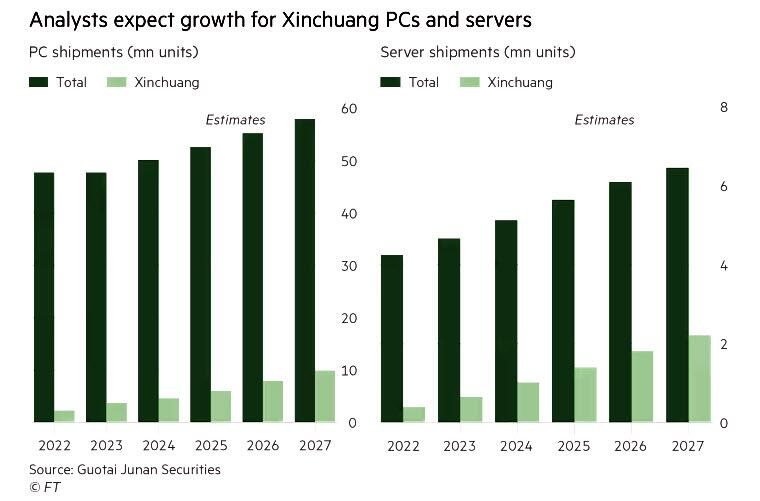
Beijing’s procurement revamp is part of a national strategy for technological independence in the military, government and state sectors that has become known as xinchuang or “IT application innovation”.  State-owned enterprises were similarly told by their overseer, the State-owned Assets Supervision and Administration Commission, to complete a technology transition to domestic providers by 2027, according to two people briefed on the matter. Since last year, state groups have begun quarterly reporting on their progress in revamping their IT systems, though some foreign technology would be allowed to remain, the people said.    

The creeping ban on US-made hardware and software means that US companies in China will be dented, starting with the world’s dominant PC processor makers, Intel and AMD. China was Intel’s largest market last year, providing 27% of its $54bn in sales and 15% of AMD’s $23bn in sales. Microsoft does not break out China sales but president Brad Smith last year told the US Congress that the country provided 1.5% of revenues.

It may be difficult for Intel or AMD ever to make the list of approved processors. To be evaluated, companies must submit their products’ complete R&D documentation and code. The top criteria for evaluation is the level of design, development and production completed within China, according to a notice from the state testing agency.  

Then again, like most regulations in China, this one too is meant to be broken. As the FT reveals after speaking with two provincal-level procurement officials, some leeway remained to buy computers with foreign processors and Microsoft Windows. But the transition is certainly in place: Lao Zhangcheng, in charge of purchasing 16 fully Chinese computers for an organization under the Shaoxing city transport bureau, said his colleagues had no choice but to get used to domestic operating systems.

“We are replacing old computers that have foreign chips,” Lao said. “After this purchase, basically everyone in the office will have a domestic computer. The old computers we have left with Windows systems can still be used under certain situations.”

Lin Qingyuan, a chip expert at research group Bernstein, said substitution would progress faster for server processors than for PCs because of the more limited software ecosystem in need of replacement. He expected xinchuang servers to account for 23 per cent of total China server shipments in 2026.

“The purchasing guidance has made the xinchuang policy more actionable for officials,” he added.

Analysts at Zheshang Securities estimate China will need to invest Rmb660bn ($91bn) from 2023 to 2027 to replace the IT infrastructure in government, party organs and eight major industries.

Tyler Durden
Mon, 03/25/2024 – 06:55

via ZeroHedge News https://ift.tt/zEhurGX Tyler Durden