Never Ever Forget

Never Ever Forget

Authored by Jeffrey Tucker via DailyReckoning.com,

Beware the Ides of March,” Shakespeare quotes the soothsayer’s warning Julius Caesar about what turned out to be an impending assassination on March 15.
The death of American liberty happened around the same time four years ago, when the orders went out from all levels of government to close all indoor and outdoor venues where people gather.

It was not quite a law and it was never voted on by anyone. Seemingly out of nowhere, people who the public had largely ignored, the public health bureaucrats, all united to tell the executives in charge — mayors, governors and the president — that the only way to deal with a respiratory virus was to scrap freedom and the Bill of Rights.

What Happened to This Document?

In addition, the Department of Health and Human Services issued a classified document, only to be released to the public months later. The document initiated the lockdowns. It still does not exist on any government website.
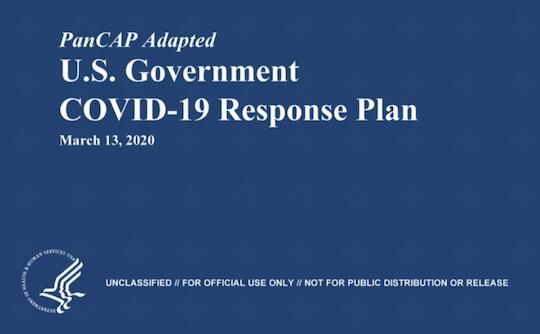
The White House Coronavirus Response Task Force, led by the vice president, will coordinate a whole-of-government approach, including governors, state and local officials, and members of Congress, to develop the best options for the safety, well-being and health of the American people. HHS is the LFA [lead federal agency] for coordinating the federal response to COVID-19.

Closures were guaranteed:

Recommend significantly limiting public gatherings and cancellation of almost all sporting events, performances and public and private meetings that cannot be convened by phone. Consider school closures. Issue widespread “stay at home” directives for public and private organizations, with nearly 100% telework for some, although critical public services and infrastructure may need to retain skeleton crews. Law enforcement could shift to focus more on crime prevention, as routine monitoring of storefronts could be important.

A Blueprint for Totalitarian Control of Society

In this vision of turnkey totalitarian control of society, the vaccine was pre-approved: “Partner with pharmaceutical industry to produce anti-virals and vaccine.”

The National Security Council was put in charge of policymaking. The CDC was just the marketing operation. That’s why it felt like martial law. Without using those words, that’s what was being declared. It even urged information management, with censorship strongly implied.

As part of the lockdowns, the Cybersecurity and Infrastructure Security Agency, which was and is part of the Department of Homeland Security, as set up in 2018, broke the entire American labor force into essential and nonessential.

They also set up and enforced censorship protocols, which is why it seemed like so few objected. In addition, CISA was tasked with overseeing mail-in ballots for the November election.

Congress passed and the president signed the 880-page CARES Act, which authorized the distribution of $2 trillion to states, businesses and individuals, thus guaranteeing that lockdowns would continue for the duration.

They wanted zero cases of COVID in the country. That was never going to happen. It’s very likely that the virus had already been circulating in the U.S. and Canada from October 2019. A famous study by Jay Bhattacharya came out in May 2020 discerning that infections and immunity were already widespread in the California county they examined.

What that implied was two crucial points: There was zero hope for the zero COVID mission and this pandemic would end as they all did, through herd immunity, not from a vaccine as such. That was certainly not the message that was being broadcast from Washington.

The growing sense at the time was that we all had to sit tight and just wait for the inoculation on which pharmaceutical companies were working.

Different Sets of Rules

By summer 2020, you recall what happened. A restless generation of kids fed up with this stay-at-home nonsense seized on the opportunity to protest racial injustice in the killing of George Floyd.

Public health officials approved of these gatherings — unlike protests against lockdowns — on grounds that racism was a virus even more serious than COVID. Some of these protests got out of hand and became violent and destructive.

Meanwhile, substance abuse raged — the liquor and weed stores never closed — and immune systems were being degraded by lack of normal exposure, exactly as some doctors had predicted.

Millions of small businesses had closed. The learning losses from school closures were mounting, as it turned out that Zoom school was near worthless.

It was about this time that Trump seemed to figure out that he had been played and started urging states to reopen. But it was strange: He seemed to be less in the position of being a president in charge and more of a public pundit, tweeting out his wishes until his account was banned. He was unable to put the worms back in the can that he had approved opening.

By that time, and by all accounts, Trump was convinced that the whole effort was a mistake, that he had been trolled into wrecking the country he promised to make great. It was too late.

Mail-in ballots had been widely approved, the country was in shambles, the media and public health bureaucrats were ruling the airwaves and his final months of the campaign failed even to come to grips with the reality on the ground.

(In this interview, I discuss how the censorship industrial complex is working to end free speech in America. I also discuss what I see coming in the November election. Go here to watch it).

Didn’t They Say Vaccines Would Prevent Infection?

At the time, many people had predicted that once Biden took office and the vaccine was released, COVID would be declared to have been beaten. But that didn’t happen and mainly for one reason: Resistance to the vaccine was more intense than anyone had predicted.

The Biden administration attempted to impose mandates on the entire U.S. workforce. Thanks to a Supreme Court ruling, that effort was thwarted but not before HR departments around the country had already implemented them.

As the months rolled on — and four major cities closed all public accommodations to the unvaccinated, who were being demonized for prolonging the pandemic — it became clear that the vaccine could not and would not stop infection or transmission, which means that this shot could not be classified as a public health benefit.

Even as a private benefit, the evidence was mixed. Any protection it provided was short-lived and reports of vaccine injury began to mount. Even now, we cannot gain full clarity on the scale of the problem because essential data and documentation remain classified.

What Exactly Happened?

After four years, we find ourselves in a strange position. We still do not know precisely what unfolded in mid-March 2020: who made what decisions, when, and why. There has been no serious attempt at any high level to provide a clear accounting much less assign blame.

Not even Tucker Carlson, who reportedly played a crucial role in getting Trump to panic over the virus, will tell us the source of his own information or what his source told him. There have been a series of valuable hearings in the House and Senate but they have received little to no press attention, and none has focused on the lockdown orders themselves.

The prevailing attitude in public life is just to forget the whole thing. And yet we live now in a country very different from the one we inhabited five years ago. Our media is captured. Social media is widely censored in violation of the First Amendment, a problem being taken up by the Supreme Court this month with no certainty of the outcome.

The administrative state that seized control has not given up power. Crime has been normalized. Art and music institutions are on the rocks. Public trust in all official institutions is at rock bottom. We don’t even know if we can trust the elections anymore.

In the early days of lockdown, Henry Kissinger warned that if the mitigation plan does not go well, the world will find itself set “on fire.” He died in 2023. Meanwhile, the world is indeed on fire.

The essential struggle in every country on Earth today concerns the battle between the authority and power of the permanent administration apparatus of the state – the very one that took total control in lockdowns – and the enlightenment ideal of a government that is responsible to the will of the people and the moral demand for freedom and rights.

How this struggle turns out is the essential story of our times.

Tyler Durden
Mon, 03/25/2024 – 13:00

via ZeroHedge News https://ift.tt/ZSOaTIi Tyler Durden
Oil Surges As US Production Unexpectedly Tumbles After Shale Merger Wave Fizzles; Russia Orders Companies To Cut Production

Oil Surges As US Production Unexpectedly Tumbles After Shale Merger Wave Fizzles; Russia Orders Companies To Cut Production

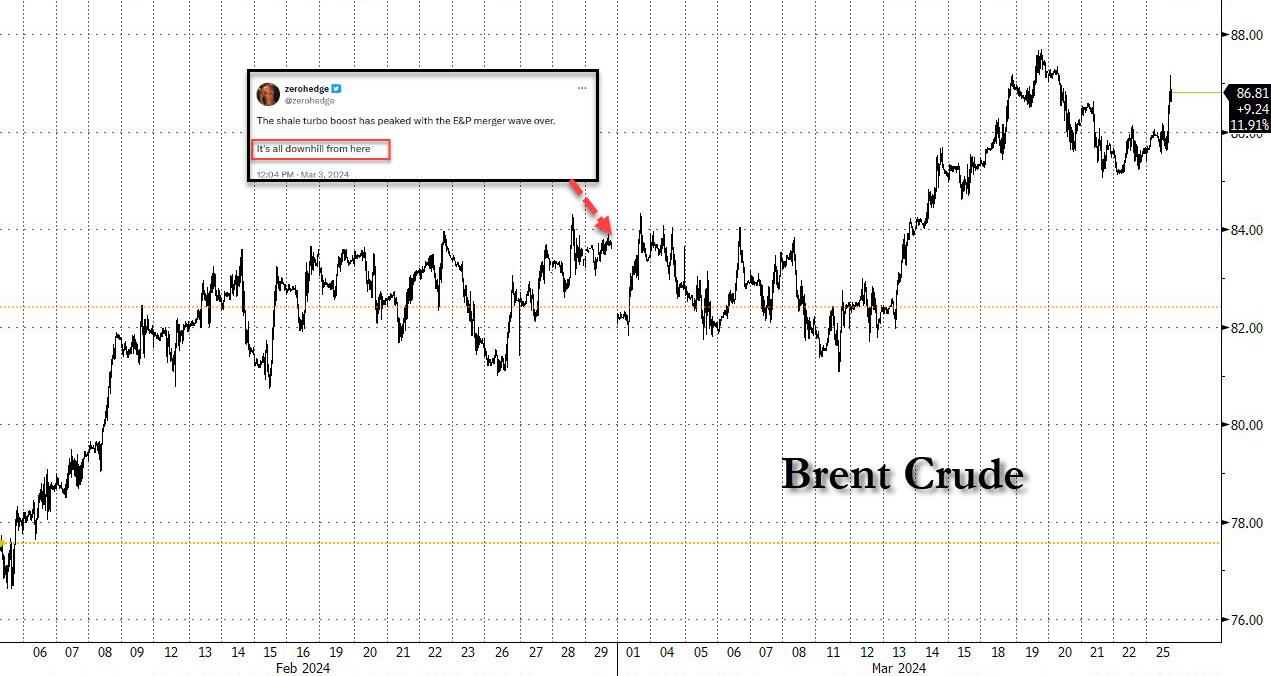
A few weeks ago we looked at the current state of M&A play in the US shale patch, and concludes that with most E&P companies – from small to XXX-large – either set acquire (or be acquired) and/or have opted for an independent future for the near-term, it was only a matter of time before the burst in oil production that defined late 2023 and early 2024, and was meant to window-dress the books of various potential acquisition targets, was about to dry out with a whimper.

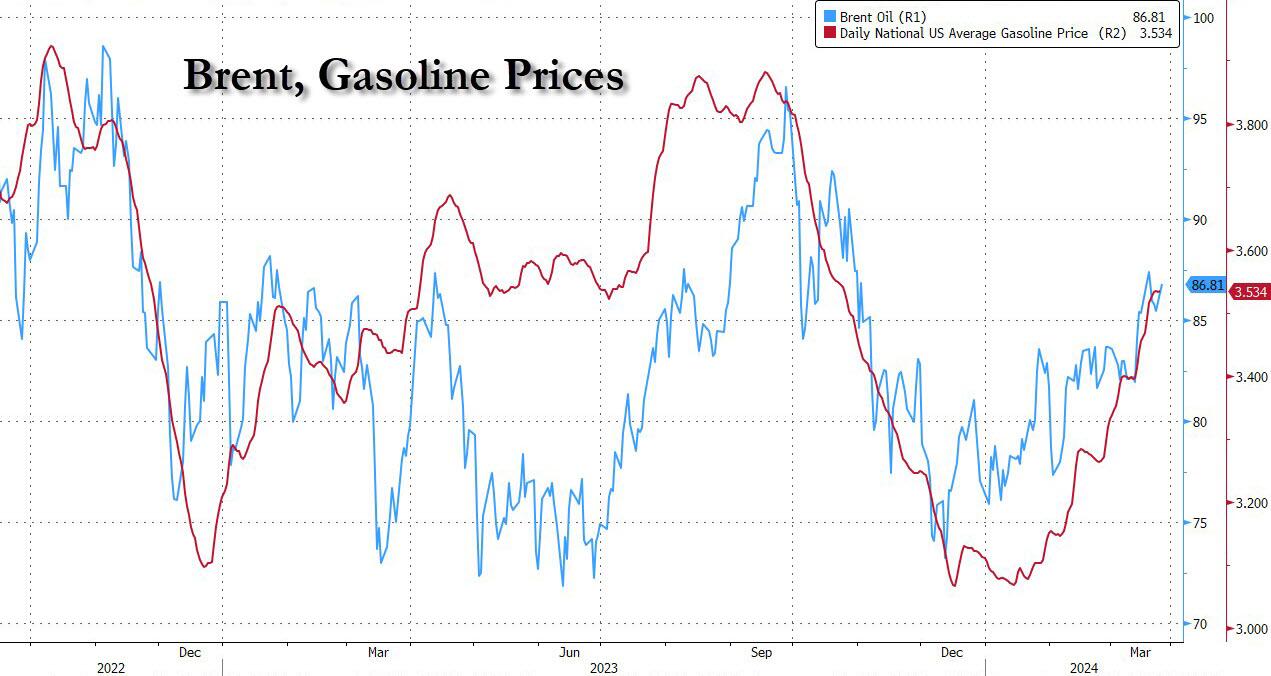
Fast forward three weeks, and what we predicted would happen has happened, along with Brent jumping to a 2024 six-month high on its way to going far higher…

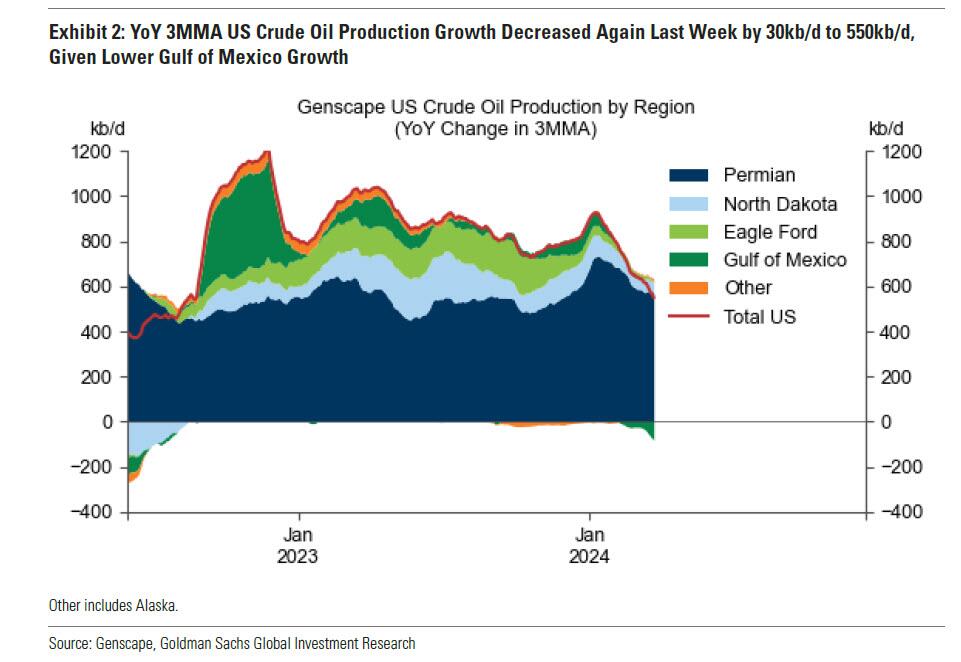
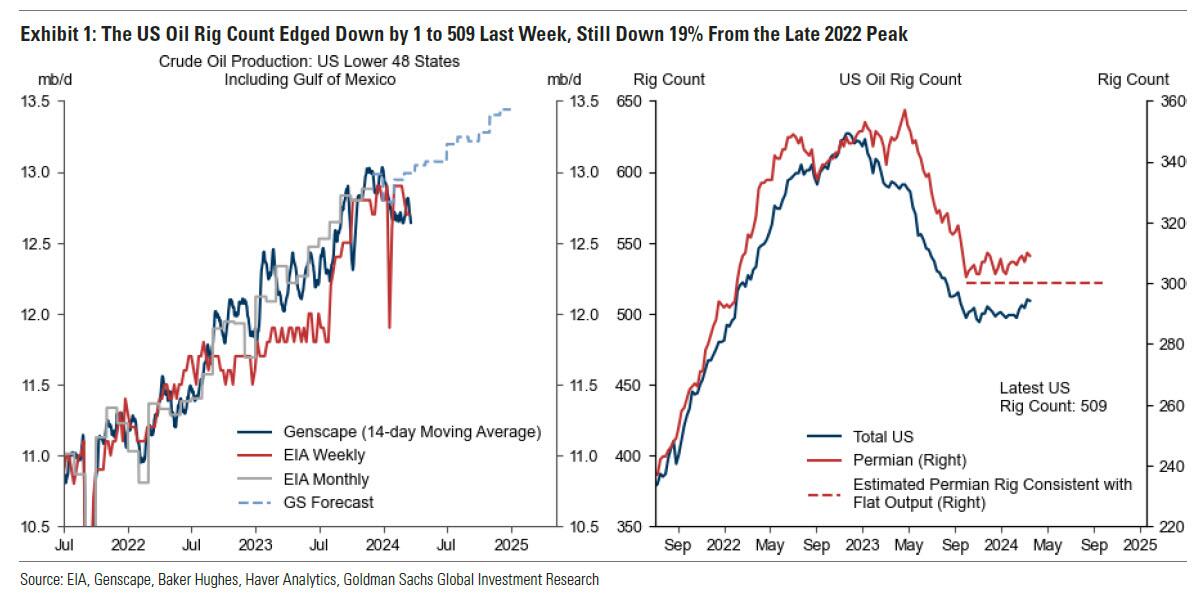
Overnight, in Goldman’s weekly Oil Tracker note, the bank’s commodity team showed in its “chart of the week” the striking observation that – at a time when everyone and their grandmother is expecting US oil production to keep rising while OPEC+ slashes its own – pipeline implied US L48 crude production has declined nearly 0.4mb/d since December to 12.6mb/d, with a 160kb/d week-on-week drop in Genscape data (14DMA). Furthermore, the 3-month moving average US crude production growth slowed to 550kb/d YoY, with softness in the Gulf of Mexico.

And just like that the biggest bear case brandished around by the oil bears crashed and burns.

Which is not to say that US shale production is about to crater to 0 and oil will hit $200 overnight: as Goldman writes in the report, other key trends of the week were mixed, with lower Russia production on the bullish side, but softness in Goldman’s China demand nowcast and the crude basis, and the sharp rise in positioning on the bearish side.

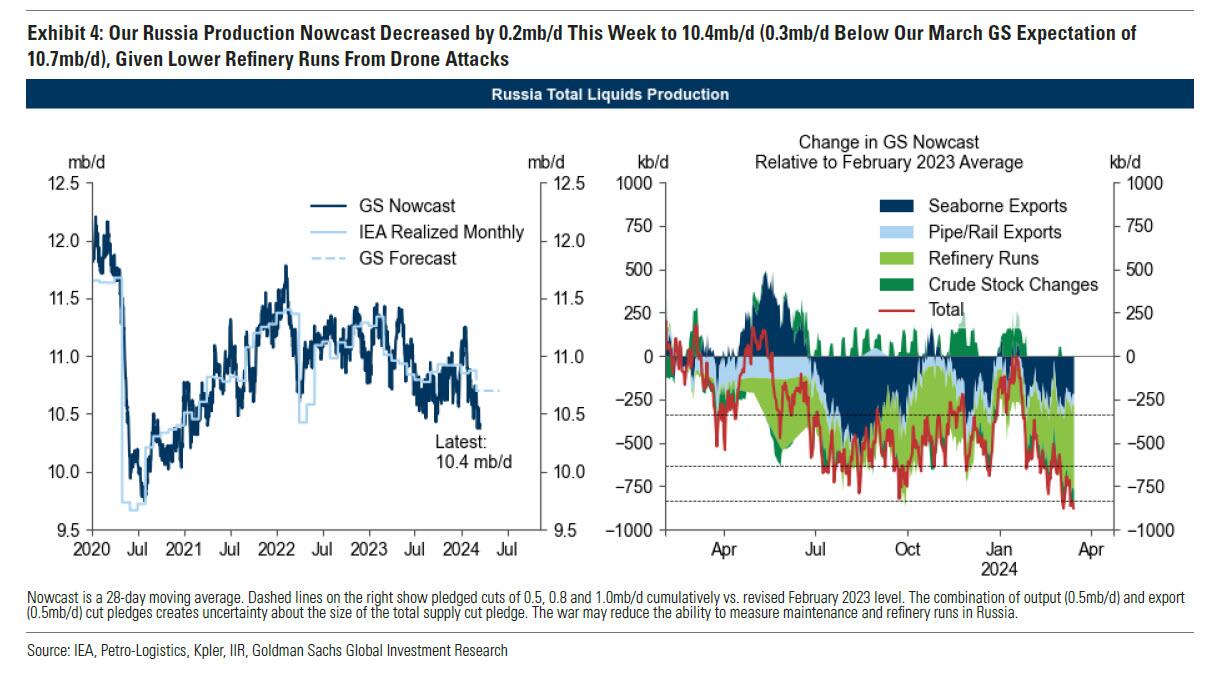
Before we turn on China, let’s first take a closer look at what’s taking place in Russia; Here Goldman notes that the bank’s Russian liquids production nowcast slipped by 0.2mb/d this week to 10.4mb/d on lower refinery runs following drone attacks that continued over the weekend.

  • Russian refinery runs decreased by 0.3mb/d since the first string of drone attacks on Russian refineries in January.
  • Russian production is now roughly in line with the pledged cuts of 1mb/d from February 2023 average.

Speaking of the plunge in Russian refinery runs, last week we learned that none other than Joe Biden himself slammed Ukraine for daring to attack the heart of Russian oil infrastructure as the guaranteed outcome are much higher gas and oil prices, which make it less likely the Fed will be able to cut rates, and thus ensure that Biden’s already abysmal approval rating will slide even further. No wonder the FT said that the “White House had grown increasingly frustrated by brazen Ukrainian drone attacks that have struck oil refineries, terminals, depots and storage facilities across western Russia, hurting its oil production capacity.” An NSC spokesperson told the FT that “we do not encourage or enable attacks inside of Russia.”

Translation: we encourage them not to attack Russian refineries.

But wait, there’s more: not only did Rosneft halt the primary unite at its Kuibyshev oil refinery in Samara after the latest Ukraine drone attack, but sensing that Biden is suddenly extremely vulnerable to further Russian production cuts, Reuters reported this morning that Russia’s government has ordered companies to reduce oil output in the second quarter.

While the stated reason is to ensure they meet a production target of 9 million barrels per day (bpd) by the end of June in line with its pledges to OPEC+, three industry sources said on Monday, Russia never before made a big stink about cheating on its OPEC+ promises, until now.  Why? Because suddenly every incremental dollar in oil costs means Biden’s approval rating drops by (at least) 1%.

And just like that, the fate of Biden’s re-election is now in the hands of the two things he hates the most: US shale companies and Vladimir Putin… as is the price of oil and gas, and expect both to keep rising for the foreseeable future crushing any last hope Biden may have had of being re-elected.

Going back to the Goldman report, the bank next turns to China where it says that its oil demand nowcast remained soft week at 15.7mb/d, and adds that “the risks to our forecast of a 350kb/d deficit in Q2 are balanced as the misses in our US supply nowcast and our China demand nowcasts are roughly offsetting.”

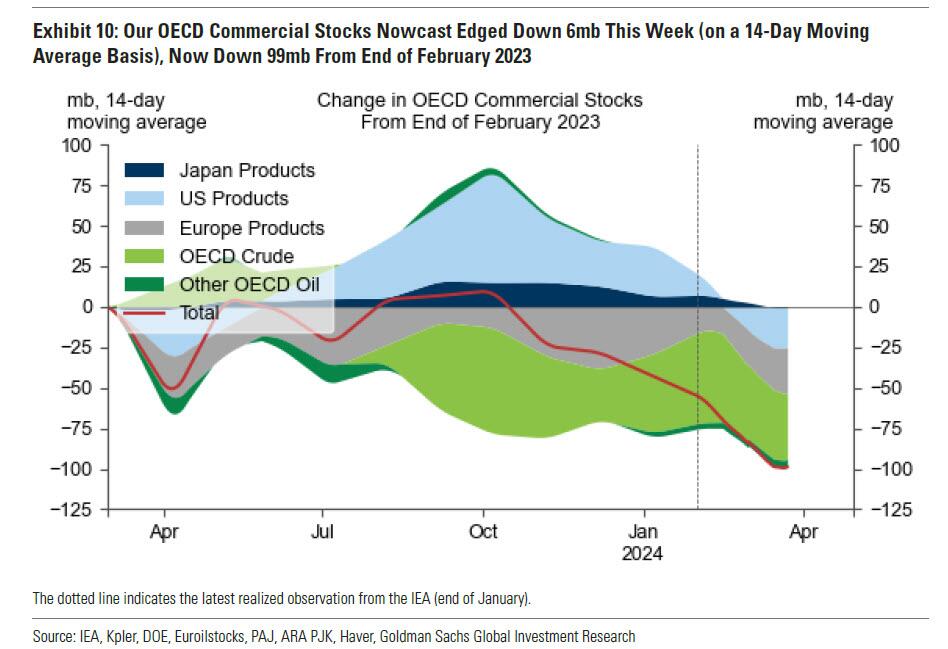
Finally, Goldman’s OECD total oil landed commercial stocks nowcast — the key variable in the bank’s crude pricing framework — remains about 19mb below its March expectations at 2,723mb.

More in the full Goldman note available to pro subscribers.

Tyler Durden
Mon, 03/25/2024 – 12:44

via ZeroHedge News https://ift.tt/hAp8QHV Tyler Durden

RFK Jr. Issues Dire Warning Over CBDC Adoption

RFK Jr. Issues Dire Warning Over CBDC Adoption

Authored by Naveen Athrappully via The Epoch Times,

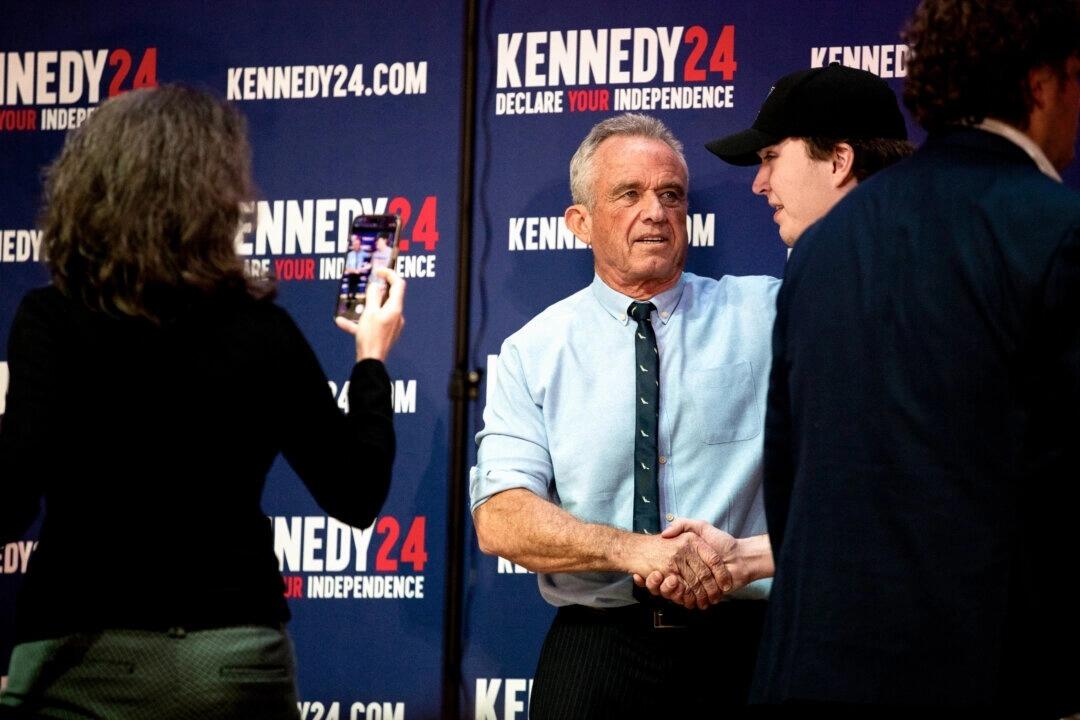
Independent presidential candidate Robert F. Kennedy Jr. warned that central bank digital currencies (CBDCs) pave the way for an authoritarian government in America similar to the Chinese communist regime.

I’m against central bank digital currencies because that is part of the path to getting us where China is today. That’s where they started, that’s where all these other countries started with central bank digital currency, and it’s the end of freedom. We will be slaves if we allow that to happen,” Mr. Kennedy said during a March 22 event. He pointed to the Canadian trucker’s protests to explain why CBDCs were dangerous for freedoms. The Canadian government portrayed the truckers “as right-wing, fascist, and racist” when they were not, he said.

“The government used facial recognition systems and other intrusive technologies to identify the participants, all the truckers. They got their license plates, etc. And then they froze their bank accounts. So they couldn’t get diesel for their trucks, they couldn’t buy food for their kids, they couldn’t pay for their education, they couldn’t pay their mortgages.”

A trucker told Mr. Kennedy that he was going to jail for being unable to pay his alimony.

“It occurred to me that transactional freedom is as important as freedom of the press. If you have freedom of speech in the First Amendment, and yet when you exercise that speech, the government doesn’t like it, they can starve you to death, they can throw you out of your home because you can’t pay your mortgage or your rent, then that is meaningless.”

Transactional freedom is “absolutely critical” for freedom of speech to exist, he said. “If we get a central bank digital currency, they’d do what they do in China.”

In China, people pay for groceries and gasoline using their “face,” he said, referring to facial recognition systems. The Communist regime keeps a social credit score on its citizens so that anyone found violating regulations will face penalties and restrictions, like potentially restricting an individual’s access to grocery stores within a certain radius of their house or workplace.

“You can’t buy gas, you can’t buy an airplane ticket, you can’t buy anything else. So, you’re basically under home confinement. Like the truckers in Canada, they were never charged with a crime. They were certainly never convicted,” he said.

“It was just they were doing something the government didn’t like. The government was able to destroy their lives, and that is a very dangerous power to give government.”

CBDC Dangers

In addition to Mr. Kennedy, several other prominent individuals have raised concerns about central bank digital currencies, including former President Donald Trump. During a campaign stop in New Hampshire in January, President Trump vowed to “never allow” the U.S. Federal Reserve to issue a CBDC.

“As your president, I will never allow the creation of a central bank digital currency. Such a currency would give the federal government absolute control of your money,” he said.

“This would be a dangerous threat to freedom and I will stop it from coming to America.”

In a July 2023 video, Brexit leader Nigel Farage highlighted the dangers of government control over currencies.

“The ultimate fear is if we get CBDCs, we could finish up like the Canadian truckers, people who were within the law, found themselves outside the law and had their bank accounts frozen. Controlling people’s money would be the ultimate form of tyranny.”

Several key international figures admitted that CBDCs will allow for greater control over people’s finances.

During a seminar back in 2020, Agustin Carstens, general manager of the Bank for International Settlements, pointed out that “we don’t know who’s using a $100 bill today, and we don’t know who’s using a 1,000-peso bill today.”

The key difference with the CBDC is “the central bank will have absolute control on the rules and regulations that will determine the use of that expression of central bank liability, and also we will have the technology to enforce that,” he explained.

In October 2022, IMF Deputy Managing Director Bo Li said that CBDCs “can allow government agencies and private sector players to program, to create smart contracts, to allow targeted policy functions.”

He went on to explain that CBDCs can be used to control items like welfare money, food stamps, and consumption coupons.

A February paper from the Bank of Canada research warned that CBDCs could negatively affect bank deposits.

“The CBDC would directly compete with bank deposits in the market for digital money. As a consequence, there are concerns that a CBDC could substantially crowd out bank deposits, which may undermine financial stability by raising the funding cost and reducing the profitability of the banking sector,” the paper said.

Republican senators led by Sen. Ted Cruz (R-Texas) have introduced a proposal seeking to ban CBDCs in the United States.

“The Biden administration salivates at the thought of infringing on our freedom and intruding on the privacy of citizens to surveil their personal spending habits, which is why Congress must clarify that the Federal Reserve has no authority to implement a CBDC,” Mr. Cruz said in a Feb, 26 statement.

“I’m proud to lead the fight in the Senate to restrict the Federal Reserve’s exploration of and attempt to introduce a CBDC to the American economy.”

Tyler Durden
Mon, 03/25/2024 – 12:20

via ZeroHedge News https://ift.tt/ZptXdVH Tyler Durden

“Kill Them All”: Putin Allies Lobby For Return Of Death Penalty After Terror Attack

“Kill Them All”: Putin Allies Lobby For Return Of Death Penalty After Terror Attack

Russia’s notoriously outspoken former president and current senior security official Dmitry Medvedev channeled the Russian populace’s outrage in wake of the Crocus City Hall terror attack which happened Friday, and resulted in 137 people killed and at least 182 others wounded.

Medvedev stated on Telegram, “Should we kill them? We should. And we will.” The attack on the concert venue and mall complex by four gunmen, which ISIS-K has claimed responsibility for, marks the deadliest terror attack on Russian soil since the September 2004 Beslan school siege.

Crocus City Hall auditorium, the day after the attack: Wiki Commons

The former president continued by saying “it’s more important to kill everyone involved” in the Crocus City Hall attack, beyond just the four suspected gunmen who made an appearance in court Sunday to settle the matter of pre-trial confinement. In total, eleven suspects were apprehended, but little information has been released on the others, none of which are said to be Russian nationals.

“All of them: those who paid, those who sympathized [and] those who helped,” said Medvedev of those who may have collaborated or helped plan the attack. “Kill them all,” he emphasized.

Currently, there are growing calls from Russians for the federal government to reinstate the death penalty. “Senior members of Russian President Vladimir Putin’s regime have called for the country to bring back the death penalty following Friday’s attack on a Moscow concert hall,” AFP writes.

“Critics have sounded the alarm over the demand, including due to Russia’s broad use of counter-terrorism and anti-extremist laws to target Kremlin opponents and supporters of Ukraine,” the report continues. A moratorium on capital punishment has been in place since the 1990s nationwide. 

Vladimir Vasilyev, head of the ruling United Russia party in the State Duma, said over the weekend: “Now a lot of questions are being asked about the death penalty.”

The four alleged gunmen showed signs of brutal interrogations, possibly even torture, as they were hauled into a Moscow court on Sunday.

Vasilyev added: “This topic will definitely be deeply, professionally and substantively worked out. A decision will be made that will meet the mood and expectations of our society.”

By the sound of that statement, and the temperature of the current ‘national mood’ as mourning gives way to anger – the government could be ripe to undo the ban on capital punishment.

Meanwhile, some say there’s no need for the death penalty as… “we’ve got Siberia”:

Tyler Durden
Mon, 03/25/2024 – 12:00

via ZeroHedge News https://ift.tt/Okfj2Cl Tyler Durden

Peter Schiff: Inflation Bloodbath On The Way

Peter Schiff: Inflation Bloodbath On The Way

Via SchiffGold.com,

This time Peter tackles Jerome Powell’s speech from Wednesday, in which he announced that the Fed is holding the federal funds rate between 5.25 and 5.5%. He also briefly discusses Bitcoin’s pullback and the media’s lies about Donald Trump.

On Powell’s announcement, several commodities surged in price, with silver, gold, and copper performing especially well. Peter sees this as a repudiation of Powell’s messaging:

“I think we’re on the verge of the biggest bull market in commodities since the 1970s. Of course, this flies in the face of Powell claiming that inflation is going to go back down to two percent. There’s no chance that inflation is going to go back down to two percent! All the data shows that inflation is on the way up. Plus, if you understand what inflation is, it has nowhere to go but up.”

A hotter-than-expected Producer Price Index (PPI) report last week also contradicts Powell, with the PPI increasing from last month by more than twice the most conservative estimates. The PPI, in addition to a recently announced 13% federal deficit increase, does not bode well for the economy:

“This is why we have inflation. It’s driving prices higher. All this money is being spent. How can it not bid up prices? This is why the Fed is not only going to taper the QT [quantitative tightening] program but go back to quantitative easing because government spending is going ballistic. And all of it is stoking the fires for inflation. … There’s no downward pressure from five and a quarter, five and a half percent interest rates. Those rates are still too low.”

Peter expects rate cuts in the future. Every political force incentivizes the Fed to cut rates soon:

The Fed is cutting rates come hell or high water. It doesn’t matter what the data is. The Fed is going to cut rates because the country is broke. They’re not cutting rates because they won the war against inflation: they lost that war. They’re cutting rates because they have to avoid a financial crisis— a banking crisis. They want to try to reelect Joe Biden. They want to try to save the government from having to default and cut social security and cut Medicare, and so everything’s going to be cut through inflation.”

Powell’s dovish remarks are a textbook case of the Fed’s inability to unwind its policies. Once it starts manipulating the dollar, it can’t go back:

“Bernanke— in 2009, when the Fed just started to increase the balance sheet— said that, ‘After the emergency, we’re going to bring it right back down to where we started. We’re not going to keep any of the bonds that we bought, because we’re not a banana republic. We don’t monetize government debt.’ Well, now you have Jerome Powell saying, ‘We are a banana republic. We do monetize debt because we want to maintain an ample balance sheet.’”

The one thing Powell got right is that rising wages are a symptom of inflation, not its cause:

If wages are going up, that’s a sign that there’s still an inflation problem. … It’s like when you take your temperature with a thermometer and you know you’re sick. The thermometer is not making you sick. You’re sick because there’s something wrong with you. The thermometer is simply allowing you to confirm that you’re sick.”

The Fed’s inability to handle inflation has sentenced the economy to a grim fate:

We haven’t experienced anything like that since the 1970s. The difference is we’re in much worse shape economically than we were in the 1970s, and we don’t have the ability to put out this fire. We’re not going to get another Ronald Reagan. We’re not going to get another Paul Volker, and even if they were there, they couldn’t do what they did back then because of the financial position, the weak position that America now occupies that it didn’t occupy back in 1980. So it’s a whole different ball game, and it’s going to have a very different ending.”

With hopes of rate cuts sparked by this week’s report, more cheap credit will only add fuel to the raging flames of inflation.

Tyler Durden
Mon, 03/25/2024 – 11:40

via ZeroHedge News https://ift.tt/7w8QYn0 Tyler Durden

“It looks like fly sh*t to me. . .”

I’m on my way back home from Mexico City after an incredible weekend event here with more than 100 of our Total Access members.

First things first, if you’ve never been to Mexico City, I highly recommend it. A lot of people have a misconception that the city is some kind third world dump. It’s not. And most first-time visitors are stunned by the vast green areas, expansive parks, tree-lined streets, museums, architecture, and modern lifestyle.

In my opinion it also has some of the best restaurants in the western hemisphere. You can eat extremely well in Mexico City, but you don’t pay very much for it.

The event we held for our Schiff Sovereign Total Access members was also pretty great.

I started off the conference explaining why we should expect higher inflation in the future– and I’ve written about this extensively. The US government’s own projections call for $20 trillion in additional debt over the next decade. And frankly we think they’re woefully underestimating the problem.

But even $20 trillion will likely prove catastrophic. That would mean the US national debt will reach $55 trillion.

If yields remain at today’s levels (roughly 4.5%), then the government will have to spend nearly $2.5 trillion per year, just to pay interest on the debt. That would make interest on the debt the #1 expense of the federal government, triggering a vicious cycle in which the Treasury Department would have to borrow more and more each year just to be able to pay interest on the money they’ve already borrowed.

To say this is unsustainable would be a massive understatement. And we believe that the Federal Reserve will step in to bail out the government by slashing interest rates to zero (or even negative levels).

Think about it– if the national debt is $55 trillion, but the interest rate on that debt is literally 0%, then the government’s annual interest bill is zero… essentially saving them $2.5 trillion per year.

Sounds great. But it would come at substantial cost.

For the Federal Reserve to lower rates, it would require them to dramatically increase the money supply, what we typically refer to as ‘printing money’. They’re not actually printing physical currency– it all happens electronically. But the effect is the same: it’s highly inflationary.

When the Fed ‘printed’ $5 trillion during the pandemic, the US economy saw 9% inflation. So, if the Fed prints $20 trillion or more to push interest rates down to zero, how much inflation will be see then?

No one knows. But it probably won’t be their magical 2% target.

My partner Peter Schiff came on the stage later and made similar comments. And with this inflationary scenario in mind, we sketched out a number of strategies, both personal and financial, that would make sense in the coming years.

It would be easy to study this problem and come away with a sense of dread. After all, a $55+ trillion national debt and $2.5 trillion in annual interest expense looks pretty scary. (Remember, these are based on the government’s own forecasts.)

But if you can understand the trend and its consequences, then you can also take completely rational steps to reduce their impact. That’s the entire concept behind a Plan B.

Peter and I both see overwhelming evidence of substantial inflation in the future. But this means we can prepare for it now, rationally. And we outlined a number of strategies to do so.

One rather obvious one is gold. And we talked about why gold will likely become very important in the future. My personal view is that gold will eventually displace the dollar as the global reserve standard, i.e. how foreign governments and central banks settle their accounts.

With a $55+ trillion projected national debt, and $2.5 trillion in annual interest expense, it’s hard to imagine the rest of the world continuing to allow the US dollar to remain the dominant reserve currency.

And it would be a similar outcome if the Fed ‘prints’ tens of trillions of dollars.

Either way, we see the dollar’s reign as the dominant reserve currency coming to an end over the next decade.

But since no one trusts the Chinese government, or some new ‘BRICS dollar’, gold is the most likely candidate to replace the US dollar since every government and central bank on the planet already owns it… and has confidence in it.

Gold has the added benefit that no single government controls it. And so single country dominates gold production; China, Russia, the United States, Canada, etc. all produce substantial quantities each year.

We later heard from a colleague of mine who runs one of the largest precious metals storage facilities in the world, based in Singapore. He gave me an insider’s view of the gold and silver markets, and sketched out why there may be a shortage coming, especially in silver.

He explained how many of the world’s largest commodities and metals exchanges have seen dwindling stockpiles… while many mines are doing direct ‘offtake’ agreements with large industrial consumers (like electronics companies).

The end result has been a trend of declining physical silver availability, and he believes this will ultimately drive the silver price much higher.

He added that silver is currently quite cheap compared to gold, with the silver/gold ratio currently at about 90:1, versus its historic average over the past several years of roughly 70.

We also had a presentation from a venture capital firm that talked about buying shares of prominent startups (Airbnb, SpaceX, etc.) in the secondary market, i.e. from employees or early-stage investors seeking liquidity. It’s an interesting way to take a discounted position in a high growth business whose value could explode in an inflationary environment.

As one could expect right now, there was also ample discussion about cryptocurrency, including a mini-debate between Peter and our guest Mark Moss, who also spoke at the event. More on that another time.

Perhaps my favorite part was hearing from the former President of Mexico, Vicente Fox. He spoke in the morning about how many short-sighted and dangerous leaders are ruining the world… and I couldn’t agree more.

During a Q&A session later, he told the crowd about the time that George W. Bush came down to Mexico to convince him to support the war in Iraq.

Former President Fox told us that Bush’s team rolled out maps of Iraq onto his desk and pointed at a tiny speck, saying, “There are the weapons of mass destruction.”

Fox stared closely at the table and brought his face closer to where they were pointing, and said, “It looks like mierda de mosca to me…” That’s Spanish for ‘fly shit’.

I want to extend my sincerest thanks to all the members who joined us for a wonderful weekend in Mexico City. The event, the restaurants, the personal discussions with each of you, and the camaraderie were all unforgettable.

Source

from Schiff Sovereign https://ift.tt/DlvRYbW
via IFTTT

Trump Bond Reduced To $175 Million At 11th Hour

Trump Bond Reduced To $175 Million At 11th Hour

A New York court of appeals has significantly reduced the bond required to stop his properties from being seized by authorities from $464 million to $175 million, in order to appeal his New York civil fraud trial.

The decision by a five-judge panel of appellate court judges, comes after the real estate mogul claimed he would have to sell properties in a “fire sale” to raise cash.

Had the court denied Trump’s request, and he had failed to obtain the full bond amount, Trump was at risk of losing his bank accounts, followed by some of his properties.

His attorneys had asked the appeals court to either waive the bond requirement or reduce it, arguing that the $464 million judgement against Trump and his family was likely to be overturned on appeal.

Trump has 10 days to post the bond.

Tyler Durden
Mon, 03/25/2024 – 11:22

via ZeroHedge News https://ift.tt/AqRk0Bu Tyler Durden

Kamala Harris Gets Humiliated In Puerto Rico

Kamala Harris Gets Humiliated In Puerto Rico

Authored by Paul Joseph Watson via Modernity.news,

A video shows Vice President Kamala Harris clapping along with a song during her visit to Puerto Rico, before being told that the song is actually a protest against her.

Well, this is awkward.

Harris was visiting the Goyoco community center in the Santurce neighborhood of San Juan when her motorcade was confronted by dozens of loud demonstrators, one of whom held a sign saying “Kamala Harris war criminal”.

Unable to take the hint, Harris then reacted to a group of musicians thinking they were welcoming her.

After clapping along and smiling inanely, Harris was informed by her aide that the musicians were actually singing, “We want to know, Kamala, what did you come here for?… Long live Free Palestine and Haiti too!”

“We want to know what you think of the colony,” they also asked.

Harris then quickly clasped her hands together and looked sheepish, but still bizarrely continued nodding along anyway.

She’s never been the sharpest knife in the drawer, has she?

*  *  *

Your support is crucial in helping us defeat mass censorship. Please consider donating via Locals or check out our unique merch. Follow us on X @ModernityNews.

Tyler Durden
Mon, 03/25/2024 – 10:55

via ZeroHedge News https://ift.tt/DMGS0Qd Tyler Durden

Double-Bottom? European NatGas Jumps On Russia Missile Attacks On Ukraine’s Energy Grid

Double-Bottom? European NatGas Jumps On Russia Missile Attacks On Ukraine’s Energy Grid

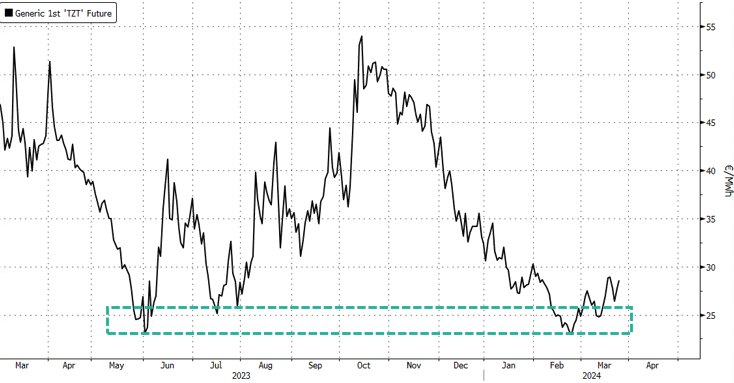
European natural gas prices have constructed what appears to be a double-bottom, around the 25 euros a megawatt-hour level. Prices are moving higher Monday morning as a war risk premium returns following Russia’s massive aerial attack on Friday in what Ukrainian officials said was the biggest bombardment on its energy infrastructure since the start of the war. 

The front-month futures at the TTF hub, the benchmark for Europe’s gas trading, jumped as much as 8.1% on Monday before settling 6.7% higher—the largest daily advance since January 3, according to Bloomberg data. Prices have been halved to 25 euros after peaking around the 53 handle last October, mostly due to above-average weather producing large inventories across Europe during the winter season. 

On Facebook, Oleksiy Chernyshov, chief executive officer of state-run Naftogaz Ukrainy, said Russia unleashed drones and missiles on Friday and over the weekend that damaged Ukraine’s power and gas facilities. He noted that missiles struck an underground NatGas storage facility in the western part of the country; despite this, pipelines weren’t severely disrupted, and supplies to foreign customers were all met. 

Bloomberg noted, “Ukraine has been advertising itself as a storage haven for European traders awash with gas. Almost 80% of its underground capacity is located in the west of the country, far from the front line and in areas that have suffered relatively limited airstrikes during Russia’s invasion, now into its third year.” 

Traders are placing a rising war risk premium on energy markets as a new phase in the Russia-Ukraine war accelerates over who can destroy each other’s energy infrastructure the fastest. Prices are also moving higher on news that the Freeport LNG export plant in Texas reduced flows over the weekend. Norway also experienced an unplanned outage and reduced pipeline NatGas exports. 

“Freeport and Ukraine attacks on Russian energy infrastructure are probably the main drivers,” Ole Sloth Hansen, head of commodity strategy at Saxo Bank A/S, wrote in a note. He said there are no bearish drivers” in the market today. 

Hansen noted that EU NatGas prices are tracking higher on rising geopolitical risk with Brent crude prices. 

Tyler Durden
Mon, 03/25/2024 – 10:35

via ZeroHedge News https://ift.tt/AC6cRFm Tyler Durden

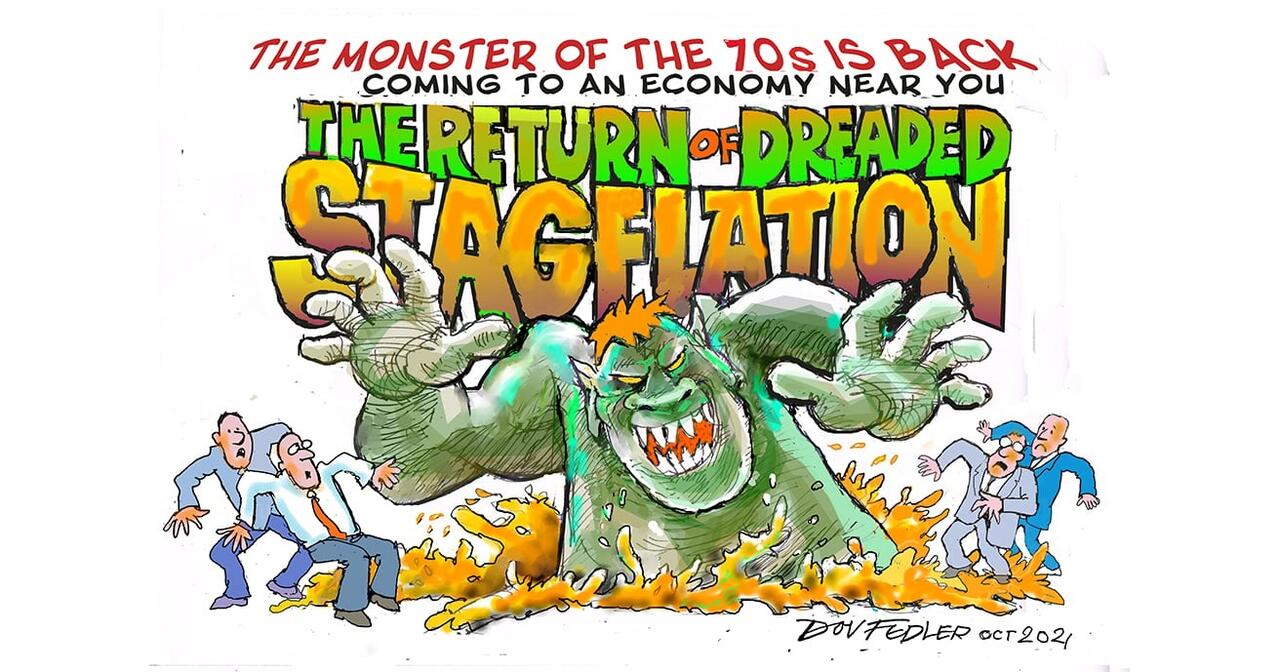
Easing In The Middle Of Persistent Inflation May Worsen Stagflation Risk

Easing In The Middle Of Persistent Inflation May Worsen Stagflation Risk

Authored by Daniel Lacalle,

Thirty major central banks are expected to cut rates in the second half of 2024, a year when more than seventy nations will have elections, which often means massive increases in government spending. Additionally, the latest inflation figures show stubbornly persistent consumer price annualized growth.

In the United States, headline PCE inflation in February will likely grow by 0.4%, compared with a 0.3% rise in January, and consensus expects a 2.5% annualized rate, up from 2.4% in January. This is on top of the already 20% accumulated inflation of the past four years. Core inflation will likely show a 0.3% gain, according to Bloomberg Economics, which means an annualized 2.8%, building on top of the price increases of the past years.

Thirty central banks easing and seventy national governments increasing spending in an election year means more fuel for the inflation fire in a year in which money supply growth has bounced significantly from its 2023 lows.

Central banks ignored monetary aggregates when they shrugged off the risk of inflation in 2020, and now they are, again, easing way too fast when the battle against inflation has not finished. Furthermore, the only real tool that central banks have used is hiking rates, because different parallel measures of money growth, including reverse repo liquidity injections, have kept money supply growth at an elevated rate even when the balance of the G7 central banks was moderating, albeit at a slower pace than announced.

Cutting rates may come too late because, by the time it is implemented, it will cause a double negative. Government deficits will be cheaper to refinance, bloating an already record-high public debt yet again, but those cuts may have little impact on small and medium enterprises and families because they suffer significantly more from the accumulated effects of inflation, which means weaker margins, more difficulties to make ends meet, and impoverishment.

We must also remember that these persistent levels of official inflation come after relevant tweaks in the calculation of the consumer price index.

We certainly know one thing: consumers do not pay attention to the annualized rate of growth in prices, but to the accumulated level of destruction of their purchasing power, and everyone, from Europeans to Americans, knows that they have become artificially poorer by the insane fiscal and monetary policies implemented in 2020.

Nobody who takes inflation seriously would even consider easing in an election year, adding trillions of dollars of deficit spending to the fire of inflation. Furthermore, the history of inflation warns us about giving up easily and too fast.

The Fed is making a big mistake by cheering the headline economic figures that come from disguising a private sector recession with a massive increase in public debt and weakening employment figures embellished by temporary jobs and public sector hiring. Additionally, it is making a mistake by giving dovish signals that make market participants take more risk. There has been no relevant reduction in the money supply if we include the different layers of liquidity injections. Announcing forthcoming rate cuts will certainly make speculative debt rise but will hardly change the credit demand from the backbone of the economy, small businesses, and families. Since the US government has rejected any calls for normalization and instead added more deficits and debt as if rising bond yields were not a problem, citizens and businesses have already suffered greatly from ongoing inflation and rate increases. As such, the rate cuts will help an already bloated government spending and the zombie corporations that keep access to capital markets. Everyone else will be hurt both ways, with inflation and lower access to credit.

You may think all the above problems are policy mistakes, but they are not. This is a slow process of nationalizing resources. Inflation and artificial money creation through deficits and monetization are a gradual transfer of wealth from real salaries and deposit savings to the government. You are basically becoming poorer to sustain an ever-increasing government size. The next time you read that massive deficits and monetary easing are good policies for the middle class, ask yourself why you find it harder each year to pay for goods and services. The mistakes made in 2020–2024 will cost the middle class many more taxes, even if the government promises it will only be “taxes on the rich,” the oldest gimmick to raise your taxes.

More taxes, persistent inflation, the hidden tax, and the loss of value of your wages. That is “easing” for you. A private sector recession with headline economic figures bloated by government debt. The recipe for stagflation.

Tyler Durden
Mon, 03/25/2024 – 10:15

via ZeroHedge News https://ift.tt/RAEYHCr Tyler Durden