Taiwan Indicts Surgeon Who Sent Patients To China for Organ Transplants

Taiwan Indicts Surgeon Who Sent Patients To China for Organ Transplants

Authored by Frank Fang and Eva Fu via The Epoch Times (emphasis ours),

A Taiwanese surgeon and four other individuals have been charged with illegally brokering organ transplantation in China, a case that a local medical advocacy group said is alarming given that Beijing sources organs from prisoners of conscience.

Doctors prepare for a kidney transplant in a file photo. Pierre-Philippe Marcou/AFP/Getty Images

The surgeon, Chen Yao-li, is accused of orchestrating a criminal group that helped send 10 Taiwanese patients to China for organ transplant surgery from 2016 to 2019, the district prosecutors’ office in southern Taiwan’s Changhua County said in a press release on Nov. 25.

Chen is charged with violating the island’s Human Organ Transplant Act, which says that any transplant organ “shall be provided or acquired free of charge” and “persons who broker organ transplants or the provision and acquisition of organs” may be jailed for up to five years and a maximum fine of NT$1.5 million (about $46,200).

Chen once worked at the Changhua Christian Hospital’s organ transplant center.

After prosecutors announced the indictment, the hospital said Chen has not worked at the facility since July 2022. The Changhua prosecutors began investigating Chen in March of that year.

The hospital warned locals against traveling to China for liver transplants, citing reports and the United Nations’ warning about the regime’s forced organ harvesting that targets Falun Gong practitioners, prisoners of conscience, Uyghurs, and Christians. It added that it prohibits unethical and illegal medical conduct and respects the results of judicial investigations.

David Huang, vice chairman and spokesperson of the Taiwan Association for International Care of Organ Transplant, said the case marks an important milestone.

It is the first indictment against illegal organ brokers since Taiwan amended its Human Organ Transplant Act in 2015, to prohibit the use of organs from executed prisoners, as well as the sale, purchase, and brokering of organs.

I hope that this indictment will attract the attention of local citizens and the government. Going to China for organ transplantation involves medical, moral, and legal risks,” Huang said in an email to The Epoch Times.

The Epoch Times requested comment from Chung Shan Medical University Hospital, where Chen works as the vice director of the facility’s liver transplant center. The hospital declined to comment on the indictment but said, “Dr. Chen has always followed our hospital’s managerial procedures and professional standards while carrying out medical work in our hospital.”

Liver and Kidney Transplants

Prosecutors alleged that Chen, while working at the transplant center, had his transplant patients contact an accomplice surnamed Huang, who was the head of an unnamed biotech company. Huang allegedly arranged for six Taiwanese patients to have either a liver or kidney transplant surgery at a Chinese hospital in Qingdao, a city in eastern China’s Shandong Province.

Huang allegedly charged each of the six patients NT$5 million to NT$7.5 million (about $154,000 to $231,000) for a liver transplant, and NT$3 million to NT$3.5 million (about $92,400 to $107,800) for a kidney transplant. Huang’s wife, surnamed Yang, then connected patients with doctors at the Affiliated Hospital of Qingdao University to arrange the surgeries.

Chen allegedly also went to the Chinese hospital in Qingdao to “provide instruction” inside the operating room while the liver surgeries were taking place, according to prosecutors.

Separately, Chen allegedly instructed a Taiwanese nurse assistant surnamed Hsieh to travel to China to administer post-operative care for a payment of NT$200,000 (about $6,150) per patient.

Chen also worked with an accomplice surnamed Lin, who had for years provided “organ transplant services” between Taiwan and China, to have four Taiwanese patients undergo either kidney or liver transplant surgery in Changsha, a city in central China’s Hunan Province. The two then split the payments.

Prosecutors are seeking a six-year sentence for Chen and a three-year sentence for each of his four accomplices. They aim to confiscate the group’s total illegal earnings of about NT$20.4 million (about $628,000).

Chen allegedly earned over NT$14.8 million (about $455,600) during the three-year span. He returned $83,060 during the investigation, and prosecutors have confiscated his property to prevent him from “enjoying the illegal proceeds,” the Changhua prosecutor’s office said.

Hsieh must now return NT$1.1 million (about $33,800) in illegal earnings as part of her settlement with prosecutors, who agreed to a deferred prosecution against the nurse.

Organ Transplants in China ‘Highly Risky’: Prosecutors

Taiwanese prosecutors warned people of the risks that come with undergoing organ transplants in China.

Most of the patients involved only survived for two or three years after the organ transplants, they said. Some died within a week after returning to Taiwan.

It demonstrates that organ transplant surgeries that involve intermediaries and are untransparent are highly risky,” the press release stated.

The London-based China Tribunal in 2019 concluded that forced organ harvesting was happening on a “significant scale” in China, with Falun Gong practitioners being the main source of organs. Practitioners of Falun Gong, a spiritual practice also known as Falun Dafa, have been targets of persecution by the Chinese regime since 1999.

The U.S. House of Representatives passed the Falun Gong Protection Act (H.R. 4132) in June.

If enacted, the legislation would require the president to provide relevant congressional committees with a list of foreign individuals who have “knowingly and directly engaged in or facilitated the involuntary harvesting of organs within the People’s Republic of China.” Those on the list would face sanctions such as a ban on entering the United States.

Sen. Marco Rubio (R-Fla) introduced the Senate version (S.4914) of the legislation in July. Rubio has been nominated by President-elect Donald Trump to serve as U.S. Secretary of State.

David Huang from the Taiwan Association for International Care of Organ Transplant applauded the legislative efforts in the United States. Should the Senate pass the legislation, Huang said it would be “an epoch moment in the making.”

Tyler Durden
Thu, 11/28/2024 – 21:20

via ZeroHedge News https://ift.tt/A62PRyI Tyler Durden

Man Allegedly Part Of Rothschild Banking Family Dies In Mysterious Hollywood Hills House Fire

Man Allegedly Part Of Rothschild Banking Family Dies In Mysterious Hollywood Hills House Fire

The internet is abuzz after a man, identified by local media outlets as a possible member of the Rothschild banking family, died in a mysterious house fire in the Hollywood Hills area on Wednesday.

ABC 7 News reports that fire crews responded to a house fire on the 8500 block of Lookout Mountain Avenue on Wednesday afternoon. While battling the blaze, firefighters discovered a deceased man inside the home. Neighbors identified him as “Will Rothschild,” according to the media outlet.

The outlet further reported, “Rothschild was described by neighbors as an eccentric millionaire—or even billionaire—with multiple properties and dozens of expensive cars,” adding that “Rothschild was said to have lived as a bit of a recluse.”

ABC 7’s Jory Rand commented, “It turns out the man who lived there might have been a billionaire.”

The plot thickens…

Tyler Durden
Thu, 11/28/2024 – 20:40

via ZeroHedge News https://ift.tt/3cNovk7 Tyler Durden

Gold-Backed Or Bust: Judy Shelton’s Plan To Tame The Fed And Restore The Dollar

Gold-Backed Or Bust: Judy Shelton’s Plan To Tame The Fed And Restore The Dollar

Authored by Paul Mueller via the American Institute for Economic Research (AIER),

Judy Shelton has spent her career advocating for sound money. Her latest book, “Good as Gold: How to Unleash the Power of Sound Money,” makes an up-to-date case for reinstituting a gold standard. Her intriguing conclusion is that the dollar can be reconnected to gold by simply issuing federal treasury bonds with gold-redeemability clauses. The book also addresses recent events and important current debates about monetary systems like whether central bankers should have wide policy discretion, whether fixed or floating exchange rates are better for economic growth, and what happens when countries manipulate their currency to boost exports.

Dr. Shelton engages these questions in the context of academic debates, but she also uses the lens of rational economic planning to evaluate how the monetary system contributes to or detracts from economic growth. At the end of the day, the case for sound money rests on the claim that it will generate more stable and greater long-run economic prosperity. Dr. Shelton believes sound money will do just that. But what would such a sound money regime look like?

Although Dr. Shelton would prefer a system along the lines of a classical gold standard, she would probably be content with other monetary systems that dramatically reduced the discretion of policymakers. The real problem with our current monetary regime is not primarily technical. It is behavioral. Because public officials have strong incentives to inflate the currency, bail out various corporations, and underwrite extensive government borrowing, they do a poor job conserving the value of fiat currency or providing a predictable stable system of interest rates, credit, liquidity, etc.

In the first couple chapters of “Good as Gold,” Dr. Shelton takes the Federal Reserve to task. The wide discretion Fed officials can exercise makes monetary policy unpredictable. Although Fed officials argue that their decisions are countercyclical, that may not always be the case. As Milton Friedman famously noted, the effects of monetary policy decisions have “long and variable” lags. Despite claims to being “data-driven,” Federal Open Market Committee (FOMC) decisions remain unpredictable. Data can change rapidly and unpredictably, which can make policy change rapid and unpredictable too.

Another problem is that the “data-driven” mantra invokes the assumption that the data always clearly indicate what ought to be done. In fact, this is rarely the case. Not only do a wide variety of inflation measures exist, but there are also a wide range of time intervals over which to compare inflation trends. But that’s not the worst of it!

Employment, unemployment, GDP, and a host of other economic numbers suggest different things are going on in the economy. Retailers expect strong record spending this holiday season while the N.Y. Fed just released a study where the number of people reporting concern about their ability to make debt payments hit its highest level since 2020. How to weigh these various factors is far from clear.

Another problem with Fed policy is the rapid change in its interest rate targets. Three years ago, the short-run interest rate was ~.5 percent. Within two years it was over 5 percent. That rapid change created many issues in the economy, only some of which we have recognized. The rate-hike cycle created significant turmoil in the banking industry with Silicon Valley Bank and Signature Bank failing entirely while many large regional banks shrank or were enfolded into larger national banks.

The commercial real estate market has also been upended. While the owners of office buildings were already facing strong headwinds from the pandemic’s normalization of remote work, the Fed delivered a one-two punch when it raised interest rates. Most large commercial real estate investors use variable rate debt to finance their portfolios—which means the interest rate they pay moves with the market. Adding a couple percentage points to one’s debt rapidly changes the viability of a venture. In addition to higher debt-servicing costs, commercial real estate investors saw the market value of their holdings decline precipitously as buyers disappeared, financing costs rose, and future potential cash flows were more heavily discounted.

The previous rate-hike cycle in 2006 and 2007 preceded a major recession and financial crisis. Even as the Fed creates disruptions in markets, it has also overseen the relentless decline in the value of the dollar—ironically in the name of pursuing their mandate to maintain price stability. A dollar in 2024 is worth what a quarter was in 1980 and what a dime was in 1965. And a 2024 dollar is worth about what a penny was worth in 1900.

This downward march in the value of the dollar creates problems.

It drives up asset prices, favoring those who have investment savvy while eating away at the value of people’s savings and undermining the prosperity of those on fixed incomes. The steady fall of the dollar also distorts price calculations and expectations.

I’ve argued elsewhere that the Fed has been a prime culprit in boosting housing prices and, as a result, creating a “transitional gains trap” where homeowners with significant equity, juiced in large part by easy money, have organized to protect their equity by putting up local legal barriers to building new housing.

But “Good as Gold” includes much more than criticism of the Fed. Dr. Shelton points out that unstable money and exchange rates create costs to doing business. International firms must devote time, energy, and money to protect themselves from erratic fluctuations in currency exchange rates. Creating these “hedges” to protect their profitability from exchange-rate risk necessitates additional classes of assets and asset traders—contributing to greater “financialization” of the economy. While the services being offered create real value for corporations, they come at a price and would not be needed under more stable monetary arrangements.

Besides the frictions and costs that unstable money introduces into day-to-day business operations, it also creates long-term consequences when it comes to investing. If certain exchange rates can move 15 percent, 30 percent, or more in a single year, Dr. Shelton asks, then how can investors rationally allocate capital based on real factors and comparative advantage? The structure and mix of capital investment we currently have across countries and within the same country looks very different than it would in a world of stable money.

Dr. Shelton makes this point indirectly in a fascinating chapter about the monetary debate between Milton Friedman and Robert Mundell. Both were staunch advocates of free markets, but they differed in what monetary regime they thought best. Friedman argued in favor of freely floating exchange rates set by market participants. In this world, governments would feel pressure from markets, in the form of capital outflows, if they engaged in domestic monetary policy shenanigans. Mundell, on the other hand, favored more stability in exchange rates that would require domestic prices to adapt to changes in trade and capital flows. Friedman and Mundell both agreed, however, that government officials and central bankers should have very little discretion in how they managed a country’s monetary system.

In a later chapter, Shelton offers the problem of “currency manipulation” as a reason for implementing a sound money regime. Her argument basically asserts that countries that actively depreciate or weaken their domestic currency experience short-run benefits (in the form of more competitive exports) and long-term costs (in the form of inflation and capital outflows). Other countries, however, feel short-run pain as their exports decline and their factories shut down—even though they also receive cheaper goods and reallocate much of the displaced labor and capital. I find this line of reasoning a bit curious.

Shelton rightly champions free trade and argues that it works best when countries do not artificially manipulate the value of their currencies. No objection here. But I am not convinced that a sound money regime, even a gold standard, would change other countries’ incentives to devalue their currency. Gold convertibility of one currency does not prevent the issuer of a different fiat currency from issuing large amounts of that fiat currency to reduce the relative price of its exports.

I suppose one could argue (and Dr. Shelton does) that currency manipulation becomes easier to discern because currencies will be valued in terms of a fixed standard (gold), rather than in terms of another fluctuating fiat currency. For example, the price of gold in terms of dollars increased by 77 percent from May 2014 to May 2024.

The currencies of the largest trade partners with the United States lost far more value relative to gold in that period: Euros (129 percent), Mexican Peso (131 percent), Canadian dollar (122 percent), Chinese yuan (105 percent), and Japanese yen (165 percent). But that probably matters relatively little to the devaluing regime. Using gold as a benchmark might reveal relative changes in the value of currencies better. It could also defuse the language of “currency manipulation.”

Instead of attributing motives to foreign central bankers, policy makers could set relatively straight-forward criteria for when another country’s currency declines in a distortive way. Shelton suggests that some level of tariffs should be imposed in response to another country’s currency devaluation to offset the monetary distortion to international trade. This idea may not be crazy from a purely technical standpoint, yet I would hesitate to recommend it because of the likely distortions and co-opting of such policies by special interests. I also question whether the costs of not imposing tariffs on depreciating currencies is as high as Dr. Shelton believes.

Sound money advocates like Shelton must explain how we could get to a sound money regime. On the one hand, advocating a gold standard seems archaic and implausible. On the other hand, it would not be technically difficult to implement. And, in fact, given the dominance of the U.S. dollar, if another major currency, such as the Euro, also chose to move back to gold redeemability, it is not hard to imagine other major currencies (Yen, Yuan, Pound, etc.) following suit. The political difficulty, of course, is getting the United States to take the first step and then getting the EU to follow suit.

The odds of successful reform are highest when pursuing the easiest path to transition the current system to a sound monetary regime. Abolishing the Federal Reserve is not on that path. So tying dollars back to gold using the Fed makes more sense than moving back to a pre-Fed world. Similarly, constraining the FOMC seems far more plausible than abolishing it.

It may be worth raising a few other important secondary questions. At what price will the currency be convertible into gold? Dr. Shelton has suggested that incorporating a gold clause in Treasury bonds could be a good method for discovering the right price of convertibility. In fact, putting gold convertibility into government bond contracts may be sufficient, in and of itself, to tie dollars back to gold.

Afterall, depreciation of dollars would create consequences for the federal government and the Federal Reserve, the very institutions primarily responsible for managing the dollar and maintaining the monetary system. Shelton also makes the important point that currency should be seen as being like a weight or measure—something standardized for the public to use. It should not be viewed as a policy instrument or lever for managing the economy. This simple point rarely arises in modern commentary on the Fed and on monetary policy—yet it has deep legal and historical roots in the American founding and beyond.

Another benefit of moving to gold redeemability for U.S. bonds is that it utilizes U.S. gold reserves more effectively. Currently, the United States is the largest holder of gold in the world. But ironically, that gold is severely undervalued on the government’s ledger. Its book value is less than two percent of its market value (i.e., on the ledger the gold is valued at less than $50/oz when its market value is over $2700/oz). Offering gold redeemability might also open up the option for extremely long-dated debt (50 years or more) and lower interest rates because the most significant risk to lending to the federal government, the devaluation of future dollars, has been taken off the table.

The likely benefits of such bonds are so significant that it may seem surprising that they have not been implemented. The problem, of course, is that this form of bond would reveal the man behind the curtain. It would show that government officials can and do play fast and loose with the dollar and with the U.S. financial system to enable themselves and their friends a free hand to borrow and spend, and to actively “manage” the economy.

Dr. Shelton’s proposed changes will be vigorously resisted by those who benefit from the existing status quo—large commercial banks and financial institutions, Federal Reserve officials and bureaucrats, politicians and regulators—everyone who benefits from the Fed’s tendency to loose monetary policy. Still advocates of freedom and prosperity should continue to make the arguments and offer proposals for moving to a sound monetary regime.

And that is exactly what Dr. Shelton does in “Good as Gold.”

Tyler Durden
Thu, 11/28/2024 – 20:00

via ZeroHedge News https://ift.tt/j34QCrZ Tyler Durden

These Are The US States Producing The Most Turkeys In 2024

These Are The US States Producing The Most Turkeys In 2024

Every Thanksgiving, millions of Americans gather around the table to feast on a traditional turkey dinner. But have you ever thought about the origins of these Thanksgiving turkeys?

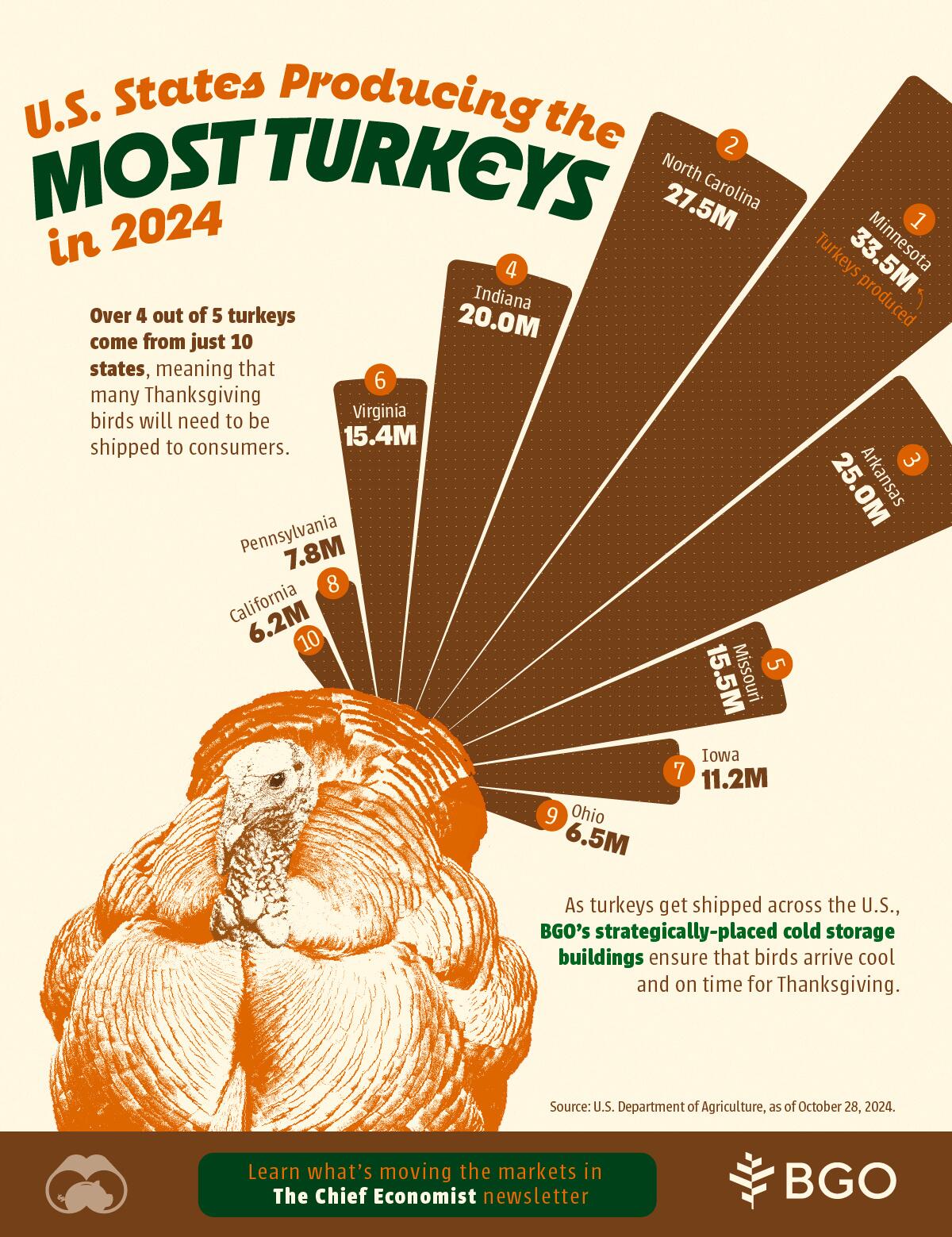
As Visual Capitalist’s Jenna Ross details below, turkey production in the U.S. is highly concentrated, with a few states dominating the market. In this infographic from BGO, we’ll explore the top 10 turkey-producing states in 2024.

Ranking the Top States

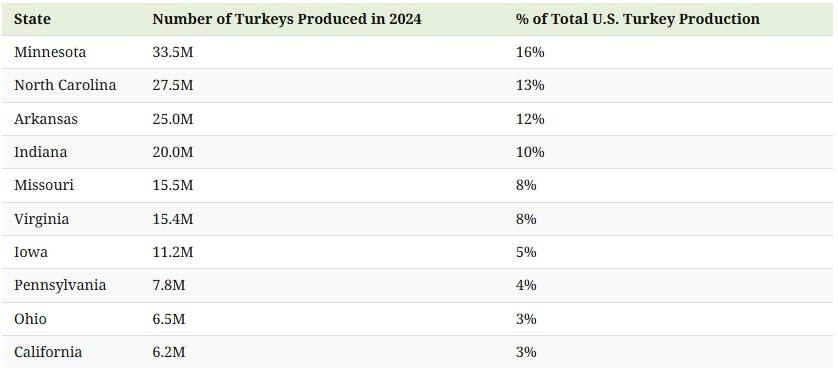
Over four out of every five turkeys come from just 10 states. Most of these states are located in the Midwest or the South.

Source: U.S. Department of Agriculture, as of October 28, 2024.

The top spot goes to Minnesota, having produced nearly 34 million birds so far in 2024. Minnesota became the top-producing state due to a number of factors:

  • Multi-generational farm families have passed down their knowledge and expertise

  • The state grows a lot of soybean and corn, which are the main ingredients in a turkey’s diet

  • A veterinarian from the University of Minnesota Extension helped eliminate a disease that once killed many turkeys

North Carolina lands in second place for turkey production. The state’s moderate climate and affordable land and labor likely contributed to the industry’s growth. Like Minnesota, North Carolina also has easy access to crops like corn and soybean to feed the birds.

Rounding out the top three, Arkansas produces 12% of America’s turkeys. Many poultry companies are located in the state, including Butterball and Tyson Foods.

Transporting Turkeys to Tables

With turkey production being so concentrated, most birds will need to be shipped to consumers. It’s critical that they don’t spoil on the journey, and that producers have them transported quickly. Cold storage is a key part of the solution.

BGO is a leading investor in cold storage buildings that are strategically placed to ensure quick delivery to stores. Ultimately, these facilities help ensure turkeys arrive cool and on time for Thanksgiving.

Tyler Durden
Thu, 11/28/2024 – 19:20

via ZeroHedge News https://ift.tt/f49YLIh Tyler Durden

Trade Policy Is About Much More Than Tariffs

Trade Policy Is About Much More Than Tariffs

Authored by Gordon Gray via RealClearMarkets,

Since the early days of his campaign, President Donald Trump has pledged to impose wide-ranging tariffs on many imported goods, including a 10 percent or higher tax on imports from other countries. This decision has made waves, drawn criticism, and largely dominated the trade policy debate in recent months – understandable, given the far-reaching implications of such a drastic change in policy. Nevertheless, President Trump’s tariffs are far from the only trade policy issue deserving of attention by the new administration. As we look ahead to January, any trade reform effort considered by President Trump and his advisors should also include overdue changes to a little-known agency responsible for implementing our country’s trade agenda: the International Trade Commission (ITC).

Congress has given the executive branch wide authority to set trade policy. The ITC’s role is less widely understood. Due to Section 337 of the Tariff Act of 1930, the ITC maintains the ability to institute “unfair import investigations,” a tool ostensibly designed to protect American companies from intellectual property infringement violations stemming from foreign competitors.

If an infringed product is imported into the United States, the ITC has one remedy – an Exclusion Order – that completely ban the product in question from the U.S. market.

Unfortunately, in recent years, the ITC has become the forum of choice for opportunistic patent assertion entities (PAEs). Also known as patent trolls, PAEs are companies that purchase portfolios of patents with the sole purpose of using them as the basis for infringement litigation. While the threshold for injunctions in federal courts are much higher, patent trolls flock to the ITC thanks to its unique ability to issue relief via ITC Exclusion Orders.

When an Exclusion Order is issued, the ITC is supposed to investigate and determine whether banning the imported product in question will negatively affect the public. In the past, a wide range of stakeholders, from Hispanic interest groups to rural community advocates, have called on the ITC to issue public interest exemptions and ensure consumers’ access to critical products is not impeded. Unfortunately, the ITC rarely conducts a thorough public interest review before taking action. In fact, it’s been nearly forty years since it last used a public interest exemption to decline issuing an Exclusion Order.

Fortunately, there are bipartisan efforts in Congress to address these deficiencies in how the ITC considers such cases. Last year, Representatives David Schweikert (AZ-01) and Don Beyer (VA-08) introduced the Advancing America’s Interests Act (AAIA) to stop patent abuse at the ITC and reaffirm its public interest standard.

The AAIA would also strengthen an important feature of the the Tariff Act – the “domestic industry” standard – that would prohibit a U.S. company from being used as a plaintiff unless they voluntarily join a complaint requesting the ITC’s relief. As part of the Tariff Act of 1930, a complainant at the ITC needs to demonstrate that it contributes to the industry in the U.S. related to whatever patent rights it is alleging have been infringed. Yet in an oft-used loophole, the patent holder can satisfy this requirement by stating it licenses its patents to other companies even if those companies did not join the complaint.

This creates a “domestic industry by subpoena” problem where a patent troll claims it has met the domestic industry requirement by involving an otherwise unwilling and uninterested licensee in the investigation. The AAIA would prohibit this practice unless the licensed entity in question ‘joins’ the complaint.

Tariffs policy and protectionism figured prominently in the presidential campaign, and there is no doubt these issues will remain salient during the second Trump administration. But trade policy is more than simply a function of tariffs. Congress should act and pass legislation to return the ITC to its original mission. The constant threat of patent troll litigation is a drag on many U.S. companies and pulls resources away from developing the new technologies necessary to grow our economy and out-innovate the world.

As policymakers look forward to what should be included in a new administration’s trade agenda, fixing the ITC should be at the top of the list.

Tyler Durden
Thu, 11/28/2024 – 18:40

via ZeroHedge News https://ift.tt/T3Ym61E Tyler Durden

Thanksgiving Pilgrimage: Holiday Travel To Beat Record

Thanksgiving Pilgrimage: Holiday Travel To Beat Record

Thanksgiving holiday travel is expected to reach a new record in 2024, as nearly 80 million Americans are forecast to hit the road or the skies to travel more than 50 miles for this year’s celebrations.

That’s according to projections from AAA who are predicting that 71.7 million Americans will take to the nation’s roads, while 5.8 million will fly domestically and 2.3 million will travel by train or other means to be with family or friends for the holidays.

Infographic: Thanksgiving Pilgrimage: Holiday Travel to Beat Record | Statista

You will find more infographics at Statista

As Statista’s Felix Richter reports, that represents an increase of 2.1 percent from last year and 2.7 percent from 2019, as lower gas prices compared to last year are fueling Americans’ appetite for travel.

“Thanksgiving is the busiest holiday for travel, and this year we’re expecting to set new records across the board, from driving to flying and cruising,” Stacey Barber, Vice President of AAA Travel, said.

“Americans reconnect with family and friends over Thanksgiving, and travel is a big part of that.”

All modes of transport are set to see a noticeable increase this year and road trips will continue to dominate Thanksgiving travel.

90 percent of travelers are expected to drive to their holiday destination, as gas prices are currently lower than they have been for the most part of the past three years. Even though air travel is far less common for Thanksgiving celebrations, the Transportation Security Administration (TSA) is bracing for the busiest Thanksgiving period on record, with airports expected to be especially crowded on Tuesday and Wednesday before Thanksgiving and the Sunday after.

Tyler Durden
Thu, 11/28/2024 – 18:00

via ZeroHedge News https://ift.tt/3BNw1L5 Tyler Durden

The Outcome Of Romania’s Presidential Election Could Spoil The US’ Potential Escalation Plans

The Outcome Of Romania’s Presidential Election Could Spoil The US’ Potential Escalation Plans

Authored by Andrew Korybko via Substack,

The surprise victory of populist conservative-nationalist Calin Georgescu in the first round of Romania’s presidential election gives this heterodox outsider the chance to enter into office next month. The Mainstream Media is apoplectic since he criticized Romania’s hosting of the US’ missile defense infrastructure and is against perpetuating NATO’s proxy war on Russia through Ukraine. He’s also a devout Orthodox Christian and praised some of his country’s most controversial World War II-era figures.

Interestingly, he was also the diaspora’s favorite, with the added twist being that more in Western Europe voted for him than those in Eastern Europe. This suggests that his appeal is also due to the hope that he’ll bring long-overdue accountability to his infamously corrupt country and finally help its people improve their living standards through more effective economic, financial, and developmental policies. Foreign policy is important, but local issues and economics far outweigh the former for average voters.

If Georgescu becomes President of Romania, he’s therefore much more likely to try to change his country’s internal workings than he is to radically transform its foreign policy, but it also can’t be ruled out that his potential victory could adversely affect NATO’s proxy war on Russia through Ukraine. Those who voted for him dislike how Ukrainian grain flooded their domestic market to local farmers’ detriment and also aren’t pleased with the government financially supporting Ukrainian refugees.

Additionally, the latest military-strategic developments in this conflict raised worries among many about the spectre of World War III, in which case Romania would be directly involved due to its hosting of the previously mentioned US missile defense infrastructure. Their country also plays an important logistical role in arming Ukraine and its newly built “Moldova Highway” could facilitate the deployment of NATO troops there if the bloc or a “coalition of the willing” therein decides to conventionally intervene.  

Even if Romania doesn’t dispatch troops, the transit role that it could play in others’ intervention there could put a Russian target on its back, especially if this leads to direct NATO-Russian hostilities. For this reason and keeping in mind his criticism of NATO’s proxy war on Russia through Ukraine, he as Supreme Commander might not approve of these plans. After all, he’s a populist conservative-nationalist who prioritizes what he sincerely believes to be national interests, which this scenario is contradictory to.

If he wins, then he’ll assume office on 21 December, which could therefore make it impossible for the US to rely on Romania in the abovementioned respect from there on out. That would be significant, provided that Georgescu has the political will to implement such a policy, since it means that the outgoing Biden Administration might thus only have less than a month to do this if it wants to. After all, even if Trump decides to “escalate to de-escalate” through such means, he too might not be able to.

There’s always the possibility that Poland might serve as the only route through which conventional NATO troops could enter Ukraine, even if it doesn’t dispatch its own, but neither the outgoing conservative-nationalist president nor his liberal-globalist rivals in the ruling coalition might allow this. The reason is that both want to appeal to Ukro-skeptical voters ahead of next year’s presidential election, the first in order to keep the second in check while the second wants to finally be unrestrained.

That’s why each have been trying to outdo the other in populist rhetoric, with the ruling coalition even going as far as to trump the former conservative-nationalist government of which the outgoing president is a part by taking an even harder line towards Ukraine. To that end, they demanded that it exhume and properly bury the Volhynia Genocide victims’ remains like it earlier did for 100,000 Wehrmacht troops, and it’s now only offering more military aid in exchange for a loan and no longer for free.

In fact, one of the Deputy Prime Ministers went as far as accusing Zelensky of wanting to provoke a Polish-Russian War in Ukraine, which powerfully signals that the ruling liberal-globalist coalition isn’t really interested in facilitating a conventional NATO intervene there and thus can’t be relied on for this. If Romania is ruled out in this respect too should Georgescu win, assume office next month, and promulgate the proposed policy, then the US might therefore be more willing to cut a deal with Russia.

Therein lies the most globally significant consequence if this populist conservative-nationalist becomes President of Romania since it could greatly limit the ways in which the US – whether under the outgoing Biden Administration or the incoming Trump one – could “escalate to de-escalate” on more of its terms. By removing the likelihood of a conventional NATO intervention, the odds might then greatly increase for Russia ending this conflict on more of its own terms instead, which could lead to a more lasting solution.

Tyler Durden
Thu, 11/28/2024 – 17:20

via ZeroHedge News https://ift.tt/g4bt3SG Tyler Durden

Lake Tahoe To Make Waves With First Flying Electric Ferry In US

Lake Tahoe To Make Waves With First Flying Electric Ferry In US

Authored by Ilene Ang via The Epoch Times,

Getting from one end of Lake Tahoe to another could soon become easier, as the first electric hydrofoil ferry in the United States is expected to debut at the popular tourist destination.

The “flying” ferry, which uses computer controlled hydrofoil wings to lift its hull above the water, is a joint venture of Swedish tech company Candela and U.S. operator FlyTahoe. A similar launch took place in Stockholm last month.

The Candela P-12 ferry will make the north-south trip across the lake in just 30 minutes, saving passengers a drive around the lake that typically takes about three hours.

Millions make the drive around Lake Tahoe each year to admire its beauty. But according to Ryan Meinzer, founder and CEO of FlyTahoe, the wear of tires on the roads over time causes particulates and road sediment to form.

“This road sediment isn’t just causing damage to lungs and the air, but it’s also ending up [in] the lake,“ he told The Epoch Times. ”Essentially, Lake Tahoe is a large watershed, and in fact, this is one of the largest contributors to the degradation of the clarity of the famous blue cobalt lake that we love.”

There were over 15 million visitors to Tahoe last year, and about 20,000 trips a day between the north and south of the lake, Meinzer said. “This is why FlyTahoe has decided to focus its primary efforts on that particular route.”

In an announcement on Nov. 21, Candela said the hydrofoil ferry is the world’s fastest electric vessel at 25 knots, or about 30 miles an hour, with a range of about 40 nautical miles. It cuts energy consumption by 80 percent compared to other vessels due to the design of its wings, which lift the hull above the water and reduce drag. This, in combination with technology and sensors to balance the vessel, provides “a silent and smooth ride,” the announcement said.

“It basically works like a jet fighter, which is constantly balanced using ailerons. The principle of the P-12 is the same, except our wings fly in water instead of air,” said Gustav Hasselskog, CEO and founder of Candela. Ailerons are small hinged sections on the outboard portion of an aircraft’s wing.

The interior of an electric hydrofoil ferry, the Candela P-12. Candela

Meinzer hopes to have a fleet of electric hydrofoil ferries traversing Lake Tahoe in the future, but for now, the company is under contract for just one.

Meinzer says one of his biggest challenges is working with local laws and complying with federal regulations like the Jones Act, which regulates maritime commerce in U.S. waters.

“We, of course, need to make sure that we’re complying with all safety standards and inspection standards, because at the end of the day, this is a vessel that is flying across a lake,” he said.

Meinzer also cited infrastructure considerations such as charging. “This electrification of waterways is relatively new,” he said, and while there are some electric boat charging stations in and around Lake Tahoe, “we need more.”

“A rising tide lifts all boats. In that respect, the more electric chargers are installed around the marinas of the lake, the better it is for anyone who has electric boats in the lake, not just FlyTahoe.”

Meinzer explained that if the ferry’s range is 40 miles fully charged and the lake is about 20 miles across, it can make a round trip on one charge.

The cost for a one-way trip across the lake is expected to be about $50, Meinzer said. Eventually, he hopes to lower the price with government grants.

The hydrofoil will be able to ferry up to 30 people across the lake per trip, and is wheelchair accessible, with storage for snowboards, skis, and bikes.

Ryan Meinzer, CEO of FlyTahoe. FlyTahoe

FlyTahoe has not finalized pickup and drop-off destinations, boat storage, or parking options yet, Meinzer said.

A spokesperson for Candela told The Epoch Times that the hydrofoil ferry is expected to begin operations in late 2025 or the first half of 2026.

Tyler Durden
Thu, 11/28/2024 – 16:00

via ZeroHedge News https://ift.tt/q32gi9D Tyler Durden

Lebanon Accuses Israel Of Already Violating Ceasefire Several Times

Lebanon Accuses Israel Of Already Violating Ceasefire Several Times

Who could have seen this coming?

As The Cradle reports, the Israeli military carried out several artillery and bombing attacks on the south of Lebanon on Thursday, marking yet another round of ceasefire violations on the second day after the cessation of hostilities between Hezbollah and Israel. 

“Israeli enemy artillery is shelling the heights of the town of Halta, Hasbaya district, targeting citizens in the outskirts of the town,” Lebanon’s National News Agency (NNA) reported on Thursday afternoon. 

Via Reuters

Taybeh, Khiam, and the Marjayoun plains were also struck by Israeli artillery, according to NNA. Three shells were fired at the town of Rmeish, damaging a house and a supermarket. Israeli troops also opened fire on Lebanese citizens trying to return to their homes in Bint Jbeil. 

Israeli tanks shelled the towns of Kfar Shuba and Wazzani as well. At least two Lebanese citizens were injured in an airstrike on the town of Markaba. 

The Lebanese army warned displaced residents of southern border villages on Wednesday not to enter areas where Israeli troops are still deployed

Israeli forces have been violating the ceasefire since it took effect early on November 27. The Israeli army opened fire on a group of Lebanese journalists in the southern town of Khiam on 27 November. 

Earlier on Wednesday, Israeli troops also opened fire on Khiam, Kfar Kila, and other towns as displaced residents made their way back. Israeli Army Radio and Channel 12 reports claimed several people were killed. Lebanese media did not acknowledge any deaths. 

Hezbollah said in a statement on Wednesday night “that its fighters from various military specialties will remain fully prepared to deal with the Israeli enemy’s ambitions and attacks, and that their eyes will continue to follow the movements and withdrawals of the enemy’s forces beyond the borders, and their hands will remain on the trigger, in defense of Lebanon’s sovereignty and for the sake of the dignity and honor of its people.”

Lebanese forces announced their deployment across the south on 27 November as part of the ceasefire deal, which is based on the implementation of UN Resolution 1701. As part of the agreement, Lebanese troops are required to dismantle all Hezbollah infrastructure south of the Litani River, and Israel is required to withdraw its army from Lebanon – all within a period of 60 days.

The entry of weapons into Lebanon and attempts by the resistance to restock weaponry are prohibited in the agreement.

A pre-existing tripartite mechanism, including France and the UNIFIL, has been headed by the US to monitor any violations reported by both Israel and Lebanon.

Tyler Durden
Thu, 11/28/2024 – 14:40

via ZeroHedge News https://ift.tt/czNf2Hy Tyler Durden

“Good Faith” Discussions Underway To Un-Cancel NFL Redskins Logo 

“Good Faith” Discussions Underway To Un-Cancel NFL Redskins Logo 

In a recent X post by Republican Montana Sen. Steve Daines, the senator wrote, “The censorship of the former Commander logo was a classic case of woke gone wrong. I applaud the Commanders & the NFL for their commitment to never censor the logo again.”

Speaking to Fox News, Daines said, “The irony – they [woke left] were canceling Native American culture, as in the DEI [Diversity, Equity, and Inclusion] movement went way too far …” 

At a recent Energy & Natural Resources Committee meeting on Capitol Hill, Daines stated that there had been “good faith negotiations” with the NFL team to restore the logo of Blackfoot Chief John Two Guns White Calf, which had been in use for half a century.

In 2020, the NFL team succumbed to pressure from the radical left, promoting woke culture and forcing a name change from the Redskins to the “Washington Commanders.”

Before the woke left unleashed cancel culture, the NFL franchise used Native American artist Walter “Blackie” Wetzel’s artwork of the Blackfoot chief as the inspiration for the team’s logo from 1972 to 2020.

In 2022…

And just like that, the iconic logo, celebrating Indian Country, was memory-holed, as were many other logos.

The nation is waking up from a terrible decade of toxic and nation-killing wokeism nightmare. As we’ve previously noted, the ‘Overton Window‘ has shifted. 

For the sake of humanity, let us hope the woke mind virus—destructive by nature and detrimental to the nation—comes to an abrupt end. Woke ideology was never intended to succeed; its true purpose is to destroy. Even The New York Times and Bloomberg acknowledged a new Rutgers study showing that DEI initiatives transform individuals into being “hostile.” 

Tyler Durden
Thu, 11/28/2024 – 14:00

via ZeroHedge News https://ift.tt/T3WketI Tyler Durden