DOGE Makes ‘5-Bullets’ Email A Weekly Task, Sparking New Turf Battle, Employee Confusion

DOGE Makes ‘5-Bullets’ Email A Weekly Task, Sparking New Turf Battle, Employee Confusion

After the first attempt turned into a messy turf war with uneven compliance, the Department of Government Efficiency has doubled down, issuing a second emailed directive to millions of federal employees, instructing them to reply with five bullets describing accomplishments from the previous week. Inviting even more controversy, DOGE told employees it will now be a weekly requirement. Once again, multiple federal agencies are countermanding the DOGE demand amid questions about chains of command and the productivity toll associated with a request that has an unclear purpose. 

For many employees, the second request hit in-boxes late Friday, with a subject line that read, “What did you do last week? Part II.” Much like the previous request, it told recipients to reply with “approx. 5 bullets describing what you accomplished last week and cc your manager.” However, unlike the first go-round, this one made the task a recurring one: “Going forward, please complete the above task each week by Mondays at 11:59pmET.”

Under the guidance of Elon Musk, DOGE is delivering unprecedented, long-overdue scrutiny of the bloated federal government (Chesnot/Getty via Axios)

As with the first DOGE directive, the second one prompted some parts of the federal government to tell their employees not to reply. That included the State Department, which reassured employees that “department leadership will continue to respond on the behalf of our workforce.” A message sent to Energy Department workers said, “Per the Secretary’s guidance, please do not respond, if you have not already done so,” the Washington Post reports. Taking a particularly unhelpful tack, the head of a VA hospital told employees it was up to them if they want to reply or not. 

One doesn’t have to be a defender of government-as-usual to understand why a cabinet secretary or agency head– and a Trump-appointed one at that — would bristle at an outside entity giving orders to every employee in his organization. Even if it’s assumed DOGE has such authority, it would be understandably perceived by many leaders as overreach and micromanagement of employees they’re personally responsible for. Of course, the question of authority isn’t an academic one; many of the 5-bullets directives are being sent by the Office of Personnel Management, which some say lacks the power to issue such commands; the question is already being litigated.  

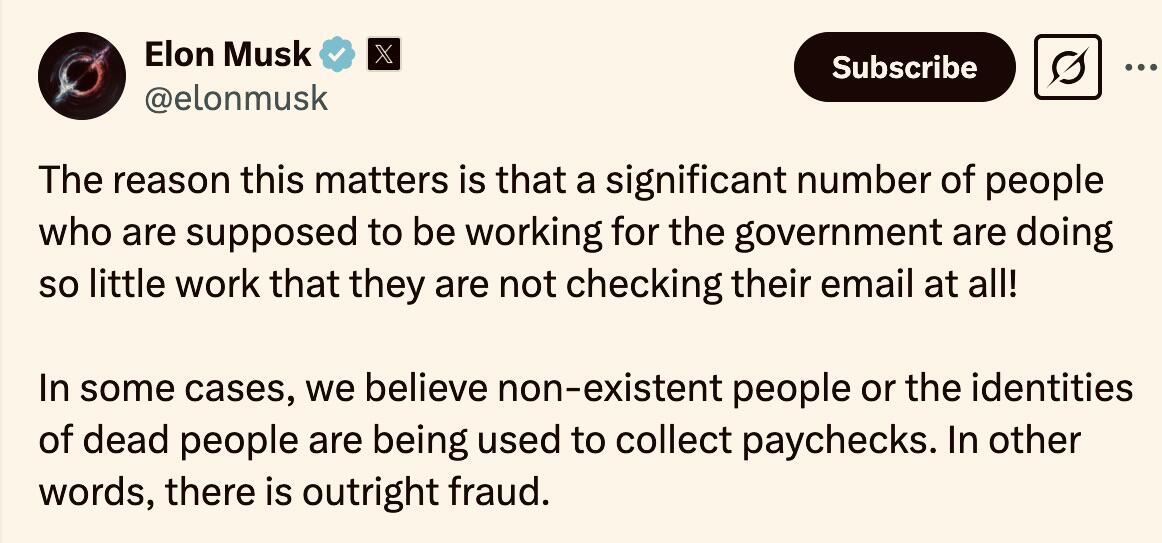
All that aside, federal employees are confused about the ultimate aim of the requirement — which is affecting how much time they’re investing in it. Commenting on X and elsewhere, DOGE’s Elon Musk has suggested the goal is merely to ferret out “non-existent” or dead federal employees, calling it a “very basic pulse check” to confirm recipients have “a pulse and two neurons.” If genuine, that characterization raises the question of why that requires five bullets — particularly when you consider DOGE’s titular aim of government efficiency.

Critically, unlike Musk’s spoken and social-media comments, the OPM emails don’t instruct employees to treat the task casually and invest minimal time in complying. Against the backdrop of DOGE’s absolutely laudable drive to achieve a major reduction in the size of the federal workforce, and with no clear, official explanation of what purpose the bullets serve, it’s understandable that anxious federal employees, thinking their retention may swing in the balance, would invest far more time than Musk anticipates, aiming for a level of substance and quality akin to what they’d put on a resume written to save their jobs.

Apparently harboring their own worries about how the 5-bullet requirement may affect the fate of their budgets and organizations, some DOGE-compliant federal entities are reinforcing the notion that employees should strive to craft the sharpest, most compelling bullets possible, distributing detailed lists of tips for writing exemplary responses. ZeroHedge has obtained a copy of one such guidance sheet sent to at least one organization within the Department of Defense. Spanning more than a page, it urge employees to, for one example, find opportunities to list accomplishments that are in harmony with DOGE’s mission. 

No more $32,000 transgender comic books for Peruvians: DOGE spearheaded the dismantling of the money-wasting US Agency for International Development (AFP via BBC)

Speaking to the Washington Post, one federal employee shared her own back-of-envelope calculation of the weekly cost of the contentious DOGE exercise

If 2 million federal employees each spend 15 minutes answering the emails, at an average hourly wage of $35, that will equate to 500,000 hours and $17.5 million going toward responding to the messages each week. “That’s a conservative estimate,” the employee said. “There are more than 2 million feds, and most of us spent way more than 15 minutes between trying to figure out what it meant, meetings about whether to respond or not and actually writing the email.”

However noble DOGE’s intentions — and we’re demonstrably among the organization’s greatest enthusiasts — two reasonable questions hang overhead: Who (or what) is reading these millions and millions of bullets, and what exactly is the payoff for taxpayers from a now-weekly chore assigned to their 2 million employees? 

Tyler Durden
Sun, 03/02/2025 – 16:30

via ZeroHedge News https://ift.tt/vIRj0ZQ Tyler Durden

Oklahoma School District Mismanaged Millions Of Dollars, Audit Finds

Oklahoma School District Mismanaged Millions Of Dollars, Audit Finds

Authored by Michael Clements via The Epoch Times (emphasis ours),

A recent audit of Oklahoma’s Tulsa Public Schools reported financial mismanagement, noncompliance with state law and district policy, and a lack of transparency by administrators.

The state Capitol in Oklahoma City in May 2023. Michael Clements/The Epoch Times

State Auditor and Inspector Cindy Byrd said auditors reviewed $37.7 million in Tulsa Public Schools (TPS) expenditures between 2015 and 2023 and found that $29 million was paid to consultants. Byrd said auditors found 1,450 discrepancies in 900 invoices and 90 vendor records.

The report also alleged that TPS may have violated a state law prohibiting the teaching of critical race theory and diversity, equity, and inclusion (DEI) in Oklahoma’s public schools.

Byrd released the audit report during a press conference on Feb. 26 in Oklahoma City. She said Gov. Kevin Stitt requested the audit in 2022 after Devin Fletcher, the system’s former chief talent manager and equity officer, resigned amid allegations of mismanagement.

In October 2023, Fletcher pleaded guilty to one felony count of conspiracy to commit wire fraud. He admitted to stealing $603,000 from TPS and the Foundation for Tulsa Schools, a nonprofit created to support TPS programs. Byrd said he was sentenced to 30 months in prison.

Byrd alleged Fletcher only perpetuated mismanagement that TPS administrators had engaged in since at least 2018.

Fletcher’s misconduct was the result of a much larger problem,” Byrd said.

She said that the TPS board shared some responsibility.

“Had board members acted with more diligence … they would have been in a much better position to prevent Fletcher’s malfeasance and to provide the oversight that state law requires,” Byrd said.

According to the report, TPS administrators routinely covered expenditures with foundation money. In this way, the report alleged, they avoided TPS policy 5202, which required requests for proposals, competitive bidding, and itemized invoices for any expenditure greater than $50,000.

Using foundation money also allegedly enabled them to hide much of the mismanagement from TPS board members since the board did not routinely review foundation expenditures, according to the report.

Auditors reported more than $25 million in contracts for which TPS had no requests for proposals. Many of the contracts were just below the $50,000 threshold. This meant no bids were required.

These allegedly included contracts with vendors who had relationships with administrators, board members, or former school system employees.

For example, the report states that a company named Snickelbox was hired in 2018 to provide consulting services. Between 2018 and 2022, TPS paid Snickelbox $872,588. Auditors said they determined that $329,278 of the total amount was paid fraudulently.

According to the report, Snickelbox invoices provided no details on what TPS paid for. In addition, Snickelbox contracts did not specify what TPS could expect from the company. This lack of detail made it difficult to determine which payments were fraudulent, the report stated.

According to the report, four other TPS employees—lead Budget Analyst Elizabeth Richardson, Chief Financial Officer Jill Hendricks, former Chief Financial Officer Nolberto Delgadillo, and Director of Materials Management Rachel Vejraska-Thomas—approved the Snickelbox payments.

Lauren O’Mara, who owned Snickelbox, and Fletcher had attended a fellowship with The Broad Center at the Yale School of Management, according to the report. The auditors reported that TPS made payments to 16 Broad Center alumni during the audit period.

According to the report, The Broad Center “operates as an independent nonprofit organization that identifies, develops, and supports K-12 public school system leaders who they believe are committed to ensuring that every school, classroom, and child receives the resources they need to succeed.”

The Broad Center’s webpage stated that “Diversity, Equity, and Racial Justice are essential” to its “mission of empowering school system leaders to achieve the dual goals of excellence and equity.”

Stitt asked Byrd to look into allegations that TPS had violated House Bill 1775, which banned critical race theory and DEI curricula from Oklahoma’s public schools. The Legislature passed the law in 2021.

The Oklahoma State School Board Association issued guidelines for school administrators in 2022. The guidelines state that such programs “cannot be made a part of a district’s curriculum and instructional standards [or] included in any professional development provided to employees.”

In 2023, the Oklahoma State Department of Education issued Board Order 2023-SR-0240, which required all school districts to submit a report that includes “all DEI-related expenditures made in the school district during the 2022-2023 school year.” According to the audit report, the order also covered information “that related to DEI ‘as concepts.’”

Auditors reported that TPS administrators worked with The Broad Center at Yale to hire its graduates.

Foundation funds were used to cover travel expenses for TPS employees to attend Broad Center programs, according to the report. Between 2018 and 2020, TPS hosted programs and meetings at Tulsa locations where Broad cohorts participated in programs that included a Child Equity Index Exercise and a DEI at Night function.

Between 2016 and 2023, TPS paid 23 vendors more than $6.2 million for consulting services, the report stated. Prior to hiring Broad Center graduates, the district had no relationship with any of those vendors, auditors said.

Byrd said she had turned her findings over to Oklahoma Attorney General Gentner Drummond’s office for the investigation of possible criminal activity. A spokesman for Drummond’s office said the attorney general stays in regular contact with all state agencies.

“However, to protect the integrity of investigations and to protect the reputations of innocent people, we do not typically confirm or deny our investigations or our communications with our law enforcement partners,” communications director Phil Bacharach wrote in an email to The Epoch Times.

Tyler Durden
Sun, 03/02/2025 – 16:00

via ZeroHedge News https://ift.tt/AuceJCU Tyler Durden

United Nations Chief Warns Of Global Funding Crisis Due To US Cuts

United Nations Chief Warns Of Global Funding Crisis Due To US Cuts

The Trump Administration’s agency audits and funding cuts have a wide spectrum of people in a panic, not just in the US but around the world.  For some this is not much of a revelation; it’s been known for decades that the US taxpayer backstops numerous governments and NGOs.  Without US dollars many of these organizations (and some countries) would not exist.  However, seeing the beggars all come out of the woodwork at the same time to get their cut of the pie because the money is running dry is truly something to behold.  

Why has America become a cash cow for the entire world?  

Call it an extension of globalism or the incremental sabotage of the US economy, the bottom line is that the US is the wealth generator for hundreds if not thousands of political and financial entities that do not have the best interests of Americans in mind.  US taxpayers are investing in their own destruction.

Yet another example is the United Nations, which received around $18 billion total from the US annually (that’s 20% of the UN’s entire budget each year.   UN Secretary-General António Guterres has released a press statement calling for a reversal of funding cuts, warning that the organization cannot function without US dollars. 

“These cuts impact a wide range of critical programmes,” Guterres told reporters at the UN Headquarters in New York. “The consequences will be especially devastating for vulnerable people around the world…”

Last week the UN called the situation a “liquidity crisis”:

“The President of the UN Field Staff Union said the Organizaton’s severe liquidity and funding shortfall has created a crisis that threatens the foundation of the staff’s work.  “UN staff — who are the backbone of this institution — are being forced to bear the brunt of these financial constraints.  Workloads are increasing beyond sustainable levels,” he said, urging Member States to meet their financial commitments fully and on time.”

The US officially provides 20% of the UN’s budget, but this is not the end of it.  As Guterres mentions, other governments are also, coincidentally, cutting funding at the same time as the US.  In other words, these governments get money from America then give it to the UN.  It is not clear exactly how much of the UN’s operations are supported by American taxpayers, but the funding cuts promise to be quite revealing.  

Much worse is how the UN spends that money. 

The UN then exploits that cash to fund anti-sovereignty efforts such as mass immigration programs into the west.  They contribute to the humanitarian and national security crisis at the US southern border by distributing millions of dollars in financial assistance (including debit cards and cash vouchers) to fund migrants headed north.  The same migrants that have been crossing into the country illegally in record numbers. 

Keep in mind, the US taxpayer doesn’t get to choose how their money is spent by globalist organizations.  They talk endlessly of humanitarian food aid and HIV prevention and refugee support, but they don’t talk about bankrolling mass migrations from the third world, or promoting transgender propaganda internationally, or putting millions into the anti-gun rights lobbies, or Agenda 2030 and “Net Zero” carbon controls, sometimes referred to as “Sustainable Development Goals”. These projects are where the money really goes.

The majority of the ideals and goals put forward by the UN run contrary to US values and freedoms.  It’s an insult to American citizens to steal their money, use it to pay for project they would normally oppose, and then accuse them of causing a global panic when they decide to take their money back.  If the US government wants to support a specific humanitarian cause they can do so directly instead of using a middleman like the UN. 

America is not obligated to support globalism.  

Tyler Durden
Sun, 03/02/2025 – 15:25

via ZeroHedge News https://ift.tt/DUfKYJo Tyler Durden

The Most Difficult Question: Where Is The Economy Headed?

The Most Difficult Question: Where Is The Economy Headed?

By Peter Tchir of Academy Securities

Where Is the Economy Headed?

In hockey, they always say skate to where the puck will be, not to where it has been. We always have to do that in our business, but it seems particularly difficult right now:

  • Given the errors inherent in much of the data, it is difficult to know where we actually are, let alone where we are going.
  • Trump 2.0 is coming out of the gate with so many potential policies that it is difficult to track, let alone understand, what will get implemented and what it will do.

Understanding those issues, let’s see what we can come up with.

The Economy Is NOT as Good as the Current Data Suggests

I continue to think that the jobs data is heavily overestimated, especially at the start of the year. The seasonality issues I have with the jobs data are:

  • It includes the Covid shutdown and reopening, which played havoc with seasonals, giving us too big of an adjustment early in the year.
  • It continues to be skewed towards traditional weather pattern issues, where jobs are added in the winter due to decreased construction in the Northeast.

While I believe that the BLS is getting better at understanding how the gig economy is creating EINs at a pace that produces far fewer jobs than we used to get, I don’t think they fully account for that yet.

While I’m not going to pound my fist on the table on inflation seasonals, I do think they face some similar issues, causing inflation at the start of the year to be overstated.

So, my starting point, i.e., where the puck is, is not as strong as the official data suggests.

Policies Don’t Need To Be Implemented to Impact the Economy

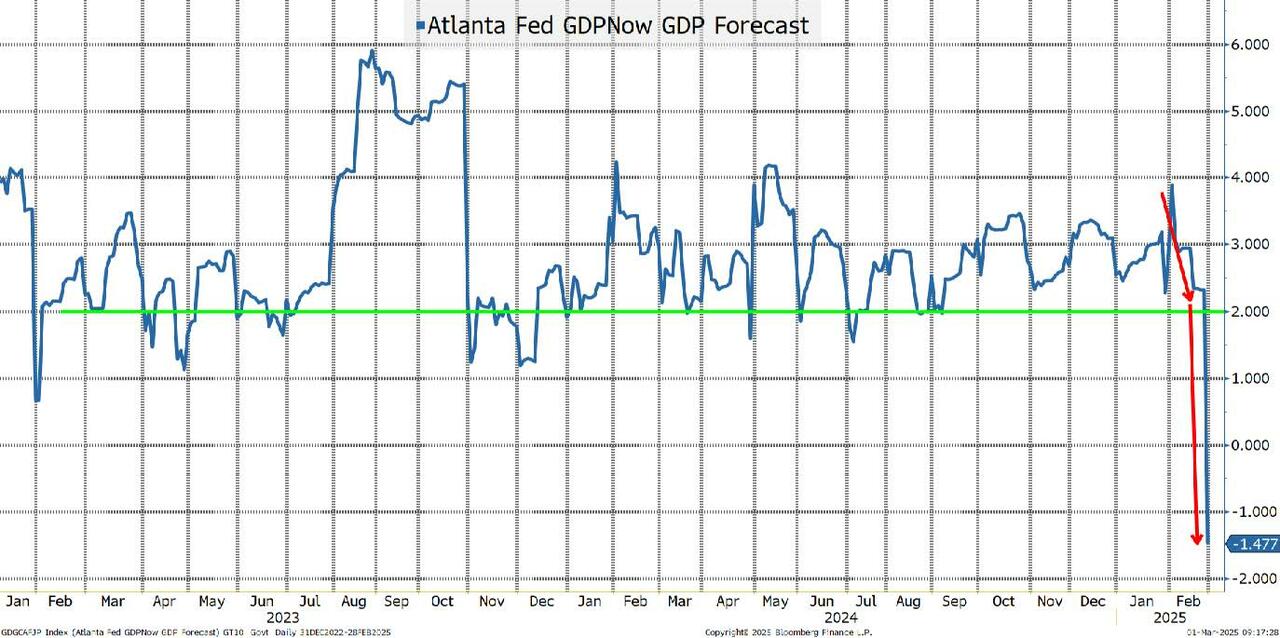
Let’s start by looking at this chart. It has some flaws, which we will go through, but it illustrates the point quite well – that intended, or even potential policy, can meaningfully affect the economy.
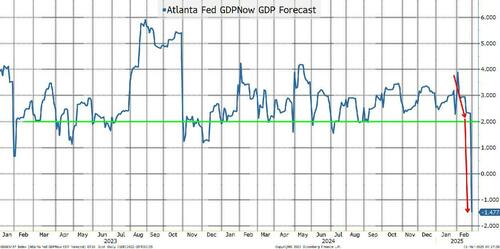
The Atlanta GDPNow forecast has been pretty good. It just plummeted.

  • The drop is almost entirely due to trade!
    • The advanced trade balance dropped to -$153 billion. That compares to -$129 in March of 2022 (the next worst print) and an average of -$64 billion going back to 2000.
  • The Atlanta GPDNow forecast does tend to overstate recent economic data, especially near the beginning of a quarter (more data comes in, etc.) and when it incorporates new data.

Some of this is likely to reverse as it was a preemptive reaction to potential tariffs by companies across the globe.
Having said that, how much will be undone? What does it mean for spending and the economy going forward if some things were “pulled forward” in anticipation of tariffs?

While this looks bad for GDP, it probably made inflation tick higher (rush to purchase and get things delivered ahead of tariffs) and maybe propped up the jobs data.

The importance of reactions to anticipated policies cannot be overstated. Companies are all skating to where the puck might be. And the longer the policies are anticipated, the more that will be done, making “undoing” it more difficult.

Waiting for Headlines from D.C.

We may see tariff information related to Canada and Mexico this weekend. Are they doing enough to get another extension? Coming into the weekend, Mexico extradited some prisoners to the U.S. which might help their cause. Supposedly Canada isn’t doing much about getting the seizure rate up from 1%. So, who knows? Though there was late-day chatter, primarily from Bessent, regarding a “Fortress North America.” The chatter was that Canada and Mexico might avoid tariffs with the U.S. by imposing their own tariffs on China. Interesting, and the concept of North America working well together makes a lot of sense, but that would be a pretty dramatic shift. Again, maybe all part of the “art of the deal?” More on “dealmaking” later.

As important as those tariffs might be for markets and the global economy, they all took a backseat on Friday to the televised meeting from the Oval Office. While many were present, it really boiled down to Trump, Zelensky, and Vance. I cannot remember the last time I watched anything from the Oval Office more than once – I think I’ve viewed it, in its entirety, at least twice and I’ve seen several snippets as well.

I cannot remember the internet being as binary and vocal about something since “what color is the dress” broke the internet about a decade ago.

Yes, comparing the stakes from yesterday’s meeting with something as pointless as whether a dress was blue/black or white/gold may seem like I’m trivializing something, but I’m just trying to defuse the situation long enough to make it through my take. This is my take, though it comes from conversations with journalists, our Geopolitical Intelligence Group, and others plugged into the situation. These opinions are my own, but I don’t think I can discuss where the economy is headed without at least laying the groundwork for how I’m thinking about the Russia/Ukraine/U.S. peace talks.

Maybe all of these issues will be resolved before you get to read this T-Report, but here is my take:

  • The U.S. has offered Ukraine a mineral deal as part of the peace talks. That deal has been negotiated in length and by all accounts both sides seem to think the terms of the mineral deal are acceptable (in so far that it is a mineral deal).

So far so good. Then what the heck happened on Friday?

  • The U.S. view is that the mineral deal is sufficient to deter Putin going forward. That it sends a strong message that the U.S. and Ukraine will be linked together economically. The logic is that Putin will take that strong message into account and not interfere, making the mineral agreement effectively a security agreement.
  • The Ukrainian view is that Putin and Russia cannot be trusted, and they need a security agreement alongside the mineral agreement.
  • Which brings up the question of why this meeting occurred at all? Was it to force Zelensky to accept that all he was going to get was a mineral agreement and that he had to trust that it would be effective as a security agreement? Did Zelensky think this was his opportunity to push the U.S. into providing a security agreement? Was this meant to be more of a “photo op” ahead of the final deliberations, which went sideways? It is interesting that Zelensky chose not to have an interpreter, which might have been very useful to slow things down and allow words to be used to de-escalate. I’ve always loved the Hamilton song – “The Room Where it Happens” and apparently yesterday, the entire world was in the “Room Where it Happens.”

In this case, I can see why both sides believe their points are valid.

From the U.S. perspective:

  • Without a doubt, increasing economic ties and having money invested in a region will increase American presence. It will incentivize the U.S. to protect their interests. While there is not an official security agreement, which Putin might not accept anyway, this is a back door to providing a security agreement, without providing one. Subtle, but plausible.
  • While Putin has broken agreements in the past (and the U.S. did too in expanding NATO), Trump believes that Putin will live up to an agreement with Trump. There were no new incursions during Trump 1.0. We have discussed in the past that having a dialogue with adversaries is the only way to achieve our goals. Trump clearly has that dialogue with Putin.

From the Ukrainian perspective.

  • Putin has violated agreements. The U.S. (and others) provided security guarantees when convincing Ukraine to give up their nuclear arsenal. They have been fighting for their lives and are afraid of any deal that might just give Putin time to reorganize and rebuild. They feel they need a security agreement and signing a mineral agreement without a security agreement would leave them with even fewer cards than they already hold (or don’t hold).
  • Some of the mineral deal itself seems like it is paying for what has occurred, not what is about to be. Also, the USMCA agreement was negotiated under Trump, and he hasn’t hesitated to effectively change the terms of that deal, via sanctions, when it suited him.

Zelensky might have to come back and take what was offered, even as Europe is having emergency meeting after emergency meeting on the subject.

Without the U.S. support, this likely ends badly for Ukraine, so they potentially come and take the deal, but I cannot believe that there won’t be longer-term ramifications for the global order. That may turn out great for the U.S. (clearly the admin believes it), or it might not, and only time will tell.

The Art of the Deal

One thing that became very clear, after a full-on media assault by this administration, is that:

  • Trump is a dealmaking guru (and guru might understate his skills).
  • Every deal Trump does is great, so everyone should do his deals.

That has always been a talking point, but it noticeably ramped up after that Oval Office meeting.

I’m not sure what it means, but the spike in volume is so noticeable that I think it is important. Maybe he is preparing the U.S. for certain deals (that might have short-term pain domestically) to win in the long run?

Jobs

Jobs week used to be more fun when we believed the numbers!

Since this is February data, I’m not sure I’d bet against weak numbers, given my concerns about seasonality adjustments overstating them.

I will point out that initial jobless claims popped up to 242k, and only a small portion of the increase can be linked to anything DOGE related. Presumably, with DOGE pushing forward, we will see jobless claims increase as people are forced out of work in the federal government.

I remain highly concerned about the ability of many who lose their jobs to get new jobs, not because of their skills or qualifications, but because my view on the economy is that the job market is far squishier than we’ve been led to believe – especially the private sector.

Unfortunately, we don’t get the JOLTS Quit rate until the following week. While there is a 1-month lag in the JOLTS data, I continue to view the Quit rate as “crowd sourced” data, as individuals are very good at understanding their own employment situation and their ability to attain another job. It has been mired at 2% on average since June, which is at the low-end of readings during “normal” times.

With so much uncertainty around the direction of trade policies, I find it difficult to believe many companies are in hiring mode. Even for those that presumably are inclined to wait and see how things play out.

Whatever the official data is, I’m looking for mediocre performance on the jobs front.

It is too early and too unclear for companies to build out and expand based on potential policies that may or may not be implemented.

It is not too early to be cautious and protect yourself against the possible risks of those policies.

Policy uncertainty basically has the opposite of buy now pay later.

The Consumer Classes

We cannot talk about “the consumer.”

The rich are doing well and continue to do well. Even with stocks basically unchanged on the year, and some serious crypto wealth taken off the table, the rich are doing well. We don’t need to spend a lot of time worrying about this class of consumer – which makes up a disproportionately large amount of consumer spending. So, with this group still performing, you cannot be too frightened about consumption.

The poor continue to struggle. Inflation. Rates. Jobs. You name it, and this group continues to struggle and may face further setbacks depending on what programs are cut. While it is harsh to say, they do not drive consumer spending, so while they are struggling, we can see overall consumption remain on track, since this class of consumer is not a force in consumption (yes, it is harsh to say, but it is true).

The middle class is where it gets interesting. While it is unclear how the Trump 2.0 policies will play out, there is clearly a path to a big rebound for the middle class. In fact, I’m eyeing a lot of what is going on in D.C. and Mar-a-Lago through the lens that Trump’s legacy might be to rebuild the middle class. The administration isn’t focused on the stock market. They aren’t focused on short-term pain. They are focused on policies that if they work out the way they are perceived they will, we will see a rise in the middle class. Not just in the number, but also in the security that those people have in their jobs. A true “middle class,” not something that sometimes feels like “just above poor.” If this is the mindset, a lot of good could happen, but that might be too far down the road for now as bumps come first and there is no certainty that every plan will play out as drawn up.
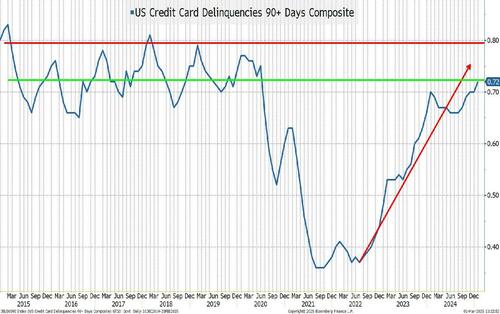
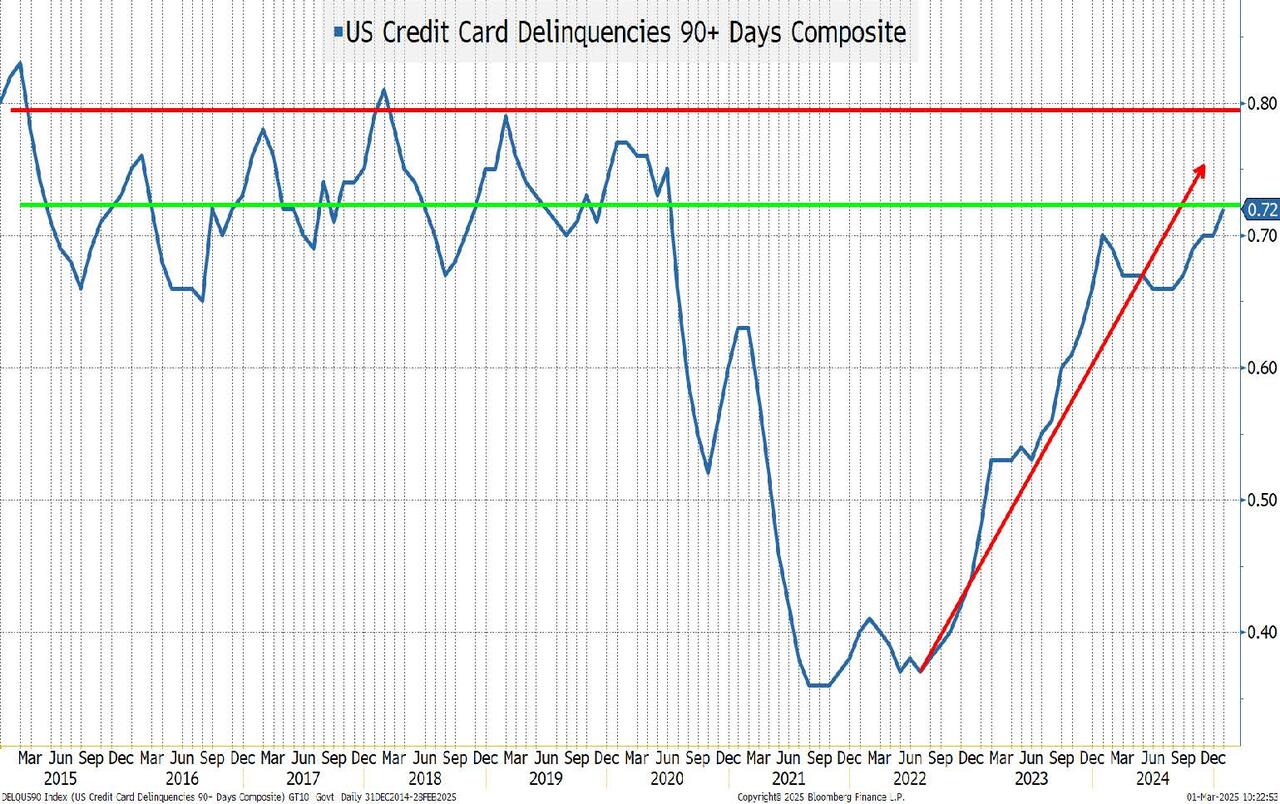
Credit card delinquencies have tracked back to about “average” for the period of 2015 through 2019. Not “alarming” but worth watching. I do like to focus on credit card debt as I think changes in Fed policy have almost no impact on problems in this market. I find it difficult to believe that paying 21% instead of 22% (or the like) has any influence on the trend. A year ago, there was a buffer here that just isn’t the case right now. It helped protect us during the recession fears in a way that isn’t achievable today.

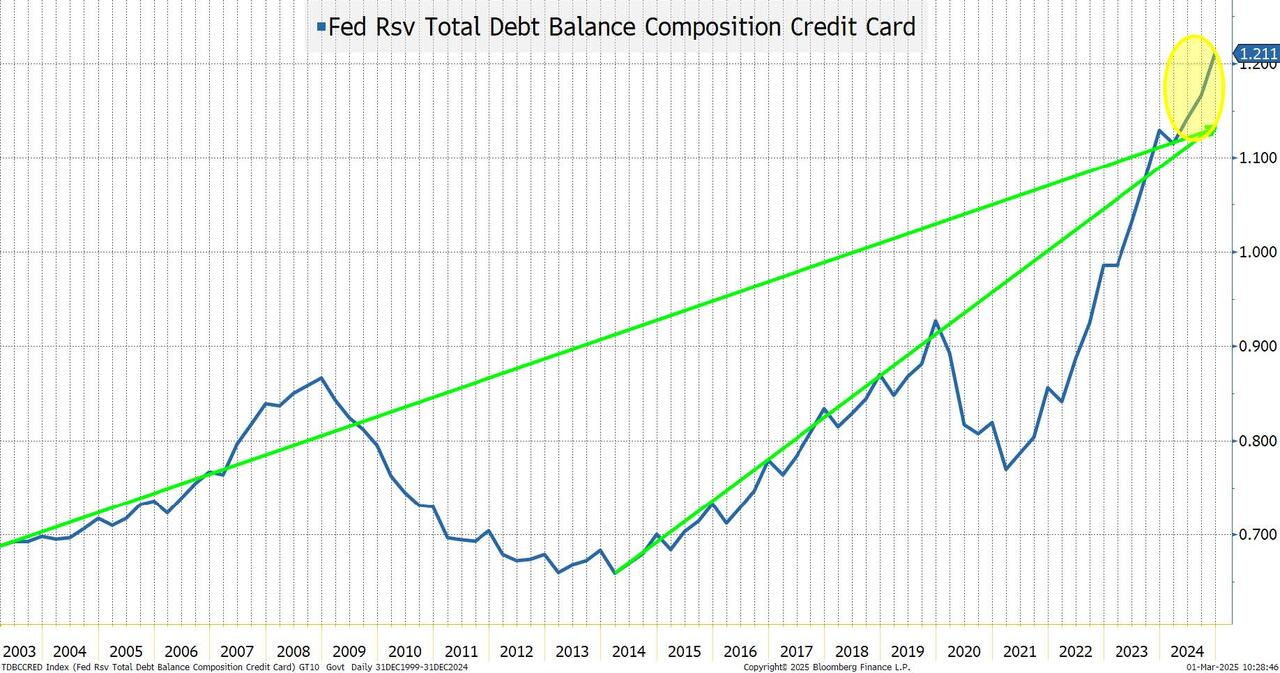
Similarly, we had some breathing room with the amount of credit card debt outstanding.

That is clearly less the case now, as we’ve broken back above trend. I’ve highlighted it in yellow since we have had inflation and an influx of people. So maybe the trend line is too low. Also, only a portion of this is likely to be middle class and represent “tapped out spending” from people who were spending. Nonetheless, we have less wiggle room if we get a downturn.

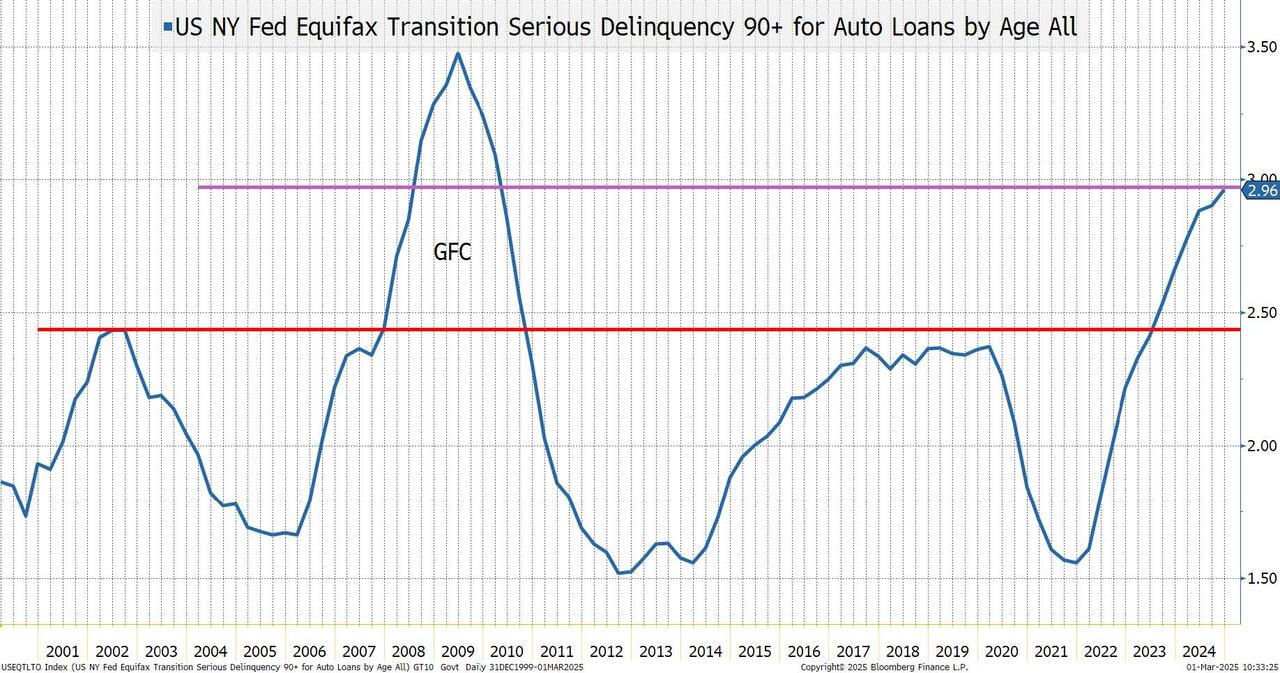
The auto loan metrics are more concerning.
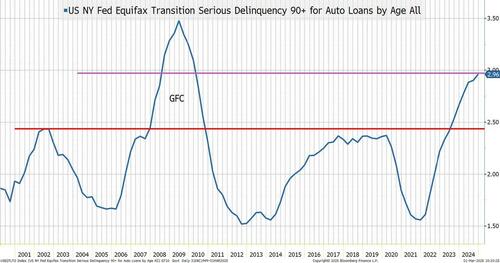
Basically, we are at levels of 90+ serious delinquencies, according to this time series. That was only “achieved” during the GFC.

While we can argue that credit card problems may be impacting consumers who don’t drive consumption (no pun intended), autos seem a bit more “upscale” than that.

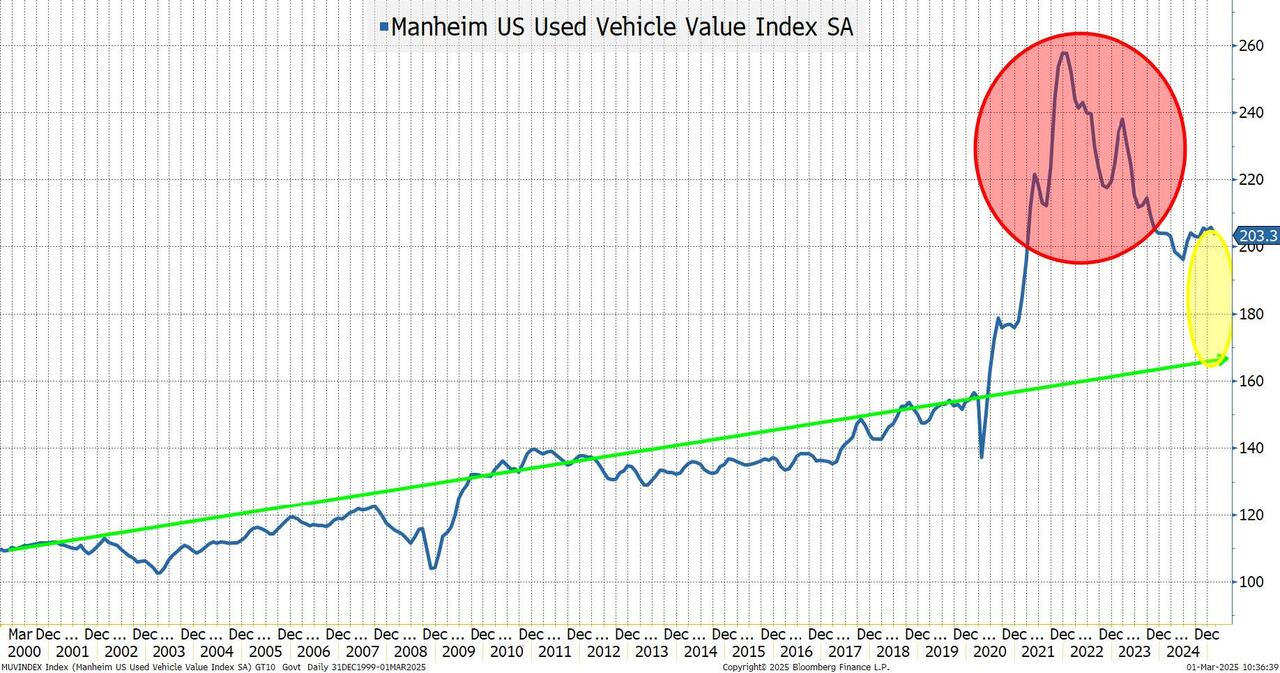
I do have an affinity for the Manheim used auto index.
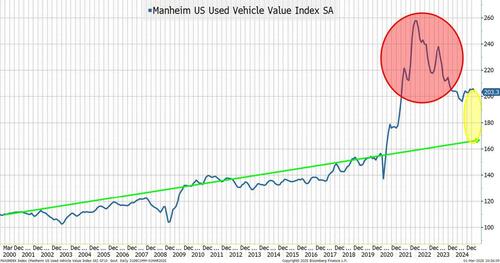
I’ve included it here, because I understand that it has some impact on setting “residual” values on leases, which in turn likely influenced loan underwriting. Clearly, what we saw post-Covid was largely an anomaly that is “normalizing.” Presumably much of that increase was ignored by lenders, but it is unclear to me how much. Delinquencies rising with recovery values declining isn’t good for anyone.

All Housing is Local

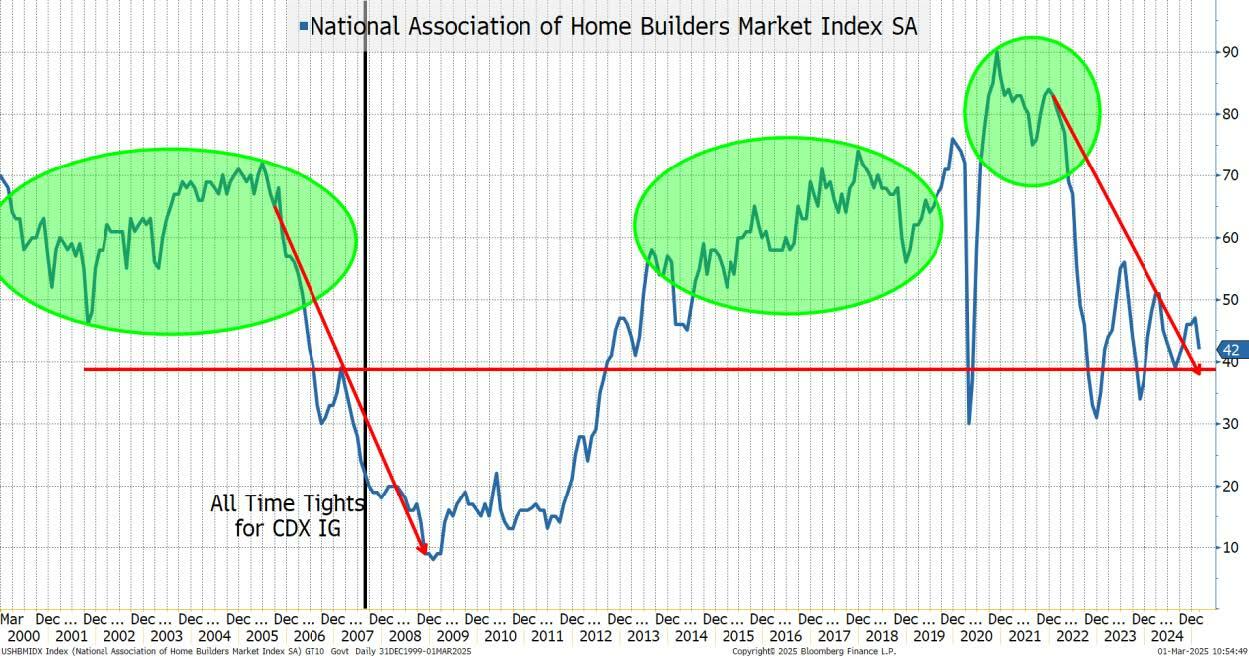
Homebuilder confidence is once again declining.
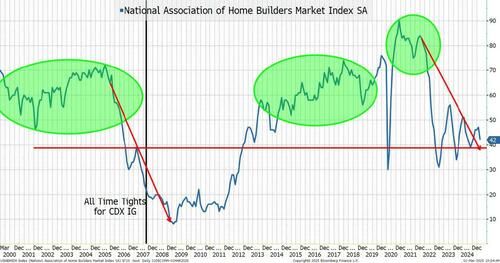
From my days of trading high yield homebuilders, I have applied two filters to this chart:

  • It is always overstated! Homebuilders are typically a pretty optimistic group about their own business – probably have to be when you need to buy land potentially years in advance of development.
  • They tend to do best when people are moving to new areas. Low population density areas that people want to move to afford them the best opportunity for profits (shale and fracking were big at one time, and more recently Tennessee, Florida, etc.).

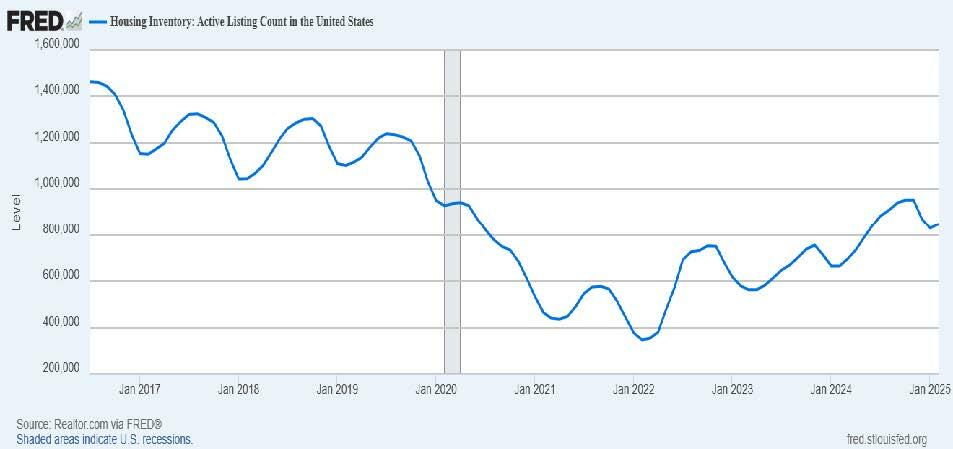
This decline is occurring while the statistic of homes for sale nationally is below trend (you will see why I brought up the second point in a moment).
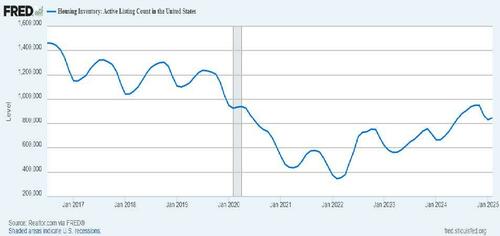
While homes for sale have been creeping higher, we are still well below pre-Covid levels.

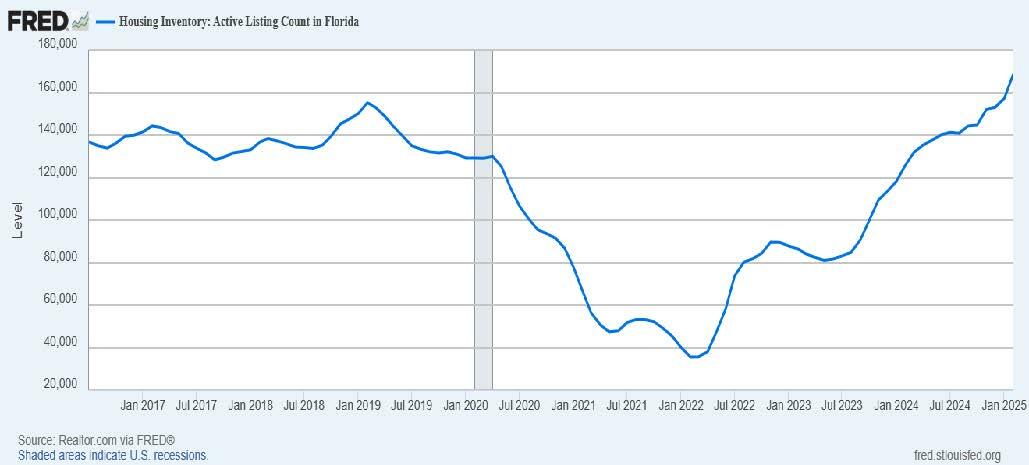
On the other hand, Florida is now at about any level we have seen in the past decade.
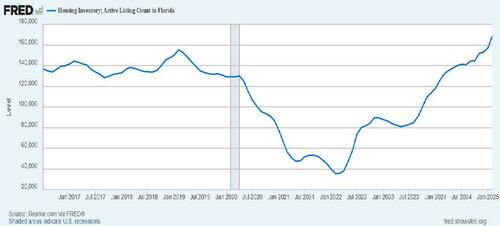
I was in Palm Beach last week for work (I swear it was for work), and there was no economic slowdown there. Consistent with the “rich have no problem.” But away from that there are plenty of signals that things got overbuilt. That everyone could somehow be a “landlord” and make rental money.

I’d be shocked if homes for sale in Florida are being driven by low income. This is getting to the heart of the issue. Are people stuck with homes they cannot afford (far more likely when people buy rental properties rather than primary residences)?

What went from a hotbed for the builders is now souring (the “national” level might be okay, but housing is and always will be a local thing).

You see this in some other rapid growth areas (not all of them, by any means) but enough to catch my attention.

Are the foundations (pun intended) crumbling? Or at least showing some stress fractures?

How Far Ahead Are We Skating to the Puck

Repeatedly in today’s report, we mention that policies could have, over time, very positive effects for the economy. Are we supposed to be skating there? Should we ignore potential bumps and go to where the puck will (or might) be further down the road?

I think not:

  • Near-term, most policies seem to be causing disruptions and uncertainties that will hit the data and make it very difficult to move far beyond that.
  • There is no certainty that the good outcomes will materialize.
    • Things that occur in the near-term, if problematic enough and for long enough, could derail some of the opportunity.
    • Assuming everyone will move how we want them to move, it carries its own set of risks. The best players are well aware of their own limitations and think about the unexpected from their opponents. I’m not sure how well this “red team/blue team” wargame concept is being used right now.

Expect bumpiness.

Let’s go back to the theme of the year – messy but manageable.

Things will be messy, but manageable. Whenever things seem too good to be true, fade them. Whenever things feel too bleak, buy them.

That certainly applies this weekend. The Nasdaq 100 for example is down almost 3% in a month, 6% from recent highs, but flat on the year. So, while being bearish, let’s take into account that we’ve already had some substantial moves to the downside.

Outlook – The Fed and Rates

The market is currently pricing in a 35% chance of a cut by the end of the May meeting. I think that is low.

Looking for 75 bps to 100 bps of cuts this year, starting with the May meeting.

That is based on the view that the existing data will be revised down, putting us in a weaker position than is being priced in AND that the data going forward is poised to deteriorate.

We might not need that many cuts this year if the positive consequences of policy start hitting us sooner rather than later.

We could have deals with Canada, Mexico, Russia/Ukraine, China, and Europe in a matter of weeks. That could unleash the good far sooner (and make it far more likely that the good outcomes occur).

We will back off the negative near-term outlook in a heartbeat if we see that.

Until then, uncertainty, in an already fragile economy, will show up as weaker data.

While we haven’t mentioned it, government spending was an important factor in the data for the past few years and that looks like it is getting trimmed quickly.

The 10-year at 4.21% seems a touch rich to me, even with my more aggressive view on the Fed’s path. There are so many moving factors here, but I think a push back towards 4.4% is more likely than a gap to 4%, even with my weaker economic outlook (tariffs, deficits, and foreign buying may all weigh on longer term yields).

Outlook – Credit and Equities

I can’t help but start with the Russell 2000. Down 11% in 3 months! Even after Friday’s bounce, it is back to levels from September 2024. All the post-election gains have evaporated. Short interest remains high.

We’ve been focused on China (FXI up 11% in a month and 15% YTD). Energy stocks, via XLE, have outperformed.
I think on the equity side, as simplistic as this might sound, you want to:

  • Be overweight anything that falls into the National Security = National Production theme. Clearly the U.S. plan with Ukraine fits this narrative perfectly.
  • Be overweight things that are under-owned or shorted. I’ve liked value, but will add some small caps now, as they have taken potentially more of a drubbing than they deserve.
  • If a stock has a leveraged ETF tracking it, and that leveraged ETF continues to get inflows, be wary. Those stocks can do well with inflows into those ETFs having a nice impact, but I cannot think of a more obvious “froth meter” than single stock leveraged ETFs.

Credit has done quite well so far. I highlighted early 2007 in one of the charts because I vaguely remember credit trading at all time tights. Making CDX IG 29 locked on a billion and being told that another firm was same priced, but locked on $10 billion! Yet a few moments later, credit was for sale.

One of my other favorite metrics is “semi-old” new issues. Not yesterday’s or very recent issues, as even if they widen, they tend to be very liquid. But the stuff that is a couple of weeks old tends to get illiquid once the dealers don’t feel the need to support it. It might not widen, but it becomes difficult to “trade on the wire.” That tends to be an early sign of potential weakness moving forward and seems to be occurring.

The S&P 500 and VIX tend to correlate to IG better than other equity metrics. While both recovered on Friday, they too aren’t sending a warm and fuzzy measure.

Finally, what we have seen on the equity front (away from the Russell 2000) has been more about valuations. The equal weighted Nasdaq and S&P 500 have outperformed the market weighted versions. But if the next leg of equity weakness is less about valuations and more about concerns about the economy, then it will be more difficult for credit to avoid widening.

Credit spreads have been boring and so far are not signaling any sort of real economic fear, but look for that to change.

Bottom Line

They say March’s weather is “in like a lion, out like a lamb.”  That may be true of the market situation as the past couple of weeks have not been kind to equities, but it could improve. Maybe even as soon as the end of this month.

It is certainly possible, and we will be watching the headlines out of D.C. to try to catch that swing.

But, for now, I suspect that we will still be riding that bucking bronco into April, when a bunch of new tariffs are scheduled to be implemented after April Fool’s Day. Maybe everything will coalesce by then, and we will have smooth sailing for all-time highs in markets and an incredibly healthy and robust economy! But I’m not there yet.

With the speed of headlines coming out, I’m only hopeful that I don’t have to do this report again before it is edited and distributed, and I hope it is still sensical by Monday morning when I typically resend it!
Tyler Durden
Sun, 03/02/2025 – 14:50

via ZeroHedge News https://ift.tt/a7MVvfB Tyler Durden

With US Back Turned On Ukraine, Rubio Expedites Delivery Of $4BN In Military Aid To Israel

With US Back Turned On Ukraine, Rubio Expedites Delivery Of $4BN In Military Aid To Israel

Zelensky got his dressing down on Friday for basically never being satisfied even after the billions in US taxpayer dollars poured into Kiev’s coffers over several years. He was accused by President Trump and VP J.D. Vance of being ungrateful and rude in the Oval Office meeting.

As for the other country which routinely receives billion in US defense funds and foreign aid should we expect Netanyahu to receive the same treatment? Will he be told off? No, it’s very unlikely, especially considering the new massive military package which is now being expedited by the Trump administration to Israel announced just this weekend.

US Secretary of State Marco Rubio unveiled on Saturday that he has signed a declaration to expedite delivery of some $4 billion in military assistance to Israel.

Image: GPO/Fox

Rubio added that the Trump administration “will continue to use all available tools to fulfill America’s long-standing commitment to Israel’s security, including means to counter security threats.”

“Rubio said he had used emergency authority to expedite the delivery of military assistance to Israel, which is now in a fragile ceasefire with U.S.-designated terrorist organization Hamas in their war in Gaza,” Reuters writes.

Almost $12 billion in major foreign military sales has already been approved by the Trump administration since January 20, even as the White House has hailed the fragile Hamas truce and hostage handover as happening because of Trump taking office.

While Americans have by and large turned on Zelensky, and have grown weary of the persisting Russia-Ukraine war, support for Israel among the US public remains high – and so Trump is unlikely to come under fire from his base for this massive support to Israel.

Evangelicals, which account for a huge segment of Trump voters, are especially big supporters of Israel – and form the basis of “Christian Zionism”. Along with the Israel lobby, such as AIPAC, these form a powerful coalition of influence on Capitol Hill.

The Trump administration has fiercely criticized the prior Biden admin for its ‘blank check’ approach to Ukraine, but the exact same can be said of long-running US policy with Israel.

If heavy fighting resumes in the Gaza Strip, and the ceasefire collapses, the issue might be raised among some Congressional ranks and come under a little scrutiny – but by and large the entire US government is filled with pro-Israel hawks on both sides of the aisle.

Tyler Durden
Sun, 03/02/2025 – 14:15

via ZeroHedge News https://ift.tt/IPpQonY Tyler Durden

UK, France, Ukraine Agree To Work On Cease-Fire Plan To Present To US

UK, France, Ukraine Agree To Work On Cease-Fire Plan To Present To US

Update: perhaps in response to the latest toothless European summit, which Poland’s PM summarized best as follows…

  • *TUSK REITERATES POLAND WON’T SEND ITS TROOPS TO UKRAINE
  • *TUSK: SECURITY GUARANTEES FOR UKRAINE NOT DISCUSSED IN SUMMIT

… or in other words, once again nothing of significance was agreed upon, Donald Trump posted in his Truth Social account a quote from Gartner analyst Michael McCune, according to whom Zelensky now has “no choice but to back down and accept Trump’s terms” suggesting that Trump clearly is content with the outcome of the Friday debacle in the White House.

Earlier, from Jacob Burg of the Epoch Times

British Prime Minister Keir Starmer said on March 2 that Britain, France, and Ukraine are working on a cease-fire plan to present to the United States as he prepares to host European leaders in discussions to end the Russia–Ukraine war.

Starmer’s Sunday summit of leaders stands in contrast to Ukrainian President Volodymyr Zelenskyy’s meeting in the White House on Friday, during which U.S. President Donald Trump scolded him for not being ready for peace and not being grateful for America’s support in his nation’s defense against Russia’s three-year-long invasion.

Starmer said he’s working on restoring discussions of peace and is using Friday’s breakdown as an opportunity to re-engage with Trump, Zelenskyy, and French President Emmanuel Macron rather than “ramp up the rhetoric.”

“We’ve now agreed that the United Kingdom, along with France and possibly one or two others, will work with Ukraine on a plan to stop the fighting, and then we’ll discuss that plan with the United States,” Starmer told the BBC, adding that he and Macron have both spoken to Trump since the latter’s meeting with Zelenskyy.

At Sunday’s summit, European leaders will look toward shoring up the continents’ defenses in defending Ukraine, including discussions to create a European military force to send to the war-torn country to cap a cease-fire. Starmer suggested the military force would include a “coalition of the willing.”

While he does not trust Russian President Vladimir Putin, Starmer said he trusts Trump.

“Do I believe Donald Trump when he says he wants lasting peace? The answer to that is yes,” he said.

Starmer added that “intense discussions” to obtain a security guarantee from the United States are one of the three components of lasting peace.

“If there is to be a deal, if there is to be a stopping of the fighting, then that agreement has to be defended, because the worst of all outcomes is that there is a temporary pause, and then Putin comes again,” Starmer said. “That has happened in the past. I think it is a real risk, and that is why we must ensure that if there’s a deal, it is a lasting deal, not a temporary pause.”

The summit, which will be held at Lancaster House—a 200-year-old mansion near Buckingham Palace—will also include leaders from France, Germany, Denmark, Italy, the Netherlands, Norway, Poland, Spain, Canada, Finland, Sweden, the Czech Republic, and Romania.

Other attendees include the Turkish foreign minister, NATO secretary-general, and the presidents of the European Commission and European Council.

Zelenskyy received support from European leaders after Friday’s contentious meeting at the White House in which a rare earths deal was abandoned and Trump told Zelenskyy to come back when he was ready for peace.

After the Ukrainian president arrived in Britain on Saturday, Starmer embraced him.

“As you heard from the cheers on the street outside, you have full backing across the United Kingdom,” Starmer said. “We stand with you, with Ukraine, for as long as it may take.”

Starmer also pledged to boost military spending to 2.5 percent of gross domestic product (GDP) by 2027. Other European nations might follow suit.


Continue reading at the Epoch Times

Tyler Durden
Sun, 03/02/2025 – 13:29

via ZeroHedge News https://ift.tt/UV0fbt7 Tyler Durden

Trump Declares Border ‘Invasion’ Is Over as Apprehensions Plunge To Historic Low

Trump Declares Border ‘Invasion’ Is Over as Apprehensions Plunge To Historic Low

Authored by Tom Ozimek via The Epoch Times,

President Donald Trump on Saturday said the “invasion of our country” is over after the number of illegal immigrant apprehensions at the U.S.–Mexico border fell to a historic low in February, his first full month in office.

According to newly released data from U.S. Customs and Border Protection (CBP), Border Patrol agents recorded just 8,326 apprehensions last month—the lowest monthly total in recorded history. By contrast, during the administration of President Joe Biden, CBP reported as many as 300,000 apprehensions of illegal border crossers in a single month.

Trump credited his administration’s strict enforcement policies for the dramatic decline in border arrests. “The month of February, my first full month in office, had the LOWEST number of Illegal Immigrants trying to enter our Country in History – BY FAR!” Trump said in a post on Truth Social.

On his first day in office, Trump signed 10 executive orders and proclamations addressing border security and the deportation of illegal immigrants. He ended “catch and release,” shut down the CBP One app used for parole exceptions, and pressured Mexico through the threat of tariffs into deploying 10,000 troops to curb drug trafficking and tighten enforcement of immigration controls.

Trump also declared a national emergency at the border, ramped up deportations of illegal immigrants, and issued an order ending birthright citizenship.

“Thanks to the Trump Administration Policies, the Border is CLOSED to all Illegal Immigrants,“ Trump wrote. 

”Anyone who tries to illegally enter the U.S.A. will face significant criminal penalties and immediate deportation.”

The Department of Homeland Security (DHS) echoed Trump’s sentiment. DHS Secretary Kristi Noem confirmed the record low in apprehensions and emphasized the administration’s firm stance against illegal immigration.

“The world is hearing our message: do not come to our country illegally. If you do, we will find you, arrest you, and send you back,” Noem wrote in a post on social media. 

“We’re just getting started.”

Despite the administration’s success in reducing illegal crossings, Trump’s policies have drawn opposition. Last month, a group of Quaker congregations filed a lawsuit against DHS, accusing the agency of violating their religious freedom by allowing arrests of illegal immigrants attending religious services.

Additionally, multiple federal judges have blocked Trump’s executive order that ended birthright citizenship for children of illegal immigrants, with the Trump administration vowing to appeal.

Immigration and border security were top voter priorities during the 2024 election, rivaled only by economic concerns such as inflation.

In addition to his day one actions on border security, Trump recently signed an executive order instructing all agencies to identify federally funded programs that provide financial assistance to illegal immigrants and to eliminate such aid.

“With this Executive Order, President Trump is ensuring taxpayer resources are used to protect the interests of American citizens, not illegal aliens,” a White House fact sheet states.

Also, DHS recently announced that illegal immigrants in the country must register with the federal government and that failing to do so will result in fines or imprisonment. The aim is to allow law enforcement to track and compel illegal immigrants to self-deport, while saving agency resources that would otherwise be used to carry out physical removals.

DHS also announced recently that the number of illegal immigrant arrests in the interior of the country have jumped significantly under the Trump administration, with more than 20,000 arrests in the past month, compared to around 33,000 during President Joe Biden’s last full year in office.

Estimates of the total illegal immigrant population in the United States vary significantly. 

The Department of Homeland Security estimated 11 million as of January 2022, while the Center for Immigration Studies placed the figure at 12.3 million in May 2023. The Federation for American Immigration Reform provided a higher estimate of 16.8 million in June 2023.

Trump has suggested the actual number could be as high as 21 million, while Secretary of State Marco Rubio, in a May 2024 interview with NBC News during his tenure as a senator, speculated the total could reach up to 30 million.

Tyler Durden
Sun, 03/02/2025 – 13:05

via ZeroHedge News https://ift.tt/TXloZ9e Tyler Durden

Texas Company Lands On Moon In “First Successful Commercial Landing” 

Texas Company Lands On Moon In “First Successful Commercial Landing” 

Firefly Aerospace’s “Blue Ghost” lander became the first private spacecraft to successfully land on the Moon after descending from lunar orbit early Sunday morning.

Firefly confirmed on X around 0336 ET that the 6.6-foot-tall lander “stuck the landing” and “became the first commercial company in history to achieve a fully successful Moon landing. This small step on the Moon represents a giant leap in commercial exploration,” adding this “paves the way for future missions to the Moon and Mars.” 

Here is Blue Ghost’s first image of the lunar surface. 

More images.

Apollo 11 moonwalker Buzz Aldrin congratulated the Austin-based space startup on X:

Blue Ghost’s lunar journey began earlier this year atop Elon Musk’s SpaceX rocket launched from NASA’s Kennedy Space Center in Florida. The mission will last two weeks, during which the lander will conduct ten NASA-sponsored experiments.

Last year, Houston-based Intuitive Machines’ Odysseus Lander crash-landed on the moon, dooming many of its onboard instruments. 

Besides private companies, five nations—the former Soviet Union, the US, China, India, and, most recently, Japan—have successfully achieved soft landings on the lunar surface.

Missions like Firefly’s Blue Ghost show the commercial space race is heating up. The US leads this race because of Musk’s SpaceX, years ahead of the rest of the world (Goldman went bull on Starlink satellite part suppliers last month).

The US plans to send astronauts to the lunar surface in a series of crewed missions by the end of the decade. Musk recently stated that the first Starship mission to Mars would be in two years.

CBS News noted that shortly after Blue Ghost touched down on the lunar surface, employees were handed “Make Space Great Again” hats. This is what ‘America First‘ looks like—the era of weakness and gender confusion is likely coming to an abrupt end.

Americans have long been known as explorers, pioneers, and trailblazers, pushing boundaries to the extreme—from the frontier days to the Space Age. Democrats have totally lost the plot about nation with their weird obsession with woke Marxism and horrific child mutilations

After decades of crisis in the so-called Fourth Turning, a new First Turning could emerge, centered around national renewal and Space Age 2.0. The young generation will find its heroes—those launching rockets and strong leaders (MAGA). The new Americana Party will likely take the reins and lead the nation into a new chapter—one driven by strong leaders and space exploration. 

Tyler Durden
Sun, 03/02/2025 – 12:05

via ZeroHedge News https://ift.tt/svokeUK Tyler Durden

Israel Blocks All Humanitarian Aid To Gaza As Ceasefire Could Collapse

Israel Blocks All Humanitarian Aid To Gaza As Ceasefire Could Collapse

Regional Mideast sources are widely reporting that Israel’s military has halted the entry of all humanitarian aid into the Gaza Strip at a moment tens of thousands of Palestinians continue returning to their homes, especially in the war-ravaged north.

Phase one of the fragile ceasefire agreement has ended, but some Israeli hostages still remain captive in the Strip, and there’s as yet no word that the sides have come to an agreement on the phase two part of the plan. Currently, there’s talk of simply extending phase one, and the guns have remained silent so far.

But that may change given the cessation of food, medicine, and water shipments to the Strip. Both sides continue making threats, and Israeli Prime Minister Benjamin Netanyahu has signaled the air and ground war could soon resume. Palestinians are accusing Israel of seeking to change the terms and framework of the ceasefire.

Getty Images

Netanyahu’s office said Sunday that “the entry of all goods and supplies to the Gaza Strip will be halted” – warning that this is due to Hamas rejecting the continuation of peace talks proposed by US special envoy Steve Witkoff.

“Israel will not allow a ceasefire without a release of our hostages,” the statement said. “If Hamas persists in its refusal, there will be additional consequences.”

The first phase of the agreement officially ended on Saturday, but Al Jazeera reports that “Netanyahu’s office said Israel has agreed to a proposal by Witkoff to extend the first phase of the ceasefire for six weeks during Ramadan – the Muslim holy month that began over the weekend – and the Jewish Passover holiday, which ends on April 20.”

A Hamas spokesman has responded by calling the blocked aid convoys a “cheap blackmail” and a “coup” on the ceasefire agreement. Hamas is urging international mediators to intervene.

“Netanyahu’s decision to stop aid going into Gaza once again shows the ugly face of the Israeli occupation… The international community must apply pressure on the Israeli government to stop starving our people,” the Hamas spokesman said.

Since the ceasefire was first agreed to in mid-January, thousands of trucks have entered Gaza each week, but given hundreds of thousands are starving and without continued access to basic necessities of life such as medicines – the situation remains desperate.

Many have accused Biden of setting up the conditions for a total aid blockade of the Gaza Strip…

At various times throughout the conflict, international organizations including the UN have warned that parts of the Strip have stood on the brink of famine. Also, young children have died due to recent cold and winter conditions, amid lack of heating fuel or means.

Tyler Durden
Sun, 03/02/2025 – 11:40

via ZeroHedge News https://ift.tt/o3cSsGQ Tyler Durden

VDH: 10 Takeaways From The Zelenskyy Blow-Up

VDH: 10 Takeaways From The Zelenskyy Blow-Up

Authored by Victor Davis Hanson via X,

1. Zelenskyy does not grasp—or deliberately ignores—the bitter truth: those with whom he feels most affinity (Western globalists, the American Left, the Europeans) have little power in 2025 to help him. And those with whom he obviously does not like or seeks to embarrass (cf. his Scranton, Penn. campaign-like visit in September 2024) alone have the power to save him. For his own sake, I hope he is not being “briefed” by the Obama-Clinton-Biden gang to confront Trump, given their interests are not really Ukraine’s as they feign.

2. Zelenskyy acts as if his agendas and ours are identical. So, he keeps insisting that he is fighting for us despite our two-ocean-distance that he mocks. We do have many shared interests with Ukraine, but not all by any means: Trump wants to “reset” with Russia and triangulate it against China. He seeks to avoid a 1962 DEFCON 2-like crisis over a proxy showdown in proximity to a nuclear rival. And he sincerely wants to end the deadlocked Stalingrad slaughterhouse for everyone’s sake.

3. The Europeans (and Canada) are now talking loudly of a new muscular antithesis, independent of the U.S. Promises, promises—given that would require Europeans to prune back their social welfare state, frack, use nuclear, stop the green obsessions, and spend 3-5 percent of their GDP on defense. The U.S. does not just pay 16 percent of NATO’s budget but also puts up with asymmetrical tariffs that result in a European Union trade surplus of $160 billion, plays the world cop patrolling sea-lanes and deterring terrorists and rogues states that otherwise might interrupt Europe’s commercial networks abroad, as well as de facto including Europe under a nuclear umbrella of 6,500 nukes.

4. Zelenskyy must know that all of the once deal-stopping issues to peace have been de facto settled: Ukraine is now better armed than most NATO nations, but will not be in NATO; and no president has or will ever supply Ukraine with the armed wherewithal to take back the Donbass and Crimea. So, the only two issues are a) how far will Putin be willing to withdraw to his 2022 borders and b) how will he be deterred? The first is answered by a commercial sector/tripwire, joint Ukrainian-US-Europe resource development corridor in Eastern Ukraine, coupled with a Korea-like DMZ; the second by the fact that Putin unlike his 2008 and 2014 invasions has now lost a million dead and wounded to a Ukraine that will remain thusly armed.

5. What are Zelenskyy’s alternatives without much U.S. help – wait for a return of the Democrats to the White House in four years? Hope for a rearmed Europe? Pray for a Democratic House and a 3rd Vindman-like engineered Trump impeachment? Or swallow his pride, return to the White House, sign the rare-earth minerals deal, invite in the Euros (are they seriously willing to patrol a DMZ?), and hope Trump can warn Putin, as he did successfully between 2017-21, not to dare try it again?

6. If there is a cease fire, a commercial deal, a Euro ground presence, and influx of Western companies into Ukraine, would there be elections? And if so, would Zelenskyy and his party win? And if not, would there be a successor transparent government that would reveal exactly where all the Western financial aid money went?

7. Zelenskyy might see a model in Netanyahu. The Biden Administration was far harder on him than Trump is on Ukraine: suspending arms shipments, demanding cease-fires, prodding for a wartime, bipartisan cabinet, hammering Israel on collateral damage—none of which Westerners have demanded of Zelenskyy. Yet Netanyahu managed a hostile Biden, kept Israel close to its patron, and when visiting was gracious to his host. Netanyahu certainly would never before the global media have interrupted, and berated a host and patron president in the White House.

8. If Ukraine has alienated the U.S. what then is its strategic victory plan? Wait around for more Euros? Hold off an increasingly invigorated Russian military? Cede more territory? What, then, exactly are Zelenskyy’s cards he seems to think are a winning hand?

9. If one views carefully all the 50-minute tape, most of it was going quite well – until Zelenskyy started correcting Vance firstly, and Trump secondly. By Ukraine-splaining to his hosts, and by his gestures, tone, and interruptions, he made it clear that he assumed that Trump was just more of the same compliant, clueless moneybags Biden waxen effigy. And that was naïve for such a supposedly worldly leader.

10. March 2025 is not March 2022, after the heroic saving of Kyiv—but three years and 1.5 million dead and wounded later. Zelenskyy is no longer the international heartthrob with the glamorous entourage. He has postponed elections, outlawed opposition media and parties, suspended habeas corpus and walked out of negotiations when he had an even hand in Spring 2022 and apparently even now when he does not in Spring 2025.

Quo vadis, Volodymyr?

Tyler Durden
Sun, 03/02/2025 – 11:15

via ZeroHedge News https://ift.tt/cFWowlf Tyler Durden