Pentagon Purge Resumes: 3-Star Defense Health Commander Forced Into Retirement

Pentagon Purge Resumes: 3-Star Defense Health Commander Forced Into Retirement

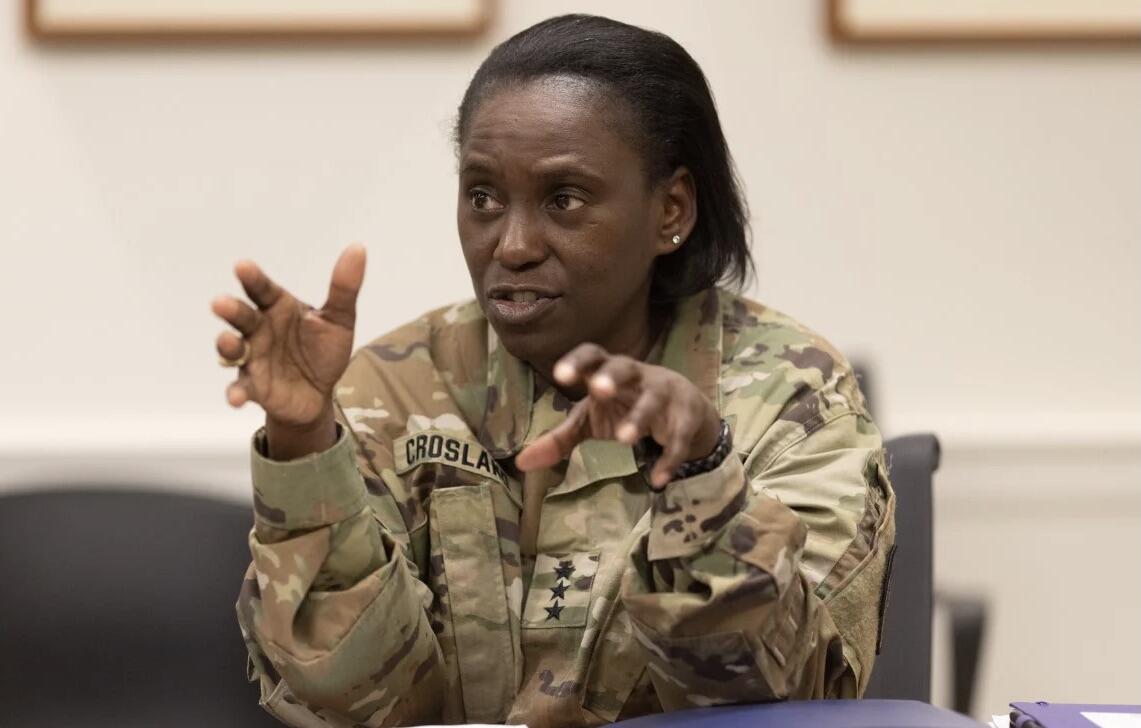
A week after the Trump administration fired the chairman of the Joint Chiefs of Staff and five more senior Pentagon officers, another head rolled on Friday as the three-star commander of the Defense Health Agency (DHA) retired — with sources telling Reuters that retirement was forced on her

As DHA commander, US Army Lt. Gen. Telita Crosland oversaw a vast medical system serving more than 9.5 million service members, retirees and family members around the world via more than 700 hospitals and clinics with a staff of more than 130,000 service members, civilian employees and contractors.  

Lt. Gen. Telita Crosland had commanded the Defense Health Agency since January 2023 (Mike Morones/MOAA

News of her sudden retirement broke Friday morning, with acting Secretary of Defense for Health Affairs Stephen Ferrara notifying DHA service members and civilian employees. In an email obtained by ZeroHedge, he wrote:  

“This morning, Army Lieutenant General (LTG) Dr. Telita Crosland, the fourth Director of the Defense Health Agency (DHA), is beginning her retirement. I want to thank LTG Crosland for her dedication to the nation, to the Military Health System, and to Army Medicine for the past 32 years. I have designated Dr. David Smith, the Acting Principal Deputy Assistant Secretary of Defense for Health Affairs, as the Acting Director of the DHA while the Department conducts the normal nomination process.”

On Friday evening, Reuters was first to confirm universal suspicions that Crosland’s sudden retirement wasn’t her idea, with both a current and former official saying she was ordered to retire. The officials, spoke to the news agency on condition of anonymity, said she was not given a reason for being pushed out of the military after a career spanning more than 30 years. A West Point graduate who started her Army service as a Medical Corps officer in 1993, Crosland was given the DHA command after serving as the Army’s Deputy Surgeon General

The Defense Health Agency has more than 700 hospitals and clinics, including Brooke Army Medical Center in San Antonio 

While specific reasons for Crosland’s retirement have yet to surface, leftists were quick to race to their own predictable, knee-jerk conclusions. Here’s a sampling from the r/fednews subreddit, which is the center of the universe for federal employees wailing about Trump’s shrinking and restructuring of the US government workforce: 

  • “She had too much honor and integrity for this administration, so they shoved her aside for a nice, obedient white man.”
  •  “She is far too not a white man.”
  • “Anyone still pretending these aren’t racist fascists are fools.”
  • “One more racially-motivated dismissal.”
  • She definitely was removed for being a POC and a female.” 

Crosland’s forced resignation capped a week of momentous moves by the Trump administration vis-a-vis the Pentagon.

Tyler Durden
Sat, 03/01/2025 – 21:35

via ZeroHedge News https://ift.tt/Uyg8re1 Tyler Durden

Gun Owners Take DC Magazine Restrictions To Supreme Court

Gun Owners Take DC Magazine Restrictions To Supreme Court

Authored by Matthew Vadum via The Epoch Times,

Gun owners in the nation’s capital are asking the U.S. Supreme Court to strike down the District of Columbia’s ban on magazines with more than 10 rounds of ammunition.

The petition in Hanson v. District of Columbia was docketed, or officially accepted for filing, by the court on Feb. 28. The respondent, the District of Columbia, was directed to file a response by March 31.

The district enacted the Firearms Registration Amendment Act of 2008 after the Supreme Court invalidated the city’s sweeping restrictions on gun ownership in District of Columbia v. Heller (2008). In Heller, the nation’s highest court determined that individuals have a right to possess firearms for lawful purposes, including self-defense at home.

The statute made it a felony-level offense to have a magazine that could hold more than 10 rounds. A violation can result in a prison term of three years and a fine of $12,500. District officials say the law is needed to protect the public.

Lead petitioner Andrew Hanson and co-petitioners Tyler Yzaguirre, Nathan Chaney, and Eric Klun, who all have concealed carry pistol licenses in the District of Columbia, possessed magazines holding more than 10 rounds outside D.C. and said they would use their magazines for lawful purposes in the district if the 10-round limit did not apply.

Hanson argues in the petition that the district’s magazine cap is unconstitutional according to a test the Supreme Court articulated in New York State Rifle and Pistol Association v. Bruen (2022), which recognized a right to bear arms in public for self-defense.

Weeks after Bruen was decided, the petitioners sued the District of Columbia, asking for a declaration from a federal district court that the magazine cap ran afoul of the Second and Fifth Amendments.

U.S. District Judge Rudolph Contreras issued an April 2023 decision that denied Hanson’s request to block the law on constitutional grounds. Contreras found that the local law adheres to the U.S. Constitution.

The judge found that the District’s ammo limitation, which was aimed at promoting public safety, was justified. The ban constituted “an attempt to mitigate the carnage of mass shootings in this country.”

“Just as states and the District enacted sweeping laws restricting possession of high-capacity weapons in an attempt to reduce violence during the Prohibition era, so can the District now,” Contreras said.

Hanson appealed to the U.S. Court of Appeals for the District of Columbia Circuit, which on Oct. 29, 2024, voted 2-1 to deny a request for a preliminary injunction against the statute.

“For 15 years, District law enforcement has operated and been resourced with the magazine cap in place,” and an “‘erroneously issued’ preliminary injunction suspending its law could drastically compromise the District’s ability to enforce its magazine cap far into the future” and allow the district to be inundated with large-capacity magazines during the life of the injunction, the court said.

Circuit Judge Justin Walker dissented.

In Heller, Walker said, the Supreme Court determined “that the government cannot categorically ban an arm in common use for lawful purposes.”

“Magazines holding more than ten rounds of ammunition are arms in common use for lawful purposes. Therefore, the government cannot ban them,” Walker wrote.

The Supreme Court should take up the case because the D.C. Circuit Court’s ruling is inconsistent with Heller, which “protects the possession and use of weapons that are ‘in common use at the time,’” according to the petition.

Even though the panel acknowledged that magazines containing 10 or more rounds are “in common use,” it found they were “particularly dangerous” and compared them to fully automatic machine guns.

The petitioners asked the Supreme Court to consider if the Second Amendment “allows a categorical ban on arms that are indisputably common throughout the United States and overwhelmingly used for lawful purposes (generally) and self-defense (specifically).”

Petitioner Yzaguirre, who is president of the Second Amendment Institute, said he’s optimistic about the petition’s prospects.

“It’s time for the Supreme Court to take its next landmark Second Amendment case,” he told The Epoch Times.

“The days of tyrannical elites restricting ‘We the People’ from exercising our God-given rights to self-defense must come to an end,” Yzaguirre said.

The Epoch Times reached out for comment to District of Columbia Attorney General Brian Schwalb. No reply was received by publication time.

Tyler Durden
Sat, 03/01/2025 – 21:00

via ZeroHedge News https://ift.tt/bdPwItZ Tyler Durden

How Modern Monetary Theory Advocates View Money & The State

How Modern Monetary Theory Advocates View Money & The State

Authored by Frank Shostack via Mises.org,

According to the Modern Monetary Theory (MMT), money is something decided by the state. The MMT regards money as a token. For instance, when an individual places a coat in the cloakroom of a theater, he receives a tin disc or a paper receipt. This receipt or a disc is a proof that the individual is entitled to demand the return of his coat.

According to the MMT, the material used to manufacture the tokens is irrelevant—it can be gold, silver, or any other metal or it can even be paper. Hence, the definition of money, according to the MMT, is what the state decides it is going to be. MMT posits that the value of money is the outcome of the state that forces people to pay taxes with the money tokens that the state has decided upon. The state taxes have to be paid with the money tokens issued by it. The state also has the ability to control the value of money through its declaration of how much it is willing to pay for a certain commodity produced by the private sector.
In the MMT framework, the token money is seen as a receipt on the economy’s resources. A token money held by an individual is regarded as his claim on a portion of resources. Individuals have exchanged goods and services for a receipt given to them by the government. Individuals who have generated goods and services are acknowledged for this by the tokens issued to them by the government.

However, could the sovereign state effectively require individuals to use tokens in the transactions among themselves? Why would anyone accept a fiat-token as a payment simply because the government accepts these tokens as tax payments? To answer these questions, we have to define money.

Defining Money

To establish the definition of money, we have to ascertain how a money-using economy evolved. Money emerged as a result of the fact that barter could not support a complex, modern market economy. The distinguishing characteristic of money is that it functions as the general medium of exchange. It has evolved from the most marketable commodity. On this Rothbard wrote,

“… just as in nature there is a great variety of skills and resources, so there is a variety in the marketability of goods. Some goods are more widely demanded than others, some are more divisible into smaller units without loss of value, some more durable over long periods of time, some more transportable over large distances. All of these advantages make for greater marketability. It is clear that in every society, the most marketable goods will be gradually selected as the media for exchange. As they are more and more selected as media, the demand for them increases because of this use, and so they become even more marketable. The result is a reinforcing spiral: more marketability causes wider use as a medium which causes more marketability, etc. Eventually, one or two commodities are used as general media—in almost all exchanges—and these are called money.”

Money is the thing that all other goods and services are traded for. This fundamental characteristic of money must be contrasted with other goods. For instance, food’s characteristic is that it supplies the necessary sustenance to human beings and people may like the taste. Capital goods’ characteristics is that it permits the expansion of the infrastructure that, in turn, permits the production of a larger quantity of goods and services. Contrary to the MMT, the essence of money has nothing to do with tax payments to the government.

Money functions as a general means of exchange. People pay with goods and services for other goods and services with the help of money. Money facilitates the payments of one good for another good. Also, contrary to the MMT, money is not a claim on resources, but the general medium of the exchange. In his writings Carl Menger raised doubts about the soundness of the view that the origin of money is government proclamation. According to Menger,

“An event of such high and universal significance and of notoriety so inevitable, as the establishment by law or convention of a universal medium of exchange, would certainly have been retained in the memory of man, the more certainly inasmuch as it would have had to be performed in a great number of places. Yet no historical monument gives us trustworthy tidings of any transactions either conferring distinct recognition on media of exchange already in use, or referring to their adoption by peoples of comparatively recent culture, much less testifying to an initiation of the earliest ages of economic civilization in the use of money.”

Mises similarly explains the acceptance of money. In his writings, Mises had shown how the value of money is established. Mises began his analysis by noting that today’s demand for money is determined by yesterday’s purchasing power of money. Consequently, for a given supply of money, today’s purchasing power is established. Yesterday’s demand for money was fixed by the prior day’s purchasing power of money. So, for a given supply of money, yesterday’s price of money was set. The same procedure applies to past periods.

By regressing through time, we will eventually arrive at a point in time when money was just an ordinary commodity where demand and supply set its price. The commodity had an exchange value in terms of other commodities (i.e., its exchange value was established in barter). On the day a commodity becomes money, it already has an established purchasing power or price in terms of other goods. This purchasing power enables us to set the demand for this commodity as money. This process sets its purchasing power on the day the commodity starts to function as money. Once the price of money is established, it serves as input for the establishment of tomorrow’s price of money. It follows then that, without yesterday’s information about the price of money, today’s purchasing power of money cannot be established.

With regards to other goods and services, history is not required to ascertain present prices. A demand for these goods arises on account of the perceived benefits from consuming them. The benefit that money provides is that it can be exchanged for goods and services. Consequently, one needs to know the past purchasing power of money in order to establish today’s demand for it.

Applying the Mises’s framework—also known as the regression theorem—we can infer that it is not possible that money could have emerged as a result of a government decree, government endorsement, or social convention. The theorem shows that money must have emerged as a commodity. According to Rothbard,

“Money is not an abstract unit of account, divorceable from a concrete good; it is not a useless token only good for exchanging; it is not a ‘claim on society’; it is not a guarantee of a fixed price level. It is simply a commodity.”

MMT and Wealth Generation

In the MMT world, where money is generated by the government and—given that the government is able to inflate freely as much money as it requires—then, by implication, the government has command over unlimited amounts of wealth. If the government determines what should be regarded as money and what its value is, this also means that the government dictates the rate of exchanges between money and goods and services. This means that prices are set by the government and bypasses the free market forces. Economic theory shows that such conduct leads to the inefficient use of resources and, in turn, to economic instability and impoverishment.

MMT holds that the role of government policies should be to prevent the emergence of a situation where “idle resources” and unemployment emerge. According to MMT, the key here is to boost the overall demand for goods and services to lift economic growth, eliminate unemployment, and make the full use of resources. This can be achieved by running large budget deficits financed by printing plenty of money. In the MMT world, money printing is not a problem as long as there is unemployment and unutilized resources.

Conclusions

In MMT, money is what the government decides it is. MMT believes that because people are forced to pay taxes with the government’s token money, that the government establishes the value of money. This, in turn, makes it a medium of exchange in the private sector also. Without a freely-established money, it is impossible to form the free rate of exchanges between money and goods and services. Consequently, this makes it impossible to have an efficient allocation of scarce resources. This sets the foundation for economic misery.
Tyler Durden
Sat, 03/01/2025 – 19:50

via ZeroHedge News https://ift.tt/oQA3Lfc Tyler Durden

House Republicans Plan To Scrub Anti-American BLM Plaza In DC

House Republicans Plan To Scrub Anti-American BLM Plaza In DC

Washington, DC, painted “BLACK LIVES MATTER” across two blocks of 16th Street, near the White House, during the 2020 color revolution riots, fueled by radical leftist, taxpayer-funded NGOs. Each of the 16 bold yellow letters spans the width of the two-lane Street, creating a massive display of toxic wokeness—one that House Republicans may soon move to scrub.

The House Oversight Committee and the Trump Administration are working on delivering a number of reforms to make our nation’s capital safe and end left-wing pet projects. This includes addressing partisan abuses by the District government such as Black Lives Matter Plaza,” House Oversight Committee chair Rep. James Comer (R-Ky) stated, quoted by the New York Post

In 2020, painters were contacted by far-left Mayor Muriel Bowser … 

… a few months after BLM riots unleashed color revolution chaos nationwide.

President Trump has made rooting out woke ideology from the federal government a top priority. The committee declined to say which other projects could be on the chopping block,” NYPost said. 

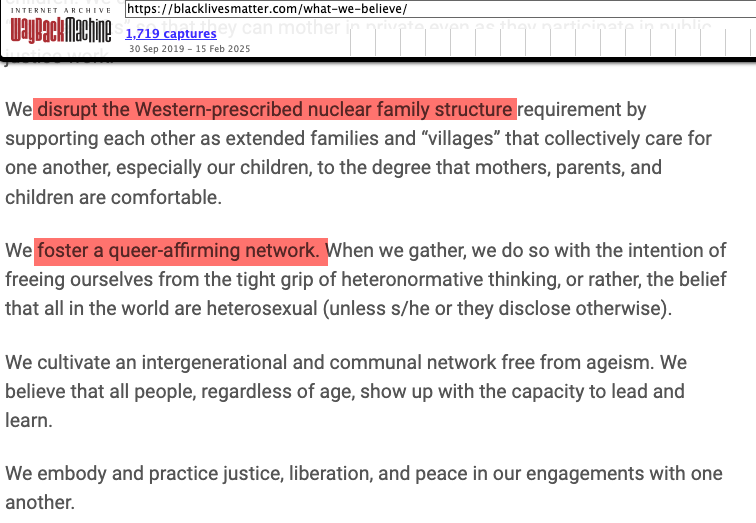
Let’s not forget that the Black Lives Matter Global Network Foundation once trumpeted its Marxist desire to dismantle America and war on the nuclear family by saying on its website: “We disrupt the Western-prescribed nuclear family structure requirement by supporting each other as extended families and ‘villages’ that collectively care for one another.” 

Mayor Bowser and Democrat-run Washington, D.C. are focused on virtue signaling and spending taxpayer money to paint Black Lives Matter instead of the record spike in homicides, carjackings, and other violent crimes,” said Arkansas GOP Sen. Tom Cotton, adding, “Washington DC’s failures are a reminder why the city must never become a state.” 

How Congress plans to override decisions from the local government may fall under the Home Rule Act of 1973. This act was invoked in 2023 when Congress struck down a law passed by the far-left DC city council, which would have weakened maximum penalties for violent crime in the crime-ridden metro area.

Tyler Durden
Sat, 03/01/2025 – 19:15

via ZeroHedge News https://ift.tt/plQ7U1s Tyler Durden

The Press Falls To Another Record Low In Public Trust

The Press Falls To Another Record Low In Public Trust

Authored by Jonathan Turley,

We have previously discussed polling showing the media at record lows in public trust. Well, the latest survey from Gallup shows that the media hit another all-time low. What is most impressive is that plummeting readers, revenues, and layoffs have done little to convince the mainstream media that the problem is not the public but themselves. The only institution with a  lower level of public trust is Congress, and that says a lot. It is like beating Ebola as the preferred communicable disease. Some 69 percent of Americans now say that they have no or little trust in the media. 

Only 31 percent say that they have a great deal or fair amount of trust. The trending line looks like the sales of buggy whips after the introduction of the Model T Ford. Gallop put it into sharp terms:

“About two-thirds of Americans in the 1970s trusted the “mass media — such as newspapers, TV and radio” either “a great deal” or “a fair amount” to “[report] the news fully, accurately and fairly.” By the next measurement in 1997, confidence had fallen to 53%, and it has gradually trended downward since 2003. Americans are now divided into rough thirds, with 31% trusting the media a great deal or a fair amount, 33% saying they do “not [trust it] very much,” and 36%, up from 6% in 1972, saying they have no trust at all in it.”

In my book, The Indispensable Right, I discuss how journalists and journalism schools have destroyed their own profession by rejecting objectivity and engaging in open advocacy journalism. The mainstream media has long echoed the talking points of the left and the Democratic Party, particularly in its one-sided coverage of the last three elections.

While Bob Woodward and others have finally admitted that the Russian collusion coverage lacked objectivity and resulted in false reporting, media figures are pushing even harder against objectivity as a core value in journalism.

We have been discussing the rise of advocacy journalism and the rejection of objectivity in journalism schools. Writerseditorscommentators, and academics have embraced rising calls for censorship and speech controls, including President-elect Joe Biden and his key advisers. This movement includes academics rejecting the very concept of objectivity in journalism in favor of open advocacy.

Columbia Journalism Dean and New Yorker writer Steve Coll decried how the First Amendment right to freedom of speech was being “weaponized” to protect disinformation. In an interview with The Stanford Daily, Stanford journalism professor Ted Glasser insisted that journalism needed to “free itself from this notion of objectivity to develop a sense of social justice.” He rejected the notion that journalism is based on objectivity and said that he views “journalists as activists because journalism at its best — and indeed history at its best — is all about morality.”  Thus, “Journalists need to be overt and candid advocates for social justice, and it’s hard to do that under the constraints of objectivity.”

The Washington Post’s former executive editor Leonard Downie Jr. and former CBS News President Andrew Heyward released the results of their interviews with over 75 media leaders and concluded that objectivity is now considered reactionary and even harmful. Emilio Garcia-Ruiz, editor-in-chief at the San Francisco Chronicle said it plainly: “Objectivity has got to go.”

Lauren Wolfe, the fired freelance editor for the New York Times, has not only gone public to defend her pro-Biden tweet but published a piece titled I’m a Biased Journalist and I’m Okay With That.” 

Former New York Times writer (and now Howard University Journalism Professor) Nikole Hannah-Jones is a leading voice for advocacy journalism. Indeed, Hannah-Jones has declared “all journalism is activism.”

This is why the whole “Let’s Go Brandon” chant was as much a criticism of the media as President Biden.

There is clearly an effort by owners like Jeff Bezos to change this culture rather than bankroll newspapers like the Washington Post vanity projects for the left.

Robert Lewis, a British media executive who joined the Post earlier this year, reportedly got into a “heated exchange” with a staffer. Lewis explained that, while reporters were protesting measures to expand readership, the very survival of the paper was now at stake:

“We are going to turn this thing around, but let’s not sugarcoat it. It needs turning around,” Lewis said. 

“We are losing large amounts of money. Your audience has halved in recent years. People are not reading your stuff. Right. I can’t sugarcoat it anymore.”

The response from staffers was to call for the new editors to be fired.  One staffer complained, “We now have four White men running three newsrooms.” The Post has been buying out staff to avoid mass layoffs, but reporters are up in arms over the effort to turn the newspaper around.

The question is whether viewers and readers can still be brought back into the fold. New media is expanding as citizens have looked elsewhere for news. In the meantime, some media outlets and organizations seem to have doubled down on the bias. Just last year, Washington Post reporter Cleve Wootson Jr. appeared to call upon the White House to censor the interview of Elon Musk with former President Donald Trump. The newspaper did not say a thing about the incongruity of one of its leading reporters calling for censorship.

After Trump was elected, NBC selected Yamiche Alcindor to return to the White House despite a history of alleged bias.  Alcindor, who also worked for PBS, was criticized for often preceding questions with attacks on conservatives or over-the-top praise for Joe Biden or Democrats. While others saw raw political bias, Alcindor explained that it was her job to use journalism to bend the “moral arc toward justice.”

Recently, the White House Correspondent’s Association picked an anti-Trump comedian who promptly encouraged Trump not to come to the dinner, saying that no one wants to be in the same room with him.

In the meantime, “J schools” continue to dismiss objectivity and crank out journalists who are told to embrace activism as the public flees legacy media for new media.

For the moment, it seems like journalists are content to write for each other and about 30 percent of the public. The echo chamber is getting smaller and smaller. So are the staffs on the outlets. Without public trust, the media is just talking to itself as the public turns to citizen journalists and new media on blogs and social media.

As someone who has worked for three networks and written as a columnist for three decades, the decline of American media has been painful to watch. The industry has operated like a ship of fools with no regard for their viewers or readers. However, we need the media. The press plays a central role in our democracy as reflected in the press protections afforded under the First Amendment.

The effort to break this culture at outlets like the Post and L.A. Times is encouraging, but these polls indicate that time is of the essence.

*  *  *

Jonathan Turley is the Shapiro professor of public interest law at George Washington University and the author of “The Indispensable Right: Free Speech in an Age of Rage.”

Tyler Durden
Sat, 03/01/2025 – 18:40

via ZeroHedge News https://ift.tt/8AX9rcb Tyler Durden

FBI Returns 33 Boxes Of Trump Property Seized During Mar-a-Lago Raid

FBI Returns 33 Boxes Of Trump Property Seized During Mar-a-Lago Raid

Authored by Aldgra Fredly via The Epoch Times,

President Donald Trump said on Friday that the Justice Department (DOJ) has returned to him boxes of documents seized by the FBI from his Mar-a-Lago home during an investigation in 2022.

Trump stated that the DOJ has “just returned the boxes that Deranged Jack Smith made such a big deal about,” referring to the former special counsel who led the investigations into Trump’s alleged retention of classified documents from his first presidential term and his attempts to overturn the 2020 election results.

“They are being brought down to Florida and will someday be part of the Trump Presidential Library. Justice finally won out,” Trump stated on his Truth Social platform.

Trump reiterated his stance that the FBI investigation against him was politically motivated.

“I did absolutely nothing wrong. This was merely an attack on a political opponent that, obviously, did not work well. Justice in our Country will now be restored,” the president stated.

Alina Habba, the president’s counselor, said that she personally loaded some of the “infamous boxes” onto Air Force One before Trump’s flight back to Florida on Friday.

“Justice has been and will continue to be restored in this country under President Trump. Truth and justice always win in the end. God Bless America,” Habba stated on the social media platform X.

In August 2022, the FBI raided Trump’s Mar-a-Lago estate in Palm Beach, Florida, as part of an investigation into his alleged mishandling of classified documents after leaving office during his first term in 2021.

During the raid, FBI agents seized over 11,000 documents and photographs without classified markings, along with more than 100 documents marked classified. Some of these documents were labeled “top secret.” The National Archives and Records Administration (NARA) also retrieved 15 boxes of government documents from Trump’s Mar-a-Lago property in January 2022.

The raid followed a warrant issued by U.S. Magistrate Judge Bruce Reinhart, which enabled agents to seize any documents with classification markings, as well as containers in which the documents were located and any containers stored or found together with the documents.

In 2023, Smith indicted Trump with felony charges over his alleged unlawful retention of national defense information, conspiracy to obstruct justice, and concealing a document in a federal investigation.

Trump had denied any wrongdoing in the cases and called the investigation politically motivated. In a June 2023 interview with Fox News, Trump defended his handling of the documents and said he believes that he had rights to the retained documents.

“Everything was declassified because I have the right to declassify,“ he told the news host. “This is purely a Presidential Records Act [thing]. This is not a criminal thing.”

Smith dropped both cases after Trump won a second presidential term in the 2024 election, citing the DOJ’s policy against prosecuting a sitting president. The special counsel resigned from the DOJ ahead of Trump’s inauguration on Jan. 20.

Prior to his resignation, Smith completed a final report on his investigations into Trump’s criminal cases. Former U.S. Attorney General Merrick Garland, who appointed Smith in the investigation, told congressional leaders in January that the report would be made public after gaining approval by the courts.

Trump’s lawyers told Garland in a Jan. 6 letter that they had reviewed a draft of the report and identified some issues. They argued that releasing the report would be “imprudent and unlawful.”

“The Draft Report violates fundamental norms regarding the presumption of innocence, including with respect to third parties unnecessarily impugned by Smith’s false claims,” the lawyers said.

They stated that releasing the report would violate the Presidential Transition Act and the doctrine of presidential immunity. Trump’s lawyers also argued that Smith lacked authority to issue the report due to his alleged invalid appointment.

Tyler Durden
Sat, 03/01/2025 – 17:30

via ZeroHedge News https://ift.tt/7dZhzJK Tyler Durden

Vance Responds To Pope’s Criticism Of Trump Administration

Vance Responds To Pope’s Criticism Of Trump Administration

Authored by T.J. Muscaro via The Epoch Times,

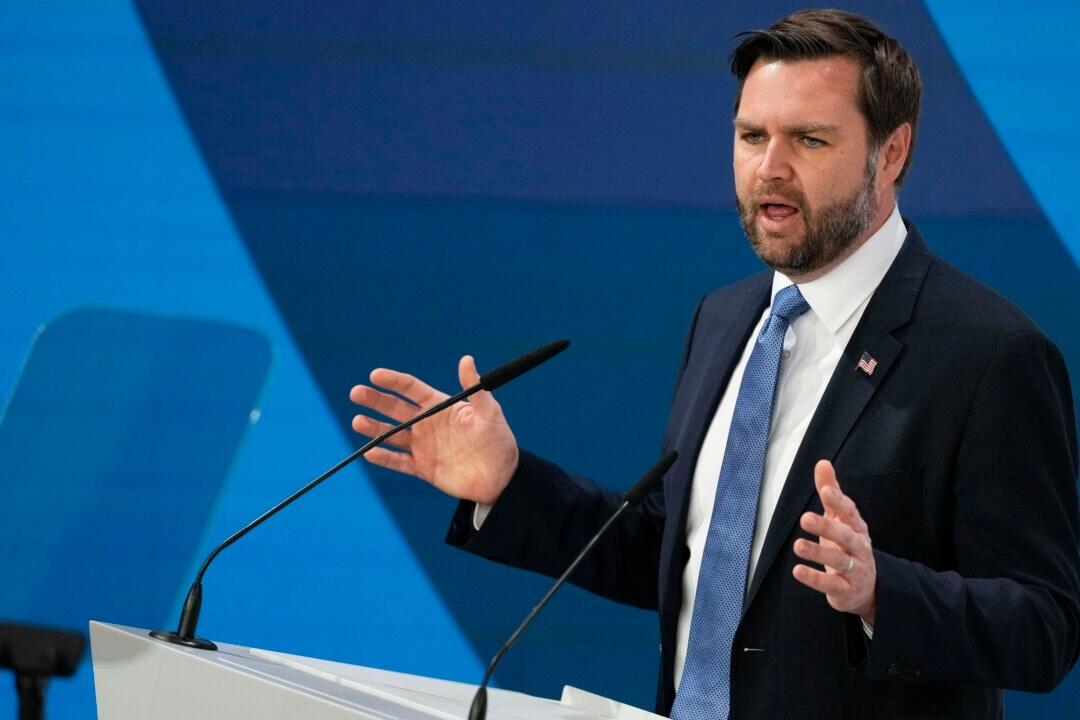
Vice President JD Vance said he was surprised to hear of Pope Francis’s criticism of the Trump administration’s immigration policy while speaking at the National Catholic Prayer Breakfast in Washington on Feb. 28.

Despite that disagreement, Vance prayed for Pope Francis at the event, as the pope remained in critical condition on Feb. 28 after suffering a bronchospasm that caused vomiting and the need for non-invasive mechanical ventilation, the Holy See announced.

Vance also said he believes that the pontiff is a man who deeply cares about the spiritual direction of the faith and the world’s Christians.

“I will always remember the Holy Father as a great pastor, as a man who can speak the truth, the faith, in a very profound way at a moment of great crisis,” Vance said. 

He recalled a sermon of hope that the pope delivered in March 2020 at the height of the pandemic in an empty St. Peter’s Square, likening it to the gospel in which Jesus calmed the sea after his terrified disciples awakened him during a storm.

Vance, the first Catholic convert to serve as vice president, asked fellow Catholics to say a prayer that he and his family had been praying daily for the pope ever since he was admitted to the hospital.

Pope Francis has criticized President Donald Trump’s immigration policies and condemned mass deportations.

“The act of deporting people who in many cases have left their own land for reasons of extreme poverty, insecurity, exploitation, persecution or serious deterioration of the environment, damages the dignity of many men and women, and of entire families, and places them in a state of particular vulnerability and defenselessness,” he said in a Feb. 10 letter.

Vance had argued that his administration’s immigration policy was aligned with his Catholic faith, citing “Ordo Amoris,” a centuries-old teaching that suggests a hierarchy of how one is supposed to love, justifying the needs and concerns of the immediate family before those of strangers.

Pope Francis appeared to correct Vance’s understanding of the concept in his letter.

“Christian love is not a concentric expansion of interests that little by little extend to other persons and groups,” he wrote. 

“The true ordo amoris that must be promoted is that which we discover by meditating constantly on the parable of the ‘Good Samaritan,’ that is, by meditating on the love that builds a fraternity open to all, without exception.”

Vance’s address also came as the U.S. Conference of Catholic Bishops has taken the Trump administration to court over the cut-off of millions of dollars in funding for refugee programs in the United States.

The vice president also discussed using social media to respond to messages and criticism from the pope, bishops, and other religious leaders.

“Sometimes the bishops don’t like what I say,” Vance said. 

“I’m sure, by the way, sometimes they’re right, and sometimes they’re wrong. My goal is not to litigate when I’m right and when they’re wrong or vice versa. My goal is to maybe articulate the way that I think about being a Christian in public life.”

Vance said that he believes Christians are not called to obsess over social media controversies involving the Catholic Church, clergy, “or the Holy Father himself,” he said.

“I think that we should frankly take a page out of the books of our grandparents who respected our clergy, who looked to them for guidance, but didn’t obsess and fight over every single word that came out of their mouth.”

Vance said that the clergy are important spiritual leaders with a 2,000-year-old duty to speak on the issues of the day, but that they are now faced with the challenges of social media, and it is just as important for the Church’s clergy to recognize that as it is for lay people.

“I think it’s incumbent upon our religious leaders to recognize that in the era of social media, people will hang on every single word that they utter, even if that wasn’t their intention, and even if a given declaration wasn’t meant for consumption in the social media age,” he said.

The vice president’s speech touched upon his conversion to the faith and the emotional declaration that his 7-year-old son’s baptism was far more significant than winning the election in November 2024.

He stated that the administration’s door was open to feedback from the nation’s faithful.

“I’ll make this commitment to you in front of God, and in front of all those television cameras back there, that we will always listen to people of faith and people of conscience in the United States of America,” Vance said. “You have an open door to the Trump administration, even and especially, maybe, when you disagree with us.

“So, please use that opportunity to communicate with us when we get things right, but also when we get things wrong.”

Tyler Durden
Sat, 03/01/2025 – 16:20

via ZeroHedge News https://ift.tt/BQP1mnX Tyler Durden

“Why Is Everything Locked Up At CVS?”: Rahm Emanuel, Fareed Zakaria Admit Democrat Cities Are “Terribly Run”

“Why Is Everything Locked Up At CVS?”: Rahm Emanuel, Fareed Zakaria Admit Democrat Cities Are “Terribly Run”

As Democrats struggle with reality – namely, that they’ve allowed crime, illegal immigration, and inflation to run rampant due to disastrous, anti-American policies – at least a few seem to be willing to acknowledge what’s going on.

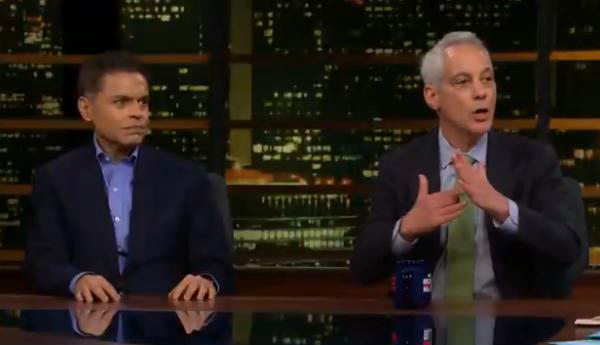
During a Friday appearance on ‘Realtime With Bill Maher,’ former Chicago Mayor and US Ambassador to Japan Rahm Emanuel, an CNN‘s Fareed Sakaria slammed progressive policies that have resulted in a populist backlash. 

“I read that the current mayor of Chicago has an approval rating of 6.6%. What’s going on in Chicago?” asked Maher.

Rahm Emanuel: “We’ve gone through 5 years where people became way too permissive as a culture. Which is why everything is locked up at CVS and Walgreens, that’s a disaster.

I don’t want to hear another word about the locker room, I don’t want to hear another word about the bathroom. You better start focusing on the classroom. In 7th grade if I had known I could have said ‘they’ and got in the girls bathroom, I would have done it.”

Zakaria then chimed in, “This is a huge Democrat party problem. Democrat cities are terribly run. Cost of housing is crazy.

“The budget of New York state is twice that of Florida. Lots of taxes, lots of regulation, but nothing gets done. Democrats have to own this: The answer to everything is not more taxes, more regulations. People are fed up with it, and feel that it isn’t working.

Watch (via @EricAbbenante);

*  *  *

Pick up a bucket of HEIRLOOM SEEDS (4,500 seeds spanning 39 varieties) from ZH Store!  Free shipping in the USA.

Click pic… buy seeds… take food supply into your own hands…

Tyler Durden
Sat, 03/01/2025 – 15:45

via ZeroHedge News https://ift.tt/Jo0wz8k Tyler Durden

Trump To Host First White House Crypto Summit On March 7

Trump To Host First White House Crypto Summit On March 7

Authored by Zoltan Vardai via CoinTelegraph.com,

US President Donald Trump will host the first White House Crypto Summit on March 7, bringing together industry leaders to discuss regulatory policies, stablecoin oversight, and the potential role of Bitcoin in the US financial system.

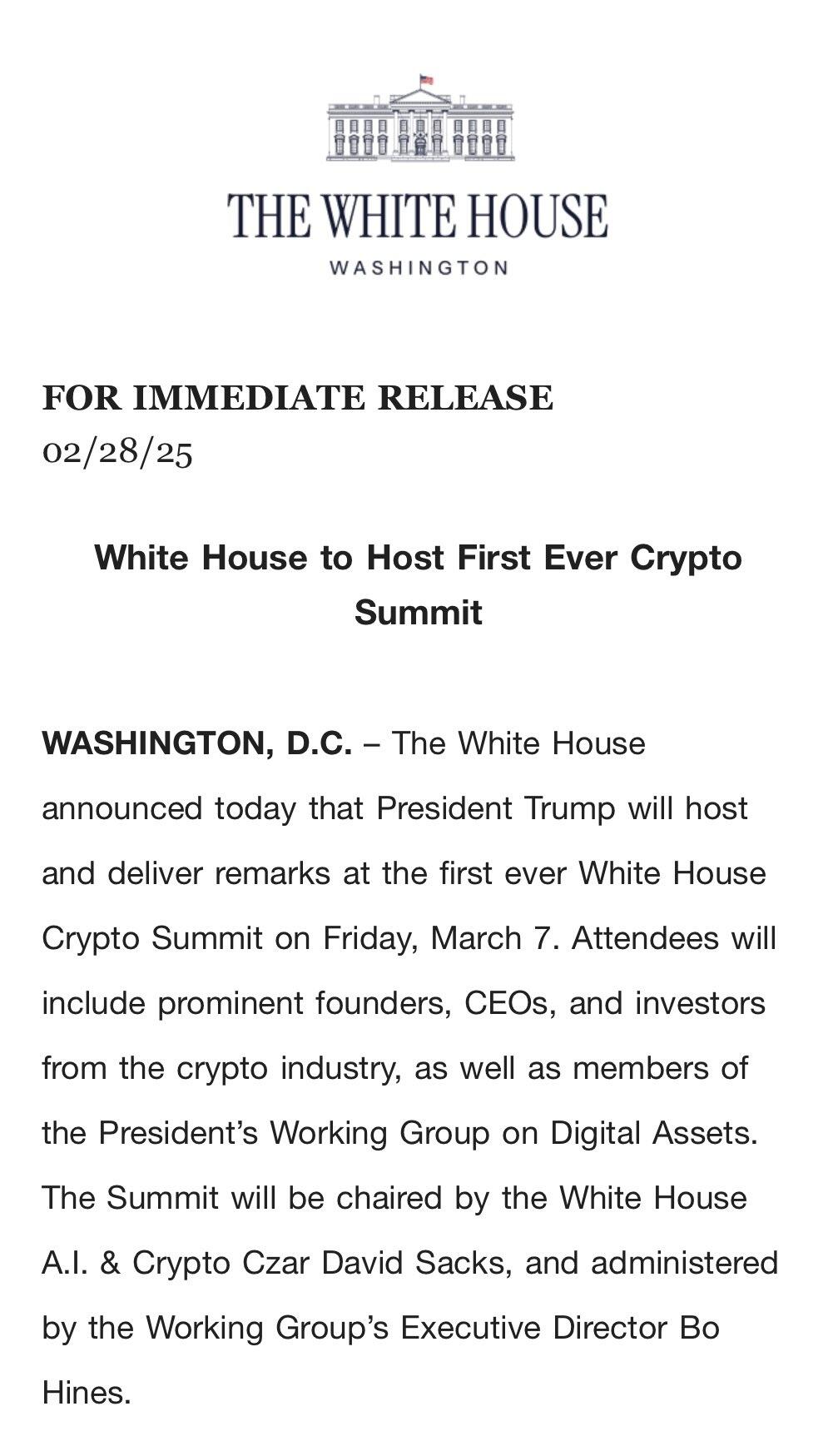
The attendees will include “prominent founders, CEOs, and investors from the crypto industry,” along with members of the President’s Working Group on Digital Assets, according to an announcement shared by the White House “AI and crypto czar,” David Sacks, in a March 1 X post.

The summit will be chaired by Sacks and administered by Bo Hines, the executive director of the Working Group.

Source: David Sacks

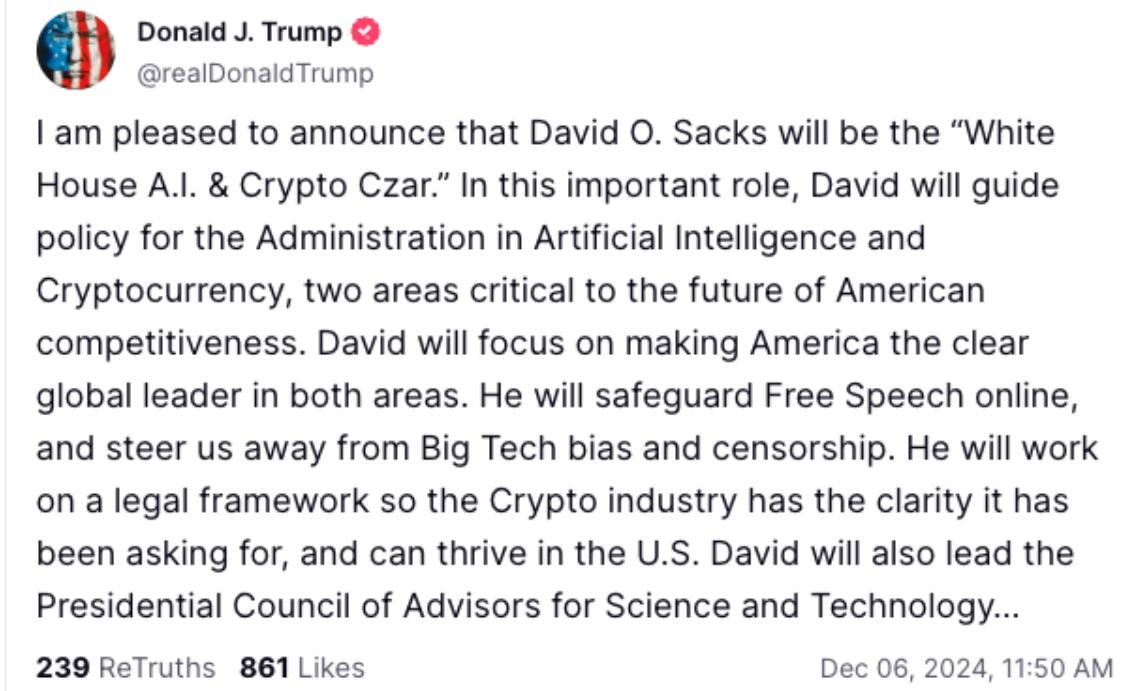
Sacks was appointed White House Crypto and AI and Czar on Dec. 6, 2024, to “work on a legal framework so the Crypto industry has the clarity it has been asking for, and can thrive in the U.S.,” Trump wrote in the announcement. 

Part of Sacks’ role will be to “safeguard” online speech and “steer us away from Big Tech bias and censorship,” Trump added.

Source: Donald Trump

Trump has previously signaled that he intends to make crypto policy a national priority and make the US a global hub for blockchain innovation. The upcoming summit may set the tone for crypto regulations over the next four years.

Sacks only has two years to push through pro-crypto policies before the 2026 midterm elections in the US, Joe Doll, the general counsel for NFT marketplace Magic Eden, told Cointelegraph in an interview.

According to Doll, the threat of a gridlocked government could stifle regulations, and the current administration must push through pro-crypto policies while still in control of both chambers of Congress.

Stablecoin, Bitcoin reserve regulation remain focus

While there are no additional details about the summit’s agenda, stablecoin regulation and legislation related to a potential strategic Bitcoin reserve have been at the forefront of regulatory discussions in the US.

The White House announcement came days after Jeremy Allaire, co-founder of Circle, the company behind the world’s second-largest stablecoin, said that stablecoin issuers worldwide should be required to register with US authorities.

Citing consumer protection, Allaire argued that US dollar-based stablecoin issuers should not get a “free pass,” enabling them to “ignore the US law and go do whatever the hell you want wherever and sell into the United States.” Allaire told Bloomberg:

“Whether you are an offshore company or based in Hong Kong, if you want to offer your US dollar stablecoin in the US, you should need to register in the US just like we have to go register everywhere else.”

The upcoming summit may shed more light on upcoming stablecoin legislation, considering Sacks previously stated that stablecoins could “extend the dollar’s dominance internationally.”

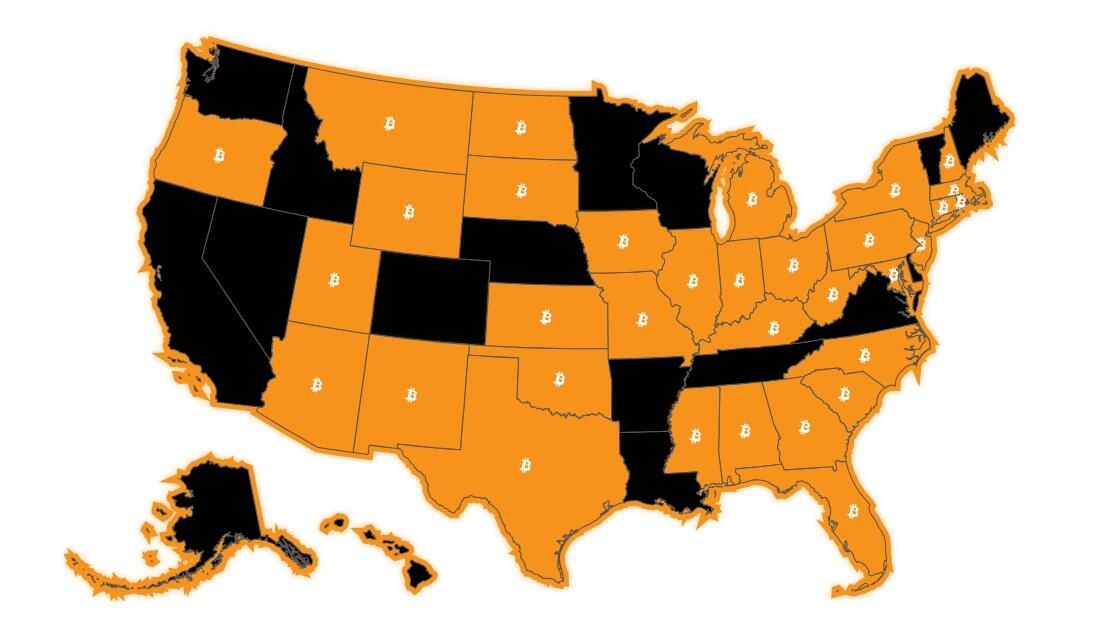
Interest in a US-based strategic Bitcoin reserve is also on the rise. So far, at least 24 states have introduced legislation related to a potential Bitcoin reserve, Bitcoinlaws data shows.

US states with Bitcoin reserve bill propositions. Source: Bitcoinlaws

However, the state-level Bitcoin reserve initiatives may not represent a pivotal moment for Bitcoin; they are only a “symbolic move” unless a significant purchase is announced, according to Iliya Kalchev, dispatch analyst at Nexo.

“Unless the hearing unveils a near-term purchase plan or a major policy shift, the market’s response will likely be mild, as Texas’ pro-crypto stance is already well known,” Kalchev told Cointelegraph.

Bitcoin has averaged over 1,077% returns over the past five years, showing the lucrative potential of a long-term holding strategy.

Tyler Durden
Sat, 03/01/2025 – 15:10

via ZeroHedge News https://ift.tt/rH6zx84 Tyler Durden

Rubio Demands Apology From Zelensky, Who Attempts Belated ‘Gratefulness’ For All The Billions

Rubio Demands Apology From Zelensky, Who Attempts Belated ‘Gratefulness’ For All The Billions

Secretary of State Marco Rubio is demanding an apology from Ukrainian President Volodymyr Zelensky after Friday’s Oval Office fireworks and heated exchange. Trump had sarcastically quipped the whole scene will make for “great television” before he shut it down and kicked Zelensky out of the White House, prior to a planned lunch.

Rubio told CNN’s Kaitlan Collins that the Ukrainian leader should “apologize for turning this thing into the fiasco for him that it became. There was no need for him to go in there and become antagonistic. Look, this thing went off the rails.”

“When you start talking about that aggressively, and the President’s a deal maker. He’s made deals his entire life, you’re not going to get people to the table,” the US top diplomat added.

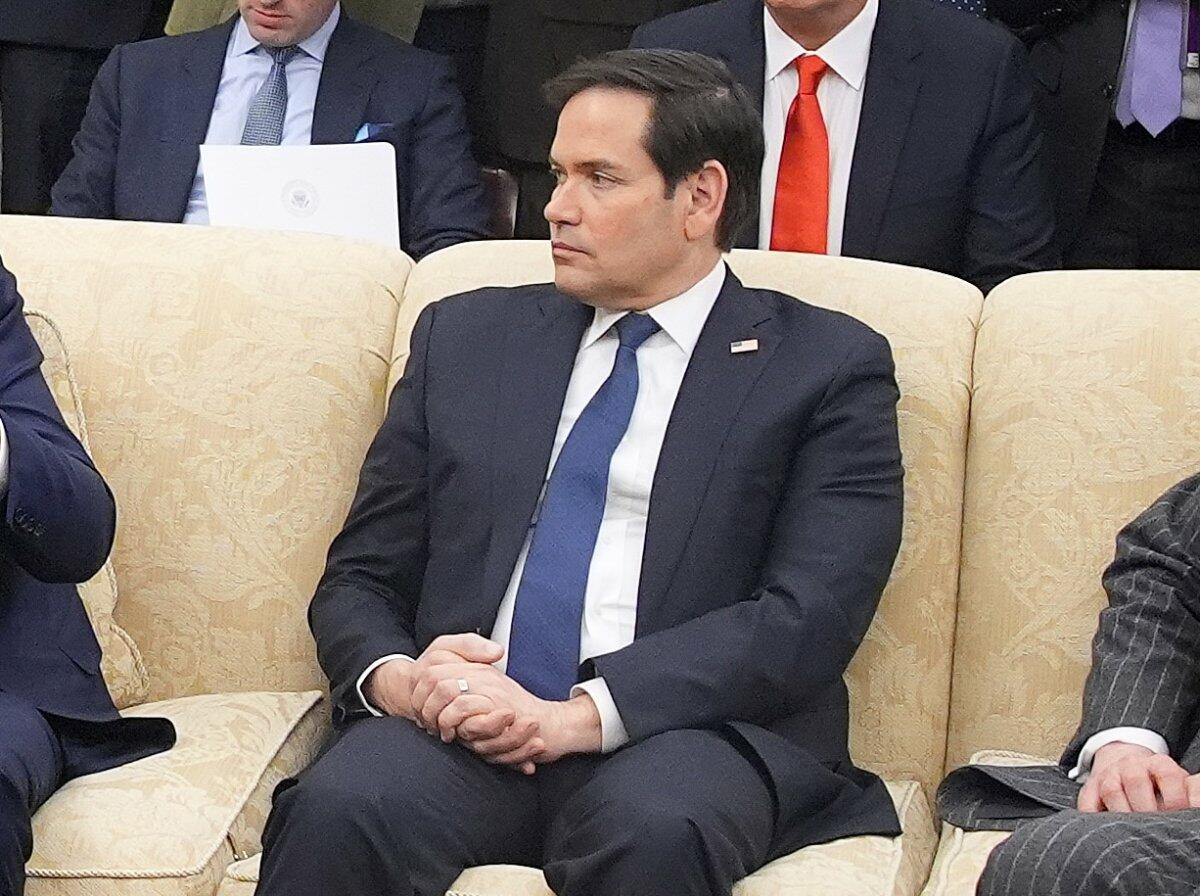
Rubio looking uncomfortable at Zelensky’s outbursts. via Getty Images

Many sources say that before the blow-up which started when Zelensky specifically called out Vance to ‘answer’ a question (after which the vice president appropriately unleashed on Zelensky), a final minerals deal was all but assured and ready to be signed.

But Rubio in his Saturday comments said he’s unsure whether Zelensky actually wants to see any kind of peace agreement at all.

“And so you start to perceive that maybe Zelensky doesn’t want a peace deal. He says he does, but maybe he doesn’t, and that active, open undermining of efforts to bring about peace is deeply frustrating for everyone who’s been involved in communications with them leading up to today,” Rubio explained.

Zelensky just prior to these fresh remarks of Rubio’s expressed what perhaps came close to regret, but something far short of an apology

“No, I respect the president, and I respect the American people and if, I don’t know, I think that we have to be very open and very honest and I’m not sure that we did something bad,” Zelensky responded when asked by Fox News’s Bret Baier if he would apologize for the meeting. 

“This is not good for both sides, anyway, and I was very open, but I can’t change our Ukrainian attitude toward Russia,” he said. 

Still, on the same day Zelensky issued a very lengthy thread on X, at over a dozen full posts, which many will see as reeking of desperation.

He wrote that he knows that the US is on ‘our’ side and that “America’s help has been vital in helping us survive, and I want to acknowledge that.” This appears a response to Vance the day prior noting that he had not once said “thank you” during Friday’s meetings. “Peace can only come when we know we have security guarantees, when our army is strong, and our partners are with us,” Zelensky also said.

“It will be difficult without the U.S. support. But we can’t lose our will, our freedom, or our people. We’ve seen how Russians came to our homes and killed many people,” he continued in the long message.

At one point he further expressed: “I want the U.S. to stand more firmly on our side. This is not just a war between our two countries; Russia brought this war onto our territory and into our homes.”

And again, more after-the-fact efforts to salvage that disaster of an Oval Office meeting: “Our relationship with the American President is more than just two leaders; it’s a historic and solid bond between our peoples. That’s why I always begin with words of gratitude from our nation to the American nation.”

…though that’s not what President Trump and Vice President J.D. Vance are saying. All of this from Zelensky is likely too little, too late.

Below is Zelensky’s full thread on X…

Tyler Durden
Sat, 03/01/2025 – 14:35

via ZeroHedge News https://ift.tt/tQyF6z4 Tyler Durden