The Defense Challenge to Alina Habba’s Appointment is Weak

Previously Steve Calabresi and I have blogged about how Alina Habba’s appointment as Acting U.S. Attorney for the District of Jersey is valid under the Federal Vacancies Reform Act (FVRA). Calabresi’s initial post argued that New Jersey judges lacked constitutional power to displace Habba by appointing an interim replacement. But while I disputed that constitutional conclusion, I ultimately reached the same position as Calabresi under the relevant statutes. I concluded that, under 28 U.S.C. § 546 and the FVRA, Habba was appropriately serving as the Acting U.S. Attorney. In my last post, I explained that the Justice Department had made a powerful defense of Habba’s appointment under the FVRA. Earlier today, the defendant challenging Habba’s appointment filed a reply brief. But that brief fails to engage on the main issues surrounding the FVRA. It appears that the defendant’s position is weak and should be swiftly be rejected.

The timeline is important here. To recap the (essentially undisputed) facts, on March 27, 2025, the Attorney General appointed Ms. Habba interim United States Attorney for the District of New Jersey pursuant § 546. (To make his case seem stronger than it really is, the defendant’s brief claims that the Ms. Habba was appointed three days earlier, on March 24—citing a CBS news article. But the Justice Department’s brief includes as an exhibit the actual appointment order, which is dated March 27, 2025.) Section 546 explicitly limits such interim appointments to a maximum period of 120 days. 5 U.S.C. § 3346(a)(1). Given an appointment of 120-days, Habba’s interim appointment would have expired on on Saturday, July 26.

On June 30, 2025, President Trump formally nominated Ms. Habba for the permanent position of United States Attorney for the District of New Jersey and submitted her nomination to the Senate. On July 24, 2025, before the Senate had acted, the President withdrew Habba’s nomination. That same day—July 24, two days before her interim appointment expired—Habba resigned her interim position as United States Attorney. The Attorney General then immediately appointed her as a Special Attorney under 28 U.S.C. § 515, which appointment Ms. Habba accepted. Exercising her authority under 28 U.S.C. §§ 509, 510, 515 and 542, among other provisions, the Attorney General also designated Ms. Habba as the First Assistant in New Jersey, effective upon her resignation as the interim United States Attorney. All of this occurred on Thursday, July 24, two days before the 120-day limit period in § 546(c)(2) expired at 12:00 a.m., Saturday, July 26. As a result of her holding the position of First Assistant U.S. Attorney position in New Jersey, by operation of law, Habba then became the Acting United States Attorney under the FVRA, 5 U.S.C. § 3345(a)(1).

In addition, on Saturday, July 26, a senior Department of Justice official notified the former First Assistant that the President would have removed her from the position of United States Attorney if her judicial appointment to that office had somehow become effective. The notification indicated that, in taking that step, the President was exercising his authority under Article II of the Constitution and 28 U.S.C. § 541(c). The former vests “the executive power in” the President; the latter provides that “each United States Attorney is subject to removal by the President.”

Against this backdrop, it seems hard to see the argument that Habba is not currently and validly the U.S. Attorney for the District of New Jersey. The defendant’s argument turns on a single phrase in the FVRA, which he does not bother to quote in his brief. Instead, the defendant represents that the FVRA “explicitly prohibits individuals whose nominations have been submitted to the Senate from serving in an acting capacity for the same office, regardless of subsequent withdrawal of the nomination. 5 U.S.C. § 3345(b)(1).” But let’s look at the text of the statute that the defendant fails to quote. The statute provides that an otherwise-qualified individual cannot serve as an Acting U.S. under the FVRA if:

(A) during the 365-day period preceding the date of the death, resignation, or beginning of inability to serve, such person—

(ii) served in the position of first assistant to the office of such officer for less than 90 days; and

(B) the President submits a nomination of such person to the Senate for appointment to such office.

5 U.S.C. § 3345(b)(1)(A)–(B) (emphasis added).

To be sure, Habba had been the first assistant for less than 90 days. So her eligibility to serve devolves to the last phrase highlighted above, related to a Presidential nomination.

At the time Habba became the Acting U.S. Attorney, the President had previously withdrawn her nomination. So the statutory question becomes whether the highlighted phrase above should be read as creating a perpetual disability for a person whose nomination was submitted to the position from becoming Acting U.S. Attorney—i.e., should be read as if it were written “the President has submitted a nomination of such person ….”—or read as creating a disability for a person whose nomination is pending at the time—i.e., should be read as if it were written “the President is currently submitting a nomination of such person ….”

As between these two alternative readings, the later reading (which affirms Habba’s appointment) seems like the obvious one. As I explained in my earlier post, the statute’s plain language does not create a disability after the President “has submitted” a nomination in the past. Instead, the statute uses the present tense: a disability exists when the President “submits a nomination.” Under standard, recommended principles of legislative drafting, the present tense is used “to express all facts and conditions required to be concurrent with the operation of the legal action,” as Bryan Garner explains in his excellent treatise, Garner’s Dictionary of Legal Usage 536 (3d edition 2011) (emphasis added). After the President withdrew Habba’s nomination—i.e., was no longer submitting her nomination—the condition of her nomination being submitted to the Senate was no longer concurrent with her becoming the Acting U.S. Attorney.

The Justice Department has made the same argument, as I recounted earlier. Here’s the Department’s argument:

The purpose of subsection (b)(1) is to prevent the President from circumventing the Senate’s advice-and-consent function by installing a pending nominee for an office on an acting basis before the Senate can act on the nomination. See NLRB v. SW General, Inc., 580 U.S. 288, 295–96 (2017) (tracing history of provision). Accordingly, “if a first assistant is serving as an acting officer under [subsection (a)(1)], he must cease that service if the President nominates him to fill the vacant [Presidentially-appointed, Senate confirmed] office,” or else withdraw from nomination. Id. at 301; see Hooks v. Kitsap Tenant Support Servs., Inc., 816 F.3d 550, 558 (9th Cir. 2016) (“Subsection (b)(1) thus precludes someone from continuing to serve as an acting officer after being nominated to the permanent position, unless he or she had been the first assistant for ninety days of the prior year.”).

Subsection (b)(1) therefore presupposes a current nomination to an office that is pending before the Senate. Nothing in the FVRA, however, suggests that the mere fact of a past nomination for an office—withdrawn by the President and never considered or acted upon by the Senate—forever bars an individual from serving in that capacity on an acting basis. The statute precludes a person from serving as an acting officer once “the President submits a nomination of such person to the Senate for appointment to such office,” 5 U.S.C. 3345(b)(1)(B) (emphasis added); it does not say that the person is barred from such service if the President ever submitted a nomination in the past, or continues to be barred once a nomination is withdrawn. See, e.g., Dole Food Co. v. Patrickson, 538 U.S. 468, 478 (2003) (explaining that a statutory provision “expressed in the present tense” requires consideration of status at the time of the regulated action, not before); Nichols v. United States, 578 U.S. 104, 110 (2016) (same). Indeed, a lifetime ban of that sort would have no logical relationship to the distinct separation-of-powers problem that Congress sought to address in subsection (b)(1): Congress’s desire to protect its ability to consider and act upon a pending nomination for an office can hardly be served if no nomination is pending.

In my earlier post, I explained my view that the Department’s argument was “powerful.” So what does the defendant now say in reply to the Department? Nothing. The defendant’s entire reply brief is devoted to teasing out the implications of what happens if Habba were to be in her position improperly. Indeed, nowhere in his reply does the defendant even quote the FVRA’s “submits a nomination” language, much less explain why the Department’s straightforward interpretation is somehow unreasonable.

Against this backdrop, I expect the defendant’s argument will be swiftly rejected. Perhaps his motion has had its desired effect, of attracting headlines about how Habba’s appointment has been challenged as unconstitutional and diverting attention attention away from whether the defendant is guilty of the drug dealing crime alleged against him. But the bottom line is that the defendant is asking a court to bar his prosecution under a statutory provision he does not even quote, much less plausibly interpret.

The defendant does refer back to the New Jersey’s judges’ effort to appoint a person besides Habba as the interim U.S. Attorney. But that argument founders on the fact that judicial authority to appoint an interim U.S. Attorney only exists after the expiration of the 120-day term. Indeed, the New Jersey’s judge’s order provided that it became effective “upon the expiration of 120 days after appointment by the Attorney General of the Interim U.S, Attorney, Alina Habba.” As the chronology recounted above makes clear, there was no expiration of the 120 days. Habba resigned two days before. And even if the judges had somehow effected an appointment of a person besides Habba, the relevant statutes make clear that the President (acting through his Attorney General) can remove that person. Title 28 U.S.C. § 541 specifically provides that “[e]ach United States Attorney is subject to removal by the President.” 28 U.S.C. § 541(c). Here again, the defendant does not even cite this provision, much less explain why the President is somehow unable to use it to effectuate his choice to be U.S. Attorney.

To be sure, one can debate whether Habba is well qualified to assume the important position of the U.S. Attorney for the District of Jersey. I take no position on the merits of that issue. And one can also find this entire appointment process to be arcane and hyper-technical–even a “loophole.” Perhaps so. But the bottom line is that the President (acting through his Attorney General) has put in place (at least temporarily) an Acting U.S. Attorney that he has confidence in to execute his policies. That seems like the sensible outcome.

The post The Defense Challenge to Alina Habba's Appointment is Weak appeared first on Reason.com.

from Latest – Reason.com https://ift.tt/xhe4WzP
via IFTTT
T-Day Arrives: Trump Raises Tariff On Dozens Of Countries, With Minimum Rate Of 10%

T-Day Arrives: Trump Raises Tariff On Dozens Of Countries, With Minimum Rate Of 10%

Almost 4 months after Liberation Day sparked a global market crash, moments ago T-Day finally arrived… and barely anyone noticed.

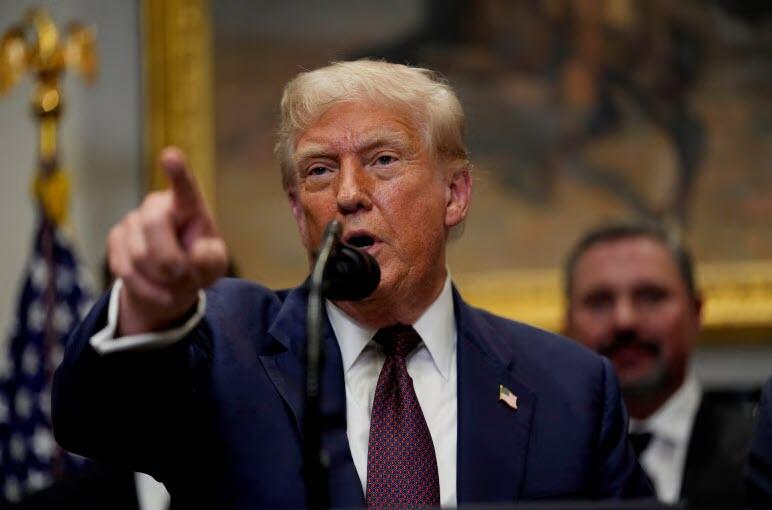
President Trump at the White House.

Late on Thursday, just ahead of the August 1 deadline for tariff renegotiation, President Trump announced a slew of new tariffs, including a 10% global minimum and 15% or higher duties for countries with trade surpluses with the US, forging ahead with his unprecedented effort to reshape international commerce.

First, the silver lining: baseline rates for many trading partners remain unchanged from the duties Trump imposed in April, which may ease investors’ worst fears – although with the S&P sitting at record highs it is difficult to claim anyone had any fears about anything – after the president had previously said they could even double. Yet Trump’s decision to raise tariffs on Canadian goods to 35% threatens to inject fresh tensions into an already strained relationship.

Trump signed the new tariff directive just hours before his prior Aug. 1 deadline for higher tariffs to kick in on scores of trading partners. As Bloomberg reports, most tariffs will take effect after midnight on Aug 7, to allow time for US Customs and Border Protection to make necessary changes to collect the levies.

Taken together, the result will be significantly higher tariffs on goods from almost all US trading partners. The average US tariff rate will rise to 15.2% if rates are implemented as announced, according to Bloomberg Economics, an increase from 13.3%, and significantly higher than the 2.3% it was in 2024, before Trump took office.

Major industrialized economies, including the European Union, Japan and South Korea, accepted 15% duties on their products, while charges on items from Mexico, Canada and China are even bigger.

Today’s announcement notwithstanding, Trump is expected to unveil separate tariffs on imports of pharmaceuticals, semiconductors, critical minerals and other key industrial products in the coming weeks. Other details are also forthcoming, including so-called “rules of origin” to decide which products are transshipped, or routed through another country, and thus would face at least a 40% rate, a senior US official told Bloomberg, adding that a decision will be made in the coming weeks.  The senior US official said there is no date yet when revised auto tariff rates would be implemented.

Thursday’s order was signed behind closed doors without the fanfare of Trump’s April tariff rollout, during which he brandished placards with rates during a Rose Garden event. Since then Trump has faced criticism for overpromising on trade deals after he and aides vowed to broker numerous agreements, with at least one pledging “90 deals in 90 days.”

In the end, imports from about 40 countries will face the new 15% rate and roughly a dozen economies’ products will be hit with higher duties, either because they reached a deal or Trump sent them a letter unilaterally setting import taxes. The latter group has the highest goods-trade surpluses with the US. 

Some of those were expected, such as a 25% levy on Indian exports that Trump announced this week on social media. Others included charges of 20% on Taiwanese products and 30% on South African goods. Thailand and Cambodia, two countries that were said to have struck a last-minute deal, received a 19% duty, matching rates imposed on regional neighbors including Indonesia and the Philippines. Vietnam’s goods will be tariffed at 20%, according to the WSJ

Trump’s deals with the EU, Japan and South Korea would lower duties on their vehicle exports to 15% from the general rate of 25%. 

In a separate order, Trump followed through on his threat to hike tariffs on exports from Canada, one of the US’s largest trading partners, from 25% to 35% for goods that do not comply with the U.S.-Mexico-Canada Agreement. That change excludes goods that are covered under the North American trade pact he negotiated in his first term. That stood in contrast to the 90-day extension Mexico received to negotiate a better agreement. Earlier in the day, Trump wrote on Truth Social that he agreed to extend for 90 days the existing tariffs on Mexican goods. He said a 25% fentanyl tariff, a 25% tariff on cars and a 50% tariff on steel, aluminum and copper would remain in place.

Still other nations are set to be hit with even higher tariffs. Trump has pledged to hike tariffs to 50% on Brazil over its digital policies and legal action against former President Jair Bolsonaro, a Trump ally. 

The lower 10% and 15% rates are expected to apply to a wide range of mostly smaller- and medium-sized economies that Trump showed little interest in bargaining with one-on-one. He had signaled in recent days there were simply too many countries to cut individualized deals with all of them.  Some smaller states, however, were hit with the highest rates, including Syria at 41%, as well as Laos and Myanmar and 40% each, both preferred hubs of Chinese transshipments. 

The tiny African nation of Lesotho, however, which had been reeling from Trump’s threat in April to impose a 50% duty, instead received a 15% rate. That change puts the landlocked mountainous kingdom at an advantage against the far larger country that entirely surrounds it, South Africa.

One big exception from this week’s deadline is China, which faces an Aug. 12 deadline for its tariff truce with the US to expire. The Trump administration has signaled that is likely to be extended. No final decision has been made but the recent US-China talks in Stockholm were positive, the official said.

There were signs that Trump’s order took some partners by surprise. Taiwan’s cabinet said in a statement its rate was temporary, and that the US levy is expected to be reduced after more talks, which had been delayed by scheduling conflicts.

The announcement brings to a close, at least for now, months of wait-and-see about how Trump would set his country-based tariffs, which he billed as the centerpiece of his plan to shrink trade deficits and revive American manufacturing. Trump twice delayed his so-called reciprocal tariffs, first announced in April, to allow time for negotiations, first after markets panicked and then as foreign governments bargained to get better terms from the US.

“U.S. customs officials will face challenges implementing the EO, particularly with the different tariff rates now applied across the world,” said Wendy Cutler, a former US trade negotiator. “The seven day breathing period before implementation will help, but importers should expect start up problems at a minimum.”

Some analysts were worried that today’s announcement will spark another round of selling similar to the post-Liberation day dump. “The reality is that we’re still going to see higher tariffs than pre-Liberation Day and we’ll start to see some economic impact of that in the months ahead,” said Shane Oliver, a Sydney-based chief investment officer at AMP Ltd. “There’s still uncertainty about China, Mexico has been delayed by another 90 days and details around sectoral tariffs are also yet to come.”

Others just can’t wait to move on: “With the biggest economies having either already made a deal, had a postponement or been hit with another tariff hike that will probably be eventually negotiated lower (Canada), many traders seem to prefer to keep the focus on US NFP as the next likely catalyst for broad USD movement,” said Sean Callow, a senior analyst in Sydney

“I would have thought 10% baseline tariff was a positive surprise for risk, worth at least a little bounce on Aussie and the like, given Trump’s recent comments have referred to 15% or higher” Callow said, adding that “perhaps the main uncertainty had already been removed on the likes of South Korea, Japan, India and, for now, China.”

Asian stocks came under pressure after Trump announced the new rates, with the MSCI Asia Pacific Index dropping 0.5%, led by losses in South Korea and Taiwan. Futures on the S&P 500 slipped 0.1% while those for European stocks retreated 0.4%. The Taiwan dollar and Korean won led declines in currency markets, while the Swiss franc edged lower after the nation’s products were hit with a 39% charge, one of the few nations that saw its rate go up. The Canadian dollar held steady in the face of higher rates.


Tyler Durden
Thu, 07/31/2025 – 22:55

via ZeroHedge News https://ift.tt/3F4ITiZ Tyler Durden

These Are The Best Military And Intelligence Unit Watches

These Are The Best Military And Intelligence Unit Watches

Via Watches Of Espionage,

Customized Timepieces From Rolex, Breitling, Tudor, Bremont, & Omega

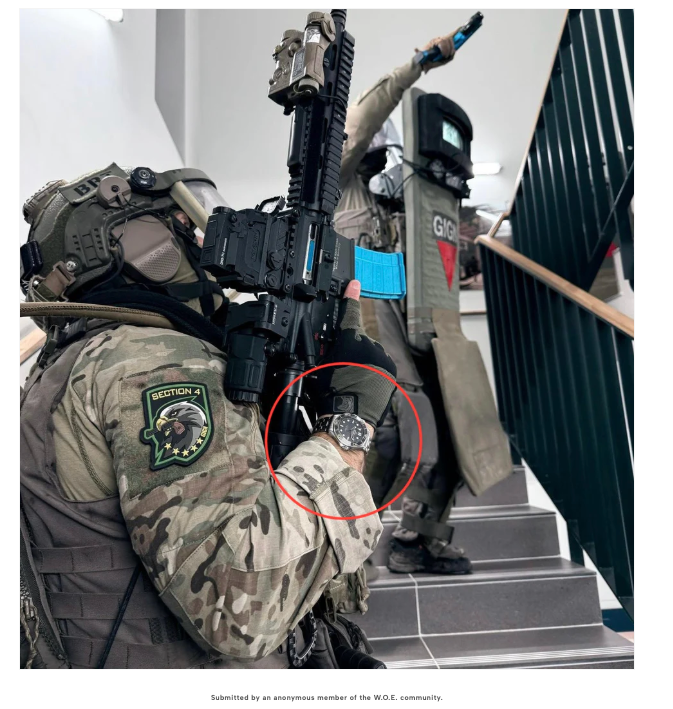
In the W.O.E. community, military “unit watches” are at the heart of modern watch culture. A unit watch is a timepiece that is customized by the manufacturer for members of a specific unit or organization. Customizations generally include the unit’s insignia on the dial and/or an engraving on the caseback. Unit watches are generally private purchases, paid for by the individual operator, and not issued or purchased by the government.

Given our position at W.O.E., I think I can safely say that no one on this planet knows more about unit watches. Whether this is something to be proud of or not, you can decide. Today, we take a look at a few of my favorite unit watches from some of Swiss watchmaking’s greatest names.

Since I launched W.O.E., I have noticed an uptick in unit watches. What was once reserved primarily for elite aviation and SpecOps units has trickled down to law enforcement, conventional military units, and intelligence organizations. If I can be so arrogant as to suggest it, W.O.E. has had a significant impact in bringing awareness and increasing unit watch adoption. (End Humble Brag – Break)

You will notice that most of the watches in this Dispatch come from major Swiss watch brands: IWC, Breitling, Tudor, and Omega. Smaller brands like Christopher Ward, Sangin, Pagoda, Elliot Brown, and many others are making significant headway in this space. We may have to make another list. Stay tuned.

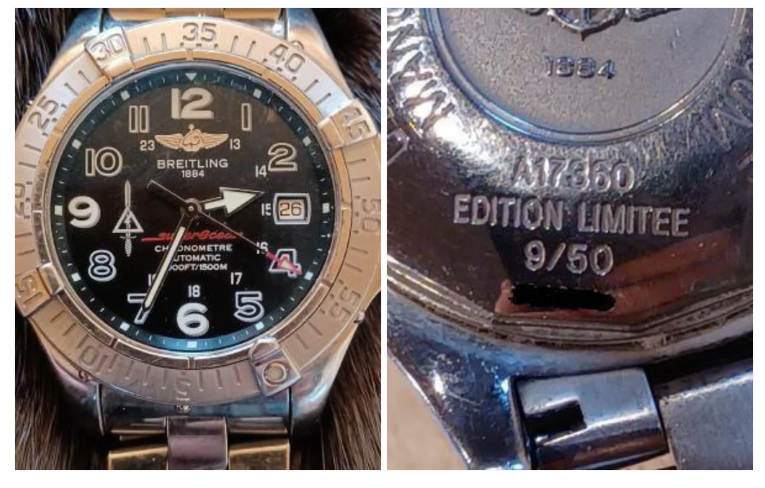
US Army Delta Force Breitling Superocean

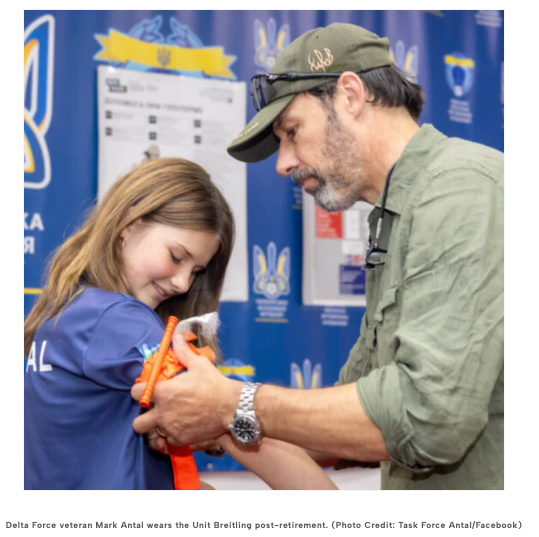
Starting off with a bang, in 2009/2010, 1st Special Forces Operational Detachment – Delta, AKA Delta Force, commissioned a custom Breitling Superocean. The subtle unit insignia is printed on the dial at nine o’clock, and “Oppressors Beware” is engraved on the side of the case. 50 total were made. In my discussions with operators from the era, these watches were sometimes worn on operations, but they were generally reserved for time off and low-intensity training. Many former operators continue to wear the watches to this day as mementos of their service with the Army’s Tier One SpecOps unit.

Unit members in the late 2000s experienced some of the most sustained combat of any SpecOps operating in Iraq, Afghanistan, and in other countries as a part of the Global War on Terror (GWOT). The fact that an operator took the time to step back and commemorate this unit with a custom watch is special and indicative of the roles of timepieces as mementos among the military elite. All of the examples of the Delta Breitling we have seen are well worn after years of hard use, the way it should be.

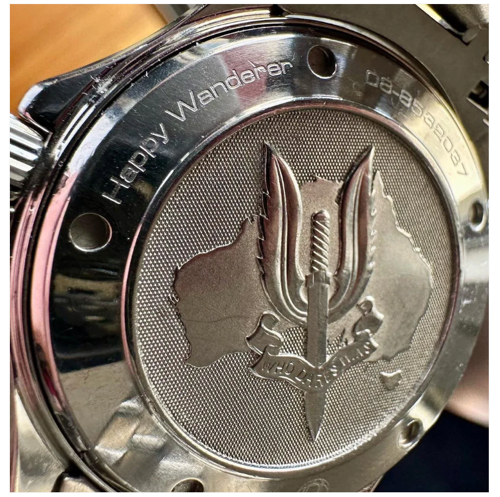
Australian SAS Omega Seamaster

We have covered Omega’s modern Unit Watch program extensively, but Omega’s relationship with intelligence and SOF units goes back decades. In the early 2000s, Omega produced several unit watches for the British Special Air Service (SAS) and Special Boat Service (SBS). By 2012, the Australian SAS wanted in on the action and commissioned an Omega Seamaster with the SAS Winged Dagger over the outline of Australia on the caseback. The case back is also engraved with the member’s year of selection, his PMKEYS (regimental number), and “Happy Wanderer”, the unit’s marching song.

The watches were again commissioned in 2016. The first batch could be purchased by both serving and former SASR operators, the latter only by those still serving. According to former SASR operator Andy White, the Omega Seamaster was chosen specifically due to SASR’s dive capability and operators spending so much time above and below the water’s surface.

SGT Diddams MG, a close friend of White, was KIA in Afghanistan in 2012. In January 2021, while his family moved from Melbourne to Perth, his watch, an irreplaceable heirloom, was stolen from their car. It’s identical to the one pictured, with the only differences being the selection date and his number: 95/8239384. Please keep an eye out for the watch.

Italian “Polipetto” Rolex Sea-Dweller

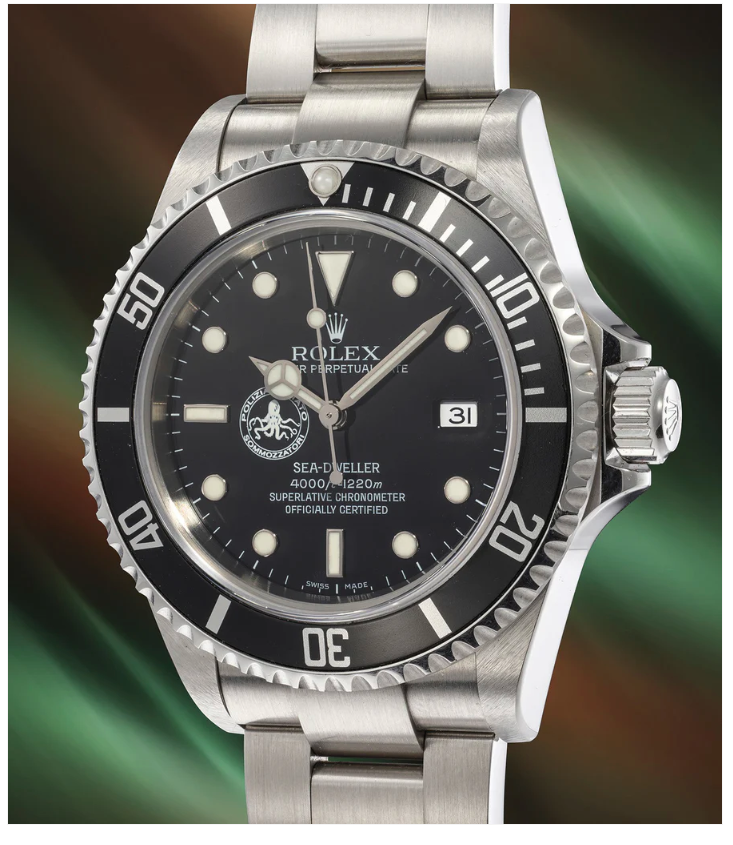
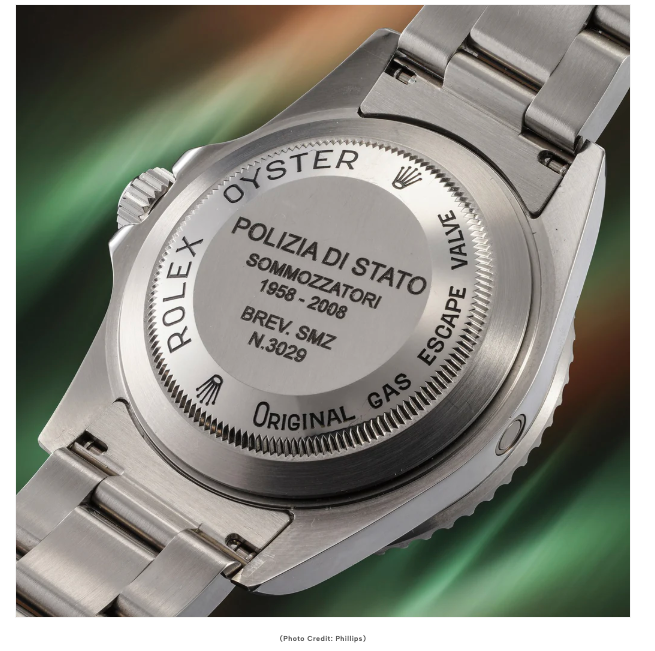
When it comes to unit watches, Rolex is the gold standard, having produced some of the most sought-after and collectable references (read expensive). While the British SAS Submariner and Explorer IIs are probably the most well-known, there are several more obscure references, and one of our favorites is the so-called “Polipetto”, a customized 16600 Sea-Dweller made for the diving branch of the Polizia di Stato or Italian National Police.

Part of the watch’s charm is the unit’s insignia, a stylized octopus, which is printed on the dial at nine o’clock, along with a custom caseback engraving. Among the most coveted and collectible modern Rolex sport watches, only 78 examples were produced, and of those, only 28 bear the service number of the individual diver on the caseback. In addition, the 16600 is perhaps the last great Sea-Dweller, with a 40mm case, no lame “Rolex” text on the rehaut, an aluminum bezel insert, and even lug holes on some examples. Slap an octopus insignia on there, and it’s easy to see how one Polipetto example hammered for 165,100 Swiss Francs (around $207k) in 2024.

Canadian Tudor Pelagos 39

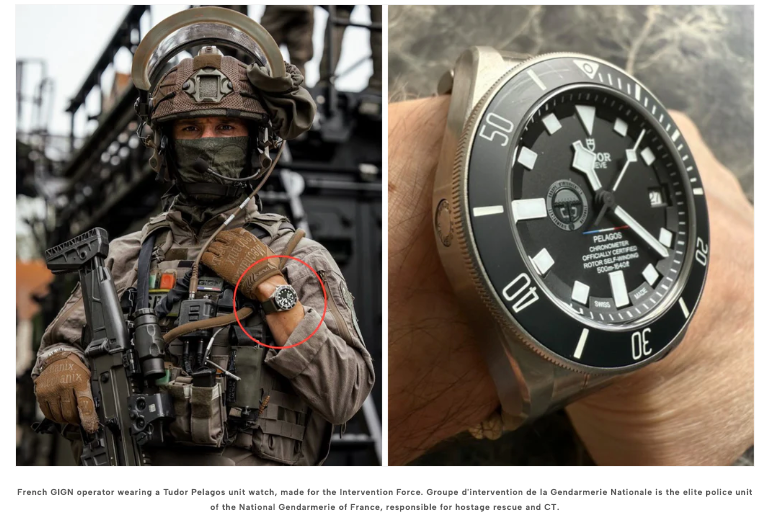
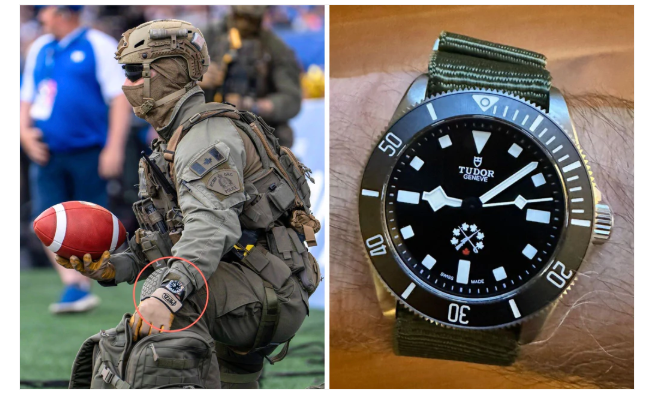
Tudor is arguably the leader in modern unit watches, having produced customized versions of their tool watch line for everyone from the 75th Ranger Regiment to the US Secret Service Counter Assault Team (CAT, AKA Hawkeye). It is difficult to narrow these down to a “favorite”, but for the purposes of this Dispatch, I’m going to go with the custom Pelagos 39 developed for the Royal Canadian Mounted Police’s Emergency Response Team (ERT).

The Royal Canadian Mounted Police’s Emergency Response Team (ERT) is Canada’s federal tactical unit tasked with CT, high-risk arrests, and hostage rescue, a loose equivalent to FBI’s Hostage Rescue Team (HRT).

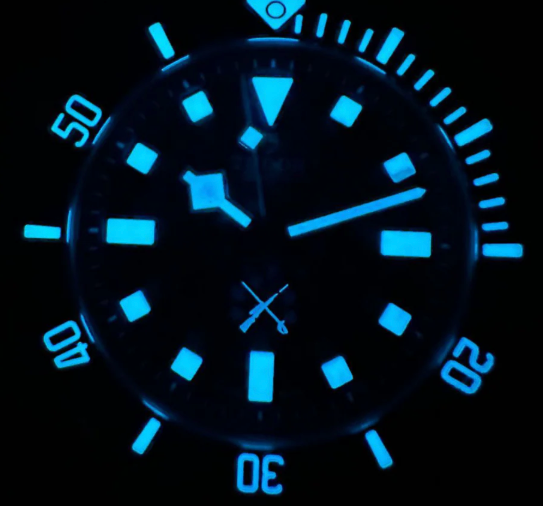
The watch contains an ERT crest on the dial, which represents the original teams consisting of six members and one team leader (7 maple leaves), a Cavalry sword, and a .308 rifle. The coolest part of this watch is the lume; the maple leaves are not lumed, which results in a cool contrast with the rifle and saber standing out. A total of 83 were produced and delivered in early 2025.

UK’ Special Reconnaissance Regiment’ Rolex Submariner

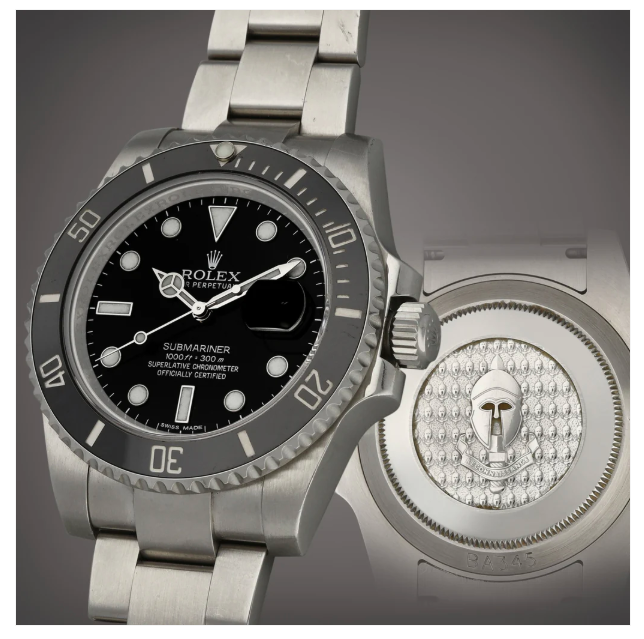
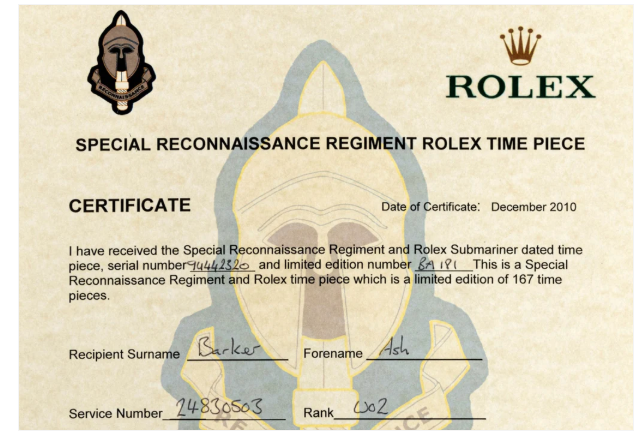
There are military watches, and then there are modern legends. This Rolex Submariner, engraved with the insignia of the UK’s Special Reconnaissance Regiment (SRR), falls squarely into the latter category. The emblem says it all: a Spartan helmet intersected by a sword, surrounded by smaller Spartan helmets, a nod to a unit that doesn’t seek recognition and rarely grants it. This was produced in 2013, and Rolex ceased these unit-specific customizations not long after, handing the torch to Tudor, which continued the tradition of partnering with elite units.

Watches like this SRR Submariner and the famed SAS Explorer II are among the last of their kind. Military-commissioned Rolexes with real operational provenance are increasingly rare. Last year, one was auctioned off by Sotheby’s for a whopping 36k British pounds, which amounts to over $46k in real money (at the time).

Will Rolex ever restart its unit watch program? It’s hard to say, but we would love to see it.

French Olympic Omega Seamaster Diver 300

We have covered the new Omega Seamaster unit watches at length, so we won’t beat a dead horse here. There have been some great unit watches developed, many of them not seen by the wider public or posted on social media.

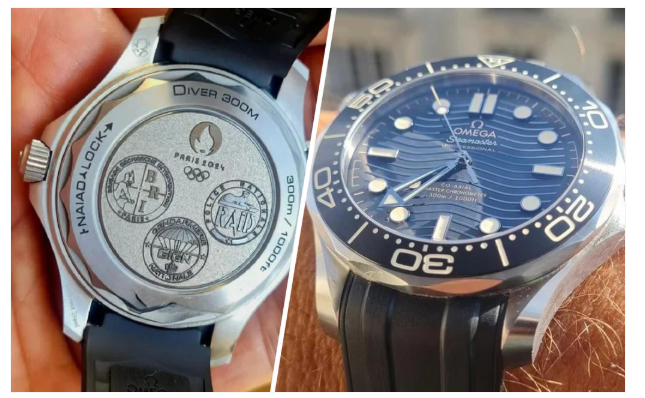
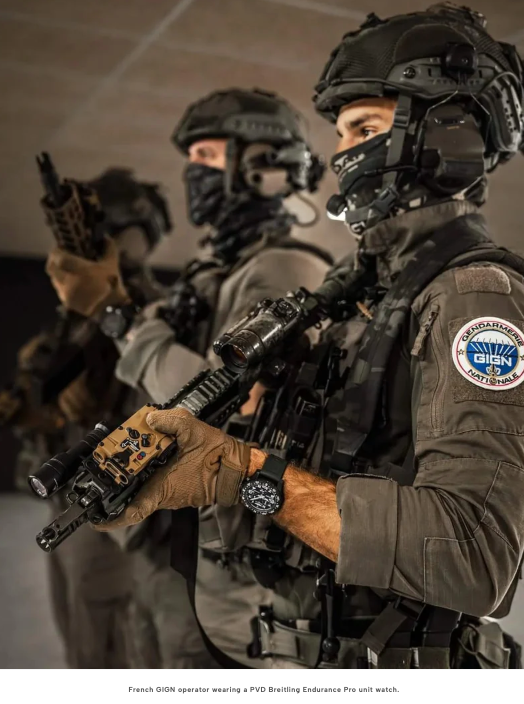
That said, there is one that stands out. Omega produced a Seamaster for the three elite French law enforcement units tasked with security for the event: GIGN, RAID, and BRI. This is one of the few examples I have seen of a unit watch developed for three separate units, which makes it stand out.

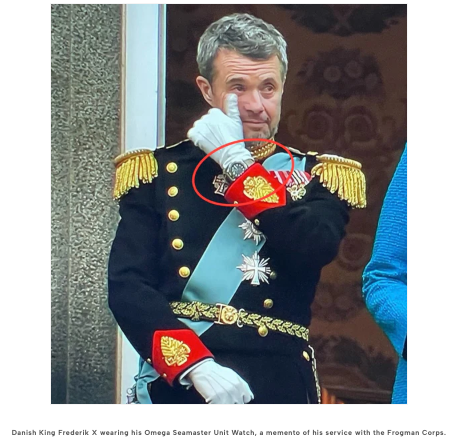
Omega was the official timekeeper of the 2024 Olympics, and while marketing stuff is fun, a GIGN/RAID/BRI unit Seamaster is what really gets us going. Beyond the insignia on the case back, this is effectively the same watch as the one utilized by US Secret Service officers during the recent assassination attempt on former US President Donald Trump and a unit-specific model created for the Danish Frogman Corps.

US Navy’s IWC Top Gun

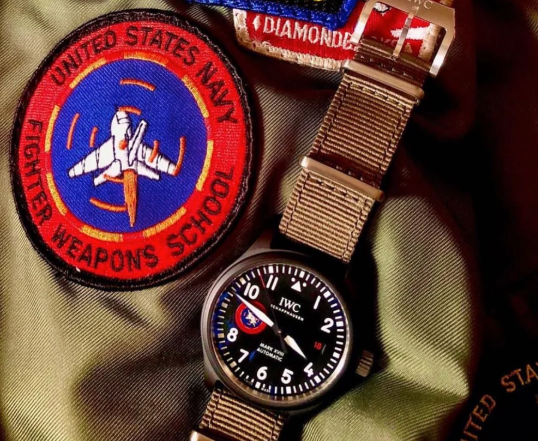
When it comes to aviation squadron watches, IWC Schaffhausen is king.  There are numerous notable IWC squadron watches, but arguably the most well-known is the brand’s partnership with the United States Navy Fighter Weapons School (the real TOPGUN). But interestingly, this didn’t start as a unit watch, but a commercial endeavor.

In 2007, IWC entered a commercial relationship with the US Navy, becoming an official licensee and beginning its line of TOP GUN watches. Featuring the logo of the 1980s hit movie of the same name, the series of watches became a staple of IWC’s offerings with licensing fees directly funding morale, welfare, and recreation programs for US sailors, retirees, and their families.

This prepared the foundation of a more organic relationship, IWC’s foray into custom squadron watches. Having seen watches from the TOP GUN commercial line, pilots from the United States Navy Fighter Weapons School reached out to IWC to investigate the feasibility of making a unit watch for the Strike Fighter Tactics Instructor (SFTI) program.

The result was the 2018 release of the IWC’s first custom military piece: the Edition ‘SFTI’ in both a Pilot’s Watch Mark XVIII and a Pilot’s Watch Chronograph. These exclusive watches continue to be made today, but can only be purchased by TOPGUN graduates, the way it should be.

US-Afghan Special Mission Wing Bremont

The Special Mission Wing, AKA “the triple seven,” was an Afghan unit trained and mentored by Americans for air lift assets, most notably the Russian-built Mi-17. This watch was produced by Bremont for the American servicemen supporting that unit. Bremont’s custom unit watch program has produced some unique timepieces for UK, US, and Australian SOF and aviation units, and was a leader until the recent redirection of the company under CEO Davide Cerrato.

The insignia at twelve o’clock is taken from the Special Operations Joint Task Force – Afghanistan insignia, while each of the numbers around the dial is representative of the Dari script. The 7 (V) is flanked by two “ghost” 7s representing the 777 Special Mission Wing (VVV). The helicopter is the Mi-17V5, which was purchased by the US government for the Government of Afghanistan and flown by both NATO and Afghan crews. Finally, the Cyrillic underneath the Bremont prop is a Russian transliteration of Bremont and is a tribute to the Russian heritage of the Mi-17.

We are big fans of “Arabic dials” (in this case Dari), and this is a cool piece.   Unfortunately, the 777 SMW was disbanded after the US pulled out. Many of the pilots made it to freedom, where they are working to get their families out as well.

UK Special Air Service Breitling Avenger

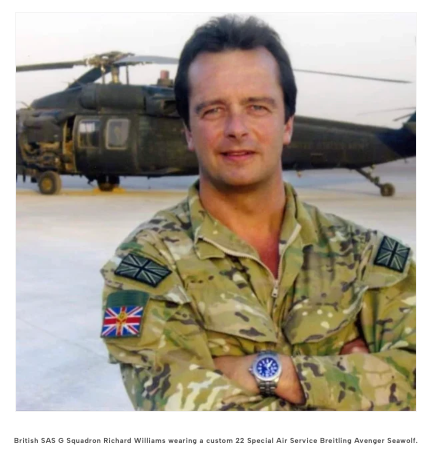
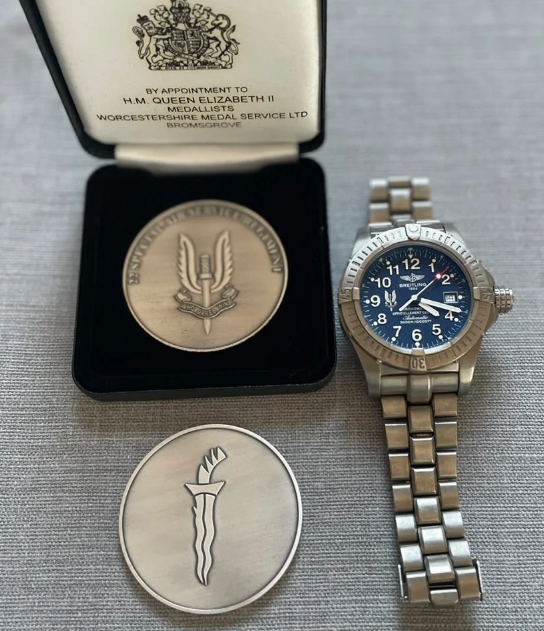
I have a hypothesis that unit watch culture in the United States Special Operations Forces originated with our cousins across the pond in the UK.  In 2003/2004, approximately six years before Delta Force’s unit Breitling, the UK’s Special Air Service (SAS) ordered a customized unit watch, a Breitling Avenger Seawolf with the SAS insignia at nine o’clock.

We spoke with former SAS Melvyn Downes about this piece, who said around 200 were produced. Only serving 22 SAS operators could purchase the watch and all were individually numbered. Some active members of SAS sold them to former members. Given the amount of cross training and deployments between UKSF and Delta, I assess with medium confidence the Delta Breitling was born out of this relationship.

French Marine Nationale (MN) Tudor Pelagos FXD

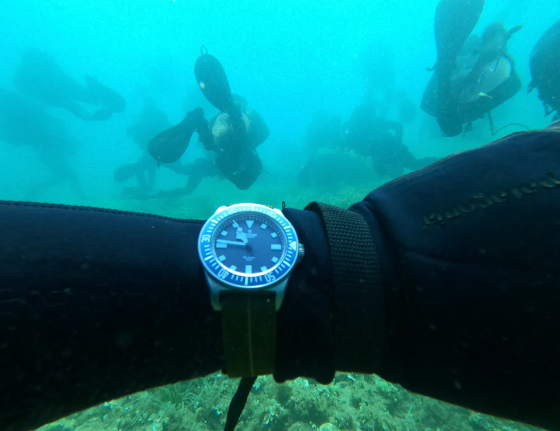
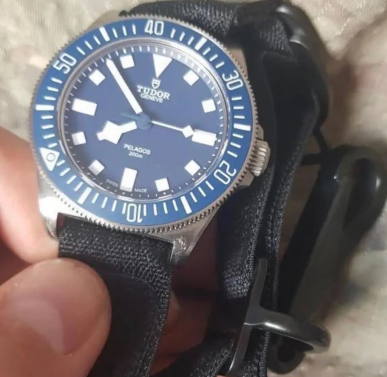
In contrast to many of the watches included here, which are small batch custom versions of core models within each brand’s standard civilian catalog, the Tudor Pelagos FXD owes its very existence to an elite military unit. Leaning into a partnership that started in the 1950s, the Commando Hubert, the French Navy’s elite maritime special operations unit, asked Tudor to develop a new dive watch for the specific use case of its combat swimmers.

With integrated “fixed” lugs and a bidirectional countdown bezel, the Commando Hubert version of the watch has only two lines of text at six o’clock: “Pelagos” and “200m” as well as a unique dive strap and custom caseback. Soon after the watch was created, Tudor released the civilian FXD in 2021 to massive fanfare among the Use Your Tools crowd, with the also-sexy black variant coming in 2023.

Over the past couple of years, the Pelagos has become a popular platform for other unit watch projects, but what is even cooler about the FXD is that the watch itself was organically developed for SpecOps end users.

US SEAL Team Six Tudor Pelagos FXD

When Tudor released the “Black FXD” in September 2023, we published a Dispatch on the background of how the original Blue FXD was developed in partnership with SEAL Team Six. While we sought approval to tell the story prior to release, it gained more traction than expected, and we took it down at the request of those involved.

Fast forward to today, and the cat is very much out of the bag. The watch has been posted on social media, seen at public events, and even discussed at length by a former member of the Command during a recent episode of the Unsubscribe podcast.

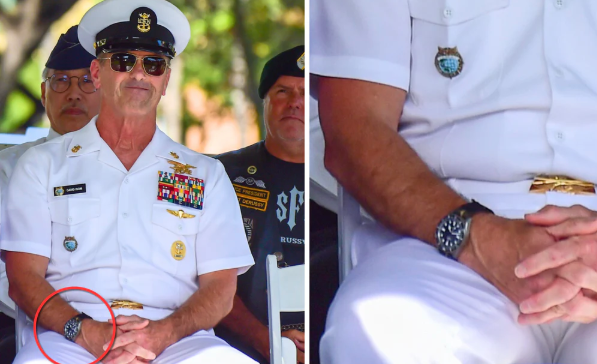
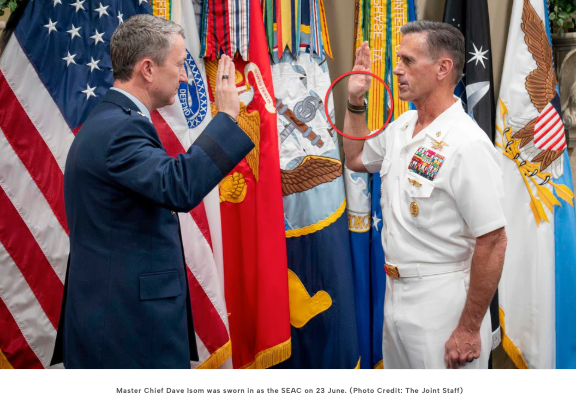
Most recently, the watch was seen on the wrist of former Gold Squadron member, Fleet Master Chief Dave Isom, when he took over as the Senior Enlisted Advisor to the Chairman (SEAC) of the Joint Chiefs of Staff. In contrast to the commercially available version, the Gold Squadron FXD has a simpler “two-line” dial with “PELAGOS” executed in gold and “660 ft”. Most visibly, the hook and loop strap boasts a gold center stripe, in contrast to the regular red stripe. Each squadron has its own version with the squadron insignia on the caseback. Very cool.

Final Thoughts – Should You Collect These Watches?

Decades from now, the individuals who earned these watches will have all moved on in their lives and into retirement, and their unit watches will be among the few lasting, and wearable, reminders of their service. What makes these timepieces special is that they can’t be bought; they must be earned.

That said, inevitably, some unit watches do end up at auction, fetching upwards of $30-50k on the open market in many cases. Watches that were originally designed and intended as keepsakes for a select few can now be purchased by the highest bidder.

While it is unfortunate that some practitioners choose to part with these meaningful timepieces, I also understand that life circumstances change, and the astronomical secondary market pricing can be irresistible. That said, it is a shame that those practitioner’s great-grandchildren won’t be able to treasure the watches worn by their ancestors.

For collectors, I understand the attraction, but I also think it is a little bit strange to wear a modern watch like this that you have no direct relationship with. No, I wouldn’t go as far as to say it is “stolen valor,” but there is something about it that just doesn’t feel right. From a collector’s standpoint, there is a difference in my mind between new “unit watches” and vintage military-issued watches. As the decades roll on, maybe my feelings will change.

For me, when a watch like this comes up for auction, the life is sucked out of it. I am naive about the auction world, but from the outside looking in, it appears to be champagne and cocaine, a part of the watch industry I just don’t relate to. The fact that an earned watch can be acquired by the highest bidder, who almost certainly isn’t the kind of person who would have earned the watch in the first place, just doesn’t pass the smell test.

That said, I believe in the basic principles of capitalism and do not fault anyone involved. We see the world as it is, not as we feel it should be.

*   *   * 

Seperate, but awesome…

. . . 

Tyler Durden
Thu, 07/31/2025 – 22:35

via ZeroHedge News https://ift.tt/U0irmMq Tyler Durden

Trump’s Russia Sanctions Ultimatum Will Blow Up In America’s Face: Jeffrey Sachs

Trump’s Russia Sanctions Ultimatum Will Blow Up In America’s Face: Jeffrey Sachs

Economist and longtime adviser to the UN Jeffrey Sachs has issued a scathing critique of President Trump’s decision to unleash yet more anti-Russia sanctions, giving Moscow just ten days to negotiate for peace with Ukraine or else the new punitive measures will go into effect.

Sachs called the new policy “dangerous” and a sign that the Trump administration is plagued by contradictions and lack of a coherent strategy for ending the war, despite constant early boasting that Trump would rapidly achieve peace. The ‘secondary sanctions’ aimed primarily at those nations still trading with Russia are doomed to be ineffective anyway, the Colombia University professor pointed out.

Getty Images

“If the sanctions are actually applied, they are an escalation of the conflict, and therefore very dangerous. I do not believe that they will be effective,” he said in an interview with Russian media.

“For example, I do not believe they will stop Russia from selling oil, gas, and other commodities to Asian markets. Yet, provocations and escalation often have unpredictable negative effects, and that could be true here as well,” he added.

The new restrictions are likely to backfire regardless, as they “could expose” the “incompetence” or even “accelerate the breakup” of US-led geopolitical and economic blocs.

“This is, in short, the wrong approach. We need diplomacy and negotiation to get to the root causes of the conflict, and solve them, not unworkable ultimatums based on the idea of an unconditional ceasefire,” Sachs added.

He further highlighted the West’s inability to acknowledge and come to terms with the real underlying causes of Ukraine war, such as historic NATO expansion east, the sham Minsk accords, or the coup events of 2014.

“Instead, the Western powers now demand an unconditional ceasefire. Russia will not agree to this, nor will a new round of US sanctions compel Russia to agree to this,” Sachs emphasized.

But top Trump admin officials are defending the freshly issued ultimatum given to the Kremlin. For example, White House special envoy to Russia and Ukraine Keith Kellogg has claimed the relative ineffectiveness of current sanctions thus far has largely been due to weak enforcement from the West.

However, Kellogg has asserted that “Putin will start feeling the pressure not just from within his military, but also from the oligarchs and internally” and that the sanctions will “start to bite”.

Tyler Durden
Thu, 07/31/2025 – 22:10

via ZeroHedge News https://ift.tt/wfaCp3A Tyler Durden

Senate Rejects Bids To Block Arms Sales To Israel

Senate Rejects Bids To Block Arms Sales To Israel

Authored by Victoria Friedman via The Epoch Times,

The Senate voted on July 30 to reject two resolutions that would have blocked arms sales to Israel in response to concerns over civilian casualties in the Gaza Strip since Israeli forces began military action against the Hamas terror group.

Senators rejected two motions introduced by Sen. Bernie Sanders (I-Vt.) that would have stopped the export of over 5,000 bombs and guidance kits and 20,000 firearms. The resolutions failed by 73–24 and 70–27, respectively, in the 100-member chamber.

Sanders, who aligns with the Democrats, said on the evening of July 30 before the vote: “American taxpayer dollars are being used to starve children, bomb schools, kill civilians, and support the cruelty of [Prime Minister Benjamin] Netanyahu and his criminal ministers. That, Mr. President, is why I have brought these two resolutions of disapproval to block offensive arms sales to Israel.”

Chairman of the Senate Foreign Relations Committee, Sen. Jim Risch (R-Idaho), who voted against both motions, called the resolutions misguided, and said before the vote that if they were adopted, it would “reinstate the failed policies of the Biden administration, and would abandon America’s closest ally in the Middle East.”

Risch said that the situation in the Gaza Strip and the impact on its residents was the fault of Hamas, who he said “use the people of Gaza as human shields.”

“These are not good people, and it is in the interest of America and the world to see this terrorist group destroyed,” he said.

Israel began its military operations against Hamas after the terror group’s deadly Oct. 7, 2023, attack, when Hamas militants killed about 1,200 civilians in Israel and kidnapped 251. According to the Israeli government website, 49 of those who were abducted that day are still being held in captivity. One additional hostage is still being held in Gaza, who has been held since 2014.

The Gaza Strip’s Hamas-controlled Ministry of Health reported that more than 60,000 people have been killed since Oct. 7, 2023. The ministry does not differentiate between civilians and combatants in these casualty figures, and The Epoch Times cannot verify their accuracy.

Throughout the conflict, Israel has said that it tries to avoid harming the civilian population and only targets Hamas terrorists.

Palestinian Statehood

In recent weeks, a number of Western nations have indicated they plan to recognize a Palestinian state.

On July 25, French President Emmanuel Macron said he would formally announce the decision to recognize a Palestinian state at the U.N. General Assembly in September, citing the need to end the Israel–Hamas war.

Macron called for an immediate cease-fire and the release of all hostages, as well as for Hamas to disarm.

“Finally, the State of Palestine must be built, its viability ensured, and, by accepting its demilitarization and fully recognizing Israel, it must contribute to the security of all in the Middle East,” he said.

Four days later, UK Prime Minister Keir Starmer said that the UK will recognize a Palestinian state by September, unless Israel agrees to a cease-fire and to improve humanitarian conditions in the Gaza Strip.

Starmer said such a state is “the inalienable right of the Palestinian people,” and that Palestinian statehood is essential for Israel’s long-term security.

The following day, Canadian Prime Minister Mark Carney said his country would recognize Palestinian statehood at the U.N. in September if the Palestinian Authority, which runs the West Bank, made reforms including holding an election in 2026 and refraining from militarization.

Carney said that Canada “will always steadfastly support Israel’s existence as an independent state in the Middle East, living in peace and security” and that “any path to lasting peace for Israel also requires a viable and stable Palestinian state.”

Some 146 U.N. member states already recognize a Palestinian state, according to the U.N. Office of the High Commissioner for Human Rights.

Israeli Prime Minister Benjamin Netanyahu said on X on July 24 that such recognition would “reward terror” and risk the creation of what he described as “another Iranian proxy.”

“A Palestinian state in these conditions would be a launch pad to annihilate Israel—not to live in peace beside it,“ Netanyahu said. ”Let’s be clear: the Palestinians do not seek a state alongside Israel; they seek a state instead of Israel.”

Tyler Durden
Thu, 07/31/2025 – 21:45

via ZeroHedge News https://ift.tt/2wSmOyg Tyler Durden

These Are America’s 25 Largest Private Landowners

These Are America’s 25 Largest Private Landowners

The U.S. is known for its massive public national parks, but a handful of families and entrepreneurs also own tracts of land that would dwarf some states.

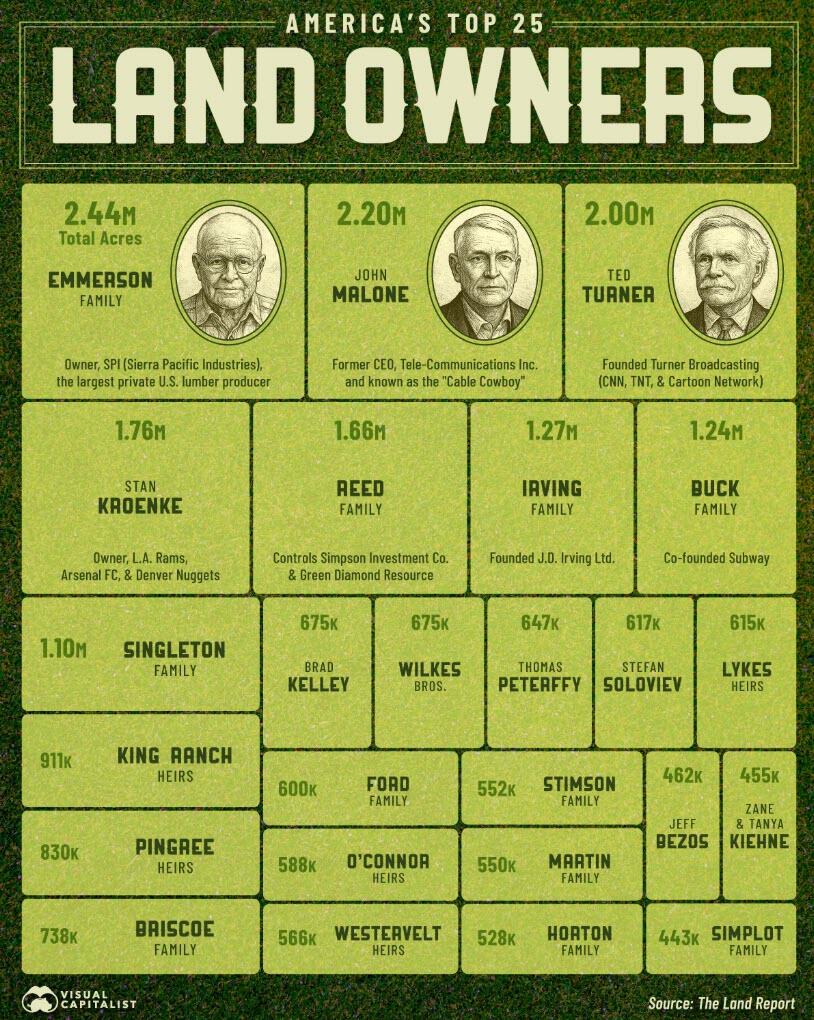
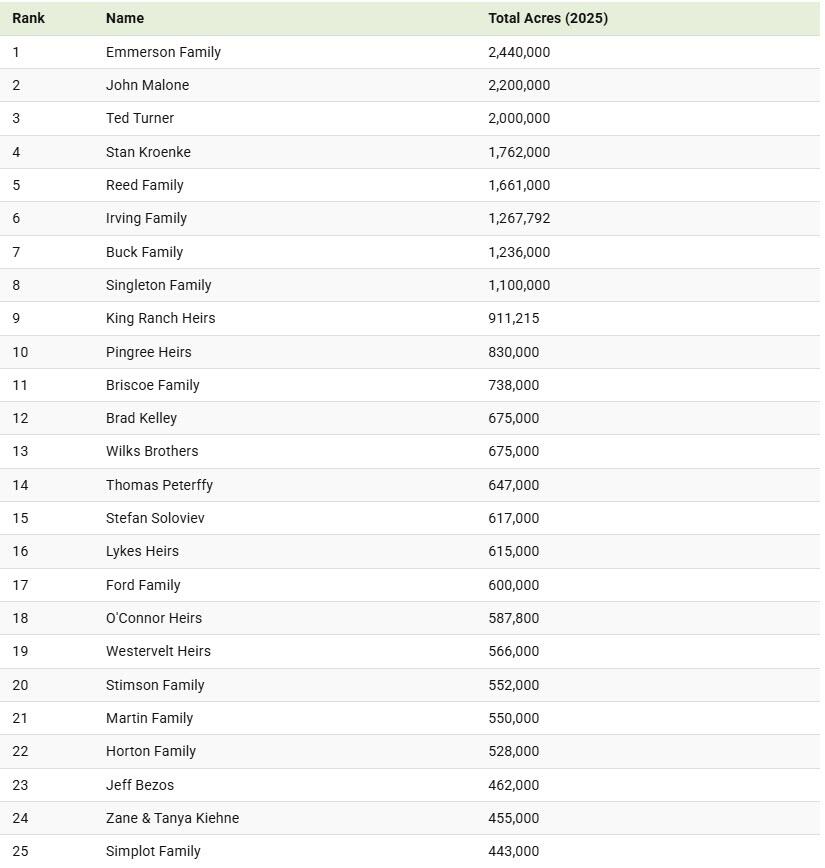
This infographic, via Visual Capitalist’s Niccolo Conte, ranks America’s 25 largest private landowners in 2025 and shows just how concentrated ownership has become.

The data for this visualization comes from The Land Report, which annually tracks the nation’s biggest deed holders. Its 2025 investigations reveals a timber-heavy top tier, diversified ranching empires in the middle, and a sprinkling of tech titans and investors rounding out the list.

Timber Kings Still Rule the Landowner List

Red Emmerson and his family control 2.44 million acres across California, Oregon, and Washington, making them America’s largest private landowners in 2025.

For reference, this is more than 3x Rhode Island’s land area.

Three of the top five landowners—Emmerson, Malone, and the Reed family—built (or expanded) their holdings in commercial forestry.

Timber acres offer steady cash flow, long-term capital appreciation, and valuable carbon-offset potential, which helps explain why Wall Street has shown renewed interest in forests.

These vast, contiguous tracts also give owners leverage in biodiversity markets and provide a hedge against inflation, making timberland an attractive multigenerational asset.

Ranching Dynasties Hold Their Ground

Names such as Ted Turner (founder of Turner Broadcasting), Stan Kroenke (owner of the LA Rams and Denver Nuggets), and King Ranch have also become synonymous with American ranching.

While cattle remains the backbone, many of these families have diversified into hunting leases, wind-energy easements, and conservation tourism.

Ted Turner, for example, manages the world’s largest private bison herd across 45,000 of his 2 million acres, while the Kroenke and Briscoe estates stretch from the Great Plains to the Rockies.

Tech Moguls Join the U.S. Landowning Elite

The 2025 ranking also features several self-made billionaires from outside natural-resource industries.

Jeff Bezos owns more than 460,000 acres in West Texas, where Blue Origin tests rockets and ranching remains active.

Thomas Peterffy, the digital-trading pioneer, has quietly assembled 647,000 acres, making him the largest landowner in Florida.

Also not while on this list, Bill Gates (#43) is the largest farmland owner in the U.S., with 270,000 acres.

The presence of these tech titans illustrates a broader trend. Tech fortunes are increasingly finding refuge—and strategic opportunity—in hard assets like land, influenced by climate concerns, privacy, and long-term stewardship motives.

If you enjoyed today’s post, check out The Top 15 Countries by Land Area on Voronoi, the new app from Visual Capitalist.

Tyler Durden
Thu, 07/31/2025 – 21:20

via ZeroHedge News https://ift.tt/8O9jm0D Tyler Durden

Justice Kavanaugh “Definitely Pay[s] Attention” To the Press

Justice Kavanaugh spoke at the Eighth Circuit Judicial Conference. He was interviewed by Judge Sarah Pitlyk, who was his former law clerk. (Kavanaugh’s clerk tree continues to grow, with President Trump’s recent nominations to the Third and Sixth Circuits.)

I have yet to find a video of the event, but there are several press accounts. Politico offers this insight:

Kavanaugh also made clear he closely follows press coverage, podcasts and social media posts about the Supreme Court, what he described as “an ocean of criticism and critiques out there.”

“I’m aware of it. I definitely pay attention to it. I think you have to. We’re public officials who serve the American people. It’s not an academic exercise,” said Kavanaugh, who worked as a White House lawyer for President George W. Bush. “It’s important for maintaining public confidence in the judiciary and the Supreme Court to know how the opinions are being conveyed and received and understood by the American people.”

Oh I bet he does. Indeed, in 2021, the Supreme Court’s Public Information Office “clipped approximately 10,000 news articles related to the court and the justices, roughly half of them tweets.” The Justices have to go out of their way to not see this content.

I also appreciate that Justice Kavanaugh responded directly to Justice Kagan’s missives at the Ninth Circuit Conference about the lack of a written opinion for emergency docket orders.

Kavanaugh . . . said there can be a “danger” in writing those opinions. He said that if the court has to weigh a party’s likelihood of success on the merits at an earlier stage in litigation, that’s not the same as reviewing their actual success on the merits if the court takes up the case.

“So there could be a risk in writing the opinion, of lock-in effect, of making a snap judgment and putting it in writing, in a written opinion that’s not going to reflect the final view,” Kavanaugh said.

Kavanaugh is right. More and more, it seems that Justice Kavanaugh is speaking out in defense of what the majority is doing–his opinions in Labrador v. Poe and CASA were extremely important. He has become the explainer in chief! Chief Justice Roberts is content in issuing stern end-of-year messages and trying to cheer up Judge Boasberg at Judicial Conference meetings.

By contrast, in 2022, Justice Barrett said she does not read press coverage about herself.

Let’s say I have not ever talked to my clerks about whether they read SCOTUS blog. I would be surprised if most of the law clerks in the building did not. I have a policy of not reading. I read news. I’m not an uninformed person, but I have a policy of trying not to read any coverage that addresses me. I mean, I kind of generally want to know about the court. But I do try not to read like whether they’re positive or negative, I think it’s not a very good idea to read and consume media, that’s about me, because, you know, I think there are personal and institutional reasons for that, you know, the institutional reason is that judges have life tenure, so that they can be insulated from fear of public opinion. And so to read criticisms of the court, I think, undermines that. So you know, you shouldn’t be playing to anyone in the public or any kind of constituency, you know, being happy if you make one segment of the public happy, or, you know, reluctant to anger another. . .  .

And then on a personal level, you know, it’s just not good to have any of that in your head. Certainly not if it’s critical and mean. But even if it’s high praise, I mean, like, why should you be reading a steady diet? Or my case, it wouldn’t really be a steady diet. But why should you be consuming, you know, flattering, you know, articles about yourself, because on a personal level, I mean, the day that I think I am, you know, better than the next person in the grocery store, checkout line, and you know, is a bad day. So, I would say that I really tried to bracket and put aside, you know, anything, you know, to the extent that I can avoid reading, and if it addresses me in particular.

I was incredulous about this statement at the time, and I remain incredulous. Indeed, as Justice Barrett prepares a media blitz for her forthcoming book, I have to imagine she will follow press coverage about herself carefully. Justice Barrett’s planned event with Bari Weiss at Lincoln Center seems to have sold out almost immediately.

I am still fond of Justice Scalia’s 2013 remarks about his press diet to New York Magazine:

What’s your media diet? Where do you get your news?
Well, we get newspapers in the morning.

“We” meaning the justices?
No! Maureen and I.

Oh, you and your wife …
I usually skim them. We just get The Wall Street Journal and the Washington Times. We used to get the Washington Post, but it just … went too far for me. I couldn’t handle it anymore.

What tipped you over the edge?
It was the treatment of almost any conservative issue. It was slanted and often nasty. And, you know, why should I get upset every morning? I don’t think I’m the only one. I think they lost subscriptions partly because they became so shrilly, shrilly liberal.

So no New York Times, either?
No New York Times, no Post.

And do you look at anything online?
I get most of my news, probably, driving back and forth to work, on the radio.

Not NPR?
Sometimes NPR. But not usually.

Reading the press is not necessarily a bad thing. As Mike Davis observed “Sometimes feeling the heat helps people see the light.”

The post Justice Kavanaugh "Definitely Pay[s] Attention" To the Press appeared first on Reason.com.

from Latest – Reason.com https://ift.tt/Sxrhd04
via IFTTT
“Medicaid Millionaire”: Louisiana Woman Facing Fraud Charges After Buying Lamborghini While Illegally Collecting Benefits

“Medicaid Millionaire”: Louisiana Woman Facing Fraud Charges After Buying Lamborghini While Illegally Collecting Benefits

A Louisiana woman dubbed the “Medicaid millionaire” is facing fraud charges after allegedly buying a Lamborghini while illegally collecting Medicaid benefits, according to the state attorney general’s office, reported by Fox News.

Candace Taylor, 35, of Slidell, was arrested Monday after investigators found she underreported her income to qualify for the program. The Louisiana Bureau of Investigation launched its probe after a complaint from the state health department.

The Fox News report says court records say Taylor ran six businesses that brought in over $9.5 million between 2020 and 2024. Bank records show deposits of $480,994, including more than $325,000 linked to her businesses.

Photo: Fox News

“From 2021 through 2024, Ms. Taylor continued to transfer tens of thousands of dollars between her personal and business accounts, with personal inflows consistently exceeding the eligibility thresholds for Medicaid,” the affidavit states.

Despite this, Taylor allegedly kept renewing her benefits—most recently claiming $4,000 in monthly income without disclosing she owned the business.

Authorities say her spending included $45,086 in Audi vehicle payments, a $100,000 wire to an exotic car dealer, and $13,000 for a 2022 Lamborghini Urus. She also allegedly withdrew multiple six-figure cashier’s checks for property, cosmetic surgery, jewelry, and luxury services.

Taylor’s first Medicaid application in 2019—filed under the name “Candace Sailor”—was denied. Less than a year later, she re-applied under the same name with inconsistent information about dependents.

Tyler Durden
Thu, 07/31/2025 – 20:30

via ZeroHedge News https://ift.tt/fhMFU68 Tyler Durden

Is Trump Hellbent On Derailing India’s Rise As A Great Power

Is Trump Hellbent On Derailing India’s Rise As A Great Power

Authored by Andrew Korybko via Substack,

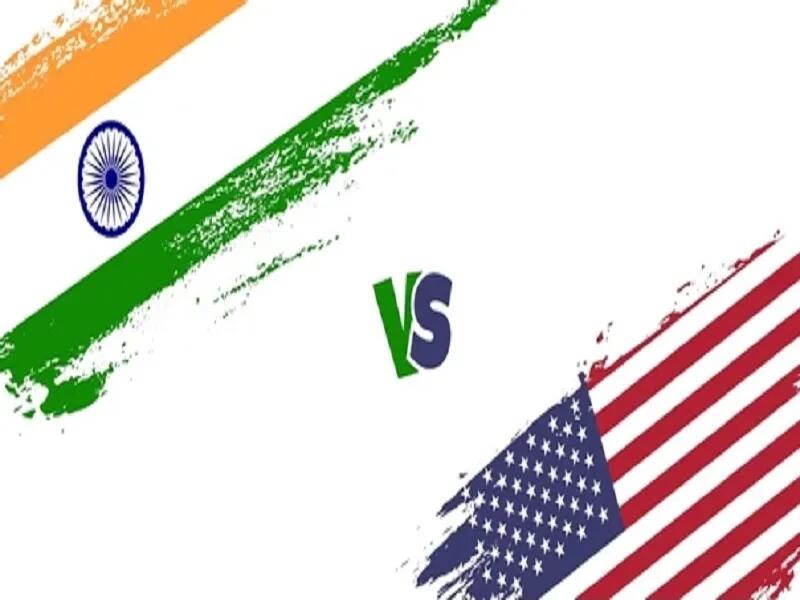
Trump raged against India on Wednesday in a series of posts announcing his 25% tariff on its exports on the pretext of its trade barriers and close ties with Russia.

He then announced an oil deal with Pakistan and predicted that “maybe they’ll be selling Oil to India some day!”

His final post described India’s economy as “dead” and claimed that “We have done very little business with India” despite it being the fastest-growing major economy in the world and bilateral trade amounting to nearly $130 billion in 2024.


India’s Ministry of Commerce & Industry calmly responded to Trump’s tariff announcement by reaffirming its commitment to talks and declaring that the state “will take all steps necessary to secure our national interest”, which likely infuriated him since he probably expected Modi to anxiously call him.

The favorable trade deal that he clinched with Japan last week and the totally lopsided one with the EU that followed emboldened him into playing hardball with India upon thinking that it’ll fall into line too.

The US wants India to open its agricultural and dairy markets, stop its massive import of discounted Russian oil, and rapidly diversify away from Russian military equipment.

Complying with the first demand would be disastrous for the 46% of the Indian workforce employed in these industries, however, while the second would risk decelerating its economic growth and the third would make its security dependent on the US. The end result would therefore derail India’s rise as a Great Power and turn it into a US vassal.

Trump is hellbent on doing precisely that, which is the continuation of Biden’s policy, as explained below:

* 13 December 2022: “Will The US Sell India Out To China To Sweeten The Deal For A Sino-American New Détente?

* 14 May 2025: “There Might Be A Method To The Madness Of Trump Unexpectedly Damaging Indo-US Ties

* 16 May 2025: “Trump’s Desired Return To Bagram Airbase Could Reshape South Asian Geopolitics

* 7 June 2025: “The US Is Once Again Trying To Subordinate India

* 13 July 2025: “The US-Pakistani Rapprochement Could Have Far-Reaching Geostrategic Consequences

These analyses will now be summarized for the reader’s convenience and placed in the current context.

In brief, India’s Russian-assisted rise as a Great Power hastens the coming of trimultipolarity that’ll in turn help midwife complex multipolarity, which would greatly reduce the likelihood of ever restoring US-led unipolarity or the short-lived period of informal Sino-US bi-multipolarity (“G2”/“Chimerica”).

Russia’s special operation and the West’s reaction to it revolutionized International Relations and created the opportunity for India to make up for lost time in becoming a Great Power with truly global influence.

The US responded to these developments by attempting to subordinate India via election meddlinginfowars, and dual geopolitical pivots to Bangladesh (whose prior long-serving leader it helped depose) and Pakistan to pile on the pressure in pursuit of this goal or to contain India if it still refuses to concede.

Complementary elements of this pressure campaign include political support for Delhi-designated “Khalistani” separatists-terrorists and spring 2023’s violent ethno-religious unrest in Manipur.

If Trump’s tariffs don’t coerce India into becoming a US vassal, which the US would then exploit to coerce concessions from China in advance of its ultimate goal of restoring unipolarity, then he might settle for letting China subordinate India instead as part of the “G2”/“Chimerica” scenario.

Either way, he doesn’t expect India’s rise as a Great Power to continue due to the zero-sum dilemma in which the tariffs were meant to place it between becoming the US’ or China’s vassal, but India might still surprise everyone.

Tyler Durden
Thu, 07/31/2025 – 20:05

via ZeroHedge News https://ift.tt/ZamMAc3 Tyler Durden

Two Waymos Equipped With LiDAR Crash 

Two Waymos Equipped With LiDAR Crash 

The LiDAR vs. camera debate is a major battle in the autonomous vehicle and robotaxi race

Elon Musk has long insisted that using only cameras on driverless cars is the most efficient way to achieve true self-driving capability. All Tesla models, including the robotaxis, use external cameras to navigate, steer, and brake, while robotaxi competitors, such as Waymo, use far more expensive LiDAR. 

LiDAR is far more expensive, costing approximately $12,000 per vehicle, as compared with cameras, which come in at around $400 per car, according to Bloomberg. Musk has maintained that camera-only technology is the most “human” way to approach self-driving. In 2019, he said, “Lidar is lame,” adding, “In cars, it’s friggin’ stupid. It’s expensive and unnecessary.”

Musk’s insistence on a camera-only approach for self-driving has prompted critics to argue for the urgent need for LiDAR, with some calling Tesla’s reliance on cameras “Autopilot’s gravest flaw,” according to Car and Driver.

However, while Tesla critics continue to call for more LiDAR … two Waymo Jaguar SUVs equipped with LiDAR have crashed into each other this week. 

According to Tesla investor Sawyer Merritt, mainstream media is silent over two Waymos crashing into each other:

This is the sad state of news these days. Today, a Waymo car crashed into another Waymo, but the media hasn’t covered it at all. I’ve seen no articles. If this were two @Tesla Robotaxis, it would be all over the news. Negative headlines against Tesla generate clicks. Ones about Waymo don’t as much, so most of the media doesn’t bother to write about it. Is this crash the end of the world? Absolutely not. But the media would certainly paint it that way if it were Tesla Robotaxis. Nonetheless, the work toward a safer driverless future presses on.

Waymo car crashed. Not a single headline. If Tesla Robotaxi had even a tiny intervention, it would’ve been all over the news,” X user DOGE Designer wrote, with Elon Musk chiming in with a “Hmm.” 

Tyler Durden
Thu, 07/31/2025 – 19:40

via ZeroHedge News https://ift.tt/0jiS4mh Tyler Durden