From Lawfare To Barfare: Another Way To Target Trump Allies

From Lawfare To Barfare: Another Way To Target Trump Allies

Authored by Benjamin Weingarten via RealClearInvestigations,

When Jeffrey Clark was tapped to lead the second Trump administration’s chief regulatory review office, it marked an astonishing redemption. 

For years, congressional investigators and prosecutors had pursued the former Department of Justice official primarily over an unsent letter he drafted, in support of President Trump’s 2020 election challenge, calling for Georgia to consider launching a last-minute legislative session to review its results.

Trump’s return to power has not ended Clark’s troubles: Washington, D.C.’s legal disciplinary authority has recommended he be disbarred over his conduct from five years ago. Lawyers for Clark claim that the effort seeks to punish “thought crime” regarding their client’s belief in potential irregularities in an election that authorities declared devoid of widespread fraud.

Even as President Trump’s critics now claim he is engaging in retribution against a wide range of past assailants, including former FBI Director James Comey, his supporters say Clark’s case reveals there is an ongoing, politically motivated push to punish MAGA advocates. In their telling, the president’s adversaries who weaponized the justice system through “lawfare” have opened another front in their war through “barfare.” 

The Rise of Barfare

Since 2020, Democratic officials and progressive groups established specifically to target conservatives have lodged bar complaints against dozens of Trump-allied attorneys such as Clark. While supporters of these efforts say they are trying to hold officeholders and advocates accountable for actions that betrayed the canons of ethical legal practice, conservative opponents say the push to punish their political foes via bar complaints, often brought in politically partisan jurisdictions, threatens not only the ability of presidents to receive counsel but the American legal system itself.

“The most politicized situations are the ones where the bar should be the most reticent,” to consider punishing attorneys over their work, James Burnham, former DOGE general counsel, said during a recent panel discussion on alleged bar weaponization hosted by the right-leaning Federalist Society. “That’s when lawyers are supposed to be the most creative and the most aggressive. But it’s not the kind of situation where we want lawyers to be afraid to even engage in advocacy in the first place.”

The Clark complaint concerned his activities in the final weeks of the first Trump administration, while he served in part as acting assistant attorney general for the Justice Department’s Civil Division. Clark, an environmental and regulatory lawyer by background, believed that there was potentially election-altering fraud or irregularities in Georgia and other states, requiring resolution before the fast-approaching January 6, 2021, election certification date.

In response, he wrote a draft letter dated Dec. 28 and addressed to Georgia leaders recommending that the state legislature convene a special session to further probe potential irregularities and take remedial steps as necessary if they impacted the election outcome. 

Clark circulated the letter to acting Attorney General Jeffrey Rosen and Deputy Attorney General Richard Donoghue, who were responsible for probing 2020 election issues. Rosen and Donoghue disagreed with its thrust – especially the suggestion that there was potentially election-altering fraud – and declined to sign and deliver it.

Trump Gets Wind

As Trump’s election challenge proceeded, he got wind of Clark’s views. Apparently finding an ally, the president floated the idea of making Clark acting attorney general. Clark allegedly offered to decline any such appointment if Rosen would sign off on the letter, the then-Democrat-led Senate Judiciary Committee would later report – an allegation Clark would flatly deny. In opposition to a possible appointment, Clark’s superiors convened a Jan. 3, 2021, meeting with President Trump and other officials, at which several said they and other colleagues would resign en masse should the president elevate him. 

Ultimately, the president backed off, and Clark’s letter was consigned to the ashbin of history – until one or several ex-Trump administration officials leaked word of its existence and contents to the New York Times. The Times wrote about Clark’s efforts in a Jan. 22 article titled “Trump and Justice Dept. Lawyer Said to Have Plotted to Oust Acting Attorney General.”

A flurry of probes pertaining to the president’s election challenge would follow. Clark – a Harvard- and Georgetown-educated litigator who had spent the bulk of his career as a partner at white-shoe law firm Kirland & Ellis – would spend the next several years facing the scrutiny of congressional committees, including the Democrat-dominated January 6 Committee, and prosecution in cases brought by Fani Willis in Fulton County, Georgia, and Special Counsel Jack Smith in Washington, D.C. In June 2022, he was forced to wait outside his home in his undergarments while federal investigators searched his suburban Virginia residence, seizing electronic devices in connection with their January 6 probe. 

In July 2022, in response to a complaint lodged by the then-Democrat-led Senate, the D.C. Board on Professional Responsibility charged Clark with violating the D.C. Rules of Professional Conduct. It accused him of engaging “in conduct involving dishonesty” by drafting the letter the board alleged contained false statements, and for “attempt[ing] to engage in conduct that would seriously interfere with the administration of justice.” 

The allegations against Clark rested in part on the argument that because his superiors disagreed with his views on potential election fraud in Georgia, Clark’s assertions in the letter were fraudulent.

Unprecedented Case

In his defense, Clark invoked a slew of privileges, and raised myriad procedural and substantive arguments – including that the local D.C. disciplinary board lacked jurisdiction over Clark’s conduct as a federal lawyer providing counsel to the president; that Clark enjoyed immunity from liability while rendering advice to the president; and that the purported false statements were merely proposed Justice Department positions for consideration by superiors – positions largely consistent, as his lawyers noted, with those raised by several U.S. Supreme Court justices and nearly 20 state attorneys general.

Clark’s lawyers argued during his trial that “[N]o one has ever been charged by the D.C. Bar with attempted dishonesty in a draft letter that recommended a change in policy or position where that document was not approved and never even left the office.” 

His lawyers made the point that sanctioning him for such conduct would lead to a limitless array of disciplinary actions against attorneys over private or internal deliberations on behalf of clients should they hold contrarian views.

Government “lawyers will be afraid to give their candid opinions for fear of losing their careers. Likewise, lawyers will not join government for the same reason,” Harry MacDougald, one of Clark’s lawyers, told RealClearInvestigations.

On July 31, 2025, despite acknowledging “that there are no factually comparable prior disciplinary cases,” a majority of the board recommended that Clark be disbarred. While rejecting Clark’s arguments, including that he was protected as a government lawyer giving advice, the nine-member board said that the charges against him “focus on the truthfulness of the factual assertions” in the letter that he authored. 

Although Clark’s superiors had testified that Clark had “sincere personal concerns” regarding the integrity of the election, the board said, “they also agreed that the Justice Department had not identified potentially outcome-determinative issues in Georgia or other states.”

Therefore, his continued efforts to press officials to send the letter “constituted an attempt to make intentionally false statements about the results of the Justice Department’s investigation,” the board said.

The tribunal added that Clark “should be disbarred as a consequence and to send a message to the rest of the Bar and to the public that this behavior will not be tolerated.”

The disbarment decision is pending before the D.C. Court of Appeals, which has final say over such decisions in the nation’s capital.

Claims of Unequal Justice

In an August 2025 filing with the appeals court obtained by RCI detailing Clark’s exceptions to the board’s order, his counsel contrasted the disciplinary tribunal’s treatment of the Justice Department lawyer with that of FBI lawyer Kevin Clinesmith. He received just a one-year suspension for doctoring a document submitted to the FISA Court supporting the government’s FISA warrant application that enabled them to surveil Trump adviser Carter Page.

The disciplinary process in the D.C. bar is radically disparate according to the political affiliation and views of the respondent attorney,” Clark’s lawyers charged.

A preliminary review of public records indicates that a majority of the board that made the Clark recommendation was comprised of registered Democrats, individuals who had contributed to Democrat candidates, or public advocates of progressive causes. Only one board member was publicly identifiable as a Republican.

The board recommendation followed a trial before a separate three-member panel, at least two of whom were registered Democrats and had contributed financially to Democratic Party candidates, public records show. 

The Office of Disciplinary Counsel, which handed down the original charges against Clark and effectively prosecutes such cases, is also headed by an attorney, Hamilton P. Fox III, who, according to public records, is a Democrat.

“D.C. voted Democrat more than 90% against Trump all three times he was on the ballot – the most lopsided margin in the country to have its own Bar,” MacDougald noted on X in a response to the disciplinary authority’s decision.

Many prominent Republicans also took issue with the actions of Trump and his confidantes in challenging the 2020 election. This includes the sole publicly identifiable Republican board member, Margaret M. Cassidy, a member of the Republican National Lawyers Association who concurred in the recommendation that Clark be disbarred.

After the panel handed down its recommendation to disbar Clark, MacDougald told RCI, “the reason Jeff has been singled out is lawfare – straight up political persecution.”

With the Clark disbarment decision now in the hands of federal judges, the lawyer may have just gotten a big boost. On Sept. 25, three former attorneys general submitted an amicus brief in support of his case. William P. Barr, Jeff Sessions, and Michael Mukasey – all Republican-appointed prosecutors, but not all supportive of Clark’s conduct – echoed his arguments in writing:

The District of Columbia Board on Professional Responsibility…has no business – indeed, no authority whatever – in policing internal deliberative discussions and documents exchanged within the federal Executive Branch for containing purportedly ‘dishonest’ (yet somehow also ‘sincere’) ideas or assertions,” they said.

They added that “immunity for top advisors is necessary to ensure that the President may receive candid and necessary advice prior to acting.”

“Although we are not persuaded by Mr. Clark’s proposed legal strategy, and former Attorney General Barr has publicly criticized it in no uncertain terms, disbarring or otherwise disciplining Mr. Clark for those actions would set a dangerous precedent that would significantly interfere with Executive Branch functions,” while sending a “biting chill throughout the federal government,” they concluded.

Not Alone in the Dock

On the same July day that the D.C. tribunal formally made its recommendation to disbar Clark, three current Justice Department officials were hit with ethics complaints lodged with the bar disciplinary authorities where they are licensed to practice. 

The parallel complaints – targeting Deputy Assistant Attorney General Eric Hamilton, Special Counsel Brad Rosenberg, and Trial Attorney Liam Holland – allege they made “intentionally and materially misleading statements” in litigation over the Trump administration’s attempt to curtail the work of the Consumer Financial Protection Bureau. The complaints note that presiding Judge Amy Berman Jackson of the D.C. District Court upbraided the lawyers over certain representations made to the court.

Several ex-DOJ staff members have defended their colleagues, writing that “our former colleagues took immediate steps to correct the record in response to plaintiffs’ evidence,” while noting that “leaving any such inquiry in the first instance to the court and the parties, who have intimate knowledge of the facts and circumstances that state bar authorities lack, would be a far better approach for determining whether sanctionable misconduct occurred.”

The Justice Department did not respond to RCI’s inquiries regarding the complaints against its employees.

The three complaints were filed by the Legal Accountability Center. The advocacy group’s executive director, Michael J. Teter, has said its efforts are aimed at “going on offense in defense of democracy” at a time when “the rule of law is under direct assault.” The organization maintains it is merely seeking to hold to account “attorneys who abuse their power and violate professional conduct rules.” Its financials are unavailable. A broken web link appears to tie the nonprofit to progressive tech billionaire Pierre Omidyar’s Democracy Fund.

Among the Legal Accountability Center’s initiatives is The 65 Project. The so-called “dark money” outfit was launched in the wake of the 2020 election to “shame” lawyers who represented President Trump in some 65 lawsuits challenging the election and “make them toxic in their communities and their firms,” according to Democrat operative David Brock, founder of the partisan watchdog group Media Matters, who is one of the group’s advisers.

Billed as a bipartisan effort, The 65 Project is led by staffers with ties to Democratic Party campaigns and causes. Teter, who also serves as its managing director, has worked for candidates including John Kerry and counseled the liberal American Civil Liberties Union. Its senior advisor, Melissa Moss, is a former Clinton appointee and finance director of the Democratic National Committee. 

The 65 Project was originally run through another nonprofit, Moss’ Law Works, which achieved notoriety for hosting a stage adaptation of the Mueller Report performed by Hollywood stars. According to archived websites, The 65 Project was sponsored by the Franklin Education Forum, a supporter of progressive causes previously chaired by Brock, and a grant recipient of Omidyar’s Democracy Fund. 

Neither Teter nor the organizations with which he is affiliated responded to RCI’s inquiries in connection with this story.

Justice or Harassment?

More senior officials, as well, have gotten hit with bar complaints in recent months. In September, the center filed a bar complaint against Deputy U.S. Attorney General Todd Blanche, claiming, among other things, a conflict of interest in his interviewing of Ghislaine Maxwell. It also filed a complaint against Ed Martin, the former U.S. attorney for D.C., asserting he had abused his position and conduct rules by engaging in politically motivated investigations, among other matters. Martin, now a DOJ special attorney, also faces scrutiny from the D.C. disciplinary body. During his tenure as U.S. attorney, he had requested information of that office, citing in part the Clark case, indicating his concern that it might be biased against conservatives. 

Elected Republican officials around the country, including Montana Attorney General Austin Knudsen, and Lawrence VanDyke, the former solicitor general in Montana and Nevada, and a current judge on the Ninth Circuit Court of Appeals, have also been targeted.

Judging by their disposition, most of these accusations were of dubious legal merit. A recent analysis of nearly 80 complaints filed by third-party organizations like The 65 Project against attorneys who represented Trump or related causes – many of them Republican state attorneys general – found that in only three instances did attorneys face public discipline.

The conservative group America First Legal filed a bar complaint against Teter last fall for his The 65 Project work, claiming he was abusing the bar disciplinary process in targeting attorneys associated with Trump. It is unclear whether the Utah Bar, which received the complaint, has taken any action.

De-Weaponizing the Bar Discipline Process

Those who believe the bar is being weaponized against those who hold disfavored viewpoints – namely on the right – say corrective action is required. They assert that, beyond pursuing arguments regarding the immunity that federal lawyers ought to have from state and local authorities, there is a First Amendment right to viewpoint diversity that quasi-governmental entities, such as state bar associations, are currently violating. 

Some, such as Michael Francisco, an appellate litigator who formerly clerked for Supreme Court Justice Neil Gorsuch, believe that “attorneys are not capable of regulating themselves.” 

America First Legal’s Gene Hamilton echoed these remarks, adding during the Federalist Society panel: “I really do think that each of the state bar associations need to take a really hard look at the rules and to modify them to prevent abuses of the disciplinary process.

Clark’s lawyer, MacDougald, told RCI that ultimately, lawyers advocating for Republican and Democratic causes will be losers if the weaponization of discipline doesn’t end. 

“Lawyers have a job to do and should be allowed to do it,” he said. “State legislatures and State Bar associations must reform themselves and commit to political neutrality or they will destroy themselves and the profession.”

Tyler Durden
Wed, 10/01/2025 – 13:20

via ZeroHedge News https://ift.tt/p1DN3L0 Tyler Durden
U.S. Antimony Books First $10M DOD Order Under “Indefinite Delivery Indefinite Quantity” Contract

U.S. Antimony Books First $10M DOD Order Under “Indefinite Delivery Indefinite Quantity” Contract

United States Antimony announced Tuesday that it has received a $10 million delivery order under its newly signed indefinite delivery, indefinite quantity sole-source contract with the US Defense Logistics Agency.

The order covers 315,000 lbs. of antimony metal ingots, which will be used to replenish the US National Defense Stockpile.

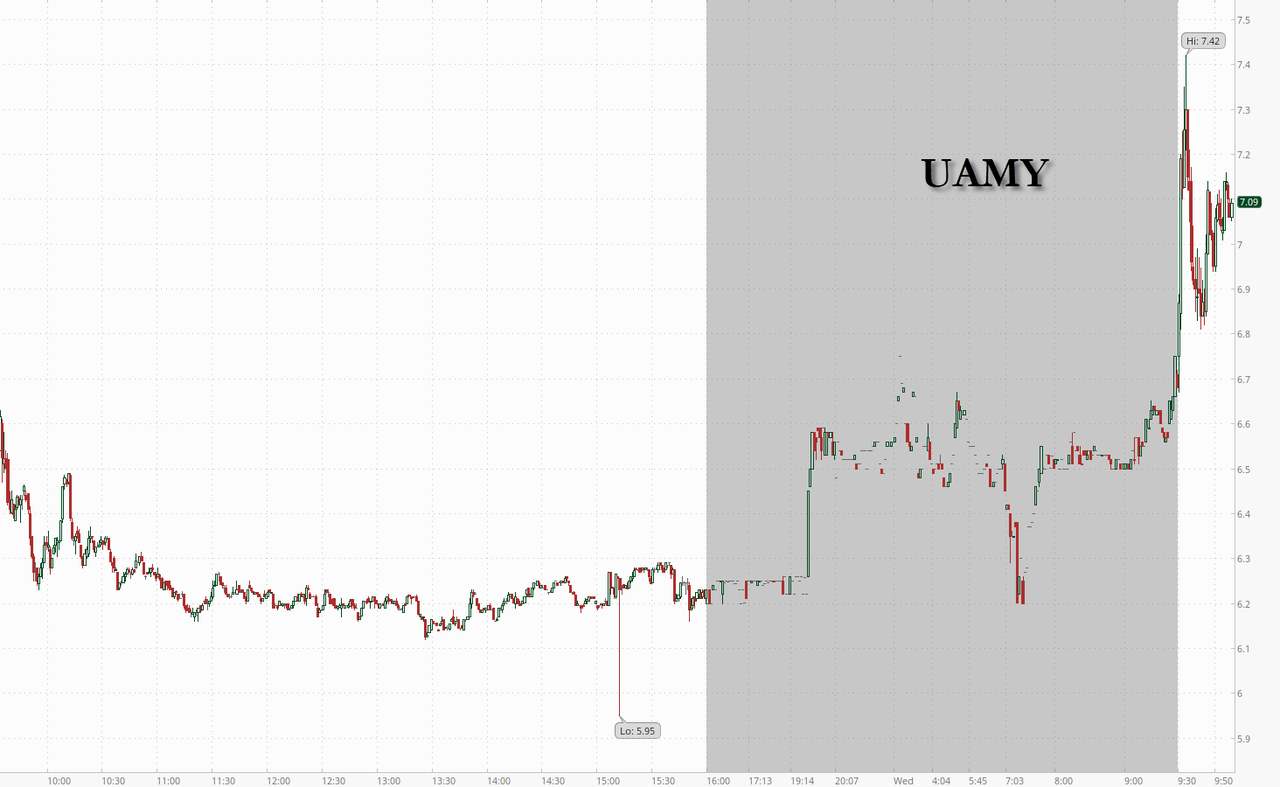
Shares were up more than 10% in response to the order, while at the same time Bloomberg reported UAMY’s CEO had purchased $613k in common stock at a price of $6.13/share, according to his Form 4

Looking ahead, the company said it expects 2026 gross revenues of $100 million, compared with the $100.6 million forecast by two analysts polled by FactSet. UAMY also reaffirmed its 2025 revenue outlook of $40 million to $50 million, while three analysts polled by FactSet project $45.2 million.

Recall, as we noted last month, UAMY operates the only two antimony smelters in North America, and said it is positioned to begin immediate deliveries from its domestic facilities.

“It’s incredibly meaningful for all our employees to play such a strategic role in strengthening our nation’s defense readiness,” USAC CEO Gary C. Evans said in a statement last month.

The deal follows months of negotiations and reflects a partnership with the Department of Defense that accelerated in late 2024. It also highlights broader U.S. efforts to reduce dependence on foreign sources, particularly China, for critical minerals and strategic materials.

Antimony, a critical mineral which is used in munitions, batteries, flame retardants, and military-grade compounds, has been flagged by defense officials as a vulnerability in the U.S. industrial base.

The Trump administration has made domestic supply-chain resilience a policy priority. Trump has taken a series of executive and policy actions aimed at securing U.S. access to critical minerals, citing national security and economic independence.

Similar initiatives have supported other strategic sectors. The federal government has backed Intel with billions of dollars in CHIPS Act funding to expand U.S. semiconductor manufacturing capacity, while MP Materials has received Defense Department support to boost rare earth processing, reducing reliance on overseas supply chains.

Additional announcements are also expected relatively soon around nuclear fuel and uranium, another area where U.S. officials are seeking to strengthen domestic capability and reduce reliance on foreign suppliers.

Two months ago we laid out all the winners in the coming critical mineral scramble in The Coming Rare Earth Revolution And How To Profit: All You Need To Know About The “Ex-China Supply Chain.” Those who put on the recommended baskets are currently enjoying high double-digit gains. 

Tyler Durden
Wed, 10/01/2025 – 13:00

via ZeroHedge News https://ift.tt/woHLWDE Tyler Durden

The Case For A Citizen-Only Census

The Case For A Citizen-Only Census

Authored by Hayden Ludwig via RealClearPolitics,

Who is the census for? Or more importantly, who does Congress represent? If you answered “U.S. citizens,” you’re correct – or at least you should be.

At the start of each decade, the federal government tallies who’s living in the country and where, citizens and non-citizens alike. That census data determines how many seats in the House of Representatives each state receives, as well as its share of Electoral College votes for president. This whole process is mandated by Article I, Section 2 of the Constitution, the part most focused on proper representation.

But representation for whom? Since 1790, anyone and everyone living within America’s borders, “excluding Indians not taxed.” That’s approximately 300 million Americans and 41 million non-citizens, the most in our nation’s history, nearly half of them living here illegally.

Non-citizens have never been allowed to vote in congressional elections. But they receive improper representation in Congress because the census fails to exclude them from the apportionment process, when all 435 House seats are divvied up between the 50 states and D.C. That’s dramatically inflated Democrats’ power in the House of Representatives as the non-citizen population has grown, at Americans’ expense.

Simply excluding 18.6 million illegal aliens – the most plausible estimate given by the Federation for American Immigration Reform – from the 2020 apportionment would shift eight House seats, mostly from blue to red and purple states. Removing all 41 million non-citizens would shift a stunning 22 seats the same way. In either case, these are districts that should represent U.S. citizens; instead, they’re brimming with non-citizens, and Democratic Party politicians prefer it this way.

Blue states, on average, report nearly double the percentage of non-citizen residents than red states: 6.3% to 3.7%. Of the top 20 states with the largest percentage of non-citizens, only six vote red or purple. Democrats also control seven of the 10 House districts with the most non-citizens; the other three are held by Republicans, either born in Cuba or who are children of Cuban immigrants. Those seats were, until recently, Democrat-controlled. I’ve documented more such revelations in my recent investigative report, “The Emerging Permanent MAGA Majority.”

Immigrants tend to flock to states with more job opportunities, which tend to be in states with big cities such as California and Texas, the states with the largest foreign-born populations. But as people have abandoned unlivable “progressive” fiefdoms for conservative southern states, this has turned the problem of representation inflation into a cynical opportunity to unfairly boost Democrat power.

To show this in action, imagine two congressional districts with equal populations of 760,000 residents, the national average. District A contains 700,000 U.S. citizens and 60,000 non-citizens. District B has 400,000 U.S. citizens and 360,000 non-citizens (some of them illegal aliens). Both districts elect one congressional representative, but District A’s congressman represents 360,000 more voters than District B.

As a result, a vote in District B is effectively worth twice as much as a vote in District A, because there are far fewer District A voters dividing up the same congressional seat.

Stacking blue districts with so many non-citizens lets a smaller electorate punch above its weight. This isn’t a mystery; it’s a core feature of Democratic electoral strategy. Take it from Rep. Yvette Clarke (D-NY), who admitted of illegal aliens in 2021 that “I need more people in my district, just for redistricting purposes.” Thirty-five percent of Clarke’s constituents are foreign-born, the 23rd-highest in Congress.

Counting non-citizens also artificially boosts the number of House seats in blue states, even as Americans flee Chicago and New York City for Phoenix and Jacksonville. Democrat-run states lost a net seven House seats between the 2010 and 2020 censuses, and would’ve lost three more seats had the Census Bureau not overcounted six blue states. In 2030, they could lose between six and nine House seats, according to recent projections.

Ironically, many of the immigrants who are unintentionally boosting Democratic seats hold traditional social views, yet they skew congressional representation toward the far left simply by living in blue cities. They’re moderates represented by radicals. They’re also “voting” without a vote.

This has been the logic governing Democratic strategy for nearly three decades: Encourage mass immigration, discourage border enforcement, and reward illegal aliens with U.S. citizenship. It’s why Democrats bet the farm on Hispanics building a permanent majority in Washington – never imagining that Donald Trump could convert millions of Hispanic voters into America First populists.

That’s good, but it isn’t enough to restore America’s greatness. We have to push further and end Democrats’ cynical exploitation of the census for good.

Conservatives are hawks on closing the border, but they’ve largely missed or ignored the injustice of counting non-citizens in the census. This isn’t good politics, nor is it ethical. States such as Idaho, Ohio, and Tennessee are robbed of congressional representation because California, New Jersey, and Texas house so many non-citizens. In other words, some states are punished for having a big population of Americans – including naturalized immigrants – while others are rewarded for attracting migrants, even if they entered illegally.

This is why it’s crucial to ask who the census is for, rather than how we’ve always done it.

The founding generation viewed the census with a very different priority than we do today: Building a nation rather than preserving one. They adopted an expansive definition of American citizenship, assuming that loyalists, British sympathizers, and other Tories would self-deport from the republic – as some 80,000 actually did. The 1790 census counted as citizens everyone who claimed the new identity of “American” and proved it by remaining within the nation’s borders after the war.

Article I, Section 2 counted three-fifths of indentured servants and black slaves, but excluded Indian tribes. Why the distinction? Because one group lived under U.S. jurisdiction while the other did not. The census was never fundamentally about collecting interesting demographic data, but apportioning congressional representation. It was already outrageous and hypocritical that slaves, denied citizenship and legal rights, still inflated the southern states’ seats in the House. Yet the principle was already clear: Representation belongs to those who owe allegiance to the United States Constitution, not foreigners under another sovereign power.

This is the same logic that limits voting rights to U.S. citizens. No one outside of woke Berkeley is offended that non-citizens cannot vote for our leaders, although a few blue states are trying to normalize it. In fact, bipartisan voters have approved recent Citizen-Only Voting Amendments in huge numbers in red and blue states alike.

Paul Jacob, who chairs Americans for Citizen Voting, the group behind these ballot initiatives, points out that voting and representation are inextricably linked. “Only citizens should be voting in our elections, and each state’s representation should be based on the number of U.S. citizens in the state. Not on how many illegal aliens they’ve let in,” he told me. “No longer can we allow states to grab extra voting power in Congress by counting their illegal population.”

To fix that, we don’t need to deport every single illegal alien (though we should strive for that). We simply remove them from congressional apportionment and let the process play out fairly. Call it a “Citizen Only Census,” a return to the Founders’ high regard for citizenship after decades of being dragged through the mud by Democrats. The simplest way to do this is to restore a citizenship, or place of birth, question to the 2030 Census. This was the case in all but one census from 1820 to 2000.

The first Trump administration tried to in 2019 and lost 5–4 in the Supreme Court, but only because the court ruled the Commerce Department hadn’t provided sufficient procedural justification. The high court did not rule that it’s unconstitutional. Quite the opposite, actually: “The Enumeration Clause [Article I Section 2] does not provide a basis to set aside the Secretary’s decision,” the justices explained.

President Trump’s first administration started late, used the wrong arguments, and still came within one vote of winning that fight. The takeaway is obvious: Start earlier with a better strategy. The court’s transformation since 2019 ought to encourage them. Originalists have gained control of two liberal Supreme Court seats, establishing a supermajority and raising hopes that the court would approve restoring the citizenship question if given a second chance.

That’s an opportunity patriots – and America itself – can’t afford to miss.

Tyler Durden
Wed, 10/01/2025 – 12:40

via ZeroHedge News https://ift.tt/PCTsaRE Tyler Durden

Israel Paying US Social Media Influencers $7,000 Per Post As Right-Wing Support Craters

Israel Paying US Social Media Influencers $7,000 Per Post As Right-Wing Support Craters

Following Israeli Prime Minister Benjamin Netanyahu’s meeting in New York on Friday with a group of pro-Israel influencers, we learn that Israel is likely paying them a whopping $7,000 per pro-Israel social-media post in a desperate drive to bolster plummeting support of Israel among America’s young conservatives. 

That’s the conclusion of Responsible Statecraft’s Nick Cleveland-Stout, based on analysis of a disclosure filed with the US Department of Justice as required by the Foreign Agents Registration Act (FARA). While pro-Israel lobbying heavyweight AIPAC is notoriously exempt from FARA registration, the social media operation comes under the transparency law’s provisions because Israel’s Ministry of Foreign Affairs is paying for it

The influence campaign is being facilitated by Bridge Partners, a DC-based firm owned by founders Yair Levi and Uri Steinberg. “[Bridge Partners] has also enlisted the help of a former major in the IDF spokesperson unit, Nadav Shtrauchler,” writes Cleveland-Stout. “For legal counsel, Levi and Steinberg have turned to Pillsbury Winthrop Shaw Pittman, a firm that previously worked for controversial Israeli spyware company NSO Group.”

The current phase of the campaign runs from June to November, with a $900,000 budget for a stable of 14 to 17 influencers turning out pro-Israel content. Taking into account disclosed administrative costs and the campaign’s expectation that the group will produce 75-90 posts, Responsible Statecraft estimates each post will earn the influencers somewhere between $6,143 and $7,373. The individual influencers are not identified in the filings. However, given they are being paid by a foreign government to engage in political activity, the influencers seemingly have a duty to register as individual agents of the State of Israel

Netanyahu candid public statements to influencers last week raised eyebrows, as they laid bare Israel’s drive to control social media discourse in the United States in a bid to shore up American support. “We’re going to have to use the tools of battle,” said Netanyahu. “Weapons change over time…the most important ones are in social media. And the most important purchase that is going on right now is…TikTok.”

After pro-Palestinian content in the wake of the Oct 7 Hamas attacks catalyzed a long-simmering deep state drive to ban TikTok, the ban is being averted via TikTok’s transfer of an 80% stake to Oracle, Silver Lake, and Andreessen Horowitz. The new owners include significant backers of Israel.

The Israeli social media push comes amid cratering support for Israel among Americans. The deterioration is strongest among Republicans who have long represented the cornerstone of Israel’s backing in the United States. That trend is even more pronounced among younger Republicans: An August Responsible Statecraft poll found that just 24% of Republicans under age 35 sympathize more with Israel than the Palestinians.  

According to the FARA disclosures, Israel refers to the paid-influencer campaign as the “Esther Project.” That name closely resembles “Project Esther,” the Heritage Foundation proposal for the US government and pro-Israel groups to destroy the pro-Palestinian movement in the United States by declaring activists to be members of a “terrorist support network.” and using that as the pretext for deportations, lawsuits, job terminations, school expulsions and exclusion from “open society.”

After taking office, Secretary of State Marco Rubio quickly embraced the sinister tactic, using it to arrest and jail international students who’d engaged in pro-Palestinian activism. In the most infamous case, Rubio had federal agents chain and shackle a mild-mannered, female Tufts University child development student and lock her away in a crowded detention center in Louisiana pending deportation — all for merely writing a calm and measured op-ed in the student newspaper advocating the school’s divestment from Israel. In a blistering opinion issued Tuesday, a Reagan-appointed federal judge declared that such arrests and deportations violate the First Amendment and represent an “abuse” of power: “It is hard to imagine a policy more focused on intimidating its targets from practicing protected political speech.”

While that ruling is a victory for open discourse, there’s no such recourse for a TikTok algorithm that’s moving into the hands of Israel advocates. 

Tyler Durden
Wed, 10/01/2025 – 12:20

via ZeroHedge News https://ift.tt/Widgpv1 Tyler Durden

A Fifth Circuit Disgrantle in the Alien Enemies Act Case

Yesterday, the Fifth Circuit granted rehearing en banc in W.M.M. v. Trump. This case, formerly known as A.A.R.P. v. Trump, presents a challenge to President Trump’s use of the Alien Enemies Ac to remove certain aliens. On September 2,  the merits panel opinion ruled against Trump. Judge Southwick wrote the majority opinion, and he was joined by Judge Ramirez. Judge Oldham wrote a blistering dissent.

At the time, I wondered whether the Solicitor General would simply seek certiorari, or seek rehearing en banc. The former option would get a resolution sooner, but the government may have worried that the Court would not grant review in the absence of a circuit split. So filing an en banc petition was probably the safer bet. And indeed, the government sought rehearing en banc, which was granted.

The Fifth Circuit has seventeen active members, which means that nine members voted to rehear the case. There are decent odds that if nine members vote to rehear the case, then nine members will vote to reverse the panel opinion, but those sorts of predictions are tough to make. And as often happens on the Fifth Circuit, the en banc court may fracture, and there will be a judgmnet, but not a single controlling opinion. One judge usually justs concurs in judgment, making a majority even tougher to cobble together.

After the court granted rehearing, Judge Southwick issued an usual opinion: he dissented from the grant of rehearing en banc.

A prompt, final resolution of this case is in the legitimate interests of all parties, whatever lesser interests of either side of the litigation might be served by the delay of en banc in this court. It is, I believe, also in the country’s best interest that additional, necessarily inconclusive, inferior-court determinations not delay the Supreme Court’s reclaiming this case. I therefore respectfully dissent from the grant of rehearing en banc.

We all know what a dissental is. There is also a disgrantle, as Judge VanDyke explained: a dissent from the grant of rehearing en banc. My colleague Eugene Volokh described the disgrantle as a “nonce word,” which is a “on one specific occasion or in one specific text or writer’s works.” Well, I’m using disgrantle here.

I searched the Fifth Circuit database for the phrase “dissenting from the grant of rehearing en banc.” No other hits came up. I know of at least one instance in which this mechanism was used. Way back in 2008, Judge Smith dissented from the grant of rehearing en banc, though he styled his opinion as just a dissent: United States v. Seale, 550 F.3d 377 (5th Cir. 2008). I’m sure there are other such cases, but they are rare.

I am aware of one case where four members of the Supreme Court dissented from the grant of certiorari: American Tradition Partnership v. Bullock (2012)

I also want to flag Judge Ho’s brief concurrence in W.M.M.:

Our colleague opposes rehearing en banc on grounds of delay. But the burden of any delay falls on the Government. And the Government asked for rehearing en banc, rather than seek certiorari in the Supreme Court. Perhaps we could have minimized delay by declaring last year in United States v. Abbott, 110 F.4th 700 (5th Cir. 2024), that the Judiciary has no business telling the Executive that it can’t treat incursions of illegal aliens as an invasion.1 But we are where we are. The issue is obviously compelling. I concur in the grant of rehearing en banc.

Well before Trump came into office, Judge Ho opined that determinations under the Invasion Clause were not justiciable. (See Rob Natelson’s post on this opinion.) Judge Ho was well ahead of the curve. If Judge Ho was right, then W.M.M. becomes a much easier case. Ho’s view did not receive any other votes in 2024. And I was surprised that Judge Oldham’s dissent in W.M.M. did not cite Ho’s concurrence. We will see what happens on the en banc court this time around.

The post A Fifth Circuit Disgrantle in the Alien Enemies Act Case appeared first on Reason.com.

from Latest – Reason.com https://ift.tt/4N78UPC
via IFTTT

The Formula for Making Immigration Popular With American Voters

The Cato Institute’s Alex Nowrasteh and Reason‘s Katherine Mangu-Ward debate National Review‘s Rich Lowry and Steven Camarota from the Center for Immigration Studies on the benefits and drawbacks of mass immigration. Thursday, October 2, live on stage in Washington, D.C. Get your tickets here.

With crime or the economy, most people can recognize improvement even when they don’t agree about what is causing a problem or how to measure it precisely. More job opportunities? That’s progress. Fewer murders? Progress. More houses available? Progress. Immigration lacks a similarly shared yardstick. Headcounts of people admitted, hired, resettled, or removed mean different things to different observers.

What would it mean to define progress on immigration in a way that almost everyone, regardless of where they come from ideologically, agree it’s a good thing? Most people, including those who are currently skeptical about immigration, tend to support freer movement over borders when it is demonstrably beneficial in terms of being orderly and well-managed, culturally compatible, and economically sound. Attracting more high-skilled foreigners, for instance, is so intuitively appealing that it was one of the few things both Trump and Harris voters agreed on before the 2024 election. At the same time, few people care about total numbers in the abstract, so cutting immigration on its own often does not resolve anyone’s underlying worries about costs and the lack of control.

The good news is that there appears to be a workable overlap on what “getting it right” looks like in practice across at least three distinct areas: higher administrative capacity that moves cases quickly and accurately, better immigrant outcomes that also make immigrants’ own contributions to the U.S. visible, and more predictable enforcement that make our border more secure and enforcement encounters lawful without chaos.

Higher administrative capacity: Timely and accurate decisions on both admissions and deportations reduce uncertainty for everyone and are desirable, regardless of whether you think immigration in general is good or bad. Backlogs erode trust and push people into limbo. Simpler filings, clearer criteria, and expanded premium processing can shrink backlogs and produce more consistent results.

Greater administrative capacity implies both faster protection for those who qualify and faster removals for clearly ineligible cases, which pro-immigration advocates should accept as a feature of an orderly system. Without sufficient processing capacity, we can’t have either good immigrant outcomes or a secure border.

Better immigrant outcomes: While these may be important in and of themselves, we know that voters genuinely care that newcomers land on their feet and add value to their new adopted country. Earnings growth and tax contributions over time, language acquisition and stable employment, and alignment of skills with documented needs are intuitive signals that immigration policies work.

Contrary to what many assume, the better immigrant outcomes observed in the U.S. and other English-speaking countries, compared with mainland Europe, likely stem more from selection or the greater desire of ambitious would-be migrants to come there than from elaborate integration or welfare programs, which often fail on their own terms.

More predictable law enforcement: If you believe open immigration is a right, it is understandable to be uneasy about deporting an unauthorized person who has settled here, even if that person has done nothing illegal beyond entering the country illegally. But making enforcement more credible or the border more secure does not require embracing cruelty or the counterproductive practices of the Trump administration.

A sense of predictability matters because it communicates whether rules are real in everyday life. And for most people, progress looks exactly like clear rules applied the same way every day. That means consistent adjudication, capacity to handle spikes at the border without chaos, and steady implementation of lawful outcomes, even when some laws on the books are imperfect and may harm individual migrants.

Immigration Progress Is Not Just About Better Messaging or Reducing Prejudice

Making progress on immigration is decidedly not about coming up with better messaging strategies. In our increasingly polarized politics, every persuasive pro-immigration message meets a more persuasive counter-message. And even the best possible rhetoric hits hard limits if it is not tied to a credible policy design or outcome. Slogans and stunts may help generate short-term headlines, but grand promises without execution feed the long-term backlash.

Instead, sustainable gains in public trust come from better performance: rules that are legible, timelines that are kept, outcomes that ordinary people can verify in their own communities. Messaging can set tone, but lasting persuasion follows visible and predictable competence, which is what ultimately builds trust and creates room for further reform.

Making progress on immigration is also not mainly about reducing prejudice. It is true that people with racial biases are more likely to oppose immigration, especially immigration from culturally different groups. But reducing bias at scale is hard and slow: Psychological research shows that these attitudes are deeply rooted in people’s personality and shift little over time.

Happily, my research shows that most opposition to immigration is conditioned on specific policy details rather than rooted in blanket xenophobia. Many people who are currently skeptical of immigration do not hate immigrants. When they see clear benefits, they are willing to back a more open system.

 In other words, durable progress does not come from information campaigns trying to convince skeptical voters of how good immigration really is yet again. It comes from governments adopting better policies that prove their value and generate their own support.

What This Means for Work Visas

If progress follows performance, governments should start where voters already agree: high-skill immigration. That is why the recent presidential plan to levy a $100,000 charge per H-1B work visa is a useful case study for how not to do immigration politics or policy.

Since 1990, the H-1B visa has been the main channel for U.S. firms to hire foreign professionals. Economic evidence ties these high-skill visas to higher productivity, patenting, startup formation, and wage gains for natives as well as immigrants, which makes the plan to impose a $100,000 fee counterproductive. If it does not effectively halt the program entirely, a blanket charge of that size would price out smaller employers, push work offshore, and undercut graduate pipelines, repeating a familiar pattern of missing an opportunity for real reform. Nor do the newly proposed H-1B wage rules help: By relying on artificial government wage levels instead of real pay, they may end up favoring outsourcing firms over genuinely high-skill hires.

The H-1B program has many real flaws, from the inefficient lottery system to the fact that immigrants are effectively tied to their employers, who abuse that leverage. So the administration’s stated goal and rhetoric of benefiting American workers by prioritizing stronger skills in the program is reasonable. But the administration’s proposal taxes people for participating rather than selecting better applicants, so it fails on its own terms. As repeatedly suggested by both center-right and center-left analysts, a more credible fix is to rank petitions by wage-based selection. That way, offers with stronger market signals rise to the top, allow workers to switch employers without risking their legal status, and step up penalties for repeat abusers.

Public opinion supports this direction. Americans are unusually favorable toward skilled immigration: Large shares want to prioritize highly skilled workers, and earlier surveys found about 8 in 10 think skilled immigration should be encouraged. Doctors, engineers, and other professionals are intuitive assets because the benefits are visible: They fill needed jobs, pay taxes, start firms, and integrate quickly. Critics are right that H-1B can be misused and does not always bring in the most skilled workers. Yet unlike illegal immigration or asylum pressures, there has been no broad bottom-up opposition to H-1B or any mass protest movement. Most public pushback that exists has come from either a narrow slice of Republican elites opposed to immigration in general or from left‐wing labor populists who see guest worker programs as threats to American workers. Attempts to mobilize anger about H-1B have consistently fallen flat compared with illegal immigration or asylum issues. And when most people are asked about H-1B visas, even with some explainer, they support it.

The same principle applies beyond H-1Bs. Our rules should set legal migrants up for success in ways that are demonstrably beneficial to the public: work visas tied to documented labor needs, quicker reunification for immediate family, credible student-to-work transitions for strong performers, and state-based visa programs that let communities with shrinking populations opt in to invite workers to settle and contribute to their local economies.

What Does This Mean for Refugees and Asylum Seekers?

Openness to refugees and asylum seekers is the hardest test for immigration progress, because humanitarian appeals persuade few voters and because gains are easy to undermine. Most people want clear benefits at home, not just compassion abroad. But progress is possible, if humanitarian admissions look orderly, useful, and limited. 

The idea of community or private refugee sponsorship, first launched in Canada in 1979, directly addresses a common retort in debates about humanitarian obligations: “Why don’t you house them yourself?” Sponsorship gives willing individuals and private groups across ideological lines a legal way to act on their convictions and share both the financial and social costs of resettlement.

We have already seen these principles work in the United States. The Welcome Corps, launched in 2023, allowed vetted civic groups, campuses, congregations, and local coalitions to sponsor refugees under national rules and ceilings. It converted a willingness to help into a capacity to help, it relieved pressure on a fragile resettlement system, and it attracted support that crossed party lines because it kept government control over eligibility while letting communities opt in. According to a 2023 YouGov poll, this was one of the few pro-immigration policies supported by the majority of Republicans. The program ended in early 2025, when the current administration stopped all humanitarian admissions, but not because of any opposition to sponsorship itself. So if it is revived, it would likely regain bipartisan support.

Despite its potential, sponsorship is not a fix for possible asylum pressures. Border processes must be rule-bound and credible. That means discouraging illegal entry, adjudicating claims quickly in custody, removing people who do not qualify, and narrowing eligibility where abuse is common, while preserving protection for those who meet the standard. One possible template is to rebuild and speed up border adjudication while setting clear limits on asylum pathways. Put together, quiet competence at the border and voluntary capacity in communities make humanitarian immigration more acceptable and sustainable.

How To Make Progress When People Disagree

Immigration is generally beneficial, but it is not costless: It has winners and losers, economic tradeoffs, and moral dilemmas. In a democracy, what matters is not just your view but what your fellow citizens think.

We know that name-calling or fact-dumping will not persuade, since we have already tried that many times. We also know that neither closed borders nor open borders is politically possible right now. But the politics of compromise is not about abandoning principles, teaming up with the enemy, or blindly following cost-benefit analysis. It is about devising and passing policies that improve lives in ways that most people, regardless of where they come from politically, can recognize as good.

Immigration progress is possible when benefits are visible to ordinary citizens. That means prioritizing demonstrably beneficial immigration—skilled work, immediate family reunification, structured humanitarian pathways—that reassure skeptics while widening opportunities. It means finding ways to make freer movement compatible with popular consent.

The post The Formula for Making Immigration Popular With American Voters appeared first on Reason.com.

from Latest – Reason.com https://ift.tt/74wsLIo
via IFTTT

Government Shutdown: Illegals Can’t Register to Vote This Week

The government has shut down, and now the CDC has suspended “nonessential” functions, like providing guidance on HIV prevention.

Yesterday, America understood that condoms prevent STDs. Today— who could say? The government is shut down. We are all lost.

The Bureau of Labor Statistics won’t be able to release its monthly jobs report— which has been wildly inaccurate for the past several years.

I guess the public will just have to settle for the ADP report instead. You know, the one from the private payroll company that actually processes paychecks for over 25 million workers — real data, from real businesses — and somehow manages to release its numbers on time, without spending a dime of taxpayer dollars.

The Commerce Department is furloughing tens of thousands of employees. Which means… well, what exactly does that mean? Does anyone actually know what the Commerce Department even does?

The Census Bureau is shut down too. No more “community outreach” programs registering illegal immigrants to vote.

Of course I am just cherry-picking the most unnecessary functions of government.

What we should all really be concerned about is going without a functioning military—

Oh wait, the military continues to function during a government shutdown.

But there will be sacrifices. The Defense Department has paused elective surgeries — which I assume means Navy sailors will have to reschedule their sex-change operations.

But I imagine with the government shut down, airplanes will begin to fall out of the sky—

Oh, Air Traffic Controllers still work. The TSA still functions, which might not make air travel safer, but will continue to prevent you from bringing water on a flight.

But the government is totally shut down.

Well, not the National Parks, which collect some of their own revenue, or the Smithsonian which had plenty of budget leftover to continue operating.

It’s a super serious shutdown though.

Well, FEMA will continue to operate— which I guess means continuing to ignore areas hit by storms.

And Social Security checks will still go out. You can still renew your passport.

No, they didn’t pause SNAP or safety net programs. Pell Grants are not paused. ICE is still on the hunt.

It’s being extremely generous to even claim all the things which are still functioning during this “shutdown” are “essential.”

And the Trump administration seems to have come to the same conclusion, which is why they are maneuvering to make many of these layoffs permanent, perhaps shutting down entire non-essential departments and offices.

Because it turns out that, aside from a few bureaucratic inconveniences, the world doesn’t end when a bloated, inefficient, overreaching government takes a breather.

Of course, this doesn’t change the fact that government shutdowns in general are not a good look when it comes to instilling confidence in the government.

We wrote Monday that the dysfunction in American politics will only further spur foreign governments and central banks to dump their dollars and replace them with gold.

But if Trump can do anything to redeem the US, it is pulling a DOGE in one fell swoop, and hitting the delete button on all unnecessary government programs.

That would show the world that the US recognizes its financial problems, and is taking steps in the right direction to balance the budget, and reduce it’s debt load.

This is the kind of mentality we need.

Annnnd, he’s being sued.

You’d think the President, who runs the Executive Branch, could fire people in the Executive Branch. But no. Every action is dragged into court, usually before some activist federal judge with a terminal case of Trump Derangement Syndrome.

Cue the injunctions. Red tape. Back pay.

As if a government job is a God-given right.

There is no greater entitlement mindset in America today than that of a federal employee who declares, “From my cold, dead hands… you’ll take my position in the Department of Commerce!”

And if you want to talk about losing confidence, just imagine being a foreign central banker watching this circus unfold— an executive legally prevented from executing.

That’s exactly the kind of thing that makes them throw up their hands— forget it!

They’ll just keep buying gold, dumping Treasuries, and get out while they still can.

PS– Gold just hit $3,900 on news the government shut down.

Gold has been going through the roof, but many top quality gold miners have lagged far behind. That is starting to change, but there is still opportunity before the gap closes.

Click here to learn more about the undervalued precious medals producers we have found for subscribers of The 4th Pillar investment research newsletter— we’re currently offering a limited time discount.

Source

from Schiff Sovereign https://ift.tt/vjxehS6
via IFTTT

New Tactics, But Climate Crusaders Running Out Of Options

New Tactics, But Climate Crusaders Running Out Of Options

Authored by Gary Abernathy via The Empowerment Alliance,

In the wake of a federal government no longer serving as its obedient lapdog, the desperate lengths to which the climate cult goes to maintain its standing is increasingly imaginative.

Case in point: CNN recently reported that “for the first time, scientists have quantified the causal links between worsening heat waves and global warming pollution from individual fossil fuel and cement companies, pushing the boundaries of extreme weather event research in multiple surprising ways.”

In other words, the climate crusaders – apparently believing that it’s necessary to ratchet up the alarm factor in order to retain relevance – are now claiming the ability to pinpoint exact companies and actions that are allegedly leading to “worsening heat waves” – an interesting finding in the midst of one of the coolest Augusts and Septembers in much of the U.S. in recent years.

The study “encompasses 213 heat waves around the world from 2000 to 2023.” The conclusion? Wait for it – heatwaves “became much more likely and severe during that period, largely due to the burning of fossil fuels.” Shocking.

Accusations that fossil fuels are causing global warming, or cooling, or any weather pattern varying from what is claimed to be “normal,” are nothing new, of course. What’s new is that the study, published in the journal Nature, now claims to identify the specific culprits.

“Of the extreme heat events the researchers focused on, as many as a quarter of them would have been ‘virtually impossible’ without the climate pollution from any of the 14 biggest ‘carbon majors’ — the largest fossil fuel and cement producers responsible for the lion’s share of the world’s carbon pollution,” according to the report. The alleged “carbon majors” include industry giants ExxonMobil and Chevron, of course, along with nations such as the former Soviet Union.

The study also found these companies are responsible for 50% of the increase in heat wave intensity since before humans started adding so much planet-warming carbon and methane pollution to the atmosphere,” according to CNN’s story.

Now we get to the kicker, the apparent practical application of such a specific report: “The conclusions may have far-reaching ramifications, including aiding those who seek in court to make oil and gas companies pay for climate change-related harm, a task that has proven extremely difficult in the U.S.”

Indeed, the radical climate movement has increasingly attempted to win court judgments against companies that provide our most affordable and reliable fuels. These “scientific studies” could provide left-leaning judges with a new justification to side with climate change zealots. One study co-author acknowledged that the conclusions provide another weapon in the legal arsenal.

Courts are indicating a willingness to hold carbon majors accountable, but at the same time asking for more scientific certainty, and our study helps to close a part of that gap,” said Corina Heri, a study co-author and law professor at Tilburg Law School in Zurich.

It’s difficult to claim as coincidence the fact that the ramped-up effort to apply a shiny new veneer to rusty climate theories comes as the federal government is exponentially moving away from the grip of climate change fever.

The New York Times recently reported that Chris Wright, energy secretary in the Trump administration, has argued that “renewable energy projects developed with the aim of reducing fossil fuels were not beneficial to the United States.” Wright recently “defended the Trump administration’s decision to block a nearly completed $6.2 billion wind farm off the coast of Rhode Island by saying offshore wind increases electricity prices and by downplaying the jobs at stake.”

Speaking on Sept. 5 to the council on Foreign Relations, a Washington research organization, Wright said, “Climate change, for impacting the quality of your life, is not incredibly important. In fact, if it wasn’t in the news, in the media, you wouldn’t know.”

Adding insult to injury as far as climate zealots are concerned was a follow-up announcement by the Environmental Protection Agency that it will no longer require greenhouse gas emission reports “for thousands of coal-burning power plants, oil refineries, steel mills and other industrial facilities across the country,” as the Times reported. EPA head Lee Zeldin called greenhouse gas reporting “nothing more than bureaucratic red tape,” and said ending the program could save U.S. businesses $2.4 billion over the coming decade.

Naturally, the energy “experts” contacted by the Times disagreed with Wright’s assessment, and critics similarly assailed the end of greenhouse gas emission reporting, claiming it would seriously set back the fight against climate change.

It’s no wonder that those invested in the global warming movement (by whatever moniker it embraces in any given decade), once riding on easy street with the full backing of the Biden-Harris administration, are attempting to retrench and regroup with a new method to attack their favorite bogeyman – traditional, reliable, affordable energy – in sympathetic courtrooms.

But they may be running out of road, at least in the U.S. If the Trump administration continues to dismantle the statutory mechanisms that have kept the Climate Doom Squad alive, pretty soon there won’t be any far-flung climate regulations left to use as legal ammo – freeing up courts to concern themselves with issues grounded in fact, removed from politics, and more pertinent to average Americans.

Gary Abernathy is a longtime newspaper editor, reporter and columnist. The opinions expressed are those of the author and do not necessarily reflect the views of The Empowerment Alliance or ZeroHedge.

asingly imaginativ

Tyler Durden
Wed, 10/01/2025 – 12:00

via ZeroHedge News https://ift.tt/CWVulGb Tyler Durden

Supreme Court Lets Fed’s Cook Simmer In Job Until Oral Arguments In January

Supreme Court Lets Fed’s Cook Simmer In Job Until Oral Arguments In January

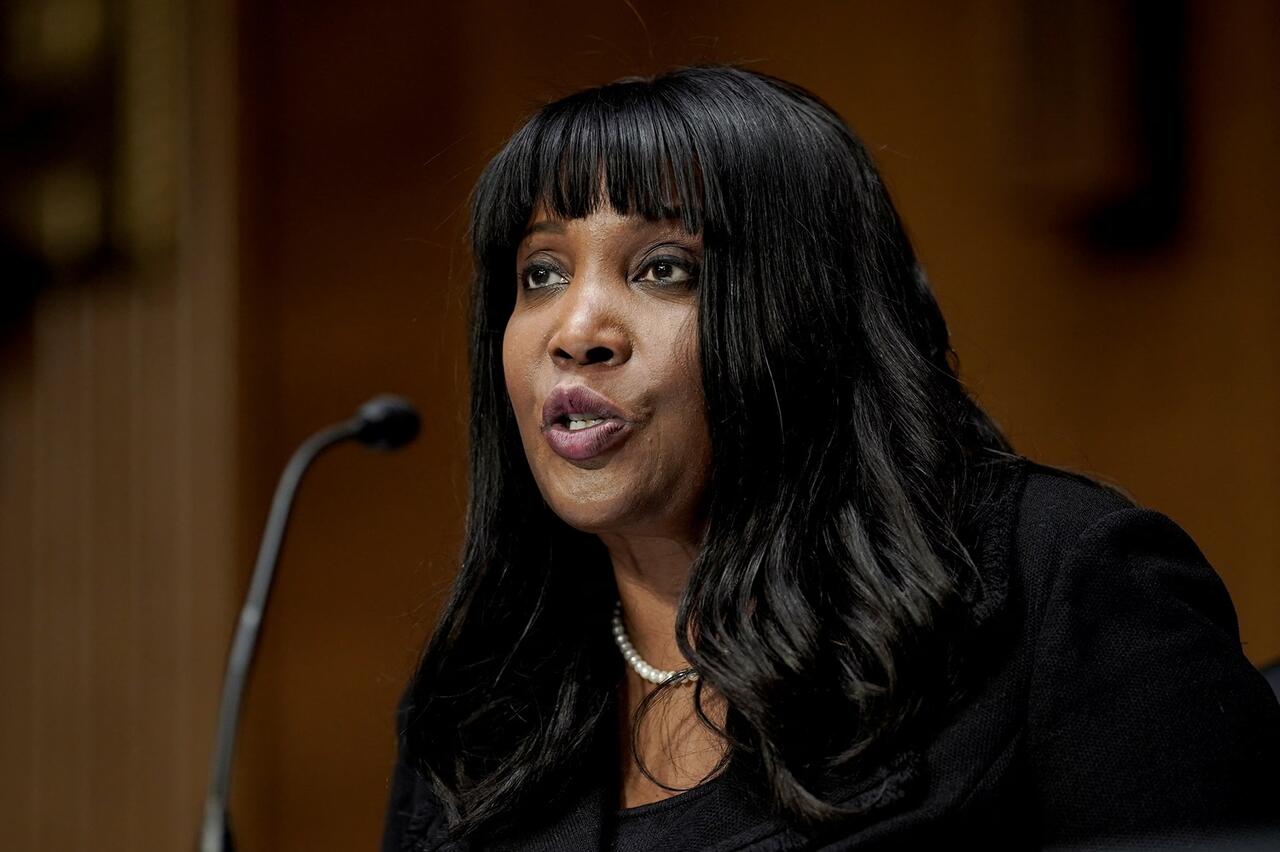
The US Supreme Court has allowed Federal Reserve Governor Lisa Cook remain on the job until they hear oral arguments in her lawsuit after Trump fired her in late August over allegations of mortgage fraud.

The Wednesday order from the court – which has largely sided with Trump this year in cases challenging his firings of officials across the federal government – means Cook can continue to participate in Fed operations for at least the next three months. 

The move defers Trump’s bid to remove Cook while the DOJ appeals a lower court ruling that said she was likely to win her lawsuit over the firing. No justice noted a dissent from the order. 

The Fed has remained uninvolved in the fight – and says it will respect whatever ruling comes down. They are scheduled to meet on Oct. 28-29, where they will vote on whether to lower interest rates again. 

The court fight over Cook’s position on the Fed unfolded rapidly ahead of its most recent policy meeting on Sept. 16-17. Lower courts allowed Cook to participate and the board voted to lower interest rates by a quarter percentage point. Following the meeting, the Justice Department asked the Supreme Court to intervene. -Bloomberg

Recently, a group of former Fed and Treasury officials who served under both Republican and Democrat administrations filed an appeal to justices in a ‘friend-of-the-court brief,’ which urged the court to leave Cook in place.

Tyler Durden
Wed, 10/01/2025 – 11:19

via ZeroHedge News https://ift.tt/nGpbO5V Tyler Durden

Oil Trims Losses After DOE Shows Modest Weekly Inventory Builds

Oil Trims Losses After DOE Shows Modest Weekly Inventory Builds

Oil dipped modestly, extending its two-day slide, after the latest DOE data showed another weekly increase across most oil products, even as expectations were for continued declines. 

  • Crude +1,782k vs est -50k
  • Gasoline +4,125k vs est. -80k
  • Distillates +578k vs est. -1,650k
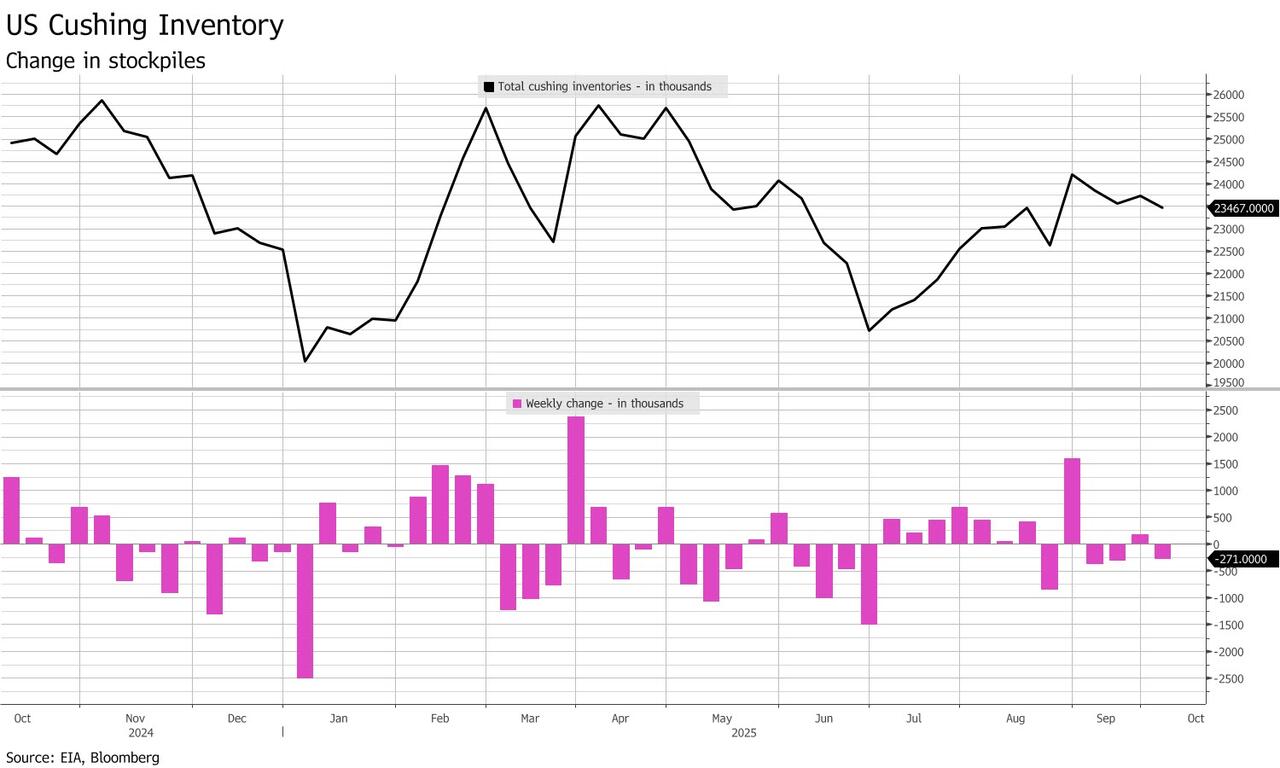
  • Cushing crude -271k

The 1.79-million-barrel build in commercial crude stockpiles contrasts with the 3.7-million-barrel draw seen by the API on Tuesday

Following draws in the past two weeks, crude, gasoline and distillate inventories were expected to post another modest drop, but the official data showed an increase across all three products.

Increases in crude, gasoline and propane are enough to push total crude and product inventories higher versus last week. It’s the fourth overall build in the last five weeks and the largest weekly increase since early September.

Meanwhile, crude inventories at Cushing, Oklahoma fell to around 23.5 million barrels. It’s the third draw at the hub in four weeks, bringing levels to the lowest since late August. 

Some other notable weekly changes:

  • PADD 3 crude +4,031k
  • Refinery utilization -1.6ppt vs est. -0.3ppt
  • Refinery crude inputs -308k b/d
  • Crude imports -662k b/d

The build in commercial stockpiles was boosted by another 742,000 barrels injected into the SPR. That increased the overall nationwide crude build to 2.53 million barrels in the week to Sep. 26.

Crude exports fell below 4 million barrels a day, which brings them to the lowest in about one month. More barrels staying put might have helped relieve a bit of downward pressure on US inventories, which rose to the highest since early September. 

According to BBG, a decline in Gulf Coast crude refinery runs pulled down the overall US number to 16.2 million barrels a day, the lowest level since May. That was most likely due to the turnaround at Marathon’s Garyville plant in Louisiana, one of the largest refineries in the nation. Overall US crude runs are still at the highest seasonal level since 2018.

Meanwhile, US production continued its relentless weekly increase, rising by another 4k barrels/day on the week, back near record highs, even as rig counts remain near 4 year lows. Indeed, total crude production edged higher to 13.5 million barrels a day last week, the highest since March. The small increase came as the number of rigs drilling for oil rose for a fifth straight week, with six units put into operation last week, according to Baker Hughes. At some point there will be questions about all the toxic water flowing out of Permian wells which is allowing productivity to approach 100%, but not yet…

Oil prices recovered some of their losses, having plunged from their Friday highs (oil had just closed its best week since the Iran-Israel conflict) and sinking to the lowest level since June as CTAs are now back aggressively shorting the price as long as momentum remains lower.

Finally, Bloomberg reports that US gasoline demand continues to pull back, recording a fourth consecutive decline last week based on the four-week average of product supplied. The figure is down 351,000 barrels a day over the stretch and brings the figure to a six-month low. That said, demand is still closely tracking year-ago levels and is still firmly above where it sat this week in 2023. If that trend continues, we could see a solid bounce back in the next few weeks. 

Tyler Durden
Wed, 10/01/2025 – 11:04

via ZeroHedge News https://ift.tt/YgI6mW7 Tyler Durden