The Illusion Of Progress & The Pursuit Of ‘More’

The Illusion Of Progress & The Pursuit Of ‘More’

Authored by Anthony Deden via Forum Geopolitica,

The Illusion of Progress

This essay was born out of revulsion to an accidental summer reading that paraded progress as virtue and private equity as its high priest. Every paragraph spoke the same pious language of “sustainable improvement,” “societal benefit,” and “longterm value creation,” as though leverage, asset-stripping, and balance-sheet cosmetics had become moral acts. I found myself revolted not merely by the hypocrisy, but by the vacuousness of it. In our hyper-financialized society, we have come to mistake valuation for value, and activity for achievement. The word ‘progress’ has been exploited to justify anything that moves—no matter what it destroys. What follows is an act of refusal to bow to the idea that more money is progress. If this essay has a motive, it is contempt for the trivial slogans that pass as thought, and for the hollow theory that confuses financial engineering with human improvement.

“Illusion is the first of all pleasures.”

– VOLTAIRE. LA PUCELLE D’ORLÉANS. ÉDITION LONDON: [PUBLISHER UNSPECIFIED], 1756. EPILOGUE.
Once upon a time, progress meant a tangible conquest of necessity—something that could be seen, held, and mended. Progress was the story of men and women mastering nature through invention: the plough that turned survival into surplus, the compass that unlocked the seas, the printing press that scattered learning beyond the cloister. Each advance widened the circle of freedom and gave shape to civilization’s rise.

The eighteenth and nineteenth centuries quickened that rise. Steam compressed distance, iron bridged rivers and continents, and the telegraph carried thought at the speed of light. Gaslight and electricity stretched the day, and clean water, sanitation, and medicine pushed death to the margins of daily life. Progress could be counted in engines built, bricks laid, and diseases conquered. It was visible, measurable, and grounded in use.

Furthermore, the results were tangible. Between 1800 and 1900, average life expectancy in Western Europe rose from about 35 to 55 years. Real wages roughly tripled. Literacy spread from a minority to the great majority of the population. A factory worker’s wage could buy more food, clothing, and comfort than an artisan’s income a century earlier. A home might possess running water, heat, light, and—by the early twentieth century—affordable transport and communication. Progress was not an abstraction: it could be counted and measured.

Behind these visible achievements lay an invisible order. Enterprise rested on saving; saving depended on restraint. Honest money was scarce, redeemable, and real. It connected effort to reward and production to value. The world was built by those who produced before they consumed. Credit, too, was a bridge between past work and future creation, not a source of perpetual motion. Money and goods moved in harmony: each note represented something earned,something built.

When nations laid railways or spanned oceans, they did so with capital saved by citizens. In other words, deferred pleasures were converted into steel and stone. Inventors like Watt and Edison advanced not speculation, but service. Their genius enriched the common life.

The free market was not yet a casino but an arena of usefulness, where prosperity followed contribution. And yes, profit was evidence of having met a genuine need.

By the dawn of the twentieth century, progress had become a landscape that was visible in telegraph poles, tramways, and electric light. It carried an almost moral confidence: that man, guided by reason and effort, could make the world better in substance, not merely in symbol. Henry Grady Weaver tells us that the mainspring of progress was not energy from coal or oil, but from man himself — his imagination disciplined by liberty.When he lost faith in that freedom, his machines outlived his spirit.

Hans-Hermann Hoppe reminds us in A Short History of Man that for most of human history, progress meant learning to act rationally within limits — to use intelligence, thrift, and cooperation to transform scarcity into sufficiency. It required discipline, prudence, and the willingness to live within limits.

The real advances of mankind—from cultivation to industry—were not the gifts of invention alone but of moral order: the discovery that property, family, and saving could bind effort to consequence and turn scarcity into sufficiency. Progress was an achievement of character before it was a measure of output. It was the steady improvement of life through virtues that bound action to consequence: thrift, property, responsibility, and the protection of what one built.

Yet, by the early twentieth century, this older meaning of progress—rooted in work, discipline, and the tangible improvement of life—was already beginning to fade. The moral foundations that once joined virtue to growth began to erode. The word itself was captured by a new creed—one that mistook abstraction for achievement, and motion for improvement.

Slowly, the means of creation turned into the means of speculation.

When Finance Replaced Production

The material age that had built bridges, ships, and power stations entered the twentieth century with unshaken faith in its own momentum. Yet beneath the surface, the structure of enterprise was already changing. The tools of finance— credit, capital markets, and accounting—were invented to fund production, but they began to evolve faster than the production they were meant to serve.

In the early industrial order, money and goods moved together. The banker was the steward of accumulated savings, and the stock exchange was a meeting place between the thrifty and the enterprising. Investment was a form of partnership between labor, invention, and capital. But as the century advanced, finance detached itself from its material foundations. Paper claims multiplied far beyond the stock of tangible goods. The abstraction that had once facilitated trade began to define it.

Two revolutions hastened this separation.

  • The first was monetary: the gradual abandonment of money’s anchor in real value. Convertibility yielded to confidence; credit creation replaced saving. As Hans-Hermann Hoppe observed, when money ceases to be anchored in real value, society’s time preference inevitably rises: the future is discounted, patience gives way to immediacy, and the long view of the builder yields to the short view of the trader.

  • The second revolution was institutional: the rise of corporations whose worth came to rest less on what they produced than on what others believed they were worth. Accounting, once the record of fact, became the medium of expectation.

By the mid-twentieth century, profits no longer required production in the traditional sense. Balance sheets could expand through debt; share prices could rise through mergers, acquisitions, and later, buybacks. Speculation in financial instruments grew to rival the industries whose securities they represented.

Murray Rothbard warned that such monetary inflation does not enrich society as a whole but transfers its substance—quietly and systematically—from producers and savers to those nearest the source of new credit. What appears as growth is, in truth, redistribution masked by rising prices and expanding balance sheets.

In the end, this transformation redefined what society meant by “growth.” The prosperity of the industrialist had once rested on his capacity to make and sell useful goods; the prosperity of the financier now depended on movement within the realm of symbols—interest rates, valuations, derivatives, and expectations. The appearance of wealth became a substitute for wealth itself.

The change also altered the time horizon of enterprise. A factory demanded years of patient investment, but a financial product could be invented and sold within weeks. The long view of the builder yielded to the short view of the trader. Markets rewarded agility, not durability. The capacity to arbitrage, restructure, or repackage assets came to be regarded as a higher skill than the slow work of design and manufacture.

In this environment, the language of production gave way to that of returns. Efficiency was redefined as the reduction of costs rather than the creation of value. Whole industries were re-engineered for balance-sheet optimization rather than technological advance. A company could shrink its workforce, outsource its factories, and still be celebrated for “unlocking shareholder value.” The metric of success was no longer what was built or improved, but what the market capitalization reflected.

The cultural prestige of finance rose in parallel. The banker and fund manager replaced the engineer and merchant as models of success. Economic life migrated from workshops to screens; from things to figures. Profit became an end in itself, divorced from the human activity that had once justified it. The purpose of enterprise—serving needs through production—was eclipsed by the perpetual pursuit of financial gain.

In this new order, even money lost its solidity. It became not the record of past effort but the anticipation of future policy. Credit creation, once a bridge between savings and investment, turned into a self-replicating process: new debt to sustain old, new liquidity to sustain valuations. Guido Hülsmann later described this as the moral hazard of fiat money. That is, a regime in which falsified measures of value erode the link between action and consequence, allowing entire societies to consume the illusion of wealth while their real capital quietly decays.

Indeed, the system could grow without building anything at all,so long as confidence held.

Thus the illusion took form. Finance, which had begun as the servant of production, became its master. The making of goods receded behind the making of prices. The expansion of credit came to be celebrated as progress, and the multiplication of paper wealth as proof of prosperity. The old sequence—save, invest, produce, profit—was inverted. What had once been a measure of achievement became the object of it. The world entered an era in which the acquisition of money, detached from material purpose, was mistaken for progress itself..

False Measures — Why GDP Misleads

The illusion of progress gained its most enduring disguise in the language of measurement. Numbers replaced judgment, and the gross domestic product became the supreme idol of economic life. Conceived in the 1930s to estimate wartime output and industrial capacity, GDP was never meant to represent human welfare or civilizational advancement. It counted production for the sake of mobilization, not prosperity. Yet over time, this emergency metric came to define progress itself.

GDP measures the speed of activity, not the value or purpose of what is done. It tallies every transaction as growth, whether it builds a bridge or bombs one, whether it cultivates soil or strips it bare. The cutting of a forest, the repair of its flood damage, and the lawsuits that follow each adds to the total. Destruction and recovery register as twin booms. As stupid as it sounds, in this arithmetic, a society may spend itself into apparent wealth.

As sober economists have noted, GDP’s blindness extends beyond moral and qualitative dimensions to structural ones. It measures the economy’s endpoints while ignoring the intricate chains of production that sustain them. As Mark Skousen observed, Gross Output—what he called “the top line” of national accounting—captures this hidden architecture, whereas GDP records only the “bottom line.” The result is a statistical mirage: activity looks healthy even as the capital structure deforms. Under easy credit, GDP swells not through productive depth but through monetary distortion, mistaking inflation and malinvestment for prosperity.

This illusion deepens because GDP cannot distinguish between creation and consumption, between genuine capital formation and the liquidation of the past. It registers motion, not meaning. When a company borrows to buy back its shares, GDP rises. When financial speculation multiplies without adding a single good or service, GDP rises again. In this way, the volume of transactions is mistaken for the creation of wealth.

Such aggregates seduce policymakers into believing the economy can be managed as a single machine. Friedrich Hayek called this the fatal conceit—the belief that dispersed human action can be guided through statistical dials. To raise GDP is easy: borrow, spend, inflate, and count. But what such policies expand in figures, they often destroy in substance. Bridges decay, real wages stagnate, and the living fabric of society is consumed to sustain the illusion of growth.

Where progress once measured improvement in the quality of life and institutions, it now measures only quantity and velocity. It is only an illusion sustained by policy and finance.

Under these false measures, even decline appears as progress. Disasters, bailouts, and wars can all lift the totals. A nation that borrows and spends beyond its means looks more “dynamic” than one that saves and repairs. The more financialized an economy becomes, the larger its reported growth—because it counts turnover and speculation as production itself.

Thus a tool once devised for administration has become a mask for deterioration. GDP cannot tell us whether we are advancing or merely accelerating toward exhaustion.

When Everything Becomes an Investment

In our time, almost nothing escapes the grammar of finance. What began as the detachment of money from matter has become the detachment of value from virtue. The vocabulary of capital now governs nearly every sphere of life: art becomes an asset class, education a credential market, food a vehicle for branding, and even leisure a form of competitive display. The very word investment has swollen to include every pursuit that promises advantage, whether or not it produces anything of worth.

Private equity is the purest expression of this new creed. Its tools—leverage, optimization, and exit—belong to a world where time has been conquered and consequence deferred. Businesses once built to last are now built to sell. The craftsman’s slow accumulation of goodwill is replaced by the manager’s quick extraction of yield. When every enterprise must justify itself through “enhanced shareholder value,” the distinction between stewardship and exploitation collapses. The result is not creation but conversion of substance into symbols, and of permanence into liquidity.

The same logic pervades the ordinary. Food, stripped of season and place, becomes a derivative of chemistry and logistics. Education, once a cultivation of understanding, becomes a debt-financed speculation on employability. The financialization of everything is not merely an economic development but a metaphysical one: it teaches us to see the world not as a trust to be tended but as a balance sheet to be managed.

Here lies the moral inversion of our age. Money, which was once the servant of purpose, has become its measure. The larger yacht, the faster airplane, the greater “net worth”—these are not symbols of abundance but of dislocation. They mark the distance between possession and peace. The pursuit of more has displaced the question of what it is for. And when a civilization forgets to ask that question, it continues to advance in technique while it declines in wisdom.

An honest investment policy for such a time cannot be built upon forecasts or leverage, but upon conscience. The real measure of return is endurance: what remains when the fashion has passed, what serves when speculation ends. Capital that sustains meaning—institutions, skills, and relationships—outlasts all that merely inflates price. To invest rightly is to align money with purpose, to treat gain as the servant of continuity rather than the substitute for it.

If there is to be progress again, it will come when we understand that it is not the endless acceleration of change but the maintenance of meaning through time. It is not a line on a graph that ascends, but a circle that endures.

Only when money measures service, and success is judged by what is built and preserved rather than what is traded or displayed, will progress cease to be an illusion—and become, once more, an achievement of character.

Tyler Durden
Sun, 11/30/2025 – 18:40

via ZeroHedge News https://ift.tt/Kk4QXI1 Tyler Durden
FDA’s “Profound Revelation”: COVID Shots Killed At Least 10 Children, Stronger Vax Rules Coming

FDA’s “Profound Revelation”: COVID Shots Killed At Least 10 Children, Stronger Vax Rules Coming

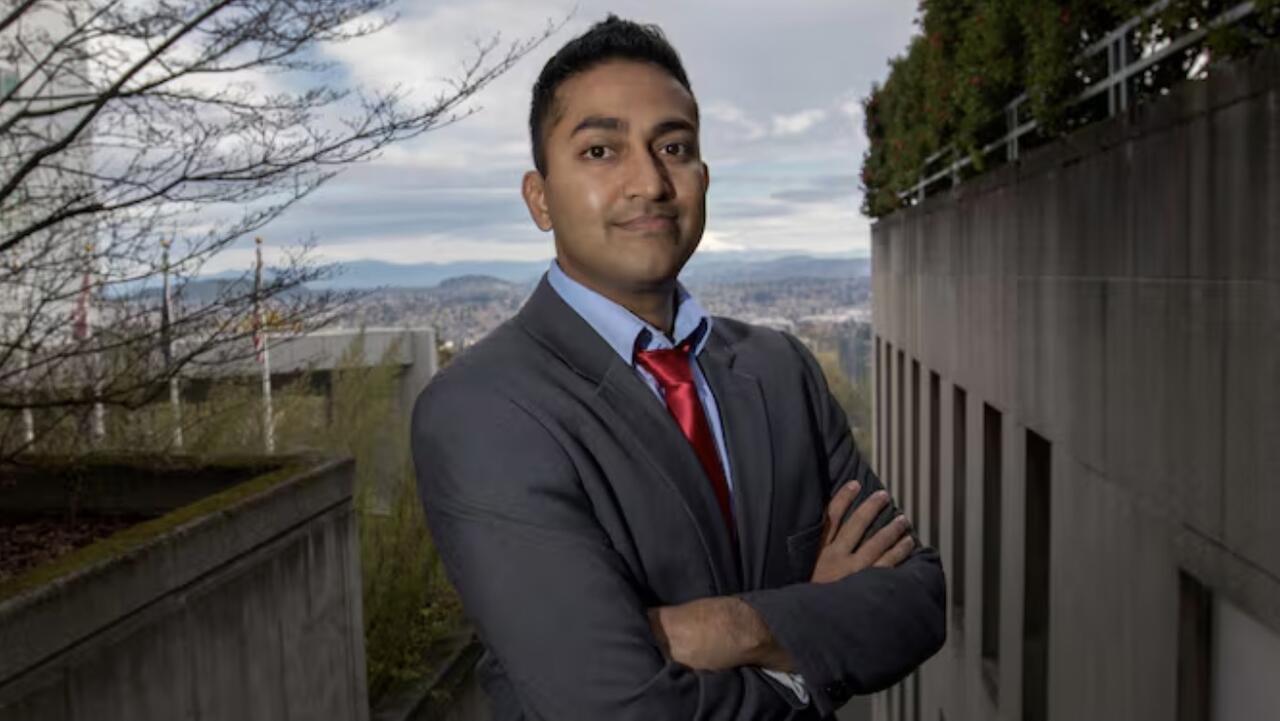
The Food and Drug Administration’s top overseer of vaccine policy on Friday told employees that at least 10 American children died “after and because of receiving” a Covid-19 vaccine. In a 3,000-word memorandum first reported by PBS, Dr. Vinay Prasad, director of the FDA’s vaccine division, also committed to implementing changes to the FDA’s evaluation of vaccine efficacy and safety, and encouraged dissenting employees to find a new job

“This is a profound revelation,” Prasad wrote. “For the first time, the US FDA will acknowledge that COVID-19 vaccines have killed American children.” Prasad said the conclusion about children dying from Covid-19 vaccines was reached after he and other FDA staffers undertook a multi-month, “detailed analysis of deaths voluntarily reported to the [Vaccine Adverse Event Reporting System] system (VAERS).”

That effort focused on 96 deaths that occurred between 2021 and 2024, and said “no fewer” than 10 of them were caused by the vaccines. “If anything, this represents conservative coding, where vaccines are exculpated rather than indicted in cases of ambiguity. The real number is higher.” He added,

“It is horrifying to consider that the US vaccine regulation, including our actions, may have harmed more children than we saved. This requires humility and introspection.” 

A hematologist-oncologist and former Cal-San Francisco professor, Vinay Prasad is the nation’s top vaccine regulator (Kristyna Wentz-Graff / OHSU)

Prasad slammed the coercive nature of policies that insisted on Covid shots for children: 

“Healthy young children who faced tremendously low risk of death were coerced, at the behest of the Biden administration, via school and work mandates, to receive a vaccine that could result in death. In many cases, such mandates were harmful. It is difficult to read cases where kids aged 7 to 16 may be dead as a result of covid vaccines …

FDA has never requested the manufacturers demonstrate in randomized fashion that vaccinating children improves…outcomes. The available randomized data in children is deeply limited, and broadly negative for symptomatic infection, as discussed in prior ad-coms. Furthermore, COVID-19 was never highly lethal for children, and now MIS-c [Multisystem Inflammatory Syndrome in Children] has decreased drastically, and the harms, to kids, are comparable to many respiratory viruses for which we do not provide annual immunization.” 

Prasad — a hematologist-oncologist — was among several outspoken critics of the Covid-19 regime that moved into key public health posts after Trump took office in January. Others include Robert F. Kennedy, Jr as Health and Human Services secretary, Dr. Marty Makary as FDA commissioner and Dr. Jay Bhattacharya as Director of the National Institutes of Health. 

Friday’s memorandum emphasizes that VAERS likely understates vaccine-triggered mortality: 

“When it comes to vaccine deaths, VAERS is passively reported. It requires a motivated person, often a doctor, to submit the information. The submission process is tedious and most people who start the form give up along the way. Many more deaths may be unreported.” 

To minimize future vaccine-driven deaths, Prasad said the FDA “will take swift action regarding this new safety concern” and “will demand pre-market randomized trials assessing clinical endpoints for most new products.” Throughout the Covid-19 pandemic, Prasad repeatedly sounded alarms about public health interventions that were imposed without rigorous efforts to seek evidence of their risks and rewards. This has been a central theme in his body of work; he also authored a book, “Malignant: How Bad Policy and Bad Evidence Harm People with Cancer.” 

Prasad said the FDA will also “revise the annual flu vaccine framework,” which he called “an evidence-based catastrophe of low quality evidence.” He also acknowledged that “[FDA has] not been focused on understanding the benefits and harms of giving multiple vaccines at the same time.” He ended the memo by urging staffers who aren’t comfortable with the new approach to resign:

“I remain open to vigorous discussions and debate on these topics, as I have always been. I am open minded to modifications or alterations…Some staff may not agree with these core principles and operating principles. Please submit your resignation letters to your supervisor and CC my deputy Katherine Szarama…for those who choose to remain…I look forward to working with you.” 

Prasad’s pointed statement about vaccine-caused deaths comes ahead of this week’s meeting of the Centers for Disease Control and Prevention’s vaccine committee. The draft agenda for the meetings on Dec 4 and 5 includes FDA policy on giving hepatitis B vaccines to newborn babies, and the entire children’s immunization schedule. The meetings are open to the public via live webcasts.  

It’s noteworthy that major media outlets that obtained a copy of Prasad’s memorandum have only provided short quotations from it, seemingly seeking to undercut Prasad’s assault on the Covid regime those same outlets unquestioningly supported. You can read the entire 3,000-word memo at The Brownstone Institute, a site originally launched to scrutinize Covid policies. 

Dr. Robert Malone, a Covid vaccine critic with credentials in mRNA technology, hailed Prasad’s memorandum as a historic milestone. “I am stunned, gobsmacked by his letter,” he wrote at Malone News. “The significance and importance of this letter in the context of US and global vaccine policy cannot be overestimated. This is a revolution, the likes of which I never expected to see in my lifetime. The Washington Post called me a liar for stating what is now official FDA policy and truth.” 

Of course, vaccines were just one of many public health policies of the Covid era that may have done far more harm than good. With a Pandora’s box of policy side-effects that include impaired child development, learning loss, a surge in mental breakdowns, soaring juvenile suicide attempts, increased drug and alcohol abuse, increased domestic violence and higher drug overdoses, it’s increasingly clear that, in its coercive, ham-handed approach to Covid-19, public health didn’t err on the side of caution, but rather erred on the side of catastrophe. 

Tyler Durden
Sun, 11/30/2025 – 18:05

via ZeroHedge News https://ift.tt/Nfl7Ea0 Tyler Durden

South Park Roasts Americans Taking Saudi Money In Thanksgiving Special

South Park Roasts Americans Taking Saudi Money In Thanksgiving Special

Via Middle East Eye

The makers of the popular satirical cartoon show South Park turned their sights on Saudi Arabia in their latest episode, attacking American media personalities, politicians and sporting events for taking money from the state. Titled Turkey Trot, the episode starts with Mayor McDaniels convening a meeting with local businesses trying to secure sponsorship for its annual Thanksgiving Turkey Trot race.

Struggling to find funds due to the economic crisis in the US, one character suggests there is someone “who’d be willing to give South Park a bunch of money”, adding “they’re giving money to everyone else”. The scene then cuts to a mock advert for the Turkey Trot, which features mock Arabic singing, shots of Saudi men dancing and a warning that “disparaging remarks towards the Saudi Royal family are strictly prohibited”.

That appears to be a reference to the recent Riyadh Comedy Festival, which Saudi Arabia hosted in September and October, and featured comedians including Kevin Hart and Dave Chappelle amid much criticism.

According to contracts for the event leaked by comedian Atsuko Okatsuka, performers had to abide by a list of conditions, which included agreeing not to disparage Saudi Arabia’s political leadership, religious values and legal system.

As the South Park episode develops, the show’s anti-hero Eric Cartman becomes an advocate for Saudi Arabia, eager to cash in on the Turkey Trot’s $5,000 prize. When his teammate Tolkien Black bows out of the race because “it doesn’t feel right”, Cartman takes on the challenge of changing his mind.

“They’re trying to be progressive, okay,” he argues. “You want them to go back to what they were doing?”

“You want Saudi Arabia to go back to cutting people up and paying Kevin Hart,” says Cartman. “Is that what you want?

“Them wanting to help pay for American things is good. Because, guess what, if Saudi Arabia is out paying for sporting events, they’re not out hacking up reporters and inviting Pete Davidson to come do comedy.” Cartman continues: “They allow women to drive! It’s like practically a lesbian utopia over there.”

Tolkien remains unconvinced despite Cartman’s arguments, which at one point include blaming him if Saudi Arabia resumes “stuffing journalists into suitcases”.

That reference is to the murder of Middle East Eye columnist Jamal Khashoggi by Saudi agents in October 2017. Since Saudi Crown Prince Mohammed bin Salman became the kingdom’s de facto ruler in 2017, Riyadh has diversified its investment interests to include sporting events and popular entertainment.

In entertainment, besides the Riyadh Comedy Festival, the country also hosts the Red Sea Film Festival, which opens next week and which regularly attracts Hollywood’s A list. In sports, the LIV Golf tour attracts some of the best golfers in the world and the Saudi Pro League features football stars including Cristiano Ronaldo, Neymar, Karim Benzema and Sadio Mane.

Performers and athletes are attracted to such events by industry-leading payments despite criticism that they are helping to sanitise Saudi Arabia’s reputation.

Not all big names are taking the criticism lightly and have defended their right to perform in Saudi Arabia. The most significant of these was the comedian Dave Chapelle, who argued that US critics lacked the moral standing to criticize his appearance in Saudi Arabia given the state of free expression in their home country.

“Right now in America, they say that if you talk about Charlie Kirk, that you’ll get cancelled,” Chappelle said during a performance in Saudi Arabia. “It’s easier to talk here than it is in America.”

Egyptian comedian Bassem Youssef argued that the criticisms of comedians appearing in Saudi Arabia made no sense given that the US was also accused of human rights violations and no one had objected to their appearances there.

In a follow-up video, Youssef reiterated his point. “My point was that America is in no position to lecture other countries about morality or human rights violations,” he said.

And in a reference to the Israeli war on Gaza, during which at least 69,000 Palestinians have been killed, he added: “It’s not just because of the funding and enabling of a live streamed genocide for two years. Although that’s a solid start.”

Tyler Durden
Sun, 11/30/2025 – 17:30

via ZeroHedge News https://ift.tt/J8fGgec Tyler Durden

“The Whole Model Is Broken”: ‘Tech Mafia Wife’ Admits ‘We Were Klaus Schwab’s Useful Idiots’

“The Whole Model Is Broken”: ‘Tech Mafia Wife’ Admits ‘We Were Klaus Schwab’s Useful Idiots’

When someone who used to be the queen of elite progressive philanthropy says the entire system failed – and may have been hijacked for something much darker – the world needs to hear it.

As ‘Camus’ writes in a post on X, Nicole Shanahan – ex-wife of Google co-founder Sergey Brin, former running mate of RFK Jr., and someone who personally signed nine-figure philanthropy checks – just went full whistleblower on the entire Silicon Valley “tech wife mafia” and how they were used.

“…the whole model is broken… the whole model makes everybody worse off…” exclaims Shanahan confirming what Desiree Fixler said, that:

“The WEF sold the “Great Reset” as “build back better” — climate action, ESG, inclusion, and PPP.

In practice, it shifted power away from voters to NGOs, corporate elites, and unelected technocrats.

Policy was relabeled “science” to silence debate.

Markets were warped by ESG scores, carbon taxes, and paper-pushing regulation.

Corporations were turned into enforcers of ideology.”

As Shanahan exposes in this shocking insider account, communities weren’t uplifted – wealth and power were pushed upward, and the ‘tech mafia wives’ were simple ‘useful idiots’:

“I don’t think many of the tech mafia wives realize… they were used to set the groundwork for what Klaus Schwab calls The Great Reset.

Their money especially was being conscripted through a network of NGO advisors, Hollywood, Davos, and their own companies.

A really small group of people… completely blind to how their groundwork is being used to enable these Great Reset policies.”

Then she reflects on these ‘tech mafia wives’ orienting their values around these actions but really just being ‘useful idiots’:

“These women find their meaning through philanthropic work. I really believed I was helping Black communities and indigenous communities rise up…”

For Shanahan, she admits:

“My version of success is those communities are actually uplifted. Not just more money pumped into them.”

But now the problems have gotten worse, she admits: 

“Crime worse. Mental health worse. The whole model is broken.

At the end of the day they always go: ‘But climate change…’

Social justice + climate change – it gets progressive women 100% of the time.”

Fixler agrees vehemently:

“We got higher energy bills, debased money, an affordability crisis, fewer jobs, and creeping control over how we live and speak.”

This is the one of the most jaw-dropping few minutes of ‘pulling back the curtain’ you will watch this year…

h/t Camus (@newstart_2024)

Tyler Durden
Sun, 11/30/2025 – 16:55

via ZeroHedge News https://ift.tt/VzGy81j Tyler Durden

Trump Pushes To Reopen California Coast To Offshore Drilling

Trump Pushes To Reopen California Coast To Offshore Drilling

Authored by Felicity Bradstock via OilPrice.com,

  • A draft federal plan proposes six offshore lease sales along the California coast, reversing decades of restrictions introduced after the 1969 Santa Barbara spill.

  • California Governor Gavin Newsom, coastal states, and environmental groups vow legal and political resistance, calling the plan dangerous and “dead on arrival.”

  • The proposal also includes new leasing in the eastern Gulf of Mexico, likely sparking pushback from Florida Republicans and adding to nationwide opposition.

New oil and gas drilling could commence in California if President Donald Trump gets his way, as the U.S. federal government continues to support a “Drill, baby, drill” approach to fossil fuel production. 

In November, the Trump administration plans to allow new oil and gas drilling off the California coast, according to a draft plan shared with the Washington Post. This would be the first time in several decades that new exploration operations were permitted. The document outlines a plan for six offshore lease sales along the California coastline, as well as the expansion of drilling into the eastern Gulf of Mexico, between 2027 and 2030.

It is thought that the Interior Department could announce a formal proposal as early as this week. Any new drilling is expected to be centred around the Santa Barbara County region, where limited drilling is already taking place. 

A major oil spill off the coast of Santa Barbara in 1969 prompted the government to bring an end to new leasing off the Pacific Coast, as well as limit existing drilling operations. Previous governments have continued to restrict drilling in the Californian waters, which extend three miles from the shoreline, due to concerns over beach pollution and the potential negative impact on tourism.

Pete Stauffer, the ocean protection manager of the Surfrider Foundation, stated, “Offshore drilling is highly unpopular across the country and will increase the likelihood of yet another destructive oil spill off our coasts. Surfrider Foundation’s chapter network will fight this proposal vigorously to protect all US coastlines from the unnecessary risks involved with new offshore drilling.”

The plan would also require Trump to approve new oil and gas leasing in the eastern Gulf of Mexico, a body of water that the President renamed the Gulf of America in January. This would likely lead to pushback from Republicans in Florida who have been opposed to new drilling since the Deepwater Horizon rig disaster of 2010. 

Meanwhile, in June, South Carolina governor Henry McMaster wrote a letter to Interior Secretary Doug Burgum in which he stated that South Carolina’s coastline was “one of the most pristine in the country, and offshore drilling is simply not in its best interest.”

Despite efforts by the Trump administration to open nearly all U.S. coastal waters to drilling earlier this year, the Interior Department ultimately decided to introduce a moratorium on drilling off Florida, Georgia and South Carolina through 2032 following pressure from Republicans in the southeast of the country.

The position of oil and gas companies on conducting drilling in California waters is not yet clear, although developing new projects in the state would require a significant investment in supporting infrastructure, compared to other already developed regions of the United States. Analysts do not expect oil and gas companies to have much interest in the area due to the lack of infrastructure, as well as the widespread regional opposition to new drilling.

During this month’s COP30 climate summit in Brazil, California’s Democratic governor, Gavin Newsom, told reporters that any plan to carry out new drilling in the region would be “dead on arrival” in California. Newsom also said that the state would “absolutely” challenge the plan in court once it was finalised. This reflects his historic stance on new drilling. In June, Newsom addressed the Interior Department in a letter stressing California’s “continued opposition” to additional fossil fuel development.

Newsom, a long-time supporter of the U.S. green transition, attended the climate summit in Trump’s absence, after the Trump administration said that no high-level U.S. representatives would go to UN climate talks. During a ministerial meeting, Newsom said, “I’m very mindful that the Trump administration has abandoned any sense of duty, responsibility, or leadership as it relates to the issues that bring us all here together… It’s an abomination. It’s a disgrace.”

In response to news of the anticipated drilling proposal, Newsom said that it was “remarkable” that Trump did not call for drilling near his Florida resort, Mar-a-Lago.

“He didn’t promote it off the coast of Florida,” stated Newsom. “That says everything about Donald Trump.”

In California, Texas-based oil company Sable Offshore has shown interest in reactivating three drilling rigs in federal waters off Santa Barbara that have sat unused since an oil spill in 2015. In May, Sable began producing oil at one of the rigs under an existing lease. However, following the move, California’s attorney general, Rob Bonta, sued Sable Offshore, accusing the firm of illegally discharging waste into local waterways.

Although there has been no formal proposal for drilling in California, reports of plans for new exploration have prompted widespread pushback from state officials. The state governments of California, Florida and South Carolina have all shown opposition to new offshore oil exploration, meaning the federal government can expect a fight to get any new projects off the ground in those regions. 

Tyler Durden
Sun, 11/30/2025 – 16:20

via ZeroHedge News https://ift.tt/YGa6xnk Tyler Durden

Is Ukraine’s Anti-Corruption Investigation Turning Into A Rolling Coup?

Is Ukraine’s Anti-Corruption Investigation Turning Into A Rolling Coup?

Authored by Andrew Korybko via Substack,

Zelensky might be next after Yermak was just taken down unless he complies with Trump’s demands for peace, in which case it’s not unforeseeable that he too could be formally implicated in this scandal as the catalyst for a US-backed regime change carried out in collusion with his domestic allies.

Zelensky’s warmongering grey cardinal Andrey Yermak, who formally serves as his Chief of Staff, submitted his resignation after his apartment was raided as part of the investigation into Ukraine’s $100 million energy graft scandal. Russian Ambassador-at-Large Rodion Miroshnik believes that he was fired, however, to protect Zelensky as the walls close in on him amidst this investigation. Whatever the truth may be, Miroshnik might be onto something, which will be elaborated on throughout this analysis.

It was earlier assessed that “Ukraine’s Corruption Scandal Might Pave The Way For Peace If It Takes Yermak Down” since “his downfall could undo the already shaky alliance between the armed forces, the oligarchs, the secret police, and parliament that keeps Zelensky in power.” Zelensky held off on getting rid of him for that reason, which emboldened Yermak to declare on his behalf that Ukraine won’t cede any territory to Russia, thus spoiling one of the main proposals in the US’ draft peace framework.

Shortly thereafter, Yermak’s apartment was raided with the participation of the two US-funded entities leading this graft investigation, the National Anti-Corruption Bureau of Ukraine (NABU) and the Special Anti-Corruption Prosecutor’s Office (SAPO). Had Zelensky accepted the principles contained in the aforesaid framework, particularly the 26th one about how “all parties involved in this conflict will receive amnesty for their actions during the war”, Yermak might have been able to ride off into the sunset.

Instead, Yermak whispered in Zelensky’s ear to play tough with Trump and reject the US’ draft peace framework, after which the US let the anti-corruption bodies that it funds proceed with their investigation. Trump could have stopped it right then and there before it predictably took Yermak down had Zelensky at the very least publicly agreed to the draft’s concession for ceding Donbass. Yermak’s career and his entire legacy in Ukrainians’ eyes were therefore destroyed by his warmongering.

Next up might come Zelensky’s if he doesn’t comply with Trump’s demands. Without his grey cardinal maintaining the already shaky alliance that keeps him in power, he’s now more politically vulnerable than ever, the obvious realization of which could see some of his allies make power moves against him in the coming future. For instance, US-encouraged defections from the ruling party could lead to him losing control of the Rada, which might be leveraged by the US to remove him if he remains obstinate to peace.

In parallel, the US might threaten the corrupt oligarchs that they’ll be caught in the dragnet too unless they get their parliamentary proxies to go along with the rolling regime change against Zelensky, which could also see the US ordering the secret police to allow opposition protests against Zelensky.

The armed forces’ role would be limited to disobeying Zelensky if he orders them to break up these protests, and as a reward, their beloved Valery Zaluzhny could replace Zelensky on the throne when all is said and done.

Yermak’s resignation/firing set this scenario sequence into motion, but it could be maximally catalyzed by NABU-SAPO formally making it known that Zelensky is under investigation, which the US might authorize it to do (including through a raid) if he doesn’t soon comply with Trump’s demands. In retrospect, Zelensky’s efforts over the summer to subordinate NABU-SAPO were aimed at averting this, but they failed and Trump is now using these anti-corruption bodies to finally coerce him into peace.

Views expressed in this article are opinions of the author and do not necessarily reflect the views of ZeroHedge.

Tyler Durden
Sun, 11/30/2025 – 15:10

via ZeroHedge News https://ift.tt/fZ6Ii0W Tyler Durden

The Santa Rally Recipe: Fed Put In Full Force

The Santa Rally Recipe: Fed Put In Full Force

By Peter Tchir of Academy Securities

The market figured out a holiday recipe that works well:

  • A Healthy Dose of Fed Puts.

  • A Dash of Trade Hopes.

  • A Smidge more Fed Puts because you can never have enough Fed Puts.

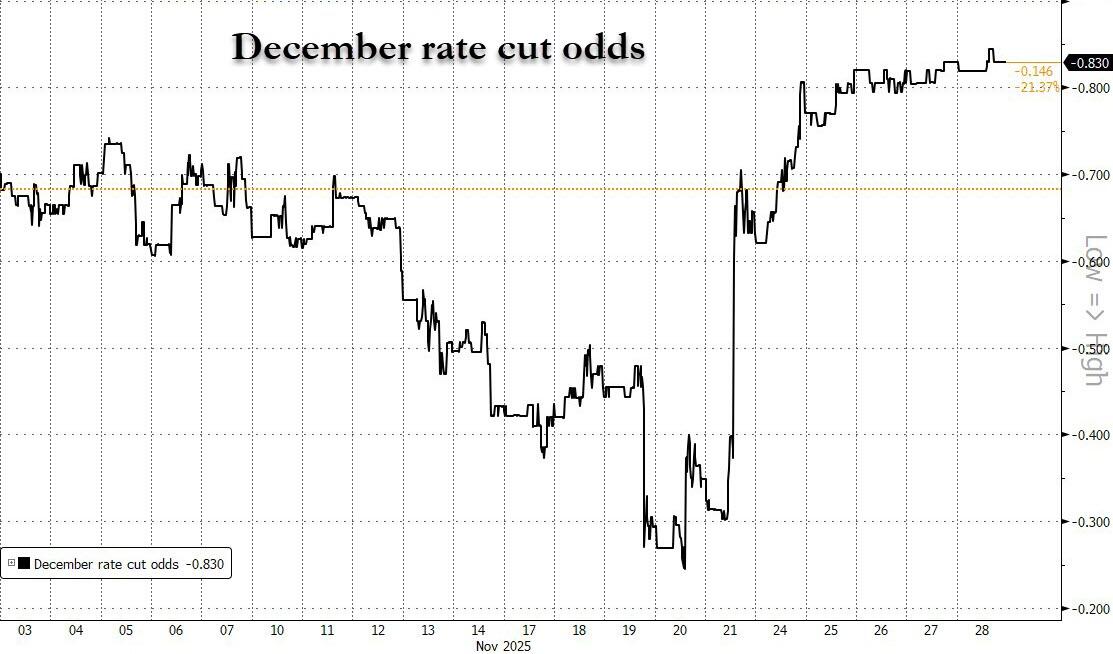
In the past 5 trading days (including Friday November 21st):

  • The Nasdaq 100 is up 5.7% (outpacing the “rotation” trade of the S&P 500 Equal Weight which is up 3% in those same trading days).

  • The probability of a Fed cut at the December meeting spiked to 83% from 35% (well within the range where the Fed would be unlikely to disappoint). 10s rallied as well, though “only” from 4.07% to 4.02%.

  • Bitcoin, which traded below $82,000 on the 21st, has reclaimed the $90k threshold.

  • Credit spreads joined in the party as CDX went from 56 to 51. That was matched by the Bloomberg Corporate Bond OAS, which tightened from 85 to 80.

There were a couple of other “events” during the week that created some interesting movements (at least briefly). First, and possibly most interesting longer-term, was the sudden need to understand a TPU versus a GPU.

We were able to talk about this, the Fed, and risks to the economy in the first segment of last week’s Bloomberg TV interview. The second segment focuses more on geopolitical issues.

Briefly (only briefly) did the TPU vs GPU story seem to help answer the questions posed last weekend: Is the pAIn Over? Are we at the end of “Free” Money?

Any questions on spending and risks to growth were overwhelmed by the Fed Put (and some signs that the administration would let/even encourage chip sales not just to the Middle East, but also to China).

In addition, please see the link to our November ATW that we released this week. We are focused on the U.S. pressure being put on the Maduro regime.

The Fed Put is In Full Force

You may not believe in Santa, or the Santa rally, but the Fed Put might be the strongest it has been in some time.

  • The recognition that the Fed Put is in full effect started last Friday, with Williams coming across more dovish than most supposed.

  • It continued over the weekend as more Fed speakers seemed to shift to the dovish side of the ledger.

  • Then, finally, it was reported that Kevin Hassett would get the nod to be the next Fed chair.

    • The market, correctly, interpreted this as a signal that the Treasury, the Fed, and the admin would work more closely together – helping pave the way for lower yields and easier monetary conditions.

    • There is “chatter” that Hassett will act as a “shadow” chair at the December meeting ensuring a cut.

  • The most material change in the week leading up to this barrage of dovishness wasn’t in the data, but in equity prices.

    • If you could point to some serious change in the data, we could argue that the Fed Put isn’t real, and that they are just “data dependent.” But that wasn’t the case at all. What seemed to drive the rush to get easy money back on track was the performance of equities, and the risk that they were breaking through some serious support levels, causing concern of further downside. Not something that the admin or the Fed wants – especially in an illiquid holiday season.

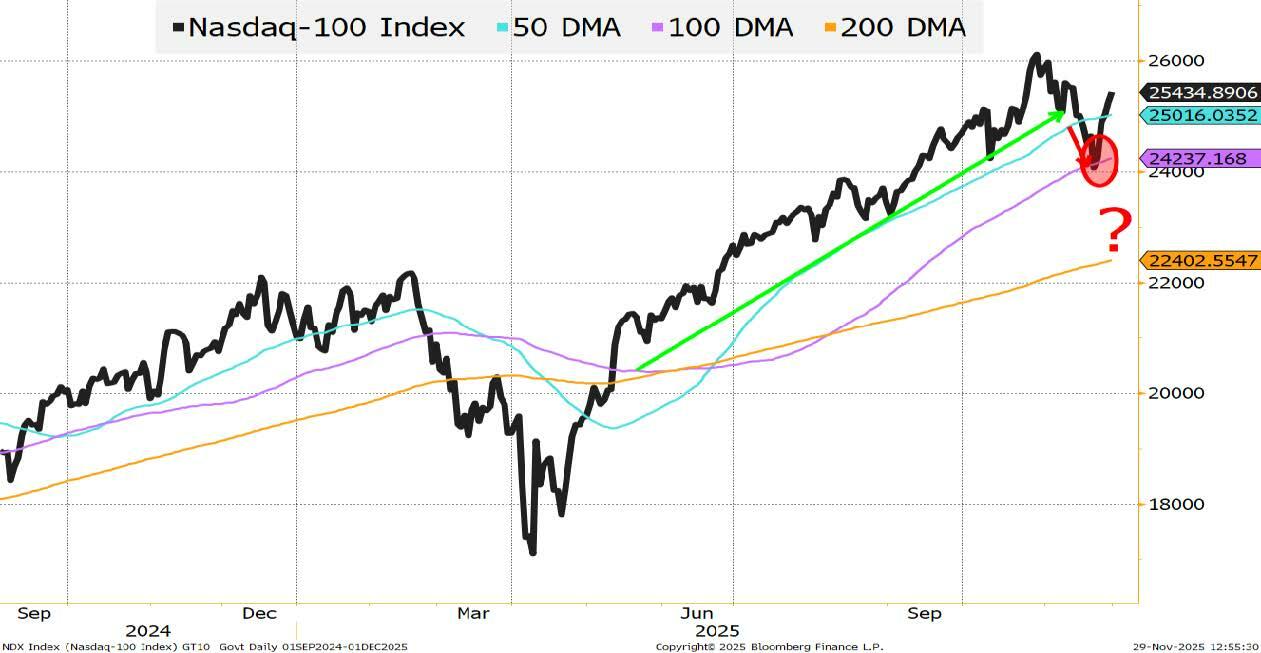
  • The Nasdaq 100 had not broken below its 50-Day Moving Average since the rally that started with the admin retracting the Liberation Day tariffs. It crossed that technical threshold, and almost immediately fell to the 100-Day Moving Average, which it also breached (almost like a hot knife through butter). For many technicians, that put the 200-Day Moving Average in play, which would have been a further 7% decline. It is impossible, at least for me, to look at this chart and think anything other than that the Fed Put is not just alive and well, but it will also flourish under this admin. The admin did go from talking about “Main Street over Wall Street” at the time of the Liberation Day tariffs, to changing track and cheering the stock surge. The admin has continued to point to stocks as a benchmark (not truly unique to this admin, but this admin seems to have a better understanding of markets, and the machinations that can help markets, than prior administrations).

There are a few things that I find surprising about the market reaction (and the Fed hitting the “panic” button):

  • I did believe the market pullback had more to do with concerns about the AI spend, than it did about the Fed not cutting in December (obviously, given the market reaction, that assessment was wrong).

  • We have not wavered in our assessment that we will likely see Fed Funds effective at 2.875% (100 bps lower than today) by next summer. We did not think that whether we get a December cut or not would matter much (yes, it clearly did). The market is “only” pricing in three cuts between now and September 2026 – that seems too few/too slow. More potential for the markets to get surprised to the upside by easy money and looser financial conditions.

  • There is a sense of “irony” or “paradox” or “Catch 22” (or some other word) that fears about the stock market seemed to trigger the shift to the dovish side, and now we will potentially get a cut while stocks may be at all-time highs.

Is the Fed Enough?

I do believe that the risks to spending are greater than the benefits of a 25 bps rate cut, BUT:

  • December, with low liquidity and strong seasonals, tends to support strength.

  • A market that was already set up for a nice end of year rally is likely to reset itself to that mindset (it is an “easy” and comfortable way to finish the year).

  • The government shutdown did end, so with backpay, we could see some boosts to the economy.

  • While questions are mounting about domestic AI spend and valuations, the potential for selling chips to other countries has grown in scale and scope of late.

Chips for Everyone

While the questions surrounding TPUs vs GPUs were interesting, they did little for markets. Just like DeepSeek was quickly brushed off as some “one-off” type of thing, the market continues to see demand for high-end chips as “virtually” insatiable.

While some questions remain about the longer-term risk of selling chips to competitors (like China) or even some countries that we don’t fully align with (parts of the Middle East), we seem to be set to sell those high-quality chips to those countries.

This will:

  • Substantially change the trade balance with many countries. This is one of the administration’s top goals (though I’m not sure how making something in Taiwan and shipping it across the Strait to China exactly works, but it does for now – and makes, at least to me, the imperative to manufacture more and better chips in this country even more obvious – thinking ProSec™).

  • Allow for growth.

  • Highlight the competitive advantage other countries have in electron production. The production of electricity is increasingly recognized as a potential roadblock to the planned growth of AI and Data Centers. Countries like Saudi Arabia are better prepared for this need for electricity than we are (once again, highlighting the need for ProSec™). China too has been growing its electricity production through any and all means possible, including, but not limited to, coal, solar, nuclear, and aggressive development work on fusion.

  • It is clear that the Middle East will want to buy and use the U.S. chips (designed in the U.S. even if not fully produced in the U.S.). It is less clear that China will go down that path aggressively or not. This could be a test to see if China is truly committed to developing their own industry, even at the risk of working with inferior equipment in the near-term, or whether the need is so great, that they will delay the progress of their own chip industry. The latter would be nice and a big win in the trade wars – but I’m not sure how likely it is, or whether or not we will regret the decision down the road.

Bottom Line

We can all sleep more comfortably and enjoy the holidays a little more with the Fed Put on full display. Who needs to see the tree at Rockefeller Center when the Fed Put is obvious every time we glance at our screens.

I think there are issues regarding valuations, spending, and the state of the consumer/economy, but with earnings season behind us, little “new” or useful data, strong seasonality, and a Fed that seems determined to cut, we should be in for a “normal” December – rather than what we seemed to be facing as markets started to trade on November 21st!

What a difference a week can make!

Things could change – the fears expressed recently are real, but it seems we will be given the opportunity to get our portfolio ready for the new year to capture the opportunities that are unfolding as we speak (especially making things domestically that we need for “security”).

Tyler Durden
Sun, 11/30/2025 – 14:00

via ZeroHedge News https://ift.tt/bgZeQCB Tyler Durden

NYT Torches Tim Walz After Somalians Scam Woke Minnesota For $1 Billion ‘On His Watch’

NYT Torches Tim Walz After Somalians Scam Woke Minnesota For $1 Billion ‘On His Watch’

The NY Times has thrown Minnesota governor Tim Walz under the bus over a massive and sprawling fraud scandal that federal prosecutors say siphoned over $1 billion from the state’s social safety net programs – more than the entire state spends annually to run its Department of Corrections.

Minnesota Gov. Tim Walz, Rep. Ilhan Omar (D-MN)

The fraud involved a series of schemes that federal authorities say took root over the past five years, many centered within Minnesota’s Somali diaspora, where individuals established companies that billed state agencies for services that were never performed. Prosecutors say 59 people have been convicted across various cases so far, in three separate plots.

Minnesota’s fraud scandal stood out even in the context of rampant theft during the pandemic, when Americans stole tens of billions through unemployment benefits, business loans and other forms of aid, according to federal auditors. – NYT

Federal prosecutors have emphasized the seriousness of the cases being prosecuted by career federal attorney Joseph H. Thompson – who warned that the scale of fraud threatens public confidence. “No one will support these programs if they continue to be riddled with fraud,” Mr. Thompson said. “We’re losing our way of life in Minnesota in a very real way.

Feeding Programs and Expanding Fraud

The first public indication of a systemic problem emerged in 2022, when attorneys began prosecuting fraud related to pandemic-era child nutrition programs. 

Prosecutors charged that Feeding Our Future, a Minneapolis nonprofit, partnered with dozens of local businesses to claim reimbursements for tens of thousands of nonexistent meals. The funds were allegedly used for luxury spending, including homes, vehicles, and international real-estate investments.

Investigators later determined that the problem extended beyond the food-assistance program. Two additional fraud schemes came to light last year, including inflated reimbursement claims for services to people at risk of homelessness and fraudulent autism-therapy certifications involving children recruited from Somali communities in Minneapolis.

One provider in the autism program, Asha Farhan Hassan, is accused of facilitating $14 million in fraud. Her attorney, Ryan Pacyga, said she entered the field with good intentions but eventually engaged in falsifying invoices and intends to plead guilty. Pacyga added that some defendants believed state agencies were enabling the fraud. “No one was doing anything about the red flags,” he said. “It was like someone was stealing money from the cookie jar and they kept refilling it.”

Political and Cultural Fault Lines

The cases have fueled debate about whether state officials hesitated to intervene due to concerns over accusations of racism or political backlash. A report by Minnesota’s Office of the Legislative Auditor found that threats of discrimination lawsuits influenced regulatory decisions, including early warnings issued by Feeding Our Future that challenging claims from minority-owned businesses would trigger litigation and public accusations.

Kayseh Magan, a former fraud investigator at the Minnesota attorney general’s office, said that pushback contributed to reluctance among Democratic officials. “There is a perception that forcefully tackling this issue might cause political backlash among the Somali community, which is a core voting bloc,” Mr. Magan said.

Amid the prosecutions, allegations even spilled into courtroom misconduct: defendants attempted to bribe a juror with $120,000 and a note asking, “Why, why, why is it always people of color and immigrants prosecuted for the fault of other people?

Mr. Thompson argued that heightened racial sensitivities following the death of George Floyd in 2020 affected oversight and enforcement. “This was a huge part of the problem,” he said. “Allegations of racism can be a reputation or career killer.”

Walz’s Response

Walz (D), now in his second term and seeking a third, acknowledged that pandemic policies prioritized speed and accessibility of assistance. “The programs are set up to move the money to people,” Mr. Walz said. “The programs are set up to improve people’s lives, and in many cases, the criminals find the loopholes.”

And of course since Walz is seeking a third term next year and fraud has become a central theme in the upcoming governor’s race, he’s introduced stricter measures, including:

  • a task force to pursue fraud cases

  • enhanced inter-agency data-sharing

  • new technology — including AI — to detect suspicious billing

Community Impact and Racial Tensions

The fallout has reverberated sharply within Minnesota’s Somali community of roughly 80,000 residents. Many say the scandals have cast suspicion on innocent families and entrepreneurs. Rep. Ilhan Omar, whose district includes Minneapolis, urged Minnesotans not to generalize wrongdoing. “We do not blame the lawlessness of an individual on a whole community,” she said.

Except – as Somali-American professor Ahmed Samatar of Macalester College argues, the scandal demands honest reflection

Dr. Samatar said that Somali refugees who came to the United States after their country’s civil war were raised in a culture in which stealing from the country’s dysfunctional and corrupt government was widespread.

Minnesota, he said, proved susceptible to rampant fraud because it is “so tolerant, so open and so geared toward keeping an eye on the weak.” -NYT

Some Somali social-service providers have criticized the increased scrutiny, with the Minnesota Somali Community Center asserting that heightened enforcement has left legitimate organizations feeling “criminalized and intentionally targeted.”


Tyler Durden
Sun, 11/30/2025 – 13:25

via ZeroHedge News https://ift.tt/TN7ZrVx Tyler Durden

Watch: Chevy Proves Woke Is Dead With New Ad

Watch: Chevy Proves Woke Is Dead With New Ad

Authored by Steve Watson via Modernity.news,

Chevrolet’s new Christmas commercial “Memory Lane” has taken the internet by storm, racking up millions of views and an avalanche of praise for its simple, heartfelt storytelling that celebrates a traditional American family.

There are no lectures, no forced diversity, just a mom and dad driving their 1987 Suburban to a snowy cabin reunion with their grown kids and grandkids.

The three-minute spot shows the empty-nester couple retracing decades of family memories as “Merry Christmas Baby” plays, ending with the whole clan gathered around the tree in a tear-jerking return to the kind of ads that once defined the season before woke corporate activism poisoned the well.

In the ad, the mom’s hand rests on the dash as flashbacks roll of babies in car seats, teenagers bickering, college drop-offs, and now grandchildren piling in.

“This old Suburban’s been with us through it all… from the first kick of a baby’s foot against the seat to the last kick of a teenager out the door,” she reflects.

The final scene – the tailgate down, pie passed around, family silhouetted against the lit cabin – struck a chord with viewers, with one X respondent even stating “Forgot it was a car commercial sitting over here weeping lmao.”

Chevy has quite deliberately pivoted to authentic, emotional storytelling following years of corporate virtue-signaling disasters from other companies. GM’s VP of marketing has said that the spot was built from real customer stories to “honor the moms who hold it all together.”

The ad’s runaway success stands in brutal contrast to the graveyard of brands that went full woke and paid the price.

Jaguar’s disastrous ‘non-binary’ rebrand, complete with alphabet people and zero cars, tanked sales so hard the CEO abruptly “retired” weeks later.

Bud Light’s Dylan Mulvaney partnership still bleeds two years on, with sales down 30% on previous highs.

Even Google caught heat last Christmas for a holiday ad starring a nonbinary influencer that felt more like a lecture than celebration.

Nike and American Eagle also confirmed the Overton window shift with recent ads.

Chevy’s “Memory Lane” zero politics, 100% heart ad is the clearest proof yet that the pendulum has swung. As one viral reply put it: “This is what happens when you make ads for normal people instead of HR departments.”

With Christmas shopping season in full swing, Chevy dealers report Suburban inquiries spiking and the ad already closing in on 20 million views across platforms. In an era where corporate America spent half a decade alienating its core customers, Chevrolet just reminded everyone how powerful it is to simply make something beautiful again.

Your support is crucial in helping us defeat mass censorship. Please consider donating via Locals or check out our unique merch. Follow us on X @ModernityNews.

Tyler Durden
Sun, 11/30/2025 – 12:50

via ZeroHedge News https://ift.tt/zmMDnQV Tyler Durden

McCarthy: “‘We Intended the Strike to Be Lethal’ Is Not a Defense”

Over at NRO, Andrew McCarthy largely agrees with Jack Goldsmith’s conclusion that the the reported attack on survivors of a drug boat strike was unlawful. According to McCarthy, “If this happened as described in the Post report, it was, at best, a war crime under federal law.” He writes further:

even if we stipulate arguendo that the administration has a colorable claim that our forces are in an armed conflict with non-state actors (i.e., suspected members of drug cartels that the administration has dubiously designated as foreign terrorist organizations (FTOs)), the laws of war do not permit the killing of combatants who have been rendered hors de combat (out of the fighting) — including by shipwreck.

To reiterate, I don’t accept that the ship operators are enemy combatants — even if one overlooks that the administration has not proven that they are drug traffickers or members of designated FTOs. There is no armed conflict. They may be criminals (if it is proven that they are importing illegal narcotics), but they are not combatants.

My point, nevertheless, is that even if you buy the untenable claim that they are combatants, it is a war crime to intentionally kill combatants who have been rendered unable to fight. It is not permitted, under the laws and customs of honorable warfare, to order that no quarter be given — to apply lethal force to those who surrender or who are injured, shipwrecked, or otherwise unable to fight.

A key point here is that McCarty is not relying upon UN-affiliated entites nor unincorporated international law for his conclusion. Rather, he is resting his contentions on federal law (including those portions of the laws of war or international law that have been formally ratified by the Senate).

The laws of war, as they are incorporated into federal law, make lethal force unlawful if it is used under certain circumstances. Hence, it cannot be a defense to say, as Hegseth does, that one has killed because one’s objective was “lethal, kinetic strikes.”

And, it is worth noting, that federal law imposes the most severe penalties on war crimes.

McCarthy also highlights the fundamental irrationality of the Administration’s policy, particularly given the constraints of federal law

. . . if an arguable combatant has been rendered hors de combat, targeting him with lethal force cannot be rationalized, as Bradley is said to have done, by theorizing that it was possible, at some future point, that the combatant could get help and be able to contribute once again to enemy operations. . . .

if the Post report is accurate — Hegseth and his commanders changed the protocols after the September 2 attack, “to emphasize rescuing suspected smugglers if they survived strikes.” This is why two survivors in a subsequent strike (on October 16) were captured and then repatriated to their native countries (Colombia and Ecuador).

This was a ludicrous outcome: under prior policy, the boat would have been interdicted, the drugs seized, and the operators transferred to federal court for prosecution and hefty sentences. Under the Trump administration’s policy, if the operators survive our missiles, they get to go back home and rejoin the drug trade. But put that aside. The point is that, if the administration’s intent to apply lethal force were a defense to killing shipwrecked suspected drug traffickers, the policy wouldn’t have been changed. It was changed because Hegseth knows he can’t justify killing boat operators who survive attacks; and he sends them home rather than detaining them as enemy combatants because, similarly, there is no actual armed conflict, so there is no basis to detain them as enemy combatants.

The post McCarthy: "'We Intended the Strike to Be Lethal' Is Not a Defense" appeared first on Reason.com.

from Latest – Reason.com https://ift.tt/0OCec6Y
via IFTTT