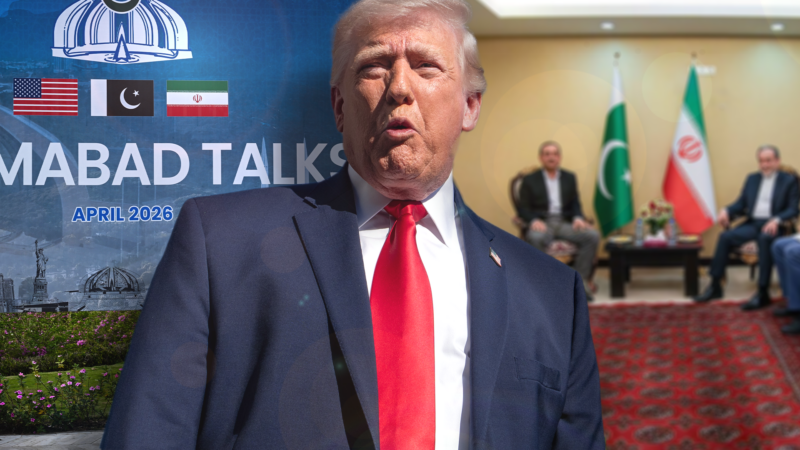
The best sign of a U.S.-Iranian compromise is both sides insisting that they aren’t giving anything up. On Friday morning, U.S. President Donald Trump announced that he had reached a deal with Iran to give up its enriched uranium. “No money will exchange hands,” he claimed, and the “deal is in no way subject to Lebanon, either,” though he also declared that “Israel will not be bombing Lebanon any longer.”
The lady doth protest too much. Axios reports that in Pakistani-brokered talks, the U.S. has offered to unfreeze several billion dollars of Iranian money in foreign banks in exchange for the uranium. And the Israeli press reports that Trump pushed Israel to accept a ceasefire with Lebanon, over the Israeli government’s objections, because Iran threatened to walk out of talks.
Meanwhile, the same morning, Iranian Foreign Minister Abbas Araghchi declared the Strait of Hormuz “completely open for the remaining period of ceasefire, on the coordinated route” announced by Iranian authorities. Iranian officials rushed to downplay Araghchi’s statement, claiming that there is actually “no new agreement” on Hormuz, that ships transiting the strait must continue paying Iran a toll, and that Iran was reserving the right to retaliate for the U.S. blockade. The lady, again, doth protest too much.
Trump also claimed that the U.S. blockade of Iranian ports would “REMAIN IN FULL FORCE” until a final peace deal was reached, which “SHOULD GO VERY QUICKLY.” While the U.S. military says that it has turned around 19 ships, shipping data show that several Iranian-linked ships have crossed the U.S.-declared blockade line over the past few days.
Of course, nothing is over until it’s over. U.S.-Iranian talks have broken down into war twice already. And the Trump administration has used optimistic statements—which later failed to pan out—to pump markets several times. The real test is whether momentum will continue once the U.S.-Iranian ceasefire officially expires next week. An Iranian source told Al Jazeera on Friday afternoon that “we are still at the beginning of the process, not at the level of a finalized agreement.”
Ironically, the deal on offer is similar to past deals that Trump bashed Democratic presidents for making. Rather than a total ban on the Iranian nuclear industry, the U.S. and Iran are discussing a temporary freeze on uranium enrichment, with the duration subject to haggling, according to Axios. Back in 2018, the Trump administration had promised to get a nuclear deal with Iran that “never expires.”
And Iran would reportedly receive economic relief in exchange. Trump is technically correct that “no money will exchange hands” in the proposed deal, because Iran will get to access its own money, which had been paid out by oil customers into foreign bank accounts that were later frozen by the U.S. Treasury. But when former presidents Barack Obama and Joe Biden similarly unfroze Iranian money, Trump accused them of giving “American taxpayer dollars” to Iran.
Limits on Iran’s missile arsenal, which were a major demand of the Trump administration and Republican hawks before the war, seem to have been dropped from the negotiations. Instead, the administration is insisting that it has “functionally destroyed” Iran’s missile force. U.S. military officials disagree.
“Iran retains thousands of missiles and one-way attack UAVs that can threaten U.S. and partner forces throughout the region, despite degradations to its capabilities from both attrition and expenditure,” Defense Intelligence Agency Director Lt. Gen. James Adams testified to Congress on Thursday.
Of course, Iran has taken serious damage from the war. Iranian authorities estimate war reconstruction costs at $270 billion, and it will be unable to recover without U.S. sanctions being lifted, which is a major U.S. point of leverage. Moving forward, Israel has won direct U.S. support against Iran and Hezbollah, the pro-Iran militia in Lebanon.
But thousands of innocent people have been killed and millions of people around the world have been pushed into poverty to get to this point, not to mention the potential $1 trillion cost to American taxpayers. And Trump had originally planned for this war to be a three-day operation to overthrow the Iranian government once and for all. If the end result is a deal that was already on the table—or a return to war—then was it all worth it?
The post Trump's Iran Deal Looks a Lot Like the Previous Ones He Hated appeared first on Reason.com.
from Latest – Reason.com https://ift.tt/IvyXepS
via IFTTT