Gold Vs An Erupting Financial Volcano
Authored by Matthew Piepenburg via VonGreyerz.gold,
Below, we look soberly at the historical case of gold in the backdrop of current headlines and a global financial system nearing an eruption moment.
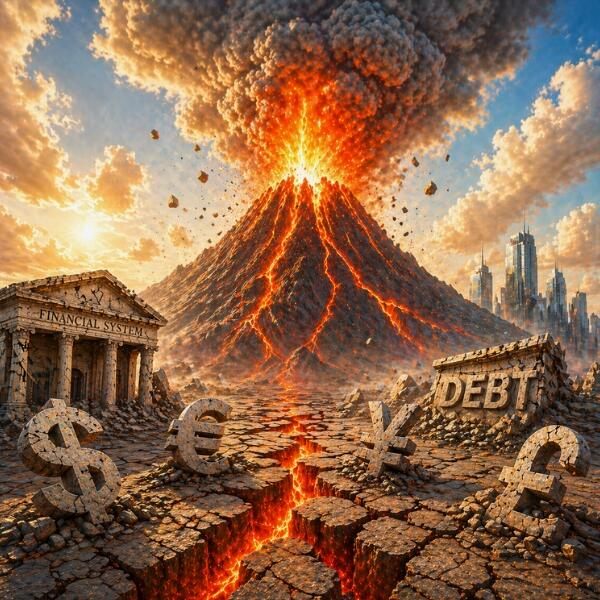
Although the catalysts of oil, war, bond dysfunction, and bloated stocks may seem modern and unique, the current case for gold is as timeless and constant as nature itself.
Volcanic Parallels…
In May of 1980, David Alexander Johnston, a volcanologist for the United States Geological Survey, was manning an observation post 10 kilometers from the percolating volcano of Mount St. Helens in the state of Washington.
On May 18th, he would be the first to report the volcano’s sudden eruption.
Within in minutes, however, Johnston would be killed by the volcano’s “lateral blasts.” his body was never recovered, and 56 others would also perish—along with 7,000 big game animals, 12 million fish, 200 homes, 300 kilometers of highway and 15 kilometers of railway.
Although monitoring volcanos may seem entirely removed from monitoring economic shocks, there are volcanic rumblings beneath our global oil, credit, equity and currency markets which are about to erupt.
Like Johnston, few realize just how quickly observation can suddenly turn to extreme danger.
In fact, the current “calm before the financial eruption” feels almost surreal when one compares the hard facts of the global oil, bond and Main Street indicators against a topping stock market and a completely indecipherable “conflict narrative” coming out of DC.
To make this “eruption announcement” economically clear and soberly real as opposed to just sensational, all we need is a moment of silence to consider simple math, the rhyming cadence of history and a modicum of realism (and common sense).
Let’s start with oil.
Oil’s Warning Meters
History reminds us that the last great “oil shocks” of 1973 and 1990 had massive ripple effects on U.S. markets and Main Street economies.
What is coming, however, will be far worse.
During the oil embargo period of 1973, for example, the world experienced a 7% deficit of oil supply. This resulted in a 300% oil price surge, a 52% fall in U.S. stocks (over 2 years) and a peak inflation level of over 12%.
Seventeen years later, during the Gulf War, the world saw a similar global oil deficit (7%), a 75% spike in oil prices and a 21% fall in U.S. stocks.
Fast forward to today, however, and we see an almost surreal moment of total disregard for such warnings as well as blindness to the financial volcano growling on the horizon.
Since the last oil tanker squeezed past the Strait of Hormuz in late February, global oil usage of 100 million barrels per day has fallen by 13%, as 13 million barrels per day have been delayed by the fog of war.
This marks a global oil deficit in 2026 of nearly twice the levels seen in 1973 and 1990, yet the U.S. stock market (always the last to get the memo) is trading at nearly all-time highs as of this writing.
This Is Crazy…
Globally, oil reserves are running out, including within the U.S., whose Strategic Petroleum Reserves are at half their 400M barrel level.
The situation is far worse in Asia, India and Africa, whose last oil deliveries from the Hormuz Strait ended days ago.
This explains why hotels are closed in Mumbai, and fishing trawlers are out of gas off the coast of Thailand.
As for Australia, the EU and the UK, their last deliveries out of Hormuz came on April 10th.
Now their leaders are nervously trying to limit demand while hoping for a true and lasting cease-fire for an Iranian conflict driven by a Truth-Social account rather than professional diplomacy or even a rudimentary understanding of global finance.
Even if this conflict ended right now, the delayed economic effects from these record-breaking energy deficits are and will be extraordinary.
This is not a fable but a fact.
Oil, which fuels the world, also transports the goods which feed and move the world.
When oil prices rise, the cost of everything rises, including the food transported on ships running on oil, and which food is grown from fertilizers made from oil.
Within the next few weeks, we could be looking at a humanitarian food crisis in the developing economies.
Meanwhile, in the U.S., the University of Michigan’s Consumer Confidence Index is near the bottom as the S&P nears its peak—marking a total (and tragi-comical) disconnect from Main Street indicators and Wall Street mania, the likes of which we’ve never seen before.
Also never seen before in history is the surreal disconnect between the paper (Brent futures) price for oil and the actual sales (“dated Brent”) price for the commodity in real time – a gap of over $35 dollars.
This delta between real oil pricing and paper oil pricing represents a pathetic attempt by policy makers to psychologically suppress panic via the help of well – pure dishonesty.
But then again, dishonesty as a matter of policy is nothing new to broken financial regimes, a fact proven by inflation misreporting, recession denial or the latest frauds legalized on the COMEX.
(By the way, those governmental proxies front-running the fake futures oil price gambit are looking down the barrel of one heck of a short-squeeze unless this war – and spiking oil price – is not immediately resolved…)
In sum, what we are experiencing as of now is the worst oil supply deficit in history, about to humiliate a U.S. stock bubble at all-time highs, which is totally disconnected from Main Street at the same time a fertilizer/food crisis is about to erupt in the world’s most vulnerable economies.
And Then There’s the Bond Market…
But even such appalling conditions pale in comparison to what our global bond markets are telling us.
As I’ve repeated for years: “The bond market is the thing.”
Boring? Perhaps. But bonds are absolutely critical. As sovereign bond demand tanks and hence bond yields rise, the cost of debt/borrowing rises.
This is fatal to economies that now operate almost entirely on debt.
And there is no better measure of debt costs than the yield on 10-Year sovereign bonds, almost all of which are rising like shark fins around drowning (and debt-soaked) nations like the UK, Germany, the U.S. and Japan.
But what is even more remarkable in the global bond market is what we are seeing out of China, whose yields are falling, not rising.
This means Chinese bonds have more demand than U.S. Treasuries, British Gilts, Japanese JGB’s and German Bunds, which also means the days of Western bond hegemony in general, and U.S. Treasury hegemony in particular, are witnessing an historical turning point, one which we have been forewarning for years.
In the case of the U.S., the yield on the U.S. 10Y is creeping dangerously close toward its “Uh-Oh” recession-inducing red line of 4.6% to 4.8%.
At $40T in U.S. public debt, Uncle Sam simply cannot survive such rising yields.
Regardless of who sits at the Federal Reserve Bank (which is neither “federal,” nor a “reserve” nor even a “bank”), trillions will need to be printed to buy America’s otherwise unloved, unwanted and weaponized IOUs.
Bessent may try a “soft default” of UST’s by illegally (yet in the name of “national security”) fixing yields lower and extending bond durations further out.
But even such desperate measures will not stop the inevitable “mouse-clicking” of trillions in M0 Fed Balance Sheet dollars and M2 money supply expansion to save our bond markets at the expense of our currency.
In short, Uncle Sam will have no choice but to create bad money out of thin air to pay his own criminally negligent bar tab.
Even if peace were somehow declared today in the Middle East, the debt and currency damage was already fatally ill long before the conflict in Iran acted to accelerate the dying process.
Which brings us, of course, to real money vs. fake money…
All Roads Lead to Gold
The now undeniable destruction of the dollar’s absolute purchasing power and the desperate yet failed measures to somehow reclaim dollar hegemony are beyond debate.
The USA and its dollar will not end, but their hegemony is already (and will continue) declining. Regardless of whatever happens next in Iran or elsewhere, the die for U.S. debt, and hence the USD, was cast long ago.
Yes, there is so much change everywhere and every day, especially now. We all see this.
But such blunt-speak is not anti-American. It is financial realism and simple pattern recognition, for despite all speculations, squawking pundits, changing headlines, tweets, and armchair military guessing, nothing has really changed at all…
History reminds us again and again that broken nations over their skis in failed and extended wars, extreme deficit spending and political mismanagement have always debased their currencies to temporarily save their political optics and near-term legacies.
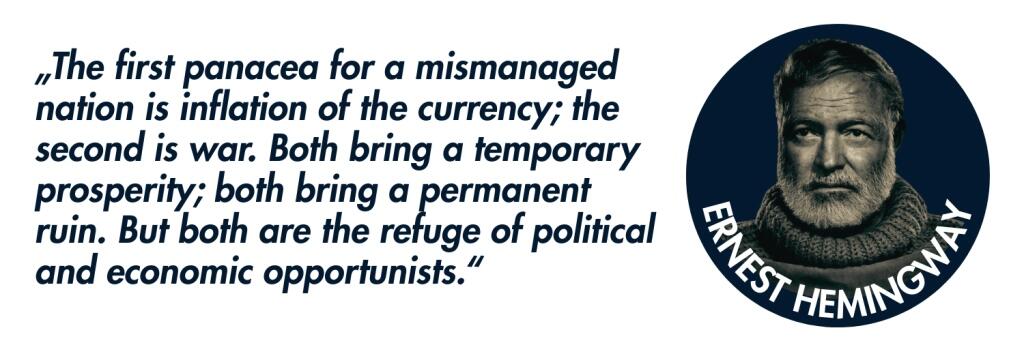
This has always meant “temporary prosperity followed by permanent ruin” created by a handful of “political and economic opportunists,” who, as Hemingway warned, take their nations toward currency destruction and war – the very scenario in which we now openly find ourselves.
As the world reserve currency slowly loses its trust, faith, credibility and purchasing power in such a classic yet historically familiar backdrop, gold, as it has done for thousands of years, will continue to honestly rise in a setting of now almost comical dishonesty.
Like David Johnston, many of us have been watching the financial debt volcano rumble in the distance.
As of 2026, that volcano is now erupting. It is now up to each of us to avoid being swept away by its “lateral blasts” of paper currency destruction.
In other words, it’s up to each of us to own honest and real money to protect ourselves from the financial lava flowing our way.
Tyler Durden
Tue, 04/21/2026 – 15:00
via ZeroHedge News https://ift.tt/d4J9yHQ Tyler Durden