As Pump Prices Hit Iran War Highs, Duffy Claims They’ll Fall Immediately After Hormuz Reopens
As pump prices for gasoline (and diesel) hit Iran War highs, U.S. Transportation Secretary Sean Duffy said on Sunday that gasoline prices should begin to decline “immediately” once shipping resumes through the Strait of Hormuz, pushing back against analyst warnings that relief for consumers could take months.

Duffy, speaking on ABC’s “This Week” program on May 3, acknowledged that prices may take time to return to pre-war levels but said reopening the critical oil transit chokepoint would quickly ease pressure at the pump.
“Once the Strait opens, you’ll see prices come down, come down immediately,” Duffy said.
“There’s going to be a tail to that … but you’re going to see, I think, immediate relief.”
As Tom Ozimek reports for The Epoch Times, prior to Duffy’s remarks, several analysts featured on the program said they expect fuel prices to climb further and predicted that a sustained decline could take months.
The transport chief’s comments come as U.S. fuel prices have risen to their highest levels in roughly four years, driven by disruptions linked to the Iran conflict and constrained flows through the Strait of Hormuz, a key maritime transit route that typically carries about one-quarter of global oil shipments.
Duffy’s remarks build on recent statements by President Donald Trump, who said on April 30 that gas prices would “drop like a rock” once the Iran war ends.
It comes as the Trump administration has launched “Project Freedom,” a military-backed effort to ease disruptions in the Strait of Hormuz.
U.S. Central Command said on May 4 that about 15,000 U.S. personnel, along with guided-missile destroyers, aircraft, and unmanned systems, would support merchant vessels “seeking to freely transit” the strait.
Iran’s military responded to the initiative by threatening to target U.S. forces entering the waterway.
Prices Climb as Disruptions Persist
Oil prices rose again on Monday, with Brent crude climbing above $111 per barrel and U.S. West Texas Intermediate topping $105 in morning trading, after Iran claimed it had forced a U.S. warship to turn back from the strait—an assertion denied by U.S. Central Command.
The market reaction fed into ongoing supply uncertainty driven by the ongoing Middle East conflict. UBS analyst Giovanni Staunovo said the “path for prices remains skewed to the upside” as long as flows through the Strait of Hormuz remain restricted.
At the pump, the national average gasoline price has climbed to around $4.45 per gallon, up more than $1.50 since the conflict began, according to American Automobile Association data. Analysts say further increases are likely.
GasBuddy’s head of petroleum analysis, Patrick De Haan, said on May 4 that crude had jumped around $5 per barrel, with spot gasoline values pointing to another 10-cent rise.
He predicted the national average could soon reach $4.55 per gallon or higher, with uneven regional impacts.
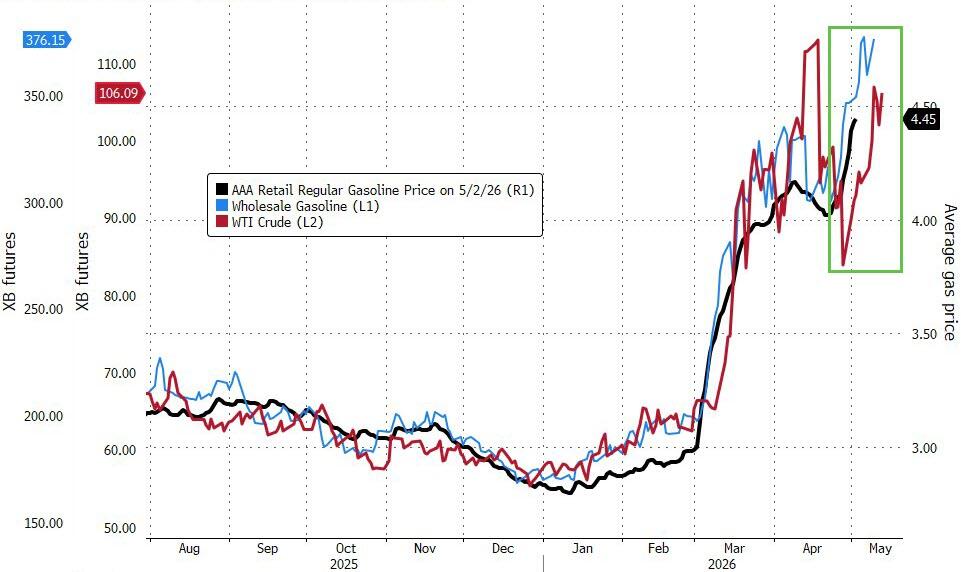
Prices are “all over the place,” De Haan added in a separate post, noting that while $3.99 per gallon remains the most common price, levels near $4.39 and $4.99 are close behind.
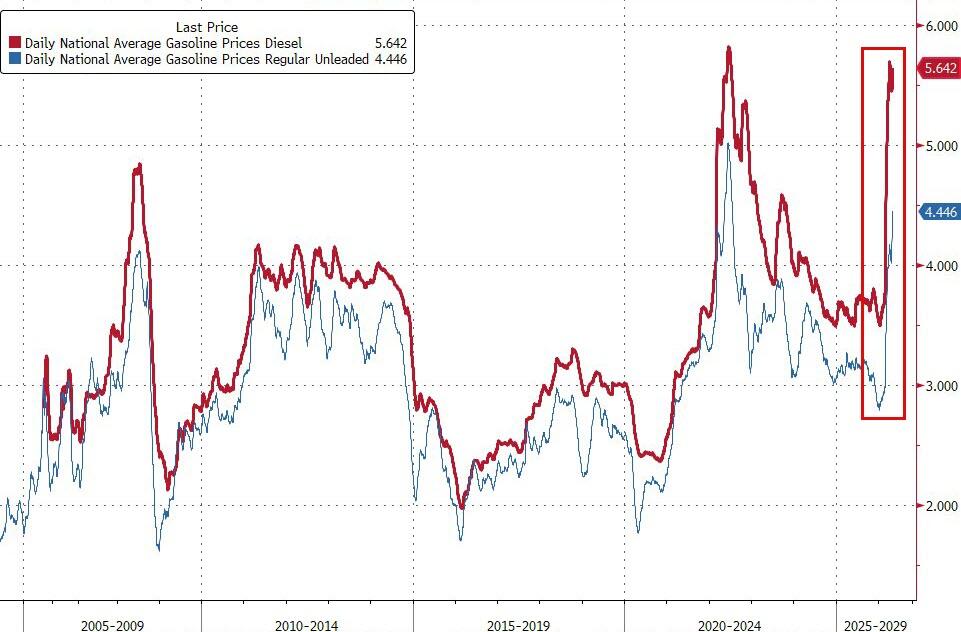
Diesel costs—a key driver of freight and food prices—have climbed even faster, with averages above $6 per gallon in eight states, including California, Washington, and Illinois, according to GasBuddy data.
Trump’s ‘Project Freedom’ Plan
Details of “Project Freedom” remain unclear, with some analysts suggesting the initiative may struggle to deliver the kind of rapid supply normalization that would significantly ease fuel prices.
While U.S. Central Command has said U.S. forces will support merchant vessels transiting the Strait of Hormuz, officials have not clarified whether consistent naval escorts will be provided.
Analysts at ING said the initial oil price dip following Trump’s announcement of the initiative quickly faded as traders reassessed the plan’s likely impact.
“The announcement saw a brief sell-off in oil prices, but the market has since pared these losses,” ING said in a May 4 note. “The market does not seem convinced by the plan. … Even if this allows vessels to leave the Persian Gulf, we’re likely to see little inbound traffic. This would only amount to temporary relief.”
At the same time, risks in the region remain elevated. Iranian officials have warned that foreign military forces entering the strait would face retaliation, and Iran’s military has imposed a new maritime control zone in the Strait of Hormuz, further complicating efforts to normalize shipping, according to Iran’s state-affiliated media outlet Tasnim.
In an update on May 4, U.S. Central Command said U.S. Navy guided-missile destroyers had transited the Strait of Hormuz and were operating in the Arabian Gulf, adding that two U.S.-flagged merchant vessels had safely passed through the chokepoint.
Tyler Durden
Mon, 05/04/2026 – 16:45
via ZeroHedge News https://ift.tt/rajgZYD Tyler Durden