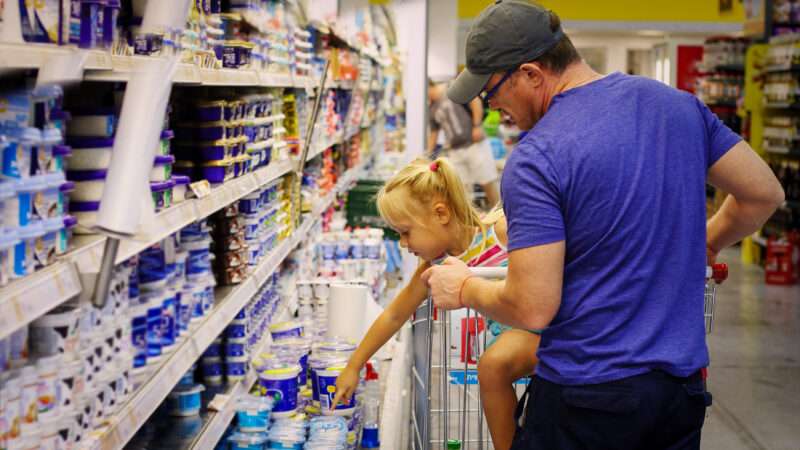
Affordability has become the latest go-to buzzword for politicians across the ideological spectrum. Food has received special focus, with everyone from New York Mayor Zohran Mamdani to President Donald Trump pledging to make mealtime cheap again. But despite all the rhetoric, both parties continue to push policies that spike the cost of groceries and meals.
Earlier this year, the U.S. Supreme Court struck down a portion of the Trump administration’s tariffs, but the decision did not affect Section 232 tariffs on steel and aluminum. These metals still face a 50 percent tariff rate.
The impact can be felt in grocery store aisles across the country.
The steel tariffs affect what’s known as “tinplate steel,” which is the rolled steel used in the cans of many types of food, such as tomatoes, fruits and vegetables, and soups. The Consumer Brands Association warned that the tariffs could elevate the cost of canned foods by up to 15 percent. Only about 30 percent of the demand for tinplate can be met domestically, which leaves canned food packagers with little choice but to absorb the higher costs—before passing them along to consumers—or to cut costs elsewhere through downsizing.
Earlier this year, Del Monte Foods—the popular purveyor of canned fruits and vegetables—announced plans to shut down its long-operating plant in Modesto, California. The plant’s closure led to the loss of around 600 full-time and 900 seasonal jobs. While the steel tariffs weren’t the only factor in the plant’s closing, they appear to have been a contributing cause, as they also were in Del Monte’s decision to declare bankruptcy in July of last year.
Yet the political left has also pursued self-defeating policies when it comes to food affordability. For one, the Biden administration advanced its own plans to increase tariffs on tinplate steel in 2024, only to be rejected by the International Trade Commission (ITC). (Unlike the Biden-era version, the Trump tinplate tariffs were enacted under Sec. 232, where ITC sign-off is not needed).
At the state and local level, left-leaning politicians continue to push a host of policies that raise the cost of food. In New York City, Mamdani continues to champion and vigorously enforce the city’s minimum wage on food delivery, which rose to $22.13 on April 1. While the law initially only applied to app-based restaurant delivery, it was recently expanded to encompass grocery delivery as well.
In early 2024, consumers paid a 58 percent increase in fees to delivery apps when compared to the same quarter a year prior—before the Department of Consumer and Worker Protection began enforcing the minimum pay rate—according to a report from the New York City government. In response to the wage’s extension to grocery delivery, Instacart instituted a $5.99 “regulatory response fee” to help offset the increased labor costs. Seattle, which enacted its own minimum wage for food delivery, has seen similar cost spikes.
In the last few years, progressive cities like Washington, D.C., and Chicago have also repealed what’s known as the tipped-wage credit, which is what allows restaurants to pay workers below the minimum wage as long as their tips make up the difference. Unsurprisingly, once the government mandated these workers receive the traditional minimum wage, food prices promptly went up and restaurants started adding additional “service fees” onto customer tabs. Deep-blue states such as Illinois, New York, and Connecticut have considered bills to repeal the tip credit in recent years, too.
The left has also continued to push menu labeling mandates—requiring restaurants to flag which of their items are high-sodium or high-sugar—which impose additional costs on food joints. Beyond raising food prices, these policies don’t even succeed on their own terms. D.C. restaurant workers saw compensation levels fall after the tipped-wage repeal, while there continues to be little evidence that menu labeling requirements lead consumers to make healthier eating choices.
But while each side has its own unique food-based follies, the effort to raise food costs is often a thoroughly bipartisan and cooperative affair. The infamous Renewable Fuel Standard (RFS) from the Environmental Protection Agency (EPA)—which requires plant-based biofuels to be added into our gasoline supply—is also a consistent cost-raiser for food.
By creating increased artificial demand for corn and soybeans, the mandate increases the costs of these crops. The International Council on Clean Transportation has estimated that the RFS has led to a 12 percent cost increase for corn. Given that corn and soybeans are feeding staples for livestock such as cows, pigs, and chickens, the impact of this unseen tax on our food supply is far-reaching.
In that vein, the EPA found the RFS could raise topline food expenditures by up to $6.8 billion in 2023. Despite this, support for the mandate remains strongly bipartisan, with growing calls to permanently increase the percentage mix of plant-based biofuels added to gasoline.
With policies like these, there appears to be little relief in sight. According to the Department of Agriculture, food prices are forecasted to increase by 3.6 percent in 2026, with both food-away-from-home and food-at-home prices scheduled to rise by more than their 20-year historical average rate.
Preaching about high food costs makes for good political theater. But so far, affordability does not appear to be on the menu.
The post The Bipartisan War on Cheap Food appeared first on Reason.com.
from Latest – Reason.com https://ift.tt/1T8ZcK6
via IFTTT