Banks are scouring porn platforms in order to flag objectionable words and scenes. Payment processors are deciding what constitutes misinformation about war. And a credit union could decide whether your donation to a cannabis advocacy group can go through.
We’re now deep into the era of suppressing speech through financial institutions.
Rainey Reitman got an early introduction to this phenomenon while working to help free whistleblower Chelsea Manning. The campaign she was working on was run through a group called Courage to Resist. Back in 2011, its PayPal account was suddenly frozen and neither Reitman nor the group’s leader could get a clear answer on why, just some vague nods to the PATRIOT Act. Haggling with PayPal representatives didn’t help—but getting media attention for their plight did.
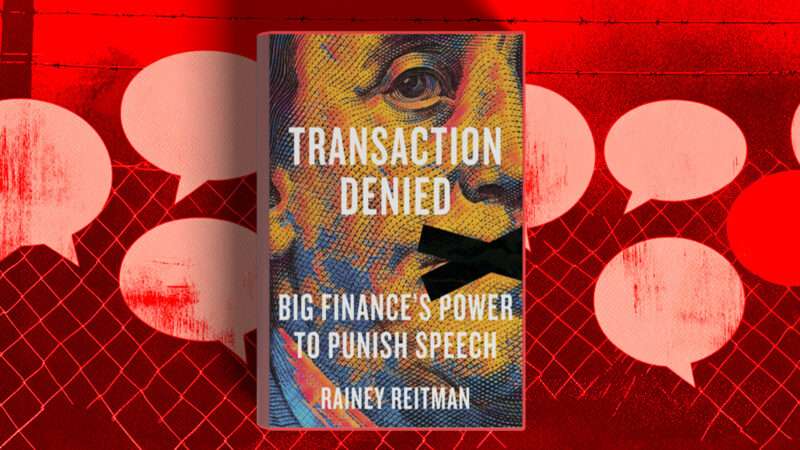
“When PayPal reversed their decision so quickly in response to the publicity surrounding our press release, it was clear to me….We really had done nothing wrong,” Reitman writes in Transaction Denied: Big Finance’s Power to Punish Speech. “If there had been any legal requirement for PayPal to suspend our account, they wouldn’t have changed their mind just because people were tweeting at them.”
Thus began Reitman’s interest in what she calls “financial censorship.” It’s a concept her book describes as financial service providers—banks, payment processors, credit card companies—limiting or closing the accounts of “controversial or marginalized speakers who haven’t violated any laws,” thereby becoming “a tool to pressure dissenting and marginalized voices ” into shutting up.
What Is Financial Censorship?
“It is a form of privatized censorship where banks and payment intermediaries act as censors in ways the government couldn’t do directly without violating the First Amendment,” writes Reitman, a longtime civil liberties advocate and a co-founder of the Freedom of the Press Foundation.
And, no, Reitman does not want to quibble over whether the term censorship can apply to the actions of private entities instead of only describing government actions. “I think that’s a pedantic and unhelpful distinction,” she writes.
Transaction Denied details myriad ways in which financial censorship—also called “financial exclusion” or “debanking”—has played out over the past 15 years. It tells the stories of protesters, journalists, gun rights advocates, adult content creators, Muslim entrepreneurs, cannabis activists, erotica writers, religious freedom fighters, naked yogis, and others who have been affected.
Of course, private institutions like banks aren’t required to do business with any particular person or group, so long as they’re not rejecting their business based on a protected category (like race, religion, or sex). There’s nothing legally amiss about a financial company canceling someone’s account based on bad vibes, moral objections, incompatible moon signs, or any other reason, so long as that reason doesn’t implicate antidiscrimination law.
Reitman recognizes this, though she also floats the idea of shaking things up. “People today cannot survive on wads of cash stuffed under a mattress; they need access to payment and banking services to exist in society,” writes Reitman. She would like to “change the law to make it illegal for financial institutions to deny services or end services for people because they are exercising their rights under the First Amendment,” to see more enforcement of antidiscrimination laws against banks, and to require more transparency and appeals processes around account closures.
But one needn’t endorse all or any of those proposals to find financial censorship concerning—and to see how it’s more tied to traditional censorship than it may first appear.
Government ‘Censorship by Proxy’
Closing people’s accounts over for spurious or speech-related reasons isn’t a pure “whim” of financial companies, notes Reitman. It’s often “censorship by proxy,” in which private companies are taking action in direct response to government pressure of some sort.
Sometimes this pressure is direct and targeted, as in cases involving the National Rifle Association (NRA), Backpage, and WikiLeaks.
In Illinois, a sheriff named Tom Dart sent a letter to credit card companies requesting that they “cease and desist from allowing your credit cards to be used to place ads” on the classified-ad platform Backpage, which was a popular platform for sex work ads. New York financial authorities, under the direction of then-Gov. Andrew Cuomo, sent a letter to financial institutions suggesting that failing to blacklist the NRA could be a “reputational risk” that they should “take prompt action” to manage. (Carrying reputational risk can invite greater regulatory scrutiny.) And in the wake of the website WikiLeaks publishing leaked U.S. State Department cables, Connecticut Sen. Joe Lieberman publicly (and falsely) accused it of criminal action and implied that companies that didn’t sever ties with WikiLeaks might be assisting in illegal acts.
Sometimes the pressure is more circuitous. It might involve guidance to banks about whole industries to scrutinize carefully, as in Operation Choke Point. It might involve ratings by financial regulators—entities like the Office of the Comptroller of the Currency and the Federal Deposit Insurance Corporation—that take into account “reputational risk,” a vague measure of whether an institution has high-caliber clients. (Banks want a high rating to help “reduce unnecessary scrutiny from regulators” and are thus “incentivized to adopt reputation management systems,” Reitman explains.) It might involve stern calls for digital intermediaries to help crack down on “fake news” or face unspecified consequences.
“Often in cases of financial censorship, there’s a whiff of government involvement but it’s hard to prove,” notes Reitman.
Sometimes the pressure comes in the form of ill-conceived regulations and security measures. For instance, the “know your customer” obligations—”legal requirements financial institutions have to verify the identities of their customers” as part of anti–money laundering and anti-terrorism regulations—that “are threaded into different parts of US banking law, particularly the inaccurately named Bank Secrecy Act, and were expanded under the USA PATRIOT Act,” writes Reitman. Supposedly about thwarting illegal activity, “they are inextricably intertwined with restrictions placed on entirely legal accounts for customers who haven’t done anything wrong.”
Or take targeted economic sanctions, levied against particular foreign industries, individuals, and entities. Banks are expected to help enforce these sanctions—and don’t have to intentionally violate them to be in trouble. They’re “extremely incentivized to develop sledgehammer-sized sanctions enforcement programs because even the smallest slipup can bring a barrage of regulatory scrutiny and extreme fines,” explains Reitman. “For many financial institutions, it is easier to just close accounts and block transactions.”
This is how New York City Councilwoman Shahana Hanif found a $14 Venmo payment to a friend blocked. She was paying the friend back for lunch at a Bronx Bangladeshi restaurant called Al Aqsa and wrote the restaurant’s name in her transaction note. Al Aqsa is “a common Arabic word” and appears in many business names, notes Reitman. But an entity called the Al-Aqsa International Foundation is subject to U.S. economic sanctions.
Hanif’s lunch snafu is just a small example of the kinds of financial trouble that Americans—particularly those in Muslim communities or at all associated with certain foreign cultures—can run into when the blunt tools used to enforce economic sanctions come down against them.
Culture and Courts Encourage Financial Censorship
There are ample ways in which government actions are—directly or indirectly—responsible for overzealous risk management by financial institutions.
But cultural forces share some blame too. Activists of many stripes have taken to lashing out at financial services (and all sorts of digital intermediaries) for doing business with people or entities whom they find distasteful, encouraging an atmosphere where providing basic services is somehow coded as an endorsement.
This is moving society further away from considering financial institutions as a kind of neutral infrastructure, like telephone lines, and toward greater support for using big finance to punish speech, at least in some instances. And it’s a short-sighted strategy. “Just because it might make you happy today to see a person that you don’t agree with losing access to their money and suffering, that doesn’t mean that that same mechanism might not be turned against you down the road,” Lia Holland of Fight for the Future told Reitman.
Taken to the extreme, the expectation that financial services should only do business with entities they fully endorse is leading us into some sticky legal territory.
We’re seeing attempts to hold financial companies legally liable for harms that occur on web platforms where the financial company is merely a conduit—and not even necessarily a conduit for any illegal transaction. Simply by serving as a payment processor for a given platform, they’re enabling bad actors who use the platform for harm, the argument goes.
The most prominent instance of this argument involves Visa, Pornhub, and a woman named Serena Fleites. A Pornhub user nonconsensually uploaded naked videos that a then-13-year-old Fleites had taken of herself, Fleites (now an adult) alleges in an ongoing lawsuit. Fleites argues that this makes Pornhub guilty of sex trafficking and Visa, which serviced the site, guilty of participation in a sex trafficking venture. “No one is saying that Visa even processed any payments specifically related to videos of Fleites,” notes Reitman, who also points out that most of the content on Pornhub is legal content featuring adults. Nonetheless, a judge rejected Visa’s motion to dismiss.
The outcome of this case could have huge consequences. “If credit card companies are held liable for the potential illegal content hosted by websites that have any kind of payment or advertising service, it creates an untenable burden on credit card companies to review and police every piece of content on any aspect of the web that has any form of payment,” writes Reitman. “It is hard to overstate how far-reaching and dangerous it would be for the courts to hold Visa liable because users decided to upload illegal content onto Pornhub.”
Any app or platform that allows user-generated content and interpersonal communication would face huge pressure to bluntly suppress speech in order to satisfy payment processors. It could make it difficult for any online entity that allows any sort of controversial or politically disfavored speech to even exist.
Bankers as Sex Police
When faced with steep legal liabilities for neutrally offering services to legal customers, it’s no wonder that financial institutions may liberally cut off customers about whom there is any worry.
But financial companies themselves are not blameless. Many have taken their role as speech police too far—as in the case of banks and porn platforms. “Bankers are making sweeping decisions about what types of sexual speech should exist online today,” Reitman writes.
Mike Stabile of the Free Speech Coalition “confirmed that adult content sites will frequently give passwords to their banks so that bankers can review all the content on the website,” Reitman reports. Stabile told her that banks will flag certain words and scenes that a platform must remove in order to be approved for an account or keep an old one in good standing.
Meanwhile, Cathy Beardsley, CEO of the adult payment facilitator Segpay, told Reitman that banks and credit card companies “use spiders, and they’ll go through the websites monthly looking for terms and words that will get flagged, that we have to then have our merchants clean up.”
Mastercard in particular plays a distinct role in morality policing customers. (Something Reason explored at length in a 2022 piece, “The New Campaign for a Sex-Free Internet.“) It offers vague instructions for staying in its good graces, and banks and payment processors are left to interpret these as they see fit.
Whether it’s risk aversion or prudishness driving their decisions, financial companies are often so powerful that they’re basically unaccountable to consumers, who simply don’t have many options. But—once again—government policy may share some culpability here.
“Banks enjoy special privileges and benefits (like government backed insurance), and there are lots of barriers to entry for start-up companies wanting to enter the financial space,” notes Reitman.
Facing more competition could help force financial institutions to change their ways. But competition is hard in an industry where regulatory barriers to entry are so steep.
A Section 230 for Banks?
Transaction Denied offers myriad ideas—both big and small—for how to help mitigate financial censorship. Especially intriguing is Reitman’s call for a sort of Section 230 for banks. “We need legislation to make it clear that payment intermediaries, banks, and credit card companies are not liable for the activities of the people and institutions who use their services,” she writes.
The book also includes a frank exploration of both the possibilities and the limitations of cash and cryptocurrency as solutions.
But Transaction Denied is perhaps most interesting and valuable as a wake-up call. Financial exclusion is an issue that still hasn’t gotten a ton of attention. And when it does—such as in instances involving WikiLeaks, Backpage, Pornhub, or the NRA—it’s often involving companies that many people find easy to dismiss. It’s been easy for people to tune it out as something that only happens to “bad” companies or to people whose ideas and actions they dislike.
By telling the stories of varied people and groups who have experienced financial exclusion, Reitman makes clear that no one industry, cause, or political persuasion has a monopoly on being targeted. While there are certain patterns observable, this isn’t a situation involving one or two disfavored industries, or a few understandable mistakes by banks and payment processors. It’s a systemic problem, driven by political, cultural, corporate, and regulatory forces.
People like to blame big, evil corporations here, or imagine a one-sided political bias at play. But financial companies are largely acting under the pressures and incentives that the state—and sometimes culture warriors and political activists—have put upon them. Transaction Denied reminds us that effectively addressing this issue will take more than just booting bankers from porn sites or boycotting PayPal. It requires a comprehensive approach—and one that often asks the government to do less.
More Sex & Tech
Legislation intended to protect kids online (COPPA 2.0 and KOSA) would broaden the "actual knowledge" standard, creating uncertainty that will push companies toward more data collection from all users. My latest @ReasonFdn https://t.co/BeYIAtocW6
— Nicole Shekhovtsova (@nicole_shekh) April 29, 2026
• A new study looks at how the words used to describe people selling sex affect public perceptions of them. “The findings provide evidence that terms like ‘sex worker’ and ‘escort’ carry less stigma and are viewed more positively than words like ‘prostitute’ and ‘hooker,'” writes Eric W. Dolan at PsyPost.
• If a criminal hacks your password or swipes your credit card, you can change the password or cancel your card. But easy fixes like these aren’t possible when facial recognition systems are violated, notes Jonathan S. Weissman of the Rochester Institute of Technology. “If a facial recognition database is breached, the ‘locks’ that a template opens – accessing a bank app, getting through security at an airport, entering an office building – can’t be reset. A person’s face is permanent, and so is the threat.”
The post Bankers Scouring Porn Sites. Payment Processors Punishing Journalists. Here's How 'Big Finance' Is Chilling Speech appeared first on Reason.com.
from Latest – Reason.com https://ift.tt/f4xuVka
via IFTTT