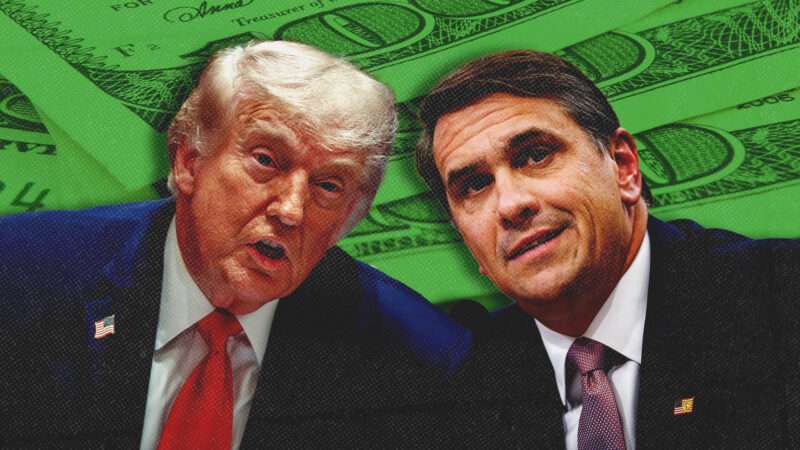
On Tuesday, Acting Attorney General Todd Blanche confirmed that the Justice Department will not implement President Donald Trump’s politically and legally contentious “Anti-Weaponization Fund,” which would have allocated $1.8 billion in taxpayer money to compensate purported victims of “an evil, corrupt, and weaponized Biden Administration” (as Trump put it). But Blanche said another element of Trump’s “settlement agreement” with the IRS—a provision that shields him and his family from liability for tax violations and other federal offenses—remains in place.
The Anti-Weaponization Fund, which was described in a May 18 agreement signed by Trump’s personal lawyers, Associate Attorney General Stanley E. Woodward Jr., and IRS CEO Frank Bisignano, was controversial because it was brazenly corrupt: It was the product of a pretextual lawsuit that pitted Trump against agencies he oversees, and it was designed to benefit his allies. But the liability shield, which was revealed in a May 19 addendum signed by Blanche alone, is even shadier, since it directly benefits the president himself.
On January 29, Trump sued the IRS and the Treasury Department in the U.S. District Court for the Southern District of Florida, preposterously claiming that an IRS contractor’s illegal leaking of his tax returns had caused “at least” $10 billion in damages. In addition to offering an improbable estimate of the injury he had suffered, Trump missed the statutory deadline for filing such claims. And although he argued that the IRS had failed to properly oversee its contractors, it was not clear whether the agency could be held liable for the crimes of someone it did not employ. But the Justice Department, which was charged with representing the IRS in court, never bothered to mount a defense.
That failure underlined the blatant conflicts of interest created by the case, both sides of which were represented by lawyers who work for Trump. “I’m supposed to work out a settlement with myself,” Trump acknowledged a few days after filing the lawsuit.
The result of Trump’s admitted self-dealing was not pretty. But amid the backlash against the Anti-Weaponization Fund, which had nothing to do with Trump’s claims against the IRS, congressional critics tended to overlook Blanche’s addendum, which likewise does not address Trump’s complaint about the agency’s allegedly lax oversight of contractors entrusted with confidential tax information.
Among other things, the addendum bars the IRS from pursuing claims against Trump, the two sons who joined the lawsuit, the Trump Organization, or any “related or affiliated individuals” based on tax returns filed before the date of the agreement. Judging from just one potential dispute between Trump and the IRS, that edict could spare Trump more than $100 million in penalties.
Notably, the addendum was not signed by any IRS officials, which raises the question of how Blanche can dictate the conduct of an agency he does not control. And if we interpret the addendum as an expression of Trump’s will (which it clearly is), it arguably violates 26 USC 7217, which forbids the president to “request, directly or indirectly, any officer or employee of the Internal Revenue Service to conduct or terminate an audit or other investigation of any particular taxpayer.”
The addendum extends beyond the IRS. It says “the United States” is “FOREVER BARRED and PRECLUDED” from pursuing “any and all claims” regarding “any matters currently pending or that could be pending” before the IRS, the Treasury Department, or “other agencies or departments.” In a May 27 motion urging U.S. District Judge Kathleen Williams to reopen Trump v. IRS, 35 former federal judges noted the implications of that restriction: “The plain language of this extremely broad provision sweeps in [IRS] audits of Plaintiffs’ tax returns and all other claims the United States might have against Plaintiffs—extraordinary benefits for which no consideration was provided to the government.”
The addendum, in short, resembles a self-pardon, except that it extends even further, encompassing civil violations as well as criminal offenses. No president has ever attempted to pardon himself, and it is not clear whether such an act of clemency would be legal. It would certainly generate a huge political backlash, since it would create the appearance that the president is above the law and contradict the principle that no one should be a judge in his own case. Blanche’s addendum is problematic for the same reasons.
Testifying before a House subcommittee on Tuesday, Blanche presented the provision as typical of litigation involving the IRS. “Like anytime the IRS settles with an individual taxpayer or another company, as part of the settlement, it’s standard, it’s typical to get rid of past ongoing audits,” he said. “It’s not a forward-looking document. It’s nothing that gives any sort of immunity in the future to the president or his family or his organizations.”
That comparison is obviously inapt. Unlike the disputes to which Blanche alluded, this case did not involve alleged tax violations. It involved the unauthorized disclosure of tax returns, which is actionable under federal law. When “any officer or employee of the United States” knowingly or negligently discloses such information without legal justification, says the provision on which Trump’s lawsuit relied, the affected taxpayer “may bring a civil action for damages against the United States.”
Ostensibly, that is what Trump was doing when he sued the IRS. But he clearly filed his lawsuit too late: more than two years after “the date of discovery.” Even if he had hit that deadline, he would have had to make the case that the contractor who leaked his tax returns counted as a federal “officer or employee” or that the IRS itself negligently disclosed his information by sharing it with the company that employed the contractor.
That’s assuming the Justice Department treated Trump like any other plaintiff with similar claims, which it obviously did not do. Blanche “did not want the Justice Department to go into court and fight the suit, as it normally would, but also did not want to settle it by paying Mr. Trump directly,” The New York Times reports. Blanche reportedly thought “ending the case by funneling taxpayer money straight to the president” would be “politically untenable.”
Blanche evidently perceives an important difference between handing Trump $100 million and saving him the same amount (or more) by barring the IRS from pursuing claims based on his past tax returns. But the upshot is the same either way. And even if you accept Blanche’s distinction, that does not explain why settling the lawsuit required granting Trump, the other plaintiffs, and all “related or affiliated individuals” complete immunity from civil or criminal liability for any federal offenses they might have committed prior to May 19. That surely is not “standard” or “typical.”
Nor was the Justice Department’s handling of this case prior to the settlement. “The government never asserted even basic defenses,” the former federal judges said, noting that “the claims were clearly untimely” and that “the alleged discloser here…was not a
government employee.” The Justice Department’s lassitude, they argued, “only strengthens the conclusion that the litigation was collusive from the start and that its goal was to obtain legal authority for the purported ‘settlements.'”
Trump sued components of his own administration, represented by a Justice Department that also answers to him. And under an executive order that Trump issued in February 2025, the government’s lawyers were not allowed to “advance an interpretation of the law” that “contravenes” the president’s position.
The case “was never an adversarial proceeding over which the Court even had jurisdiction,” the former judges argued. It was instead “a means to allow a ‘commission’ controlled by the President to dole out $1.776 billion in taxpayer dollars without constitutional or congressional authority to do so, and to confer unlawful private benefits to the President and his family by purportedly prohibiting the United States from prosecuting any and all claims against them. And the parties have plainly tried to shield this conduct from necessary judicial scrutiny by short-circuiting this Court’s inquiry into whether the lawsuit is in fact an actual case or controversy.”
Trump did that by dropping his lawsuit two days before the deadline that Williams had set for briefing on the question of whether it involved an actual controversy between adverse parties, as required for the case to proceed. As a result, Williams never resolved that issue, and she never had an opportunity to review the settlement.
Last week, in response to the former judges’ motion, Williams ordered the government to address their “grievous allegations” by June 15. She said the brief should address “the charges of collusion and whether the Parties are truly adverse,” “the assertion that the dismissal in this case was premised on deception by the Parties,” and “the question of whether the case should be reopened because the Court was the ‘victim of a fraud.'”
Those remain live questions, notwithstanding the demise of the Anti-Weaponization Fund. It will be interesting to see how the Justice Department rebuts the charge that it used a phony lawsuit as a pretext for protecting the president and his family from legal consequences that ordinary Americans would face if they ran afoul of federal law.
Congress also should be paying attention to this sweet deal. “I haven’t been focused on that, to tell the truth,” Sen. Susan Collins (R–Maine) said on Tuesday. “I think the same rules should apply to everybody.” Blanche and Trump clearly disagree.
The post Trump's Immunity Deal Stinks Even More Than His Blatantly Corrupt 'Anti-Weaponization Fund' appeared first on Reason.com.
from Latest – Reason.com https://ift.tt/IzZfspL
via IFTTT