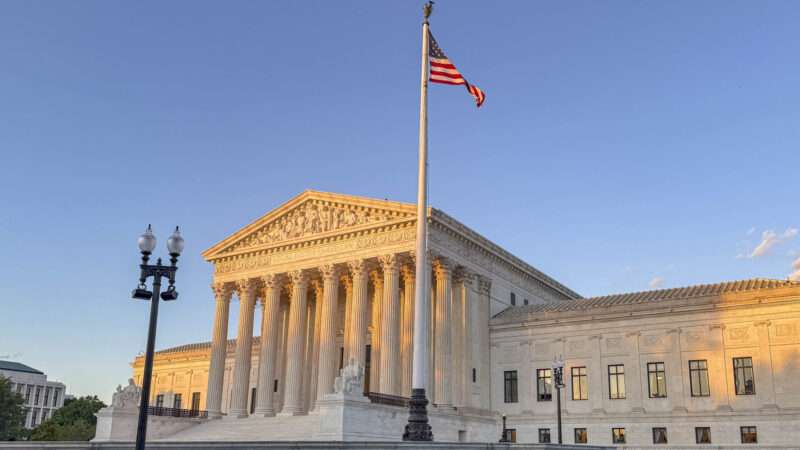
President Donald Trump has the power to fire members of the Federal Trade Commission but cannot give the boot to members of the Federal Reserve. So said the Supreme Court on Monday, in a pair of related decisions about the scope of executive power.
The court ruled 6–3 in favor of the president in Trump v. Slaughter, which challenged his decision to fire Rebecca Slaughter from her position as a commissioner of the Federal Trade Commission (FTC). But in Trump v. Cook, the court sided with Lisa Cook, a member of the Federal Reserve’s board of governors who had sought to fire. The decision in that case was 5–4, with Chief Justice John Roberts and Brett Kavanaugh joining the three liberal justices to form a somewhat unusual majority.
With the two decisions, the Supreme Court seems to have strengthened the president’s control over the executive branch while underscoring the Federal Reserve’s distinctive role, an approach the court had emphasized in previous rulings.
The Federal Reserve’s “unique historical status and role” means that it is shielded from presidential powers in ways that other federal entities are not, Roberts wrote in the Cook opinion. Even though presidents are authorized to remove members of the Federal Reserve’s board “for cause,” the majority found that Trump’s attempt to fire Cook lacked the “procedural protections” to which she is entitled.
In plain English, the president can’t fire a member of the Federal Reserve board simply because wants to. He must first prove that the target is guilty of some violation, and the target must be given time to respond to the allegations.
“Without such constraints in place, any perceived or alleged misstep (past or present) could provide a ready pretext for a Governor’s removal—a fact that he would surely know,” wrote Roberts. “Nothing could be more corrosive of the independence that Congress sought to preserve.”
On the other hand, the Court says presidents do have the power to fire members of executive branch agencies at any time and for any reason—even if they work for so-called “independent agencies,” such as the FTC. In doing so, the court overturned a 1935 decision, Humphrey’s Executor v. United States, that said then-President Franklin Roosevelt exceeded his authority when he tried to fire an FTC commissioner. Lower courts had leaned on the Humphrey’s Executor precedent when they ordered the Trump administration to reinstate Slaughter to the FTC.
Roberts, who also delivered the opinion in the Slaughter case, wrote that “subordinates who exercise the President’s power are subject to removal by him. Then, and only then, can they remain accountable to the President, and the President to the people.”
That ruling is a “major victory for proponents of the ‘unitary executive’ theory—the idea that the president should have complete control over the executive branch,” writes Amy Howe of SCOTUSblog. “Under this theory, the president should be able to fire any member of the executive branch, and laws—like the one that the court struck down—that restrict his ability to do so violate the separation of powers.”
In a dissenting opinion, Justice Sonia Sotomayor argued that the court’s majority had discarded democracy “in favor of one that distorts the structure of Government” and gives the president “far greater power than ever before.”
There’s no doubt the second part of that is true. Monday’s ruling clears the way for Trump and future presidents to more directly assert their control over the full length and breadth of the executive branch. But the idea of placing some executive branch officials beyond the president’s control (and therefore unaccountable to voters, once they are appointed), as Sotomayor seems to prefer, seems more than a bit anti-democratic and thus potentially problematic too.
As always, the best way to limit the abuses of executive power is to reduce executive power. The president’s power to hire and fire who he wants would matter a lot less if the FTC and its ilk did less—or if they didn’t exist in the first place.
The post Can the President Fire Anyone He Wants? Yes, Unless the Target Is Part of the Federal Reserve. appeared first on Reason.com.
from Latest – Reason.com https://ift.tt/1RTxzsE
via IFTTT