Key Events In The Coming Vacation Week: All About Inflation

With the traditional post-payrolls market lull setting in, and most trading desks taking a week or two off, it will be a relatively quiet week with attention turning to inflation data with releases in the US, China, Norway & Switzerland, a key factor as central banks consider if/when to tighten in the near future. The US print will gain most attention: a strong number will validate the Fed’s balance sheet unwind intentions and a potential December rate hike.

The major US release for the week comes on Friday in the form of July’s CPI. As RanSquawk notes, analysts expect the headline to come in at 1.8% YY from 1.6% last time out, while the core reading is expected to rise by 1.8% YY from 1.7% last time out. The core metric has missed expectations over the last four releases. HSBC opines that “One major reason why core inflation has softened this year has been a slowdown in the pace of increase in rents.” At its most recent decision the Federal Reserve noted that it is “monitoring inflation developments closely” while it is of the belief that “inflation will remain somewhat below 2% in near term, but stabilise around 2% in medium-term.” This is of course against a back drop of limited wage growth.

It is also worth noting that North American liquidity will be lower on Monday owing to a Canadian national holiday. Other releases of note during the week: Monday US Fed Labour Market Conditions Index (Jul) Tuesday US JOLTS Job Openings (Jun) Wednesday US Nonfarm Productivity (Q2) US Unit Labour Costs (Q2) US Wholesale Inventories (Jun) Thursday US PPI (Jul).

There will be some July China macro data released, starting with FX reserves on Monday. Chinese trade data for July is due on Tuesday, with analysts expecting the surplus to widen to USD 46.08bln from USD 42.77bln last time out. HSBC believe that “exports growth likely remained strong in July supported by still resilient external demand.” The latest Caixin manufacturing PMI gives credence to this view, as it pointed to new export orders expanding at a faster pace. On the import front HSBC expect that “import growth remained strong, supported by the broad-based nature of the economic recovery.”

In EM, there are monetary policy meetings in Mexico, Peru and the Philippines.

Other releases of note during the week: Monday Chinese FX Reserves (Jul) Tuesday Japanese Current Account (Jun) Australian NAB Business Survey (Jul) Wednesday Australian Housing Finance Data (Jun) Thursday Australian Melbourne Institute Inflation Expectations (Jul) During the week: Chinese New Yuan Loans & Money Supply Data (Jul)

US inflation, Fedspeak & China data

After a robust NFP report, focus this week turns to US inflation prints. We expect core CPI to accelerate to a 0.2% m/m clip in July, ending a four-month streak of subdued prints. We also hear from several Fed speakers, including NY Fed President Dudley. July macro data from China will also be released over the next two weeks, starting with Monday’s FX reserves data. Our economists expect the July reading of activity growth to moderate from June’s strong levels. CPI likely stayed flat, while PPI may continue to ease on base effects. Meanwhile, headline new credit data have likely declined, but M2 growth may rebound modestly.

The week ahead in Emerging Markets

There are monetary policy meetings in Mexico, Peru and the Philippines. Sovereign rating review in South Africa

In other data

In the US, inflation will be the main focus, but we also have non-farm productivity and unit labor costs, the monthly budget statement and several Fed speakers. In the Eurozone, a very quiet week ahead with no key data releases. We have final CPI and industrial & manufacturing production for Germany, France, Italy and Spain. In the UK, we get industrial & manufacturing production, construction output and trade balance. In Japan, we get the current account and trade balance, money supply, machine orders and PPI. In Australia, RBA Governor Lowe is due to appear before the parliamentary economic committee and we hear a speech by Assistant Governor (Financial Markets) Kent. On the data front, we receive both consumer and business sentiment and housing finance approvals. In New Zealand, focus will be on the RBNZ, though we also get the manufacturing PMI and RBNZ Governor Wheeler will also appear before Parliament Select Committee.

A detailed breakdown of the main weekly events courtesy of DB’s Jim Reid

  • Monday starts with Germany’s industrial production figures for June in early morning, followed by UK’s July Halifax house price index and then US’s consumer credit stats for July.
  • On Tuesday, Japan’s balance of  payments and trade balance figures for June will be out in early morning. Then Germany’s June trade balance, current account, export and import stats are due. France will also report its June trade balance and current account figures. Over in the US, there is the NFIB small business optimism index for July.
  • Turning to Wednesday, China’s CPI and PPI for July will be out in early morning. Later on, Italy’s June industrial production figures and Bank of France’s business sentiment indicator are also due. Over in the US, there is the 2Q nonfarm productivity and unit labour costs data, June wholesale inventories as well as the MBA mortgage applications.
  • For Thursday, the June industrial production and manufacturing production figures for UK and France will be out. Further, June trade balance stats for UK and Italy are also due. Over in the US, we have the July PPI data, the monthly budget statement as well as the initial jobless claims and continuing claims figures.
  • On Friday, the final CPI figures for Germany, France and Italy will  be released. Over in the US, CPI stats for July are also due.

Onto other events, today starts with speeches from the Fed’s Bullard and the Fed’s Kashkari, followed by the OPEC/Non-OPEC joint technical committee meeting in Abu Dhabi. Then on Thursday, the Fed’s Dudley will speak. Onto Friday, the Fed’s Kaplan and Fed’s Kashkari will also speak. Finally we’ll still have earnings season continuing on both sides of the Atlantic but we’re now past the peak.

* * *

Finally, here is a table from BofA and guidance from Goldman with a breakdown of the key US events together with consensus estimtes

The key economic release this week is the CPI report on Friday. There are several scheduled speaking engagements by Fed officials this week.

Monday, August 7

  • 11:45 AM St. Louis Fed President Bullard (FOMC non-voter) speaks: St. Louis Fed President James Bullard will give a speech on the U.S. economy and monetary policy at the America’s Cotton Marketing Cooperatives’ annual conference in Nashville, Tennessee. Audience and media Q&A is expected.
  • 01:25 PM Minneapolis Fed President Kashkari (FOMC voter) speaks: Minneapolis Fed President Neel Kashkari will participate in a moderated audience Q&A session at an event hosted by the Sioux Falls Rotary Club in South Dakota.
  • 03:00 PM Consumer credit, June (consensus +$15.25bn, last +$18.41bn)

Tuesday, August 8

  • 10:00 AM JOLTS job openings, June (consensus 5,700k, last 5,666k)

Wednesday, August 9

  • 08:30 AM Nonfarm productivity (qoq saar), Q2 preliminary (GS +0.6%, consensus +0.7%, last flat); Unit labor costs, Q2 preliminary (GS +1.1%, consensus +1.0%, last +2.2%): We estimate non-farm productivity increased 0.6% in Q2 (qoq ar), modestly below the 0.75% average achieved during this expansion. We expect unit labor costs – compensation per hour divided by output per hour – to increase 1.1% (qoq saar).
  • 10:00 AM Wholesale inventories, June final (consensus +0.6%, last +0.6%)
  • 11:00 AM Cleveland Fed President Mester (FOMC non-voter) speaks: Cleveland Federal Reserve President Loretta Mester will give the keynote speech at the Community Bankers Association of Ohio’s Annual Convention in Cincinnati, Ohio.
  • 01:00 PM Chicago Fed President Evans (FOMC voter) speaks: Chicago Fed President Charles Evans will discuss current economic conditions and monetary policy in a closed group interview with representatives of the press in Chicago.
  • 01:30 PM San Francisco Fed President Williams (FOMC non-voter) speaks: San Francisco Fed President John Williams will give a speech titled “Monetary Policy’s Role in Fostering Sustainable Growth” in Las Vegas, Nevada. Audience and media Q&A is expected.

Thursday, August 10

  • 08:30 AM PPI final demand, July (GS flat, consensus +0.1%, last +0.1%); PPI ex-food and energy, July (GS +0.1%, consensus +0.2%, last +0.1%); PPI ex-food, energy, and trade, July (GS +0.2%, consensus +0.2%, last +0.2%): We estimate that headline PPI was flat in July, reflecting a modest rise in core producer prices offset by a decline in gasoline margins and energy prices. We estimate PPI ex-food, energy, and trade services rose by 0.2%. In the June report, PPI exceeded expectations as higher-than-expected food and core prices excluding trade services more than offset a retracement in the volatile trade services category.
  • 08:30 AM Initial jobless claims, week ended August 5 (GS 245k, consensus 240k, last 240k); Continuing jobless claims, week ended July 29 (consensus 1,960k, last 1,968k): We estimate initial jobless claims rebounded 5k to 245k in the week ended August 5. Initial claims can be particularly volatile around this time of year due to annual auto plant shutdowns, and we expect a rebound in these factory closures to boost claims for this week. Additionally, we expect a rebound from depressed levels of jobless claims in California. Continuing claims – the number of persons receiving benefits through standard programs – have trended up recently after falling sharply in the first four months of the year.
  • 10:00 AM New York Fed President Dudley (FOMC voter) speaks: New York Fed President William Dudley will give opening remarks at an “Economic Press Briefing on Wage Inequality in the Region” held at the Federal Reserve Bank of New York. Audience and media Q&A is expected.
  • 02:00 PM Monthly budget statement, July (consensus -$55.5bn, last -$90.2bn)

Friday, August 11

  • 08:30 AM CPI (mom), July (GS +0.20%, consensus +0.2%, last flat); Core CPI (mom), July (GS +0.21%, consensus +0.2%, last +0.1%); CPI (yoy), July (GS +1.8%, consensus +1.8%, last +1.6%); Core CPI (yoy), July (GS +1.8%, consensus +1.7%, last +1.7%): We expect a 0.21% increase in July core CPI (mom sa), which would be its fastest pace since January and would produce a one tenth increase in the year-over-year rate (to +1.8%). Our forecast reflects a boost from the second California tobacco tax increase of the year – a roughly US$2 per pack increase effective July 1 – as well as stabilization in used car prices, and mean reversion in airfares, apparel, and lodging following recent weakness. We also expect a reprieve from cell phone plan disinflation in the communication category, as a price hike for some T-Mobile plans is likely to offset new discounts offered by a few smaller pre-paid carriers. We also expect an above-trend increase in education prices, reflecting firming college tuition inflation indicated by press reports and university budget summaries. We estimate a 0.2% rise in headline CPI, reflecting rising food prices but a modest decline in energy prices. This would be consistent with the year-over-year rate rising two-tenths to 1.8%.
  • 09:40 Dallas Fed President Kaplan (FOMC voter) speaks: Dallas Federal Reserve President Robert Kaplan will take part in a moderated Q&A session at the sixth annual CPE day hosted by the University of Texas at Arlington’s Accounting Department. Audience and media Q&A is expected.
  • 11:30 AM Minneapolis Fed President Kashkari (FOMC voter) speaks: inneapolis Federal Reserve President Neel Kashkari will participate in a moderated audience Q&A session at the Independent Community Bankers of Minnesota’s annual convention in Bloomington, Minnesota.

Source: BofA, DB, Goldman

via http://ift.tt/2vcbwiG Tyler Durden
Pence Denies Report About 2020 Run, Chicago to Sue DOJ, IED Blast at Indiana Islamic Center: A.M. Links

  • Vice President Mike Pence denied a New York Times report that he was eyeing a run for president in 2020.
  • The city of Chicago says it will sue the Department of Justice over federal grant stipulations related to assisting federal immigration enforcement.
  • The FBI says an improvised explosive device was responsible for an explosion at an Islamic center in Indiana.
  • One person was killed and seven were injured after a ride at the Ohio state fair fell apart while in motion.
  • The government of Venezuela says one of its bases suffered a paramilitary attack.
  • Two Chinese tourists were detained in Germany after photographing themselves making a Nazi salute.

from Hit & Run http://ift.tt/2hC8i3b
via IFTTT

Dumb – And Dumber – Money Keeps Pouring In

Authored by John Rubino via DollarCollapse.com,

Someday, stock, bond and real estate valuations will matter again.

And the mechanism by which this return to sanity is achieved will probably be the torrent of money now flowing in from people who, for various reasons, don’t care about (or understand) the prices they’re paying.

Millennials, for instance, seem to have reached the “beginners’ mistakes” phase of their financial lives. They’re major buyers of recreational vehicles – see The Perfect Crash Indicator Is Flashing Red — and are now opening stock brokerage accounts at a startling pace:

Schwab: “New Accounts Are At Levels We Have Not Seen Since The Dot Com Bubble” As Millennials Rush Into Stocks

(Zero Hedge) – In its Q2 earnings results, [stock broker Charles] Schwab reported that after years of avoiding equities, Schwab clients opened the highest number of brokerage accounts in the first half of 2017 since 2000. This is what Schwab said on its Q2 conference call:


New accounts are at levels we have not seen since the Internet boom of the late 1990s, up 34% over the first half of last year. But maybe more important for the long-term growth of the organization is not so much new accounts, but new-to-firm households, and our new-to-firm retail households were up 50% over that same period from 2016.

In total, Schwab clients opened over 350,000 new brokerage accounts during the quarter, with the year-to-date total reaching 719,000, marking the biggest first-half increase in 17 years. Total client assets rose 16% to $3.04 trillion.


Schwab also adds that the net cash level among its clients has only been lower once since the depths of the financial crisis in Q1 2009:


“Now, it’s clear that clients are highly engaged in the markets, we have cash being aggressively invested into the equity market, as the market has climbed. By the end of the second quarter, cash levels for our clients had fallen to about 11.5% of assets overall, now, that’s a level that we’ve only seen one time since the market began its recovery in the spring of 2009.”


But wait, there’s more: throwing in the towel on prudence, according to a quarterly investment survey from E*Trade, nearly a third of millennial investors are planning to move out of cash and into new positions over the coming six months. By comparison, only 19% of Generation X investors (aged 35-54) are planning such a change to their portfolio, while 9% of investors above the age of 55 are planning to buy in.


Furthermore, according to a June survey from Legg Mason, nearly 80% of millennial investors plan to take on more risk this year, with 66% of them expressing an interest in equities. About 45% plan to take on “much more risk” in their portfolios.

In other words, little by little, everyone is going “all in.”

Here’s a related chart showing margin debt – many investors borrow against existing stock portfolios to buy more shares. Not surprisingly given the above, it’s at record levels and rising.

Corporations, meanwhile, continue to hoover up their own shares even as the market averages break records:

Big Pharma Spends on Share Buybacks, but R&D? Not So Much

(New York Times) – Under fire for skyrocketing drug prices, pharmaceutical companies often offer this response: The high costs of their products are justified because the proceeds generate money for crucial research on new cures and treatments.


It’s a compelling argument, but only partly true. As a revealing new academic study shows, big pharmaceutical companies have spent more on share buybacks and dividends in a recent 10-year period than they did on research and development. The working paper, published on Thursday by the Institute for New Economic Thinking, is entitled “U.S. Pharma’s Financialized Business Model.”


The paper’s five authors concluded that from 2006 through 2015, the 18 drug companies in the Standard & Poor’s 500 index spent a combined $516 billion on buybacks and dividends. This exceeded by 11 percent the companies’ research and development spending of $465 billion during these years.


The authors contend that many big pharmaceutical companies are living off patents that are decades-old and have little to show in the way of new blockbuster drugs. But their share buybacks and dividend payments inoculate them against shareholders who might be concerned about lackluster research and development.


While stock buybacks appear to be particularly troublesome among drugmakers, big companies in other industries — in sectors like banking, retail, technology and consumer goods, among others — are also buying back boatloads of their shares. Through May, some $390 billion in buybacks have been announced this year, $13 billion more than at this time in 2016, according to figures compiled by Jeffrey Yale Rubin at Birinyi Associates, a stock market research firm.


June 28 was the biggest single buyback announcement day in history. That was when 26 banks disclosed buybacks worth $92.8 billion, largely a response to having just passed the stress tests administered by the Federal Reserve Board. That figure blew past the previous record of $56.4 billion announced on July 20, 2006.

Note that last sentence: The previous record for corporate share repurchases occurred about a year before stock prices fell off a cliff.

But the dumbest money is not in the private sector.

It’s sitting around central bank conference tables making clueless bets on equities with taxpayer (i.e., make-believe) money. The Bank of Japan is leading the way:

(Japan News) – At its Policy Board meeting on July 28-29, 2016, the BOJ decided to increase its purchases of ETFs, which hold stocks and other assets, at an annual pace of ¥6 trillion from ¥3.3 trillion.


Since then, the benchmark 225-issue Nikkei stock average on the Tokyo Stock Exchange has risen some 20 percent.


The BOJ program “has created a sense of security among investors,” Nobuyuki Hirano, chairman of the Japanese Bankers Association (Zenginkyo), and president of Mitsubishi UFJ Financial Group Inc., one of Japan’s three megabank groups, said at a press conference earlier this month.

Last month, BoJ Governor Haruhiko Kuroda told reporters that it is “‘possible in theory’ to reduce the BOJ’s ETF purchases before inflation reaches the target. But it was ‘generally unthinkable’ that the BOJ would remove a part of its easing program, and had no intention of treating ETF purchases differently from the other elements of the program.”

It bears repeating that this is all happening with most major equity indexes at or near record levels – that is, levels that have in the past preceded huge crashes. Which is how these guys came to be known as dumb money.

via http://ift.tt/2vbVoxJ Tyler Durden

Bitcoin Forked, and Gold and Silver Report 6 August 2017

So bitcoin forked. You did not know this.

Well, if you’re saving in gold perhaps not. If you’re betting in the crypto coin casino, you knew it, bet on it, and now we assume happily diving into your greater quantity of dollars after the fork. You don’t have a greater quantity of bitcoins; bitcoin has no yield. Bitcoin simply sells for a greater quantity of dollars now than it did before. But who wants to sell? Bitcoin’s going to a million bucks—at least.

So bitcoin, whatever it is, forked. Whatever forking is.

To understand these two concepts, let’s consider an analogy.

Picture a bank, the old-fashioned kind. Call it Acme (sorry, we watched too much Coyote and Road Runner growing up). A group of disgruntled employees leave. They take a copy of the book of accounts. They set up a new bank across the street, Wile E Bank. To win customers, they say if you had an account at Acme Bank, you now have an account at Wile, with the same balance!

Is this just the sort of evil thing a greedy bankster would do? Do we need regulation to keep them from doing it (is it even illegal currently)? No, it’s actually impossible. The problem is that Wile E Bank doesn’t have the assets. It does not have the bills and bonds and loans payable to Acme. So it would be suicide to take on the liabilities. It would be nothing more than offering free money to people.

Of course, no one would to do that. It would not be a crime, but an act of altruism. Or perhaps an act of “Wile E Coyote, Super Genius.”

Yet, this is what happened with bitcoin. Bitcoin cash set up across the street (so to speak). Anyone who had a bitcoin balance as of the moment of the fork—when the Coyote and his posse set up shop—has the same bitcoin cash balance now.

To understand how this could be possible, we have to drill down into what makes a currency, a currency. Most in the gold and bitcoin communities would agree on one thing. The dollar is a fiat currency. People use it, because the government has various ways to force them (including especially a monopoly in schools).

The bitcoin people will tell you that bitcoin is not a fiat currency. And they are right. It’s true, no government forces anyone to use bitcoin (if anything, it’s the opposite).

This does not give us enough resolution to see the issue clearly, so let’s keep going deeper. The dollar is not only fiat, but also irredeemable. That means the issuer of the currency will not redeem it for a fixed amount of money. And let’s explain that statement, which may seem rather cryptic (OK, pun intended).

At the time America was founded, there was no question that money meant gold and silver. And when you deposited money in the bank, there was no question that you were entitled to get back the same amount. The dollar was merely a way of standardizing the size of the deposit, so that it was consistent from bank to bank and therefore anyone could read any bank’s or any company’s financial statements. It’s better if everyone agrees on how long a foot is, how much weight is in a pound, how much time is in a second. And how much gold is in a dollar.

By a slow process of erosion, in many incremental steps over two centuries, the government severed any link between the dollar and gold. After 1933, the dollar was not redeemable in gold by the American people. After 1971, it was no longer redeemable even by central banks.

You can exchange the dollar for anything else, including gold. But there is no contractual obligation of the issue to redeem for a fixed amount of gold or else be declared bankrupt. And we see that the terms of exchange, including price, are constantly changing. And the change is generally adversely to those who hold dollars.

Bitcoin, like the dollar, is irredeemable. It can be exchanged for most things, including gold. But there is no issuer per se, much less no contractual obligation by any issuer to redeem for an agreed amount of gold.

However, there is another key concept which differentiates the dollar and bitcoin. That concept is backing. The dollar is a liability, backed by an asset. Yes, it’s true that the backing is debt (government and corporate bonds primarily), and this debt is payable in dollars. Which is backed by this debt. It’s circular, and would surely be a criminal activity of done by private, for-profit actors.

However, for every single dollar you or anyone may have, there is a debtor who is working to pay—or at least service—his debts. Every debtor must sell goods or services of some kind in exchange for dollars, to pay the monthly vig. Or else.

Or else what? If he doesn’t pay, that is called default. And in defaulting, he will lose his home, car, business, etc. The threat of taking away someone’s business or home makes them quite highly motivated to sell whatever they have to, to raise enough cash to keep servicing the debt.

This explains why the dollar has retained so much value, why its value is as stable as it is, and why manufacturers are more and more aggressive to sell better and better stuff.

It is commonly accepted to say the dollar is “printed”, but we can see from this line of thinking it is really borrowed. There is a real borrower on the other side of the transaction, and that borrower has powerful motivations to keep paying to service the debt.

Bitcoin has no backing. Bitcoin is created out of thin air, the way people say of the dollar. The quantity of bitcoins created may be strictly limited by Satoshi’s design.

It is possible for bitcoin to fork, because it is not backed by any asset.

The blockchain is an important new technology. It’s a public ledger that can record anything, with each record indelibly stamped with the date and the recording party. This is useful to record assets. It could revolutionize supply chain management, for example making it possible to track food from farm to table.

But something must be emphasized here. A ledger is useful for recording something, but bitcoin is a recording only of itself.

So in this light, it should be clear why a new bank can’t just offer free dollar (or gold) accounts. The old bank has a bunch of assets, say $1.1 million. And a bunch of liabilities, say $1 million. The new bank would declare $1 million in new liabilities but it would have no assets at all.

For 46 years, the dollar has been perfectly irredeemable. However, it is backed by bonds. Bitcoin is not only irredeemable, but also unbacked. That is a big difference—in favor of the dollar.

We have heard bitcoin proponents defend this by saying this is better because there is no risk of loss of the assets. This is akin to saying that being dead is better than being alive, because there is no risk of death.

Being unbacked and irredeemable, bitcoin is just a number in a ledger. Well, now two numbers in two ledgers. Bitcoin and bitcoin cash forked, remember?

We are not here to prognosticate on the bitcoin price. It may or may not be a good speculation today. However, we want to observe one thing. There are small unsound structures, such as a Jenga tower just before someone pulls the last stick. There are big unsound vehicles, such as the RMS Titanic sailing in the iceberg-infested waters of the North Atlantic Ocean. And there are the… pugnacious… systems such as bitcoin. The boldness of bitcoin’s promoters is matched by the unsoundness of bitcoin’s monetary design (as opposed to the technological soundness of the blockchain). This combination will result in devastating losses to whomever is left holding the bag at the end.

Usually, there is no opportunity to call out these things. Or else, one looks at the crowd of believers, and decides discretion is the better part of valor. But this week, bitcoin forked. This is now the time to say that forking is proof that bitcoin as presently constituted is unsound. The crypto emperor is naked.

We want to clarify one thing. We are not saying that anyone involved in bitcoin, is a dishonest person. The principles of monetary economics are not obvious, and we do not fault anyone for participating in the bitcoin market or for thinking that bitcoin is money.


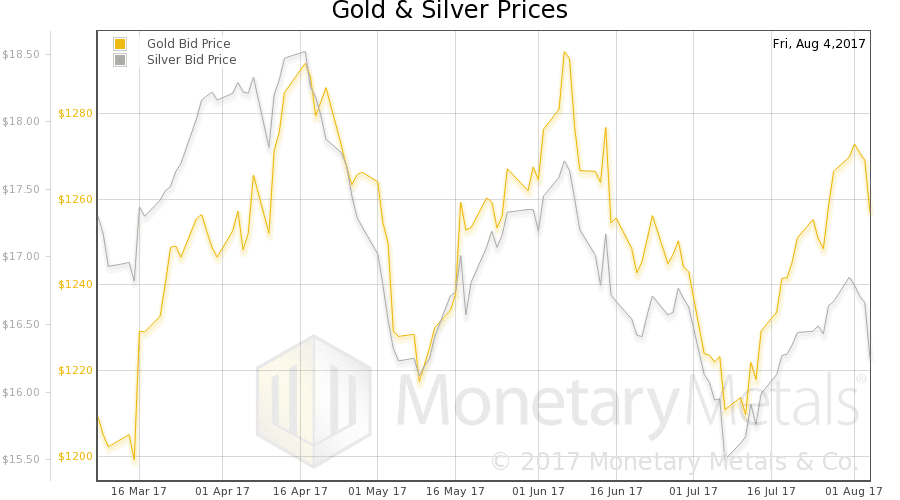
The prices of the metals came down this week, especially silver on Friday, which was -2.7%. Was it manipulation? We doubt it. The manipulators were away from the metals markets this week… something about a fork in another money market which we’ve been told is a bigger threat to the hegemony of the Federal Reserve.

Was is speculators taking profits and getting out of their silver positions? Was it softness in the market for actual metal? Below, is a graph of the silver action on Friday. And also graphs of the true measure of the fundamentals.

But first, here are the charts of the prices of gold and silver, and the gold-silver ratio.

Next, this is a graph of the gold price measured in silver, otherwise known as the gold to silver ratio. The ratio moved up this week, especially on Friday. We find it interesting that the ratio did not fall farther.

In this graph, we show both bid and offer prices for the gold-silver ratio. If you were to sell gold on the bid and buy silver at the ask, that is the lower bid price. Conversely, if you sold silver on the bid and bought gold at the offer, that is the higher offer price.

For each metal, we will look at a graph of the basis and cobasis overlaid with the price of the dollar in terms of the respective metal. It will make it easier to provide brief commentary. The dollar will be represented in green, the basis in blue and cobasis in red.

Here is the gold graph.

The dollar rose a bit this week (the mirror image of the falling price of gold). As the dollar rose, the cobasis increased. Gold became a bit scarcer.

Our calculated gold fundamental price fell about $20 (chart here).

Now let’s look at silver.

In silver, the move up in the cobasis is greater. Keep in mind that we are approaching the expiry of the September silver contract, which has been in temporary backwardation for over a month.

The continuous basis in silver moved up, but not so much (chart here).

Our calculated silver fundamental fell a few pennies (chart here).

Here is a graph of the September silver basis overlaid with price for Friday, showing the drop from around $16.70 to below $16.30.

Notice how the event began. At 12:30 (GMT), the price began dropping. But basis is not really responding. This is an even selling of both metal and futures. Slowly at first, the basis moves down, and continues even after the price stabilizes and begins a slow rising trend a little after 14:00. This is the speculators selling getting with the program, and selling. No one wants to hold an asset that’s going down! This is a relatively big move in the basis, around 70bps.

So is the silver selloff over? It’s hard to tell. The fundamentals were firming this week—the fundamental price did not move down much during the move. -$0.09 from Thursday to Friday. On the other hand, speculators may be putting in sell orders over the weekend and may decide to bail out on Monday. Momentum can be self-fulfilling.


© 2017 Monetary Metals

via http://ift.tt/2ugZqSj Monetary Metals

Kelly Loses Control As “Vacationing” Trump Unleashes Angriest Tweetstorm Yet

Just days after the Wall Street Journal and others reported that Trump’s new Chief of Staff, General John Kelly, had taken steps to “control” the flow of information on the President’s twitter feed, America will wake up this morning to one of his longest tweet storms yet.  Not surprisingly, this latest rant started off by ripping into the “Failing NYTimes” and other “24/7 Fake News” outlets…

The failing @nytimes, which has made every wrong prediction about me including my big election win (apologized), is totally inept!


The Trump base is far bigger &  stronger than ever before (despite some phony Fake News polling). Look at rallies in Penn, Iowa, Ohio and West Virginia. The fact is the Fake News Russian collusion story, record Stock Market, border security, military strength, jobs, Supreme Court pick, economic enthusiasm, deregulation & so much more have driven the Trump base even closer together. Will never change!


Hard to believe that with 24/7 #Fake News on CNN, ABC, NBC, CBS, NYTIMES & WAPO, the Trump base is getting stronger!


…but then quickly moved on to the “phony Vietnam con artist,” Senator Richard Blumenthal.

Interesting to watch Senator Richard Blumenthal of Connecticut talking about hoax Russian collusion when he was a  phony Vietnam con artist!


Never in U.S.history has anyone lied or defrauded voters like Senator Richard Blumenthal. He told stories about his Vietnam battles and conquests, how brave he was, and it was all a lie. He cried like a baby and begged for forgiveness like a child. Now he judges collusion?


All of which kind of makes you wonder whether General John Kelly has already lost control of the White House and what that might mean for his future.

via http://ift.tt/2vHGAIF Tyler Durden

China: Growth Despite North Korean Tensions?

Much to everyone’s surprise, China’s economy showed impressive growth numbers as the economic growth rate will very likely come in at 6.6% which is a bit higher than the official government estimates which were calling for a 6.5% growth rate (but lower than the historical growth rate). For 2018, the market seems to be expecting a 6.3% growth rate.

Source: tradingeconomics.com

These preliminary results boosted the commodity markets as the prices of pretty much all base metals increased on renewed hopes as the Chinese industrial economy remains the main consumer of raw materials. As such, the fate of the base metals prices is closely connected to the well-being of the Chinese economy (which was clearly visible when for instance the copper price collapsed after China prohibited the copper-based lending scheme in an attempt to tackle the shadow banking system).

Source: stockcharts.com

The main question now is whether or not the Chinese economy will be able to withstand an economic shock caused from increased political tensions? It looks like the domestic issues have been swiped under the carpet as the Purchase Manager Index seems to be holding up quite well whilst the real estate market (still) hasn’t crashed (for now).

The attention now seems to be shifting to ‘the bigger picture’. Not only have there been (growing) tensions between the USA and China with regards to the trade balance between both countries, the North Korean issue also seems to make things worse, as President Trump now seems to be connecting both issues with each other.

For some reason, the current president of the United States has voiced the opinion China ‘owes’ the USA help in the North Korea conflict exactly because of the historical trade deficit between both countries. Although tit-for-tat situations rarely exist in high-level politics, it does seem to be interpreted differently by the current leader of the USA.

Without choosing sides here, the issue with North Korea definitely seems to be one of the larger risks China is facing right now. Will it intervene with force? Or will it continue to ‘just talk’? It’s perfectly understandable for China to remain on the sidelines, trying to solve the issue during back room meetings as China definitely has more to lose than to gain, but China also has the power to prefer an economic war rather than a military war as it’s the main trade partner of North Korea.

Source: politifact.com

After all, any military intervention would be the first large-scale intervention in a long time and if China doesn’t meet the primary objective within a certain time frame, the credibility of its army could get hit, and this could have spillover effects onto the entire political system in China, and ultimately reflect in the consumer confidence levels as well.

Source: goldprice.org

A domino reaction would be very likely, and that’s the main reason why China doesn’t want to appear too tough on North Korea right now as it’s still counting on a ‘diplomatic’ solution to make all three parties happy again. However, a second risk could emerge if the USA thinks China doesn’t move fast enough in trying to defuse the situation.

President Trump has repeatedly warned the US would not allow North Korea to develop an ICBM which could reach the USA and the clock seems to be ticking as it’s now pretty realistic to assume North Korea will be able to build one of those missiles during Trump’s current term.

A peaceful solution would be a bad outcome for gold investors, but provide a welcome boost for base metals investors, as the Chinese economy would be allow to keep its momentum going.

!! Click here to read our Guide to Gold !!

via http://ift.tt/2wAx9a9 Secular Investor

Frontrunning: August 7

  • Futures slightly higher after Dow’s record run (Reuters)
  • Tillerson says U.S., Russia can settle differences (Reuters)
  • Hot-Stock Rally Tests the Patience of Value Investors (WSJ)
  • ‘Good Conservative’ Grassley Ramps Up His Panel’s Trump-Russia Probe (BBG)
  • Brands Strike Back: Seven Strategies to Loosen Amazon’s Grip (WSJ)
  • Oil slides from nine-week highs as market looks to OPEC (Reuters)
  • BlackRock, Vanguard Say Bond Market’s Got This Trade All Wrong (BBG)
  • Bond Bears Balk at ‘Trade of Decade’ (BBG)
  • Samsung scion Lee fights back tears as prosecutors seek 12 years’ jail (Reuters)
  • Cyber threats prompt return of radio for ship navigation (Reuters)
  • De Blasio Pushes for Tax on the 1% to Fund New York City Subway Fix (BBG)
  • Libor’s Demise Creates a Mortgage Mystery (WSJ)
  • Big Oil’s Dream of $65 Billion Hidden Off Norway Is Fading Away  (BBG)
  • Tesla Goes From Zero to 100 in Three Months (BBG)
  • Penalties Against Wall Street Are Down Sharply in 2017 (WSJ)
  • This American Town Was Left to Die, and Suddenly Economists Care (BBG)
  • Israel moves to shut down local operations of Al Jazeera (Reuters)
  • U.K. Economy Suffers After Consumer Spending Slumps Again  (BBG)
  • Kenyans stockpile food, police get first aid kits ahead of vote (Reuters)
  • Buffett Nears a Milestone He Doesn’t Want: $100 Billion in Cash  (BBG)
  • Why the World’s CEOs Fear Paul Singer (BBG)
  • StanChart CEO says Gulf rift puts Dubai finance hub at risk (Reuters)
  • Police Push Tracking for Civilian Drones (BBG)
  • Australia finds U.S. military aircraft that crashed off northeast coast (Reuters)
  • Inside the Secret World of Global Food Spies (BBG)


Overnight Media Digest

WSJ

– Google’s new diversity chief, Danielle Brown, criticized the contents of an employee’s memo that went viral inside the company for suggesting Google has fewer female engineers because men are better suited for the job. on.wsj.com/2vvGeo5

– The US military called off a search-and-rescue mission for three Marines missing after their Osprey aircraft went down in waters off Australia’s east coast, military officials said. on.wsj.com/2vvCsuT

-WeWork Companies Inc raised $500 million to expand operations in South Korea and Southeast Asia. The New York-based company, said that it also acquired Singapore co-working firm, Spacemob Pte Ltd in a separate deal. on.wsj.com/2vwbTFE


FT

The British government has said it will pay “no more than it needs to” in its divorce settlement with the European Union, playing down a Sunday Telegraph report that it would pay a sum of 36 billion pounds if the EU agreed to start negotiating a post-Brexit trade deal.

The Britain’s peer-to-peer lenders will soon have to give out detailed information about how much investors have lost in the past on loans they arranged, as the Financial Conduct Authority (FCA) tries to regulate the fast growing sector.

Royal Dutch Shell Plc and BP Plc declared confidence in the future of North Sea oil and gas production after a series of cost cuts that executives say have pulled the basin back from the brink of precipitous decline.

Singapore start-up oBike, which offers 1 pound-an-hour rental bikes in London, has said it was “disappointed” after Wandsworth council seized more than 130 of its cycles and described them as a “yellow bike plague”.


NYT

– Fox News suspended Eric Bolling, a longtime host at the network, pending an investigation into reports that he sent lewd photographs to three female colleagues via text message. nyti.ms/2flMXdt

– Workers at a Nissan plant in Mississippi overwhelmingly rejected a bid to unionize, an election that the union quickly criticized. The union accused Nissan of waging an unusually aggressive fight against the organizing effort. nyti.ms/2fkLBzN

– U.S. Vice President Mike Pence declared his loyalty to President Trump, denouncing an article suggesting that he was positioning himself to run for president in 2020 if Trump does not seek a second term. nyti.ms/2fkfJv4

– U.S. Deputy Attorney General Rod Rosenstein said the Justice Department was not pursuing reporters as part of its growing number of leak investigations. nyti.ms/2flaRWC


Canada

THE GLOBE AND MAIL

** The Halifax Chronicle Herald and the union representing the paper’s employees have reached a tentative agreement weeks after the provincial government intervened in their bitter 18-month-old labor dispute. tgam.ca/2vvGvHC

** British Columbia’s New Democratic Party government plans to collect the names and jobs of temporary foreign workers in the province for a new registry aimed at providing information to help develop labor-market policy. tgam.ca/2vwByho

** Canadian athletes at the world athletics championships have been coping with injuries and an outbreak of a Norwalk virus at the team’s hotel that felled marathoner Eric Gillis on Sunday. tgam.ca/2vwj6pg

NATIONAL POST

Canadian Finance minister Bill Morneau’s tax plans announced last month could result in a tax rate as high as 93 percent, as pointed out by tax lawyer Michael Goldberg of Minden Gross LLP in Toronto. bit.ly/2vwAni7


Britain

The Times

Royal Dutch Shell Plc is to launch as an electricity supplier in Britain, challenging some of Europe’s biggest utilities. bit.ly/2fk3Khi

The chief executive of Glaxosmithkline Plc, Emma Walmsley, has vowed to develop more blockbuster drugs by bringing greater commercial rigour to its research and development. bit.ly/2fk4nra

The Guardian

Head office staff at the Tesco-owned One Stop convenience chain are fighting for a better redundancy package after it emerged employees on Tesco contracts were being offered a more generous payoff. bit.ly/2fk8DH0

Sainsbury’s is to cut more than 1,000 jobs at head office as part of a fresh efficiency drive designed to save 500 million pounds ($652.25 million). bit.ly/2fjTC87

The Telegraph

Property investor Henderson Park, founded by former Goldman Sachs executive Nick Weber last year, has confirmed the acquisition of two of the UK’s largest hotels in a deal thought to be worth around 500 million pounds. bit.ly/2fjvhzr

Boutique hotel operator Firmdale is set to report that it booked record revenue of 125.8 million pounds in 2016 driven largely by rising room rates at its eight London properties. bit.ly/2fknhxZ

Sky News

Arqiva, which is owned by a consortium of Australian and Canadian investors, has appointed Barclays Plc, Goldman Sachs Group Inc, HSBC Holdings Plc and JPMorgan Chase & Co to prepare a London stock market listing that would value the company at up to 6 billion pounds. bit.ly/2fkNQD5

An independent study will look at how the UK can meet its climate change targets while also keeping costs down for consumers. bit.ly/2fkxN8x

via http://ift.tt/2wAuOMi Tyler Durden

North Korea Refuses To Negotiate, Threatens US With “Severe Nuclear Lesson”

For all the hope that this weekend’s UN breakthrough, in which the Security Council voted unanimously 15-0 to impose $1 billion in sanctions on North Korea exports, that saw both China and Russia side with the US, it appears that North Korea refuses to even contemplate a negotiation or a cooling of tensions. As the following headlines suggest, a retaliation remains a real possibility.

  • NORTH KOREAN FOREIGN MINISTER: PYONGYANG WILL ‘UNDER NO CIRCUMSTANCES’ NEGOTIATE ON ITS NUCLEAR WEAPONS
  • NORTH KOREA SAYS IT’S READY TO TEACH U.S. ‘SEVERE LESSON’ WITH NUCLEAR STRATEGIC FORCE IF IT TAKES MILITARY ACTION
  • NORTH KOREA TOP DIPLOMAT SAYS NO NEGOTIATIONS ON ITS NUCLEAR & MISSILE PROGRAM UNLESS U.S. GIVES UP HOSTILE POLICY TOWARD PYONGYANG:

This was North Korea’s first official response to the fresh sanctions voted through by the UN security council.

As Reuters elaborates, North Korea is ready to give the United States a “severe lesson” with its strategic nuclear force if it takes military action against it, and will not put its nuclear program or its missiles on the negotiating table, it said in a statement to a regional meeting on Monday.

In a transcript of a statement by Foreign Minister Ri Yong-ho, which was distributed to media in Manila, Pyongyang called new U.N. sanctions “fabricated” and warned there would be “strong follow-up measures” and acts of justice. It said the resolution showed the United Nations had abused its authority.

As quoted by Bloomberg, North Korea asked Asean and participants in regional forum in Manila to “take impartial and practical stand and attitude” on its nuclear weapons, which it says it has no intention of using against any other country except U.S. and those that will join America.

“We take great pride and self-conceit in the fact that we can contribute to decisively reducing the danger of war on the Korean Peninsula, Northeast Asia and in the Asia Pacific by possessing a strong nuclear deterrence,” North Korean Foreign Minister Ri Yong Ho says in statement at Asean Regional Forum, a copy of which was distributed to reporters in Manila

North Korea expects forum and Asean “will distinguish the essence of the nuclear issue of the Korean peninsula and the danger of the ‘America First’ policy” as foreign ministers showing great deal of interest in situation in Korean peninsula. The foreign minister also accused Japan, South Korean authorities of “kowtowing blindly to U.S.”

He said that North Korea seeks to convince UN to withdraw sanctions and to persuade U.S. to drop its hostile policy:

“Had it not been the hostile policy enforced by the U.S. for more than 70 years against North Korea since the first day if its founding and had the policy not been intensified with an undisguised nuclear blackmail and threat, the nuclear issue of the Korean Peninsula would not have come into being from the beginning.

North Korea also said its intercontinental ballistic missile tests in July proved that the entire United States was in its firing range, and those missiles were a legitimate means of self-defense.

On Sunday night Donald Trump tweeted that he had “Just completed call with President Moon of South Korea. Very happy and impressed with 15-0 United Nations vote on North Korea sanctions.”

While Trump, who is on “working vacation” for the next two weeks, is up early, tweeting up another firestorm this morning, he has yet to respond to the latest rebuttal from North Korea.

via http://ift.tt/2uiANch Tyler Durden

Venezuela Descends Into Predictable Dictatorship: New at Reason

Venezuela’s descent into a socialist hell has been entirely predictable.

A. Barton Hinkle writes:

A thousand gleeful obituaries have been written for “Kansas’ failed experiment” with Gov. Sam Brownback’s tax cuts. But if Kansas’ economy provides a cautionary tale for supply-siders on the right, then Venezuela provides an even more stark warning for socialist sympathizers on the left.

Last weekend, president Nicolas Maduro used a sham election to consolidate power, and by Tuesday armed thugs were rounding up opposition leaders. This is the all but inevitable outcome of the Venezuelan government’s economic policies, which have driven the richest nation in Latin America—a country with more oil than Saudi Arabia—into shocking destitution.

Basic necessities such as diapers, toilet paper, and toothpaste have become rare luxuries. Infant mortality has skyrocketed, and is now higher in Venezuela than in Syria. Inflation has reached an annual rate of 700 percent. The government has responded by “scrambling to print new bills fast enough to keep up with the torrid pace of price increases,” as Bloomberg noted a year ago, which of course has only made the problem worse.

View this article.

from Hit & Run http://ift.tt/2ui0CZH
via IFTTT

Tesla To Raise $1.5 Billion In Bond Offering

Just days after reporting its biggest quarterly cash burn in history, Tesla announced on Monday it plans to raise about $1.5 billion in new cash, although in a welcome change for equity investors, this time it decided against an equity or convertible sale, and will offer bonds instead to take advantage of the insatiable bond market, as the carmarker seeks to ramp up production of its latest Model 3 electric vehicle. Tesla had over $3 billion in cash on hand at the end of the June quarter, compared with $4 billion at the end of the previous quarter and $3.25 billion a year earlier.

The debt offering comes as Tesla has reportedly received thousands of advance reservations for the Model 3, which Elon Musk said were averaging at about 1,800 per day since the car’s launch in late July. Tesla counts on the Model 3, its least pricey car, to become a profitable, mass market electric car maker although it may have difficulties in a market that is becoming increasingly competitive.

At the launch event, Musk said the company would face “at least six months of manufacturing hell” as it increases production of the Model 3, which has a $35,000 base price.

Tesla’s cash burn, expected to top $2 billion this year, hit a record $1.16 billion in the second quarter…

… and prompted short-sellers like David Einhorn to add bets against the Palo Alto, California company, which remains the most crowded global short name.

via http://ift.tt/2flekV4 Tyler Durden