Jim Bianco Warns “Investors Should Be Careful What They Wish For”

Authored by Christoph Gisiger via Finanz und Wirtschaft,

Wall Street is rattled. This week, the long-running stock rally turned into a rout. On Monday, the Dow Jones suffered its largest one-day decline since the summer of 2011. After stocks came out roaring at the beginning of the year, investors now are facing a lackluster performance for 2018. For Jim Bianco, the sudden plunge is a sign that financial markets are finally showing concern about inflation. The influential market strategist from Chicago thinks that a return of inflation could force central banks to accelerate their exit strategy and that the basic relationship between stocks and bonds will change once again.

Mr. Bianco, financial markets have been thrown into turmoil. What is going on?

For the first time in the post crisis area the markets are finally showing concern about a return of inflation. This is something that we talked about and speculated about for a long time, but it never became an issue until now. The catalyst to this sell-off was last week’s employment report which showed that wages were up 2.9% in January, the fastest pace since June 2009.

Why are investors so concerned about that?

The reason the market is worried about inflation has to do with central bank activity. Central banks and especially the Federal Reserve have put out the idea that it could take up to ten years for them to unfold their unconventional measures. For instance, the Fed said that it might get its balance sheet back to normal in 2026. But built into this was the assumption that there would not be anything like inflation that would come along and force the Fed to move in a different pace. So now, if inflation materializes it forces central banks to move a lot faster.

Why is that a problem for financial markets?

I’m of the opinion that all central bank stimulus is fungible. Whether it’s the European Central Bank, the Bank of Japan or the Federal Reserve: it doesn’t matter who does it as long as stimulus is added. If you add up their balance sheets, they have accumulated an all-time high of 16.4 trillion dollars. So even though the Fed has raised rates five times and is expected to reduce its balance sheet, collectively the central banks are the easiest they have ever been right now. But if there is an inflation fear coming, it forces the hand of the two easiest central banks: the ECB and the BoJ. What will they do about it in response? Do they start to taper faster? Do they start to reverse? These are the questions that are the heart of what’s bothering the financial markets right now.

Since the financial crisis, economists predicted time and again that inflation was just around the corner, but it never happened. What’s different this time?

The models that are saying inflation is returning in 2018 probably said the same thing in 2017, 2015, 2011 and many other times. Yet, it never materialized. Part of the explanation why inflation never materialized might be the Amazon effect: the internet is making things much more efficient and that has been holding down prices. But what’s different now, is that the market is taking it seriously. The market did not take it seriously in 2017, 2015 or 2011 when we thought inflation might return. It’s the market that pushed the yield on ten year treasuries up to 2.85% and that sent the Dow down 4,6% on Monday. But the most telling thing to me is the reversal of some of these correlations in the market.

What do you mean by that?

The correlation between stock market volatility and inflation expectations has been negative for a decade, meaning that when inflation expectations went up, volatility would go down and vice versa. But now, we’re on the verge of that correlation becoming positive for the first time since the financial crisis, meaning that as inflation expectations go up so does volatility.

Why is that so important?

This could be a return to the way that markets used to trade in the 1980s and 1990s. During that time, we traded with an inflation mindset: whenever we thought that inflation is coming back, up went interest rates and down went stocks. On the other hand, whenever we were relieved that there was no inflation, down went interest rates and up went stocks.

And how used markets to trade in the recent past?

Since 2000 we’ve traded with a deflation mindset: our biggest fear was deflation. When we thought that deflation was coming back, down went interest rates and – since deflation is bad for stocks – down went stocks. In contrast to that, when we were relieved that deflation was not a problem up went interest rates and up went stocks.

What does it mean when these correlations are changing once again?

People still think that’s the way we’re supposed trade right now. But if we’re transitioning to an inflation mindset like in the 1980s and 1990s, higher interest rates mean inflation which is bad for stocks – and add to that a set of central banks that are completely unprepared for a return of inflation because they’re in such an easy position right now.

Another remarkable development is the weakening of the US Dollar. How does the Dollar weakness fit into the whole picture?

I think it’s a confirmation of this reversal. I would argue that just like the correlation between volatility and inflation expectations has been turning up for the last year, the Dollar has been turning down. Behind both of those developments has been a concern about inflation. I think that’s been the primary driver. Look at it this way: Why would the Dollar be weakening with the strong economy? With the tax reform? And with everything else that has been going on with stronger interest rates? The Dollar shouldn’t be weakening unless you worry about inflation. That’s why the Dollar could be one of those warning signs we misjudged and tried to tie it to politics. But the Dollar maybe has been one of those things that are telling you inflation is coming.

So what’s next for the bond market? Is there a specific technical level which investors should watch out for?

On the ten year treasury note it was 2.63% from last year. We broke it last week and you saw the market sell off quite a bit. At this point, you now have to go with the 2014 high of 3.05% which is one of the highest levels in the post crisis era. If we take that out that would be a very big concern. We’re only around twenty-five basis points away from that level so we’re in a very weak technical position right now. Ultimately, if you’re a stock investor, what you would need to stop the route would be interest rates to stabilize and maybe even have a rally in bonds to signify that the market is saying: “maybe we overdid this inflation thing”.  Something like that happened on Monday after the Dow briefly went down nearly 1600 points during the trading session.

During this great bull market, it has always been rewarding for equity investors to buy such dips. Is this still a smart thing to do now?

The buy-the-dip-strategy worked because what never ever materialized during any of these dips was inflation. But if inflation returns, I think that jeopardizes the whole buy the dip mentality. So far, you had central banks that elevated markets and they have never been forced to really think about accelerating their exit because you never had inflation. So every dip has been a buy. But if central banks have to deal with inflation and have to accelerate their exit than a buying the dip mentality could really be a problem.

What’s your general take on the state of the stock market?

Stocks had a huge run. January has been the 15th straight month without a decline. Also, the Dow Jones went 404 consecutive trading days without experiencing a 5% correction. This week’s losses in stocks brought this streak to an end. The only time the Dow lasted longer without undergoing a 5% correction was the 437 trading days ending September 7, 1959. So if you understand that this has been the second longest run of this kind in the history of the Dow, you should understand that we might get into a period like we were in 2015 or in 2011 when we had several months of choppy to sideways markets with a lot of volatility. Gone is that period where the market never corrected and only went up.

So what should investors do now?

If we’re in an inflation environment in which both bonds and stocks struggle the whole risk parity trade is going to be problematic. It’s going to be very difficult to find a place that is going to perform well. This could be like the 1980s and 1990s: when markets went down, everything else went down as well, even investments like gold. So you really have to be careful in this environment.

via RSS http://ift.tt/2BM3BgE Tyler Durden

Futures Sliding After-Hours As Volatility Resumes Rise

Just when you thought it was over, the late-day tumble in stocks and surge in volatility has extended after-hours with Dow futures tumbling and XIV notably lower (VXX higher)…

As XIV drops, VXX is also rising notably…


All major US equity futures are down…

via RSS http://ift.tt/2C2RIyj Tyler Durden

Pence Arrives in Asia, Biden Calls Trump a ‘Joke’, Road Trip in Space: P.M. Links

  • Leaders of both parties in the Senate arrived a two-year budget deal.
  • Vice President Pence arrived in Japan ahead of the Olympics opening ceremonies in South Korea later this week.
  • Joe Biden called President Trump a “joke” in response to the suggestion Trump was joking about calling Democrats treasonous.
  • White House staff secretary Rob Porter has resigned after two ex-wives accused him of abuse.
  • At least six people are dead after a magnitude-6.4 earthquake in Taiwan.
  • SpaceX is livestreaming the Starman mannequin’s Tesla Roadster ride in space.

Follow us on Facebook and Twitter, and don’t forget to sign up for Reason’s daily updates for more content.

from Hit & Run http://ift.tt/2sgRKmE
via IFTTT

Tesla Cash Burn Unexpectedly Tumbles, Model 3 Rollout Unchanged

Amid reports of a slowing ramp up in Model 3 production, and the company’s own warning last quarter that manufacturing challenges during a production ramp such as this “makes it difficult to predict exactly how long it will take for all bottlenecks to be cleared or when new ones will appear”, investors were looking ahead with trepidation to today’s Tesla earnings report, especially with Elon Musk’s attention recently seemingly focused on outer space than dominating the terrestrial auto sector, despite the stock rising in recent days on hopes that the company will be able to get to its new, reduced target of 5,000 cars per week.

Well, this time there was some good news, when Tesla reported a loss of $771 million, or an adjusted EPS of ($3.04), better than the $3.20 expected, if more than 4 times greater than the $0.69 loss one year ago.

There was more good news hiding in Tesla’s top line: the company reported revenue of $3.29bn, just above the $3.28 billion expected, which however was offset by the decline in gross margin which was 13.8%, far below the 14.8% estimate.

But the biggest surprise was in Tesla’s cash burn which unexpectedly plunged from a record $1.4 billion in Q3 to just $276.8 million in Q4, far below the $900 million expected. Altogether, Tesla burned $3.475 billion in cash in 2017. Looking ahead, Tesla warned that “capital expenditures in 2018 are projected to be slightly more than 2017.”

Then we get to the all important auto deliveries: here we learn that in Q4, Tesla delivered 1,542 Model 3 cars to eagerly waiting customers, which however as Bloomberg notes, means that some 400,000 are still waiting. But most importantly, and in light with the recently reduced guidance, Tesla still sees Model 3 weekly production target of 2,500 by the end of Q1 and 5,000 by the end of Q2, and sees overall 2018 revenue growth significantly exceeding 2017, which of course was to be expected.

Tesla also reported a record number of Model S and X deliveries in Q4, or 28,425. Combined Model S and Model X deliveries in Q4 grew 10% globally compared to the company’s prior record in Q3, and grew 28% compared to Q4 2016. Overall, Telsa now sees Model S, X Deliveries About 100,000 in 2018.

Some more good news: customer deposits for future deliveries surged in Q4 from $686 million to a record $854 million, the highest yet and offsetting the decline observed at the start of the year.

In a curious aside, Musk said that “in order to incorporate our learnings and be capital efficient, we intend to start adding enough capacity to get to a 10,000 unit weekly rate for Model 3 once we have first hit the 5,000 per week milestone.” Which would suggest that the “capacity” – and tools – are not there at this point, which means even more CapEx will be spent in the next few weeks, which may explain the sharp drop in Q4 cash burn.

Commenting on the company’s endless bottlenecks, Musk said that “what we can say with confidence is that we are taking many actions to systematically address bottlenecks and add capacity in places like the battery module line where we have experienced constraints, and these actions should result in our production rate significantly increasing during the rest of Q1 and through Q2.

Away from its auto business, Tesla said it had installed only 87 megawatts of solar-power systems in the fourth quarter: this was the company’s most disappointing report on the solar side yet since buying SolarCity for $2 billion in 2016.

To be sure, Tesla acknowledged the decline which was  “20% less than Q3 2017” and attributes it to its “decision to close certain sales channels” and a short supply of Powerwalls for home customers who wanted to combine it with solar.

What is notable is that even as cash burn slowed, total long-term debt soared to $9.5 billion from just under $6 billion at the end of 2016.

Some more on Tesla’s outlook, from the release:

We expect Model S and Model X deliveries to be approximately 100,000 in total, constrained by the supply of cells with the old 18650 form factor. As our sales network continues to expand to new markets in 2018, we believe orders should continue to grow. With demand outpacing production, we plan to optimize the options mix in order to maximize gross margin. As stated above, we continue to target a weekly Model 3 production rate of 2,500 by the end of Q1 and 5,000 by the end of Q2. Also, we are focused on achieving our target of 25% gross margin for Model 3 after our production stabilizes at 5,000 cars per week.

We expect energy storage products to experience significant growth, with our aim to at least triple our sales this year. We expect energy generation and storage gross margin to improve significantly in 2018 as we enter the year with a backlog of higher-margin commercial solar projects and a more profitable energy storage business due to manufacturing efficiencies from scaling.

Service and Other gross margin should improve in each subsequent quarter in 2018. This will be achieved mainly through improved service productivity via Mobile Service and better remote diagnostics for Model 3. Diagnostics architecture has been substantially redesigned for Model 3 in order to reduce physical service visits by more than 50%. Additionally, Superchargers will start generating revenue in 2018 with pay per use charging primarily by Model 3 customers.

Capital expenditures in 2018 are projected to be slightly more than 2017. The majority of the spending will be to support increases in production capacity at Gigafactory 1 and Fremont, and for building stores, service centers, and Superchargers.

So with the benefit of no further cuts in the delivery calendar, the modest top and bottom line beats, the slowing cash burn, and the rising customer deposits, the company’s stock after dropping lower initially is now modestly higher.

via RSS http://ift.tt/2Eb0c8J Tyler Durden

Cboe Global Markets To Host Call On Recent Market Chaos

After a record-long streak without a 5% pullback in the S&P 500, the US equity markets lazy post-election boat ride was violently disrupted this week when a confluence of fears – including the showdown over the FISA memo, an optimistic average hourly wage number and anxieties about rising interest rates – sent markets spiraling lower, with the S&P 500 and the Dow recording their worst daily drop since August 2011, when Standard & Poor’s stripped the US of its AAA credit rating.

The violent moves have caused tremendous losses destroying inverse VIX ETPs in the process.

So with their stock tanking, the executives at CBOE are holding a phone call at 4:30 ET with journalists to explain how this is just a temporary speed bump, everything is still awesome and that retail investors who piled into those assets were aware of the risks they were taking.

Cboe

Of the two major options exchanges, the Cboe is the most heavily dependent on selling products tied to the VIX – which it created.

A KBW report released this morning showed 20% to 25% of Cboe’s revenues come from VIX-related products,  according to David Lutz of Jones Trading.

“The concerns are that this could impact CBOE’s VIX’s volumes,” said Richard Ripetto, an analyst at Sandler O’Neill + Partners.

via RSS http://ift.tt/2BdUDaN Tyler Durden

Yield-Spike Spooks Stocks, Commodities Clubbed As Dollar & Bitcoin Bounce

Seriously…


It was ugly in Asia overnight (and US futures were weak before the open)…


Just as we saw last Friday, it appears that today’s yield spike in Treasuries (driven by a weak auction and more fiscal largesse in the budget deal) spooked stock investors..


S&P, Dow, and Nasdaq ended the day red as the whole market slipped into the close (NOTE the idiotic swings in The Dow in the afternoon)…


Futures show the wild swings did not stop…


Once again, the inverse VIX (XIV) ETF was running the show for The Dow…


The Dow was well-managed in the last hour (just as we saw yesterday), critically clinging to its 50DMA this time…


VIX ended the day lower… but backl above 25 into the weak close…


But for context, S&P’s VIX remains around 70-80% higher than Thursday’s close last week…

AAPL was weak again today as yesterday’s dead cat bounce fades…


FANGs also tumbled…


Treasury yields spiked notably today… 30Y is now higher on the week but the 5Y/7Y belly remains lower in yield on the week…


With 10Y yields back above 2.85% – where the carnage began on Friday…


The Dollar Index surged back to a key support/resistance level today – breaking back above Mnuchin Massacre highs…


Commodities were clubbed like a baby seal across the board as the dollar rallied…


But WTI/RBOB were really ugly after the surge in production and big build in inventories… back to one-month lows…


Cryptocurrencies had a good day (as VIX dropped)…


With Bitcoin bouncing back above $8,000…


Another down day for aggregate bond and stock holders… Risk Prirty is in trouble…


via RSS http://ift.tt/2nRS6L8 Tyler Durden

Putting The Mean In “Mean Reversion”

Via Global Macro Monitor,

Asset valuations, including stock prices, eventually revert to their long-term mean (average) valuation or at least attempt to if not interrupted by outside intervention, such as central banks.    It has been the major factor in the steep sell-off in stocks over the past few days, in our opinion.

Stock valuations are at extreme levels, are running way ahead of fundamentals, and sentiment and positioning were off the charts.  Many investors even began to delude themselves that stocks can and never go down.

Moreover,  it is the new Fed Chairman’s,  Jerome Powell,  first day on the job.  It is less than certain that the new regime at the Fed will step in to prop up stock valuations.   Don’t bet against it, however,  as ever since the mid-1990’s,  the stock and asset markets have become the economy.

Macro Triggers

There are other short and medium-term macro factors at play that may have triggered the sell off:   1) the end of quantitative easing;   2) rising interest rates, inflation, and fears of bursting bond bubbles;  3) U.S. fiscal promiscuity and worries about how the government will finance itself, including $1 trillion in 2018 (stunning and gone unnoticed);  4) the botching of dollar policy by Secretary Mnuchin at Davos, which could spook off foreign buyers of U.S. Treasury debt;   5) fears central banks are way behind the curve as almost all still have negative real policy rates;  6)  threat of increased political instability in the world’s oldest democracy;  7) the first day on the job for new Fed Chair and uncertainty about Fed independence from the White House;  8) machines gone wild;  9) money supply growing slower than the economy;  10) other;  11)  we don’t know;  12) all of the above; and 13) none of the above.

Then there are the technical issues.  Massive short volatility positioning by everyone and their Target manager which got drilled today as the new VIX had its highest one day increase in history.  The old VIX, linked to the OEX or S&P100,  which was in play in 1987, was up much higher.     Take a look at the short volatility ETF, XIV, today, which disintegrated in after hours.

Asset Values And Nominal GDP

Interestingly,  former Secretary of Treasury,  Larry Summers,  comments in today’s Washington Post on the prospect that:  “Asset values and levels of borrowing cannot grow faster than gross domestic product.”

Asset values and levels of borrowing cannot indefinitely grow faster than gross domestic product, even though their ability to do so for a time has contributed to economic success over the past few years. If the Fed raises rates sufficiently to assure financial stability, there is the risk that the economy will slow too much. If it focuses on maintaining the growth necessary to meet its inflation target, there is the risk of further increases in leverage and asset prices setting the stage for trouble down the road.  – Larry Summers, WashPost

Prescient and he did not even know it.

U.S. Household Net Worth and Nominal GDP

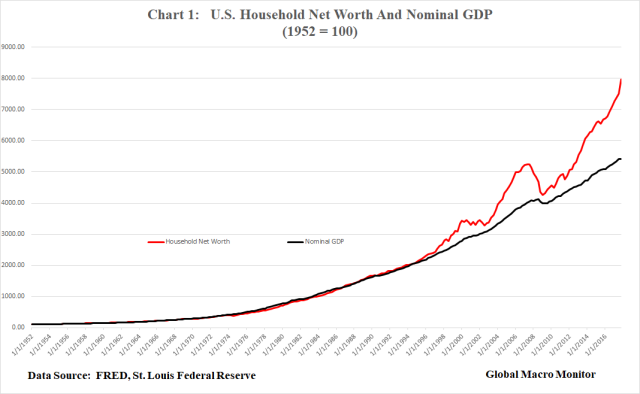
After all,  it was under Mr. Summers’ watch in the 1990’s that U.S. asset values, as measured by household net worth,  began to significantly diverge from the nominal gross domestic product.

MeanR_1

Chart 1 illustrates this point.

More than forty years before 1995,  household net worth tracked nominal gross domestic product in a very tight relationship (note we estimated the last data point in both time series).   The largest divergence of the two series prior to 1995 was at the beginning of 1979, when the net worth index, after a decade of inflation, was 12 percent below the GDP index.

Furthermore, it was during the 1970’s;  the net worth index was below GDP in every quarter except one,  Q4 1972, the Nixon reelection rally.  The take away here is that net asset value growth lags nominal GDP growth in periods of relatively high inflation.  In other words, inflation has been, historically, bad for assets.

The largest positive divergence of net worth to GDP was 8.41 percent, at the beginning of 1961.

During the 1952-1995 period, household net worth growth would thus mean revert to nominal GDP.   Asset prices were closely linked and anchored to the fundamentals of the economy.

Net Worth To GDP Ratio

This above is  also illustrated in Chart 2, which shows the ratio of household net worth to GDP.   Similarly, during the 1952-1995 net worth remained in a range of 3.15 – 3.87  to nominal GDP and mean reverting to its average of 3.55 during the period.

The chart also illustrates household net worth is now completely unhinged from nominal GDP as assets are currently at extreme valuations and this sell-off may be the start of a mean reverting process.   Also see the Household Net Worth to Personal Income ratio.

Note how  the ratio moved back into the range during the collapse of the NASDAQ in 2001 and the bursting of the credit/housing bubble in 2009.  Policymakers deemed it too painful and potentially deflationary to allow assets to mean revert fully and intervened with extraordinary monetary policy, more so after the collapse of the credit bubble.

The result was to push asset values ever higher and away from their fundamental value, albeit,  asset valuation is ambiguous and nobody knows their “true value.”

Stock prices are likely to be among the prices that are relatively vulnerable to purely social movements because there is no accepted theory by which to understand the worth of stocks….investors have no model or at best a very incomplete model of behavior of prices, dividend, or earnings, of speculative assets. – Professor Robert Shiller

What Happened In The Mid-1990’s? 

So why did asset values begin their rapid divergence from the economy in the mid 1990’s?

Nobody knows for certain but we have our priors.

1) Moral Hazard

First,  moral hazard was internalized by traders and investors.   Though the “Greenspan put” was born almost a decade earlier after the 1987 stock market crash,  the 1994-1995 monetary tightening culminated in the collapse of the Mexican peso and set off the Tequila Crisis in emerging markets.  The U.S. government had to step in and bailout Mexico with $50 billion-plus in loans.

The Fed moves after the Russian debt crisis, the dot.com collapse, and the bursting of the credit bubble, ultimately led to quantitative easing (QE) with the goal of inflating asset prices.

Many of those bailed out during Mexico’s peso crisis were U.S. investors trapped in the country’s bonds and short-term debt securities.   Though we think it was the right thing to do, as a collapse of the Mexican economy was not in the interest of anyone,  it did set in motion significant inflationary expectations in financial assets and as consequence institutionalized moral hazard.

2) Money Velocity

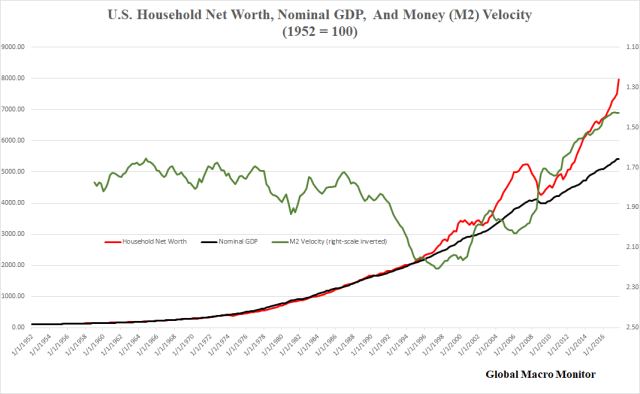
Second,  the rise of the internet and technological changes fundamentally changed the U.S. economy and its payments system.   We do not have time to research the specifics, but we suspect it is reflected in the secular decline in money velocity that peaked in the 1990’s and has fallen ever since with the exception of a small bump just before credit/bubble popped.

Chart 3 illustrates the coincidental timing of the fundamental divergence in asset values and decline in M2 money velocity.  We inverted the velocity axis to show how it tracks the net worth series.  That is as the money velocity declined,  assets values rose relative to nominal GDP.

MeanR_3

Monetary policy is a complicated beast, and nobody knows exactly why M2 velocity has been falling,   just as it difficult to even define what the concept of money truly is.   Nevertheless,  by definition falling money velocity is a simple mathematical calculation that the money supply is growing faster than nominal GDP.  The hypothesis is that the “excess money,”  rather than being absorbed into the economy flows into the asset markets.

It is interesting to note the increase in velocity just before the housing/bubble collapse.  That is the “excess liquidity” as we just defined was declining leading some to believe it contributed to the bursting the bubble.

Ironically, we awoke this morning to the following tweet.   Same concept.

MeanR_4

Hat Tip:  @Schuldensuehner

This fits our “liquidity über alles” model as we think, above all else, excess liquidity fuels momentum markets and trumps even fundamental valuation in the short and medium-term.

3) Asset Markets Became The Economy

The labor shock caused by the entry of China and Eastern Europe into the global economy contributed significantly to the hollowing out the U.S. middle class as policymakers failed to compensate the losers of free trade.  They were effectively swept under the rug as globalization took off, corporate profits soared, and consumer prices were held in check with cheap imports.

Fundamental Shift In Aggregate Demand

Thus, it is our contention the decline in the purchasing power of a relatively large swath of  Americans, with a relatively high propensity to consume, were crippled and when coupled with the rapid rise in income and wealth inequality aggregate demand has become insufficient to drive economic growth at an adequate pace.

The simple circular flow of income, which we all learned in Econ 101, no longer applies to the new economy.   Income needs a kicker in the form inflated asset values and household net worth.

MeanR_5

Policymakers therefore have little choice but to keep asset prices high and continue to generate asset inflation to induce consumption through an ever diminishing wealth effect and boost confidence in the business sector to positively influence CapX.

Go no further and look at the new channels of monetary policy.

IMF_Monetary Transmission

Conclusion

Finally,  we have no idea if this recent sell-off is the beginning of a major mean reversion to fundamental value for stock prices.  Major meaning net worth moving back into the 1952-1995 range.    We seriously doubt policymakers will stand idly by and let that happen and we could soon be back in QE mode.

What is clear from the above charts, however, is that the efficacy and efficiency of monetary policy are diminishing after the bursting of each bubble.   As the size of each bubble increases a larger policy response is warranted.   We suspect the next round of QE in the U.S. will be the direct buying of corporate equities ala the Bank of Japan.

We doubt this can continue, ad infinitum, however.   Either inflation will take hold and/or dollar holders will lose confidence in the currency.

Time For Gary Cohn To Step Up

One last thing.   After Secretary Mnuchin’s currency debacle in Davos, it would behoove the Trump Administration to keep him in the closet and let Gary Cohn become the face of government during this period of market turbulence.  Mr. Mnuchin does not exactly exude confidence, and the new Fed Chair is an untested unknown.

It was comical to watch the money channel today.  The financial pundits are seeing only the tip of the iceberg or, it could be, we are seeing icebergs that are  just ice cubes?  Doubt that.

Good luck,  folks.

via RSS http://ift.tt/2BgscZC Tyler Durden

Senate Reaches Bipartisan Deal to Keep the Government Open By Spending More Money On Everything

After weeks of negotiation, Republicans and Democrats in the Senate have reached the outlines of a spending deal that would avert a government shutdown.

Democratic Senate Minority Leader Chuck Schumer called the deal “the first real sprout of bipartisanship,” and said he hoped it would “break the long cycle of spending crises that have snarled Congress.” Majority Leader Mitch McConnell, the chamber’s top Republican, called the agreement a “significant bipartisan step forward” and suggested that it could help “make 2018 a year of significant achievement for Congress.”

So how did the two sides finally come together? They decided to spend more—on everything. And they’ll worry about paying for it later (or maybe not at all).

The Senate bill would lift current federal spending limits by about $315 billion through 2019, according to The Washington Post. The bill also includes $90 billion in disaster aid funding, making for a total of roughly $400 billion in spending.

The deal placates Republican defense hawks by boosting spending for the military, lifting the spending cap put in place by the 2013 sequester agreement by $80 billion this year and $85 billion next year.

The deal pairs the boost in defense spending with a roughly equal increase in domestic spending. On the homefront, the plan includes $10 billion for infrastructure spending, as well as billions for federal health initiatives, including $6 billion to respond to the opioid crisis, $7 billion for community health centers, and a decade-long extension of the Children’s Health Insurance Program (CHIP), up from the six-year extension Congress passed earlier this year.

All this additional spending will, of course, significantly increase the budget deficit.

The deal follows a House vote yesterday that passed a separate spending bill. But that bill was thought to be largely dead on arrival since the Senate would negotiate its own deal, which the House would eventually accept.

For the moment, however, it is not entirely clear whether the House will accept the deal. House Minority Leader Nancy Pelosi said as the deal as announced that she and many fellow Democrats would oppose the deal unless there is a separate vote on immigration legislation. Speaker of the House Paul Ryan has declined to make any commitment to holding an immigration vote.

Some House Republicans, meanwhile, have already objected to the bill on the grounds that it spends way too much money.

Amash is likely to be relatively lonely in his objections to the bill, however. In the end, this agreement, or something similar, will probably become law with plenty of Republican support.

Republican leadership in Congress spent the better part of the Obama years warning that mounting debt posed a dire threat to the nation’s future. But now, with control of both chambers of Congress and the White House, it looks likely that the GOP’s two most signifcant legislative achievements will be a tax reform law that raises the deficit by $1.5 trillion and a spending deal that increases the federal tab by hundreds of billions more.

from Hit & Run http://ift.tt/2Bh5911
via IFTTT

The Rhymes Of History

Authored by Sven Henrich via NorthmanTrader.com,

The Rhymes of History are present everywhere if you look closely. As I outlined in Retiring the Bear this week’s drop was no surprise as it was well advertised in the charts and sentiment. As promised I wanted to share some structural charts that may put the drop in a historical context.

There’s a lot of talk of who and what to blame for the drop. Searching for explanations is common practice following a big drop and i’ll leave that to others, but my view is simply that it was technically based.

We were massively extended and a reconnect had to happen and did happen. In the same token the bounce off of the lows so far is also not a surprise as we had reached massive oversold readings on $NYMO as I outlined on Monday:

Markets are obeying technicals nicely and allows us to navigate through the now much more volatile action. And that’s a good thing. I don’t know about you but 2-3 handle intra-day ranges are not my cup of tea. I prefer wider trading ranges. So recognize markets have changed and one must keep an eye on the tea leaves.

So let’s look at the big structures for historical cues.

Firstly here’s what happened, a big uninterrupted ramp up followed by a big snap lower into key MAs:

In  many ways this move is completely consistent with previous major topping processes. A massive ramp higher, a quick rug pull of over 10% (12% as a matter of fact) producing an oversold RSI reading and now a bounce.

And the timing of the snap rhymes with previous examples.

Recently I’ve mentioned the global Dow Jones, the $DJW, as the monthly RSI reached virtually the same overbought reading as in 2007 when it snapped lower and produced a fast correction:

What’s notable here in particular is that this snap occurred at virtually the same time then as it did now, in February following a lengthy virtually uncorrected move higher.

Here’s the $SPX back then:

The current action is then eerily similar in time and in context. Back then the initial rout produced an oversold RSI reading for the first time in a long time. That low was followed by a bounce into the middle RSI, then a new low on a positive divergence followed by a larger rally.

Back then we went on to make 2 more new highs with intermittent 2 way action:

This is a scenario that could be considered to be a possibility here as it leaves room for the upside risk targets discussed in the 2018 Market Outlook. This way everyone would get bullish again, the correction would be viewed as another blip although back then it already marked the beginning of the end.

Note the initial drop in February, despite more highs following, resulted in much more volatile price action for the entire year before falling apart:

Bottom line: The 2007 top was a process that took months to unfold providing ample of 2 way price action opportunity.

A couple of weeks ago before the big drop in Weekend Charts I showed the ADX directional indicator being as extreme as in 2008. I note that this year’s reversal has come at precisely at the same historic extreme as in 2008:

Back then we saw new lows emerge in the months ahead on a negative divergence. The mirror image here would be new highs on a negative divergence, supporting a potential replay of the 2007 scenario.

The flip side here is if markets cannot make new highs. We’ve seen this play in 2000 following the market peak in March:

The initial low followed a fast 14% correction and the subsequent back and forth produced a lower high which then marked the end of the bull:

The bottom line here: As extreme as markets have been, on a structural basis they are obeying the very signals they have respected in the past. The volatility game has changed, gone are the days of 2-3 handle intra-day ranges and technicals are dominating. This provides traders with a lot of 2 way action opportunities, but also puts participants on notice: This week was a major warning and while new highs may still come they are by no means a guarantee. Participants may be well served paying close attention to the emerging rhymes of history.

via RSS http://ift.tt/2BJVUHH Tyler Durden

Credit Card, Student And Auto Debt All Hit Record Highs In December

The US consumer closed out 2017 with a credit bang.

While we reported last month that in November US credit card debt had just surpassed the previous all time high hit in July 2008 just before all hell broke loose when Lehman filed for bankruptcy two months later, there was a slight chance that in December this number had declined after the record surge in November credit-funded spending (which was just revised from $28BN to $31BN).

Well, that did not happen, and while December total consumer credit increased by less than the expected $20BN, it was still an impressive $18.45BN, of which $5.1billion was credit card debt and $13.3 billion non-revolving – or student and auto – loans.

More importantly, with the latest $5.1 billion increase in revolving, or credit card, debt the total is now $1.027.9 trillion, the highest number on record.

Meanwhile, non-revolving credit which with the exception of one definition change month, has never gone down, also hit a new all time high of $2.813 trillion, a monthly increase of $13.34 billion.

What about its components? Well, with everything else going for record highs, we doubt it will be a surprise to anyone that both student debt and auto loans hit a new all time high in the quarter ending December 2017, with $1.491 trillion for the former, and $1.11 trillion for the latter.

So for anyone still wondering why the US economy closed 2017 with an upward GDP burst, here is your answer. The problem is that with the personal savings rate just shy of all time lows…

… and with US consumers deep in the red on their household debt, just what will keep the US economic expansion going from this point on is far less clear, especially if the stock market has now peaked, as recent events suggest.

via RSS http://ift.tt/2EbXIGM Tyler Durden