Schiff Pranked By Russians Offering Naked Pics Of Trump With Moscow “Special Service” Escort

Ranking House Intel Committee Democrat Adam Schiff appears to have fallen for a prank by famous Russian comedy duo “Vovan” and “Lexus,” posing as a Ukrainian politician who claimed to have photos of President Trump having sex with Russian model Olga Buzova after the 2013 Miss Universe pageant in Moscow.

In an audio recording of the April 10, 2017 phone call, Schiff can be heard discussing the Russia investigation with Vovan who was impersonating Andriy Parubiy – chairman of the Ukrainian Parliament.

“I would caution that our Russian friends may be listening to the conversation so I wouldn’t share anything over the phone that you wouldn’t want them to hear,” said Schiff at the beginning of the call. 

Undeterred, “Parubiy” continued: 

“In November 2013, Mr. Trump visited Moscow, he visited competition Miss Universe, and there he met with Russian journalist and celebrity Ksenia Sobchak,” Vovan said in a heavily accented English, going on to explain that in addition to having ties to Putin, Sobchak is “also known as a person who provides girls for escort for oligarchs. And she met with Trump and she brought him one Russian girl, celebrity Olga Buzova.” Schiff asked for clarification, and Parubiy kicked it up a notch, telling Schiff that Sobchak is a “special agent of Russian secret service.”


Olga Buzova

Buzova “got compromising materials on Trump after their short relations,” Parubiy said. “There were pictures of naked Trump.”

Schiff then asks “And so Putin was made aware of the availability of the compromising material?” to which Vovan replied “Yes, of course,” adding  “all those compromising materials will never be released if Trump will cancel all Russian sanctions.”

The biggest bombshell: He had obtained a recording of Buzova and Sobchak talking about the kompromat while the two were visiting Ukraine. He told Schiff, “We are ready to provide [those materials] to FBI.

The prankster also told Schiff about alleged meetings between Trump’s former National Security Advisor Michael Flynn, saying that he met with Russian pop star who they alleged was Kremlin operative in a café located in Brighton Beach, NY frequented by Russian immigrants. 

“they used a special password before their meetings.” said Vovan. “Weather is good on Deribasovskaya.” The right response was “It rains again on Brighton Beach.”

Schiff thanked the prankster for the call, after which his office engaged in correspondence to arrange for the transfer of the “classified” material. 

Listen below:

Russian pranksters “Vovan” and “Lexus”

The Russian pranksters, “Vovan” and “Lexus” – who previously tricked both John McCain and Maxine Waters into believing that they were the Prime Minister of Ukraine, and spoke of the need to increase sanctions on Russia. 

During the call to Maxine Waters, the duo convinced her that the Russians had rigged the elections in Limpopo – a fictional land from a Russian children’s fairy tale. Waters promised to lend assistance to the deposed President of Limpopo. 

via RSS http://ift.tt/2BfXvUw Tyler Durden

Legal Limits on Opioid Prescriptions May Increase the Number of Pills Dispensed

Last month Arizona became the 15th state since 2016 to impose a statutory limit on the length of initial opioid prescriptions for acute pain. The rationale for such laws is that shorter prescriptions will mean fewer pills in circulation and less potential for abuse and diversion. But recent research suggests the opposite may be true, because patients tend to get refills when the initial prescription is too short.

According to guidelines published by the U.S. Centers for Disease Control and Prevention in March 2016, “three days or less will often be sufficient” when doctors prescribe opioids for acute pain, and “more than seven days will rarely be needed.” State legislators seem to have taken that recommendation to heart. In 2016 and 2017, according to a tally by the National Conference of State Legislatures (NCSL), 14 states enacted limits on such prescriptions, ranging from three days (Kentucky) to two weeks (Nevada), with seven days the most common. Arizona picked five days.

One obvious problem with such arbitrary limits is that some patients recovering from surgery or injuries will need more than three, five, or seven days of pain medication. That is a problem for those patients, but it is also a problem for politicians trying to prevent nonmedical use. A study published last month by JAMA Surgery found that prescription lengths similar to those mandated by most of these state laws were associated with a higher likelihood of refills for some types of surgery. “While government restrictions often limit the dispensing of opioid prescriptions to 7 days or less,” MedPage Today noted, this study suggests that “longer initial opioid prescription lengths following certain surgical procedures may, in fact, limit the need for refills and decrease total opioid use.”

Harvard surgeon Rebecca Scully and her collaborators looked at prescription data for more than 200,000 patients who took pain medication after surgery, 19 percent of whom received at least one refill. The prescription length associated with the lowest probability of a refill was nine days for general surgery, 13 days for women’s health procedures, and 15 days for musculoskeletal procedures. “In practice,” Scully et al. conclude, “the optimal length of opioid prescriptions lies between the observed median prescription length and the early nadir,” i.e., the point where a refill was least likely.

That rule of thumb would make the optimal prescription length four to nine days for general surgery procedures, four to 13 days for women’s health procedures, and six to 15 days for musculoskeletal procedures. “Although 7 days appears to be more than adequate for many patients undergoing common general surgery and gynecologic procedures,” Scully et al. write, “prescription lengths likely should be extended to 10 days, particularly after common neurosurgical and musculoskeletal procedures, recognizing that as many as 40% of patients may still require 1 refill at a 7-day limit.”

Some states with prescription limits (including Arizona) make exceptions for postsurgical pain, but the NCSL summary indicates that most do not. A legal limit of seven or fewer days not only interferes with proper patient care; it may increase rather than reduce the number of pills ultimately dispensed.

from Hit & Run http://ift.tt/2EMpWcj
via IFTTT

Peak Hubris

Authored by Michael Lebowitz via RealInvestmentAdvice.com,

In the past month, two well-known and highly respected money managers have made confident assertions about the markets. Their comments would lead one to believe that the future path of the market in the coming months is known.

Sadly, many investors put blind faith in the words of high-profile, accomplished professionals and do little homework of their own. While we certainly respect the background, knowledge, and success of these and many other professionals, we take exception with their latest bit of advice.

Before the election, in November 2016, were there investment professionals that claimed a Donald Trump victory would drive equity prices significantly higher? Although we are certain there were a (very) few, they certainly were not publicly discussing it, and the broad consensus was overwhelmingly negative.  

In March of 2009, which professional investors were pounding the table claiming that the next decade would produce some of the greatest market returns in history? Again, while some may have thought valuations were fair at the time, few if any were raging bulls.

The two instances are not unique. More often than not, investor expectations fail to accurately anticipate the future reality. This is not solely about amateur individual investors, as it equally applies to the best and brightest. Despite the urge to heed the sage advice of the “pros”, we must always remain objective, especially when everyone seems so certain about what will happen next.

The Known Future

The current message from Wall Street analysts, media gurus and most investors is that stock prices will undoubtedly go up for the foreseeable future.  Unbridled optimism about corporate earnings offer one point of fundamental justification for such views, but in large part these forecasts are predominantly based on the simple extrapolation of prior price trends. In late January 2018, a few esteemed Wall Street analysists actually raised their year-end S&P 500 price forecast from what it was only weeks prior. Although rationalized by stronger estimates of earnings expectations and an improving economic prognosis, the fact that January’s market rally has the S&P 500 already approaching their year-end forecast also played a meaningful role.

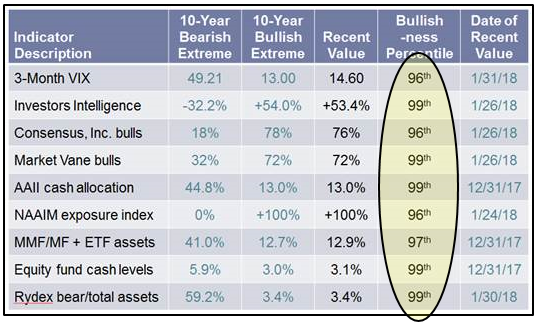
Basing future expectations on the most recent price activity is a great method of forecasting returns, until the trend changes. Wall Street analysts are not the only ones convinced the recent trend will continue in the months ahead. The graph below shows that expectations for stock price increases are now higher than at any time since at least 1987.

This second table from Ronnie Stoeferle at Incrementum provides a broad gauge of the excessive bullishness in the markets.

While there are a slew of technical reasons to suspect the recent market dip may be a speed bump on the way to higher prices, there are some serious fundamental warnings along with geopolitical concerns that argue downside risks are being grossly ignored. We would avoid using the word certainty to describe a market or economic forecast, and given the juxtaposition of risks and excessive valuations, relying on the certainty of others is not a prudent way to build wealth.

Ray Dalio

The following quotes came from a recent interview with Ray Dalio:

  • “We are in this Goldilocks period right now. Inflation isn’t a problem. Growth is good, everything is pretty good with a big jolt of stimulation coming from changes in tax ”
  • “There is a lot of cash on the sidelines. … We’re going to be inundated with cash,” … “If you’re holding cash, you’re going to feel pretty stupid.”
  • Finally, he said he expects to see “a market blow-off” despite the economy being in the last legs of the economic growth cycle.

What could go wrong? Ray Dalio, the billionaire founder of the world’s largest hedge fund, warns us that taking a conservative posture will make you “feel pretty stupid.”

There are four problems with these comments. First of all, does Ray Dalio really believes there is “cash on the sidelines”?  For every buyer there is a seller. The concept of “money on the sidelines” does not hold in a free market economy. This is one of Lance Robert’s 7 Myths of Investing.

Second, neither he nor anyone else knows what the future holds and for every buyer there is a seller. Third, even if we presume him to be correct concerning the market, will he let you know when it’s time to sell stocks and hold cash?  Keep in mind that wealth is compounded most effectively by not chasing markets higher but by avoiding large losses. Finally, Mr. Dalio almost certainly has hedges in place so that, even if he is wrong, his portfolio will have some cushion. Again, although we respect his insight and he may well be correct, it is concerning to hear a person of such influence potentially mislead investors into thinking the future is certain and worse mocking those taking precautionary measures.

Jeremy Grantham

Mr. Grantham, also a very successful investment manager, has made similar comments as to how this bull market ends.

  • “I recognize on one hand that this is one of the highest-priced markets in U.S. history. On the other hand, as a historian of the great equity bubbles, I also recognize that we are currently showing signs of entering the blow-off or melt-up phase of this very long bull ”
  • “A melt-up or end-phase of a bubble within the next six months to two years is likely, i.e., over 50%.”

Mr. Grantham has a perfect track record this millennium of calling out the equity bubbles of 2000 and 2008 well in advance. Further, he has stated unequivocally that equity valuations are excessive and investors should expect flat to negative returns over the longer term. Currently, his firm GMO is forecasting annualized inflation-adjusted returns of -4.4% for U.S. large-cap stocks over the next seven years. Despite the prospects of negative returns and wealth losses, he feels confident influencing others to chase a “melt-up” bubble that may last from six months to two years.

Dalio/Grantham Wisdom

Both highly successful investors and thought leaders are telling the story of tenable market risks but then tempting investors with the possibility of a grand finale worth chasing.

No one knows how this current bull market will end. Dalio and Grantham may be correct, and it may end with a melt-up, blow-off rally for the ages.  On the other hand, it may have ended last week with the blow-off rally having occurred over the last year.

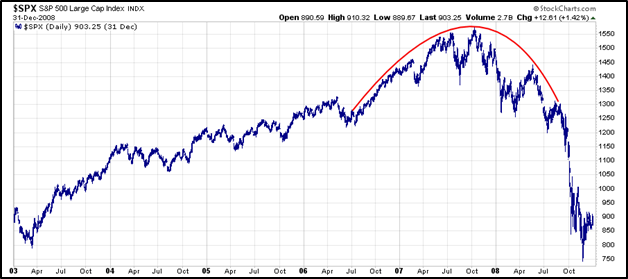
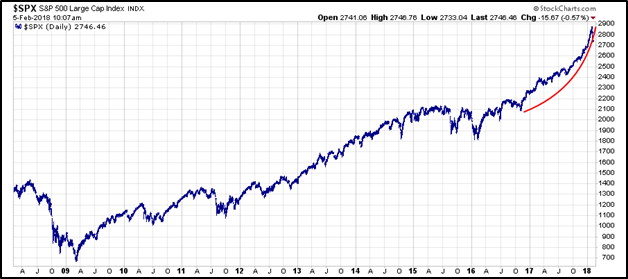
To put a historical perspective on how this market may top, the following charts compare the death of the NASDAQ 100 bull market in 2000 and the end to the S&P 500 bull market in 2007.

As shown, the topping of the last two bull markets took vastly different paths. Whether a blow-off rally as seen in the late 1990s, the one advocated by Grantham and Dalio, is the right call or a more frustrating rounded top of 2008 is the answer, we do not know. Left for consideration is whether the 37% rally since Trump’s election was the blow-off top and, if so, has it reached its apex?

Summary

While market geniuses in their right, Dalio and Grantham’s ideas about how this ends have zero certitude. If their minds change, we will almost assuredly be the last to know. Although a cynical premise, could they be propping the market up with talk of a magnificent rally so they can reduce their own risk? There is abundant evidence this occurred in 2007 as the mortgage meltdown progressed, albeit with different protagonists.  So, we think it is a fair question to ask in this instance.

Given current valuations, the risks are significant, and if history is any indication, we can be assured that this bull-run will end sooner rather than later. This is not a message encouraging you to ignore the thoughts of Dalio, Grantham or other successful investors. Rather we remind you that you are solely responsible for the risks you take. Being a good fiduciary and worthy steward of wealth mandates that we understand the risks as highlighted by Dalio and Grantham and avoid being influenced by the consensus groupthink that often has an ulterior motive. We all know how that ends.

We leave you with the S&P 500 price projections from Wall Street’s best and brightest in 2008.

via RSS http://ift.tt/2nUlRuX Tyler Durden

Budget Deal Or Bad Auction? Bonds, Stocks Slammed As Dollar Jumps

Take your pick – a dismal 10Y auction that spiked rates to where the carnage started last week, or a budget deal that suspends the debt ceiling and adds to the fiscal recklessness of America’s balance sheet?

Either way, stocks are tanking…


Bonds are tanking…

Even as the Bill curve normalizes modestly…


And the dollar is bid as risk-funding unwinds…

via RSS http://ift.tt/2FVgeE4 Tyler Durden

New Orleans Nixes Plan for Strict Cap on French Quarter Strip Clubs

Amid an outpouring of protests from New Orleans strippers and their supporters, city regulators have opted against a plan to limit the number of French Quarter strip clubs to one per blockface.

The plan, proposed by the New Orleans City Council last year, would have capped the number of strip clubs in the area at 14 and prevented any new venues from opening on the same blockface as an existing club.

At a public hearing on Tuesday, the City Planning Commission voted in favor of a modified proposal drafted by city planners, who rejected lawmakers’ per-block limits and recommended only a “soft cap” of 14 live adult entertainment venues around the Bourbon Steet area (which the city calls the “Vieux Carré Entertainment District”).

The proposal leaves open “the possibility of more than 14 venues being allowed to operate so long as any applicant businesses above that number receive conditional-use approval,” explains The Times-Picayune. And it “does not outright recommend changes to French Quarter zoning rules related to strip clubs” but “offers up recommendations ‘if’ the council decides to move forward with enacting changes.”

The commission explicitly rejected the idea that limiting the number of strip clubs in the area was a good crime-reduction strategy. Any “negative secondary impacts…cannot only be attributed to the concentration of” strip clubs, it stated in a report:

Staff believes that the nature of Bourbon Street and particularly the Vieux Carré Entertainment District is in itself a cause for higher crime because of the concentration of entertainment uses including not only [strip clubs] but mostly bars, live performance venues, and live entertainment, and the concentration of visitors drawn to these uses in a small geographic area. Because of this particular characteristic, staff believes that there is nothing inherent to [strip clubs in the district] that causes crime.

Writer and dancer Reese Piper, who tweeted live updates from yesterday’s hearing, said the room was “packed with dancers,” who spoke out against the proposed caps and recent police actions against the clubs. “In New Orleans, women of the night do not go quietly,” one speaker told the commission.

“What happens in New Orleans matters to citizens everywhere,” said Lyn Archer of the Bourbon Alliance of Responsible Entertainers.

No one at yesterday’s meeting spoke out in favor of a strip club cap.

It’s now up to the New Orleans City Council to decided whether it will incorporate the planning commission’s proposal into the city’s Comprehensive Zoning Ordinance.

from Hit & Run http://ift.tt/2nQJ9l4
via IFTTT

Bond Yields Jump After Ugly 10Y Auction

Remember: the catalyst for last Friday’s 666 Dow point plunge had nothing to do with a surging VIX and everything to do with bond yields blowing out to 2.85% after the stronger than expected hourly earnings number (which was largely the result of a drop in weekly hours worked).

Well, it may be time to batten the hatches again because as we warned first thing this morning, it is time keep an eye on today’s 10Y auction for an indication if last week’s yield’s jump would continue. It now appears that indeed the primary driver for the selloff may be here after an especially sloppy 10Y auction, following yesterday’s subpar 3Y.

Here are the details: the 10Y auction stopped out at 2.811%, a 0.8bps tail to the When Issued 2.803%, and the highest since January 2014. The internals were also mediocre at best: the Bid to Cover dropped from 2.69 in January to 2.34% in February, and below the 6 auction average of 2.43. Indirects also pulled back, with foreign buyers taking down 67.5% of the auction, down from last months’ 71.4%, if modestly better than the 6 month average; Directs were awarded 5.4%, also below January’s 6.5% while Dealers were left with 27.1%, an increase from last month’s 22.0%.

Overall, this was a surprisingly poor auction, which however may be mitigated by the fact that it took place just minutes after the Senate announced a bipartisan deal which sent yields to session highs.

And, in kneejerk response to both the Senate deal announcement and this poor auction, the 10Y is now just shy of 2.83%, and rapidly approaching the level which prompted the equity selloff on Friday.

via RSS http://ift.tt/2nOQiCu Tyler Durden

McConnell, Schumer Announce Bipartisan Budget Deal

In a deal that will spare the American people the anxiety inducing last-minute political brinksmanship that precipitated last month’s government shutdown, the leaders of Senate Democrats and Republicans have announced a two-year budget deal that will include funding for opioid abuse treatment, badly needed disaster relief and funding for some of President Trump’s infrastructure plan.

The compromise also includes defense spending that is a top priority of conservative Republicans, while raising domestic spending by a commensurate amount.

To secure the agreement, Republican Senate leader Mitch McConnell reiterated his promise to allow a free-wheeling debate over an immigration compromise next week that he said will be “fair to all sides.”

Even Senate Democratic Leader Chuck Schumer said the deal was “good for the American people” – a remark likely made with one eye on the polls ahead of November’s mid-term elections.

The leaders also touted the deal as a bipartisan triumph:

*MCCONNELL: BILL IS SIGNIFICANT BIPARTISAN STEP FORWARD

*MCCONNELL: IMMIGRATION DEBATE WILL BE FAIR TO ALL SIDES

*MCCONNELL SAYS DEAL INCLUDES DISASTER AID, INFRASTRUCTURE

*MCCONNELL SAYS NEGOTIATORS AGREE ON BUDGET DEAL*SENATE LEADERS ANNOUNCE BIPARTISAN TWO-YEAR BUDGET DEAL

*MCCONNELL SAYS DEAL ISN’T PERFECT BUT COMMON GROUND FOUND

*MCCONNELL SAYS DEAL ENDS BUDGET CAPS UNDER SEQUESTRATION

*MCCONNELL: DEAL INCLUDES FUNDING FOR OPIOID ABUSE

“The compromise we’ve reached will ensure that for the first time in years our armed forces will have more of the resources they need” and ensure funding for disaster relief, infrastructure and work to combat opioid abuse, McConnell said from the Senate floor.

Even a White House aide said

via RSS http://ift.tt/2EQvF17 Tyler Durden

New York Legislators Unveil Legislation Banning Tide Pods

Tide PodsThe Tide Pod Challenge has reached the next stage of the safety hysteria cycle, with lawmakers proposing legislation to fight an alleged menace.

Not a single child died from consuming a liquid detergent package last year, and the number of child exposure incidents has been falling steadily since 2015. Yet a pair of New York legislators introduced a bill yesterday to keep the colorful laundry aids from being sold in the state.

The bill—sponsored by Sen. Brad Hoylman (D/WF–Manhattan) and Assemblymember Aravella Simotas (D/WF–Queens)—would require all detergent packages sold in New York to be of a uniform color that is “unattractive to children.” The product would also have to come wrapped in child bite–resistant packaging. Also, there would need to be a warning label informing would-be Tide Pod champions that the product is dangerous to eat.

“As the parent of two young kids, I’m very concerned about the safety of liquid detergent packets,” Hoylman said in a press release. “It’s way past time to fix these products or remove them altogether from store shelves.”

Consumer safety activists also released statements of support for the bill. “By clearly marking individual packages with a warning message, I hope teenagers will rethink their self-harming behavior,” said Shino Tanikawa, a member of Community Education Council District and clearly a master of how teens think.

The fear expressed by proponents of a Tide Pod ban is that the product looks and smells dangerously like candy, thus leading children to consume them.

Yet the actual number of fatal poisonings resulting from children consuming these items is quite rare. From 2012 to 2017, only two children died from consuming liquid detergent packs. That’s compared to the 16 kids under the age of 6 who died from exposure to batteries between 2012 and 2016, according to the National Poison Control Center. Batteries, you may have noted, do not resemble candy.

The text of Hoylman and Simotas’ bill does its best to hype this danger nonetheless, informing us that “from 2013–2015, there were over 49,000 reported cases of young children ingesting or inhaling the contents of liquid detergent pods.” The American Association of Poison Control Centers puts this number lower, counting 34,479 children under 6 being exposed to liquid detergent packages.

These numbers include all manner of exposures, including kids who merely get it on their skin. The fact that almost no children are dying from these exposures suggests that most are manageable medical incidents.

And would the bill really cut down on those exposures? Proctor and Gamble—the makers of Tide Pods—sells less flashy all-white detergent packs, and it says its already makes the packages child-resistant. The company has also already launched a safety initiative in response to the reputed plague of people consuming its products.

But if the legislation won’t cut back on dangerous behavior, it certainly is bringing more publicity to Hoylman and Simotas. So in one sense at least, the bill is already doing the job its authors wanted it to do.

from Hit & Run http://ift.tt/2FVrS1v
via IFTTT

Larry Sharpe, Libertarian Candidate for Governor of New York, Quits the Party’s National Committee

Larry Sharpe, who came in a close second in the vote for vice presidential nominee at the Libertarian Party’s 2016 convention, was recently lauded by Politico as a “rarity…a serious Libertarian candidate” in his current race to be governor of New York. (Sharpe is also the subject of a feature interview in the February Reason, conducted by Matt Welch.)

Last week Sharpe resigned from his position as an alternate representative for region 8 on the Libertarian National Committee (LNC) after that committee failed to suspend its vice-chair, Arvin Vohra.

Vohra had generated a ton of social networking controversy for some remarks on Facebook. A sampling:

If a 14 year old has a kid, I would prefer the other person to be an adult, with a job….Statist Logic: “Teenagers cannot consent to sex.” “It is totally okay to force teenagers into useless government schools against their wills.” Government schools do a thousand timesmore damage to teenagers than consensually dating adults ever possibly could. Nonconsensual brainwashing masquerading as education is far more damaging than, for example, young marriage….

Should a man be allowed to have sex with another man? Only the two men in question should have a say. Should an adult be allowed to have sex with a teenager? Only the adult, the teenager, and their families/culture should have a say. There is no reason to bring government into it.

Vohra also condemned all soldiers as paid killers and all public school teachers as supervisors of indoctrination camps.

As the suspension motion stated, some LNC and party members believed that:

Vice Chair Arvin Vohra’s public discourse has repeatedly included inflammatory and insulting remarks which bring the Party, its candidates, and its principles into disrepute;…Mr. Vohra’s remarks have destructively stereotyped party members and large segments of the population, a behavior completely at odds with our Party’s philosophy of recognizing and treating people as individuals; and…Mr. Vohra’s comments have caused wide-spread offense, and the result is that the LNC, its committees, and Party affiliates are distracted from productive activities…

The party’s special counsel, Oliver Hall, conducted an investigation of Vohra’s comportment and statements. The investigation concluded that “despite the controversial nature of the content of some of his ideas, Mr. Vohra generally communicated them in a manner that is professional and respectful” and, further, that nothing he said rose to the level of the accused “collective deprecation” based on “sex, race, color, national origin, disability, age, religion or any other protected category.”

That decision vindicating Vohra came down on January 25; motions to censure and suspend him were voted on in a video meeting of the LNC on February 2. The suspension vote failed, 8–8. (Two-thirds of the LNC would have had to vote “yes” according to bylaws for the suspension vote to pass.) The censure vote passed, 9–7. (Vohra was permitted to vote against his own censure, and did.)

“The recent reaction from the LNC,” Sharpe wrote in his public resignation letter, regarding the suspension vote, “has clarified for me that Arvin does fit on the LNC. Clearly, the one who does not belong is me.”

Sharpe said in a phone interview this week, “In any other organization in this country if an officer who represented that organization had made statements way Arvin did, in some way shape or form members of that board would say, ‘hey, stop.'” To Sharpe, the failure to suspend Vohra is an organizational failure that he does not wish to be associated with.

Sharpe is “still a proud lifetime member of the Libertarian Party,” he stresses, and still a candidate for governor of New York. He sees his resignation as, among other things, a necessary move as a candidate to make it clear he’s distancing himself from Vohra’s statements, including Vohra saying that he would “probably” not personally have sex with a 14-year-old.

Someone in Vohra’s position, Sharpe thinks, should have the “empathy to know that if someone asks you if you would have sex with a 14-year-old, you don’t answer ‘probably not.’ It’s common sense to just say no.”

Sharpe says he’s been making motions to have Vohra removed for months before last week’s vote, but didn’t want to make a huge public cause out of it. At this point, though, he believes the LNC is “not prepared to be like a professional organization.” And though “they have every right to not be like that,” he thinks it’s not good for either side for him to stay a part of the LNC. (As an alternate, he didn’t have the power to actually vote in last week’s censure or suspension votes.)

Some have written off the importance of anything Vohra says on Facebook as an internal controversy that no one outside narrow L.P. social orbits would even be aware of, something that ought to have nearly zero effect on L.P. candidates. Sharpe disagrees, noting first that in modern politics social networking is terribly important; “Donald Trump won because of Twitter. Social media matters.”

Sharpe grants that the vast majority of Libertarian candidates don’t even make enough waves for major-party foes to bother attacking them, but says “I’m a long-term thinker, I’m not worried about the next election but this party is going to get bigger, and people are going to bring this stuff back to hit us. Part of the dirt will be things the LNC has done and not done. Candidates becoming serious need to be prepared to handle it, and I handled it by in writing calling for Vohra to step down twice and then resigning myself.”

Sharpe also worries that recruiting of serious people to run with the Libertarian Party will be harmed by people who see Vohra’s style and say, “I don’t want to touch this, this is a disaster.” He also worries that failing to boot Vohra will lead to fundraising being harder down the line, with “people saying I give you guys money and you make mistakes [like this] and shoot yourself in the foot? Why should I give you more money?”

Others on the LNC were worried about launching endless social media–driven witch-hunts against any thoughts they’d express. Sharpe’s response: “We are responsible to [party members]. Let them come after us” if they think what LNC members say or do is bad for the party’s image.

While Sharpe disagrees with Vohra’s view on age of consent laws and his opinion that everyone in the military should be seen as an immoral hired killer, he does not want him driven from the L.P. or the movement; he even grants that were Vohra running for public office, “I would vote for him. I do know he’s a real libertarian, that’s for sure. I would avoid his campaign like the plague, because it would be a dumpster fire, but when it comes to Election Day, my vote goes to Vohra.”

But he doesn’t think someone like Vohra should be a party official. “I’m not mad at him,” he says. “I’m mad at us. We should have acted. Being mad at Arvin is like being mad at a dog for barking.”

He also believes from his communication with other party members outside the LNC that the vote to not suspend Vohra from his position was “not what the [general Libertarian] public wanted, 100 percent no.”

Vohra, in a written statement prior to the vote, defended himself, saying:

My “crimes” so far include failing to sufficiently worship those who carry out the foreign and educational policies I find ineffective and morally abhorrent. I know that the prevailing attitude among the less sophisticated parts of America is that the federal government’s soldiers and government school teachers are “heroes”, against the evidence of their actual actions. I consider it part of my responsibility to work to change that.

My other “crime”: daring to suggest that age of consent laws should not exist, at least in their current form. As a believer in individual self determination, and a very open anarchist, this position should hardly be surprising. I don’t think government should have any involvement in sex, period. I also don’t think government should exist at all.

Joshua Katz, an at-large representative on the LNC, argues that voting against suspending Vohra was not the same as thinking his comments were wise or correct. “We must tread carefully in policing the speech of LNC members when not using Party resources,” he writes in an email. “It sets a dangerous precedent and can lead to endless factional infighting. This party needs a board that devises workable strategies for political success and safeguards its assets, not one that spends its time arguing about what its members say and do. For that reason, I was cautious on censure, and opposed suspension.”

In Katz’s view, suspension would be warranted only by things like “breaches of fiduciary duty, such as misuse of party assets. While I disagree wholeheartedly with Mr. Vohra’s statements, and do not think they are reflective of any libertarianism with which I am familiar, or of which I would be a part, I do not think that Mr. Vohra’s personal social media speech is part of his fiduciary function.”

Katz isn’t very worried that an average voter moving forward will note nor remember anything Arvin Vohra wrote on Facebook. “Even the amount of time and energy spent on the question of what our Vice Chair says on social media, in my view, demonstrates our excessive internal focus, and lack of focus the things that matter,” he says.

If the party’s membership at large disagrees with Vohra’s statements and style as much as Katz does, he says, they should express their opinions via “board elections at the convention. I respect the fact that others disagree on the scope of where suspension is appropriate.”

Whitney Bilyeu, LNC representative for Region 7, agrees that it should be up to members voting at the convention to judge whether Vohra’s comments were or were not something party members wanted representing them. “I asked for, and considered, the input from members and candidates in my Region representing both sides of the votes,” she says via email. “The vast majority either were indifferent, or thought censure was more appropriate. However, there were some who called for removal of Vohra. It was a difficult decision, in light of the circumstances, but I hope that my decision will serve to protect current and future members from a dangerous precedent, overreaching authority by the LNC.”

LNC representative for Region 1 Caryn Ann Harlos voted for Vohra’s suspension. Except for the age of consent stuff, she agrees with most of Vohra’s views about issues such as war, public schools, and legalization of all drugs. Her vote to suspend him, she says, was not about his opinions; it was about “professionalism and empathy.” She says the majority of state chairs from her nine-state region agreed with her votes to suspend and censure.

While Harlos isn’t confident there will be any trouble for candidates down the line based on things Vohra wrote, she does think it better to sell libertarian ideas in a “relatable, kind, human” way that doesn’t go out of its way to offend or insult state employees or non-libertarians in general. If Libertarians are to convince the world that, for example, private charity can meet needs government currently meets, it might be best to have a public face with “empathy and sympathy” and not the style of an “edgelord on Facebook…who would believe a society of [that type] will take care of people?” Despite voting against him, Harlos says she’s angry at people who have tried to personalize a philosophical discussion about age of consent laws to state or imply Vohra is a pedophile.

Vohra responded via Facebook video to the vote result. Pleased that he was still vice chair, he doubled down on the importance of his particular communication content and strategy. He thinks, for example, that not enough Americans understand that the proper Libertarian position is to be against the existence of public schools, and that Libertarian messaging fails to be “blunt enough, brutal enough” to make that clear at all times.

He insisted that his comments about soldiers and teachers do not bring Libertarian candidates or causes into disrepute. They are “just stating some uncomfortable and unpleasant facts,” he said. It is the proper Libertarian position that no one should join the military or work for public schools, he argued, and anyone offended by hearing such things “should be offended.” Libertarians should socially “treat statism like racism” and refuse to tolerate or be friends with anyone who exhibits un-libertarian beliefs, he declared. That way, “I know we can make freedom happen, we can win federal elections, we can win the presidency, if you actually fight to change the culture.”

Vohra also read and endorsed portions of a recent article by Ron Paul condemning the party’s messaging with the 2016 Johnson/Weld campaign.

Vohra has certainly let party members who show up to the 2018 convention in this summer in New Orleans know exactly what they are endorsing if they choose to re-elect him.

In the big picture, the national party’s finances are doing fine, with 2017’s take (minus bequests and convention revenue) being 5 percent above the running previous 10-year average, and 17 percent above the previous 10-year average for odd-numbered years (which generally have less political activity of all sorts).

from Hit & Run http://ift.tt/2EbtXWY
via IFTTT

BofA: This Was A “Minsky Moment” For The VIX

While Monday’s historic spike in the VIX may be fading from memory – for now – it is certainly the case that the short-vol imbalances have hardly been removed from the market: while the short VIX ETN industry may have been eliminated, following several “termination events” for ETNs such as the XIV, it represented only $3 or so billion in assets; as such it is a small fraction of the total systematic vol sellers, including Risk Parity funds, CTAs, vol targeters, annuity funds and according to Fasanara Capital, everyone else, in what is one massive, multi-trillion, low-vol bet.

For now, however, the panic over the VIX surge has stabilized, and today the fear index is already down over 20%, tumbling from 30 to 22. Still, before everyone assumes that all is well and the crisis has been averted – when in reality what happened on Monday merely let out some of the record pressure within the vol complex – here is Bank of America’s derivatives expert, Benjamin Bowler, explaining why what happened on Monday was a Minsky Moment for the VIX, and also why the real crash can only take place once the volatility panic in equities spreads to other asset classes.

* * *

Wake up call for short equity vol, by Bank of America’s Benjamin Bowler and team.

US equity centric shock + short vol makes VIX ground zero

The sell-off in US equities Monday (S&P cash down 4.1%, futures down 5.4%) was the worst one-day S&P decline since 2011, and ended the 90 year record just set in recent weeks for the longest period without a 5% S&P pullback.

So far, the bulk of the stress has been equity centric (Chart 7), and by far the largest shock has been to US equity vol, where the moves in VIX and VIX futures exceeded anything in recorded history. Chart 8 compares VIX to the similar measures for US Treasuries (MOVE), FX (CVIX), and Gold (GVZ).

A “Minsky Moment” for the VIX

While we did not see short volatility positioning as large enough or levered enough to catalyze the next global crisis, we were concerned about the risk of an outsized VIX spike in 2018 with little forewarning, potentially amplified by a short vol positioning squeeze.

February 5th delivered exactly such a VIX spike, with the constant maturity VIX 1-month future recording its largest spike in history (by a wide margin) relative to the decline in US equities (Chart 11). Indeed, the 94.4% rise in the constant maturity VIX 1M future was nearly 17.5x as large as the -5.4% drop in e-mini futures, easily the largest stress beta recorded (data since Sep-07) and a large enough percentage rise to leave some popular short volatility strategies at risk of losing 100% of their capital.

Particularly striking was the acceleration in the vol spike between 4pm and 4:15pm (Chart 12), when the front-month VIX futures contract rose nearly 10 vol points and the second-month contract rose nearly 8 vol points. For context, the largest close-to-close move ever recorded in the constant maturity VIX 1M future was ~5.5 vol points in Brexit. A likely driver of the parabolic vol spike into the close on 5-Feb was the sizeable rebalancing needs of levered and inverse VIX products, which by our estimates may have bought ~$250mn vega or a record 26% of the day’s volume ($930mn vega) traded in the front two VIX futures contracts.

Despite the pain likely being felt by some in the short vol community, it is important to remember that the size of potential losses here is a fraction of the broader active risk-taking market. For example, even if some popular short volatility strategies lose 100% of their capital, this would likely be several orders of magnitude less than the ~$1tn loss in S&P 500 market capitalization experienced on 5-Feb.

Note that with VIX futures now at a significantly higher base level and the short vol positioning embedded in “inverse VIX” products significantly de-fanged, an imminent repeat of the events of 5-Feb becomes less acute, in our view.

This is an equity tantrum not a bond tantrum which is comforting

While many suggest this shock was driven by concerns of inflation leading to faster than expected policy normalization (the right thing to be concerned about in our view), rates have been incredibly stable compared to past bond-led shocks such as the taper tantrum (Chart 9, 10). In fact, Treasuries rallied Monday in a flight-to-quality (perhaps aided by CTA positioning), but the fact this shock so far is very equity centric is positive. Key to understanding whether this is a short-term technical equity sell-off, which quickly reverses, or the beginning of something bigger, lies in where rates vol goes from here.

via RSS http://ift.tt/2BfYoMO Tyler Durden