Boeing’s Hypersonic Strike-Aircraft Can “Buzz Around The World In 1-3 Hours”

Last month, we noted that “hypersonic aircraft and missiles are being developed and tested by the United States, Russia, and China at an accelerating pace.” While the race for hypersonic technologies has certainly flourished among global superpowers, who realize that the first to possess these technologies will not just revolutionize their civilian and military programs, but will also dictate the future path for civilizations on planet earth.

There is a fierce competition between Lockheed Martin’s Skunk Works team and the Boeing Company to harness such technologies. Back in January, a Skunk Works Executive hinted that a U.S. hypersonic bomber has “already been made.”

Oddly enough, internet sleuths on Google Earth last month discovered a secret hypersonic aircraft hiding at a mysterious Florida airbase located down the street from President Trump’s Mar-a-Lago resort.

Undoubtedly, all hypersonic programs are top secret, but appear to be much further along than what is preached in the headlines.

Last week, Boeing dropped more breadcrumbs regarding their hypersonic program, featuring an aircraft with surveillance and strike capabilities. The Russian Times says Boeing proposes to develop the aircraft in the next 10 to 20 years but already faces substantial competition from Lockheed Martin.

RT says in the latest Aviation Week report, the design for Boeing’s hypersonic aircraft, believed to be dubbed “Valkyrie II,” was unveiled at the American Institute of Aeronautics and Astronautics SciTech forum in Orlando, Florida back in January. Even though the hypersonic project has yet to be officially green-lighted, Boeing says the aircraft can fly around the world “in one to three hours” and serve as a multi-purpose aircraft.

“This is one of several concepts and technologies we’re studying for a hypersonic aircraft,” said Kevin Bowcutt, Senior Technical Fellow of hypersonics at Boeing Research & Technology.

“This particular concept is for a military application that would be targeted for an intelligence, surveillance, and reconnaissance, or ISR, and strike capabilities,” he added.

In a Facebook Live video on February 01, Bowcutt said the hypersonic craft would be able to cut through the air faster than a bullet fired from a gun.

“It’s two-and-a-half times the speed of a speeding bullet,” Bowcutt told Facebook Live viewers.

“It’s more than twice as fast as the Concorde. So basically you can get anywhere in the world in one hour across the Atlantic, two hours across the Pacific – pretty much anywhere between two points in one-to-three hours,” Bowcutt added.


If Boeing’s hypersonic project gets the green-light, it would further heat up the competition between Lockheed Martin, which built the SR-71 and is currently planning to develop a replacement called the SR-72.

Popular Mechanics says both Boeing and Lockheed’s hypersonic aircraft are relatively the same with the idea of ramjet/scramjet technology to make the aircraft fly at Mach 3 to March 5.

Boeing and Lockheed’s designs are very similar, both planning to use a combined-cycle engine that uses a conventional turbojet to accelerate to roughly Mach 3, and then a dual ramjet/scramjet to make the jump to hypersonic speeds. Boeing is working with Orbital ATK to develop an engine, while Lockheed has partnered with Aerojet Rocketdyne.

Below is the Defense Advanced Research Projects Agency’s (DARPA) family of Falcon-Hypersonic aircraft that are comparable in shape to Boeings proposed hypersonic aircraft.

If there is one thing that keeps the military–industrial complex from sleeping at night, it is “hypersonic.”

Hypersonic flight is no longer a pipe dream. As we have noted before, “hypersonic aircraft and missiles are being developed and tested by the United States, Russia, and China at an accelerating pace.” The race towards hypersonic technologies is now, and whichever global superpower acquires the technology first, will change the economic and geopolitical playfield across the globe. Let’s just hope the United States is the winner here, otherwise, other countries acquiring the technology first could be splinter the U.S. empire.

via RSS http://ift.tt/2C0OZWg Tyler Durden

Brickbat: Understood in Any Language

CourtroomConnecticut state police have charged court interpreter Mahfuz Alhamid with kidnapping after he tried to lure a 12-year old girl out of court. The girl was waiting for her mother, who had a probation hearing, when Alhamid asked her if she would kiss him and go to the parking lot with him.

from Hit & Run http://ift.tt/2GVgUe3
via IFTTT

France: Migrant Crisis Spirals Out Of Control

Authored by Soeren Kern via The Gatestone Institute,

Hundreds of Africans and Asians armed with knives and iron rods fought running street battles in the northern port city of Calais on February 1, less than two weeks after French President Emmanuel Macron visited the area and pledged to crack down on illegal immigration.

The clashes plunged Calais — emblematic of Europe’s failure to control mass migration — into a war zone and reinforced the perception that French authorities have lost control of the country’s security situation.

The mass brawls, fought in at least three different parts of Calais, erupted after a 37-year-old Afghan migrant running a human trafficking operation fired gunshots at a group of Africans who did not have money to pay for his services. Five Africans suffered life-threatening injuries.

Within an hour, hundreds of Eritreans, Ethiopians and Sudanese took to the streets of Calais and attacked any Afghans they could find. More than a thousand police officers using batons and tear gas were deployed to restore order. Two dozen migrants were hospitalized.

French Interior Minister Gérard Collomb described the level of violence in Calais as “unprecedented.” He attributed the fighting to an escalating turf war between Afghan and Kurdish gangs seeking to gain control over human trafficking between Calais and Britain, which many migrants view as “El Dorado” because of its massive underground economy. Each day around 40 ferries depart Calais for Britain.

Vincent de Coninck, director of the charity Secours Catholique du Pas-de-Calais, said that rival gangs were trying to secure control over access to the port of Calais in order to induce payments of €2,500 ($3,100) from migrants seeking to stow away on trucks crossing the English Channel.

De Coninck added that the situation in Calais had deteriorated since January 18, when Macron and British Prime Minister Theresa May signed the so-called Sandhurst Treaty, in which May pledged to speed-up the processing of migrants hoping to travel to Britain from Calais.

According to de Coninck, Macron and May failed adequately to explain the contents of the new treaty. This failure, he said, had created false hopes among migrants from Africa and elsewhere that the treaty would improve their chances of reaching Britain. De Coninck further said that hundreds of new migrants had arrived in Calais during the two weeks since the treaty was signed. The surge of new arrivals, he said, had created an “imbalance” between Africans and Asians — thereby increasing inter-ethnic tensions.

François Guennoc, vice-president of the Calais charity L’Auberge des Migrants, echoed the view that the new treaty had created false expectations. “It gave people hope to reach England,” he said.

“People arrived suddenly, about 200, mainly underage people and women who arrived in Calais because they thought that the Home Office said they could go directly to England. Then they thought the Home Office was lying. People were upset. It was crazy.”

Europe’s migration crisis has emerged as the first major test facing President Macron, who appears to be seeking out a middle-ground compromise position on the issue: he has promised to pursue “humanitarianism” by speeding up the processing of asylum requests while also pledging to pursue “firmness” by deporting those who do not qualify.

During the presidential campaign, Macron, who ran as a centrist, repudiated the anti-immigration positions of his opponent, Marine Le Pen. He campaigned on a platform of open borders and promised to establish France as “the new center for the humanist project.” Since assuming office on May 14, 2017, however, Macron appears to have incorporated many of Le Pen’s ideas.

In an essay published by Le Monde on January 2, 2017, Macron wrote that German Chancellor Angela Merkel’s decision to allow in more than a million migrants from Africa, Asia and the Middle East had “saved the collective dignity” of the European people. He added that he would not tolerate the “rebuilding of walls in Europe” and criticized the “abject simplifications” made by those who say that “by opening the borders to migrants, the chancellor exposed Europe to severe dangers.”

On July 27, 2017, however, after less than three months in office, Macron warned that 800,000 migrants in Libya were on their way to Europe. He announced a plan to establish immigration centers in Libya to vet asylum seekers there. He said his plan would stem the flow of migrants to Europe by discouraging economic migrants from embarking on the Mediterranean crossing to Europe. “The idea is to create hotspots to avoid people taking crazy risks when they’re not all eligible for asylum,” Macron said. “We’ll go to them.”

In that same speech, though, Macron appeared to encourage migrants to make their way to France. He pledged housing for all newcomers “everywhere in France” and “from the first minute.” He added: “By the end of this year, I do not want to have any men and women living on the streets, in the woods. I want emergency accommodations everywhere.”

On August 8, 2017, the French Interior Ministry reported that more than 17,000 migrants attempted to board UK-bound trucks and trains at the port and Eurotunnel in Calais during the first seven months of 2017. The figures showed that the closure of “The Jungle” in October 2016 had failed to deter migrants in Calais from reaching Britain.
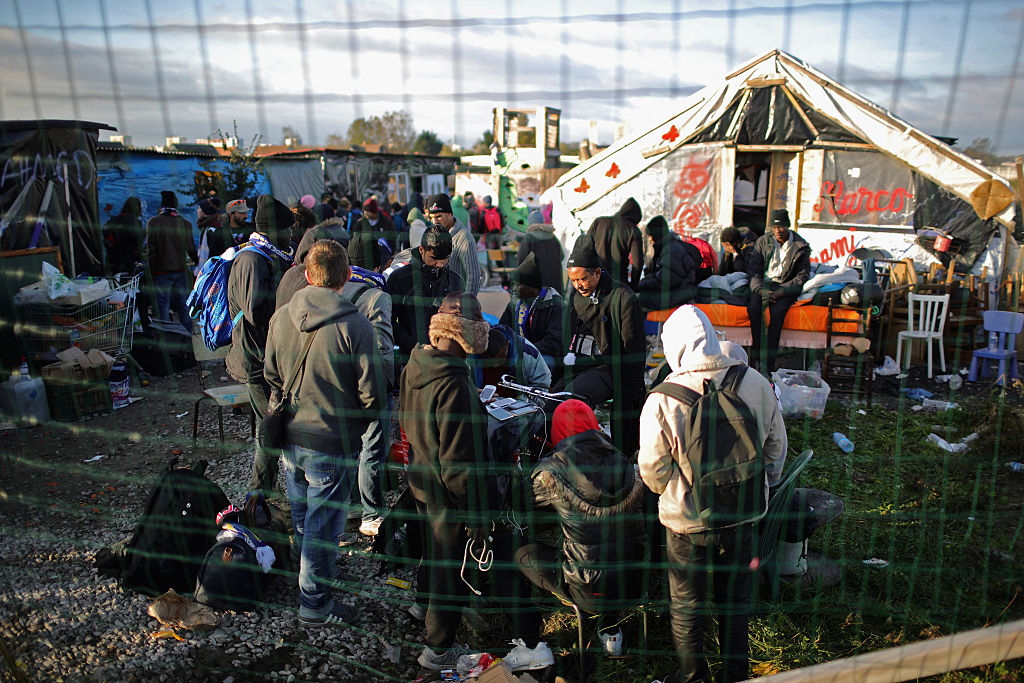
Pictured: Migrants at “The Jungle” migrant camp in Calais, France on October 28, 2016, shortly before the camp was closed by French authorities. (Photo by Christopher Furlong/Getty Images)


In September 2017, the French government asked the European Union for permission to maintain border controls within the passport-free Schengen zone for as long as four years due to the continuing threat of Islamic terrorism, according to a classified document leaked to The Guardian. On October 3, France extended border controls for another six-month period, to April 30, 2018.

On October 15, two weeks after a Tunisian migrant stabbed to death two women in Marseille, Macron pledged to deport any migrant who commits a crime. “We will take the most severe measures, we will do what we must do,” Macron said. “We are not taking all the steps that should be taken. Well, that is going to change.” Analysts said that nuances in French law would make the pledge impossible to implement.

On November 20, in a circular leaked to the press, Interior Minister Gerard Collomb ordered prefects, representatives of the state in each of the 96 departments in mainland France, to deport all failed asylum seekers. He also ordered them to submit a report, by the end of February 2018, that would provide

“details about the fight against irregular immigration in your department in 2017, and your plan for the implementation of these instructions in the coming months. (…) The fight against irregular immigration is the responsibility of each prefect of each department. It is necessary to act quickly.”

The leak of the so-called Collomb Circular marked the beginning of an organized resistance movement among French political and media elites to Macron’s migration policies. In an open letter published by Le Monde, for instance, a group of intellectuals and trade unionists, many of whom had supported Macron during the presidential campaign, criticized his migration policy: “Mr. Macron, your policy contradicts the humanism you advocate!”

On December 4, in an interview with RTL, Interior Minister Collomb said the government was working on a reform of migration policy. “There are 95,000 asylum applications a year, that is, a big city every year. If we welcomed everyone, we could not do it in good conditions. We have decided to welcome those who are refugees from theaters of war, who are political prisoners, but at the same time to try to pursue a policy that allows economic migration to be carried out in other ways.”

On December 12, Interior Minister Collomb ordered regional authorities to establish “mobile teams” to force undocumented migrants out of emergency shelters. The measure produced a strong backlash from charities, which said the shelters are sacrosanct.

On January 9, 2018, the French Office for the Protection of Refugees and Stateless Persons reported that in 2017, more than 100,000 people had requested asylum in France, a “historic” number and an increase of 17% compared to 2016.

On January 14, Interior Minister Collomb announced a plan to establish 400 detention centers to deport economic migrants in the country illegally. “Refugees are welcome, economic migrants are not,” he said.

On January 16, during his visit to Calais, Macron outlined his government’s new immigration policy: food and shelter for those entitled to remain in France, and deportation of those in the country illegally.

On January 18, Macron traveled to Britain, where signed the Sandhurst Treaty, which reduces the processing time for migrants hoping to travel to Britain from Calais from six months to one month for adults, and 25 days for children. The new treaty, far from solving the migrant crisis, appears to be exacerbating it.

In an analysis published by Paris Match, pollsters Chloé Morin and Marie Gariazzo said that conflicting voter reactions to the “Macron method” of compromise on migration policy “reflects the contradictions of his electorate”:

“Quantitative studies indicate, a priori, that a clear majority of French voters support a more restrictive migration policy…. The heart of the government’s policy…guarantees the inviolability of the right to asylum while challenging the country’s ability to welcome all the world’s misery….

“It is not certain that the Macronian gamble — finding a balance between firmness and humanity — is a long-term winner. Emmanuel Macron appears at this stage to be supported by his base. But we find among them an expectation of firmness (‘we must not be overwhelmed,’ ‘laxity would have negative consequences for our country’) as well as one of humanity (‘we must help those fleeing wars and persecutions,’ ‘It is morally indisputable to welcome foreigners in emergency, distress’) ….

“This discourse is thus systematically caught between those on the one hand who — often on the right, but sometimes even in the heart of the Macronian base — judge his policy as too ‘lax,’ and on the other hand, those who are indignant over its firmness ….

“It is very likely that a large part of those at the center of the political spectrum, particularly in the center-left, will accept the government’s narrative and subscribe little-by-little to the logic of ‘selective immigration.’ Thus, the official discourse could contribute in the long term to a shift of the ‘moderate’ population on the subject of migration from one of humanity towards one of firmness.”

Macron’s popularity ratings have experienced an “unprecedented” rebound since he pursued a harder line on immigration, according to the French pollsters Ifop. His job approval rating jumped by 10 percentage points since October to 52%. Previously, Macron’s popularity rating registered the biggest decline for a new president since 1995.

“Emmanuel Macron did it,” Paris Match reported. “Never before has a president of the Republic fallen into unpopularity so fast and then become popular again.”

*  *  *

Appendix: A Brief History of the Migrant Crisis in Calais

Migrants from across the developing world view Britain as “El Dorado” because of its massive underground economy, which totaled approximately £223 billion (€250 billion; $311 billion) in 2016, or 11.5% of GDP, according to the International Monetary Fund.

In addition, the Identity Documents Act 2010, which entered into effect January 2011, abolished national identity cards. The change, driven by civil liberties concerns over unnecessary data collection and intrusion by the state, allows illegal migrants in Britain to remain inconspicuous.

Moreover, unlike France, migrants from war-torn countries who reach Britain can easily apply for refugee status, which provides them with permission to reside in the United Kingdom for an initial period of five years — with the right to work and access welfare benefits. Lawful residence in the UK for a continuous period of five years qualifies an individual to apply for British citizenship.

This combination of factors has turned Britain into a magnet for migrants. More than 865,000 non-EU migrants were granted permission to live in Britain in 2016 — a rate of one every 36 seconds, according to Eurostat.

Migrants have been gathering in Calais, France’s closest point to Britain, in large numbers ever since the Channel Tunnel linking France and Britain opened in May 1994, and the Schengen Agreement, which abolished border controls between France and most of its EU neighbors (but not the UK), entered into force in March 1995.

In 1999, the French government asked the Red Cross to build a migrant “reception center” in Sangatte, situated around ten kilometers west of Calais, to accommodate a growing number of migrants on the streets of Calais and surrounding areas. The Sangatte camp, which was housed in a giant warehouse near the entrance to the Channel Tunnel, had a capacity for 600 people.

Far from resolving the migrant problem in Calais, the Sangatte facility served as a magnet, quickly drawing thousands more people to the area. Within months, some 2,000 migrants were living in the camp in increasingly cramped conditions. Many of those staying at Sangatte tried to jump onto slow-moving trains at the entrance to the Channel Tunnel, or hide inside trucks crossing to Britain on ferries.

At the time, French authorities reported a massive increase in the number of arrests in or around the Channel Tunnel. In 1999, 8,000 people were arrested in Calais for immigration offenses. By 2001, that number had jumped ten-fold to 80,000 arrests. Eurotunnel, the company that manages and operates the Channel Tunnel, said that in 2001 alone, 54,000 people had “attacked” the terminal in Calais and 5,000 had gotten through. Many of those were living in Sangatte.

The Sangatte camp was closed in late 2002, after a series of riots between Afghan and Kurdish migrants. In all, some 67,000 migrants stayed at the facility during its three years in operation.

In February 2003, France and Britain signed the Treaty of Le Touquet, which allows for so-called juxtaposed controls, meaning that travelers between the two countries now clear immigration in the country of departure rather than upon arrival. In effect, the treaty pushed parts of the British border to France. By doing so, it exacerbated the migration bottleneck in Calais.

As part of the agreement to close Sangatte, Britain took in 1,200 migrants. Those who remained in France were sheltered in at least a dozen different squats both inside Calais and on its outskirts. These camps — Africa House, Fort Galloo, Leader Price/Sudanese Jungle or Tioxide Jungle — have been repeatedly raided or bulldozed by French police, only for other squats to crop up elsewhere.

Many of the migrants housed at Sangatte moved a few kilometers east to a disused industrial zone called “The Dunes.” Situated just steps from the Port of Calais, the area would eventually become known as “The Jungle.”

On September 22, 2009, French police bulldozed “The Jungle” and rounded up hundreds of migrants hoping to stow away on trucks headed for Britain. A day later, Calais Mayor Natacha Bouchart said she had “spotted between fifteen and twenty new squats” nearby. She also reported that Afghan migrants were establishing makeshift camps at the Hoverport, an unused collection of buildings which closed in 2005 after the last hovercraft sailed from Dover to Calais.

September 12, 2014. Police in Calais warned that migrants were becoming increasingly violent in their quest to reach Britain. Gilles Debove, the Calais area delegate for the French police union, said tear gas was being used to stop “mass onslaughts” on vehicles about to cross the Channel:

“The other day, two to three hundred migrants tried to get into a lorry park and we fired tear gas to scatter them because there are too few of us to control situations like this any other way. We’re also facing an increase in crimes by migrants who mug people, steal mobile phones and carry out sexual assaults.”

November 11, 2015. More than 250 French riot police were deployed to “The Jungle” after weeks of unrest. Local government official Fabienne Buccio said the rise in violence was due to the frustration of migrants at being prevented from reaching Britain.

December 17, 2015. Around 1,000 migrants stormed the Channel Tunnel in a bid to reach Britain. Police, who used tear gas to disperse them, said the number seeking to cross the Channel in a single day was “unprecedented.” Many of the migrants who were turned away moved back to “The Jungle” to try again.

January 19, 2016. French authorities leveled one-third of “The Jungle” to create a 100-meter “buffer zone” between the camp and an adjacent highway that leads to the ferry port.

February 7, 2016. The migrant crisis spread to other parts of France due to an increased police presence in Calais. Migrant camps sprouted up in the nearby ports of Dunkirk, Le Havre, Dieppe and Belgium’s Zeebrugge, as migrants sought new ways to cross the English Channel to Britain.

February 29, 2016. After a court in Lille approved a plan by the French government to evict 1,000 migrants from “The Jungle,” demolition teams began dismantling the southern part of the camp. The government tried to relocate the migrants to official accommodations inside converted shipping containers in the northern part of the camp. But most refused the offer, fearing they would be forced to claim asylum in France. “Going to Britain is what people here want,” Afghan migrant Hayat Sirat said. “Destroying part of the jungle is not the solution.”

March 7, 2016. Migrants evicted from “The Jungle” moved to a new camp in Grande-Synthe near the northern port of Dunkirk, just up the coast from Calais. Critics said that the new camp risks becoming a “new Sangatte,” referring to the Red Cross center in Calais that was closed in 2002.

May 31, 2016. Migrants evicted from Calais moved to Paris and established a massive squatter camp at the Jardins d’Eole, a public park near the Gare du Nord station, from where high-speed Eurostar trains travel to and arrive from London. The area, which became so dangerous that the government classified it as a no-go zone (Zone de sécurité prioritaires, ZSP), has become a magnet for human traffickers who charge migrants thousands of euros for fake travel documents, supposedly for passage to London.

August 11, 2016. In an interview with Le Figaro, a French counter-terrorism officer warned that Islamic State jihadis were hiding in “The Jungle” camp. “What is happening in ‘The Jungle’ is truly mind boggling,” he said. “Our officers are rarely able to penetrate the heart of the camp. It is impossible to know if a jihadi from Belgium, for example, is hiding in the camp. This camp is a blind spot for national security.”

September 5, 2016. Hundreds of French truck drivers, businessmen and farmers blocked off the main route in and out of Calais, in an attempt to pressure the French government to close “The Jungle.” The blockage brought to a standstill the route used by trucks from all over Europe to reach Calais and Britain.

September 12, 2016. A document leaked to Le Figaro revealed the government’s plan, dated September 1, to relocate 12,000 migrants from Calais to other parts of France. The migrants would be relocated to around 60 so-called Reception and Orientation Centers (centres d’accueil et d’orientation, CAO), each with a capacity for between 100 and 300 migrants.

September 13, 2016. The President of the Alpes-Maritimes region, Eric Ciotti, criticized the government’s “irresponsible” plan to relocate migrants in Calais to other parts of France. He said the plan would “proliferate a multitude of small Calais, genuine areas of lawlessness that exacerbate lasting tensions throughout the country.” He added:

“This plan reflects the resignation of the government in the face of massive illegal immigration. It weakens national cohesion under a false pretext of humanity which hides a dangerous ideology that denies any distinction between foreigners who seek asylum, who France should decently receive, and those who are economic migrants, whom we can no longer tolerate, and who should be returned to their countries of origin.

“The only solution is to deport, without delay, all illegal immigrants who do not intend to remain on our territory, and to place asylum seekers in centers dedicated to the study of their cases.”

September 14, 2016. The President of the Auvergne-Rhône-Alpes region, Laurent Wauquiez, expressed anger at the government’s “diktat” to relocate 1,800 migrants from Calais to his region. He said: “This is madness and it is not a matter of solidarity. The problem of Calais is not solved by multiplying Calais throughout France. We expect the government to solve the problem of Calais, not move it to other parts of the country.”

September 16, 2016. Steeve Briois, the Mayor of Hénin-Beaumont and Vice President of the National Front, criticized the government’s plan to relocate migrants from “The Jungle” to the rest of the country. He said:

“This crazy policy would consequently multiply mini-Calais on the entire national territory, without consulting the people and local elected officials. This forced policy of the Socialist government is simply unacceptable; it seriously threatens public order and the safety of our citizens.”

September 20, 2016. Construction work began on a wall to prevent migrants at the camp from stowing away on cars, trucks, ferries and trains bound for Britain. Dubbed “The Great Wall of Calais,” the concrete barrier — one kilometer (half a mile) long and four meters (13 feet) high on both sides of the two-lane highway approaching the harbor — will pass within a few hundred meters of “The Jungle.”

September 21, 2016. A whistleblower reported that volunteer aid workers at “The Jungle” were forging sexual relationships with migrants, including children. “I have heard of volunteers having sex with multiple partners in one day, only to carry on in the same vein the following day,” he wrote. “And I know also, that I’m only hearing a small part of a wider scale of abuse.” He added that the majority of cases in question involved female volunteers and male migrants. “Female volunteers having sex enforces the view (which many have) that volunteers are here for sex,” he wrote.

October 25, 2016. French authorities began dismantling “The Jungle.” The government said that 4,014 migrants had been relocated or re-sheltered from the camp.

March 3, 2017. Calais Mayor Natacha Bouchart banned local aid groups from distributing free food near the former “Jungle” camp. “I took this decision to make sure that no permanent base or squat is created around Calais,” she said.

April 28, 2017. Emmanuel Macron pledged that, if elected president, he would seek to renegotiate the Le Touquet treaty, which allows British border police to operate in Calais.

June 19, 2017. A Polish truck driver was killed when his truck crashed into another truck that had been stopped on the A16 motorway about 15 kilometers from Calais by migrants seeking to stow away to Britain. Nine Eritrean migrants found in one of the trucks were arrested and were expected to be charged with involuntary homicide, disrupting traffic and endangering people’s lives.

July 7, 2017. French police forcibly removed 2,500 African migrants from Porte de la Chapelle in northern Paris, which has become a gathering point for migrants since the closure of “The Jungle” in Calais.

July 26, 2017. Human Rights Watch accused French police of systematically abusing asylum seekers and migrants, disrupting humanitarian assistance, and harassing aid workers, “behavior that appears to be at least partly driven by a desire to keep down migrant numbers.”

August 8, 2017. The French Interior Ministry reported that more than 17,000 migrants attempted to board UK-bound trucks and trains at the port and Eurotunnel in Calais during the first seven months of 2017. The figures showed that the closure of “The Jungle” in October 2016 had failed to deter migrants in Calais.

August 18, 2017. French police forcibly removed 2,000 African migrants living on sidewalks at Porte de la Chapelle in northern Paris. Interior Minister Gerard Collomb said the police action proved that the system for handling migrants is “dysfunctional.”

September 17, 2017. French police forcibly removed hundreds of migrants from a forest on the northern coast near Calais over fears it could become a magnet for others hoping to head to Britain. Some 350 men, women and children, most of them Iraqi Kurds, had been living for weeks in squalid conditions on the edge of Grande-Synthe.

October 25, 2017. A year after “The Jungle” camp in Calais was razed, the charity Help Refugees reported that between 800 and 2,000 migrants were still gathered there.

November 8, 2017. French police arrested three Iraqis accused of smuggling up to 40 migrants a day to Calais and into Britain in refrigerated trucks.

December 10, 2017. Paris residents furious that hundreds of migrants are sleeping on the streets of their neighborhood threatened to launch a hunger strike unless French authorities remove the squalid makeshift camps. Pierre Vuarin, a spokesman for a neighborhood association, said: “The pavement is sometimes soaked in urine and the streets aren’t cleaned every day. Some people have sold their flats at knockdown prices and others have suffered mental breakdowns.”

December 22, 2017. Abdullah Dilsouz, a 15-year-old Afghan migrant, was crushed to death after he was run over by a truck near the port of Calais.

January 9, 2018. More than 100,000 people requested asylum in France in 2017, a “historic” number and an increase of 17% on the year before, according to the French Office for the Protection of Refugees and Stateless Persons (OFPRA). The principal country of origin for asylum seekers in France in 2017 was Albania, followed by Afghanistan, with 5,987 requests. Of that number, 83% were granted refugee status.

January 16, 2018. On an official visit to Calais, President Emmanuel Macron said he would not tolerate building another “Jungle” camp in Calais: “In no way will we allow illegal routes to be developed here. In no way will we let a ‘Jungle’ spring up, or an illegal occupation of the territory.”

January 18, 2018. President Macron and British Prime Minister Theresa May signed the so-called Sandhurst Treaty, which “complements” the Le Touquet treaty. The treaty requires Britain to reduce the processing time for migrants hoping to travel to Britain from Calais from six months to one month for adults, and 25 days for children. It also requires Britain to pay £44.5 million (€50 million; $62 million) for extra security measures in France to prevent another “Jungle” camp from forming in Calais and other ports. The extra cash will go towards fencing, CCTV and other detection technology.

February 1, 2018. Hundreds of African and Asian migrants armed with knives and iron rods fought running street battles in Calais. Two dozen migrants were injured in what the French government dubbed “unprecedented” scenes of violence among those seeking to reach Britain.

February 3, 2018. The Guardian reported a 25% increase in the number of migrants in Calais. It attributed the surge on the Sandhurst Treaty, which raised “false hopes” that it would be easier to reach Britain.

via RSS http://ift.tt/2E6e4B2 Tyler Durden

Why FX Volatility Is Lagging VIX (And What Happens Next)

We noted last night that, for now, it appears there is no contagion to other asset-classes from the explosion in equity volatility expectations…

While rates, FX, and oil vol has picked up, it remains notably low (and well below longer-term averages).

Credit Agricole’s Valentin Marinov explains why and what happens next…

FX volatility gauges have clearly lagged behind other vol measures like VIX during the latest bout of escalating risk aversion. Indeed, whereas the VIX has recently hit its highest levels in almost seven years, our index of G10 USD-crosses implied volatility has barely managed to scale its highs from September 2017 and has remained well below its long-term averages.

In addition, a look at the relative G10 performance since last week would highlight that the biggest losers were the European currencies like EUR, GBP, NOK and SEK rather than the ‘usual suspects’ AUD and especially NZD. At the same time, USD emerged victorious even against safe havens like JPY and CHF. It seems therefore that a positioning unwound rather than the FX sensitivity to risk aversion could explain the moves.

Does the above discrepancy indicate that the FX markets are lagging the equity markets so that investors should turn even more negative on risk-correlated and commodity currencies?

We think that cautiousness is certainty warranted and as a result we maintain our relatively bearish outlook for AUD and NZD in the near-term. That said, there are other factors that make us think that the FX volatility may continue to lag the equity volatility. The main reason seems to be the relatively subdued correlation between USD and US rates and UST yields. This has been attributed to the flattening of the UST curve that has been in place for most of 2017. In turn, this reflected investors’ belief that the Fed tightening cycle how now matured so that any future rate hike would have less of a positive impact on USD. All this also implies that the recent surge in UST yields is less positive for USD than it is negative for US stocks.

There has been some contained bear steepening of UST curve since the start of February and this may explain the renewed recoupling between USD and the elevated US rates and UST yields that helped the dollar regain some ground across the board in the last few days.

The question for us is whether this correlation will grow in intensity so that higher yields result in stronger USD, trigger more unwinding of USD-funded carry trades and thus fuel realized and implied FX volatility.

That may indeed be the main risk in the near term especially if the Fed officials or a potential US government shutdown trigger further bear steepening of the UST curve. Over longer-term, however, the UST curve may resume its flattening trend and this should, once again, deprive USD from any US rates or UST yields support.

As a result, the moves in the USD-crosses may remain relatively more contained than in the stock markets and the FX volatility may continue to lag the stock market volatility.

via RSS http://ift.tt/2nRklJJ Tyler Durden

Turkey’s Offensive In Syria: The US Falls Into A Trap Of Its Own Making

Authored by Peter Korzun via The Strategic Culture Foundation,

In the heat of the battle for Afrin, Turkey has warned it will go farther to establish control over vast swathes of land in northern Syria. The offensive  is supposed to take Turkish forces as far as Syria’s border with Iraq. On Jan. 28, Ankara called on Washington to withdraw its military from Manbij (100 km from Afrin) before it launches an operation to clear that area of Kurdish militias. It’s important to note that the US had provoked Turkey’s action by announcing its decision to set up a new border security force in the areas under Kurdish control. So Washington has created this situation all by itself – a trap of its own making. Having sown the wind, it reaps the whirlwind.

A push to the east will potentially force a confrontation between Turkish troops and the US-led Syrian Democratic Forces (SDF). The Kurdish combat units in Afrin missed their opportunity to avoid a worst-case scenario.

Some Pro-Kurdish sources say Russia had betrayed the Afrin Kurds by pulling its peacekeepers out before the Turkish attack began. This is a very misleading statement. Let’s look at the facts. Moscow believes all regions west of the Euphrates should be under the control of the regular Syrian army, because these areas belong to Syria – a territorially cohesive country with a legitimate government. Russia had asked the Kurds in Afrin to interact with Damascus and allow its regular army into the area. They refused. Moscow is still ready to act as a mediator to broker talks on autonomy within Syria. So far that initiative has been rejected. The Kurds have preferred the US as their protector. Now they are on their own. They’ve made their bed, now they must lie in it.”.

The US military has not defended the Kurds in Afrin, claiming it does not regard them as allies on par with the Kurds who are part of the SDF farther east. The US maintains that the Kurds in Afrin did not fight the Islamic State (IS). But even so, those Kurds did protect Afrin and kept their land from being invaded by jihadi militants. Perhaps the US never committed itself to defending the Kurds in Afrin, but it did accept the responsibility of protecting the SDF in Manbij. What will happen now? It is next to impossible to make predictions with any degree of accuracy, but we can contemplate some potential scenarios.

The Turkish Hürriyet Daily News reported that the US and Turkey are in talks over ways to de-escalate the conflict. NATO Deputy Secretary General Rose Gottemoeller has confirmed that fact, but it’s not clear how that would jibe with the offensive announced by Ankara to capture the land held by the SDF. In any event, it would be too humiliating for Washington to give in to Turkey’s demand. If the US fails to protect its Kurdish allies, it will have no reason to maintain its military presence in Syria. It will have to leave the country, just as Russia and Syria have requested.

One potential scenario would include inciting a broader uprising of Kurds that would encompass Turkey, Iran, and Iraq. That might reshape the regional map. A development like that is not outside the realm of possibility.

Another consequence – NATO’s cohesion has already been undermined now that Turkey and the US are supporting opposite sides. If the situation continues to deteriorate, the US will either blink first or it will ask NATO to suspend, or even expel, Turkey from that organization, at least as long as President Erdogan is in power. This would naturally push Ankara in the direction of Moscow and Beijing, if it should move from NATO to the Shanghai Cooperation Organization. President Erdogan only recently mentioned how tired he was of the whole EU membership process.

A political defeat for the US is the most probable outcome. Washington will have to pay for its lack of a clear action plan in Syria and its inability to fully grasp the situation. Obviously Washington is in a predicament. It is up against a very hard choice.

If the US intends to stay in northern Syria, it certainly needs the Kurds. But if America sides with the Kurds, it will lose Turkey. It might find itself excluded from the entire nation-building process, since it is hostile toward all the major actors: the Syrian government; Russia; Iran; and Turkey. If it abandoned the Kurds, that would be a blow to its credibility in the Middle East, given its recent split with the Palestine Authority over the recognition of Jerusalem.

If the US manages to reach an agreement with Turkey, that will mean farewell to the prospect of Syrian Kurdistan obtaining a special status that would make it an independent state, whether just in practice or perhaps even officially. The Turkish offensive is likely to make the Kurds more willing to negotiate with Damascus. A future alliance with the Syrian government is an alternative that would push the Kurds into the peace process. It would boost Syria’s chances of remaining an undivided state. Moscow could act as a mediator between Damascus, the Kurds, and Ankara. After all, Moscow is one of few capitals where the Syrian Kurds maintain a representative office.

All efforts should be exerted within the framework of the Astana peace process, which is being directed  by Moscow, Ankara, and Tehran. Washington has always emphasized that its goal in Syria was to fight against IS. But that jihadist group is now so diminished as to be insignificant in Syria. The mission has been accomplished. Why should Washington expend more time and effort, balanced on the brink of armed conflict with Ankara or with any other actor in Syria? After all, if the Astana peace process succeeds, America’s European allies will heave a sigh of relief as the waves of refugees from Syria abate. The best thing the US could do under these circumstances would be to pull out of Syria, focus on diplomacy, and just give peace a chance.

via RSS http://ift.tt/2nPzEmc Tyler Durden

Germany Still Holds The Most Winter Olympics Medals

The first ever Winter Olympic Games were held in Chamonix in the French Alps in 1924 – 16 nations took part, competing for medals in 9 disciplines.

The most recent winter games were held in the Russian resort of Sochi in 2014, where 88 nations competed in 15 disciplines.

This week, the 23rd games will start with an opening ceremony in Pyeongchang in South Korea on Saturday. They will go on for two weeks, until February 25.

As Statista’s Dyfed Loesche notes, Germany has so far been able to rake in most medals at the Winter Olympics, standing at 377 today. This is counting in all medals German teams have acquired, from Nazi Germany, through to Germany divided in to East and West and after reunification in 1990.

Infographic: Germany Still Holds Most Medals | Statista

You will find more infographics at Statista

In second place, Russia had a good run in Sochi, but the International Olympic Committee (IOC) decided to bar 43 Russian athletes from competing at this year’s winter games, as they stand accused to have profited from systematic doping in 2014.

On Thursday the international sports court CAS overturned some of these suspensions.

via RSS http://ift.tt/2nJlL9V Tyler Durden

Little Barbies: Sex Trafficking Of Young Girls Is America’s Dirty Little Secret

Authored by John Whitehead via The Rutherford Institute,

They’re called the Little Barbies.

Children, young girls—some as young as 9 years old—are being bought and sold for sex in America. The average age for a young woman being sold for sex is now 13 years old.

This is America’s dirty little secret.

According to the National Center for Missing & Exploited Children,Children are being targeted and sold for sex in America every day.”

Sex trafficking—especially when it comes to the buying and selling of young girls—has become big business in America, the fastest growing business in organized crime and the second most-lucrative commodity traded illegally after drugs and guns.

As investigative journalist Amy Fine Collins notes, “It’s become more lucrative and much safer to sell malleable teens than drugs or guns. A pound of heroin or an AK-47 can be retailed once, but a young girl can be sold 10 to 15 times a day.”

Consider this: every two minutes, a child is exploited in the sex industry.

According to USA Today, adults purchase children for sex at least 2.5 million times a year in the United States.

Who buys a child for sex? Otherwise ordinary men from all walks of life.

They could be your co-worker, doctor, pastor or spouse,” writes journalist Tim Swarens, who spent more than a year investigating the sex trade in America.

In Georgia alone, it is estimated that 7,200 men (half of them in their 30s) seek to purchase sex with adolescent girls each month, averaging roughly 300 a day.

On average, a child might be raped by 6,000 men during a five-year period of servitude.

It is estimated that at least 100,000 children—girls and boys—are bought and sold for sex in the U.S. every year, with as many as 300,000 children in danger of being trafficked each year. Some of these children are forcefully abducted, others are runaways, and still others are sold into the system by relatives and acquaintances.

“Human trafficking—the commercial sexual exploitation of American children and women, via the Internet, strip clubs, escort services, or street prostitution—is on its way to becoming one of the worst crimes in the U.S.,” said prosecutor Krishna Patel.

This is not a problem found only in big cities.

It’s happening everywhere, right under our noses, in suburbs, cities and towns across the nation.

As Ernie Allen of the National Center for Missing and Exploited Children points out, “The only way not to find this in any American city is simply not to look for it.”

It is estimated that there are 100,000 to 150,000 under-aged child sex workers in the U.S.

Every year, the girls being bought and sold gets younger and younger.

Social media makes it all too easy for young people to be preyed upon by sexual predators.

As one news center reported, “Finding girls is easy for pimps. They look on MySpace, Facebook, and other social networks. They and their assistants cruise malls, high schools and middle schools. They pick them up at bus stops. On the trolley. Girl-to-girl recruitment sometimes happens.” Foster homes and youth shelters have also become prime targets for traffickers.

With a growing demand for sexual slavery and an endless supply of girls and women who can be targeted for abduction, this is not a problem that’s going away anytime soon.

In fact, this growing evil is, for all intents and purposes, out in the open: trafficked women and children are advertised on the internet, transported on the interstate, and bought and sold in swanky hotels.

Indeed, as I make clear in my book Battlefield America: The War on the American People, the government’s war on sex trafficking—much like the government’s war on terrorism, drugs and crime—has become a perfect excuse for inflicting more police state tactics (police check points, searches, surveillance, and heightened security) on a vulnerable public, while doing little to make our communities safer.

So what can you do?

Educate yourselves and your children about this growing menace in our communities.

Stop feeding the monster: Sex trafficking is part of a larger continuum in America that runs the gamut from homelessness, poverty, and self-esteem issues to sexualized television, the glorification of a pimp/ho culture—what is often referred to as the pornification of America—and a billion dollar sex industry built on the back of pornography, music, entertainment, etc.

This epidemic is largely one of our own making, especially in a corporate age where the value placed on human life takes a backseat to profit. It is estimated that the porn industry brings in more money than Amazon, Microsoft, Google, Apple, and Yahoo.

Call on your city councils, elected officials and police departments to make the battle against sex trafficking a top priority, more so even than the so-called war on terror and drugs and the militarization of law enforcement.

Stop prosecuting adults for victimless “crimes” such as growing lettuce in their front yard and focus on putting away the pimps and buyers who victimize these young women.

Finally, the police need to do a better job of training, identifying and responding to these issues; communities and social services need to do a better job of protecting runaways, who are the primary targets of traffickers; legislators need to pass legislation aimed at prosecuting traffickers and “johns,” the buyers who drive the demand for sex slaves; and hotels need to stop enabling these traffickers, by providing them with rooms and cover for their dirty deeds.

That so many women and children continue to be victimized, brutalized and treated like human cargo is due to three things: one, a consumer demand that is increasingly lucrative for everyone involved—except the victims; two, a level of corruption so invasive on both a local and international scale that there is little hope of working through established channels for change; and three, an eerie silence from individuals who fail to speak out against such atrocities.

But the truth is that we are all guilty of contributing to this human suffering. The traffickers are guilty. The consumers are guilty. The corrupt law enforcement officials are guilty. The women’s groups who do nothing are guilty. The foreign peacekeepers and aid workers who contribute to the demand for sex slaves are guilty. Most of all, every individual who does not raise a hue and cry over the atrocities being committed against women and children in almost every nation around the globe—including the United States—is guilty.

via RSS http://ift.tt/2nOc3Cl Tyler Durden

Student-Loan Crisis Worsens; Looming Defaults Strain Govt Bailout Program

As the student loan bubble continues to burst, record numbers of Americans enrolling in government subsidized student loan debt-forgiveness plans, known as income-driven repayment, are on track to send the US student-loan program into negative territory, according to a report by the Department of Education’s inspector general.

Debt-laden graduates search for the six-figure jobs they were promised

The plans, known as income-driven repayment, set monthly payments as a percentage of a borrower’s earnings and typically forgive balances after 10 or 25 years, depending on the borrower’s career field and debt amounts.

Overall, borrowers in income-driven repayment will repay less than what they originally borrowed, the report said, draining the program of billions of dollars in expected revenue. –WSJ

As we reported last month, nearly 40% of student loans taken out in 2004 may default by 2023 according to a report by the Brookings Institute – blowing past all previous projections.

a

Of note, approximately 5% of undergraduates took out private student loans in 2004, which swelled to 14% of undergraduates by 2008 – 2,901,000 students according to ticas.org. Private student loans, as opposed to federal student loans, are unable to participate in income-driven government repayment programs

The federal student loan system had originally been projected to turn a profit of $25 billion on all loans made up to Sept. 30, 2015 – however that number has been revised down to $5 billion, according to the IG report. The income-driven repayment program alone will cost the government $11.5 billion in revenue. 

“The data show the total costs for all loans…approaching an overall positive subsidy,” which translates to a net cost to taxpayers, i.e. the program going into the red – according Patrick Howard, the department’s assistant inspector general for audit.

a

The IG report was highly critical of the Department of Education for a glaring lack of transparency over the student loan program – which has grown to one of America’s largest consumer loan portfolios. A cumulative $1.4 trillion in federal student debt is owed by 43 million Americans – which is unable to be discharged in bankruptcy. As such, the debt forgiveness program is the only hope if the six-figure job borrowers were promised before taking out a six-figure loan didn’t materialize. 

Republicans in Congress have criticized the debt forgiveness plan created by the Obama administration, as they say the plans are being taken advantage of on a large scale. 

“What was designed as a temporary safety net has become the standard where students expect their debt to be forgiven after a certain amount of time,” Sen. Lamar Alexander (R., Tenn.), head of the committee overseeing education, told the Senate during a hearing last week. “We will not know the impact of so many borrowers being in this program for another decade, when the first set of borrowers begin to have their debt forgiven.”

The Department of Education has committed to providing more transparency going forward, stating in the report that it is “committed to the transparent communication of the Federal student loan program costs, including describing trends in repayment options that may impact future estimated costs.” 

As we reported last July, the US saw its largest one-month outlay on record at $429 billion, 33% higher than its July 2016 outlay –  because the Treasury revised up its estimates of the subsidy cost of student loans, and to a lesser extent housing, it guarantees.

a

Here is the CBO explanation:

Outlays for the Department of Education rose by $31 billion (or 51 percent), because the department revised upward, by roughly $39 billion, the estimated net subsidy costs of loans and loan guarantees issued in prior years—a change much larger than last year’s $7 billion upward revision. If the effects of those revisions were excluded, outlays for the department for the first nine months of fiscal year 2017 would have fallen by $2 billion (or 3 percent).

Outlays for the Department of Housing and Urban Development rose by $29 billion, primarily because the department made upward revisions in June 2017, but downward revisions in April 2016, to the estimated net subsidy costs of loans and loan guarantees issued in prior years.

While the federal student loan debacle is going to fall on the shoulders of US taxpayers, it will be interesting to see how private lenders – such as Wells Fargo, adapt to 40% of their 2004 loans defaulting within the next five years. 

via RSS http://ift.tt/2nKcuhO Tyler Durden

“Hostiles…”

Authored by Jim Quinn via The Burning Platform blog,

I don’t like going to the movies. Too much hassle, too many commercials and previews, too expensive, and 90% of the movies are worthless drivel, SJW inspired crap, or government buoyed propaganda. Last weekend was my wife’s birthday and she wanted to see a movie. When she shockingly suggested a western, I reluctantly agreed. So my wife and one of my sons got in the car and headed to an old Franks theater in Montgomeryville that only charges $8.50. I had seen a brief review of Hostiles on-line and saw it got a decent rating on rotten tomatoes. I was looking forward to being mildly entertained.

The next two hours and fifteen minutes of this dark, somber, violent, morally ambiguous treatise about the old west cannot be described as enjoyable.

But I did find it riveting and thought provoking. Christian Bale, as Captain Joseph Blocker, mournfully carries out his duties without a single smile crossing his bearded countenance for the entire movie. The tone, atmosphere and message of this film reminded me of my favorite western and subject of the final part of my five part series based on Clint Eastwood movies – Unforgiven. One of the soldiers in Hostiles even has dialogue almost matching Will Munny’s foreboding exchange at the end of Unforgiven:

“That’s right. I’ve killed women and children. I’ve killed just about everything that walks or crawled at one time or another. And I’m here to kill you, Little Bill, for what you did to Ned.”

It was clear to me Scott Cooper, the director, was paying tribute to Eastwood and his Academy Award winning revisionist western classic, with his dark cinematography, introspective atmosphere, and themes of good, evil, heroism, aging, duty and courage. Movies in this age of shallowness, disinformation, and fake news rarely broach subjects like the treatment of Native Americans in the 1800s.

The usual superficial Hollywood treatment paints a black and white picture of good and evil; right and wrong; good guys and bad guys, when the true picture is a swirling surreal portrait of opacity and moral relativism. The reason Unforgiven is considered a classic is its honest portrayal of the brutality, murder, reputation, heroes, villains, and the blurred line between good and evil.

Hostiles tells the story of Captain Joseph Blocker who is on the verge of retirement after decades of fighting Indians, with a reputation as the most relentless, brutal and unforgiving Indian fighter in the U.S. Cavalry. By order of the president he is tasked with returning a paroled and dying of cancer Cheyenne Chief – Yellow Hawk – to his home Valley of the Bears in Montana so he can be buried in his birthplace. He initially refuses the assignment because of his blind hatred of all Indians and specifically Yellow Hawk.

During his decades of fighting Indians, he found Yellow Hawk to be his equal in murderous brutality and disdain for his enemies. He personally slaughtered four of Blocker’s closest friends. His colonel threatens him with court martial and the loss of his government pension if he does not carry out his orders. Always the good soldier, he obeys and leads his hand-picked men as they begin their mission.

Shortly after undertaking their mission they come across a burnt out homestead where a Comanche renegade war party had killed and scalped the patriarch, shot and killed his three children and left a shattered wife who had hidden in the woods to escape slaughter. The stoic, gruff, hard hearted Blocker makes the executive decision to escort this broken woman to safety, the soldier displaying a degree of compassion that almost renders him unrecognizable.

The dangerous journey to Montana becomes a metaphor for Blocker’s passage from blind hatred to trust, understanding and retrieval of his humanity. After a lifetime of barbarity and animosity, killing without remorse because he didn’t see his enemy as human, Blocker gradually gains perspective and empathy.

Image result for yellow hawk hostiles

After his unit is attacked by the same murderous Comanche war party and he loses some of his few soldiers, Blocker reluctantly removes the chains from Yellow Hawk, who gives his word to help defend their small contingent. They prove their worth and allegiance by sneaking out of camp in the middle of the night and slaughtering the Comanche warriors and then returning. Blocker silently acknowledges this act, beginning to shift his preconceived beliefs about Yellow Hawk and his Cheyenne brethren.

A grudging respect between mortal enemies develops as the journey and metaphor intersect and the violence of the old West continues unabated. The line between heroes, villains, bravery, cowardice, murder and self-defense blurs, as the concept of morality is distorted by the lawlessness of an unforgiving world. The old West was far more complex than portrayed by the Hollywood entertainment complex.

Despite a well-crafted film and an Academy Award winning lead, I believe this western will not connect with Americans and draw a large audience because we are in the midst of a Fourth Turning.

Movies and books become blockbusters when they reflect the current mood of the country. The violent backdrop of Hostiles fits into the current paradigm, but its message of compromise, understanding, and reconciliation is inconsistent with the current disposition of the American populace.

Americans are in a fighting mood. Just as physical altercations broke out on the floors of Congress in the 1850s and compromise became impossible, the current animosity in the political realm has crossed the point of no return. Self-proclaimed moderates have no say in the current poisoned partisan atmosphere. The pure hatred and vitriolic loathing of opponents for control of this country has reached a breaking point.

Hostile is the perfect description for the factions clashing for control of the American Empire. The last week revealed the Deep State conspiratorial plot to prevent Donald Trump from winning the presidency. A sitting president, his high level lackeys in the FBI and DOJ, crooked Hillary, and the left wing propaganda spewing media, colluded to steal the presidential election – essentially committing treason. A few years ago only obscure bloggers used the term Deep State to describe the shadowy wealthy interests pulling the strings behind the scenes and ruling over the peasants through a combination of fear, disinformation, surveillance, propaganda, and control of the legislative, judicial and executive branches.

Now there is irrefutable proof Edward Bernays was telling the truth in 1928 regarding an invisible government manipulating the habits and opinions of the ignorant masses to benefit their own self interests. The level of control and manipulation has reached a tipping point. The internet, obscure bloggers, and a small but vocal irate minority setting brush fires of freedom in the minds of critical thinking citizens has foiled the plans of Deep State traitors.

The unanticipated election of Trump has unleashed a tsunami of civil strife, plots to undermine the presidency, exposing the corporate fake news media as co-conspirators of the Deep State, and an out of control surveillance state that makes Orwell’s 1984 Big Brother seem like a piker. Make no mistake about it, there is a civil war ongoing in this country and the outcome is very much in doubt.

The three critical factors driving this Fourth Turning continue to be civic decay, global disorder and debt.

As described, civic decay is accelerating at an astounding rate, hurtling the country towards a Constitutional crisis. Every day new evidence of surveillance state misdeeds feeds the rage building among critical thinking non-partisan Americans. The American military empire is actively engaged in Syria, Iraq, Afghanistan, Africa, and other countries around the globe. Turkey is at war in Syria with our Kurd allies.

Our Al Qaeda backed rebels are fighting Assad and Russia. The Ukraine is a powder keg, with our installed lackey president pushing for conflict with Russia. Israel and Hamas are on the verge of war. Iran and Saudi Arabia are fighting a proxy war in Yemen. The Korean peninsula could explode at any moment. Global disorder is mounting in intensity and dimension. America’s belligerency, policing the world, provoking Russia and China into an alliance, and pursuing the agenda of neocons and the military industrial complex, pushes the world ever closer towards a global conflict.

The third core element of this Fourth Turning has thus far been the component temporarily concealing the foulest aspect of this ongoing crisis. The Deep State and their financiers at the Fed and Too Big To Trust Wall Street banks have propped up a debt saturated failing financial system with tens of trillions in additional debt. By artificially suppressing interest rates; rigging stocks, currencies and precious metals through the shadowy derivatives market and dark pools; and providing free money to Wall Street bankers, they have purposely created the largest bubble in world history in stock, bond and real estate markets simultaneously. The “Everything Bubble” puts all other bubbles to shame. Just the slowing of debt creation is beginning to reveal cracks in the system.

Image result for everything bubble zero hedge

The average American has been led to believe the current bull market is due to an improving economy or some other such tripe. Their delusions are built on a vaporous foundation of unpayable debt and relentless propaganda spewed by the corporate media. This debt based paradigm is mathematically unsustainable. A 1% increase in interest rates blows the entire Ponzi scheme sky high – and rates have begun to rise. The ten year Treasury breaching 2.8% last week led to a 1,100 drop in the Dow in the blink of an eye. When greed turns to fear, look out below.

Buy the dip says the Wall Street shill “experts” who are paid to tout stocks. Debt is still the key focal point which will propel this Fourth Turning towards its climax. Leverage is a beautiful thing during a crack up boom, as speculators who believe they are brilliant investors appear to get money for nothing. During the inevitable bust the highly leveraged “investing experts” see their faux wealth evaporate in an instant, while the debt remains and must be serviced.

I wonder how the investing geniuses who bought bitcoin at $18,000 with their credit card a few weeks ago are feeling now with bitcoin below $8,000. It appears this fragile fake financial house of cards, built on a titanic mountain of dodgy debt, is wobbling and the slightest gust of wind or 25 basis point increase in interest rates endangers all of the Deep State machinations to prop up their failing social order. When average Joes and Janes see their 401ks obliterated for the third time in the last two decades, they will be enraged and susceptible to the ravings of the latest politician lunatic savior. When people lose it all, they will lose control of their reason, and all hell will break loose.

Once financial hardship sweeps over the land, the civic decay and global disorder will fuse with the anger of the populace and thrust this crisis into a violent dimension. The use of debt by the Deep State ruling class has disguised the rot in the system, but will turbocharge the downside as financial collapse and universal dismay with those in power leads to violence, bloodshed and war.

If you think the current environment is hostile, you haven’t studied history to understand the death and destruction wrought during the climaxes of the last two Fourth Turnings. Millions will die before this is over. We are exiting the eye of the hurricane and the risk of catastrophe is high. You can feel the swelling peril in your bones. Get your affairs in order and get ready for the next phase of this crisis.

Image result for exiting the eye of a hurricane

“The risk of catastrophe will be very high. The nation could erupt into insurrection or civil violence, crack up geographically, or succumb to authoritarian rule. If there is a war, it is likely to be one of maximum risk and effort – in other words, a total war. Every Fourth Turning has registered an upward ratchet in the technology of destruction, and in mankind’s willingness to use it.” – Strauss & Howe – The Fourth Turning

via RSS http://ift.tt/2C0k78k Tyler Durden

“Sea Hunter” – A Drone Ship With No Crew Just Joined The US Naval Fleet

In the latest installment of the Pentagon’s preparation for the fast-approaching drone wars, a prototype autonomous ship known as the Medium Displacement Unmanned Surface Vehicle (MDUSV) has successfully been transferred to the United States Navy from the Defense Advanced Research Projects Agency (DARPA), after it completed its multi-year Anti-Submarine Warfare (ASW) Continuous Trail Unmanned Vessel (ACTUV) program.

The autonomous ship “Sea Hunter”, developed by DARPA, is shown docked in Portland, Oregon after its christening ceremony, April 7, 2016. REUTERS/Steve Dipaola

Christened as the “Sea Hunter,” the Office of Naval Research (ONR) will take the reins from DARPA in the development process, which the anti-submarine warfare vessel could be the first of an entirely new class of warship for the United States Navy. The vessel can travel thousands of miles and even stay at sea for months without the need of a manned crew.

“ACTUV’s move from DARPA to ONR marks a significant milestone in developing large-scale USV technology and autonomy capabilities,” said Alexander Walan, a program manager in DARPA’s Tactical Technology Office (TTO).

“Our collaboration with ONR has brought closer to reality a future fleet in which both manned warships and capable large unmanned vessels complement each other to accomplish diverse, evolving missions,” Walan added.

“ONR appreciates the truly impressive work by DARPA in advancing this technology, and the strong partnership we’ve had on ACTUV over the years,” said Robert Brizzolara, ONR program officer for MDUSV.

“As ACTUV transfers from DARPA to ONR, ONR is looking forward to continuing and capitalizing on the science and technology work. In particular, we are already working on autonomous control, a challenging area that is key to maturing MDUSV and delivering it to the fleet,” he said.

“ACTUV represents a new vision of naval surface warfare that trades small numbers of very capable, high-value assets for large numbers of commoditized, simpler platforms that are more capable in the aggregate,” said Fred Kennedy, TTO director.

“The U.S. military has talked about the strategic importance of replacing ‘king’ and ‘queen’ pieces on the maritime chessboard with lots of ‘pawns,’ and ACTUV is a first step toward doing exactly that,” he stated.

Newsweek outlines the cost benefits of the drone-ship and points out its strategic purpose of a “surveillance vehicle.”

The vessel comes at a relatively cheap $20 million prospective price tag and takes only around $20,000 a day to run. This figure is less expensive than a crew-run ship and also nixes potential personnel risks when navigating dangerous missions, such as navigating a minefield. Without firepower onboard, the Sea Hunter is currently a surveillance vehicle. Its tests so far have revolved around how easily and autonomously the vessel can maneuver its 132-foot-long body, accelerate to speeds nearing 27 knots, and using use radar and cameras to spot other vessels.


Sea Hunter christening ceremony in Portland, Oregon. (U.S. Navy photo by John F. Williams/Released)

Last month, General Mark Milley warned an audience at the Association of the United States Army’s Institute of Warfare event, that the United States must embrace artificial intelligence, robotics, and other emerging technologies immediately to maintain relevance on the ever so changing battlefield.

“I don’t know if artificial intelligence is going to mean robots and machines replace humanity… but I do know the quantum computing and some of the IT technologies that are out there today are so significant and can help you [with] rapid decision-making in complex decentralized environments – that if we don’t take advantage of that in things like the network—then we would be fools because others are moving out quickly on that,” Milley said.

“Every vehicle is going to have the capability to be robotic,” he said, stressing the importance of a vehicle’s flexibility in giving options to a commander on the front lines, giving him options without requiring different vehicles to be deployed. “He can estimate the situation, he can make a determination as to whether he wants this assault to be manned or unmanned,” Milley explained

As a whole, the Pentagon is racing against the clock to implement future combat systems of tomorrow into the military vehicles of today. Just take note, what is happening in the United States Navy with the new addition of “Sea Hunter,” signals the modernization of America’s military will be through the adoption of autonomous vehicles. When the next major conflict breaks out, it is likely that machines will be on the front-lines waging an unemotional war against each other.

via RSS http://ift.tt/2BKV3Xi Tyler Durden