“Euphoria Turns To Terror”: Dow To Open 750 Points Lower As VIX Eruption Accelerates

It’s a bloodbath, with the Dow set to open 750 points lower thanks to the +377 fair value…

… but it could have been much worse, with S&P futures actually trading toward the highs of the overnight session after tumbling an additional 3.5% from Monday’s close, as risk assets around the world crashed then modestly rebounded even as traders remain on edge over what the implosion in the vol complex means for everyone.

World stock markets nosedived for a fourth day running on Tuesday, having seen $4 trillion wiped off from what just eight days ago had been record high values.

“Playtime is officially over, kids,” analysts at Rabobank said. “Rising volatility painfully reminds some investors that one-way bets don’t exist.”

“Since last autumn, investors had been betting on the ‘Goldilocks’ economy – solid economic expansion, improving corporate earnings and stable inflation. But the tide seems to have changed,” said Norihiro Fujito, senior investment strategist at Mitsubishi UFJ Morgan Stanley Securities.

Meanwhile, “The euphoria has turned to terror.”

There was a modest bound in European bourses, which opened sharply lower in the wake of the largest ever point loss in Dow Jones Industrial Average history. London’s FTSE 100 lost 3.5% at the opening bell, with every constituent falling and financial stocks hit hardest. The Europe-wide Stoxx 600 fell 2.2 %, while Frankfurt’s Xetra Dax 30 fell 3.5%, before recouping some losses.  As of this writing, core European cash equity markets trade around -1.5%/-2.0%.

In fact, as Bloomberg notes, the Stoxx Europe 600 Index at one point today slumped the most since Brexit, with every industry sector falling as much as 2 percent.

This came after massive falls on Asian bourses. Stocks in Japan and China were the worst hit, with Hong Kong tumbling over 6% in early trading. Japan’s Topix index was down by more than 6%, marking its biggest one-day fall in a year and a half, while Japan’s Nikkei entered a correction, after plunging as much as 7.1%, triggering JSCC intraday margin call for Japanese index futures.

And while Asian stocks also managed to rebound modestly from overnight lows it was not before the MSCI Asia Pacific index erased 2018 gains, just like the Dow Jones, which is itself on the verge of a -10% correction.

Meanwhile, in some welcome news, there was at least a little normalcy as Treasuries extend their safe-haven rally with 10-year yield down three basis points to 2.68%, while euro-area bonds found support.

The currency market was stock-driven for another day with the dollar turning negative as European equities pared losses and S&P futures traded briefly in the green, and now the BBDXY is virtually unchanged.

As Bloomberg notes, major G-10 FX pairs again remain relatively immune to wild equity swings, yuan rallies after PBOC says the market will have a larger role in FX rate; USD/JPY holds close to 109.00. Haven demand eased modestly, with the yen and the Swiss franc turning defensive. The euro moved above the $1.24 handle as short-term accounts closed shorts with a loss. The Aussie remains lower after uneventful RBA policy meeting.

Whipsaw in core fixed income, early trades see fading of rally in UST, Bund and Eurodollar futures before uptick in volatility measures prompts reversal; UST/bund spread wider by 7bps with futures block trades in focus, iTraxx crossover opens sharply wider but settles close to key 260bps level. Bitcoin briefly trades below $6k level.

In the commodities complex, both WTI and Brent crude futures trade lower albeit off worst levels with prices suppressed by the ongoing global risk sentiment; the recovery for WTI has also been stalled by a failure to reclaim USD 64/bbl to the upside with energy newsflow otherwise relatively light ahead of tonight’s API inventories. In metals markets, spot gold (+0.25%) continues to benefit from its safe-haven appeal and the softer USD despite the World Gold Council stating that demand for the yellow metal fell to its lowest level since 2009 during 2017.  The Bloomberg Commodity Index is trading 0.2% lower, having pared loss of as much as 0.4% earlier.

But unlike recent days, when attention was on US TSYs and the Dollar, today – and for the coming days – it will be all about the VIX, which extended its advance after Monday’s biggest-ever jump, which sent it higher by 116% on the session, heading for a level not seen since August 2011.

As of 6:39am in New York, the VIX climbed another 24% to 46.37. As discussed last night, the surge in the volatility measure is already claiming casualties, with various VIX-linked ENT set for “termination” and raising questions about the future of exchange-traded products tied to it.

And while we wait for today’s trading session to unfold, here is what else happened overnight.

Bulletin Headline Summary from RanSquawk

  • European equities join the global sell-off as markets look to see whether Wall St will endure another day of heavy losses
  • That said, markets have gradually pared losses throughout the morning as commentators debate whether this is a minor blip or part of a larger correction
  • Looking ahead, highlights today include Canadian trade, APIs, NZ jobs and a slew of speakers

Market Snapshot

  • &P 500 futures little changed at 2,608
  • STOXX Europe 600 down 1.6% to 375.99
  • MXAP down 3.4% to 173.27
  • MXAPJ down 3.5% to 568.36
  • Nikkei down 4.7% to 21,610.24
  • Topix down 4.4% to 1,743.41
  • Hang Seng Index down 5.1% to 30,595.42
  • Shanghai Composite down 3.4% to 3,370.65
  • Sensex down 1.6% to 34,198.34
  • Australia S&P/ASX 200 down 3.2% to 5,833.34
  • Kospi down 1.5% to 2,453.31
  • German 10Y yield fell 4.8 bps to 0.688%
  • Euro up 0.3% to $1.2404
  • Brent Futures down 0.7% to $67.13/bbl
  • Italian 10Y yield fell 2.4 bps to 1.757%
  • Spanish 10Y yield fell 2.9 bps to 1.43%
  • Brent Futures down 1% to $66.93/bbl
  • Gold spot up 0.3% to $1,343.64
  • U.S. Dollar Index down 0.1% to 89.48

Top Overnight News from BBG

  • ECB’s Jens Weidmann says the greatest risk is now to assume that all problems are solved. “Shocks in specific regions or specific sectors of the economy can still put the euro area to an endurance test — despite the progress that has been made in the past years”
  • RBA leaves interest rates unchanged at record-low 1.5% as seen by all 28 economists surveyed by Bloomberg; its chief, Philip Lowe, reinforced that a return of rapid wage growth remains a distant prospect despite strengthening business investment and a hiring bonanza
  • Germany’s factory orders increased 7.2% y/y in December versus estimate increase of 3.1% y/y; Germany construction PMI rose to 59.8 in January from 53.7 in December
  • Janus Henderson Group’s return to inflows proved to be short-lived, another sign that active managers have a long way to go before they stop the bleeding; the firm reported $2.9b of outflows in the three months through December, compared with the $700m of net new money it attracted in the three months through September
  • U.S. House sets Tuesday vote on stopgap spending measure
  • U.K. January BRC like-for-like retail sales 0.6% vs 0.7% estimate
  • Kuroda: Carefully watching stock markets; economic fundamentals are firm
  • RBA leaves rate unchanged; sees low wage growth to continue for a while
  • Australia December trade balance – A$1.4b vs A$0.2b estimate; Australia December retail sales -0.5% vs -0.2% estimate

Asia stocks continued the global equity sell-off and saw hefty losses across the board, as panic selling rolled over to the region following a slaughtering on Wall St. in which the DJIA (-4.6%) tumbled nearly 1200 points and briefly  slipped into correction territory with sell programmes pushing the space lower but closed well off session lows amid a recovered on low volume. ASX 200 (-3.2%) and Nikkei 225 (-4.7%) slumped at the open in which losses in crude weighed on Australia’s energy stocks, while the Japanese benchmark was the worst performer amid JPY strength and with the index in a technical correction. Hang Seng (-5.1%) and Shanghai Comp. (-3.4%) were also heavily weighed amid the ongoing market turmoil and after the PBoC refrained again from liquidity operations. Finally. 10yr JGBs traded higher and tracked the gains in T-notes which were up over a point, as the ongoing stock market sell-off spurred a flight-to-quality and lifted bond across the curve which saw the Japanese 40yr yield drop to its lowest since April last year. Furthermore, today’s 10yr inflation-indexed auction from Japan also attracted stronger demand and higher accepted prices. PBoC skipped open market operations again today for a daily net drain of CNY 80bln. PBoC set CNY mid-point at 6.3072.

Top Asian News

  • Ex-Goldman Volatility Trader Sees More Blood Before Rout Ends
  • Kuroda Says 10-Year Yield Target Won’t Change ‘Even a Bit’
  • Singapore, Malaysia Agree to New Stock Exchange Trading Link
  • What Global Policy Makers Are Saying About the Stock Slide
  • Currency Fundamentals Aren’t Shifting Much: FX Macro Ranking
  • Evergrande January Contract Sales 64.4B Yuan

European equities have kicked the session off on the backfoot (Eurostoxx 50 -1.8%) in a continuation of the sentiment seen late last night on Wall Street and overnight during Asia-Pac trade. There’s been a lack of fresh catalysts in European trade for the sell-off with participants in the region catching up to yesterday’s aforementioned losses; prices have recovered modestly from initial losses but remain markedly lower with all the ten sectors firmly in the red. Losses across all sectors are relatively broad-based with some slight underperformance in financials amid the downtick in yields and a disappointing earnings update from Munich Re (- 3.9%) who sit at the bottom of the DAX. Focus in the financial sector has also been placed on Credit Suisse (-3.7%) who opened with heavy losses (-7.2%) amid fears over declines in the XIV (a product issued by the company). In the Stoxx 600, very few companies trade in the green with Intesa Sanpaolo (+1.7%) a notable exception following their pre-market earnings.

Top European News

  • ECB’s Weidmann Says Complacency Is Biggest Risk for Euro Area
  • Freezing Russian Air Hits Europe After Third-Mildest January
  • AMS Potential Convertible Bond Placement Up to EU600m
  • Investec’s Koseff, Kantor Step Down After 40 Years at Helm

In currencies, Usd/Jpy and Eur/Jpy are edging higher again as EU cash bourses pare worst losses and flight to quality flow/positioning wanes somewhat. The headline pair has rebounded above 109.00 vs circa 108.50 lows overnight and bids at that level extending down to 108.30, just ahead of strong technical support at 108.28. The cross has traded up to 136.75 from around 134.00 in Asia, as Eur/Usd briefly reclaimed 1.2400+ status and the DXY continues to struggle on recoveries above 89.6000 near term resistance (within an 89.720-370 range). Cable is back below 1.4000 and briefly took out 1.3980 ‘support’ as Sterling succumbs to more UK political/Brexit uncertainty – Eur/Gbp pulling away from 0.8900. Usd/Cad edging back down towards 1.2500 having tested 1.2550+ levels when risk aversion was running rife (Dow crashing almost 1600 points for example). Elsewhere, some marked region-specific divergence in the Aud and Nzd, as the former was hit by disappointing data (weak retail sales and an unexpected trade deficit) plus some RBA concerns about wages, household consumption and the growth/inflation outlook, if the currency  appreciates too much. Aud/Usd is now under 0.7900 albeit off 0.7835 lows, while the Aud/Nzd cross has lost the 1.0800 handle and the Kiwi is back above 0.7300 vs the Greenback.

In the commodities complex, both WTI and Brent crude futures trade lower albeit off worst levels with prices suppressed by the ongoing global risk sentiment; the recovery for WTI has also been stalled by a failure to reclaim USD 64/bbl to the upside with energy newsflow otherwise relatively light ahead of tonight’s API inventories. In metals markets, spot gold (+0.25%) continues to benefit from its safe-haven appeal and the softer USD despite the World Gold Council stating that demand for the yellow metal fell to its lowest level since 2009 during 2017. Elsewhere, base metals were seen notably lower overnight in-fitting with the lack of global risk appetite with nickel said to have led the complex lower.

US Event Calendar

  • 8:30am: Trade Balance, est. $52.1b deficit, prior $50.5b deficit
  • 10am: JOLTS Job Openings, est. 5,961, prior 5,879

DB’s Jim Reid concludes the overnight wrap

If you turned off your phone after dinner last night in Europe or if you had to leave early in the US you’ll be waking up to an extra-ordinary last hour on Wall Street. In fact the DOW dropped c.800 points in 10 minutes at 3pm NY time to be down -5.87% at the time. The DOW and S&P 500 eventually closing at -4.60% and -4.10% respectively – the worst day since August 2011. 10 yr Treasuries rallied 13.6bps (18bps from the day’s highs) to 2.707% – the biggest rally since June 2016. The biggest talking point though has to be the VIX which saw its biggest daily climb EVER, both in percentage and absolute terms (+116%, +20.0 to 37.32). This was the highest level since August 2015 when the Shanghai Comp.’s c8.5% drop briefly led to a vol spike after their currency devaluation. However before that you’d have to go back to October 2011 to see a higher close. Indeed if we look at the 7,077 trading days since VIX data is available (back to 1990), yesterday’s close would be in the top 96.85% percentile with most of the higher points occurring in 2008/09. Given how many products (including leverage ETFs) that have set up to exploit low vol, yesterday surely would have done some serious damage.

This morning in Asia, markets are extending the US selloff. The Nikkei (-5.23%) is on track for the largest fall since November 2016, while the Kospi (-1.36%), Hang Seng (-4.03%), and China’s CSI 300 (-2.55%) are all down as we type. S&P futures are 1.5% lower. The UST 10y yield is another c2bp lower and the House Republicans will vote later today to extend government funding until 23 March.

Indeed the last few days have really emphasised how easy it would be to get the next financial crisis if inflation really started to misbehave as most of this price action stems from a hint of it. When we published the note of the same name last September, we said the next crisis was inevitable soon and that the most likely cause over the next 2-3 years was if what we called the great withdrawal of unconventional policy coincided with higher inflation, especially given what are still record high levels of global market debts. If higher inflation materialised then central banks would be unable to respond in the way they have done in recent years (and even decades). Our structural view was that the next financial crisis was probably unavoidable before the end of the decade. In our 2018 outlook the base case was higher than expected inflation and yields but a controlled widening of spreads as the year progressed reflecting this and the likely associated higher levels of vol that this would bring. So the price action of the last few sessions is an extreme version of our 2018 view but perhaps more in line with medium term views.

For 2018 it all still rests with inflation. If US inflation is just a bit above expectations this year then our base case is still probably something we feel comfortable with (IG +25bps and HY +100bps over 2018). However if US inflation beats by more, the glue that has held the carry trade – and associated recent multi-year risk rally – will unfold very quickly and the timing of the next financial crisis will be brought forward. The problem is that a number of US labour  market statistics look increasingly stretched. So could wages really break out much higher in 2018? One to ponder but Torsten Slok’s latest chart book on the stretched US labour market is useful on this.

For balance, we should say if this fails to lead to US inflation breaking out on the upside then we will almost certainly go back to carry and risk will rally back big time. So inflation is absolute key. If we get through 2018 without some pick up, economists may have to throw out all their inflation/wages models. In listening to one of our US economists Matt Luzzetti last night, he made the point that this recent move will matter in so far as in impacts financial conditions. They have tightened sharply from record easy levels but their analysis suggest that the tightening needs to last for at least 6 weeks for it to impact growth momentum. So we have some time before growth expectations should be materially influenced. Interesting Bloomberg’s March Fed hike calculator went down from 82% to 80% yesterday. Not a big move so far.

Staying with rates, a big difference yesterday was that bonds seemed to benefit from a flight to safety even though they are the root cause of the move. Interestingly DB’s Alan Ruskin has shown that consecutive weeks of higher US bond yields and lower equity prices, have become progressively less common since the 1980s/1990s, and especially since the 2008 financial crisis. Three weeks of equities down, 10y yields up (as we’ve just seen) has not happened for more than a decade. The normal crisis relationship between equities and bonds was restored yesterday.

In Europe, 10y Bunds fell as much as 4.7bps at one stage to 0.715% before paring that move to close just over 3bps lower by the end of play. The Stoxx 600 however tumbled -1.56% and suffered its biggest one day and two day fall (-2.92%) since July 2016, while the six-day tumble of -4.64% is the biggest since June 2016. However this all happened before the bulk of the US sell-off so stand by for a wild ride at the open this morning. It’s worth highlighting that the moves in the last two days have now pushed most major US/European markets into negative territory YTD.

Rounding out the stats for the US, all sectors fell with losses led by the financials, health care and industrials sectors. Wells Fargo dropped 9.2% after the story we discussed yesterday concerning the Fed banning the bank from increasing its total assets beyond their size at the end of 2017 (US$1.95trn) until it cleans up its consumer and compliance issues.

Turning to currencies, the US dollar index gained for the second consecutive day (+0.40%), while the Euro and Sterling fell -0.77% and -1.13% respectively, with the latter weighed down by softer PMI readings. In commodities, WTI oil retreated for the third consecutive day to $63.55/bbl (-0.94%). Elsewhere, precious metals rebounded given the risk off tone (Gold +0.47%; Silver +0.87%) and other base metals were mixed but little changed (Copper +0.92%; Zinc  +0.79%; Aluminium -0.24%).

Away from the markets, the ECB’s Draghi seemed relatively dovish on his annual report to the EU parliament. On rates and inflation, he noted that “while our confidence that inflation will converge toward our aim of close to 2% target has strengthened, we cannot yet declare victory”. Further, he added “monetary policy will evolve in a fully data-dependent and time consistent manner” and that “….patience and persistence with regard to monetary policy is still warranted for underlying inflation pressure to build up”. Elsewhere, the Fed’s Kashkari noted in last Friday’s jobs report “we saw a little hint that wages might finally be rising…

but its’ not yet enough”. He added “it could be a blip, but let’s not ignore it”. In Germany, today may be the deciding day for Ms Merkel to form the next coalition government as talks resume at the CDU’s headquarters. The Saxony State Premier Haseloff expects a coalition deal with the SPD today and noted “we’ve covered most topics (with the SPD), just several fundamental questions on health care policy remain”. On the other side, the SPD General Secretary Klingbeil said today “is the decisive day…it’ll be decided whether we successfully close the talks or not”. He added “all of us are willing to get to a solution, but the talks are contentious”.

Now onto some of the Brexit headlines. The EU negotiator Barnier and the UK’s Brexit secretary Davis have met  officially for the first time in 2018 but their respective positions seemed broadly unchanged. Mr Davis emphasised that the UK has been “very clear” on what it wants, but Mr Barnier disagreed and noted “the time has come to make a choice” and that barriers to goods and services are unavoidable if the UK leaves the customs union. For now, the EU side “will wait for an official UK position of the government, in the next few weeks”. Elsewhere, the head of the UK’s Financial Conduct Authority warned that both sides need to reach a transitional agreement for financial services by March, in part as some derivatives and insurance financial contracts may no longer be “serviceable”.

Before we take a look at today’s calendar, we wrap up with other data releases from yesterday. In the US, the January ISM non-manufacturing index was above market at 59.9 (vs. 56.7 expected) – the highest since 2005. In the details, the employment gauge rose to 61.6 – the strongest since 1997 and the new orders index rose to a seven year high. The final reading of January composite and services PMIs were unrevised at 53.8 and 53.3 respectively. In the Fed’s latest senior loan officers survey, banks reported demand for commercial and industrial loans (C&I) were broadly unchanged but weaker for auto loans and residential mortgages. Looking ahead, the survey found that banks expect to ease standards on residential mortgages and C&I loans, while tightening standards on commercial real estate and credit card loans.

The Euro area retail sales was broadly in line at -1.1% mom (vs. -1% expected), while the February Sentix investor confidence index was slightly lower than expected at 31.9 (vs. 33.2). The final reading of the Euro area January PMIs was revised slightly higher, with the composite PMI up 0.2 to 58.8 to a c11 year high and services PMI up 0.4 to 58. Across the countries, Germany’s composite PMI was revised 0.2 higher to 59 while France was revised down 0.1 to 59.7.

Elsewhere, the flash PMIs for Italy were above market, with the composite PMI at 59 (vs. 57.4 expected) and services at 57.7 (vs. 55.9 expected). In the UK, the flash PMIs were lower than expectations, with the composite PMI at 53.5 (vs. 54.6) and services PMI at 53 (vs. 54.1 expected) – the lowest since September 2016.

Looking at the day ahead, a fairly quiet data day all round with December factory orders in Germany the only release of note in Europe, while in the US the December trade balance and JOLTS job openings data is scheduled to be released. Away from that it’ll be worth keeping an eye on Fed Bullard’s comments when he speaks in the afternoon on the US Economy and Monetary Policy, while the ECB’s Weidmann speaks in the morning. General Motors and Walt Disney are due to report earnings.

Good luck navigating what looks set to be a volatile period for markets. 

via RSS http://ift.tt/2nGtPsd Tyler Durden

XIV, SVXY Halted, News Pending

With every trader suddenly focused on the vol-ETF complex after last night’s collapse in the NAV of the most popular inverse VIX ETF – the Credit Suisse-created VelocityShares XIV – which plunged over 80% effectively triggering a “termination event”, this morning it appears that the worst is indeed coming, with both the VelocityShares Daily Inverse VIX Short-Term ETN (XIV) and the ProShares Short VIX Short-Term Futures ETF (SVXY) suspended by the Nasdaq and NYSE Arca, respectively, on pending news.

As a reminder, the now terminal collapse of both ETFs took place after the VIX surged a record 116%, triggering a waterfall collapse in the NAV of the two synthetic products.

Meanwhile, to ease concerns that it had suffered a ~$500 million rout on its XIV holdings, moments ago Credit Suisse repeated what it told us last night, issuing a statement that the Swiss bank “has experienced no trading losses” from Velocity Shares Daily Inverse VIX Short Term ETNs, or XIV, due December 4, 2030, the bank said in statement.

Ok, but if not Credit Suisse, then someone else must have gotten hit on that $500 million in XIV exposure. One wonders who that someone is.


via RSS http://ift.tt/2E7HEGf Tyler Durden

Former Lehman Trader: “There’s More Pain To Come For Markets”

Some apt observations on the morning after the biggest VIX move in history (in percentage terms) by Bloomberg macro commentator and former Lehman trader, Mark Cudmore, who has certainly been here before.

There’s More Pain to Come for Global Equity Markets: Macro View

There’s been a rapid deterioration in market fundamentals and that means that, even at these much lower prices, global stocks don’t look attractive yet.

It’s true global growth is still supportive, and so this is unlikely to be the start of a long-lasting bear market. But, one of the other pillars behind the rally has been severely weakened during the past month: liquidity.

Two-year U.S. yields closed Thursday 90 basis points above their finish on Sept. 8. That speed of tightening hasn’t been seen since the first half of 2008. And we all know how that year ended.

There’s more from this angle: five-year U.S. yields also tightened by more than 90 basis points over the same period. That has severely diminished the net-present value of expected future cash flows from stocks, effectively making them look more expensive on this basis.

And now we also have an explosion in volatility. That will have a lasting impact on VAR (value-at-risk) calculations, sustainably reducing potential leverage levels for both banks and hedge funds for the rest of this year. Another severe blow to liquidity.

This is all coming amid a flurry of data and metrics showing how January was a record month for equity inflows and bullish sentiment across a number of markets. There’s far less cash on the sidelines to buy the dip than there was only a few weeks ago, which again hurts the liquidity support.

To top it all off, the main reason I suddenly turned bearish last Wednesday, remains worryingly valid. It was the first time in many years that regular bears weren’t getting excited by a 1.8% fall in stocks. That suggested investors were too complacent then, and they’re still too complacent today.

Until yields fall further, investors deleverage more and we see a preponderance of bears openly roaming, we can expect to see lower equity prices. That all may happen very quickly, but it needs to occur before we find a base.

One extra warning: Don’t get too excited if we get a big bounce soon. Risk-averse markets see the most powerful short-term swings in these sorts of conditions, when liquidity is lower and wealth destruction means many traders have weakened hands and reduced conviction.

via RSS http://ift.tt/2EofXMO Tyler Durden

The Big German Zombie

Authored by Jeffrey Snider via Alhambra Investment Partners,

It’s kind of a cheap shot to go back and rehash corporate statements from way back in the past. Still, when the topic is banking and why the monetary system refuses more than intermittent and minor progress, it’s worth the revisit. What’s different now than before 2008, really August 2007, is far more than regulation. It’s the attitude that’s changed.

On August 1, 2007, Dr. Josef Ackermann, Chairman of the Board for Deutsche Bank, reported strong results for the firm. This was eight days before all Hell broke loose.

After an excellent first quarter, we delivered another outstanding quarterly result, with significant earnings growth over the same period last year. All our business divisions contributed to this growth. As a result, we delivered a very strong first half year, clearly demonstrating the power and resilience of our platform.

Obliged to put down just a few words to reassure shareholders about all the wild stuff they were hearing in the media about toxic waste and whatnot, Ackermann ably dismissed any concerns with hard words.

Some areas of the credit markets may continue to experience turbulent conditions, and investors may adopt a more conservative stance toward leveraged finance. Our business model which benefits from rigorous risk management and independent control processes is structured to deliver performance also in the face of such challenges. We have consistently adopted a prudent approach to risk-taking, and the current environment is no exception.

Some might read that decade-old passage and see little more than the usual bland boilerplate. It’s easy to look at that and conclude the bank chief was almost lying, claiming the bank was safe when it wasn’t.

What he was really saying, however, was that unlike some others Deutsche Bank, in his view, took risks but they were the right ones, the bets on positions (from vanilla to exotic) that would pay off no matter what. He wasn’t denying that there were risks on his sheets, Ackermann was admitting to them. That was the hubris that defined the pre-crisis era, particularly from the Asian flu up to then. Everyone knew things could get dicey like for LTCM in 1998, but that was for somebody else to worry about. Our risks were the good risks that would always payoff because we know what we are doing.

Accompanying the Chairman’s statement was the usual quarterly figures and reports. Deutsche Bank as a result of its “prudent approach to risk-taking” had increased its balance sheet to €1.86 trillion in assets. A huge part of those assets, those left mostly off-balance sheet, was its massive derivatives book that so much of the rest of the world depended upon for systemic risk absorption (in eurodollar terms, the ability to manipulate balance sheets in a predictable and capital efficient manner is modern money).

Ten and a half years later, Deutsche Bank just reported that it has shrunk yet again. Total assets, along with its derivatives portfolios, have been falling almost regularly for the past 6 quarters since all that “global turmoil” at the end of 2015 and the beginning of 2016. The bank blames, among other things, that hefty fine it was forced to pay for housing bubble era wrongdoing (so much for risk protocols). The bank’s problems are much deeper than that (no surprise).

It is an astonishing 35% smaller now (Q4 2017) than it was at its peak in Q3 2011 (why always 2011?), and 20% reduced from those last days of the risk-everything-eurodollar in the middle of 2007.

The problem isn’t fines or regulations, but balance sheet management. They cannot manipulate their constraints and risks like they could before the last months of 2007. There seemed a possible restoration to it between 2009 and 2011, but that later secondary crisis closed the door forever. It has become harder over time as other banks beside DB cut back on “bond trading” or FICC (or FIC, in Deutsche’s categorization), the essence of this kind of monetary flexibility.

Derivatives were absolutely essentially to the massive prior growth, mostly because, as Dr. Ackermann will be remembered for, they fooled everyone into thinking they could cheat (in a sense) on the balance sheet and there would be no cost in doing so.

Recognizing that, yes, there are huge risks involved in all these money dealing activities, there is simply no incentive to do them anyway. Many people blame regulation for that imbalance, but it always reduces to simple profit analysis. If there was money to be made here, they would do it regardless of still any lingering risks.

Instead, Deutsche’s FIC segment just posted €554 million in revenue for the latest quarter, down 29% compared to Q4 2016 even though for most of it “reflation” was the widespread trend. For the year as a whole, which wasn’t all “reflation”, FIC revenues were €4.38 billion, 14% less than in 2016. It isn’t that there is no money in money, but there isn’t nearly enough to be made to make it worth the time, effort, and now very limited balance sheet resources.

The bank is just another zombie, the formerly living, breathing monetary basis for worldwide credit-based money. Fed Chairman Bernanke was asked about zombies all the way back in February 2009.

No, assured Bernanke. “I think zombie was not an appropriate description for any of the banks,” including, clearly, Citi. They all had, in the Chair’s esteemed estimation, “substantial franchise value, they’re all lending, they’re all active, they have substantial international franchises.”

It’s another major point he got very wrong. For the economic history of the last ten years, falling back on “substantial franchise value” was his biggest mistake. It haunted him into four QE’s, and us as those ridiculous experiments failed to spark recovery. What’s even more galling, Bernanke knew this was the key to everything. He told Congress even before the crisis was over that:

If there is one message that I’d like to leave you with, if we’re going to have a strong recovery, it has got to be on the back of a stabilization of the financial system.

The zombies are still shrinking, destroying all the groundwork for any possible boom. Small consolation for anyone, but the former Chairman got that much right.

via RSS http://ift.tt/2Em2IMs Tyler Durden

Bitcoin ATM Installations Skyrocket Throughout Market Correction

While some investors are weathering the crypto storm confidently, many have jumped ship, but one group has proven resilient despite market conditions: Bitcoin ATM providers.

Bitcoin ATM installations Outpacing Traditional ATMs

As CryptoAnswers’ Creighton Piper details, installations have gone parabolic over past weeks/months, as seen below.

Chart courtesy of CoinATMRadar.com via amCharts

136 Bitcoin ATMs (BTMs) were installed during the market pullback alone, bringing the worldwide total to 2177 as tracked by CoinATMRadar.com. On average, 5 BTM locations spring up every day. This is just one more example of how the crypto ecosystem continues to grow, despite depressing market sentiment.

The United States still dominates the BTM industry with 1296 locations nationwide. This is a marked 30% increase since we last covered this development in October 2017. Canada and the UK follow with 340 locations and 109 locations respectively.


Top 5 countries: USA, Canada, UK, Austria, Spain

Bitcoin ATMs Expand Access to Top Cryptocurrencies

BTMs are beginning to pop up everywhere. Las Angeles alone boasts 165 units, and New York has 127. They offer quick, easy access to anyone needing to acquire and use Bitcoin on the fly. Transactions are instant, but this convenience comes at a price. Buying Bitcoin incurs a ~9% fee, while selling fetches a 7% fee.

In addition to Bitcoin, many locations offer Litecoin (905), Ether (332), and DASH (173) as well. Of the 2177 total BTMs, 944 of them offer some sort of altcoin support, and some of them even offer Dogecoin and/or Monero.

Privacy Issues

Until recently, fiat could be converted to crypto with nothing more than cash in your pocket. Personal details were unnecessary, and transactions could be made anonymously. This was great for innocent users to take advantage of, but it also allowed black market operatives easy access. Most BTM manufacturers are beginning to incorporate identification features now to comply with increasing regulation. Operators may opt to disable those features but are often mandated to use them. Some locations are still able to be used anonymously, but generally a phone number is required. BTMs remain the go-to resource for private transactions, however. Exchanges maintain an arsenal of client data, while BTMs do not. They help distance users from centralized banks and exchanges and keep private details safe. Anyone off-put by the phone number requirement can sidestep using a burn phone.

Final Word

Unfortunately, I was not able to find out how much Bitcoin is traded through these avenues compared to LTC, ETH or other offerings. That would be interesting info, as it would represent how raw use cases of top cryptocurrencies are evolving as their networks compete. As BTC network fees escalate out of control, I would imagine ETH and LTC are gaining on BTC in this respect.

At any rate, the confidence in the BTM market tells a different story than the exchange market. While currencies are subject to FUD and manipulation, ecosystem figures are immune. The best way to gauge the health of crypto in general is to look at real usage, adoption, and infrastructure growth. Fortunately for us all, that continues to be very much a growth story.

via RSS http://ift.tt/2BfgBKi Tyler Durden

Brickbat: Our Father, Who Art in Beijing

Xi JinpingChinese Communist Party officials in the Yugan county of Jiangxi province have been visiting poor Christians in their homes, urging them to take down crosses and paintings of Jesus and replace them with photos of President Xi Jinping. Some Christians say party officials told them they would not be eligible for government help unless they removed Christian symbols. Party officials deny the claim.

from Hit & Run http://ift.tt/2BdIPW7
via IFTTT

Russia’s “Dreadful Threat” To Britain

Authored by Brian Cloughley via The Strategic Culture Foundation,

It is claimed that Russia is menacing Britain. Please don’t burst out laughing. This is a serious business. The defence minister of the United Kingdom of Great Britain and Northern Ireland, the colourful Mr Gavin Williamson, told enthralled readers of the xenophobic right wing Daily Telegraph newspaper (a sad and stumbling shadow of its former distinguished self) that Russia is a “real threat” to the UK.

Williamson wrote that Russia was examining energy cables and pipelines between the UK and the EU, and warned that sabotage could come by a cyber-attack, missile or undersea activity. He asked “Why would they keep photographing and looking at power stations, why are they looking at the interconnectors that bring so much electricity and so much energy into our country?”

And well he might ask that question, because all that anyone needs to do is tap Google Search and up will come dozens of maps showing exactly where power stations are located, by type, in Britain. Here is just one example, published by the UK’s Daily Mail newspaper.

And here’s Pembroke Combined Cycle Power Plant in west Wales.

There are thousands of maps and photographs published showing power plants, pipelines and cables all over Europe. And Russia, like other countries, has satellites that show in exquisite detail everything that is capable of being photographed. If it wants information about any of the creaking power infrastructure in poor old Britain there is no need to send a spook out of John Le Carré to “look at power stations.” The BBC pointed this out to its listeners in reporting the comment by Russia’s defence Ministry spokesman that “for the minister’s information, all data regarding the location of British power stations and pipelines is as secret as, for instance, photographs and the location of Westminster Abbey or Big Ben.”

The absurdity of Williamson’s excited warning tends to erode his reputation for high intelligence, but then it is only too often, as observed in the analysis ‘Clever Sillies’, that “the most intelligent people are more likely than those of average intelligence to have novel but silly ideas, and therefore to believe and behave maladaptively.”

Williamson is not alone in delivering breath-taking allegations of the supposedly active Russian danger. The BBC noted that “he was backed by former First Sea Lord [civilian head of the Royal Navy] and security minister Lord West, who told the paper he was ‘absolutely certain’ Russia was looking at how to get into the UK’s critical infrastructure.” His words echoed those of the head of the National Cyber Security Centre, Ciaran Martin, who alleged that Russia had already staged attacks against Britain’s media, telecommunications and energy sectors over the past year.

Then came the observation that all this “comes as the Ministry of Defence is under pressure to avoid cuts that could be coming from the Treasury.”

When needing money, it is most tempting for politicians and their adherents to conjure up a threat that can be neither disproved nor discounted and is attractive to believe. These people don’t need to provide evidence to back up their assertions (look at Trump), and the magic word “patriotism” is always implied, hanging unsaid but majestically dominant over those whose prudence and rationality are always defeated by the hype of contrived nationalistic fervour. That’s how the manic promoters of Brexit have managed to do so much damage to the essentially decent spirit of the people of the United Kingdom, and polarise the nation.

It appears that Mr Williamson is trying his best to obtain a lot of money out of an unwilling finance ministry (the Treasury) in order to stop or at least slow down the decline in effectiveness of Britain’s Army, Navy and Air Force, which attracted the attention of the UK’s satirical magazine Private Eye some months ago:

There is no doubt that Britain’s defence forces are in a parlous state. They are at their lowest strength for over a century, and their capabilities have declined alarmingly. On February 4 the BBC reported that “A government review has proposed axing up to 2,000 marines and the Royal Navy’s two specialist landing ships, but a Commons Defence Select Committee report said such cuts would be ‘militarily illiterate’,” which is far from reassuring to those remaining in the sadly depleted armed services.

When I joined the British Army in 1958 the strength of the Royal Artillery, alone, was some 80,000. The most recent reports indicate that the entire army now numbers “77,440 fully trained regular soldiers.” Not only that, but good soldiers are leaving the army (as I hear in London which I’m visiting as I write this piece) because their conditions of service are terrible and the dreaded “outsourcing” of support services — Britain’s disastrous privatisation racket — has badly affected the ethos of the military family, be that centred on land, sea or air.

But Williamson is not noted for his devotion to family, either his own or others. He is utterly bereft of sympathy or solicitude for those members of society who are disadvantaged through no fault of their own.

For example, in Parliament he has consistently voted against measures to advance equality and human rights while voting in favour of reducing people’s benefits, and against raising them at least in line with prices. He has also voted against paying higher benefits over longer periods for those unable to work due to disability or illness. He voted against making it illegal for people to discriminate against others on the basis of caste and in favour of repealing the Human Rights Act 1998. You get the picture : he’s hardly a caring and compassionate human being.

According to the British Government “The Armed Forces Covenant is a promise from the nation that those who serve or have served, and their families, are treated fairly. We’re working with businesses, local authorities, charities and community organisations to support the forces through services, policy and projects.” Yet it is a matter of record that Mr Williamson “voted against strengthening this covenant. He has voted against a legally binding covenant set out in law and against public bodies considering the effects of people’s service in the forces when setting healthcare, education and housing policies.”

Given his history of intolerance, coldness and insensitivity Williamson is hardly the sort of defence minister to engender support and respect from the armed forces, but that factor would not even enter his mind. What is uppermost in his mind is that the way to the political top of the Conservative Party is to attract attention and headlines and that one way of achieving publicity is to jump on the anti-Russia bandwagon by declaring that Russia is determined to “Damage [Britain’s] economy, rip its infrastructure apart, actually cause thousands and thousands and thousands of deaths, but actually have an element of creating total chaos within the country.”

Fortunately, in addition to the editors of Britain’s Private Eye magazine, some other people and organisations have a sense of humour and treated Williamson’s nutty outburst with calm derision. Russia’s defence ministry spokesman, Major General Igor Konashenkov, summed it up in a way that got a lot of positive attention in Britain.

His pithy observation was that “Gavin Williamson in his fiery crusade for military budget money appears to have lost his grasp on reason. His fears about Russia getting pictures of power plants and studying the routes of British pipelines are worthy of a comic plot or a Monty Python’s Flying Circus sketch.”

Farce marches on. 

via RSS http://ift.tt/2nKJCoQ Tyler Durden

South Korea Runs Anti-Terror Drills In PyeongChang Ahead Of Olympic Games

For South Korean national security officials, the memory of the 1987 bombing of a Korean Air Flight 10 months before the 1988 Summer Olympics in Seoul is still fresh. And with the PyeongChang Winter Olympics beginning Friday, officials are scrambling to prepare for nearly every conceivable terror scenario, from a terrorist taking hostages, to unleashing a chemical attack at one of the Olympic venues to a drone dropping an explosive from the sky.


North

The South Korean government isn’t taking any chances: It has banned 36,000 people from entering the country due to security issues. The government has assembled a security force of 60,000 – including 50,000 soldiers. A law enforcement center has been set up in Seoul to monitor potential threats. South Korean marines have been training with their American counterparts to test their competence in the snow and cold, as CBS reports.

“We’ve covered reconnaissance skills as well as critical combat skills in a cold-weather mountainous environment,” U.S. Marine Captain Thomas Rigby told CBS News correspondent Ben Tracy.

Despite the detente in North-South relations – and the decision to form a joint North-South women’s ice hockey team, which played its first friendly match against Sweden yesterday.


South

While the US and South Korea have agreed to suspend military exercises until after the Games, the history of hostilities, combined with North Korea’s accelerating progress toward building a reliable nuclear weapon, has made security services wary.

One concern is how law enforcement would respond to a devastating cyber attack. The North is well known for its cyber warfare skills. South Korea has hired an independent cybersecurity firm to guard against attacks.

After all, the North is only 50 miles from PyeongChang.

via RSS http://ift.tt/2GRhsS4 Tyler Durden

Merkel, Schultz, & The Prelude To A European Liquidity Shock

Authored by Tom Luongo,

“While out loving Watchmaker loves us all to death.” — Rush “BU2B”

Politicians are cockroaches who walk upright.

If there was ever an example of political leadership selling out their constituents for their own agendas it is the coalition negotiations happening in Germany right now.

Both Angela Merkel and SPD Leader Martin Schultz have to retain power in Germany in order to retain power in Brussels heading up the European Union.  To do this they will agree to anything regardless of what Germans actually want.

Not So Grand After All

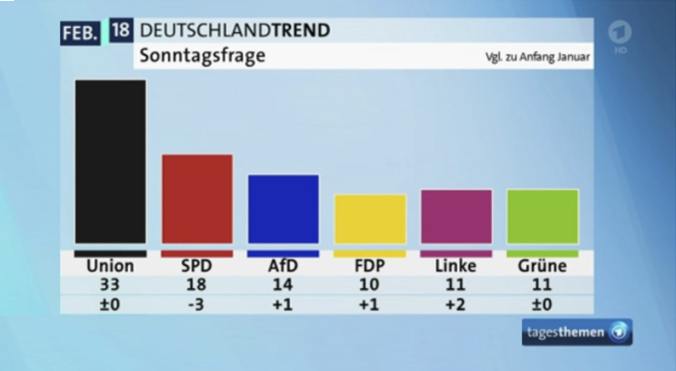
The talks between the two to form a government have resulted in a Grand Coalition bargain that no one is happy with.  And it’s killing Schultz’s SPD among voters.  Thanks to Mike Shedlock over at Mish Talk, we’ve got the latest German political polling.

The SPD is down to 18%.  With Merke’s CSU/CDU’s 33% they barely have the support of a majority in Germany.  Since the election the SPD has lost more 2.5% or 10% of its support.

german polling 2-5.jpg

This is the SPD that ran Germany for decades.  This is the SPD that got 25.7% in 2013.  Martin Schultz’s approval rating among Germans is dropping faster than Hillary Clinton’s at a rape survivors club meeting.

Seriously, Schultz is approved by just 25% of Germans.  Frustration is growing among German voters. Mike makes the salient point that:

That Germany has no new government more than four months after the election is barely comprehensible to the Germans: 71 percent do not understand why it takes so long to form a government.

I think part of this 71 percent fully understand that Merkel and Schultz are working so hard on this Grand Coalition for not Germany’s sake but for the European Union’s.  That’s the reason why support for the minor parties is growing at the SPD’s expense.

If the SPD votes down the coalition agreement, which is becoming more likely by the day, then these talks will fail and Germans will have to go back to the polls.  German President, former SPD leader and Merkel’s foreign minister during the last government, Sigmar Gabriel does not want a 2nd election.

He knows the results would be catastrophic both for Merkel and for the SPD.  Merkel would have to step down as head of the CSU/CDU Union party and then the whole situation bursts wide open.

The Alternatives to Grand Plans

If the coalition is ratified by the SPD then it will create an unstable alliance and Alternative for Germany (AfD) will assume the Opposition Party role in the Bundestag.  Any opportunity for AfD to govern will add credence to it among Germans.

This is a win-win scenario for Eurosceptics in the end.  Either way the opposition parties rise in value to Germans as the Union/SPD will take the blame if the government fails.  AfD, the FDP and Der Linke will continue gaining support.

The bigger the toe hold AfD gains in national politics the less radical they appear. Basrriers to people voting for them will crumble.  People are bonded to their party like their sports teams.  It’s basic human in-group/out-group bias behavior.

So, while Germans may not be ready to hand AfD the reins of power yet seeing them in government legitimizes them for the long game.  And that’s the nightmare scenario for EU-firsters and Marxists like Merkel and Schultz.

This is why they are fighting so hard to retain power.  They know the next four years are important to the survival of the EU.

This is their window of opportunity to go for further political and monetary integration.  This is why they both agree on the European Stabilization Mechanism against the wishes of Germans.

In true Progressive fashion, both Schultz and Merkel agree that Germany must lead a greater Europe to save it from its own tribal in-fighting.  But, to do that they need to also destroy German culture in the process.

Thankfully the German people have woken up to their insanity at the right moment in time.  Let’s see if its enough for 2018.

Euro Worries

If the SPD rank and file reject this coalition agreement that will likely mark the top in the Euro.  For now the markets believe the story that it’s just a rubber stamp away and regime certainty will prevail.

But, if it doesn’t then there will be accelerating capital flight out of Europe.  The U.S. dollar will bottom, the euro will peak and bond yields will begin rising sharply.

In fact, they already are and I fear that this rally in the euro is a rush to cash before a market dislocation.  This is why eurodollar markets are crashing, the dollar has been in free fall while bond yields are rising.

Now that stocks are correcting this feels more and more like the prelude to a liquidity shock than anything else.  And the epicenter for it, in my opinion, is in the details of the European political nightmare unfolding.

via RSS http://ift.tt/2GSWsdE Tyler Durden

Pentagon Auditor Can’t Account For $800 Million In Spending

The Pentagon’s Defense Logistics Agency (DLA) has reportedly “lost track” of hundreds of millions of dollars it spent,  said Ernst & Young, the accounting firm conducting the first-ever Pentagon audit, according to Politico.

E&Y discovered that DLA “failed to properly document more than $800 million in construction projects,” said Politico, which also reported this is just one of the many instances where millions of dollars went missing as the accountability system inside the Pentagon is broken. Worse, according to Politico, the first-ever audit, covering the fiscal year that ended Sept. 30, 2016, signals complete incompetence about how the Pentagon handles its $700 billion annual budget.

While these comments from Ernst & Young are mindnumbing, the Trump administration is set to ask Congress for $716 billion for defense spending for fiscal 2019, a 7% increase over the 2018 Budget. Budget analysts have sounded warnings this would be a significant surge in spending for the Pentagon at a time when the organization can barely keep track of its current expenditures.

If you can’t follow the money, you aren’t going to be able to do an audit,” Sen. Chuck Grassley, an Iowa Republican and senior member of the Budget and Finance committees, who has suggested to past administrations that hemorrhaging of wasteful spending at the Pentagon must stop.

Army Lt. Gen. Darrell Williams, the agency’s director, wrote in response to Ernst & Young’s bombshell findings that the audit has “provided us with a valuable independent view of our current financial operations.”

“We are committed to resolving the material weaknesses and strengthening internal controls around DLA’s operations,” he said, according to Politico.

The DLA is a $40 billion-a-year logistics agency within the Pentagon with some 25,000 employees and processes about 100,000 orders a day, said Politico.

Ernst & Young’s auditors found significant accounting errors in DLA’s process of tracking expenditures. There are minimal accounting records of where the money is going said the report. This does not bode well for accountability at the Pentagon, which has combined assets of $2.2 trillion.The Politico describes one section of the audit where Ernst & Young’s auditors found misstatements for some $465 million in construction projects. Another section described that there was very little documentation for another $384 million worth of spending.

In one part of the audit, completed in mid-December, Ernst & Young found that misstatements in the agency’s books totaled at least $465 million for construction projects it financed for the Army Corps of Engineers and other agencies. For construction projects designated as still “in progress,” meanwhile, it didn’t have sufficient documentation — or any documentation at all — for another $384 million worth of spending. The agency also couldn’t produce supporting evidence for many items that are documented in some form — including records for $100 million worth of assets in the computer systems that conduct the agency’s day-to-day business. “The documentation, such as the evidence demonstrating that the asset was tested and accepted, is not retained or available,” it said. 

The auditor also said that around $100 million worth of assets in computer systems had very little documentation.

The report, which covers the fiscal year that ended Sept. 30, 2016, also found that $46 million in computer assets were “inappropriately recorded” as belonging to the Defense Logistics Agency. It also warned that the agency cannot reconcile balances from its general ledger with the Treasury Department. 

“The initial audit has provided us with a valuable independent view of our current financial operations,” Army Lt. Gen. Darrell Williams, the agency’s director, wrote in response to Ernst & Young’s findings. “We are committed to resolving the material weaknesses and strengthening internal controls around DLA’s operations.”

In a statement to Politico, the DLA said it is the “first of its size and complexity in the Department of Defense to undergo an audit so we did not anticipate achieving a ‘clean’ audit opinion in the initial cycles.”

“The key is to use auditor feedback to focus our remediation efforts and corrective action plans, and maximize the value from the audits. That’s what we’re doing now,” the statement said.

Back in January, the team of 1,200 auditors found some $830 million in “missing” helicopters as the audit kicked off into 2018.

And in a preview of what is to come, Norquist told the House Armed Services Committee that an initial Army audit found 39 UH-60 Black Hawk helicopter ($830,700,000) were not adequately recorded in the property system. “The Air Force identified 478 structures and buildings at 12 installations that were not in its real property system,” he added. In other words these helicopters were simply “missing” on the books. 

As the army of auditors penetrates deep inside the Pentagon’s financial records, we wonder what the 1,200 will find next as they descend further down the rabbit hole of decades of failed proxy wars, regime changes and dictator slush funds?

via RSS http://ift.tt/2BZ7MBd Tyler Durden