“They’re Running Out Of Maneuvering Room” – Debt Ceiling Alarms Are Ringing In The Bond Market

While all eyes were glued to the collapsing stock market and soaring long-bond yields on Friday, the $2 trillion Treasury-bill market, where the U.S. government turns for short-term funding, was suddenly showing serious anxiety about the approaching deadline to raise the nation’s debt ceiling.

As Bloomberg reports,  there’s growing concern that the impasse over the debt limit will become entangled with efforts to keep the government open.

Critically, with Treasury expected to exhaust its borrowing authority as early as the first half of March, a four-week bill sale on Tuesday will serve as the latest gauge of investor anxiety.


Current federal funding expires Feb. 8, and the Republican-led Congress has been working on a stopgap measure to extend that into late March.

“People are kind of getting skeptical of March 8 bills,” said Joseph Abate, a strategist at Barclays Capital in New York. “You might argue that the March 1 bill isn’t necessarily vulnerable to payment delay because the Treasury probably has sufficient resources to meet outflows and thus might be able to last until” March 5.


Treasury has placed the drop-dead date around the end of February. But investors are leaning toward the projection from the nonpartisan CBO, which said last week that the U.S. may run the risk of default without a debt-ceiling increase in the first half of March.

After the Jan. 30 auction of bills maturing March 1, the rate on those securities was higher than debt due a week later. Since then, the rate on debt expiring March 8 has climbed to 1.40 percent, exceeding that on bills due a week later.


So far, Republican leaders’ plan for keeping the government open doesn’t include a move to lift the cap. As long as that’s the case, dislocations in the bills market may persist.

“They reset the clock on extraordinary measures, but Congress hasn’t moved on the debt ceiling since Dec. 8,” Abate said. “They’re running out of maneuvering room.”

But hey, why worry? Stocks are only 2% off record highs, so everything must be awesome?

via RSS http://ift.tt/2nLu1W7 Tyler Durden

Support For SPD Dives: German Coalition Doubts Mount

Authored by Mike Shedlock via MishTalk,

Support for SPD, in coalition talks with CDU/CSU to form a German government, is now at a record low. Doubts mount.

The poll results are from the Tagesschau.De article SPD Trend Slips to 18 Percent.


The article is in German. As is typically the case with Google translations from German, the results need quite a bit of working over. I cannot read or write German but it is usually easy to spot errors.

“As Bad as Never”

I like this amusing as-translated subtitle regarding SPD party leader Martin Schulz: “Schulz rated as bad as never”.


Only 25 percent of citizens are satisfied with his work, five points less than last month, a record low.

Impatience Mounts

That Germany has no new government more than four months after the election is barely comprehensible to the Germans: 71 percent do not understand why it takes so long to form a government.

The above paragraph is my translation. As translated by Google “71 percent have no understanding that the formation of a government takes so long.”

It’s usually easy to make such corrections but sometimes I am scratching my head. Typically, I ignore offending paragraphs.

Let’s now turn our attention to comments from Eurointelligence regarding the poll.

Agreement Not in Doubt, Ratification Is

There can be no doubt whatsoever that CDU/CSU and SPD will conclude a coalition agreement. The doubt is only about whether SPD members will accept it. The reason why the SPD leadership is now becoming desperate to strike a deal is the latest polls.

The CDU/CSU is stable at 33%, but the combined share of the two largest parties would only be 51%. With this poll we are now within the margin of error of a result in which a grand coalition becomes no longer arithmetically possible. This has already happened in the Netherlands, and we think it will happen in Italy on March 4, too. In this case, the smaller parties will become disproportionately powerful. The AfD has 14% and is only 4 points behind the SPD. That gap, too, is within the margin of error of the polls. The other three parties are all scoring 10-11%. With this poll, even a Jamaica coalition would only have the thinnest of majorities.

While it makes sense for the SPD leadership to support a grand coalition out of pure self-interest, SPD members have different incentives. They couldn’t care less whether MPs who narrowly managed to get a seat at the last election will have to fight for their seat again and possibly lose it. Or that Martin Schulz and Sigmar Gabriel may have to look for another job.

All we know is that the SPD grassroots activists are massively opposed to a grand coalition and that SPD voters are split – we’ve seen polls of 50/50 and 60/40. But the voters are not necessarily representative of the members, nor are the activists. The outcome of the party referendum is genuinely uncertain, and we believe that the financial markets, in particular, are underestimating the possibility of a rejection.

Buddy System

Eurointelligence notes that Merkel and SPD now agree on “almost everything”.

This buddy system offends the SPD rank and file. It also offends CDU/CSU party members accusing Merkel of giving in.

For example, Angela Merkel made a big concession to Schulz by accepting the principle that the ESM is to be brought under EU law. But this is under attack by components of CDU/CSU as well as FDP and AfD.

Sleight of Mouth

Merkel upset the Greens and SPD rank and file by backing off diesel emissions. She and Schulz also upset SPD rank and file when they agreed via sleight of mouth to both cut and expand immigration.

As I pointed out before this coalition agreement is about nothing more than keeping both Merkel and Schulz in power. The latter wants to hang on to his political perks like free limousines for as long as he can.

Outcome?

On January 21, when SPD and Merkel announced coalition talks, I offered this assessment:

“Don’t celebrate yet. Once a final deal is reached, assuming a deal is reached, the party’s 450,000 members have an up or down vote on the package. With only 56% of the party leaders in favor of the deal, the membership vote is certainly questionable.”

Ratification is at best 50-50. New elections are the most likely result if the rank-and-file vote this mess down.

Peak Merkel – Peak Schulz

Best Possible Result

The best possible result depends on your outlook. If you are eurosceptic, the best result is this sequence of events:

  1. A grand coalition that lasts for a year or so, with AfD gaining parliamentary powers.

  2. The grand coalition then splinters with infighting and another election in which Merkel steps down and SPD is trounced.


via RSS http://ift.tt/2nJpmEl Tyler Durden

Norway Has The ‘Best’ Democracy In The World (USA Is 21st!)

Across the world, 49.3 percent of people live in some form of democracy with only 4.5 percent living in full democracies. That’s according to a new study spanning 165 countries conducted by The Economist Intelligence Unit.

As Statista’s Niall McCarthy notes, 89 nations saw their democracy score fall compared to last year with only 27 improving and the rest stagnating. The research was based on criteria including civil liberties, the electoral process and pluralism, government functionality, political participation and political culture with the countries rated on a 0 to 10 scale.

Infographic: The Best And Worst Countries For Democracy  | Statista

You will find more infographics at Statista

Northern Europe leads the way for democracy with Norway recording the highest score, 9.87. Iceland came second with 9.58 while Sweden was third with 9.39.

In the same study last year, the U.S. was downgraded from a “full democracy” to a “flawed democracy” and this year, it only comes 21st with a score of 7.98.

North Korea comes last, scoring 1.08 out of 10 while Chad and Syria complete the bottom three.

Saudi Arabia is also present on the list of the world’s 10 worst democracies despite the fact that the U.S. and the UK have sold it billions of dollars worth of weapons. It comes joint 159th with Tajikistan with both countries scoring 1.93 out of 10.

via RSS http://ift.tt/2s8Ypzi Tyler Durden

Europe: Making Islam Great Again

Authored by Judith Bergman via The Gatestone Institute,

“We cannot and will never be able to stop migration”, wrote the EU’s Commissioner for Migration, Home Affairs and Citizenship, Dimitris Avramopoulos recently. “At the end of the day, we all need to be ready to accept migration, mobility and diversity as the new norm and tailor our policies accordingly”.

Given that such people would have us believe that migration has become such a categorical and seemingly incontestable policy of the EU — “Migration is deeply intertwined with our policies on economics, trade, education and employment”, Avramapolous also wrote — it is crucial to analyze what kind of “diversity” the EU is inviting to make its home on the European continent.

Professor Ednan Aslan, Professor of Islamic Religious Education at the University of Vienna, recently interviewed a sample of 288 of the approximately 4,000 predominantly Afghan asylum seekers in the Austrian city of Graz, on behalf of the city’s integration department. Members of the department understandably wanted to know the views of the Muslim newcomers there. The results were published in a study, “Religiöse und Ethische Orientierungen von Muslimischen Flüchtlingen in Graz” (“Religious and ethical orientations of Muslim refugees in Graz”).

According to the study, two-thirds of the asylum seekers are men, mostly under 30 years old. They are all in favor of preserving their traditional, conservative, Islamic values. The migrants are extremely religious; 70% go to the mosque every Friday for prayers.

The women are just as religious, if not more: 62.6% pray five times a day, notably more than the men (39.7%). In addition, 66.3% of the women wear a headscarf in public, and 44.3% refuse to shake hands with a man.

Half of the migrants (49.8%), report that religion now plays a larger role in their daily lives in Europe, than it did in their native country. 47.2% are convinced that Jews and Christians have strayed from the “right path”, and 47.8% think that the future of Islam would be in danger if Islam were to be interpreted in a modern and contemporary fashion.

For 51.6% of the interviewees, the supremacy of Islam over other religions is undisputed. 55% believe in hell for unbelievers.

Anti-Semitism is deeply ingrained: 46% believe that Jews have “too much influence in world affairs”, and 44% believe that Judaism is harmful. 43% opine that Jews themselves are at fault for being persecuted, while 54.5% think that Jews only care about themselves.

The migrants are not only intolerant of other religions: 50% find that homosexuality is a punishable sin. 44% of respondents said they would endorse violence against a woman if she cheated on her husband. 43% also said that fathers have a right to use violence on children if necessary.

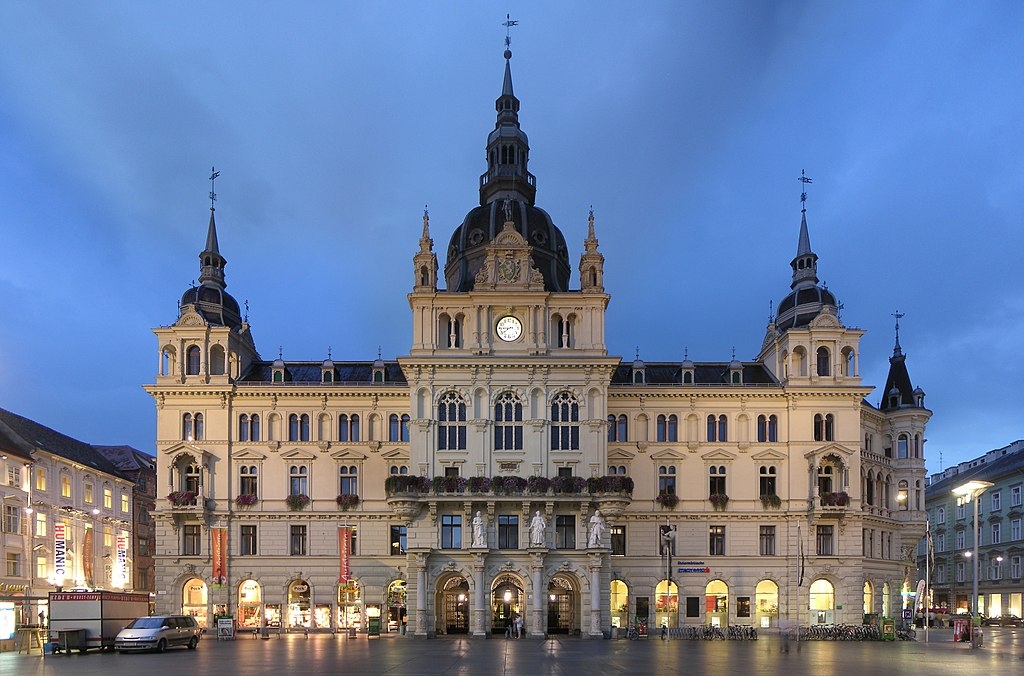
When the integration department of the city of Graz, Austria interviewed a sample of 288 of the approximately 4,000 predominantly Afghan asylum seekers in the city, the migrants expressed deep intolerance towards Christians, Jews and homosexuals. Pictured: City Hall, Graz, Austria. (Image source: Tamirhassan/Wikimedia Commons)


The Austrian study is not the first of its kind to show that Muslim migrants to Europe hold supremacist, anti-Semitic, and misogynistic views. In 2016, a study of nearly 800 migrants from Syria, Iraq, Afghanistan and Eritrea in the German state of Bavaria was conducted by a German think tank, the Hanns Seidel Foundation. This study showed that patriarchal beliefs were widespread among the migrants interviewed, especially among migrants from Afghanistan and the mainly non-Muslim migrants from Eritrea, over 60% of whom believed that women should stay at home. Anti-Semitism was another major finding of the study, which showed that regardless of age and educational background, a majority of the migrants held anti-Semitic beliefs. Well over 50% of Syrians, Iraqis and Afghans said that the “Jews in the world have too much influence”.

Anti-Semitism in Germany has indeed become so widespread that Germany recently decided to appoint a special commissioner to fight it. Germany is reportedly preparing legislation that could see migrants who express anti-Semitic views deported from the country. “You Jew!” has apparently become a common insult among Muslim pupils in Berlin schools.

Other studies and polls also reveal the large degree to which Muslims in Europe value sharia law over national law:

A 2016 UK poll showed that 43% of British Muslims “believed that parts of the Islamic legal system should replace British law while only 22 per cent opposed the idea”. A different poll, also from 2016, found that nearly a quarter (23%) of all Muslims supported the introduction of sharia law in some areas of Britain, and 39% agreed that “wives should always obey their husbands”. Nearly a third (31%) thought it was acceptable for a British Muslim man to have more than one wife. According to the same poll, 52% of all British Muslims believe that homosexuality should be illegal.

According to a 2014 study of Moroccan and Turkish Muslims in Germany, France, the Netherlands, Belgium, Austria and Sweden, an average of almost 60% of the Muslims polled agreed that Muslims should return to the roots of Islam; 75% thought there is only one interpretation of the Koran possible and 65% said that Sharia is more important to them than the laws of the country in which they live. The specific numbers for Germany were that 47% of Muslims believe Sharia is more important than German law. In Sweden, 52% of Muslims believe that Sharia is more important than Swedish law.

The studies are supported by European intelligence reports. In Germany, intelligence agencies warned in the early fall of 2015 that, “We are importing Islamic extremism, Arab anti-Semitism, national and ethnic conflicts of other peoples, as well as a different understanding of society and law.” Four major German security agencies made it clear that “German security agencies… will not be in the position to solve these imported security problems and thereby the arising reactions from Germany’s population.”

In Norway, the head of the Norwegian Police Security Service (PST), Benedicte Bjørnland, said, in January 2016, that one cannot, “assume that new arrivals will automatically adapt to the norms and rules of Norwegian society.”

“Furthermore, new arrivals are not homogenous and can bring ethnic and religious strife with them… If parallel societies, radicalization and extremist environments emerge in the long run, we will have challenges as a security service.”

It is hardly surprising, then, that Europeans have begun to report that they no longer feel at home in their own countries. A recent Belgian study, in which 4,734 Belgians were polled, showed that two-thirds of Belgians feel that their nation is being “increasingly invaded”. Two thirds of the people said that there are “too many immigrants in Belgium”, while 77% agreed with the statement, “Today we no longer feel at home as we did before [mass migration]”. According to 74% of people surveyed, Islam is “not a tolerant religion”, while 60% said the presence of so many Muslims in their nation presents a threat to its identity. Only 12% said they believe the religion is “a source of enrichment” for Belgium.

The study also surveyed 400 Belgian Muslims: 33% said they “don’t like Western culture”, 29% said they believe the laws of Islam to be superior to Belgian law, and 34% said they “would definitely prefer a political system inspired by the Quran”. The study also found that 59% of Muslims in Belgium would “condemn” the marriage if their son chose a non-Muslim partner, and 54% would condemn the marriage if their daughter chose a non-Muslim partner. Tellingly, the response of the researchers behind the study — public broadcaster RTBF, liberal newspaper Le Soir, sociology research institute Survey and Action and a foundation called This is Not a Crisis — was to claim that they “observed the development of a true anti-Muslim paranoia [among Belgians], which has taken on a pathological dimension”.

None of these studies, polls, and intelligence reports appear to be making the least impression on European leaders. In the starry-eyed words of Avramapolous, it is not enough that the mainly Muslim migrants who have come to Europe, “have found safety in Europe”. According to him, “We also need to make sure they find a home”.

The question that remains unanswered — as European leaders seek to make Islam great again on the continent — is where Europeans are supposed to make their homes.

via RSS http://ift.tt/2EhJtnc Tyler Durden

Global Smart Phone Sales Suffer Biggest-Ever Quarterly Drop

What is true for Apple is apparently true for the rest of the smartphone industry: Sales are falling as users opt to hold on to their old phones longer, presenting a challenge for the pattern of near-constant innovation that has seen Apple and its rivals produce new models every year.

According to the Guardian, the rising cost of new phones as Samsung and others join Apple in pushing the top end of the market to higher prices appears to be hurting overall sales – though total sales figures have been insulated by the higher cost of each individual unit sold. Data from Strategy Analytics shows global smartphone shipments shrank year-on-year from 438.7 million to 400.2 million in the fourth quarter of 2017 – a 9% drop. That’s the biggest drop on record. According to the SA data, even iPhone sales declined by 1%.

IPhone

Linda Sui, director at Strategy Analytics, said: “It was the biggest annual fall in smartphone history. The shrinkage in global smartphone shipments was caused by a collapse in the huge China market, where demand fell 16% annually due to longer replacement rates, fewer operator subsidies and a general lack of ‘wow models’.”

Two weeks ago, JP Morgan analyst Narci Chang surprised the market by forecasting production of Apple’s flagship phone would plunge of 50% Q/Q, “even larger than the decline of the iPhone 8/8+” and noted that the “weakness will continue in 1H18 as high-end smartphones are clearly hitting a plateau this year.”

Last week, Chang was proven right when JPM’s worst case outlook was confirmed by a report in Nikkei saying Apple will halve its iPhone X production target for the three-month period beginning in January from over 40 million units envisaged at the time of its release in November.

Still, in its earnings report last week, Apple managed to post record results, even with 1.3% fewers iPhone sold. Smartphone revenue rose 13% Y/Y to a record $61.58 billion due to the higher average price, even as total iPhone sales declined.


Apple


According to the Guardian, another reason for the drop in sales is that big leaps in smartphone features, such as ever better cameras, are now in the past. While the iPhone X adopted the market trend of all-screen designs that had been a hallmark of Samsung’s phones, incremental increases in AI tech will likely dominate over the coming years, making new models less compelling.

“We’re getting to the point where photo quality is already so good that the focus is turning to the smarts that you build beyond that,” Google’s vice president product manager Mario Queiroz, said last year.

As another analyst pointed out, iPhone sales volumes have been declining for more than a year.

“Global iPhone volumes have actually declined on an annual basis for five of the past eight quarters,” said Neil Mawston, executive director at Strategy Analytics. “If Apple wants to expand shipment volumes in the future, it will need to launch a new wave of cheaper iPhones and start to push down, not up, the pricing curve.”

Despite the shrinkage in the last quarter, the entire market crossed 1.5 billion smartphones shipped for the first time in 2017, up 1.3%.

But it is a far cry from the year-on-year increase of 158 million and 12.3% in 2015 and smaller still than the 48 million and 3.3% increase in 2016, as developed nations hit saturation point and first time buyers become upgraders, a much harder sell.

via RSS http://ift.tt/2nIBuFC Tyler Durden

Is It Really True That Switzerland Is The #1 Most-Corrupt Nation, & U.S. #2?

Authored by Eric Zuesse via The Strategic Culture Foundation,

The Tax Justice Network produces a Financial Secrecy Index, ranking countries for the assistance their legal systems provide, to money-launderers, and to all people who seek to protect corruptly-obtained wealth. The higher the score, the more corrupt the government is. The last time this Index was published, in 2015, Switzerland was rated the world’s most-corrupt country, and Hong Kong was then #2. But now, in its newly released global rankings, “Financial Secrecy Index — 2018 Results”, though Switzerland still holds its #1 (most-corrupt) spot, the U.S. has become #2, and Hong Kong has now fallen to #4, which is immediately below Cayman Islands (which is #3, and which had been #5 in 2015).


The detailed report-card for Switzerland says”

“the Swiss will exchange information with rich countries if they have to, but will continue offering citizens of poorer countries the opportunity to evade their taxpaying responsibilities. These factors, along with ongoing aggressive pursuit of financial sector whistleblowers (resorting at times to what appear to be non-legal methods) are ongoing reminders of why Switzerland remains the most important secrecy jurisdiction in the world today.”

The detailed report-card for the United States notes America’s rising score, and resulting success in attracting corrupt wealth, as follows:

The rise of the US continues a long term trend, as the country was one of the few to increase their secrecy score in the 2015 index. The continues [intending the word “continued”] rise of the US in the 2018 index comes off the back of a significant change in the US share of the global market for offshore financial services. Between 2015 and 2018 the US increased its market share in offshore financial services by 14%. In total the US accounts for 22.3% of the global market in offshore financial services.

The U.S. report-card asserts that, “Financial secrecy provided by the U.S. has caused untold harm to the ordinary citizens of foreign countries, whose elites have used the United States as a bolt-hole for looted wealth.” Of course, this isn’t the largest such “bolt-hole” — it’s the second-largest. Furthermore, the report-card for Switzerland said:

According to the Swiss Bankers’ Association banks in Switzerland hold CHF 6.65 trillion ($6.5 trillion) in assets under management, of which 48 percent originated from abroad: this made Switzerland the world leader in global cross-border asset management, with a 25 percent share of that market.1 In terms of the narrower wealth management sector, Deloitte estimated that Switzerland was also the world leader with US$2.04 trillion in assets under management in 2014, compared to the $1.65 trillion and $1.43 trillion for the UK and US respectively.2 

The “Secretiveness” scores ranged from “100%” meaning total secrecy, to “Moderately secretive” meaning from 31% to 40% secretive; and, so, among the 112 ranked countries, none were unwelcoming of corruptly obtained wealth; all were at least “moderately” welcoming of it.

Furthermore, other factors than “Secretiveness” were also included in the rankings. The 242-page Methodology document says, for example, that “The secrecy score is cubed and the weighting is cube-rooted before being multiplied to produce a Financial Secrecy Index which ranks secrecy jurisdictions according to their degree of secrecy and the scale of their trade in international financial services.” So, countries such as Montserrat,  which ranked at the very bottom, #112, actually had a “Secrecy” score of 77.5% (higher even than Switzerland), but it had extraordinarily good “International Standards and Cooperation” such as with “Anti-Money Laundering” and a 0% score of non-cooperation with “Bilateral Treaties.” Above all: any country, in which only few wealthy foreigners want to park their money, was ranked among the least-corrupt, in Tax Justice Center’s methodology — and “FSI Share,” or the percentage of the global total wealth that’s stashed offshore within the given country, is by far the dominant factor, in their calculations of ‘Financial Secrecy Index’, so that their methodology is simply absurd. The Methodology document ‘justifies’ this deceptive practice by saying:

The ranking reflects not only information about which are the most secretive jurisdictions, but also the question of scale (i.e. the extent to which a jurisdiction’s secrecy is likely to have global impact). In this way, the Financial Secrecy Index offers an answer to the question: by providing offshore financial services in combination with a lack of transparency, how much damage is each secrecy jurisdiction actually responsible for?     

Obviously, any ranking-system that’s ranking countries more according to how big a percentage of the global offshore wealth it’s hosting, than according to how secretive the country is when other countries are seeking its assistance in tracking down assets that are held abroad, is no real ‘Financial Secrecy Index’ at all, and thus should be renamed, perhaps as “International Economic Harm Index” or something else that’s not nearly as misleading as the existing title for it (‘Financial Secrecy Index’) is.

Be that as it may: among the 112 nations that were ranked,

China was #28 and was 60% secretive (60% “Secrecy Score”).

Russia ranked #29 and was 64% secretive.

Ukraine ranked #43, and was 69% secretive.

By contrast, U.S. was ranked as 60% secretive; so, U.S. is actually in their league and is less corrupt than Ukraine, but is ranked as the 2nd-most-‘Secretive’ of all rated countries. Switzerland was ranked as 76% secretive, which places Switzerland among the 28 most-secretive countries on the list — but it has the highest ‘Financial Secrecy Index’ of any, even though more than two dozen countries received a higher “Secrecy Score.”

The nine highest-scoring nations on their actual “Secrecy Score” were, from the top: (#1) Vanuatu 89%; (#2) Antigua-Barbuda 87%; (tied #s 3-5) UAE, Bahamas, and Brunei, 84%; (tied #s 6-9) Thailand, Kenya, Liberia, and Bolivia, 80%.

So: Those were actually the 9 highest-scored “Secrecy Score” countries.

The 7 lowest-scored “Secrecy Score” ones were: 42% (tied) UK and Slovenia, 44% Belgium, 45% Sweden, 47% Lithuania, 49% Italy, 49% Brazil.

But is Brazil really among the least-corrupt countries? Is it, even, really, among the financially most transparent countries?

Furthermore, the detailed report-card for the U.S. asserts:

A wealthy Ukrainian, say, sets up a Delaware shell company using a local company formation agent. That Delaware agent will provide nominee officers and directors (typically lawyers) to serve as fronts for the real owners, and their details and photocopies of their passports can be made public but that gets you no closer to who the genuine Ukrainian owner of that company is: if the nominees are lawyers they are bound by attorney-client privilege not to reveal the information (if they even have it: the owner of that shell company may be another secretive shell company or trust somewhere else). The company can run millions through its bank account but nobody – whether domestic or foreign law enforcement – can crack through that form of secrecy in any efficient or effective way. In the words of Dennis Lormel, the first chief of the FBI’s Terrorist Financing Operations Section and a retired 28-year Bureau veteran, “Terrorists, organized crime groups, and pariah states need access to the international banking system. Shell firms are how they get it.” …

Almost two million corporations and limited liability companies (LLCs) are formed in U.S. states each year, many by foreigners, without the states ever asking for the identity of the ultimate beneficial owners. Some serve legitimate purposes but many, in the words of Senator Carl Levin, “function as conduits for organised crime, money laundering, securities fraud, tax evasion, and other misconduct.”

Nonetheless, the U.S. is granted a modest “Secrecy Score” of only 60% — though the process that’s described there is providing 100% secrecy. Nothing is being said, not even in the Methodology document, about how a country which can provide 100% secrecy, deserves a mere 60% “Secrecy Score.”

The detailed report-card on Switzerland likewise includes considerable text describing a country that seems as corrupt as is indicated in the text describing America. Granting the U.S. a “Secrecy Score” of only 60%, while Switzerland receives a much higher 76% such score, is puzzling; and, again, the Methodology document provides no help to understand what the actual methodology that was used is — much less to justify the methodology.

Perhaps the worst score of all should go to the Tax Justice Network itself.

However, maybe the so-called “International Consortium of Investigative Journalists” deserves an even worse score, because that organization headlined on January 30th, “US, Switzerland singled out for financial secrecy by new index” and reported favorably about this “new index,” which is actually in at least its second edition, since an earlier one was reported in 2015 — so, this isn’t even a ‘new index’ at all, but is at least a three-year-old index. Isn’t a bit of investigative journalism necessary from a purported professional organization of ‘Investigative Journalists’? Or does mere ‘journalistic’ stenography now qualify, even as ‘investigative’ journalism? Is ‘journalism’ now mere PR, propaganda, public relations? And is ‘investigative’ now mere reading and reciting from a source? What’s the difference between PR versus ‘investigative journalism’?

And: what’s the difference between America’s 60% “Secrecy Score” and Switzerland’s 76% one? Based upon the detailed report-cards, how would it be possible to be ‘more corrupt’ than each of these countries is?

The United States Government routinely characterizes any Government that it seeks to overthrow as being ‘corrupt’. Perhaps that fact, more than any other, shows how corrupt the U.S. Government itself really is. Throwing stones from glass houses does no one any good. But it does prove — and not merely by some organization’s flawed methodology — that hypocrisy can sometimes signal a threat that could turn out to be even worse than “Financial Secrecy” or “Secrecy Score” or even than real corruption. When the United States Government called Saddam Hussein, and Muammar Gaddafi, and Viktor Yanukovych, etc., by such terms as “corrupt,” the invasions and coups which were ‘justified’ by means of that U.S. name-calling, perpetrated vastly more harm than any corruption which was, or might have been, perpetrated by those individually blamed persons. Such “stones from glass houses,” as the U.S. casts, contain bombs; they’re actually warheads; they are weapons of mass destruction, such as extremely corrupt governments employ with the most hypocritical of ‘humanitarian’ ‘concerns’, for the mass-victims, which commonly result from their mass-weapons. Corruption that’s so heavily armed, is the worst sort of corruption there is — regardless of whether it’s associated with an exceptionally high “Financial Secrecy Index,” or any other type of extraordinary corruption. And, certainly, the U.S. far outdoes Switzerland, on this score. So: Trump is right — “America is Number One”, after all.

via RSS http://ift.tt/2EefPPJ Tyler Durden

Israel And Egypt Form Secret Alliance To Wipe Out Egyptian Jihadists

Israel has been conducting bombing raids on jihadists within Egypt’s borders since at least late 2015 as part of a secret two-year alliance. For more than two years, unmarked Israeli drones, helicopters and jets have carried out a covert air campaign, conducting more than 100 airstrikes inside Egypt, frequently more than once a week — and all with the approval of President Abdel Fattah el-Sisi, the NYT reported on Sunday.

Once enemies in three wars, and having struggled to reach peace agreements for decades, Egypt and Israel are now (not so) secret allies against a common foe.

a
Prime Minister Benjamin Netanyahu of Israel at a conference in December (Getty)

In late 2015, jihadists in Egypt’s Northern Sinai moved in, killing hundreds of soldiers and police officers and briefly seizing a major town – setting up armed checkpoints as they established control over the area. On October 31, 2015, the Islamic State of Iraq and the Levant’s Sinai branch, formerly known as Ansar Bait al-Maqdis, brought down a Russian passenger flight with an explosive device – killing all 224 people aboard.

a
Russian passenger jet downed by Egyptian jihadists 

With Egypt seemingly unable to stop the jihadists, Israel – alarmed by the threat just over the border, began taking action – sending a barrage of airstrikes into the neighboring Arab country whose officials and media continued to vilify the Jewish state in public. 

In order to conceal their involvement, Israel’s drones, jets and helicopters have covered up their markings. “Some fly circuitous routes to create the impression that they are based in the Egyptian mainland,” according to American officials briefed on the operations.

a

It is unclear whether any Israeli troops have actually set foot inside Egyptian borders.

Despite efforts by both Israel and Egypt to hide the origin of the strikes and censor public reports, Egypt and Israel’s two-year alliance has become somewhat of an open secret in intelligence circles: 

Inside the American government, the strikes are widely known enough that diplomats and intelligence officials have discussed them in closed briefings with lawmakers on Capitol Hill. Lawmakers in open committee hearings have alluded approvingly to the surprisingly close Egyptian and Israeli cooperation in the North Sinai.

In a telephone interview, Senator Benjamin L. Cardin of Maryland, the ranking Democrat on the Senate Foreign Relations Committee, declined to discuss specifics of Israel’s military actions in Egypt, but said Israel was not acting “out of goodness to a neighbor.”

“Israel does not want the bad stuff that is happening in the Egyptian Sinai to get into Israel,” he said, adding that the Egyptian effort to hide Israel’s role from its citizens “is not a new phenomenon.” –NYT

Moreover, despite Israeli military censors preventing reports of the strikes from becoming public, certain news outlets circumvented the censorship by citing a 2016 Bloomberg report in which a former Israeli official admitted to drone strikes inside of Egypt. 

The two-year alliance between the two countries is thought to have begun after Egypt’s relatively new president Mohamed Morsi – a leader within the Muslim Brotherhood who came to power after the Arab Spring revolt, was outed in a military takeover by el-Sisi – then defense minister. 

Israel welcomed the change in government, urging Washington to accept it. 

And Egypt needed the help; following Mr. Sisi’s takeover, Islamist militants who had established a refuge in the North Sinai region between the Suez Canal and the Israeli border began a wave of deadly assaults against Egyptian security forces. 

A few weeks after Mr. Sisi took power, in August 2013, two mysterious explosions killed five suspected militants in a district of the North Sinai not far from the Israeli border. The Associated Press reported that unnamed Egyptian officials had said Israeli drones fired missiles that killed the militants, possibly because of Egyptian warnings of a planned cross-border attack on an Israeli airport. (Israel had closed the airport the previous day.)

At the time, both Israel and Egypt vehemently denied the reports – however after the Russian charter jet was brought down in October of 2015, Israel began its wave of airstrikes, killing a long list of militant leaders according to an American official who spoke on the condition of anonymity in order to discuss classified operations. 

After Israel wiped out much of the jihadist leadership in the region, less ambitious successors stepped in. No longer employing armed checkpoints, closing roads or claiming territory – the group began targeting “softer” targets like Christians in Sinai and Muslims they considered heretics. As an example, the militant group killed over 300 worshippers at a Sufi Mosque in North Sinai. 

a
Sufi Mosque in North Sinai, 311 worshippers killed by militants in Nov. 2017

Since Israel has effectively been keeping jihadists at bay in a mutually beneficial arrangement, some American supporters of Israel have been complaining that given Egypt’s reliance on the Israeli military, “Egyptian officials, diplomats and state-controlled news media should stop publicly denouncing the Jewish state.” 

“You speak with Sisi and he talks about security cooperation with Israel, and you speak with Israelis and they talk about security cooperation with Egypt, but then this duplicitous game continues,” said Representative Eliot L. Engel of New York, the ranking Democrat on the House Foreign Relations Committee. “It is confusing to me.”

Israel’s prime minister, Benjamin Netanyahu, has also pointedly reminded American diplomats of the Israeli military role in Sinai. In February 2016, for example, Secretary of State John Kerry convened a secret summit in Aqaba, Jordan, with Mr. Sisi, King Abdullah of Jordan and Mr. Netanyahu, according to three American officials involved in the talks or briefed about them.

Mr. Kerry proposed a regional agreement in which Egypt and Jordan would guarantee Israel’s security as part of a deal for a Palestinian state. –NYT

Netanyahu scoffed at the idea – arguing that if Egypt was unable to control the ground within its own borders, it was hardly in a position to guarantee Israel’s safety. 

via RSS http://ift.tt/2nJpx2u Tyler Durden

The Grand Crowded Trade Of Financial Speculation

Excerpted from Doug Noland’s Credit Bubble Bulletin,

Even well into 2017, variations of the “secular stagnation” thesis remained popular within the economics community. Accelerating synchronized global growth notwithstanding, there’s been this enduring notion that economies are burdened by “insufficient aggregate demand.” The “natural rate” (R-Star) has sunk to a historical low. Conviction in the central bank community has held firm – as years have passed – that the only remedy for this backdrop is extraordinarily low rates and aggressive “money” printing. Over-liquefied financial markets have enjoyed quite a prolonged celebration.

Going back to early CBBs, I’ve found it useful to caricature the analysis into two distinctly separate systems, the “Real Economy Sphere” and the “Financial Sphere.” It’s been my long-held view that financial and monetary policy innovations fueled momentous “Financial Sphere” inflation. This financial Bubble has created increasingly systemic maladjustment and structural impairment within both the Real Economy and Financial Spheres. I believe finance today is fundamentally unstable, though the associated acute fragility remains suppressed so long as securities prices are inflating.

[ZH: This week’s sudden burst of volatility across all asset-classes highlights this Minskian fragility]

The mortgage finance Bubble period engendered major U.S. structural economic impairment. This became immediately apparent with the collapse of the Bubble. As was the case with previous burst Bubble episodes, the solution to systemic problems was only cheaper “money” in only great quantities. Moreover, it had become a global phenomenon that demanded a coordinated central bank response.

Where has all this led us? Global “Financial Sphere” inflation has been nothing short of spectacular. QE has added an astounding $14 TN to central bank balance sheets globally since the crisis. The Chinese banking system has inflated to an almost unbelievable $38 TN, surging from about $6.0 TN back in 2007. In the U.S., the value of total securities-to-GDP now easily exceeds previous Bubble peaks (1999 and 2007). And since 2008, U.S. non-financial debt has inflated from $35 TN to $49 TN. It has been referred to as a “beautiful deleveraging.” It may at this time appear an exquisite monetary inflation, but it’s no deleveraging. We’ll see how long this beauty endures.

The end result has been way too much “money” slushing around global securities and asset markets – “hot money” of epic proportions. This has led to unprecedented price distortions across asset classes – unparalleled global Bubbles in sovereign debt, corporate Credit, equities and real estate – deeply systemic Bubbles in both (so-called) “risk free” and risk markets. And so long as securities prices are heading higher, it’s all widely perceived as a virtually sublime market environment. Yet this could not be further detached from the reality of a dysfunctional “Financial Sphere” of acutely speculative markets fueling precarious Bubbles – all dependent upon unyielding aggressive monetary stimulus.

I have posited that aggressive tax cuts at this late stage of the cycle come replete with unappreciated risks. Global central bankers for far too long stuck with reckless stimulus measures. A powerful inflationary/speculative bias has enveloped asset markets globally. Meanwhile, various inflationary manifestations have taken hold in the global economy, largely masked by relatively contained consumer price aggregates. Meanwhile, global financial markets turned euphoric and speculative blow-off dynamics took hold. A confluence of developments has created extraordinary financial, market, economic, political and geopolitical uncertainties – held at bay by history’s greatest Bubble.

Bloomberg: “U.S. Average Hourly Earnings Rose 2.9% Y/Y, Most Since 2009.” Average hourly earnings gains have been slowly trending higher for the past several years. Wage gains have now attained decent momentum, which creates uncertainty as to how the tax cuts and associated booming markets will impact compensation gains going forward.

February 2 – Bloomberg (Rich Miller): “As Jerome Powell prepares to take over as chairman of the Federal Reserve on Feb. 5, some of his colleagues are publicly agitating for a radical rethink of the central bank’s playbook for guiding monetary policy. Behind the push for reconsideration of the Fed’s 2% inflation target: a fear of running out of monetary ammunition in the next recession. With interest rates near historically low levels—and likely to remain that way for the foreseeable future—these officials worry the Fed will have little leeway to aid the economy when a downturn inevitably hits. They argue that revamping the inflation objective beforehand could help counteract that. ‘The most important issue on the table right now is that we need to consider the possibility of a new economic normal that forces us to reevaluate our targets,’ Federal Reserve Bank of Philadelphia President Patrick Harker said in a Jan. 5 speech.”

“Is the Fed’s Inflation Target Kaput?”, was the headline from the above Bloomberg article. There is a contingent in the FOMC that would welcome an inflation overshoot above target, believing this would place the Fed in a better position to confront the next downturn. With yields now surging, these inflation doves could be a growing bond market concern.

Interestingly, markets were said to have come under pressure Friday on hawkish headlines from neutral/dovish Dallas Fed President Robert Kaplan: “If We Wait to See Actual Inflation, We’ll Be Too Late; We’ll Likely Overshoot Full Employment This Year; We Central Bankers Must Be Very Vigilant; Base Case Is For 3 Rate Hikes in 2018, Could Be More.”

[ZH: something changed this week]

Are Kaplan’s comments to be interpreted bullish or bearish for the struggling bond market? Are bonds under pressure because of heightened concerns for future inflation – or is it instead more because of a fear of tighter monetary policy? Confused by the spike in yields back in 1994, the Fed questioned whether the bond market preferred a slow approach with rate hikes or, instead, more aggressive tightening measures that would keep a lid on inflation.

Just as a carefree Janet Yellen packs her bookcase for the Brookings Institute, the Powell Fed’s job has suddenly morphed from easy to challenging. With tax cut stimulus in the pipeline and signs of a backdrop supportive to higher inflation, a growing contingent within the FOMC may view more aggressive tightening measures as necessary support for an increasingly skittish bond market. At the minimum, the backdrop might have central bankers thinking twice before coming hastily to rescue vulnerable stock markets.

The marketplace has begun to ponder risk again.

February 1 – Bloomberg (Sarah Ponczek and Lu Wang): “Coordinated selling in stocks and bonds is making life miserable for investors in one of the most popular asset allocation strategies: those lumped together under the rubric of 60/40 mutual funds. Counter to their owners’ hope, that pain in one will be assuaged by the other, this week has seen both fixed-income and equities tumbling as concern has built about the pace of Federal Reserve interest rate increases. Funds that blend assets have borne the brunt, suffering their worst weekly performance since Feb 2009.

Stock prices have been going up for a long time – and seemingly straight up for a while now. Bonds, well, they’ve been in a 30-year bull market. Myriad strategies melding stocks and fixed-income have done exceptionally well. And so long as bonds rally when stocks suffer their occasional (mild and temporary) pullbacks, one could cling to the view that diversified stock/bond holdings were a low risk portfolio strategy (even at inflated prices for both). And for some time now, leveraging a portfolio of stocks and bonds has been pure genius. The above Bloomberg story ran Thursday. By Friday’s close, scores of perceived low-risk strategies were probably questioning underlying premises. A day that saw heavy losses in equities, along with losses in Treasuries, corporate Credit and commodities, must have been particularly rough for leveraged “risk parity” strategies.

It’s worth noting that the U.S. dollar caught a bid in Friday’s “Risk Off” market dynamic. Just when the speculator Crowd was comfortably positioned for dollar weakness (in currencies, commodities and elsewhere), the trade abruptly reverses. It’s my view that heightened currency market volatility and uncertainty had begun to impact the general risk-taking and liquidity backdrop. And this week we see the VIX surge to 17.31, the high since the election.

The cost of market risk protection just jumped meaningfully. Past spikes in market volatility were rather brief affairs – mere opportunities to sell volatility (derivatives/options) for fun and hefty profit. I believe markets have now entered a period of heightened volatility. To go along with currency market volatility, there’s now significant bond market and policy uncertainty. The premise that Treasuries – and, only to a somewhat lesser extent, corporate Credit – will rally reliably on equity market weakness is now suspect. Indeed, faith that central bankers are right there to backstop the risk markets at the first indication of trouble may even be in some doubt with bond yields rising on inflation concerns. When push comes to shove, central bankers will foremost champion bond markets.

While attention was fixed on U.S. bond yields and equities, it’s worth noting developments with another 2018 Theme:

February 2 – Wall Street Journal (Shen Hong): “Chinese stocks had their worst week since 2016, with fresh concerns about Beijing’s campaign to cut financial risk and predictions of a slowing economy helping erase half of the market’s year-to-date gains in just a few days… Mr. Zhang [chief executive of CYAMLAN Investment] said the increasingly frequent market intervention by the ‘national team’ to prop up the major indexes could prove counterproductive. ‘It’s OK to bring in the national team when there’s a huge crisis but if it’s there everyday, it will create even more jitters,’ Mr. Zhang said. ‘If you see policemen everywhere, don’t you feel less safe?’”

The Shanghai Composite dropped 2.7% this week. Losses would have been headline-making if not for a 2.1% rally off of Friday morning lows.


The Shenzhen Exchange A index sank 6.6% this week, and China’s growth stock ChiNext Index was hit 6.3%. The small cap CSI 500 index fell 5.9%, and that was despite a 2.1% rally off Friday’s lows (attributed to “national team” buying). Financial stress has been quietly gaining momentum in China, with HNA and small bank liquidity issues the most prominent. As global liquidity tightens, I would expect Chinese Credit issues to be added to a suddenly lengthening list of global concerns.

Unless risk markets can quickly regain upside momentum, I expect “Risk Off” dynamics to gather force. “Risk On” melt-up dynamics were surely fueled by myriad sources of speculative leverage, including derivative strategies (i.e. in-the-money call options). As confirmed this week, euphoric speculative blow-offs are prone to abrupt reversals. Derivative players that were aggressively buying S&P futures to dynamically hedge derivative exposures one day can turn aggressive sellers just a session or two later. And in the event of an unanticipated bout of self-reinforcing de-risking/de-leveraging, it might not take long for the most abundant market liquidity backdrop imaginable to morph into an inhospitable liquidity quandary.

February 1 – Bloomberg (Sarah Ponczek): “When stocks fall, investors typically pull money out of the market. But when U.S. equities suffered their worst two-day slump since May, some traders didn’t blink an eye. Exchange-traded funds took in $78.5 billion in January, exceeding the previous monthly record by nearly 30%. ETFs saw close to $4 billion a day in inflows even on the stock market’s down days, according to Eric Balchunas, a Bloomberg Intelligence senior ETF analyst…”

Adding January’s $79 billion ETF inflow to 2017’s record $476 billion puts the 13-month total easily over half a Trillion. If the ETF Complex is hit by significant outflows, it’s not clear who will take the other side of the trade. This is especially the case if the hedge funds move to hedge market risk and reduce net long exposures. And let there be no doubt, the leveraged speculators will be following ETF flows like hawks (“predators”).


And I’m having difficulty clearing some earlier (Bloomberg) interview comments from my mind:

January 24 – Bloomberg (Nishant Kumar and Erik Schatzker): “Billionaire hedge-fund manager Ray Dalio said that the bond market has slipped into a bear phase and warned that a rise in yields could spark the biggest crisis for fixed-income investors in almost 40 years. ‘A 1% rise in bond yields will produce the largest bear market in bonds that we have seen since 1980 to 1981,’ Bridgewater Associates founder Dalio said… in Davos…”

Dalio: “’There is a lot of cash on the sidelines’. … We’re going to be inundated with cash, he said. “If you’re holding cash, you’re going to feel pretty stupid.’”

Here I am, as usual, plugging away late into Friday night. So, who am I to take exception to insight from a billionaire hedge fund genius. But to discuss the possibility of the worst bond bear market since 1981 – and then suggest those holding cash “are going to feel pretty stupid”? Seems to be a disconnect there somewhere. Going forward, I expect stupid cash to outperform scores of brilliant strategies.

The historic “Financial Sphere” Bubble has ensured that ungodly amounts of “money” and leverage have accumulated in The Grand Crowded Trade of Financial Speculation.

And as we detailed earlier – it doesn’t get any more crowded that record long equities and record short bonds!

via RSS http://ift.tt/2nIW8VU Tyler Durden

Who Let Dr. Strangelove Write The Pentagon’s Nuclear Posture Review?

Authored by Julia Conley via TheAntiMedia.org,

The Pentagon’s official outline for its use of nuclear force was denounced as “radical” and “extreme” by prominent anti-nuclear weapons groups when it was released Friday afternoon—confirming peace advocates’ worst fears that the Trump administration would seek to expand the use of nuclear force.

“Who in their right mind thinks we should expand the list of scenarios in which we might launch nuclear weapons?” asked Peace Action in a statement. 

“Who let Dr. Strangelove write the Nuclear Posture Review?”


The Nuclear Posture Review (NPR) calls for the development of smaller warheads that the military believes would be seen as more “usable” against other nations.

“In support of a strong and credible nuclear deterrent, the United States must…maintain a nuclear force with a diverse, flexible range of nuclear yield and delivery modes that are ready, capable, and credible,” reads the report, which serves as the first updated document the U.S. has released regarding its perceived nuclear threats since 2010.

In addition to “diversifying” its nuclear arsenal, the Pentagon notes that it will seek to “expand the range of credible U.S. options for responding to nuclear or non-nuclear strategic attack,” raising concerns that President Donald Trump will argue for the use of nuclear force as a deterrent—a significant departure from previous administrations which saw nuclear weapons as an option only for retaliation.

“The risk of use for nuclear weapons has always been unacceptably high,” said Beatrice Fihn, executive director of the International Campaign to Abolish Nuclear Weapons (ICAN).

“The new Trump Nuclear Doctrine is to deliberately increase that risk. It is an all-out attempt to take nuclear weapons out of the silos and onto the battlefield. This policy is a shift from one where the use of nuclear weapons is possible to one where the use of nuclear weapons is likely.”

Derek Johnson, head of Global Zero, called the NPR “a radical plan written by extreme elements and nuclear ideologues in Trump’s inner circle who believe nuclear weapons are a wonder drug that can solve our national security challenges.”

“Trump’s insistence that we need more and better weapons is already spurring countries to follow in his footsteps,” he added. “Nuclear arms-racing is a steep and slippery slope; we’d do well to learn the lessons of the former Soviet Union, whose collapse was accelerated by its unsustainable nuclear ambitions.”

As Paul Craig Roberts summed up so eloquently, the new US nuclear posture is a reckless, irresponsible, and destabilizing departure from the previous attitude toward nuclear weapons. The use of even a small part of the existing arsenal of the United States would be sufficient to destroy life on earth. Yet, the posture review calls for more weapons, speaks of nuclear weapons as “usable,” and justifies their use in First Strikes even against countries that do not have nuclear weapons.

This is an insane escalation. It tells every country that the US government believes in the first use of nuclear weapons against any and every country. Nuclear powers such as Russia and China must see this to be a massive increase in the threat level from the United States. Those responsible for this document should be committed to insane aslyums, not left in policy positions where they can put it into action.

via RSS http://ift.tt/2EgaXtu Tyler Durden