Wells Fargo Crashes After Fed’s Shocking Crackdown Bans Bank From Growing

Wells Fargo may be Warren Buffett’s favorite bank, but the endorsement of America’s favorite benevolent plutocrat hasn’t spared it from an unusually severe punishment (as far as too big to fail banks go).

Two hours after markets closed on Federal Reserve Governor Janet Yellen’s last day in office, the central bank announced sanctions against Wells for a host of consumer and oversight abuses dating back to its infamous cross-selling scandal, that saw bank branch employees open millions of fraudulent accounts in customers’ names.

In a press release, the Fed said it would bar Wells from expanding its assets beyond their end-2017 level until it “sufficiently improves its governance and controls.” Also, the Fed is demanding that Wells replace three current board members by April and a fourth board member by the end of the year. The release says the board of directors must also improve its oversight practices. The bank will not be allowed to grow until the Fed approves a detail plan of action to be submitted by the bank.

“The enforcement action we are taking today will ensure that Wells Fargo will not expand until it is able to do so safely and with the protections needed to manage all of its risks and protect its customers,” Yellen said in a statement. “The enforcement action we are taking today will ensure that Wells Fargo will not expand until it is able to do so safely and with the protections needed to manage all of its risks and protect its customers.”

As the release explains, in recent years, Wells pursued a business strategy that prioritized growth over managing risks and offering sufficient oversight of the firm’s lending practices. As a result, the firm cheated customers of its auto-lending division and also overcharged some mortgage borrowers. And that was AFTER the cross-selling scandal mentioned above. The bank is also facing a criminal probe into its foreign-exchange desk, which allegedly overcharged its large corporate clients. The firm lacked “an effective firm-wide risk management framework in place that covered all key risks.” This, the Fed says, prevented the serious compliance breakdowns from being adequately reviewed by the board.

Emphasizing the need for improved director oversight of the firm, the Fed’s disciplinary board sent a letter to Wells Fargo board members confirming that the firm’s board of directors did not meet supervisory expectations during the period when these abuses were perpetrated. Letters were also sent to former Chairman and Chief Executive Officer John Stumpf and past lead independent director Stephen Sanger stating that their performance in those roles, in particular, did not meet the Federal Reserve’s expectations.

Wells has provoked a vociferous public outcry because of these abusive lending practices, which have impacted millions of Americans. The pension funds of several states and municipalities have even divested their WFC shares in protest.

And to make matters worse, this is only the SECOND piece of bad news that Wells Fargo received today – we outline the first below.

Responding to the letter, Wells promised to make things right and its board said it would deliver its improvement plan within 60 days.

After today’s market bloodbath, WFC shares plunged a staggering 8% in after-hours trading…


Wells


* * *

Mortgage lending has long been a “bread and butter” business for Wells Fargo, Warren Buffett’s favorite bank. But between the months of September and December – while the bank’s PR department was busy fending off another incipient scandal – demand for the bank’s loans declined to its weakest level since the financial crisis. While we initially pegged this as a sign that the average US consumer can’t afford to take out a loan with interest rates just 1% higher.

But as the CEO of Quicken Loans revealed today during a conversation with Crain’s Detroit Business, another factor might also be at play.

Sales figures released by Quicken show that it surpassed Wells Fargo in volume of mortgage originations during the fourth quarter of 2017, bolstering the lender’s claim that it is a viable alternative to the banks that have traditionally dominated the business (and also leveraged it to blow up the US economy a decade ago).

Quicken revealed that it originated $25 billion in home loans during the quarter, compared with Wells Fargo’s $23 billion in home mortgages. Wells is the country’s leading bank in home mortgages; Bank of America and JP Morgan Chase & Co. reported $13 billion and $11 billion that quarter, respectively. 

“I don’t think we set out to close $25 billion – we just set out to do what we always do, which is take care of our clients and take care of our team members,” Quicken Loans CEO Jay Farner said Thursday in an interview with Crain’s.

Still, Farner disclosed that Wells’ $114 billion in loans for 2017 surpassed the Quickens’ full-year total. Quicken, which was founded by billionaire Dan Gilbert, is privately held, and doesn’t disclose its annual earnings.


Loans

Per Crain’s, Quicken has become an increasingly nettlesome challenger for industry leader Wells and other home-mortgage lenders, thanks to the company’s primary innovation: Rocket Mortgage – its online loan application system. The business has swelled thanks to a savvy marketing that has featured high-profile Superbowl adds. The company is planning to air a new spot during Sunday’s championship game between Atlanta and the Patriots.

In 2017, Quicken Loans began shifting to marketing what its CEO calls the Rocket Mortgage “experience” instead of the Quicken Loans brand in its advertising.

“I think you’ll see it more and more, because it’s the way we talk about this innovation in this space,” Farner said of using the Rocket Mortgage brand in company advertising. “The Quicken brand is a foundational brand.”

The new Super Bowl ad will be used to launch an advertising campaign that “will continue through the greater part of 2018,” Farner said.

While Quicken’s performance is admirable, the real story here, of course, is Wells’ fluctuating position within the home loan market. Banks are increasingly finding it difficult to keep up with the “FinTech revolution” that has spurred other online lending platforms like SoFi and Lending Tree.

And judging by the nominal value of loans in Wells’ all-important loan origination pipeline, there’s reason to believe that the slump in loan originations isn’t over.

The lagging mortgage originations number, which usually trails the pipeline by 3-4 quarters, was nearly as bad, plunging 39% sequentially from $72 billion to only $44 billion, “due to higher rates and seasonality.” Since this number lags the mortgage applications, we expect it to post fresh post-crisis lows in the coming quarter.

via RSS http://ift.tt/2nG5zFw Tyler Durden

Nine Reasons Why Globalization Can’t Be Permanent

Authored by Gail Tverberg via Our Finite World blog,

Since the late 1990s, globalization has seemed to be the great hope for the future. Now this great hope seems to be dimming. Globalization sets up conflict in the area of jobs. Countries around the world compete for development and jobs. If there is not enough cheap-to-produce energy to go around, huge wage disparity is likely to result.

We know from physics and history that economies need to grow, or they collapse. The wage disparity that high-wage countries have been experiencing in recent years is evidence that the world economy is already reaching energy limits. There are no longer enough jobs that pay well to go around. Any drop in energy supply is likely to worsen the job situation.

Most observers miss this problem, because they expect high oil prices to signal energy limits. This time, the signal is low wages for a significant group of workers, rather than high oil prices. This situation is possible in a networked economy, but it is not what most people look for.

Unhappy citizens can be expected to react to the wage disparity problem by electing leaders who favor limits to globalization. This can only play out in terms of reduced globalization.

History and physics suggest that economies without adequate energy supply can be expected to collapse. We have several recent examples of partial collapses, including the Great Depression of the 1930s and the collapse of the Soviet Union. Such collapses, or even more extensive collapses, might occur again if we cannot find energy alternatives that can be quickly scaled up to replace oil and coal in the very near term. These replacements need to be cheap-to-produce, non-polluting, and available in huge quantities.

The story that the economy doesn’t really need a growing supply of very cheap-to-produce energy is simply a myth. Let’s look at some of the pieces of this story.

[1] The world economy needs to grow or it collapses. Once all of the nations of the world are included in the world economy, one obvious source of growth (incorporating nations that are not yet industrialized into the world economy) disappears. 

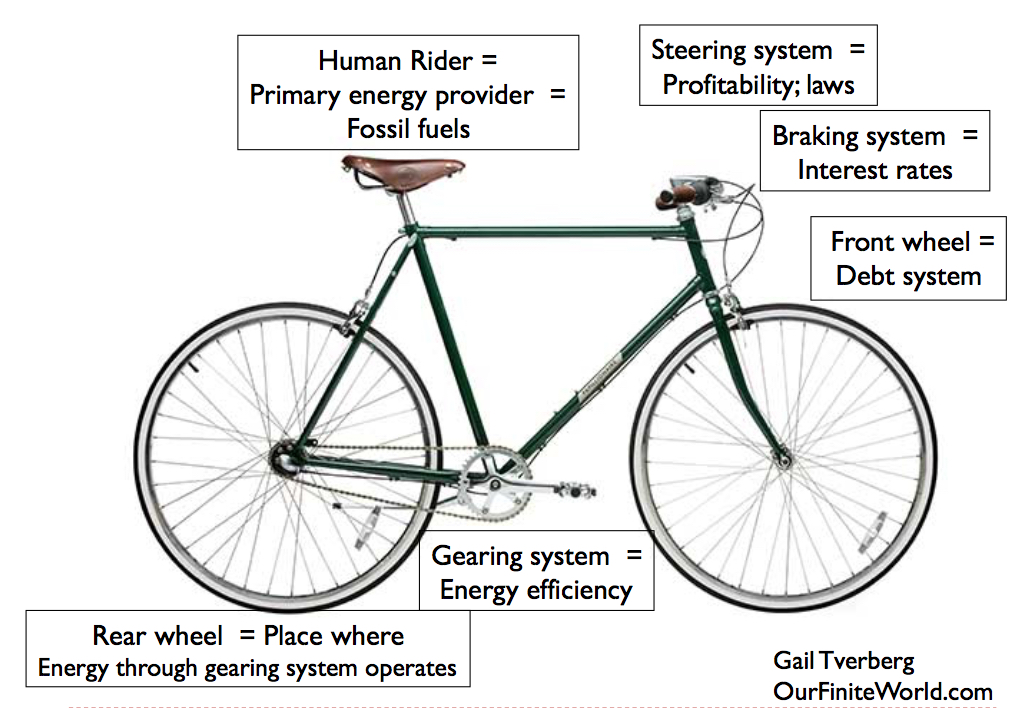
The reason why the world economy needs to grow is because the economy is a self-organized system that operates under the laws of physics. In many ways it is like a two-wheeled bicycle. A bicycle needs to roll quickly enough, or it will fall over. An economy must grow quickly enough, or debt cannot be repaid with interest.

Also, government promises may be a problem with slow growth. Pensions for the elderly are typically paid out of tax revenue collected in that same year. It is easy for a mismatch to take place if the number of younger workers is shrinking or if their wages are lagging behind.

Figure 1. Author’s view of analogies of speeding upright bicycle to speeding economy.

I explain a little more about my bicycle analogy in Will the World Economy Continue to “Roll Along” in 2018?

Economies throughout the ages have collapsed. In some cases, entire civilizations have disappeared. In the past 100 years, partial collapses have included the Great Depression of the 1930s, the collapse of the central government of the Soviet Union in 1991, and the Great Recession of 2008-2009. Economic collapses are analogous to bicycles falling over.

[2] A growing supply of energy products is extraordinarily important for keeping the world economy operating.

We can see in Figure 1 that the energy of the person operating a bicycle is very important in allowing the operation of the bicycle to continue. In the world’s economy, the situation is similar, except that we are facing a problem of a world population that is continually growing. In a sense, the economic situation is more like a rapidly growing army of bicycles with riders. Each member of the economy needs goods and services such as food, homes, clothing, and transportation. The members of the economy can collapse individually (for example, growing suicide rate) or in much larger groups (collapsing government of a country).
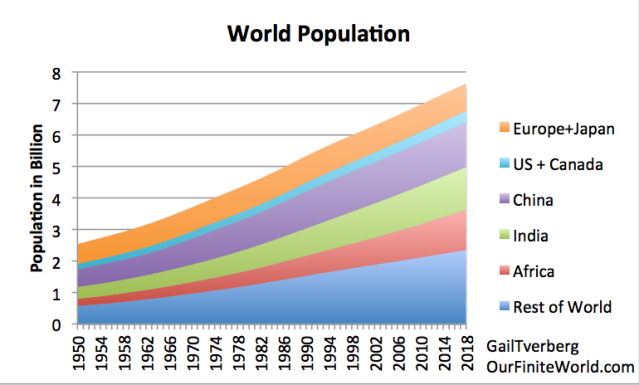
Figure 2. World population according to the United Nations 2017 historical estimates and Medium forecast of population growth after 2017.

In an economy, we have a choice regarding how much energy to use. If more energy is used, workers can have many tools (such as trucks and computers) to leverage their productivity. If all goods are made with few energy inputs other than human labor, most workers find themselves working in subsistence agriculture. The total amount of goods and services produced in such an economy tends to be very small.

If supplemental energy is used, many more jobs that pay well can be added, and many more goods and services can be created. Workers will be rich enough that they can pay taxes to support representative government that supports many services. The whole economy will look more like that of a rich nation, rather than the economy of Somalia or Haiti.

Individual nations can grow their economies by using available energy supply to create jobs that pay well. Globalization sets up competition for available jobs.

If a given country has a lot of high paying jobs, this is likely to be reflected in high per capita energy consumption for that country. There are two reasons for this phenomenon: (1) it takes energy for an employer to create jobs, and (2) workers can use their wealth to buy goods and services. This wealth buys more goods and services made with energy products.


[3] One measure of how well the world economy is doing is world energy consumption per capita. On this basis, the world economy is already reaching limits.
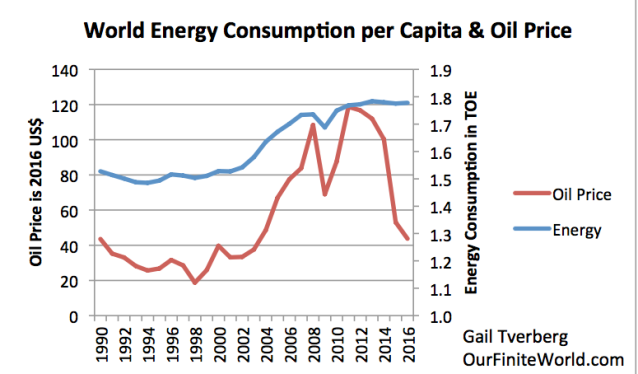
Figure 3. World energy per capita and world oil price in 2016 US$. Energy amounts from BP Statistical Review of World Energy, 2017. Population estimates from UN 2017 Population data and Medium Estimates.

It is clear from Figure 3 that energy consumption tends to move in the same direction as oil price. If “demand” (which is related to wages) is high, both oil price and the amount of energy products sold will tend to be high. If demand is low, both oil price and the amount of energy products sold will tend to be low.

Since 2014, energy consumption has remained quite high, but oil prices have fallen very low. Today’s oil prices (even at $70 per barrel) are too low for oil producers to make adequate investment in the development of new fields and make other needed expenditures. If this situation does not change, the only direction that production of oil can go is down, rather than up. Prices may temporarily spike, prior to the time production falls.

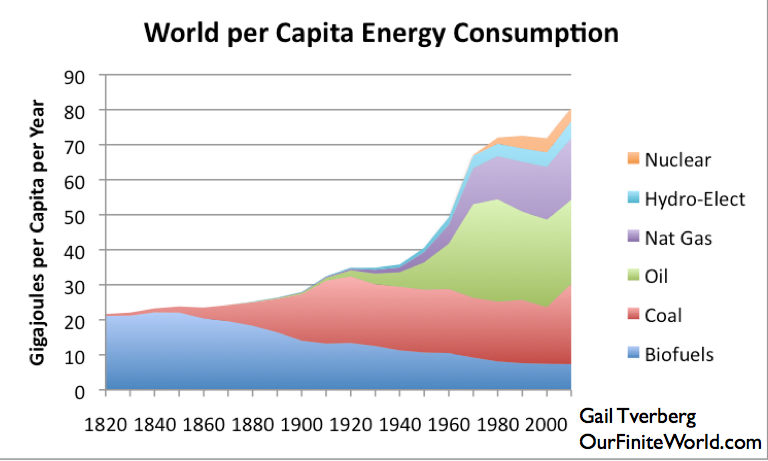
Looking at energy consumption per capita on Figure 3 (above), we notice that this amount has been fairly flat since 2011. Normally, in a growing world economy, a person would expect energy consumption per capita to rise, as it has most of the time since 1820 (Figure 4).
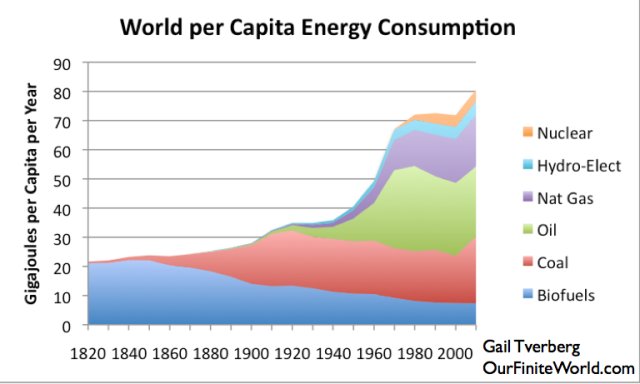
Figure 4. World Energy Consumption by Source, based on Vaclav Smil estimates from Energy Transitions: History, Requirements and Prospects (Appendix) together with BP Statistical Data for 1965 and subsequent, divided by population estimates by Angus Maddison.

The fact that energy consumption per capita has been nearly flat since 2011 is worrying. It is a sign that the world economy may not be growing very rapidly, regardless of what government organizations are reporting to the World Bank. Some subsidized growth should not really be considered economic growth. For example, some Chinese cities have been buying off the country’s housing glut with borrowed money. A better accounting would likely show lower GDP growth for China and the world.

Looking more closely at Figure 3, we note that energy per capita hit a high point in 2013, just before world oil prices began sliding downward. Since then, world energy consumption per capita has been trending downward. This is part of the reason for gluts in supply. Producers had been planning as if normal growth in energy consumption would continue. In fact, something is seriously wrong with demand, so world energy consumption has not been rising as fast as in the past.

The point that is easy to miss is that (a) growing wage disparity plus oil gluts and (b) high oil prices are, in a sense, different ways of reflecting a similar problem, that of an inadequate supply of truly inexpensive-to-produce oil. High-cost-to-produce oil is not acceptable to the economy, because it doesn’t produce enough jobs that pay well, for each barrel produced. If oil prices today truly represented what oil producers (such as Saudi Arabia) need to maintain their production, including adequate tax revenue and funds to develop additional production, oil prices would be well over $100 per barrel.

We are dealing with a situation where no oil price works. Either prices are too high for a large number of consumers or they are too low for a large number of producers. When prices are low, relative to the cost of production, we tend to get wage disparity and gluts.

[4] The reason why energy demand is not growing is related to increased wage disparity. This is a problem for globalization, because globalization acts to increase wage disparity.

In the last section, I mentioned that demand is closely connected to wages. It is really wage disparity that becomes a problem. Goods and services become less affordable for the people most affected by wage disparity: the lower-paid workers. These people cut back on their purchases of goods such as homes and cars. Because there are so many lower-paid workers in the world, demand for energy products, such as oil and coal, fails to grow as rapidly as it otherwise would. This tends to depress prices for these commodities. It doesn’t necessarily reduce production immediately, however, because of the long-term nature of investments and because of the dependence of oil exporters on the revenue from oil.

Figure 5 shows that China and India’s energy consumption per capita has been rising, leaving less for everyone else.
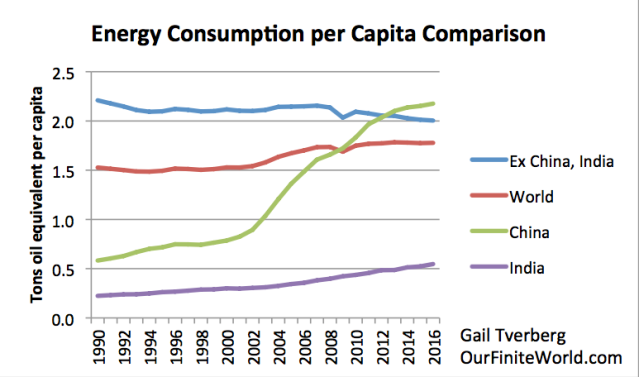
Figure 5. Energy consumption per capita comparison, based on energy data from BP Statistical Review of World Energy 2017, and UN 2017 Population Estimates.

A major way that an economy (through the laws of physics) deals with “not enough goods and services to go around” is increased wage disparity. To some extent, this occurs because newly globalized countries can produce manufactured products more cheaply. Reasons for their advantage are varied, but include lower wages and less concern about pollution.

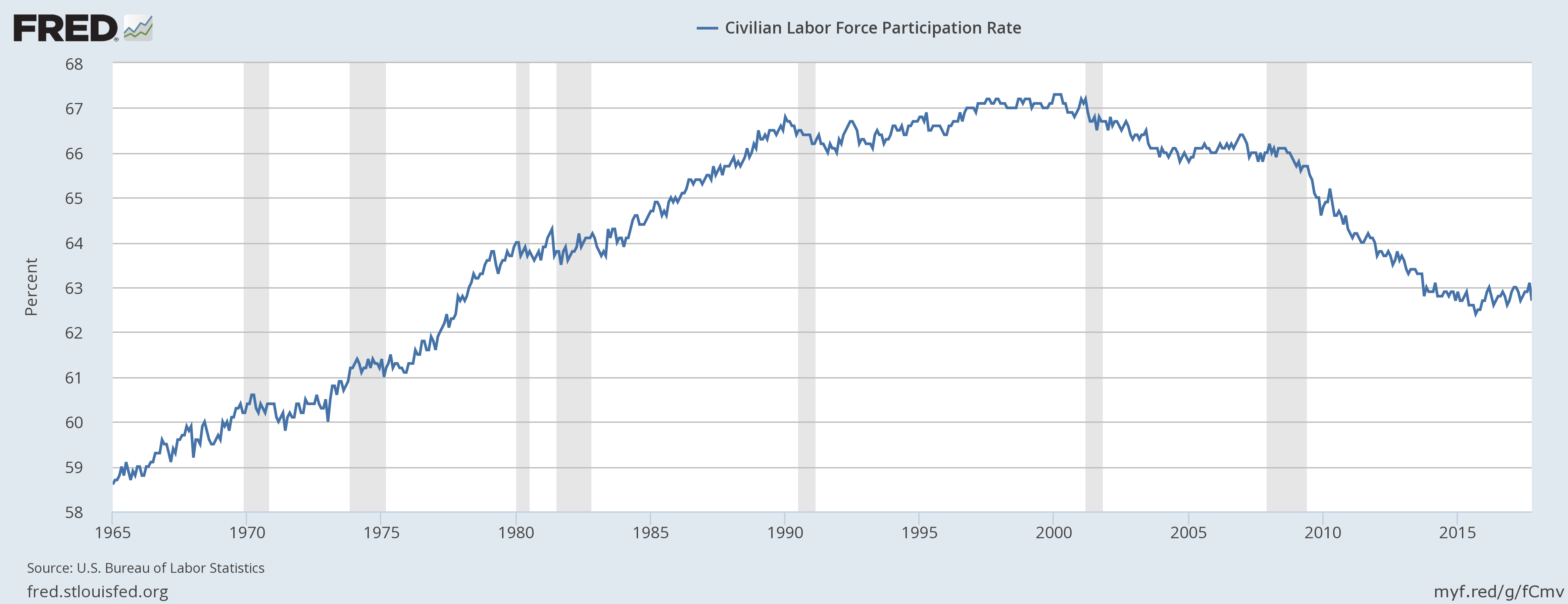
As a result, some jobs that previously would have been added in developed countries are replaced by jobs in newly globalized countries. It is probably not a coincidence that US labor force participation rates started falling about the time that China joined the World Trade Organization in 2001.
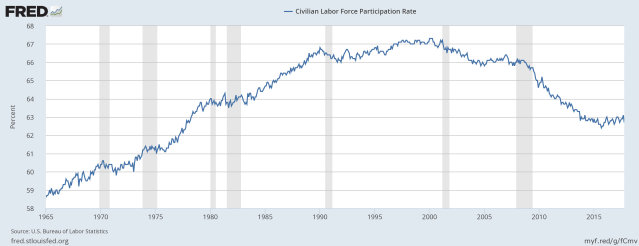
Figure 6. US Labor Force Participation Rate, as prepared by Federal Reserve Bank of St. Louis.

Lower wages for unskilled workers may also occur as the result of immigration, and the resulting greater competition for less skilled jobs. This has been a particular concern in the UK.

[5] Adding China, India, and other countries through globalization temporarily gives a boost to world energy production. This boost disappears as the energy resources of the newly added countries deplete.

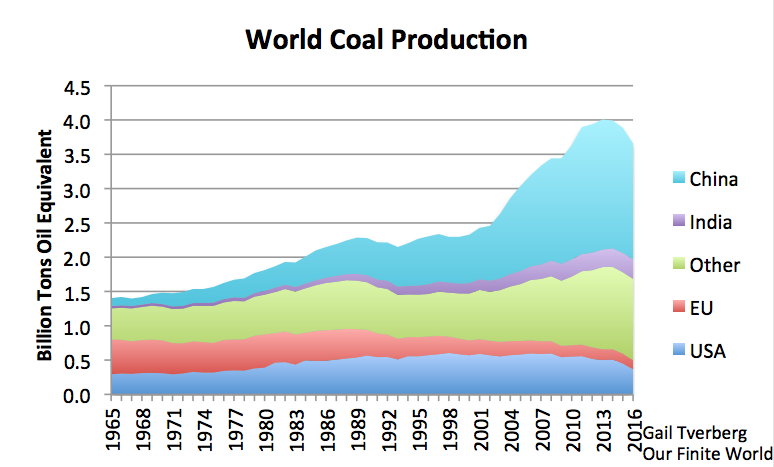
Both China and India are primarily coal producers. They rapidly ramped up production since joining the World Trade Organization (in 1995 for India; in 2001 for China). Now China’s coal production is shrinking, falling 11% from 2013 to 2016. Both China and India are major importers of fossil fuels (difference between black line and their own production).
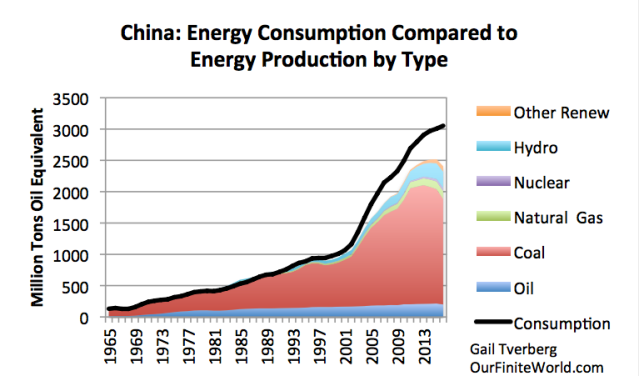
Figure 7. China’s total energy consumption compared to its energy production by type, based on BP Statistical Review of World Energy, 2017.
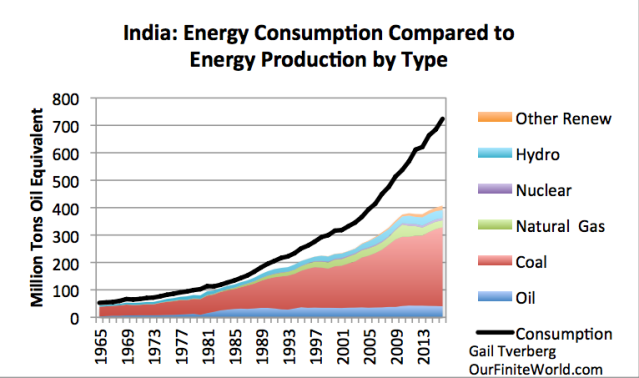
Figure 8. India’s total energy consumption compared to its energy production by type, based on BP Statistical Review of World Energy, 2017.

China and India’s big surge in coal production has had a major impact on world coal production. The fact that both countries have needed substantial imports has also added to the growth in coal production in the “Other” category in Figure 9.

Figure 9 also shows that with China’s coal production down since 2013, total world coal production is falling.

Figure 9. World coal production by part of the world, based on BP Statistical Review of World Energy, 2017.

Figure 10 shows that world GDP and world energy supply tend to rise and fall together. In fact, energy growth tends to precede GDP growth, strongly suggesting that energy growth is a cause of GDP growth.

Figure 10. World three-year average GDP growth compared to world three-year average energy consumption growth. GDP data is from the World Bank, based on 2010 US$ weights of GDP by country; energy consumption is from BP Statistical Review of World Energy, 2017.

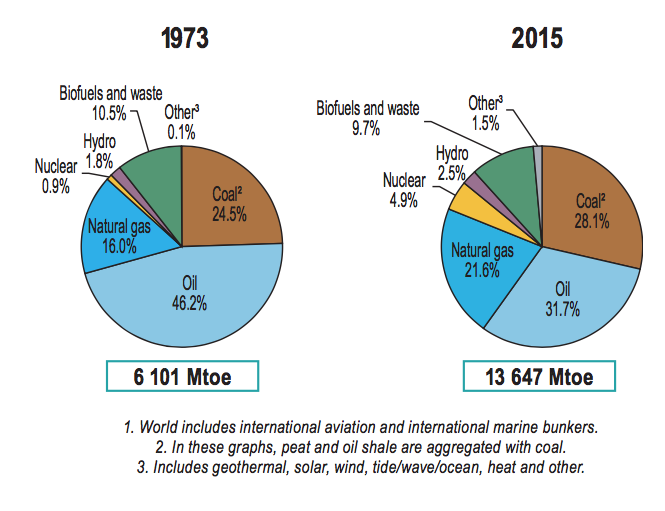
If a growth in energy consumption is indeed a primary cause of world economic growth, the drop in world coal production shown in Figure 9 is worrying. Coal makes up a large share of world energy supply (28.1% according to Figure 12). If its supply shrinks, it seems likely to cause a decline in world GDP.

Figure 11 shows energy consumption growth on a basis comparable to the energy consumption growth shown on Figure 10, except for different groupings: for the world in total, the world excluding China, and for the combination of the US, EU, and Japan. We can see from Figure 11 that the addition of China and Japan has greatly propped up growth in world energy consumption since 2001, when China joined the World Trade Organization.
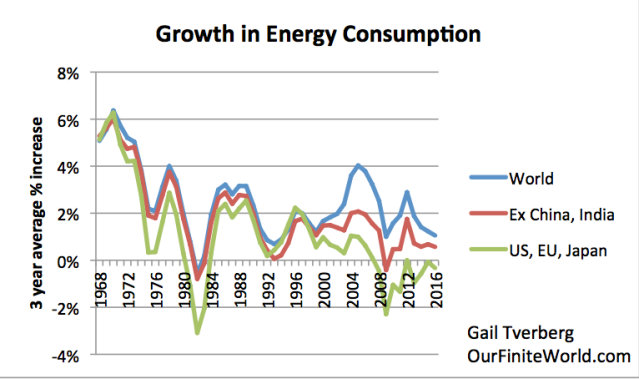
Figure 11. Three-year average growth in energy consumption, for the world total; the world less China and India; and for the sum of the United States, the European Union, and Japan. Energy data from BP Statistical Review of World Energy, 2017.

The amount of the “benefit” was greatest in the 2003-2007 period. If we look at Exhibit 10, we see that world economic growth was around 4% per year during that period. This was a recent record high. Now the benefit is rapidly disappearing, reducing the possibility that the world energy consumption can grow as rapidly as in the past.

If we want world energy consumption per capita to rise again, we need a new large rapidly growing source of cheap energy to replace the benefit we received from China and India’s rapidly growing coal extraction. We don’t have any candidates for a suitable replacement. Intermittent renewables (wind and solar) are not candidates at all. According to the IEA, they comprised only 1% of world energy supply in 2015, despite huge investment. They are part of the gray “Other” slice in Figure 11.
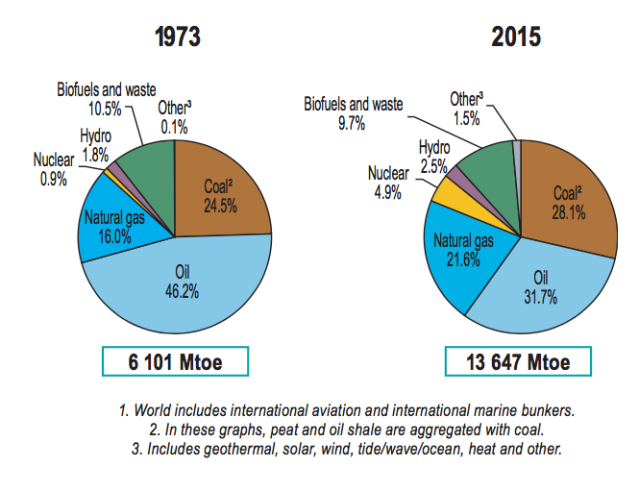
Figure 12. Figure prepared by IEA showing Total Primary Energy Supply by type from this IEA document

Academic studies regarding wind and solar have tended to focus on what they “might” do, without considering the cost of grid integration. They have also overlooked the fact that any energy solution, to be a true energy solution, needs to be a huge energy solution. It has been more pleasant to give people the impression that they can somehow operate a huge number of electric cars on a small amount of subsidized intermittent electricity.

[6] On a world basis, energy consumption per capita seems to need to be rising to maintain a healthy economy. 

When energy consumption is growing on a per capita basis, the situation is similar to one in which the average worker has more and more “tools” (such as trucks) available at his/her disposal, and sufficient fuel to operate these tools. It is easy to imagine how such a pattern of growing energy consumption per capita might lead to greater productivity and therefore economic growth.

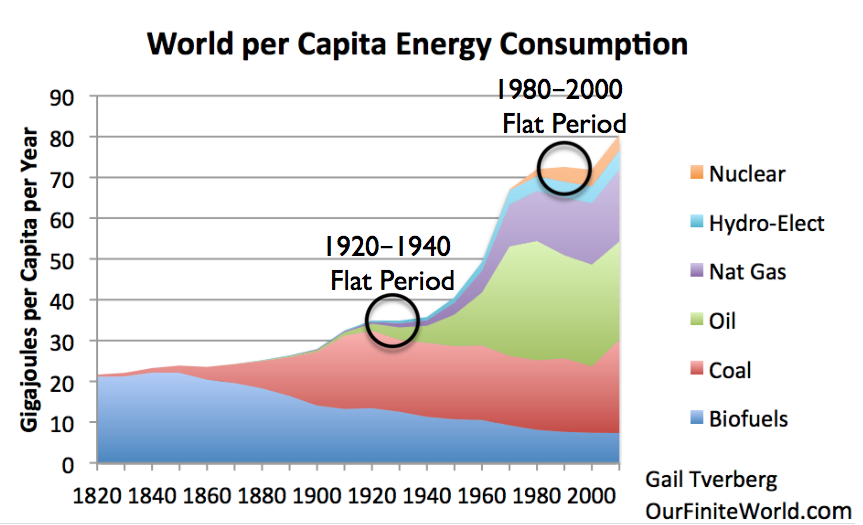
If we look at historical periods when energy consumption has been approximately flat, we see a world economy with major problems.
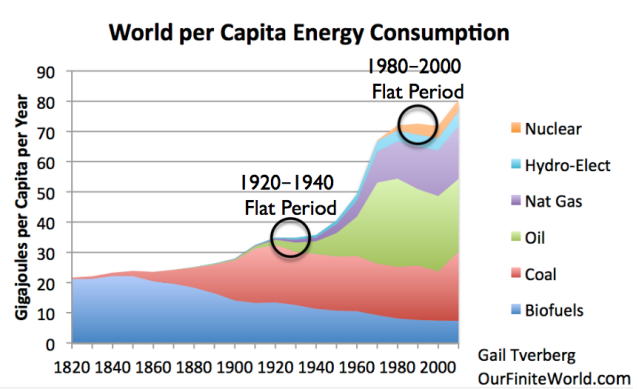
Figure 13. World per Capita Energy Consumption with two circles relating to flat consumption. World Energy Consumption by Source, based on Vaclav Smil estimates from Energy Transitions: History, Requirements and Prospects (Appendix) together with BP Statistical Data for 1965 and subsequent, divided by population estimates by Angus Maddison.

The flat period of 1920-1940 seems to have been caused by limits reached on coal production, particularly in the United Kingdom, but also elsewhere. World War I , the Great Depression of the 1930s, and World War II all took place around this time period. Charles Hall and Kent Klitgaard in Energy and the Wealth of Nations argue that resource shortages are frequently the underlying cause for wars, including World Wars I and II.

The Great Depression seems to have been a partial economic collapse, indirectly related to great wage disparity at that time. Farmers, in particular, had a difficult time earning adequate wages.

The major event that took place in the 1990 to 2000 period was the collapse of the Soviet Union in 1991. The central government collapsed, leaving the individual republics to operate independently. The Soviet Union also had strong trade relationships with a number of “satellite” countries, including Cuba, North Korea, and several Eastern European countries. In the next section, we will see that this collapse had a serious long-term impact on both the republics making up the Soviet Union and the satellite countries operating more independently.

[7] The example of the Soviet Union shows that collapses can and do happen in the real world. The effects can be long lasting, and can affect trade partners as well as republics making up the original organization.

In Figure 14, the flat period of the 1980-2000 period seems to be related to intentional efforts of the United States, Europe, and other developed countries to conserve oil, after the oil price spikes of the 1970s. For example, smaller, more fuel conserving vehicles were produced, and oil-based electricity generation was converted to other types of generation. Unfortunately, there was still a “backfire” effect related to the intentional cutback in oil consumption. Oil prices fell very low, for an extended period.

The Soviet Union was an oil exporter. The government of the Soviet Union collapsed in 1991, indirectly because with these low oil prices, the government could not support adequate new investment in oil and gas extraction. Businesses closed; people lost their jobs. None of the countries shown on the Figures 14 and 15 have as high energy consumption per capita in 2016 as they did back when the Soviet Union collapsed.

Figure 14. Per capita energy consumption for the Soviet Union and three of its satellite countries. Energy data from BP Statistical Review of World Energy, 2017. Population data from UN 2017 Population data and Middle Estimates.

The three satellite countries shown on Figure 14 (Bulgaria, Hungary, and Poland) seem to be almost as much affected as the republics that had been part of the Soviet Union (Figure 15). This suggests that loss of established trading patterns was very important in this collapse.

Figure 15. Per capita energy consumption for the three largest (by population) republics that made up the Soviet Union. Energy data from BP Statistical Review of World Energy, 2017. Population data from UN 2017 Population data and Middle Estimates.

Russia’s per capita energy consumption dropped 29% between peak and trough. It had significant fossil fuel resources, so when prices rose again, it was again able to invest in new oil fields.

Ukraine was a major industrial center. It was significantly impacted by the loss of oil and gas imports. It has never recovered.

The country that seemed to fare best was Uzbekistan. It had little industry before the collapse, so was less dependent on energy imports than most. Of all of the countries shown on Figures 14 and 15, Uzbekistan is the only one that did not lose population.

[8] Today, there seem to be many countries that are not far from collapse. Some of these countries are energy exporters; some are energy importers.

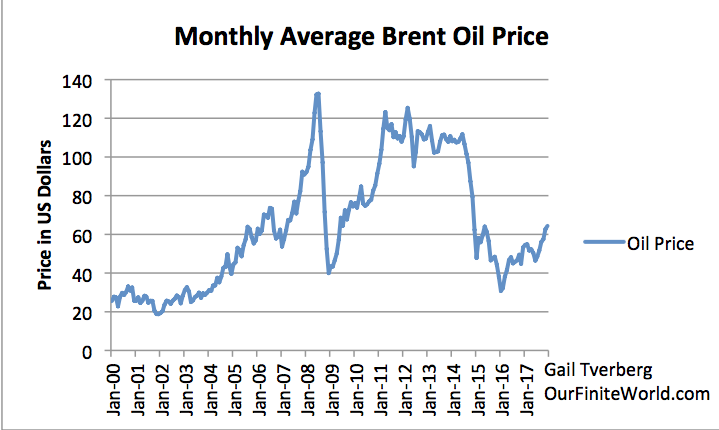
Many of us have read about the problems that Venezuela has been having recently. Ironically, Venezuela has the largest oil reserves in the world. Its problem is that at today’s prices, it cannot afford to develop those reserves. The Wikipedia article linked above is labeled 2014-2018 Venezuelan protests. Oil prices dropped to a level much lower than they had been in 2014. It should not be surprising that civil unrest and protests came at the same time.
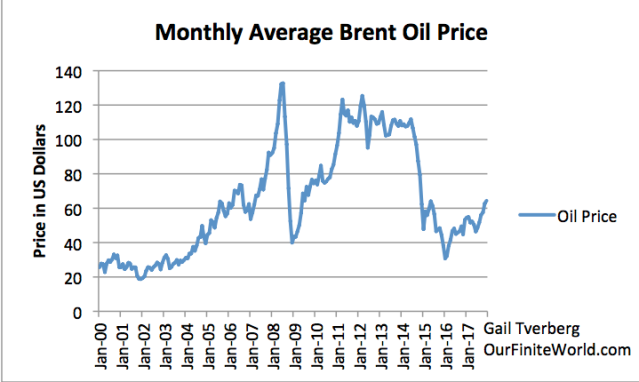
Figure 16. Monthly average spot Brent oil prices, through December 2017, based on EIA data.

Other oil producers are struggling as well. Saudi Arabia has recently changed leaders, and it is in the process of trying to sell part of its oil company, Saudi Aramco, to investors. The new leader, Mohamed bin Salman, has been trying to get money from wealthy individuals within the country, using an approach that looks to outsiders like a shake-down. These things seem like very strange behaviors, suggesting that the country is experiencing serious financial difficulties. This is not surprising, given the low price of oil since 2014.

On the oil-importer side, Greece seems to frequently need support from the EU. The lower oil prices since 2014 have somewhat helped the country, but the basic shape of the energy consumption per capita chart makes it look like it is struggling to avoid collapse.
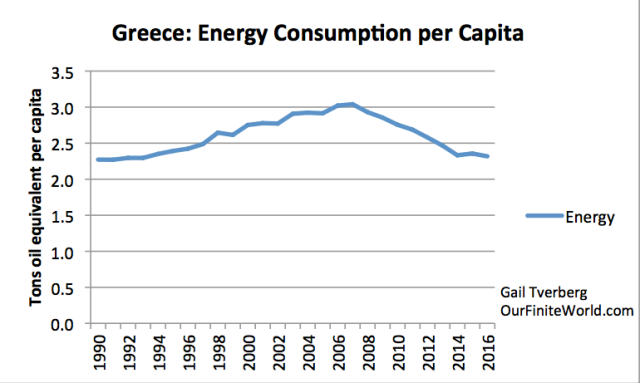
Figure 17. Greece energy per capita. Energy data from BP Statistical Review of World Energy, 2017; population estimates from UN 2017 Population data and Medium projections.

There are many other countries struggling with falling energy consumption per capita. Figure 18 shows a chart with four such countries.

Figure 18. Energy consumption per capita for Japan, UK, Italy, and Spain. Energy consumption from BP Statistical Review of World Energy; population from UN 2017 Population data and Medium Estimates.

In a sense, even though oil prices have been lower since 2014, prices haven’t been low enough to fix the economic problems these countries have been having.

China is in a different kind of situation that could also lead to its collapse. It built its economy on coal production and rapidly growing debt. Now its coal production is down, and it is difficult for imports and substitution of other fuels to completely compensate. If slowing growth in fuel consumption slows economic growth, debt will become much harder to repay. Major debt defaults could theoretically lead to collapse. If China were to collapse, it would seriously affect the rest of the world because of its extensive trading relationships.

[9] Leaders of countries with increasing wage disparity and unhappy electorates can be expected to make decisions that will move away from globalization. 

Unhappy workers are likely to elect at least some leaders who recognize that globalization is at least a small part of their problems. This is what has happened in the US, with the election of President Trump.

The hope, of course, is that even though the rest of the world is becoming poorer and poorer (essentially because of inadequate growth of cheap-to-produce energy supplies), somehow a particular economy can “wall itself off” from this problem. President Donald Trump is trying to remake trading arrangements, based on this view. The UK Brexit vote was in a sense similar. These are the kinds of actions that can be expected to scale back globalization.

Conclusion

Having enough cheap energy for the world’s population has been a problem for a very long time. When there is enough cheap-to-produce energy to go around, the obvious choice is to co-operate. Thus the trend toward globalization makes sense. When there is not enough cheap-to-produce energy to go around, the obvious choice is to try reduce the effects of globalization and immigration. This is the major reason why globalization can’t last.

We now have problems with both coal and oil. With the decline in China’s coal supplies, we are reaching the point where there are no longer enough cheap energy supplies to go around. At first glance, it looks like there is enough, or perhaps even a superabundance. The problem is that no price works. Producers around the world need higher oil prices, to be compensated for their total cost, including the cost of extraction, developing new fields, and the tax levels governments of exporting countries need. Consumers around the world are already having trouble trying to afford $70 per barrel oil. This is what leads to gluts.

We have been told that adding wind and solar to the electric grid can solve our problems, but this solution is simply absurd. If the world is to go forward as before, it somehow needs a new very large, very cheap supply of energy, to offset our problems with both coal and oil. This new energy supply should not be polluting, either.

At this point, it is hard to see any solution to the energy problems that we are facing. The best we can try to do is “kick the can” down the road a little farther. Perhaps “globalization light” is the way to go.

We live in interesting times!

via RSS http://ift.tt/2BPJucV Tyler Durden

“Dr. Doom” Nouriel Roubini Says Bitcoin Is The “Biggest Bubble In Human History”

NYU economist Nouriel Roubini – aka “Dr. Doom” – has long been a cryptocurrency skeptic. So it’s hardly surprising that he delighted in bashing the cryptocurrency during an appearance on Bloomberg TV Friday, where he said the bitcoin boom that carried the price of a single token to $20,000 late last year was “the biggest bubble in human history” and that this “mother of all bubbles” is finally crashing..

And, of course,

And it’s not just Bitcoin, Roubini added. There are more than 1,300 cryptocurrencies or ICOs, and “most of them are even worse” than the largest digital token. These constitute a “a bubble to the power of two or three,” he said.

Furthermore, while many of bitcoin’s critics (Warren Buffett, Ray Dalio, Jamie Dimon – though Dimon later recanted) have clarified that they see value in “blockchain technology”, which many have proclaimed has the potential to change the world by disrupting industries as diverse to Wall Street and health care.

Blockchain has “been around for 10 years, and the only application is cryptocurrencies, which is a scam,” the New York University economist added.

Roubini added that bitcoin “is an environmental disaster.” As we pointed out late last year, bitcoin mining already consumes more energy than 12 US states.

* * *

After breaking below $8,000 for the first time since November earlier today, bitcoin and other cryptocurrencies aggressively rebounded from a selloff that sent bitcoin lower by roughly 30% at its nadir.


Chart

Still, bitcoin is on track to book its worst week since 2013…

bitcoin


via RSS http://ift.tt/2GGH1oV Tyler Durden

Kissinger Warns “Pre-Emptive Attack” Against North Korea “Is Strong” Possibility

Authored by Alex Christoforou via TheDuran.com,

Former Secretary of State Henry Kissinger has said that he agrees with the aggressive statements President Trump has made towards North Korea.

The former Secretary of State said that the Trump Administration “will hit that fork in the road, and the temptation to deal with it with a pre-emptive attack” against North Korea “is strong, and the argument is rational.”

PJ Media reports

The Trump administration has signaled that North Korea would be crossing a red line if it developed nuclear capability for its intercontinental ballistic missile program. Yet some policy officials and military experts claim that North Korea has already crossed that line, or is at least very close to attaching nuclear warheads to its missiles.

Kissinger offered his thoughts on the impending “fork in the road,” in which the administration may consider pre-emptive military action or increasingly tighter sanctions against the regime.

“We will hit that fork in the road, and the temptation to deal with it with a pre-emptive attack is strong, and the argument is rational, but I have seen no public statement by any leading official,” Nixon’s secretary of State told members of the Senate Armed Services Committee. “But in any event, my own thinking, I would be very concerned by any unilateral American war at the borders of China and Russia, in which we are not supported by a significant part of the world, or at least of the Asian world.”

The current North Korean trajectory, Kissinger continued, could lead to nuclear proliferation throughout Asia, as he believes South Korea will not accept being the only Korea without nuclear capability. Japan will follow suit, he said.

“Then we’re living in a new world, in which technically competent countries with adequate command structures are possessing nuclear weapons in an area where there are considerable national disagreements,” Kissinger said. “That is a new world that will require new thinking by us.”

This would drive a rethinking of the entire U.S. nuclear deterrent posture, Kissinger said, as the current strategy assumes only one potential nuclear threat. One little country in North Korea does not pose such an extreme threat, Kissinger said, but the situation has the potential to evolve into a nuclear landscape the world has never seen.

In the coming weeks, the Trump administration is expected to release its Nuclear Policy Review, which is rumored to call for new nuclear weapons capability, more useable nuclear weapons and expanded conditions under which the U.S. would contemplate using a nuclear weapon.

Sen. Elizabeth Warren (D-Mass.) asked President Reagan’s Secretary of State George P. Shultz if he still believes that the U.S. should further reduce its reliance on nuclear weapons. Schultz said a nuclear exchange would have “devastating” impacts on the planet, “so I continue to believe that we should be trying to eliminate them.”

“We were getting there for a while, and now that’s all stopped, and now our problem is proliferation, so this is a new problem we have to work out and work at it hard,” Schultz said.

Schultz also agreed with Kissinger’s recommendation that the U.S. attempt to start a serious dialogue with Russia, which the U.S. could expand to other countries and attempt to get a joint enterprise with the objective of eliminating nuclear weapons from the planet.

In response to Kissinger’s comments on North Korea, Schultz said that the U.S. needs to be “careful with red lines.” He added that when a solider points his weapon at an enemy, he’d better be ready to kill.

“Empty threats destroy you,” Schultz said.

He agreed with Kissinger’s recommendation that the U.S. work constructively to bring China and Russia to the table, mostly China, as it has greater influence over North Korea. Kissinger said the U.S. should be working closely with China to bring further sanctions and pressure against North Korea. Schultz pointed out that China has a declining population and GDP, which should make them more receptive to collaboration.

“That would be my preferred course, and on the other hand, if it turns out that neither is availing, then we better get used to the fact that South Korea, in my opinion, will not accept being the only Korea that has no nuclear weapon,” Kissinger said.

Earlier in the conversation, Kissinger said that if it gets to the point where the U.S. is forced to come to a deal with North Korea and freeze its nuclear program, the U.S. will have somewhat legitimized North Korea’s military capability, which will encourage other countries in the region.

Kissinger also warned Congress last week against potential military intervention near Russian and Chinese borders without the world’s support.

After today’s memo release (and judging by McCain’s response), we suspect the war-drums from the left will build.

via RSS http://ift.tt/2EBAzih Tyler Durden

If You Think The Nunes Memo Will ‘Discredit’ FBI and DOJ, You Haven’t Been Paying Attention For the Past 50 Years

As Scott Shackford reports, the White House has cleared the release of a classified memo by House Intelligence Committee Chair Devin Nunes (R-Calif.) that purports to show that FBI agents and others at the Department of Justice (DOJ) acted out of political motives in surveilling Carter Page, a campaign adviser to then-candidate Donald Trump. Nunes’ Democratic counterpart, Rep. Adam Schiff (D-Calif.) has called out Nunes in no uncertain terms:

“The selective release and politicization of classified information sets a terrible precedent and will do long-term damage to the Intelligence Community and our law enforcement agencies.”

Well, sure.

But to the extent that Schiff is trying to suggest the FBI and DOJ aren’t constantly acting out of political motives and basic incompetence that hurt their credibility, he’s completely out to lunch. Both of these units of government have remarkably and well-deserved bad reputations stretching back decades.

And this is where the obsessive fixation of details in Washington completely blocks out the big picture. Remember how Republicans figured that by endlessly sifting sand for details about “Benghazi,” they would finally end Hillary Clinton’s career in the public eye? They were too far up their own asses to ever ask the obvious question: What the hell were we doing in Libya to begin with? Especially given Barack Obama’s manifest lack on interest in getting even a rubber-stamp authorization from Congress? Even after the United States helped plunge Libya into a total clusterfuck, that larger-picture view was left to the crazy-eyed libertarians.

Similarly with “the memo,” which deals with a relatively obscure and meaningless Trump hanger-on and, as Shackford notes in his article, fails to advance either side of the debate over whether the president was playing footsie with the Russians. The important issue here isn’t the damage that Nunes’ document (and eventually, Schiff’s minority report that will be published after it is vetted for security reasons) does or doesn’t do to the reputation of the FBI and federal law enforcement. It’s that the reputation of these groups is already awful.

Schiff is claiming that Nunes is acting only out of political interest, a charge that mirrors what Nunes is saying about the FBI and the Department of Justice. Those of us who actually care about proper governance would do well to think back to, I don’t know, a few months before the 2016 election, when then-director of the FBI James Comey, appointed by Barack Obama, laid out a devastating case against Candidate Clinton…before saying he wouldn’t recommend bringing charges against her.

Recall the rhetorical cherry that Comey put on the top of that shit sundae:

To be clear, this is not to suggest that in similar circumstances, a person who engaged in this activity would face no consequences. To the contrary, those individuals are often subject to security or administrative sanctions. But that is not what we are deciding now.

So regular Americans could get strung up, but not Hillary Clinton. This is not ancient history or fable about a black-bag But we’re not supposed to bring up the deservedly low opinions of the FBI and a Justice Department that have for decades done everything possible to make Americans suspect their employees aren’t really trustworthy. The FBI in particular has a long history of abusing its power and the results of that show up in polls mostly showing a massive lack of confidence in it. To the right is a poll from 2016, which tracks with other measures of a broad-based decline in major U.S. institutions. One-third of Americans have strong confidence in the FBI, the same awful result that the CIA fetches.

A Harvard CAPS-Harris poll from late December found

Sixty-three percent of polled voters believe that the FBI has been resisting providing information to Congress on the Clinton and Trump investigations. This is a remarkable finding for an agency whose new head said a few days ago that the agency was in fine shape. No, it isn’t.

Consider this gloss on Tim Weiner’s damning 2012 of the FBI, Enemies:

Most presidents since Woodrow Wilson have been less intimidated by the F.B.I. than seduced by it. Under the rubric of protecting the nation, they secretly authorized the F.B.I. to open mail, infiltrate political parties, tap phones, perform “black bag” break-ins of homes and institutions, and draw up vast lists of Americans eligible for “custodial detention” during a crisis….

Botched confrontations with cults and right-wing radicals left a trail of blood from Whidbey Island to Ruby Ridge to the Branch Davidian compound in Waco. The bureau was penetrated again and again by double agents from Russia, China, Cuba, even Al Qaeda. (The Chinese spy Katrina Leung, truly a double agent, seduced both the special agent in charge of her case and “a leading F.B.I. counterintelligence expert on China.”) F.B.I. turncoats like Robert Hanssen and Earl Pitts went undetected for years, costing “hundreds of millions of dollars” and the lives of a “dozen or more foreign agents who worked for the bureau and the C.I.A.”

The best terror informant the bureau actually had was dropped for fear that he might be a double agent, while as late as 2002, only eight agents could speak Arabic. The F.B.I. remained a “pyramid of paper,” mysteriously unable to create a decent computer system; by 2000, “the average American teenager had more computer power than most F.B.I. agents,” according to Weiner, and agents “could not perform a Google search or send e-mails outside their offices.”

This is the essential context for any discussion of “the memo” and investigations by the government into actors such as Hillary Clinton and Donald Trump. And the hits just keep coming. Investigative journalist Sharyl Attkisson, who broke the story of the DOJ’s heinous “Fast and Furious” gun-walking operation, reports on new text messages between Peter Strzok and Lisa Page, two FBI officials whose political animus against Donald Trump has hurt the credibility of the Russia investigation.

Page: Have a meeting with turgal about getting iphone in a day or so

Strzok: Oh hot damn. . . We get around our security/monitoring issues?

Page: No, he’s proposing that we just stop following them. Apparently the requirement to capture texts came from [Office of Management and Budget], but we’re the only org (I’m told) who is following that rule. His point is, if no one else is doing it why should we. . . I’m told – thought I have seen – that there is an IG report that says everyone is failing. But one has changed anything, so why not just join in the failure.

Attkisson notes:

It’s a shockingly cavalier attitude from an attorney and high level FBI official.

There are more text messages between Strzok and Page from a critical time period, as we now know, that the FBI claimed had been lost in a technical glitch. After that became public, the Inspector General said he was able to recover them. (Interesting that the FBI couldn’t.)

Are Americans stupid for feeling like its government is not worthy of respect and confidence? No, of course not. The people in government, especially a string of mostly inept-at-best and power-mad-at worst FBI directors and attorneys general have brought us to a place where we don’t trust them anymore. Especially in an age of forced transparency, squabbles between highly partisan members of Congress is a diversion from bigger and harder truths. Just like in the early to mid-1970s, when the Pentagon Papers, LBJ’s constant lies about Vietnam, Nixon’s illegal actions here and abroad, and revelations of COINTELPRO and massive abuses by the FBI, CIA, and NSA came to light, we need a new Church Commission and Rockefeller Commission if we’re ever going to be able to believe in our government again.

from Hit & Run http://ift.tt/2DXF5Xa
via IFTTT

FBI Director Wray Writes To Staff After Memo: “Keep Calm & Tackle Hard”

While Democrats and Republicans argue over the veracity and impact of the long-anticipated FISA memo, FBI Director Christopher Wray – who despite being appointed by President Trump opposed his push to have the memo released – sent a heartfelt note to the bureau’s rank and file employees, reassuring them that this, too, shall pass, and thanking them for their dedicated service.

While media reports have mostly focused on the superficial partisan squabbling, the work that the FBI does has a real impact on American communities that is felt far and wide.


wray

Wray

His upbeat, optimistic message contrasted with a tweet sent by his predecessor, former FBI Director James Comey – under whose watch most of these alleged abuses occurred.

“That’s it?” the former director asked, before accusing the House Intelligence Committee, which compiled the memo under the leadership of Rep. Devin Nunes, of producing a document that is “dishonest and misleading.”

Meanwhile, the Democratic leadership warned the administration not to use the memo as a “excuse” to fire Special Counsel Bob Mueller, and Republican Sen. John McCain said the memo “serves only Putin’s interests”.

Read Wray’s note below in its entirety…

The American people read the papers, and they hear lots of talk on cable TV and social media. But they see and experience the actual work you do – keeping communities safe and our nation secure, often dealing with sensitive matters and making decisions under difficult circumstances. And that work will always matter more.

Talk is cheap; the work you do is what will endure.

We speak through our work. One case at a time. One intelligence product at a time. One decision at a time.

We do that work, and we stay laser-focused on doing great work, even when it’s not easy, because we believe in the FBI. We believe in what it stands for and in what this institution means to people.

And nothing is going to change that.

We’re going to keep doing that work, because we know who and what we are, and because we know that our mission comes first. The American people come first.

So I ask you to keep doing your great work and keep being the great people you are. And I know that I consider it an incredible privilege to work beside you — and that I’m determined to defend your integrity and professionalism every day.

Remember: keep calm and tackle hard.

Thank you for standing strong together, and for keeping your faith in this institution that means so much to all of us.

While excerpts of the memo leaked early in the afternoon, the memo was published in its entirety for public consumption a few hours later…

via RSS http://ift.tt/2EcqRFi Tyler Durden

Political Correctness Serves Only The Ruling Elite

Authored by Charles Hugh Smith via OfTwoMinds blog,

No wonder the Ruling Elites loves political correctness: all those furiously signaling their virtue are zero threat to the asymmetric plunder of the status quo.

The Ruling Elites loves political correctness, for it serves the Elite so well. What is political correctness? Political correctness is the public pressure to conform to “progressive” speech acts by uttering the expected code words and phrases in public.

Note that no actual action is required. This is why the Ruling Elite loves political correctness: conformity is so cheap. All a functionary of the Ruling Elite need do is utter the code words (“hope and change,” “we honor diversity,” “thank you for your service,” etc.) and they get a free pass to continue their pillaging.

Those placated by politically correct utterances accept symbolic speech acts as substitutes for real changes in the power structure. This glorification of symbolic gestures–virtue signaling via social media, the parroting of progressive phrases, etc.–is as cheap as the mouthing of PC platitudes. Everybody gets to feel validated and respected at no cost to anyone: the progressives feel smugly superior because the Ruling Elite now feels compelled to parrot “progressive” speech acts in public, and the Ruling Elite is free to pillage without any demands for a radical restructuring of the incentives and distribution of the nation’s wealth and income.

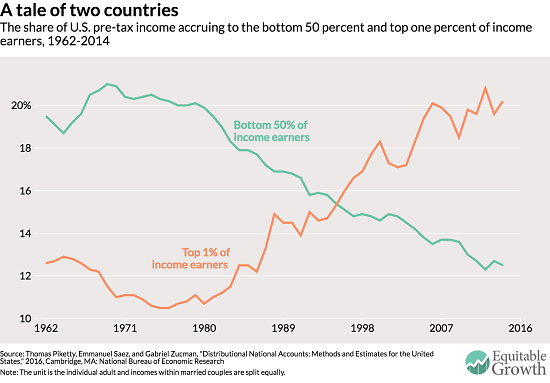
The rise of “progressive” speech acts and political correctness parallels the decline of the fortunes and incomes of the bottom 90%. While the “progressives” focus on cheap symbolism, the laboring classes are being gutted by the centralized financialization that rewards the few at the expense of the many.

Here’s median family financial assets: back to the levels of 1995:

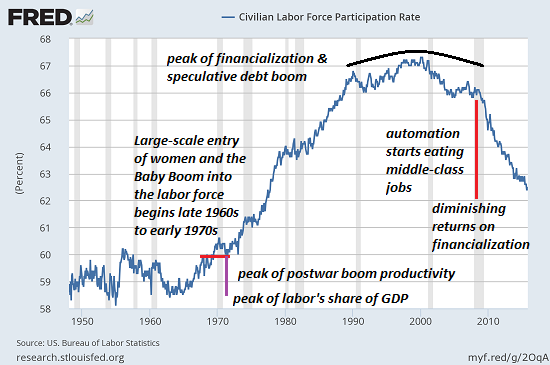
Here’s civilian participation in the work force–back to the levels of 1975:

Here’s the percentage of income going to the top 1% and the bottom 50%:

So while the “progressives” focus exclusively on their own ineffectual virtue-signaling and the empty “victories” of Ruling Elites mouthing the acceptable code words, our economy, society and the social contract are being shredded. No wonder the corporate media promotes empty gestures, virtue signaling and political correctness: all that phony compliance leaves the current wealth-power structure unchanged, and the Ruling Elite firmly in charge of the economy and governance.

No wonder the Ruling Elite loves political correctness: all those furiously signaling their virtue are zero threat to the asymmetric plunder of the status quo.

*  *  *

My new book Money and Work Unchained is $9.95 for the Kindle ebook and $20 for the print edition. Read the first section for free in PDF format. If you found value in this content, please join me in seeking solutions by becoming a $1/month patron of my work via patreon.com.

via RSS http://ift.tt/2DWkBlE Tyler Durden

Wales Bans Kids From Getting Nipple Rings, the Economy Adds 200k Jobs, and the NFL Loses Its Core Audience: P.M. Links

  • NFLThe Welsh National Assembly bans kids getting nipple rings.
  • The economy adds 200,000 jobs in January.
  • Arizona State Rep. Don Shooter did a literal mic drop after being expelled from the state legislature over sexual misconduct allegations.
  • The father of one of Larry Nassar’s victims tried to attack the disgraced doctor in court today.

from Hit & Run http://ift.tt/2DVnTBB
via IFTTT

Scaramucci Unloads On “Priebus The Fu**ing Sith Lord” , “Cock Of The Swamp” Bannon In Explosive Interview

Former White House communications director Anthony Scaramucci unleashed on former West Wing Trump advisors Reince Priebus and Steve Bannon in an incredibly candid and revealing Vannity Fair article published Thursday evening.


In a series of three “epic” interviews with investigative journalist William D. Cohan, Scaramucci covered a tremendous amount of ground – from his humble beginnings as an Italian kid growing up on Long Island, to his time at Harvard Law, and finally on to Goldman Sachs and the world of hedge funds – which “The Mooch” says pales in comparison to DC politics. 

ìI want you to imagine the worst person that youíve met on Wall Street, the most ruthless and the most diabolical … Thatís the best person in Washington. Thatís the Eagle Scout of Washington

In order to take the job, Scaramucci agreed to sell his majority stake in SkyBridge – the New York City-based hedge fund of funds he founded in 2005. 

It’s no mystery why Trump wanted Scaramucci around him. Having known each other for many years, “The Mooch” is the consummate Washington outsider; a self-made super high energy Wall St. multi-millionaire, vs the swamp creatures attempting to “handle” Trump – Bannon included as it turns out.

And even though Scaramucci originally backed Jeb! for President, Trump still invited the straight-talking Mooch into his circle of trust – giving him the job of rooting out leaks and stopping them.

Iím not intimidated by Trump. I have a relationship with him. I said that to him once in the Oval: ëBy the way, how do you want me to talk to you? Do you want me to talk to you like youíre the president of the United States, the way these other people talk to you, or do you want me to talk to you the way I was talking to you on the campaign, or when we were friends? Tell me which way you want to go here. Obviously, when theyíre around Iíll say ëMr. Presidentí and all the sycophantic stuff, but when weíre alone, how do you want me to talk to you?í [Replied Trump:] ëYouíve got to talk to me like weíre friends.íî

Rancid Penis

Scaramucci delved into his experience with various DC swamp creatures, starting with former White House chief-of-staff Reince Priebus, whom he refers to as “Rancid Penis” – who Mooch refers to as a Jamoke; described in the Urban Dictionary as a “clumsy loser who is incapable of doing normal human tasks.” 


ìRancid Penis, you know, he just cannot believe this. Heís just very jealous, canít believe Iím this close to Trump. Priebus had the society broken up into ëAlways Trumpersí and ëNever Trumpers,í and he was trying to flood the White House staff, as the chief of staff, with ëNever Trumpers,í and trying to figure out ways to blockade, slow down, and keep out, particularly of the White House, the ëTrumper-Trumpers.í”

Originally tapped to head up the Office of Public Liaison – Valerie Jarrett’s old job under Obama, Scaramucci says Priebus tried to talk him out of the West Wing: 

ìSo, when the president turned to me and said he wanted to give me the O.P.L. job, I got a call from Reince: ëDonít take the O.P.L. job. You can be the finance director for the R.N.C. Stay at your company.í Blah, blah, blah. I said, ëNo, no, no. Iím gonna take the O.P.L. job. I want to work with the president.í How many times in my life am I gonna be able to work in the White House and work for the president of the United States? And Reinceís answer was, ëActually, Iím gonna do everything I can [to help you].í He did say this because heís a Washingtonian. Thatís what they do to you, they say, ëgolly geeí to your face and they act like Richie Cunningham to your face. Theyíre Richie Cunningham and theyíre Opie from The Andy Griffith Show, but theyíre the fucking Sith Lord behind your back. Theyíre hitting you with a lightsaber behind your back.î In fact, according to Scaramucci, Priebus disinvited Scaramucciís parents from the January 22 swearing-in ceremony for the new White House staff.Vanity Fair

Scaramucci says Priebus jumped all over his decision to sell his stake in his hedge fund, SkyBridge, to Chinese conglomerate HNA Group Co. Ltd. ìHe gets this whole nefarious research packet over to The New York Times. They love this stuff. Boom: HNA is this mysterious, nefarious company.

Cock of the Swamp Bannon


In order to get rid of Scaramucci, Priebus reportedly enlisted Steve Bannon – another Jamoke – enticing him with a seat on the National Security Council (which lasted approximately three months before National Security adviser H.R. McMaster gave him the boot). 

“Then he goes to [Steve] Bannon [then Trumpís chief strategist] and he says, ëIím gonna get you on the National Security Council if thatís where you want to go, but youíve got to join forces with me and take out Scaramucci.íî

Scaramucci was shocked at Bannon’s betrayal. ìI helped Bannon through the three months that he was on the campaign, and we had a good relationship. But Bannon turns on me, because Bannon is ultimately railing against the swamp, but heís actually a cock of the swamp.”

Heís the creature from the Black Lagoon, Bannon. He acts more swamp-like than any person thatís ever become a Washingtonian. So for all of his railing on the swamp, he is literally the pig in George Orwellís Animal Farm that stands on his two legs the minute he gets power. He is the creature from the Black Lagoon.

Bannon and Priebus eventually recommended Scaramucci to the role of US ambassador to the Organization for Economic Cooperation and Development, in Paris – a position which included a 17-room apartment in Paris to move to with his family. Unfortunately, that would require a lengthy Senate approval, so in the meantime Priebus found Scaramucci a desk job at the Export-Import bank in Washington. 

On To Communications

While Priebus and Bannon successfully blocked Scaramucci from heading up the Office of Public Liaison, Ivanka Trump called The Mooch and set up a meeting – the topic being the White House’s copious leaks to the press, along with how to manage Trump’s image.  ìSo I go over that day,î he said. ìI go see Ivanka. They clearly donít want Priebus to know that Iím coming. I go through the door. Thereís a study off the Oval Office. Iím sitting there with the president. Ivankaís open with me. She says, ëWe have to re-structure.íî The meeting would lead to Scaramucci’s appointment as the new White House director of communications. 

ìGo back [to July] and look at the news cycles. What was going on was absolute berserkazoid craziness: internecine warfare, leaks every 13 seconds, Bannon leaking on everybody, Priebus leaking on everybody, total chaos in the White House, total disorganization.î

After Scaramucci accepted the job, Priebus and Bannon took it upon themselves to try and talk him out of it – peppering Scaramucci with a string of desperate phone calls and text messages. When Bannon was finally able to get through, he told Scaramucci that he wasn’t fit for the job.

You want to know what your chances are?í I said, ëWhat are my chances, Stephen?í [Replied Bannon]: ëZero! You got that, man? Zero. You got it? Zero.í I said, ëZero, O.K., I didnít realize that the word ëpresidentí was in front of your last name, Stephen…”

The next day, Scaramucci headed over to the White House where Trump would announce his decision to name him comms director – with instructions to his senior staff that Scaramucci was to report directly to him

In response, former Press Secretary Sean Spicer walked directly into the Oval Office and resigned. 

He comes back and he announces that heís resigned, and I said, ëO.K., thatís great.í Trumpís irritated. He says, ëThese guys are unbelievable. I gave them the job of a lifetime, theyíre letting everybody down. Theyíre letting me down.íî (Spicer could not be reached for comment.)”

The fall…

After a leak about Trump’s dinner plans was tweeted by Ryan Lizza, then-Washington correspondent for The New Yorker (who was subsequently fired for sexual misconduct), Scaramucci called Lizza to try and find out who his source was – dropping copious F-bombs, making jokes about murdering leakers, and referring to Steve Bannon in not-so kind terms.

Much to The Mooch’s chagrin, the profanity-laced conversation was taped – which Lizza promptly turned into a profanity-laced New Yorker article which would ultimately cost Mooch the dream job that he sold out of his hedge fund to take. Lizza’s article includes such gems as “Iím not Steve Bannon, Iím not trying to suck my own cock,î and “What I want to do is I want to fucking kill all the leakers and I want to get the Presidentís agenda on track so we can succeed for the American people.” 


Two days later – and a half hour or so after Reince Priebus was pushed out of his post as Chief-of-Staff and replaced by John Kelly, the New York Post ran an article stating that Scaramucci’s wife was divorcing him because she hates Trump.

a

Two days after that – and following an effort by Bannon to undermine Scaramucci by convincing the evangelical Freedom Caucus to complain to Trump over the profanity-laced Lizza phone call, John Kelly called The Mooch into his office and fired him, to which Scaramucci replied “Wow, that’s super disappointing.” 

Scaramucci notes that his firing at the hand of Kelly did not leak to the press. Moreover, Kelly even allowed Scaramucci to leave the White House through the East Wing exit near the Treasury to avoid cameras. 

Takeaways

The Mooch reflected on his very brief time at the White House;

“You want to talk about the education of Anthony Scaramucci? I learned that the swamp is probably a gold-plated cesspool with no drain. You understand what Iím saying? You canít drain the fucking thing. Itís a gold-plated cesspool, and you got cesspool operators in there that know how to slow down disruptors like Donald Trump

On Trump, Scaramucci says that “one Trump tweet more than any other sums up the man: ìMy button is bigger than your button.î He said, ìIf you really know the guy and you know how heís raking it over everybody and breaking everybodyís balls, itís like laugh-out-loud funny.î”

via RSS http://ift.tt/2DVoXW7 Tyler Durden

Weekend Reading: Did The Market Just Get ‘Woke’?

Authored by Lance Roberts via RealInvestmentAdvice.com,

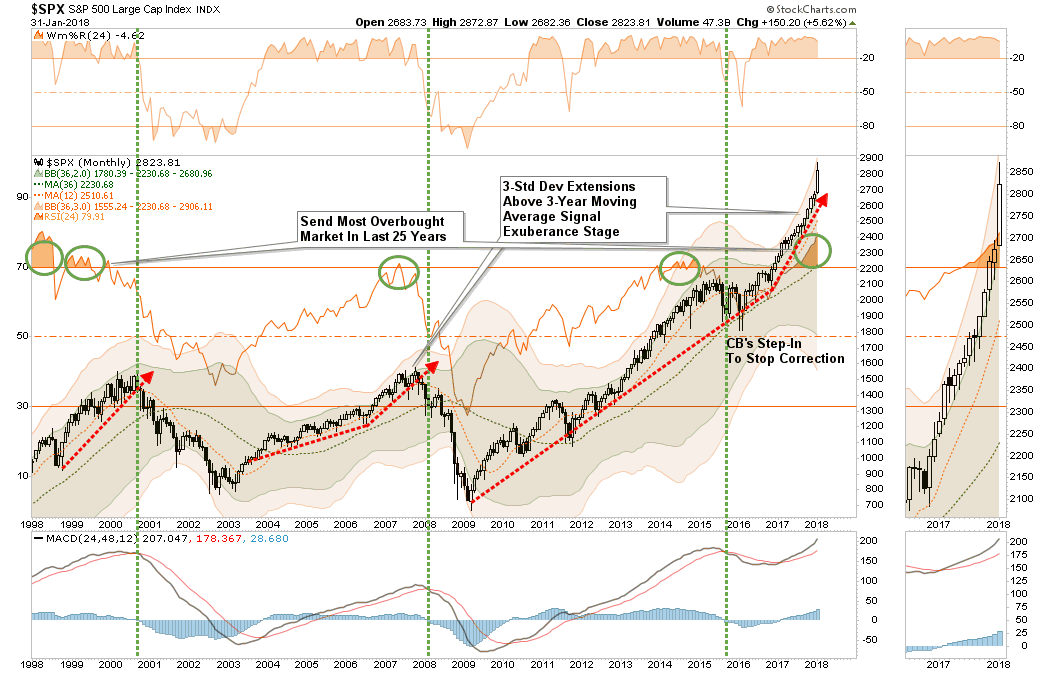
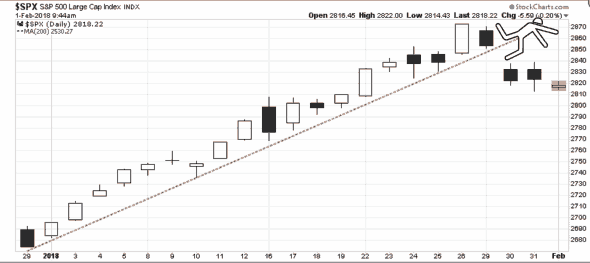
Since the beginning of this year, we have been warning of the potential for a correction. Of course, such warnings seemed pointless as the nearly “parabolic” rise in the markets seemed unstoppable. The chart below shows the current acceleration through the end of January.

But all of a sudden, something seems to have changed as the market stumbled this past week and has been unable to regain its footing.

So, what “woke” the markets?

Was it the sudden realization that Central Banks globally are reducing Q.E. programs? Or, that economic growth may be weaker than expected given recent numbers? Or, something else?

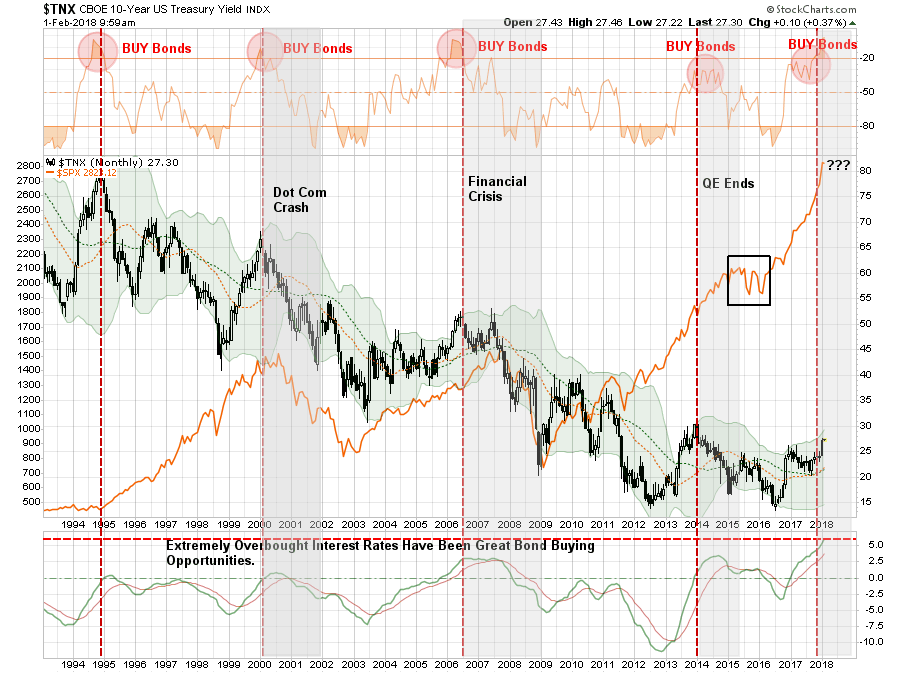
Whatever, the excuse turns out to be, the real culprit is seen in the chart below.

As I have been discussing “ad nauseam” over the last couple of years, interest rates are now stuck in a trading range that will likely remain between 0-1% during the next recessionary drag with a 3% ceiling as seen in 2014. Importantly, rates are at levels of overbought conditions only seen 3-times previously going back to 1980.

I am going to discuss this in more detail in this weekend’s forthcoming “Real Investment Report.” However, the point here is that since interest rates drive everything from borrowing, to spending, to capital investment – higher rates negatively impact economic growth. Since stocks are ultimately a reflection of the economy, it is hard to suggest that stocks will continue to rise in the face of higher rates.

Furthermore, higher rates are rapidly crushing the one argument used by bullish investors over the last eight years which has been “low rates justify higher valuations.” As I have repeatedly stated in the past, it is one argument that can literally change overnight.

Is this the beginning of the next major market correction?

Probably not.

There is simply too much exuberance currently in the market. It will take several failed rally attempts to begin to erode that base of bullishness.

But therein lies exactly what you want to look for. Rallies that fail at previous resistance levels, rising volatility and declining rates of participation.

As with every previous major market correction in history, investors were always given multiple warnings BEFORE the crash actually occurred.

(We have a special report coming out next week to our newsletter subscribers only discussing these warning signs. Click here to enter your email address if you want a copy of this report.)

Of course, few investors heeded those warnings because they had been lulled into the belief “this time is different.”

It wasn’t then. It won’t be next time either.

Here is your weekend reading list.


Economy & Fed


Markets


Cryptocurrency Mania


Research / Interesting Reads


“Speculation is an effort, probably unsuccessful, to turn a little money into a lot. Investment is an effort, which should be successful, to prevent a lot of money from becoming a little.” ― Fred Schwed Jr.

via RSS http://ift.tt/2nD00aW Tyler Durden