Movie Review: May It Last: A Portrait of the Avett Brothers: New at Reason

I have failed several times to pigeonhole the Avett Brothers for people I think might like them. It’s hard. To begin with, there’s no ignoring the fact that this is a band with a banjo player, and who wants to deal with that? Is this some kind of country act? If so, what’s with the cello?

The Avetts aren’t country, exactly (in Grammy world they’ve been consigned to the vague Americana category). But there’s no use in trying to describe them precisely. The Avetts (whose surname would rhyme with HAY-vet if that were a word) have to be heard and seen in order to absorb the full experience of their music. Conveniently, both of those bases are covered in a new documentary called May It Last: A Portrait of the Avett Brothers, which premiered on HBO this week. The film was co-directed by Judd Apatow, the Hollywood comedy king, and veteran documentarian Michael Bonfiglio, and it surely qualifies as a labor of love—something the Avetts seem to inspire in many of those who enter their orbit, writes Kurt Loder in his new review for Reason.

View this article.

from Hit & Run http://ift.tt/2s0lnbE
via IFTTT

Payrolls Jump 200K, Beating Expectations As Earnings Soar Most Since 2009

While Wall Street did expect a whisper number above the consensus forecast of 180K, the big question for today’s payrolls report was what would average hourly earnings – that critical leading indicator for inflation – do. Well, according to the BLS, while January payrolls did indeed beat, rising by 200K, above consensus…


… it was the average hourly earnings that slammed expectations, rising by 2.9% Y/Y, well above the 2.6% expected, and the highest print since Jun 2009.


In kneejerk response, Bill Gross just said that the jobs report should send the 10Y yield to 3%.

Developing

via RSS http://ift.tt/2s2FXZ6 Tyler Durden

Frontrunning: February 2

  • January Jobs Report Expected to Show Pickup in Hiring (WSJ)
  • Global stocks set for biggest weekly loss since late 2016 as bond yields rise (Reuters)
  • Tech Giants Power to New Heights as Revenues Rise (WSJ)
  • Tech Bounce Fails to Hold as Jobs Angst Cools U.S. Stock Futures (BBG)
  • Bitcoin set for worst week since 2013 as crypto sell-off intensifies (Reuters)
  • Crypto Bros Are Actually a Brotherhood (BBG)
  • Wynn Calls on Staff to Rally Behind Him Amid Allegations (WSJ)
  • Texas shale tests North Sea crude as oil benchmark (Reuters)
  • Migrant boat capsizes off Libya, 90 feared dead, mostly Pakistanis (Reuters)
  • Bank of America Sell Signal Rings Louder on Record Equity Inflow (BBG)
  • More victims of ex-USA Gymnastics doctor to testify as scandal widens (Reuters)
  • Deutsche Bank Posts Big Loss, Triggering Slide in Share Price (WSJ)
  • Wall Street Is Taking On More Risk Again (BBG)
  • Former Trump Aide Carter Page Was on U.S. Counterintelligence Radar Before Russia Dossier (WSJ)
  • Exclusive: U.S. to impose arms embargo on South Sudan to end conflict  (Reuters)
  • Put That Bag Down: Flyers Ignoring Safety Pleas to Grab Luggage (BBG)
  • Russia says U.S. ‘hunting’ for Russians to arrest around the world (Reuters)

Overnight Media Digest

WSJ

– The Commodity Futures Trading Commission fined Deutsche Bank Securities Inc $70 million as regulators continue to punish attempted manipulation of interest-rate benchmarks. on.wsj.com/2ntU98O

– U.S. President Donald Trump is expected to tell lawmakers as early as Friday that he has approved the release of a classified memo that Republicans allege shows improper surveillance of one of the president’s former campaign aides, a White House official said Thursday. on.wsj.com/2nxBf0L

– CBS Corp and Viacom Inc said Thursday that their boards have formed special committees to evaluate a potential merger, a deal that would reunite the two big pieces of the Redstone family’s media empire. on.wsj.com/2nwkGlG

– Trump said Thursday that he is willing to walk away from immigration negotiations if Democrats won’t agree to his terms, and many involved in the debate said the chances of a deal appear to be fading. on.wsj.com/2nu7QEO

– Pope Francis has decided to accept the legitimacy of seven Catholic bishops appointed by the Chinese government, a concession that the Holy See hopes will lead Beijing to recognize his authority as head of the Catholic Church in China, according to a person familiar with the plan. on.wsj.com/2nuxBVf


FT

– Carmakers that try to cheat vehicle emissions tests could face unlimited fines and criminal charges under proposals set out on Thursday by the British government.

– Britain’s Royal Mail Plc and the Communications Workers Union (CWU) said on Thursday they had reached an agreement to end a nearly 10-month dispute over plans to replace the firm’s defined benefit pension scheme, sending its shares higher.

– The White House will likely give Congress approval on Friday to make public a secret Republican memo alleging FBI bias against President Donald Trump in its Russia probe, a White House official said on Thursday, as tensions over the disputed document gripped Washington.


NYT

– CBS Corp and Viacom Inc, which were part of the same company from 2000 to 2006, said on Thursday that their boards had created special committees of independent directors to “evaluate a potential combination.” (nyti.ms/2DRMonc)

– India announced on Thursday a sweeping plan to give half a billion people free access to healthcare. The healthcare plan, part of the government’s 2018-19 budget presented on Thursday, would offer 100 million families up to 500,000 rupees ($7,797.88) of coverage each year. (nyti.ms/2GEeRKV)

– Chinese conglomerate HNA Group, in an email, advertised an “employee treasure” product with an 8.5 percent return if workers handed over $1,500, while a similar one dangled 9 percent, and a third mentioned a return as high as 40 percent if employees handed up $15,000. These pitches, more than a dozen of which were reviewed by The New York Times, were not part of an employee stock program. Instead, they appear to be high interest loans, with the company as borrower and its workers as lenders. (nyti.ms/2nvM0Az)


Canada

THE GLOBE AND MAIL

** The battle over the flow of oil to the West Coast has ratcheted up with Canadian Prime Minister Justin Trudeau declaring that Kinder Morgan Canada Ltd’s Trans Mountain pipeline expansion will be built, and Alberta Premier Rachel Notley suspending electricity-purchase talks with B.C. tgam.ca/2nuXYdF

** Swoop, the new WestJet Airlines Ltd ultralow-cost carrier (ULCC), will begin operating in June with domestic flights, but will also announce that month how it plans to win back Canadian travellers heading to southern destinations from airports near the U.S. border. tgam.ca/2nuZ2ya

** British Columbia’s public auto insurer’s ability to meet its obligation to pay claims is on a crumbling footing, a key measure of the financial health of an insurance company shows. The Insurance Corp of B.C., according to its latest financial update, has only half of the capital it is required to hold in reserve to ensure that it is able to pay its claims. tgam.ca/2nvwuVn

NATIONAL POST
** Canadian cannabis stocks plunged on Thursday to their lowest levels since December, and analysts covering the sector say investors should be ready for more volatility in the weeks to come. The pain was widespread, with the Canadian Marijuana Index, which tracks 24 leading cannabis stocks, down more than 11 percent at Thursday’s close. bit.ly/2nzXlQr


Britain

The Times

– Royal Mail Plc and its main trade union have declared industrial peace with an agreement to cut working hours, a two-and-a-half-year pay settlement worth 12 percent and a groundbreaking new pension arrangement. bit.ly/2DWA716

– SIG Plc is attempting to strip several staff of their bonuses after revealing that its profits had been overstated by 6.6 million pounds over multiple years. bit.ly/2E5iqeL

The Guardian

– The UK’s food regulators are launching a nationwide review of all meat cutting plants in the wake of “serious incidents” at 2 Sisters Food Group and Russell Hume. bit.ly/2E9l2Zg

– The former BHS boss Dominic Chappell has been issued with a formal demand for about 10 million pounds ($14.26 million)relating to the pension scheme of the collapsed department store chain. bit.ly/2DUhURs

The Telegraph

– Medopad, a UK healthcare startup, is planning to raise $120 million in what would be one of the largest early-stage funding rounds for a British company. bit.ly/2BO3Jrb

– Array BioPharma on Thursday sued AstraZeneca Plc , accusing the pharmaceutical company of refusing to pay required royalties for a cancer drug after entering into an $8.5 billion collaboration with Merck & Co Inc. bit.ly/2E8VKdO

Sky News

– The struggling doorstep lender Provident Financial Plc will take the unusual step on Friday of moving its acting chairman into the role of permanent chief executive. bit.ly/2FytApB

– Luke Johnson, one of Britain’s most successful entrepreneurs, has hoisted a “for sale” sign over Neilson Active Holidays, the leisure business he acquired five years ago. bit.ly/2FBfsfa

The Independent

– Morrisons is to axe 1,500 shop floor workers as it becomes the latest supermarket to announce large-scale job cuts. ind.pn/2nuANk2

– Less than a week after Primera Air abruptly cancelled its planned flights from Birmingham to Boston, the airline has announced a new link from Stansted to Washington D.C. ind.pn/2GE58UT


via RSS http://ift.tt/2GFxEFO Tyler Durden

“‘Release The Memo’ Is A Political Stunt, But I Want It Out Anyway…”

Authored by Mike Krieger via Liberty Blitzkrieg blog,

Before I get started, I want to put my cards on the table. I don’t trust Republicans like Devin Nunes for a moment. He doesn’t care about the civil liberties of Americans, and it’s become clear to me the whole “release the memo” thing is largely a political stunt. I’m not claiming there isn’t anything important in there, but rather that they don’t have the best interests of the U.S. citizenry in mind.  Nevertheless, I’m very much in favor of it being released for a variety of reasons.


First, I want to offer a little advice. It’s always tempting to immediately take a side on whatever issue happens to be dominating the news cycle at any given moment, but this is typically a poor decision. One thing I’ve learned over the years is you should always wait at least a few days before coming to any sort of conclusion on most big stories being aggressively hyped by partisan pundits in the media.

From my seat, both Republicans and Democrats in Congress are being dishonest about the memo, which makes perfect sense because the vast majority of politicians in Washington D.C. are corrupt liars who pretend to hate each other while consistently passing bipartisan legislation to abuse the American public. If that’s not obvious to you by now, I don’t know what it’ll take.

Devin Nunes and other Republicans in the House of Representatives have been attempting to portray their push to release the memo as some sort of civil liberties crusade. They claim it’ll expose the criminality of the deep state and how it abuses its unconstitutional surveillance powers. Perhaps it will, but that’s not at all what’s driving the effort.

Here’s the problem. The exact same people who are now complaining about FISA and intelligence agency abuse (which is certainly happening) just voted to give the U.S. government more surveillance power. If you think this sounds extremely shady, you’re absolutely right.

With that in mind, take a listen to what Judge Andrew Napolitano had to saw about the matter during a recent appearance on Fox News.

What does that tell you? It tells you these politicians who now claim to care about surveillance abuse coincidentally only happened to care after the anti-civil liberties FISA reauthorization passed. These so-called GOP freedom fighters didn’t make a stink about surveillance powers before Congress voted when it could’ve actually made a difference, but they waited until after. This tells you without a shadow of a doubt that this is a stunt to help Trump politically, not an effort to help the American public. More fake political wrestling. It’s really disgusting when you think about it.

All that said, I still want the memo released since I think some good could inadvertently emerge from it. Just because the GOP isn’t coming from an honest or decent place with this move, doesn’t mean it can’t result in a snowball effect which leads to serious and important revelations about how unaccountable intelligence agencies really operate.

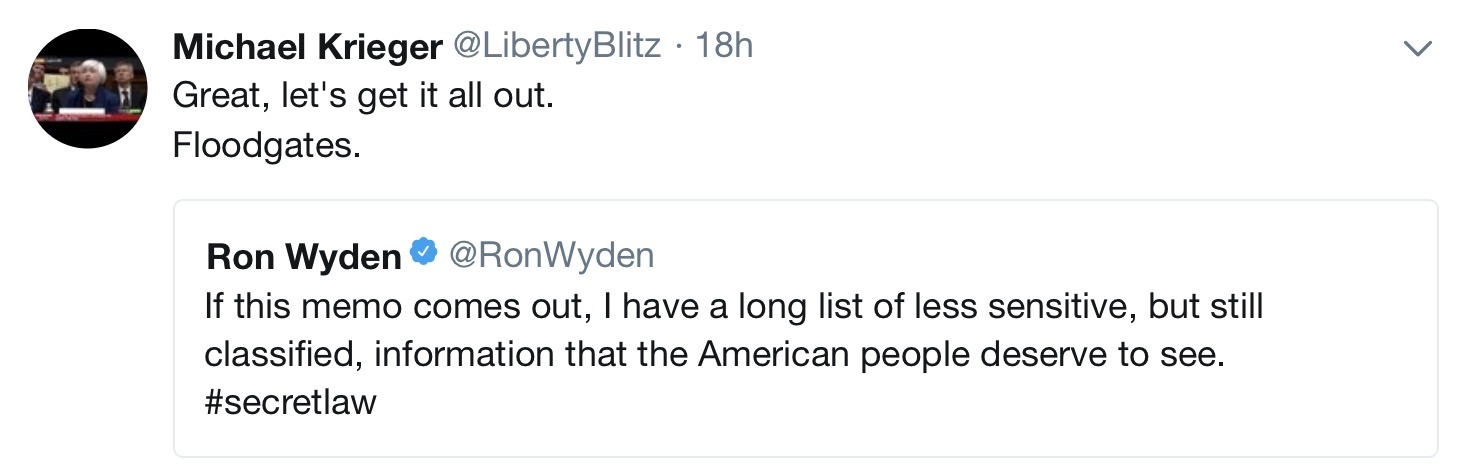
What really got me thinking along these lines was a series of tweets by Democratic Senator Ron Wyden last evening. I found the following to be of particular interest.

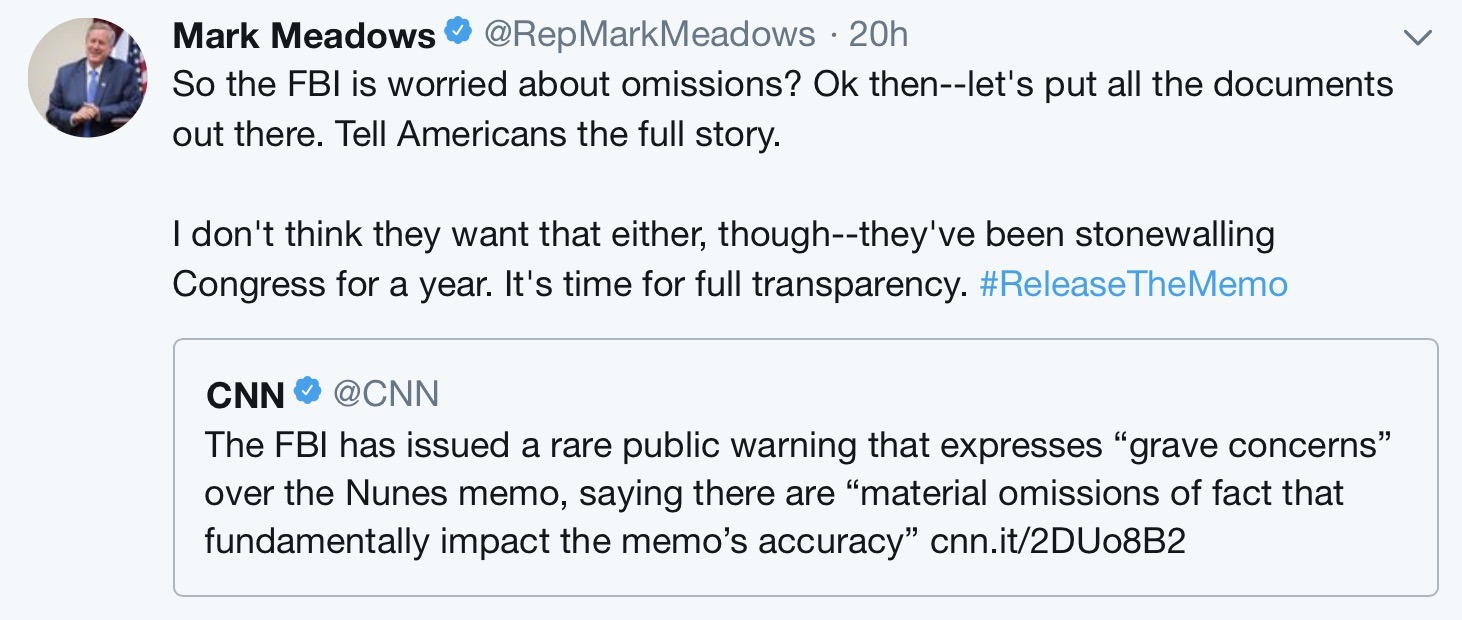
The following from Republican Rep. Mark Meadows also caught my attention.

While it seems clear the memo’s intent is to help Trump politically – not protect the civil liberties of Americas – it also seems clear a lot of powerful interests don’t want it released because they know it could open up Pandora’s Box. In other words, it could lead to all sorts of uncomfortable follow up questions being asked that may inadvertently get the public more interested in unconstitutional surveillance. This might then push the debate out into the open, which is precisely where intelligence agencies don’t want it.

As Marcy Wheeler pointed out in an excellent interview on Democracy Now this morning:

Nunes is using, by the way, to release it, a legal measure that Congress has available to them to release classified information. It was discussed with the release of the torture report. It would’ve be appropriate to use it with the torture report, in this case it’s probably not an appropriate use of the law.

See what I mean about Pandora’s Box now? Read Wyden’s tweet again after listening to the Wheeler interview. With the release of the memo, it appears Nunes is crossing a line that should’ve been crossed a long time ago. Congress has been far too subservient to whatever intelligence agencies tell them to do, thus hiding all sorts of criminality and unconstitutional practices from the American public.

Glenn Greenwald highlighted this in a recent article titled, Republicans Have Four Easy Ways to #ReleaseTheMemo — and the Evidence for It. Not Doing So Will Prove Them to Be Shameless Frauds, in which he notes:

According to the procedural rules of both houses of Congress, their intelligence committees can declassify material in their possession if the committee votes that such declassification would be in the public interest. It is then declassified after five days unless the president formally objects. If the president does object, the full chamber votes on the question.

It is true that – in a measure of how embarrassingly deferential Congress is to the executive branch – neither the House nor the Senate intelligence committees has ever utilized this power, so it’s impossible to know how this gambit would play out in practice. But if Trump refused to release proof of the Obama administration’s misdeeds, congressional Republicans should have a straightforward way to overrule him.

The big question is, will a release of this memo break the seal and result in Congress being less deferential to intel agencies and the President in the future? Only time will tell, but that would be a good thing for transparency.

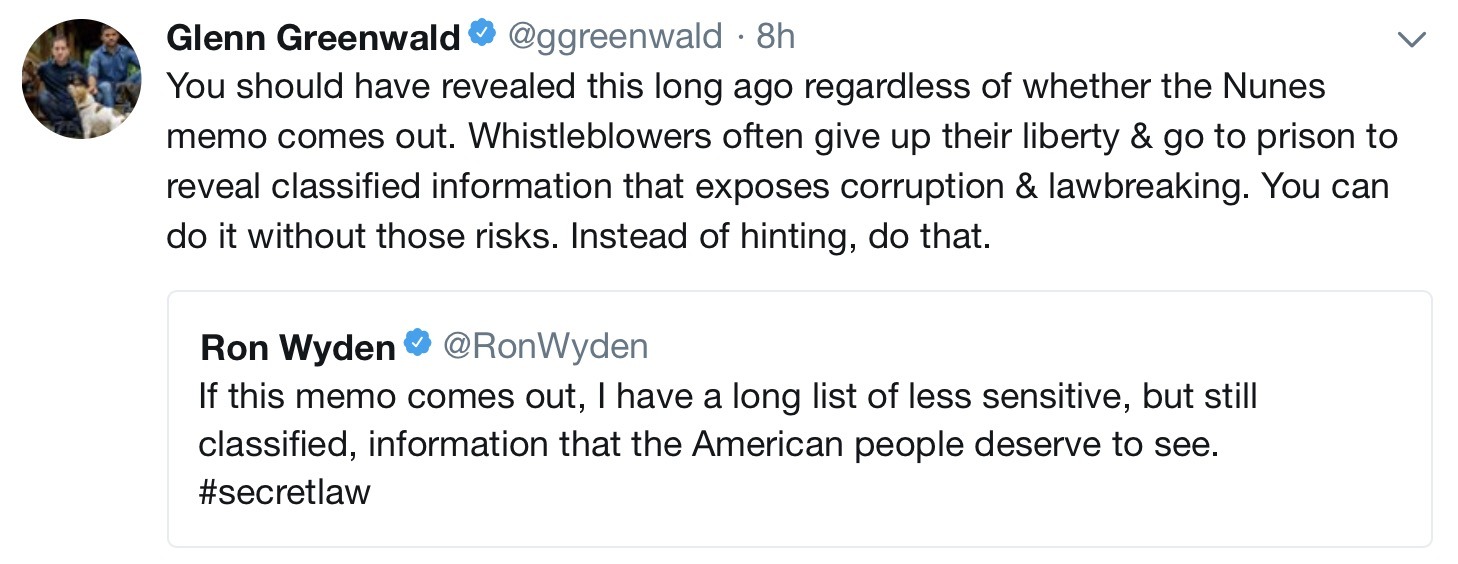
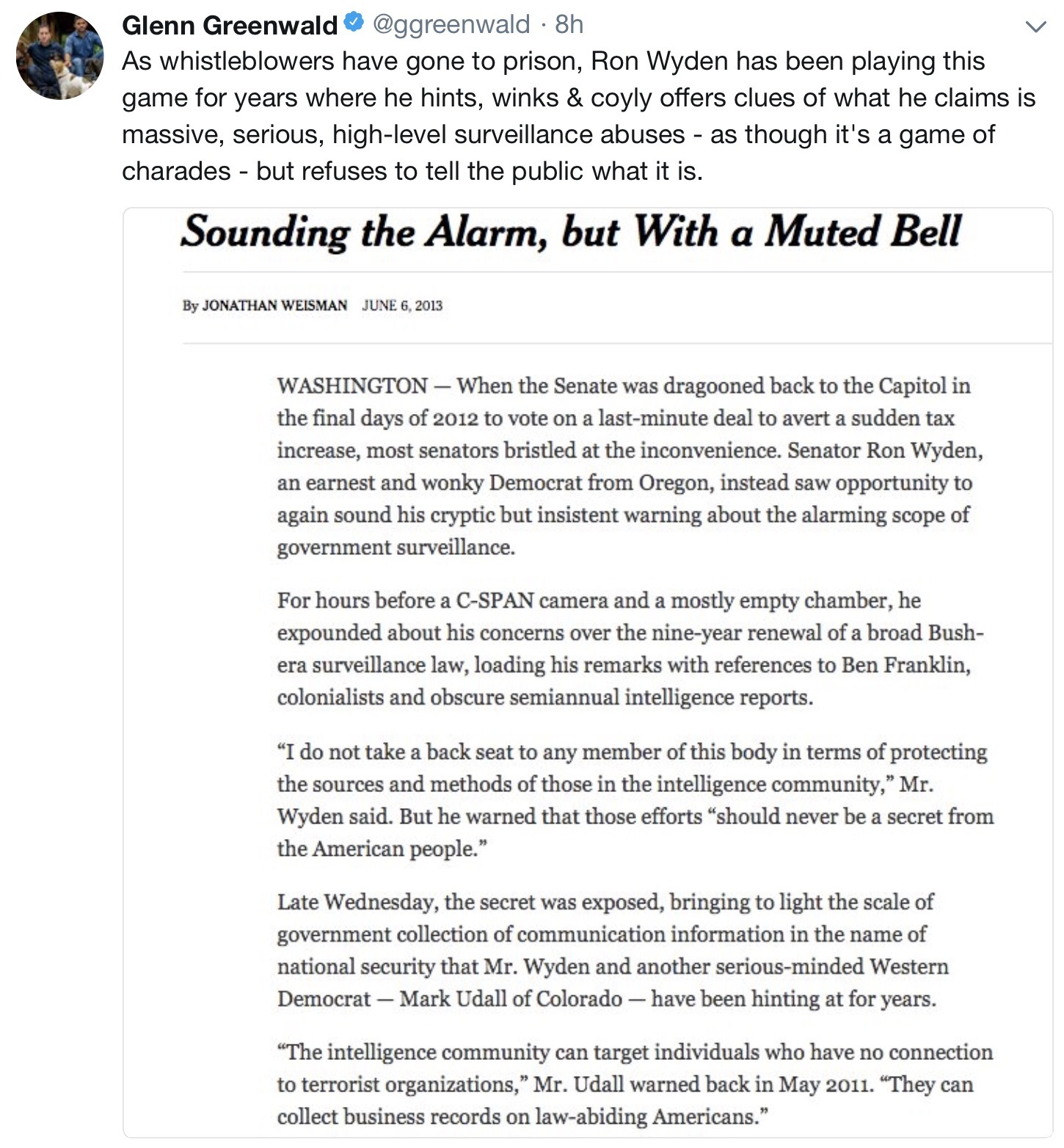
I also like the fact that Greenwald took Wyden to task on Twitter.

This is precisely the sort of pressure all of us should be putting on Congress.

As Julian Assange accurately noted last summer:

Enough secrets, we deserve to know just low lawless our government is.

*  *  *

If you liked this article and enjoy my work, consider becoming a monthly Patron, or visit our Support Page to show your appreciation for independent content creators.

via RSS http://ift.tt/2nw4AbP Tyler Durden

Gallery Nixes Naked Nymphs Because #MeToo

HylasThe Manchester Art Gallery has removed a John William Waterhouse painting, “Hylas and the Nymphs,” due to concerns that the artwork—which depicts young, nude white women alongside the Greek hero Hylas—is no longer suitable in a post #MeToo world.

“For me personally, there is a sense of embarrassment that we haven’t dealt with it sooner,” Clare Gannaway, the gallery’s contemporary art curator, told The Guardian. “Our attention has been elsewhere…we’ve collectively forgotten to look at this space and think about it properly. We want to do something about it now because we have forgotten about it for so long.”

Gannaway also described the painting—and others like it—as old-fashioned for depicting women “either as passive beautiful objects or femmes fatales.” She said there were “tricky issues about gender, race and representation.” It’s a bit unclear what exactly the problem is here, but the curator seems to be suggesting the girls are too white, and too naked.

The Guardian reports that the #MeToo movement “fed into the decision.”

The removal might not be permanent, and it is intended “to prompt conversations.” The gallery wants attendees to leave post-it notes expressing their views on the wall where the painting used to hang. One such note had this to say: “Feminism gone mad! I’m ashamed to be a feminist!”

The Manchester Art Gallery’s website suggests that the painting’s removal “was part of a group gallery takeover” and was filmed as a piece of performance art that explores “gender trouble” in 19th century paintings. The gallery is clearly attempting to frame the decision as an artistic choice rather than an act of censorship. But the gallery also removed postcards of the painting from its gift shop. Liz Prettejohn, who curated an earlier Waterhouse exhibition at the Royal Academy in London, told BBC News:

This is a painting that people love and the most ridiculous thing is the claim that somehow it’s going to start a debate to take it out of public view.

Taking it off display is killing any kind of debate that you might be able to have about it in relation to some of the really interesting issues that it might raise about sexuality and gender relationships.

The Victorians are always getting criticised because they’re supposed to be prudish. But here it would seem it’s us who are taking the roles of what we think of as the very moralistic Victorians.

In any case, Gannaway’s apparent criticism—that the painting depicts young girls who are partially nude and serve as passive objects for the male gaze, or some such thing—is wildly off base. Look at it a little more closely and you will see that the nymphs have plenty of agency: They are dragging Hylas to his doom within their watery abode. According to Greek mythology, Hylas was abducted by the nymphs, probably raped, and never seen again. His friend and lover Hercules searched for him, but alas, poor Hylas was never seen again.

So I guess there is a #MeToo angle here: The painting literally depicts a sexual crime. It would be silly to withdraw the painting for that reason too, but at least the perceived offense would have fit the situation. Yet the politically correct curator seems to have missed the point of the painting—she’s too busy re-applying fig leaves to R-rated art.

from Hit & Run http://ift.tt/2nxMxC6
via IFTTT

BofA: “Our Sell Signal Was Triggered On Jan 30, S&P 2686 Is Next”

Last Friday, when the S&P hit an all time high and inexplicably melted up in the last hour of trading in a burst of frenzied buying, we warned that according to Bank of America, “Biggest Sell Signal In 5 Years Was Just Triggered.” Incidentally, on that very day, the S&P 500 bull market became the second largest of all time last Friday, as the global equity market cap of $86.6TN rose $57.9TN from 2009 lows and $29.9TN from 2016 lows, according to BofA.

In retrospect, following what is shaping up as the worst week for stocks since 2016, Bank of America was right.

Now, in a follow up, Bank of America’s chief investment strategist Michael Hartnett confirms in his latest Flows Show that the bank’s indicator of market sentiment officially hit a “sell” signal on January 30, pointing to a downturn for risk assets.

Specifically, the bank’s “Bull & Bear” indicator of market sentiment jumped from 7.9 to 8.6 on Jan 30, driven up by record inflows to equities and strong hedge fund risk appetite.


Why is this relevant? Because as we noted last week, the indicator has accurately predicted 11 out of 11 corrections since 2002, with a 12% average decline over the next 3 months once triggered…


… while 10-year U.S. Treasury yields fell 58 basis points on average after the trigger.

As a result of the trigger, the bank’s strategists forecast a decline of the S&P 500 to 2,686 points by the end of the first quarter. As usual, however, the bankers hedged their bets, also making the case for the S&P 500 to shrug off the “sell” trigger and rise above 3,000. Sentiment signals could be less relevant, they noted, in a world in which equities have surged higher thanks to central banks’ extraordinary post-crisis injections of liquidity into global markets. And, as already seen this week, the Bank of Japan intervened on two occasions to make sure 10Y JGB yields did not jump above the central bank’s 0.1% target on the 10Y.

“A speculative equity overshoot has begun, driven by a central bank liquidity supernova and rotation out of $10.8 trillion of negative yielding global debt, suggesting we have entered a 2 standard deviation world … making sentiment signals less relevant” BofA wrote.

This was confirmed by some of the bank’s clients in Asia, who were sanguine about a potential pullback.

“Too early for a tradable correction… pullback 2-3 percent max which will be bought… macro & investment backdrop too perfect to sell,” BAML quoted clients as saying.

This echoes what JPM’s head quant Marko Kolanovic said yesterday when noting that the current selloff will likely not result in a quant puke:

“Equity price momentum is positive and trend followers are not likely to reduce equity exposure. While the recent move was concerning for its correlation properties (bonds, equities and commodities all going lower), overall the volatility of multi-asset portfolio is still very low, and the increase was relatively small (e.g., increased from —4% to —5%).”

On the other hand, a deeper correction than predicted could be triggered by a jump in wages causing a spike in the MOVE index of bond volatility, driving the S&P 500 to under 2,600 points. But with the market already worrying about a bond shock, a bigger surprise would be a February of weaker macroeconomic indicators, a stronger dollar and lower yields, the note said.

“We think ‘bond shock’ too consensus and EPS shock, credit shock, dollar shock more likely catalysts for cross-asset volatility spike,” they wrote.

The “sell” signal hit after a roaring New Year’s rally across global equities, with benchmarks in the U.S. and Europe driven to new records. A record $102 billion poured into equity funds since the start of the year, already more than a third of last year’s total of $280 billion.

Putting the frenzied inflows in perspective, this week some $25.7 billion was plowed into equities, with $5.7 billion going into bonds.

Flows figures for the year so far also showed initial stirrings of a shift away from ETFs in favour of active funds after a bumper year for passive in 2017. Last year’s flows were comprised of $441 billion into ETFs and $161 billion outflows from long-only funds, while this year $81.7 billion went into ETFs and $21 billion flowed into long-only funds.

Further, as we also noted last week, the bank’s emerging markets ‘sell’ signal was also triggered as inflows to EM equities in January surged to above 1.8 percent of total assets under management.

The note also points out that YTD flows have shown a “stubborn” bid for asset classes likely to benefit from deflationary forces, with a record $5.7 billion going into tech stocks and $35.4 billion into investment grade and EM credit. But investors also drove money into inflation plays and weak dollar plays, with $12.5 billion going into Japanese equities, $3.6 billion into financials, a record $4.4 billion into inflation-protected U.S. bonds (TIPS) and $24.4 billion into EM equities.

In other words, a peak “barbell” strategy, with investors expecting market mood to shift from one extreme to another, most likely with the help of central banks.

via RSS http://ift.tt/2nvtisK Tyler Durden

Why Albert Einstein thought we were all insane

In the early summer of 1914, Albert Einstein was about to start a prestigious new job as Director of the Kaiser Wilhelm Institute for Physics.

The position was a big deal for the 35-year old Einstein– confirmation that he was one of the leading scientific minds in the world. And he was excited about what he would be able to achieve there.

But within weeks of Einstein’s arrival, the German government canceled plans for the Institute; World War I had broken out, and all of Europe was gearing up for one of the bloodiest conflicts in human history.

The impact of the Great War was immeasurable.

It cost the lives of 10 million people. It bankrupted entire nations.

The war ripped two major European powers off the map– the Austro Hungarian Empire, and the Ottoman Empire– and deposited them in the garbage can of history.

Austria-Hungary in particular boasted the second largest land mass in Europe, the third highest population, and one of the biggest economies. Plus it was a leading manufacturer of high-tech machinery.

Yet by the end of the war it would no longer exist.

World War I also played a major role in the emergence of communism in Russia through the 1917 Bolshevik revolution.

Plus it was also a critical factor in the astonishing rise of the Nazi party in Germany.

Without the Great War, Adolf Hitler would have been an obscure Austrian vagabond, and our world would be an entirely different place.

One of the most bizarre things about World War I was how predictable it was.

Tensions had been building in Europe for years, and the threat of war was deemed so likely that most major governments invested heavily in detailed war plans.

The most famous was Germany’s “Schlieffen Plan”, a military offensive strategy named after its architect, Count Alfred von Schlieffen.

To describe the Schlieffen Plan as “comprehensive” is a massive understatement.

As AJP describes in his book War by Timetable, the Schlieffen Plan called for rapidly moving hundreds of thousands of soldiers to the front lines, plus food, equipment, horses, munitions, and other critical supplies, all in a matter of DAYS.

Tens of thousands of trains were criss-crossing Europe during the mobilization, and as you can imagine, all the trains had to run precisely on time.

A train that was even a minute early or a minute late would cause a chain reaction to the rest of the plan, affecting the time tables of other trains and other troop movements.

In short, there was no room for error.

In many respects the Schlieffen Plan is still with us to this day– not with regards to war, but for monetary policy.

Like the German General Staff more than a century ago, modern central bankers concoct the most complicated, elaborate plans to engineer economic victory.

Their success depends on being able to precisely control the [sometimes irrational] behavior of hundreds of millions of consumers, millions of businesses, dozens of foreign nations, and trillions of dollars of capital.

And just like the obtusely complex war plans from 1914, central bank policy requires that all the trains run on time. There is no room for error.

This is nuts. Economies are comprised of billions of moving pieces that are beyond anyone’s control and often have competing interests.

A government that’s $21 trillion in debt requires cheap money (i.e. low interest rates) to stay afloat.

Yet low interest rates are severely punishing for savers, retirees, and pension funds (including Social Security) because they’re unable to generate a sufficient rate of return to meet their needs.

Low interest rates are great for capital intensive businesses that need to borrow money. But they also create dangerous asset bubbles and can eventually cause a painful rise in inflation.

Raise interest rates too high, however, and it could bankrupt debtors and throw the economy into a tailspin.

Like I said, there’s no room for error– they have to find the perfect balance between growth and inflation.

Hedge fund billionaire Ray Dalio summed it up perfectly last month when he said,

“It becomes more and more difficult to balance those things as time goes on. . . It may not be a problem in the next year or two, but the risk of not getting it right increases with time.”

Today there’s a changing of the guard at the Federal Reserve– Janet Yellen is leaving her post as chair, and she’s being succeeded by Jerome Powell.

Yellen leaves her post having brought down the unemployment rate in the United States to 4.2%, which certainly sounds nice.

Yet at the same time, workers’ wages (when adjusted for inflation) have hardly budged under her tenure.

Americans’ savings rate has been cut in half. Consumer debt and student loans are at all-time highs.

And dangerous asset bubbles have expanded, from stocks to bonds to property.

The risk of them getting it wrong is clearly growing.

That’s why having your own Plan B is so important.

It’s a simple concept: don’t keep all of your eggs in one basket, especially when the people who control the basket have such a tiny margin of error.

The right Plan B makes sense no matter what happens, or doesn’t happen, next. If they get it right, you won’t be worse off. But if they get it wrong, you’ll still prosper.

I truly hope they don’t get it wrong.

But if they ever do, people may finally look back and wonder how we could have been so foolish to hand total control of our economy over to an unelected committee of bureaucrats with a mediocre track record… and then expect them to get it right forever.

It’s pretty insane when you think about it.

As Einstein quipped at the height of World War I in 1917, “What a pity we don’t live on Mars so that we could observe the futile activities of human beings only through a telescope. . .”

Source

from Sovereign Man http://ift.tt/2EBrru4
via IFTTT

Trump Blasts FBI Leadership For “Politicizing The Sacred Investigative Process”

After a week of intense speculation, Speaker Paul Ryan has backed President Trump’s wish to release the infamous “FISA Memo” on Friday (despite Nancy Pelosi’s demands that its main architect, House Intel Committee Chair Devin Nunes, be moved from his position), the president pushed back against accusations that he’s politicized federal law enforcement, claiming that the FBI’s leadership is truly to blame.

“The top Leadership and Investigators of the FBI and the Justice Department have politicized the sacred investigative process in favor of Democrats and against Republicans – something which would have been unthinkable just a short time ago. Rank & File are great people!,” the president said in the first of two tweets.

In the second, he included a quote from Judicial Watch head Tom Fitton about the Democratic skullduggery that was involved in the creation and funding of the memo, which may have been used improperly by the FBI to secure a FISA warrant against Trump campaign adviser Carter Page.

“‘You had Hillary Clinton and the Democratic Party try to hide the fact that they gave money to GPS Fusion to create a Dossier which was used by their allies in the Obama Administration to convince a Court misleadingly, by all accounts, to spy on the Trump Team.’ Tom Fitton, JW”

Republican leaders have pushed back against Democrats’ objections by calling for increased transparency at the law enforcement agencies.

As reported on Thursday, Trump reportedly has viewed the memo and been briefed on its contents. Once he signs off, it will be up to Nunes and his peers to deliver the final OK.

Meanwhile, the FBI has promised to release a rebuttal of the four-page memo that it says provides crucial details and context for the information compiled by Nunes, while also warning that the bureau has “grave concerns” about the memo’s release. Meanwhile, one Republican lawmaker said the FBI is right to be concerned – because the revelations in the memo will “shake the FBI to its core”…

Some of Trump’s critics have warned about the national security implications of releasing the memo over the FBI’s objections. Former CIA Director Leon Panetta even went so far as to say the release could even trigger “a constitutional crisis,” during an interview with NBC’s Chuck Todd.

Nunes has said the memo contains evidence of “egregious abuses” of the FISA power by the FBI during the Obama era.

On Thursday, Rep. Jeff Duncan said that “Having read “The Memo,” the FBI is right to have “grave concerns” – as it will shake the organization down to its core – showing Americans just how the agency was weaponized by the Obama officials/DNC/HRC to target political adversaries.

via RSS http://ift.tt/2s4190O Tyler Durden

“The Bubble Has Burst” – Bitcoin Tumbles Below $8,000 As Cryptocarnage Continues

It seemed like just yesterday that every cryptocurrency bloodbath would be promptly bought, often sending the price of bitcoin and its peers to new record highs. Those days appear to be over, at least for now.

So far this year, cryptocurrencies have been beset with bad news: Bitfinex, by some accounts the world’s largest exchange, was recently subpoenaed by the CFTC, along with Tether, a separate corporate entity that involves many of the same people from Bitfinex, as questions mount about the authenticity of its tether token. Tethers, which are widely used by crypto traders to quickly move in and out of different crypto pairs, are supposed to be backed by dollars, with one tether = one dollar. But Tether’s decision to fire its auditor appears to validate the concerns of the exchange’s critics.

Raising fears about another massive, Mt. Gox-like hack, Coincheck, a mid-sized Japanese exchange, reported this month that it suffered “the biggest crypto theft in its history” when hackers made off with $400 million worth of NEM tokens. On Friday, Bloomberg reported that Japan’s Financial Services Agency raided Coincheck’s offices a week after the hack, hauling out documents and computers as evidence.

The inspection was conducted to ensure security for users, Finance Minister Taro Aso said. On Friday morning, 10 FSA officials entered Coincheck’s premises to gain a better understanding of how the exchange is operating in light of the regulator’s business improvement order imposed earlier this week, an agency official told reporters in Tokyo. The exchange has until Feb. 13 to produce a report detailing the causes of the incident.

And as if the threat of cybertheft wasn’t enough to scare off the marginal buyer, the threat of regulators trying to ban crypto – much like China did – has become a major concern. Regulators in India said explicitly declared yesterday that bitcoin is not legal tender and said it would take “all measures to eliminate their use,” foreshadowing a coming crackdown in a market that many hoped would one day grow to one of bitcoin’s largest. After a weekslong will-they-won’t-they back and forth, South Korea‘s Ministry of Justice announced revealed that it had abandoned a proposal to ban crypto outright, but instead seek to regulate it, requiring exchanges to obtain details about customer identities.

After bitcoin’s worst month in years, it dipped below $8,000 Friday morning in the US to levels it hasn’t seen since November while Ethereum, Ripple and Litecoin all took double-digit beatings.

btc

Meanwhile, as Bloomberg points out, bitcoin’s rough month was even worse in South Korea. As of Friday morning ET, bitcoin has dropped more than 60% from its January high in Korea as South Korea struggles with how to prevent money laundering and tax evasion without throttling the ecosystem.

The selloff has many Korea traders fearing the worst.

“The bubble in cryptocurrencies has burst” in Korea, said Yeol-mae Kim, an analyst at Eugene Investment & Securities Co. in Seoul. Because of the intense demand from retail buyers, bitcoin trades at what’s called “the kimchi premium” on SK exchanges. In January, the premium stretched to its widest level on record when bitcoin traded at $22,525 in Korea, $7,500 higher than the composite price at the time.

via RSS http://ift.tt/2DVCDk5 Tyler Durden

“Sea Of Red”: Stocks, Futures Tumble Amid Soaring Yields

The last day of an already tumultuous week is shaping up as a bloodbath for investors across the globe as the following market snapshot of global stocks and futures shows.

European equity markets and U.S. equity futures sold off sharply, however as Bloomberg notes, the traditional pre-NFP lack of market activity has so far mitigated large cross-asset reaction. S&P futures were down over 20 points and flirting with the 2,800 level.

Equities were tested by the surge in bond yields, with some fund managers saying anything between 2.7% and 3% on the 10Y TSY would signal a bond bear market. The level is seen by many stock-watchers as a potential trigger for a correction in equities.

To be sure, the correlation between higher yields and lower equities continued overnight in a particularly aggressive manner. The silver lining is that as the US 10y tests 2.80% and the US 30y at 3.04%, the USD at least appears to have found a bottom, for now. Overnight German Bund yields also reached a two-year high as core European bonds fell along with gilts.

As we pointed out last night, the risk off sentiment took shape in Asia, with Chinese stocks continuing their recent plunge…

… as core yields weighed on the EM FX space as a whole. “Markets are increasingly choppy and price action increasingly unpredictable” Citi’s FX desk notes.

There was nothing obvious to trigger the move: some attributed the risk off mode to a report that 18 people were injured when a van intentionally hit pedestrians in central Shanghai, China. Additionally, WSJ reports, “Chinese stocks had their worst week since 2016, with fresh concerns about Beijing’s campaign to cut financial risk and predictions of a slowing economy…” The BoJ also knocked JPY back after it took action against the rising JGB 10y yield by announcing it would buy unlimited amounts of 10y JGBs at 11bps.

Meanwhile, Europe was a bloodbath largely due to to the previously discussed poor result from Deutsche Bank which sent the German lender’s stock tumbling. The weakness quickly spread to German stocks with the DAX turning negative for 2018, giving up an advance that had reached 5%, as the DAX slides for a fifth straight day. This was the worst weekly drop for the DAX since November 2016, down 3.5%

The DAX weakness sent the broader Eurostoxx Index dropped for a 5th day, the longest losing streak since November, and sliding below its 200-DMA.

In FX, the USD/JPY rallied further toward 110 after BOJ acted to control the yield curve by placing a cap on yields as it offered to buy an unlimited amount in 10yr JGBs at a yield of 0.110%. The BoJ also announced to buy JPY 450bln in 5yr-10yr, more than the prior JPY 410bln operation.

The Bloomberg Dollar Spot Index snapped a three-day decline and headed for its biggest gain since November as stretched short positioning called for caution ahead of the U.S. payrolls report. The yen was set for its worst week in 3 1/2 months as the BOJ further damped speculation about normalizing its policy anytime soon. Monetary policy prospects weighed on Antipodean currencies as well, while the euro and the pound also came under pressure. European bonds and equities traded in the red. USD strength was particularly evident against EMFX, with USD/ZAR trading back above 12.00.

Elsewhere, core yields edge higher but without much momentum, while credit spreads widen, iTraxx Crossover through 200-DMA. As Bloomberg highlights, a hawkish Euribor put trade targeting ~80bps of ECB hikes by end-2019 caught attention; crude and metals weighed by USD move, another bitcoin selloff of more than 10%.

Traders will now be looking to U.S. jobs data, which may offer support to stocks and bonds if the trend of healthy growth in hiring but low wage inflation continues.

Elsewhere, oil traded near its highest level since 2015 in New York as forecasters paint a rosier picture for supply and demand. Bitcoin continues to slide after a miserable January, falling below $9,000.

Market Snapshot

  • S&P 500 futures down 0.7% to 2,803.75
  • STOXX Europe 600 down 0.8% to 390.55
  • MSCI Asia Pacific down 0.7% to 183.03
  • MSCI Asia Pacific ex Japan down 0.7% to 599.58
  • Nikkei down 0.9% to 23,274.53
  • Topix down 0.3% to 1,864.20
  • Hang Seng Index down 0.1% to 32,601.78
  • Shanghai Composite up 0.4% to 3,462.08
  • Sensex down 2.3% to 35,099.20
  • Australia S&P/ASX 200 up 0.5% to 6,121.39
  • Kospi down 1.7% to 2,525.39
  • German 10Y yield rose 2.0 bps to 0.741%
  • Euro down 0.2% to $1.2484
  • Italian 10Y yield fell 6.3 bps to 1.697%
  • Spanish 10Y yield rose 1.4 bps to 1.423%
  • Brent futures up 0.2% to $69.78/bbl
  • Gold spot down 0.2% to $1,346.44
  • U.S. Dollar Index up 0.2% to 88.87

Top Overnight News

  • Chancellor Angela Merkel’s bloc and Germany’s Social Democrats secured an agreement on education even as “large” policy differences remain, a top party official said as parties near a self-imposed weekend deadline
  • The U.K. must not enter into a new customs union with the European Union after it leaves the bloc, Trade Secretary Liam Fox said, setting a new red line for Theresa May’s negotiations with Brussels and her own party on Brexit
  • Riksbank Deputy Governor Martin Floden says “there are risks to the rate path, inflation in particular is unusually uncertain,” according to an interview with Market News International
  • Japan’s government will likely present to Parliament its nominees of BOJ governor and deputy governors around mid- to late February at the earliest, Reuters reports, citing unidentified people familiar with the matter
  • BofAML says “massive” equity inflows last week helped trigger a sell signal triggered Jan 30th via record equity inflows, bullish hedge fund risk appetite indicator and global equity index breadth measure
  • U.K. Jan. Construction PMI 50.2 vs 52.2 est; housing activity lowest since Jul. 2016
  • BOJ took action today after large increase in JGB yields: senior official
  • Strong chance that BOJ’s Kuroda will be reappointed, according to people familiar, Reuters reports
  • China to allow overseas investors to trade iron ore futures on Dalian exchange

Asia equity markets traded broadly lower with sentiment in the region dampened amid a lack of catalysts and following the indecisive lead from Wall St. where most major indices finished negative and the Nasdaq 100 underperformed. ASX 200 (+0.5%) and Nikkei 225 (-0.8%) were mixed with Australia kept afloat by financials and energy, while the Japanese benchmark was the laggard and saw nearly all the prior day’s gains wiped out. Elsewhere, Shanghai Comp. (-0.4%) and Hang Seng (-0.1%) were downbeat amid Shenzhen volatility, while continued inaction by the PBoC also resulted to a weekly net liquidity drain of CNY 760bln. Finally, 10yr JGBs reversed the initial spill-over selling from US, with support from a risk averse tone and after the BoJ Rinban announcement in which it increased purchases in the 5yr-10yr range. Furthermore, the BoJ also effectively placed a cap on yields as it offered to buy an unlimited amount in 10yr JGBs at a yield of 0.110%. BoJ announced to buy JPY 450bln in 5yr-10yr (Prev. JPY 410bln), JPY 190bln in 10yr-25yr and JPY 80bln in 25yr+ JGBs, while it also announced a special bond operation to buy an unlimited amount of 10yr JGBs at a yield of 0.110%. However, there were no takers for the fixed rate operation and the BoJ stated it took the steps after a surge in yields and that it is adhering to policy of keeping 10yr yield near 0%. PBoC skipped open market operations for a net weekly drain of JPY 760bln vs. Prev. JPY 320bln drain W/W. 

Top Asia News

  • Dollar Slide Spurs Yuan Forecast Revisions, Worry on Speed
  • Foreign Funds Poured $13 Billion Into Chinese Shares in January
  • Fosun’s $1.5 Billion Biotech Arm Is Said to Mull Hong Kong IPO
  • HNA-Like Debt Pileups Raise Risk of Forced Asset Sales in China
  • What’s on the Block in China’s Potential Sale of the Century?
  • World’s Biggest Pension Fund Gains $55 Billion as Stocks Climb
  • Mitsui & Co Surges to Highest Since 2008 on Share Buyback

European equities (Eurostoxx 50 -0.6%) are trading lower across the board following a downbeat session overnight in Asia-Pac and the US. Underperformance has been seen in the DAX (-1.1%) with the index dragged lower by Deutsche Bank (-6.1%) after reporting a larger than expected quarterly loss; Commerzbank (-1.5%) also seen lower but little contagion seen in the broader European banking sector. Elsewhere, energy names are the only sector trading higher in Europe alongside firmer energy prices, telecoms underperform with BT (-5.5%) at the bottom of the FSTE 100 following their latest earnings update.

Top European News

  • Germany DAX Gives Up Year’s Gain in Worst Selloff Since 2016
  • ECB Official Warns Markets Are Unprepared for Inflation Bogeyman
  • Czechs Signal Pause in Rate Hikes and Bet on Currency Gains
  • Wereldhave Slumps On 2018 Profit Guidance Miss, Dividend Cut

In FX, the DXY remains weak overall as its 2018 (and late 2017) bear trend continues, but the index is holding in above 88.500 and some key support levels ahead of the 88.000 level. In fact, the Dollar is firmer vs all G10 rivals as US Treasury yields continue their ascent and some benchmark maturities hit key or psychological levels (long bond over 3% for example). EUR/USD is pivoting around 1.2500, Cable still finding it tough on advances beyond 1.4200, USD/Cad sticky circa 1.2300 and similarly USD/CHF bouncing back towards 0.9300 after forays below. USD/JPY is still gradually firming within a wide 109.00-110.00 range, and sniffing out layered offers up to the top of that band, with a 50% Fib at 109.88 also providing some resistance. JPY undermined by more aggressive BoJ buying of JGBs overnight, NZD by weak building permits and the AUD extending recent losses/underperformance on disappointing data and rolled out RBA rate expectations. Ahead, NFP the main Friday focus.

In commodities, WTI and Brent crude futures have modestly extended on the prior day’s gains, albeit off best levels
with WTI back below USD 66/bbl and Brent retreating from USD 70/bbl with energy newsflow otherwise relatively light ahead of the Baker Hughes rig count and earnings from Exxon and Chevron (keep an eye out for CAPEX plans). In metals markets, Gold has traded relatively sideways ahead of NFP, whilst Chinese steel futures were seen higher overnight amid ongoing speculation over further extensions to domestic steel production curbs.

US Event Calendar

  • 8:30am: Change in Nonfarm Payrolls, est. 180,000, prior 148,000
  • Unemployment Rate, est. 4.1%, prior 4.1%
  • Average Hourly Earnings MoM, est. 0.2%, prior 0.3%; Average Hourly Earnings YoY, est. 2.6%, prior 2.5%
  • 10am: U. of Mich. Sentiment, est. 95, prior 94.4; Current Conditions, prior 109.2; Expectations, prior 84.8
  • 5%
  • 10am: Factory Orders, est. 1.5%, prior 1.3%; Factory Orders Ex Trans, prior 0.8%
  • 10am: Durable Goods Orders, prior 2.9%; Durables Ex Transportation, prior 0.6%
  • 10am: Cap Goods Orders Nondef Ex Air, prior -0.3%

DB’s Jim Reid concludes the overnight wrap

Today’s highlight will obviously be the employment report. Average hourly earnings have taken over from the headline number as the key focus of the report at the moment. DB are strongly of the view that wages are going up but we are not convinced you’ll see that in this report. They expect the number to tick down a tenth (+0.2% vs. +0.3% – consensus 0.2%) but the year-over-year trend may round up a tenth to 2.6%. For the headline number they expect a healthy gain in payrolls (+210k vs. +148k – consensus 180k) which should keep the unemployment rate steady at 4.1%. So far this week the employment and wages data has generally been positive. The latest evidence was 4Q unit labour costs yesterday which were above market at 2% (vs. 0.9% expected).

The employment report comes at a time of a continued sell off in US treasuries. UST 10y yields jumped the most in 12 months, rising 8.5bp to 2.791% and making a fresh high since April 2014. The UST 30y also closed above 3% for the first time since May 17 (3.025%) while the 2s10s steepened 6.5bp back to the highest since mid-December. The weakness seemed to have several contributing factors, such as a perception of it being a hawkish FOMC statement the night before, more data that supports the view that inflation is firming (the highest ISM prices paid reading since May 2011), and the UCL data discussed above. Over in Europe, changes in core 10y bond yields were more modest, with Bunds and Gilts up c2bp and OATs up 0.8bp. Peripherals actually outperformed, with yields down 2-6bp, in part supported by successful debt auctions in Spain.

Staying with US equities, the S&P 500 initially traded higher yesterday post Facebook’s results (shares +3.3%) but pared back gains to be marginally lower (-0.06%) while other bourses were mixed (Dow +0.14%; Nasdaq -0.35%). European markets were broadly lower, with the Stoxx 600 (-0.50%), FTSE (-0.57%) and DAX (-1.41%) down to a c4 week low. The pull back in the DAX was broad based with all sectors in the red, particularly industrials, real estate and healthcare stocks. The VIX was little changed at 13.47 (-0.5%).

After the bell, Amazon’s share price jumped c6% after reporting the strongest holiday quarter sales growth in eight years, while Apple’s shares recovered to be up c3%, in part as the CFO guided to >10% growth in iphone sales for the current quarter and investors took note of Apple’s higher average selling price for iPhone (+14% on pcp) as a potential sign of solid demand for its iPhone X after earlier reports to the contrary. Elsewhere, Alphabet is down c2% after its 4Q results missed estimates.

This morning in Asia, markets are broadly lower. The Nikkei (-0.85%), Kospi (-1.62%) and China’s CSI300 (-0.20%) are all down while the Hang Seng is up modestly (+0.13%) as we type. Elsewhere, the BOJ has announced its first unlimited fixed rate bond purchase operation since July, while also offering to buy more (40bn Yen; $365m) 5-10 year bonds at its regular operation this morning.

The yield on 10y JGBs fell from yesterday’s 9.4bp to c8bp this morning. Now turning to the ECB, Bloomberg has reported a group of unnamed ECB members had urged Mr Draghi in last week’s ECB meeting to be more specific than its current expectation that it will keep rates on hold “well past” the end of QE, but Draghi resisted a change on the wording. Elsewhere the ECB’s Praet seemed a tad dovish. On inflation, he noted “…we’re still some distance away from meeting the council’s criteria for a sustained adjustment in the path of inflation” and that “monetary policy will evolve in a data dependent and time consistent manner”.

Over in Germany, Ms Merkel noted that based on mid-term growth estimates, she expects the new government will “have additional scope” to spend beyond the EUR46bn agreed to in the exploratory talks with the SPD. The additional  funds could be spent on digital transformation, development and foreign policy objectives. Elsewhere, when asked if the self-imposed Sunday deadline for coalition talks would hold, the SPD premier of the state of Mecklenburg said “we need to take the time that we need so that we can do good things for the people”.

Turning to currencies performance from yesterday, the US dollar index fell for the third consecutive day (-0.52%), while the Euro and Sterling jumped 0.77% and 0.51% respectively, with the Euro now at 1.251 – a fresh high since December 2014. In commodities, WTI oil edged up 0.4%. Precious metals were mixed but little changed (Gold +0.27%; Silver -0.62%) while other base metals advanced (Copper flat; Aluminium +0.14%; Zinc +0.71%).

Away from the markets, the ECB’s Nowotny has added to the debate on bitcoins, he noted “for a long time, I had the view that investment in Bitcoin should be a private matter, but I got the feeling that a legal provision is needed” and that “I like what the Chinese PBOC governor has said – bitcoins…are a matter for the police”. As a reminder, bitcoin fell c9% yesterday and is c54% down from its December highs. Elsewhere, he also noted “in my view, we should end the bond buying program” and that “this will also then lead to an increase in long term interest rates”.

Over in the UK, the BOE has begun simulating stresses in “stretched” bond markets to assess potential financial stability risks, in part as companies issued more bonds for funding than they did before the GFC. A key focus will be on liquidity mismatch in times of stressed markets. Across the pond, 38 US banks will have to report back to the Fed by 5 April in their annual stress test. Some of the downside assumptions include a jump in unemployment rate to 10%. Staying in the UK, the FT has reported that Brexit advisers to PM May are in “live” discussions on whether Britain can achieve a customs union deal covering trade in goods with the EU post a two year transition period.

Before we take a look at today’s calendar, we wrap up with other data releases from yesterday. In the US, the January ISM manufacturing index was above market at 59.1 (vs. 58.6) and the ISM prices paid rose to the highest since May 2011 (72.7 vs. 68.8 expected), which likely adds to the argument of higher inflation going forward. The 4Q nonfarm productivity fell for the first time in seven quarters (-0.1% vs. 0.7% expected) while unit labour costs was above market at 2% (vs. 0.9%). The December construction spending was up 0.7% mom (vs. 0.4%). Elsewhere, the final reading of the January manufacturing PMI was confirmed at 55.5. Finally, the weekly initial jobless claims was below expectations (230k vs. 235k) while continuing claims was above (1,953k vs. 1,929k). Factoring in the above, the Atlanta Fed now estimate 1Q GDP growth to be a whopping 5.4% (vs. 4.2% previous).

In Europe, the final readings for January manufacturing PMIs were broadly unchanged with the Euro area confirmed at 59.6 – 1pt below last month’s 20 year high, while Germany’s PMI was revised 0.1 lower to 61.1 and France 0.3 higher to 58.4. Elsewhere, the flash PMI for Italy was above market at 59 (vs. 57.4) but the UK PMI fell to the lowest since June 2017 at 55.3 (vs. 56.5), although still above its long run average of 51.7. Finally, the UK’s January Nationwide House price index was above expectations at 3.2% yoy (vs. 2.5%).

Looking at the day ahead, as discussed at the top it’s another payrolls Friday in the US and as usual keep an eye on other components of the January report including average hourly earnings and the unemployment rate. Also due in the US will be December factory orders, the final January University of Michigan consumer sentiment report and final December durable and capital goods orders.


via RSS http://ift.tt/2s0ixUl Tyler Durden