Donald Jr.’s Trump Tower Meeting Was Not a Crime, and Neither Was Lying About It

Robert Mueller, the special counsel investigating Russian attempts to influence the 2016 presidential election, has taken an interest in a misleading public statement about Donald Trump Jr.’s June 2016 meeting at Trump Tower with a Russian lawyer who claimed to have dirt on Hillary Clinton. In particular, The New York Times reports, Mueller wants to know what role President Trump played in writing the statement, which said the meeting was “primarily” about Russian policy on international adoptions. But neither the meeting nor the statement about it violated the law, which illustrates the difficulty that Mueller will have in demonstrating that the collusion and obstruction perceived by many of the president’s opponents actually constitute crimes.

The Trump Tower meeting with Russian lawyer Natalia Veselnitskaya included Paul Manafort, Trump’s campaign manager, and his son-in-law, Jared Kushner, as well as his son. When the meeting came to light last summer, the White House scrambled to explain it. “It was a short introductory meeting,” said a July 8 statement attributed to Donald Jr. but reportedly crafted mainly by his father. “I asked Jared and Paul to stop by. We primarily discussed a program about the adoption of Russian children that was active and popular with American families years ago and was since ended by the Russian government, but it was not a campaign issue at that time and there was no follow up.”

The statement was deliberately misleading, since emails showed that Donald Jr. agreed to meet with Veselnitskaya after one of his father’s former Russian business partners, who called her a “Russian government attorney,” said she had documents that “would incriminate Hillary and her dealings with Russia and would be very useful to your father.” The intermediary described the information as “part of Russia and its government’s support for Mr. Trump.” Donald Jr.’s reply suggested he was eager to see what Veselnitskaya had. “If it’s what you say,” he wrote, “I love it.” Veselnitskaya, it appears, was bluffing and did not have any useful information.

This episode was embarrassing, but that does not mean it was criminal. When former White House strategist Stephen Bannon called the meeting “treasonous,” he was speaking loosely. The legal definition of treason requires waging war against the United States or giving “aid and comfort” to its enemies, defined as nations or organizations with which it is at war.

Donald Jr. did not do either of those things by talking to a Russian lawyer in the hope of obtaining information that could be used against his father’s opponent in the presidential election. The fact that Veselnitskaya had ties to the Russian government, which preferred Trump to Clinton, does not transform opposition research into treason. If the meeting with Veselnitskaya provided “aid and comfort” to an enemy of the United States, so did any action aimed at electing Trump. In any case, Russia does not legally qualify as an enemy, since it is not at war with the United States.

Even though the meeting was perfectly legal, lying about it could be a crime. But not in this context. As the Times notes, “Lying to federal investigators is a crime; lying to the news media is not.” Even if the elder Trump wrote the statement attributed to his son with the intent of deceiving the press and the public about the motivation for the meeting with Veselnitskaya, that would not be illegal.

Since Trump has agreed to answer questions from Mueller, he still has an opportunity to commit an actual crime by lying about the meeting or about the genesis of the statement attributed to his son. Lying to Mueller would violate 18 USC 1001, which criminalizes deliberately false statements “in any matter within the jurisdiction of the executive, legislative, or judicial branch of the Government of the United States.” Michael Flynn, Trump’s former national security adviser, pleaded guilty to that offense, as did former Trump campaign adviser George Papadopoulos. Both cases involved lies to the FBI about direct or indirect contacts with Russians—contacts that were not in themselves illegal.

It is still possible, in other words, that Trump will commit a felony by lying about a nonexistent crime. Whether he could be indicted for that offense without being impeached first is a matter of dispute. So is the question of whether the president can obstruct justice by doing things (such as firing the FBI director) that he has the undisputed authority to do. In practice, a president’s obstruction of justice, which figured in the impeachments of Richard Nixon and Bill Clinton, is whatever Congress says it is. The current Congress, controlled by the president’s party, has little interest in exploring the matter.

No doubt things would be different, as New York Times columnist Bret Stephens argues, if Hillary Clinton had been elected president and proceeded to do what Trump has done. But it seems unlikely that Mueller will change Republicans’ minds by focusing on Trump’s efforts to mislead the public about his campaign’s Russian contacts. If lying to the public were a crime, Trump would be eligible for a life sentence.

from Hit & Run http://ift.tt/2DT37GN
via IFTTT

Four Market-Based Indicators That May Help Investors Identify Stock Market Fragility

Authored by Bryce Coward via Knowledge Leaders Capital blog,

With a hint of volatility returning to the stock market this week, we thought it good timing to review some of the market-based indicators we follow that help us judge the sturdiness of the market. This is by no means an exhaustive list, but rather a few items to consider when evaluating whether pullbacks are for buying or selling.

In each of the charts below, the indicator in question is plotted with the blue line on the left axis and the S&P 500 is plotted with the red line on the right axis. Vertical reference lines have been added to highlight important turning points for each indicator.

First, how is the consumer staples sector, the epitome of stability, performing relative to the overall market? An underperforming consumer staples sector is typically evidence of improving risk appetite, stable to rising interest rates and improving consumer confidence. Alternatively, outperformance of the sector can be an indication that market participants are sniffing out weakness in the economy. Usually, the consumer staples sector starts to outperform the broad market ahead of significant downturns in stocks, as the vertical lines below demonstrate. Currently, the consumer staples sector is in the throes of a multi-year period of underperformance, suggesting more strength, not weakness, is in store for the stock market.


Second, are corporate bond spreads higher or lower compared to a year ago? The difference between yields on corporate bonds and yields on treasury bonds (the credit spread) is an indication of investor willingness to take on credit risk to achieve a higher rate of return in fixed income portfolios. If bond investors are increasingly confident about firms’ abilities to meet debt obligations then credit spreads will contract. Alternatively, credit spreads expand when bond investors become less confident about economic prospects. Typically, credit spreads start to rise on a year over year basis before important market peaks. Currently, credit spreads are 65bps lower than year ago levels, and are stable.


Third, has the price of oil made a parabolic move higher? Oil, being an important raw material input into consumer products far and wide can have a dramatic impact on ex-oil consumer spending because demand for oil products tends to be inelastic. For example, the price of gas doesn’t necessarily dictate individuals’ demand for gas because it is a necessity. Therefore, price spikes in oil act as a tax on consumers and price declines act as a windfall. The last three huge spikes in the price of oil (other than the one that occurred in 2017) coincided with or led important tops in stocks. We aren’t yet close to a parabolic type spike in the price of oil.


Finally, a good gauge of excessive investor sentiment, and therefore higher than normal market risk, is the year-over-year performance of emerging market stocks. When EM stocks are up more than 50% on a year-over-year basis it suggests investors have submitted to a fully risk-on, pedal to the metal mentality. Such euphoria is never sustained for long and so parabolic price spikes in EM stocks tend to lead market selloffs. EM stocks, while some of the best performers over the last year, haven’t quite reached fever pitch yet.


The absence of positive confirmations from these data suggest that, while the risk of an intermediate correction may be higher than normal simply due to the lack of one in recent history, any such correction would be for buying, and not for getting more defensive.

via RSS http://ift.tt/2ExpMpg Tyler Durden

50 Years Before Colin Kaepernick, There Was “Some Observations on the NFL and Negro Players”

“The NFL happens to be in a position to make great contributions — not only to the Negro cause, which admittedly not every owner might agree to, but to its own competitive and financial situation, which is important to every owner, as well as to the League itself. Little or nothing has ever been done in this realm by professional baseball, basketball, or boxing; football has the opportunity to make a real contribution.”

That’s quote from a 1966 memo written by Claude “Buddy” Young, a former pro football player who was working for the NFL as director of player relations. Titled “Some Observations on the NFL and Negro Players,” the memo spelled out a series of policies the league would adopt 20 years later. The document also anticipates the context of ongoing controversy related to former 49ers’ quarterback Colin Kaepernick’s 2016 refusal to stand during the playing of the National Anthem.

Writes Paul Lukas at The Undefeated site:

With the civil rights movement leading to increased tensions throughout much of America at the time, the memo warns that “some incident, however slight (a Negro player whose militant stand on the [civil] rights issue being cut by one team, for example, strictly on the basis of his performance on the field) could spark a demonstration, large or small, or picketing by the more fiery extremist groups.” It reads like a fortune-teller’s vision of the Kaepernick controversy and the recent national anthem protests….

Philadelphia Eagles defensive back Malcolm Jenkins, one of the founders of the Players Coalition, which has been working with the league to address social issues and criminal justice reform, saw the parallels between 1966 and the Kaepernick situation.

“It was almost like a premonition,” said Jenkins. “He could recognize that these players still have to go back to their communities and be black men in America, and at some point they might feel they needed to take a stand. Honestly, some of the things in the memo are almost verbatim some of the same things we’ve been talking about. But it’s a good feeling to see that what we’re doing is not something new, and that we’ve actually kind of picked up the baton from those who’ve gotten us this far.”

Lukas notes that the memo calls for including blacks, who made up about 25 percent of NFL players in 1966 and now account for 70 percent of team rosters, in front offices, coaching, and training positions. Young also called for classes for rookies in things such as financial planning. In all, it’s a remarkable document that showed how a business entity such as the NFL could treat players as individuals while also creating a system more comfortable with and accepting of racial diversity. As such, it’s worth reading today.

The memo can be read below or at The Undefeated and is an incredible document, especially for its time. Young worked for the NFL until his death in a 1983 car accident; his number, 22, was the first retired by the Baltimore Colts franchise.

Related: Matt Welch’s excellent 2005 article, “Locker-Room Liberty: Athletes Who Helped Shape Our Times and the Economic Freedom that Enabled Them.” It’s a look at how basketball’s Oscar Robertson, baseball’s Dick Allen, and football’s Joe Namath insisted on keeping more of the money they were making for sports teams, leading to profound changes that went far beyond sports.

from Hit & Run http://ift.tt/2ny30W9
via IFTTT

FBI Director Ready With “Rebuttal’ If Memo Released: Report

It is clear that whatever is in ‘the memo’ will reflect poorly on The FBI (past, and perhaps present).

FBI Director Christopher Wray was allegedly shocked to his coreafter viewing the four-page FISA memo Sunday night – hours before asking Deputy FBI Director Andrew McCabe to step down, according to journalist Sara Carter.

That is likely why Wray opposed the release of the memo:

“With regard to the House Intelligence Committee’s memorandum, the FBI was provided a limited opportunity to review this memo the day before the committee voted to release it. As expressed during our initial review, we have grave concerns about material omissions of fact that fundamentally impact the memo’s accuracy,” the FBI said in a statement.


But now, according to CBS News senior national security analyst Fran Townsend, FBI director Christopher Wray is prepared to issue a rebuttal if the White House releases Rep. Devin Nunes’s classified memo alleging inappropriate surveillance of the Trump campaign by the FBI and Justice Department.

Townsend, who served as homeland security adviser to President George W. Bush, told “CBS This Morning” she believes the FBI is worried about both the accuracy of the memo’s contents and what it may reveal about their sources and methods.  

“I think we have to remember the Nunes memo is an advocacy piece. It’s not a fact piece. This is Chairman Nunes’ summary of what he believes the abuses are. For that reason, it’s one-sided,” Townsend said.  

Townsend, who spent 13 years at the Justice Department, said it’s simply “not possible” for one partisan actor to push through a FISA warrant or to obtain one based on a single piece of evidence.

“There’s multiple internal reviews in the FBI, there’s a legal review at the Justice Department, it goes to the attorney general, or in this case, the deputy who reviews it and then it goes to an independent federal judge who looks at it. No FISA warrant relies on a single piece of evidence. So if the allegation from Chairman Nunes is that they relied solely on the Steele dossier, that’s not possible. It never happens,” she said.

Of course, given the allegedly terrible picture the memo paints of The FBI, it is perhaps not entirely surprising that Wary would oppose its release and rebutt its accusations.

via RSS http://ift.tt/2DVJIBe Tyler Durden

You Should Never Time The Market?

Authored by Lance Roberts via RealInvestmentAdvice.com,

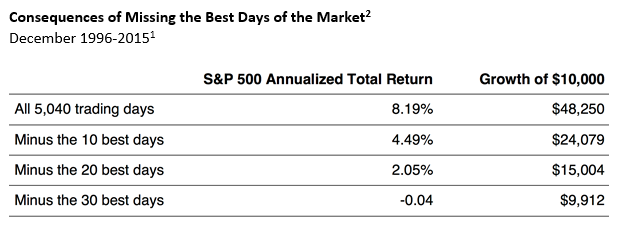
Just recently, a report was released discussing why you should NOT try and time the market, but rather “just stay invested for the long-haul.”  To wit:

“Periods of high volatility and occasional bouts of uncertainty are a part of the investing process. When markets correct, you can’t control their length or severity, but you CAN control how you respond. The temptation is to exit the market entirely and sit on the sidelines waiting for the ‘right’ time to re-enter and re-invest. We believe that unfortunately, for the typical investor, this is not a prudent investment strategy. Why? Because we are not aware of anyone who can successfully time the market on a consistent basis and the consequences of missing just a few of the best days in the market can really put a dent in your long-term returns.”
The report then continues:

“Additionally, bear markets have tended to be short-lived while bull markets have been longer, stronger and more powerful creating a net positive for the long-term investor vs the ‘buy low, sell high’ investor.”

Unfortunately, the entirety of the analysis is based on faulty, mainstream, assumptions.

The “Math” Problem

For years, the investment industry has tried to scare clients into staying fully invested in the stock market at all times, no matter how high stocks go or what’s going on in the economy. The warnings are always the same:

“You can’t time the market.”

“Studies show that market timing doesn’t work.”

Of course, the reasoning for promoting “buy and hold” investing is not necessarily for “your benefit,” but generally for those wishing to extract a “fee” for their services.

But let’s get right to the “math” of it.

Is it true that over the long-term investors made most of their money from just a handful of big one-day gains? In other words, if you missed any of those days, your return would be “bupkis.” Obviously, since no one can predict when those few, big jumps are going to occur, it’s best to stay fully invested at all times, right? So just give them your money and bask in the warm blow of the “efficient market hypothesis.”

But, that’s entirely wrong. What it doesn’t address is the other half of the equation which makes the real difference to whether you should invest, when and how.”

While it is true, that missing out on the 10-best days did reduce your gains, missing out on the 10-WORST days was far more lucrative.

Clearly, avoiding major drawdowns in the market is the key to long-term investment success. Given that markets spend roughly 95% of their time making up previous losses, avoiding major drawdowns leads to a greater probability of reaching long-term goals.

As Brett Arends once stated:

“The cost of being in the market just before a crash is at least as great as being out of the market just before a big jump and may be greater. Funny how the finance industry doesn’t bother to tell you that.”

The reason that the finance industry doesn’t tell you the other half of the story is because it is NOT PROFITABLE for them. The finance industry makes money when you are invested – not when you are in cash.  Therefore, it is of no benefit to Wall Street to advise you to move to cash.

The Percentage Problem

If the “math problem” wasn’t bad enough, the author then climbs right into the “percentage problem” in the second chart trying to prove his point yet again.

Unfortunately, this is also incorrect.

Since the chart above was nominal, I have rebuilt the analysis presented above using inflation-adjusted total returns using Dr. Robert Shiller’s monthly data. The chart shows the S&P 500 from 1900 to present and I have drawn my measurement lines for the bull and bear market periods. Also, notice the very long periods before the markets make “new highs.”
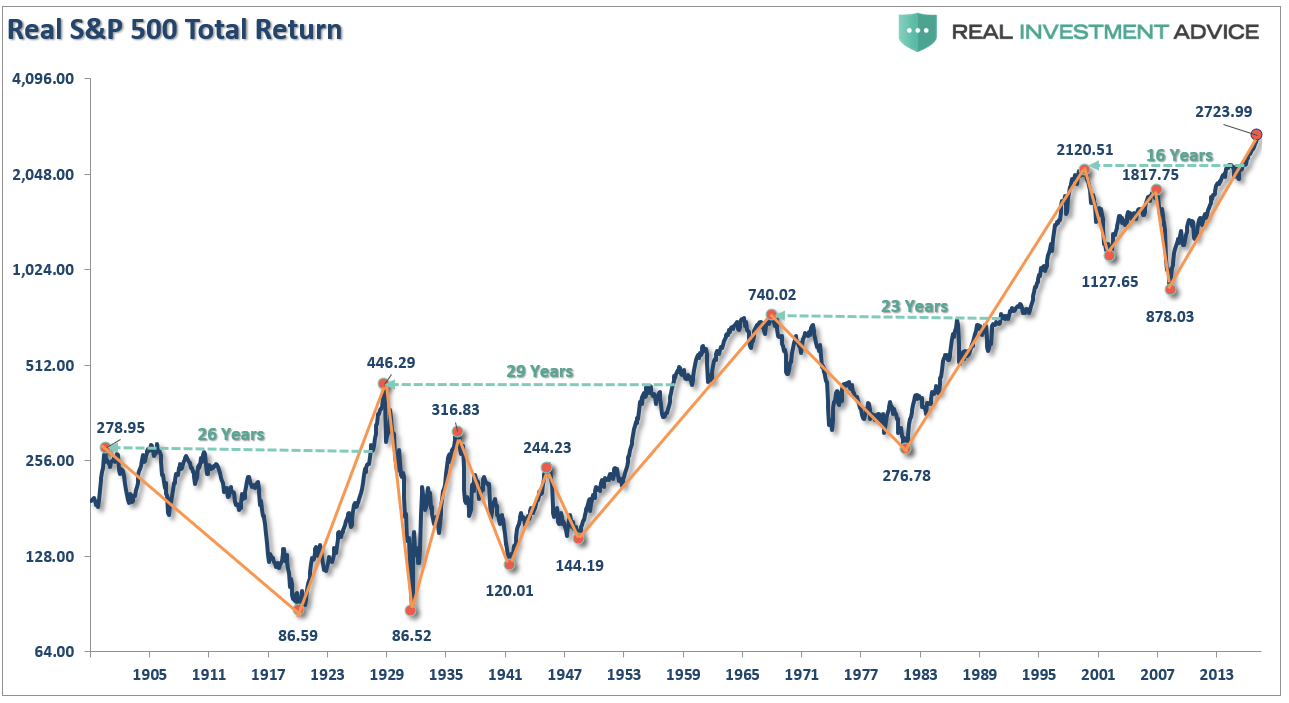
The table below is the most critical. The table shows the actual point gain and point loss for each period. As you will note, there are periods when the entire previous point gains have been either entirely, or almost entirely, destroyed. 
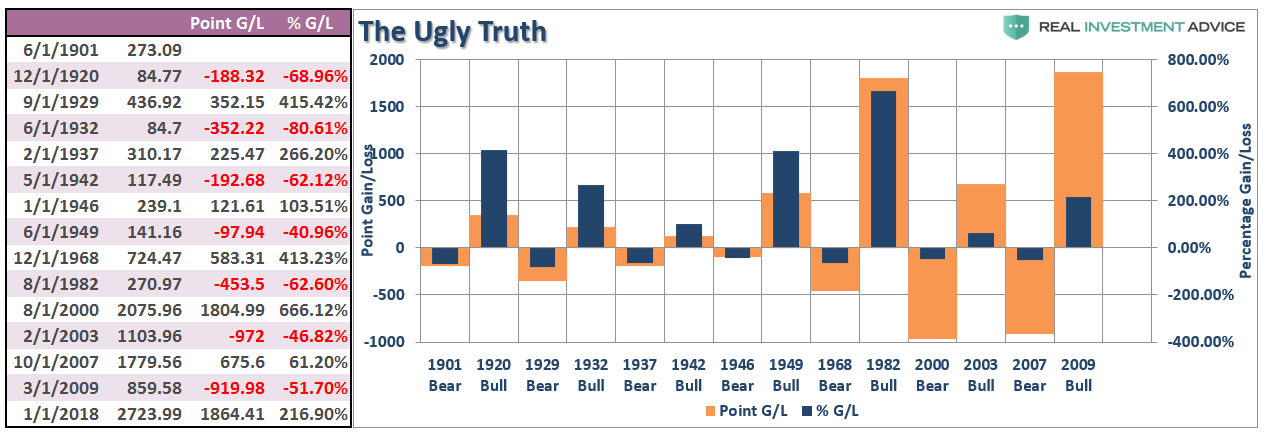
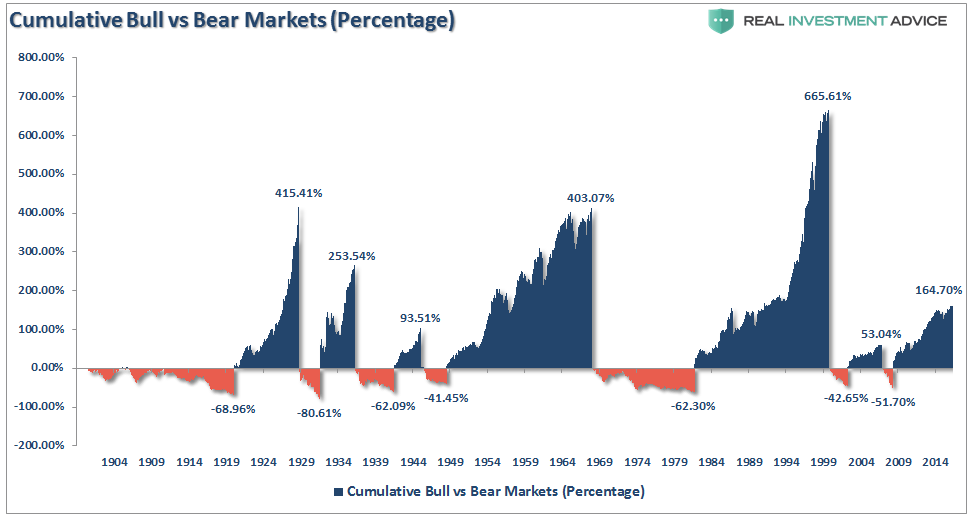
The next two charts are a rebuild of the first chart above in both percentage and point movements.

Again, even on an inflation-adjusted, total return, basis when viewing the bull/bear periods in terms of percentage gains and losses, it would seem as if bear markets were not worth worrying about.
However, when reconstructed on a point gain/loss basis, the ugly truth is revealed.
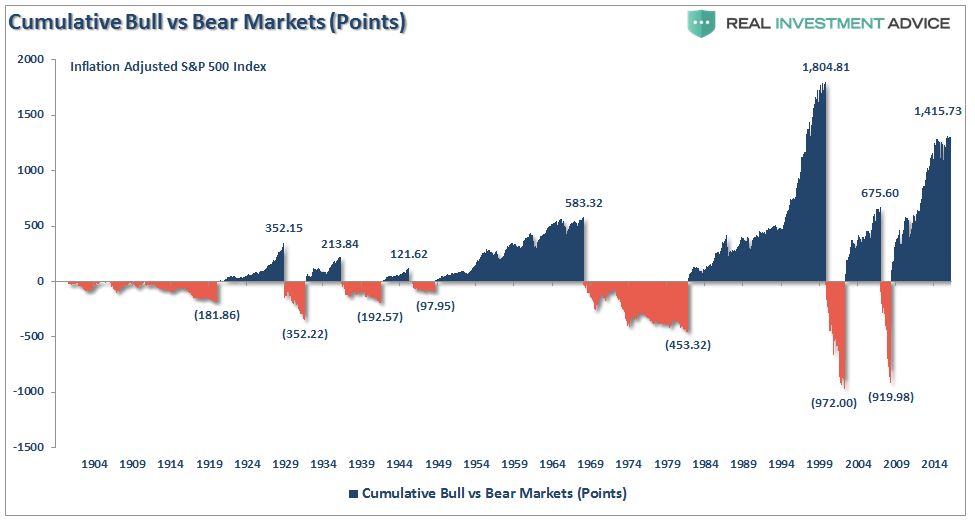
Percentages are very deceiving especially when you start talking about very large numbers. However, when it comes to your money, it is about how many points are lost which is critically more important.

So, what’s the solution?

No, You Can’t Time The Market

I do agree with the statement above that you “can’t time the market.” Importantly, I do not endorse “market timing” which is specifically being “all in” or “all out” of the market at any given time.

The problem with “market timing” is consistency.

But answer this question:

Why are there are no great investors of our time that “buy and hold” investments?

Because all great investors manage risk. 

Having a methodology to “buy” and “sell” investments is the core of investing, hence the very basic rule of investing which is to “buy low and sell high.”

While there are many sophisticated methods of handling risk within a portfolio, even using a basic method of price analysis, such as a moving average, can be a valuable tool over the long-term holding periods. Will such a method ALWAYS be right? Absolutely not. However, will such a method keep you from losing large amounts of capital? Absolutely.

The chart below shows a simple 12-month moving average study. What becomes clear is that using a basic form of price analysis can provide useful identification of periods when portfolio risk should be REDUCED. Importantly, I did not say risk should be eliminated; just reduced.
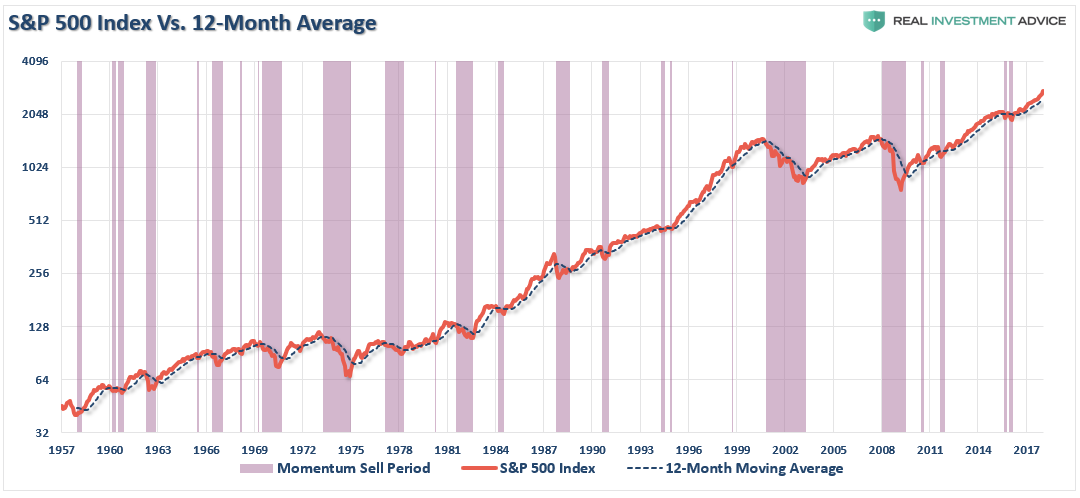
Again, I am not implying, suggesting or stating that such signals mean going 100% to cash. What I am suggesting is that when “sell signals” are given that is the time when individuals should perform some basic portfolio risk management such as:

  • Trim back winning positions to original portfolio weights: Investment Rule: Let Winners Run
  • Sell positions that simply are not working (if the position was not working in a rising market, it likely won’t in a declining market.) Investment Rule: Cut Losers Short
  • Hold the cash raised from these activities until the next buying opportunity occurs. Investment Rule: Buy Low

By using some measures, fundamental or technical, to reduce portfolio risk by taking profits as prices/valuations rise, or vice versa, the long-term results of avoiding periods of severe capital loss will outweigh missed short-term gains. Small adjustments can have a significant impact over the long run.

Buy & Hold Won’t Get You There

If you just “buy and hold” and “dollar cost average” you will make money over the long-term.

This is a true statement.

It will just leave you very short of your required investment goals.

Let me give you an example of what I mean.

In 1988, Bob was 35 years old, had saved up a $100,000 nest egg and decided to invest it in the S&P 500 index. He added $625/month to the index every month and never touched it. When Bob retires at 65, he wants to maintain his current $75,000 lifestyle. We will assume he can generate 3% a year in retirement on his nest egg.

The chart below shows the difference between two identical accounts. Each started at $100,000, each had $625/month in additions and both were adjusted for inflation and total returns. The purple line shows the amount of money required, inflation-adjusted, to provide a $75,000 per year income to Bob at a 3% yield. The only difference between the two accounts is that one went to “cash” when the S&P 500 broke the 12-month moving average in order to avoid major losses of capital.
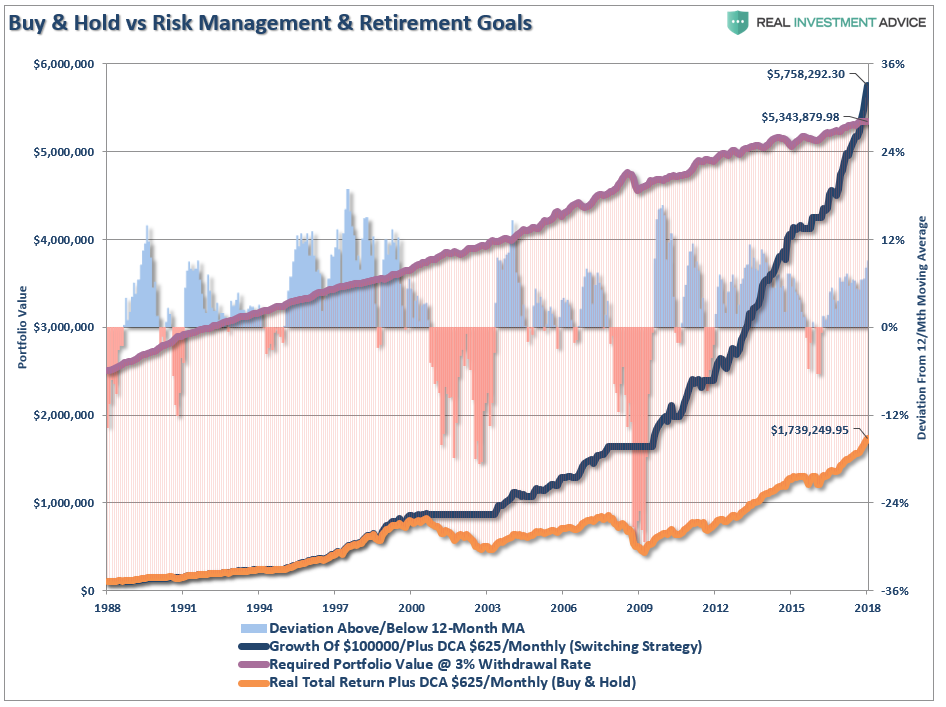
There is a clear advantage to providing risk management to portfolios over time. The problem, as I have discussed many times previously, is that most individuals cannot manage their own money because of “short-termism.”

Despite their inherent belief that they are long-term investors, they are consistently swept up in the short-term movements of the market. Of course, with the media and Wall Street pushing the “you are missing it” mantra as the market rises – who can really blame the average investor “panic” buying market tops and selling out at market bottoms.

Yet, even after two major bear market declines, it never ceases to amaze me that investors still believe that somehow they can invest in a portfolio that will capture all of the upside of the market but will protect them from the losses. Despite being a totally unrealistic objective this “fantasy” leads to excessive risk-taking in portfolios which ultimately leads to catastrophic losses. Aligning expectations with reality is the key to building a successful portfolio. Implementing a strong investment discipline, and applying risk management, is what leads to the achievement of those expectations.

Planning To Win 

Many individuals have been led believe that investing in the financial markets is their only option for retiring. Unfortunately, they have fallen into the same trap as most pension funds which is believing market performance will make up for a “savings” shortfall.

With valuations elevated, the economic cycle very long in the tooth, and the 3-D’s (debt, demographics, and deflation) applying downward pressure to future economic growth rates, investors need to consider the following carefully.

  • Expectations for future returns and withdrawal rates should be downwardly adjusted.
  • The potential for front-loaded returns going forward is unlikely.
  • The impact of taxation must be considered in the planned withdrawal rate.
  • Future inflation expectations must be carefully considered.
  • Drawdowns from portfolios during declining market environments accelerate the principal bleed. Plans should be made during rising market years to harbor capital for reduced portfolio withdrawals during adverse market conditions.
  • The yield chase over the last 8-years, and low interest rate environment, has created an extremely risky environment for retirement income planning. Caution is advised.
  • Expectations for compounded annual rates of returns should be dismissed in lieu of plans for variable rates of future returns.

Chasing an arbitrary index that is 100% invested in the equity market requires you to take on far more risk that you most likely want. Two massive bear markets over the last decade have left many individuals further away from retirement than they ever imagined. Furthermore, all investors lost something far more valuable than money – the TIME that was needed to reach their retirement goals.

Investing for retirement, no matter what age you are, should be done conservatively and cautiously with the goal of outpacing inflation over time. This doesn’t mean that you should never invest in the stock market, it just means that your portfolio should be constructed to deliver a rate of return sufficient to meet your long-term goals with as little risk as possible.

It should be clear that market corrections are indeed very bad for your portfolio in the long run. However, before sticking your head in the sand, and ignoring market risk based on an article touting “long-term investing always wins,” ask yourself who really benefits?

This outcome this time will not be “different,” so isn’t it worth considering a different approach?

via RSS http://ift.tt/2nusKn4 Tyler Durden

UPenn Removes Steve Wynn’s Name From Campus Plaza, Scholarship; Revokes Degree

In response to allegations of “sexual harassment and intimidation” by Steve Wynn, his alma mater, the University of Pennsylvania, has voted to do something it said it hasn’t done in one century: it is removing Wynn’s name from the outdoor plaza by Houston Hall, called “Wynn Commons”; it will also remove Wynn’s name from a scholarship he funded.

The group of trustees, alumni, deans and faculty also voted to revoke Wynn’s honorary degree. The UPenn group also revoked a honorary degree granted to Bill Cosby.

Wynn, CEO of Wynn Resorts Ltd., is an alumnus of Philadelphia-based school and a former trustee. He has denied allegations of sexual impropriety.

Full statement below:

A Message to the Penn Community from David L. Cohen, Chair, Penn Board of Trustees
Amy Gutmann, President

Late last week, multiple credible reports emerged in the national press detailing pervasive and decades-long acts of sexual harassment and intimidation by Steve Wynn, former Penn Trustee and College alumnus.

The nature, severity, and extent of these allegations, and the patterns of abusive behavior they describe, involve acts and conduct that are inimical to the core values of our University.

While Mr. Wynn has denied the allegations, the reputational impact of what has been reported is so significant that Mr. Wynn resigned from his position as finance chairman for the Republican National Committee.

Further, the board of directors of Wynn Resorts has formed a special committee to investigate the allegations of sexual misconduct made against him. And gaming regulators in both Nevada and Massachusetts are also investigating.

In the wake of the substantive and detailed press reports, and of consequent actions by fiduciary and regulatory bodies, we felt it was imperative to examine Mr. Wynn’s recognized presence on Penn’s campus. We hold as a sacred commitment our responsibilities of stewardship of our University’s reputation. As chair of the Trustees and president of the University, we have a leadership responsibility and must always think and act on behalf of what is best for Penn and our core values. Perhaps nowhere is the need for clarity of purpose and action more important than in matters with such potential impact on the ethos of our society and our University community.

To that end, we convened a small group composed of trustees, alumni, deans, and faculty who deliberated carefully on the nature of the charges made against Mr. Wynn and the correct course of action the University should take in response. That group made recommendations to the Executive Committee of the Board of Trustees, which unanimously accepted them on behalf of the Board, and which will result in the following immediate actions.

  • First, we will remove the name Wynn Commons, named for Mr. Wynn, from the centrally located outdoor plaza bounded by Houston Hall, Claudia Cohen Hall, College Hall, and Irvine Auditorium.
  • Second, Mr. Wynn’s name will be removed from a scholarship fund established by a donation from him. The scholarships will continue to be awarded.
  • Third, we will revoke Mr. Wynn’s honorary degree.

At the same time we are taking these actions, we will also revoke the honorary degree awarded to Bill Cosby, who has similarly been accused by multiple parties of sexual assault.

It has been a century since the University of Pennsylvania last revoked an honorary degree, and we do not take that decision — or the decision to remove Mr. Wynn’s name from the Commons and from the scholarship fund he created — lightly.

We view these as extraordinary and essentially unique circumstances that call for an immediate, decisive, and clearly ethical response. The decision to remove the name Wynn Commons could not be made independently of considering the other ways in which the University had previously recognized Mr. Wynn. It became necessary, therefore, to consider the appropriateness of Mr. Wynn’s honorary degree and any other honorifics Penn had previously bestowed. Upon careful consideration, when it became clear that the Wynn name should be removed from visible public recognition on Penn’s physical campus, it was no less incumbent on the Trustees to remove that name from the roster of those holding the University’s highest symbolic honor. That decision in turn made it also clear that the multiple and highly credible charges involving Bill Cosby warranted the same action.

Our nation is currently undergoing a profound reckoning regarding the role and extent of sexual misconduct in all areas of our society. It is incumbent on all of us to address these issues wherever and whenever we find that they affect our extended community. As a University, we have always been, and will always continue to be, looked to by our alumni and neighbors, our faculty, and most of all by our students, for moral leadership. We must not — we cannot — fail to provide it.


via RSS http://ift.tt/2nz2Ttm Tyler Durden

Three Years Ago, D.C. Passed Strong Transparency Laws For Asset Forfeiture. Nothing Happened.

Three years ago, the District of Columbia joined a growing number of jurisdictions that were reforming their civil asset forfeiture laws amid civil liberties concerns. The District enacted strong new protections for property owners, as well as transparency requirements that police show exactly how much they were seizing from residents every year.

But three years later, D.C. residents, journalists, and advocacy groups have no idea how the reforms are working. The District’s law enforcement has illegally dragged its feet, and not a single required annual transparency report has been released. The department says it’s still compiling its first report, as it says it has been doing for the past two years.

In December of 2014, the D.C. Council unanimously passed an asset forfeiture reform bill that, among other things, mandated the Metropolitan Police Department (MPD) and the D.C. Attorney General’s office post annual reports of asset forfeiture activities to their websites, as well as submit those reports to the Council.

Lack of transparency is one of the biggest challenges to monitoring civil asset forfeiture, a practice that allows police to seize property suspected of being connected to criminal activity without convicting, or even charging, the owner.

A report last year by the Institute for Justice, a libertarian-leaning public-interest law firm that has challenged asset forfeiture laws in several states, found that a majority of states had little to no transparency or reporting requirements surrounding the practice.

The District’s new transparency requirements went into effect on Jan. 1, 2016, but the annual reports for the past two years are nowhere to be found. They don’t appear on either MPD or the A.G.’s websites. Likewise, the D.C. Council has not received any.

The Institute for Justice filed public records requests with the D.C. Council and the A.G.’s office for the required reports. In both instances, the Council and the A.G.’s office said they had no responsive documents.

“These transparency requirements are extremely important, because without the data these reports provide, lawmakers and the public are really not able to hold law enforcement accountable for any of their forfeiture activities,” Jennifer McDonald, a research analyst at the Institute for Justice, says. “This type of data allows us to make decisions about forfeiture policies. It would show us how often forfeitures actually advance criminal investigations. Without this information we’re all left in the dark, and when you consider that all of these forfeited properties become public property, the fact that the public has no information on property that belongs to it is particularly concerning.”

In response to questions from the D.C. Council last February, the MPD projected it would release its first report in the summer of 2017. The A.G.’s office testified that it couldn’t complete it’s report without MPD’s numbers.

In response to a press inquiry, an MPD spokesperson said the department is still compiling its first report.

“After further evaluation it was noted that additional data was needed before publishing asset forfeiture activity on our website,” the spokesperson said. “We are currently in the process of analyzing and organizing the data, in hopes of releasing it in the near future.”

That’s what MPD told the A.G.’s office last year, too.

“OAG’s Civil Enforcement Section has been in contact with MPD regarding these obligations, and MPD’s General Counsel indicates that the police department is currently preparing the list of all property seized in 2016,” the A.G.’s office told the Council last February.

In the meantime, MPD isn’t following the law, dragging the A.G.’s office along with it, and no one can evaluate what sort of impact the new requirements have had on asset forfeiture activities in D.C., or if civil asset forfeiture laws are being abused.

The D.C. Council will again ask the MPD about the status of its asset forfeiture reports in the coming weeks. However, like many transparency laws, there’s little to no consequences for flouting the requirements, and the Council has limited power to prod MPD into action.

“The committee on the Judiciary and Public Safety has requested from MPD and the Office of the Attorney General their annual reports on asset forfeiture, but it hasn’t been provided,” Erik Salmi, a spokesperson for Ward 6 Councilmember Charles Allen, says. “In the next four weeks, the Committee will be conducting annual oversight hearings of both offices where we’ll have a conversation about this topic among others.”

from Hit & Run http://ift.tt/2DSuuwO
via IFTTT

Watch: Trump Speaks To House And Senate Republican Conference

President Trump is delivering remarks to House and Senate Republicans in Lewisburg, WV at their annual retreat.

“The priorities of Republicans in Congress are the priorities of the American People.  We believe in strong families and strong borders.  We believe in the rule of law, and we support the men and women of law enforcement.  We believe every American has the right to grow up in a safe home, to attend a good school, and to have access to a great job,” Trump will say.

Trump will also speak about immigration and address the controversial topic of “Dreamers.”

“Nearly 7 in 10 Americans support an immigration reform package that includes a permanent solution on DACA, secures the border, ends chain migration, and cancels the visa lottery,” Mr. Trump will say. “These are the Four Pillars of the White House Framework – a plan that will finally bring our immigration system into the 21st century.”

Watch live below:

via RSS http://ift.tt/2GFK6FK Tyler Durden

Atlanta Fed Sees Q1 GDP Soaring to 5.4%

The first estimate of Q4 GDP may have been a dud, with soaring imports resulting in a disappointing 2.6% annualized print, but that hasn’t stopped the Atlanta Fed to unveil its most bullish GDP forecast in years: moments ago, the regional Fed revised its initial Q1 GDP nowcast estimate from 4.2% to a whopping 5.4% following today’s strong ISM print.

This would be the highest GDP forecast by the Atlanta Fed going back to Q1 2012:

This is how the Fed justified its euphoria economic outlook:

The GDPNow model forecast for real GDP growth (seasonally adjusted annual rate) in the fourth quarter of 2017 is 5.4 percent on February 1, up from 4.2 percent on January 29. The forecast of real consumer spending growth increased from 3.1 percent to 4.0 percent after this morning’s Manufacturing ISM Report On Business from the Institute for Supply Management, while the forecast of real private fixed-investment growth increased from 5.2 percent to 9.2 percent after the ISM report and this morning’s construction spending release from the U.S. Census Bureau. The model’s estimate of the dynamic factor for January—normalized to have mean 0 and standard deviation 1 and used to forecast the yet-to-be released monthly GDP source data—increased from 0.42 to 1.37 after the ISM report

Then again, the Atlanta Fed is best known for its initial high-balling of GDP estimates which then gradually fade as the quarter progresses and as real data replaces estimates from sentiment surveys such as the ISM.

Finally, keep in mind that the blistering Q1 2012 GDP, which was also supposed to print north of 5% was eventually marked down to just 0.8%.

via RSS http://ift.tt/2rWnzkB Tyler Durden

Introducing “The 3R”: Why Goldman Thinks Oil Is Going To $82

It may not be Goldman’s historic(ally wrong) “oil to $200 super-spike” call from the spring of 2008  which has so far top-ticked the highest price of crude in history, but in the grand scheme of things, Goldman’s call from this morning was not that much different when the world’s central banker incubator boosted its price forecast by a third and said global crude markets have probably rebalanced.

So now that the rebalancing narrative is over, Goldman needed a new, catchy narrative, ideally packaged in a handy mnemonic, ala “BRICs.” It got just that in the form of, drumroll…. “The 3Rs”, or “reflation, releveraging and reconvergence” which letters supposedly “reinforce our bullish overweight commodity outlook.”

And not just bullish: “the most bullish in a decade on the 3Rs”

Here is the 30,000 foot summary behind Goldman’s rediscovered commodity euphoRRRia, which the bank frames as follows: “The 3R’s unlikely to repeat 2008, but will likely rhyme in 2018.”

Strong demand growth against limited supply growth due to OPEC and Chinese supply curtailments created significant reflation in commodity prices last year. During 2H17, commodities were the best performing asset class, posting a solid 18% return. Given the high level of debt held by commodity producers, not only do higher commodity prices reduce the number of bad loans and free up capacity on bank balance sheets, higher commodity prices also help strengthen EM currencies and weaken the dollar via the accumulation and recycling of rising excess savings. On net, this in turn lowers EM funding costs and leads to EM releveraging. More EM leverage leads to more EM growth reconvergence, reinforcing even more synchronized global growth and, ultimately, reflation pressures – creating a feedback loop. Our global Current Activity Indicator (CAI) is tracking 5.1% annualized real GDP growth, and as of last Friday (January 26) financial conditions in the US were the best ever recorded in the history of our Financial Conditions Index.

So based on what Goldman sees as an “increasingly supportive growth backdrop” the bank upgraded its commodity forecasts across oil, copper, iron ore and coal. The breakdown:

Given we have raised our 6-month Brent crude oil target the most, to $82.50/bbl from $62/bbl previously, we have front-loaded outperformance of the S&P GSCI and now expect returns of +15% and +10% over the next 6 and 12 months, respectively.  In addition, with low and declining inventories in key commodity markets, we expect commodity price volatility will rise from the current historically low levels.

Furthermore, Goldman is “also initiating a new 2018 top trade and recommending a long 6-month call option on the S&P GSCI excess return index struck 5% out of the money.” With a cost of 2.3%, the breakeven is a 7.3% return with a 4.4 to 1 expected payout based upon our 6-month return forecast of 15%.

Translation: Goldman’s prop desk is now aggressively selling commodity upside exposure to clients, which means that by definition, Goldman is turning bearish on commodities.

To be sure, it wouldn’t be a catchy Goldman mnemonic if it didn’t have its own “circular” chart to self-validate the U-turn in the bank’s sentiment, so that’s precisely what head Goldman commodity strategist Jeff Currie put together:

There are many more charts and justifications behind Goldman’s mini “super-spike” call in the full note which we are confident readers can track down from their friendly, neighborhood Goldman salesman, but the best summary of what Goldman really meant, was in the following tweet:

via RSS http://ift.tt/2rWm5Xz Tyler Durden