Mulvaney Warns Coronavirus Could Lead To School Closures; Blames Press For Peddling ‘False Narrative’ To Take Down Trump
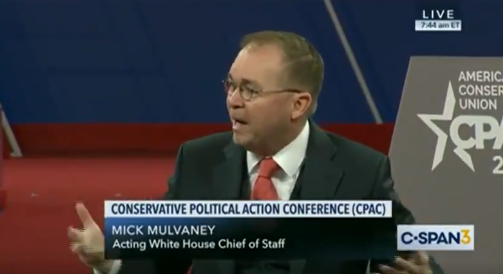
Acting White House Chief of Staff Mick Mulvaney said on Friday that the coronavirus is likely to cause disruptions to every day life – including likely school closures and changes to public transportation.
“Are you going to see some schools shut down? Probably. Maybe see impacts on public transportation? Sure, but we do this. We know how to handle this,” Mulvaley said while speaking at the Conservative Political Action Conference (CPAC) outside of Washington on Friday.
Mulvaney also slammed the media for painting a narrative that the Trump administration is “scrambling” to contain the virus, noting that he briefed Congress along with top health officials six weeks ago. He accused the media of ignoring coronavirus until now, according to The Hill.
“Why didn’t you hear about it?” Mulvaney asked the audience while sitting down with Heritage Foundation economist Stephen Moore. “The press was covering their hoax of the day because they thought it would bring down the president.”
“Is it real? It absolutely is real,” Mulvaney said. “But you saw the president the other day — the flu is real.“
Mulvaney then downplayed the risk of the new coronavirus, saying that people should be focusing on the mortality rate which is currently, officially, between 2 and 3%.
Acting White House Chief of Staff Mick Mulvaney: “What I might do today to calm the markets is tell people to turn their televisions off for 24 hours…This is not Ebola. It’s not SARS. It’s not MERS.” #coronavirus#CPAC2020
What Mulvaney didn’t note is that COVID-19 is hyper-virulent, and can reinfect people who have already had it. If even 1/10 of the world is infected, that’s 15 – 22 million dead – a global crisis by any standard. He also didn’t mention the economic impact of tens of millions of people who will survive, but can’t function for several weeks.
If coronavirus gains a foothold in American cities and we begin to see footage of people falling over in the streets, we suspect the Trump administration will have much explaining to do for their early attempts to downplay the threat.
There Is Just One Question: Will The Fed Activate A Coordinated Central Bank Bailout On Sunday
With global markets in freefall, the S&P opening 3% lower and cementing its worst week since the global financial crisis; the Dow (or is thar Down Joanes) plunging more than 4,000 points this week, traders (especially levered ones) are left with just one option to stave off a career (and personal fortune)-ending margin call: praying, though not to god but rather to the Fed.
To be sure, the Fed itself has given enough reasons for this: on Monday the biggest uber-dove in history, former Minneapolis Fed and the Fed’s only negative “dot” ever, Narayana Kocherlakota penned a Bloomberg op-ed saying the Fed should cut not once but twice, and do it on an emergency basis ahead of the March FOMC meeting.
Then, this morning, one day after he penned a similar Op-Ed, former Fed Governor Kevin Warsh – who has finally crushed his “hawkish” facade as he guns to replace Powell as the Fed’s Chair – echoed Kocherlakota when he said he expects the Fed and other central banks around the world to act soon in response to the coronavirus outbreak. Warsh, no longer even pretending to give a rat’s ass about efficient markets and price discovery that is independent of Fed manipulation, recommended the Fed act as quickly as Sunday to assuage financial markets that have been in an aggressive swoon all week as the virus has spread.
“Chairman Powell needs to reach out to his counterparts around the world and buy some time. That’s what a quarter-point could do.” Former Fed Gov. Warsh says the Fed should respond quickly to coronavirus fears: “I think the sooner they cut the better.” https://t.co/tNbNRvhiz5pic.twitter.com/hg6HUXNiSE
Adding fuel to the speculative fire that a coordinated central bank action is coming is that the Bank of Korea shocked markets when it did not cut rates on Thursday, with some readers suggesting that the only reason it did not “was to preserve ammo to cut with other CBs this weekend.”
Needless to say, the market expects all this and more, with Eurodollar options now suggesting some traders are expecting more than 1 rate cut at the March meeting, amid rising bets for a rate cut ahead of the next scheduled meeting.
So with two former Fed officials (and potentially one future Fed chair), opining that the Fed may announce an emergency rate cut as soon as this weekend, sinking traders – desperate to grab hold to any stick – have been scrambling all morning to create a rumor, or at least a rumor, that on Sunday night the Fed will step in.
Picking up on this theme, Nomura’s CHarlie McElligott summarizes today’s market action, writing that we are now going through “dangerous times, as recently overwhelming Dealer short gamma hedging into the down trade, mechanical systematic deleveraging and dynamic shorting of Futures now are at risk of a “turn,” as Equities downside / VIX upsides hedges are increasingly likely to be monetized, creating violently “squeezy” flows in the Equities market which has recently been purged.” And while none of this is news to regular readers, as we have covered all the technical and flow aspect of the ongoing historic crash in great detail, what is notable is that Charlie adds that all this is happening “with the background “upside catalyst” of the growing-likelihood of “imminent” Central Bank coordinated policy response statement as soon as this wknd, ahead of the Sunday Asian reopen.”
The problem is that whereas just one week ago, the mere rumor of coordinated central bank action would have been sufficient to send stocks soaring, any attempts at a bounce for Equities (such as the 70-handle move in Spooz off the earlier overnight lows—similar to yesterday morning) will come down to likely – and imminent – monetization of large options hedges in the market, with McElligott noting that tactical traders looking to sell their Puts in S&P products / take-off VIX Calls (even see retail redeem their “long vol” VIX ETNs) to book the positive PNL against whatever hits they’ve taken in their “long” books—and probably thereafter switch into a more “dynamic hedging” stance, just trading futures thereafter to manage exposures whether “long” or “short.”
In other words, the ongoing phase transition from negative dealer gamma to positive (should those who hold hedges monetize them), is now keeping stocks lower, and preventing any bullish rumors from taking hold!
* * *
Which, once again brings us to the key topic: while it may be impossible to front run it, is the Fed about to activate a global coordinated bailout, and if so, how should one trade it? This is where it gets complicated. According to Nomura’s cross-asset strategist, the fear of this potentially imminent – and coordinated- central bank “interventionary” response (most likely time is this upcoming Sunday night, before the Asian open) will keep markets in a dangerous space, because strategies and traders which are potentially “pressing” shorts:
either directionally (CTA model now “in play” of outright “short SPX” as noted above) or
pressing-shorts to managed “net exposures” or hedge long books, will be exposed to a surge squeeze higher, while investors who have been “grossed-down” by their risk management VaR models won’t be exposed to an “up-trade” in risk and likely feel obligated to “grab into” a short squeeze
The danger after a coordinated central bank response (assuming one comes), is that investors will be forced into chasing that potential move higher in Equities out of fear that they “missed the lows,” but again into that inevitable “cluster” report of confirmed cases in a global mega-city outside of China (see what’s happening in California now as prime target), “as the pandemic is now certainly “real”—which could drive another shock-down, but this time, without the hedges which, on the way down, can also act as “insulation” when monetized.”
In other words, if or rather when the corona pandemic gets even worse after central banks have launched its bazooka, it will be orders of magnitude worse as central banks will have staked their credibility on being able to offset the economic consequences of the pandemic (they can’t, unless they can print viral antibodies), while investors will now be looking into the abyss without any hedges left.
And that could be catastrophic.
Which may explain why, in case the Fed does nothing on Sunday night, the NYSE announced that it would conduct “disaster recovery testing in the Cermak Data Center between 8:30 – 11:00 am ET” on March 7 amid Coronavirus fears.
As Charlie Gasparino adds…
BREAKING: @NYSE announces “disaster recovery testing in the Cermak Data Center between 8:30 – 11:00 am ET” on March 7 amid Coronavirus fears..”During this test, NYSE will facilitate electronic Core Open and Closing Auctions as if the 11 Wall Street trading floor were unavailable”
… “During this test, NYSE will facilitate electronic Core Open and Closing Auctions as if the 11 Wall Street trading floor were unavailable.” In other words, testing as if a viral pandemic had swept across Wall Street…
US Consumer Sentiment Soars Near 16 Year Highs (Before Virus Fears Rose)
While expectations dipped from the preliminary data, overall UMich sentiment jumped to almost its highest since 2004.
The gauge of current conditions increased from the prior month to 114.8 and the expectations index rose to 92.1, data showed Friday.
Source: Bloomberg
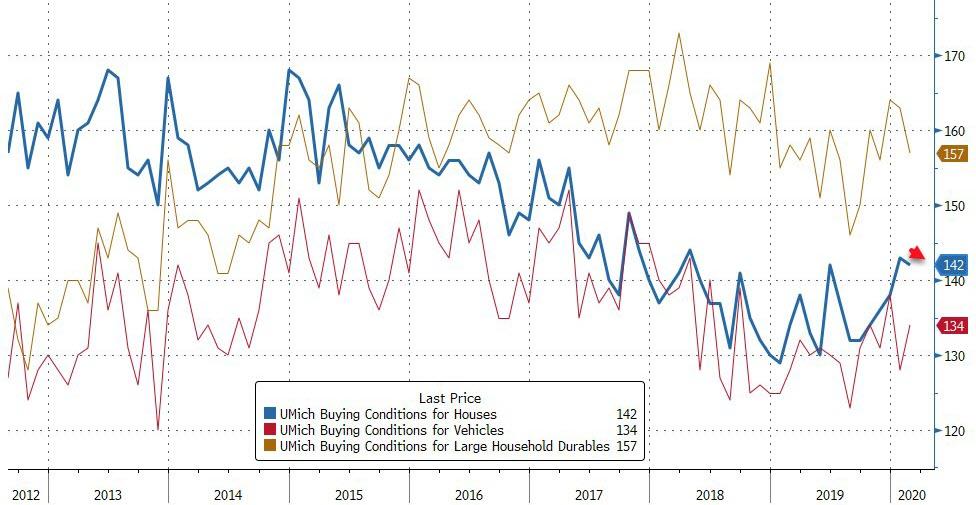
Appetite for buying houses dipped modestly in February…
Source: Bloomberg
Longer-term inflation expectations dropped to 2.3% this month from 2.5% in January. Federal Reserve officials watch this figure closely as Chairman Jerome Powell has warned lower expectations can drag actual inflation even lower. Inflation expectations for the year ahead fell to 2.4% from 2.5% in January. The preliminary February reading also was 2.5%.
The gauge of sentiment about current personal finances was the second-highest since 1998.
Notably, only 8% of all consumers in February mentioned the virus when describing the economic outlook, though the share rose to 20% in the final two days of the survey. Interviews were conducted Jan. 29 through Feb. 25.
Still, “the domestic spread of the virus could have a significant impact on consumer spending,” Richard Curtin, director of the University of Michigan consumer survey, said in a statement.
“If the virus spreads into U.S. communities, consumers are likely to limit their exposure to stores, malls, theaters, restaurants, sporting events, air travel, and the like.”
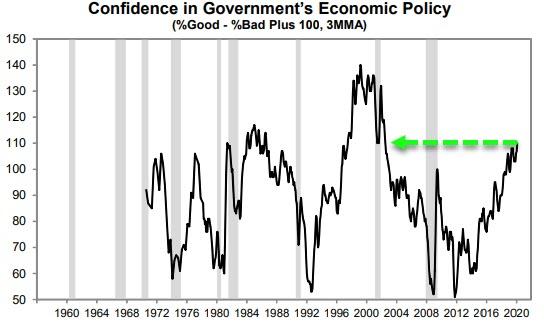
Panic is best avoided by a strong sense of confidence in local, state, and federal responses that aim to control the potential spread of the virus as well as limit any resulting damage to the economic welfare of consumers. The most effective fiscal and monetary policies include proposed reactions to the virus that are transparent, well understood, and act to maintain confidence in government economic policies close to its nearly two-decade high…
While the final February sentiment reading is the latest sign consumers remain a steady hand for the U.S. economy, a rapidly spreading coronavirus, the stock market collapse and the approaching elections nonetheless represent risks.
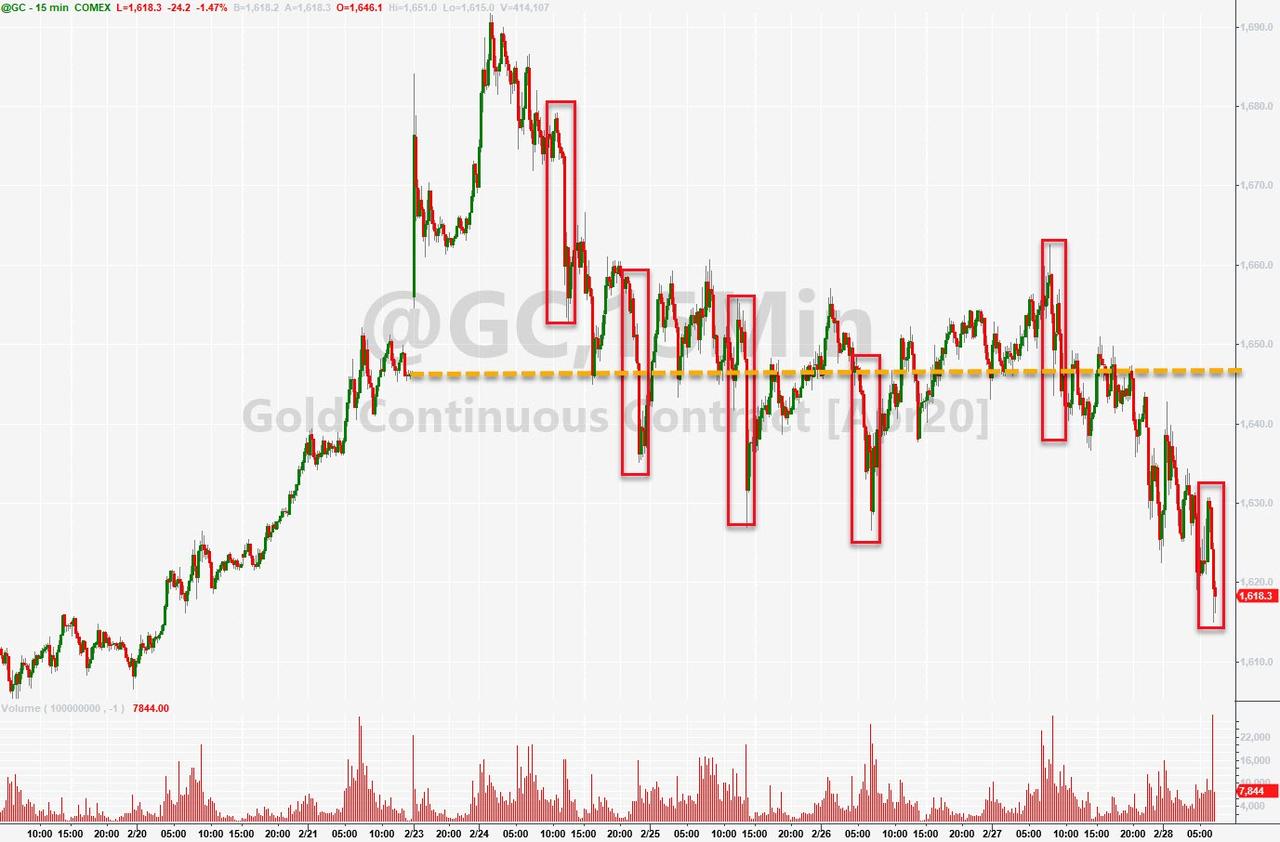
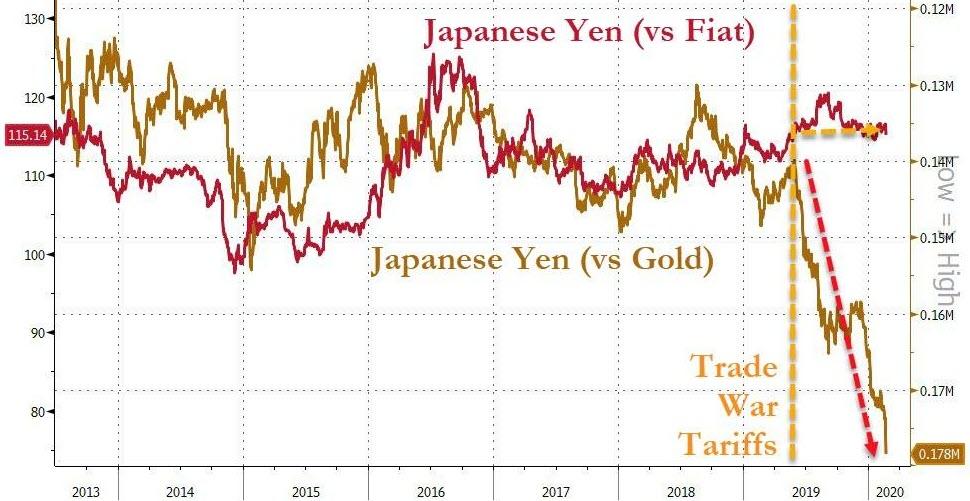
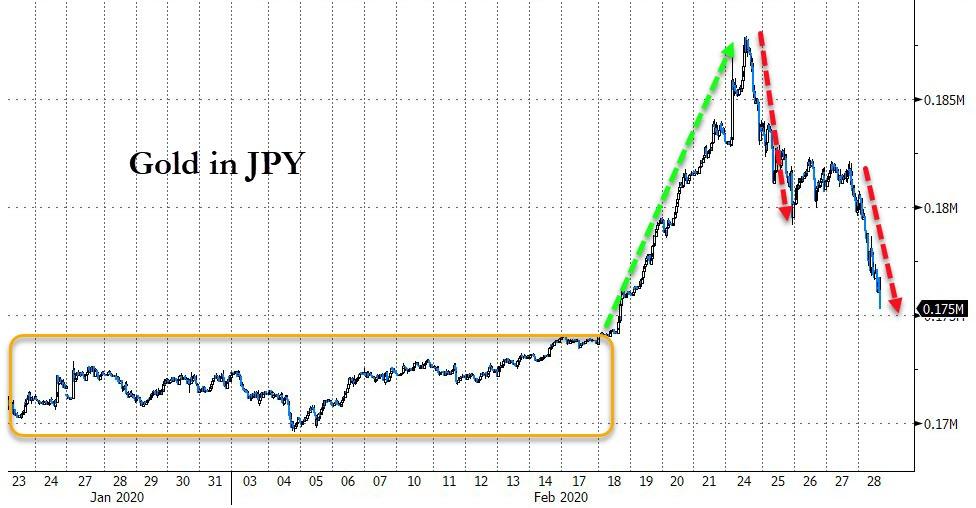
Noting that JPY and gold had massively decoupled, seemingly breaking out of their unofficial peg.
Perhaps this week’s crisis was enough to force the BIS or Bank of Japan back into the precious metals market to stabilize faith in fiat as the chart above shows a series of high volume dumps pressuring gold lower, and the chart below shows a huge roundtrip back into the ‘peg’ for yen against gold…
The legal provisions that let the feds secretly spy on digital communications are set to expire soon. Attorney General Bill Barr wants a blanket reauthorization ASAP. But yesterday the president suggested that he may disagree.
“Good talk with @realDonaldTrump yesterday and I’m pleased he is urging FISA reform NOW—and not a reauthorization of the current Patriot Act,” tweeted Sen. Rand Paul (R–Ky.) on Thursday morning. That afternoon, the Kentucky senator followed up:
Spoke with @realDonaldTrump . He agrees that the secret FISA court (intended to be used on foreign spies) should be forbidden from ever spying on or investigating Americans, and that Congress should act NOW to make sure of that!
The decision whether to renew the USA Freedom Act as is rests with Congress, of course. But Trump’s support for reforms could make a big difference to some Republicans there.
Both Republicans and Democrats have enthusiastically renewed these provisions in the past, and they appear poised to do so again, despite longstanding complaints about abuse of the process. Lawmakers now have until March 15 to decide whether to renew without reforms or pick from several reform proposals.
“In January, a bipartisan pack of privacy-minded lawmakers introduced a bill that would formally end the bulk collection of Americans’ records and introduce other reforms to the secretive Foreign Intelligence Surveillance Amendment (FISA) Court to provide some more transparency and better protect Americans from unwarranted surveillance,” Reason‘s Scott Shackford wrote yesterday. Alas,
congressional leaders just want to push through a quick temporary renewal with some less modest fixes. Reps. Jerrold Nadler (D–N.Y.) and Adam Schiff (D–Calif.), chairs of the House Intelligence and Judiciary Committees, put together a reform bill of their own that would extend the USA Freedom Act until 2023.
Nadler and Schiff’s bill would end the bulk data collection program but would extend the part of Section 215 of the Patriot Act that lets the FBI secretly collect business records it deems relevant to terrorism investigations. So the feds will be able to easily collect your data when it’s in the hands of a third party—and these days, that means most of your data.
Four provisions are set to expire; Lawfare has more details.
Barr has said he wants a “clean” renewal of the act with no reforms, promising that any problems can be fixed through administrative procedure. (“That’s the worst possible outcome,” argues Shackford, “because it would give Barr the power to decide—in secret—whose privacy rights are protected and whose are not.”) But Trump may be breaking with his top cop on the matter.
In addition to the discussion he reportedly had with Paul, Trump yesterday retweeted a post from Rep. Jim Jordan (R–Ohio) that said, “We can’t simply reauthorize the system that allowed those lies and omissions to happen.” Trump also quote-tweeted with his own comment:
“The three surveillance tools on the verge of lapsing are [FISA] provisions…that broaden the FBI’s authority to wiretap certain targets and request key documents. They are separate from the tools that the FBI used on [former Trump campaign advisor Carter] Page,” CNN points out. But the FBI did use FISA warrants in investigating Page. Trump and some Republicans seem to have latched on to that as a reason to reform the provisions under question now. Weird, but whatever works!
QUICK HITS
“Thousands of government entities and private businesses around the world [are] listed as clients of the controversial facial recognition startup” Clearview AI, reportsBuzzfeed. Customers include U.S. Immigration and Customs Enforcement (ICE), “the Drug Enforcement Administration (about 2,000 searches); the Bureau of Alcohol, Tobacco, Firearms, and Explosives (more than 2,100 searches); and the FBI (5,700 searches across at least 20 different field offices),” in addition to more than 200 companies.
The 9th Circuit Court of Appeals is refusing to let Maricopa County, Arizona, Sheriff Joe Arpaio get a misdemeanor contempt of court charge vacated.
A Virginia bill would expand the definition of prostitution to include accepting money for touching “the intimate parts of another with the intent to sexually arouse or gratify.”
from Latest – Reason.com https://ift.tt/2uzWOo2
via IFTTT
NYSE Announces Disaster-Recovery Test Due To Virus Fears
In a somewhat shocking sounding move, given administration officials’ ongoing effort to calm the public fears over the spread of Covid-19, The New York Stock Exchange has announced it will commence disaster-recovery testing in its Cermak Data Center on March 7 amid coronavirus concern, Fox Business reports in a tweet, citing the exchange.
“During this test, NYSE will facilitate electronic Core Open and Closing Auctions as if the 11 Wall Street trading floor were unavailable,” Fox says.
To reiterate, the disaster recovery plan is to check the process that would occur if Covid-19 ‘public distancing’ proposals come into effect and effectively shut the trading floor?!
The test is reported to occur March 7 between 8:30 am-11 am.
Goldman: This Is How The Selloff Changed On Thursday
Dip-buyers tried – and failed – yesterday to bring an end to the avalanche of stock market losses, but the moves in bonds, FX, and commodities are just as stunning and in an overnight note, Goldman Sachs explains how the cross-asset sell-off changed on Thursday… and what they are watching.
Via Goldman Sachs,
As we look across moves in equity, credit, rates, commodities, China equities, US Health Care and volatility, we believe the timing of moves in each asset helps us to estimate how sentiment has shifted. We believe that understanding these sentiment shifts has implications for asymmetric moves around upcoming political and macro catalysts as well as the steady stream of COVID-19 updates. We detail these shifts and our favorite options trades below.
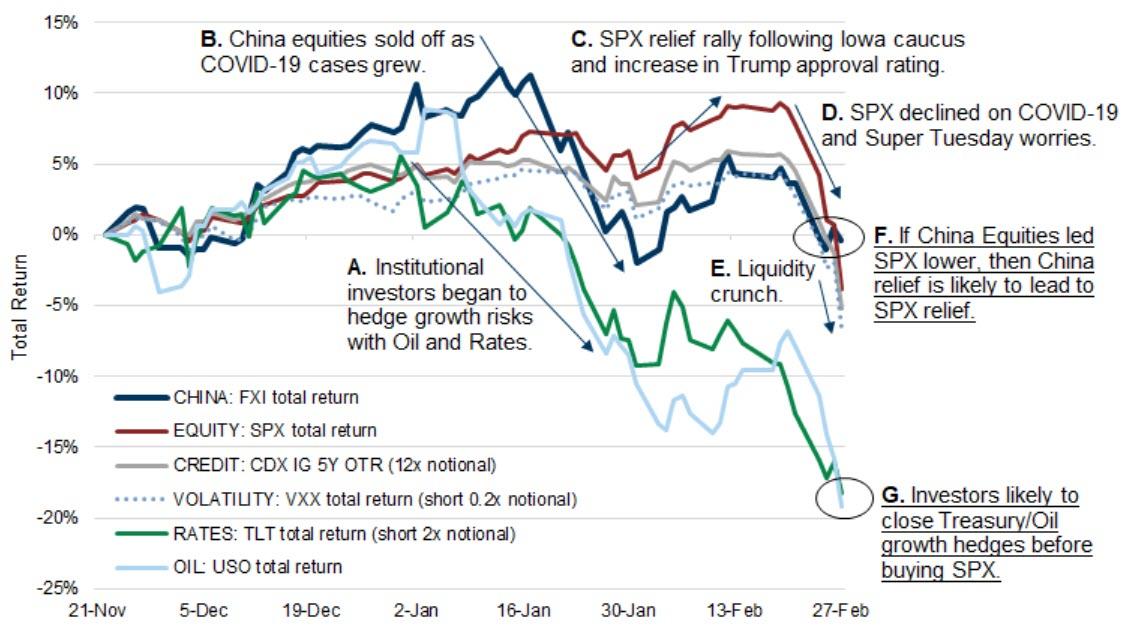
Exhibit 1: How the sell-off developed and what we are watching now
Total return of FXI, SPX, CDX IG 5Y, VXX, TLT, USO
How the cross-asset selloff developed:
A. Early January: Treasuries rallied and oil declined as institutional investors used these assets to reduce the risk of multi-asset portfolios to a global growth slowdown.
B. Late January: China Equities began to decline in late January as COVID-19 cases increased in China. US Health Care stocks sold off more than SPX in anticipation of the Iowa Caucus (not shown).
C. Early February: Broad US equities rallied as individual investors bought ETFs and select Tech/Consumer stocks as the Iowa catalyst passed. China equities rallied as the rate of growth of COVID-19 cases in China seemed to plateau.
D. Monday-Wednesday of this week: US Equities, US Credit, Treasuries and Oil all declined in a correlated sell-off. This pushed Treasuries and Oil to even further extremes. US Health Care Equities sold off more than the SPX demonstrating that political risk was a significant driver of selling pressure.
E. Thursday of this week: The VIX spiked to its highest level since February 2018 and SPX futures liquidity dropped to near all-time lows. Low liquidity likely amplified the price impact of equity selling flow. This marked a significant change in the velocity of the sell-off.
What we are watching now:
F. China Equities were up 2% in the month of February as of yesterday’s close, outperforming the SPX by 9%. Some underperformance of the SPX vs FXI during a period when investors have become more concerned about the impact of COVID-19 on the broader global economy was understandable; however, the resilience of FXI in recent days seems inconsistent with a view that global growth risk has significantly accelerated. We will be closely watching equity performance in China looking for opportunities to buy puts on FXI or calls on US/European markets.
G. Treasuries and Oil prices were leading indicators heading into this broad equity decline; we will be closely watching these markets for evidence that investors are removing these hedges and positioning for a rebound in growth sentiment. We have yet to see investors reduce these hedges. This indicator is not yet supportive of buying calls on US equities. Buying TLT puts appears attractive for investors that expect global growth sentiment to improve.
Four Notable Derivatives Market Developments:
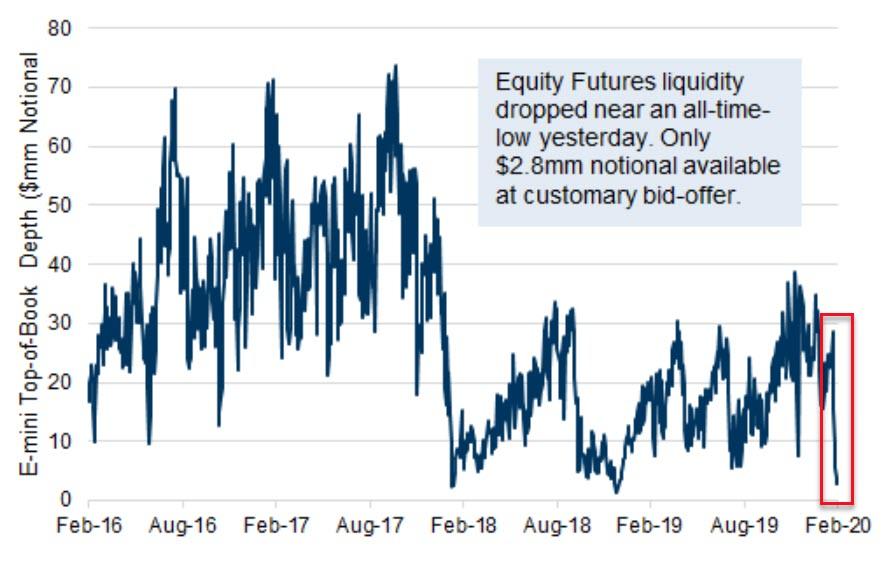
1. SPX futures liquidity declined significantly on Thursday, reaching its lowest level since December 2018.
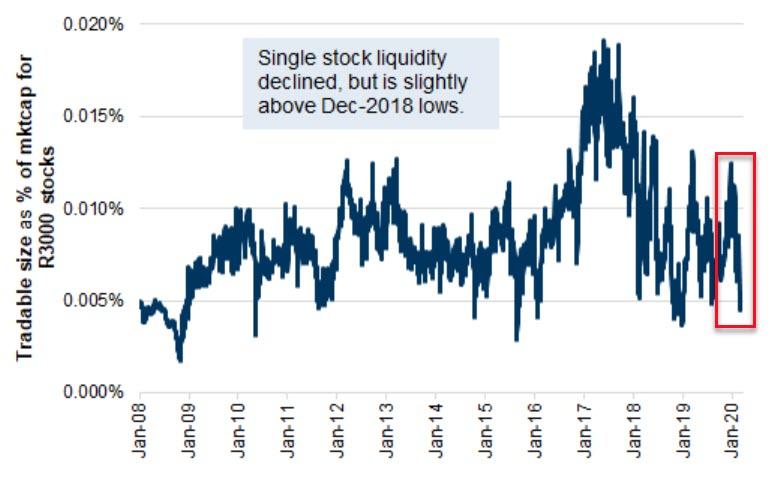
This supports the idea that the sell-off accelerated due to a lack of liquidity rather than an increase in fundamental investors selling. Single stock liquidity also declined, but is at less extreme levels.
Exhibit 2 : S&P Futures liquidity declined to near all-time-lows yesterday
Daily median E-mini future bid-ask depth ($mm notional), based on 5-minute intraday snapshots
Exhibit 3 : Single Stock liquidity has declined, but is slightly above Dec-2018 lows
% of market cap tradable while only expecting to move the stock 10bps for Russell 3000 companies
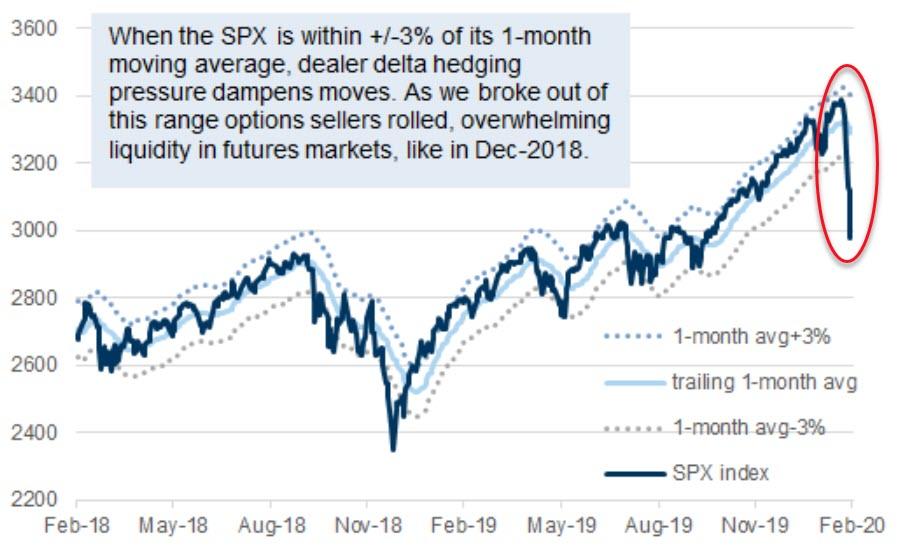
2. Systematic Options selling flows: Rolling of short put positions likely exacerbated SPX moves on Thursday.
As of Wednesday, the SPX broke out of the +/-3% range relative to its 1 month moving average. We estimate, there are over $100b of AUM in systematic SPX 1 month put and strangle selling strategies. These portfolio managers generally sell 1-month puts and strangles and only adjust positions if the options sold trade significantly in-the-money. We use the 1-month moving average of the SPX as a proxy for the SPX level when they initiated their positions. On Wednesday, the SPX traded to 5.7% below the 1-month moving average, likely beginning to trigger rolling activity (these investors would buy back their in-the-money-puts and sell new out-of-the-money puts). This activity is visible as excess selling pressure on SPX futures and pressure on SPX option put-call skew. On Thursday, we believe this rolling activity combined with lower SPX futures liquidity than in prior days, likely exacerbated price moves as the SPX declined to 9.5% below its 1-month moving average.
Exhibit 4 : Rolling of short options positions outsized underlying equity liquidity
SPX relative to its 1 month moving average
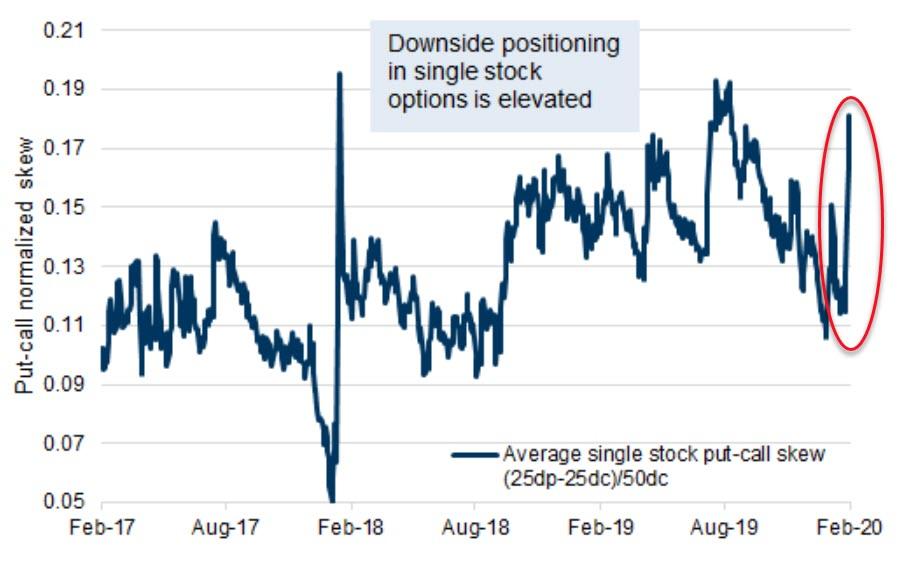
3. Investors have rushed to hedge single stocks, showing a fear of further sell-off acceleration.
We find S&P 500 average stock put-call skew has been statistically more useful than index put-call skew as a contrarian indicator for predicting forward returns of the SPX over a two-month period (R-squared of 12% over the past 3 years). Ahead of earnings season, this signal suggested muted returns for stocks. Single stock skew is calculated using the volatility surfaces of all individual stocks in the S&P 500 and it is more likely to be indicative of broad positioning across the market and less likely to be influenced by a few large trades by macro investors in index options.
Exhibit 5 : Elevated concerns are priced into single stock options
S&P 500 average stock put-call skew
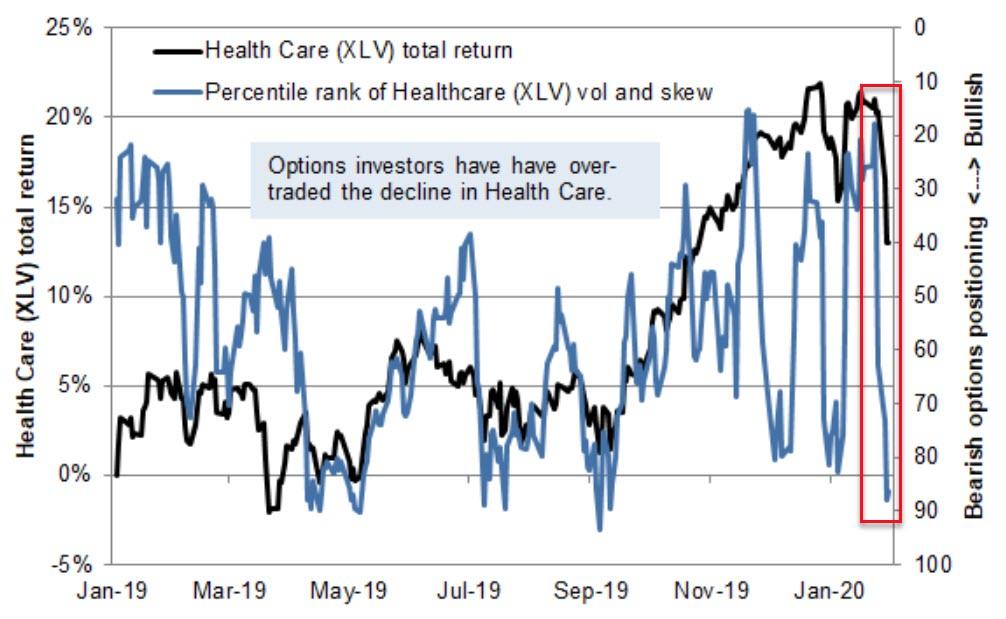
4. Healthcare stocks underperformed the SPX early this week showing that investor worries about political risk increased sharply following the results from Nevada on Saturday.
Weakness in Health Care stocks as we approach Super Tuesday looks similar to the last week of January when political concerns led investors to reduce risk ahead of the Iowa Caucus. We see unusually high potential for a relief rally in Health Care stocks next week as investor concerns are likely to be relieved in the short term by the passing of Super Tuesday.
Exhibit 6: Options pricing suggests Health Care sentiment is at bearish extremes
XLV total return relative to the 1 year rolling percentile rank of 3 month implied volatility and put-call normalized skew
We believe that investors have reduced Health Care exposure and implemented hedges this week in anticipation of Super Tuesday as a catalyst and will see fewer near-term catalysts after we pass Super Tuesday. To be clear, we are not taking a view on the result of Super Tuesday as we believe a wide variety of potential outcomes are likely to lead to an improvement in sentiment for Health Care stocks.
…the real message will likely get lost in all this. Most likely the popular narrative will be to blame the coronavirus as the unforeseen event, nobody could have seen this coming, this was not something anyone could have prepared for.
While that’s true on the surface it completely misses the larger point: The Fed, with it liquidity operations masked all the underlying issues in the markets over the past year. We had no earnings growth in 2019, we had multiple expansion. The bond market never confirmed the reflation trade, Gold had been rallying for months signaling something was amiss. And now the Fed left itself vulnerable to not being able to deal with a real crisis and basically openly invited people to TINA chase stocks into high valuations.
The Fed gave no warning to investors, instead it cheerlead investors off the cliff. Even last week Fed officials defended valuations and saw nothing wrong with anything adding to the atmosphere of complacency.
And now everyone will blame the virus, but not the reckless chase into stocks into historic valuations to begin with.
But, as Nomura’s Charlie McElligott warned, the fear of this potentially imminent – and likely coordinated – central bank “interventionary” response (let’s call it: this upcoming Sunday night, before the Asian open) will keep markets in a dangerous space, because strategies and traders which are potentially “pressing” shorts 1) either directionally (CTA model now “in play” of outright “short SPX”) or 2) pressing-shorts to managed “net exposures” or hedge long books, will be exposed to a surge squeeze higher, while investors who have been “grossed-down” by their risk management VaR models won’t be exposed to an “up-trade” in risk and likely feel obligated to “grab into” a short squeeze.
European Nightmare As Turkey “Opens The Gates” On Refugees While Covid-19 Ravages Nearby Iran
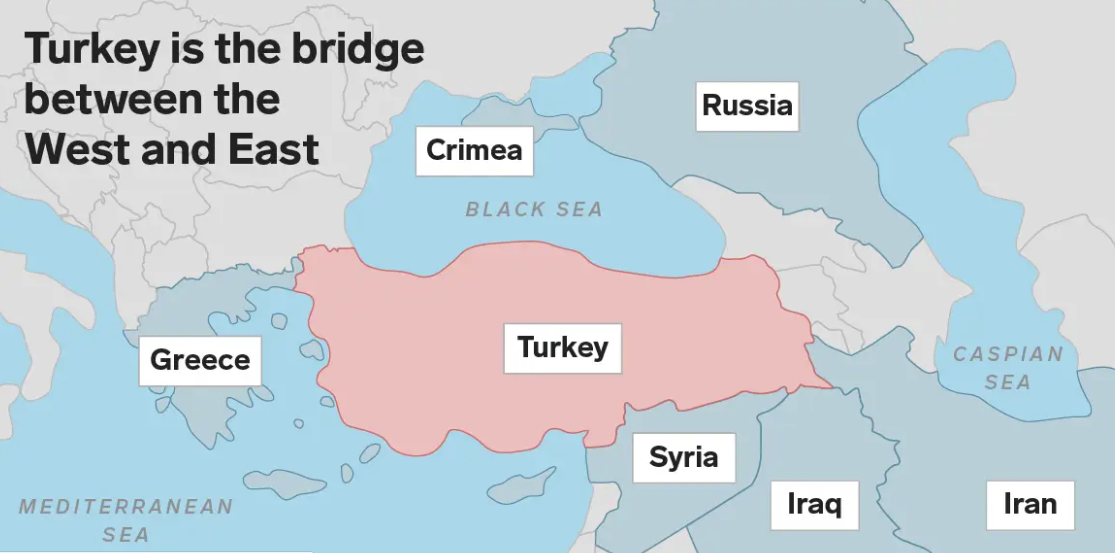
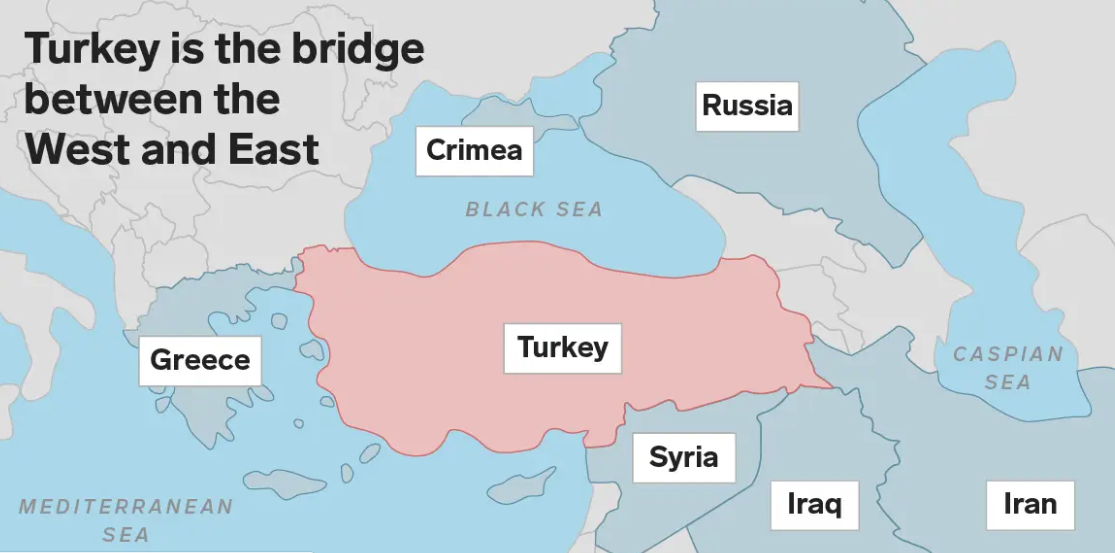
As coronavirus ravages Iran and threatens to spread through the broader Middle East, potentially hitting refugee and war-torn populations hardest, it appears Erdogan is now making good on prior threats to “open the gates” of a flood of refugees on Europe. On Friday top Turkish officials were quoted as saying Turkey has no choice but to “loosen” its stance on the some 3.4 million refugees it is hosting.
This was the immediate, and perhaps predictable reaction, to Thursday’s dramatic escalation involving the deaths of some 33 Turkish soldiers in Idlib via airstrike, in the single deadliest day for Turkey in Syria throughout the entirety of the war. Widespread early reports said it was a Russian strike, but in a sign that Ankara doesn’t want to confront the more formidable Russian Air Force, it has blamed Syrian forces.
Turkey has announced it has opened its until now sealed border with Idlib for at least 72 hours, and will allow unhindered passage of refugees to Europe.
Turkish TVs broadcast footages showing migrants are boarding boats off Turkish coast, departing to Greek islands pic.twitter.com/YLMEM1lCMk
Turkey will open its southwestern border with Syria for 72 hours to allow Syrians fleeing the pro-government forces’ assault free passage to Europe, Turkish official sources have told Middle East Eye.
The decision came after a security meeting chaired by Turkish President Recep Tayyip Erdogan in Ankara late on Thursday after 33 Turkish soldiers were killed in Syria’s Idlib province.
A senior Turkish official said on Thursday that Syrian refugees headed towards Europe would not be stopped either on land or by sea.
The European Union is downplaying the fact that crowds of Syrian refugees have already been seen en route to Greece via land borders as well as the Aegean Sea.
Buses in Istanbul were filmed providing transport to refugees and migrants to the Bulgarian and Greek borders.
Refugees gathered in Fatih, Istanbul, today after 5 buses brought by Turkey already left toward the Greek/Bulgarian border. Syrians know they are being used, but they don’t care. They want to live without fear. pic.twitter.com/0Z4CwrbKtc
An EU spokesman was quoted in Reuters as downplaying the potential “flood” from Turkey coming: “I would like to stress that there was no official announcement from the Turkish side about any changes in their asylum seeker, refugee or migrant policy,” the spokesman for the EU’s executive said. “So from our point of view the EU-Turkey statement … still stands and we expect Turkey to uphold its commitments.”
But the reality on the ground may quickly prove these words moot:
Al Jazeera’s John Psaropoulos, reporting from Athens, said the situation was “a European nightmare” as “the floodgates [are] being opened”.
As European officials mull whether this is but more of Erdogan’s threats or perhaps an early “taste” of what’s to come, or whether the flood has begun, Greece and Bulgaria have begun taking action, bolstering patrols along border areas with Turkey.
7/ If you are a refugee in Turkey, this is what you are watching the whole day on TV.
“Hundreds of Syrian refugees in Turkey have begun preparing to travel towards the country’s borders with Greece and Bulgaria after Ankara’s sudden decision to no longer impede their passage to Europe,” The Guardian reports early Friday.
“Turkish police, coastguard and border security officials were ordered to stand down overnight on Thursday, Turkish officials briefed reporters,” the report adds.
Greece appears to be responding by completely shutting any Turkish border access point to any and all traffic.
Buses line up in Istanbul to take refugees to European borders, via Al-Akhbar.
And further, according to The Guardian: “Turkish news agency Demirören showed footage of what it said was 300 people, including women and children, walking on highways and through forested land in north-west Turkey towards the EU border early on Friday. Syrians, Iranians, Iraqis, Pakistanis and Moroccans were among those in the group, it said.”
The WHO is especially concerned of an outbreak among refugee populations in war-torn regions of Iraq and Syria.
“Refugees and internally displaced populations across Iraq and Syria have been identified as the most vulnerable groups in the region, should the spread of the virus become a pandemic,”The Guardian reports of recent statements.
“Health officials in both countries remain under-equipped to deal with such a a reality that seems more possible with each passing day,” the report added.
Via Business Insider
Sprawling and densely packed “tent cities” of refugees along the border areas of Syria remain the most vulnerable.
Needless to say, we now have a dual crisis unfolding that’s indeed even more of a “nightmare” for Europe and the world than many could have predicted: a refugee flood, borders being opened, and the global threat of Covid-19.
The legal provisions that let the feds secretly spy on digital communications are set to expire soon. Attorney General Bill Barr wants a blanket reauthorization ASAP. But yesterday the president suggested that he may disagree.
“Good talk with @realDonaldTrump yesterday and I’m pleased he is urging FISA reform NOW—and not a reauthorization of the current Patriot Act,” tweeted Sen. Rand Paul (R–Ky.) on Thursday morning. That afternoon, the Kentucky senator followed up:
Spoke with @realDonaldTrump . He agrees that the secret FISA court (intended to be used on foreign spies) should be forbidden from ever spying on or investigating Americans, and that Congress should act NOW to make sure of that!
The decision whether to renew the USA Freedom Act as is rests with Congress, of course. But Trump’s support for reforms could make a big difference to some Republicans there.
Both Republicans and Democrats have enthusiastically renewed these provisions in the past, and they appear poised to do so again, despite longstanding complaints about abuse of the process. Lawmakers now have until March 15 to decide whether to renew without reforms or pick from several reform proposals.
“In January, a bipartisan pack of privacy-minded lawmakers introduced a bill that would formally end the bulk collection of Americans’ records and introduce other reforms to the secretive Foreign Intelligence Surveillance Amendment (FISA) Court to provide some more transparency and better protect Americans from unwarranted surveillance,” Reason‘s Scott Shackford wrote yesterday. Alas,
congressional leaders just want to push through a quick temporary renewal with some less modest fixes. Reps. Jerrold Nadler (D–N.Y.) and Adam Schiff (D–Calif.), chairs of the House Intelligence and Judiciary Committees, put together a reform bill of their own that would extend the USA Freedom Act until 2023.
Nadler and Schiff’s bill would end the bulk data collection program but would extend the part of Section 215 of the Patriot Act that lets the FBI secretly collect business records it deems relevant to terrorism investigations. So the feds will be able to easily collect your data when it’s in the hands of a third party—and these days, that means most of your data.
Four provisions are set to expire; Lawfare has more details.
Barr has said he wants a “clean” renewal of the act with no reforms, promising that any problems can be fixed through administrative procedure. (“That’s the worst possible outcome,” argues Shackford, “because it would give Barr the power to decide—in secret—whose privacy rights are protected and whose are not.”) But Trump may be breaking with his top cop on the matter.
In addition to the discussion he reportedly had with Paul, Trump yesterday retweeted a post from Rep. Jim Jordan (R–Ohio) that said, “We can’t simply reauthorize the system that allowed those lies and omissions to happen.” Trump also quote-tweeted with his own comment:
“The three surveillance tools on the verge of lapsing are [FISA] provisions…that broaden the FBI’s authority to wiretap certain targets and request key documents. They are separate from the tools that the FBI used on [former Trump campaign advisor Carter] Page,” CNN points out. But the FBI did use FISA warrants in investigating Page. Trump and some Republicans seem to have latched on to that as a reason to reform the provisions under question now. Weird, but whatever works!
QUICK HITS
“Thousands of government entities and private businesses around the world [are] listed as clients of the controversial facial recognition startup” Clearview AI, reportsBuzzfeed. Customers include U.S. Immigration and Customs Enforcement (ICE), “the Drug Enforcement Administration (about 2,000 searches); the Bureau of Alcohol, Tobacco, Firearms, and Explosives (more than 2,100 searches); and the FBI (5,700 searches across at least 20 different field offices),” in addition to more than 200 companies.
The 9th Circuit Court of Appeals is refusing to let Maricopa County, Arizona, Sheriff Joe Arpaio get a misdemeanor contempt of court charge vacated.
A Virginia bill would expand the definition of prostitution to include accepting money for touching “the intimate parts of another with the intent to sexually arouse or gratify.”
from Latest – Reason.com https://ift.tt/2uzWOo2
via IFTTT