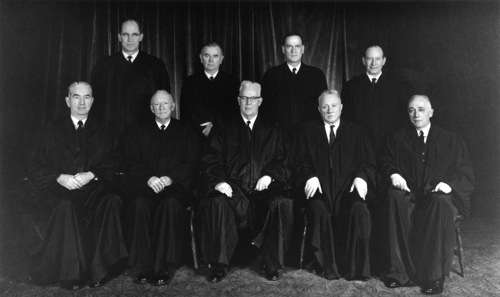
2/28/1966: Miranda v. Arizona argued.
from Latest – Reason.com https://ift.tt/2wYdfvv
via IFTTT
another site
2/28/1966: Miranda v. Arizona argued.
from Latest – Reason.com https://ift.tt/2wYdfvv
via IFTTT
The original, 1933 version of The Invisible Man was the fourth of Universal’s classic monster movies. (It had been preceded by Dracula, Frankenstein, and The Mummy.) Its star, mostly hidden behind bandages and black sun goggles, was Claude Rains; the director, still hot from helming the wildly successful Frankenstein, was James Whale. But forget all that. A new Invisible Man now moves among us, and he’s much, much scarier.
Some years back, the present-day Universal Pictures decided to unite all of its old monsters in a fake franchise called the Dark Universe. This ill-conceived project was strangled in its dark cradle by a disastrous 2017 remake of The Mummy, starring Tom Cruise. So resounding was this bomb that Uni execs decided to deep-six the Dark Universe concept and just turn its next monster reboot over to people who knew what they were doing. This turned out to be, quite wisely, Blumhouse producer Jason Blum and the Australian writer-director Leigh Whannell, who’d had a long involvement with the Saw and Insidious movies, and, more pertinently, had also scripted and directed an excellent 2018 sci-fi film called Upgrade.
As you’d expect, Whannell’s take on The Invisible Man bears only a glancing resemblance to the long-ago James Whale version. Now the title entity is basically a supporting character in a story focused on his wife—a sort of Bride of Invisible Man, you might say. The wife, Cecilia, is played by Elisabeth Moss, and she’s in every scene, borne along on a storm cloud of paranoia and raging fury. This is not a MeToo movie, exactly—it’s a full-on horror flick—but it’s thoughtful and clever and it resonates with the current ascendancy of female concerns.
Cecilia is a onetime architect who has relinquished her career to attend to the batty demands of her husband Adrian (Oliver Jackson-Cohen), who is ultra-controlling. They live in San Francisco, in an icily modern house with a basement laboratory where Adrian—a wealthy tech entrepreneur—pursues his experiments in the field of optics. After several years of marriage, Cecilia hates Adrian with a deep and unflagging passion, and as the movie opens we see her fleeing their home and being spirited away in a car by her sister, Alice (Harriet Dyer). This is a tense sequence, and it’s punctuated by a really jolting, out-of-nowhere shock. Happily, things get much worse very quickly.
Two weeks later, we find Cecilia sheltering with an old friend named James (Aldis Hodge) and his daughter Sydney (Storm Reid). Then she learns that Adrian has committed suicide, and is informed by his creepy brother, Tom (Michael Dorman), that her late husband has left her $5-million, tax-free, to be dispensed in regular installments. Great. (Later, though, we learn there’s a stipulation that the money spigot will be turned off if Cecilia ever loses her mind.)
Strange things start happening—small-scale at first: Cecilia leaves a frying pan on a burner when she walks out of the kitchen for a minute and we see that something is turning up the flame dangerously high in her absence. In the middle of the night, we see the blanket on the bed where she’s sleeping being slowly pulled down. She hears a phone ringing—up in the attic. Cecilia tells James about these incidents and he tells her to stop acting weird.
The gaslighting continues, and Cecilia soon realizes that Adrian is responsible—he’s somehow still alive. No one else believes this, of course, and the unseen husband proves devilishly clever at isolating her from everyone who might provide support.
I’ll go no further into what transpires, apart from noting that the director’s camera style—showing us widescreen views of spaces where nothing seems to be happening—has the effect of cranking up our anxiety as we wait for something awful to do so. There’s also an excellent score, by Benjamin Wallfisch, which deploys steely, post-Hitchcock strings and what sounds like a host of metal locusts in an enveloping Dolby Atmos aural environment.
Best of all, there are no simpleminded jump scares in this movie—no cheap-thrill boo! effects. There are plenty of scares, and they’ll likely make you jump (two of them are brilliantly horrific), but they arise naturally out of Whannell’s story, which is constructed with a series of ingenious twists that keep coming at you right up to the end. For those who may have been waiting for a horror movie that really works you over, this is it.
from Latest – Reason.com https://ift.tt/381ajeg
via IFTTT
2/28/1966: Miranda v. Arizona argued.
from Latest – Reason.com https://ift.tt/2wYdfvv
via IFTTT
The original, 1933 version of The Invisible Man was the fourth of Universal’s classic monster movies. (It had been preceded by Dracula, Frankenstein, and The Mummy.) Its star, mostly hidden behind bandages and black sun goggles, was Claude Rains; the director, still hot from helming the wildly successful Frankenstein, was James Whale. But forget all that. A new Invisible Man now moves among us, and he’s much, much scarier.
Some years back, the present-day Universal Pictures decided to unite all of its old monsters in a fake franchise called the Dark Universe. This ill-conceived project was strangled in its dark cradle by a disastrous 2017 remake of The Mummy, starring Tom Cruise. So resounding was this bomb that Uni execs decided to deep-six the Dark Universe concept and just turn its next monster reboot over to people who knew what they were doing. This turned out to be, quite wisely, Blumhouse producer Jason Blum and the Australian writer-director Leigh Whannell, who’d had a long involvement with the Saw and Insidious movies, and, more pertinently, had also scripted and directed an excellent 2018 sci-fi film called Upgrade.
As you’d expect, Whannell’s take on The Invisible Man bears only a glancing resemblance to the long-ago James Whale version. Now the title entity is basically a supporting character in a story focused on his wife—a sort of Bride of Invisible Man, you might say. The wife, Cecilia, is played by Elisabeth Moss, and she’s in every scene, borne along on a storm cloud of paranoia and raging fury. This is not a MeToo movie, exactly—it’s a full-on horror flick—but it’s thoughtful and clever and it resonates with the current ascendancy of female concerns.
Cecilia is a onetime architect who has relinquished her career to attend to the batty demands of her husband Adrian (Oliver Jackson-Cohen), who is ultra-controlling. They live in San Francisco, in an icily modern house with a basement laboratory where Adrian—a wealthy tech entrepreneur—pursues his experiments in the field of optics. After several years of marriage, Cecilia hates Adrian with a deep and unflagging passion, and as the movie opens we see her fleeing their home and being spirited away in a car by her sister, Alice (Harriet Dyer). This is a tense sequence, and it’s punctuated by a really jolting, out-of-nowhere shock. Happily, things get much worse very quickly.
Two weeks later, we find Cecilia sheltering with an old friend named James (Aldis Hodge) and his daughter Sydney (Storm Reid). Then she learns that Adrian has committed suicide, and is informed by his creepy brother, Tom (Michael Dorman), that her late husband has left her $5-million, tax-free, to be dispensed in regular installments. Great. (Later, though, we learn there’s a stipulation that the money spigot will be turned off if Cecilia ever loses her mind.)
Strange things start happening—small-scale at first: Cecilia leaves a frying pan on a burner when she walks out of the kitchen for a minute and we see that something is turning up the flame dangerously high in her absence. In the middle of the night, we see the blanket on the bed where she’s sleeping being slowly pulled down. She hears a phone ringing—up in the attic. Cecilia tells James about these incidents and he tells her to stop acting weird.
The gaslighting continues, and Cecilia soon realizes that Adrian is responsible—he’s somehow still alive. No one else believes this, of course, and the unseen husband proves devilishly clever at isolating her from everyone who might provide support.
I’ll go no further into what transpires, apart from noting that the director’s camera style—showing us widescreen views of spaces where nothing seems to be happening—has the effect of cranking up our anxiety as we wait for something awful to do so. There’s also an excellent score, by Benjamin Wallfisch, which deploys steely, post-Hitchcock strings and what sounds like a host of metal locusts in an enveloping Dolby Atmos aural environment.
Best of all, there are no simpleminded jump scares in this movie—no cheap-thrill boo! effects. There are plenty of scares, and they’ll likely make you jump (two of them are brilliantly horrific), but they arise naturally out of Whannell’s story, which is constructed with a series of ingenious twists that keep coming at you right up to the end. For those who may have been waiting for a horror movie that really works you over, this is it.
from Latest – Reason.com https://ift.tt/381ajeg
via IFTTT
In 2018, my colleague James Phillips and I published a post on the Harvard Law Review Blog. We offered some tentative findings about the linguistic claims made by the majority and dissent in D.C. v. Heller. Since then, James was hired as an associate professor at the Chapman University Fowler School of Law. As James transitions to academia, we plan to submit for publication a much more detailed version of our research. In the interim, we published an essay in The Atlantic that previews our work. We show that both Justice Scalia and Justice Stevens erred.
Here is a segment that focuses on the phrase “keep arms”
Next, we turn to Justice Stevens’s dissent. He wrote that the Second Amendment protected a right to have and use firearms only in the context of serving in a state militia. Stevens appears to have determined—though his exact conclusion is somewhat unclear—that the phrase keep and bear arms was a unitary term of art. Such single linguistic units, called binomials or multinomials, are common in legal writing. Think of cease and desist or lock, stock, and barrel. As a result, Stevens concluded, there was no need to consider whether keep arms had a different meaning from bear arms. Therefore, he had no reason to determine whether keep arms, by itself, could refer to an individual right.
Was Stevens’s linguistic intuition correct? No. The phrase keep and bear arms was a novel term. It does not appear anywhere in COEME—more than 1 billion words of British English stretching across three centuries. And prior to 1789, when the Second Amendment was introduced, the phrase was used only twice in COFEA: First in the 1780 Massachusetts Declaration of Rights, and then in a proposal for a constitutional amendment by the Virginia Ratifying Convention. In short, keep and bear arms was not a term of art with a fixed meaning. Indeed, the meaning of this phrase was quite unsettled then, as it had barely been used in other governmental documents. Ultimately, a careful study of the Second Amendment would have to treat keep arms and bear arms as two separate linguistic units, and thus two separate rights.
We performed another search in COFEA, about the meaning of keep arms, looking for documents in which keep and arms (and their variants) appear within six words of each other. The results here were somewhat inconclusive. In about 40 percent of the hits, a person would keep arms for a collective, military purpose; these documents support Justice Stevens’s reading. And roughly 30 percent of the hits reference a person who keeps arms for individual uses; these documents support Justice Scalia’s analysis. The remainder of the hits did not support either reading.
We could not find a dominant usage for what keep arms meant at the founding. Thus, even if Scalia was wrong about the most common meaning of bear arms, he may still have been right about keep arms. Based on our findings, an average citizen of the founding era would likely have understood the phrase keep arms to refer to possessing arms for both military and personal uses.
James and I were also cited in a recent New York Times Magazine profile on originalism.
For originalists, the new tool is “a paradigm-shifting technology,” two members of the Federalist Society, the law professor Josh Blackman and the Stanford law fellow James C. Phillips, wrote in The Harvard Law Review’s blog in August 2018. It also means that cherry-picking the historical record to establish a dubious “original” meaning would be harder to conceal. “We can do empirics,” says Alison LaCroix, a historian and law professor at the University of Chicago. “There’s a data set.”
Blackman and Phillips conducted a review of the database and found that the dominant use of “bear arms” at the time of the country’s founding related to the militia. (Even so, they didn’t conclude that Scalia got Heller wrong.) LaCroix and three linguists submitted a brief to the court last fall, in the New York case, with studies they had each done. One found that references in the database “to hunting or personal self-defense” for the phrase “bear arms” were “not just rare, they are almost nonexistent.” The phrase “keep arms,” the brief stated, was also used “almost exclusively in a military context.”
The findings confirm what Rakove and his fellow historians showed about the era’s political history. But this time, the analysis played by the rules of the game as Scalia defined them, by looking narrowly at the original public meaning of the text. “I don’t care how big a fan of Justice Scalia you are,” Phillips told me. “At some point, you run up against the data.”
(We disagree with some of the quotes from the other professors.)
Our goal here is not simply to beat up on Justice Scalia. Linguistic analysis formed only a small part of Scalia’s originalist opus. And the bulk of that historical analysis, based on the history of the common-law right to own a firearm, is undisturbed by our new findings. But originalists should still be able to assess, critically where Justice Scalia faltered. And Heller critics should likewise acknowledge where Justice Stevens faltered.
Finally, we offer this observation in our essay:
Corpus linguistics, like any tool, is more useful in some cases than in others. The Second Amendment in particular poses distinct problems for data searches, because it has multiple clauses layered in a complicated grammatical structure.
Our ultimate conclusion highlights some of the limits of corpus linguistics, at least with respect to the Second Amendment.
from Latest – Reason.com https://ift.tt/3acEO2b
via IFTTT
Hyundai Halts Production At Major South Korean Plant After Worker Tests Positive For Coronavirus
Hyundai Motor Company halted operations at its Ulsan, South Korea, manufacturing complex’s second factory on Friday after a worker tested positive for Covid-19, disrupting production lines of its sport utility vehicles, reported Reuters.
According to the automaker, “colleagues who came in close contact with the infected employee” have been placed in “self-quarantine” and are being “tested for possible infection.”
It’s just the latest indication of the massive economic toll that the coronavirus is having on the already-struggling South Korean economy, which was already mired in a trade dispute with Japan before the virus arrived.

Hyundai is “thoroughly” disinfecting the facility and has given no indication of when production might resume.
The plant is known for producing the company’s immensely popular SUV models, including the GV80, Palisade, Santa Fe, and Tucson, turning out roughly 1,000 cars per day. The company has five factories in the area, with an annual production capacity of 1.4 million vehicles, or about 30% of its global production.

Despite a virus-infected employee (and who knows how many others…), Hyundai has also been struggling with severed supply chains involving suppliers from China, which is why the company chose to idle some Ulsan plants earlier this month.
Samsung announced last weekend that its smartphone factory in Gumi-si, South Korea, closed because of a virus outbreak at the factory.
Last week, chipmaker SK Hynix, a key Apple supplier, reported a virus infection case, resulting in one of its factories to shut down and 800 employees told not to return to work for several weeks as a preventative measure to stop the spread of the virus.
Major factory shutdowns of automobile and electronic companies across South Korea are coming at a time when the global outbreak’s center of gravity is shifting from Wuhan, China, to Daegu, South Korea.
South Korea has confirmed nearly 600 more cases of the virus on Friday, bringing its total to 2,337, making it the largest outbreak outside of mainland China.
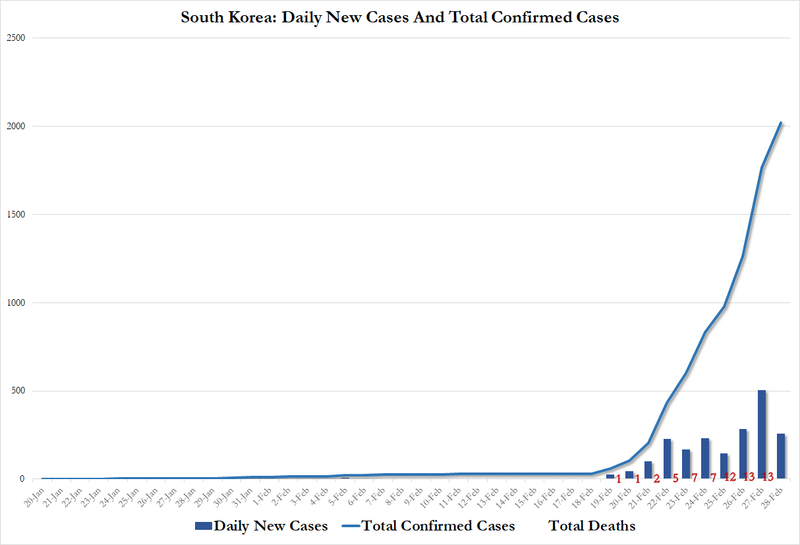
Now that the virus is quickly spreading in South Korea, it’s only a matter of time before paralysis of its economy sets in, similar to the economic collapse we’re now seeing in China.
Former Morgan Stanley Asia chairman Stephen Roach warned last month that the global economy could be in a period of vulnerability, where an exogenous shock, such as the virus outbreak both disrupting supply by crushing factory output while also killing consumption, might plunge the global economy into the next global depression, especially considering the many vulnerabilities, from over-levered corporations to the $1.5 trillion pile of student loan debt, rattling around the financial system.
Tyler Durden
Fri, 02/28/2020 – 06:19
via ZeroHedge News https://ift.tt/2TgInxq Tyler Durden
In 2018, my colleague James Phillips and I published a post on the Harvard Law Review Blog. We offered some tentative findings about the linguistic claims made by the majority and dissent in D.C. v. Heller. Since then, James was hired as an associate professor at the Chapman University Fowler School of Law. As James transitions to academia, we plan to submit for publication a much more detailed version of our research. In the interim, we published an essay in The Atlantic that previews our work. We show that both Justice Scalia and Justice Stevens erred.
Here is a segment that focuses on the phrase “keep arms”
Next, we turn to Justice Stevens’s dissent. He wrote that the Second Amendment protected a right to have and use firearms only in the context of serving in a state militia. Stevens appears to have determined—though his exact conclusion is somewhat unclear—that the phrase keep and bear arms was a unitary term of art. Such single linguistic units, called binomials or multinomials, are common in legal writing. Think of cease and desist or lock, stock, and barrel. As a result, Stevens concluded, there was no need to consider whether keep arms had a different meaning from bear arms. Therefore, he had no reason to determine whether keep arms, by itself, could refer to an individual right.
Was Stevens’s linguistic intuition correct? No. The phrase keep and bear arms was a novel term. It does not appear anywhere in COEME—more than 1 billion words of British English stretching across three centuries. And prior to 1789, when the Second Amendment was introduced, the phrase was used only twice in COFEA: First in the 1780 Massachusetts Declaration of Rights, and then in a proposal for a constitutional amendment by the Virginia Ratifying Convention. In short, keep and bear arms was not a term of art with a fixed meaning. Indeed, the meaning of this phrase was quite unsettled then, as it had barely been used in other governmental documents. Ultimately, a careful study of the Second Amendment would have to treat keep arms and bear arms as two separate linguistic units, and thus two separate rights.
We performed another search in COFEA, about the meaning of keep arms, looking for documents in which keep and arms (and their variants) appear within six words of each other. The results here were somewhat inconclusive. In about 40 percent of the hits, a person would keep arms for a collective, military purpose; these documents support Justice Stevens’s reading. And roughly 30 percent of the hits reference a person who keeps arms for individual uses; these documents support Justice Scalia’s analysis. The remainder of the hits did not support either reading.
We could not find a dominant usage for what keep arms meant at the founding. Thus, even if Scalia was wrong about the most common meaning of bear arms, he may still have been right about keep arms. Based on our findings, an average citizen of the founding era would likely have understood the phrase keep arms to refer to possessing arms for both military and personal uses.
James and I were also cited in a recent New York Times Magazine profile on originalism.
For originalists, the new tool is “a paradigm-shifting technology,” two members of the Federalist Society, the law professor Josh Blackman and the Stanford law fellow James C. Phillips, wrote in The Harvard Law Review’s blog in August 2018. It also means that cherry-picking the historical record to establish a dubious “original” meaning would be harder to conceal. “We can do empirics,” says Alison LaCroix, a historian and law professor at the University of Chicago. “There’s a data set.”
Blackman and Phillips conducted a review of the database and found that the dominant use of “bear arms” at the time of the country’s founding related to the militia. (Even so, they didn’t conclude that Scalia got Heller wrong.) LaCroix and three linguists submitted a brief to the court last fall, in the New York case, with studies they had each done. One found that references in the database “to hunting or personal self-defense” for the phrase “bear arms” were “not just rare, they are almost nonexistent.” The phrase “keep arms,” the brief stated, was also used “almost exclusively in a military context.”
The findings confirm what Rakove and his fellow historians showed about the era’s political history. But this time, the analysis played by the rules of the game as Scalia defined them, by looking narrowly at the original public meaning of the text. “I don’t care how big a fan of Justice Scalia you are,” Phillips told me. “At some point, you run up against the data.”
(We disagree with some of the quotes from the other professors.)
Our goal here is not simply to beat up on Justice Scalia. Linguistic analysis formed only a small part of Scalia’s originalist opus. And the bulk of that historical analysis, based on the history of the common-law right to own a firearm, is undisturbed by our new findings. But originalists should still be able to assess, critically where Justice Scalia faltered. And Heller critics should likewise acknowledge where Justice Stevens faltered.
Finally, we offer this observation in our essay:
Corpus linguistics, like any tool, is more useful in some cases than in others. The Second Amendment in particular poses distinct problems for data searches, because it has multiple clauses layered in a complicated grammatical structure.
Our ultimate conclusion highlights some of the limits of corpus linguistics, at least with respect to the Second Amendment.
from Latest – Reason.com https://ift.tt/3acEO2b
via IFTTT
New York Times columnist Thomas Friedman, who admires what a single-party autocracy such as China’s can accomplish when it is “led by a reasonably enlightened group of people,” praised that country’s “one child” policy in a 2008 book, saying it “probably saved China from a population calamity.”
In the Amazon Prime Video documentary One Child Nation, the Chinese-American filmmaker Nanfu Wang lays bare the brutal reality of the oppressive regime that was so glibly endorsed by rich Westerners who take their own reproductive freedom for granted. She shows that the one-child policy, in force from 1979 to 2015, routinely relied on extortion, assault, kidnapping, and infanticide.
Returning to the farming village in Jiangxi province where she was born and raised, Wang talks to an uncle and an aunt who mournfully remember the infant daughters they felt compelled to abandon. Wang’s grandfather says he had to dissuade local officials from sterilizing her mother after Wang was born.
One of those village leaders tells Wang “the one-child policy was very difficult to implement” because “people resisted.” If they couldn’t be persuaded by propaganda, they would be punished by confiscation of their possessions or demolition of their homes. Recalcitrant women were physically forced to undergo sterilization. “It was really fucked up,” the former official says. “We below didn’t want to do this, but we had no choice.”
A local midwife estimates that she performed 50,000 to 60,000 sterilizations and abortions. “Many I induced alive and killed,” she says. “My hand trembled doing it.”
A former family planning official recalls that “sometimes pregnant women tried to run away” from forced abortions, often performed at eight or nine months, and “we had to chase after them.” Unlike the midwife, she is proud of her work, agreeing with Thomas Friedman that “the policy was absolutely correct.”
from Latest – Reason.com https://ift.tt/2I4VGMs
via IFTTT
New York Times columnist Thomas Friedman, who admires what a single-party autocracy such as China’s can accomplish when it is “led by a reasonably enlightened group of people,” praised that country’s “one child” policy in a 2008 book, saying it “probably saved China from a population calamity.”
In the Amazon Prime Video documentary One Child Nation, the Chinese-American filmmaker Nanfu Wang lays bare the brutal reality of the oppressive regime that was so glibly endorsed by rich Westerners who take their own reproductive freedom for granted. She shows that the one-child policy, in force from 1979 to 2015, routinely relied on extortion, assault, kidnapping, and infanticide.
Returning to the farming village in Jiangxi province where she was born and raised, Wang talks to an uncle and an aunt who mournfully remember the infant daughters they felt compelled to abandon. Wang’s grandfather says he had to dissuade local officials from sterilizing her mother after Wang was born.
One of those village leaders tells Wang “the one-child policy was very difficult to implement” because “people resisted.” If they couldn’t be persuaded by propaganda, they would be punished by confiscation of their possessions or demolition of their homes. Recalcitrant women were physically forced to undergo sterilization. “It was really fucked up,” the former official says. “We below didn’t want to do this, but we had no choice.”
A local midwife estimates that she performed 50,000 to 60,000 sterilizations and abortions. “Many I induced alive and killed,” she says. “My hand trembled doing it.”
A former family planning official recalls that “sometimes pregnant women tried to run away” from forced abortions, often performed at eight or nine months, and “we had to chase after them.” Unlike the midwife, she is proud of her work, agreeing with Thomas Friedman that “the policy was absolutely correct.”
from Latest – Reason.com https://ift.tt/2I4VGMs
via IFTTT
“Hundreds Of Millions Of Dollars Lost” As Shipping Rates Collapse Due To “Hugely Disruptive” Virus
Covid-19’s effect on the global economy, energy markets, and the shipping industry have been absolutely disastrous, borderline crisis, if not, has already triggered the onset of the next financial crisis.
OPEC slashed its oil demand forecast earlier this month, and Goldman Sachs doubled down on its bearish oil take and has cut its oil price target by $10 to $53 for the year, as a result of a “demand shock” that has collapsed Chinese oil demand by at least 20%, or as much as 4 million barrels per day.
The plunge in energy demand in China, which by the way, is the world’s largest oil importer, has stranded oil cargoes off the coast of the country and led to an oil tanker parking lot in Asia Pacific waters.

The gears of the global economy have jammed, as demand and supply shocks from China risks triggering the next economic crisis.
Paralysis is quickly developing across the global economy, as sea and land ports in China have reduced activity. When supply chains are severed, economies on both sides of the world are damaged.
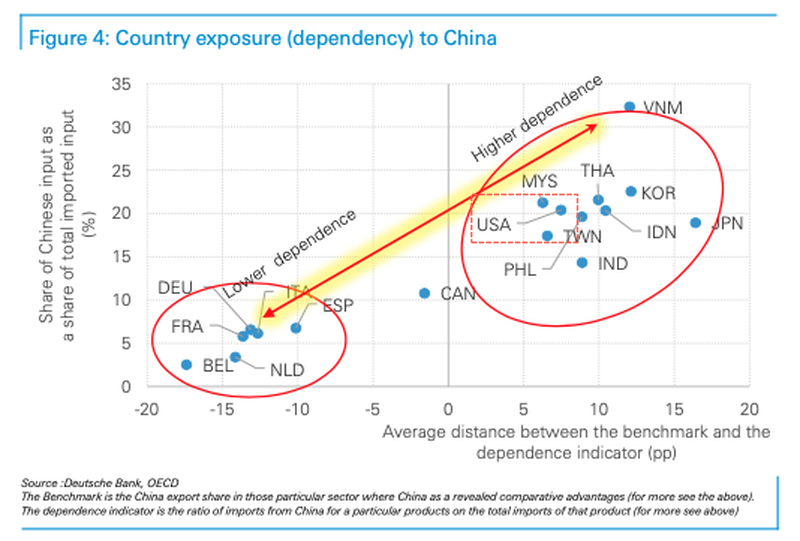
International Chamber of Shipping (ICS) Secretary-General Guy Platten told Reuters on Wednesday that revenue shocks have already hurt shippers this year.
Platten said tanker rates had plunged upwards of 80% since the virus outbreak began last month.
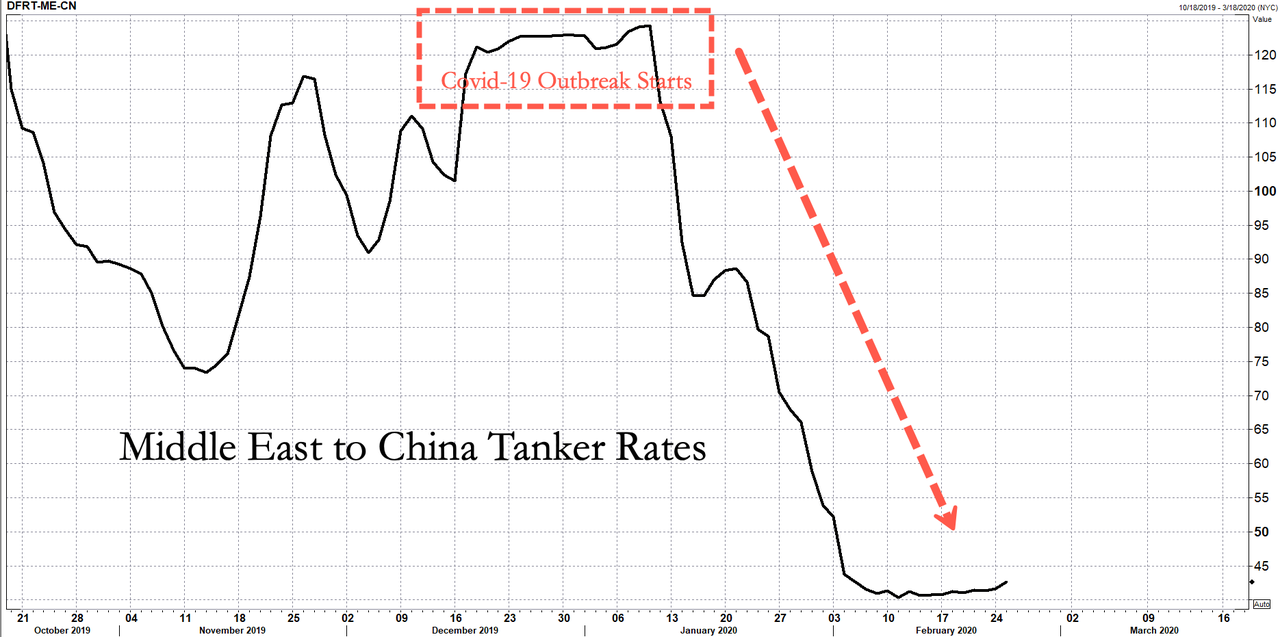
He said the virus is “hugely disruptive” for the shipping industry as demand for raw materials from emerging and developed economies has dramatically slowed.
“On the finished goods side of it you’ve got empty containers for example in China and you’ve got a shortage of containers in the (United) States because the manufactured goods are not getting out of China and being transported around the world. It’s affecting all the supply chain throughout the shipping industry,” he said.
Platten said shipping rates have crashed in various vessel classes. “We know that container lines are doing empty sailings. It would be hundreds of hundreds of millions of dollars (that) would be in jeopardy now.”
“All we know is that there has been an absolute plunge in rates for various classes of ship … We know that container lines are doing empty sailings. It would be hundreds of hundreds of millions of dollars (that) would be in jeopardy now,” he said.
A.P. Moller-Maersk A/S, the world’s largest container shipping company, warned last week that factories in China are currently operating below half-speed capacity, has paralyzed global supply chains.
“As factories in China are closed for longer than usual in connection with the Chinese New Year as a result of the COVID-19, we expect a weak start of the year,” Maersk warned.
Noel Hacegaba, the Deputy Executive Director of Administration and Operations for the Port of Long Beach, California, was featured on CNBC Wednesday afternoon, warned that Long Beach, the second-largest containerized port in the US – is experiencing weakness in volume, down 6% y/y in Jan, and down another 6% y/y in Feb. For the quarter, he said the port could see a decline of 12% y/y.

Hacegaba said in the last couple of weeks, truck and rail operations at the port that extends into California have plunged “to a tune of 20 to 25%.”
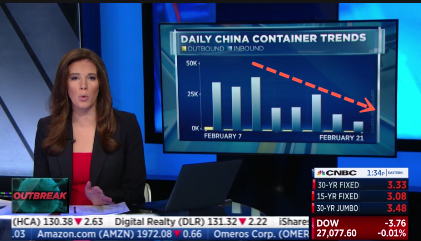
He warned that economic paralysis in China would cause some goods just to be canceled altogether because many are seasonal, adding that a slowdown in China’s economy is bad news for the US.
For more color on why shipping rates and commodity prices have plunged – we specifically outlined in semi-official data from China that business conditions are printing at depression levels (as a reminder, China has been responsible for 60% of the world’s credit creation in the last decade – if China’s catches the flu – so does everyone):
To summarize, the outbreak of the virus has crashed China’s economy, resulting in plunging demand for commodity/energy products and the need to ship raw materials and or finished goods across the world.
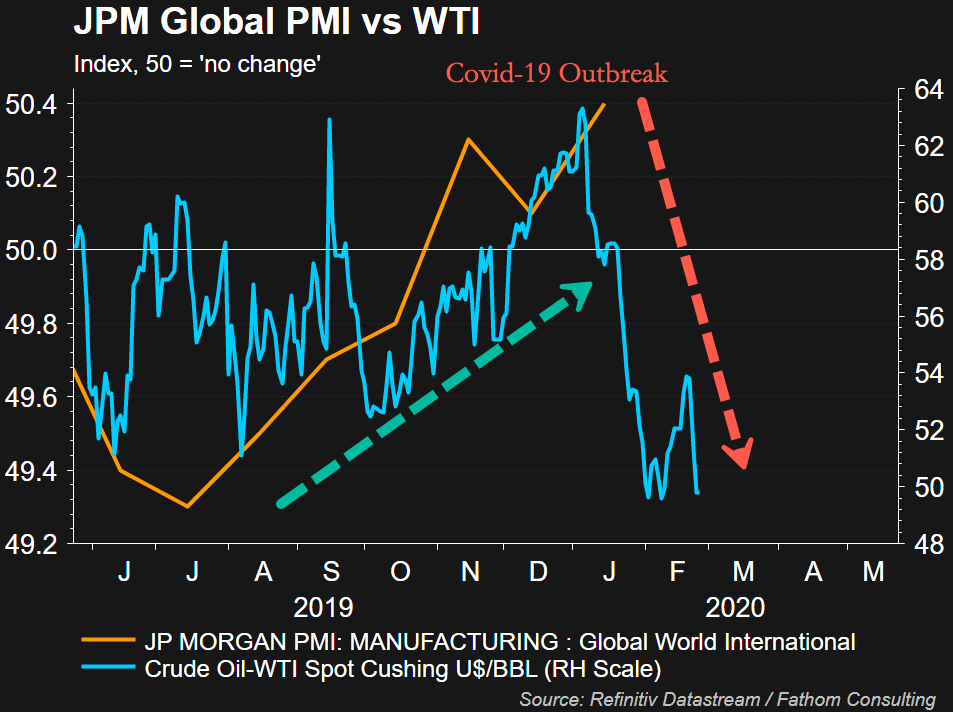
The bear market in crude, forced by China’s implosion, suggests the global economy is about to plunge into a recession.
Tyler Durden
Fri, 02/28/2020 – 05:45
via ZeroHedge News https://ift.tt/2vo4Fpe Tyler Durden