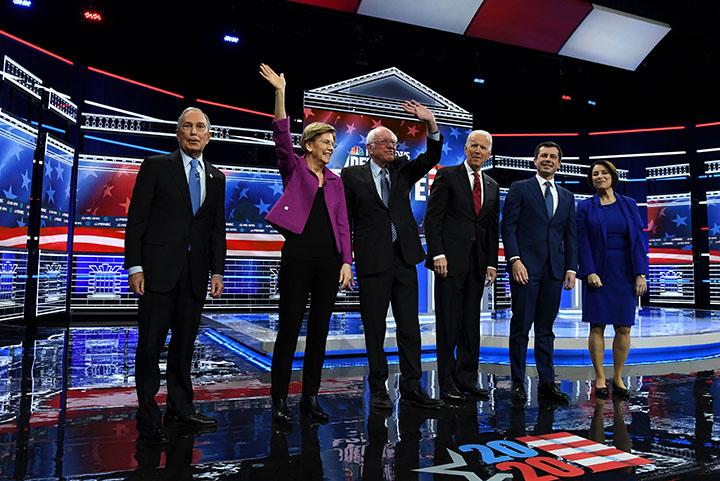
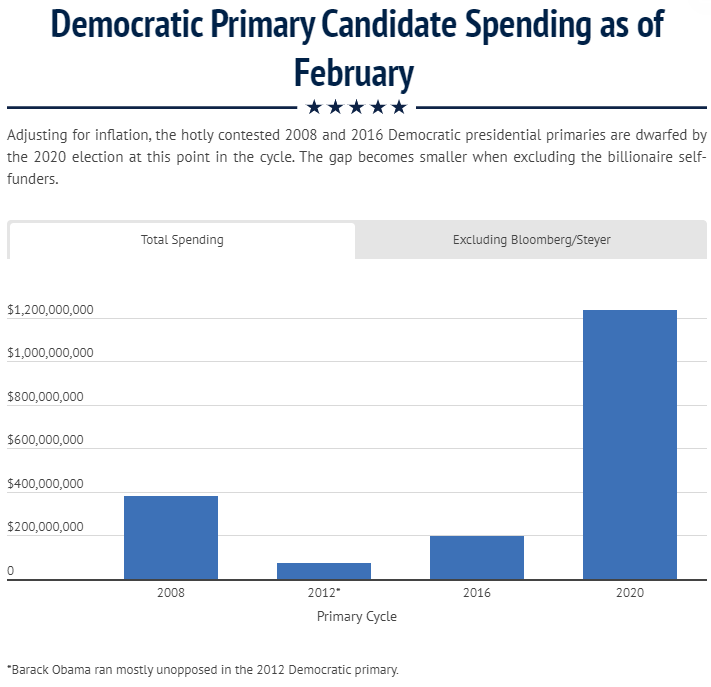
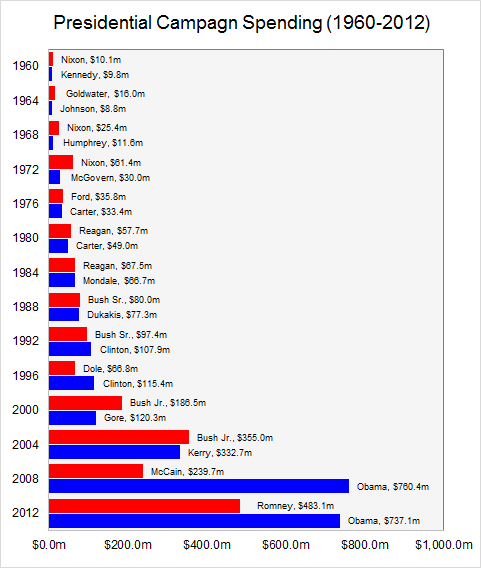
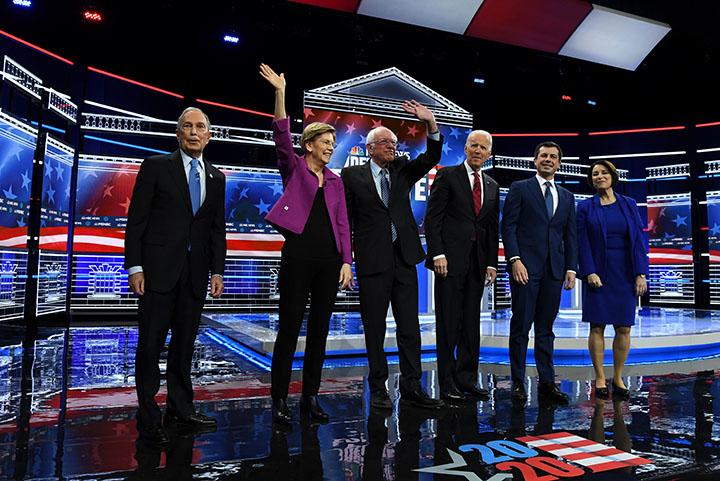
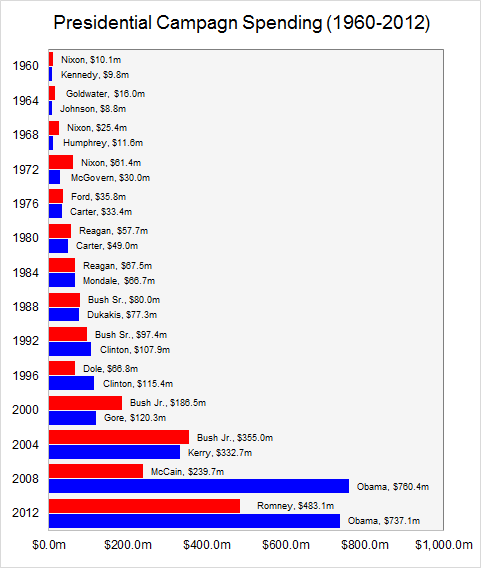
With only a sprinkling of delegates pledged to presidential contenders, the 2020 Democratic primary is already the most expensive. Candidates vying for the Democratic nomination have spentmore than $1.2 billion, more than they shelled out throughout 2008 or 2016.
At this point in the highly competitive 2008 Democratic primary, candidates spent a combined $313 million, or $382 million when adjusting for inflation. The 2020 primary is roughly six times more expensive than the 2016 race was at this point in the cycle.
Source: Ethan Miller/Getty Images
Two billionaires, Michael Bloomberg and Tom Steyer, are driving the spending record by self-funding their campaigns at unprecedented levels. They account for more than half of the total spending by primary candidates. But even when excluding the two billionaires, the 2020 Democratic primary is still the most expensive of its kind at this point in the cycle.
The 2020 primary includes more competitive candidates than previous races, and those candidates are unwilling to drop out of the race before Super Tuesday. That comes as Sen. Bernie Sanders (I-Vt.) increasingly becomes the favorite to win the nomination while the more moderate candidates split votes.
Bloomberg, who based his expensive strategy around Super Tuesday, has urged his primary opponents to drop out or risk giving Sanders the nomination. The 2020 Democrats didn’t go along with that plan. Instead, they told Bloomberg to drop out.
That stubbornness is driving up campaign spending. And it’s one aspect that separates the 2020 race from past contests. In 2008, the primary featured two fundraising giants, Hillary Clinton and Barack Obama, and well-funded contenders like Sen. John Edwards (D-N.C.), Sen. Chris Dodd (D-Conn.) and New Mexico Gov. Bill Richardson. However, each of those low-polling candidates ended their campaigns before Super Tuesday.
This time around, the Democratic candidates trailing Sanders still believe they can win despite facing odds that become less favorable with each primary result. Former Vice President Joe Biden says his campaign will rebound with a win in South Carolina. Former South Bend, Ind., mayor Pete Buttigieg launched a massive Super Tuesday fundraising push last week. Sen. Elizabeth Warren (D-Mass.) embraced a super PAC that is supporting her cash-poor campaign ahead of the March contest.
Six Democratic candidates spent north of $60 million through January, according to the most recent filings. Meanwhile, Sen. Amy Klobuchar (D-Minn.), a late riser in the field, spent nearly $31 million.
At its peak last year, the Democratic field included two dozen candidates, each of whom were focused on earning a spot in national debates. The Democratic National Committee required candidates to reach polling and individual donor thresholds to participate in the debates. Those rules forced candidates to spend big on social media advertisements and email lists to attract small-dollar donors, even though they were sure to lose money on those transactions. Steyer spent millions of dollars on Facebook ads that urged users to give just $1.
The DNC scrapped those rules late last month in exchange for stricter polling thresholds and guaranteed spots for those who had already won delegates. That opened the door for Bloomberg — a recent six-figure donor to the committee — to make the debates. The decision was criticized by current and former candidates who had crafted their strategy around the DNC rules. Bloomberg’s campaign, which is entirely funded by the New York billionaire himself, is spending$6 million per day.
Still, it’s the third highest spender in the race who has the best shot at the Democratic nomination. With his dominant win in Nevada, Sanders secured his third popular vote victory in three contests. Sanders’ fundraising haul of $133 million is on par with Hillary Clinton’s $130 million total at this point in 2016, and he has nearly $17 million cash on hand compared to $19 million combined for the rest of the non-billionaires.
HHS Whistleblower Claims ‘Corrupt Cover-Up’ Of Dangerous Coronavirus Quarantines
A complaint filed with Health and Human Services (HHS) and promptly leaked to the New York Times alleges that federal health employees interacted with Americans quarantined for possible coronavirus exposure without proper medical training or protective gear, and that health agency leaders engaged in a ‘corrupt cover-up‘ when staff members complained, according to the Times.
Filed with the Office of the Special Counsel, a whistleblower described as a ‘senior leader’ at HHS said the team was “improperly deployed” to two California military bases to assist with processing American evacuees from coronavirus hot zones in China and elsewhere.
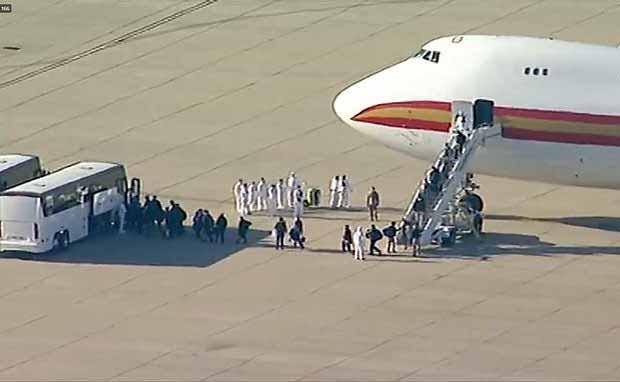
The staff members were sent to Travis Air Force Base and March Air Reserve Base and were ordered to enter quarantined areas, including a hangar where coronavirus evacuees were being received. They were not provided training in safety protocols until five days later, the person said.
Without proper training or equipment, some of the exposed staff members moved freely around and off the bases, with at least one person staying in a nearby hotel and leaving California on a commercial flight. Many were unaware of the need to test their temperature three times a day. –New York Times
“I soon began to field panicked calls from my leadership team and deployed staff members expressing concerns with the lack of H.H.S. communication and coordination, staff being sent into quarantined areas without personal protective equipment, training or experience in managing public health emergencies, safety protocols and the potential danger to both themselves and members of the public they come into contact with,” reads the complaint, which HHS has acknowledged receiving.
“We take all whistle-blower complaints very seriously and are providing the complainant all appropriate protections under the Whistleblower Protection Act,” said deputy assistant secretary Caitlin B. Oakley, who is also the department’s national spokeswoman for the Office of the Assistant Secretary of Public Affairs. “We are evaluating the complaint and have nothing further to add at this time.”
The Times notes that the complaint comes right after President Trump began to downplay the risks of coronavirus on US soil “amid bipartisan concern about a sluggish and disjointed response by the administration to an illness that public health officials have said is likely to spread through the United States.”
In other words, the coronavirus response officially an election issue now.
The whistle-blower’s account raised questions about whether the Trump administration has taken adequate precautions in its handling of the virus to date, and whether Mr. Trump’s minimization of the risks has been mirrored by other top officials when confronted with potentially disturbing developments. –New York Times
The first American case of coronavirus emerged neary Travis Air Force Base this week in an American patient with no known contact with hot zones or other coronavirus patients.
The Times also reports that similar incidents ‘appear to have happened elsewhere,’ pointing to HHS employees were also dispatched to Marine Corps Air Station Miramar to help evacuees from Wuhan, China “someone with direct knowledge of the effort” leaked.
The levels of protection varied even while he was at Miramar, he said. Standards were more lax at first, but once people arrived who appeared to be sick, workers began donning personal protective equipment. He is now back at work, and has yet to be tested for coronavirus exposure.
In the complaint, the whistle-blower painted a grim portrait of agency staff members who found themselves on the front lines of a frantic federal effort to confront the coronavirus in the United States without any preparation or training, and whose own health concerns were dismissed by senior administration officials as detrimental to staff “morale.” They were “admonished,” the complaint said, and “accused of not being team players,” and had their “mental health and emotional stability questioned.”
After a phone call with health agency leaders to raise their fears about exposure to the virus, the staff members described a “whitewashing” of the situation, characterizing the response as “corrupt” and a “cover-up,” according to the complaint, and telling the whistle-blower that senior officials had treated them as a “nuisance” and did not want to hear their worries about health and safety. –New York Times
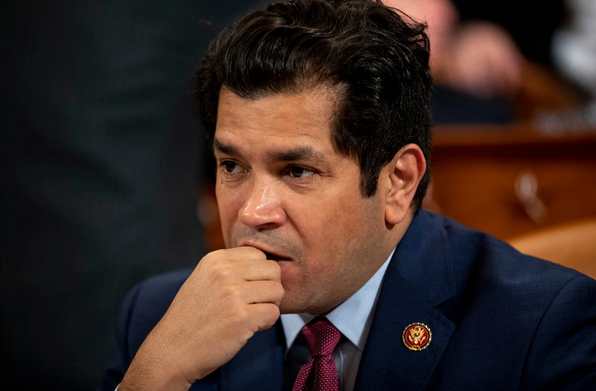
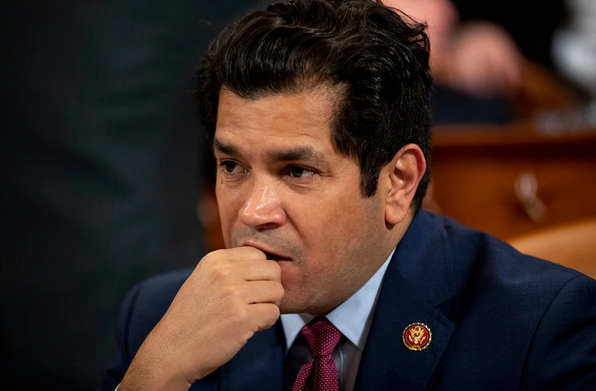
California Democratic Rep. Jimmy Gomez, whose office received the complaint, appeared to reference it during a Thursday morning hearing with HHS secretary Alex M. Azar in the House Ways and Means Committee. Gomez was contacted by the whistleblower, who he had met before entering Congress, due in part because his committee has jurisdiction over HHS.
Rep. Jimmy Gomez (D-CA)
“To your knowledge, were any of the ACF employees exposed to high-risk evacuees from China?” Gomez asked Azar during a tense exchange.
“They should never have been, without appropriate PPE,” Azar responded – referring to ‘personal protective equipment’ used to protect workers from disease. “If you were anyone in quarantine, to maintain quarantine, that should be the case.”
Gomez claimed that the teams sent to March and Travis air bases dealt with a “chaotic” situation.
“I would not accept your proposition that it was chaotic at all times,” Azar responded. “I am not aware of any violation of quarantine or isolation protocols.”
“Do you think that breaking basic protocols and exposing untrained human service employees to the coronavirus before allowing them to be dispersed around the country could have endangered the employees and other Americans?” Gomez asked.
“I don’t believe that has taken place,” replied Azar.
The complaint, which was reported by The Washington Post, surfaced the day after the Centers for Disease Control and Prevention confirmed the first known instance of a person testing positive without exposure to anyone known to be infected with the coronavirus, also known as Covid-19, or recent travels to any of the countries where it is circulating. The C.D.C. said that it was possible the patient, who is a resident of Solano County, Calif. — home to Travis Air Force Base — could have been exposed to a returning traveler who was infected.
March Air Reserve Base in Riverside, Calif., housed 195 people evacuated from Wuhan, China, for 14 days beginning in late January, while Travis in Northern California has housed a number of quarantined people in recent weeks, including some of the approximately 400 Americans on the Diamond Princess cruise ship that had docked in Japan. –New York Times
The whistleblower claims that the staff members, who had some experience with emergency management, were not properly prepared for the task at hand.
“They were not properly trained or equipped to operate in a public health emergency situation,” wrote the official. “They were potentially exposed to coronavirus; appropriate measures were not taken to protect the staff from potential infection; and appropriate steps were not taken to quarantine, monitor or test them during their deployment and upon their return home.”
Is The Coronavirus Pandemic About To Become Another Spanish Flu
Authored by Michael Every of Rabobank
COVID-19 vs The Spanish Flu
Summary
In light of the recent outbreak in Europe, it appears a question of when –rather than whether– the COVID-19 epidemic will be declared a global pandemic
Countermeasures such as quarantine or travel bans remain necessary to contain the virus’ spread. This will continue to cause disruption, as policy makers chase a moving target
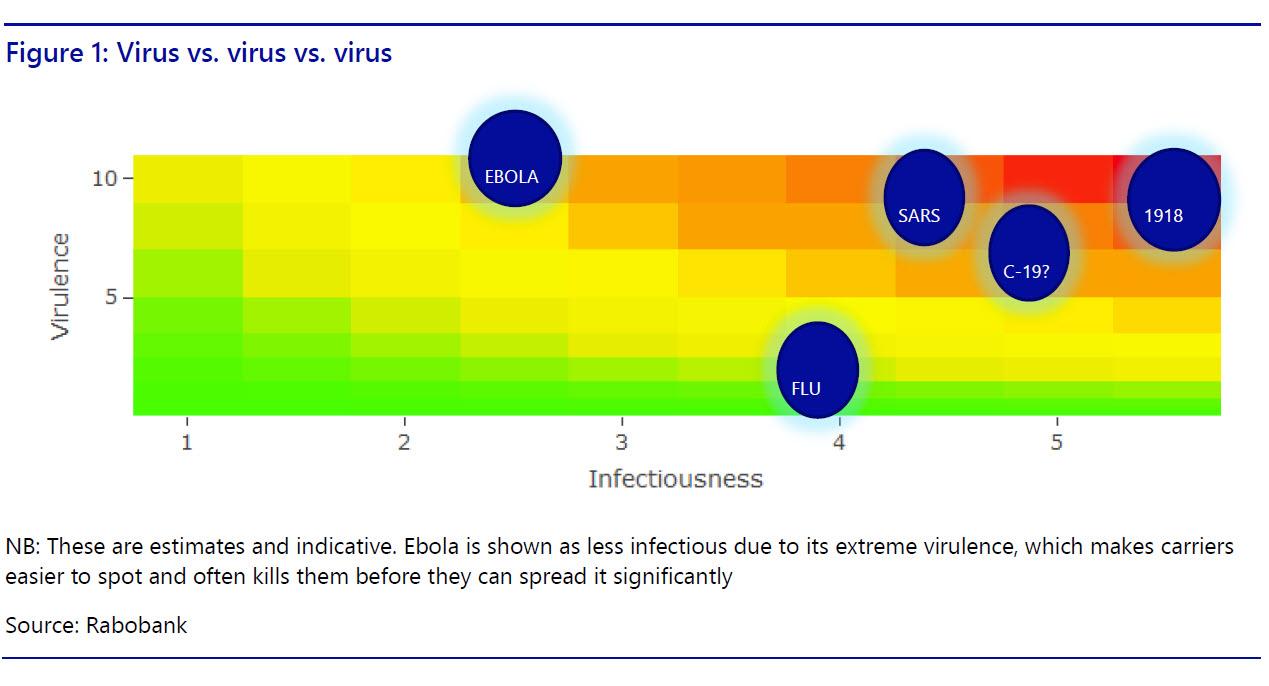
There is an increasing interest in the 1918-19 Spanish flu, and there are indeed some similarities in terms of virulence, infectiousness, and the potential attack rate.
Anecdotal evidence suggests a similar economic impact both despite and because of changes in society.
The key lesson from COVID-19 is the same as with the financial sector: complex interconnected systems greatly increase underlying risks, which are multiplicative and exponential, rather than additive and linear.
Chasing a moving target
Since the middle of January, the number-one worry for businesses, policy makers and market participants has been the outbreak of a new coronavirus known as COVID-19. In an effort to gauge its potential impact, analysts initially resorted to comparisons with the outbreak of SARS and MERS, two previous diseases resulting from coronaviruses. But we are now already way past this. It appears a question of when –rather than whether– this epidemic will be declared a global pandemic.
This is why there has been an increase in interest in previous pandemics. In particular, we have noticed a lot of comparisons with the ‘Spanish flu’, which originated in the final year of the First World War, spread rapidly, and resulted in an estimated 50-100 million deaths worldwide. So far, COVID-19 has led to more than 80,000 illnesses and 2,700 deaths, predominantly in China’s Hubei province, but more recently also in places such as South Korea, Iran, and Italy.
At the same time, we have also heard plenty of comparisons with another viral epidemic: the seasonal flu. In the US alone, the Centers for Disease Control and Prevention (CDC) estimates that so far this season there have been at least 26 million flu illnesses, 250,000 hospitalizations and 14,000 deaths. It is then argued that COVID-19 isn’t much of a big deal compared with seasonal flu, and that ‘business as usual’-conditions should return as soon as possible.
This is too complacent. Virologists have studied seasonal flu for decades. Despite the high number of illnesses, we generally have a good idea on what to expect. As the Northern Hemisphere moves towards spring, it is certain that flu cases will go down. In contrast, very little is known about COVID-19. Its basic reproduction number is also unknown, but the explosive rise in cases signal that it’s significantly higher than 1. Therefore, countermeasures such as quarantine or travel bans remain necessary to contain the virus’ spread.
The philosopher Søren Kierkegaard once wrote that “life can only be understood backwards, but it must be lived forwards”. Indeed, COVID-19 appears to be a wild card in terms of how far it will spread, how many deaths it will cause, and how severe the demand and supply shock is going to be. Let’s find out whether the Spanish flu could provide us with some pointers.
La gripe Española
The Spanish flu was a strain of avian influenza. Starting in late 1917, the virus spread across Europe, North America and Asia. Initially, it resembled seasonal flu, and those most at risk were the sick and the elderly. But around August 1918, the virus mutated to a much deadlier form, and deaths peaked between September and November 1918, eventually culminating in an estimated 500 million infections and 50-100 million fatalities. The Spanish flu is therefore the deadliest pandemic in human history, claiming many more lives than the First World War itself.
Whereas infectious diseases prior to the Spanish flu had mostly spread along trade routes (the 14th century Black Death is a good example of how intensified contact along dense networks increases a disease’s potential), the global context of the First World War appeared to enable the great spread of this flu. There was a lot of movement and interaction between people –with and without guns– and transmission was facilitated by extremely poor sanitary and health conditions.
The pandemic occurred in three waves with different characteristics. The first originated in early March 1918, and was a relatively mild one. The second wave was extremely deadly and came in the autumn of 1918. The third and final wave took place in the winter of 1919. Virologists have proposed several mechanisms to explain why this flu came in waves, including viral evolution (e.g. mutations), environmental changes (e.g. the weather) and behavioral changes in response to the pandemic (e.g. containment efforts), but there appears no real consensus of the interactions of these factors. This is partially due to data limitations and a lack of expertise at that time.
It has also been hypothesized that the unique circumstances of the First World War altered the virus’s natural selection process. Typically, the dangerous strains make their hosts very sick, who then recognize their symptoms relatively easily and move either into quarantine or pass away rapidly. These strains tend to die out relatively quickly – even if it is with their hosts, in the case of Ebola, for example. Milder strains, on the other hand, make people only mildly ill. Their hosts will have a stronger tendency to remain active in public life, and to expose others with these milder strains. One benefit of this is that it (partially) improves immunity to the more aggressive strains. In the First World War, however, very sick soldiers were sent on very crowded trains to even more overcrowded field hospitals, while the mildly ill remained at the front. This eventually helped spread deadlier strains in the second half of 1918, wreaking havoc in those parts of the world were the milder strains hadn’t presented themselves yet.
Comparisons with COVID-19
A rather similar epidemic?
As it stands now, COVID-19 seems to be a virus with relatively modest virulence: the case fatality rate being estimated to be around 2%, much lower than SARS or MERS. However, it has relatively high infectiousness. with the initial estimates of R0 –the basic reproduction number– are around 2.5. Simply put, this means that each case can generate 2.5 other cases. This may change over time, as people adjust their behavior, yet the relatively long incubation period for COVID-19 (perhaps up to 27 days) ensures that people can carry and transmit the virus without showing any symptoms.
The Spanish flu had a case-fatality rate of more than 2.5%, although estimates vary, and a reproduction number in the range of 2.0–3.0 in cities (which is what we should look at now, given the population shift from rural areas to urban areas). In other words, if countermeasures are as ineffective in containing the virus as they were in 1918-1919, when they were arguably non-existent, it could be argued that the current virus has a potential attack rate of 60-80%. We can therefore learn from the Spanish flu that as long as this virus remains transmissible but relatively mild, it has the potential to spread rapidly around the world. This pessimistic theoretical approach has been backed up by the Harvard University epidemiologist Marc Lipsitch.
What’s in a name? The rose still stinks regardless
The origins of the Spanish flu remain shrouded in mystery, even though it is generally accepted that there was very little Spanish about it. Instead, Spain was a neutral country in the war and the freedom of its press was greater than in the warring nations. As a consequence, there were lots of reports about the virus’ devastating effects in Spain, while in most other European countries any information that was likely to impact morale or indicate weakness was strongly censored.
We can draw a parallel here. Even though China has now taken extreme precautionary measures to limit the spread of COVID-19, they were rather late in their response. The authorities have also acknowledged this recently. But as the Chinese government continues to control the flow of information it is likely that a wide distrust in the officially published data on cases and fatalities will remain. The same holds true in Iran, for example, while many other countries, even the US, are not really testing their populations to any real extent: no tests means no cases – but it does not mean no virus is present.
But does that still matter at this point? While the lack of good and timely information potentially contributed to the initial spread of the virus, the genie is now out of the bottle. Moreover, whether the virus is or is not present does not seem to be altering the pattern of public behavior much. With full transparency of the risks people generally go into panic-buying mode and then into a voluntary lockdown almost as aggressively as they do under a state-imposed quarantine: for example, Chinese restaurants are deserted, even in areas of countries with no reported virus links.
The public reaction in some countries to date already seems to echo the panic seen in 1918-19.
Not W-shaped, but J-shaped
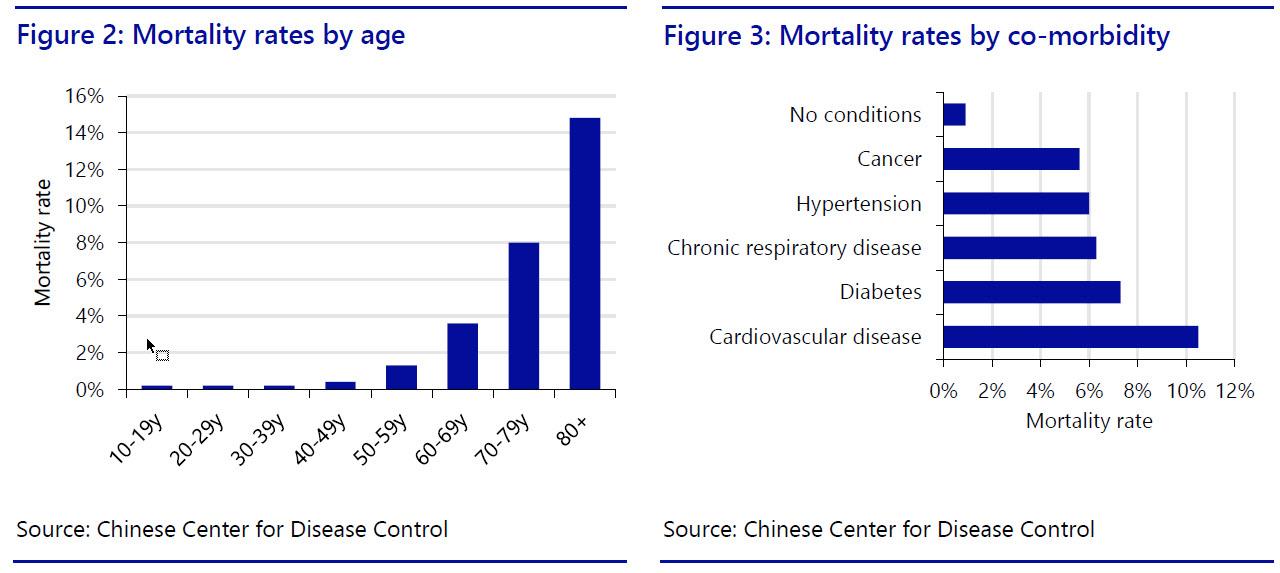
The curve of influenza deaths by age has historically been U-shaped, but the Spanish flu had a W-shaped curve. It was extremely deadly for those in the 19-40 age cohort, who are usually least vulnerable to viruses. This is in stark contrast to the mortality rates for COVID-19, which seems to have the worst impact on those aged over 65 and/or with co-morbidity factors such as diabetes, lung and/or heart conditions. This would then be a J-shaped curve.
The figures below are based on a study that examined data from 72,314 patients and was carried out by a group of experts at the Chinese Center for Disease Control and Prevention. This would seem to argue for COVID-19 to present a much less significant threat to the global economy than its predecessor a century ago. However, we would argue that this overlooks some mitigating factors.
Notably, the population profile of developed countries today, where the most economic damage could be done, skews significantly higher than it did back in 1918-19 in its own J-shape. This means that while younger people have less to worry about with COVID-19 than with Spanish flu, there are more of those who are potentially most vulnerable to the current virus. For example, the average life expectancy in the US was around 56 years in 1919, well below the 65+ band where COVID-19 seems to do the most damage today. Moreover, more than 16% of the US is aged over 65, and so most at risk from the virus, and that rises to 27% in Japan, 23% in Italy, 22% in Portugal, 21% in Germany, and 20% in France.
Second, although healthcare today is vastly superior to that of the early 20th century in almost all locations, which is a huge comfort, it is also much more expensive than the relatively simple treatments available in 1918-19, and hence more rationed. While a fully-equipped ICU may ensure a better and faster recovery from a virus, how many ICU beds would be available to patients if the elderly demographic were to fall victim to COVID-19 en masse in each country? They would be overwhelmed, as we already see from normal seasonal flu epidemics in the UK, and currently in China, a country which despite aging rapidly still only has around 12% of its citizens aged over 65. Meanwhile, in emerging economies with a much younger demographic, which is a positive, the public healthcare systems are generally far weaker and less prepared, meaning that the virus can again potentially still wreak havoc.
In short, COVID-19 could still potentially compare with the Spanish flu – in a worst-case scenario.
Fear and trembling, indeed
From a purely economic perspective, there isn’t a lot of data which we can use to examine the impact of the Spanish flu with any sort of precision given the absence of detailed national accounts data in most countries. Clearly, however, 1918-19 was a totally different structure for a virus to hit. Agriculture still accounted for a far larger share of GDP than today, and rural economies were still relatively more important: in those areas, the virus spread less rapidly due to lower population density.
By contrast, the bulk of today’s economy is about the urban environment and services, the former the prime environment for virus transmission. Moreover, both cities and services are hit hardest by any virus lockdown, making the modern economy arguably even more susceptible than in 1918-19 despite our advances in technology and communications. For example, a 2009 UK study found that even in a mild pandemic scenario the economic cost would be 0.5-1.0% of GDP, rising to 4.3% of GDP, and potentially even higher, in the case of a severe “high fatality” scenario. (Please see our recent special report on the potential global economic impact of the virus.)
Clearly, however, there are already some worrying parallels between Spanish flu and COVID-19. For example, this paper published by the Federal Reserve Bank of St. Louis contains some anecdotes that any person who reads today’s business news might very well recognize. We’ve picked just three:
“Merchants in Little Rock, Arkansas say their business has declined 40%. Others estimate the decrease at 70%.”
“The only business in Little Rock in which there has been an increase in activity is the drug store.”
“Physicians report they are kept too busy combating the disease to report the number of their patients and have little time to devote to other matters.”
More broadly, the authors also surveyed economic research and conclude that most of the evidence indicates that the effects of the 1918-19 pandemic were short-term. Then again, there was a lot of euphoric post-war reconstruction that needed to be done in 1919 in Europe at least, which flowed through to the US economy to some extent. Today’s businesses seem to find it hard to locate profitable investment opportunities despite ultra-low rates, and a further sharp drop in global demand is all that they need.
The Fed also found that back in 1918-19 “a decrease in the supply of manufacturing workers that resulted from influenza mortalities would have had the initial effect of reducing manufacturing labor supply, increasing the marginal product of labor and capital per worker, and thus increasing real wages”. Yet another study on the impact of the 1918 pandemic on Swedish economic performance found robust evidence that “the influenza had no discernible effect on earnings” but that it instead led to “a significant increase in poverty rates” – obviously as the state played a much smaller counter-cyclical role in 1919 than it does in 2020.
In today’s economic environment, where wage growth has proved almost universally sticky to the downside, we find it very hard to believe that COVID-19 will lead to an increase in real wages – at least near term. Rather, for developed economies with ever more ‘gig’ workers and self-employed, even in developed economies, an increase in poverty appears far more likely, ceteris paribus.
In short, the 1918-19 Spanish Flu massively disrupted a global economy already shattered by the First World War (1914-18). COVID-19, while so far much less virulent in some key respects, also looks potentially able to do a huge amount of damage to a modern global economy with its own pre-existing health conditions.
‘Stating’ the obvious
However, unlike in 1918-19, the state will almost certainly step in: populations, and markets, will demand it. Fiscal spending will accelerate hugely, with little concern over deficits, just as would be the case in a war. Even traditionally-prudent Hong Kong, hard hit by both political unrest and now COVID-19, has just announced a HKD10,000 (USD1,274) fiscal transfer for each adult permanent resident to try to jump-start the economy. Yet can a virus-hit emerging market do the same? That seems highly unlikely. Indeed, some emerging markets are incapable of testing for COVID-19 and others are charging for doing so (and for treating it), which ensures the poor will try to avoid reporting any illness. As such, the virus could have a ‘home base’ to linger in and spread from.
Even in richer economies physical bottle-necks, e.g., ICU beds, would remain for a long time. No other country can build a new hospital in just a few days as China just has (though the finished product is of questionable quality according to some reports). Imagine a global pandemic with a shortage of key inputs, such as masks: even China, the world’s workshop, experienced this recently. In the worst case we would see shortages of masks, and drugs, and beds, and nurses and doctors. Naturally, the public cry for wider and better healthcare would grow the deeper COVID-19 bites. As such, the potential flow-on effects from a worst-case virus scenario may be as socio-economically substantial as the revolutionary European social reforms that followed the end of World War 1.
Conclusion: just a passing fever?
Indeed, having considered “sick-stemic risk” stemming from COVID-19, we also need to consider the following: against a political tailwind blowing towards right-wing populism anyway, as explored in last year’s The Age of Rage; with businesses already rethinking their global strategies in the wake of the US-China trade war; and with a health-scare now seeing voters panic and look for answers, will we see a more pronounced shift towards anti-globalization movements in the wake of the virus?
The prevailing political trend of “national security” will likely also come into play: “How can it be,” populations will ask, “that we have no local production of virus masks, or drugs? Surely we need to keep them for ourselves first! Why are we allowing foreigners in when they might be infected? Let’s prioritize health and not markets!”
Deglobalization will arguably accelerate – and that is before we address the issue of how states will be able to pay for the higher healthcare spending that populations will demand, which does not sit alongside a small-government, free-trade globalization that we have grown accustomed to.
For now we can see that in the short-term there will undoubtedly be far less global travel and much less trade: we already see that. In the long-term it all depends on how COVID-19 plays out.
If it passes quickly, then just as in 2008-09 the key structural lessons on systemic risk of globalization will arguably be ignored in favour of the obvious near-term benefits, while lip-service is paid to the risks in public. However, should COVID-19 spread and linger, meaning that each new journey, each new encounter means a risk of infection with a 1 in 5 chance of serious illness and a 1 in 50 chance of death (based on data so far), then things may change very significantly on many socio-economic fronts. After all, the word “quarantine” emerged from the established practice in Venice of holding visiting sailors off its coast for 40 days to ensure they did not carry any disease.
To repeat, the lessons of COVID-19 are far older than the century-old Spanish flu: complex interconnected systems may produce what look like superior outcomes/returns in the short-term, but they also greatly increase underlying risks that will eventually emerge at far greater cost. These are multiplicative and exponential rather than additive and linear. Markets still aren’t pricing such outcomes, even after the recent equity sell-off.
Let’s conclude with Søren Kierkegaard again: his seminal work was titled “Fear and Trembling”, which seems appropriate enough today looking at COVID-19 vs. Spanish flu. However, he also argues for a leap of faith and states that “Hope is a passion for the possible.” Indeed.
Why Is Tesla Quietly Moving Crates & Loaded Pallets Out Of Gigafactory 2?
WGRZ Buffalo reported Tesla is “quietly” moving “a large number of crates and loaded pallets” out of its taxpayer-funded factory in Buffalo, New York.
This comes one day after we reported Tesla ended its partnership with Panasonic to produce solar panels at the factory, also known as Gigafatory 2.
Panasonic is expected to stop production in May and be completely moved out of the factory by September.
As we noted, Tesla continues “continues to lie tell NY state officials that it’s going to continue to produce its solar roof in Buffalo and that the company is exceeding its required job counts by the state, which was a condition of the deal for the company to receive an insane $959 million in taxpayer money to build its factory.”
WGRZ said the crates and loaded pallets are being hauled to a warehouse in Wheatfield Business Park, once the home to Bell Aerospace.
Tesla’s landlord at Gigafatory 2 is the state of New York, also known as Empire State Development (ESD). Tesla famously started operations at Buffalo in 2018 after getting a sweetheart deal to lease the facility from ESD for $1 per year and pledged to commit $5 billion in investments. Tesla faces a monster $41.2 million fine if it doesn’t keep operations open or have a headcount above 1,500.
Reuters and Bloomberg both reported in 2018 that crates and pallets of machinery were sitting in the factory. WGRZ provided no further details of what exactly was shipped out.
Considering the events this week, it couldn’t get any worse for Tesla – it remains to be seen if Gigafatory 2 will still be operating in the quarters ahead. Maybe ESD is about to evict Musk?…
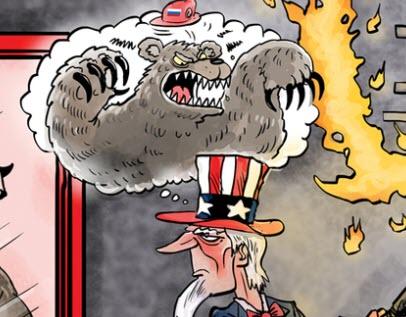
Those hapless individuals who run the United States are again slipping into a fantasy world where Americans are besieged by imaginary threats coming from both inside and outside the country. Of course, it is particularly convenient to warn of foreign threats, as it makes the people in government seem relevant and needed, but one might recommend that the tune be changed as it is getting a bit boring. After all, there are only so many hours in the day and Russian President Vladimir Putin must pause occasionally to eat or sleep, so the plotting to destroy American democracy must be on hold at least some of the time.
Yes, anonymous sources and the guys and gals who made the Iraq war a reality are now claiming that the Kremlin is at it again! Hints over the past year that Putin might try to replay 2016 in 2020 only do it better this time have now been confirmed! Per one news report the enemy is already at the gates: “U.S. intelligence officials told lawmakers last week that Russia is interfering in the 2020 election campaign by aiming to cast doubt on the integrity of the vote and boost President Donald Trump’s re-election.”
And there’s more! In a New York Timesarticle headlined “Same Goal, Different Playbook: Why Russia Would Support Trump and Sanders: Vladimir Putin is eager both to take the sheen off U.S. democracy and for a counterpart who is less likely to challenge his territorial and nuclear ambitions,” it was revealed that the Kremlin is intending to also help Bernie Sanders, so whichever way the election goes they win.
According to the Times Bernie has been “warn[ed]… of evidence that he is the Russian president’s favorite Democrat.” The article then goes on to explain, relying on its anonymous sources, that “…to the intelligence analysts and outside experts who have spent the past three years dissecting Russian motives in the 2016 election, and who tried to limit the effect of Moscow’s meddling in the 2018 midterms, what is unfolding in 2020 makes perfect sense. Mr. Trump and Mr. Sanders represent the most divergent ends of their respective parties, and both are backed by supporters known more for their passion than their policy rigor, which makes them ripe for exploitation by Russian trolls, disinformation specialists and hackers for hire seeking to widen divisions in American society.”
The Times article was written by David Sanger, the paper’s venerable national security correspondent. He is reliably wedded to Establishment views of the Russian threat, as is his newspaper, and strikes rock bottom in his assessment when he cites none other than “Victoria Nuland, who in a long diplomatic career had served both Republican and Democratic administrations, and had her phone calls intercepted and broadcast by Russian intelligence services.” Nuland, clearly the victim of a nefarious Russian intelligence operation that recorded her saying “fuck the EU,” opined that “Any figures that radicalize politics and do harm to center views and unity in the United States are good for Putin’s Russia.” Nuland is perhaps best known for her role in spending $5 billion in U.S. taxpayer money to overthrow the legitimate government of Ukraine. She is married to leading neoconservative Robert Kagan, which Sanger fails to mention, and is currently a nonresident fellow at the liberal interventionist Brookings Institution. She also works at former Clinton Secretary of State Madeleine Albright’s consultancy, presumably for the Benjamins. Albright, one might recall, thought that killing 500,000 Iraqi children through U.S. sanctions was “worth it.”
Given the fact that Russia will have very limited resources in their effort to corrupt American democracy, which is, by the way, doing a very good job of self-destruction without any outside help, how exactly will they do it? Sanger explains:
“As they focus on evading more vigilant government agencies and technology companies trying to identify and counter malicious online activity, the Russians are boring into Iranian cyberoffense units, apparently so that they can initiate attacks that look as if they originate in Iran — which itself has shown interest in messing with the American electoral process… And, in one of the most effective twists, they are feeding disinformation to unsuspecting Americans on Facebook and other social media. By seeding conspiracy theories and baseless claims on the platforms, Russians hope everyday Americans will retransmit those falsehoods from their own accounts. That is an attempt to elude Facebook’s efforts to remove disinformation, which it can do more easily when it flags ‘inauthentic activity,’ like Russians posing as Americans. It is much harder to ban the words of real Americans, who may be parroting a Russian story line, even unintentionally.”
So those wily Russians are making themselves look like Iranians and they are planning on “feeding disinformation” to “unsuspecting Americans” consisting of “conspiracy theories” and “baseless claims.” Sounds like a plan to me as the various occupants of the White House and Congress have been doing exactly that for the past twenty years. That we had a national election in 2016 in which a reality television personality ran against an unindicted criminal would seem to indicate that the effort to brainwash the American people has already been successful.
The usual bottom feeders are also piling on to the Russian interference story. Jane Harman, former congresswoman who once colluded with Israeli intelligence to lobby the Department of Justice to drop criminal charges against two employees of AIPAC in exchange for Israel’s support to make her chair of the House Intelligence Committee, warns “How dangerous it would be if we lose the tip of the spear against those who would destroy us.”
Former CIA Director John Brennan also has something to say. He is “very disturbed” by his conviction that Russia is actively meddling in the 2020 campaign in support of President Trump. He said “We are now in a full-blown national security crisis. By trying to prevent the flow of intelligence to Congress, Trump is abetting a Russian covert operation to keep him in office for Moscow’s interests, not America’s.” Brennan is best known for having orchestrated the illegal campaign to vilify Trump and his associates prior to, during and after the 2016 election. He also participated in a weekly meeting with Barack Obama where he and the president would add and remove names from a “kill list” of U.S. citizens residing overseas. He and his boss should both be in prison, but they are instead fêted as American patriots. Go figure.
Time to take a step back from the developing panic. As usual, the U.S. government intelligence agencies have produced no actual evidence that Moscow is up to anything, and there are already reports that the Office of National Intelligence briefer “overstated” her case against the Kremlin in her briefing of the House Intelligence Committee. Sure, the Russians have an interest in an American election and will favor candidates like Trump and Sanders that are not outright hostile to them, but to claim as the NY Times does that Russia has incompatible “territorial and nuclear interests” is a stretch. And yes, Moscow will definitely use its available intelligence resources to monitor the nomination and election process while also clandestinely doing what it can to improve the chances of those individuals they approve of. That is what intelligence agencies do.
In American Establishment groupthink there is one standard for what Washington does and quite a different standard for everyone else. Does it shock any American to know that the United States has interfered in scores of elections all over the world ever since the Second World War, to include those in places like France and Italy well into the 1980s? And in somewhat more kinetic covert actions, actually removing Mohammed Mossadeq in Iran, Salvador Allende in Chile, Jacobo Arbenz in Guatemala and Mohamed Morsi in Egypt just for starters, not even considering the multiple plots to kill Fidel Castro. And it continues to do so today openly in places like Iran and Venezuela while also claiming hypocritically that the U.S. is “exceptional” and also a “force for good.” That anyone should be genuinely worrying about Russian proxies buying and distributing a couple of hundred thousands of dollars’ worth of ads in an election in which many billions of dollars’ worth of propaganda will be on the table is ridiculous.
It is time to stop blaming Russia for the failure of America’s ruling class to provide an honest and accountable government and one that does not go around the world looking for trouble.
That is what the 2020 election should really be all about.
Pope Francis Urges Catholics To Stop Trolling For Lent
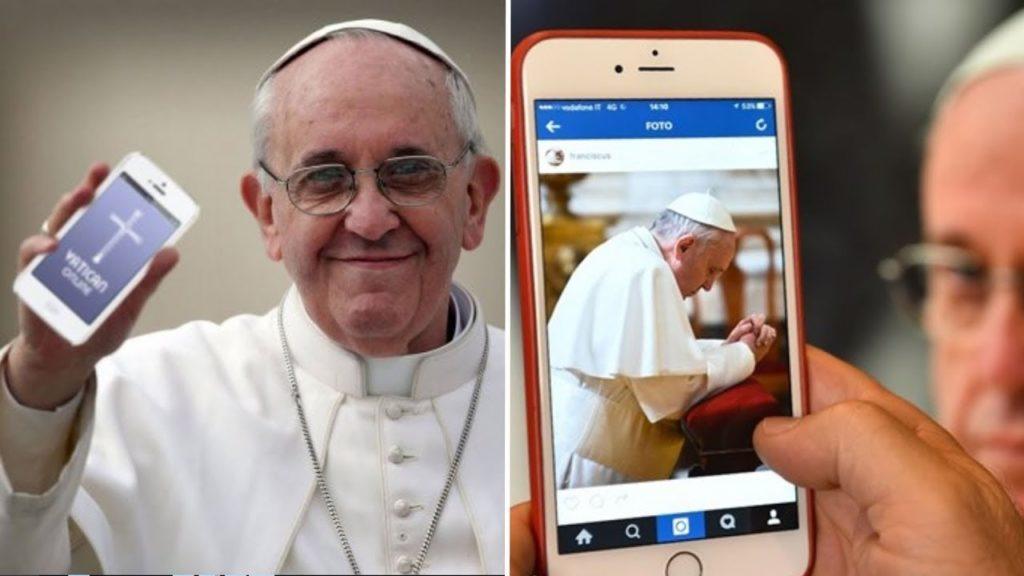
Pope Francis addressed tens of thousands of people in St. Peter’s Square on Ash Wednesday (the start of Lent), asking everyone in a modern twist to give up social media over the next 40 days leading up to Easter, reported Reuters.
📹VIDEO: Pope Francis gave this advice for #Lent2020: “Turn off the television and open the Bible; disconnect from the cell phone and connect to the Gospel.”
He urged the faithful to step away from the noise of the world and spend more time with the Lord. #AshWednesday#Lentpic.twitter.com/aXwz5XnF0o
The Pope asked millions of his followers to stop trolling one another, adding that Lent “is a time to give up useless words, gossip, rumors, tittle-tattle, and speak to God on a first-name basis.”
Besides trolling, Twitter battles and meme wars, the Pope asked Catholics to unplug from technology to get closer to god:
“We live in an environment polluted by too much verbal violence, by many offensive and harmful words, which the internet amplifies,” Francis said. “We are inundated with empty words, with advertisements, with subtle messages. We have become used to hearing everything about everyone, and we risk slipping into a worldliness that atrophies our hearts.
In this connected world, everyone is “hearing everything about everyone” in a moment’s notice, the Pope said, adding that Lent can serve as a digital detox program. “Lent is the right time to make room for the Word of God. It is time to turn off the television and open the Bible. It is the time to disconnect from your cell phone and connect to the Gospel,” he said.
Francis said, “when I was a little boy, there was no television… it was customary to not listen to the radio during Lent. It’s the desert. Lent is the time to renounce, to disconnect from our cellphones, and connect to the Gospel.”
His comments came on Ash Wednesday, a day of fasting and abstinence for those celebrating Lent. Catholics often smear ashes on their forehead as a reminder of their mortality. As for this Lent, the Pope has requested social media, trolling, and all smart devices to be given up for the next 40-days.
The likelihood that Catholics can give up social media for nearly six weeks would be impressive. Social media is highly addictive both physically and psychologically; certainly, there will be some that can’t even make it one day.
Georgetown University named a new Associate Director for Undocumented Students, who referred to illegal immigrants as “freedom fighters.”
While not a new position, the role does highlight ongoing efforts by universities across the country to aid illegal immigrants, provide additional benefits and resources, some of which are not even available to American citizens, and even offer free legal assistance to fight deportation.
The position at Georgetown, though, is part of the Center for Multicultural Equity and Access, which the university describes as “support[ing] students of color at Georgetown University in a variety of ways.” The center says it “can provide you with someone to talk to about personal issues or concerns,” “a chance to explore diversity issues,” and “affordable options for textbooks, printing, or summer housing.”
In an email to Georgetown’s newspaper, Jennifer Crewalk, the new Georgetown associate director for undocumented students, said,
“I’m looking forward to focusing on community healing, the present needs of our students, but also ask all of us to be visionaries for what is possible for the near future, our undocumented students are the freedom fighters of this moment and time, and they are helping to awaken people to how important it is for our communities to be conscious.”
According to the Georgetown Hoya, Charlene Brown-McKenze, director of the Center for Multicultural Equity and Access said, “Georgetown provides Undocumented Student Resources to ensure the dignity and care of all members of the university community, Jennifer comes to Georgetown with experience and passion that will serve her well as the new Director for Undocumented Students.”
Crewalk told the campus newspaper that “building a conscious community can educate and move people toward awareness of their own privilege when people acknowledge their own privileges, they can better advocate for others.”
Mark Krikorian, executive director for the Center for Immigration Studies, told Campus Reform, “it’s bad enough that my alma mater is using tuition payments from American parents to serve the needs of illegal immigrants, but to refer to foreign citizens living here in defiance of American law as ‘freedom fighters’ is an obscenity.”
“It is really consistent with the ‘Jesuit values’ Georgetown claims to espouse to claim that the lawfully enacted statutes of the United States are so illegitimate that those defying them are ‘freedom fighters’?” Krikorian added.
According to Georgetown University’s website, the Center for Multicultural Equity and Access currently has a staff of 11 people, including three program coordinators, two associate directors, and two assistant directors for separate campus programs and initiatives.
Georgetown, a Jesuit Catholic institution, also has an LGBTQ Resource Center, which is promoted as the “first such Center of its kind at a Catholic/Jesuit institution in the country.”
As Campus Reform has also reported, Gonzaga University, another Catholic Jesuit institution, recently opened a new “LGBTQ+ Rights Clinic.”
Crewalk and Georgetown University did not respond to Campus Reform in time for publication.
Facial-Recognition Company That Worried Privacy Advocates Has Entire Client List Stolen
A Manhattan-based facial recognition company that uses artificial intelligence to collect data from unsuspecting social media users has reported that its entire client list has been stolen.
The company, Clearview AI, has developed an app which allows anyone to snap a picture of someone which is then compared to a database of more than 3 billion photos that the company has scraped off Facebook, Venmo, YouTube and other sites, before serving up matches along with links to the sites where the database photos originally appeared.
Clearview AI has partnered with law enforcement agencies around the country, however it was unknown exactly how many or who they were. That may not be the case for much longer, after an intruder “gained unauthorized access” to its customer list – along with data on the number of searches its customers have conducted, as well as how many user accounts have been set up, according to the Daily Beast.
The company raised concerns among privacy advocates after a New York Times article described their work with law enforcement agencies, with over 40 organizations signing a letter calling for an independent watchdog to recommend a ban on government use of facial recognition technology.
The company claims that there was “no compromise of Clearview’s systems or network,” and that the vulnerability has been breached. Specific search histories were not obtained.
“Security is Clearview’s top priority,” said company attorney Tor Ekeland. “Unfortunately, data breaches are part of life in the 21st century. Our servers were never accessed. We patched the flaw, and continue to work to strengthen our security.”
The firm drew national attention when The New York Times ran a front-page story about its work with law-enforcement agencies. The Times reported that the company scraped 3 billion images from the internet, including from Facebook, YouTube, and Venmo. That process violated Facebook’s terms of service, according to the paper. It also created a resource that drew the attention of hundreds of law-enforcement agencies, including the FBI and the Department of Homeland Security, according to that report. In a follow-up story, the Times reported that law-enforcement officials have used the tools to identify children who are victims of sexual abuse. One anonymous Canadian law-enforcement official told the paper that Clearview was “the biggest breakthrough in the last decade” for investigations of those crimes. Daily Beast
David Forscey, managing director of the non-profit Aspen Cybersecurity Group said that the breach is concerning.
“If you’re a law-enforcement agency, it’s a big deal, because you depend on Clearview as a service provider to have good security, and it seems like they don’t.”
Marijuana possession and distribution is illegal under federal law. Nonetheless, a majority of states have legalized medical marijuana to some degree, and several more states have legalized marijuana possession and use for even recreational purposes. As a practical matter, this means individuals are able to possess and use marijuana without significant fear of prosecution throughout much of the United States. Yet the federal prohibition still influences business decisions related to marijuana as the specter of federal action remains.
Next month, the Brookings Institution will publish my new book, Marijuana Federalism: Uncle Sam and Mary Jane, an edited volume exploring the implications of the conflict between federal and state marijuana laws, and suggesting how the proper reforms could harness federalism to produce better marijuana policy.
As I explain in the introduction, even though the Justice Department has not sought to preempt or displace state-level reforms, the federal prohibition casts a long shadow across state-level legalization efforts. This federal-state conflict presents multiple important and challenging policy questions that often get overlooked in policy debates over whether to legalize marijuana for medical or recreational purposes. Yet in a “compound republic” like the United States, this federal-state conflict is particularly important if one wishes to understand marijuana law and policy today.
Marijuana possession and distribution is illegal under federal law. Nonetheless, a majority of states have legalized medical marijuana to some degree, and several more states have legalized marijuana possession and use for even recreational purposes. As a practical matter, this means individuals are able to possess and use marijuana without significant fear of prosecution throughout much of the United States. Yet the federal prohibition still influences business decisions related to marijuana as the specter of federal action remains.
Next month, the Brookings Institution will publish my new book, Marijuana Federalism: Uncle Sam and Mary Jane, an edited volume exploring the implications of the conflict between federal and state marijuana laws, and suggesting how the proper reforms could harness federalism to produce better marijuana policy.
As I explain in the introduction, even though the Justice Department has not sought to preempt or displace state-level reforms, the federal prohibition casts a long shadow across state-level legalization efforts. This federal-state conflict presents multiple important and challenging policy questions that often get overlooked in policy debates over whether to legalize marijuana for medical or recreational purposes. Yet in a “compound republic” like the United States, this federal-state conflict is particularly important if one wishes to understand marijuana law and policy today.