SCOTUS Could Use More Skeptics Like Amy Coney Barrett

Amy-Coney-Barrett-9-29-20-Newscom

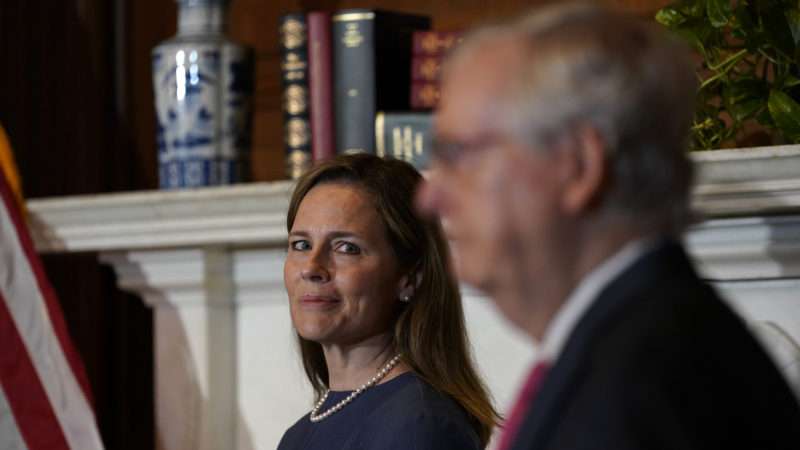
Democrats worry that Supreme Court nominee Amy Coney Barrett, an originalist and textualist who clerked for Justice Antonin Scalia in the late 1990s, will emulate him if she is confirmed by the Senate. We could do a lot worse.

Although progressives often portrayed Scalia as an authoritarian ogre, he was a more faithful defender of First, Fourth, and Sixth amendment rights than some of his purportedly “liberal” colleagues on the Court. Barrett’s track record during three years on the U.S. Court of Appeals for the 7th Circuit suggests she also would frequently prove to be a friend of civil liberties.

In a 2018 opinion, Barrett concluded that an anonymous tip did not provide reasonable suspicion for police to stop a car in which they found a man with a felony record who illegally possessed a gun. “The anonymous tip did not justify an immediate stop because the caller’s report was not sufficiently reliable,” she wrote for a unanimous three-judge panel, noting that the report of gun possession by itself did not indicate criminal conduct.

In another Fourth Amendment case, decided in 2019, Barrett concluded that federal drug agents violated the Constitution when they searched a suspected heroin dealer’s apartment based on the consent of a woman who answered the door but did not live there. Because the search was invalid, she said, the evidence it discovered should have been suppressed.

In a 2018 opinion for a unanimous 7th circuit panel, by contrast, Barrett said it did not matter whether the warrant authorizing tracking software that identified users of a child pornography website was valid. The evidence could be used anyway, she said, based on “the good-faith exception to the exclusionary rule.”

Another Barrett opinion that may give pause to civil libertarians is her 2019 dissent from a decision in which the majority held that state and federal courts had erred by rejecting a defendant’s claim that prosecutors improperly withheld exculpatory evidence when they tried him for attempted murder. While Barrett agreed that prosecutors should have revealed that the victim, whose testimony was crucial in obtaining a conviction, had undergone hypnosis prior to the trial, she thought the issue was not clear enough to override the determination of an Indiana appeals court.

Although that dissent might be cited as a reason to question Barrett’s commitment to due process, her 2019 opinion in a case involving a Purdue University student who was suspended for a year based on uncorroborated sexual assault allegations points in another direction. She said the university’s “fundamentally unfair” adjudication of those charges “fell short of what even a high school must provide to a student facing a days-long suspension.”

When it comes to federal sentencing, an area where Scalia’s Sixth Amendment views had a major impact, Barrett has repeatedly (although not always) sided with criminal defendants who argued that their punishment was more severe than the law allowed. And although her record on qualified immunity, a court-invented doctrine that shields police officers from federal civil rights claims when their alleged misconduct did not violate “clearly established” law, is also mixed, she wrote a reassuring 2019 opinion that demolished the argument of a detective who maintained that he could not be sued for lying in a probable cause statement that was used to charge a man with murder.

Barrett’s critique of categorical bans on gun ownership by people with felony records, which she argues are inconsistent with the Second Amendment, will alarm gun control supporters. But her scholarly 2019 dissent in a case involving a man convicted of mail fraud shows how her originalist approach casts doubt on policies that permanently deprive people of the fundamental right to armed self-defense even when they have never demonstrated violent tendencies.

Barrett, in short, is not the sort of conservative who automatically defers to the government’s position when its actions impinge on constitutional rights. The Supreme Court could use more skeptics like her.

© Copyright 2020 by Creators Syndicate Inc.

from Latest – Reason.com https://ift.tt/30hRv9s
via IFTTT
Trump Claims Biden Called Black Americans ‘Superpredators.’ That Was Hillary Clinton.

biden-debate

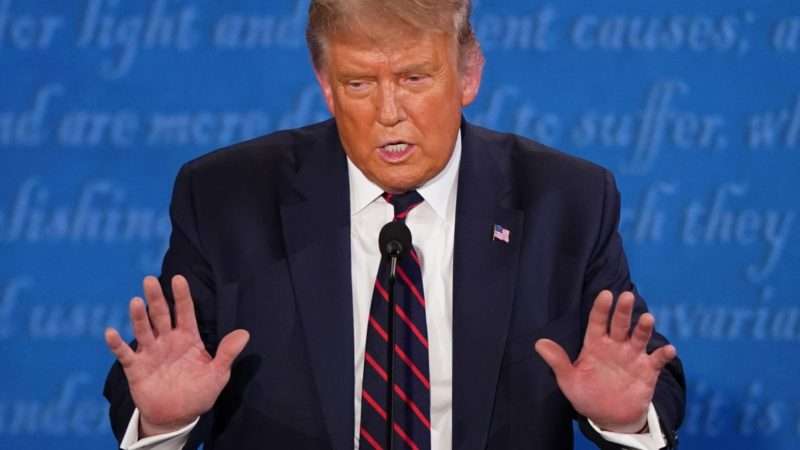
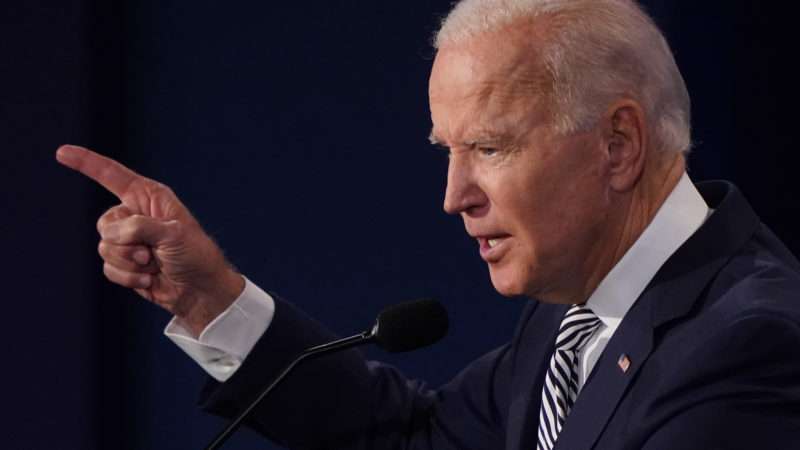
President Donald Trump attacked Democratic nominee Joe Biden at tonight’s debate for his role in passing tough-on-crime legislation and supposedly calling black Americans “superpredators” years ago. 

“I’m letting people out of jail now,” Trump said to Biden. “You’ve treated the black community as bad as anyone in the country. You called them superpredators and you’ve called them worse than that.”

Trump has previously attacked Joe Biden for his role in crafting the 1994 crime bill, formally known as the Violent Crime Control and Law Enforcement Act of 1994. It was Hillary Clinton, however, who infamously uttered the term “superpredators” back in 1996. (You can still find plenty of videos of floor speeches of then-Senator Biden railing against “predators” or generally demagoguing on the subject of violent crime.)

The rise of criminal justice reform as a major issue in politics has made the 1994 crime bill a liability for Biden, who has since apologized for his role in tough-on-crime legislation passed in the 1980s and ’90s by large bipartisan margins.

In a speech last year on Martin Luther King Jr. Day, Biden said those bills “trapped an entire generation,” and that “it was a big mistake when it was made.”

This has also led Trump, in an attempt to cut into Biden’s support among black voters, to attack Biden for both being too harsh on crime in the past and not believing in “law and order” now.

However, the popular narrative about the ’94 crime bill isn’t correct. Fordham Law professor John Pfaff has argued persuasively that, though it was certainly a bad bill, it neither created mass incarceration—which was already chugging along by the 1990s—nor was a significant driver of imprisonment.

The bill created several draconian mandatory minimum sentences at the federal level and dangled grants for new prisons and new tough-on-crime laws for states, but mass incarceration is predominantly a state-level phenomenon.

“Its effect on crime was consistently hampered by the sheer size of state and local justice systems, diminishing any impact it might have made for good or for ill,” Pfaff wrote in a 2016 New York Times Op-Ed. “And in many ways, the debates over it are largely symbolic.”

There are plenty of other terrible criminal justice bills that Biden co-sponsored during his long tenure in the Senate, such as the massive expansion of civil asset forfeiture and the crackdowns on juvenile offenders. But in a “debate” that was little more than two candidates yelling over each other, there wasn’t much room for anything other than vague symbology.

from Latest – Reason.com https://ift.tt/30jpsGB
via IFTTT

Tuesday’s Debate Demonstrated That Donald Trump Wants This Election To Become a Chaotic Mess

zumaglobalten363593

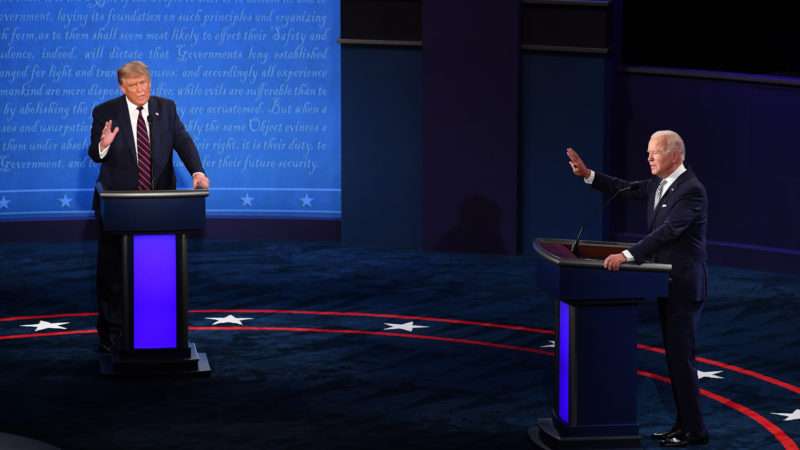
Near the very end of Tuesday’s mostly unwatchable debate between President Donald Trump and former Vice President Joe Biden, there was actually a single important moment that could have ramifications on and beyond Election Day.

By now, it’s no secret that the outcome of this year’s presidential election might not be known on November 3. Due to the abnormally high number of mail-in and absentee ballots that are expected to be cast this year—and compounded by the fact that several states, including some important swing states, are not allowed to start counting those ballots before Election Day—there will likely be a large number of completely legitimate votes that won’t be counted in the hours immediately after polls close. If the election is close, how the two top candidates act in the immediate aftermath of an uncalled contest will be crucial to securing the legitimacy of the election.

With that in mind, debate moderator Chris Wallace asked both candidates on Tuesday night if they would urge their “supporters to stay calm during this extended period, not to engage in any civil unrest” and pledge that neither would declare victory until the results were final.

Trump immediately rejected the premise.

“I am urging my supporters to go into the polls and watch very carefully,” he said, before spiraling off into a tangent about how some of his supporters were “thrown out” of polling places in Philadelphia earlier today. “You know why? Because bad things happen in Philadelphia,” Trump said.

Fair enough. But in this case, it doesn’t look as devious as the president is trying to make it sound. City commissioners in Philadelphia have denied that anyone was unfairly tossed from election offices processing mail-in ballots, according to the local CBS affiliate.

Later in the same answer, Trump accused Democrats of cheating because of reports that “they found ballots in a wastepaper basket three days ago…and they all had the name ‘Trump’ on them.”

Again, there’s a bit of truth here. The FBI and the Pennsylvania State Police are investigating an incident in which nine ballots were apparently discarded in a Luzerne County, Pennsylvania, election office. At this point, it remains unclear whether those ballots were discarded for legitimate reasons. But Trump and his supporters have seized on the fact that at least seven of the votes were cast for the incumbent president as proof of malfeasance.

All of that only makes it more important for Trump, Biden, and everyone else to keep their shit together for the next six or eight or 10 weeks. But Trump’s ultimate goal is not allowing law enforcement to determine the truth about whether those nine ballots were legitimately discarded. He’d much rather use the incident as a wedge to raise questions about the legitimacy of the entire election.

As Wallace dutifully pointed out, there were more than 31 million mail-in votes cast in the 2018 election—more than a quarter of all votes. As Biden pointed out, there are five states where elections are now conducted almost entirely by mail—and he could have pointed out that at least one of those vote-by-mail systems, in Colorado, was implemented by a Republican. No matter how many times Trump tries to claim otherwise, it is simply not true that more mail-in voting will disadvantage Republicans.

Biden’s response to the same question from Wallace was exactly what you’d hope to hear from a national leader. “Yes,” he said, he would wait to declare victory until the race was certified. “No one has established at all that there is fraud related to mail-in ballots,” he added. “I will accept [the outcome].”

But it matters that Trump won’t say he trusts the process, and it matters that he won’t tell his supporters to wait for the results to be counted. It matters that he seems willing to turn everything into a conspiracy directed against him.

“This is not going to end well,” Trump said at the very end of his tirade.

It might turn out to be a self-fulfilling prophecy.

from Latest – Reason.com https://ift.tt/3kWTd8c
via IFTTT

Trump and Biden Spar Over Which One Is the True Threat to America’s Suburbs

reason-trumpbiden

America’s tranquil suburbs were regrettably dragged into tonight’s presidential debate. President Donald Trump and former Vice President Joe Biden sparred fiercely, and occasionally coherently, over which one of their candidacies posed the greatest risk to these tidy communities.

“If [Biden] ever got to run this country and they ran it the way he would want to run it, our suburbs would be gone,” said Trump, winding up a rant about recent violence in Democrat-controlled cities like Chicago and Portland.

Trump was basically repeating an accusation he’s levied before: that Biden wants to “abolish the suburbs” through a soft-on-crime approach and intrusive federal housing policies.

In particular, Trump has singled out a campaign proposal of Biden’s to require jurisdictions receiving federal housing and transportation grants to implement policies intended to make housing more affordable and inclusive. Under Biden’s proposal, that could include everything from allowing the construction of apartment buildings in low-density neighborhoods to banning landlords from asking about potential tenants’ criminal history.

That proposal is a more muscular version of an Obama-era fair housing regulation that the Trump administration gutted this summer over the alleged threat it posed to suburban communities’ single-family zoning policies.

Biden responded by accusing Trump, a New York City native, of being ignorant of suburbs as they exist today, and of making racially coded attacks. Trump wouldn’t know a “suburb unless [he] took a wrong turn,” said Biden. “This is not 1950. All these dog whistles and racism don’t work anymore.”

The former vice president went on to insist that today, “suburbs are by and large integrated.”

Interestingly, Trump and his Secretary of Housing and Urban Development, Ben Carson, have also seized on the argument that suburbs are more integrated today than in the past to defend single-family zoning. If suburbs are racially inclusive already, then their zoning policies clearly aren’t excluding people because of their race, the argument goes.

Biden went on to argue that the COVID-19 pandemic, floods, and fires pose a much greater risk to the lives and livelihoods of suburban residents, with the implication being that the president’s failure on climate change and COVID-19 made him the real anti-suburbs candidate.

The intensity of the exchange is odd when one considers what little control the federal government exercises over the quality and character of suburban life.

While the federal government can pull some strings when it comes to funding and regulation, suburban communities’ zoning codes and approaches to law enforcement hinge more on who gets elected to city hall than who occupies the White House.

On the debate stage tonight, suburbs existed as more of a political and cultural football both candidates wanted to defend than as a policy issue they were eager to sink their teeth into.

Those who do have strong opinions about preserving the suburbs (or their own sanity) would have been better off skipping tonight’s debate and boning up on who is running for office closer to home.

from Latest – Reason.com https://ift.tt/3idtsig
via IFTTT

SCOTUS Could Use More Skeptics Like Amy Coney Barrett

Amy-Coney-Barrett-9-29-20-Newscom

Democrats worry that Supreme Court nominee Amy Coney Barrett, an originalist and textualist who clerked for Justice Antonin Scalia in the late 1990s, will emulate him if she is confirmed by the Senate. We could do a lot worse.

Although progressives often portrayed Scalia as an authoritarian ogre, he was a more faithful defender of First, Fourth, and Sixth amendment rights than some of his purportedly “liberal” colleagues on the Court. Barrett’s track record during three years on the U.S. Court of Appeals for the 7th Circuit suggests she also would frequently prove to be a friend of civil liberties.

In a 2018 opinion, Barrett concluded that an anonymous tip did not provide reasonable suspicion for police to stop a car in which they found a man with a felony record who illegally possessed a gun. “The anonymous tip did not justify an immediate stop because the caller’s report was not sufficiently reliable,” she wrote for a unanimous three-judge panel, noting that the report of gun possession by itself did not indicate criminal conduct.

In another Fourth Amendment case, decided in 2019, Barrett concluded that federal drug agents violated the Constitution when they searched a suspected heroin dealer’s apartment based on the consent of a woman who answered the door but did not live there. Because the search was invalid, she said, the evidence it discovered should have been suppressed.

In a 2018 opinion for a unanimous 7th circuit panel, by contrast, Barrett said it did not matter whether the warrant authorizing tracking software that identified users of a child pornography website was valid. The evidence could be used anyway, she said, based on “the good-faith exception to the exclusionary rule.”

Another Barrett opinion that may give pause to civil libertarians is her 2019 dissent from a decision in which the majority held that state and federal courts had erred by rejecting a defendant’s claim that prosecutors improperly withheld exculpatory evidence when they tried him for attempted murder. While Barrett agreed that prosecutors should have revealed that the victim, whose testimony was crucial in obtaining a conviction, had undergone hypnosis prior to the trial, she thought the issue was not clear enough to override the determination of an Indiana appeals court.

Although that dissent might be cited as a reason to question Barrett’s commitment to due process, her 2019 opinion in a case involving a Purdue University student who was suspended for a year based on uncorroborated sexual assault allegations points in another direction. She said the university’s “fundamentally unfair” adjudication of those charges “fell short of what even a high school must provide to a student facing a days-long suspension.”

When it comes to federal sentencing, an area where Scalia’s Sixth Amendment views had a major impact, Barrett has repeatedly (although not always) sided with criminal defendants who argued that their punishment was more severe than the law allowed. And although her record on qualified immunity, a court-invented doctrine that shields police officers from federal civil rights claims when their alleged misconduct did not violate “clearly established” law, is also mixed, she wrote a reassuring 2019 opinion that demolished the argument of a detective who maintained that he could not be sued for lying in a probable cause statement that was used to charge a man with murder.

Barrett’s critique of categorical bans on gun ownership by people with felony records, which she argues are inconsistent with the Second Amendment, will alarm gun control supporters. But her scholarly 2019 dissent in a case involving a man convicted of mail fraud shows how her originalist approach casts doubt on policies that permanently deprive people of the fundamental right to armed self-defense even when they have never demonstrated violent tendencies.

Barrett, in short, is not the sort of conservative who automatically defers to the government’s position when its actions impinge on constitutional rights. The Supreme Court could use more skeptics like her.

© Copyright 2020 by Creators Syndicate Inc.

from Latest – Reason.com https://ift.tt/30hRv9s
via IFTTT
Trump Claims Biden Called Black Americans ‘Superpredators.’ That Was Hillary Clinton.

biden-debate

President Donald Trump attacked Democratic nominee Joe Biden at tonight’s debate for his role in passing tough-on-crime legislation and supposedly calling black Americans “superpredators” years ago. 

“I’m letting people out of jail now,” Trump said to Biden. “You’ve treated the black community as bad as anyone in the country. You called them superpredators and you’ve called them worse than that.”

Trump has previously attacked Joe Biden for his role in crafting the 1994 crime bill, formally known as the Violent Crime Control and Law Enforcement Act of 1994. It was Hillary Clinton, however, who infamously uttered the term “superpredators” back in 1996. (You can still find plenty of videos of floor speeches of then-Senator Biden railing against “predators” or generally demagoguing on the subject of violent crime.)

The rise of criminal justice reform as a major issue in politics has made the 1994 crime bill a liability for Biden, who has since apologized for his role in tough-on-crime legislation passed in the 1980s and ’90s by large bipartisan margins.

In a speech last year on Martin Luther King Jr. Day, Biden said those bills “trapped an entire generation,” and that “it was a big mistake when it was made.”

This has also led Trump, in an attempt to cut into Biden’s support among black voters, to attack Biden for both being too harsh on crime in the past and not believing in “law and order” now.

However, the popular narrative about the ’94 crime bill isn’t correct. Fordham Law professor John Pfaff has argued persuasively that, though it was certainly a bad bill, it neither created mass incarceration—which was already chugging along by the 1990s—nor was a significant driver of imprisonment.

The bill created several draconian mandatory minimum sentences at the federal level and dangled grants for new prisons and new tough-on-crime laws for states, but mass incarceration is predominantly a state-level phenomenon.

“Its effect on crime was consistently hampered by the sheer size of state and local justice systems, diminishing any impact it might have made for good or for ill,” Pfaff wrote in a 2016 New York Times Op-Ed. “And in many ways, the debates over it are largely symbolic.”

There are plenty of other terrible criminal justice bills that Biden co-sponsored during his long tenure in the Senate, such as the massive expansion of civil asset forfeiture and the crackdowns on juvenile offenders. But in a “debate” that was little more than two candidates yelling over each other, there wasn’t much room for anything other than vague symbology.

from Latest – Reason.com https://ift.tt/30jpsGB
via IFTTT

Trump Pushed To Condemn White Nationalist Proud Boys, Instead Tells Them ‘Stand Back and Stand By’

trumpproudboys_1161x653

In tonight’s debate between President Donald Trump and former Vice President Joe Biden, the protests and violence in several American cities over the summer dominated the second half of the discussion.

Biden was pressed (as he has been this summer) to disavow violence and rioting by antifa protesters. Biden did so, saying “Violence is never appropriate.”

Host and Fox News anchor Chris Wallace then noted that Trump has been criticized repeatedly for refusing to denounce the violence that comes from white nationalists at some of these protests. Wallace asked Trump, “Are you willing tonight to condemn white supremacists and militia groups to say they need to stand down and not add to the violence in a number of the cities as we saw in Kenosha and as we’ve seen in Portland?”

Trump said, “Sure, I’m willing to do that, but I would say, almost everything I see is from the left-wing, not from the right-wing.” After demanding from Wallace specific names of groups he should condemn, Biden and Wallace settled on the Proud Boys. Trump responded not with condemnation but by saying “Proud Boys, stand back and stand by.” Then he veered the discussion immediately toward antifa violence, saying “I’ll tell you what. Somebody’s gotta do something about antifa and the left, because this is not a right-wing problem, this is a left-wing problem.”

That’s not a condemnation. Trump still, unlike Biden, seems unable to repudiate violence from people who support him. The clip from C-SPAN is below:

Trump can sometimes speak unclearly, so some will point to his vague verbal style to excuse tonight’s comments. Regardless of the president’s intent, the Telegram account for the Proud Boys reportedly immediately made a mockup a logo with “Stand Back” and “Stand By” as text, suggesting that the message they received is to wait for potential action. The Daily Beast reports that Proud Boys leader Joe Briggs wrote on Parler that in reality, “Trump basically said to go fuck them up. This makes me so happy.”

from Latest – Reason.com https://ift.tt/3idq2fq
via IFTTT

Where Is The Right’s “George Soros”?

Where Is The Right’s “George Soros”?

Tyler Durden

Tue, 09/29/2020 – 23:45

Via The American Mind,

No Coup For You

Democrats are preparing to win by any means necessary. What’s the Right going to do about it?

Michael Anton’s warning about the upcoming election, “The Coming Coup,” continues to roil the public square. Will Republican leaders do their best to prepare for the crisis of legitimacy—caused purposefully by Democrat Party changes to our normal voting procedures—that now almost surely awaits us for weeks after November 3? We hope so.

But note well: for all the controversy it has caused, no one on the Left has yet tried to refute Anton’s article, point by point. Instead, slime continues to ooze forth from the usual crevices. At first, no one on “the other side” except Ed Kilgore at New York magazine responded. As we said in “Stop the Coup,” Kilgore, much like everyone else in the mainstream press, simply “sidesteps outrageous statements from leftist activists and Democrat Party royalty indicating they do not plan to concede even if Trump wins.” But at least Kilgore nodded towards to the substance of Anton’s article.

The TIPsters Strike Back

The next round of responses revealed what has become the new normal for the American Left. Let’s take three quick examples.

First, a scurrilous, poorly constructed hit piece appeared (listen to us discuss on our ‘The Roundtable’ podcast here) smearing Anton, The American Mind, and the Claremont Institute as anti-Semitic for daring to mention George Soros’s name. As Newt Gingrich—recently silenced on Fox News for the same supposed sin—responded here at The American Mind: “This is ludicrous.” Once again, the article did not deny or disprove anything asserted in “The Coming Coup.” Instead, it absurdly called us racists.

Nonetheless, Nils Gilman, a think-tanker and PhD from UC Berkeley and one of two central co-founders of the Transition Integrity Project that Anton called out in his article, retweeted this execrable piece of garbage and upped the ante—using it to declare that our friend and colleague Michael Anton “deserves” to be shot to death. Writing such a tweet is unthinkable for anyone in a similar position to Gilman on the American Right; we all know such a public statement would lead to unemployment and full-fledged cancellation.

The letter that Claremont Institute President Ryan Williams sent to Gilman’s employer in reply, read in part:

This is incitement to political violence. Mr. Gilman has yet to retract his inflammatory words.

Is the official position of the Berggruen Institute that its political opponents should be killed? Does the Berggruen Institute countenance or tolerate advocacy of political violence by its employees? If not, why has the Berggruen Institute not disavowed this threat? Why has the Berggruen Institute not terminated the employment of Nils Gilman?

[…]

I call on you immediately to disavow, explicitly and publicly, political violence against Michael Anton or anyone else. Failure to do so will constitute an endorsement of political violence by the Berggruen Institute, its staff, and its donors.

Gilman and his friends laughed it off. The tweet is still up. The Berggruen Institute has not responded. And as Claremonster Steve Hayward wrote in City Journal, even the moronic Never Trumpers got in on the act.

Charlie Sykes, an anti-Trump conservative, this week tweeted, “For no particular reason, this morning I’ve been thinking about Nicolae Ceaușescu’s last public appearance.” The Romanian dictator’s last public appearance, of course, was the execution of him and his wife following a ten-minute trial. This is not just unsubtle; it isn’t even artful.

There is something especially pathetic about having to watch these cringing wormtongues writhe in action. Charlie Sykes is being paid now to be a useful idiot for the Left; he will not be pleased with the ultimate fate of his career should they win.

Another TIP member, Edward Luce, recently chimed in with lies and false gossip about Anton in the Financial Times. As Anton replies in “From Death Threats to Lies”:

It’s pretty obvious what’s going on here. TIP’s initial strategy of ignoring criticism of their open coup talk was starting to fail. They realized they needed to get back on the offensive. Hence the recent slate of “Trump Is Attempting a Coup!” articles, on which I hope to have more to say later. These latest attacks are part of a counteroffensive, pure and simple.

The counteroffensive consists of attempts to slander us and distract the audience from the central problem.

What Now?

Many of the folks above know better. Many in the audience know better. But they know something else, more viscerally—especially those in the upper middle class whose professions are tied to larger forces and elite trends—namely, the white-hot ruling class fury at the Orange Bad Man. They feel it keenly now more than ever. They see the ruling class marshaling its forces, readying the purge of the heretics who dare oppose them. During these times, it is unlikely that those beholden to such forces will stick their necks out. Instead, it is easier to believe the acceptable propaganda of “polite” company.

At present, that propaganda includes two big lies that serve as the bedrock assumptions used by the powers-that-be to stir up and scare the upper-middle, professional classes – the otherwise-very-intelligent-people – many of whom still believe Trump was a Russian agent and Vladimir Putin his handler.

  1. Trump will not leave office. The President of the United States is prepping to refuse to peaceably transfer power if he loses the election.” This, of course, is part and parcel of the coup narrative that Anton has helped bring into the light. When the results of the election are unclear and disputed in the courts due to their own efforts to change voting procedures throughout the nation, they will say that Trump is refusing to lose office while they are on the side of the angels.

  2. “Trump is telling people to vote twice/break the law.” This is rated fake news even by fake news itself. But the whole story fits very well with the coup narrative as it delegitimizes the President and the election.

So here, again, is the question of the hour: Do Republican leaders understand the purpose of the two false statements above and how enthusiastically—and successfully—they are being wielded as rhetorical weapons at present?

What the other side is doing is smart. They wish to win, by any means necessary.

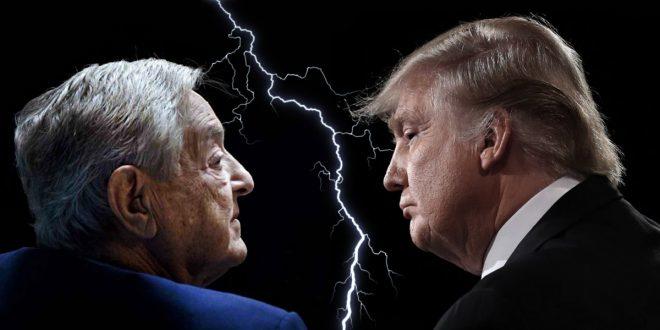
But where is the Right’s George Soros?

Where is the Right’s Transition Integrity Project and accompanying war-gaming of the possibilities this fall?

Are Republicans preparing for the political complications that will inevitably result from the hundreds of lawsuits Democrats have filed and will file in the future?

Where are the Republican party’s 600+ lawyers-in-waiting?

Where are the Right’s meetings for activist and lobbying groups to plan to protect the polling places and put people in the streets for weeks after the election?

What we know for sure is that it is very likely that we will not know the results of the election for weeks after election day. This should now be the assumption of every thinking person on the Right. The question is: what are we going to do about it?

via ZeroHedge News https://ift.tt/2EOo2fY Tyler Durden

Trump Pushed To Condemn White Nationalist Proud Boys, Instead Tells Them ‘Stand Back and Stand By’

trumpproudboys_1161x653

In tonight’s debate between President Donald Trump and former Vice President Joe Biden, the protests and violence in several American cities over the summer dominated the second half of the discussion.

Biden was pressed (as he has been this summer) to disavow violence and rioting by antifa protesters. Biden did so, saying “Violence is never appropriate.”

Host and Fox News anchor Chris Wallace then noted that Trump has been criticized repeatedly for refusing to denounce the violence that comes from white nationalists at some of these protests. Wallace asked Trump, “Are you willing tonight to condemn white supremacists and militia groups to say they need to stand down and not add to the violence in a number of the cities as we saw in Kenosha and as we’ve seen in Portland?”

Trump said, “Sure, I’m willing to do that, but I would say, almost everything I see is from the left-wing, not from the right-wing.” After demanding from Wallace specific names of groups he should condemn, Biden and Wallace settled on the Proud Boys, a white nationalist group. Trump responded not with condemnation but by saying “Proud Boys, stand back and stand by.” Then he veered the discussion immediately toward antifa violence, saying “I’ll tell you what. Somebody’s gotta do something about antifa and the left, because this is not a right-wing problem, this is a left-wing problem.”

That’s not a condemnation. Trump still, unlike Biden, seems unable to repudiate violence from people who support him. The clip from C-SPAN is below:

Trump can sometimes speak unclearly, so some will point to his vague verbal style to excuse tonight’s comments. Regardless of the president’s intent, the Telegram account for the Proud Boys reportedly immediately made a mockup a logo with “Stand Back” and “Stand By” as text, suggesting that the message they received is to wait for potential action. The Daily Beast reports that Proud Boys leader Joe Briggs wrote on Parler that in reality, “Trump basically said to go fuck them up. This makes me so happy.”

from Latest – Reason.com https://ift.tt/3idq2fq
via IFTTT

Donald Trump Says Joe Biden Is the Candidate of Perpetual COVID-19 Lockdowns

upiphotostwo763988

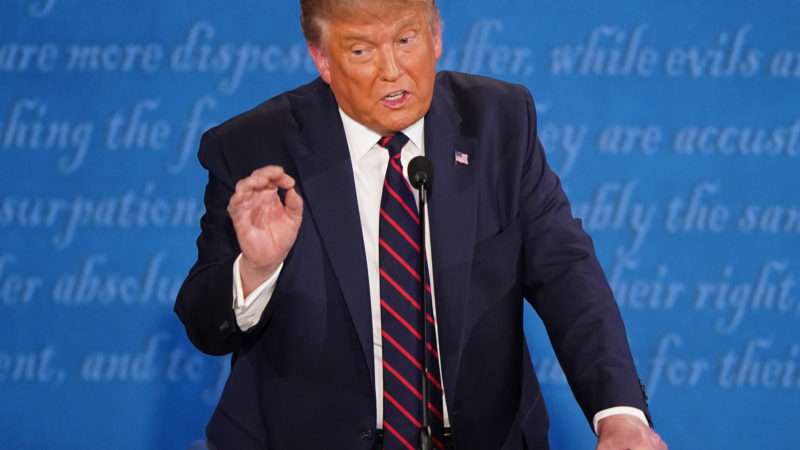
In the first presidential debate on Tuesday night, moderator and Fox News anchor Chris Wallace did Joe Biden no favors when he noted that the Democratic nominee seemed more hesitant than incumbent President Donald Trump when asked about reopening the country after coronavirus-related closures. In response, Trump seized the moment and successfully painted his opponent as the avatar of painful, economy-wrecking lockdowns.

In a chaotic, horrendous debate in which few actual substantive ideas were debated productively—and no one came off looking good—this was clearly a strong moment for the incumbent.

“[Biden] wants to shut this country down and I want to keep it open,” said Trump. “He wants to shut it down again. He will destroy this country.”

The president claimed that shutting down the country was necessary at the beginning of the COVID-19 pandemic, but that the potential for long-term damage means states should prioritize reopening. Trump also called out individuals states and cities run by Democratic politicians—Pennsylvania, New York City, and others—and claimed that continued lockdowns were destroying jobs, families, and small businesses.

“It’s almost like being in prison,” said Trump. “Look at what’s going on with divorce, alcoholism, drugs. It’s very sad. [Biden] will close down the whole thing. We don’t need someone to come in and shut it down.”

When it was his turn to respond, Biden pivoted. Bafflingly, he mostly refused to rebut the charge that he would shut down the economy again. Instead, he accused Trump, and wealthy people in general, of continuing to rake in millions and billions while common people were suffering.

“The difference is millionaires and billionaires in the COVID crisis have done very well,” said Biden. “You folks in working-class towns, how are you doing?”

It was clearly an effort to discuss the recent New York Times story about Trump paying very little in income taxes over the years. This is a perfectly fine line of attack, but it didn’t really address the topic at hand: ruinous coronavirus lockdowns. But if Trump wanted viewers to believe that Biden would shut down the economy again at a moment’s notice, Biden did little to dispel this notion. He claimed that businesses and schools needed more money in order to thrive and that he would work with congressional leaders to provide them with financial and logistical support. On the other hand, it seemed clear that Trump wants to reopen schools—a top demand of frustrated, working-class parents in large cities run by Democrats—whereas Biden might defer to the special interests within his political coalition: namely, pro-shutdown teachers unions.

This seems like one of the stronger arguments Trump can make for reelection: Vote for me, or the economic and social misery relating to pandemic-era restrictions will continue, possibly getting worse. It’s an argument quite at odds with the president’s actual record, of course: As the death toll climbs past 200,000, the Trump administration has largely failed to prevent coronavirus-related misery. But Biden could have forcefully clarified that he will work to return the U.S. to normal as swiftly as possible, even in the absence of funding allocated by Congress. He didn’t.

from Latest – Reason.com https://ift.tt/3kVzaaf
via IFTTT