Quants Discover A Guaranteed Source Of Alpha: Just Trade Based On The Growth Of The Fed’s Balance Sheet

Quants Discover A Guaranteed Source Of Alpha: Just Trade Based On The Growth Of The Fed’s Balance Sheet

Tyler Durden

Sun, 09/27/2020 – 17:14

It was almost 9 years ago in January 2012 when – in a world that was becoming increasingly centrally-planned by central banks and disconnected from fundamentals – we first recommended to readers that the simplest way to generate alpha and outperform the broader market was to do the opposite of what Wall Street’s professionals were doing, and go long the most hated stocks. This is what we said one year later, in 2013, when reviewing and doubling down on this very strategy:

…  in a world in which nothing has changed from a year ago, and where fundamentals still don’t matter, what is one to do to generate an outside market return? Simple: more of the same and punish those who still believe in an efficient, capital-allocating marketplace and keep bidding up the most shorted names.

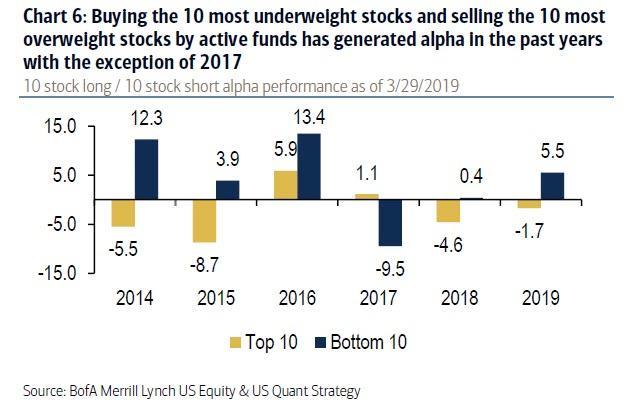
Fast forward to early 2019 when none other than Bank of America confirmed that we were correct: as the bank’s chief equity strategist Savita Subramanian wrote last April, “over the last several years, buying the most underweight stocks by large cap active funds and selling the most overweight stocks by large cap active funds has consistently generated alpha.”

As the bank added, the 10 most neglected stocks had outperformed the 10 most crowded stocks by an annualized spread of 8.4% on average during the first 15 days of each quarter since 2012. This is shown in the chart below which reveals that buying the 10 most underweight stocks and selling the 10 most overweight stocks by active funds has generated alpha every year in the past five except 2017.
Ok fine, as we said nearly a decade ago, going long the most shorted names has been a source of incremental alpha for much of the past decade (a time when most hedge funds had abandoned alpha generation altogether, and instead focused on levered beta strategies in hopes of halting the melting of the ice cube that is the “2 and 20” model).

But what if there is an even simpler strategy to beat the market and generate alpha? According to SocGen quants including Solomon Tadesse, Andrew Lapthorne and others, who last week penned a note titled “Can quants make money by tracking the Fed books?” there is, and it involves that other strategy we have been pounding the table on for much of the past decade, namely to trade alongside the Fed’s balance sheet which has become the dominant price setter in this bizarro, upside down market.

Before we get into the details of the proposed trade, here is some background which we provide solely for the benefit of the handful of remaining idiots who still claim the Fed does not influence stock prices:

The Fed balance sheet and the stock market

Monetary policy historically dictates asset price dynamics, with low interest rates and accompanying expansionary monetary policy supporting risk asset rallies and monetary contractions by contrast driving market retreats. This has increasingly been more obvious since the Great Financial Crisis of 2008, where financial market reactions appear to have become increasingly aligned and dependent on central bank actions.

Indeed, with the advent of QE programmes as monetary policy tools in the wake of the 2008 GFC, the trajectories of market performance and the Fed balance sheet appear to have converged into lock step. Total assets on the Fed balance sheet have expanded from $2.24tn at the end of 2008 to the current level of about $7tn, for 216% growth, while the S&P 500 rose from 903.25 to about 3340, netting cumulative growth of about 270% during the same period. Over the course of the current  pandemic, the Fed balance sheet has increased from $4.67tn on 18 March 2020 (a week before the market bottom) to $7.01tn, growing by 50%, while the S&P 500 has risen by 42% during the same period.

This broad view of the relationship between Fed actions and stock market performance appears to suggest a causal link going from central bank policies to asset prices. The question then is how predictable are asset returns based on prior Fed actions, and whether such predictability can be utilised in enhancing investment performance?
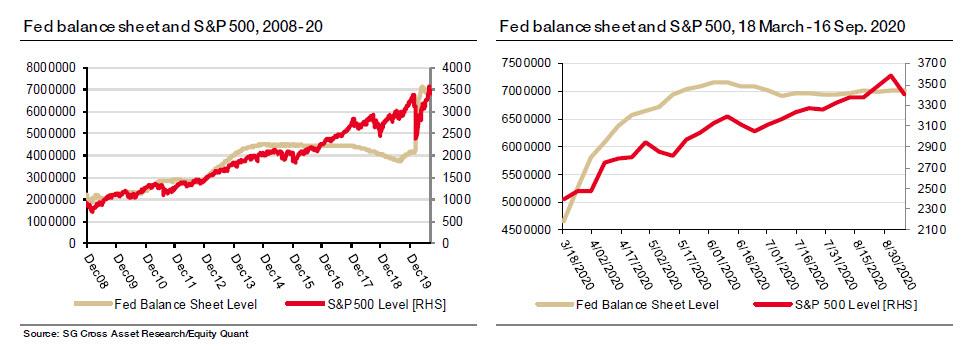
How predictable indeed, and has the Fed forcibly made its policies so transparent yet market-moving to ensure that everyone can partake in the market “upside”? Before we get into the experimental specifics, here is a summary of the simple strategy proposed by the SocGen quants – to trade in lockstep with the change in Fed’s balance sheet:

  • Since the Great Financial Crisis of 2008, financial markets appear to have become increasingly aligned with central bank actions and increasingly less connected to economic fundamentals. So, should you simply follow the Fed? The above observation is now generally expected, and there is a plethora of charts circulating showing the relationship between the size or the growth of the Fed balance sheet and a variety of risk assets. But can we use this information systematically to inform our investment decisions?
  • The sheer scale of these unconventional measures does seem to have also made asset returns more predictable, and performance appears increasingly contingent on central bank actions. This provides a potential opportunity for investors.
  • And with the Fed committing to maintain its asset purchase programmes “at least at the current pace to sustain smooth market functioning”, and with ultra-low rates expected to at least until 2023, according to the Fed, it is clear these unconventional monetary policies are going to remain a key driver of markets for some time.

To help confused Gen-Z investors (and other hedge funds), the SocGen note introduces a simple tactical alpha strategy that uses the growth of the Fed balance sheet to measure the degree to which monetary expansion is supporting risk-asset rallies. The strategy, implemented in the context of the classic long-only equity/cash decision, “provides supportive evidence of market predictability and the potential to utilize measures of unconventional monetary policies in designing systematic strategies.”

In short, all one needs to outperform the market is to front- or even back-run the Fed’s balance sheet growth.

More importantly, “the simulation generates a sizable outperformance with a reasonable success rate” and while illustrative, the strategy provides a framework to extend to analogous risk -on/-off cases involving other asset classes, as well as the design of more complex long/short strategies with leverage.

Some experiment observations. As Lapthorne, Tadesse et al write, to check if these contemporaneous correlations might suggest causality, the figures below present the correlation of weekly growth (log differences) in total Fed balance sheet assets with lagged and subsequent returns of the S&P 500 index. It shows the correlation between the Fed’s asset expansion/contraction in week t and stock market returns in week t + k, where correlations at negative values of k indicate the Fed’s response to lagged stock returns, and correlations at positive values of k show stock market’s reactions to the Fed’s actions.

The negative correlation between lagged stock market performance and current growth in Fed assets (left-hand chart) means that stock market declines increase the likelihood of Fed action in the form of balance sheet expansion. On the other hand, the positive correlation between subsequent stock market performance and current Fed asset growth means that Fed balance sheet expansion leads to positive stock market performance. The impact of Fed asset growth on equity markets lasts, on average, for the subsequent four weeks.

Consistent with economic priors, balance sheet expansion leads to stronger positive market returns, and our analysis shows that this lasts for up to four weeks, following the policy change (left figure), with a peak observed at three weeks. On the other hand, and contrary to expectations, Fed balance sheet contractions are also followed, on average, by market rebounds, although the strength of these correlations were much weaker in the initial three weeks, with a stronger bounce on the four-week mark.
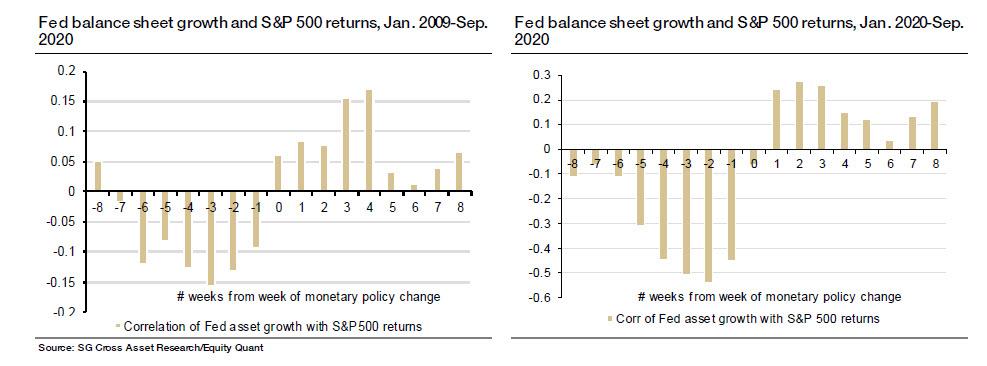
As the strategists explain, while there appears to be a small announcement effect at week 0, the market reaction appears gradual. This is consistent with the notion that Fed asset purchases primarily impact the stock market through liquidity spill-overs from the other asset classes that are the target of the direct asset purchases (i.e. Treasuries, MBSs, and corporate bonds). It may also reflect the impact of subsequent equity repricing from lower cost of capital due to the Fed actions.

How to trade these observations?

As SocGen’s strategists lay it out, the design of investment strategies that utilize Fed actions need to consider the distinctive lead-lag correlations between Fed expansion and Fed contraction. As a broad illustration, the bank quants design a weekly tactical alpha strategy based on Fed asset growth that aims to boost investment returns by selectively overweighting riskier assets during Fed monetary expansion regimes. To that end, the quants used weekly Fed balance sheet data over the period of 2009 and Sep. 2020 – a period of intensive use of unconventional monetary policy tools.

The strategy consists of using a classic equity-cash allocation with the goal of generating excess returns by systematically tilting towards risk opportunistically following expansionary monetary policy. As an illustration, a long-only portfolio with a strategic allocation of 75/25 between equity and cash was constructed, with a 25% risk budget allocated for tactical alpha, but this can easily be adapted to an equity/bond mix or a long/short strategy.

The evidence shows that the impact of Fed asset growth lasts on average for four weeks with the lead-lag correlation to cumulative S&P returns peaking at around the fourth week. The input to the strategy is the weekly growth rate in the Fed total assets, and the strategy seeks to allocate more to equities (from safe asset holdings) during periods of monetary easing as reflected in the growth in Fed assets.

Table 1 below summarizes the performance of this simple tactical tilting strategy. It should come as no surprise to almost anyone, that a systematic tracking of the Fed balance sheet adds value, with the strategy generating annualized excess returns of about 250bp per annum with a tracking error of similar magnitude, providing a risk-adjusted alpha of one, at hit rate above 60%.
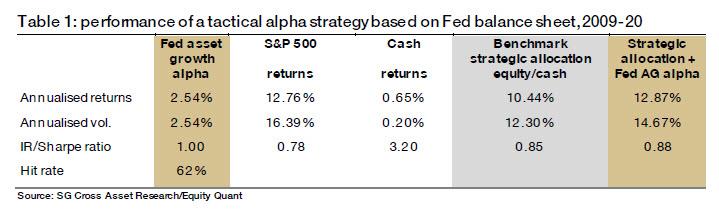
Comparing the performance of the “tactically-boosted” portfolio against the traditional 75/25 benchmark, total returns would have gone up to 12.9% from 10.4%, while the Sharpe ratio improves only modestly as overall volatility would also pick up.

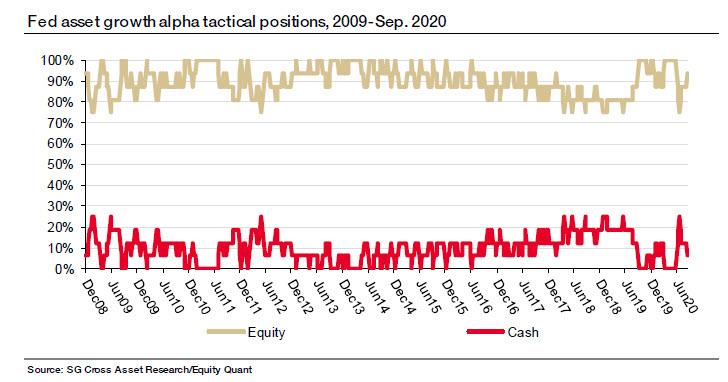
As laid out in the next chart below, the positioning of the strategy shows that the portfolio broadly tracked the monetary policy stance, as reflected in the Fed balance sheet during the period. During the winding down of QE and quantitative tightening in 2017 and 2018 all through half of 2019, the portfolio largely took off its equity bet, staying with its max cash positions, only to get go back to equity starting in the latter part of 2019 as monetary easing began. It was also heavily tilted towards equity in the heyday of QE in 2010 through 2014, with periodic shifts to cash during moments of a lull in asset purchases.
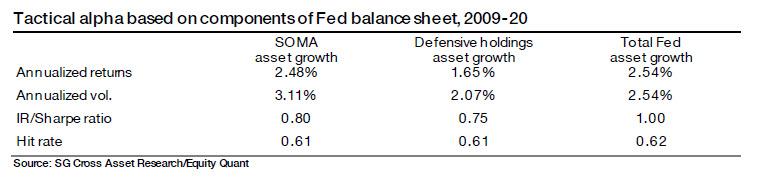
To conduct the above analysis, SocGen’s quant used the growth in the total assets of the Federal Reserve to design the tactical alpha strategy. A large part of the strategy performance and of market predictability seems to come from the QE-laden SOMA component of the Fed balance sheet (table below), though with higher volatility. There is also evidence that changes in the defensive holdings of the balance sheet (which includes repo and the dollar-swap facilities, which are largely used during crises) may contain some information. Finally, despite the small (realized) size and sporadic nature of the back-stop facilities component, the symbolic role of these programs – which include the Corporate Credit, Main Street, Commercial Paper, Money Market Mutual Fund Liquidity, Municipal Liquidity, Term Asset-Backed Securities and other facilities that were introduced during the current crisis – to instil market confidence cannot be overemphasized. Thus, as the quants conclude “using the overall Fed assets may provide signal diversity across the three pillars, aggregating information on unconventional policies across all domains of Fed activities.

* * *

In summary, to generate scare alpha in the current environment, one can either be a die-hard contrarian and repeatedly go long the most hated/shorted names, or can pursue an even simpler  tactical alpha strategy that uses information on the growth of the Federal balance sheet as a signal of the degree of monetary expansion that generally supports risk-asset rallies.

As SocGen concludes, the strategy implemented in the context of a long-only equity/cash decision provides some evidence of the potential to utilize measures of unconventional monetary policies in designing systematic strategies. The simulation generates a sizable outperformance with a reasonable success rate, which one would naturally expect in a world where trillions in Fed balance sheet expansions lead to record stock market rallies.

That said, unlike the “go long the most hated names” which is a pure alpha trade, the Fed balance sheet-tracking strategy proposed by SocGen is implementable as an overlay through trading on futures or other derivatives, and is meant to add an incremental 2.5% or so to overall returns. As Lapthorne et al wrap up, “while illustrative, the strategy provides a framework to extend to analogous cases of risk -on/- off cases involving other asset classes, as well as the design of long/short strategies with leverage. Given the multitude of factors that bear on asset performance, the Fed balance sheet signal could also be blended with other factors in multi-factor settings to enhance portfolio performance.”

via ZeroHedge News https://ift.tt/3kTlkVE Tyler Durden
Highly-Educated Americans Are By Far The Most Closed-Minded; Gallup

Highly-Educated Americans Are By Far The Most Closed-Minded; Gallup

Tyler Durden

Sun, 09/27/2020 – 16:40

Authored by Eric Zuesse via The Strategic Culture Foundation,

On September 11th, Gallup headlined “Bias in Others’ News a Greater Concern Than Bias in Own News”, and reported (based upon polling a randomized sample of 20,046 American adults) that:

69% of Americans say they are more concerned about bias in the news other people consume than its presence in their own news (29%).” 

In other words: 69/29, or 2.38 times, as many Americans are closed-minded (prejudiced) regarding information-sources which don’t fit their ideology, than are not. Overwhelmingly in America, only Democratic Party information-sources are trusted by Democrats, and only Republican information-sources are trusted by Republicans. Each side distrusts the other’s information-sources. Gallup’s news-report aptly noted the important fact that “This plays into the political polarization in the U.S. national discourse.” 

The more prejudiced a population are, the more polarized it will be. Of course, one would expect this to be the case, but Gallup has now found striking new empirical evidence for it — that the public’s closed-mindedness is greatly increasing America’s political polarization. Each side is craving propaganda instead of truth, but each side’s voters want only the type of propaganda that is funded by the billionaires who also fund that side’s politicians and control that side’s ‘news’ media. Consequently, American politics is controlled by the conflict between liberal billionaires versus conservative billionaires — totally controlled by billionaires (instead of by the public). There is the liberal herd, and the conservative herd, but they’re both herds — not by the public in an actual democracy. And each of these two herds is controlled by its shepherd, who are its billionaires. (Here is how that’s done.) Billionaires control each Party and thereby control the Government. This is why the Government ignores the preferences of America’s public. As will be shown here, the September 11th Gallup findings help to explain how and why that results.

Neither Democrats nor Republicans can become exposed to the other side’s evidence and arguments unless they see those — the other side’s evidence and arguments, both for its own case and against the opposite side’s case (i.e., against the case that oneself believes). Not to see the opposite side’s viewpoint is to be blind to it, and thus to become locked into whatever oneself believes. This 69/29 is like a jury’s rendering its verdict and nearly three quarters of the jurors having not listened to — and thus not considered — the opposite side’s presentations. That’s a frightening situation to exist in any court of law, and it is an equally frightening situation to exist in any nation’s electorate.

As a consequence of Americans’ strong tendency to be closed-minded, America’s politics are, to a very large extent, driven more by prejudices than by the realities that the public are actually facing. Individuals are seeking for sources that will likeliest confirm what they already believe, and are seeking to avoid sources that are the likeliest to disconfirm their beliefs. This is consequently a population that’s highly vulnerable to being manipulated, by playing up to, and amplifying, the given Party’s propaganda, to which the given individual already subscribes. Republican Party billionaires (by their use of their conservative newsmedia and think tanks, etc., which they control) can easily manipulate Republican Party voters, and Democratic Party billionaires can, likewise, easily manipulate Democratic Party voters, by their liberal media, think tanks, etc. That’s billionaires, on each of the two sides, guiding each of the two Parties’ voters; and, therefore, the nation is an aristocracy — a country which is controlled by its wealthiest few — instead of an authentic democracy (which is controlled not by the numbers of dollars, but actually by the numbers of residents, each one of whom is independently and open-mindedly seeking for credibly documented facts). An aristocracy rules any such land.

The public are not the rulers in such a nation. It’s not a democracy; it is a collective dictatorship, by its billionaires (its aristocracy).

Both of the two Parties’ voters vote in accord with their billionaires’ agenda, but especially in accord with whatever is on the agenda that’s shared by both liberal and conservative billionaires — billionaires fund both of the national Parties: Democrats and Republicans, and thereby control both Parties. Billionaires, in each Party, have their very golden, very heavy, thumbs, pressing down hard upon the scale of any such ‘democracy’, such that regardless of which group of billionaires ends up winning any ultimate election, the public inevitably will lose, because it’s really just a contest between billionaires, who are stage-managing the nation’s entire political proceedings. This is like two boxers fighting in a ring, in which the selection-process which placed them there was corrupt; and, so, even if the ultimate winner is not equally corruptly pre-determined, the final result has nonetheless already been rigged (during the primaries). When the contenders have been selected by a corrupt process, the ultimate outcome cannot be a democracy.

This happens not only regarding elections, but regarding particular issues. For example, in 2002 and 2003, “regime-change in Iraq,” and “Saddam’s WMD,” were just as much agendas of liberal billionaires’ media and think tanks as they were of conservative billionaires’ media and think tanks (and were thoroughly based on lies); so, a closed-minded public were actually trapped, into the lies that were agreed-upon by both sides of the domestic American political spectrum — the sides that are funded and controlled by the liberal billionaires, and by the conservative billionaires. The nearly $2 trillion cost of the invasion and military occupation of that country, and the consequent destruction of that country, were done for America’s billionaires, and produced nothing for the American people except that enormous public debt and those injuries and deaths to America’s soldiers and to Iraqis. And that’s typical, nowadays, in this (just as in any) aristocracy: the aristocracy are served; the nation’s public serve to them. (In the U.S., this has caused “U.S. Satisfaction at 13%, Lowest in Nine Years”, as Gallup headlined on 4 August 2020; and it has caused Americas’ satisfaction with their Government to have ranged from its all-time low of only 7% in 2008, to its all-time high of only 45% at the very start of 2020 — well below 50%, for as long as Gallup has surveyed this.)

What all of the billionaires want is what the American public get as their Government. It’s bipartisanship amongst its billionaires. That’s what produces this Government’s policies. It’s what determines the Government that Americans get. However, what is basic in making it a dictatorship of the aristocracy-type (such as this America is) is that the population is very prejudiced, not open-minded — not each individual constantly seeking solid evidence to change one’s mind about how society works (what the reality in the nation actually is), so as for one’s view to become increasingly accurate over time. Instead, one’s myths are constantly being fed. Such a public, as this, are not individuals, in a democracy, but more like mobs, very manipulable.

Often, America’s bipartisan views are based upon lies that virtually all billionaires want the public to believe. In such cases — and these instances are frequent — the truth is being simply ignored, or else outright denied, by both sides (and by the media, for both sides). Individuals’ prejudices are thus being increased, instead of reduced, by what the public see and hear in “the news.” Everyone has prejudices, and truth can predominate only if people are constantly skeptical of the sources that they are relying upon — constantly trying to root out and replace whatever false beliefs they have. This is the essence of scientific method. Democracy depends upon it. Aristocracy requires the opposite. America has the opposite.

Change away from this present situation, to a democracy, would be difficult. On both of America’s political sides, there needs to be far less trust of the Establishment (including its politicians, its media, its think tanks, etc.), in order for any real democracy to become able to exist. It’s not even able to exist now. And, therefore, it does not exist.

But what is even more depressing is that America’s educational system, most especially its colleges and universities, are encouraging, instead of discouraging, this situation, this closed-mindedness. The more educated an American is, the more closed-minded that person becomes — as is further shown in this same September 11th Gallup news-report:

Whereas 52% of Americans with a high school education or less are more concerned about bias in others’ news than in their own [and 45% of that minimally educated group think that the news which they are reading might be biased], the figure is 64% among those with some college education and is even higher among college graduates (73%) and those with postgraduate education (77%) [and only 22% of that maximally educated group think that the news which they are reading might be biased].”

The most-educated Americans are the most-manipulable (the most closed-minded) Americans.

No finding in this Gallup report was as extreme as the finding that the more highly educated an American is, the less open that person is likely to be to changing his or her mind (outlook) about the situation. In other words: the more educated an American is, the more closed-minded that person tends to become. Higher education in America increases, instead of decreases, an individual’s closed-mindedness. However, other contrasts which were almost as extreme are:

“Those who identify as liberal (80%) are more concerned than conservatives (68%) and moderates (65%) with other people’s media bias. 

In other words: liberals are 80/65 or 1.23 times as closed-minded as are moderates, and are 80/68 or 1.18 times as closed-minded as conservatives are.

“While 58% of Black adults are more concerned about bias in others’ news than in their own, fully 73% of Asian Americans and 72% of White adults say the same.” 

Thus, African-Americans are 58/72.5 or 80% as closed-minded as are Euro-Americans and Asian-Americans.

This is the worst combination possible: it’s a closed-minded population, which is especially closed-minded amongst its most educated segment. The leading segment is also the most closed-minded segment. These are crucial agents of the billionaires, and they crucially inculcate into the next generation of Americans the aristocracy’s values.

This means that the leaders keep themselves, conceptually, inside a cocoon. They have minimal contact with the most vulnerable members of the society, which is the less-educated members. That enhances inequality of opportunity, throughout the society. Since the most-highly-educated Americans are the group that are the most-closed to opinions which are contrary to their own, it’s easy for the most-highly-educated Americans to view individuals who disagree with those persons’ views as being simply a “basket of deplorables.” Their disagreement then becomes their contempt.

‘Facts’ about politics are — for those persons, highly educated persons — more derived from their values and priorities, than their values and priorities are derived from the political facts. Scientific epistemology is being turned upside-down, regarding political issues, in such a country. Overwhelmingly, some sort of faith, instead of any sort of science, determines what individuals in such a country believe about politics. In every aristocracy, this is the way that both conservative and liberal persons view any persons in the general public who oppose themselves: they’re viewed as being a “basket of deplorables.” It’s the very essence of elitism — on both sides. (For prominent examples of this: both Hillary Clinton and Donald Trump had contempt for each-others’ voters — blotted them out.)

The leadership’s minimal contact with the public makes exceedingly unlikely the leadership’s compassion, concern about the sufferings that they, themselves, are causing down below. Actually, though every aristocracy claims to want to improve conditions for their public, the reality is that whenever doing that would entail their own losing power, that claim becomes exposed to be sheer hypocrisy — a lie; often a self-deception, and not merely a deception against the public. Deceiving themselves about their own decency is easy, because they have minimal contact with the most vulnerable members of the society, the very people whom they claim to care the most about (and to be working in politics to help). Fakery is built into each and every aristocracy. Americans’ strong tendency to be closed-minded causes the aristocratic con to be widely accepted as if it were instead truth. (Again: the “WMD in Iraq” con was a good example of this — the aristocracy’s media just blocked-out the reality.) Scientific studies have even demonstrated that the wealthier a person is, the less compassion the individual tends to have for people who are suffering.

Furthermore, since the less-educated persons aspire to be more-educated, they are — even without knowing it — aspiring to become less open to contrary views, instead of to become more open to such views. One bad consequence of this is: it strangulates imaginativeness, openness, and creativity, in favor of being rote, rigid, and bureaucratic. Another bad consequence of it is that the authority-figures, in such a society, are, in some important ways, actually inferior to the rest of the population. Moreover, America’s colleges and universities are not increasing their students’ open-mindedness (as they should) but the exact opposite — they are reducing their students’ open-mindedness. Even if professors are teaching some truths, the professors are training their students to be authoritarian, instead of to be open to a more truthful, comprehensive, and deeper understanding, which encompasses those truths, but also many more — which the majority of professors either ignore or else deny, because such deeper understanding violates the existing Scripture, or standard viewpoint (shaped by both sides’ billionaires). At least in the United States, this is now the normal situation. That Gallup poll showed it not merely weakly, nor even only moderately, but extremely.

This is a perverse situation, which bodes ill for the future of the entire nation. Any country which is like this is not only an aristocracy instead of a democracy, but it is greatly disadvantaged, going forward. It will be disadvantaged both in the arts and in the sciences. Its future will be stultifying, instead of dynamic. Aristocracies tend to be this way. Also, because it will remain highly polarized, its internal ideological frictions will waste a large proportion of the nation’s efforts. As a nation, its forward-motion, its progress, will thus largely be crippled, by its internal discord and distrust, between the two warring factions of its aristocracy — and friction between the respective followers on each side.

This describes a declining culture — a nation that is in decline.

That’s what this poll-report, from Gallup, indicates, as clearly as any poll-findings can.

It indicates a nation in decline.

During the Presidential primaries in the Democratic Party, a major point of difference between the two major candidates, Joe Biden versus Bernie Sanders, was whether billionaires are bad for the country: Biden said no; Sanders said yes. (This was a major reason why the billionaires made sure that Sanders would lose.) In any country where wealth-inequality is so extreme, there can be no authentic democracy. America’s extreme inequality of wealth makes democracy impossible in this country. America’s other problems follow from that. In reality, it’s a one-party state, and that party is controlled not actually by the counts of voters, but by the counts of dollars. It is an aristocracy; and its decline — to what has been documented here — follows from that fact. Whatever democracy America might once have had is gone now. It has become replaced by a land of mass-deceptions, which are bought and sold.

via ZeroHedge News https://ift.tt/2Ger9y8 Tyler Durden

Amy Coney Barrett Condemns Purdue University’s ‘Fundamentally Unfair’ Adjudication of Sexual Assault Claims

Amy-Coney-Barrett-9-27-20-Newscom

John and Jane, two students in Purdue University’s Navy ROTC program, began dating in the fall of 2015 and had consensual sex 15 to 20 times. According to John, Jane’s behavior became increasingly erratic, culminating in a suicide attempt he witnessed that December. They broke up in January 2016, after John tried to get Jane help by reporting her suicide attempt to two resident assistants and an adviser.

Three months later, in the midst of the university’s s Sexual Assault Awareness Month, Jane alleged that John had sexually assaulted her on two occasions. Those charges ultimately led Purdue, a state university in West Lafayette, Indiana, to suspend John for a year, forcing him to resign from ROTC and ending his plans for a career in the Navy. The process that led to those results, Supreme Court nominee Amy Coney Barrett concluded in a 2019 opinion for a three-judge panel of the U.S. Court of Appeals for the 7th Circuit, “fell short of what even a high school must provide to a student facing a days-long suspension.”

The case, which Ben McDonald covered here last year, illustrates the extent to which universities, responding to a 2011 “Dear Colleague” letter from the U.S. Department of Education, created procedures that effectively presumed the guilt of students charged with sexual assault. That letter warned university officials that their handling of such cases would be scrutinized under Title IX, which prohibits sex discrimination in educational programs that receive federal funding. The department broadened the definition of “sexual harassment,” required schools to assess charges based on a “preponderance of the evidence” (meaning they are more likely than not to be true) rather than a stricter standard, and encouraged other short cuts by universities keen to maintain federal funding.

The upshot was that many students facing sexual assault charges did not receive anything resembling due process. The plaintiff in this case, identified in court documents as “John Doe,” was accused of digitally penetrating his then-girlfriend, identified as “Jane Doe,” while she was asleep and, on another occasion, groping her over her clothes, also while she was asleep. John denied both accusations, citing Jane’s continued friendly texts with him after both alleged incidents, noting that a roommate who was present on one of those occasions denied that anything like what Jane described had happened, and offering the testimony of character witnesses. He also suggested that Jane was angry with him because he reported her attempted suicide, an intervention that had precipitated their breakup.

But John never really got a chance to present a defense, because university officials had already made up their minds. Barrett’s description of what happened is based on John’s account, because at this stage of the case she was deciding whether he had stated legal claims against the university that he should be allowed to pursue, assuming the facts he alleged were true. But most of the facts, especially as they relate to the university’s biased process for investigating sexual assault allegations, are undisputed.

Although Jane never filed a formal complaint and never testified about the alleged assaults, the university pursued the case on her behalf. John said he first heard about the allegations when he received a letter from Katherine Sermersheim, Purdue’s dean of students and a Title IX coordinator. At that point, Barrett notes, “John was suspended from the Navy ROTC, banned from all buildings where Jane had classes, and barred from eating in his usual dining hall because Jane also used it.”

Sermersheim charged two underlings with investigating Jane’s allegations. Their report was submitted to a three-person panel of Purdue’s Advisory Committee on Equity, which was responsible for recommending how the university should respond. John was not allowed to see the full report, but a Navy ROTC representative gave him a redacted version a few minutes before John was scheduled to appear before the committee. John discovered that the investigators claimed he had confessed—which was not true, he said—and that they had omitted any reference to Jane’s suicide attempt, which was relevant in evaluating her credibility and her possible motive for making false charges.

John and the “supporter” he was allowed under Purdue’s rules met with the advisory committee for half an hour. “The meeting did not go well for John,” Barrett notes. “Two members of the panel candidly stated that they had not read the investigative report. The one who apparently had read it asked John accusatory questions that assumed his guilt. Because John had not seen the evidence, he could not address it. He reiterated his innocence and told the panel about some of the friendly texts that Jane had sent him after the alleged assaults. The panel refused John permission to present witnesses, including character witnesses and a roommate who would state that he was present in the room at the time of the alleged assault and that Jane’s rendition of events was false.”

A week later, John received a letter in which Sermersheim said she had found him guilty by a preponderance of the evidence. She suspended him for a full academic year and conditioned his return to school on completion of “bystander intervention training” and meetings with Purdue’s Center for Advocacy, Response, and Education, which supports victims of sexual violence.

John appealed Sermersheim’s decision to Alysa Rollock, Purdue’s vice president for ethics and compliance, who asked Sermersheim to explain the factual basis for her finding. Sermersheim said she had found John guilty based on her assessment of his credibility and Jane’s. “I find by a preponderance of the evidence that [John] is not a credible witness,” she wrote. “I find by a preponderance of the evidence that [Jane] is a credible witness.” Although Jane never appeared before the advisory committee and Sermersheim never talked to her in person, that assessment was good enough for Rollock, who confirmed Sermersheim’s ruling and the sanctions that accompanied it.

John, who was forced to leave Navy ROTC because of that decision, sued Sermersheim, her investigators, Rollock, Purdue President Mitch Daniels, and the university’s trustees in 2017, arguing that his treatment violated the 14th Amendment’s guarantee of due process and Title IX’s ban on sex discrimination. After a federal judge dismissed all of his claims, Barrett and two other 7th Circuit judges concluded that John’s due process and Title IX claims against the university should have survived.

Regarding the due process claim, the judges found that the damage to John’s career plans affected a “liberty interest” protected by the 14th Amendment. And taking the facts stated by John as true, they said, it was clear that Purdue’s procedures fell short of due process.

“John received notice of Jane’s allegations and denied them, but Purdue did not disclose its evidence to John,” Barrett wrote for the unanimous three-judge panel. “Withholding the evidence on which it relied in adjudicating his guilt was itself sufficient to render the process fundamentally unfair.”

There were other problems with Purdue’s process. “At John’s meeting with the Advisory Committee, two of the three panel members candidly admitted
that they had not read the investigative report, which suggests that they decided that John was guilty based on the accusation rather than the evidence,” Barrett noted. “And in a case that boiled down to a ‘he said/she said,’ it is particularly concerning that Sermersheim and the committee concluded that Jane was the more credible witness—in fact, that she was credible at all—without ever speaking to her in person. Indeed, they did not even receive a statement written by Jane herself, much less a sworn statement. It is unclear, to say the least, how Sermersheim and the committee could have evaluated Jane’s credibility.”

Sermersheim and the committee also gave short shrift to John’s countervailing evidence. “Sermersheim and the Advisory Committee may have concluded in the end that John’s impeachment evidence did not undercut Jane’s credibility,” Barrett wrote. “But their failure to even question Jane or John’s roommate to probe whether this evidence was reason to disbelieve Jane was fundamentally unfair to John.” And because Jane never testified, John never had a chance to cross-examine her.

In these circumstances, Barrett and the two other judges concluded, John should be able to seek an injunction requiring the university to expunge its finding of guilt from his disciplinary record, thereby removing a crucial obstacle to his career plans. They also found his allegation of sex discrimination plausible.

John argued that the Education Department’s 2011 guidance, which Education Secretary Betsy DeVos has reversed precisely because of concerns about its impact on due process, gave Purdue a financial incentive to slant its adjudication process against male students like him. While the letter may be relevant in evaluating Purdue’s motive, Barrett said, it is not enough, by itself, to make John’s sex discrimination claim credible.

But Barrett noted additional evidence cited by John, including the fact that “Sermersheim chose to credit Jane’s account without hearing directly from her.” According to John’s lawsuit, the advisory committee was “similarly biased in favor of Jane and against John.” Barrett thought it was “plausible that Sermersheim and her advisors chose to believe Jane because she is a woman and to disbelieve John
because he is a man.”

Barrett also noted a Washington Post article that Purdue’s Center for Advocacy, Response, and Education (CARE) “put up on its Facebook page during the same month that John was disciplined.” The headline: “Alcohol Isn’t the Cause of Campus Sexual Assault. Men Are.” That statement, “which CARE advertised to the campus community, could be understood to blame men as a class for the problem of campus sexual assault rather than the individuals who commit sexual assault,” Barrett wrote. Notably, CARE’s director wrote a letter about Jane’s charges that “Sermersheim apparently gave significant weight.”

None of this necessarily means that John will ultimately win his lawsuit, which remains unresolved. But Barrett thought he should at least get a chance, and her reasoning reflects a concern about due process that should be welcomed by people on the left as well as the right.

That probably will not happen, however. Adam Liptak, who covers the Supreme Court for The New York Times, cites John Doe v. Purdue University in an article that says Barrett “has compiled an almost uniformly conservative voting record in cases touching on abortion, gun rights, discrimination and immigration.” He mentions the case under the “discrimination” heading, implying that her position reflected insensitivity to that concern. But leaving aside the fact that John claimed he was a victim of sex discrimination, Barrett’s opinion is mainly about due process, the lack of which may or may not have been related to John’s sex but should in any case trouble any fair-minded person.

Liptak contrasts Barrett with her mentor, the late Justice Antonin Scalia, for whom she clerked in the late 1990s. “While Justice Scalia’s methods occasionally drove him to liberal results, notably in cases on flag burning and the role of juries in criminal cases,” he says, “Judge Barrett could be a different sort of justice.” There is not much evidence to support that distinction, especially given Barrett’s opinions in cases involving the Fourth Amendment, excessive federal sentences, and qualified immunity for police officers. And if upholding the due process rights of someone facing sexual assault charges does not count as a “liberal result,” the term has lost all meaning.

from Latest – Reason.com https://ift.tt/3mYWHsL
via IFTTT

Hope For Hedge Funds? Market Volatility Has Investors Seeking Long-Short Strategies

Hope For Hedge Funds? Market Volatility Has Investors Seeking Long-Short Strategies

Tyler Durden

Sun, 09/27/2020 – 16:15

Few in the finance industry have suffered at the hands of Fed policy that has driven the stock market nowhere but up over the last decade more than hedge funds. Investors have left hedge funds in droves as the appeal of passive investing has grown, resulting in growing outflows and lower fees.

But now, with volatility returning to the market, it seems as though there could be some hope for hedge funds after all.

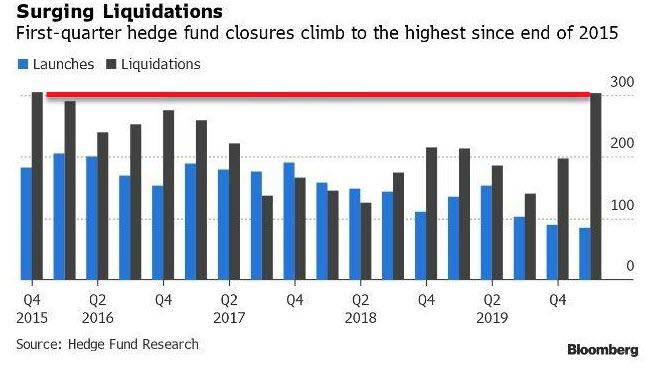
Recall, we noted this summer that hedge fund liquidations had soared to their highest level since 2015. HFR released a report in late June that showed 304 funds liquidated in 1Q20. This was the highest level of fund liquidation since the fourth quarter of 2015, when 305 funds shut down. Shown below, the number of closures in 1Q20 is about 50% higher than the last quarter in 2019.

The recent pullback in the market has some investors seeking out long-short fund strategies, according to Reuters. The S&P has fallen 10% from its Softbank-induced highs on September 2 and the aggressive valuations, mixed with the volatility, has many investors seeking protection. 

Long-short equity hedge funds fell 5.75% in March, while the market plunged, but also posted a gain of 13.67% in the first 8 months of 2020. They were the best-performing strategy in August, according to Nomura. Hedge fund assets amount to $3.6 trillion, globally. 

Philippe Ferreira at fund of hedge fund Lyxor Asset Management said: “We see great demand for strategies that protect from great volatility.”

He continued: “We are seeing flows into strategies that bring some form of protection. We are not seeing flows into strategies that are highly correlated to the market environment. There are many long-short that have a long bias and they are left by the sidelines at the moment. Long-short equity that is less correlated is in high demand.”

Long-short funds offer hedges (hence the name ‘hedge fund’) by shorting stocks and other strategies that give firms exposure to when markets move lower.  

Industry tracker eVestment shows searches for long-short equity funds at 17%, up from 11.1% in July. 

Rob Christian, co-head of research and investment management at hedge fund solutions group K2 Advisors, said: “Broadly, equity investors are trying to reduce their equity risk using long-short managers.”

Nigel Gliksten, partner at Toscafund Asset Management, said: “My view overall is that long-short equity generally fell out of fashion a few years ago and there is just starting to be a little bit more interest, from our experience.”

Matt Rowe, chief investment officer at asset-management firm Headwaters Volatility, concluded: “We have seen a big increase in inbound enquiries from family offices, institutional investors and banks, to layer in long volatility risk-reducing positions that would effectively create a long-short trade.”


via ZeroHedge News https://ift.tt/3iczgZc Tyler Durden

Morgan Stanley: Brace For A Very Difficult Trading Environment In The Next 5 Weeks

Morgan Stanley: Brace For A Very Difficult Trading Environment In The Next 5 Weeks

Tyler Durden

Sun, 09/27/2020 – 15:50

Sunday Start, by Michael Wilson, Morgan Stanley chief US equity strategist

The Waiting Is the Hardest Part

Over the past month, several key risks to markets have surfaced, producing the first meaningful correction in this new bull market. More specifically, the S&P 500 dropped over 10% from its recent highs, led by the 14% plunge in the Nasdaq 100. Truth be told, I thought this correction would arrive in August, but instead US equity markets experienced a blow-off move to the upside as real 10- and 30-year yields made all-time lows and retail speculation became rampant. Timing is everything, as they say. Nevertheless, the correction in which we find ourselves is happening for the reasons I suspected back in August.

  • First, the US is facing a fiscal cliff. With Congress embroiled in election-year politics and a tussle over when to fill the Supreme Court vacancy, the probability of CARES 2 getting passed before November 3 has dropped considerably – just 33% now, according to our public policy strategist Michael Zezas.
  • Second is COVID-19 and the looming arrival of a second wave. So far, Europe has seen a greater impact from the second wave, but we all know it’s coming to the US and other parts the world this fall/winter. Until we know exactly what it looks like, further lockdowns here remain a real risk, particularly given the role they could play in deciding the outcome of the US elections.
  • Third, real long-term interest rates appear to have bottomed as rates markets accept what the Fed has been saying all summer about yield curve control.
  • Finally, we have the election itself and the uncertainty surrounding not only the outcome, but also its validity and timing of a definitive result. 2020 has been an unusual year to say the least, and this election is the cherry on top.

In short, uncertainty has rarely been higher for financial markets.

Realized and implied volatility reflect these concerns, with both up substantially in the past month. Options markets are pricing in higher risk than normal around the US election, but nothing like we experienced in 2016. This doesn’t seem right, given the uncertainty about the election process and results that is building. As a result, I expect volatility to remain high for the next 4-5 weeks, creating what is likely to be a difficult trading environment. Despite this seemingly consensus view, both gross and net exposures for our institutional clients remain decidedly elevated. When volatility and beta are adjusted, they stand at all-time highs.

What this tells me is that if volatility stays high and markets remain fairly trendless, these exposures are likely to fall over the next month. That means lower equity prices before this correction is over. We have targeted the 200-day moving averages for the S&P 500 and Nasdaq 100 as good levels to think about, which are approximately 6% and 14% lower, respectively.

Looking beyond the near term, I think three of these risks are likely to be resolved positively by the end of the year or shortly thereafter. Meaning, more fiscal stimulus is likely as both parties want to spend more but may not be able to come to terms before the election. More market pressure will likely help to get it done sooner. Meanwhile, progress on a vaccine and natural herd immunity via a second wave should become clearer, and we will have a conclusion to the election. The waiting is the hardest part.

This leads me to my final point for this week’s Start. The recent correction was inevitable, in my view, as all bull markets consolidate along the way, especially when the initial rally is this powerful. Timing such corrections is difficult, and this time was no different. Now that it has begun in earnest, we need to start thinking about what to buy into this dip. If you share my view that these near-term hurdles will be cleared by year-end, this means that the recovery can continue in 2021. To me, this implies that recovery stocks should be the area of focus particularly if real rates have bottomed. This includes consumer cyclicals/services, materials, industrials and financials. Moving down the capitalization curve makes sense, too. Perhaps the best way to express such a view is to look at the equal-weighted S&P 500 versus the market cap-weighted version.

This typically works quite well coming out of a recession, and I see no reason to believe it won’t be the same this time.

Enjoy your Sunday.

via ZeroHedge News https://ift.tt/2S5WhCp Tyler Durden

Amy Coney Barrett Condemns Purdue University’s ‘Fundamentally Unfair’ Adjudication of Sexual Assault Claims

Amy-Coney-Barrett-9-27-20-Newscom

John and Jane, two students in Purdue University’s Navy ROTC program, began dating in the fall of 2015 and had consensual sex 15 to 20 times. According to John, Jane’s behavior became increasingly erratic, culminating in a suicide attempt he witnessed that December. They broke up in January 2016, after John tried to get Jane help by reporting her suicide attempt to two resident assistants and an adviser.

Three months later, in the midst of the university’s s Sexual Assault Awareness Month, Jane alleged that John had sexually assaulted her on two occasions. Those charges ultimately led Purdue, a state university in West Lafayette, Indiana, to suspend John for a year, forcing him to resign from ROTC and ending his plans for a career in the Navy. The process that led to those results, Supreme Court nominee Amy Coney Barrett concluded in a 2019 opinion for a three-judge panel of the U.S. Court of Appeals for the 7th Circuit, “fell short of what even a high school must provide to a student facing a days-long suspension.”

The case, which Ben McDonald covered here last year, illustrates the extent to which universities, responding to a 2011 “Dear Colleague” letter from the U.S. Department of Education, created procedures that effectively presumed the guilt of students charged with sexual assault. That letter warned university officials that their handling of such cases would be scrutinized under Title IX, which prohibits sex discrimination in educational programs that receive federal funding. The department broadened the definition of “sexual harassment,” required schools to assess charges based on a “preponderance of the evidence” (meaning they are more likely than not to be true) rather than a stricter standard, and encouraged other short cuts by universities keen to maintain federal funding.

The upshot was that many students facing sexual assault charges did not receive anything resembling due process. The plaintiff in this case, identified in court documents as “John Doe,” was accused of digitally penetrating his then-girlfriend, identified as “Jane Doe,” while she was asleep and, on another occasion, groping her over her clothes, also while she was asleep. John denied both accusations, citing Jane’s continued friendly texts with him after both alleged incidents, noting that a roommate who was present on one of those occasions denied that anything like what Jane described had happened, and offering the testimony of character witnesses. He also suggested that Jane was angry with him because he reported her attempted suicide, an intervention that had precipitated their breakup.

But John never really got a chance to present a defense, because university officials had already made up their minds. Barrett’s description of what happened is based on John’s account, because at this stage of the case she was deciding whether he had stated legal claims against the university that he should be allowed to pursue, assuming the facts he alleged were true. But most of the facts, especially as they relate to the university’s biased process for investigating sexual assault allegations, are undisputed.

Although Jane never filed a formal complaint and never testified about the alleged assaults, the university pursued the case on her behalf. John said he first heard about the allegations when he received a letter from Katherine Sermersheim, Purdue’s dean of students and a Title IX coordinator. At that point, Barrett notes, “John was suspended from the Navy ROTC, banned from all buildings where Jane had classes, and barred from eating in his usual dining hall because Jane also used it.”

Sermersheim charged two underlings with investigating Jane’s allegations. Their report was submitted to a three-person panel of Purdue’s Advisory Committee on Equity, which was responsible for recommending how the university should respond. John was not allowed to see the full report, but a Navy ROTC representative gave him a redacted version a few minutes before John was scheduled to appear before the committee. John discovered that the investigators claimed he had confessed—which was not true, he said—and that they had omitted any reference to Jane’s suicide attempt, which was relevant in evaluating her credibility and her possible motive for making false charges.

John and the “supporter” he was allowed under Purdue’s rules met with the  advisory committee for half an hour. “The meeting did not go well for John,” Barrett notes. “Two members of the panel candidly stated that they had not read the investigative report. The one who apparently had read it asked John accusatory questions that assumed his guilt. Because John had not seen the evidence, he could not address it. He reiterated his innocence and told the panel about some of the friendly texts that Jane had sent him after the alleged assaults. The panel refused John permission to present witnesses, including character witnesses and a roommate who would state that he was present in the room at the time of the alleged assault and that Jane’s rendition of events was false.”

A week later, John received a letter in which Sermersheim said she had found him guilty by a preponderance of the evidence. She suspended him for a full academic year and conditioned his return to school on completion of “bystander intervention training” and meetings with Purdue’s Center for Advocacy, Response, and Education, which supports victims of sexual violence.

John appealed Sermersheim’s decision to Alysa Rollock, Purdue’s vice president for ethics and compliance, who asked Sermersheim to explain the factual basis for her finding. Sermersheim said she had found John guilty based on her assessment of his credibility and Jane’s. “I find by a preponderance of the evidence that [John] is not a credible witness,” she wrote. “I find by a preponderance of the evidence that [Jane] is a credible witness.” Although Jane never appeared before the advisory committee and Sermersheim never talked to her in person, that assessment was good enough for Rollock, who confirmed Sermersheim’s ruling and the sanctions that accompanied it.

John, who was forced to leave Navy ROTC because of that decision, sued Sermersheim, her investigators, Rollock, Purdue President Mitch Daniels, and the university’s trustees in 2017, arguing that his treatment violated the 14th Amendment’s guarantee of due process and Title IX’s ban on sex discrimination. After a federal judge dismissed all of his claims, Barrett and two other 7th Circuit judges concluded that John’s due process and Title IX claims against the university should have survived.

Regarding the due process claim, the judges found that the damage to John’s career plans affected a “liberty interest” protected by the 14th Amendment. And taking the facts stated by John as true, they said, it was clear that Purdue’s procedures fell short of due process.

“John received notice of Jane’s allegations and denied them, but Purdue did not disclose its evidence to John,” Barrett wrote for the unanimous three-judge panel. “Withholding the evidence on which it relied in adjudicating his guilt was itself sufficient to render the process fundamentally unfair.”

There were other problems with Purdue’s process. “At John’s meeting with the Advisory Committee, two of the three panel members candidly admitted
that they had not read the investigative report, which suggests that they decided that John was guilty based on the accusation rather than the evidence,” Barrett noted. “And in a case that boiled down to a ‘he said/she said,’ it is particularly concerning that Sermersheim and the committee concluded that Jane was the more credible witness—in fact, that she was credible at all—without ever speaking to her in person. Indeed, they did not even receive a statement written by Jane herself, much less a sworn statement. It is unclear, to say the least, how Sermersheim and the committee could have evaluated Jane’s credibility.”

Sermersheim and the committee also gave short shrift to John’s countervailing evidence. “Sermersheim and the Advisory Committee may have concluded in the end that John’s impeachment evidence did not undercut Jane’s credibility,” Barrett wrote. “But their failure to even question Jane or John’s roommate to probe whether this evidence was reason to disbelieve Jane was fundamentally unfair to John.”

In these circumstances, Barrett and the two other judges concluded, John should be able to seek an injunction requiring the university to expunge its finding of guilt from his disciplinary record, thereby removing a crucial obstacle to his career plans. They also found his allegation of sex discrimination plausible.

John argued that the Education Department’s 2011 guidance, which Education Secretary Betsy DeVos has reversed precisely because of concerns about its impact on due process, gave Purdue a financial incentive to slant its adjudication process against male students like him. While the letter may be relevant in evaluating Purdue’s motive, Barrett said, it is not enough, by itself, to make John’s sex discrimination claim credible.

But Barrett noted additional evidence cited by John, including the fact that “Sermersheim chose to credit Jane’s account without hearing directly from her.” According to John’s lawsuit, the advisory committee was “similarly biased in favor of Jane and against John.” Barrett thought it was “plausible that Sermersheim and her advisors chose to believe Jane because she is a woman and to disbelieve John
because he is a man.”

Barrett also noted a Washington Post article that Purdue’s Center for Advocacy, Response, and Education (CARE) “put up on its Facebook page during the same month that John was disciplined.” The headline: “Alcohol Isn’t the Cause of Campus Sexual Assault. Men Are.” That statement, “which CARE advertised to the campus community, could be understood to blame men as a class for the problem of campus sexual assault rather than the individuals who commit sexual assault,” Barrett wrote. Notably, CARE’s director wrote a letter about Jane’s charges that “Sermersheim apparently gave significant weight.”

None of this necessarily means that John will ultimately win his lawsuit, which remains unresolved. But Barrett thought he should at least get a chance, and her reasoning reflects a concern about due process that should be welcomed by people on the left as well as the right.

That probably will not happen, however. Adam Liptak, who covers the Supreme Court for The New York Times, cites John Doe v. Purdue University in an article that says Barrett “has compiled an almost uniformly conservative voting record in cases touching on abortion, gun rights, discrimination and immigration.” He mentions the case under the “discrimination” heading, implying that her position reflected insensitivity to that concern. But leaving aside the fact that John claimed he was a victim of sex discrimination, Barrett’s opinion is mainly about due process, the lack of which may or may not have been related to John’s sex but should in any case trouble any fair-minded person.

Liptak contrasts Barrett with her mentor, the late Justice Antonin Scalia, for whom she clerked in the late 1990s. “While Justice Scalia’s methods occasionally drove him to liberal results, notably in cases on flag burning and the role of juries in criminal cases,” he says, “Judge Barrett could be a different sort of justice.” There is not much evidence to support that distinction, especially given Barrett’s opinions in cases involving the Fourth Amendment, excessive federal sentences, and qualified immunity for police officers. And if upholding the due process rights of someone facing sexual assault charges does not count as a “liberal result,” the term has lost all meaning.

from Latest – Reason.com https://ift.tt/3mYWHsL
via IFTTT

Atlanta BLM Founder Arrested After Spending $200,000 In Donations On House, Entertainment, & Suits

Atlanta BLM Founder Arrested After Spending $200,000 In Donations On House, Entertainment, & Suits

Tyler Durden

Sun, 09/27/2020 – 15:25

The founder of a Black Lives Matter group in Atlanta has been charged with misappropriating donations solicited through Facebook on behalf of the social justice cause. 

32 year old Sir Maejor Page has been arrested by the FBI on fraud and money laundering charges after he used $200,000 in BLM donations on “food, dining, entertainment, clothing, furniture, a home security system, tailored suits and accessories,” according to Fox News

He was arrested in Toledo after the Toledo FBI office opened an investigation last year on a tip they received from a cooperating witness. Page founded Black Lives Matter of Greater Atlanta in 2016 and had taken in more than $466,000 in total donations in June, July and August alone. 

FBI agent Matthew Desorbo said in the agency’s complaint against Page: “In sum, Page has spent over $200,000 on personal items generated from donations received through BLMGA Facebook page with no identifiable purchase or expenditure for social or racial justice.”

Page took in the donations “for George Floyd” according to his Facebook page. Instead the money was diverted to things like a home security system (ironic, given the looting and riots), dining and clothing. He also used $112,000 of the money to purchase a house for himself in Toledo, Ohio. 

BLM of Greater Atlanta lost its tax exempt status in 2019 for failing to submit its IRS 990 tax returns. Despite this, Page had become a “familiar face” at BLM marches in Atlanta. He was even part of a group that ultimately met with former Atlanta mayor Kasim Reed to demand changes in policing. 

What are you going to tell us next, that throwing a brick through the window of an Old Navy and stealing T-Shirts isn’t a path to racial justice either?

via ZeroHedge News https://ift.tt/3czxqjU Tyler Durden

California’s Latest Liberal-Pandering Law Puts Female Prisoners At Risk

California’s Latest Liberal-Pandering Law Puts Female Prisoners At Risk

Tyler Durden

Sun, 09/27/2020 – 15:00

Authored by Andrea Widburg via AmericanThinker.com,

On Saturday, California Governor Gavin Newsom signed a law mandating that convicted criminals can request placement in single-sex prisons based upon the prisoners’ self-defined “gender identity.” There’s strong evidence that letting intact men go to women’s prisons is an invitation for rape. That makes the new law one of the most misogynistic things California’s hard-left government could have done.

For myriad reasons, only the smallest fraction of which has to do with biology, there have always been men and women who feel uncomfortable in their skin and associate more strongly with the opposite sex. That must be a terrible feeling, and these people deserve our pity and should be treated whenever possible with kindness and respect for their suffering.

Nevertheless, just because they feel as if they are the opposite sex does not mean that their delusion must be society’s reality. That hasn’t stopped California, which has joined Rhode Island, Connecticut, New York City, and Massachusetts by passing a law allowing convicted prisoners to pick their “gender identity” when they’re being assigned to the single-sex prisons in California’s corrections system:

Gov. Gavin Newsom signed a law on Saturday requiring California to house transgender inmates in prisons based on their gender identity – but only if the state does not have “management or security concerns.”

The law Newsom signed Saturday says officers must ask inmates privately during the intake process if they identify as transgender, nonbinary or intersex. Those inmates can then request to be placed in a facility that houses either men or women.

The law says the California Department of Corrections and Rehabilitation cannot deny those requests solely because of inmates’ anatomy, sexual orientation or “a factor present” among other inmates at the facility.

The justification for this new law is that men who identify as women, when placed in all-male prisoners are often raped. In Australia, for example, a man who identified as a woman claims to have been raped over 2,000 times, which is utterly appalling and, I’m sure, not unique. Vulnerable men need to be protected — but a sane society doesn’t protect gender-confused men by putting women at risk.

California’s new law doesn’t require that the men have had mutilating surgery or take hormones because of their body dysmorphia. Instead, the law lets the men decide what gender they are. If I were a man with a choice of a dangerous men’s prison or a more civil women’s prison, and I wasn’t all about being macho, it might seem like a good thing to announce that I’d found my inner woman.

For the women, it’s anything but a good thing.

In England, which has been housing men in women’s prisons for some time now, the program has been disastrous for women:

The United Kingdom Ministry of Justice (MoJ) has revealed that inmates who identify as transgender are responsible for a rate of sexual attacks that is exponentially higher than their proportion of the population of women’s jails and prisons.

In response to a question that former Labour Party General Secretary Baroness McDonagh put before Parliament, the MoJ has acknowledged that, while inmates who identify as transgender make up about one percent of the 3,600 inmates in women’s jails and prisons, they have committed 5.6% of all reported sexual assaults.

Also in England, a man calling himself Karen White ended up in prison after stabbing a neighbor. Despite a history that included sexual assault, exposure, sexually abusing minors, and cruelty to animals, he ended up in a women’s prison, where he promptly sexually assaulted women.

In Illinois, a woman filed a federal lawsuit claiming that a man who identified as a “transgender woman” raped her.

In a moral nation, the prisons must protect those men who compulsively present as women. However, that same societal morality says that women in prison must be protected from being forced to share their quarters with mentally ill, or merely opportunistic, men who still have their external genitalia attached.

via ZeroHedge News https://ift.tt/2S1bnJB Tyler Durden

Armenia Orders ‘Full Troop Mobilization’ Against Azerbaijan As Tanks Clash, Martial Law Declared

Armenia Orders ‘Full Troop Mobilization’ Against Azerbaijan As Tanks Clash, Martial Law Declared

Tyler Durden

Sun, 09/27/2020 – 14:36

Sunday saw huge clashes erupt between the armies of Armenia and Azerbaijan along the already militarized and disputed Nagorno-Karabakh border region. An official state of war in the region has been declared by Yerevan. 

“Early in the morning, around 7 a.m. the Azerbaijani forces launched a large-scale aggression, including missile attacks…” Armenia’s Defense Ministry stated Sunday. Armenia has since reportedly declared martial law and a “total military mobilization” in what looks to be the most serious escalation between the two countries in years. 

Tank warfare unfolding Sunday. Armenian Defense Ministry produced footage (still frame) of attack on Azeri positions.

Air and artillery attacks from both sides ramped up, with each side blaming the other for the start of hostilities, while international powers urge calm. Crucially, civilians have already been killed on either side by indiscriminate shelling. At least a dozen soldiers on either side have also been reported killed.

Armenia’s high command has ordered all troops throughout the country to muster and report to their bases: “I invite the soldiers appointed in the forces to appear before their military commissions in the regions,” a statement said.

Armenia’s military has released footage of significant tank warfare in progress. The below is said to be Armenian army forces destroying Azerbaijani tanks:

And here’s more from Sunday’s fighting:

The recent conflict hearkens back to 2016, but before that to post-Soviet times. Christian Armenia and Muslim Azerbaijan fought a war at that time in which at least 200 people were killed over Armenian ethnic breakaway Nagorno Karabakh, which declared independence in 1991, despite being internationally recognized as within Azerbaijan territory.

The first war for the territory finished in 1994, but the region has been militarized since, amid sporadic shelling. 

Dozens of civilians have already been injured Sunday in the major flare-up of fighting, as CNN reports:

While Armenia said it was responding to missile attacks launched by its neighbor Sunday, Azerbaijan blamed Armenia for the clashes.

    In response to the alleged firing of projectiles by Azerbaijan, Armenian Prime Minister Nikol Pashinyan tweeted that his country had “shot down 2 helicopters & 3 UAVs, destroyed 3 tanks.”

    Multiple dramatic battlefield videos are circulating on social media confirming the large-scale deployment of tanks, artillery units, and airpower. Multiple Azerbaijani soldiers have been reported killed, but it’s as yet unclear what casualty numbers could be.

    Turkey’s role in new fighting is attracting scrutiny. Its foreign ministry blamed Armenia and called for it to halt military operations, however, it hardly appears to be a mere outside or ‘neutral’ observer, given new widespread reports Turkey has transferred ‘Syrian rebel’ units to join the fighting on Azerbaijan’s side.

    These reports of Turkish supplied Syrian mercenaries began days ago, in what regional analysts predicted would be a huge escalation in hostilities in the Caucuses. 

    Armenian Prime Minister Nikol Pashinyan late in the day slammed Turkey’s meddling in the conflict. Ankara had called Armenia “an obstacle” to peace after the fresh hostilities broke out. Yerevan has now formally confirmed Turkey is supplying fighters.

    Via BBC

    Given the number of vital oil and gas infrastructure facilities and pipelines in the region, impact on global markets could be seen as early as Monday.

    “At least 16 military and several civilians were killed on Sunday in the heaviest clashes between Armenia and Azerbaijan since 2016, reigniting concern about stability in the South Caucasus, a corridor for pipelines carrying oil and gas to world markets,” Reuters reports.

    Azerbaijan has also declared an official state of martial law while clashes between the armies are unfolding. 

    Meanwhile footage has emerged showing Armenia’s nationwide mustering of its national and reserve forces

    Unverified footage of frontline fighting into the night:

    “Pipelines shipping Caspian oil and natural gas from Azerbaijan to the world pass close to Nagorno-Karabakh,” Reuters reports. “Armenia also warned about security risks in the South Caucasus in July after Azerbaijan threatened to attack Armenia’s nuclear power plant as possible retaliation.”

    The fighting is expected to grow fiercer along front lines in the disputed region into the night as the prospect of a full ‘state of war’ is looming between the historic rivals. 

    via ZeroHedge News https://ift.tt/3cB7rbJ Tyler Durden

    Surge In Chinese Industrial Profits Continues, But Is This Just More “Fake Data”

    Surge In Chinese Industrial Profits Continues, But Is This Just More “Fake Data”

    Tyler Durden

    Sun, 09/27/2020 – 14:15

    Overnight, China’s National Bureau of Statistics reported that profits at Chinese industrial enterprises remained surprisingly resilient in August, rising 19.1% from a year ago if moderating fractionally from the 19.6% y/y surge in July, as Beijing telegraphs that China’s factories maintained momentum following the pandemic shutdown. Profit margin for industrial companies increased further in August compared to one year ago. By industry, data suggest upstream industries’ profit growth outperformed downstream industries in August.

    Here are the main highlights:

    • China’s industrial profits grew 19.1% year-over-year in August, moderating marginally from 19.6% in July. In month-over-month non-annualized terms, profits fell 1.6% in August.
    • On a year-over-year basis, upstream industries’ profit growth outperformed downstream industries in August. Downstream industries’ profit growth moderated to +16.9% yoy in August (vs. 28.7% yoy in July) while upstream industries’ profit growth accelerated to +31.0% yoy (vs. +4.6% yoy in July). By major industry, profit of general equipment manufacturing rose 37% yoy (vs. 26% yoy in July) and electrical machinery and equipment rose 13.3% yoy (vs. 8.1% yoy in July). Automobile manufacturing profits remained relatively solid and rose 55.9% yoy in August, though moderating from 102.5% yoy in July. The decline in profits of mining sectors narrowed meaningfully to -11.9% yoy in August from -40.6% yoy in July, on the back of rising commodity prices and demand recovery.

    In a statement accompanying the data release, the NBS said that the increase was due to factors including the continued recovery of production and demand as well as falling costs and fees for companies. The bureau also pointed to a recovery in mining industry profitability and rapid growth in profits for equipment manufacturers.

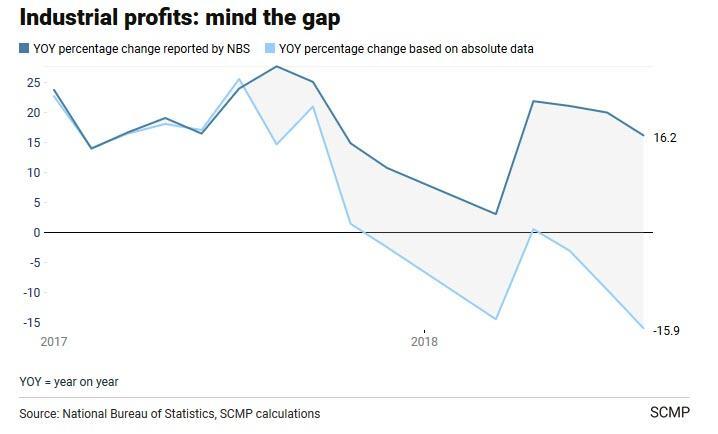
    However, as usual when it comes to Chinese ‘data’, there were several key question marks in the report – which was quite flattering for Xi Jinping in the ongoing cold war with Trump – that put the validity of the data in question:

    • For one, industrial revenue growth remains stagnant, and while total industrial revenue growth accelerated to +4.9% yoy, from +3.3% yoy in July, it was nowhere near the surge in profits. In the absence of top-line growth, the continued surge in profits was entirely contingent on rising margins (total profits divided by revenues), which expanded to 6.9% in August (vs. 6.1% in the same period last year), contributing to the solid growth in total profits. How China is managing such dramatic profit margin expansion without mass layoffs, and in a time when supply chain transformations should be crushing margins remains a great unknown.

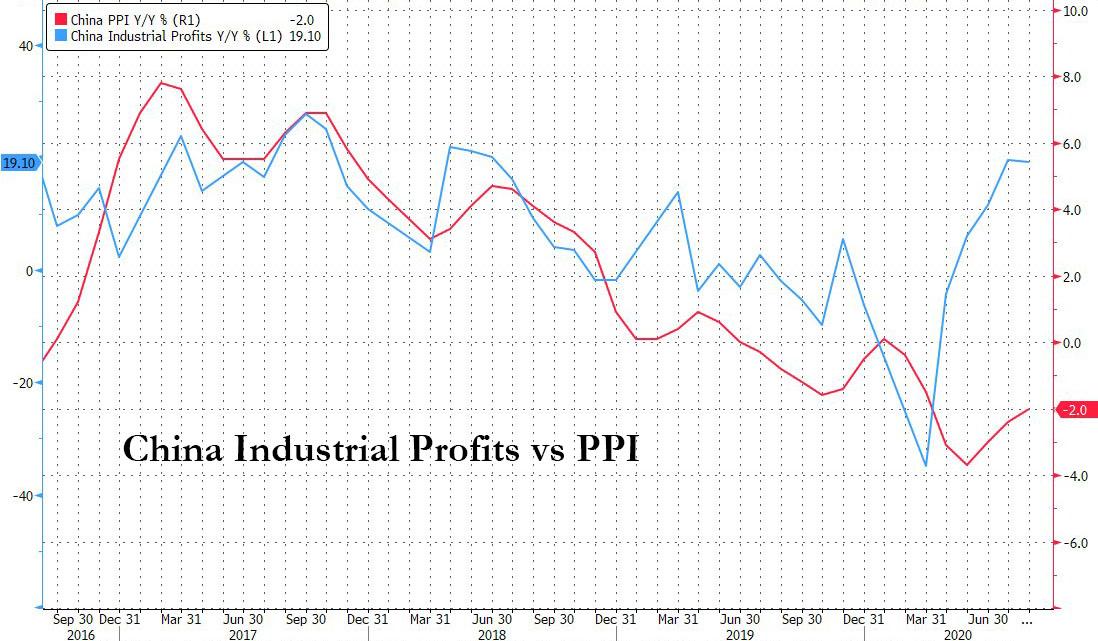
    Secondly, and casting even further doubt on the data’s credibility, is that the jump in Industrial Profits comes at a time when China’s so-called gate inflation, i.e., Producer Prices, which is critical in determining pricing power for local companies and is thus a key driver for industrial profits, remains solidly negative. In fact, after tracking PPI lower for the past three years, Industrial profits magically surged starting in April, even as producer prices continued to sink. As a result, the current divergence between Industrial Profits and PPI is the widest it has ever been.

    This decoupling between the two traditionally closely-correlated data sets suggests three things:

    • i) Chinese PPI will jump in the coming months as rising prices are a critical component to validate the jump in both industrial margins and profits, leading to a broader reflationary wave spilling out of China and washing across the rest of the world.
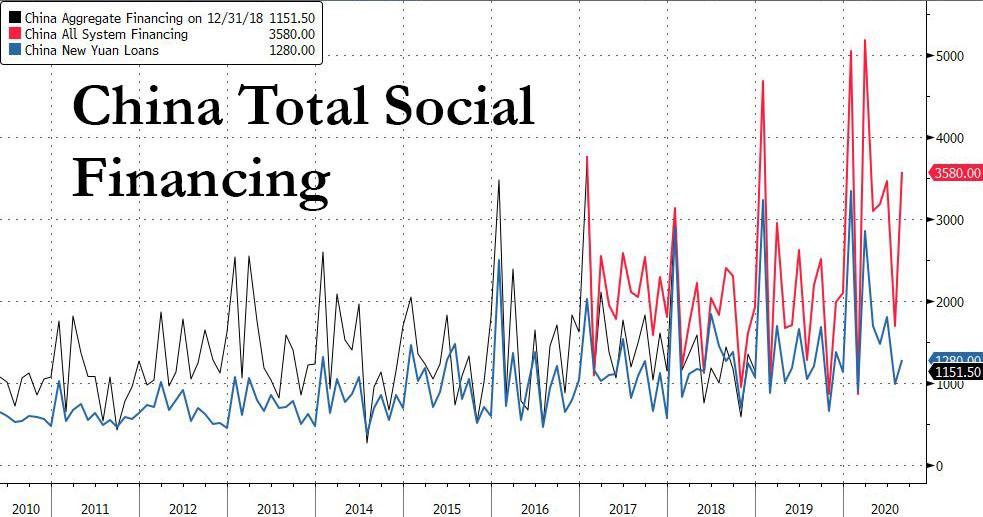
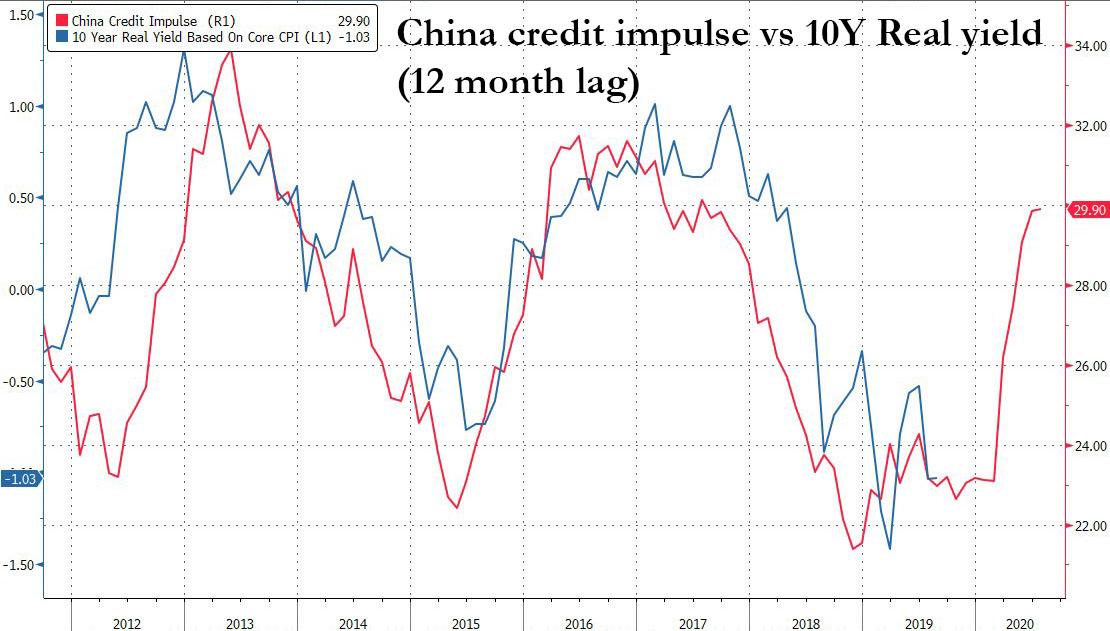
    • ii) the spike in Industrial profits has been a one-off outlier, resulting from the recent surge in local credit creation which has seen trillions of dollar in new credit creation since the covid pandemic struck, and once Beijing eases back on the throttle, profits will tumble.

    • iii) the Chinese data is (and has been) fake, and remains goalseeked for the political benefit of Xi Jinping who is eager to show that his handling of the covid pandemic has been more successful than that of Trump, resulting in a faster return to economic normalcy. Stripping away the populist veneer however sparks even more questions: as a reminder, back in 2018 we showed a staggering gap between official government industrial profits “data” and micro data in absolute terms: a divergence that could only be explained away with even more Beijing data fraud (see “More Fraud Exposed In Chinese Official Econ Data“).

    One final reason why the official Chinese “data” is especially suspect, is that Goldman’s latest China real-time activity tracker showed a sharp drop in industrial activity in the past month, just the opposite of what the official data suggests.

    Of course, if China has devolved to once again simply fabricating core economic data, that makes the lives of traders and strategists especially difficult since much hope for a global reflation wave has come from the recent surge in China’s credit impulse which leads 10Y TSY yields with a 12 month lead. Unfortunately, if this impulse fails to affect China’s economy first and foremost, then it will make all bets that yields are set to jump in the next 6 months a very costly mistake.

    via ZeroHedge News https://ift.tt/3ibF0lU Tyler Durden