“He Who Cheats Best, Wins?” – Bloomberg Backs Lawbreakers-For-Biden In Florida

“He Who Cheats Best, Wins?” – Bloomberg Backs Lawbreakers-For-Biden In Florida

Tyler Durden

Thu, 09/24/2020 – 22:40

Authored by Tom Luongo via Gold, Goats, ‘n Guns blog,

In 2016 I told the few people who were listening to me then that I thought Trump would win Florida by around seven points depending on the level of cheating in Broward and Dade counties by now deposed and disgraced Broward Supervisor of Election, Brenda Snipes.

He wound up winning by three, so to me that says there was likely a fair amount of it going on. Argue with me all you want but I operate, normally, under the principle that U.S. elections of any import are determined by the maxim:

He who cheats best, wins.

Call it the Luongo Rule of Electoral Politics if you will.

This year we know that the cheating will be systemic and of a kind that we’ve not experienced before.

There is no more decorum about it. Only those truly naive or in the media will tell you otherwise.

In this election the ideologues have been radicalized on all sides to view the threat of the other side winning as existential to their future. And, far be it from me to tell them they’re wrong, because when I’m being honest with myself, they aren’t.

So that gives them not only motive, means and opportunity to cheat but also the fervent belief that they have to in order to save society itself. Well, at least, that’s what they are telling themselves as they go about doing it.

What’s also very clear is that the oligarch class which animates the establishment wing of the Republican party is working with the whole of the Democratic party and the media to remove Trump from power by any and all means necessary.

And while they are certainly signaling that they will use any and all means necessary to achieve this end, they would prefer for their actions to have the veneer of respectability, through some form of electoral mandate, even if that mandate is patent fiction.

Now any political neophyte knows Florida is the most important state in the union today from an electoral college perspective. Without Florida both Trump and Biden have a very difficult path to victory.

Those 29 (soon to be 31) electoral votes represent the pivot on which the entire election rests. I spent an hour recently with Joe Cotto of the Cotto/Gottfried Show talking about this from a uniquely Florida perspective which I think should give anyone pause who thinks Florida is actually up for grabs, because it isn’t.

Caption: They even got mah Trump Face… must love YouTube!

Looking back on the whole Coronapocalypse a tremendous amount of attention and pressure was placed on Governor Ron DeSantis to destroy the state economy.

It seemed every five days or so I’d log into Twitter to see some version of #DeSantisMustDie trending. After six months of it it’s a little tiring.

Then again, after a four-year temper tantrum electoral politics is pretty much tiresome.

For most of this year the polls have all told us that Joe Biden was winning in Florida. And that may have been the case six months ago, you know, when no one gave a crap about the presidential election except people who make their living covering it.

Guilty as charged.

But in the wake of almost surreal violence and scenes of looting and, frankly, animal-like behavior all that was ever going to do was push the moderate voter in a state like Florida towards Donald Trump, not away from him.

And now the polls, as flawed and dishonest as most of them are, have begun to reflect this basic truth. At no time in 2016 did Trump lead the polls in Florida. On election night I watched the faces of shitlibs from across the socio-economic spectrum of Alachua county go into paroxysms of despair as the results came in.

I almost, for a minute, felt bad for them.

So, this years, in my analysis, it doesn’t help that even the die-hard Democrat midwits I’ve known for most of my life are holding their nose to vote for Biden, not because he’s any good but because their own sense of self would be tarnished forever by voting Republican.

That level of disgust is a not a motivator to vote, it’s a motivator to stay home and drink heavily. And it will not play well for Biden here, nor will it help him win Democratic strongholds by the same majorities Democrats usually win by in places like Broward, Leon (Tallahassee), Alachua (Gainesville) and even Miami-Dade.

The fear that Florida will go big for Trump is so acute now Mini Mike Bloomberg and LeBron James are spending millions to pay off debts of black and Hispanic felons to restore their voting rights before the election hoping that translates into enough votes to push Biden to victory.

Honestly, they should worry more about pushing him to the teleprompter lucid at this point.

Now, don’t get me wrong, felons who have paid their way back to make restitution to their victims should be allowed to decide who rules over them. I think they should have their right to self-defense restored as well, especially non-violent felons.

But what’s happening here is blatant electioneering and an in-kind contribution to the Biden campaign. It’s indicative of what happens when you invest too much power in the political process, the power corrupts everyone and incentivizes them to skirt the rules.

Given that the entire political, legal and monetary system is designed to roll wealth up to oligarchs like Bloomberg it seriously distorts their power to alter the course of elections at a fundamental level.

All libertarian critiques of why handing these people money, guns and laws is a truly terrible idea apply here.

The problem with money in politics is that there is money in politics.

And that won’t change until the systems themselves are decentralized and stripped of their power.

That’s what is so seductively dangerous about the whole “Defund the Police” movement, it is highlighting a real inequity in our society. Police and prosecutors have too much power and too much immunity from the consequences of their actions and the use of their power.

And I’m happy to have a real conversation about how to alter the path we’re on – End the Drug War, get rid of income taxes, tort reform, strengthen home rule of states, etc. But that’s not what Antifa and BLM are offering. It isn’t what the Democrats’ silent assent for their subhuman behavior will offer us if they return to power.

And as far as I can tell very few people here in the state of Florida disagree with me on this.

So, the last stand of American Marxists is on full display and they’ve brought not only their dirty money, like most of the money Bloomberg has made in his life, but now their racial Struggle Sessions to the streets of St. Petersburg.

And if anyone in that video had two operating brain cells to rub together to make a spark they’d realize this isn’t going to win them an election. And then the Soros/Brock bucks will vanish and they’ll just be more grist for the mill of oligarchs like Mini Mike.

They have gone all-in on this strategy. Men like George Soros have spent billions in support of this push for the World Economic Forum’s Great Reset. They aren’t going to allow such a little thing like the passing of a supreme court justice at the wrong time deter them from their goal.

You don’t need to have a dog’s keen nose to smell the fear and desperation that clings to these people, however. It is palpable in their behavior, their rhetoric and their over-reaction to everything Trump does or might do.

And their act is tiresome.

The American people have fear porn fatigue. It’s showing up in the polls and its showing up in their hysterics.

Regardless of how the election turns out, there will be no rest from the violence unleashed and the violence yet to come when millions of Americans come to the uncomfortable conclusion that they will never hold power again in their lifetimes.

No matter how they try to buy our obedience in Florida. Because this is the Florida I know.

*  *  *

Join My Patreon if you want the Florida treatment on politics. Install the Brave Browser to limit California’s bad ideas

via ZeroHedge News https://ift.tt/3j2ABDe Tyler Durden
Court-Appointed Lawyer Ordered for Junior High Schooler’s First Amendment Lawsuit

From Crozier v. Westside Community School Dist., decided earlier this month by the Eighth Circuit (Judges Steven Colloton, Roger Leland Wollman, and William Duane Benton):

In the fall of 2016, A.C. was a student at Westside Middle School in Omaha, Nebraska. The complaint alleges that a teacher assigned A.C.’s eighth-grade class to watch a video about athletes kneeling during the national anthem. The week before, it is alleged, there were “violent race riots” in North Carolina that “were spurred by the shooting of an unarmed black man by a police officer.” In that context, during a “critical thinking” discussion, the teacher called on A.C. to share her ideas. A.C. demurred, but the teacher insisted that A.C. answer.

A.C. then expressed her view that “kneeling was disrespectful to law enforcement and military, and questioned that this violence could have stemmed from music lyrics that said such things as ‘F-the Police, and the use of the N-word.'” (A.C. employed euphemisms in her comments and did not use profanity or the actual “N-word.”) When the teacher demanded to know where A.C. obtained this information, she answered, “from the media.”

To explain further, A.C. shared an example from the previous school year when she overheard a conversation between two seventh-grade students, one black and one white; the white student asked why he couldn’t say the “N-word” when the black student could. The teacher then interrupted A.C. and directed her to stop speaking. The Croziers allege that if A.C. had been permitted to finish, she would have expressed her view that no one should use the “N-word.”

A.C. stayed home from school the next day due to illness. The teacher allegedly “told several class periods worth of students that A.C. was a racist.” The Croziers allege that the teacher “lied to intentionally defame and label A.C. as a ‘racist who said the N-word.'” They assert that the teacher, in speaking to other students, “made the supposition that A.C. was home that day due to suspension,” even though she knew that A.C. was home sick. The Croziers allege that the teacher admitted branding A.C. a racist: when A.C.’s mother later told the teacher that it was “entirely unfair that [she] labeled A.C. a racist,” the teacher “rolled her eyes and smugly responded, ‘I do not believe that to be unfair.'”

As a result of this alleged retaliation, the Croziers claim, A.C. was taunted by other students who “heard what [she] said,” and A.C. feared for her safety if she returned to school. Some students sent A.C. text messages asking if she was suspended. When she returned to school, some called out to her in the halls. To avoid “sneering and bullying,” she removed herself to the Dean’s office to do schoolwork, and began eating lunch in bathroom stalls to avoid anyone who could harm her. She allegedly suffered emotional distress, anxiety, and depressive thoughts.

After meeting with the principal and assistant superintendent, the Croziers removed A.C. from school and began schooling her at home. A month after the classroom discussion, A.C. called a suicide hotline, described how the teacher’s actions had caused her harm, and said that she wanted to kill herself. She twice attempted suicide. A.C. entered therapy and for a time was under 24-hour suicide watch. The Croziers later transferred A.C. to a new school.

The Croziers contacted eight lawyers about A.C.’s case but were unable to retain one…. [Later, t]he Croziers contacted twenty-seven more lawyers, Nebraska Legal Aid, and a legal clinic at a local law school, without success. The lawyers gave various reasons for declining, including lack of qualifications for the case, workload, lack of interest in the case, and conflicts of interest.

The Croziers sued pro se, but the Eighth Circuit concluded that nonlawyer parents generally couldn’t represent their children in court (just as nonlawyers generally aren’t allowed to represent anyone other than themselves). And because “In Nebraska, if a plaintiff is a minor at the time a cause of action accrues, the statute of limitations is tolled until plaintiff reaches the age of 21,” this means “A.C. has a ‘reasonably adequate opportunity’ to sue,” and refusing to let her parents represent her “does not violate her fundamental right to access the courts.”

Nonetheless, the Eighth Circuit concluded that the trial court should appoint a lawyer for A.C.:

“Indigent civil litigants do not have a constitutional or statutory right to appointed counsel.” “Rather, when an indigent [plaintiff] has pleaded a nonfrivolous cause of action, a court ‘may’ appoint counsel.” 28 § U.S.C. 1915(e)(1)…. The [district] court concluded that although the Croziers demonstrated “their lack of financial resources” and made a “diligent effort” to obtain counsel, their constitutional claims were “not sufficiently meritorious to warrant the appointment of counsel.” … We review that decision for abuse of discretion. A district court “has a good deal of discretion to determine whether representation is warranted given the nature of the case and the litigants,” but the discretion is not unbounded.

The district court denied the motion for counsel after concluding that the Croziers were “unlikely to prevail” on their claims, including the core claim that the teacher violated A.C.’s right to freedom of speech by retaliating against her. In support, the district court cited a ruling that it was constitutional to discipline a student for uttering profanity in a principal’s office, and decisions declaring that schools and teachers may limit classroom speech based on legitimate pedagogical concerns. The court concluded that “the First Amendment affords little protection to student speech during class time,” so the teacher “likely would be entitled to qualified immunity.”

The merits of the case have not been briefed and argued, but we think the district court was too quick to dismiss the usefulness of counsel, at least on the core claim of First Amendment retaliation. It is clearly established that “[s]tudents in the public schools ‘do not shed their constitutional rights to freedom of speech or expression at the schoolhouse gate.'” … [T]he extent to which teachers may control student speech in the classroom is an open issue. And whatever the scope of a teacher’s authority to limit classroom discussion, it is clear that students “cannot be punished merely for expressing their personal views on the school premises—whether ‘in the cafeteria, or on the playing field, or on the campus during the authorized hours.'”

The allegation here is that a public school teacher retaliated against a student merely for expressing her personal views when called upon to speak in a classroom. The complaint asserts that the teacher defamed the student by falsely labeling her as a racist who uses the “N-word”—an act that the district court understandably did not describe as reasonably related to a legitimate pedagogical concern. A retaliation claim requires proof that the teacher’s action would deter “a person of ordinary firmness” from continuing to speak, but the stress, anxiety, and ostracization arising from a teacher’s false attribution of racist utterances to a middle-schooler might fit the bill. The district court did not address whether retaliation by defamation is any more permissible than the “punishment” expressly forbidden by Tinker, or otherwise elaborate on why retaliation for classroom speech would be consistent with the First Amendment.

Ordinarily, the denial of a motion to appoint counsel would mean that the plaintiffs may continue to litigate pro se, obtain a ruling on the merits from the district court, and exercise their right to appeal. But in the unusual circumstances of this case, the district court’s denial of the motion, together with the rule against pro se representation by parents, terminated the action before any claim could be adjudicated. The student could proceed on her own when she reaches the age of majority, but that course would entail substantial delay and potential prejudice in pursuing the vindication of her alleged rights. We thus conclude that the district court’s assumption about the likely application of qualified immunity was insufficient on this record to justify denial of the motion for appointment of counsel.

We have only a complaint before us, so we do not know whether the Croziers can prove their factual allegations. Some legal theories in the pro se complaint appear stronger than others, and an attorney might assist in winnowing the claims. Having received no briefs on the merits, we express no view on whether any claim ultimately would be successful.

But the core allegation of First Amendment retaliation is a serious claim on which the plaintiffs and the court would benefit from the assistance of counsel, especially when the case otherwise cannot proceed to a timely decision on the merits. We expect that some member of the bar, in the tradition of the profession, will respond favorably to a request from the district court….

from Latest – Reason.com https://ift.tt/367iE2O
via IFTTT

Court-Appointed Lawyer Ordered for Junior High Schooler’s First Amendment Lawsuit

From Crozier v. Westside Community School Dist., decided earlier this month by the Eighth Circuit (Judges Steven Colloton, Roger Leland Wollman, and William Duane Benton):

In the fall of 2016, A.C. was a student at Westside Middle School in Omaha, Nebraska. The complaint alleges that a teacher assigned A.C.’s eighth-grade class to watch a video about athletes kneeling during the national anthem. The week before, it is alleged, there were “violent race riots” in North Carolina that “were spurred by the shooting of an unarmed black man by a police officer.” In that context, during a “critical thinking” discussion, the teacher called on A.C. to share her ideas. A.C. demurred, but the teacher insisted that A.C. answer.

A.C. then expressed her view that “kneeling was disrespectful to law enforcement and military, and questioned that this violence could have stemmed from music lyrics that said such things as ‘F-the Police, and the use of the N-word.'” (A.C. employed euphemisms in her comments and did not use profanity or the actual “N-word.”) When the teacher demanded to know where A.C. obtained this information, she answered, “from the media.”

To explain further, A.C. shared an example from the previous school year when she overheard a conversation between two seventh-grade students, one black and one white; the white student asked why he couldn’t say the “N-word” when the black student could. The teacher then interrupted A.C. and directed her to stop speaking. The Croziers allege that if A.C. had been permitted to finish, she would have expressed her view that no one should use the “N-word.”

A.C. stayed home from school the next day due to illness. The teacher allegedly “told several class periods worth of students that A.C. was a racist.” The Croziers allege that the teacher “lied to intentionally defame and label A.C. as a ‘racist who said the N-word.'” They assert that the teacher, in speaking to other students, “made the supposition that A.C. was home that day due to suspension,” even though she knew that A.C. was home sick. The Croziers allege that the teacher admitted branding A.C. a racist: when A.C.’s mother later told the teacher that it was “entirely unfair that [she] labeled A.C. a racist,” the teacher “rolled her eyes and smugly responded, ‘I do not believe that to be unfair.'”

As a result of this alleged retaliation, the Croziers claim, A.C. was taunted by other students who “heard what [she] said,” and A.C. feared for her safety if she returned to school. Some students sent A.C. text messages asking if she was suspended. When she returned to school, some called out to her in the halls. To avoid “sneering and bullying,” she removed herself to the Dean’s office to do schoolwork, and began eating lunch in bathroom stalls to avoid anyone who could harm her. She allegedly suffered emotional distress, anxiety, and depressive thoughts.

After meeting with the principal and assistant superintendent, the Croziers removed A.C. from school and began schooling her at home. A month after the classroom discussion, A.C. called a suicide hotline, described how the teacher’s actions had caused her harm, and said that she wanted to kill herself. She twice attempted suicide. A.C. entered therapy and for a time was under 24-hour suicide watch. The Croziers later transferred A.C. to a new school.

The Croziers contacted eight lawyers about A.C.’s case but were unable to retain one…. [Later, t]he Croziers contacted twenty-seven more lawyers, Nebraska Legal Aid, and a legal clinic at a local law school, without success. The lawyers gave various reasons for declining, including lack of qualifications for the case, workload, lack of interest in the case, and conflicts of interest.

The Croziers sued pro se, but the Eighth Circuit concluded that nonlawyer parents generally couldn’t represent their children in court (just as nonlawyers generally aren’t allowed to represent anyone other than themselves). And because “In Nebraska, if a plaintiff is a minor at the time a cause of action accrues, the statute of limitations is tolled until plaintiff reaches the age of 21,” this means “A.C. has a ‘reasonably adequate opportunity’ to sue,” and refusing to let her parents represent her “does not violate her fundamental right to access the courts.”

Nonetheless, the Eighth Circuit concluded that the trial court should appoint a lawyer for A.C.:

“Indigent civil litigants do not have a constitutional or statutory right to appointed counsel.” “Rather, when an indigent [plaintiff] has pleaded a nonfrivolous cause of action, a court ‘may’ appoint counsel.” 28 § U.S.C. 1915(e)(1)…. The [district] court concluded that although the Croziers demonstrated “their lack of financial resources” and made a “diligent effort” to obtain counsel, their constitutional claims were “not sufficiently meritorious to warrant the appointment of counsel.” … We review that decision for abuse of discretion. A district court “has a good deal of discretion to determine whether representation is warranted given the nature of the case and the litigants,” but the discretion is not unbounded.

The district court denied the motion for counsel after concluding that the Croziers were “unlikely to prevail” on their claims, including the core claim that the teacher violated A.C.’s right to freedom of speech by retaliating against her. In support, the district court cited a ruling that it was constitutional to discipline a student for uttering profanity in a principal’s office, and decisions declaring that schools and teachers may limit classroom speech based on legitimate pedagogical concerns. The court concluded that “the First Amendment affords little protection to student speech during class time,” so the teacher “likely would be entitled to qualified immunity.”

The merits of the case have not been briefed and argued, but we think the district court was too quick to dismiss the usefulness of counsel, at least on the core claim of First Amendment retaliation. It is clearly established that “[s]tudents in the public schools ‘do not shed their constitutional rights to freedom of speech or expression at the schoolhouse gate.'” … [T]he extent to which teachers may control student speech in the classroom is an open issue. And whatever the scope of a teacher’s authority to limit classroom discussion, it is clear that students “cannot be punished merely for expressing their personal views on the school premises—whether ‘in the cafeteria, or on the playing field, or on the campus during the authorized hours.'”

The allegation here is that a public school teacher retaliated against a student merely for expressing her personal views when called upon to speak in a classroom. The complaint asserts that the teacher defamed the student by falsely labeling her as a racist who uses the “N-word”—an act that the district court understandably did not describe as reasonably related to a legitimate pedagogical concern. A retaliation claim requires proof that the teacher’s action would deter “a person of ordinary firmness” from continuing to speak, but the stress, anxiety, and ostracization arising from a teacher’s false attribution of racist utterances to a middle-schooler might fit the bill. The district court did not address whether retaliation by defamation is any more permissible than the “punishment” expressly forbidden by Tinker, or otherwise elaborate on why retaliation for classroom speech would be consistent with the First Amendment.

Ordinarily, the denial of a motion to appoint counsel would mean that the plaintiffs may continue to litigate pro se, obtain a ruling on the merits from the district court, and exercise their right to appeal. But in the unusual circumstances of this case, the district court’s denial of the motion, together with the rule against pro se representation by parents, terminated the action before any claim could be adjudicated. The student could proceed on her own when she reaches the age of majority, but that course would entail substantial delay and potential prejudice in pursuing the vindication of her alleged rights. We thus conclude that the district court’s assumption about the likely application of qualified immunity was insufficient on this record to justify denial of the motion for appointment of counsel.

We have only a complaint before us, so we do not know whether the Croziers can prove their factual allegations. Some legal theories in the pro se complaint appear stronger than others, and an attorney might assist in winnowing the claims. Having received no briefs on the merits, we express no view on whether any claim ultimately would be successful.

But the core allegation of First Amendment retaliation is a serious claim on which the plaintiffs and the court would benefit from the assistance of counsel, especially when the case otherwise cannot proceed to a timely decision on the merits. We expect that some member of the bar, in the tradition of the profession, will respond favorably to a request from the district court….

from Latest – Reason.com https://ift.tt/367iE2O
via IFTTT

Hedge Funds Flock To Florida As Wealthy Americans Seek Lower Taxes

Hedge Funds Flock To Florida As Wealthy Americans Seek Lower Taxes

Tyler Durden

Thu, 09/24/2020 – 22:20

Carl Ichan isn’t the only mogul moving to Florida for tax reasons.

According to Bloomberg, a flood of hedge funds are planning to expand their presence in the Sunshine State, as wealthy residents from northern states contend with the threat of higher taxes.

Paul Singer’s Elliott Management Corp. is reportedly considering opening a Florida office, as is Chicago-based Balyasny Asset Management, which has approximately $8 billion in AUM and plans to open an outpost in MIami, according to people familiar with the matter. 

Adding to the list of firms which have already made the move is Bluecrest Capital Management, which just opened a Miami office for approximately 10 portfolio managers. Notably, Miami is offering companies up to $50,000 if they relocate downtown and employ at least 10 high-wage workers as part of their “Follow the Sun” campaign.

The moves to Florida, which has no state income tax, come as locales with the highest number of hedge funds weigh tax increases on the rich. Last week, New Jersey adopted a millionaires tax, and a ballot measure in Illinois calls for raising taxes on the wealthy. New York Governor Andrew Cuomo has said such a tax could be possible if the U.S. government fails to step in with aid, and Connecticut’s legislature also has discussed a tax hike.

Every firm like Elliott is in the process of evaluating choices in how and where they work, including working from home and opening additional offices, but Elliott has not made any decisions,” said Stephen Spruiell, a spokesman for the New York-based firm. –Bloomberg

According to Palm Beach Hedge Fund Association head David Goodboy, two or three hedge funds per week are asking him about making the move, vs. one or two per month during the normal times. 90% of them are from Manhattan and Greenwich, Connecticut – with popular destinations including Miami, Palm Beach and Boca Raton – the latter of which Verition Fund Management set up shop two years ago for a couple of portfolio managers.

In 2015, David Tepper moved from New Jersey to Miami, relocating Appaloosa Management there the following year.

As Bloomberg also notes, wealthy individuals have been drawn to Florida’s favorable tax laws for years – with the GOP-backed 2017 law capping deductions for state and local taxes on federal returns undoubtedly contributing to newcomers. Meanwhile, real estate in Miami and Palm Beach has been on fire – with sellers deluged by offers.

via ZeroHedge News https://ift.tt/2Eute8q Tyler Durden

Is Insurance More Expensive In Black Neighborhoods?

Is Insurance More Expensive In Black Neighborhoods?

Tyler Durden

Thu, 09/24/2020 – 22:00

Via Priceonomics.com,

This post is from Goodcover, a Priceonomics Data Studio customer.

Amid the recent Black Lives Matter protests, much of society has been re-examining explicit and implicit sources of discrimination against Black people in America. What are the conscious and unconscious ways our society and economy harm Black citizens?

Housing and its associated cost has historically played a critical role in institutionalizing racism and segregation. Even insurance companies have historically discriminated against Black people through processes like redlining where they refused to write policies in certain neighborhoods, thus making housing more expensive or challenging to acquire.

As an insurance provider ourselves, we wanted to examine data to see how race impacts the price of insurance. We asked: is renters insurance more expensive if you live in a predominantly Black neighborhood than if you live in a predominantly white one?

We analyzed public data from the California Department of Insurance on how much companies charge for renters insurance in cities across the state. We also analyzed our own pricing for those locations.

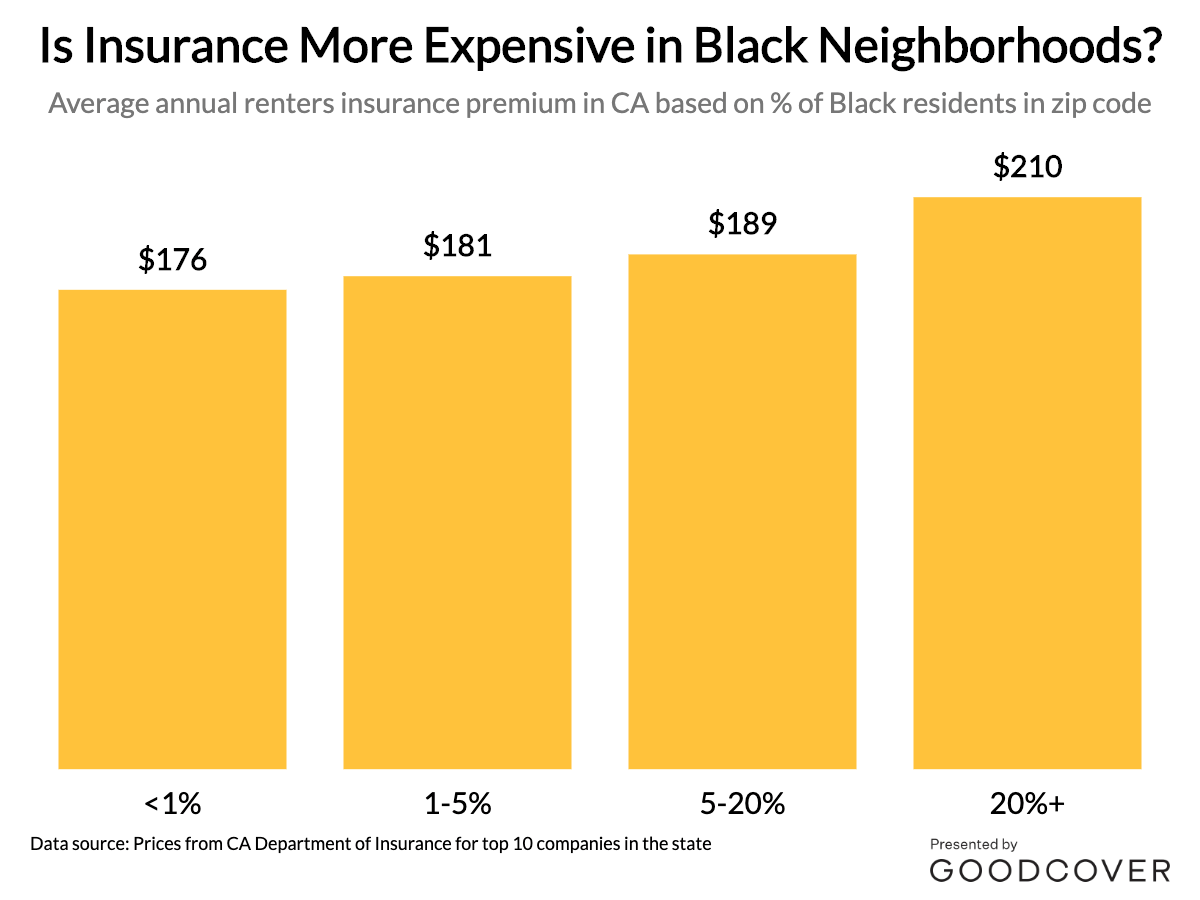
We found the higher the percentage of Black people living in a zip code or city, the higher the price of insurance on average. Across the industry renters insurance annual premiums were about 20% higher in predominantly Black neighborhoods than predominantly white ones. While we did not find such a correlation in our own prices, we recognize there is a lot of work left to do.

The data and methodology

Before diving into the results, it’s worth spending a moment on methodology. The California Department of Insurance requires all insurance companies operating in the state to publicly file the rates they would charge for a set coverage level in a given area. We analyzed this public data using defined coverage limits ($100k liability, $30k personal property, $500 deductible) for the top 10 most popular companies in the state and analyzed how much they charged in different zip codes and cities for renters insurance. Using US census data, we’re able to calculate the percentage of the population in those areas that is Black, and see how that correlates with prices.

This analysis is focused on showing the difference in insurance prices for the same kind of housing that’s in a mostly Black neighborhood versus a mostly white one. Housing discrimination spans all races and ethnicities across our country, however for this research our primary focus is on Black communities in the state of California.

In this analysis we haven’t identified any causal factors; It’s meant more as a jumping off point for further analysis examining potential causal factors which can range from discriminatory practices based on the racial composition of a neighborhood (i.e. redlining), to other factors that impact pricing like proximity to a fire station.

This is a first analysis, meant to start a conversation about how racial inequities in finance and insurance. First, we must answer the question, is renters insurance more expensive if you live in a predominantly Black neighborhood?

Cost of renters insurance in California

To begin, let’s look at the average price of renters insurance in California and how much it varies according to the percentage of the population in a zip code that is Black. For context, in California 5.9% of the population is Black, and across the state the average renters insurance policy costs $183 per year.

Chart via Goodcover

As shown above, companies charge more for renters insurance in zip codes where there’s a higher percentage of Black residents. If your zip code has more than 20% Black population, the expected annual price for renters insurance would be $210, which is around 20% more expensive than in zip codes where less than one percent of the population is Black.

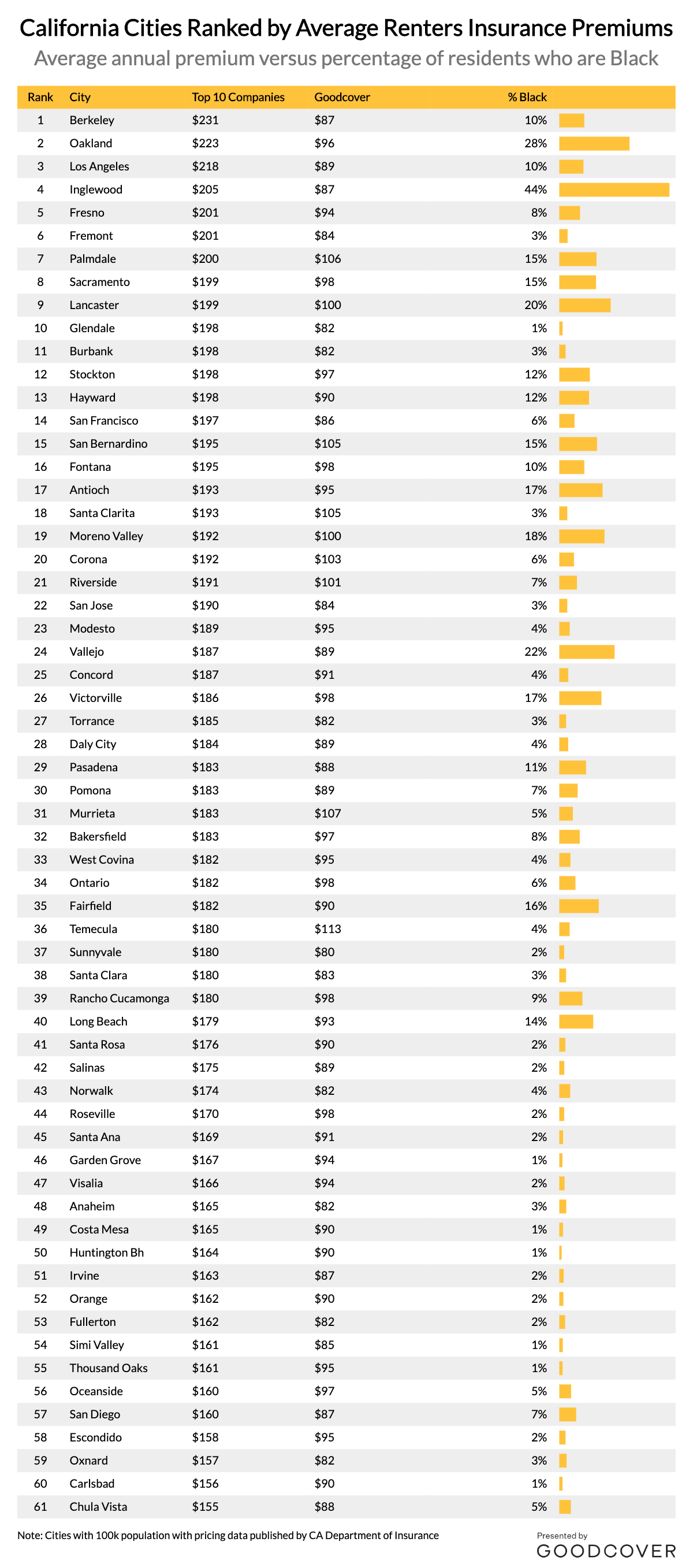
Next, let’s turn our attention to the average price of renters insurance across various cities in California and how it varies by the percentage of residents who are Black. The chart below ranks cities in California from most to least expensive annual policies and also shows the percentage of Black residents in that city. (One column represents the average price for the top 10 insurance providers, and next column are average Goodcover prices for those cities. Only cities with over 100k residents where the CA Department of Insurance publishes rates are included.)

Chart via Goodcover

Across California, renters insurance is most expensive in Berkeley, followed by Oakland and Los Angeles. Each of the top five cities with most expensive renters insurance policies in California have a substantially higher percentage of Black residents than the state average of 5.9%.

Is there any correlation between the percentage of Black residents in a city and companies charging more for renters insurance?

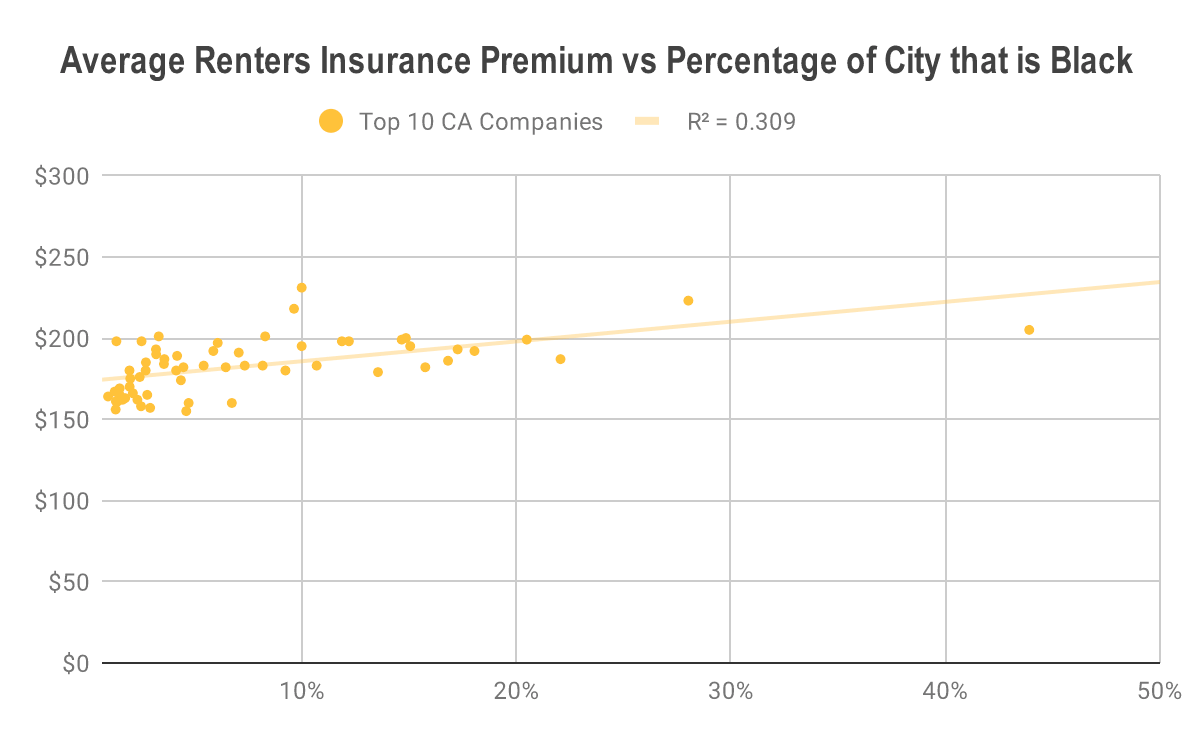
Let’s see, the following chart plots renters insurance prices versus percent of population that is Black from the same list of cities as above.

Chart via Goodcover

The above chart shows a 30%, statistically significant (p < 0.0001) correlation between higher prices for renters insurance and the percentage of Black residents living in the city. Virtually every city with a higher percentage of Black residents have insurance policies that cost more than the state average. And crucially, not just the average but also the minimum price among top California insurers is noticeably higher in every city with a higher than average percentage of Black residents.

Examining our own rates

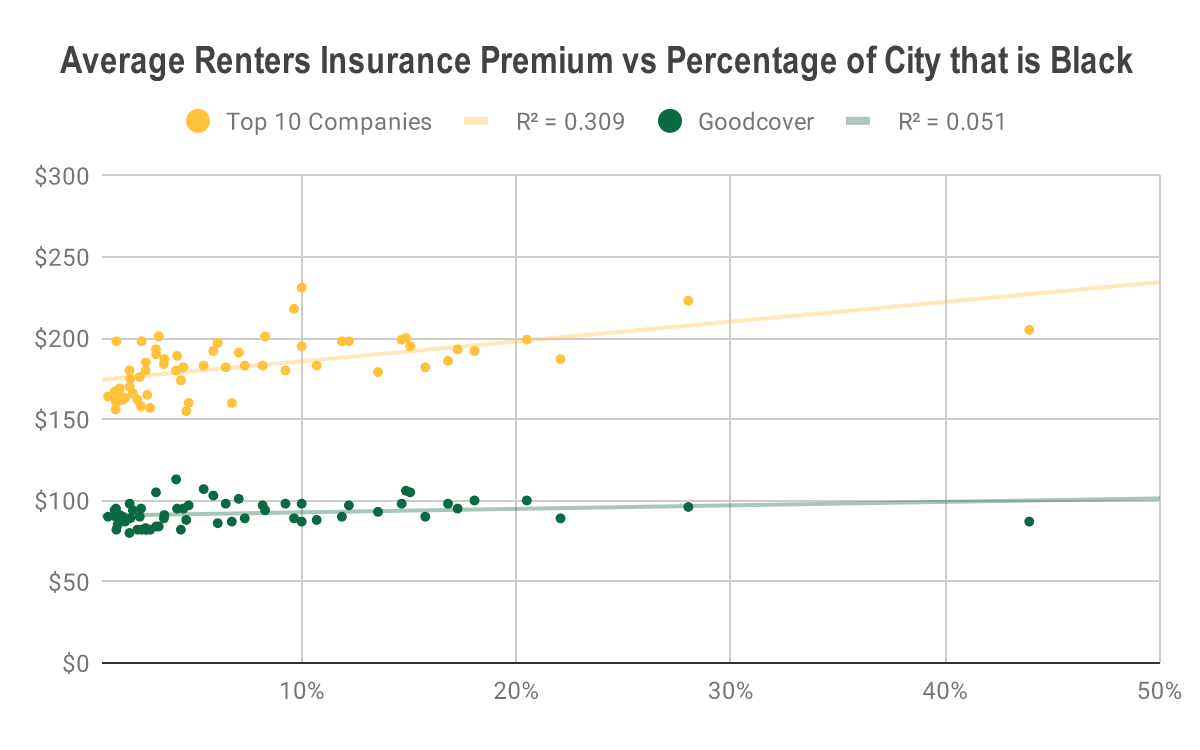
Looking at the industry at a whole, we see a troubling correlation. Is Goodcover also more expensive in Black neighborhoods? To find out we looked at how Goodcover would rate for the same policy and location compared to the top 10 insurance companies in the state using the government pricing data. We found a far lower, statistically insignificant (p = 0.079) correlation as shown below.

Chart via Goodcover

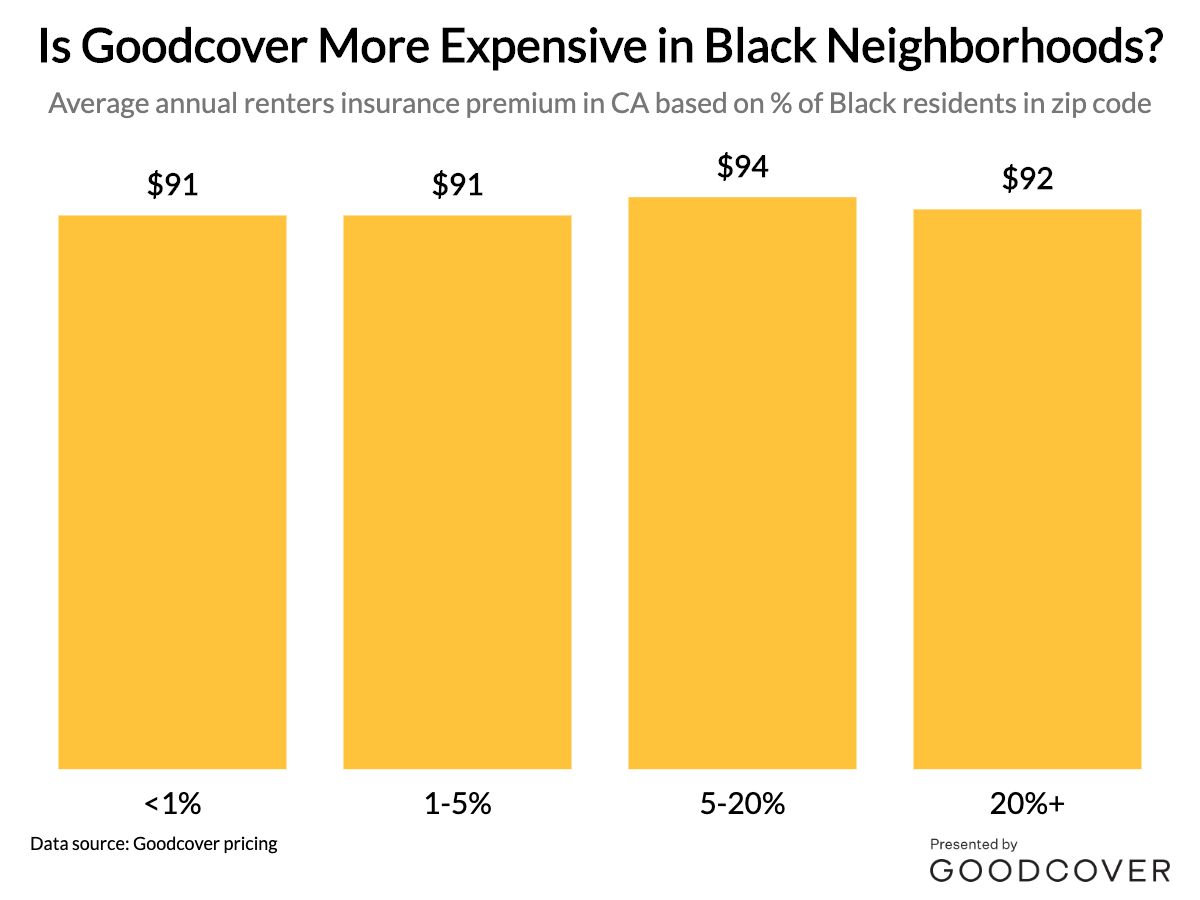
Furthermore, doing the same population segment analysis as earlier, our average annual pricing was $91, $91, $94, $92, for zip codes with percentage of Black population of <1%, 1-5%, 5-20%, and 20%+ respectively – a different trend than the increase of price seen for the top 10 companies which resulted in a 20% higher price for areas with the largest Black population.

Chart via Goodcover

The data shows that the insurance industry charges renters in California more if they live in Black neighborhoods, but Goodcover doesn’t.

We don’t have a good explanation for why this is happening. To be clear, we don’t believe the insurance industry is intentionally raising prices on Black neighborhoods because they have a higher percentage of Black residents. There are many potential causal factors, which is one reason why racial discrimination in housing is such a systemic problem.

Our own pricing is based on statistical analysis that controls for factors that influence risks like fire, theft, water damage, liability (which together account for 85% of our price). This analysis shows that there should not be any real correlation between price and the percentage of Black residents in a neighborhood.

A partial explanation for the discrepancy could be that our rates were computed and filed with the State of California in 2019, so we were able to evaluate risk as we see it now, rather than inheriting old rating structures and any potential biases.

Continuing the conversation

In this analysis, we have shown that there’s a wide variation in how much renters insurance costs across California and that prices tend to be significantly higher in predominantly Black neighborhoods.

However we’ve also shown that from our own analysis of risk, which resulted in Goodcover’s rating, there is no readily evident reason why this correlation exists. Further study is warranted to understand why this is so.

At Goodcover, we believe it is our responsibility both as a company and as an industry to understand and address our systemic biases. This begins internally – Goodcover is committed to diversity, equity and inclusion in our hiring practices, service and pricing. And then there’s more to be done in our industry – we must further examine rating for bias, increase use of digital servicing to remove biases such as linguistic profiling, reduce or eliminate installment fees that penalize policyholders living paycheck to paycheck, and simply lower the cost of renters insurance to make it more accessible for the 56% of Californians who still don’t have it.

Eliminating pricing disparities because of the composition of a community is attainable, and the  right thing to do. Our industry needs to keep vigilant in re-examining our processes so we banish discrimination from the ways we serve our policyholders and the public.

via ZeroHedge News https://ift.tt/2HuA2nQ Tyler Durden

Walmart Raises Pay – Only To Slash Hours, Bonuses

Walmart Raises Pay – Only To Slash Hours, Bonuses

Tyler Durden

Thu, 09/24/2020 – 21:40

Walmart last year said it was overhauling its stores to make them operate smoother and create more opportunities for employees to “do meaningful work.” The “Great Workplace” initiative, described by the nation’s largest private employer, said it would be “the key to winning the future of retail.” 

Walmart’s new initiative, which includes restructuring the leadership roles at its Supercenters and raising pay for some of its salaried and hourly employees, also eliminated their quarterly bonuses, and now appearing to reduce workers’ hours while increasing workloads despite promises of greater opportunity. 

The Guardian spoke with employees who were promised “greater opportunity for associates to lead and take more ownership in the business,” but, they said, none of that came to pass. Instead, some saw their hours reduced, making it more difficult impossible to pay bills and feed their families. 

Some staff said the retailer is accelerating internal restructuring plans as some workers have seen their hours “cut horrendously – making it very difficult” to survive on minimum wage. 

Noted above, the plan, called the Great Workplace program, was rolled out in 2019 and promoted increased wages for those accepted into new management positions. About 11% of workers, or about 165,000 out of 1.5 million employees, are expected to receive pay increases. As for low-level employees, working on the floor, if that is restocking shelves, directing customers, or unloading delivery trucks, their minimum wage starts around $11 an hour and will remain unchanged. 

The Guardian spoke with several former and current employees who confirmed “significant cuts to workers’ hours, pay cuts, and increased workloads.” 

Kimberly Patrick Gray, a Walmart associate for four years in Tupelo, Mississippi, said her store saw a consolidation of “three departments into one and then expected all the associates from those areas to fight for hours.” 

Gray said her schedule was reduced from around 35 hours a week on average to less than 20 hours this year, forcing her to quit because the reduction in hours made it “very difficult to pay bills.”

A department manager at a store in Arizona, who wanted to remain anonymous, said Walmart’s new restructuring plan slashed pay by at least $2.05 an hour if they were not chosen for a leadership position. 

“Those that are not offered a lead position or turn down a team lead over will have till 29 January to find another position,” they said. “Only those department managers that get team lead positions will receive a pay raise. The rest of us will be cut in pay. If I’m lucky I will only lose $2.05 an hour. It is possible that I could lose much more.”

In Oklahoma, a customer service manager with three years at Walmart, said they would have to reapply for a different position if they’re rejected from a team lead position. 

“My coworkers and I feel like we are being put against each other with this whole process because we feel like we have to fight for these positions,” they said.

A cashier at a store in California said the restructuring has resulted in extra workloads, including restocking and front end inventory, which would have been done by a manager.

“It’s more work for the same, or less money, unless you are one of the ones who roll into the new positions,” they said. “We are on a skeleton crew and there is zero time when there aren’t sales to ring.”

Former part-time employee Eric Anderson, who worked at a Walmart supercenter in Mulberry, Florida, quit in Oct. 2019 due to restructuring changes: 

“The first inklings of trouble came when my produce manager, who had 20 years with Walmart, said he was going to have to reapply for his job. Same with several more longtime employees,” Anderson said.

He said departments were consolidated during the restructuring with no new hires, resulting in existing workers taking on more tasks. 

“They all jumped through the hoops to reapply and none of them got to keep their jobs. Most were eligible for a severance for their years of service. At that point Walmart would not tell them when their last day would be, so they couldn’t apply for other jobs because they didn’t know when they could start,” he said. “When I saw how this company treated loyal long time employees, I decided I was done.”

Gary Stevens, a former maintenance supervisor at  Walmart in Ticonderoga, New York, for nearly eight years, quit earlier this year as the Great Workplace program reduced his staff by 50%. 

“Workloads increased and the management was pushing us to get more done than if I had a full staff. Not one of them knew how to do my job in stripping and waxing floors, but they would tell me how long it should take and yell at me and my crew if we ran behind the time they gave us,” Stevens said.

Walmart also announced the closure of 63 Sam’s Club locations in 2018, resulting in 10,000 layoffs. In 2019, the retailer fired greeter positions at about 1,000 of its retail locations. Corporate jobs have also been axed; last year, it closed a corporate center in Charlotte, North Carolina, laying off 570 workers and outsourcing it to a firm in Arkansas.

While virtue-signaling Walmart promised the world to its low-skill workers, and in some cases, greatly underdelivered, the company’s executives have spent billions of dollars in stock buybacks enriching themselves, shareholders, and fat cats on Wall Street. 

via ZeroHedge News https://ift.tt/2EvnPhq Tyler Durden

Iranian Drones Buzz US Aircraft Carrier; Helicopter With ‘Russian PMCs’ Crashes In Libya

Iranian Drones Buzz US Aircraft Carrier; Helicopter With ‘Russian PMCs’ Crashes In Libya

Tyler Durden

Thu, 09/24/2020 – 21:20

Submitted by SouthFront,

A Libyan National Army (LNA) military helicopter that was transporting Russian private military contractors has crashed near al-Jufra Air Base in central Libya, Brig. Gen. Abdul Hadi Dara, a spokesman for the Sirte-Jufra Operations Room of the Tripoli-based Government of National Accord (GNA), claimed on September 23.

The helicopter, which was also carrying weapons, allegedly crashed near the town of Sawknah, to the southwest of al-Jufra. Several explosions were heard in the region. The GNA spokesman told Turkish state-run Anadolu Agency that at least four Russian PMCs lost their lives in the crash.

These claims were dismissed by the Libyan National Army (LNA), which reported that the helicopter touched the ground with the main rotor during an emergency landing. The aircraft caught fire and burned as a result of the incident. However, there were no casualties.

While a limited presence of Russia-linked PMCs in Libya is no secret, pro-GNA and pro-Turkish sources like to claim that almost every incident, crash or explosion involves the mysterious Russians and led to casualties among them. Likely, this approach is an attempt to compensate for the inability of the Turkish Armed Forces, GNA units and almost 10,000 Turkish-backed Syrian militants deployed in Libya to capture the port city of Sirte from the Libyan National Army. In fact, the mighty Turkish advance on LNA positions virtually ground to a halt after Turkish-led forces secured the countryside of Tripoli. The main reason for this being the red line drawn by Egypt, the main LNA backer along with the UAE, which warned that it will respond with direct military action if Sirte is attacked. At the same time, Russian participation in the ongoing standoff is mostly focused on distant diplomatic support to the UAE-Egypt block and diplomatic work with Turkey. Russian PMCs deployed in the conflict zone represent the interests of various Russian business groups rather than those of the state.

According to the US, there are 3,000 Russia-linked PMCs. Later, AFRICOM even claimed that Russia deployed 14 warplanes in Libya. These warplanes, the US military says, are based out of Al Jufra and Al Khadim airfields. They are allegedly operated by Russian contractors and have engaged in “combat activities”. Nonetheless, the Pentagon provided no evidence to support these claims.

On September 11, Rear Admiral Heidi Berg, AFRICOM’s director of intelligence, said that two Russia-deployed Mig-29 jets had already crashed: one on June 28, another on September 7. The statement came just a few days after an evacuation training video released by a Russian military blog was used by Turkish propaganda and MSM to claim that a Russian warplane had crashed in Libya. So, it looks as if the US military simply once again used sensational, unfounded reports to maintain an artificially created frightening image of Russia.

On September 23, Iran’s Islamic Revolutionary Guard Corps released several close-up photos of the US Navy’s aircraft carrier USS Nimitz and its escort ships in the Persian Gulf. The photos were taken by an IRGC military drone that buzzed the US carrier strike group recently. The USS Nimitz passed through the Strait of Hormuz into the Persian Gulf last week.

On the same day, 188 new naval drones and helicopters were officially added to the IRGC Navy’s fleet of aircraft. During the ceremony, three types of vertical take-off and landing drones, dubbed Sepehr, Shahab-2 and Hodhod-4, were unveiled for the first time. According to an IRGC Navy commander, all three drones can take off from ships. The batch of delivered equipment also included a number of Mohajer-6 combat drones. The Mohajer-6 has a range of 200 km and can be armed with up to four guided missiles.

Iran insists that it has a full spectrum of means and measures that it can employ against US naval forces and bases in the Persian Gulf region in the event of an open military confrontation. In their turn, the United States regularly deploys aircraft carriers in the gulf as a part of its own power projection policy. In April 2020, US President Donald Trump even stated that he had passed an order to “destroy any and all Iranian gunboats” if they harass US ships at sea. Taking into account that Iran sees the Persian Gulf as a vital area of national interest and cannot leave US strike groups there without close monitoring, the sides are balancing right on the brink of a new open confrontation.

via ZeroHedge News https://ift.tt/2RVyQMj Tyler Durden

20 Inmates And Accomplices Charged In COVID-19 Unemployment Fraud

20 Inmates And Accomplices Charged In COVID-19 Unemployment Fraud

Tyler Durden

Thu, 09/24/2020 – 21:00

Pennsylvania officials charged 20 inmates and outside accomplices in a scheme to fraudulently bilk some $300,000 in COVID-19 unemployment benefits, according to ABC News.

The fraud ring operated across three state prisons, where inmates allegedly collected the personal information of other inmates and distributed them to their accomplices on the outside, who would then apply for pandemic relief funds in their names.

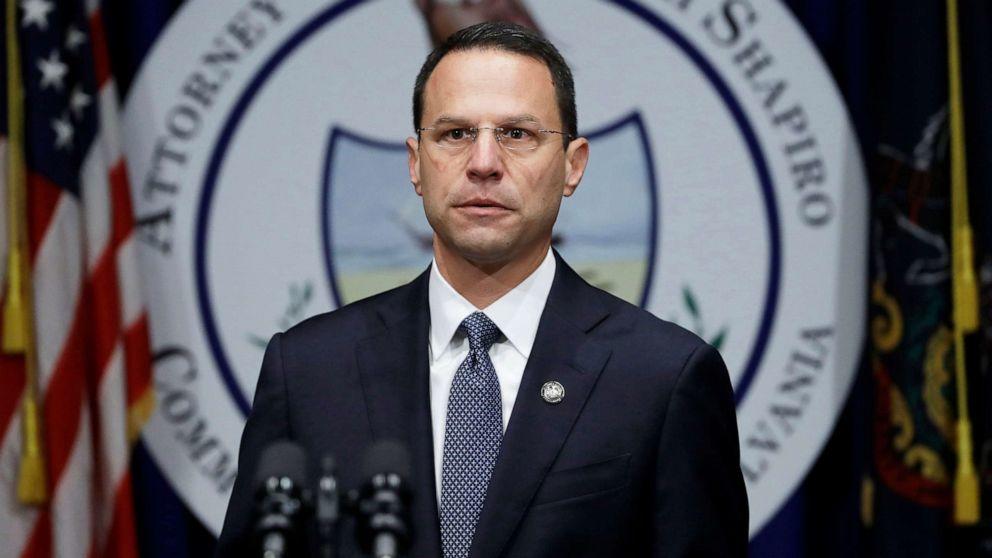
Pennsylvania Attorney General Josh Shapiro said the arrests are linked to at least two existing rings of inmates who were busted in similar COVID-19 related fraud cases.

“After announcing our first round of arrests in these COVID unemployment scams, I promised that there were more to come,” said Shapiro. “Today, 20 more individuals have been charged with illegally taking benefits away from hardworking Pennsylvanians who are struggling during this crisis.”

The investigation will continue, according to Shapiro. “These arrests are not the end of our investigation, and I’ll continue working with my colleagues at the federal level to track down those heading these schemes, along with those who are willfully participating and breaking the law.”

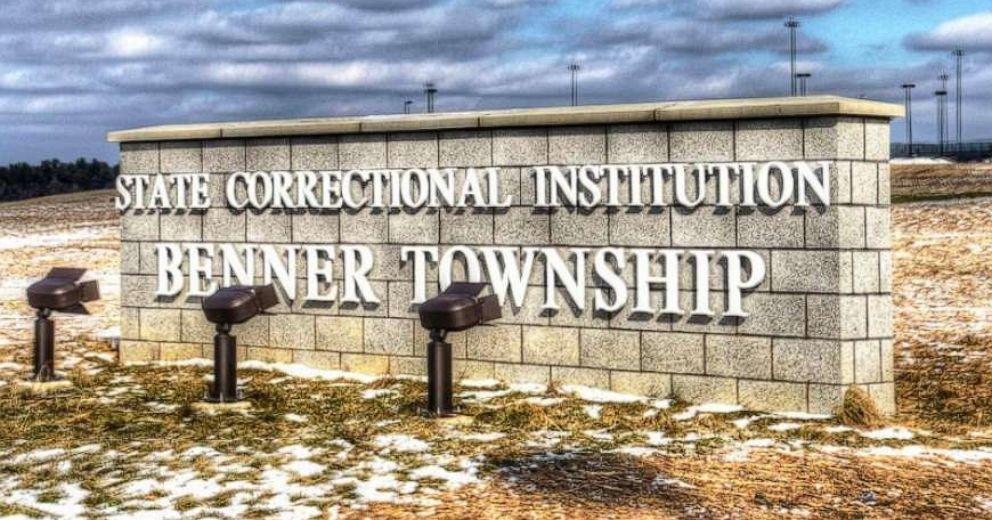
The arrests were part of a broader operation, which included a roundup of arrests at state correctional facilities in Centre County, Correctional Institution Benner, and in Schuylkill County at the Mahanoy State Correctional Institution.

The Benner ring included two ringleaders — inmate James Neff Zonge and his girlfriend Adele Moore — as well as and eight additional inmates.

Moore, a resident of State College, Pennsylvania, and Zonge were accused of helping start the ring. Officials said Moore successfully applied for COVID-19 unemployment benefits on Zonge’s behalf and began doing the same for others. Zonge allegedly received about $3,000 from the inmates for his help in filing the claims.

Moore allegedly kept the majority of the money for her own personal use. She also received about $7,000 from inmates for filing the applications and from two of the inmate debit cards that she received for the inmates at her residence. Zonge, meanwhile, netted about $3,000 from inmates for his part in the scheme. –ABC News

The ringleader of the State Correctional Institution Mahanoy scheme was allegedly Wendy Danfora of York, PA, and her inmate boyfriend Markal Munford – who is accused of applying for COVID-19 unemployment benefits, also using inmate names. While Danfora gave a portion of the fraudulently obtained funds to the inmates whose names she used, she kept the majority of the $109,900 in benefits to herself.

via ZeroHedge News https://ift.tt/3csuTb6 Tyler Durden

How Saudi Arabia Put OPEC’s Future At Stake

How Saudi Arabia Put OPEC’s Future At Stake

Tyler Durden

Thu, 09/24/2020 – 20:40

Authored by Simon Watkins via OilPrice.com,

OPEC’s 60th birthday should have been reason for celebration, but its largest producer Saudi Arabia is increasingly putting its own interests before the cartel’s objectives and has put the very existence of OPEC at stake on a number of occasions.

Founded 60 years ago this month by Iran, Iraq, Kuwait, Saudi Arabia, and Venezuela, the Organization of the Petroleum Exporting Countries (OPEC) originated from a solid base of sensible values centred upon providing a collective voice for oil producers that were being exploited by the ‘Seven Sisters’ group of international oil companies. Its stated mission was to:

“Co-ordinate and unify the petroleum policies of its member countries and ensure the stabilization of oil markets, in order to secure an efficient, economic and regular supply of petroleum to consumers, a steady income to producers, and a fair return on capital for those investing in the petroleum industry.”

For nearly 55 years it was broadly able to achieve these aims, buoyed by its members accounting for around 40 per cent of the world’s crude oil output and about 60 per cent of the total petroleum traded internationally. In 2014, though, OPEC’s de facto leader, Saudi Arabia placed its own interests above those of its fellow OPEC members, since which time the Kingdom has betrayed the group on two more notable occasions and jeopardised its very existence.

Prior to 2014, OPEC had managed to turn the tables on the Seven Sisters group of major oil companies, comprising the Anglo-Persian Oil Company (now BP) and Royal Dutch Shell (RDS), plus three iterations of Standard Oil (Standard Oil of California, Standard Oil of New Jersey, and Standard Oil Company of New York), plus Gulf Oil, and Texaco. At one point, these seven companies controlled at least 85 per cent of the world’s petroleum reserves, having often paid the host countries a minimal percentage of the resulting sales profits in return.

This compensation model dated from the first major oil discovery (the Masjed Soleiman field) made by a modern foreign oil company (the Anglo-Persian Oil Company) operating in the Middle East (modern-day Iran). Iran’s 16 per cent share of the profits from its oil before 1951 (when the Iranian parliament voted to nationalise the British company due to its paltry payout) looked positively generous when compared to Standard Oil’s payment of US$275,000 in April 1933 (equivalent to around US$6 million in 2020) to Saudi Arabia to secure the exclusive rights to drill across the entire country. As a portent of the geopolitics of the global oil market to come, the then-Prime Minister of Iran, Mohammad Mosaddegh, was removed in 1953 by a military coup – ‘Operation Ajax’ – organised jointly between the U.K.’s Secret Intelligence Service and the U.S.’s Central Intelligence Agency after he had nationalised the Anglo-Persian Oil Company’s local infrastructure assets, and renamed it the National Iranian Oil Company. After the formation of OPEC, though, the influence of the Seven Sisters began to markedly decline.

The real turning point for OPEC as an international commercial and geopolitical force came in October 1973 when OPEC members plus Egypt, Syria and Tunisia began an embargo on oil exports to the U.S., the U.K., Japan, Canada and the Netherlands in response to the U.S.’s ongoing supply of arms to Israel in the Yom Kippur War. The spike in oil prices was exacerbated by incremental cuts to oil production by OPEC members over the period and, taken together, by the end of the embargo in March 1974, the price of oil had risen from around USD3 per barrel to nearly USD11 per barrel and then it trended higher again. This in turn stoked the fire of a global economic slowdown, especially felt in the West. In the process, the balance of power between the big developed market-consumers of oil and the big emerging market-producers of oil had shifted, as highlighted by the Saudi Minister of Oil and Mineral Reserves at the time, Sheikh Ahmed Zaki Yamani.                                                                    

In 2014, though, at a series of high-profile meetings with bankers and fund managers in New York and London, various senior Saudi officials made it clear that, regardless of the economic and financial consequences to its fellow OPEC members, the Kingdom would instruct them to massively overproduce crude oil in order to crash oil prices in order to destroy the then-nascent U.S. shale oil sector. For the U.S., the instigation of this oil price war by the Saudis was an unforgivable betrayal of the trust in Saudi Arabia that had been implicit in the deal agreed in 1945 between the then-U.S. President Franklin D. Roosevelt and the Saudi King at the time, Abdulaziz. This deal had been that the U.S. would guarantee the security both of the ruling House of Saud and, by extension, Saudi Arabia, in exchange for which the U.S. would receive all of the oil supplies it needed for as long as Saudi had oil in place. After some initial success – the U.S. oil rig count in January/February 2015 saw its biggest period-on-period fall since 1991 – the Saudis found by 2016 that all that they had done was help to shape a much more cost-efficient U.S. shale oil sector that could survive above US$35 per barrel of WTI, compared to pre-2014 estimates of a US$75+ per barrel. In the process, according to the IEA, OPEC member states had collectively lost at least US$450 billion in revenues.

By the time that the next oil price war rolled around earlier this year, instigated again by the Saudis with exactly the same strategy as the war of 2014-2016 (crude oil overproduction to crash oil prices) and exactly the same objective (to destroy or disable the U.S. shale oil sector) the U.S. was in no mood to – as one senior source close to the Presidential Administration told OilPrice.com at the time – “put up with any more crap from the Saudis.” In the run-up to the March 2020 oil price war, U.S. President Donald Trump had already repeatedly warned the Saudis that the U.S. would not accept any actions that would undermine either its economy or the continued development of its shale oil sector. At a 2018 speech before the U.N. General Assembly, he stated:

“OPEC and OPEC nations are, as usual, ripping off the rest of the world, and I don’t like it. Nobody should like it,” he said, and shortly afterwards he underlined at a rally in Southaven, Mississippi, in October 2018:

“I said, ‘King we’re protecting you. You might not be there for two weeks without us.’”

Finally, on 2 April, after the Saudis had further destroyed the finances of its fellow OPEC members, Trump telephoned Saudi Arabia’s de facto ruler, Crown Prince Mohammed bin Salman, and directly told him that unless OPEC started cutting oil production he would be powerless to stop lawmakers from passing legislation to withdraw U.S. troops from the Kingdom.

Worse, though, is on the horizon for Saudi Arabia and OPEC. The U.S. has been so enraged by the Saudis trying to destroy its geopolitically and economically crucial shale oil sector yet again that any further moves by Saudi and OPEC to either push prices up over the US$80 per barrel of Brent level (regarded as economically harmful to the U.S.) or to below US$40 per barrel of Brent (seen as damaging for the U.S. shale oil sector) is highly likely to result in the passing of the ‘No Oil Producing and Exporting Cartels Bill’ (NOPEC). A version of the NOPEC bill managed to pass both houses of Congress in 2007 before it was shelved after President George W. Bush said he would veto the legislation. However, in February 2019, the U.S. House Judiciary Committee passed the NOPEC Act, which cleared the way for a vote on the Bill before the full House of Representatives. On the same day, Democrats Patrick Leahy and Amy Klobuchar and – most remarkably – two Republicans, Chuck Grassley and Mike Lee, introduced the NOPEC Bill to the Senate. It was only the intervention of Trump at that time that stopped the Bill being voted into law.

This Bill makes it illegal to artificially cap oil (and gas) production or to set prices, which is a corollary function of OPEC, and it removes the sovereign immunity that presently exists in U.S. courts for OPEC as a group and for its individual member states. This would leave Saudi Arabia open to being sued under existing U.S. anti-trust legislation, with its total liability being its estimated US$1 trillion of investments in the U.S. alone, and to all other OPEC member facing the same legal action. It would also mean the end of OPEC in any meaningful form.

via ZeroHedge News https://ift.tt/307lyAz Tyler Durden

Seoul Outraged After North Korean Soldiers Shoot & Burn Body Of “Defector” At Sea

Seoul Outraged After North Korean Soldiers Shoot & Burn Body Of “Defector” At Sea

Tyler Durden

Thu, 09/24/2020 – 20:20

In a bizarre and alarming deadly incident in waters off Korea, a South Korean fisheries official was shot and killed by North Korean soldiers after the official was apprehended at sea

South Korea’s defense ministry has confirmed the killing while condemning the “outrageous act” despite the belief that the South Korean man was trying to defect to the north.

The official had reportedly disappeared from a boat close to the the western border island of Yeonpyeong, Yonhap news agency reports. He was reportedly set upon by a North Korean patrol vessel while wearing a life jacket. Seoul defense sources told AFP that “circumstances tell us that there was an intent to defect.”

North Korean boat patrol police file image, via Reuters.

However, it’s clear the north considered the act deeply suspicious and likely considered he was a spy or attempting to infiltrate the border for nefarious purposes. 

Shockingly, after his summary execution at sea his body was burned:

“North Korean soldiers shot dead a suspected South Korean defector after interrogating him at sea, then poured oil over his body and burned it over coronavirus fears, Seoul military officials said Thursday,” AFP reports.

“He was shot dead in the water,” a military official told AFP. “North Korean soldiers poured oil over his body and burnt it in the water.”

The report describes that the man was questioned by North Korean soldiers while he was still in the water, after which they opened fire. The burning of the body is believed related to strict anti-coronavirus measures enforced by North Korea’s military.

“We assess it was carried out under the North’s anti-coronavirus measure,” a military official in Seoul told AFP. And Yonhap said the presumed defector’s killing took place upon orders from higher-ups in Pyongyang.

“Atrocious act”: Lt. Gen. Ahn Young-ho of the South Korean military, via Yonhap/NY Times

The north currently has “shoot to kill” orders in place in cases of illegal border breaches as part of its coronavirus lockdown.

The South’s defense ministry “confirmed from the analysis of various intelligence that the North shot our citizen found in its waters and cremated his body,” according to a statement.

South Korea’s defense ministry said the killing is a huge and unnecessary provocation.  “We sternly warn North Korea that all responsibilities for this incident lie with it,” it said.

The episode underscores that the two sides are still in an active state of war, and that even “defectors” from either side run the risk of being killed on the spot upon breaching the militarized border. 

via ZeroHedge News https://ift.tt/3hZ4H9q Tyler Durden