Flurry Of Corporate Layoffs Continue As Disney, Shell, & Continental Announce Mass Firings Tyler Durden
Wed, 09/30/2020 – 11:25
As we look ahead to the last jobs report before the Nov. 3 US election, a growing number of corporations across various hard-hit industries are announcing tens of thousands of layoffs, as ‘PPP’ employment restrictions expire and the financial backlash from COVID-19 continues to ravage corporations and households.
Already this week, Royal Dutch Shell, Continental Airlines, Dow Chemicals, and Marathon Petroleum have announced restructuring plans that involve laying off tens of thousands of workers. Yesterday, Disney announced plans to eliminate 28,000 jobs as most of its theme parks remain closed, and the movie business remains effectively shuttered.
Layoff news, past 24 hours:
* Disney: 28,000 jobs cuts
* Shell: 9,000
* Dow: six percent of workforce
* Marathon Petroleum: https://t.co/B6mgCoMu8b
Royal Dutch Shell announced Wednesday morning, a new layoff program to cut upwards of 9,000 jobs, or about 10% of its workforce, as the oil major overhauls its oil and gas segments to low-carbon energy.
The Anglo-Dutch company said it would cut between 7,000 to 9,000 workers by the end of 2022. The total includes around 1,500 workers who have already agreed to leave the company this year.
The reductions are a move by Shell to decrease its corporate footprint and save costs as it transitions into low-carbon energy.
“Reduced organisational complexity, along with other measures, are expected to deliver sustainable annual cost savings of between $2.0 to $2.5 billion by 2022. This will partially contribute to the announced underlying operating cost reduction of $3.0 to $4.0 billion by the first quarter of 2021. Job reductions of 7,000 to 9,000 are expected (including around 1,500 people who have agreed to take voluntary redundancy this year) by the end of 2022,” the company said in a press release.
In a statement, Shell CEO Ben van Beurden said, “We have to be a simpler, more streamlined, more competitive organization that is more nimble and able to respond to customers.”
“Make no mistake: this is an extremely tough process. It is very painful to know that you will end up saying goodbye to quite a few good people,” van Beurden added.
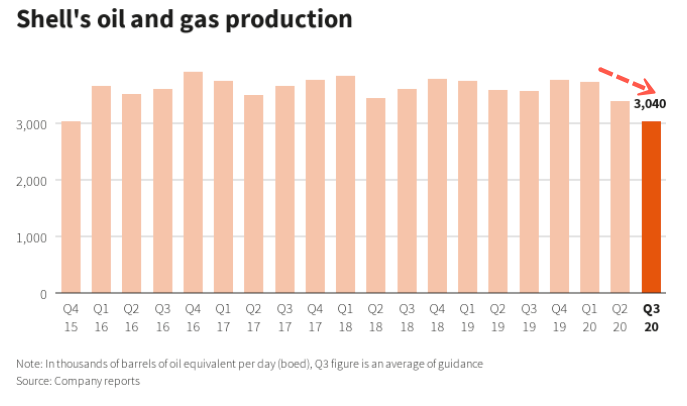
As for Shell’s oil and gas production, there was a noticeable sharp drop in output to about 3.04 million barrels of oil equivalent per day due to the decline in demand because of the virus pandemic and a busy hurricane season in the US Gulf Coast that forced offshore platforms to halt operations.
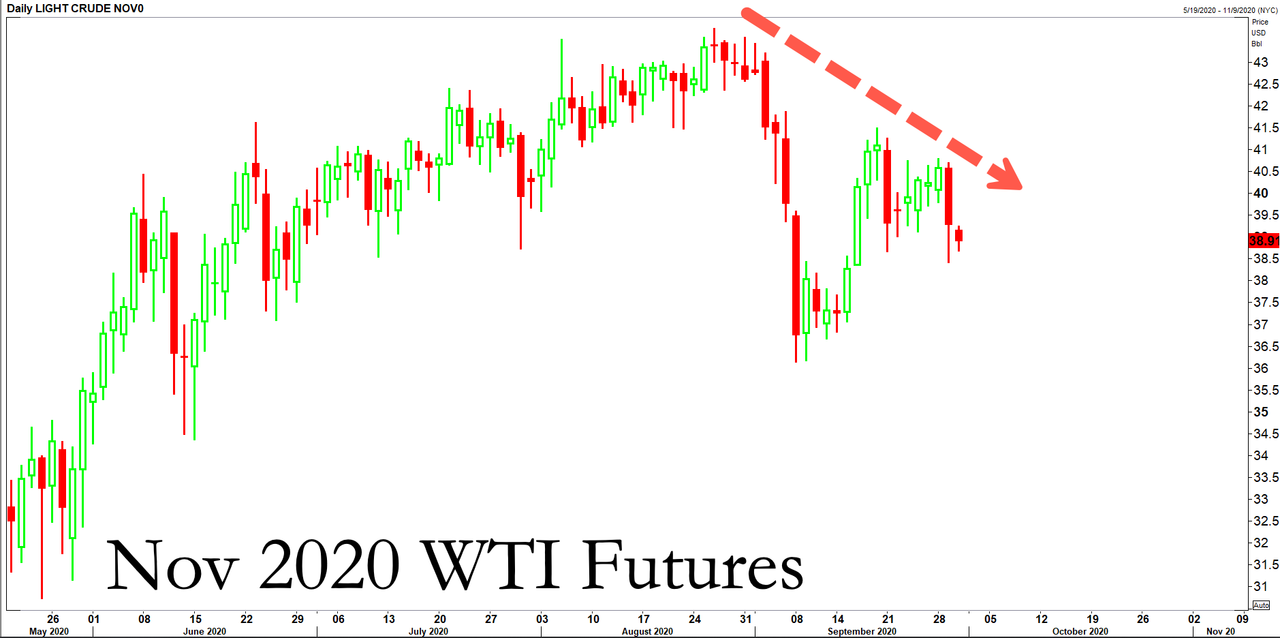
On Wednesday, oil continues to slump, extending losses from Tuesday, following new worries that rising global coronavirus cases could result in lower demand for crude products. Shell’s move reflects the challenge oil majors are facing as the virus pandemic persists.
“Shell is exploring ways to reduce spending on oil and gas production, its largest division known as upstream, by 30% to 40% through cuts in operating costs and capital spending on new projects,” sources told Reuters in early September.
We noted, in late June, Shell wrote down up to $22 billion worth of assets and warned about the “impact of COVID-19 and the ongoing challenging commodity price environment.”
As for Shell’s net-zero carbon emission ambitions by 2050, well, Van Beurden said, oil and gas would still be produced by that date, but it would mostly sell low-carbon electricity, low-carbon biofuels, and hydrogen.
“We have to be net-zero in all our operations, which means major changes at refineries, chemicals sites, on-shore and offshore production facilities. But it also means that we have to change the type of products that we sell,” he added.
Bloomberg quoted Barclays Plc analyst Lydia Rainforth’s latest research note that said Shell’s transformation to a “leaner and lower-carbon organization is the right” plan, but the “macro environment is still challenging, this may take some time to reflect in the share price.”
And now, thousands of aviation layoffs loom as a dysfunctional Congress has yet to make meaningful progress in passing the next round of stimulus, and its concomitant bailout of the airline industry.
via ZeroHedge News https://ift.tt/3jnEfrC Tyler Durden
Renowned geopolitical and financial cycle expert Charles Nenner called this market just 2% from the top in January. What does he think now? He likes gold and says he “made more money in gold than in stocks” in the past few months.
Nenner says, “We are playing the long term gold market…”
“We went out at $2,100 (per ounce), and the price target was $1,850 (on the downside). We hit $1,850 a couple of days ago, so we bought back in. We get in and out for a couple of hundred points, and it’s worthwhile. So, the gold cycle is up for much longer. $2,500 is the first target, and it could be we get higher targets. I do not believe in the stock market, most of the markets we do nicely in are the gold market, silver market, crude oil market, bond market and the dollar. It’s all very simple and normal, and the stock market is not going to end very well.”
Nenner is long the stock market now until close to the end of November. Nenner says the rising market may be signaling a coming Trump win in November. Nenner is not sure, but what he is very sure about is the stock market is way overvalued just like it was earlier this year. Nenner explains,
“As you know, the stock market is still very much overvalued. One of the reasons is the ‘Buffett Indicator,’ and that is the value of the stock market compared to the value of the entire GDP, and it’s extreme. I think it’s more extreme than the 2000 bubble. If you want to buy low and sell high, you have to have indicators of what is low and what is high, and, for me, this is high. This is based on the fundamentals, but on the cycles, we can try to test the highs one more time. This is not going to end well because everybody will try to get into the market, and then the whole thing is over.”
Nenner thinks with all the unemployment and businesses going under permanently, it is not an inflationary environment, at least not yet. Nenner says,
“I still think we are going into a deflationary environment, and that still makes sense. That is also why gold is up. Most people don’t understand that because they always look for inflation for gold to go up. I show them that most of the bull markets in gold are deflationary periods and not inflationary periods. When you have deflation, there is nowhere to hide, and it’s very cheap to hold gold. You are afraid for the financial system, and that’s why gold goes up…
Look what happened in real estate. You thought you were safe in real estate. Companies are not buying malls, and companies are not paying rent anymore, or they negotiate and they are not going to pay anymore. So, that’s also not a safe place. So, there is not much left. People go into gold and store it away for the worst case scenario. If banks don’t survive, they have the gold.”
On the war cycle and the recent peace deals in the Middle East, Nenner says, “…It is all putting pressure on Iran because they are all afraid of Iran…”
” They are going to make a pact to resist Iran, and the more Iran feels itself in a corner, the more dangerous it gets. . . . If we can go the next three to four years without a major explosion, then we are safe, but this is a very dangerous period. This is another reason why the DOW can go down to 5,000. I don’t know what is going to do it, but something is going to do it.”
Join Greg Hunter of USAWatchdog.com as he goes One-on-One with renowned cycle analyst and financial expert Charles Nenner.
“Everyone Dies”: Elon Musk Says He Won’t Get COVID Vaccine, Calls Bill Gates A “Knucklehead” Tyler Durden
Wed, 09/30/2020 – 10:45
Continuing his weeks-long feud with Bill Gates, whom he lambasted days ago for having “no clue” about electric pickup trucks, Tesla CEO Elon Musk has now taken more shots at the Microsoft founder while decrying the idea of taking the coronavirus vaccine during a podcast with Kara Swisher.
Musk said on the recent podcast that neither him, nor his children, are at risk of dying from Covid-19 and that, as a result, they would be unlikely to need the vaccine, according to RT. “I’m not at risk, neither are my kids,” he said.
Musk said: “This is a no-win situation. It has diminished my faith in humanity, this whole thing… The irrationality of people in general.”
He also spoke out against the global lockdowns (again), calling them a mistake and saying only the vulnerable should be in quarantine until after the virus passes. Musk had previously called the lockdowns “unethical” and “de facto house arrest”.
Speaking about Bill Gates, Musk said: “Gates said something about me not knowing what I was doing. It’s like, hey, knucklehead, we actually make the vaccine machines for CureVac, that company you’re invested in.”
Gates had previously said of Musk that he hoped he “doesn’t confuse areas he’s not involved in too much.”
When he was asked about the risk of the virus to his employees and their families, Musk responded: “Everybody dies.”
He continued: “We’ve been making cars this entire time and it’s been great. Through this entire thing, [SpaceX] didn’t skip a day. We had national security clearance because we were doing national security work. We sent astronauts to the space station and back.”
Recall, just hours ago, we reported that Tesla’s Nevada Gigafactory had the highest Covid case count out of all businesses in its county. The Gigafactory beat out many of the largest casinos in Reno and Sparks – and Saint Mary’s Regional Hospital and the VA Hospital.
The Gigafactory reported 117 cases, more than 5 times the local hospital and 6 times what the local VA hospital reported. The number of Washoe County coronavirus cases since June, listed by workplace, were as follows:
Gigafactory: 117
Renown: 104
Walmart: 41
UNR: 32
UPS: 27
Atlantis: 26
Peppermill: 26
Grand Sierra Resort: 25
Washoe County School District: 25
Silver Legacy: 24
Saint Mary’s Regional Medical Center: 22
Walkenhorst: 18
World Pack: 18
VA Hospital: 17
County spokesman Scott Oxarart said: “This data shows that COVID-19 is still prevalent in our community. People are frequenting places while infectious and are making it possible for future transmission. It’s important to remember that if you’re showing symptoms like fever, shortness of breath, coughing, or even symptoms such as sore throat, headaches, upset stomach, you should stay home and only go out to get a COVID-19 test or receive medical treatment.”
via ZeroHedge News https://ift.tt/2HKUDEv Tyler Durden
WTI Holds Stimulus-Hope Gains After Surprise Crude Draw Tyler Durden
Wed, 09/30/2020 – 10:35
Oil prices rebounded overnight as stocks rallied on fiscal stimulus hope and the API-reported inventory data sank in.
“Traders see oil demand as fragile,” said Paola Rodriguez-Masiu, senior oil-market analyst at Rystad Energy. “We may see some production needing to be sent to inventories in 2020’s last quarter.”
API
Crude -831k (+1.9mm exp)
Cushing +1.61mm
Gasoline +1.623mm (-1.3mm exp)
Distillates -3.424mm (-1.7mm exp)
DOE
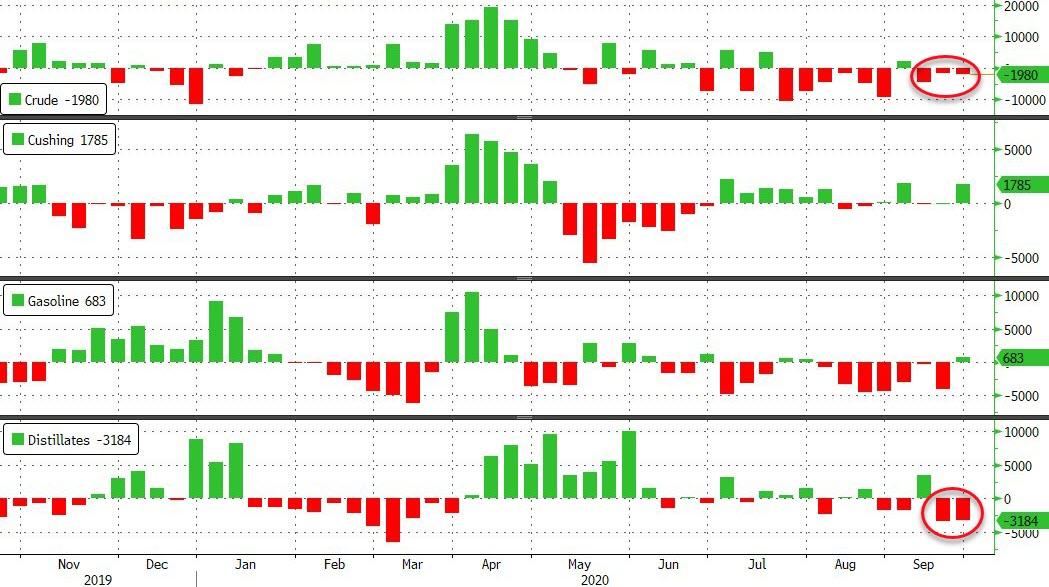
Crude -1.98mm (+1.9mm exp)
Cushing +1.785mm
Gasoline +683k (-1.3mm exp)
Distillates -3.184mm (-1.7mm exp)
A surprisingly large crude draw combined with a big distillates draw…
Source: Bloomberg
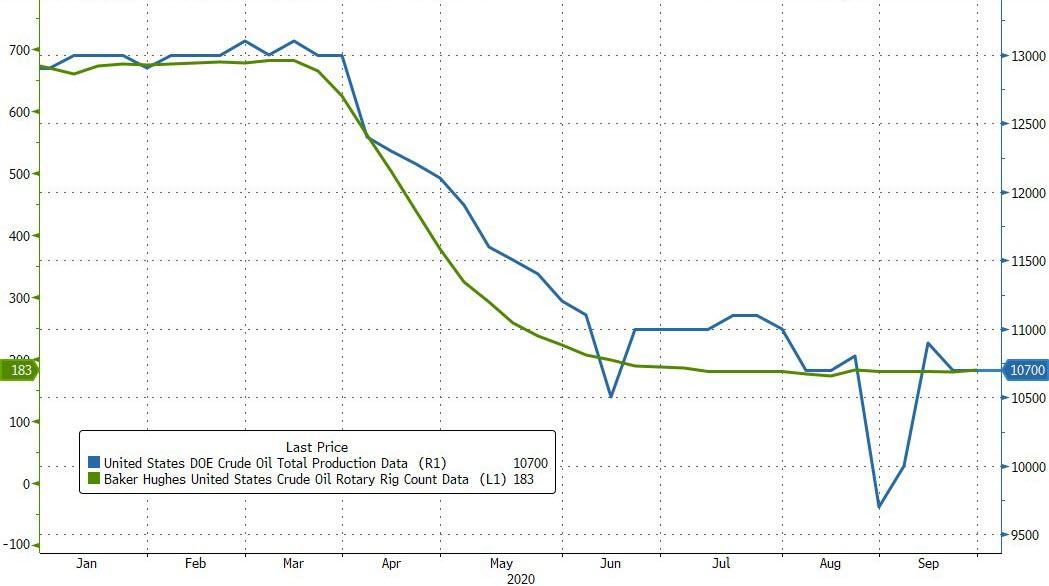
Most of the storm-impacted noise has now left the data.
Source: Bloomberg
WTI hovered around $39.50 ahead of the official data and maintained those levels immediately after…
Finally, we note that Bloomberg Intelligence Senior Energy analyst Vince Piazza warns that “daily U.S. crude output has crept close to 11 million barrels a day from the May low of 10 million, adding supply to a market whose downstream demand remains depressed by the effects of Covid-19. Well completions could drive production higher, and that would be compounded by any move of WTI into the high $40s. Coronavirus outbreaks in Europe and elsewhere add to the pressure on demand, and we believe adjusted storage remains high and limits long-term rally prospects.“
via ZeroHedge News https://ift.tt/3cJtrRM Tyler Durden
In August, I blogged about Professor Bruce Hay’s pro se case. He sued New York Media LLC, a Delaware LLC that is headquartered in New York, as well as a former and current employee of New York Magazine. Hay relied on 28 U.S.C. § 1332(a) to establish diversity jurisdiction. But he failed to establish the citizenship of each member of the LLC.
Now, the U.S. District Court for the Southern District of New York has issued an order to show cause why the complaint should not be dismissed for lack of jurisdiction. Judge Oteken’s order is two paragraphs:
Plaintiff invokes this Court’s diversity jurisdiction pursuant to 28 U.S.C. § 1332. However, the Complaint does not adequately demonstrate the Court’s subject matter jurisdiction because it does not allege the citizenship of each of the members of the LLC defendant. The state of registration and headquarters location of a limited liability company are irrelevant to the question of diversity of citizenship under § 1332. Rather, for purposes of diversity jurisdiction, an LLC has the citizenship of each of its members. See ICON MW, LLC v. Hofmeister, 950 F. Supp. 2d 544, 546 (S.D.N.Y. 2013) (citing Bayerische Landesbank v. Aladdin Capital Mgmt. LLC, 692 F.3d 42, 49 (2d Cir. 2012)). Thus, in order to invoke this Court’s diversity jurisdiction, Plaintiff must allege that the citizenship of each member of the LLC defendant was diverse from that of Plaintiff at the date of this action’s filing. Therefore, Plaintiff shall, on or before October 7, 2020, either (1) show cause as to why its complaint should not be dismissed for lack of subject matter jurisdiction, or (2) move to file an amended complaint that properly pleads jurisdiction. If Plaintiff fails to do so, this action may be dismissed.
Last week, an attorney made a notice of appearance for Hay. Perhaps Hay will file an amended complaint.
from Latest – Reason.com https://ift.tt/2G68qVQ
via IFTTT
In August, I blogged about Professor Bruce Hay’s pro se case. He sued New York Media LLC, a Delaware LLC that is headquartered in New York, as well as a former and current employee of New York Magazine. Hay relied on 28 U.S.C. § 1332(a) to establish diversity jurisdiction. But he failed to establish the citizenship of each member of the LLC.
Now, the U.S. District Court for the Southern District of New York has issued an order to show cause why the complaint should not be dismissed for lack of jurisdiction. Judge Oteken’s order is two paragraphs:
Plaintiff invokes this Court’s diversity jurisdiction pursuant to 28 U.S.C. § 1332. However, the Complaint does not adequately demonstrate the Court’s subject matter jurisdiction because it does not allege the citizenship of each of the members of the LLC defendant. The state of registration and headquarters location of a limited liability company are irrelevant to the question of diversity of citizenship under § 1332. Rather, for purposes of diversity jurisdiction, an LLC has the citizenship of each of its members. See ICON MW, LLC v. Hofmeister, 950 F. Supp. 2d 544, 546 (S.D.N.Y. 2013) (citing Bayerische Landesbank v. Aladdin Capital Mgmt. LLC, 692 F.3d 42, 49 (2d Cir. 2012)). Thus, in order to invoke this Court’s diversity jurisdiction, Plaintiff must allege that the citizenship of each member of the LLC defendant was diverse from that of Plaintiff at the date of this action’s filing. Therefore, Plaintiff shall, on or before October 7, 2020, either (1) show cause as to why its complaint should not be dismissed for lack of subject matter jurisdiction, or (2) move to file an amended complaint that properly pleads jurisdiction. If Plaintiff fails to do so, this action may be dismissed.
Last week, an attorney made a notice of appearance for Hay. Perhaps Hay will file an amended complaint.
from Latest – Reason.com https://ift.tt/2G68qVQ
via IFTTT
Watch Live: Former FBI Director James Comey Testifies Before Congress Tyler Durden
Wed, 09/30/2020 – 10:18
Former FBI Director James Comey is testifying in a long-awaited appearance before the Senate Judiciary Committee on Wednesday, where he is expected to answer questions regarding the FBI’s conduct during the Trump-Russia investigation.
Watch:
Committee Chairman Lindsey Graham (R-SC) has vowed to get to the bottom of inaccuracies and omissions used to obtain warrants to spy on the Trump campaign during the 2016 US election – as well as the the agency’s reliance on the debunked Steele dossier when the FBI knew it was dubious.
Graham has speculated that the lower-level FBI employees who conducted the interview with the sub-source were not the only ones who knew that the sub-source said the information in the dossier was unreliable.
“We’re not going to let the system blame some low-level intel analyst or case agent for defrauding the court,” Graham told Fox News in June. “I believe it goes to the very top, and I’m going to get to the bottom of it and that means Sally Yates and [Rod] Rosenstein, and [Andrew] McCabe and Comey are all going to come before the committee and they’re going to be asked, ‘What did you know and when did you know it?’” –Fox News
Let’s see if Graham is more bite than bark today…
via ZeroHedge News https://ift.tt/3451KPq Tyler Durden
Gold Pumped-n-Dumped As Stocks Melt-Up To Overnight Debate Highs Tyler Durden
Wed, 09/30/2020 – 10:03
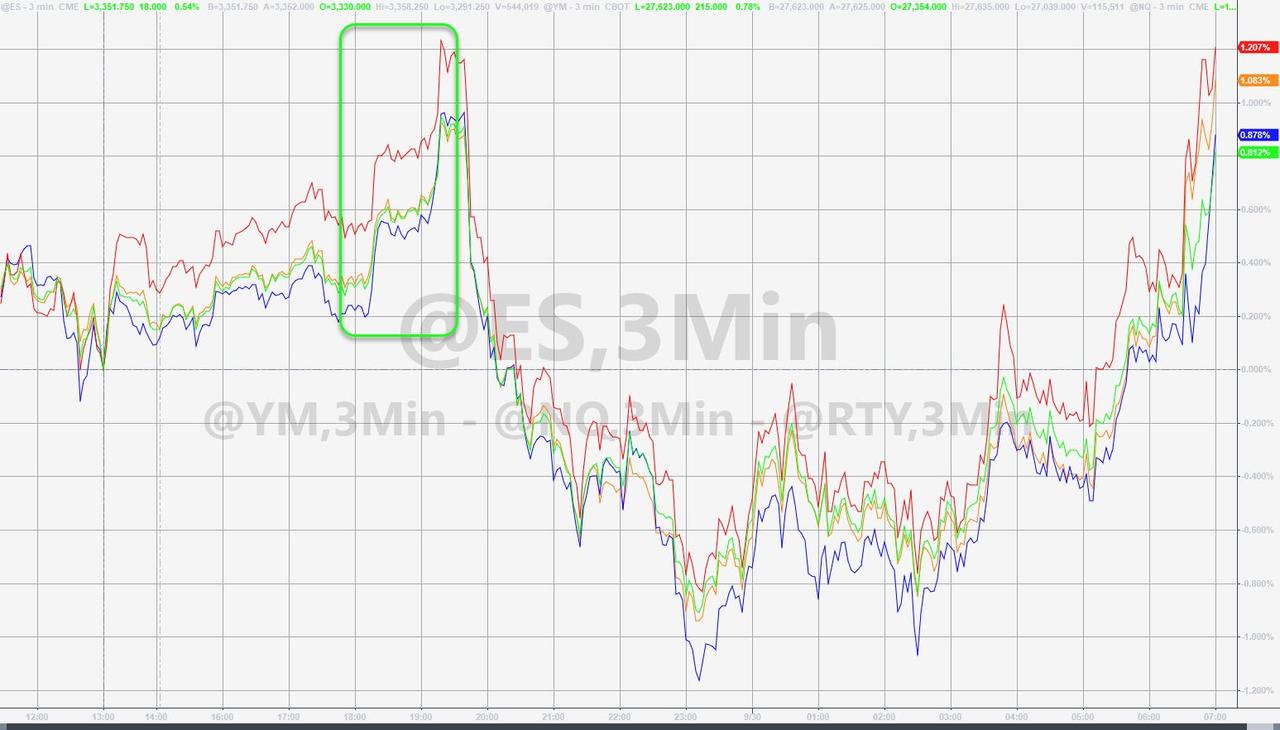
So… with futures down hard overnight, talking heads proudly proclaimed that this must mean Biden won the debate. So with stocks now surging to overnight highs, does that mean Trump won?
Some are claiming this panic-bid is driven by Pelosi’s “hopeful” comments on stimulus but she has said the same exact word every day for two weeks.
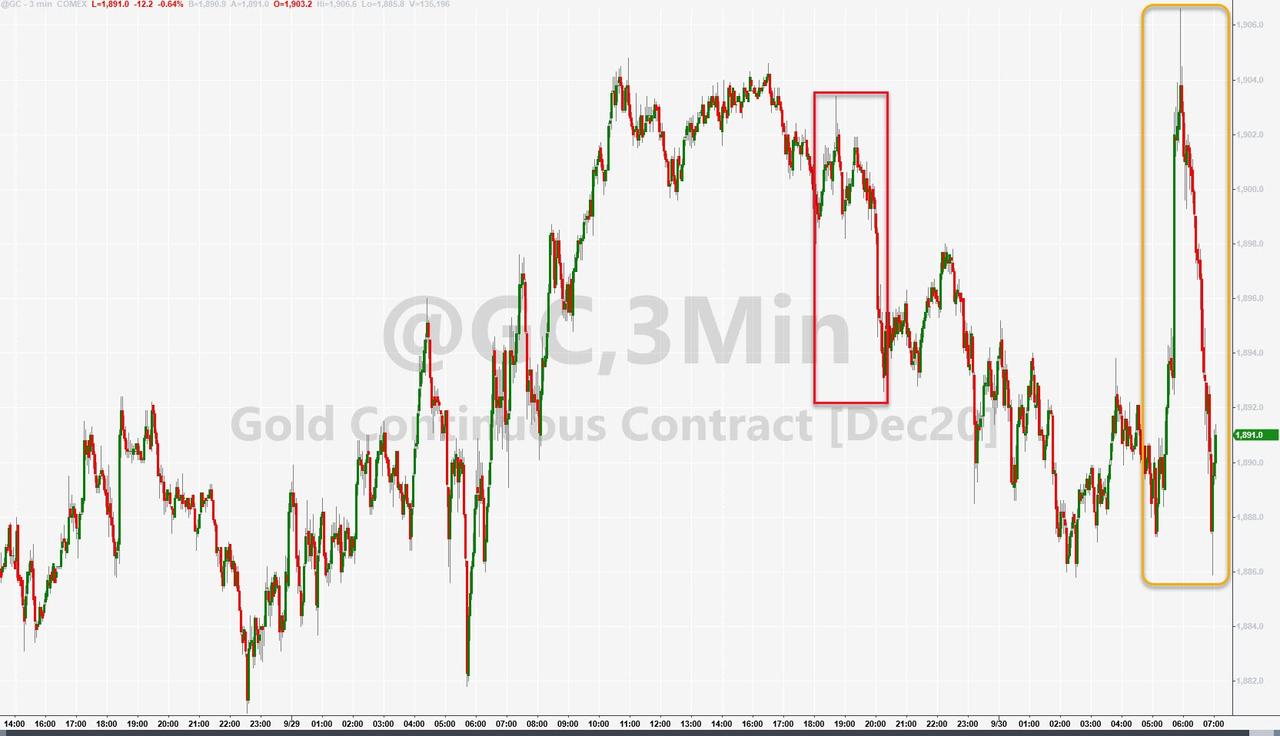
Meanwhile gold is chaotic with futures ripped back above $1900, only to be dumped again…
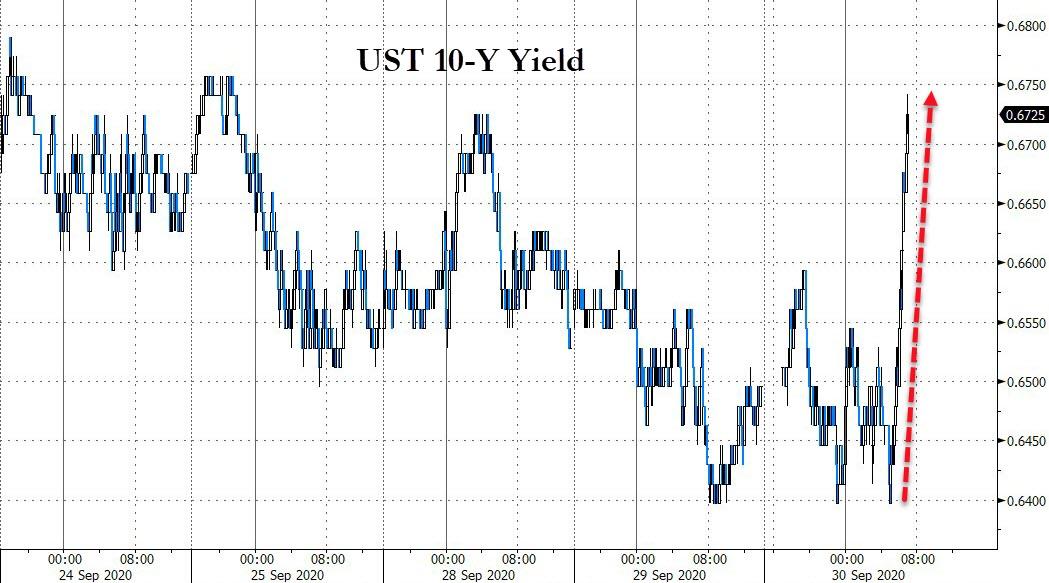
And bonds are being sold…
Month-/Quarter-end rebalancing?
via ZeroHedge News https://ift.tt/3cGzV44 Tyler Durden
One of the Fed’s congressionally charted objectives is to promote stable prices for the goods and services we all purchase. Investors have been lulled to sleep for over 20 years by “price stability.” As a result, few investors have an appreciation for how inflation can impact their investments.
Despite stable price increases for the last two decades, the Fed now wants more inflation.
Given the negative impact inflation has on our wealth, why does the Fed wish to boost inflation? Maybe more important, how can they generate inflation?
Before progressing, we explain the hypocrisy between the Fed’s 2% inflation target and true price stability. For this, we lean on David Rosenberg quoting Alan Greenspan:
“When asked at the July ’96 FOMC meeting the level of inflation that truly reflects price stability, he said, “I would say the number is zero, if inflation is properly measured.”
What is Money?
The capacity for the Fed to generate more inflation can be appreciated in a straightforward statement:
ALL MONEY IS LENT INTO EXISTENCE.
Ruminating on that statement helps you understand why inflation is not running rampant despite Fed “printing presses” running at full steam. It also provides a glimpse as to how the Fed can change that. But first, let’s consider how money is created.
“Inflation is always and everywhere a monetary phenomenon in the sense that it is and can be produced only by a more rapid increase in the quantity of money than in output.” Those oft-quoted words by Milton Friedman define the root cause of inflation. To paraphrase, it means more money chasing fewer goods creates inflation.
Most economists agree with Friedman’s theory. The question, however, is what constitutes money? The problem facing the Fed is that they do not create money. Strike that; the Fed does not yet create money.
The Fed only provides banking reserves, or “toner,” so to speak. It is up to banks to use the reserves to make loans and create new money.
Money is Born
The following lesson of how money comes into existence is from our article, Why QE Is Not Working.
“Under the traditional fractional reserve banking system run by the U.S. and most other countries, money is “created” via loans. Here is a simple example:
John deposits a thousand dollars into his bank
The bank is allowed to lend 90% of their deposits (keeping 10% in “reserves”)
Anne borrows $900 from the same bank and buys a widget from Tommy
Tommy then deposits $900 into his checking account at the same bank
The bank then lends to someone who needs $810 and they spend that money, etc…
After Tommy’s deposit, there is still only $1,000 of reserves in the banking system, but the two depositors believe they have a total of $1,900 in their bank accounts. The bank’s accountants would confirm that. To make the bank’s accounting balance, Anne owes the bank $900. The money supply, in this case, is $1,900 despite the amount of real money only being $1,000.
That process continually feeds off the original $1,000 deposit with more loans and more deposits. Taken to its logical conclusion, it eventually creates $9,000 in “new” money through the process from the original $1,000 deposit.”
If you notice, the multiplying, or creation, of money is solely dependent on banks. At each step in the process, a bank must decide to lend the latest deposit. With each additional loan, the money supply increases. If a bank does not lend, the money supply does not grow.
In the same way that banks create money, it can vanish. Money dies when a debt is paid off or when a default occurs.
Unproductive Debt Needs Inflation
The foundation of the modern U.S. economy is debt. That is not necessarily good or bad, but it does raise a couple of essential questions:
Was the debt productive and used to generate future economic activity to service and repay the debt?
Was it unproductive and used to purchase something that provides little or no income generation in the future?
Assessing every single loan outstanding for its productivity and income generation is impossible. However, there are easy ways to qualify debt in aggregate. The graphs below show the ratio of Federal Debt to GDP and Corporate Debt to GDP.
If the debt were productive in aggregate, GDP would rise faster than debt. That is not the case nor the trend for the last 50 years. Therefore, we can say with some certainty that a majority of debt is unproductive.
It should, therefore, be no surprise that productivity growth rates inversely track the growth of the debt ratios above.
Under our economic construct, unproductive debt needs more debt at lower interest rates to sustain it. At some point, and we are likely near, or at the point, it needs inflation to reduce its burden.
More debt, especially at cheaper interest rates, allows debtors to service and pay down old debt. Inflation affords debt holders the ability to service and pay back debt with money worth less than when the loan was originated. Is it any wonder why the Fed has brought rates to zero and continually yearns for more inflation?
Back To The Fed
So with an understanding of how banks create money, and the role debt plays in the economy, we come back to the Fed.
The Fed, believing they are responsible for managing economic growth, encourages ever-increasing debt levels to keep the debt scheme going. As we said, a reduction of debt would reduce the money supply and result in deflation and further defaults. The economic fallout would be terrible.
To ensure debt balances rise, the Fed encourages new debt with low-interest rates. In 2008, zero interest rates were not enough to promote debt. During the 2008 crisis and ever since the Fed has decided to push reserves onto the banking system via quantitative easing (QE). The “logic” is that if the banks have reserves, they will gladly use them to make loans.
A Bump in the Road
Money is born when a bank makes a loan. If banks are not making loans, money is not being created. This explains why, despite the Fed’s massive efforts, inflation has yet to take hold.
Bank of America recently summed up the Fed’s problem well.
“At the current low rates, even if the Fed were to set all Treasury rates to 0bp, how many new borrowers and spenders would emerge? This is the problem of the zero lower bound that has worried the Fed and other central banks for years.”
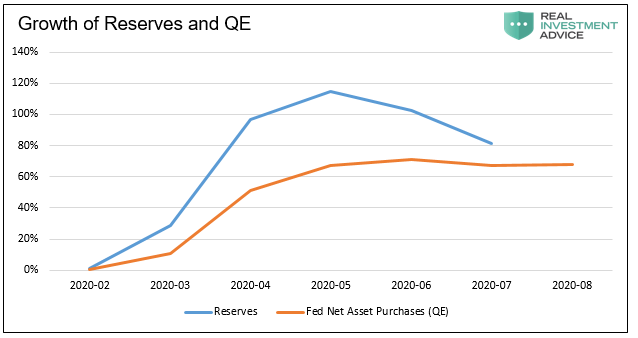
The graph below shows that since February, reserves at banks have grown faster than the amount of reserves the Fed is adding to the banking system via QE. If banks were using newly added reserves to create loans, reserve growth would be well below the growth of QE.
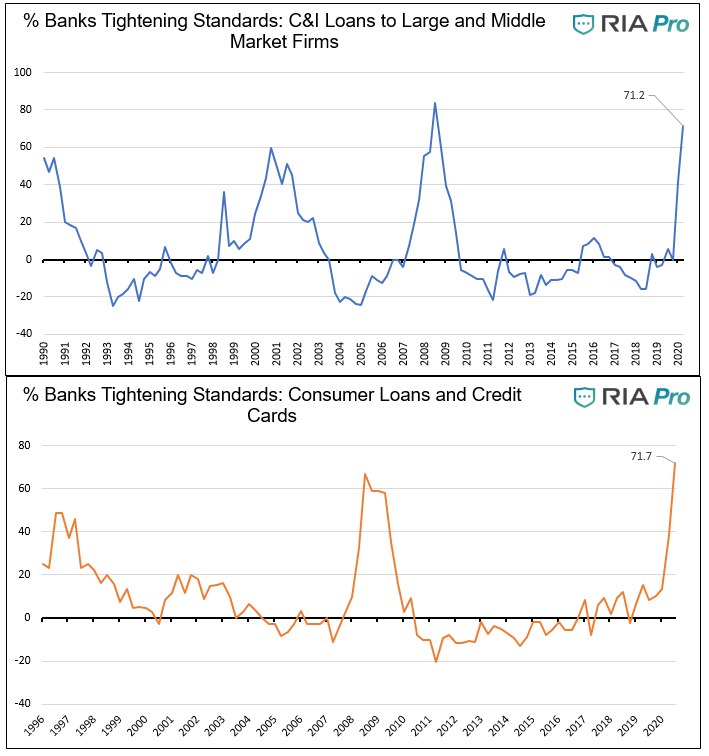
The next set of graphs shows that banks have been aggressively tightening lending standards on business and consumer loans. Also, the Mortgage Bankers Association’s (MBA) Mortgage Credit Availability Index is at a six-year low.
Worsening matters, debt is being defaulted upon due to the COVID shutdowns, and money is vanishing. Further, the savings rate is noticeably higher, and citizens are being prudent and paying off debts.
The banks have enough excess reserves to make trillions of dollars in loans. However, the banks are on the hook for defaults and solvency issues arising from such loans. Banking margins are at historically tight levels, interest rates at record lows, and the unemployment rate is up to levels rarely seen. To make matters worse, the Fed is begging for inflation, which would raise future interest rates to the detriment of bank profits. Should we expect banks to loan in such an environment? Of course not.
Bypass the Banks
“…if I was trying to create deflation like I’m in this evil Darth Vader, like ‘Let’s create deflation,’ I would have done exactly what the Fed did from 2012 until a couple of years ago.” – Stan Druckenmiller, CNBC June 2019
What can the Fed do if they cannot persuade the banks to lend, create money, and generate inflation? Ben Bernanke once told us that the Fed could print money and distribute it to the public. He referred to this as “helicopter money,” thus granting him the nickname “Helicopter Ben”.
Helicopter money may not be today’s order of business, but the Fed has hinted they may choose to become a bank and lend directly to borrowers. If the banks will not do their job, why not do it for them?
The Fed does not care about gains and losses, that’s our problem. It is a problem most citizens will not understand until they are using Benjamins in their fireplace. If the Fed loses money on a bad loan, they can print more money to offset it. Whether money is lent directly to Joe Schmo on main street, a large corporation, or the government, it would represent a new weapon in the fight for more inflation.
Think of it this way, if the Fed offered you a $100,000 “loan” at a zero percent interest rate, would you take it? No doubt many would, and as such, the supply of money and inflation would surge. Dare we say, “mission accomplished.”
Summary
If the Fed manages monetary policy with the same tools of the last decade, inflation is not likely to rise meaningfully. The Fed understands the trap its monetary policy leaves them in. To escape, the Fed may consider printing money. We suspect doing this via direct lending efforts is their way out of the trap.
A popular rebuttal to our synopsis is that it is illegal for the Fed to make direct loans. That is very true, but neither is the Fed allowed to buy corporate bonds. They chose not to abide by the Federal Reserve Act and Congress did not stop them.
As long as congressional oversight is weak and the public is blind, the Fed has the tools. If the Fed wants inflation, they can get it.
As investors, we try to anticipate what the Fed will do. Next, we try to assess the implications of those actions. This year has been one long reminder that tomorrow might not look like yesterday. Much has changed and is changing. Our decisions as investors should account for the probability that those who manage monetary policy do so for their constituents, and not being a bank, we are not their constituent.
En garde.
via ZeroHedge News https://ift.tt/2GrWmxC Tyler Durden