US Futures Slide After Debate Chaos

US Futures Slide After Debate Chaos

Tyler Durden

Wed, 09/30/2020 – 08:08

US equity futures and most global markets dropped after an acrimonious and chaotic US presidential debate, which CNN’s Dana Bash described as a “shitshow” on air, and which did little to change voters minds but underscored the risk of a contested vote in November. Safe assets, such as the yen and dollar also rose as a continued rise in COVID-19 spooked some traders although strong factory surveys boosted China’s markets.

S&P 500 futures were last 0.6% lower, with Dow Jones and Nasdaq 100 futures down by as much as 1%. Asian trading had been choppy rather than outright weak but Europe sank 0.5% early on amid worries too over the steep rises in coronavirus infections across the region again, although a wave of buying managed to bring European markets back to even. Google dipped after a report that China was preparing to launch an antitrust probe into Alphabet’s Google.

While futures initially rose, they kneejerked lower after the end of the debate as Trump cast doubt on whether he would accept the election’s outcome if he lost. Here

“What we’ve seen from the debate is the reinforcement that if Biden wins, Trump is not going to accept that,” said Chris Weston, head of research at Pepperstone Group Ltd. in Melbourne. “People positioned for an ugly contest afterwards have been validated….I don’t think we were expecting anything else from Trump. He continues to put that contested (result) risk premium back into the market.”

They have since rebounded however, as the first presidential debate offered little trading cues for bond and currency markets, according to Jun Kato, chief market analyst at Shinkin Asset Management, who noted that Trump’s performance was in line with his usual behavior and it was unclear if Biden emerged superior in the debate.

“The debate just added to the confusion about how the election will run,” said SEB investment management’s global head of asset allocation Hans Peterson. “But financially it doesn’t change anything.”

“The share market normally prefers the incumbent (president) to win,” said Shane Oliver, head of investment strategy at AMP Capital in Sydney. “U.S. futures initially rose, as perhaps Trump delivered some punches, but it wasn’t enough,” he said.

To be sure, the debate was an absolute mess with 69% of people in a CBS poll said they were annoyed with the event, “which featured expletives, name calling, insults and shouting that made it hard to hear what was actually being said.”

DB’s Jim Reid agrees, writing overnight that “there was very little substance in the debate and almost no new information proffered. The story of the debate will likely surround the President’s consistent interruption, though Mr Biden was not able to stay above the fray and traded insults at times with Mr Trump. Acrimony ruled.

More to the point, and as we asked if the debate actually matters, Bloomberg’s John Authers writes that the debate “appears to have changed little” who shows trading over the last 24 hours on the Predictit contract for which party wins the election. Volume was heavy during the debate, and yet it translated into a just-perceptible improvement for the Democrats, nothing more.

Bookies reported much the same thing; betting markets had been slightly more optimistic for Donald Trump than the prediction markets, but now they are in exact alignment. Like Predictit, the Betfair exchange now puts Biden’s victory chance at 60%. Before the debate, Biden’s odds were 4/5 on (56%). They are now 4/6 (60%). Trump’s odds, if you fancy a bet, widened from 11/8 to 6/4. Biden is ahead but not by the kind of margin that anyone would want to risk  a lot of money on.
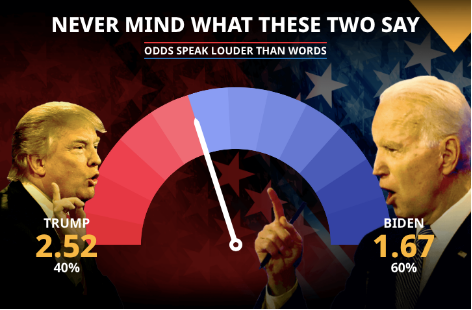
The presidential debate yielded no clear winner and barely moved the needle in betting markets, which project a narrow Biden victory. Odds maker Smarkets slightly lowered Trump’s chance of re-election to 40% after the debate from 42% beforehand.

As we said last night, and as Authers repeats this morning, Biden succeeded by “surviving the debate” and giving the president one less opportunity to bring him down in future, and while both made statements that might be usable against them, it was hard to hear what either of them were saying for lengthy tracts of the debate. The conclusion: “It’s hard to see how any genuinely undecided voter would have changed their mind on the basis of this.

Perhaps more market moving was the latest Chinese official and Caixin PMI, both of which hit just before China goes on vacation for a week. The September Manufacturing PMIs from both the National Bureau of Statistics (NBS) and Caixin signaled continued solid expansion of manufacturing activity. The NBS non-manufacturing PMI rose in September as well with the services PMI climbing to the highest level since mid-2012. The China NBS purchasing managers’ indexes (PMIs) suggest manufacturing activity continued to expand at a solid pace in September:

  • The NBS manufacturing PMI headline index was at 51.5 in September, vs 51.0 in August.
  • The NBS non-manufacturing PMI (comprised of the service and construction sectors at roughly 80%/20% weightings, based on our estimates) rose 0.7pp to 55.9 in September on a stronger services PMI. The services PMI climbed to 55.2, the highest level since June 2012.

The Caixin manufacturing PMI released later in the morning came in at 53.0, only slightly lower than 53.1 in August which was the highest level since early 2011. Similar to the NBS manufacturing survey, the Caixin manufacturing survey suggest stronger new export orders, higher employment sub-index and higher input cost pressures. The new export order sub-index in the Caixin manufacturing survey surged to 54.4 in September, the strongest reading since September 2014.
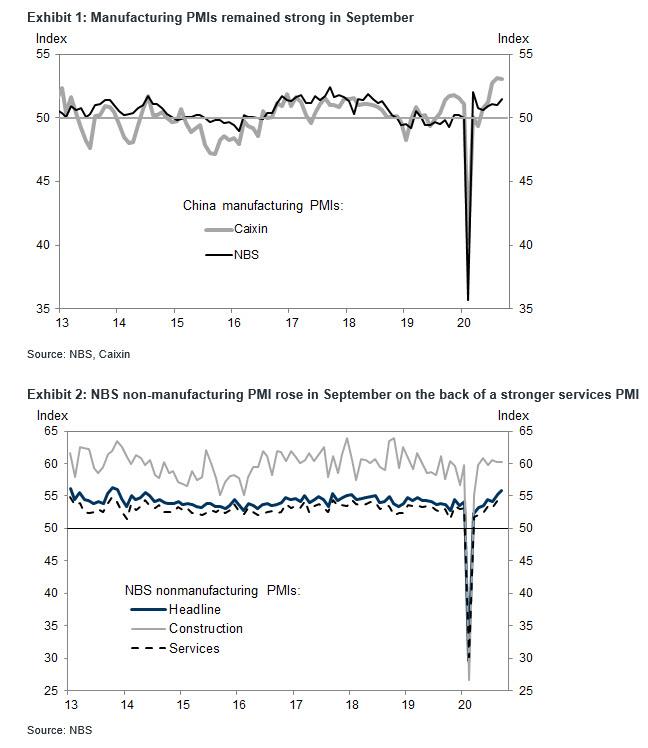
As Goldman concludes, “manufacturing PMIs suggest overall activity continued to recover in September in the manufacturing sector, on the back of persistent strength in exports. Services sector activity recovery has been catching up, as suggested by the higher services PMI under the NBS PMI survey.”

Alas, there were less good news on the US jobs front, following several blockbuster layoff announcements. Walt Disney made one of the deepest workforce reductions in not only the Covid-19 era but in history, when it announced it was firing 28,000 workers. Oil giant Royal Dutch Shell said it will cut as many as 9,000 jobs as it struggles with low demand and tries to restructure towards low-carbon energy. Dow also said it would cut 6% of its workforce, while Marathon Petroleum also started layoffs.

* * *

Back to market globally, most of which are headed for their first monthly retreats since March’s meltdown, either deepened losses or pulled back from highs scaled after data showed China’s economic recovery remains on track.  MSCI’s broadest index of world shares dropped 0.2% for a 4% September loss. Oil is down just over 10% this month while gold’s 4.1% drop will make it its worst month since late 2016.

Asia had held its ground overnight, led by a 0.8% gain in Hong Kong, though Japan’s Nikkei fell 1.5% and Australia’s S&P/ASX 200 lost over 2%. Chinese property developers gained, led by a 15% jump in Evergrande shares after the heavily-indebted giant reached a deal to ease cash crunch concerns, as noted last night. China’s factory activity expansion accelerated in September, helped by rising export orders.

In Europe, declines in industrial-goods and tech shares outweighed gains in utilities.

In FX, options trade points to a volatile November. Two-month dollar/yen volatility, a gauge of expected moves in the yen, is elevated, and its premium over one-month volatility is near record levels. Major currencies eased against the dollar after the debate, The euro dipped from a one-week high to $1.1736 and the risk-sensitive Australian dollar fell 0.2% to $0.7118, heading for its worst month since March.

In rates, Treasuries barely budged, with yields remaining within a basis point of Tuesday’s closing levels ahead of U.S. data raft including September ADP employment change and 2Q GDP. Yields were higher by less than 1bp at long end, steepening 5s30s by ~1bp; 10-year yields steady around 0.65%, outperforming bunds and gilts by less than 1bp. Price action was choppy but not sustained during first U.S. presidential debate late Tuesday, leaving yields slightly cheaper at long end. The long end may draw support toward end of U.S. trading day from month-end index rebalancing.

In commodities, oil prices fell amid rising concerns about fuel demand as the coronavirus pandemic worsens. Brent crude futures were last down 0.9% at $40.66 a barrel and U.S. crude futures were down 0.7% at $39.00 a barrel. Gold slipped 0.4% to 1,890 an ounce.

Looking at the day ahead, Fed speakers include the Fed’s Bowman, Bullard, and Kashkari. In terms of data, we’ll get the third reading of Q2 GDP, August’s pending home sales, the MNI Chicago PMI for September and the ADP employment change for September.

Market Snapshot:

  • S&P 500 futures down 0.9% to 3,305.50
  • STOXX Europe 600 down 0.4% to 360.02
  • MXAP down 0.6% to 169.28
  • MXAPJ up 0.09% to 553.65
  • Nikkei down 1.5% to 23,185.12
  • Topix down 2% to 1,625.49
  • Hang Seng Index up 0.8% to 23,459.05
  • Shanghai Composite down 0.2% to 3,218.05
  • Sensex up 0.5% to 38,156.23
  • Australia S&P/ASX 200 down 2.3% to 5,815.94
  • Kospi up 0.9% to 2,327.89
  • German 10Y yield rose 0.4 bps to -0.541%
  • Euro down 0.1% to $1.1728
  • Italian 10Y yield fell 2.7 bps to 0.648%
  • Spanish 10Y yield rose 0.4 bps to 0.229%
  • Brent futures down 1.8% to $40.30/bbl
  • Gold spot down 0.6% to $1,886.96
  • U.S. Dollar Index up 0.3% to 94.16

Top Overnight News from Bloomberg:

  • President Donald Trump and former Vice President Joe Biden hurled insults and repeatedly interrupted each other in their first debate, sparring over topics ranging from health care to the economy and their families as moderator Chris Wallace tried mostly in vain to control the conversation
  • Trump Sees Wide Vote Fraud That Doesn’t Exist: Debate Fact Check
  • Boris Johnson is braced for defeat in Parliament over his controversial plan to re-write the Brexit withdrawal agreement, a blow that could throw negotiations with the European Union into chaos at a critical time
  • Japan’s industrial production increased for a third month in August as the economy continued to reopen, though the gains slowed from July’s record jump
  • The European Union’s historic 1.8 trillion-euro ($2.1 trillion) budget and stimulus package is in danger of being delayed due to a disagreement among member states about how to enforce the adherence to democratic values, according to a spokesman for the German government
  • Italy plans to bring its budget deficit back into line with European Union rules in 2023 after a dramatic increase in spending dictated by the coronavirus outbreak
  • Oil held below $40 a barrel on rising concerns that it will be some time before there’s a meaningful recovery in demand

A quick look at global markets courtesy of NewsSquawk

Asian equity markets were mixed with participants indecisive as focus centred on the US Presidential Debate where US President Trump faced off with former VP Biden on a range of topics including COVID-19, the economy, taxes and foreign dealings of former VP Biden’s son. The debate featured plenty of bickering and highlighted no love lost between the candidates with President Trump criticizing Biden’s son and with Biden referring to Trump as a clown on several occasions, while marginal upside was seen in US equity futures early in the debate as the widely viewed front-runner Biden showed a more composed tone with President Trump seemingly disruptive and interrupting Biden and the moderator a few times, which favoured the notion of a Blue Sweep. However, all the gains were later pared at the end of the debate which descended into chaos with plenty of disruptions and President Trump also suggested the idea of a contested election which could last for months. As such, ASX 200 (-2.3%) and Nikkei 225 (-1.5%) were negative with Australia dragged lower by losses in the energy sector and with financials also underperforming, while Tokyo sentiment was lacklustre following Industrial Production data which despite beating expectations, still showed a double-digit percentage contraction Y/Y. Hang Seng (+0.7%) and Shanghai Comp. (-0.2%) were initially both positive on the eve of Golden Week as participants digested better than expected Chinese Official PMI data and although Caixin Manufacturing PMI slightly missed, the data showed new export orders rose by the most in 3 years and the employment gauge returned to growth; however, gains in Shanghai were pared back. Finally, 10yr JGBs traded lacklustre as prices reversed some of yesterday’s gains but with downside stemmed amid the BoJ’s presence in the market today and after the central bank also kept its purchase intentions for October unchanged.

Top Asian News

  • CLSA Exodus Deepens as Beijing Tightens Grip, Reins In Pay
  • Alibaba Expects First Profit From its Cloud Arm This Year
  • Armenian-Azeri Fighting Continues, Ignoring Cease-Fire Appeals
  • Japan’s Factory Output Rises for Third Month in August

A relatively choppy session thus far for European stocks, albeit with losses somewhat contained (Euro Stoxx 50 -0.6%), as sentiment was dampened overnight amid the fallout from the US Presidential debate, whilst fresh catalysts during European hours remain scarce. That being said, the EU released their report on rule of law deficiencies which singles out Hungary and Poland – a move which could threaten the swift implantation of the EU Recovery Fund as unanimity is needed to roll out the package. Meanwhile, China opened an antitrust probe into Google (-1.8% pre-market) over market dominance. European bourses see varying degrees of losses, with FTSE 100 (-0.1%) cushioned by a softer Sterling, and Spain’s IBEX (-0.1%) supported by gains in large-cap stocks including Telefonica (+0.6%) after reports said it is mulling the sale of an additional stake in its mobile telephone mast unit Telxius. Thus the telecom sector outperforms, with added tailwinds from gains in Orange (+0.7%), Bouygues (+0.9%) after the French Telecom Regulator said prices for the 5G spectrum are up by EUR 220mln following the first round of auctions, with the latter also buoyed by its disposal of Alstom (-2.2%) shares. IT meanwhile resides on the other side of the spectrum following earnings from Micron (-4.7% pre-mkt) despite beating on both top and bottom line is afflicted more-so on sub-par guidance. As such, Infineon (-1.2%), SAP (-1.2%) and STMicroelectronics (-1.2%) are subdued. Travel and Leisure also resides towards the bottom of the pile amid the ongoing woes for the sector with regards to rising COVID-19 infections. In terms of individual movers, Suez (+6.5%) is a top gainer in the Stoxx 600 after Veolia (+1.8%) upped its offer for the Co. to EUR 18/shr from EUR 15.50/shr. Shell (+0.5%) sees modest gains despite a rather gloomy Q3 update, but with upside potentially on further cost-cutting measures including global job losses of up to 9,000 employees by end-2022.

Top European News

  • Damning Report Set to Worsen Spat Over EU’s Jumbo Recovery Fund
  • ECB to Consider Allowing Inflation Overshoot, Lagarde Says
  • SNB Spent 90 Billion Francs on Interventions as Virus Took Hold
  • Merkel’s Old Foe May Finally Get His Chance to Undo Her Legacy

In FX, the Dollar and index by design seem to have found their footing after extending declines amidst all the bickering between incumbent US President Trump and rival Biden overnight. The DXY has revisited 94.000, albeit just within a 94.180-93.789 range and could be seeing late if not last minute rebalancing demand for the end of September and Q3 alongside a touch of safe-haven buying as broad risk sentiment wavers. Ahead, a busy US data schedule including ADP before Friday’s BLS report and more Fed speak via current FOMC voters Kashkari, Bowman and Kaplan.

  • CHF/GBP – Lagging fellow G10 currencies, and perhaps surprisingly given the Swiss KOF indicator easily beating consensus and advancing further above the 100.0 mark, while revised UK GDP was not quite as abject as the initial estimates and a degree of Brexit positivity persists following reports that chief EU negotiator Barnier sees an improvement in the atmosphere, more engagement from the UK side and a fresh ’buzz’ in talks. However, the Franc is back under 0.9200 and Cable has tested support ahead of 1.2800, as Eur/Gbp consolidates above 0.9100. For the record, nothing new whatsoever from BoE’s Haldane – see headline feed at 9.30BST for bullets and a link to the full speech.
  • NZD/AUD – In contrast to the above, recoveries in NZ business sentiment and the outlook for activity, not as weak as forecast Aussie building approvals and better than expected Chinese PMIs that are helping the YUAN claw back losses vs the Greenback towards 6.8100, are all keeping the Antipodes afloat. Nzd/Usd has been over 0.6600 and Aud/Usd up to 0.7150, albeit off peaks as their US counterpart continues to regain poise.
  • JPY/CAD/EUR – The Yen remains rangebound vs the Buck and flanked by decent option expiry interest from 105.60-70 (1.1 bn) to 105.15-00 (1.3 bn) following moderately firmer than anticipated Japanese ip data, while the Loonie is still attempting to contain losses around 1.3400 ahead of Canadian monthly GDP and the Euro is striving to maintain 1.1700+ status in the face of stronger sell signals vs the US Dollar.
  • SCANDI/EM – Little reaction to Sweden’s NIER upgrading its 2020 jobless rate projection or a reduction in Norges Bank daily FX purchases for October, as Eur/Sek straddles 10.5400 and Eur/Nok holds off 11.1100+ highs on the aforementioned single currency retracement. Elsewhere, EMs are correcting higher after recent heavy depreciation vs the Usd, and even the tormented Rub and Try as trouble across the Armenian-Azeri border rumbles on.

In commodities, crude futures remain softer in early European hours as the rising COVID-19 cases continue to weigh on demand prospects for the complex, with some added pressure for the lackluster sentiment across markets following the US debate. Price saw another leg lower on reports that Beijing is said to be preparing an antitrust investigation into Google, in a sign that US-Sino relations are getting no better. Elsewhere, Norway’s Industri Energi and Safe Labour unions said its workers will not go on strike after agreeing on a wage deal, but Lederne Labour union said its workers will go ahead with strikes and will potentially escalate the situations at today’s meeting. This could cut the country’s oil output by some 470k BPD, according to the Norwegian Oil and Gas Association. WTI Nov resides just sub-39/bbl whilst Brent Dec sees itself marginally above USD 41/bbl. Precious metals meanwhile succumb to the firmer Buck, with spot gold around the USD 1880/oz mark having had drifted from a high of USD 1899/oz; spot silver underperforms but remains north of USD 23.50/oz (vs. high USD 24.32/oz). LME copper prices edge lower in tandem with losses across the stock markets coupled with a firmer Dollar, whilst Dalian iron ore futures rose some 5% amid rekindled fears of supply disruptions.

US Event Calendar

  • 8:15am: ADP Employment Change, est. 649,000, prior 428,000
  • 8:30am: GDP Annualized QoQ, est. -31.7%, prior -31.7%
  • 9:45am: MNI Chicago PMI, est. 52, prior 51.2
  • 10am: Pending Home Sales MoM, est. 3.1%, prior 5.9%; Pending Home Sales NSA YoY, est. 17.6%, prior 15.4%

DB’s Jim Reid concludes the overnight wrap

I’m a proud father this morning. One of the twins came home from nursery yesterday with a big badge pinned on him, rewarded for an achievement. As I got closer to it to see what it was for I wondered which advanced skill was being recognised. Had he counted? Had he recognised a word? Had he sung in tune or perhaps been thoughtful towards another child? No, his badge simply said on it “well done for not shouting”. To be fair our twins are so loud that any moment they are not screaming is an achievement and the nursery obviously now feel the same way.

Talking of screaming and shouting, welcome to the post US Presidential debate break out room just a couple of hours after it came to an end. We discussed in our CoTD yesterday (Link here ) how irrelevant these debates have been over the last 40-50 years to candidates’ electoral chances. Well this isn’t stopping us from making last night’s debate the headline story even if it’s more of a show than anything else. Remember polling suggested Trump lost all three debates comprehensively in 2016 and snap polling by YouGov last night suggested Biden won with 48% and Trump with 41% – not far off the current poling averages. A CNN snap poll had a much bigger win for Biden but at this stage you have to be wary of sampling issues.

In a raucous debate that was indeed full of shouting, it is unclear that either President Trump or Vice President Biden changed the trajectory of the election last night. The President came into the night down -6.8% in the fivethirtyeight.com national polling average while trailing in many of the battleground states, and we will track how polls change in the next few days. There was very little substance in the debate and almost no new information proffered. The story of the debate will likely surround the President’s consistent interruption, though Mr Biden was not able to stay above the fray and traded insults at times with Mr Trump. Acrimony ruled.

Outside of the debate, we have seen China’s official September PMIs overnight with both the manufacturing (at 51.5 vs 51.3 expected) and non-manufacturing (at 55.9 vs. 54.7 expected) beating consensus expectations and reaffirming the message that the country’s recovery remains on track aided partly by strong exports. In details of the manufacturing PMI, new export orders climbed to 50.8 (vs. 49.1 last month), marking the first time it has printed above 50 this year while the new orders index also rose to 52.8 (vs. 52.0 ). Overall, the official composite PMI printed at 55.1 (vs. 54.5 last month). Alongside, the official PMIs we also saw China’s Caixin manufacturing PMI which came in a touch softer (0.1pt) than expectations at 53.0.

The Hang Seng (+1.18%) and Shanghai Comp (+0.45%) are trading up this morning following the PMI beat. Other markets in the region are mostly trading lower with the Nikkei (-0.84%) and Asx (-1.82%) both down while India’s Nifty (-0.05%) has opened weak. South Korea’s markets are closed for a holiday. Futures on the S&P 500 are also trading weak at -0.67% following the Presidential debate and European futures are pointing to a weak open (Stoxx 50 -0.44% and Dax -0.38%). Meanwhile, oil prices are trading down c. -1%. Elsewhere, Micron Technology said overnight that it has recently halted shipments to China’s Huawei. The company also announced a cut in its capital spending plans and warned about weaker demand from some corporate customers and forecast possible oversupply in a key market next year. Shares of the company fell -3.9% in afterhours trading due to this. In terms of other overnight data, Japan’s September retail sales printed at +4.6% mom (vs. +2.0% mom expected).

Ahead of the debate, risk assets fell back yesterday as markets were unable to maintain the strong momentum from Monday, with negative news on the coronavirus seemingly outweighing more positive consumer confidence numbers. By the close, equities had lost ground on both sides of the Atlantic, with the S&P 500 (-0.48%) and the STOXX 600 (-0.52%) both falling back. Energy stocks led the moves lower thanks to falling oil prices, as both Brent Crude (-3.30%) and WTI (-3.23%) underwent major falls, while banks also struggled to follow-through on their strong start to the week.

Starting with Covid, yesterday saw some negative news from the US, with the daily positivity rate in New York City rising above 3% yesterday for the first time in months, according to Mayor de Blasio. The threshold is a significant one, as de Blasio has said that the city’s schools will shut if the positivity rate is above 3% on a rolling 7-day average basis, though for now that still remains at 1.38%. The US overall has seen hosptilisations plateau at 30,000 after falling from nearly 60,000 in the middle of the summer. With cases again increasing marginally in the US over the last 2-3 weeks attention will shift to hospital capacity as the weather grows colder in the northern US. Meanwhile in Germany, Chancellor Merkel recommended that private parties were limited to 25 people, and in the UK a record 7,152 cases were reported yesterday, which also drove the 7-day average above 6,000. There was some weekend catch up to this data though. Best to look at the 7-day rolling number in the table below for the best state of play.

There was some good news overnight on the pharmaceutical front. A Regeneron Covid-19 antibody cocktail, still in early stage trials, saw positive data that it helped reduce viral levels and improved symptoms. At the same time, data from phase 2 testing showed that the Moderna vaccine triggered a “strong antibody” response in adults, with “severe” side effects in one volunteer. Meanwhile, in a sign of the pandemic’s lasting impact on the hospitality industry, Walt Disney said overnight that it is laying off 28,000 employees in its US resort business, marking one of the deepest workforce reductions of the pandemic. The cuts span the company’s theme parks, cruise ships and retail businesses and will include executives; however, 67% of those being terminated are part time employees.

In the world of central banks, Dallas Fed president Kaplan indicated that he did not expect the US economy to get back on track from the pandemic until late-2022 or even 2023. While not advocating for higher rates, Kaplan said that the Fed should remain accommodative but that may not mean keeping rates at zero. He warned that there were “real costs” to near-zero rates for elongated periods of time, specifically it can “adversely impact savers, encourage excessive risk taking and create distortions in financial markets.” We also heard from New York Fed president Williams who is not worried about inflation, though acknowledged they would deal with it if it came. Williams had a similar time frame for full recovery as Kaplan of 3 years and again seemed to call on fiscal stimulus help, saying that the recovery needed “all the official support it can get.”

And there was some more positive news on the prospects of US fiscal stimulus, with Speaker Pelosi’s deputy chief of staff tweeting that Pelosi and Treasury Secretary Mnuchin spoke yesterday morning on the phone for around 50 minutes, and agreed to speak again today. There will be a floor vote in the Senate on a relief package of some sort later this week according to reports, either the Democrat-written $2.2 trillion fiscal bill or a more bipartisan effort if one can come together. In spite of a lack of stimulus, data from the Conference Board showed US consumer confidence index experiencing the biggest monthly jump in 17 years, with a stronger-than-expected rise to 101.8 in September.

Staying with yesterday, there were some significant headlines from Europe, as a spokesperson for the German presidency of the Council of the European Union said on the recovery fund that “The timetable is in danger of slipping. A delay of the EU budget and the Recovery fund is becoming increasingly likely”. Remember that the package needs to be agreed unanimously, but there’ve been disputes over the possibility of rule-of-law conditions, and yesterday a letter was published from Hungarian PM Orban which called for the Commission Vice President for Values and Transparency to be sacked, after she called Hungary a “sick democracy”.

Over in the fixed income sphere, sovereign bonds rallied yesterday as investors moved out of risk assets. Perhaps the biggest headline came from Italy, where the country’s 30yr yield fell to a fresh all time record low of 1.74%. However there was a strong performance across the board, with yields on 10yr bunds (-1.7bps), OATs (-1.5bps) and BTPs (-2.7bps) all falling back. 10yr Treasury yields also fell -0.3bps, their 4th successive move lower. This came as the US dollar fell -0.41% Tuesday, to start the week with its worst 2-day performance since 31 Aug, however the currency is still set to record its first monthly gain since March.

On Brexit, the 9th round of negotiations began yesterday between the UK and the EU in Brussels, with Bloomberg reporting that the UK has submitted 5 confidential draft legal texts. Negotiations continue until Friday, and the question this week will be whether enough progress can be made for the two sides to be able to reach agreement by Prime Minister Johnson’s self-imposed deadline of October 15, when a summit of EU leaders takes place.

Wrapping up with some of Europe’s data from yesterday, German inflation fell to a 5-year low of -0.4% in September, which was below the -0.1% reading expected and will only add to concerns about weak price pressures in the Euro Area. That said, the European Commission’s economic sentiment indicator for the Euro Area rose for a 5th straight month in September, up to 91.1 (vs. 89.0 expected). Finally in the UK, consumer credit data showed that net borrowing was weaker-than-expected in August, coming in at £0.3bn (vs. £1.5bn expected).

To the day ahead now, and the highlights include an array of central bank speakers, including ECB President Lagarde, chief economist Lane, and the ECB’s Muller, Rehn and Kazimir. Otherwise, there’s also the Fed’s Bowman, Bullard, and Kashkari, along with the Bank of England’s chief economist Haldane. In terms of data, we’ll get the preliminary September CPI readings from France and Italy, the September change in unemployment from Germany, while from the US there’s the third reading of Q2 GDP, August’s pending home sales, the MNI Chicago PMI for September and the ADP employment change for September.

via ZeroHedge News https://ift.tt/3iajxde Tyler Durden
Beijing Targets Google’s Android Operating System In Looming Anti-Trust Crackdown

Beijing Targets Google’s Android Operating System In Looming Anti-Trust Crackdown

Tyler Durden

Wed, 09/30/2020 – 07:01

By imposing new sanctions on Chinese chipmaker giant SMIC last week, the Trump Administration signaled that it isn’t letting up on the economic war it’s waging against China. After essentially cutting China’s biggest chipmaker off from its largest customer, Huawei, with sanctions restricting the types of products that can be shipped to Huawei and its subsidiaries, the new sanctions on SMIC will rob it of what’s believed to be its second-most-valuable client, American chipmaker Qualcomm.

Even a ruling handed down on Sunday that spared TikTok  from being barred from American app stores is only temporary, and the company must still contend with a later deadline, and further pressure to strike a deal.

Although Trump and his top trade officials have argued these measures are akin to giving China a taste of its own medicine, the expansive trade war being waged by the administration is infuriating to Beijing. Now, Beijing is lashing out at an American tech giant – Google parent Alphabet – by taking a page out of EU antitrust head Margrethe Vestager’s playbook. Reuters reports that China is preparing to launch an anti-trust probe into Alphabet’s Android operating system and attempts by Alphabet to stifle competition in the Chinese market. The case was reportedly first proposed by Huawei, has been submitted by the country’s top market regulator to the State Council’s antitrust committee for review.

Reuters reports that a formal investigation might come as soon as October, and will likely depend on “China’s relationship with the US”. In other words, Beijing is turning up the pressure on an American tech giant and creating a bargaining chip out of thin air.

China is preparing to launch an antitrust probe into Alphabet Inc’s Google, looking into allegations it has leveraged the dominance of its Android mobile operating system to stifle competition, two people familiar with the matter said.

The case was proposed by telecommunications equipment giant Huawei Technologies Co Ltd last year and has been submitted by the country’s top market regulator to the State Council’s antitrust committee for review, they added.

A decision on whether to proceed with a formal investigation may come as soon as October and could be affected by the state of China’s relationship with the United States, one of the people said.

China’s State Administration for Market Regulation, its top anti-trust regulator, is preparing new anti-trust measures that will create yet another barrier to foreign firms operating in the Chinese market. It’s also looking into whether companies like Google have caused “extreme damage” to Chinese companies like Huawei. We wouldn’t be surprised to see Google pay the price for some of the Trump Administration’s aggression.

It also comes as China embarks on a major revamp of its antitrust laws with proposed amendments including a dramatic increase in maximum fines and expanded criteria for judging a company’s control of a market.

A potential probe would also look at accusations that Google’s market position could cause “extreme damage” to Chinese companies like Huawei, as losing the U.S. tech giant’s support for Android-based operating systems would lead to loss of confidence and revenue, a second person said.

Unlike in Europe, most Chinese phones use an open-source version of Android that offers alternatives to Google services. So it’s unclear what, exactly, is being targeted by Beijing. The EU memorably fined Google several times in recent years, including a $5.1 billion hit in 2018 over “anticompetitive” practices like forcing phone makers to pre-install Google apps on Android devices, while adding barriers to non-Google products. Indian regulators, meanwhile, are looking into whether Google has abused its market position to unfairly promote its mobile payments app in India.

“China will also look at what other countries have done, including holding inquiries with Google executives,” said the person.

The second source added that one learning point would be how fines are levied based on a firm’s global revenues rather than local revenues.

Reuters points out that Huawei missed its 2019 revenue target by a whopping $12 billion, which the company blamed on American aggression. Now, just imagine how US stocks might react to Alphabet posting a massive miss on revenue because China effectively banned Android phones from the world’s biggest market.

via ZeroHedge News https://ift.tt/348QWjq Tyler Durden

F-35 Stealth Jet Crashes After Mid-Air Collision Over California 

F-35 Stealth Jet Crashes After Mid-Air Collision Over California 

Tyler Durden

Wed, 09/30/2020 – 06:43

A Marine Corps Lockheed Martin F-35B stealth fighter crashed in Imperial County, California, at around 4 p.m. PT Tuesday while attempting an aerial refueling mission with a Lockheed Martin KC-130J refueling tanker, according to USNI News.

On Tuesday afternoon, “it was reported that an F-35B made contact with a KC-130J during an air-to-air refueling evolution, resulting in the crash of the F-35B. The pilot of the F-35B ejected successfully and is currently being treated,” read a statement from Marine Corps spokesman Capt. Joseph Butterfield to USNI News.

“The KC-130J is on deck in the vicinity of Thermal Airport. All crew members of the KC-130J have been reported safe,” Butterfield said. 

KC-130J Emergency Landing In Field 

Local TV station KESQ News Channel 3’s Jake Ingrassia was near the Jacqueline Cochran Regional Airport in Therma, California, at the time of the incident, capturing photos and videos of the accident scenes. 

Ingrassia tweeted a video of the F-35B crash site, interviewing an eyewitness who said the incident felt like a “three or four earthquake.” 

KESQ released a video with Ingrassia describing the crash and showing video and images of both crash sites. 

“The official cause of the crash is currently under investigation,” a military spokesperson told FOX News. “Updates will be provided as information becomes available.” 

Over the years, the F-35 has been involved in a series of crashes; the latest was in May when an F-35A crashed in Florida during a training mission.

via ZeroHedge News https://ift.tt/3cK4QMN Tyler Durden

Bond Issuance Smashes Monthly Record For The 6th Time In Past 7 Months

Bond Issuance Smashes Monthly Record For The 6th Time In Past 7 Months

Tyler Durden

Wed, 09/30/2020 – 06:30

One week after the US junk bond market smashed the annual issuance record, when sales of high yield (the term is used very loosely these days) debt hit a record $330 billion last Wednesday, surpassing the previous full-year record of $329.6 billion in 2012 (and there’s three more months to go in 2020)…

… today a new corporate debt issuance record was set when ten IG bonds priced for $6.85bn on Tuesday, shattering the monthly sales record for the sixth time in the last seven months. The borrowing spree comes on the back of a Fed-backstopped, pandemic-fueled liquidity grab, as companies sell record amounts of debt at all time low yield, using the proceeds either to refi existing debt, to load up on cash or simply to resume buybacks.

The monthly IG supply currently stands at $162.7 billion, passing last September’s $158 billion record total for the month; July was the only month since March not to set a new high water mark for the respective month, according to Bloomberg, which notes that final orderbooks were 2.5 times oversubscribed and issuers paid negative 1.5bps in new issue concessions.

Among today’s IG issuers, CubeSmart, Best Buy, National Rural and DTE all upsized from announced deal sizes while Danaher printed $1bn, the high end of the $750m-$1bn target range.

Despite the record YTD new issuance momentum, supply is expected to slow into year-end with just $150 billion expected in 4Q, down about 20% over the same period last year, as most companies that could take advantage of the wide open issuance window have already done so. A modest $75 billion is expected in October, less than half the September total.

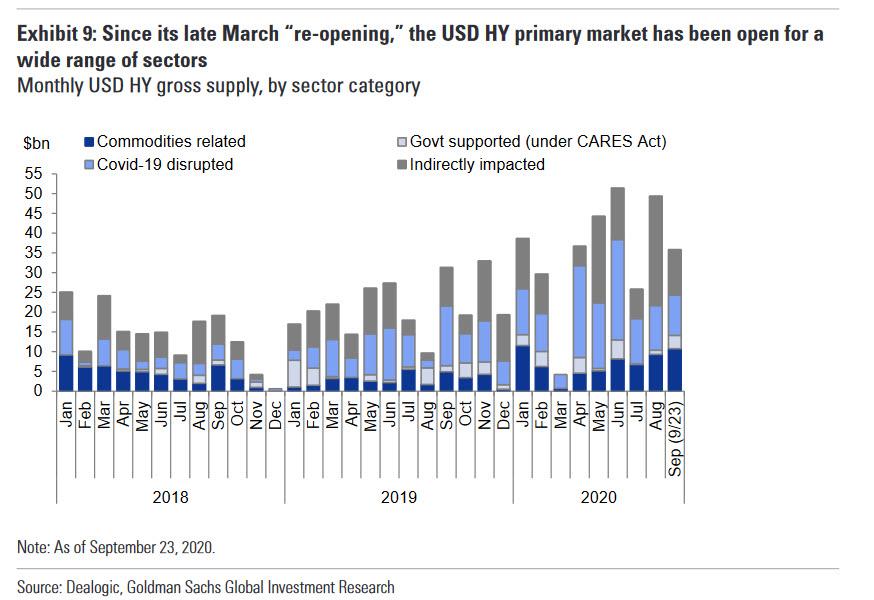
Going back to the junk bond market, the HY new issue market has been surprisingly receptive to a wide range of sectors since its “re-opening” in late March – including those groups at the epicenter of the coronavirus disruption. The chart below illustrates this by showing monthly USD HY gross issuance volumes by four broad sector categories:

  1. commodities related,
  2. government supported, under the CARES Act,
  3. directly disrupted by the coronavirus/sudden stop in the economy, and
  4. indirectly impacted.

As the chart shows, directly disrupted and government supported sectors have generated significant amounts of supply in each of the past few months, indicating the market’s continued willingness to lend to groups facing persistent headwinds related to social distancing and business restrictions. The reason: the Fed’s explicit backstop of the corporate bond market since March, when Powell announced the Fed would purchase corporate bonds and ETFs.

In recent months, junk-rated issuers have tilted away from securing liquidity lifelines and are instead looking to lock in lower interest rates and push out maturities on existing debt loads. The shift, coupled with support from the Fed, has forced investors to accept diminishing yields.

“A lot of the issuance was to get as much liquidity as you can, because things were looking like they were going to be stalled out for a while,” said Douglas Lopez, senior partner and portfolio manager at Aristotle Credit Partners. “This was the prudent move, but some companies may be building the liquidity bridge to nowhere.” It’s not just the US: Europe’s high-yield bond sales surged in July, the busiest for that month since 2009, according to Bloomberg.

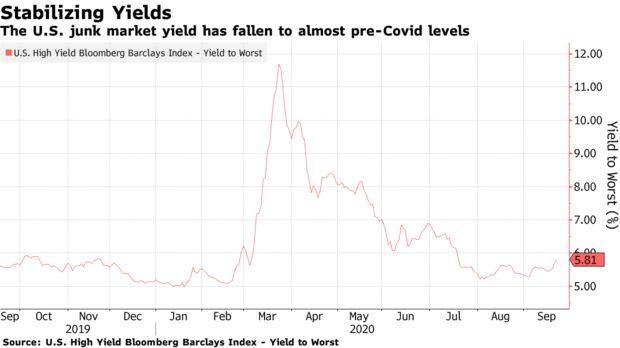
The Fed’s ZIRP policy, which is expected to last at least through 2023, has paved the way for billions of dollars to flood into funds that invest in high-yield debt as investors search for yield. That support, according to Bloomberg, has effectively turned high-yield into a borrower’s market, and yields for U.S. junk bonds have dropped to 5.81%, near pre-pandemic levels, according to Bloomberg Barclays index data.

The investor frenzy means that collateral-lite issuance is back: at the same time, call protection, which prevents a company from repaying a bond early for a period of time, has been shortened in some deals.

The flood of high yield refinancings – which have seen leveraged loans refinanced with new junk offerings – is expected to continue through September and into October, with issuers pulling forward deals to get ahead of the uncertainty around the November presidential election and a possible second wave of Covid-19. And while refinancings have surged, high-yield issuance to fund acquisitions and leveraged buyouts has yet to return, with Bloomberg noting that although early discussions for new deals is picking up, even if those are announced soon, the financings likely wouldn’t come until 2021.

And just in case there was any doubt, speaking to reporters on Tuesday, New York Fed President John Williams said that the Fed’s corporate bond purchases are giving the market confidence: “This is basically in a kind of backstop role.”

While Williams confirmed our recent observations that the Fed’s purchase of corporate bonds have slowed dramatically, saying “the level of purchases is low enough that I don’t think it’s fundamentally changing market conditions really, in a first-order way” he agreed that the Fed’s “backstop role is very important. There is still a lot of uncertainty in the economy around the pandemic. Like our other facilities, the fact that they’re there, they’re operating and ready to be used if needed, I think adds a lot of confidence and assurance to the markets that the liquidity is going to be there.”

Judging by the number of IG and HY bond issuance records smashed daily, he is certainly correct. And don’t expect that to change any time soon: “If market stresses appeared again, obviously it’s still operating and could be deployed to keep market conditions stable and well-functioning.”

via ZeroHedge News https://ift.tt/33fZTs8 Tyler Durden

On Gold, The Dollar, & Real Yields

On Gold, The Dollar, & Real Yields

Tyler Durden

Wed, 09/30/2020 – 06:00

Authored by Ven Ram, FX and rates strategist at Bloomberg,

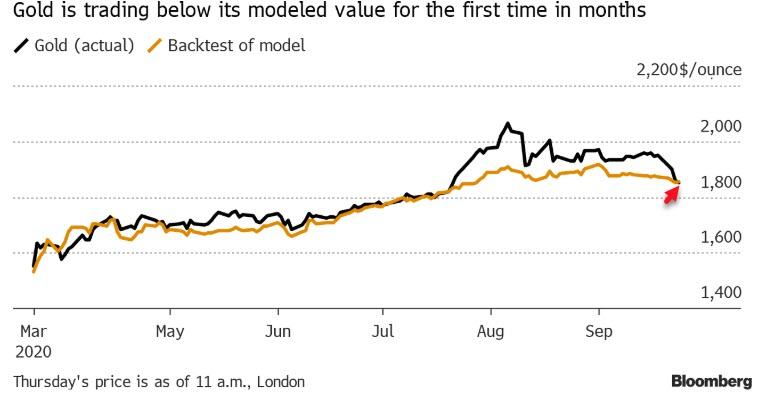
Gold is fast losing its status as this year’s go-to asset thanks to higher real rates and the dollar’s comeback. After trading at a considerable premium over estimated fair value, it is now at a discount, suggesting it’s unlikely to revisit its cyclical peak in the next few weeks.

Bullion has tumbled this month after being the best-performing major asset in the first half of the year.

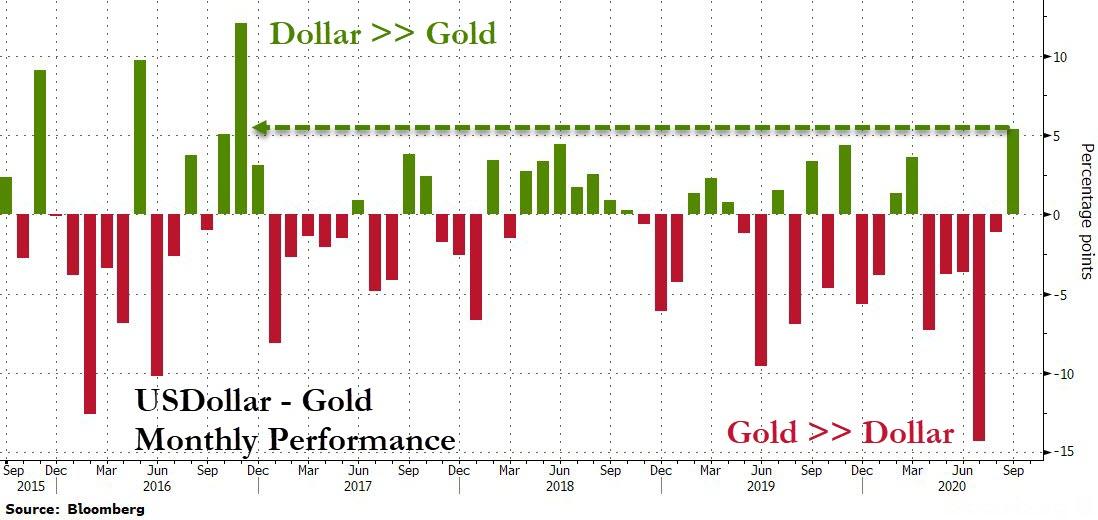
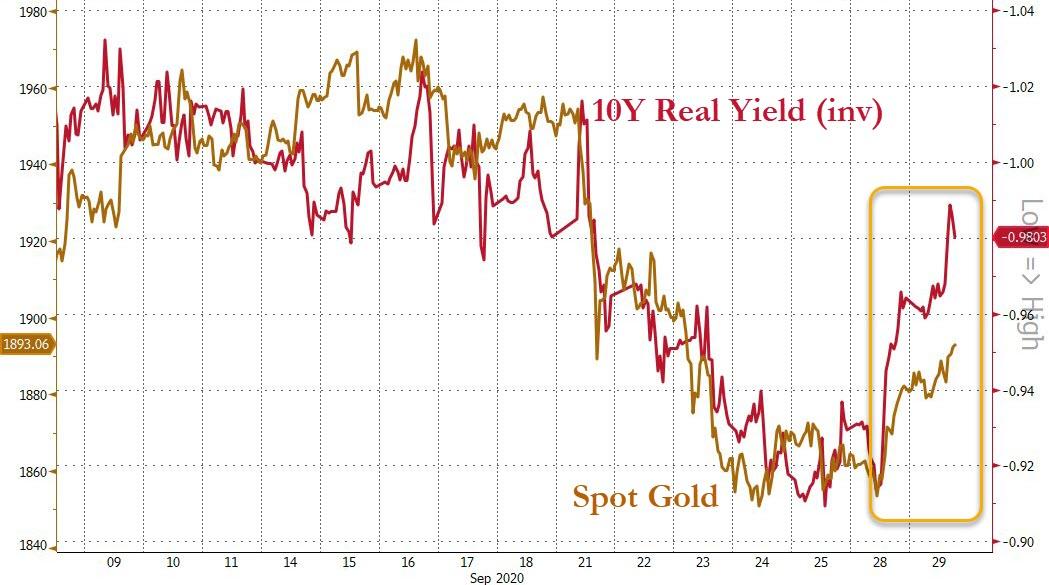
[ZH: in fact this month – to date – has seen the dollar outperform gold by the most since Trump’s election]

The difference between gold’s trading price and its modeled value, estimated from multiple factors such as nominal yields, breakeven rates and the dollar turned negative on Thursday for the first time since July.

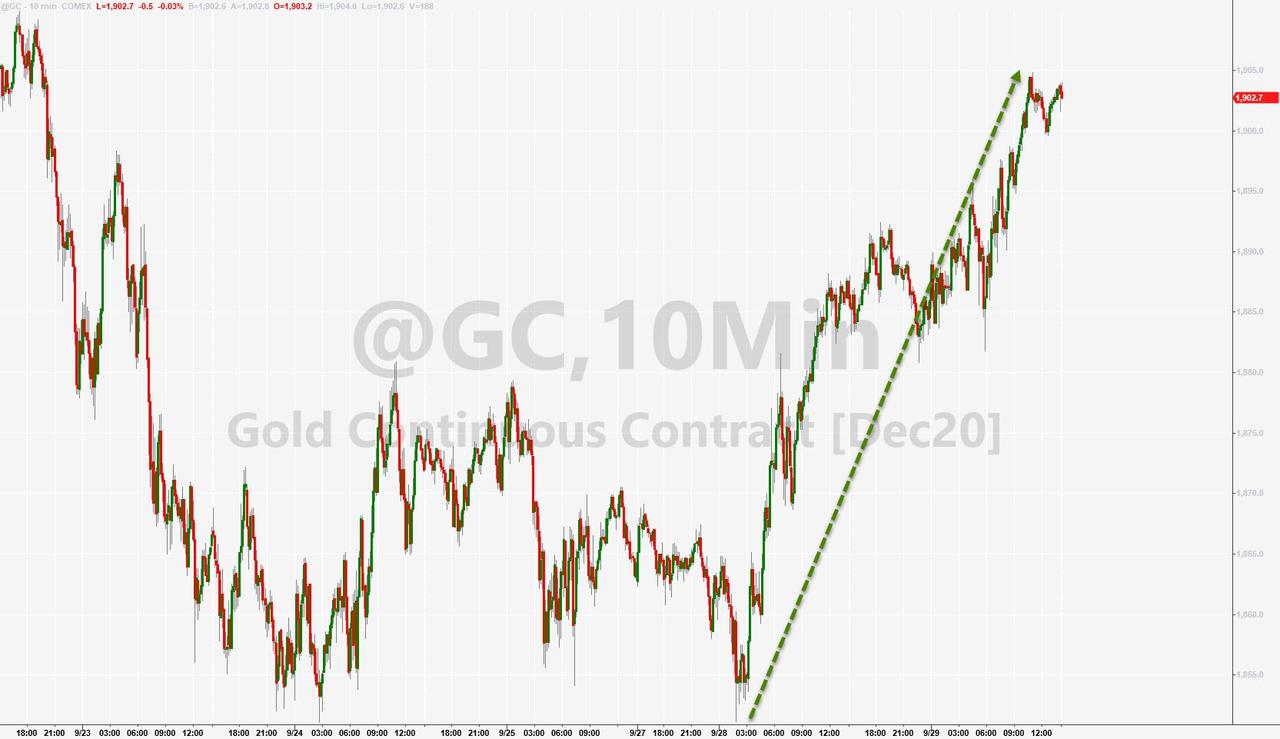
[ZH: Note that gold has bounced since then…]

That suggests gold is unlikely to re-visit its nominal record of about $2,075 in the short term if investors continue to take a view that the U.S. economy will be locked in a scenario characterized by steady yields on long-dated nominal bonds and anemic inflation breakeven-rates.

Specifically, that means the 10-year nominal yield hugging the 0.65% level that has become its familiar perch since the Federal Reserve’s emergency measures in March. The 10-year rate has been pretty resilient this week despite the sell-off in stocks, suggesting that traders are factoring an economy on the mend.

Meanwhile, inflation breakeven rates, which marched higher for five consecutive months through August, have crumbled in September. Taken together, the nominal and breakeven rates mean that real rates have nudged higher, weighing down on gold
Gold has a strong inverse relationship to the currency it is priced in, and as an asset with perceived inflation-busting properties that carries no yield, tends to do well when real rates are low.

Amid all this, the U.S. Dollar Index has risen about 1.6% this week, leaving gold exposed to further losses should the currency strengthen. At Wednesday’s close of 94.389, the DXY Index is still undervalued by almost 3% on my currency model.

The chart below shows how a backtest of the model would have aligned with gold’s actual value.

In extrapolating the forecast value of gold, I treated it essentially as a pure fixed-income derivative. That represents a limitation since gold prices are often affected by several other factors such as fund flows. My study also overlooks its utility as a haven in times of distress.

While gold may be losing its attractiveness, it would be foolhardy to completely write its fortunes off, especially given its convexity. While its ride isn’t immune to the twists and turns in the global markets, its prices tend to be sticky on the downside.

Given that there is no real clarity on the availability of a coronavirus vaccine and the attendant trajectory of the global economy, any recovery may take longer than the markets are currently projecting. That may, in turn, send real yields tumbling again, providing a second wind for gold.

But real rates and the dollar on the upswing look like a stiff challenge for bullion to overcome in the short term.

via ZeroHedge News https://ift.tt/3nepsSm Tyler Durden

Seeing Like an Anarchist

book2

Maroon Nation: A History of Revolutionary Haiti, by Johnhenry Gonzalez, Yale University Press, 302 pages, $40

“In media and popular consciousness, Haiti has become identified with hunger,” Johnhenry Gonzalez observes in Maroon Nation. But in the 19th century, after the revolution that drove out the French slaveowners and before the invasion that brought in a U.S. occupation, the country saw “a free system of decentralized, small-scale agriculture that allowed for unprecedented demographic growth.” In the century that followed Haiti’s 1804 declaration of independence, the country’s population more than quintupled. This, Gonzalez tells us, was “the steepest and largest instance of demographic expansion in Caribbean history” to that point.

This was not because the revolutionary state pursued enlightened policies. Slavery was formally abolished, but forced labor initially continued: Cultivators were still compelled to work the fields, were denied the right to leave without permission, and were legally restrained from choosing their own employers, let alone striking out on their own. To enforce these rules, post-revolutionary rulers pioneered new forms of state control, creating what Gonzalez, a historian at the University of Cambridge, says may be the world’s first “mandatory system of identification documents for all citizens.” They also conscripted soldiers, seized the former slaves’ property at will, deployed brutal forms of corporal punishment, and cracked down on “vagrancy”—that is, on freedom of movement. “In practice,” Gonzalez writes, “the universal declarations of equality and liberty that grew out of the Haitian Revolution were universally violated by all early Haitian regimes.”

It would be wrong to treat these post-revolutionary leaders as a unified group with a common vision. They differed, for example, on whether those sugar fields should be directly owned by the state. But nearly all of them thought it necessary to prop up some version of the plantation system.

Yet they couldn’t, because they weren’t ultimately in control.

In Haiti, unlike so many other rebellions around the world, the revolution didn’t stop when a new ruling class seized power. The people kept resisting—sometimes indirectly, just by fleeing to the island’s mountainous interior, and sometimes directly, by burning the sugarcane fields they left behind. And eventually, mostly, they won. The plantation economy was not restored. Hoping to avoid further unrest, the government stopped trying to restrict free movement and free contract, and it slowly started to recognize at least some of the populace’s informal land claims. With both free labor and free land in play, the plantations were doomed.

What emerged instead was far from flawless, and Gonzalez refuses to romanticize it. But “for black people in the nineteenth century,” he argues, “it was the closest thing to a free country that existed anywhere in the New World.” Space was plentiful, and land prices plunged. An economy of self-employed farmers, fishers, loggers, and smugglers emerged, with a pronounced tendency toward privacy, polyculture, and less labor-intensive work. In the towns, an urban elite ran a meager state that Gonzalez describes as “little other than a commercial taxation apparatus that supported an inward-looking military.” But in the countryside, power belonged to an anarchic meshwork of secret societies, Vodou assemblies, family compounds, informal marketplaces, and other grassroots institutions devoted to production, protection, pleasure, worship, trade, and mutual aid.

Runaway slaves known as maroons had been settling in remote regions for centuries, and parts of this social order evolved from their older institutions. Gonzalez called his book Maroon Nation because he sees most of 19th century Haiti as a vast maroon zone, a place where the sorts of social organization that ordinarily are confined to a country’s crevices became the nation’s dominant institutions.

Foreigners frequently viewed this process with distress. “To North Americans and Europeans who visited the early Haitian republic,” Gonzalez recounts, “nothing had ever looked so tragic as a crumbling sugar works being reclaimed by the jungle or a group of black people riding horses or napping rather than toiling in the sun.” Those riders and nappers, working for themselves on their own terms, did not publish a rival account of their world, but Gonzalez gives us good reasons to imagine that they saw this life not as a tragedy but as well-fed freedom.

That said, there were limits to their liberty. Despite those smugglers, for example, the urban elite had a near-monopoly on external trade. (Its controls faced outward as well as inward: The country’s constitution barred foreign ownership of Haitian land.) And there were, as always, social problems, from illiteracy to public corruption. “Rather than an unmitigated victory for either side,” Gonzalez argues, there was “a kind of prolonged, complex stalemate or war of positions.” Ordinary Haitians carved a space for themselves, but the rump ruling class fortified its position too. “By denying the rural masses any hope of formal education and confining them to the rustic freedom of decentralized crop production and marketeering, the elite jealously guarded the foreign trade and state revenue that represented the wellspring of their privilege.”

But those rural masses had far more room for free, autonomous activity than their counterparts in other post-emancipation societies. In his influential 2009 study The Art of Not Being Governed, the Yale political scientist James C. Scott—who also edits Yale University Press’s Agrarian Studies Series, which published Gonzalez’s book—describes a portion of Asia, dubbed Zomia, where geographic barriers allowed the hill people to escape the slavery, conscription, and taxes imposed by governments in the valleys. Maroon Nation shows something similar 700 miles southeast of Florida: a black Zomia in the Americas.

This social ecosystem persisted for decades, decaying only after two nearly simultaneous developments in the early 20th century. Just as the country’s population was finally beginning to fill the available space, introducing a greater degree of scarcity to the island’s resources, external forces intervened: In 1915, U.S. President Woodrow Wilson ordered an invasion of Haiti, and the troops stuck around as occupiers until 1934. (A few years into that occupation, future president Franklin Roosevelt, then serving as assistant secretary of the Navy, took charge of writing a new constitution for the country.) The puppet government adopted a number of repressive policies, including censorship, Jim Crow–style segregation, and—yes—forced labor. Elements of the old grassroots rural order persisted. But the balance of power shifted, and the corrupt and brutal regime in Port-au-Prince was able to extend its authority without doing much for the population in exchange.

The results are on display in that desperately poor nation today. But there isn’t a direct line from the revolution against the French slavocracy to the poverty of the present. In between, the country took a long detour in a far more appealing direction.

Needless to say, more appealing does not mean perfect. Gonzalez cautions against viewing 19th century Haiti as “a tropical anarchist utopia, or an ideal libertarian free market.” This is not just because of the statelet that persisted in Port-au-Prince; it is because the same people who avoided the vast hierarchies of the state and the plantation system sometimes set up mini-hierarchies of their own. Small-scale servitude persisted, and at times those grassroots institutions mimicked the forms of the state apparatus. (Some secret societies, Gonzalez notes, “adopted the ceremonial practice of controlling nocturnal travel in their areas by issuing special passports”—a distorted echo of the movement-restricting internal passports issued by both the French planters and the early Haitian revolutionary regimes.) Of course, the same topographic and social factors that allowed so many Haitians to evade the authorities and adopt a self-sufficient lifestyle may have also made it easier to break away from a more intimately situated martinet as well, helping to limit these smaller forms of domination. But we don’t have the sorts of records that would let us know how common such circumventions were.

Yet we know much more than we used to, thanks in part to this rich book. By recognizing the agency of ordinary Haitians and exploring the world they built, Gonzalez reveals dimensions untouched by conventional historical accounts. “Like the very political leaders they study,” he says, intellectual and political historians “often imagine that state authorities are somehow sovereign over larger processes of social and economic change. What is most interesting about the emergence of Haiti’s counter-plantation system is not that it reflected the revolutionary aspirations of any particular leader but rather that it rose up in spite of all Haitian rulers’ relentless attempts to reconstitute the plantation system.” James C. Scott’s most famous book is called Seeing Like a State. As he probes past the activities of the men who merely sat atop Haiti’s governments and shows the activity taking place beyond their reach, Gonzalez inverts that: He lets us see like an anarchist.

from Latest – Reason.com https://ift.tt/3cLFrlK
via IFTTT

Seeing Like an Anarchist

book2

Maroon Nation: A History of Revolutionary Haiti, by Johnhenry Gonzalez, Yale University Press, 302 pages, $40

“In media and popular consciousness, Haiti has become identified with hunger,” Johnhenry Gonzalez observes in Maroon Nation. But in the 19th century, after the revolution that drove out the French slaveowners and before the invasion that brought in a U.S. occupation, the country saw “a free system of decentralized, small-scale agriculture that allowed for unprecedented demographic growth.” In the century that followed Haiti’s 1804 declaration of independence, the country’s population more than quintupled. This, Gonzalez tells us, was “the steepest and largest instance of demographic expansion in Caribbean history” to that point.

This was not because the revolutionary state pursued enlightened policies. Slavery was formally abolished, but forced labor initially continued: Cultivators were still compelled to work the fields, were denied the right to leave without permission, and were legally restrained from choosing their own employers, let alone striking out on their own. To enforce these rules, post-revolutionary rulers pioneered new forms of state control, creating what Gonzalez, a historian at the University of Cambridge, says may be the world’s first “mandatory system of identification documents for all citizens.” They also conscripted soldiers, seized the former slaves’ property at will, deployed brutal forms of corporal punishment, and cracked down on “vagrancy”—that is, on freedom of movement. “In practice,” Gonzalez writes, “the universal declarations of equality and liberty that grew out of the Haitian Revolution were universally violated by all early Haitian regimes.”

It would be wrong to treat these post-revolutionary leaders as a unified group with a common vision. They differed, for example, on whether those sugar fields should be directly owned by the state. But nearly all of them thought it necessary to prop up some version of the plantation system.

Yet they couldn’t, because they weren’t ultimately in control.

In Haiti, unlike so many other rebellions around the world, the revolution didn’t stop when a new ruling class seized power. The people kept resisting—sometimes indirectly, just by fleeing to the island’s mountainous interior, and sometimes directly, by burning the sugarcane fields they left behind. And eventually, mostly, they won. The plantation economy was not restored. Hoping to avoid further unrest, the government stopped trying to restrict free movement and free contract, and it slowly started to recognize at least some of the populace’s informal land claims. With both free labor and free land in play, the plantations were doomed.

What emerged instead was far from flawless, and Gonzalez refuses to romanticize it. But “for black people in the nineteenth century,” he argues, “it was the closest thing to a free country that existed anywhere in the New World.” Space was plentiful, and land prices plunged. An economy of self-employed farmers, fishers, loggers, and smugglers emerged, with a pronounced tendency toward privacy, polyculture, and less labor-intensive work. In the towns, an urban elite ran a meager state that Gonzalez describes as “little other than a commercial taxation apparatus that supported an inward-looking military.” But in the countryside, power belonged to an anarchic meshwork of secret societies, Vodou assemblies, family compounds, informal marketplaces, and other grassroots institutions devoted to production, protection, pleasure, worship, trade, and mutual aid.

Runaway slaves known as maroons had been settling in remote regions for centuries, and parts of this social order evolved from their older institutions. Gonzalez called his book Maroon Nation because he sees most of 19th century Haiti as a vast maroon zone, a place where the sorts of social organization that ordinarily are confined to a country’s crevices became the nation’s dominant institutions.

Foreigners frequently viewed this process with distress. “To North Americans and Europeans who visited the early Haitian republic,” Gonzalez recounts, “nothing had ever looked so tragic as a crumbling sugar works being reclaimed by the jungle or a group of black people riding horses or napping rather than toiling in the sun.” Those riders and nappers, working for themselves on their own terms, did not publish a rival account of their world, but Gonzalez gives us good reasons to imagine that they saw this life not as a tragedy but as well-fed freedom.

That said, there were limits to their liberty. Despite those smugglers, for example, the urban elite had a near-monopoly on external trade. (Its controls faced outward as well as inward: The country’s constitution barred foreign ownership of Haitian land.) And there were, as always, social problems, from illiteracy to public corruption. “Rather than an unmitigated victory for either side,” Gonzalez argues, there was “a kind of prolonged, complex stalemate or war of positions.” Ordinary Haitians carved a space for themselves, but the rump ruling class fortified its position too. “By denying the rural masses any hope of formal education and confining them to the rustic freedom of decentralized crop production and marketeering, the elite jealously guarded the foreign trade and state revenue that represented the wellspring of their privilege.”

But those rural masses had far more room for free, autonomous activity than their counterparts in other post-emancipation societies. In his influential 2009 study The Art of Not Being Governed, the Yale political scientist James C. Scott—who also edits Yale University Press’s Agrarian Studies Series, which published Gonzalez’s book—describes a portion of Asia, dubbed Zomia, where geographic barriers allowed the hill people to escape the slavery, conscription, and taxes imposed by governments in the valleys. Maroon Nation shows something similar 700 miles southeast of Florida: a black Zomia in the Americas.

This social ecosystem persisted for decades, decaying only after two nearly simultaneous developments in the early 20th century. Just as the country’s population was finally beginning to fill the available space, introducing a greater degree of scarcity to the island’s resources, external forces intervened: In 1915, U.S. President Woodrow Wilson ordered an invasion of Haiti, and the troops stuck around as occupiers until 1934. (A few years into that occupation, future president Franklin Roosevelt, then serving as assistant secretary of the Navy, took charge of writing a new constitution for the country.) The puppet government adopted a number of repressive policies, including censorship, Jim Crow–style segregation, and—yes—forced labor. Elements of the old grassroots rural order persisted. But the balance of power shifted, and the corrupt and brutal regime in Port-au-Prince was able to extend its authority without doing much for the population in exchange.

The results are on display in that desperately poor nation today. But there isn’t a direct line from the revolution against the French slavocracy to the poverty of the present. In between, the country took a long detour in a far more appealing direction.

Needless to say, more appealing does not mean perfect. Gonzalez cautions against viewing 19th century Haiti as “a tropical anarchist utopia, or an ideal libertarian free market.” This is not just because of the statelet that persisted in Port-au-Prince; it is because the same people who avoided the vast hierarchies of the state and the plantation system sometimes set up mini-hierarchies of their own. Small-scale servitude persisted, and at times those grassroots institutions mimicked the forms of the state apparatus. (Some secret societies, Gonzalez notes, “adopted the ceremonial practice of controlling nocturnal travel in their areas by issuing special passports”—a distorted echo of the movement-restricting internal passports issued by both the French planters and the early Haitian revolutionary regimes.) Of course, the same topographic and social factors that allowed so many Haitians to evade the authorities and adopt a self-sufficient lifestyle may have also made it easier to break away from a more intimately situated martinet as well, helping to limit these smaller forms of domination. But we don’t have the sorts of records that would let us know how common such circumventions were.

Yet we know much more than we used to, thanks in part to this rich book. By recognizing the agency of ordinary Haitians and exploring the world they built, Gonzalez reveals dimensions untouched by conventional historical accounts. “Like the very political leaders they study,” he says, intellectual and political historians “often imagine that state authorities are somehow sovereign over larger processes of social and economic change. What is most interesting about the emergence of Haiti’s counter-plantation system is not that it reflected the revolutionary aspirations of any particular leader but rather that it rose up in spite of all Haitian rulers’ relentless attempts to reconstitute the plantation system.” James C. Scott’s most famous book is called Seeing Like a State. As he probes past the activities of the men who merely sat atop Haiti’s governments and shows the activity taking place beyond their reach, Gonzalez inverts that: He lets us see like an anarchist.

from Latest – Reason.com https://ift.tt/3cLFrlK
via IFTTT

Ernst & Young Ignored Whistleblower’s Warnings About $2.1BN Wirecard Fraud Back In 2016

Ernst & Young Ignored Whistleblower’s Warnings About $2.1BN Wirecard Fraud Back In 2016

Tyler Durden

Wed, 09/30/2020 – 05:30

Despite Ernst & Young’s global chairman insisting that the “Big Four” did nothing wrong in its overseeing of Wirecard during a time when the German fintech darling was running the biggest accounting frauds since WWII, the truth – as they say – will out.

In its latest bombshell report on Wirecard’s historic unraveling, the FT has reported that EY was, in fact, warned by one of its own employees in 2016 that senior management at Wirecard may have committed fraud on a massive scale. One even reportedly attempted to bribe an auditor.

Surely, if any other executive had tried to bribe an EY employee, that person would have immediately reported the illegal solicitation to his superiors. That’s apparently what happened here. Though apparently, somewhere along the line, the situation was knowingly quashed by management.

This is terrible news for EY, which is already facing an investigation by German regulators (who are now desperate to burnish their reputations after being denounced as “toothless” by practically every financial publication on the planet) as well as a flurry of lawsuits filed by Wirecard shareholders.

To recap: A special audit by EY rival KPMG uncovered a massive €1.9 billion ($2.1 billion) hole in Wirecard’s balance sheet, representing fraudulent profits beginning in 2015 and continuing through Q1 of this year. More digging by an inspector appointed by German bankruptcy court has found that Wirecard’s business was “almost entirely fictitious”. The company hired 1,000s of employees who apparently sat around pushing paper all day.

Clearly, EY is employing the deny, deny, deny  approach perfected by the Trump Administration as it seeks to slow-roll harmful revelations that discredit the auditor’s claims that it couldn’t have possibly known about Wirecard’s skulduggery. Because this doesn’t sound good:

The revelation that an EY employee identified suspicious activity at Wirecard four years before the payments group imploded in Germany’s largest postwar corporate fraud will increase the pressure on the accounting firm, which audited Wirecard for more than a decade and provided unqualified audits until 2018. EY is already under investigation by Germany’s auditor oversight body Apas and is the target of lawsuits from Wirecard investors who lost billions of euros when the company collapsed in June.  Last month, EY’s global chairman Carmine Di Sibio wrote to clients to express “regret” that the fraud was “not uncovered sooner” but he claimed that EY was ultimately “successful in uncovering the fraud”.

The latest revelations are part of an addendum to KMPG’s special auditor report. The FT has obtained a series of leaks from the report, including the initial finding of fraud, and this latest one is perhaps one of the most incriminating as far as EY is concerned. At one point, the FT reports that the addendum serves as a “damning indictment” of EY.

The new revelations are contained within an unpublished “info addendum” to a special audit by KPMG. Its main report was published in April, revealing the giant cash hole at the heart of Wirecard and precipitating the demise of the company. The 61-page addendum describes findings by KPMG that were not directly within its remit but that the firm deemed so significant it decided to report them anyway. The addendum, seen by the Financial Times, amounts to a damning indictment of EY. According to KPMG, EY’s unnamed whistleblower in May 2016 filed a letter to EY Germany’s headquarters in Stuttgart. The letter did not address the whole extent of Wirecard’s global fraud scheme that unravelled this year, but focused on one of four contentious areas that were the focus of KPMG’s special audit in late 2019: a series of acquisitions in India that Wirecard had closed in early 2016. Wirecard had paid €340m for Hermes i Tickets, GI Technology and Star Global, three payments companies that it bought from an opaque Mauritius entity named Emerging Market Investment Fund 1A.  The EY whistleblower asserted that “Wirecard Germany senior management” directly or indirectly held stakes in EMIF 1A and were therefore embroiled in a conflict of interest.

The warning stemmed from a deal in India where Wirecard “senior management” responsible for the deal appeared to have stakes in the company being acquired, and therefore sought to push up the bidding price to skim as much money out of the deal as possible.

The EY whistleblower asserted that “Wirecard Germany senior management” directly or indirectly held stakes in EMIF 1A and were therefore embroiled in a conflict of interest. The whistleblower also accused senior Wirecard managers of artificially inflating the operating profit of the Indian businesses in an attempt to push up the acquisition price, which was partly linked to future profits. These performance-dependent “earn-outs” represented a third of the total price tag.

When one of the managers learned that an EY employee was preparing to report them, he tried to bribe the employee. But that didn’t work.

According to the whistleblower, the Wirecard manager who held a senior position at Hermes offered a local EY employee a “personal compensation” provided the auditor agreed to sign off on manipulated sales numbers.

Still, the complaint went nowhere, which brings us to our next order of business concerning Wirecard. In a piece of “news analysis” published in Tuesday’s paper, the FT reports that the scandal is drawing ever closer to Chancellor Angela Merkel, who once did a personal favor for a senior Wirecard executive on behalf of the company.

The article also recounted the profound failures of BaFin, Germany’s financial regulator.

At any rate, with the election for Merkel’s successor coming next year, the blowback against the ruling coalition, including Merkel’s Christian Democrat Union, and the Social Democrats – Olaf Scholz, the finance minister who has shouldered significant criticism for the government’s failings, is a Social Democrat – could be seriously bruising. The opposition Greens are doing everything they can to push the issue.

Fortunately, with former Wirecard COO Jens Marsalek still on the run, a series of well-placed media leaks recounting Marsalek’s actions are helping the German political establishment craft a convenient political narrative: Blame it all on Russia.

via ZeroHedge News https://ift.tt/3ihCj2c Tyler Durden