Federalist Society Conference Next Week Will Be Online, Free of Charge

The Federalist Society’s yearly National Lawyers Convention will be all online this year, and will be entirely free (except there’ll be a modest fee for lawyers who want Continuing Legal Education credit). You can register here, see the overview agenda here, and see the details on the panels and the panelists here. (I’ll blog briefly about a few particular panels in coming days.) Speakers will include Justice Samuel Alito, the retired D.C. Circuit Judge Janice Rogers Brown, and Secretary of Labor Eugene Scalia.

As is the norm for Federalist Society conferences, the panels include many liberals and other non-Federalists, including:

  • Prof. Cornel West (Harvard, Princeton emeritus).
  • Prof. Randall Kennedy (Harvard).
  • Prof. Nadine Strossen, former President of the ACLU.
  • Elizabeth Wydra, President of the Constitutional Accountability Center.
  • Prof. Genevieve Lakier (Chicago).
  • Prof. Ash Bhagwat (Davis).
  • Scott Fulton, President, Environmental Law Institute, and former EPA General Counsel under President Obama,
  • and many more.

The panel topics include:

  • Religious Liberty and the New Court
  • EPA Turns 50: A Debate on Environmental Progress and Regulatory Overreach
  • Prosecutorial Discretion, Partisanship, and the Rule of Law
  • Regulatory Practice and Oversight in 2021 and Beyond
  • Rule of Law, or Just Making it Up? First Amendment Tiered Scrutiny
  • Freedom of Association in the Legal Profession
  • Regulating Social Media
  • Are MDL [Multi-District Litigation] Judges Too Powerful?
  • The Law, China, and the Possible New Cold War
  • Agency Leaders on Labor Policy
  • Intellectual Property Rights and the Rule of Law
  • Modern Quandaries of Law Enforcement
  • The Future of the Second Amendment’s Right to Keep and Bear Arms:  From the Supreme Court to Social Unrest in the Streets
  • Agency Leaders on Cryptocurrency, Blockchain, and the Evolution of a Central Bank Digital Currency
  • Emergency Powers and the Rule of Law

from Latest – Reason.com https://ift.tt/35Tr7EM
via IFTTT

JPM Stunned After Kolanovic Accuses Co-Workers Of Political Bias, Slams Biden Policies

JPM Stunned After Kolanovic Accuses Co-Workers Of Political Bias, Slams Biden Policies

Tyler Durden

Tue, 11/03/2020 – 11:37

On more than one occasion in the past year, sparks flew within JPMorgan’s trading floor when the egos opinions of the bank’s (countless) strategists clashed with each other, most recently at the end of September when as we reported “A Storm Erupts At JPMorgan” when quant disagree with quant over the impact of month-end rebalancing. Those storms however pass quickly because, after all, it’s just opinions, not political views or ideological bias that is at stake.

That changed this morning when one of the most iconic JPMorgan strategists, the man who this website first thrust into the public eye (as Bloomberg admitted in 2015), stunned his co-workers when i) he accused them of political bias and ii) slammed Biden’s policies – an unheard of event at the traditionally democratic bank.

According to Bloomberg, during a broad internal chat with more than 250 sales, trading and research workers, Marko Kolanovic, perhaps the bank’s most famous quant and strategist, “accused his colleagues of allowing political bias to influence their market research.”

“Wait so our commodity guys base their forecast based on our FX guys’ forecast, which based forecast based on our economist forecast, who bases his forecast of party preference,” Kolanovic quipped, and incidentally he was absolutely right, because the kind of narrative “goalseeking” that finally caused Marko to snap is the same bullshit that banks have subjected their clients to for the past 6 months, first claiming Trump is good for stocks, then Biden, the a Blue Wave, then a Red Wave, flip-flopping daily to make each and every outcome bullish, just to prevent clients from selling stocks.

Marko reportedly erupted when one of the bank’s derivatives sales traders had just posted a summary of the commodities strategists’ views on how a win by former Vice President Joe Biden would affect the market, saying there would be “very little impact” on U.S. oil production, which of course is utter garbage, and the Croatian strategist promptly made it clear:

“Lol. Its a joke — with Biden you remove Iran sanctions” Kolanovic responded, but it was his slam of Biden next that may have cost Kolanovic his job under the very pro-Biden Jamie Dimon. According to Marko, under Biden the “economy slows down under pressure of massive taxes, and Covid is treated with lockdowns.” adding that “Its a joke. Should be the opposite of that.”

One worker said the bank’s trading floor fell silent after Kolanovic’s remarks in the chat.

Why? Because by telling the truth, Kolanovic may have just “canceled” his job courtesy of the tolerant left which is always willing to listen to constructive criticism but only as long said criticism doesn’t actually touch on any of the left’s fanatical beliefs.

As Bloomberg adds, the chat group which is intended for sharing insight on the derivatives market, “has been a flashpoint for workers in the past when participants made comments about race and politics. One individual making inappropriate remarks was chided by a more senior participant in the chat, according to a person familiar with the matter who asked not to be identified.”

via ZeroHedge News https://ift.tt/3l6KJvu Tyler Durden

Federalist Society Conference Next Week Will Be Online, Free of Charge

The Federalist Society’s yearly National Lawyers Convention will be all online this year, and will be entirely free (except there’ll be a modest fee for lawyers who want Continuing Legal Education credit). You can register here, see the overview agenda here, and see the details on the panels and the panelists here. (I’ll blog briefly about a few particular panels in coming days.) Speakers will include Justice Samuel Alito, the retired D.C. Circuit Judge Janice Rogers Brown, and Secretary of Labor Eugene Scalia.

As is the norm for Federalist Society conferences, the panels include many liberals and other non-Federalists, including:

  • Prof. Cornel West (Harvard, Princeton emeritus).
  • Prof. Randall Kennedy (Harvard).
  • Prof. Nadine Strossen, former President of the ACLU.
  • Elizabeth Wydra, President of the Constitutional Accountability Center.
  • Prof. Genevieve Lakier (Chicago).
  • Prof. Ash Bhagwat (Davis).
  • Scott Fulton, President, Environmental Law Institute, and former EPA General Counsel under President Obama,
  • and many more.

The panel topics include:

  • Religious Liberty and the New Court
  • EPA Turns 50: A Debate on Environmental Progress and Regulatory Overreach
  • Prosecutorial Discretion, Partisanship, and the Rule of Law
  • Regulatory Practice and Oversight in 2021 and Beyond
  • Rule of Law, or Just Making it Up? First Amendment Tiered Scrutiny
  • Freedom of Association in the Legal Profession
  • Regulating Social Media
  • Are MDL [Multi-District Litigation] Judges Too Powerful?
  • The Law, China, and the Possible New Cold War
  • Agency Leaders on Labor Policy
  • Intellectual Property Rights and the Rule of Law
  • Modern Quandaries of Law Enforcement
  • The Future of the Second Amendment’s Right to Keep and Bear Arms:  From the Supreme Court to Social Unrest in the Streets
  • Agency Leaders on Cryptocurrency, Blockchain, and the Evolution of a Central Bank Digital Currency
  • Emergency Powers and the Rule of Law

from Latest – Reason.com https://ift.tt/35Tr7EM
via IFTTT

Thousands Of Witches Are Casting “Binding Spells” On Donald Trump To Lose The Election

Thousands Of Witches Are Casting “Binding Spells” On Donald Trump To Lose The Election

Tyler Durden

Tue, 11/03/2020 – 11:15

Who knew Trump Derangement Syndrome had made its way all the way to the supernatural realm?

In a move we are not quite sure is going to necessarily translate to the voting booth, thousands of delusional adult “witches” are apparently planning to cast a “binding spell” on Donald Trump heading into the election to try and get him to lose the election.

Heading into Halloween, the witches believed that the two full moons during the month of October would give them “extra magical powers” to exert influence over the election, according to The Sun

The witches had planned on several “binding” events around Halloween to try and usher Joe Biden into the White House. They have mobilized their efforts online, using hashtags like #BindTrump and #MagicResistance. 

The group’s last attempt at using magic spells to remove Trump from office came during last year’s impeachment inquiry, which resulted in precisely nothing but a massive waste of time. 

One witch from a Facebook group called “Bind Trump”, with over 6,100 members, had called for magic to be used against Trump in his last presidential debate, which Trump won handily over Joe Biden.

 “Trump needs to go off the rails again in the third and last debate,” one witch wrote in late October.

 “This will drive the election home-and him out in the landslide our nation and the world so urgently needs.”

Some witches have already claimed victory in placing a spell on Trump, claiming that it was their magic that resulted in the President getting coronavirus. Pam Grossman, a podcaster and author on witches, told The Sun that the “two powerful full moons” in October had given the witches more power. 

I think the symbolism of it starting with a full moon and ending with a full moon also feels really powerful. It’s bookended by these two incredible cosmic moments, and so that feels like a big portal for change and transformation as well,” she concluded.

If you say so, Pam. 

via ZeroHedge News https://ift.tt/2I4i5Nk Tyler Durden

Rules To Navigate A Contentious Election

Rules To Navigate A Contentious Election

Tyler Durden

Tue, 11/03/2020 – 10:55

Authored by Lance Roberts via RealInvestmentAdvice.com,

In “Policies Over Politics,” we discussed the markets’ historical trends during the presidential election years. That data mostly assumes the election process goes smoothly, and a President is declared quickly. However, in 2020, a very different outcome is likely as the surge in “mail-in ballots,” not to mention potential lawsuits, will delay the outcome. For this reason, investors need a clear set of rules to navigate a contentious election.

Oversold Bounce

In this past weekend’s newsletter, we discussed the short-term oversold condition of the market.

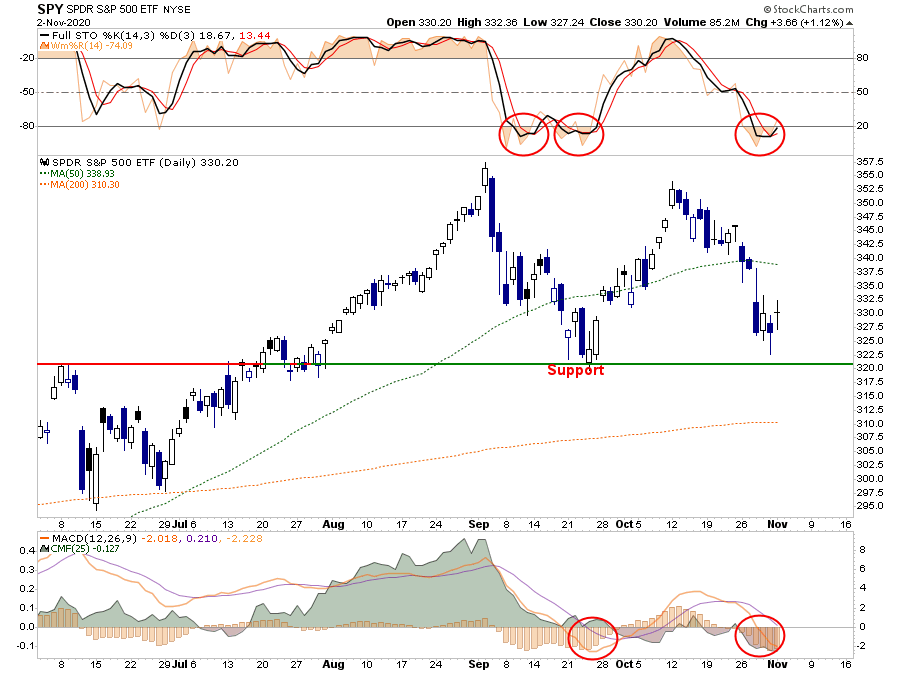
“All of our ‘sell signals’ have been intact for the last few weeks suggesting more downside risk near term. Those signals have now reversed to the point where we are likely to see a decent reflex rally starting as early as Monday. As noted in the year-to-date performance chart below, the market is 2-standard deviations below its 50-dma and is close to the September low support. Performance is positive year-to-date at 2.46%.”

On Monday, the markets did indeed bounce at the open, rising more than 1% from Friday’s close. However, that opening momentum was unable to hold as investors used the rally to sell. Such is not surprising as we head into what will undoubtedly be a volatile next two weeks.

Increasing Hedges For An Unexpected Outcome

As we have repeatedly discussed, we have been gradually raising cash and rebalancing portfolio risks as we head into the election.

We raised cash levels, reduced our bond portfolio duration, and rebalanced portfolio risk to lower volatility. On Monday, we added a short-S&P 500 index position to increase our downside hedge.

If on election night, we have a repeat of the 2016 election, and markets surge as results come in, we will remove our hedge and let our equity exposure run unfettered. Given the more oversold condition of the market currently, there is a reasonable possibility we could see a rally if there is a “concession” by one of the candidates.

However, as noted, with the massive number of “mail-in” ballots, it is highly unlikely to see a “concession” from either candidate for up to 10-days post-election as the counting of ballots concludes and votes certified. Then comes the “electoral college” which is another issue entirely.

We believe our current positioning is correct. We currently carry less than 1/2 of the market’s volatility and have plenty of cash to adjust risk accordingly. Once we have a more apparent outcome of the election, we will begin to make our next decisions.

The following rules, really more guidelines, may be useful in helping you navigate the markets over the next several months.

Investing Rules To Follow

Investing, particularly in highly uncertain environments, requires focusing not only on increasing current capital allocations but also on preserving that capital. As any “professional gambler” knows, if you lose your “stake,” you are “out of the game.”

The following are some guidelines that have served investors well over the years. They are not new or innovative, but they are time-tested and battle-hardened. 

1. Buy low, sell high.

As obvious as this seems it is the one thing that most investors do exactly the opposite of. Your ability to consistently buy low and sell high, will determine the success, or failure, of your investments. The simple reality is that 100% of your rate of return is determined by when you enter, or leave, the stock market.

2. The price of the stock market is always right.

The only thing that truly matters in investing is the price. If prices are rising – then you are long the market. If they are falling; you are in cash or short. What you ‘think’ the market should be doing at any given time is irrelevant. With all things being equal, the longer you stay on the right side of the stock market, the more money you will make. The longer you stay on the wrong side, the more money you will lose.

3. Every market or stock that goes up will go down and vice versa.

The more extreme the move up or down, the more extreme the movement in the opposite direction once the trend changes. This is also known as the “trend always changes” rule.

Rules To Wealth Building

4. Your career provides your wealth.

You most likely will make far more money from your business or profession than from your investments. Only very rarely does someone make a large fortune from investments, and it is generally those that have a business investing wealth for others for a fee or participation. (This even includes Warren Buffett.)

5. Don’t assume you can replace your wealth.

The fact that you earned what you have doesn’t mean that you could earn it again if you lost it. Treat what you have as though you could never earn it again. Never, take chances with your wealth on the assumption that you could get it back.

Trading Rules

6. The trend is your friend.

Since the trend is the basis of all profit; understanding both the long and short-term market trends are useful in understanding the risks versus the reward in putting capital at risk. Contrary to the short-term perspective of most investors today, all the big money is made by catching large market moves – not by day trading or short term stock investing.

7. You must let your profits run and cut your losses quickly.

This is the key to investing success. Trading discipline is a necessary condition of investment success. If you do NOT have a highly disciplined approach to trading – you will not make money over the long term.

8. Traditional technical and fundamental analysis alone may NOT enable you to make money in the markets consistently.

Successful market timing is possible but not with the tools and analysis most people employ. The problem with most analysis is it is biased to sell product and, therefore, is optimized, employs data mining, subjectivism, or other such statistical tricks to promote a specific perspective, opinion or objective. Focus on what the data is telling you rather that what you want it to be.

9. The worst thing an investor can do is take a massive loss on their position or portfolio.

You can avoid making that huge mistake by avoiding buying things when they are high. It should be obvious that your starting point is critical in determining your total return, if you buy low, your long-term investment results are irrefutably better than someone who bought high.

The Psychological Side

10. The most successful investing methods require changes at the margin.

A strong investment discipline requires patience, discipline, and work. However, once a portfolio is built and operational maintenance is a function of changes at the margin. Investing is a long-term process with a view towards changes of trend. Such a portfolio requires very few changes between major trend changes. If you are trading regularly – you are speculating and will eventually wind up losing more money than you made.

11. Don’t use leverage.

When someone goes completely broke, it’s almost always because they used borrowed money. Using margin accounts, or mortgages (for other than your home), puts you at risk of being wiped out during a forced liquidation. If you handle all your investments on a cash basis, it’s virtually impossible to lose everything—no matter what might happen in the world—especially if you follow the other rules given here.

12. Whenever you’re in doubt, it is always better to err on the side of safety.

If you pass up an opportunity to increase your fortune, another one will be along soon enough. But if you lose your life savings just once, you might never get a chance to replace it. Always err on the side of caution. Always ask the question of what CAN go “wrong” rather than focusing on what you “HOPE” will go right.

Beware Of The Media

It is extremely easy to get sucked into the media headlines and narratives. Such is why I turn off the media during the trading day and focus on what the markets are telling me.

Such is also why I saved the best rule for last.

13. Create a bulletproof portfolio for protection.

A portfolio of low-risk investments, fixed income and a healthy level of cash will ensure that no matter what happens in the markets, or in your life, you will be in a financially sound position to handle it. A portfolio should be able to survive any uncertainty that arises and in today’s world, there are plenty of uncertainties to choose from. It isn’t difficult, or complicated, to build a portfolio that can deliver lower volatility, income, and capital preservation.

Yes, taking some defensive action before the election may lead to missing a short-term bottom if we get a repeat of the 2016 election night bounce. That’s okay; you can put the cash to work the next day. However, if a negative outcome occurs, you will have an opportunity to “buy” quality investments at a lower price from those panicking to sell.

The financial markets will do one of two things to your future financial security:

  1. If you treat the financial markets as a tool to adjust your current savings for inflation over time, the markets will KEEP you wealthy. 

  2. However, if you try and use the markets to MAKE you wealthy, your capital will shift to those in the first category.

Ample warning signs suggest the risks of having excessive equity exposure to the market outweighs the potential for reward.

At least for now.

via ZeroHedge News https://ift.tt/2I4SdR2 Tyler Durden

Watch: GOP Poll Watcher Denied Entry In Philadelphia Days After State AG Says ‘Trump Will Lose’

Watch: GOP Poll Watcher Denied Entry In Philadelphia Days After State AG Says ‘Trump Will Lose’

Tyler Durden

Tue, 11/03/2020 – 10:35

A Republican poll watcher in the Philadelphia, PA was denied entry to a polling location despite having a valid poll watcher’s certificate.

In a viral video posted by attorney Will Chamberlain, which gained over 700,000 views in less than two hours, poll watcher Gary Feldman can be seen attempting to enter a polling station, only to be turned away by workers who claim his certificate ‘isn’t valid for this location.’

“Call the police!” says one poll worker, adding. “If you legal, call the cops.”

“I have a city-wide wather’s certificate,” said Feldman, to which another poll worker replied “That’s not for this location.”

Poll watchers are allowed to challenge the identity or residency status of a voter in the event they suspect fraud, along with inspecting voting machines and making sure poll workers aren’t influencing the vote in any way.

The incident happened days after Pennsylvania Attorney General Josh Shapiro, a Democrat, tweeted: “If all the votes are added up in PA, Trump is going to lose.”

Interesting, to say the least. What did he mean by that?

 Pennsylvania is a major battleground state this year, with pollster Nate Silver proclaiming that if Biden doesn’t win the state he’ll become the underdog.

“Maybe a lot of little things add up and Biden loses Pennsylvania by half a point, and then he doesn’t quite pull off Arizona or North Carolina. He does have other options. … But still, without Pennsylvania, then Biden becomes an underdog,” said Silver.

Perhaps this is why President Trump has deployed an ‘army’ of volunteers and paid staff to watch elections in Democratic-leaning precincts – an effort organized by veteran GOP operative Mike Roman, a former White House aide from Pennsylvania who once ran a secretive in-house intelligence unit for the Koch political network.

Roman has organized what he claims are 50,000 poll watchers.

“Our Elections Day Operations are designed to make sure that everyone that is legally entitled to vote has the opportunity to vote, once,” said Erin Perrine, Trump 2020 director of press communications in a video aimed at recruiting poll watchers. “We all know that the Democrats will be up to their old dirty tricks on Election Day to make sure President Trump doesn’t win. We cannot let that happen.”

Meanwhile, President Trump was censored by Facebook and Twitter for a Monday tweet claiming that a Supreme Court decision allowing an extension for ballot counting in Pennsylvania “will allow rampant an unchecked cheating.”

via ZeroHedge News https://ift.tt/34SvgcO Tyler Durden

Covfefe vs. Malarkey

Covfefe vs. Malarkey

Tyler Durden

Tue, 11/03/2020 – 10:15

By Michael Every of Rabobank,

So here we are: US Election Day. There are so many ways to describe what is about to happen, from the short term and tactical to the long-term and strategic – and it’s a very busy market for that kind of thing: Blue Wave; Red Wave; Wave goodbye to business as usual.

Has anyone staked a claim to “Covfefe vs. Malarkey” yet? Which sounds like a bitter American divorce; which in many ways it actually is. Yes, there is still bipartisan support in Washington, DC, but mainly for actions against China, which are polarizing; on most domestic fronts, we see nothing but that polarization.

It’s certainly going to be a long day as we wait to see which political, cultural, geopolitical economic, and geoeconomic memes will be replicated at the ballot box by the 116 Americans left who haven’t already voted. That’s a joke of course: turnout today will be huge. It’s going to be an even longer wait if this all ends up in the court room, as threatened. Which probably will happen unless turnout today is so crushing for either party that the other has no choice but to concede.

As I typed this line, a Bloomberg headline flashed by: “Trump and Biden both claim victory” even before Election Day polling booths have opened. Yes, it’s going to be a long, long day; or perhaps week; or even weeks. So let’s have some Election Day entertainment until we get the results in from key Florida counties, which will give us the first indication of what has happened.  

Woody Allen once wrote, and I have more than once lifted:

“We stand today at a crossroads: One path leads to despair and utter hopelessness. The other leads to total extinction. Let us hope we have the wisdom to make the right choice.” So is it reallyOy Vey vs. Oy Gevalt”?

George Bernard Shaw argued:

“Democracy substitutes election by the incompetent many for appointment by the corrupt few.” Which sums up the human condition nicely.

Joseph Stalin –who Shaw was a *big* fan of– noted:

“It is enough that the people know there was an election. The people who cast the votes decide nothing. The people who count the votes decide everything.” No anxious waiting for Florida when Uncle Joe was running the vote: markets would probably prefer that method if they ever got a vote on it.

J. O’Rourke wrote:

“We will win an election when all the seats in the House and Senate and the chair behind the desk in the Oval Office and the whole bench of the Supreme Court are filled with people who wish they weren’t there.” Right now it’s just much of the electorate who feel like that.

Imelda Marcos, channeling modern markets, claimed:

Win or lose, we go shopping after the election.” Except for once many US shops are boarded up and the National Guard are standing by.

Which segues well to the final thought from anarchist Emma Goldman:

If voting changed anything, they’d make it illegal.” Will we see a surge in youth Democrat turnout to show that ain’t the case, or in older, rural, Republican voters to make the same point in the inverse?

Anyway, that’s killed 5 minutes of this market purgatory as we all wait to find out if it’s “Make America Great Again”, with its 1950s and 1980s retro, or “Build Back Better”, with its “Make 2012 Great Again” retro, which triumphs.

Meanwhile, there has been market action. Down in Australia the RBA cut rates from 0.25% to 0.1%, as expected, dropped its 3-year yield target to 0,1%, stated rates are on hold there for at least three years (longer, says I), and announced an expansion of QE to AUD100bn across the 5-10 year part of the curve over the next six months. Negative rates were again stated as being incredibly unlikely, but further expansions in QE were very clearly placed on the table if they are needed. And all the signs from every other economy which has gone this route are that this will be needed.

Naturally, AUD didn’t move at all, because much of this was already priced in; but let’s see how the currency responds when the next tranche of AUD100bn QE is inevitably rolled out. On which note, the list of Chinese bans on Aussie exports continues to grow and grow. Iron ore is the biggie still waiting.

Australia’s populist One Nation party leader Pauline Hanson once infamously replied that the solution to low economic growth and rural exports was to “print more money” (in this case, to drive down the exchange rate and make Aussie products more competitive). She was widely derided for this idea – which has arguably now official policy in both Australia, and the world over, just dressed up in economic technobabble. Unless one believes that any of this QE is going to be reversed ahead? In which case I have a lovely bridge to sell you. Hardly used. Beautiful views of utopia in all directions. Anyway, the Queensland state election just held saw One Nation suffer a sharp drop in support in its home base: so populism needs to stay ahead of the establishment, it seems.

Well, that’s another 5 minutes gone. The rest of the day is up to you, sorry.

via ZeroHedge News https://ift.tt/2U2LH0h Tyler Durden

US Factory Orders V-Shaped Recovery Slows (Despite Soaring Survey Hopes)

US Factory Orders V-Shaped Recovery Slows (Despite Soaring Survey Hopes)

Tyler Durden

Tue, 11/03/2020 – 10:06

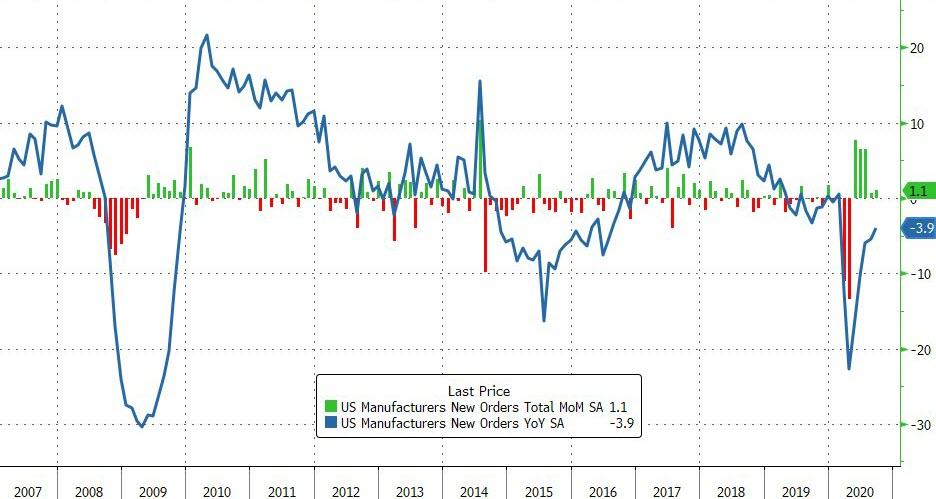
After a disappointing deceleration in factory orders v-shaped recovery in August, analysts (buoyed by ISM Manufacturing ‘soft’ data) expected September’s orders to reaccelerate at 1.0% MoM; and the final print actually surprised to the upside with 1.1% MoM jump.

However, on a year-over-year basis, factory orders remain 3.9% lower…

Source: Bloomberg

It would appear the ‘hard’ data is not quite as enthusiastic as the ‘soft’ data…

Source: Bloomberg

Core factory orders (ex-trans) disappointed modestly, rising only 0.5% MoM (vs +0.6% MoM), and all of this is before October’s more broad-based slowdown.

via ZeroHedge News https://ift.tt/32bupT3 Tyler Durden

12 Good Things That Might Happen Today, None of Which Involve Trump or Biden

westendrf525045

The 2020 election has so been so dominated by Biden versus Trump insanity that a lot of consequential ballot initiates have been getting short shrift. But today, voters in various U.S. locales will have the opportunity to usher in some pretty exciting—and libertarian—policies, as well as the chance to reject a few really bad ideas.

Let’s start with the good, shall we?

Proposition 22 in California
California’s Proposition 22 would undo some of the damage wrought by A.B. 5, the 2019 state law that reclassified all sorts of independent contractors and freelancers in California as full-fledged employees. Pushed as a way to stick it to disfavored businesses like Uber and Lyft, the law has proved detrimental to workers across a range of industries, infringing on their ability to work when and how they choose as well as leading to a lot of lost jobs. If Proposition 22 is passed, it would help mitigate these ill effects for people who drive or do deliveries by allowing them to be classified as independent contractors once again.

Proposition 207 in Arizona
Arizona residents will get the chance to legalize recreational marijuana sales by voting for Proposition 207 (also dubbed the “Smart and Safe Act”). “If passed, it would allow…adults 21 and older to purchase up to one ounce of cannabis and have up to six plants at their home,” explains Steve Cottrell, president of Curaleaf Arizona. “Adult-use cannabis products would be subject to state and local sales taxes, with an additional 16 percent excise tax.”

South Dakota Amendment A
Another marijuana legalization measure, this ballot initiative would create a constitutional amendment “to legalize the recreational use of marijuana and require the South Dakota State Legislature to pass laws providing for the use of medical marijuana and the sale of hemp by April 1, 2022.”

Initiative 190 in Montana
Montana residents also have the chance to approve recreational marijuana. Voting yes on Montana Initiative 190 would mean “legalizing the possession and use of marijuana for adults over the age of 21, imposing a 20% tax on marijuana sales, requiring the Department of Revenue to develop rules to regulate marijuana businesses, and allowing for the resentencing or expungement of marijuana-related crimes.”

Public Question 1 in New Jersey
If New Jersey’s Public Question 1 passes, it will “legalize the possession and use of marijuana for persons age 21 and older and legalize the cultivation, processing, and sale of retail marijuana.”

Initiative 65 in Mississippi
Mississippians get to vote on legalizing medical marijuana. A citizen-led ballot measure, Initiative 65, would OK it for a variety of conditions. Meanwhile, Initiative 65A—a government-led measure that’s been accused of being floated just to confuse voters—would legalize medical marijuana for terminally ill people only.

Initiative 429 in Nebraska
This ballot measure would legalize all sorts of gambling at licensed racetracks. “Currently, Nebraska outlaws gambling, except with respect to the state lottery, licensed raffles, and bingo,” notes Ballotpedia.

Measure 109 in Oregon
Oregon’s Measure 109 would let people legally purchase and consume hallucinogenic mushrooms under the care of a psilocybin administrator. If passed, it would give the Oregon Health Authority two years to “determine who is eligible to be licensed as a facilitator, determine what qualifications, education, training, and exams are needed, and create a code of professional conduct for facilitators,” says Ballotpedia.

Ballot Measure 2 in Alaska and Question 2 in Massachusetts
Ballot initiatives in Alaska and Massachusetts would establish ranked-choice voting, in which voters rank candidates by order of preference instead of just voting for one candidate.

Proposition 25 in California
Voting yes on Proposition 25 will help bring more fairness to the bail system. “A ‘yes’ vote is to uphold the contested legislation, Senate Bill 10 (SB 10), which would replace cash bail with risk assessments for detained suspects awaiting trials,” Ballotpedia explains.

Measure 110 in Oregon
This measure would lessen penalties for all sorts of illegal drugs—including heroin and cocaine—moving personal possession of them from serious criminal infractions to something warranting classes or a small fine.


Alas, this year’s ballot measures aren’t all about legalizing drugs, making the criminal justice system fairer, and negating bad workplace regulations. A number of initiatives also seek to limit liberty and individual rights and roll back positive reforms. Here are a few of the worst:

Proposition 20 in California
This California ballot measure “would undo significant criminal justice system reforms passed by California voters in recent years at the very moment that many other states are finally starting to make needed reforms,” explains policy analyst Alix Ollivier with the Reason Foundation (the nonprofit that publishes this site):

Prop. 20, supported by groups such as the California Correctional Peace Officers Association, seeks to address complaints from law enforcement groups that claim it has become too difficult to prosecute repeat offenders, that more minor offenses should be charged as felonies, and they should be able to take DNA from people that commit minor crimes in efforts to expand the DNA database used to help solve crimes.

The initiative would roll back reforms that have been made to the classification of crimes considered non-violent, create two new crimes that would be added to state law—serial theft and organized theft, and make parole more difficult to attain for those convicted of various crimes.

The measure is largely written as law enforcement’s effort to unwind the statewide criminal justice ballot measures voters passed in 2014 and 2016.

Illinois Allow for Graduated Income Tax Amendment
The state is seeking permission to raise people’s income taxes from a flat rate of 4.95 percent to 7.75 percent for households making over $250,000 and 7.99 percent for households with annual incomes over $750,000. The governor already signed a law to this effect last year, but to enact it requires a constitutional amendment since the state constitution bans a progressive income tax.

Proposition 208 in Arizona
Another ballot initiative intended to raise taxes, Arizona’s Proposition 208 would almost double the marginal income tax rate—from 4.5 percent to 8 percent—for high-earning individuals and households. It would also raise taxes on small businesses, since “small businesses pay their taxes on the individual portion of the tax code,” explains Arizona Chamber of Commerce President Glenn Hamer. If Proposition 208 passes, “small businesses will pay a top rate of 8 percent, much higher than the corporate rate of 4.9 percent. We would be the only state in the country to basically double the tax on small businesses, and at a time when so many are struggling.”

Proposition 115 in Colorado
Colorado’s Proposition 115 would criminalize abortion after 22 weeks of pregnancy. “Performing a prohibited abortion would be a Class 1 misdemeanor (the most serious level of misdemeanor in Colorado), which would be punishable by a fine ranging from $500 to $5,000 and not by jail time,” and “medical professionals who are found to have performed a prohibited abortion would have their medical licenses suspended by the Colorado Medical Board for at least three years,” explains Ballotpedia. “Under the initiative, abortions after 22 weeks would be lawful if the physician believes it is immediately necessary to save the life of the pregnant woman.”

Louisiana Amendment 1
Amendment 1 aims to ready Louisiana to curtail abortion access should Roe v. Wade be overturned by amending the state’s constitution to say nothing in it “shall be construed to secure or protect a right to abortion or require the funding of abortion.” As the Wall Street Journal explains, “should a more solidly conservative U.S. Supreme Court give states more authority to regulate abortion, Louisiana state courts would have less ability to strike down antiabortion laws” if Amendment 1 passes.

Proposition 21 in California
This measure would allow for the expansion of state rent control policies.


QUICK HITS

• In a long Twitter thread, Rep. Justin Amash (L–Mich.) lays out the many, many ways that President Donald Trump has failed libertarians:

• Folks in charge of the Grammy Awards are making a big deal about replacing the “world music” award category with the almost-identical category of “global music.”

• “An Eastern Washington teen went to a mental health clinic for help. Eight days later, he died in a jail cell.

The Daily Caller blows holes in Trumpian theories about Democratic nominee Joe Biden and his son, Hunter:

• What will the post-election major parties look like?

• Why the mobile-only streaming platform Quibi failed.

from Latest – Reason.com https://ift.tt/32cdGPw
via IFTTT
Global COVID-19 Cases Average More Than 500k For First Time As Europe Outpaces US: Live Updates

Global COVID-19 Cases Average More Than 500k For First Time As Europe Outpaces US: Live Updates

Tyler Durden

Tue, 11/03/2020 – 09:47

While more than 100 million people have already voted in Tuesday’s US election, cases and hospitalizations have climbed in several swing states, including Wisconsin and Iowa, among others, in recent weeks, while deaths have edged higher, but not nearly enough to validate the increasingly ominous warnings from Dr. Anthony Fauci.

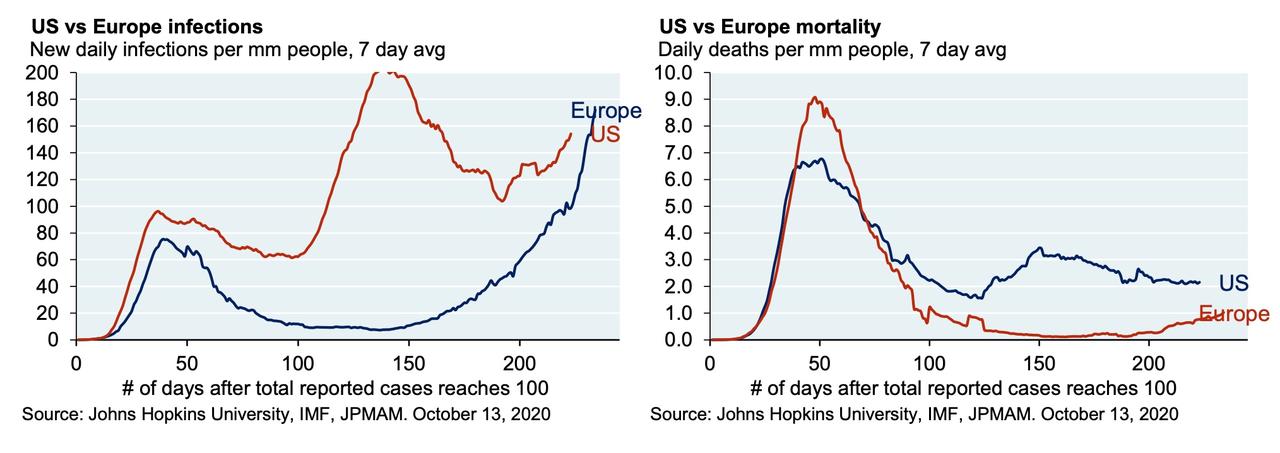
The most notable trend over the past couple of weeks in the west has been the acceleration of the coronavirus across Europe, leading to a wave of new lockdowns and restrictions, as both positivity rates and fatality rates among the biggest European countries have surpassed the US.

Source: JPM

Now that the final JHU numbers are in, it looks like the world saw 439,621 new cases on Monday, with roughly 84,000 of those coming from the US.

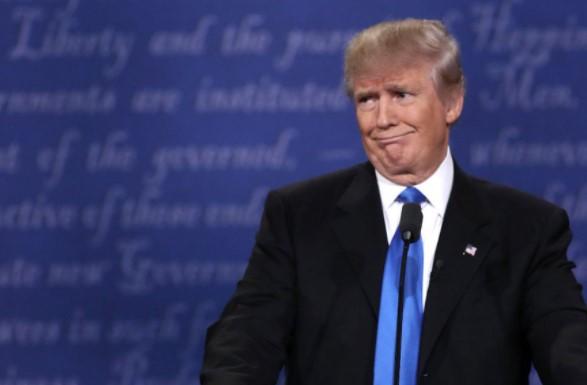
Even though the global number didn’t top 500k again on Monday, thanks to the US and Europe, the seven-day moving average of global coronavirus cases has exceeded 500,000 cases for the first time ever, just as total cases are reaching 46.8 million. Europe and the US have seen case surges in recent weeks, with American battleground states in the South and the Midwest particularly hard hit.

Across the US, most states are seeing case numbers rise, though there are some notable exceptions, including California, which has seen its 7-day average decline by 2% WoW, while case numbers soar across the northeast and midwest.

Source: mSightly

Here’s some more COVID-19 news from overnight and Tuesday morning:

Spain and France reported new records on Monday with the former reporting 55k new cases and the latter 52k (Source: JHU).

South Korea’s core consumer price index for October declined 0.3% year-on-year, marking the sharpest fall since September 1999, as the pandemic dampened domestic demand and a temporary government subsidy on mobile phone bills weighed on prices (Source: Nikkei).

Argentina will import 10 million doses of Russia’s experimental COVID-19 vaccine between December and January, as infections continue to climb in the South American country (Source: Nikkei).

via ZeroHedge News https://ift.tt/3ekC2LN Tyler Durden