11/2/2010: Brown v. Entertainment Merchants Association argued.

from Latest – Reason.com https://ift.tt/3eq7GaM
via IFTTT
another site
11/2/2010: Brown v. Entertainment Merchants Association argued.
from Latest – Reason.com https://ift.tt/3eq7GaM
via IFTTT
Trump Hints He May “Fire Fauci” After Election Day
Tyler Durden
Mon, 11/02/2020 – 06:33
Though it shouldn’t come as a surprise to anybody who remembers the handful of firings that followed the midterms back in 2018, President Trump just hinted that he’s planning on firing Dr. Anthony Fauci after Election Day.
Speaking after midnight following a busy day of campaigning, Trump was confronted by a Florida crowd’s chants of “Fire Fauci,” President Trump suggested – following a rant claiming “you won’t hear too much” about COVID-19 after Nov. 4 – that he might do just that in the very near future.
“Don’t tell anybody,” Trump began, ” but let me wait until a little bit after the election.”
The crowd roared with approval, thought Trump playfully waved away the cheers, insisting that Dr. Fauci is “a nice man”, though he has “been wrong a lot.”
Watch the clip below.
TRUMP: You turn on the news, ‘Covid, covid, covid, covid.’
CROWD: Fire Fauci! Fire Fauci!
TRUMP: Don’t tell anybody, but let me wait til a little bit after the election. pic.twitter.com/qOT0OZnJUE
— Dan Diamond (@ddiamond) November 2, 2020
This is the first time that Trump has publicly suggested he is indeed planning to fire the good doctor, though most political observers probably had an inkling that Dr. Fauci’s immunity has been wearing off. After all, if Trump wins a second term, he won’t ever need to worry about political considerations again.
Dr. Fauci hasn’t exactly been making things easy: Over the weekend, he sat for a lengthy interview with the Washington Post where he delivered strident criticisms of both President Trump and Dr. Scott Atlas, Trump’s new favorite scientific advisor, who supports the Great Barrington Declaration.
via ZeroHedge News https://ift.tt/36bcahR Tyler Durden

Just down the street from the Reason offices in D.C., protesters recently built a guillotine. No necks were harmed that night; it wasn’t fully functional. But they did it in front of Amazon founder Jeff Bezos’ house, and the message was clear: While we aren’t going to do violence to you personally right now, we want you to know that we think capitalist billionaires like you are so terrible that some violence may, in fact, be justified. Another iteration of the guillotine had popped up a couple of weeks earlier in front of the White House, with similar implications for the president and his allies.
The question, which has taken on increasing importance as Election Day draws near, is how seriously (or literally) to take such threats.
The best-case scenario is that what we are seeing in the streets is essentially LARPing. If you don’t know what LARPing is: Congratulations. I bet the parties you got invited to in high school were fun! It stands for “live action role playing,” and the most common manifestation is a small group of costumed nerds staging some form of simulated combat, often in a campus quadrangle or public park.
Like the guillotinesmiths of Kalorama, the lefty protesters of Seattle and Portland—dressed in activist goth chic and ostentatiously practicing maneuvers with shields—are looking to trigger disgust and panic in those who disagree with their aims or tactics, and boy is it working. The same is true of the Unite the Right marchers who turned up in Charlottesville three years ago and later in the Pacific Northwest to provoke fear and intimidate their opponents while wearing matching polo shirts and wielding tiki torches.
“So far, this revolutionary playacting has been more annoying than terrifying,” Cathy Young writes in this month’s cover story, an account of the events leading up to France’s Reign of Terror with an eye toward the parallels to the present day (page 18). “It’s about trolling, not killing, the enemy. But it still signals an embrace of bloodthirsty rhetoric—and of ideological homage to one of history’s bloodier leftist dictatorships.”
There are reasons to believe the situation in American cities could take a more deadly turn, however. For one thing, it did in Charlottesville, when counterprotester Heather Heyer was killed. And it already has in Portland, where Reason contributor Nancy Rommelmann has covered the monthslong conflict between the antifa “black bloc” and the various right-leaning factions that oppose it. The activists in Portland have been busy attempting, mostly without success, to set fire to various government buildings downtown. Failing that, they settle for dumpsters. They had their own guillotines there, of course, one of which conscripted a teddy bear to stand in for reviled Democratic Mayor Ted Wheeler.
But there have been repeated clashes, not only between the protesters and law enforcement but also between rival activist factions, including the now-infamous right-wing Proud Boys. At the end of August, those tensions culminated in the killing of Aaron “Jay” Danielson by a deeply troubled man who identified as antifa.
The actions of the shooter, writes Rommelmann, are “a symptom of what happens when a movement gets such a glow that it attracts people ready to take things to the next level. For most people, fatal violence causes an instinct to recoil, to take a step back and reconsider. But not for everyone.”
This is the very definition of a vicious cycle. As the less committed folks step back because they sense that things have gone too far, only the most hardcore remain in the field, ready to rumble. “That things will get worse before they get better seems inevitable,” writes Rommelmann. “A movement that justifies intimidation and violence moves in only one direction, and anyone who says they did not see this coming to the streets of Portland has not been paying attention.”
There are signs that ordinary people are becoming more likely to support this kind of violence, if not engage in it themselves. In October, a group of researchers published a disheartening set of survey responses in Politico. They found that 36 percent of Republicans and 33 percent of Democrats said it is at least “a little” justified for their side “to use violence in advancing political goals.” Those numbers are slightly higher if you specify the loss of an election as the trigger for violence.
The more extreme someone’s political views, the more likely they are to believe violence is justified to achieve them. Among those who identify as “very liberal,” 26 percent said there would be “a great deal” of justification for violence if the Democratic candidate loses the presidency. Among the “very conservative,” that figure is 16 percent if the Republican candidate loses.
These numbers are up significantly from June, but the trend begins much earlier. This is neither a left nor a right phenomenon, no matter how desperately each side would like that to be the case. No one “started it.” No one side is picking the fight. This is a change in views about political violence across the board.
The new survey builds on a longstanding body of work by two of the authors, Nathan P. Kalmoe and Lilliana Mason, who have also found that polarization seems to be directly connected to dehumanization, with 20 percent of Republicans and 15 percent of Democrats agreeing in 2018 that members of the other party “lack the traits to be considered fully human—they behave like animals.”
A 2019 report from the Carnegie Endowment for International Peace put a finer point on the ways in which this electoral cycle may be particularly ripe for conflict, declaring that “experimental evidence shows inducing expectations of electoral victory give strong partisans more confidence to endorse violence against their partisan opponents.”
Recall that one of this spring’s most outrageous instances of cancel culture at work was indirectly about the question of tolerance for political violence as well: A Civis Analytics researcher lost his job after tweeting out an academic study by Princeton’s Omar Wasow about how violent protesters may undermine the electoral goals of their allies. He was accused of “concern trolling” and “minimizing black grief and rage” and subsequently fired in what appeared to be a direct response to the tweet. Not only are people more willing to condone violence across the board, but at the extremes some are also less willing to even entertain talk about why such violence might be a bad idea.
There is one additional complicating factor here: The meaning of the word violence is in flux. Speech is increasingly described as violence. Sometimes silence is also violence, especially in conversations about race. In certain circles, conversely, it’s now up for debate whether property destruction counts as violence, with activists pushing back on the idea that the damage to homes and businesses in the wake of this summer’s Black Lives Matter protests should be taken into consideration at all.
It’s a mistake to conflate bad tweets with revolutionary violence, but it is worth pointing out that in the waning days of the election season, Bhaskar Sunkara, a co-founder of the aptly named Jacobin magazine, tweeted: “I think killing little Romanov children was justified. But it’s not surprising why these views are controversial given most people’s ethical and moral frameworks.”
Sunkara ultimately took down the tweet. But the thing he may have been most wrong about was the notion that most people’s moral and ethical frameworks can’t accommodate violence in the name of political change. Increasing numbers of Americans see those who disagree with them as subhuman and view politics as a worthy cause for violence, even if they’re not ready or willing to do violence themselves. For these new Jacobins, the romance of the guillotine persists.
from Latest – Reason.com https://ift.tt/2JpTxid
via IFTTT
Just down the street from the Reason offices in D.C., protesters recently built a guillotine. No necks were harmed that night; it wasn’t fully functional. But they did it in front of Amazon founder Jeff Bezos’ house, and the message was clear: While we aren’t going to do violence to you personally right now, we want you to know that we think capitalist billionaires like you are so terrible that some violence may, in fact, be justified. Another iteration of the guillotine had popped up a couple of weeks earlier in front of the White House, with similar implications for the president and his allies.
The question, which has taken on increasing importance as Election Day draws near, is how seriously (or literally) to take such threats.
The best-case scenario is that what we are seeing in the streets is essentially LARPing. If you don’t know what LARPing is: Congratulations. I bet the parties you got invited to in high school were fun! It stands for “live action role playing,” and the most common manifestation is a small group of costumed nerds staging some form of simulated combat, often in a campus quadrangle or public park.
Like the guillotinesmiths of Kalorama, the lefty protesters of Seattle and Portland—dressed in activist goth chic and ostentatiously practicing maneuvers with shields—are looking to trigger disgust and panic in those who disagree with their aims or tactics, and boy is it working. The same is true of the Unite the Right marchers who turned up in Charlottesville three years ago and later in the Pacific Northwest to provoke fear and intimidate their opponents while wearing matching polo shirts and wielding tiki torches.
“So far, this revolutionary playacting has been more annoying than terrifying,” Cathy Young writes in this month’s cover story, an account of the events leading up to France’s Reign of Terror with an eye toward the parallels to the present day (page 18). “It’s about trolling, not killing, the enemy. But it still signals an embrace of bloodthirsty rhetoric—and of ideological homage to one of history’s bloodier leftist dictatorships.”
There are reasons to believe the situation in American cities could take a more deadly turn, however. For one thing, it did in Charlottesville, when counterprotester Heather Heyer was killed. And it already has in Portland, where Reason contributor Nancy Rommelmann has covered the monthslong conflict between the antifa “black bloc” and the various right-leaning factions that oppose it. The activists in Portland have been busy attempting, mostly without success, to set fire to various government buildings downtown. Failing that, they settle for dumpsters. They had their own guillotines there, of course, one of which conscripted a teddy bear to stand in for reviled Democratic Mayor Ted Wheeler.
But there have been repeated clashes, not only between the protesters and law enforcement but also between rival activist factions, including the now-infamous right-wing Proud Boys. At the end of August, those tensions culminated in the killing of Aaron “Jay” Danielson by a deeply troubled man who identified as antifa.
The actions of the shooter, writes Rommelmann, are “a symptom of what happens when a movement gets such a glow that it attracts people ready to take things to the next level. For most people, fatal violence causes an instinct to recoil, to take a step back and reconsider. But not for everyone.”
This is the very definition of a vicious cycle. As the less committed folks step back because they sense that things have gone too far, only the most hardcore remain in the field, ready to rumble. “That things will get worse before they get better seems inevitable,” writes Rommelmann. “A movement that justifies intimidation and violence moves in only one direction, and anyone who says they did not see this coming to the streets of Portland has not been paying attention.”
There are signs that ordinary people are becoming more likely to support this kind of violence, if not engage in it themselves. In October, a group of researchers published a disheartening set of survey responses in Politico. They found that 36 percent of Republicans and 33 percent of Democrats said it is at least “a little” justified for their side “to use violence in advancing political goals.” Those numbers are slightly higher if you specify the loss of an election as the trigger for violence.
The more extreme someone’s political views, the more likely they are to believe violence is justified to achieve them. Among those who identify as “very liberal,” 26 percent said there would be “a great deal” of justification for violence if the Democratic candidate loses the presidency. Among the “very conservative,” that figure is 16 percent if the Republican candidate loses.
These numbers are up significantly from June, but the trend begins much earlier. This is neither a left nor a right phenomenon, no matter how desperately each side would like that to be the case. No one “started it.” No one side is picking the fight. This is a change in views about political violence across the board.
The new survey builds on a longstanding body of work by two of the authors, Nathan P. Kalmoe and Lilliana Mason, who have also found that polarization seems to be directly connected to dehumanization, with 20 percent of Republicans and 15 percent of Democrats agreeing in 2018 that members of the other party “lack the traits to be considered fully human—they behave like animals.”
A 2019 report from the Carnegie Endowment for International Peace put a finer point on the ways in which this electoral cycle may be particularly ripe for conflict, declaring that “experimental evidence shows inducing expectations of electoral victory give strong partisans more confidence to endorse violence against their partisan opponents.”
Recall that one of this spring’s most outrageous instances of cancel culture at work was indirectly about the question of tolerance for political violence as well: A Civis Analytics researcher lost his job after tweeting out an academic study by Princeton’s Omar Wasow about how violent protesters may undermine the electoral goals of their allies. He was accused of “concern trolling” and “minimizing black grief and rage” and subsequently fired in what appeared to be a direct response to the tweet. Not only are people more willing to condone violence across the board, but at the extremes some are also less willing to even entertain talk about why such violence might be a bad idea.
There is one additional complicating factor here: The meaning of the word violence is in flux. Speech is increasingly described as violence. Sometimes silence is also violence, especially in conversations about race. In certain circles, conversely, it’s now up for debate whether property destruction counts as violence, with activists pushing back on the idea that the damage to homes and businesses in the wake of this summer’s Black Lives Matter protests should be taken into consideration at all.
It’s a mistake to conflate bad tweets with revolutionary violence, but it is worth pointing out that in the waning days of the election season, Bhaskar Sunkara, a co-founder of the aptly named Jacobin magazine, tweeted: “I think killing little Romanov children was justified. But it’s not surprising why these views are controversial given most people’s ethical and moral frameworks.”
Sunkara ultimately took down the tweet. But the thing he may have been most wrong about was the notion that most people’s moral and ethical frameworks can’t accommodate violence in the name of political change. Increasing numbers of Americans see those who disagree with them as subhuman and view politics as a worthy cause for violence, even if they’re not ready or willing to do violence themselves. For these new Jacobins, the romance of the guillotine persists.
from Latest – Reason.com https://ift.tt/2JpTxid
via IFTTT
‘CommonPass’: New COVID-19 Security Measures Will Make Health A Prerequisite For Travel
Tyler Durden
Mon, 11/02/2020 – 05:00
Authored by Raul Diego via MintPressNews.com,
As the multi-sector, global response to the coronavirus tightens the noose around civil liberties, CommonPass stands out as one of the most appalling and dangerous attacks on basic human rights in the name of public health.
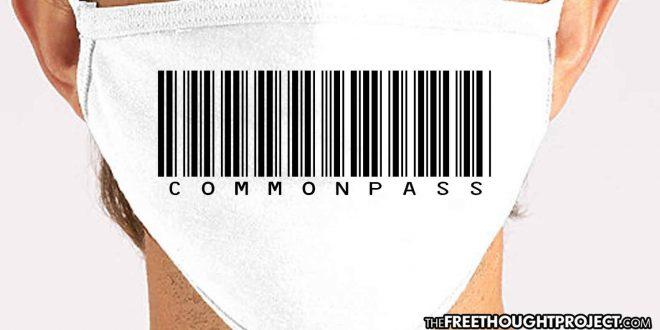
Imagine standing at a TSA security checkpoint on your way home for the holidays. You’re getting ready to go through the awkward travel procedures instituted almost immediately after 9/11 when the Transportation and Security Administration (TSA) was created and air travel in the United States morphed into a search and seizure operation with the implied possibility of your detention and interrogation.
The initial outrage such expressions of implicit state violence caused early on eventually gave way to begrudging acceptance. But now, a new layer of “security,” that could restrict freedom of movement even further, is being rolled out at several ports of entry in partnership with health technology industry leaders, academic institutions, and government health entities in more than three dozen countries.
A new digital certificate called CommonPass, designed to serve as a clearance mechanism for passengers based on a health diagnosis underwent its first transatlantic test on October 21 under the watchful eye of the Centers for Disease Control (CDC) and U.S. Customs and Border Protection (CBP) at Heathrow Airport in London. There, a group of select participants embarked on United flight 15 to Newark, New Jersey after being screened and tested for COVID-19 at the point of departure in a largely ceremonial exercise that included initiative co-founders, Paul Meyer and Bradley Perkins.

The app’s first trial run took place with much less media fanfare last month on a Cathay Pacific Airways flight from Hong Kong to Singapore and marked the beginning of the CommonPass pilot project launched by The Commons Project non-profit organization in-tandem with the World Economic Forum.
Travel industry insiders claim that CommonPass will allow international travel to resume before a COVID-19 vaccine is made widely available by applying standard methods for certification of lab results and vaccination records of travelers through the CommonPass Framework, based on criteria set by the governments of each port of entry.
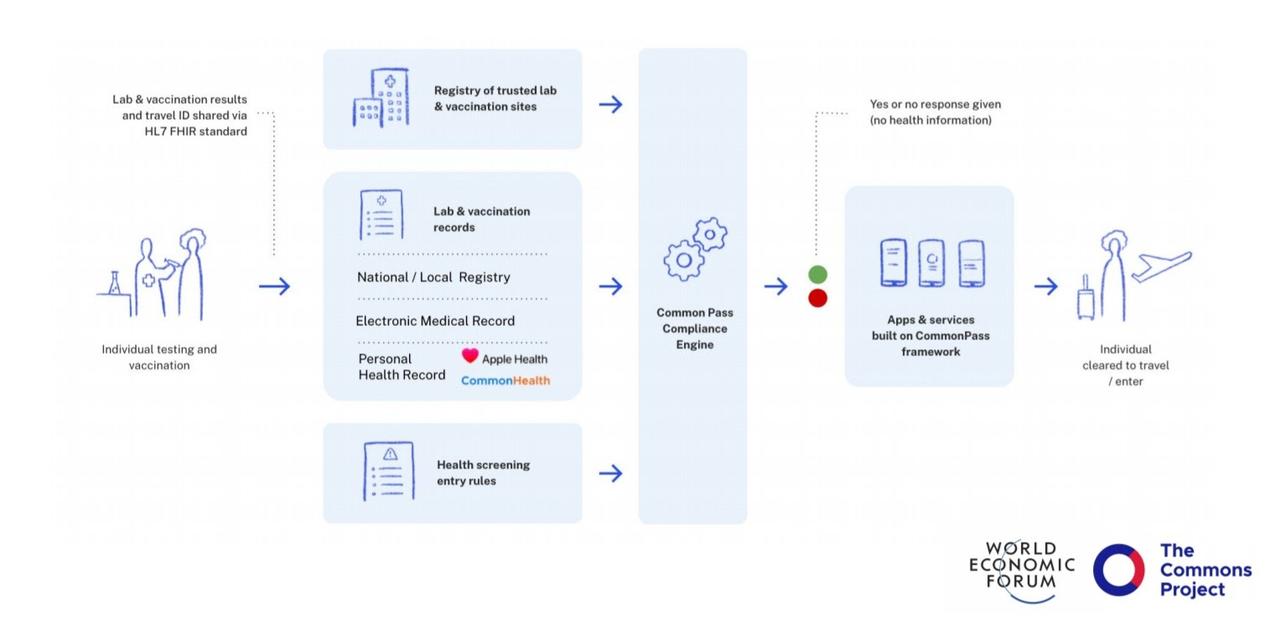
A graphic from a Commons Project presser lays out the basics of the CommonPass
J.D. O’Hara, CEO of one of the world’s largest travel services companies and one of the participants at Wednesday’s CommonPass trial run, hailed the app’s ability to “verify health
information in a secure, verified manner,” while Roger Dow of the U.S. Travel Association released a statement praising it for paving a “way forward” for the global economy in the wake of the pandemic.
As the multi-sector, global response to the coronavirus tightens the noose around civil liberties, CommonPass stands out as one of the most appalling and dangerous attacks on basic human rights in the name of public health and is rife with a potential for abuse so great, that it behooves us to find out more about the people and interests behind it.
In medieval times, the ‘commons’ denoted the de facto and collective ownership of land, which peasants used to plow, sow and harvest or raise sheep and cattle. The rise of the land-owning classes in post-Magna Carta Europe, and England in particular, slowly eviscerated this form of communal privilege through the enclosure system, which redistributed the commons to the proto-capitalist class in partnership with the monarchies and create the system of oppressive labor exploitation known as feudalism.
Starting in 1604, the Enclosure Acts of England created legal property rights for land that had belonged to the farmers and shepherds, forming the basis of modern-day capitalism. Today, that scene is being repeated as the Internet, an information ‘commons’ is being carved out by Big Tech and led by organizations like The Commons Project, which avails itself of a name that connotes the total opposite of its purpose.
Co-founders Paul Meyer and Bradley Perkins are the non-profit’s CEO and Chief Medical Officer, respectively. Perkins began his career over thirty years ago at the Center for Disease Control and, for nearly a decade, worked at the RAND corporation’s health care policy division, RAND Health Advisory Board. Meyer, for his part, is a Yale law school graduate, who was writing President Clinton’s speeches years before receiving his graduation diploma from the storied institution. Both have extensive career histories in the fields of health and technology, though in very different areas and with strange bedfellows along the way.
In 2009, Perkins became the Chief Technology Officer for a publicly-traded cross-national operator of hospitals and clinics called Vanguard Health Systems. Vanguard had been established with funding from Morgan Stanley and controlled by the Blackstone Group since 2004, maintaining control all though the company’s IPO in 2011. Two years later, Vanguard was acquired by Tenet Healthcare, creating the third-largest investor-owned hospital company in the United States with a total of 65 hospitals nationwide and over 500 healthcare facilities.

Paul Meyer, center, is pictured in a screenshot of a media briefing touting CommonPass
Besides being one of the biggest healthcare companies in the United States, Tenet is also one of the most notoriously corrupt. The same year it bought Vanguard, it was slapped with a major whistleblower complaint that disclosed the company’s fraudulent practices. That lawsuit resulted in a $514 million settlement. A more recent case involving a conspiracy between Oklahoma orthopedic surgeons at one of its facilities was settled for $66 million in 2019. But, Tenet’s problems go back even further to the early 2000s when fraud and performing unneeded surgeries led to a multitude of lawsuits and even a Senate investigation.
The Vanguard deal marked the end of Perkins’ tenure there, who chose to take a $1.9 million package instead of joining the newly merged conglomerate like its CEO and much of its staff did. He would move on to create a company of his own called Sapiens Data Science; a health tech platform that provides access to “credible scientifically validated data algorithms” and looks to create a “new revolutionary health ecosystem.”
Meyer’s background is more complicated, and his arrival on the healthcare scene runs through different channels linked to American intelligence cover operations dating back to NATO’s war in Kosovo and the former Yugoslavia during the early Clinton years. It is his involvement with an infamous human-trafficking outfit known as the International Rescue Committee or IRC, that should be cause for concern given his role in The Commons Project and flagship CommonPass app.
Before he was named Young Global Leader by the World Economic Forum or Henry Crown Fellow at the Aspen Institute, and even before becoming a Term Member of the Council on Foreign Relations and receiving MIT’s 2003 Humanitarian of the Year award, Paul Meyer found himself in war-torn Kosovo installing a new Internet infrastructure system to replace the one destroyed in the war, only days after NATO bombs had stopped shelling the Serbian people.
Barely out of law school and having spent two years writing President Clinton’s speeches as the conflict in the former Yugoslavia was transpiring, Meyer was tapped by the IRC to lead a UN and private relief effort called the Internet Projekti Kosova (IPKO) or Kosovo Internet Project, with tech-savvy local Akan Ismaili to handle the complex technical issues and Teresa Crawford from the Advocacy Project to “uplink” satellites in the region with the stated purpose of reuniting displaced Albanian families. The system was set up atop a building used by the British KFOR Civil-Military Cooperation CIMIC and British Royal Engineers were also brought onto the project, among others.
Eventually, the IRC gave the project to a non-profit organization “dedicated to providing wide access to the Internet in Kosovo.” IPKO is today the largest telecom, internet, and cable TV company in Kosovo. Meyer remains involved through the IPKO Foundation, which he co-founded to provide “free technology education” to Kosovar students.
By the 1950s, the IRC was known to be an “integral link” in the CIA’s covert network led by Tony Blair protégé and former British Foreign Minister, David Miliband since 2013. In 2018, the IRC was embroiled in a child-sex trafficking scandal dubbed the “sex-for-food scandal” covered extensively by Whitney Webb in a recent article. The organization’s cover-up of dozens of sex abuse, bribery and fraud allegations resulted in the U.K. government withdrawing its funding from the organizations. However, no IRC employees were prosecuted over the 37 incidents detailed in the report.
Currently, the IRC is very involved in the implementation of a biometric ID system for refugees of the ongoing conflict in Myanmar, a project funded by the Rockefeller Foundation-backed ID2020 Alliance, which also funds The Commons Project. IRC’s Mae La initiative, however, receives most of its funding through the notorious CIA-cutout USAID and intends to create a “blockchain-based digital identification” system using iris recognition technology to give refugees access to IRC’s services in Thailand. Long term goals include rolling health, work and financial data together into a single ID system, that will determine access to food, healthcare and mobility.
The difference between IRC’s Mae La project and The Commons Project is a question of class. Class status, to be specific. But, it is essentially the same idea and covers the same interests of the groups and individuals who form part of the Commons Project’s board of trustees; many of whom have been part of the digital tracking and healthcare technology space for years.
People like Linda Dillman, who ran Wal-Mart’s implementation of RFID employee tracking technology as the retail giant’s CIO or the former Chief Technology Officer for the U.S. Department of Health and Human Services, Bryan Sivak, who is now a Managing Director at Managing Director at Kaiser Permanente, one of the largest healthcare insurance plan providers in the nation. Other trustee affiliations stand out, as well, such as Will Fitzpatrick, General Counsel to the Omidyar Network and George W. Bush’s Assistant Secretary of Defense, Health Affairs, Dr. William Winkenwerder, Jr.
At the core of these efforts is the desire to create a DNA-based population screening agenda, which people like Perkins and Meyer are forcefully pushing forward. Perkins worked as the CMO at a company called Human Longevity, Inc., which “combines state-of-the-art DNA sequencing and expert analysis with machine learning, to help change medicine to a more data-driven science.”

A microbiologist demonstrates a whole-genome DNA sequencing machine called a MiSeq at CDC HQ in Atlanta. David Goldman | AP
Meyer developed a precursor to CommonPass in 2016, when he merged his mobile health services company, Voxiva, which implemented the “first nationwide digital disease surveillance systems in Peru and Rwanda” in partnership with the CDC, the National Institutes of Health (NIH), with Sense Health to form a health messaging service called Wellpass Meyer described as “an integrated platform… [that] helps overcome the challenges of deploying fragmented engagement and population health solutions.”
The reliability of the DNA-based, algorithmically-deduced health diagnoses used for the CommonPass trial run must also be called into question given the history of the company furnishing the technology. Prenetics, Ltd is the Hong Kong-based, Alibaba-funded company that also performed the COVID-19 testing for the UK’s Premier League’s Project Restart, which used a similar health status app called Covi-Pass, covered by this author in June.
Prenetics’ COVID tests rely on DNA-based technology it acquired in 2018, when it purchased DNAFit; a company founded by South African businessman Avrom “Avi” Lasarow, who came on board after the merger as Prenetics’ Chief Executive Officer for Europe, Middle East and Africa. Lasarow, who also heads the Premier League’s coronavirus testing program, just settled a civil case against him in the U.S. last May for nearly $60,000 surrounding allegations of “deceptive health claims”.
“Lifestyle genetics pioneer” Lasarow has a long track record of settling out of court over such issues, including a lawsuit brought by the U.S. Federal Trade Commission in 2015, which accused Lasarow Healthcare Technologies Ltd., aka L Health Ltd., and two other defendants of making false or unsubstantiated claims regarding a “melanoma detection” app. As part of that settlement, Lasarow was “prohibited from making any misleading or unsubstantiated claims about the health benefits or efficacy of any product or service.”
Prenetics has been reportedly working on establishing a partnership with VSTE Enterprises, the same company that developed the V-Code technology that underpins Covi-Pass, since May. Nevertheless, such red flags pale in comparison to the individuals and organizations that are behind CommonPass, itself, who have plans for a much vaster digital enclosure based on DNA population screening technologies through initiatives like the The Commons Project, which aims to fundamentally transform medicine and impose new limits on our freedom of movement as the CommonPass rollout is slated to quickly expand to other routes across Asia, Africa, the Americas, Europe and the Middle East.
Just as Bush’s Aviation and Transportation Security Act opened the doors for certain technology and security sectors to flourish in the wake of 9/11, this novel health-focused expansion of the national security state has bypassed all levers of democratic power to allow for the entrenchment of a far larger and more dangerous group of entities, within the health, technology and life sciences industries together with an increasingly more powerful clique of federal health agencies and officials, like Robert Kadlec, who are pushing for a full spectrum surveillance society.
Taking your shoes off at the airport and exposing your body to radiation has become routine now at every airport in the nation and most ‘temporary’ laws passed through emergency legislation remain on the books nearly two decades later. Precedent demands that we assume the same will occur with the majority of the new restrictions on our freedom of movement and quality of life currently being implemented throughout the country and the world.
Rolling back these draconian measures is not in any of their plans, as promised by the president of the U.S. Travel Association, Roger Dow, who confidently asserted after Wednesday’s successful CommonPass trail run, that the app will let us “navigate out of the crippling economic fallout of COVID-related travel restrictions and quarantine requirements,” adding that it will “pay further dividends for more seamless and convenient travel even once the pandemic has subsided.”
via ZeroHedge News https://ift.tt/3kQeO2x Tyler Durden

The furniture was sitting on the lawn, his work van was parked outside, and Roy Stucker was inside a Louisville, Kentucky, home, painting it for a new tenant. That’s when 10 Louisville police officers broke out the windows, stormed into the house, and handcuffed Stucker and his girlfriend at gunpoint. They held them for about 20 minutes before realizing that Stucker wasn’t the man they were looking for. Stucker’s attorney says that man had been arrested by Louisville police 10 days earlier and was still in custody at the time cops raided the house. Stucker and his girlfriend have filed a lawsuit against the city, claiming unlawful imprisonment.
from Latest – Reason.com https://ift.tt/3kTZimc
via IFTTT
The furniture was sitting on the lawn, his work van was parked outside, and Roy Stucker was inside a Louisville, Kentucky, home, painting it for a new tenant. That’s when 10 Louisville police officers broke out the windows, stormed into the house, and handcuffed Stucker and his girlfriend at gunpoint. They held them for about 20 minutes before realizing that Stucker wasn’t the man they were looking for. Stucker’s attorney says that man had been arrested by Louisville police 10 days earlier and was still in custody at the time cops raided the house. Stucker and his girlfriend have filed a lawsuit against the city, claiming unlawful imprisonment.
from Latest – Reason.com https://ift.tt/3kTZimc
via IFTTT
Land O’Lakes Profit Surges 22% In Q3 As Consumers Cooking-At-Home Spur Butter Boon
Tyler Durden
Mon, 11/02/2020 – 04:15
While we have watched a lot of the obvious beneficiaries of the pandemic see their company’s respective stocks soar (not the least of which was Zoom, who passed Exxon in market cap last week), there’s still one place people haven’t necessarily shed a light on yet: butter.
Butter sales at dairy companies like Land O’Lakes have been off the charts as a result of consumers cooking at home more often, according to Bloomberg. Land O’Lakes, for example, says butter sales will rise 20% to between 275 million and 300 million pounds in 2020.
The growth is even more astonishing when one considers the decline from the food service industry, which had all but shut down completely early this year, and now operates at just a fraction of how it once did. While many dairy farmers were “forced to dump milk” as demand from school and food services waned, butter was “flying off the shelves”.
Chief Executive Officer Beth Ford said: “Often times, even for the retail business, what you do is you make a lot of butter because it’s peak milk production time, and you store it for the key season. But the buying was so strong that we didn’t do that, because we were selling right off the line.”

As a result, Land O’Lakes has shifted its focus to making 36 pound cases of its butter, instead of its normal 18 pound cases.
Additionally, the company’s Purina division, which makes animal feed for animals like horses and rabbits, also saw sales increase thanks to an 80% rise in backyard flocks.
Land O’Lakes saw its profit rise by more than 5x in the third quarter to $66 million. That number marks a 22% gain from the year prior. Ford predicts that demand is going to continue to last through fall and winter, which are especially great seasons to stay at home and cook/bake.
This year will be a curious one, as some families may forgo holiday gatherings (and the baked goods that come with them) as a result of the pandemic.
Additionally, aid programs have helped farm profitability, Bloomberg notes, and there is some speculation the market could see turmoil if government support runs out. Ford said: “There will be disruption, we don’t all understand what the path to reopening will look like, but what I have is confidence in my team.”
via ZeroHedge News https://ift.tt/34NynTk Tyler Durden
The furniture was sitting on the lawn, his work van was parked outside, and Roy Stucker was inside a Louisville, Kentucky, home, painting it for a new tenant. That’s when 10 Louisville police officers broke out the windows, stormed into the house, and handcuffed Stucker and his girlfriend at gunpoint. They held them for about 20 minutes before realizing that Stucker wasn’t the man they were looking for. Stucker’s attorney says that man had been arrested by Louisville police 10 days earlier and was still in custody at the time cops raided the house. Stucker and his girlfriend have filed a lawsuit against the city, claiming unlawful imprisonment.
from Latest – Reason.com https://ift.tt/3kTZimc
via IFTTT
Chicken Kiev Meets Cold Turkey: Black Sea Axis Emerges?
Tyler Durden
Mon, 11/02/2020 – 03:30
Submitted by South Front,
On the face of it, an alliance between Turkey and Ukraine seems like a rather odd creation, yet one that may surprisingly durable simply because neither country has anywhere else to turn.

What practically dooms them to a partnership if not an outright alliance is their unenviable geographic and geopolitical position of occupying the strange “no man’s land” between Russia, NATO, and the Middle East. It is, of course, largely a predicament of their own making. Ukraine, with considerable Western backing and encouragement but nevertheless mostly through efforts of a faction of its own oligarchy, opted out of the Russia-centered network of loose alliances, trade partnerships, and other forms of cooperation that were mutually beneficial to the two in the previous two decades. But that defection was not rewarded by the West in a way the likes of Poroshenko, Yatsenyuk, Avakov, Parubiy, and other architects of the Maidan coup expected. Merely being stridently anti-Russian did not prove enough to warrant a shower of US and European cash, only onerous IMF loans which moreover come with conditions Kiev elites are in no hurry to abide by. EU foreign policy chief Josef Borrel lecturing Kiev that the European Union is not an “ATM machine” delivered that point loud and clear: Kiev is supposed to privatize whatever crown jewels its economy still has (at this point, mainly agricultural land), fight corruption of its own elites and facilitate the corruption of Western elites. Joseph Robinette Biden Junior is hardly the only Western politician with a talentless son in need of a lucrative sinecure. There are entire Western companies eager to participate in the thinly disguised plunder that the privatization of Ukraine’s economy will inevitably turn into. A Kiev court’s recent decision to declare the country’s anti-corruption institutions that were painstakingly stood up with considerable aid and tutelage from Western governments, down to screening appropriately-minded individuals for the job, looks as if it were calculated to send a middle-finger gesture to Borrel in terms even dense EU bureaucratic hacks will comprehend. Pro-EU newspapers like Kiev Post were quick to label this a “death of democracy”, presumably with the intent of interesting EU and NATO in sponsoring yet another Maidan since last one seems not to be delivering the goods. The expected shower of Western weaponry has not materialized, probably because NATO is afraid to give Ukraine so much aid that it will risk a full-blown war with Russia.
Erdogan’s Turkey, by contrast, is in process of de-facto opting out of NATO, though neither Turkey nor the alliance itself want to take the final step of severing ties completely. NATO membership is still beneficial to Turkey. While the procurement of Russian S-400 air defense systems angered NATO and US in particular, resulting in the expulsion of Turkey from the F-35 program and the cancellation of F-35 sale to the country, evidently Ankara hopes that by nominally remaining in the alliance it limits NATO and EU sanctions that would no doubt be far harsher if it were totally out of the alliance. The hope that Turkey, possibly post-Erdogan, will yet see the error of its ways and return to the fold, prevents NATO from adopting harsher stances that would definitely push Ankara away. Yet the drifting apart is unmistakable, and the animosity between Turkey’s leaders and their Western European counterparts is so intense as to beggar belief. While Germany’s Merkel is careful to tip-toe around the issue due to fear of another wave of refugees as well as unrest among the large Turkish diaspora in Germany, France’s Macron seems to have taken a personal affront to Erdogan’s suggestion he might need a mental evaluation and will press the issue of EU sanctions against Turkey at future Union summits.
But from Turkey’s perspective, getting a cold shoulder from the EU is par for the course. Its own migration to the geopolitical gray zone of Eurasia was motivated by EU’s failure to admit Turkey as a member after decades of leading it by the nose and promising neighborhood in some nebulously distant future right after Hell froze over. Like Ukraine, Turkey was not seeking EU membership because of some mythical “shared values”. It, too, saw EU as an ATM machine that would shower Turkey, one of the poorest countries on the continent, with development assistance and moreover allow Turks to freely travel and work throughout the Union. Needless to say, neither of these prospects appealed to pretty much any European country, no matter how close or distant it was geographically. So after decades of leading Turkey by the nose, EU politely put an end to the charade citing problems with Turkey’s democracy. Thus snubbed, Erdogan opted to chart an independent course and appears to be finding a similarly snubbed oligarch clique in Kiev looking for ways the two countries could extract mutual benefit from their isolated status.
There are plenty of those to be had, as limited as Ukraine’s and Turkey’s resources are, compared to such patrons as EU, NATO, US. Faced with isolation and even a potential ban on arms exports, Turkey has a strong incentive to exploit the resources of the Ukrainian defense industry and engage in some export substitution in case vital supplies are no longer available from the West. Canada’s and Austria’s ban on exports of optronics and engines needed for the Bayraktar TB2 combat drones means Ukraine’s ability to provide substitutes would be most welcome. Ukraine, for its part, would not be against deploying a huge attack drone fleet of its own in the hopes of replicating Azerbaijan’s successful offensive against Nagorno-Karabakh on the Donbass, though there Ukraine’s drones would probably run afoul of Novorossiya’s air defenses in the same way Turkish drones were brought to heel over Idlib. Turkey’s Altay main battle tank is likewise little more than an assembly of components imported from other countries, particularly Germany. Since Germany has already placed a ban on export of powerpacks and transmissions for the Altay, Turkey has been casting about for replacements, looking as far as China. Whether Ukraine’s developments in this realm can be adopted to rescue the Altay project remain to be seen. However, the Oplot powerpacks and transmissions can probably be adapted to Altay use, resulting in Turkey realizing its goal of a home-grown MBT. Ultimately, the greater the contribution of Ukrainian defense industry to Turkey’s military modernization, the more freedom of action it would bestow on Turkey and make it less dependent on other foreign sources of military hardware who can exert influence over Turkey simply by withholding future technical support. If the United States were to follow up on the F-35 expulsion with a ban on servicing Turkish F-16s which form the mainstay of its airpower, the result would be crippling of the country’s air combat capabilities that drones cannot compensate for and which would be sorely missed in any confrontation with another comparable power like Greece. Turkey’s efforts to develop an indigenous fighter aircraft would benefit from Ukraine’s technological contributions and its own interest in indigenous aircraft designs. For Ukraine, the relationship would be an opportunity to acquire NATO-compatible weaponry with the caveat that it would have to pay in full for every last drone, either with cash or in kind. Turkey’s economic situation is not so strong as to allow largesse in the form of free military aid to anyone.

Mitigating against the long-term development of what Zelensky referred to as “strategic partnership” with Turkey is the erratic behavior of Erdogan who seeks to dominate any and all partners and tries to see how far he can push before the partners push back. This practice has led to the confrontations in Syria, Libya, and eastern Mediterranean. Ukraine, in contrast to Russia, France, and even Greece, is hardly in a position to push back. The most dangerous aspect of Turkish politics, from Ukraine’s perspective, is the ideology of Pan-Turkism that just might transform Ukraine’s Tatar community into a proxy force for Turkey right inside Ukraine, adding yet another fissure to the already fractured political picture. On the plus side, Erdogan does not appear interested in “combating corruption” in Ukraine, though that does not preclude the possibility Turkey’s military collaboration with Ukraine might not cost Ukraine dearly, though not to the same extent as EU-promoted privatization efforts.
via ZeroHedge News https://ift.tt/34SP6VH Tyler Durden