
How Living on a Socialist Kibbutz Reveals the Value of Private Property


Israel flag

In an interesting recent article, Dartmouth economist Meir Kohn describes how he gradually shifted from being a socialist to eventually becoming a libertarian. A key role was his experience of living on a kibbutz, the famed Israeli socialist agricultural settlement:

A kibbutz is a commune of a few hundred adults, plus kids, engaged primarily in agriculture but also in light industry and tourism. Members work wherever they are assigned, although preferences are taken into account. Instead of receiving pay, members receive benefits in kind: they live in assigned housing, they eat in a communal dining hall, and their children are raised communally in children’s houses, and can visit with their parents for a few hours each day. Most property is communal except for personal items such as clothing and furniture, for which members receive a small budget….

Kibbutz is bottom‐​up socialism on the scale of a small community. It thereby avoids the worst problems of state socialism: a planned economy and totalitarianism. The kibbutz, as a unit, is part of a market economy, and membership is voluntary: you can leave at any time. This is “socialism with a human face” — as good as it gets.

Being a member of a kibbutz taught me two important facts about socialism. The first is that material equality does not bring happiness. The differences in our material circumstances were indeed minimal. Apartments, for example, if not identical, were very similar. Nonetheless, a member assigned to an apartment that was a little smaller or a little older than someone else’s would be highly resentful. Partly, this was because a person’s ability to discern differences grows as the differences become smaller. But largely it was because what we received was assigned rather than earned. It turns out that how you get stuff matters no less than what you get.

The second thing I learned from my experience of socialism was that incentives matter. On a kibbutz, there is no material incentive for effort and not much incentive of any kind. There are two kinds of people who have no problem with this: deadbeats and saints. When a group joined a kibbutz, the deadbeats and saints tended to stay while the others eventually left. I left.

As Kohn explains, the kibbutz experience did not lead him to become a libertarian (that came later). But it did persuade him to reject socialism.

Kohn is far from the only person who reached that conclusion after getting a taste of kibbutz life. Margaret Thatcher’s daughter Carol had a similar reaction after spending some months as a volunteer living on a kibbutz. The experience left with her with an “unromantic view of the kibbutz,” and (as her father, Denis Thatcher put it), “inoculated [her] against socialism.”

Over time, the flaws of the socialist kibbutz model became sufficiently glaring that most kibbutzim gradually abandoned key parts of the socialist model, such as equal pay, rejection of private property, and communal child-raising. See also this 2007 discussion by Nobel Prize-winning economist Gary Becker, who himself spent some time on a kibbutz during its pre-reform heyday.

In 2016, I myself visited a kibbutz as part of a trip to Israel with a group of other American legal academics. Our guide admitted that her community had abandoned several key socialist institutions over time, including communal child-raising. She herself—a socialist Zionist immigrant from Canada—decried these ideological deviations. But much of the community evidently felt they could not be avoided.

For reasons mentioned by Kohn and Becker, kibbutzim present the best-case scenario for socialism. At least initially, most participants were self-selected, highly motivated volunteers. Abuses of power and information problems typical of large-scale socialism were mitigated by the right of exit and the relatively modest scale of the community. Strong support from Israeli government and civil society helped alleviate financial and resource problems. Nonetheless, kibbutzim eventually had to adopt market incentives, expanded property rights, private child-raising, and other “capitalist” institutions in order to survive.

By contrast, Israeli “moshavim”   have been much more successful. A moshav is an agricultural settlements with private property in both houses and land, though some equipment and communal facilities (e.g. schools) are collectively owned. On the same 2016 trip, we also visited a moshav in southern Israel. The people we met seemed happy with their institutions. But our guide  lamented the fact that “the kibbutz has better PR” than moshavim do.  People all over the world have heard of kibbutzim. But hardly anyone outside Israel knows what a moshav is, except for property scholars.

Most moshavniks are far from libertarian. Many, including the ones we met, are left-wingers strongly opposed to the right-wing government led by Prime Minister Benjamin Netanyahu. But they do appreciate the benefits of individual and family autonomy, private property, and economic incentives.

The  lessons of the kibbutz and the moshav are worth remembering at a time when socialist ideology is enjoying something of a resurgence in much of the Western world. For reasons I summarized  here, many of shortcomings of full-blown socialism are also shared by the “democratic socialism” advocated by the likes of Bernie Sanders in the United States and former Labor Party leader Jeremy Corbyn in Britain.


from Latest – Reason.com https://ift.tt/2Px7oXt
via IFTTT
How the Fulton Court Should View Smith In Light of The COVID-19 Pandemic

On February 24, 2020, the Supreme Court granted review in Fulton v. City of Philadelphia. The very next day, the CDC announced that COVID-19 was heading toward pandemic status. Over the ensuing year, the Court’s Free Exercise Clause jurisprudence was tested in ways previously unimaginable. Governments completely shut down houses of worship. Yet soup kitchens in those same churches continued to serve people who were eating without masks. Cathedrals that could seat thousands were limited to a dozen people. But cramped, poorly-ventilated train stations chugged along. Penn Station could open, but St. Patrick’s Cathedral could not. And throughout this process, Governors would unilaterally tweak policies on the fly in full view of free exercise conflicts. Often these changes were naked efforts to frustrate appellate review. But generally, Governors tried to maintain a patina of neutrality by treating religious worship slightly better than some other disfavored activity. And courts dutifully deferred to these arbitrary diktats as “neutral” laws that were “generally applicable.” This past year has shined a new light on Employment Division v. Smith. And that experience has shifted how I think about Fulton.

Under Smith, a “valid and neutral law of general applicability” is reviewed with the rational basis test. Smith dealt with a controlled substance law that was not enacted with regard to Native Americans. The legislature adopted this statute through normal channels to apply to all circumstances. In contrast, the ordinances at issue in Lukumi were enacted with full view of an extant controversy. The ordinances were hastily adopted after the Santeria Church had already planned to open. Indeed, there was little deliberation. The City held an “emergency public session.” This legislative history, the Court said, reflected a targeting of religion.

For a law to be “neutral” and “of general applicability,” the law should be enacted prospectively, without regard to an extant conflict over religious liberty. And to prove its prospective nature, the law should endure beyond the current conflict. The government should not be able to flick an on-off switch at any time.  In short, the law must be passed behind proverbial the veil of ignorance, and should remain in effect when that veil is lifted.

Over the past year, Governors have issued edict after edict without any deliberation, in full view of the religious liberty conflict. There was no form of public comment, or legislative hearings. Governors simply posted a new PDF. Indeed, Governors would often modify PDFs without any public notice–what I’ve called “government by blog post.” This anti-administrativist thinks these random diktats are not “laws” at all, and violate any semblance of the due process of law. But under a fair reading of Smith, this sort or arbitrary lawmaking cannot be viewed as “neutral,” for these laws are targeted at a specific religious conflict. Many courts limit the concept of “targeting” as animus towards a specific faith. This reading is flawed. Smith and Lukumi do not require a showing of animus against a particular religion to establish a laws is not neutral. Then-Judge McConnell made this point cogently  in Shrum v. City of Coweta (10th Cir. 2006):

True to this history, the Free Exercise Clause has been applied numerous times when government officials interfered with religious exercise not out of hostility or prejudice, but for secular reasons, such as saving money,7 promoting education,8 obtaining jurors,9 facilitating traffic law enforcement,10 maintaining morale on the police force,11 or protecting job opportunities.12 Proof of hostility or discriminatory motivation may be sufficient to prove that a challenged governmental action is not neutral, Church of the Lukumi Babalu Aye v. City of Hialeah, 508 U.S. 520, 533, 113 S. Ct. 2217, 124 L. Ed. 2d 472 (1993); Axson-Flynn v. Johnson, 356 F.3d 1277, 1294 (10th Cir.2004), but the Free Exercise Clause is not confined to actions based on animus.

During the pandemic, Governors have (generally) not targeted a specific faith. (I’m looking at you, Governor Cuomo). Rather, these arbitrary regulations show a disfavor of religion itself. Consistently, Governors have simply viewed religious worship as relatively unimportant–that is, non-essential–as compared to other favored secular activities. And they made these decisions with full view of religious conflicts, and often in response to litigation.

Even if Smith  is not overruled, the precedent should be understood to only apply to actual “neutral” laws that are “generally applicable.” That is, prospective laws, passed behind the proverbial veil of ignorance, that are actually generally applicable to future circumstances. Regulations that have a short shelf life, and can be rescinded at any juncture without any accountability, do not qualify. Ad hoc guidance documents drafted in response to an appellate brief cannot be considered “neutral” laws. This understanding of Smith would force Governors to actually justify their arbitrary infringements of the free exercise of religion. It would no longer be sufficient to simply identify some comparable activity that is treated worse that religious exercise. Even a “stupid staff,” as Justice Scalia would say, can exercise this stratagem. At a minimum, the government should be required to actually enact a prospective law to benefit from rational basis review. Informal guidance documents are not entitled to blind deference.

The Fulton Court should take away this important lesson from the past year. Governors should not be able to cheat Smith by gerrymandering facially regulations for the current moment.

from Latest – Reason.com https://ift.tt/2PAtXdI
via IFTTT

China Encouraging More Capital Outflows To Ease Pressure On Yuan

China Encouraging More Capital Outflows To Ease Pressure On Yuan

Back in August 2018 we observed a historic event for China’s economyfor the first time in its modern history, China’s current account balance for the first half of the year had turned into a deficit. And while the full year amount reverted back to a modest surplus, it was only a matter of time before one of the most unique features of China’s economy – its chronic current account surplus – was gone for good.

Then, a few months later also in 2018, UBS wrote that the upcoming loss of China’s current account cushion would soften domestic activity, which coupled with the emerging US-China trade war, would mean that “for the first time in 25 years, China would have to make a choice between external stability and growth.” This was followed by the Wall Street’s Journal bringing attention to this topic, calling it a “tectonic shift” in China’s economy, which has largely gone unnoticed by investors, and which is “quietly beginning to upend the global financial system.”

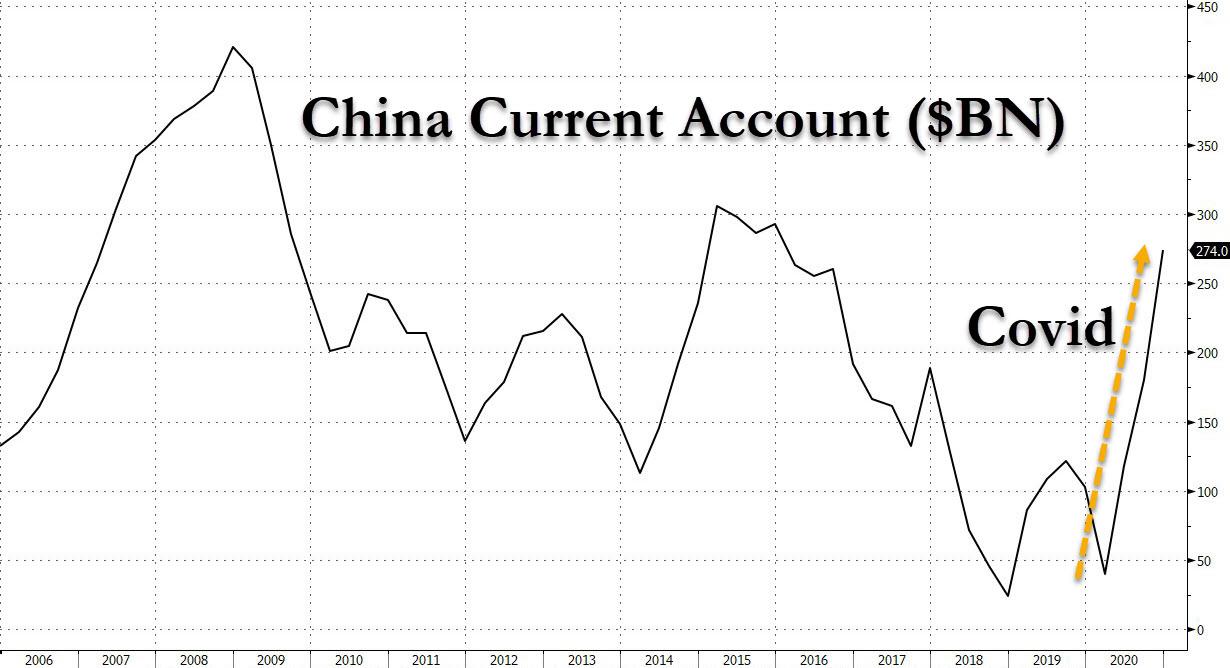
And yet, a few years later such predictions of a “tectonic shift” in both China’s economy and in global fund flows have yet to materlialize for the simple reason that thanks to covid, China’s current account which was on the cusp of turning into a deficit, exploded into a massive surplus the likes of which China had not seen since 2016 thanks to the breakout of the oh-so-convenient-for-Beijing covid pandemic, which crippled global economies and sparked a Chinese export boom (mostly related to items linked to Covid which the world couldn’t find anywhere else).

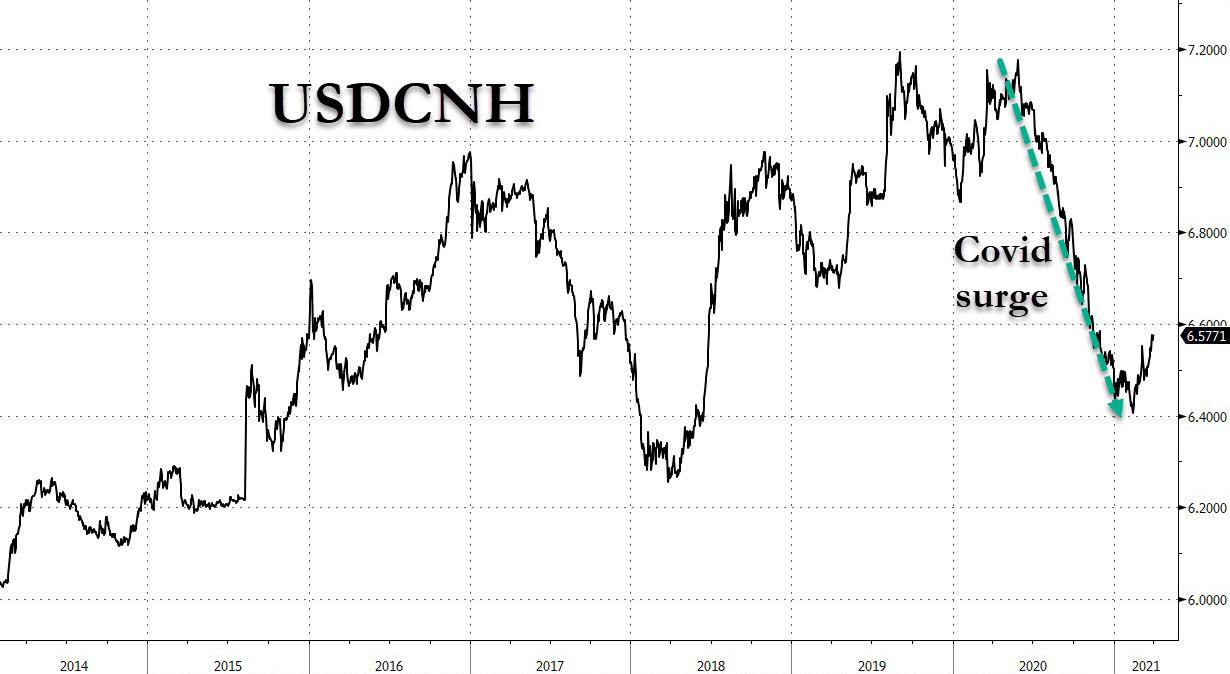
Yet while covid proved to be the capital “Hail Mary” Beijing urgently needed, China’s resurgent economy (and current account) brought with it a fresh headache, namely massive capital outflows inflows as a result of global investors flocking into local capital markets as China emerged an island of stability in a world crippled by the pandemic. The result: a unprecedented surge in the Yuan, which reached a level just shy of where it was in 2015 when Beijing was forced to devalue the currency.

But more importantly, it’s why as Caixing reports, in 2020 China reported its first annual deficit on the financial account in its balance of payments in four years as regulators allowed more money to flow out of the country to ease appreciation pressure on the yuan stemming from rising foreign investment in the country’s capital markets.

The 2020 deficit, excluding reserve assets held by the central bank, amounted to $77.8 billion, although that’s down from an initial estimate of $175.9 billion given in February, according to revised figures for the balance of payments released by the State Administration of Foreign Exchange (SAFE) on Friday. It’s the first shortfall since 2016 when the country had a financial account deficit for the year, excluding reserve assets, of $416.1 billion. The financial account includes domestic ownership of foreign assets –– such as deposits, loans, securities, commodities and direct investment –– and foreign ownership of domestic assets.

“The deficit on the financial account excluding reserve assets shows that the accumulation of overseas assets by China’s private sector is continuing,” the administration said in a report (link in Chinese) accompanying the data. “First, domestic residents have increased their investment in overseas securities, which shows that demand to diversify assets (in investment portfolios) is strong. Second, outbound direct investment has been rational and orderly. Third, banks have increased their deposits and loans overseas, as the current account surplus has provided relatively abundant foreign currency liquidity.”

Meanwhile, as shown in the chart above, the yuan appreciated 8.8% against the U.S. dollar in the second half of 2020, ending the year at 6.50 per dollar, up from 7.13 per dollar at the end of May.

“Amid the continued appreciation of the yuan since June 2020, China’s foreign exchange policies have focused on increasing the flexibility of the exchange rate, expanding capital outflows and controlling capital inflows,” Guan Tao, chief global economist at BOC International Co. Ltd. wrote in a Feb. 23 report (link in Chinese) on the preliminary balance of payments data. He said he expected this foreign-exchange policy mix to continue as the “orderly expansion of capital outflows is an important policy tool to cope with the appreciation pressure on the yuan.”

In other words, don’t be surprised to see a fresh flood of Chinese real-estate buyers in Vancouver, California and the Tri-State area.

Until then, Chinese investors are making do with foreign bonds: according to data from China Central Depository and Clearing Co. Ltd. and the Shanghai Clearing House, outstanding overseas holdings of bonds traded in the onshore interbank market rose to 3.25 trillion yuan ($495 billion) at the end of December, a net increase of 1.1 trillion yuan from a year earlier.

In an interview with Caixin, Guan said that foreign exchange in the onshore market was abundant in 2020, allowing banks to absorb domestic deposits in foreign currency and then deposit or lend them abroad.

Growing confidence in China’s recovery from the Covid-19 pandemic as other major economies continued to suffer, and higher yields on Chinese government bonds compared with U.S. Treasuries also contributed to an increase in inflows of foreign capital last year.

Ironically, three years after fears of a current account deficit sparked worries on Wall Street about how China would fund itself in the global capital markets, the abundance of foreign currency liquidity, especially the U.S. dollar, led to a decrease in the cost of financing in foreign currency which led to an increase in domestic loans made in foreign currency, said Wang Youxin, a senior researcher at a research institute backed by Bank of China.

Overall, China had a balance of payments surplus of $168.1 billion in 2020, comprising a current account surplus of $274 billion, and a combined capital and financial account deficit of $105.8 billion, the latest data show. That compares with $129.2 billion in 2019 and $177.4 billion in 2018, according to revised SAFE figures.

The financial account involves equity investment and debt financing, while the current account measures a country’s total trade in goods and services plus earnings on cross-border investments. Under the financial account, direct investment and portfolio investment had a surplus of $102.6 billion and $87.3 billion, respectively, while other investment had a deficit of $256.2 billion, up 160% from 2019, the data show. Other investment includes all financial transactions not considered direct investment, portfolio investment, financial derivatives, employee stock options, or reserve assets.

In 2020, net outflows in other investment amounted to $314.2 billion, the highest since a deficit of $349.9 billion in 2016. This mainly comprised greater net outflow of deposits of $130.4 billion, 28% higher than in 2019, and a net jump in cross-border loans of $128.2 billion which reversed a net decline of $26 billion in 2019, as banks increased their overseas lending and companies added to their overseas deposits amid ample liquidity, according to the SAFE report.

Domestic deposits in foreign currency jumped by $131.6 billion in 2020, the largest increase since 2014, while loans in foreign currency grew by $80.2 billion, the most since 2013, according to data (link in Chinese) from the People’s Bank of China.

For portfolio investment, cross-border funds flowed actively into and out of the Chinese mainland in 2020, SAFE wrote in its report. Last year, domestic investors bought a net $167.3 billion of overseas stocks and other types of securities, while their overseas counterparts purchased a net $254.7 billion in the Chinese securities markets, both hitting a record high since the data series on international balance of payments began in 1982.

Tyler Durden
Sat, 04/03/2021 – 16:00

via ZeroHedge News https://ift.tt/3sQ4viP Tyler Durden

Biden & The Lockdown Governors Need Canute-Thinking

Biden & The Lockdown Governors Need Canute-Thinking

Authored by Jon Sanders via The American Institute for Economic Research,

In early March, President Joe Biden sharply criticized Texas Gov. Greg Abbott and Mississippi Gov. Tate Reeves for allowing businesses to reopen 100 percent and for lifting their mask mandates. Biden accused them of “Neanderthal thinking” and said they were making a “big mistake.” The hand-wringing new director of the Centers for Disease Control and Prevention, Dr. Rochelle Walensky, publicly fretted that “I am really worried about more states rolling back the exact public health measures we have recommended to protect people from Covid-19.”

In late March, despite Biden and Walensky’s dire predictions, Covid-19 cases had continued to decline in Texas and Mississippi. What also continued was Biden’s criticism and Walensky’s fretting. Posing in two masks, Biden called on “every governor, mayor, and local leader to maintain and reinstate the mask mandate” and bizarrely said it was “a patriotic duty” to “mask up.” Walensky spoke of therecurring feeling I have of impending doom” and told everyone “right now I’m scared.”

There are two possibilities at play here.

  1. One is that Biden and Walensky are truly concerned about a resurgence and sincerely believe that mask mandates, all evidence to the contrary, are the “critical, critical, critical” way to prevent it.

  2. The other is, speaking of masks, that Biden and Walensky perceive that the mask of the All-Wise Central Planner who can dictate even the progress of a virus is being ripped off publicly.

It’s been over a year. It’s well past time for that mask to be torn off.

It’s not that Texas and Mississippi’s results sans masks are unusual. Other states with mask mandates are also seeing case declines. It’s consistent with natural seasonality as well as expanding natural immunity along with vaccine-induced immunity. What it’s showing is that case declines are consistent with those things, the natural progress of the virus, not with mask mandates.

For Biden and the long list of U.S. governors with their own house blends of distinctions among activities the virus supposedly does and doesn’t allow, what they need (among other things) is an understanding of just how limited their plans and powers really are in the face of a natural force. Arbitrary and capricious Covid orders infest from California and Michigan to New York and Connecticut. My own governor, Roy Cooper in North Carolina, has even distinguished between party buses (safe) and tour buses (banned) and private bars (unsafe) and bars in restaurants, taverns, and breweries (A-OK).

They need the humility of Canute. 

According to legend, Canute the Great, an 11th century warrior and king, wearied of the obsequious flatteries of his courtiers and decided to teach them a lesson in the limitations of a sovereign’s power. His choice was a natural phenomenon: the rising tide. 

Philosopher David Hume introduced the legend well in his History of England: “Canute, the greatest and most powerful monarch of his time, sovereign of Denmark and Norway, as well as of England, could not fail of meeting with adulation from his courtiers; a tribute which is literally paid even to the meanest and weakest princes.” Some asides are evergreen.

Hume goes on to tell that some of Canute’s flatterers one day even “exclaimed that every thing was possible for him.” That prompted Canute’s lesson (emphasis added): 

[T]he monarch, it is said, ordered his chair to be set on the sea-shore, while the tide was rising, and as the waters approached, he commanded them to retire, and to obey the voice who was lord of the ocean. He feigned to sit some time in expectation of their submission; but when the sea still advanced towards him, and began to wash him with its billows, he turned to his courtiers, and remarked to them, that every creature in the universe was feeble and impotent, and that power resided with one Being alone, in whose hands were all the elements of nature; who could say to ocean, ‘Thus far shalt thou go, and no farther’; and who could level with his nod the most towering piles of human pride and ambition.

In the earliest account of Canute’s demonstration, Henry, Archdeacon of Huntingdon wrote in Historia Anglorum the following:

[W]hen he was at the height of his ascendancy, he ordered his chair to be placed on the sea-shore as the tide was coming in. Then he said to the rising tide, “You are subject to me, as the land on which I am sitting is mine, and no one has resisted my overlordship with impunity. I command you, therefore, not to rise on to my land, nor to presume to wet the clothing or limbs of your master.” But the sea came up as usual, and disrespectfully drenched the king’s feet and shins. So jumping back, the king cried, “Let all the world know that the power of kings is empty and worthless, and there is no king worthy of the name save Him by whose will heaven, earth and sea obey eternal laws.” 

The lesson of Canute is this: the forces of nature obey their Creator, not a man who is elevated to rule over other men, but who is still a man. The governed who believe otherwise are simpletons, while the ruler who acts on that belief is destined to be a frustrated tyrant exposed as a fraud.

To be sure, then, Biden and the other leaders aren’t the only ones who need the lesson of Canute. We all do. Especially since we forgot our own lessons under SARS, H1N1, and the flu of 2018-19.

If we forsake self-reliance and our own wisdom and experiences, but choose instead to look to government out of fear to save us from a natural force, few leaders will have the humility to admit that such a thing is beyond the reach of the state. They will, as they have, issue ill-conceived edicts in the hopes of placating the public, possibly bringing some mitigation, and (in the words of early Covid research urging masks despite finding their effects “uncertain”) providing “feelings of empowerment and self-efficacy.”

Keeping the mask of the All-Wise Central Planner “saving” us by forcing certain actions on us for our own good is only possible if every leader does it. When some stop while others never started, and it becomes evident that there’s no link between state mask mandates and natural outcomes, the phoniness is revealed. The tide turns. No wonder the Central Planners are angry and scared.

Benjamin Franklin warned, “They who can give up essential liberty to obtain a little temporary safety, deserve neither liberty nor safety.” Heaven help us if we prove him right, accepting government mask mandates and personal restrictions ironically for “feelings of empowerment.”

Tyler Durden
Sat, 04/03/2021 – 15:30

via ZeroHedge News https://ift.tt/31HTdS3 Tyler Durden

Students At Florida High School Warned They Will Be “Re-Educated” If Caught Not Wearing A Mask

Students At Florida High School Warned They Will Be “Re-Educated” If Caught Not Wearing A Mask

Authored by Paul Joseph Watson via Summit News,

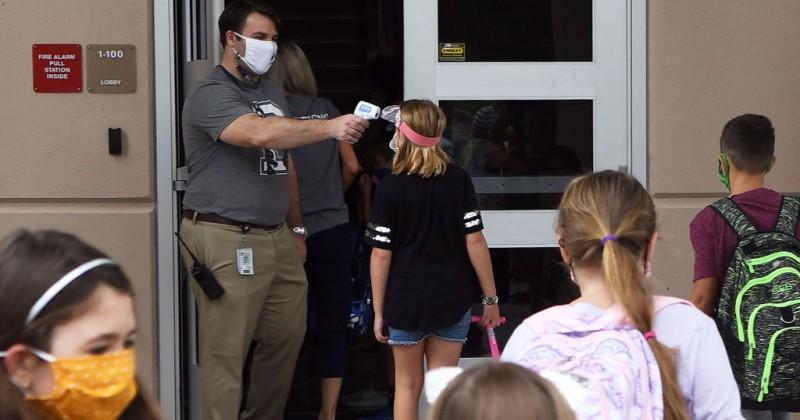
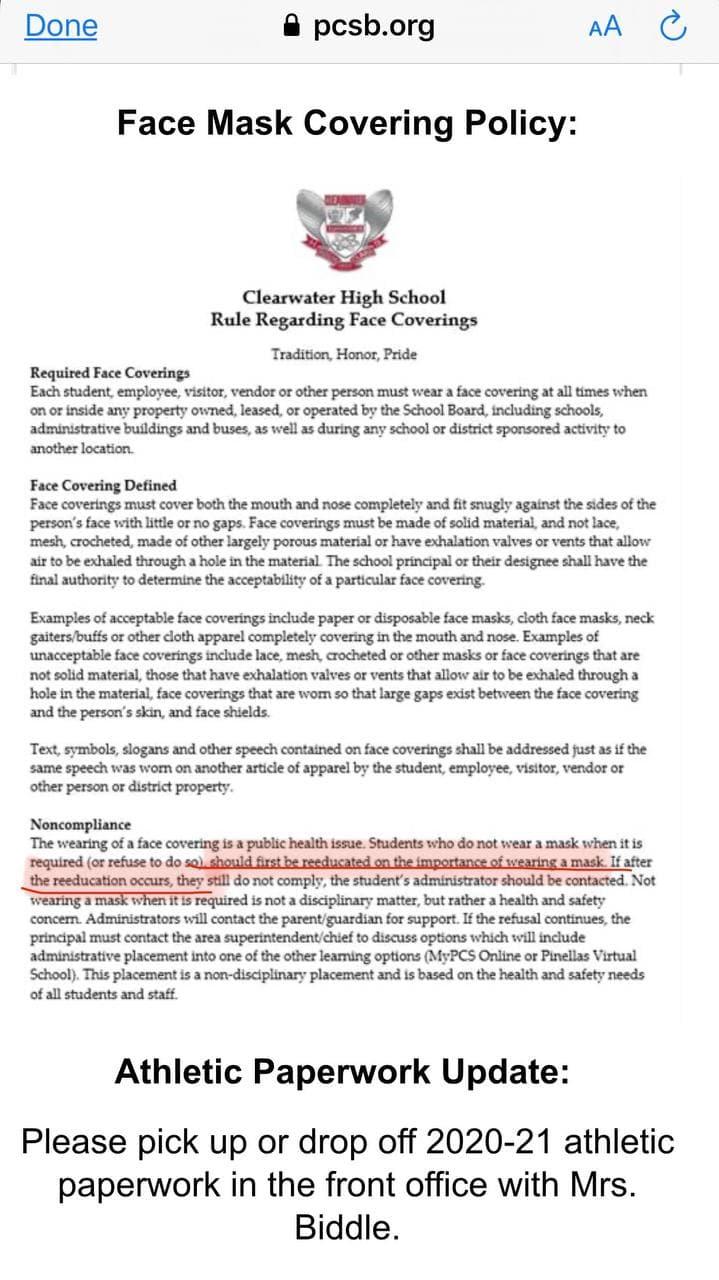
Students at Clearwater High School in Florida have been warned that they will be “re-educated” on the importance of wearing a mask if they are seen on school premises not wearing a face covering.

An advisory posted on the school’s website regarding face mask policy tells students, teachers, staff and any visitors that masks are mandatory on all school property as well as on school buses.

The section on “noncompliance” then spells out the punishment for anyone caught flouting the rules.

“The wearing of a face covering is a public health issue. Students who do not wear a mask when it is required (or refuse to do so), should first be reeducated on the importance of wearing a mask,” states the advisory.

“If after reeducation occurs, they still do not comply, the student’s administrator should be contacted,” it adds, outlining that parents will also be contacted and the student will be forced to switch to online learning if non-compliance continues.

The mask rule remains in place despite Florida Governor Ron DeSantis never issuing a statewide mask mandate and Florida being one of the states that has tried to keep COVID-19 lockdown restrictions to a minimum.

The term “re-education” is normally used in the context of involuntary political indoctrination and was a concept embraced by historical Communist dictatorships.

In its modern parlance, the term is applied to dissidents in authoritarian states such as North Korea and China, where political prisoners and minority groups are “re-educated” out of their anti-state beliefs through forced labor and indoctrination while imprisoned in “re-education camps.”

Leftists and authoritarians have repeatedly suggested that so-called “anti-vaxxers” and people who refuse to wear masks should be arrested and “re-educated” in government facilities.

Back in December 2019, we also highlighted how disgraced Lincoln Project founder Rick Wilson called for anti-vaxxers to be treated the same way and have their children taken away.

“Anti-vaxxers are a scourge and a strong argument for re-education camps, the immediate seizure of their property, and putting their children into protective custody,” tweeted Wilson.

*  *  *

Brand new merch now available! Get it at https://www.pjwshop.com/

*  *  *

In the age of mass Silicon Valley censorship It is crucial that we stay in touch. I need you to sign up for my free newsletter here. Support my sponsor – Turbo Force – a supercharged boost of clean energy without the comedown. Also, I urgently need your financial support here.

Tyler Durden
Sat, 04/03/2021 – 14:30

via ZeroHedge News https://ift.tt/3wpDvsU Tyler Durden

There Is Now A One-In-Three Chance Headline CPI Exceeds 3% Over The Next 5 Years

There Is Now A One-In-Three Chance Headline CPI Exceeds 3% Over The Next 5 Years

Now that the highly anticipated March payrolls report is in the bag, which contrary to some expectations was not a hammerblow to growth and tech names as it did come hot but not quite as hot as some had expected (JPM big data indicated a print of 1.8 million, double the actual number), attention again turns to the reflation trade and what the current state of economic overheating means for inflation expectations.

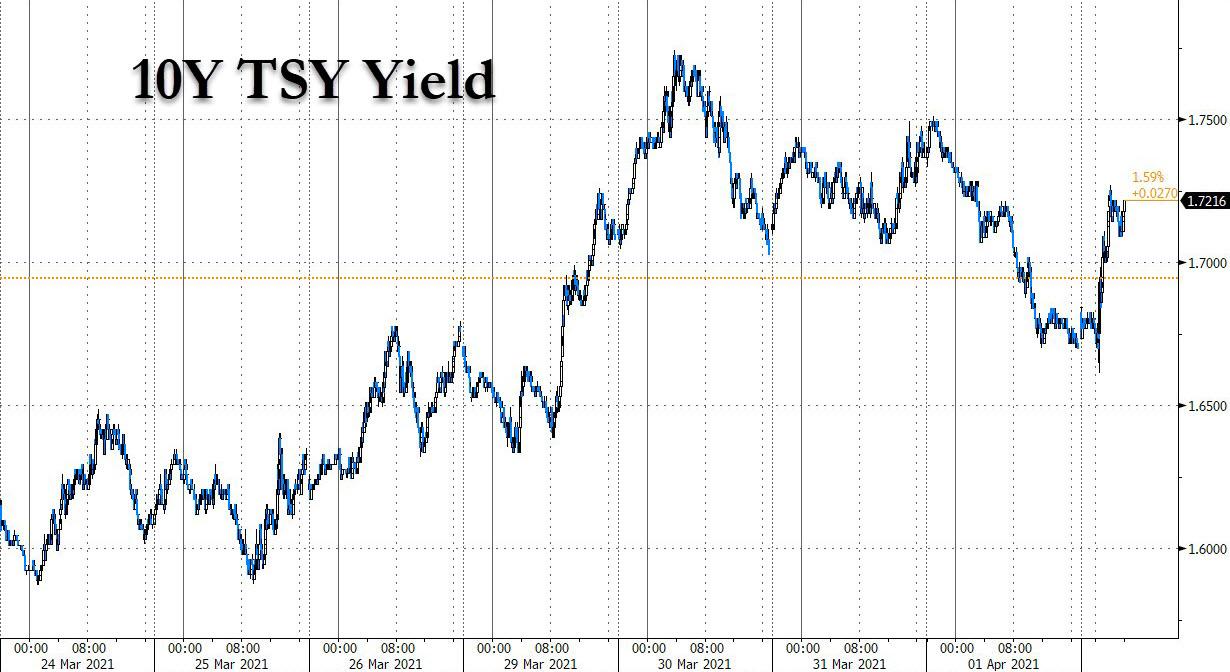
Here attention once again turns to the 10Y nominal yield, which as expected jumped on the payrolls report, rising by 5bps, if still a ways away from the 2.00% threshold where all hell is expected to break loose.

Just as closely watched are 10Y breakevens, which have continued to push to near-decade highs, last seen at 2.35%, the highest level going back to 2013.

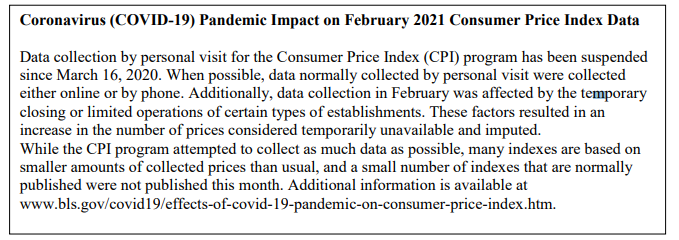
So needless to say, the market remains increasingly jittery on the reflation front, especially since it can’t really trust the CPI and PCE data published by the US government, both of which have long been political tools (and choices), with the BLS no longer even bothering to mask this sad fact, and admitting last month that half the numbers feeding the US CPI basket were estimated.

So what do non-biased, real-time inflation indicators show?

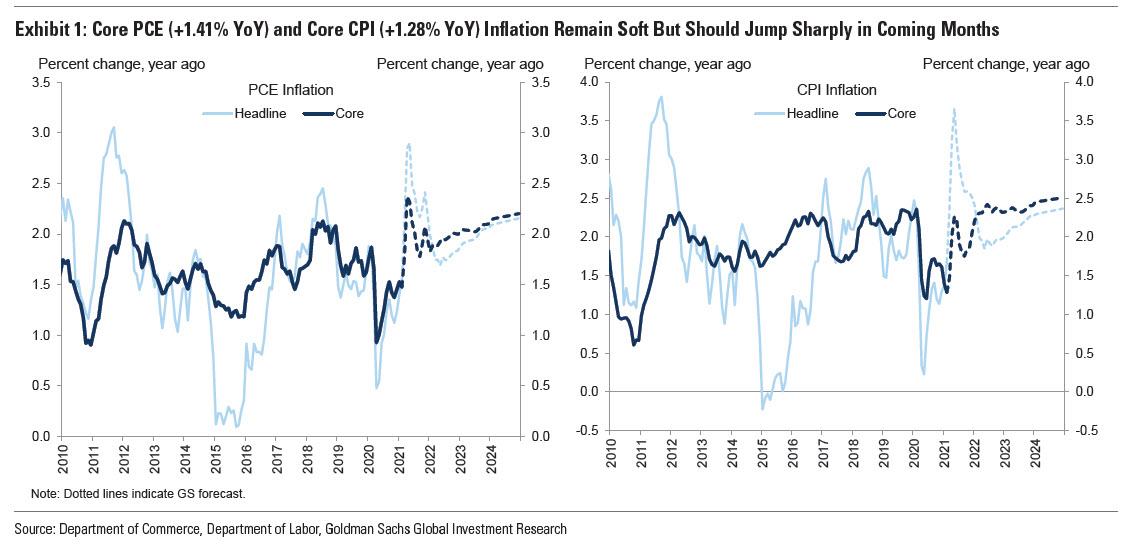
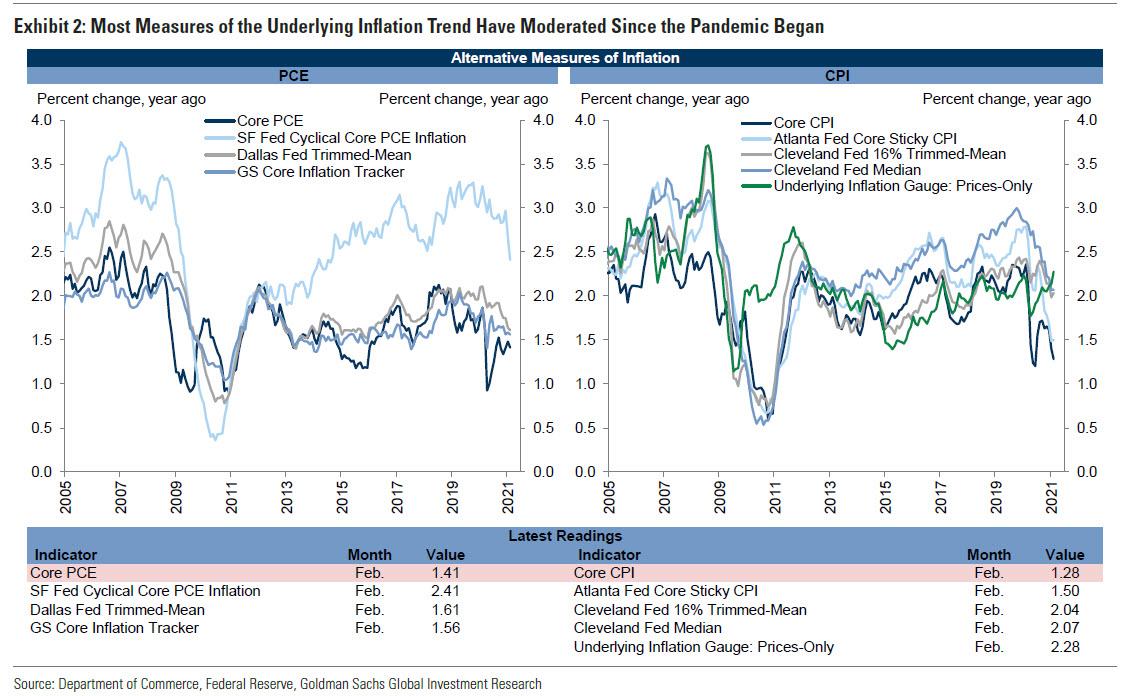
For the answer we go to Goldman, and its latest monthly inflation monitor, according to which while core PCE inflation stands at 1.41% year-on-year through February and core CPI stands at 1.28%, year-on-year inflation should rise sharply over the next few months, driven largely by base effects. As a result, Goldman expects core PCE to peak at 2.31% in April and headline PCE to peak at 2.90% in May; meanwhile on the CPI front, Goldman expects core CPI to peak at 2.26% and headline CPI to peak at 3.66%, both in May.


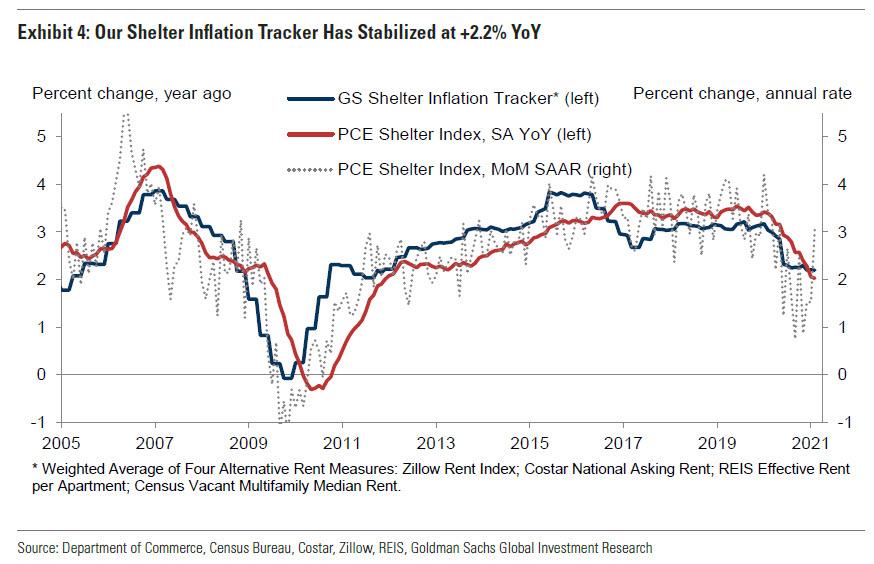
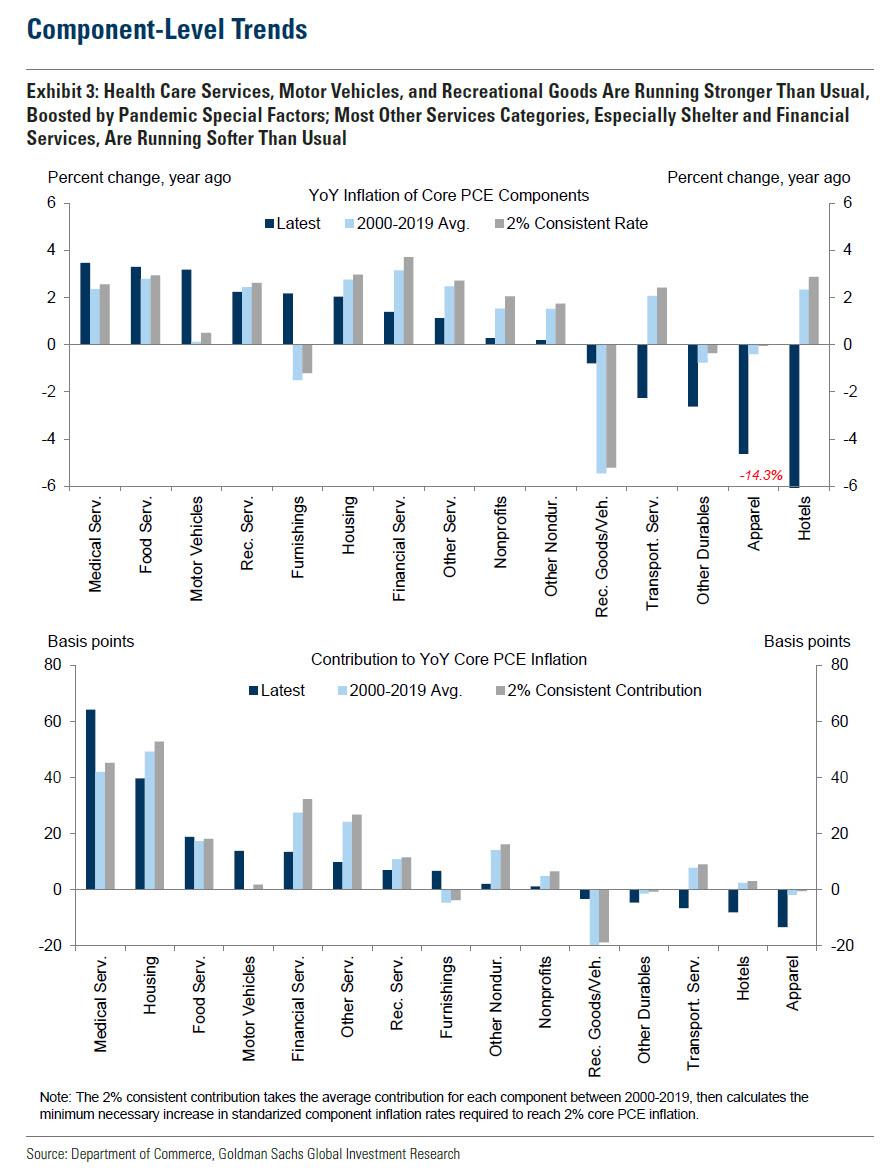
A look at the component level detail shows that health care services, motor vehicles, and recreational goods categories are running stronger than usual, boosted in part by pandemic special factors. Curiously, other services categories, especially shelter (due to plunging rents in liberal bastions like NY, Portland and San Fran) and financial services, are running softer than usual.

While rents may be sliding (if only briefly)…

… Goldman’s wage tracker has risen 3.2% year-on-year, and its wage survey leading indicator has rebounded to 2.8%…

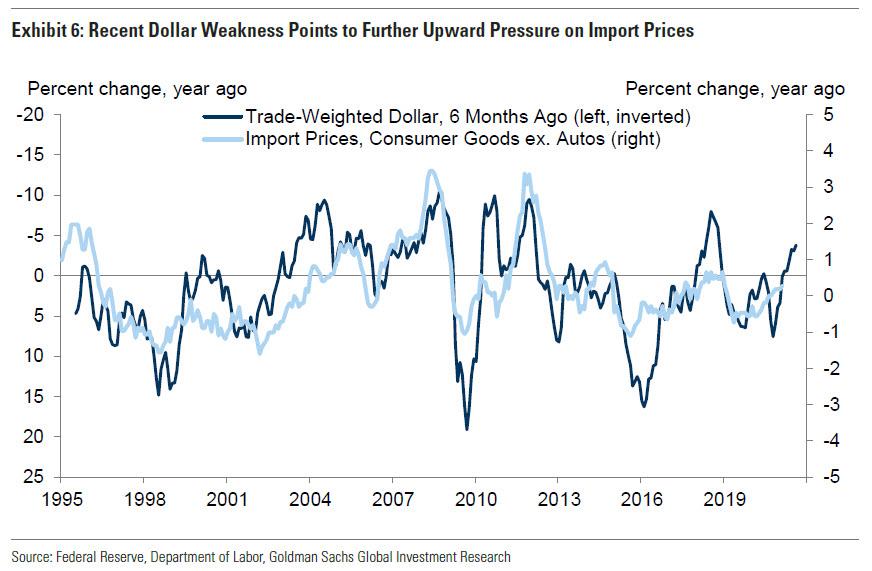
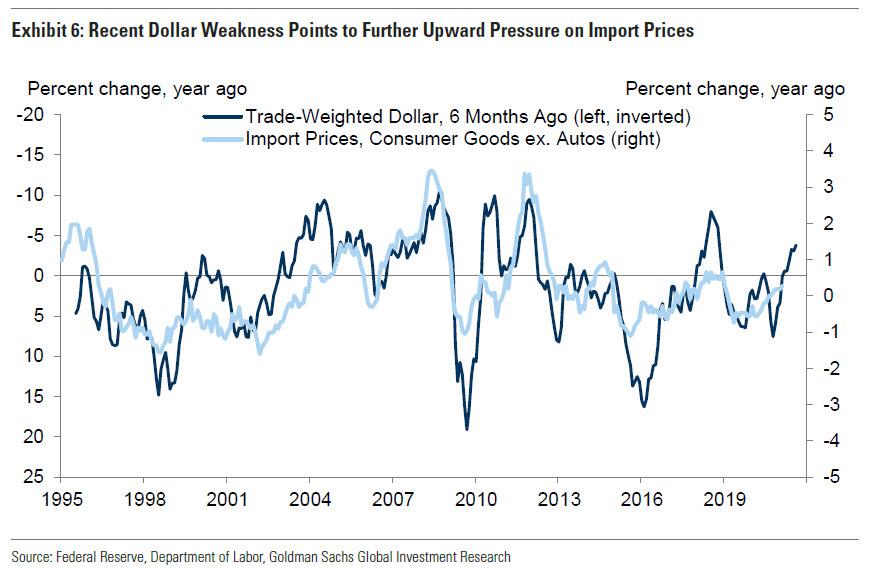
… with the bank noting that recent dollar weakness points to further moderate upward pressure on import prices.

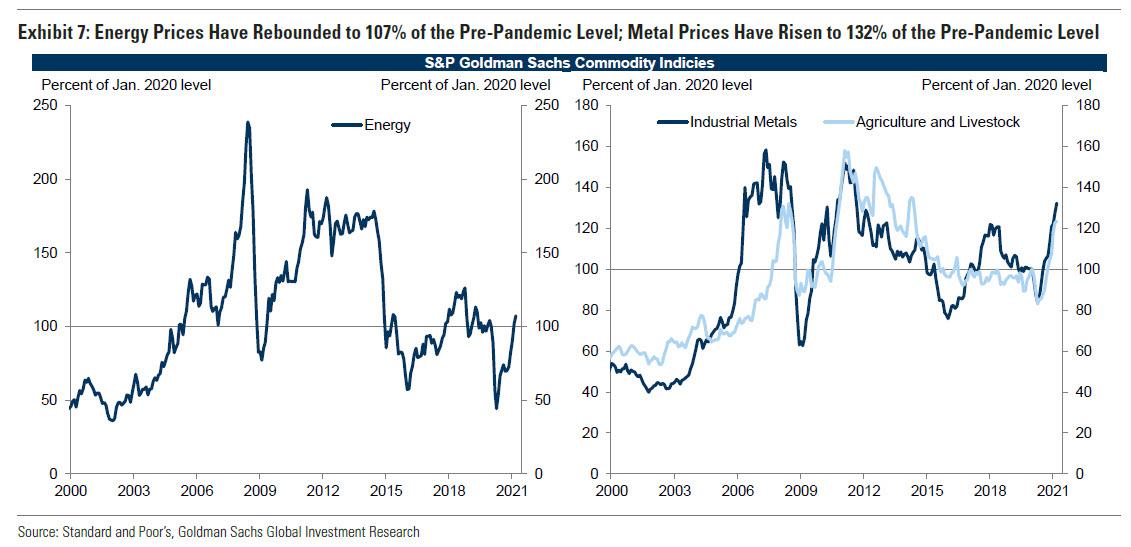
Meanwhile, as everyone knows by now, commodity prices have rebounded significantly in recent months. Energy prices rose to 107% of the pre-pandemic level in March and industrial metals rose to 132% of the pre-pandemic level.

In summary, here is a snapshot of Goldman’s component level inflation trends.

Which brings us to the all important inflation expectations measure.

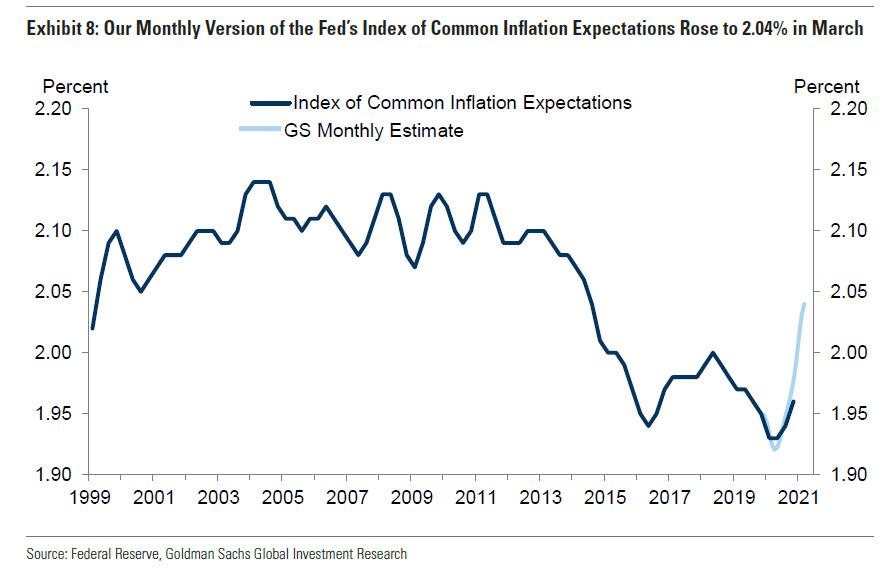
According to Goldman’s monthly version of the Fed’s Index of Common Inflation Expectations, the index rose to 2.04% in March, the highest level since 2014 (if below the top of the 20-year range)…

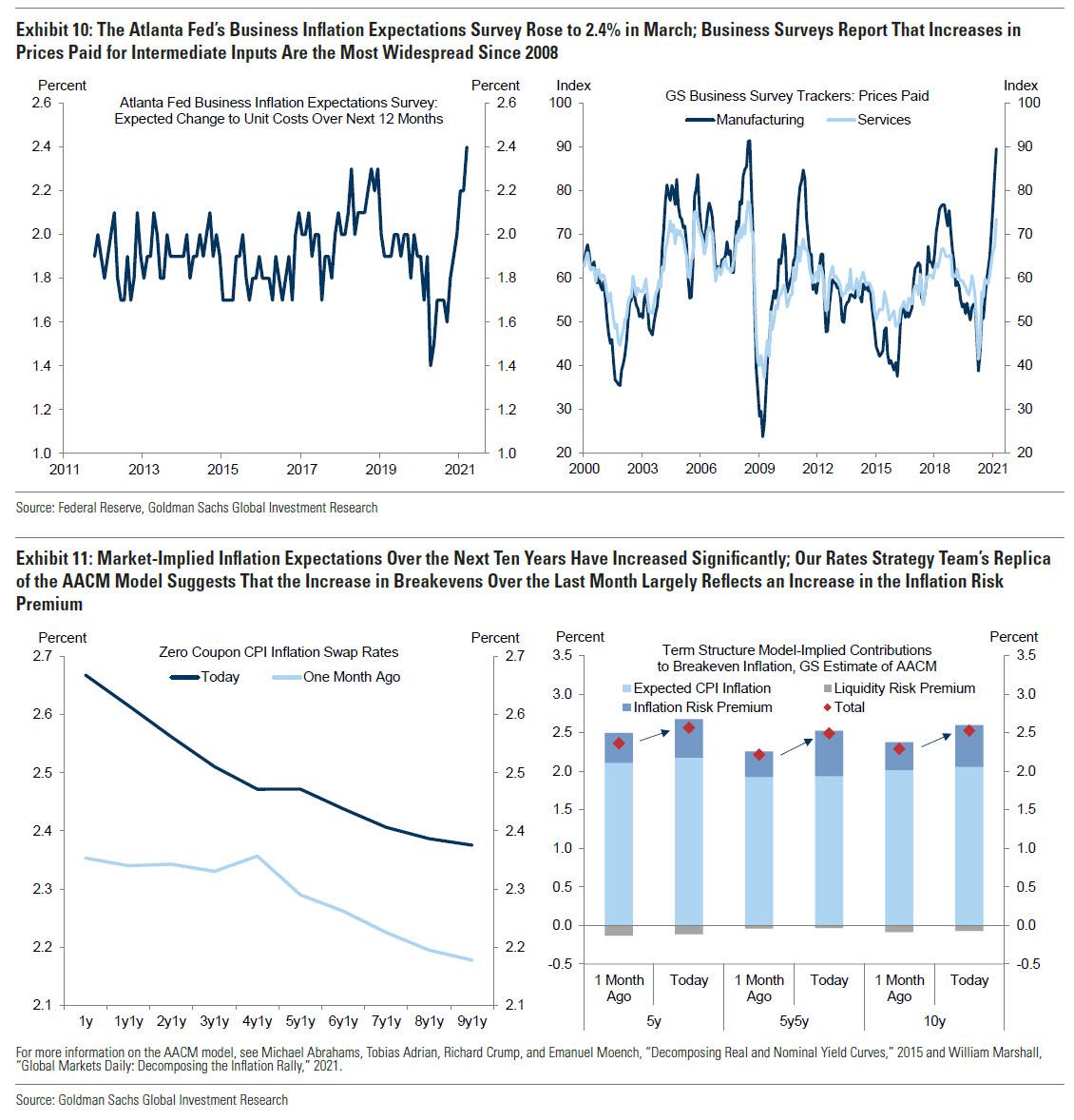
… which however is below recent household, business, and financial market-implied inflation expectations, which have all increased meaningfully over the last year.  The University of Michigan’s longer-run measure has risen to 2.8%, the highest rate since 2015.

Elsewhere, the Atlanta Fed’s business inflation expectations survey increased to 2.4%, its highest rate since the series began in 2011. But the punchline is that market-implied inflation expectations for each of the next 9 years rose 20-30bp over the last month…

… and market pricing now implies a 31% chance of headline CPI inflation exceeding 3% over the next 5 years: this means that there is a non-trivial, one-in-three (and rapigly growing) chance the Fed loses control over inflation.

That said, and as we will cover in a subsequent post, Goldman is sanguine about the odds of the Fed losing control over inflation. In Goldman’s latest Top of Mind periodical, the bank admits that “given its growth forecasts are at the high end among forecasters, its Fed views are at the dovish end, and yet we don’t expect problematic overheating.” 

The reason: according to Goldman chief economist Jan Hatzius, there is much more slack in the US economy than suggested by official estimates, which means that even the bank’s high growth forecasts will generate only moderate inflationary pressures, which will lessen as this year’s temporary fiscal stimulus fades:

There’s no question that the amount of stimulus set to hit the US economy this year is unprecedented outside of major wars… but the economy is coming out of a deep hole and there’s still a large gap to fill between actual and potential output… so [the stimulus] should not result in substantial overheating.

With all that in mind, and with soaring inflation expectations, what are the odds that the Fed – which has vowed it won’t hike rates until 2023, will act too slowly or as Goldman puts it, “the speed of recovery, the cautious approach to tapering, and the rejection of preemptive tightening under the new framework all create some risk if inflation rises faster than we expect.”

Well, according to Goldman, the risk is contained:

If the economy did overheat, we would worry more that the cost of slowing things down would be high than that the Fed would allow an inflationary spiral.”

Is that true? And is Goldman just paying lip service to a Fed that has been wrong at every corner in the past decade? We will present Goldman’s complete thoughts on this matter in a subsequent post.

Tyler Durden
Sat, 04/03/2021 – 14:00

via ZeroHedge News https://ift.tt/3mgwjdP Tyler Durden

Coming To America: LA Metro’s Model Of Extreme Capital Consumption

Coming To America: LA Metro’s Model Of Extreme Capital Consumption

Authored by MN Gordon via EconomicPrism.com,

How much does gas cost in your hamlet?

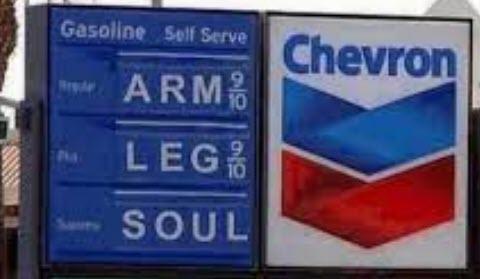
Here in the Los Angeles Basin the price of gas is now over $4 per gallon.  One year ago, it was just $2.89.  Could this be an example of what Fed Chair Jay Powell calls “temporary inflation?”

Maybe so.  Certainly, supply will increase to meet demand.  At the time of this writing, the latest Baker Hughes rig count shows 430 active drilling rigs.  That’s 13 more rigs than the prior week.  But 234 less than one year ago.

We have a hunch that Los Angeles gas prices in excess of $4 per gallon will be here until at least the fall – possibly longer.  Especially now that California refineries have switched over to producing state mandated summer blend gasoline.

What’s more, gas price increases may also be a function of rampant money printing…in addition to rising demand.  Thus, gas prices could go much, much higher.

President Biden, however, has a plan.  On Wednesday he outlined it in his $2.25 trillion American Jobs Plan (to be later followed up by the American Family Plan).  And if Biden, and his central planners get their way, we soon won’t have to use gas at all.  We’ll all drive electric vehicles and ride commuter trains.

The largest spending item in the American Jobs Plan is transportation ($620 billion).  Of this, $174 billion will go to electric vehicles, $85 billion to public transit, and $80 billion to passenger and freight trains.

Like all good central planners, Transportation Secretary Pete Buttigieg is a commuter train enthusiast.  While Mayor of South Bend, Indiana, Buttigeig championed a new downtown station for the South Shore Line.  The proposal’s massive price tag, and other factors, limited its development to merely expensive feasibility studies.

Indeed, South Bend taxpayers may have dodged a bullet.  But with the American Jobs Plan, U.S. taxpayers may soon be funding such moronic proposals through to execution, in countless cities across the nation.

What follows is our own boots on the ground experience of what may be coming to a city or town near you…

Epic Money Pits

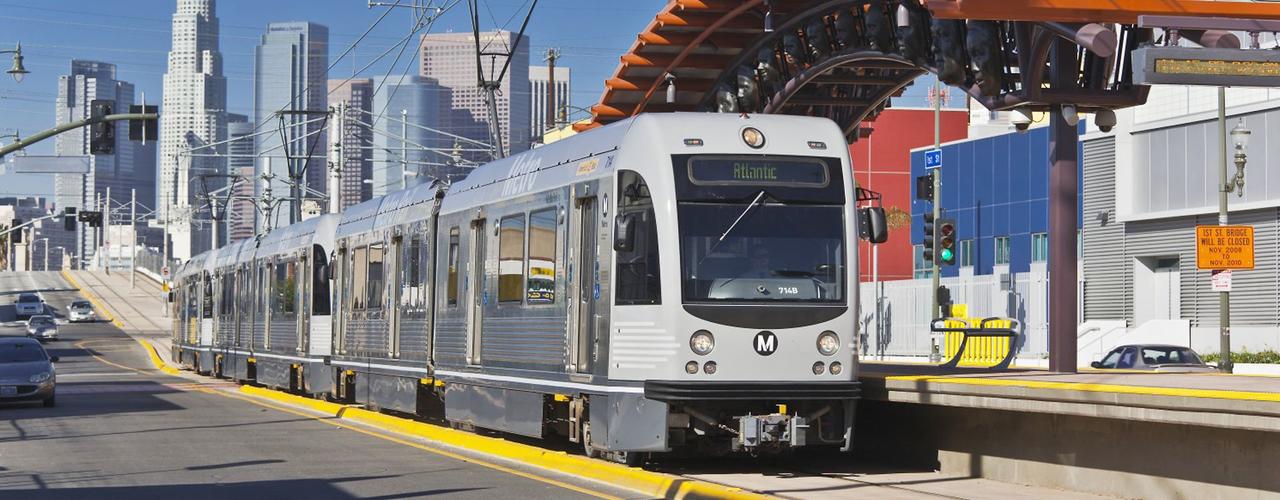
Here at the Economic Prism we’re not overtly opposed to trains, subways, and light rail transit.  Over nearly two decades, we frequently rode the LA Metro Blue Line (now the A Line) from Long Beach to Los Angeles.

The light rail train generally ran on time.  The customer base was mostly agreeable, when it wasn’t overwhelmed by the odor of indigents.  Black market vendors reliably appeared to sell umbrellas at inflated prices on the rare days there was rain.  The graffiti was world class, bar none.

Some days, no doubt, were better than others.  And other days were worse than some.  The rides were rarely boring, and sometimes remarkably lively.

For example, one late-December evening in 2005, we happened to be aboard the Blue Line traversing back to Long Beach through South Los Angeles at the precise moment the funeral service for Crips CEO, community role model, and children’s author Tookie Williams concluded.

This was one week after Tookie was executed by lethal injection at San Quentin Prison.  Governor Schwarzenegger rejected final pleas for clemency.

Following a four hour service, which included remarks by Reverend Jesse Jackson, Tony Robbins, Snoop Dogg, and a eulogy delivered by Minister Louis Farrakhan, to over 2,000 grieving attendees in and outside of Bethel AME Church, countless mourners packed into our train.  The somber atmosphere – and the smell of booze – was so thick you could cut it with a knife.

The point is, we have no aversion to riding commuter trains.  Our gripe is fundamental…

Commuter trains are epic money pits.  They’re insanely expensive to build.  And they operate at a loss in perpetuity.

Here’s what we mean…

Coming to America: LA Metro’s Model of Extreme Capital Consumption

LA Metro’s Fiscal Year 2020 budget was $7.2 billion.  Of this, only $284.5 million was covered by passenger fares.  Another $96.8 million was covered by advertising and other revenues.  The remaining $6.8 billion was covered by five different sales taxes, diesel and gas taxes, highway tolls, and various grants and bonds.

In other words, 94 percent of LA Metro’s budget was funded via forced philanthropy.  On top of that, the coronavirus turned out to be a great boon…

The recent $1.9 trillion American Rescue Plan Act included $1.6 billion for LA Metro.  This is on top of the $861.9 million grant LA Metro received under the CARES Act.  So what are LA Metro’s current plans to get a handle on its finances?

In February, LA Metro staff provided an update on the agency’s Fareless System Initiative (FSI).  The leading FSI concept involves the rollout of a fareless pilot program in 2022 that would provide free rides for low-income riders and K-12 students.

According to LA Metro staff, approximately 70 percent of existing riders could potentially qualify for the pilot program.  One of the stated benefits is an increase to transit ridership.

Clearly, LA Metro doesn’t intend to make up the fare loss on volume.  But it does have other ideas to fund it…

Staff, for instance, are closely ogling a federal bill before Congress known as the Freedom to Move Act that would establish a $5 billion competitive grant program for local agencies that want to go fareless.

Free transportation under the guise of Freedom to Move – like free money, free drugs, free food, and free education – realizes the spirit of the moment.  Somehow, free – as in fareless – is now one and the same as freedom.

In truth, free metro rides has nothing to do with freedom.  Moreover, politicians can call these bills whatever they want.  But they cannot conquer the fact that there’s no such thing as a free lunch…

And with Biden’s proposed $2.25 trillion American Jobs Plan, local entities will be able to recreate and amplify LA Metro’s model of extreme capital consumption across the land.

Enjoy the ride!

Tyler Durden
Sat, 04/03/2021 – 13:30

via ZeroHedge News https://ift.tt/3mfFv2d Tyler Durden

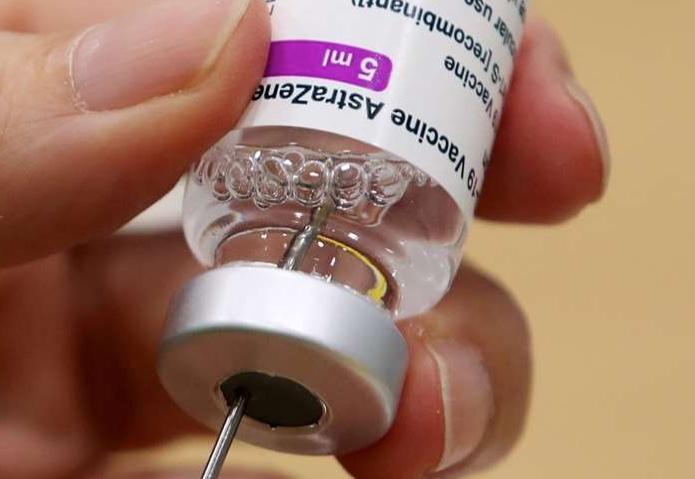
Netherlands Latest To Halt AstraZeneca Jab As Australia Admits “Likely” Blood-Clot Link

Netherlands Latest To Halt AstraZeneca Jab As Australia Admits “Likely” Blood-Clot Link

Yesterday, regulators in the UK reluctantly acknowledged – or so it seemed, anyway – 25 new cases of rare blood clots linked to the AstraZeneca vaccine. Several of the individuals had died due to the complications. 5 earlier cases had been deemed not serious, but now it appears people are dying in the country that probably has the most to lose if the AstraZeneca jab were to be found defective.

After all, a massive share of Britons who have been inoculated so far were inoculated with the AstraZeneca vaccine, which was approved for emergency use in the UK late last year, though regulators in the US are only just now starting the process of assessing its efficacy according to the trial data, and its risks.

Despite finally revealing that 7 Britons have died due to side-effects brought on by the vaccine, Britain’s medicines regulator on Saturday announced that the vaccine is “safe” and that it’s not clear whether the shots are causing the clots (though researchers in Germany and elsewhere appear to have found evidence of a link). Here’s more from the AP: 

In total, MHRA said had identified 30 cases of rare blood clot events out of 18.1 million AstraZeneca doses administered up to and including March 24. The risk associated with this type of blood clot is “very small,” it added.

“The benefits of COVID-19 vaccine AstraZeneca in preventing COVID-19 infection and its complications continue to outweigh any risks and the public should continue to get their vaccine when invited to do so,” said Dr. June Raine, the agency’s chief executive.

Meanwhile, the Netherlands yesterday became the latest developed nation to halt administration of the vaccine. Initially, the Dutch government (where PM Mark Rutte is facing a worsening political crisis) planned to restrict vaccinations to people under the age of 60, like Germany opted to do. But they decided to simply halt vaccinations to avoid potential waste of precious vaccines. According to Reuters, Dutch Health Minister Hugo de Jonge said the temporary halt is “a precautionary measure,” echoing language used by virtually every European leader who has restricted access to the AstraZeneca jab, which has long been an object of suspicion following unusual complications that emerged during the trials, and led to brief halts in the UK, US and elsewhere.

More European nations are expected to suspend the AstraZeneca vaccine, many for the second time, following the latest revelations out of the UK, which only served to further erode trust in the EMA/WHO and their insistence that the risks of the vaccine are miniscule compared with the vast societal benefit. But fortunately for the UK, and AstraZeneca – a company that’s dual headquarters are in the UK and Sweden since it was created by the merger of the Swedish Astra AB and the British Zeneca Group back in 1999 – Australia said Saturday that t will continue its inoculation program with the AZ jab.

The decision follows a highly publicized case where a 44-year-old man was admitted to a Melbourne hospital with suspicious clotting like that seen elsewhere, Suffering serious Thrombosis, a condition that prevents normal blood flow through the circulatory system, the man’s case simply couldn’t be ignored. After meeting hastily on Friday and Saturday, the Therapeutic Goods Administration (Australia’s top drug regulator) ruled that the program would continue without changes, according to Reuters. That is, at least for now.

While Australia’s deputy chief medical officer, Michael Kidd, told a televised briefing Saturday afternoon that “we have not been advised at this time by ATAGI or the TGA to pause the rollout of the AstraZeneva vaccine in Australia,” he simultaneously acknowledged that the clotting incident was “likely” related to the AstraZeneca jab,” even as officials in the UK continue to insist that there’s no evidence of a link. However, he insisted, as other public health officials have, that the risks of serious side effects remains “very low.”

Tyler Durden
Sat, 04/03/2021 – 13:00

via ZeroHedge News https://ift.tt/3wowd8u Tyler Durden

YouTube Deleted 2.5 Million ‘Dislikes’ From Biden White House Videos, Data Indicates

YouTube Deleted 2.5 Million ‘Dislikes’ From Biden White House Videos, Data Indicates

Authored by Peter Svab via The Epoch Times,

YouTube has deleted about 2.5 million ‘dislikes’ from videos on the official White House channel of President Joe Biden, according to data collected and posted online by a researcher who wished to remain anonymous. YouTube recently announced that it’s testing a new page design that hides the dislike count.

The Google-owned video platform allows users to give videos either a thumb up (like) or thumb down (dislike). For at least two years, it’s had a policy to remove likes and dislikes it considers spam.

“We have policies and systems in place to ensure that the engagement on YouTube is authentic, and remove any fraudulent metrics,” a YouTube spokesperson told The Epoch Times via email, but when asked, wouldn’t go into details on what criteria it uses to make these calls.

The White House videos have seen these kinds of interventions on an ongoing basis, but it appears it’s only the dislikes that are disappearing.

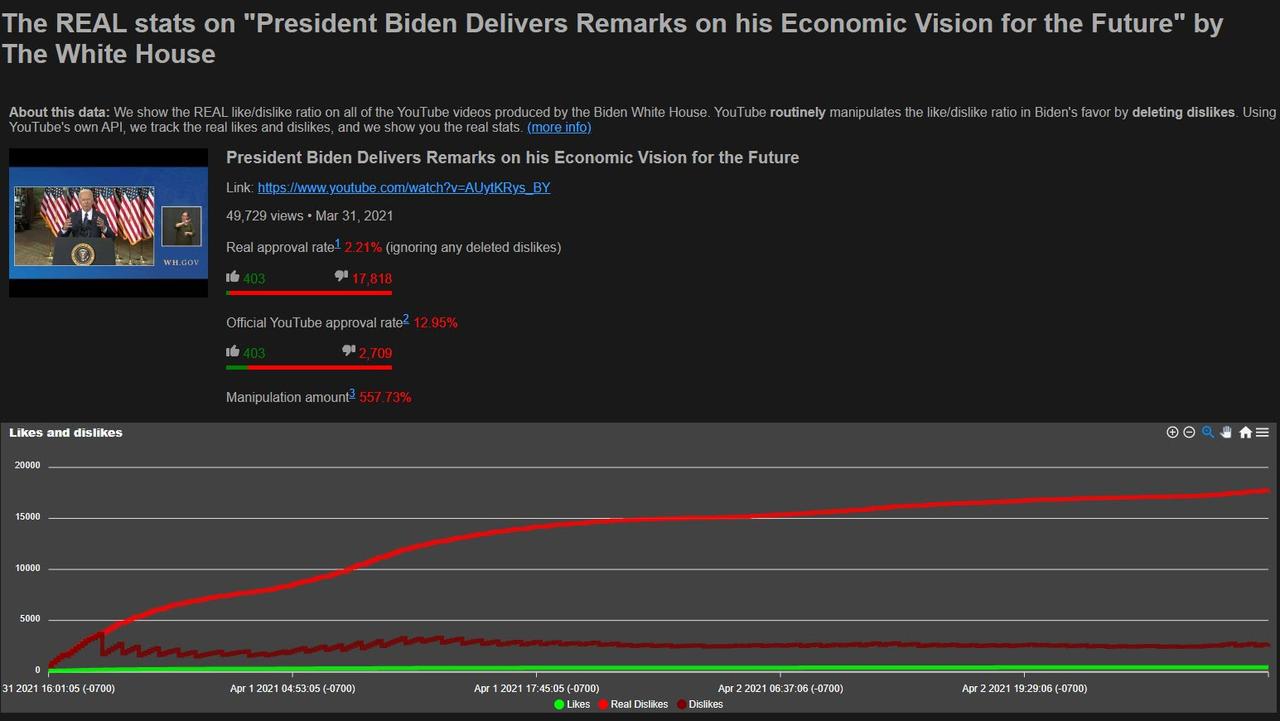
The channel has posted more than 300 videos that have garnered nearly 3.7 million dislikes of which nearly 2.5 million were removed, according to data posted on the website 81m.org. The author of the website started to track the engagement on January 26 and has published all the data as well as the methodology used to collect it, but wouldn’t comment on his or her identity when asked via email.

YouTube is deleting close to 8,000 dislikes per video on average. Not a single like was removed, the data indicates.

Even after the interventions, the videos have nearly six times more dislikes than likes on average, the data shows. Without intervention the ratio would be over 17 dislikes for every like.

Posts on social media indicate that some supporters of former President Donald Trump make a point of disliking the Biden White House videos. The videos often get thousands of dislikes shortly after popping online, only for a large portion of the dislikes being deleted later.

In some cases, batches of dislikes would be removed about once an hour, keeping the dislike count around the same number. In other cases, a large portion of dislikes would be chopped down at once, the data indicates.

The website 81m.org lists results of the same analysis for several other YouTube channels with large followings. None of them exhibited dislike removals of this magnitude.

Videos of PewDiePie, one of the most popular channels on the platform, do show some like and dislike removals, but never more than a few dozen per video, based on a review of the data for the past more than two dozen videos on the channel.

YouTube recently announced testing of a design that still includes the dislike button, but no longer shows the number of dislikes.

“This is a test for a small group of users and is a response to creator feedback that the visible count may impact their wellbeing,” a spokesperson said via email.

YouTube and its owner, Google, have long faced accusations of political bias. The companies have said their products are developed and run as politically neutral, but employee accounts and leaked internal materials indicate the companies are infusing their politics into their products.

According to research psychologist Robert Epstein, Google shifted millions of votes in the Nov. 3 election by skewing its search results and other tools, compared to competitors.

“Google search results were strongly biased in favor of liberals and Democrats. This was not true on Bing or Yahoo,” Epstein told Fox News’ Tucker Carlson, referring to data from more than 700 voters who worked with him to monitor what results they were receiving from channels such as search results, reminders, search suggestions, and newsfeeds ahead of the election.

Google previously rejected Epstein’s research results.

Tyler Durden
Sat, 04/03/2021 – 12:30

via ZeroHedge News https://ift.tt/39EKR1X Tyler Durden

Hawaii Unveils COVID Passports For Inter-Island Travel 

Hawaii Unveils COVID Passports For Inter-Island Travel 

Vaccination passports are being pitched as the new “golden ticket” in a dystopic post-COVID world if you want to travel – now that the recovery is on its way. 

Countries in Europe are already requiring travelers to use vaccine passports – usually taking the form of certificates or digital cards of past COVID tests and vaccination history – an idea catching on in tourist nations like Thailand and the Caribbean. But also, much closer to home, Hawaii state officials are considering steps to implement vaccine passports for inter-island travel and likely one day require, to some degree, out of state travelers to have a health passport to revive the local economy that has sustained severe economic damage in its tourism and travel industry. 

Local news KHON2 said state officials could soon roll out a health passport app that details vaccination history. Lt. Gov. Josh Green confirmed an app is in development called “First Vitals.” Officials have discouraged inter-island travel as the U.S.’s only archipelago state composed of eight islands in the North Pacific Ocean was forced to deal with a massive influx of travelers from outside the state during the pandemic. Many folks who flocked to Hawaii were escaping the pandemic or took advantage of cheap flights. 

Like existing COVID passes issued by other countries, Hawaii’s vaccine passport will provide officials with a QR code to authenticate the users’ vaccination history. 

“They would be able to verify the health record, they would then encrypt it so people can’t steal someone’s health record. Although really, all it is is whether you got vaccinated or not and your name and the date it occurred,” said Green.

Now that Hawaiian residents are getting vaccinated, inter-island travel is set to increase this year. Health passports could be what revives the state’s tourism industry. 

“That’s what we see, families that haven’t seen each other for a while that live in Kauai, Maui, Hawaii Island, Oahu. And this will allow that kind of travel to take place without the additional cost of being tested,” said Mufi Hannemann, president and CEO of the Hawaii Lodging and Tourism Association.

Green said a pilot test of the new vaccine app for inter-island travel could happen in the next couple of weeks. “I think that makes a lot of sense. It would immediately empower probably about half of our travelers inside the islands to travel safely,” he said.

On a national level, vaccine passports could soon become a reality. The Biden administration said earlier this week that the private sector would be in charge of developing digital passports. 

We have documented the increased rollout of digital proof of vaccination. The International Air Transport Association recently said a new travel app (called Travel Pass) would be rolled out for airline travelers worldwide. 

Since the early days of the pandemic (read: here & here & here), we’ve discussed “COVID passports,” “immunity passports,” or at least mentioned those who don’t get tested for the virus or vaccinated could face travel restrictions. 

… and here come the global vaccine passports as overreaching governments and greedy corporations are getting their noses in your medical records and will decide if you can travel or not based on vaccinations and or test results. 

Tyler Durden
Sat, 04/03/2021 – 12:05

via ZeroHedge News https://ift.tt/3cLhqwN Tyler Durden