Did The NFT Boom Just Burst?

Did The NFT Boom Just Burst?

Non-fungible tokens, or NFTs, are changing the way we think about art (and other collectibles), and in 2021, investors have started to take notice. As Decrypt writes, in the last year, NFTs have shot to the forefront of the crypto space. The cryptographically-unique tokens make it possible to create real-world scarcity for digital objects, and artists have seized on the opportunity presented by the technology.

For some context, Decrypt details the five most ridiculously expensive NFTs ever sold, and will leave you to judge their true value.

1. Everydays: The First 5000 Days: $69.3 Million

The record for the most expensive NFT ever sold (and one of the most expensive artworks ever sold) goes to EVERYDAYS: THE FIRST 5000 DAYS. The artwork, created by famed digital artist Mike “Beeple” Winkelmann, sold for $69.3 million at Christie’s—the first time that the venerable auction house has ever sold a purely digital artwork.

The NFT represents a collage of 5,000 of Beeple’s earlier artworks, demonstrating his development as an artist over the course of his career.

It was purchased by Vignesh “Metakovan” Sundaresan, who initially remained pseudonymous, but later revealed his identity, explaining that, “The point was to show Indians and people of color that they, too, could be patrons, that crypto was an equalizing power between the West and the Rest, and that the global south was rising.”

The second-highest bidder on the piece was none other than Tron CEO and founder Justin Sun, who bid a whopping $60.2 million before getting sniped at the last second by Sundaresan.

2. CryptoPunk #7804: $7.5 Million

CryptoPunk #7804 (Image: Larva Labs)

Dylan Field, the CEO of design software company Figma, is behind the sale of the second most expensive NFT in history—CryptoPunk #7804. The NFT sold for a cool 4,200 in 2018, at the time worth $7.5 million.

CryptoPunks are a randomly generated set of 10,000 unique digital characters, and are some of the first examples of non-fungible tokens released on the Ethereum blockchain.

They were developed by Matt Hall and John Watkinson from American game studio Larva Labs.

Initially given away for free, some CryptoPunks with particularly rare or desirable features—such as the blue-skinned pipe-smoking alien that is CryptoPunk #7804—have gone on to sell for significant sums. This includes CryptoPunk #1651, which sold for a six-figure sum in February.

3. CROSSROAD: $6.66 Million

CROSSROAD is an NFT created by acclaimed digital artist Beeple. It features anti-Trump messaging, and an enlarged Donald Trump-like figure laying in a defeated heap with profanities written across his naked body. It didn’t always look like that, though; the artwork was designed to change based on the outcome of the 2020 election. Had Trump won, it would’ve depicted him wearing a crown and striding through flames.

Nifty Gateway, a popular marketplace for digital collectibles, brokered the $6.66 million sale of the NFT between its original owner (Twitter user Pablorfraile) and an anonymous buyer.

The NFT was sold just four months after it was initially purchased, at roughly 10x its original price.

4. The First Tweet: $2.9 Million

An NFT version of Twitter cofounder and CEO Jack Dorsey’s first tweet, which was the first ever tweet on Twitter, was auctioned throughout March 2021 and finally sold for an eye-popping $2.9 million.

The token was minted the token through a platform known as Valuables — which allows users to craft NFTs that represent their tweets.

As part of his philanthropic efforts, Dorsey pledged to immediately convert 100% of the proceeds to Bitcoin before donating it to Africa Response.

5. CryptoPunk #6965: $1.54 Million

The second CryptoPunk on this list (seeing a theme yet?), number #6965 sports a funky fedora and an unimpressed expression. It sold for a not-too-shabby $1.54 million in February.

The CryptoPunk is one of just 24 ape Punks, which is the second rarest Punk type after alien.

As of writing, CryptoPunk #6965 is once again for sale and is listed at 2,100 ETH (or $3.42 million). If sold, the seller will net a tidy 122% profit.

However, Berna Bershay, an analyst at Empire Financial Research warns:

“With so much time spent online in the past year, the desire to own digital assets was probably dragged several years forward by the Covid-19 crisis.”

And maybe – with the pandemic beginning to fade (despite “impending doom” warnings from the CDC) that demand is starting to slow, as Bloomberg reports, that is perhaps being confirmed as prices for digital collectibles like art and sports memorabilia are sliding, turning the focus back on whether the nascent market for so-called non-fungible tokens is any more than a fleeting mania.
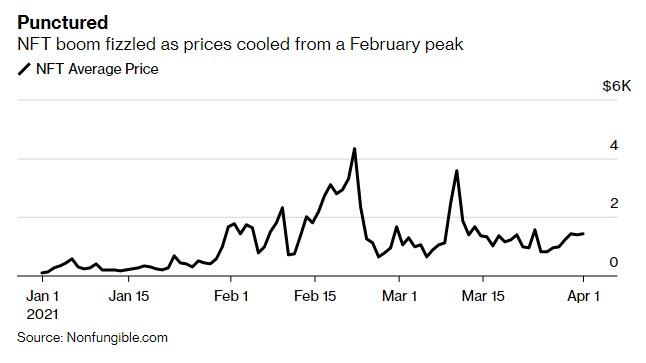
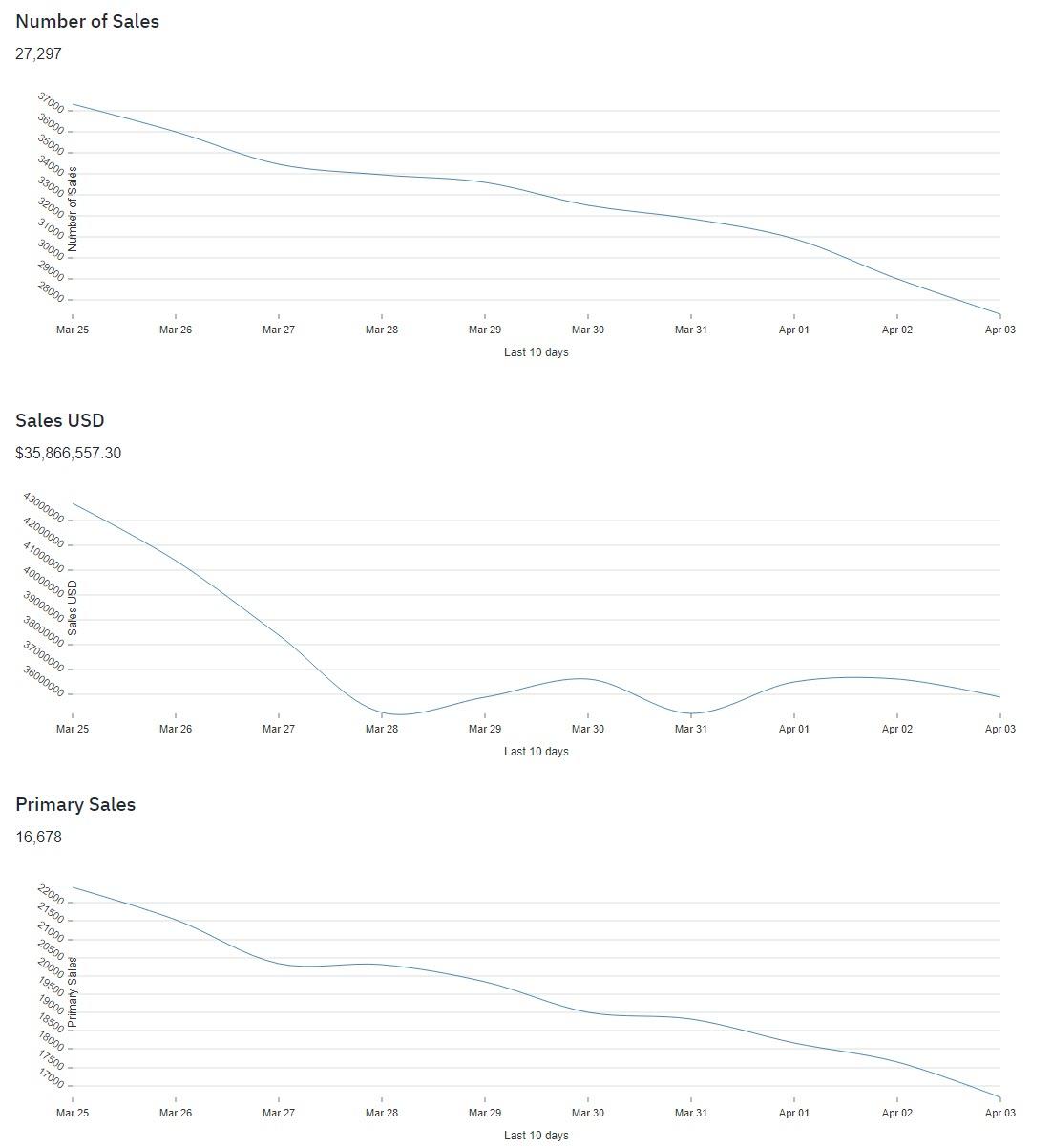
Additionally, as NonFungible.com shows, the trend for number of sales and volumes has been tumbling in the last few weeks...
Source

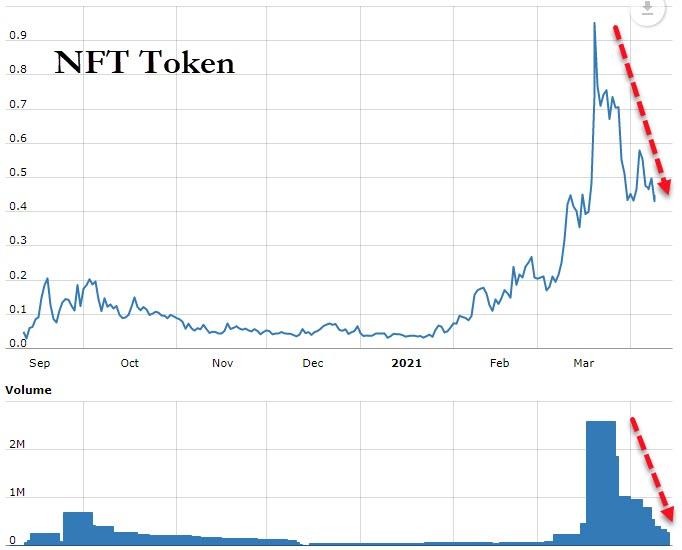
Some sense of the demand/price for NFTs can be gauged from the NFT Token
Source

“It’s not meaningful to characterize a concept as a financial bubble,” said Chris Wilmer, a University of Pittsburgh academic who co-edits a blockchain research journal.

“‘NFTs’ aren’t in a bubble any more than ‘cryptocurrency’ is a bubble. There will be manias and irrational exuberance, but cryptocurrency is clearly here to stay with us for the long term and NFTs probably are too.”

Time will tell if this is the start NFT boom’s deflation, or whether the volatility is part of a new market going through a period of price discovery – just as bitcoin and ethereum did (and still does).

However, SchiffGold.com’s Peter Schiff, is a committed skeptic, as he details below, “Do You Want To Buy A Bridge? Inside The Strange Fantasy World Of NFTs”…

Recently, a piece of collage art entitled “Everydays: The First 5000 Days,” by an artist known as Beeple, sold at a Christie’s auction for $69 million. The Wall Street Journal noted that the price was higher than any that has ever been paid for works of Frida Kahlo, Paul Gaugin, or Salvador Dali. But, before the auction, few outside the digital art world had ever heard of Beeple, which may explain why the bidding started at just $100. But the sale does not suggest a sudden re-evaluation of his talents. Instead, it is a stunning statement about the medium of the art itself or, more precisely, the lack of it. In fact, “Everydays: The First 5000 Days” isn’t made out of anything you can touch. It is entirely virtual.

Unlike other pieces of high-priced art, you can’t hang it over your mantle to dazzle your dinner guests. The image is only available on your computer or, better still, through a virtual reality headset. But even as the owner of the image, you won’t be able to control access to it. The file has been copied thousands of times, so anyone with access to the internet can look at it as much as you. And unlike the clear differences that exist between an original Van Gogh and even the best copies, there will be no visual differences between the digital copies and the original.

Instead,  what the buyer paid for is a unique claim to ownership. And while the art itself can be replicated endlessly, the claim, which entitles the owner to nothing more than the right to resell the claim, appears to be worth $69 million. Welcome to the brave new world of non-fungible tokens (better known as NFTs), the kooky offspring of the red-hot cryptocurrency market. In the NFT universe, a piece of virtual art is worth almost $10 million more than a 238-foot “Bond Villian” mega-yacht in the real world.

Call me crazy, but I’ll take the boat.

NFTs are made possible by the same “blockchain” technology that provides bitcoin with its claims to “scarcity.” Through its distributed ledger model, the supply of cryptocurrencies, such as bitcoin, can be strictly limited, and claims of unique ownership can not be counterfeited. The same technique provides NFTs with their unique “non-fungible” features. But so what? They still have no tangible properties.

The buyer who paid $69 million for the Beeple collage can take comfort from the fact that a single 10-second animated video by the same artist, of a giant dead Donald Trump covered in graffiti, was purchased in October 2020 for $67,000 and was just sold for $6.6 million! No matter that the video is viewable for free online. Price rises like that have fueled an NFT feeding frenzy that is taking many bizarre forms. In recent days, NFT versions of sports trading cards, sneakers, and clothing have sold for tens of thousands of dollars. An NFT version of a tweet by Twitter CEO Jack Dorsey just sold for $2.9 million.

It’s getting so crazy that even jokes about the absurdity get quickly swallowed up in the absurdity. A man in New York just sold an NFT fart for $75 (a relative bargain considering that a virtual version is far less offensive to the nose than a real one.) As proof that this is all just one giant Monty Python spoof, British comedian John Cleese  (the founder of the troop) just posted for sale a simple doodle he drew of the Brooklyn Bridge with the caption, “You want to buy a bridge?” (recalling the classic scam of New York City immigrants).  As of press time, Cleese’s doodle is selling for $36,000. Cheap for a historic bridge, but don’t worry John, there are still 10 days left in the auction.

NFT real estate seems to be the next frontier. A virtual house, by a celebrated online “architect” just sold for $500,000. On March 19, Bloomberg News reported that a real estate investment firm that had been buying distressed condos in the physical world is raising funds, at minimum increments of $25,000, to purchase virtual land in several recently created online “metaverses.” The goal is to develop the “land” into virtual hotels, stores and other uses, hoping to realize outsize profits when they sell to other virtual enthusiasts.

Bloomberg quotes the president of the firm as saying: “Real-world real estate is very uncertain now. Housing prices are at an all-time high. Meanwhile, offices are empty, hotels are empty. Virtual real estate is insulated from a lot of those real-world risks.” (I would counter by saying the investors themselves seem to be insulated from reality.)

But when considered a little more seriously, the NFT craze is actually a semi-rational development in the perfectly insane crypto monetary system. It is not coincidental that almost all the purchases of NFTs have been made with cryptocurrencies. In fact, oftentimes they can ONLY be purchased with crypto. That means no one is buying these fake assets with money earned through sweat and toil in the real world.

For years crypto investors have been watching with glee as their virtual holdings have rocketed into the stratosphere. But one of the cardinal rules of the true believers is that they should “hold on for dear life” (known as HODLing) and only spend when bitcoin reaches its destined price (whatever that may be). But many of these investors may have found that having wealth without spending it is a hollow victory. Many people may be becoming desperate to find something other than commas to show for the crypto riches. But as the pool of people who will sell actual assets for crypto is probably shallow, holders may find it easier to buy virtual assets with their virtual currency. This decision may be aided by the fact that people can buy NFTs without having to convert cryptos into dollars, which might invite unwanted government scrutiny. So what happens in virtual Vegas, seems to be staying in Virtual Vegas.

But the psychological causes may even run deeper. Since many of the crypto elites have made many, many thousand percent gains on their investments, they believe that they have stumbled upon the new El Dorado, the land of unlimited wealth where the streets are paved with the new gold. They feel that they have some secret knowledge of which the rest of us Luddites can’t conceive. They know from wisdom and experience that “new” digital assets have appreciated much faster than their counterparts in the “old” real world. So why buy real estate that may give you a measly 5% annual return when you can get that on a daily basis with virtual real estate? The fact that the pandemic has made us all cyber-dwellers in one form or another has thrown another log on the fire.

Many people have forgotten what it’s like to operate in the real world.

But the mainspring that fuels all of this is the conceit that “real” does not have any intrinsic superiority to “virtual.” Bitcoin has been the best performing asset of the last 10 years, despite the criticism from people like me, who argue that to be considered as a true store of value an asset must have some intrinsic value itself. NFT enthusiasts believe that such criticism of NFTs will be similarly off-target.

So, in that sense, NFTs are really just the next iteration of cryptocurrencies. But with NFTs the absurdities are much more easily seen. We can accept that a monetary unit can have no intrinsic value because for 50 years we have operated under such a system at the national level. The U.S. dollar ceased to have intrinsic value when President Nixon ended its convertibility into gold in 1971. Since then, people have simply seen it as a unit of measure that has value based on the things it will buy from those who are happy to accept it as payment.

The belief that dollars created out of thin air have real value creates the illusion that government deficits don’t matter, and that the government can create real wealth through the printing press. While I believe that such a system is dangerous and invites the kind of government expansion and currency debasement we have seen since 1971, there can be no doubt that it can function, at least until the confidence that undergirds the whole system finally gives way. That’s because no one wants money for its own sake. They want it for the things it can buy.

The acceptance of intrinsically worthless fiat currency has led to the wide acceptance of similarly worthless cryptocurrencies. But virtual assets don’t share the illusions baked into virtual currencies. They are the things that you want to buy with the money. It’s a much heavier lift to convince someone that a virtual house is as good as a real one…especially if it’s raining. As a result, the NFT rally should prove more ephemeral than the rise of cryptos themselves.

It is conceivable, I guess, that this physical world becomes so unpleasant and inhospitable, and that the virtual world becomes so accessible, visceral, and fantastical (through better technology), that a significant number of people will prefer to live in their basements with virtual reality headsets then to go to actual places and meet actual people. If that’s the case, maybe a penthouse on virtual Fifth Avenue will be worth more than an actual penthouse on Fifth Avenue?

But unlike the real thing, which is strictly limited by size, space, and the difficulty of building actual dwellings,  there is really no limit to the number of virtual penthouses that can fit on virtual Fifth Avenue, or the number of virtual Fifth Avenues that can be created, or even the number of virtual New Yorks. So even if there is some cache’ to the virtual digs, how much could it really be worth, especially if the only reason to buy it is to virtually live in it rather than sell it to a greater fool willing to pay more?

Maybe I’m out of touch, but I don’t see that happening anytime soon. Strangely, most people still prefer things that they can touch to things that they can’t. The Matrix was just a movie. It should come as no surprise the Beeple (the artist) immediately turned around and converted the $69 million he made from the sale of his art into dollars.

And so, I suspect that this mania will soon be shown for what it is: a speculative bubble on steroids. Maybe the ultimate collapse of the NFT market will be the pin that pricks the larger crypto bubble. When that happens, perhaps some of the people who were buying what they thought was digital gold will finally buy some of the real thing? That’s because digital gold is as much real gold as a digital house is a real house.

Tyler Durden
Sat, 04/03/2021 – 11:31

via ZeroHedge News https://ift.tt/2QVlgeo Tyler Durden
Dollar’s Share Of Global Reserves Tumbles To Lowest Since 1995 As Yuan Hits All Time High

Dollar’s Share Of Global Reserves Tumbles To Lowest Since 1995 As Yuan Hits All Time High

Last week, the The IMF released the latest Currency Composition of Official Foreign Exchange Reserves (COFER) report for Q4 2020.

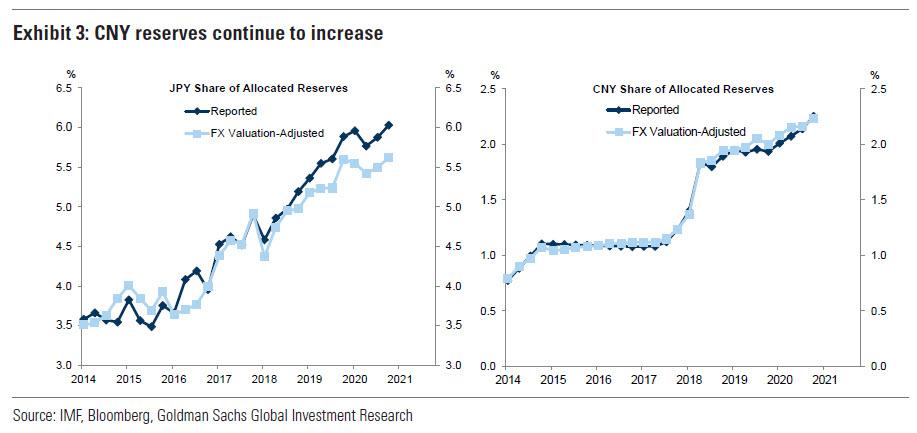
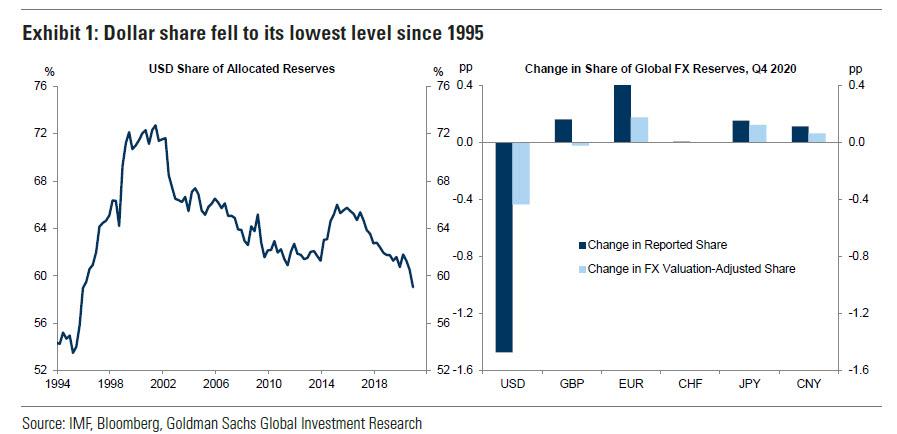
It showed that the trend of global dedollarization has accelerated and while the Dollar’s share of global reserves initially increased at the start of the pandemic, it has since decreased sharply and now stands at just 59% – a 1.5% decline for the quarter and the lowest level since 1995. According to Goldman, a fair bit of the decline over the last few quarters was due to valuation effects as the Dollar depreciated, but the decline in Q4 can be largely attributed to active selling as well.  The Euro, Yen and Renminbi were the main beneficiaries of this dollar dump, while the uptick in Sterling’s share appears to be mostly due to the currency’s appreciation.

While the Dollar’s share in allocated reserves has fallen markedly, the Euro’s share has enjoyed a modest rebound and last quarter moved decisively out of the range where it has been stuck for the past few years. 

The Yen’s share of reserves initially fell in the early stages of the pandemic, possibly on the back of cross currency basis trades being unwound, but has been climbing again for the last two quarters.

Meanwhile, in what may be the most concerning news for the US, the share of CNY reserves continues to slowly and steadily increase.

Tyler Durden
Sat, 04/03/2021 – 11:03

via ZeroHedge News https://ift.tt/3fEySVC Tyler Durden

When Central Bank Arsonists Take Victory Laps…

When Central Bank Arsonists Take Victory Laps…

Authored by Mark Jeftovic via BombThrower.com,

File under: “It is impossible to get a man to understand something when his livelihood depends on his not understanding it.”

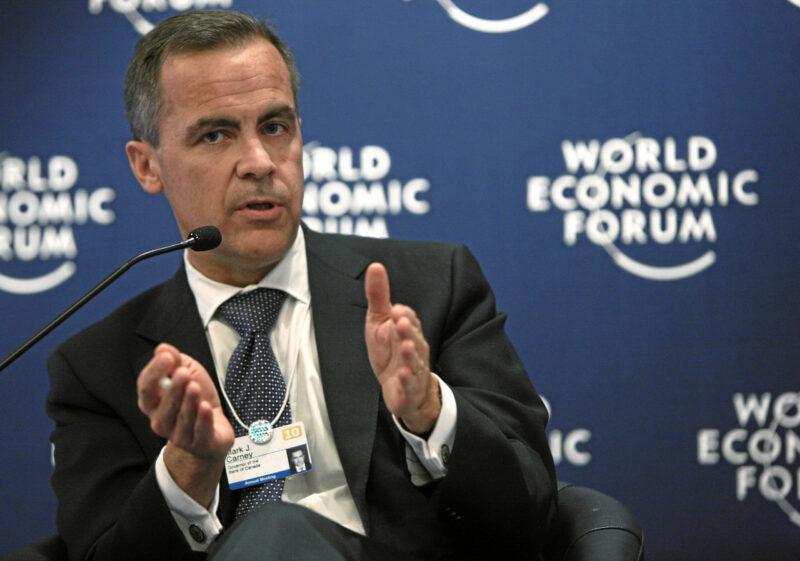
Shortly after I woke up on Good Friday, the day after April Fool’s this year, I came across a Bob Murphy tweet replying to Mark Carney, the Canadian central banker and Davos darling:

It turned out the tweet he was responding to was the fourth in a 5-series tweetstorm extolling the virtues of central bank mangling of stewardship over the financial markets.

The series was extraordinarily devoid of self-awareness, taking a victory lap on behalf of central bankers and  The Saviour State.

The market certainly can “be wrong” longer than most participants can stay solvent.  Especially when “being wrong” means mind-bogglingly overvalued and being propped up by central bankers like Carney printing money out of thin air, holding interest rates to the floor and exacerbating wealth inequality.

Carney is right. Hoping that central bankers finally figure it out isn’t a strategy.

That’s is precisely why when the central bank induced asset bubble popped in the GFC of 2008, and central banks simply doubled down on the failed policies that created it in the first place, Bitcoin was born.

After that it took on a life of its own, myriad other crypto currencies followed in its wake. The slower moving gold hit two successive all-time-highs while the central bankers kept printing, and now with the Fed, the ECB, the BOE, BOJ and the BOC trapped with yield curve control the only play left, everything else is screaming higher. Bang up job, guys.

You may not be able to spin yourself out of a crisis. The only move is to print money.

This one was a case of the arsonist wanting a hero cookie for putting out the fire. I always like to refer to David A. Stockman’s “The Great Deformation” for an in depth analysis making the case that had we let the overleveraged banks go down, the result would have been a short, sharp financial crisis limited “to the canyons of Wall St”, and we’d have had a real recovery built on much sounder footing.

Had we done that, we may have not been so trapped when the COVID-19 pandemic hit. But instead, we’ve had to double and triple down yet again.

So tell me, when the inevitable crisis that is the product of the last several decades of central bank interventions hits, and it will, who can we blame it on? The libertarians and free markets run wild? If that’s what you call the last 10 years, I’d hate to see what the likes of Carney think are centrally planned, command economies.

Ah yes, The Saviour State. Where would we be without them? Not on lockdown? Not living in a world where that which is not expressly permitted is now forbidden?

one tweeter followed up the famous Upton Sinclair quote:

“It is impossible to make a man understand something when his salary depends on him not understanding it”.

The Nation State is done. Jesse, Charles and I talk about The Network State supplanting the Nation State. We used to talk about it happening in the future. Since COVID hit and the ham-fisted policy responses across the board, we now talk about it happening, like the Great Reset, in the present.

*  *  *

To receive future posts in your mailbox join the free Bombthrower mailing list or follow me on Twitter. 

Tyler Durden
Sat, 04/03/2021 – 10:31

via ZeroHedge News https://ift.tt/2OgQYSo Tyler Durden

Melissa Chen on Fighting Wokeness at Home and Radicalism Abroad


“Ideas have consequences,” says Melissa Chen. “But so does silence.”

Chen is New York editor for The Spectator and managing director of Ideas Beyond Borders, a nonprofit that translates new and classic texts about science, history, and liberal political philosophy into Arabic and distributes them as free ebooks throughout the Middle East. Born and raised in Singapore, Chen came to the United States to study genomics at Boston University; she quickly established herself as a foe of groupthink and political correctness in America while critiquing authoritarian regimes in Singapore, China, and elsewhere. A frequent guest on such shows as The Joe Rogan Experience, Bridget Phetasy’s Walk-Ins Welcome, and The Rubin Report, Chen maintains one of the liveliest feeds on Twitter, mixing long threads with sardonic comments on the news of the day.

In this interview, Chen tells Nick Gillespie that an obsessive focus on identity politics led the media to keep insisting without evidence that the murder of massage parlor workers in Atlanta was a hate crime against Asian Americans. She also discusses why Hollywood is changing its products to please censors in the Chinese government, and she argues that the best ways to counter radicalization are speech and information, not repression.

Narrated by Nick Gillespie. Produced and edited by Regan Taylor.

Photo: Masjid Pogung Dalangan on Unsplash; Osman Rana on Unsplash; Aubrey Odom on Unsplash; Chine Nouvelle/SIPA/Newscom; Desmond Wee/The Straits Times/Newscom; Maria Thalassinou on Unsplash; Benoit Debaix on Unsplash; Alex Block on Unsplash; Adi Goldstein on Unsplash; Robin Rayne/ZUMA Press/Newscom; Swapnil Bapat on Unsplash; Maria Thalassinou on Unsplash

Music: “Mine All Mine,” by Katrina Stone, Artlist

from Latest – Reason.com https://ift.tt/3rToqfK
via IFTTT

Melissa Chen on Fighting Wokeness at Home and Radicalism Abroad


“Ideas have consequences,” says Melissa Chen. “But so does silence.”

Chen is New York editor for The Spectator and managing director of Ideas Beyond Borders, a nonprofit that translates new and classic texts about science, history, and liberal political philosophy into Arabic and distributes them as free ebooks throughout the Middle East. Born and raised in Singapore, Chen came to the United States to study genomics at Boston University; she quickly established herself as a foe of groupthink and political correctness in America while critiquing authoritarian regimes in Singapore, China, and elsewhere. A frequent guest on such shows as The Joe Rogan Experience, Bridget Phetasy’s Walk-Ins Welcome, and The Rubin Report, Chen maintains one of the liveliest feeds on Twitter, mixing long threads with sardonic comments on the news of the day.

In this interview, Chen tells Nick Gillespie that an obsessive focus on identity politics led the media to keep insisting without evidence that the murder of massage parlor workers in Atlanta was a hate crime against Asian Americans. She also discusses why Hollywood is changing its products to please censors in the Chinese government, and she argues that the best ways to counter radicalization are speech and information, not repression.

Narrated by Nick Gillespie. Produced and edited by Regan Taylor.

Photo: Masjid Pogung Dalangan on Unsplash; Osman Rana on Unsplash; Aubrey Odom on Unsplash; Chine Nouvelle/SIPA/Newscom; Desmond Wee/The Straits Times/Newscom; Maria Thalassinou on Unsplash; Benoit Debaix on Unsplash; Alex Block on Unsplash; Adi Goldstein on Unsplash; Robin Rayne/ZUMA Press/Newscom; Swapnil Bapat on Unsplash; Maria Thalassinou on Unsplash

Music: “Mine All Mine,” by Katrina Stone, Artlist

from Latest – Reason.com https://ift.tt/3rToqfK
via IFTTT

Suez Canal Logjam Ends, Last Ships Expected To Transit Today 

Suez Canal Logjam Ends, Last Ships Expected To Transit Today 

The Suez Canal Authority (SCA) reports all of the 422 ships stranded following the grounding of the massive container ship, Ever Given, on the southern stretch of the canal, passed through Saturday, ending the logjam of vessels caused by the blockage. 

Ever Given was grounded on Mar. 23, and it wasn’t ungrounded until Mar. 29, a total of about six days, when salvage teams freed the ship. All week, SCA boosted vessel flow through the canal above the average 50 per day to alleviate the traffic jam. 

Osama Rabie, the chairman of the SCA, said a total of 80 vessels transited the canal on Friday. He said 85 ships were expected to pass through the canal on Saturday, therefore ending the shipping backlog. 

Suez Canal Appears To Be Normalizing 

As a result of Ever Given, global supply chains were thrown into turmoil, already suffering from the virus pandemic’s hardships and amplified during unprecedented US fiscal stimulus, triggering one-sided trade with Asia. 

Rabie told MBC Masr television on Friday that an investigation into why the container ship ran aground began on Wednesday.

“The investigation is going well and will take two more days, and then we will announce the results,” Rabie said.

Following the investigation, there is a mounting legal action for owners of goods on board Ever Given. 

Already, shipping insurer Lloyd’s of London expects a “large loss” the could be more than $100 million. Fitch Ratings said the blockage is expected to dent global reinsurers’ earnings, already crushed by the virus pandemic disrupting global supply chains, winter storms in the US, and flooding in Australia. After the Suez crisis, marine reinsurance is expected to rise. 

Between the grounding and ungrounding of the container ship, along with the logjam of ships, the entire episode lasted approximately 12 days, exposing the fragility of the global supply. 

Tyler Durden
Sat, 04/03/2021 – 09:55

via ZeroHedge News https://ift.tt/3duFXW7 Tyler Durden

Nord Stream 2 Warns Of Security Risks From Warships & Low-Flying Planes

Nord Stream 2 Warns Of Security Risks From Warships & Low-Flying Planes

Authored by Dave DeCamp via AntiWar.com,

A senior official from Nord Stream 2 AG, the project company leading the Nord Stream 2 Russia to Germany natural gas pipeline project, has reported an uptick in “provocative” activity from warships and planes in the area where the pipeline is being built.

“Higher activity of naval vessels, airplanes and helicopters and civilian vessels of foreign states is observed in the work area after restarted construction of the offshore segment of the Nord Stream 2 gas pipeline, whose actions are often clearly provocative,” said Nord Stream AG official Andrei Minin, according to the Russian news agency TASS.

Above: the pipe-laying vessel Fortuna, which is operated by the Russian company KVT-RUS and recently targeted by US sanctions. Image via Reuters

Minin said a 1.5-mile safety zone is established around the construction area where vessels are not supposed to enter. “Nevertheless, naval vessels of foreign countries are constantly registered near service ships performing work,” he said.

He added that a Polish antisubmarine warfare airplane is “regularly flying around the work area at a small height and closely to the pipelay vessel.”

Minin said in one provocation, an unidentified submarine was above surface within one mile of the pipeclay vessel Fortuna, a ship that was hit with US sanctions on January 19th. Minin said the activity indicates “obviously planned and prepared provocations.” Besides warships and planes, he said fishing vessels have also come dangerously close to the construction area.

The Nord Stream 2 pipeline has been in the crosshairs of the US for years, but despite sanctions and threats, Nord Stream AG reported on Thursday that the project is now 95 percent complete. Construction restarted in December 2020 after being suspended due to threats of US sanctions.

Although it’s not clear if the US is involved in these provocations, it is likely. Washington seems willing to take extreme measures to stop the project and is threatening to sanction its ally Germany. Besides the US, another country keen to stop the project is Ukraine, which stands to lose up to $3 billion a year in gas transportation fees if the pipeline is complete.

The original Nord Stream consists of two lines that run from Vyborg, Russia, to Lubmin, Germany, near Greifswald. The new project would add two more lines, doubling the amount of natural gas Russia could export to Germany.

Tyler Durden
Sat, 04/03/2021 – 09:20

via ZeroHedge News https://ift.tt/31GCJJR Tyler Durden

Will Washington State Become a Friendlier Place for Small Food Entrepreneurs?


Yonder

Last month, Seattle’s city council voted to lift a host of restrictions on many home businesses, thanks to the efforts of one small local cidery and its supporters.

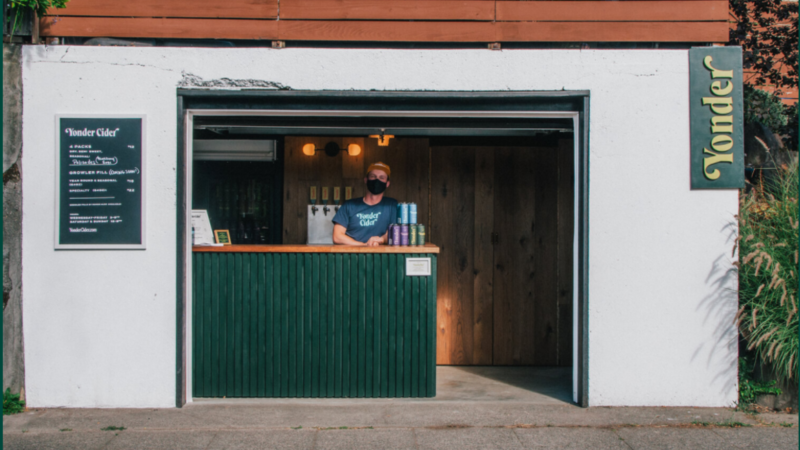
As I detailed in a February column, after one neighbor complained repeatedly to the city about Yonder Bar, the city forced the “bar”—a converted home garage walkup window where consumers may only purchase cider to drink at home, rather than a place where people drink alcohol beverages—to close temporarily.

As I also explained in the column, the city, which had approved and licensed Yonder Bar prior to its opening, claimed, in closing down the bar, that Yonder Bar was operating illegally in a residential area, didn’t have adequate off-street parking, used signage to indicate to consumers that it’s a business—and not, say, an unmarked garage full of old tires or broken croquet mallets—and could operate only by appointment.

That might have been the end of the story. But thousands of Yonder Bar’s neighbors and at least a couple city councilors rallied behind the takeaway-only bar. Those city councilors introduced a bill that would not just allow Yonder to reopen—but also allow other, similar home-based businesses to operate without fear of being shuttered by the city.

City Council members Dan Strauss and Lorena Gonzalez introduced the bill, dubbed Bringing Business Home, in order to “provide additional support and a means towards economic recovery for small businesses adversely affected by current land use codes during the pandemic.”

The bill was intended to lift some of the most onerous home-business requirements, including the appointment-only rule, signage ban, cap on employees, and traffic restrictions.

In my column on Yonder Bar, I cited one local Twitter account that predicted Yonder Bar’s persistent nemesis could end “up getting a citywide zoning change that will legalize stuff like Yonder on every lot.”

That’s largely what happened. Yonder Bar reopened soon after the bill was introduced. And then, rather amazingly, the Bringing Business Home bill passed by an 8-1 vote.

“This bill removes one of the biggest hurdles for small businesses—commercial rent—and gives them the opportunity to follow their dreams,” Yonder Bar owner Caitlin Bramm told me this week. “We started Yonder Bar in our garage, and it allowed us to safely and confidently grow while providing valuable cash flow for our business. We are thrilled to have it back open, and can’t wait to see what opportunities this bill opens up for others.”

“Our land use code cannot be the barrier to vibrant neighborhoods and a strong economy,” Councilmember Strauss said after the bill’s passage. “It’s essential we meet our businesses where they’re at: whether that’s out of their homes or garages.”

Strauss is right. But given that the legislation is only temporary—it’s set to expire in a year—the city council still has work to do to ensure Seattle’s government isn’t a barrier to the success of small food entrepreneurs.

While many small food producers across Washington State face similar restrictions, there’s also a movement currently underway to expand opportunities for home food entrepreneurs throughout the state. A bill to legalize microenterprise home kitchens, which passed in the legislature last month and is now before a key state Senate committee, could turn some home-based cooks “into a legitimate industry, fostering entrepreneurs and lowering the barrier to entry into the food industry.”

The bill’s sponsor, State Rep. Noel Frame, who also hails from Seattle, explained last month that small entrepreneurs “really want to get into the food business but may face pretty big barriers to do so, particularly cost. This is a pathway of opportunity for them that is slightly lower-barrier.”

Frame’s bill could help bring in from the cold underground food sellers such a “C.,” an anonymous seller I contacted (while researching a 2018 column) through Facebook’s Marketplace. I subsequently met C. in a Costco parking lot to buy a few of the delectable tamales her mom cooked to help supplement her income.

Unfortunately, even if Frame’s bill passes, it’s more likely to leave C. and her mom and thousands of other existing and potential home-food entrepreneurs out in the cold than it is to legalize their work.

That’s because, as part of a pilot program detailed in the bill, Washington State’s largest county—King County, which includes Seattle—may issue no more than 30 permits during the law’s first year. Most other counties could offer only 10 such permits. Other restrictions include a cap on the number of meals a seller may offer each day or week. Also, the bill wouldn’t take effect until summer 2022.

These limits have unfortunately become a feature of microenterprise home kitchen laws. California, the first state to adopt such a law, has seen its new policy vacillate between flailing and failing, largely because the state left it up to local governments to opt in to the law.

“While a handful of counties and cities have expressed interest in adopting the law in their own jurisdictions, no California city or county save Riverside County—not one—has adopted the law and drafted rules to implement it,” I explained in a column last year on the California law’s status, dubbing it “nothing more than a cruel illusion.”

Seattle city council members deserve credit for recognizing that laws and regulations often act, as Councilor Strauss noted, as a “barrier to vibrant neighborhoods and a strong economy.” Washington State lawmakers deserve credit, too, for recognizing that home-based culinary entrepreneurs want and deserve a path to legitimacy.

But until and unless Seattle’s home-business law is made permanent, and Washington State’s microenterprise home kitchen bill is strengthened, streamlined, and adopted, Washington State food entrepreneurs will likely remain tangled in red tape.

from Latest – Reason.com https://ift.tt/3sP0aN1
via IFTTT

At Least 3 Killed, 4 Injured In North Carolina Mass Shooting

At Least 3 Killed, 4 Injured In North Carolina Mass Shooting

For the second week in a row, a mass shooting has been reported in the US late on a Friday night, once an unusual time for these types of tragedies.

Once upon a time, mass shooters targeted “soft” targets like, well, schools, office buildings and other public places. Typically, attacks like this would unfold during the daylight hours. We saw at least one incident unfold this past week at a sleepy office in Orange, Calif.

But last night in Wilmington, North Caolina, 3 people were killed and 4 were injured during a shooting that apparently took place at the site of a house party. According to ABC News, which spoke with Lt. Leslie Irving, a watch commander with the Wilmington Police Department, the scene of the shooting remains “an active investigation”. Police will have more information Saturday morning, when they will brief the press.

Wilmington Police Chief Donny Williams said the shooter hasn’t been identified and is still on the run. However, Chief Williams said he doesn’t feel the public is in any danger. We’d be curious to learn how they determined that. they are working to identify suspects and don’t feel the public is in any danger.

The shooting took place at a house at the corner of 7th and Kidder streets in Wilmington, an area that’s still swarming with police activity. This was at least the fifth mass shooting since states in the US started relaxing their restrictions on movement and business operations, while allowing more people to gather at private dwellings. North Carolina Gov. Roy Cooper announced the rollbacks in late February as cases in the state dropped to their lowest levels since late last year.

Tyler Durden
Sat, 04/03/2021 – 08:45

via ZeroHedge News https://ift.tt/3dsYbaF Tyler Durden

Will Washington State Become a Friendlier Place for Small Food Entrepreneurs?


Yonder

Last month, Seattle’s city council voted to lift a host of restrictions on many home businesses, thanks to the efforts of one small local cidery and its supporters.

As I detailed in a February column, after one neighbor complained repeatedly to the city about Yonder Bar, the city forced the “bar”—a converted home garage walkup window where consumers may only purchase cider to drink at home, rather than a place where people drink alcohol beverages—to close temporarily.

As I also explained in the column, the city, which had approved and licensed Yonder Bar prior to its opening, claimed, in closing down the bar, that Yonder Bar was operating illegally in a residential area, didn’t have adequate off-street parking, used signage to indicate to consumers that it’s a business—and not, say, an unmarked garage full of old tires or broken croquet mallets—and could operate only by appointment.

That might have been the end of the story. But thousands of Yonder Bar’s neighbors and at least a couple city councilors rallied behind the takeaway-only bar. Those city councilors introduced a bill that would not just allow Yonder to reopen—but also allow other, similar home-based businesses to operate without fear of being shuttered by the city.

City Council members Dan Strauss and Lorena Gonzalez introduced the bill, dubbed Bringing Business Home, in order to “provide additional support and a means towards economic recovery for small businesses adversely affected by current land use codes during the pandemic.”

The bill was intended to lift some of the most onerous home-business requirements, including the appointment-only rule, signage ban, cap on employees, and traffic restrictions.

In my column on Yonder Bar, I cited one local Twitter account that predicted Yonder Bar’s persistent nemesis could end “up getting a citywide zoning change that will legalize stuff like Yonder on every lot.”

That’s largely what happened. Yonder Bar reopened soon after the bill was introduced. And then, rather amazingly, the Bringing Business Home bill passed by an 8-1 vote.

“This bill removes one of the biggest hurdles for small businesses—commercial rent—and gives them the opportunity to follow their dreams,” Yonder Bar owner Caitlin Bramm told me this week. “We started Yonder Bar in our garage, and it allowed us to safely and confidently grow while providing valuable cash flow for our business. We are thrilled to have it back open, and can’t wait to see what opportunities this bill opens up for others.”

“Our land use code cannot be the barrier to vibrant neighborhoods and a strong economy,” Councilmember Strauss said after the bill’s passage. “It’s essential we meet our businesses where they’re at: whether that’s out of their homes or garages.”

Strauss is right. But given that the legislation is only temporary—it’s set to expire in a year—the city council still has work to do to ensure Seattle’s government isn’t a barrier to the success of small food entrepreneurs.

While many small food producers across Washington State face similar restrictions, there’s also a movement currently underway to expand opportunities for home food entrepreneurs throughout the state. A bill to legalize microenterprise home kitchens, which passed in the legislature last month and is now before a key state Senate committee, could turn some home-based cooks “into a legitimate industry, fostering entrepreneurs and lowering the barrier to entry into the food industry.”

The bill’s sponsor, State Rep. Noel Frame, who also hails from Seattle, explained last month that small entrepreneurs “really want to get into the food business but may face pretty big barriers to do so, particularly cost. This is a pathway of opportunity for them that is slightly lower-barrier.”

Frame’s bill could help bring in from the cold underground food sellers such a “C.,” an anonymous seller I contacted (while researching a 2018 column) through Facebook’s Marketplace. I subsequently met C. in a Costco parking lot to buy a few of the delectable tamales her mom cooked to help supplement her income.

Unfortunately, even if Frame’s bill passes, it’s more likely to leave C. and her mom and thousands of other existing and potential home-food entrepreneurs out in the cold than it is to legalize their work.

That’s because, as part of a pilot program detailed in the bill, Washington State’s largest county—King County, which includes Seattle—may issue no more than 30 permits during the law’s first year. Most other counties could offer only 10 such permits. Other restrictions include a cap on the number of meals a seller may offer each day or week. Also, the bill wouldn’t take effect until summer 2022.

These limits have unfortunately become a feature of microenterprise home kitchen laws. California, the first state to adopt such a law, has seen its new policy vacillate between flailing and failing, largely because the state left it up to local governments to opt in to the law.

“While a handful of counties and cities have expressed interest in adopting the law in their own jurisdictions, no California city or county save Riverside County—not one—has adopted the law and drafted rules to implement it,” I explained in a column last year on the California law’s status, dubbing it “nothing more than a cruel illusion.”

Seattle city council members deserve credit for recognizing that laws and regulations often act, as Councilor Strauss noted, as a “barrier to vibrant neighborhoods and a strong economy.” Washington State lawmakers deserve credit, too, for recognizing that home-based culinary entrepreneurs want and deserve a path to legitimacy.

But until and unless Seattle’s home-business law is made permanent, and Washington State’s microenterprise home kitchen bill is strengthened, streamlined, and adopted, Washington State food entrepreneurs will likely remain tangled in red tape.

from Latest – Reason.com https://ift.tt/3sP0aN1
via IFTTT