Citi’s Levkovich Admits “Significant” Mistakes In Bearish S&P Call, But Sticks With 4,000 Year-End Target

Citi’s Levkovich Admits “Significant” Mistakes In Bearish S&P Call, But Sticks With 4,000 Year-End Target

Last Friday, Powell’s unexpectedly dovish Jackson Hole speech sparked another melt-up in risk assets.

Ahead of the latest rally, Wall Street’s most bearish strategists such as Citigroup’s top strategist Tobias Levkovich, had issued multiple dire warnings about a euphoria on Wall Street and how markets resemble 1999. His year-end equity call for the S&P 500 is 4,000 but has been forced to acknowledge in a note to clients he’s made “significant” mistakes in his prediction. 

Levkovich is still holding to his guns and predicting the benchmark will end this year at 4,000 before reaching 4,350 by June 2022. 
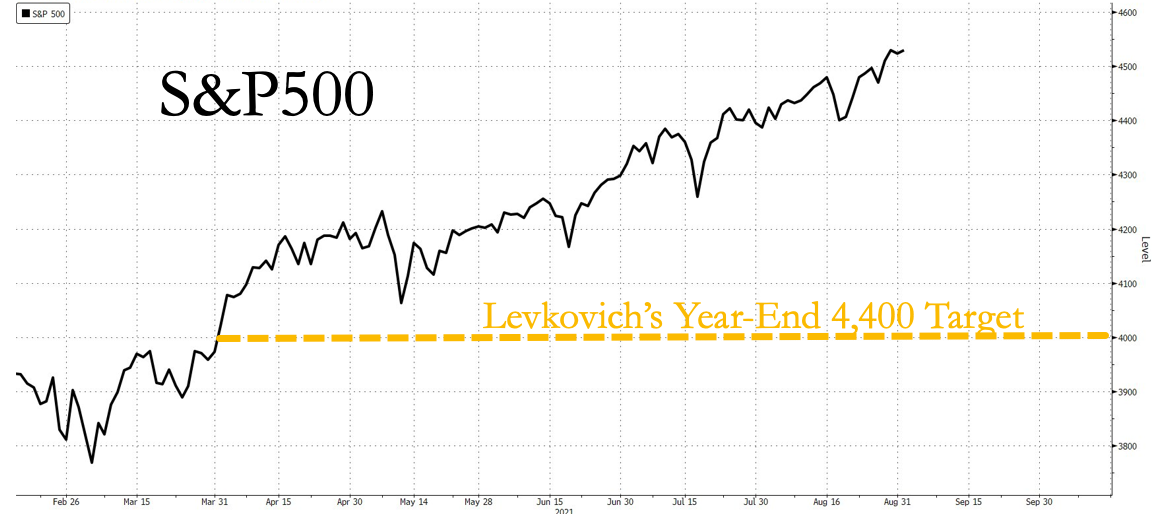
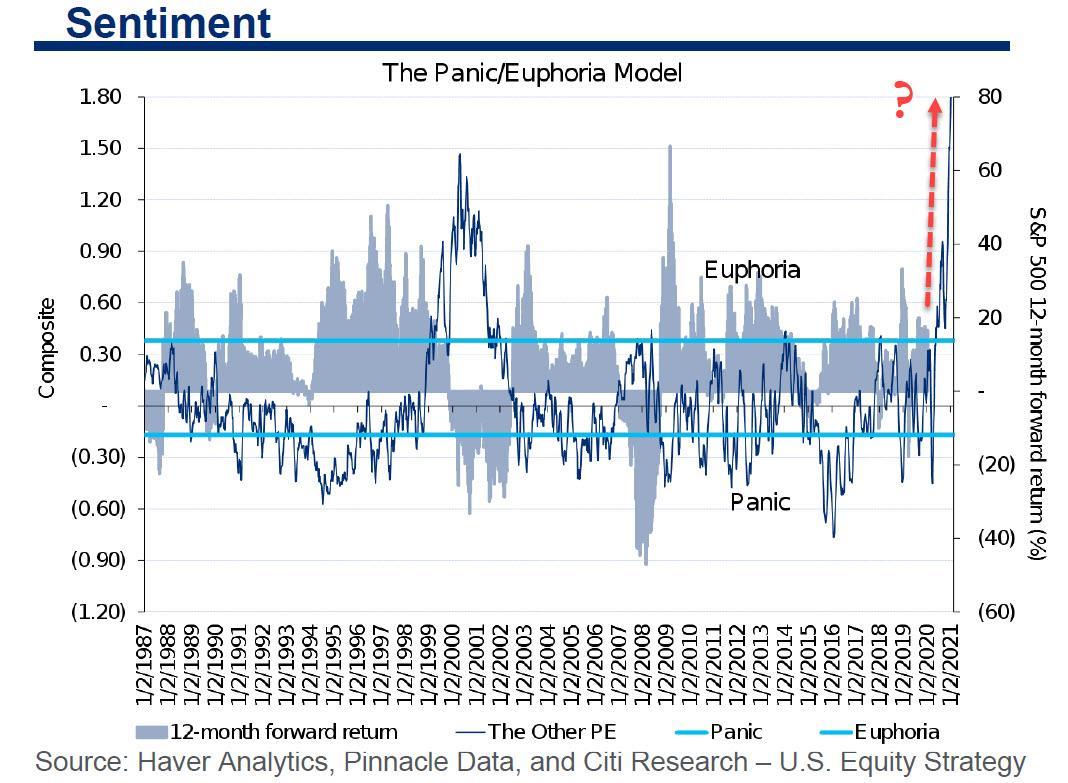
Supporting Levkovich’s bearish views are striking “parallels between current conditions and those of 1999.” 

As shown in Panic/Euphoria Model – which considers factors including the number of investor positions anticipating a fall in stocks, levels have exceeded the Dot Com period.
Besides stock market euphoria, stretched valuations, and a planned tax increase will deteriorate corporate profits, there have been other reasons for Levkovich’s bearishness. 

“Caution that proves to be wrong can cost one a career,” Levkovich told clients in a note last week, quoted by Bloomberg. “Nevertheless, we feel compelled to stand by our analytical process.”

In term’s of valuations, Levkovich is right – equities are way overvalued compared to historical norms. 
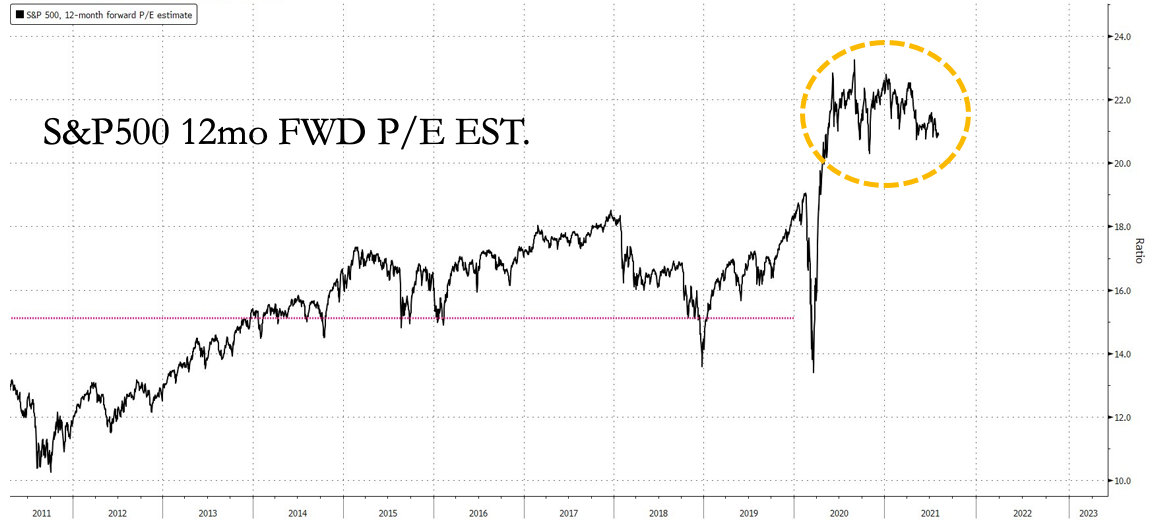
Levkovich added that crazed retail chasing any stock that moves amid unprecedented Federal Reserve bond-buying, suppressing volatility and enabling high amounts of speculation, could peak when the central bank is poised to rein in its asset purchases. Investors should expect multiples to come back in. 

“We suspect that these items may not be drivers going forward and other factors including euphoric sentiment and stretched valuation become more impactful, offset to some degree by reinvigorated share repurchase programs,” he said. “The stock market needs to consolidate the past 18 months’ worth of gains and portfolio managers require more visibility into 2022 profits.”

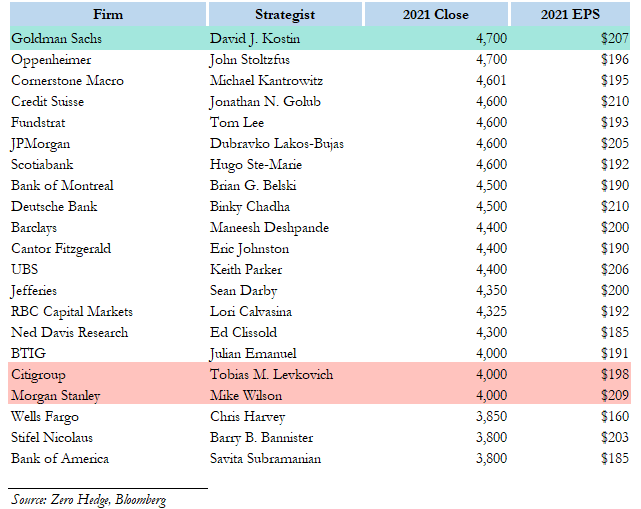
Mike Wilson, the chief U.S. equity strategist at Morgan Stanley, is in the same camp as Levkovich, who expects a 10%+ S&P 500 correction. Two weeks ago, Wilson reluctantly raised his S&P price target to 4,000 from 3,900. Meanwhile, Goldman’s David Kostin is on the opposite side of the bet, last month hiking his year-end S&P price target from 4300 to 4,700, up about 7% from here, justifying his optimism by unexpectedly low bond yields which traditionally represent a slowing economy. In other words, stocks will rise because the economy will slow from here. Just brilliant.

Here’s where the equity strategist stand with their S&P 500 year-end targets. 
And before one mock either of the strategists, it’s worth reminding that this market remains a joke “mystery” to all: as Steve Chiavarone, a portfolio manager and head of multi-asset solutions at Federated Hermes, told Bloomberg last week, “If someone would have told me in March of last year, when Covid was first rearing its ugly head, that 18 months later we would have case counts that are as high—if not higher—than they were on that day, but that the market would have doubled over that 18-month period, I would have laughed at them.”

Tyler Durden
Wed, 09/01/2021 – 18:05

via ZeroHedge News https://ift.tt/3zESLmG Tyler Durden
Rabobank: The Battle That Actually Matters Is Elsewhere

Rabobank: The Battle That Actually Matters Is Elsewhere

By Michael Every of Rabobank

“The operation was a complete success…”

“…but unfortunately the patient died”, as the old joke goes. The origins of the linked phrase ‘Pyrrhic victory’ dates all the way back to antiquity, when in 279BC Pyrrhus of Epirus won a battle against Rome that so decimated his forces he declared: “Ne ego si iterum eodem modo vicero, sine ullo milite Epirum revertar” (If I achieve such a victory again, I shall return to Epirus without any soldier.)

I mention this today not just because the White House is publicly rallying round what US Allies see as a logistically-shambolic retreat from Afghanistan, where “getting 90% out” also means “leaving 10% behind”. Indeed, if the US retreat generates a “We can ill afford another Klendathu” moment within the DC foreign policy Blob, who is to say that history won’t see it as a genuine pivot point?

As President Biden noted in a public address yesterday defending his decision: “As we turn the page on the foreign policy that has guided our nation for the last two decades we have got to learn from our mistakes. To me, there are two that are paramount; first, we set missions with clear, achievable goals, not ones we will never reach, and, second, we will stay clearly focused on the fundamental national security interest of the United States of America.” Of course, he has already made clear the other condition is the US will only fight for those who will fight with it – and I cannot emphasize enough what a sea-change in the global security architecture this implies. (Or how much further some say the US will have to shift policy –in directions allies, non-allies, and markets alike will find deeply unpleasant– if it truly wishes to act in its long-run national security interests.)

No, I mentioned Pyrrhus because all around us we see similar ‘victories’.

“We have beaten Covid with vaccines!” – Oops, Delta! Now we need three shots, not two. Until that doesn’t work either. And yet parts of the world still haven’t had one shot yet.

“We have economic recovery!” – As China’s services PMI slumps to 47.5, with the new orders index tumbling to a lower level than during the GFC, for example; and as US consumer confidence plunges from 129.1 to 113.8 in a month, and expectations from 108.4 to 91.4.

“We have beaten inflation!” – Meaning we have beaten demand-pull inflation, which still leaves us cost-push inflation and falling real wages, and so a collapse in consumer confidence.

“It’s time to taper!” – Say both FOMC members and ECB members, when we have no sign of any Building Back Better being done anywhere except in China, where it comes in a “profoundly revolutionary” wrapper. US stocks went down all of 0.1% yesterday, which was apparently worth mentioning for some press; and bond yields fluctuated on the hilarious notion that a major central bank may actually taper.

Meanwhile, as the US is now saying in a different policy dimension, the battle that actually matters is elsewhere. In particular, we are getting more details on China’s “profound revolution”:

First, a threat to shut down e-commerce platforms caught selling fake goods; second, shutting down the American Chamber of Commerce in Chengdu “because reasons”. But, more concretely, official policy to limit urban rent increases to 5% annually along with an announcement that land and home prices “will be stabilized”, while rumors of a potential property tax whirl. This is very, very big. Imagine the same in the US, UK, Australia, NZ, or Europe. It’s just as important in China.

At the same time, Bloomberg carries an article looking at the province of Zhejiang (population 65m) and its existing pilot experiment with Common Prosperity. What is being seen there is not tax-and-spend or a welfare state: rather it is forcing capital to flow to areas previously starved of it and huge efforts to bring down living costs. Specifically:

  • Targeting inequality (of intra-provincial GDP per capita) directly;
  • Aiming to increase the labour share of GDP to more than 50% (vs. the World Bank 2020 national household share of GDP estimate of 38%, which is a huge ask for obvious reasons – which GDP sector will be dropping by 12 percentage points given we also know there won’t be a swing allowed to a negative-net-exports trade deficit?);
  • More urbanisation;
  • Property taxes (on private housing) and building state-owned rental properties (social housing);
  • Letting people without official hukou residence access state services, which is a genuine revolution;
  • More spending on social services – and “donations” from local billionaires worth $236bn;
  • Lower cost business loans for favoured sectors, including manufacturing and tourism; and
  • SOEs building more infrastructure, even if it generates low returns.

As such, we get a picture of potentially higher growth, but lower returns; less luxury and more mass-market; and far more regulation. Which sounds like something Western markets don’t understand and won’t like. They prefer lower growth and higher returns; less mass-market and more “premiumisation”; and far less regulation.

Also important, the Chinese Communist Party has also just announced that it will hold a key plenum in November – though what major policy changes this portends against the current backdrop remains to be seen. One would posit it is unlikely to be small beer.

But of course, Western markets and politicians stressing the fragility of Western liberal democracy and the ‘rules-based international order’ don’t need to be concerned by policy shifts from Beijing, or it showing how Building Back Better actually needs to be done in practice, not rhetoric, such as via targeting inequality and labor share of GDP, social housing and rent controls. After all, they still have QE (for now), that marvelous magical cure for all social and economic ills! It’s a monetary operation carried out every month that is always a success for markets and asset prices, even if the political-economy patient dies. “Si talem victoriam iterum consequor, sine ulla societate ad normales revertar.”

Tellingly, Kiwi house prices were up 27% y/y today, when the RBNZ just left rates on hold, surprising markets, despite now having a house-price mandate, and Australia’s Q2 GDP came in at 0.7% q/q vs. 0.4% expected despite everyone locked down at home, while CoreLogic house prices were up 1.5% m/m, so 18% y/y annualized. Marvellous and magical once again.

Tyler Durden
Wed, 09/01/2021 – 17:50

via ZeroHedge News https://ift.tt/3BwU8nX Tyler Durden

The Federal Government Cautions Incoming Afghan Refugees Against Moving To California


reason-houston

The federal government has some helpful advice for Afghan refugees trying to start a new life in America: for the love of God, do not try to rent an apartment in California.

Many of the Afghans who have been airlifted out of their country in the wake of the Taliban’s takeover will be able to come to America under the U.S. State Department’s Special Immigrant Visa (SIV) program, which provides visas to translators who worked with U.S. forces and helps place them in a new city once they get to America.

SIV participants who opt to receive resettlement benefits can also choose to be relocated to one of 19 cities identified as having “reasonable cost of living, housing availability, supportive services, and welcoming communities with volunteers and resources.”

These cities include several in Texas (Houston, Austin, and Dallas), the Mountain West (Salt Lake City and Denver), the Southeast (Raleigh-Durham and Atlanta), and a couple of lower-cost cities in the Mid-Atlantic (Philadelphia and Baltimore).

Noticeably absent from the list are any cities in California.

Indeed, the State Department’s website explicitly warns arriving Afghans against trying to move there, saying that “some cities in California are very expensive places to live, and it can be difficult to find reasonable housing and employment. Any resettlement benefits you receive may not comfortably cover the cost of living in these areas.”

Six out of the 10 most expensive cities to rent a one-bedroom apartment are located in California, according to an August report from rental listing website Zumper.

The Washington D.C. metro area—which was ranked the sixth most expensive city in the Zumper report—is also singled out by the State Department as a particularly expensive place that incoming migrants should avoid unless they have friends or family who will be able to assist them financially.

Ultra-expensive New York City—the traditional entry point for past waves of immigrants coming to America—is also left off the State Department’s list. The much more affordable area of Northern New Jersey, in contrast, is a recommended destination for Afghan refugees.

One reason for that is that northern New Jersey is much friendlier to new housing development. The Big Apple has added about one unit of housing for every 3.6 jobs from 2009 to 2018, according to one city report. Northern New Jersey, meanwhile, has managed to add more housing units than jobs.

The State Department’s list of refugee-friendly cities is mostly dominated by high-growth sunbelt cities with high rates of housing construction, including places like Houston, Dallas, Raleigh-Durham that have both added a new unit of housing for every job over the past decade.

This de facto list of most welcoming cities for incoming Afghan refugees has some important lessons for both the left and right wings of American politics.

Folks on the right, including Fox News host Tucker Carlson, have argued that America shouldn’t admit Afghan refugees because the country just doesn’t have enough housing for them. That’s simply not true for many fast-growing cities that are adding more than enough housing to accommodate newcomers, whether they’re coming from Kandahar or Kansas City.

It’s also not true of low-growth, low-cost cities like Baltimore, Maryland, and Buffalo, New York, which also made the State Department’s list. If anything, these cities have too much vacant housing, and could really benefit from the revitalizing effects of new immigrants.

On the other hand, liberal-leaning residents of America’s bluest cities should probably do some soul searching about the fact their communities, while rhetorically accepting of immigrants, are also so expensive that new arrivals are being actively warned to not try to resettle there.

By ditching restrictions on new development, these cities could make themselves more welcoming to refugees. Leaving excessive red tape in place, meanwhile, would prove that many progressives’ messages about accepting refugees aren’t worth the multi-lingual yard signs they’re printed on.

from Latest – Reason.com https://ift.tt/3gRrqpW
via IFTTT

CDC Director Tells The Unvaccinated Not To Travel Over Labor Day Weekend – Except What About Natural Immunity?

CDC Director Tells The Unvaccinated Not To Travel Over Labor Day Weekend – Except What About Natural Immunity?

Authored by Jack Phillips via The Epoch Times (emphasis ours),

Centers for Disease Control and Prevention Director Dr. Rochelle Walensky is seen during a hearing at the U.S. Capitol in Washington, on May 11, 2021. (Greg Nash/Pool/Getty Images)

The head of the Centers for Disease Control and Prevention (CDC) recommended that people who are not vaccinated against COVID-19 should not travel over the forthcoming Labor Day weekend.

“Given where we are with disease transmission right now, we would say that people need to take these risks into their own consideration as they think about traveling,” Dr. Rochelle Walensky said during a White House COVID-19 briefing Tuesday, adding that vaccinated people should wear masks. “If you are unvaccinated, we would recommend not traveling.”

As with other recommendations from the CDC, Walenksy’s remark has no legal authority.

The current seven-day average of new COVID-19 infections in the United States is about 149,000 cases per day, according to data provided by the CDC. The number of deaths per seven-day average in the United States, the data shows, is about 985 per day as of Aug. 30.

Walensky’s comment drew criticism on social media, with some noting that people who have not received a COVID-19 vaccine haven’t listened to the CDC’s recommendations, anyway.

No travel for you, bad little children,” wrote Dr. Robert Malone, who has self-identified as a key developer of mRNA vaccine technology, on Twitter after her announcement.

Walensky’s suggestion that those who are not vaccinated should not travel also appears to tie in with vaccine passport mandates that were handed down in New York City, San Francisco, and other municipalities. Civil liberties groups have flagged such systems as potentially creating a two-tiered society of vaccinated and the unvaccinated.

Her remarks come as a CDC panel on Monday said that COVID-19 vaccines’ ability to keep people out of the hospital is waning, albeit slightly.

*  *  *

ZH: Except, what about those with natural immunity from previous infections?

*  *  *

The agency previously estimated that most people being treated for the CCP (Chinese Communist Party) virus are unvaccinated with about 97 percent not having received the shot.

The CDC panel on Monday noted that the 97 percent figure was based on data that was collected before the spread of the Delta variant. Now, the latest CDC analysis suggests that the vaccines’ effectiveness at keeping people out of the hospital is between 75 percent and 95 percent.

Individuals older than the age of 75 saw a significant decline, the panel added, noting that the vaccines’ effectiveness dropped from 90 percent in June to 80 percent in July. The agency said that immunity could be weakening over time, namely among older people, the most vulnerable group.

CDC advisers said during the panel’s briefing, however, that COVID-19 vaccines are still effective at preventing serious illness. Walensky also touted the vaccines’ efficacy at stopping serious illness during the COVID-19 briefing on Tuesday.

The federal health agency, meanwhile, said it continues to recommend that all eligible people be vaccinated against COVID-19 if they haven’t yet done so.

COVID-19 is the illness caused by the CCP virus.

Tyler Durden
Wed, 09/01/2021 – 17:30

via ZeroHedge News https://ift.tt/2Ya1KhQ Tyler Durden

The Federal Government Cautions Incoming Afghan Refugees Against Moving To California


reason-houston

The federal government has some helpful advice for Afghan refugees trying to start a new life in America: for the love of God, do not try to rent an apartment in California.

Many of the Afghans who have been airlifted out of their country in the wake of the Taliban’s takeover will be able to come to America under the U.S. State Department’s Special Immigrant Visa (SIV) program, which provides visas to translators who worked with U.S. forces and helps place them in a new city once they get to America.

SIV participants who opt to receive resettlement benefits can also choose to be relocated to one of 19 cities identified as having “reasonable cost of living, housing availability, supportive services, and welcoming communities with volunteers and resources.”

These cities include several in Texas (Houston, Austin, and Dallas), the Mountain West (Salt Lake City and Denver), the Southeast (Raleigh-Durham and Atlanta), and a couple of lower-cost cities in the Mid-Atlantic (Philadelphia and Baltimore).

Noticeably absent from the list are any cities in California.

Indeed, the State Department’s website explicitly warns arriving Afghans against trying to move there, saying that “some cities in California are very expensive places to live, and it can be difficult to find reasonable housing and employment. Any resettlement benefits you receive may not comfortably cover the cost of living in these areas.”

Six out of the 10 most expensive cities to rent a one-bedroom apartment are located in California, according to an August report from rental listing website Zumper.

The Washington D.C. metro area—which was ranked the sixth most expensive city in the Zumper report—is also singled out by the State Department as a particularly expensive place that incoming migrants should avoid unless they have friends or family who will be able to assist them financially.

Ultra-expensive New York City—the traditional entry point for past waves of immigrants coming to America—is also left off the State Department’s list. The much more affordable area of Northern New Jersey, in contrast, is a recommended destination for Afghan refugees.

One reason for that is that northern New Jersey is much friendlier to new housing development. The Big Apple has added about one unit of housing for every 3.6 jobs from 2009 to 2018, according to one city report. Northern New Jersey, meanwhile, has managed to add more housing units than jobs.

The State Department’s list of refugee-friendly cities is mostly dominated by high-growth sunbelt cities with high rates of housing construction, including places like Houston, Dallas, Raleigh-Durham that have both added a new unit of housing for every job over the past decade.

This de facto list of most welcoming cities for incoming Afghan refugees has some important lessons for both the left and right wings of American politics.

Folks on the right, including Fox News host Tucker Carlson, have argued that America shouldn’t admit Afghan refugees because the country just doesn’t have enough housing for them. That’s simply not true for many fast-growing cities that are adding more than enough housing to accommodate newcomers, whether they’re coming from Kandahar or Kansas City.

It’s also not true of low-growth, low-cost cities like Baltimore, Maryland, and Buffalo, New York, which also made the State Department’s list. If anything, these cities have too much vacant housing, and could really benefit from the revitalizing effects of new immigrants.

On the other hand, liberal-leaning residents of America’s bluest cities should probably do some soul searching about the fact their communities, while rhetorically accepting of immigrants, are also so expensive that new arrivals are being actively warned to not try to resettle there.

By ditching restrictions on new development, these cities could make themselves more welcoming to refugees. Leaving excessive red tape in place, meanwhile, would prove that many progressives’ messages about accepting refugees aren’t worth the multi-lingual yard signs they’re printed on.

from Latest – Reason.com https://ift.tt/3gRrqpW
via IFTTT

State Dept Contradicts Biden, Says Vast Majority Of Interpreters & Visa-Eligible Afghans Were “Left Behind”

State Dept Contradicts Biden, Says Vast Majority Of Interpreters & Visa-Eligible Afghans Were “Left Behind”

A stunning new exposé in The Wall Street Journal contradicts just about everything the American public has been told over the past week about the supposed “extraordinary success” of America’s “largest airlift in history”. 

The US left behind the majority of Afghan interpreters and others who applied for visas to flee Afghanistan, a senior State Department official said on Wednesday,” according to the WSJ report, which emphasizes that “as many as 100,000 Afghans may be eligible for relocation” – but the vast majority of these were left behind.

Screengrab via ABC News

Specifically the numbers relate to those local allies who qualified for the Special Immigrant Visa. The Pentagon as of last Friday said it up to that point it had been able to only get about 7,000 Special Immigrant Visa Afghans out.

But according to The Wall Street Journal

Over 20,000 Afghans who had applied for the Special Immigrant Visa program remained in Afghanistan when Kabul fell to the Taliban on Aug. 15, according to advocacy groups and congressional officials.

Including their family members, as many as 100,000 Afghans may be eligible for relocation.

The anonymous State Department official was asked to estimate how many remain trapped inside the country despite their eligibility based on a number of special visa programs: “I would say it’s the majority of them,” the official stated bluntly. “Just based on anecdotal information about the populations we were able to support.”

“Everybody who lived it is haunted by the choices we had to make and by the people we were not able to help,” the official added.

In the domino-effect of errors that plagued the last ten days of the evacuation operation, the thousands of Afghans crowding airport entrances often blocked the ability of others, including visa applicants and even Americans, from reaching US checkpoints. In other instances they were also blocked by the Taliban long before reaching the vicinity of the airport perimeter. 

This despite “every credential we tried to provide electronically was immediately disseminated to the widest possible pool” – according to the US official. But clearly the prospect of physically getting to within close distance of a US checkpoint amid the mass crush at the airport proved elusive and disastrous for most.

Tyler Durden
Wed, 09/01/2021 – 17:10

via ZeroHedge News https://ift.tt/3t6WcA5 Tyler Durden

Amazon Pressures FCC To Deny SpaceX’s Satellite Internet Plan


dpaphotosfive255052

With 1,700 satellites currently in orbit, SpaceX’s Starlink is giving its 100,000 customers download speeds of 50Mbps to 150Mbps, or higher. Bringing its orbital fleet up to 30,000 would serve customers even more effectively, SpaceX reckons, so it’s applied to do so with the Federal Communications Commission (FCC). But since meddlesome competitors are one reason why consumers can’t have nice things, Amazon’s Kuiper—which aims to launch a similar network of satellites into orbit—claims that the SpaceX application violates FCC rules and has asked the agency to deny the company’s request to launch its second-generation satellites.

The crux of the matter is that SpaceX submitted not one but two configurations of satellites, requesting approval for both. Kuiper claims that doing so is unfair and flouts FCC rules:

“The SpaceX Amendment proposes two different configurations for the nearly 30,000 satellites of its Gen2 System, each of which arranges these satellites along very different orbital parameters. SpaceX’s novel approach of applying for two mutually exclusive configurations is at odds with both the Commission’s rules and public policy and we urge the Commission to dismiss this amendment.

The Commission’s rules require that SpaceX settle the details of its proposed amendment before filing its application—not after.”

But you don’t have to be all that shrewd of an observer to deduce that Kuiper’s plea that everyone plays by the same rules looks an awful lot like an attempt to halt a competitor in its tracks. This type of thing happens all the time, a former FCC official tells Reason, and the agency currently has an ambitious broadband goal to which SpaceX is helping to contribute.

Amazon is trying to catch up to the headway that SpaceX has already made by arguing that CEO Elon Musk’s company is playing fast and loose with the rules. But what’s really behind the problem Amazon pointed to? PCMag reports that SpaceX “provided two configurations because the first one relies on the still under-development Starship craft to deliver the Starlink satellites. The second configuration taps existing Falcon 9 reusable rockets,” and the company still may not be sure which configuration it ultimately goes with.

Private companies often seek to stymie one another down in order to catch up or get ahead, and it is common practice to enlist regulatory agencies in that chess game. It’s also common for those same companies to go after federal dollars for their own plans. SpaceX has been the recipient of at least $886 million in subsidies for its Starlink satellites, and engages in its fair share of anticompetitive thwarting attempts, too, as in the battle over terrestrial vs. satellite services and the 12 GHz spectrum.

Naturally, when companies helmed by—or publicly associated with—big personalities are added to the mix, more public jousting ensues. Though Jeff Bezos stepped down as Amazon CEO in July (to go to space on his Blue Origin company’s rocket ship), Musk has been quick to mock him, as if his own company hadn’t been involved in the same types of practices.

This is typical behavior from these two. Bezos has mocked Musk’s Mars-colonization ambitions, yet believes he can create his own free-floating space colonies.

Rather than pick sides in a rent-seeking competition, consumers should root for more choice and against the FCC picking winners and losers in the new space race.

Until his lofty dreams are turned into actual space colonies that we Earth denizens can finally pay to join, Musk is the one whose company is actually serving people who live in the rural areas most in need of high-speed internet; Bezos is just dreaming, with a side of complaining to the FCC.

from Latest – Reason.com https://ift.tt/38B7P9b
via IFTTT

Amazon Pressures FCC To Deny SpaceX’s Satellite Internet Plan


dpaphotosfive255052

With 1,700 satellites currently in orbit, SpaceX’s Starlink is giving its 100,000 customers download speeds of 50Mbps to 150Mbps, or higher. Bringing its orbital fleet up to 30,000 would serve customers even more effectively, SpaceX reckons, so it’s applied to do so with the Federal Communications Commission (FCC). But since meddlesome competitors are one reason why consumers can’t have nice things, Amazon’s Kuiper—which aims to launch a similar network of satellites into orbit—claims that the SpaceX application violates FCC rules and has asked the agency to deny the company’s request to launch its second-generation satellites.

The crux of the matter is that SpaceX submitted not one but two configurations of satellites, requesting approval for both. Kuiper claims that doing so is unfair and flouts FCC rules:

“The SpaceX Amendment proposes two different configurations for the nearly 30,000 satellites of its Gen2 System, each of which arranges these satellites along very different orbital parameters. SpaceX’s novel approach of applying for two mutually exclusive configurations is at odds with both the Commission’s rules and public policy and we urge the Commission to dismiss this amendment.

The Commission’s rules require that SpaceX settle the details of its proposed amendment before filing its application—not after.”

But you don’t have to be all that shrewd of an observer to deduce that Kuiper’s plea that everyone plays by the same rules looks an awful lot like an attempt to halt a competitor in its tracks. This type of thing happens all the time, a former FCC official tells Reason, and the agency currently has an ambitious broadband goal to which SpaceX is helping to contribute.

Amazon is trying to catch up to the headway that SpaceX has already made by arguing that CEO Elon Musk’s company is playing fast and loose with the rules. But what’s really behind the problem Amazon pointed to? PCMag reports that SpaceX “provided two configurations because the first one relies on the still under-development Starship craft to deliver the Starlink satellites. The second configuration taps existing Falcon 9 reusable rockets,” and the company still may not be sure which configuration it ultimately goes with.

Private companies often seek to stymie one another down in order to catch up or get ahead, and it is common practice to enlist regulatory agencies in that chess game. It’s also common for those same companies to go after federal dollars for their own plans. SpaceX has been the recipient of at least $886 million in subsidies for its Starlink satellites, and engages in its fair share of anticompetitive thwarting attempts, too, as in the battle over terrestrial vs. satellite services and the 12 GHz spectrum.

Naturally, when companies helmed by—or publicly associated with—big personalities are added to the mix, more public jousting ensues. Though Jeff Bezos stepped down as Amazon CEO in July (to go to space on his Blue Origin company’s rocket ship), Musk has been quick to mock him, as if his own company hadn’t been involved in the same types of practices.

This is typical behavior from these two. Bezos has mocked Musk’s Mars-colonization ambitions, yet believes he can create his own free-floating space colonies.

Rather than pick sides in a rent-seeking competition, consumers should root for more choice and against the FCC picking winners and losers in the new space race.

Until his lofty dreams are turned into actual space colonies that we Earth denizens can finally pay to join, Musk is the one whose company is actually serving people who live in the rural areas most in need of high-speed internet; Bezos is just dreaming, with a side of complaining to the FCC.

from Latest – Reason.com https://ift.tt/38B7P9b
via IFTTT

Stephen Wertheim: 9/11, Afghanistan, and Failed Foreign Policy


stephenwertheim2

“You don’t get to lose a war and expect the result to look like you won it,” says historian Stephen Wertheim of the violent and chaotic withdrawal of United States forces and personnel from Afghanistan. “Yet some in Washington are denying reality, calling for still more war and blaming Biden for their failure.”

Wertheim is the author of Tomorrow, the World: The Birth of U.S. Global Supremacy, a study of how American strategists during World War II conflated military supremacy with internationalism, and a senior fellow in the American Statecraft Program at the Carnegie Endowment for International Peace.

He talks with Nick Gillespie about how the wars in Afghanistan and Iraq were doomed to failure from their earliest days, what policy makers should be focused on as we approach the 20th anniversary of the 9/11 attacks, and why a fundamental rethink of U.S. military and foreign policy is not only urgent but, after a radical shift in public opinion, eminently possible.

from Latest – Reason.com https://ift.tt/3t8884F
via IFTTT

Cop Kills Cop; Nearby Lady Gets Charged With Manslaughter


v2

Jenna Holm is facing prison time for the death of Bonneville County Sheriff’s Deputy Wyatt Maser in May of 2020, despite the fact that Maser was killed not by Holm, but by one his fellow police officers.

Maser and his colleague, Deputy Benjamin Bottcher, were called to help Holm, who had crashed her car on a rural road on May 18 of last year. When the deputies arrived, Holm was in the street wielding a machete, screaming. Bottcher, who had interacted with Holm days prior at the Idaho Falls Behavioral Crisis Center—worked to calm her down during what was possibly a mental health crisis. After Bottcher repeatedly tased Holm, eventually subduing her, Maser was walking into the road toward Holm when a third police officer, Sergeant Randy Flagel, arrived on the scene and struck Maser with his vehicle, killing him.

Idaho State Police are now seeking to prosecute Holm for Maser’s death.

“Holm’s actions had deputies focused on her due to her continued refusal to put down her machete, move off the roadway, and her aggressiveness toward any vehicle or person who was near her,” wrote Idaho State Police Detective Mike Cox in a probable cause affidavit. “Holm’s unlawful conduct, the threat she created by wielding a machete in an aggressive manner, her perpetration of the unlawful act of aggravated assault toward Deputy Maser upon his exit of his patrol vehicle, therefore constitutes by statute, that Holm committed involuntary manslaughter when Deputy Maser was struck and killed while trying to detain Holm and make safe a situation Holm was actively creating.”

Holm allegedly approached Maser with the weapon prior to being subdued, though she did not harm Maser or Bottcher. At the time Maser died, Holm was on the ground after having been tased for approximately a full minute.

The state brought charges using a lever similar to the felony murder rule, a controversial legal doctrine that allows prosecutors to pursue people on murder charges who didn’t actually commit homicide if the death occurred during the commission of another felony. An example: An Ohio teen was charged with the murder of her boyfriend after a police officer shot him in December of 2018 during a botched robbery that she allegedly helped orchestrate.

Eugene Volokh, a professor of law at UCLA law school, says that Idaho prosecutors may have a problem winning this case.

“I’m inclined to say she shouldn’t be liable because this guy, the police officer, was killed by another police officer,” he says. “I think Idaho law agrees with me on that, because Idaho…adopts the agency theory.”

The agency theory—as opposed to the proximate cause theory—holds that you may only be held accountable under the felony murder rule if the murder was carried out by other agents of the crime. The state adopted that line of thought in State of Idaho v. Pina, in which Juan Carlos Fuentes Pina’s felony murder conviction was overturned because the actual shooter in question was not an accomplice in Pina’s alleged criminal activity. In other words, had Maser been struck and killed by one of Holm’s co-conspirators, Holm could be charged. But Holm had no co-conspirators.

“She’s not being prosecuted for a death committed as a result of a felony, which would be murder,” adds Volokh. “[It] occurred as a result of an unlawful act, which would be manslaughter. In theory, you could imagine that being treated differently….This having been said, the statute for involuntary manslaughter is very, very similar to the statute for felony murder.”

Whether or not a jury will be swayed by the analysis remains to be seen. The trial was scheduled to begin on Monday but was postponed last week until February 14 of next year after Holm’s attorneys, Rocky Wixom and Jordan Crane, obtained evidence they say could work in her favor.

Neither Wixom nor Crane responded to requests for comment. But the two had somewhat of a victory in June when a judge released the findings of an internal police investigation into Maser’s death, which the state sought to conceal. Investigators concluded that Bottcher did not activate his emergency lights, failed to deploy his flashlight, and gave wrong directions, while Maser left off his rear red and blue lights and “stepped up into the roadway in front of Sgt. Flegel’s vehicle.” The report recommends roadside safety training.

Holm faces up to 30 years in prison. But as Volokh notes, one thing is not in dispute: “She didn’t kill him.”

from Latest – Reason.com https://ift.tt/2VcNMLe
via IFTTT