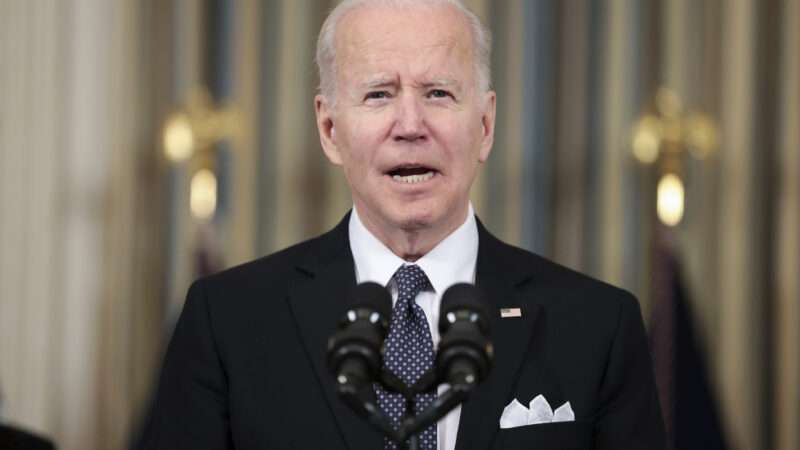
Biden’s Desperate Wealth Tax Flip-Flop


biden-wealth-tax-mic-sipaphotosthirteen292838

In December 2019, when Joe Biden, still campaigning for the Democratic presidential nomination, released his tax plan, much of the coverage focused on the contrast between his comparatively plan and the plans issued by his more progressive rivals. A CNBC report on his plan was labeled “wealth tax wars.” A Washington Post headline noted that  Biden’s $3.2 trillion tax plan highlighted “divisions” with Sens. Bernie Sanders (I–Vt.) and Elizabeth Warren (D–Mass.). Among the starkest of those divisions was that the former vice president had rejected calls by Warren and Sanders to back a wealth tax on the richest Americans. 

On the campaign trail, Biden himself played up that contrast. Among the criticisms lobbed at the Sanders and Warren wealth tax proposals was that they were fundamentally punitive, because they taxed wealth of a small, specific group of individuals. He told a wealthy crowd of supporters in Los Angeles that while they shouldn’t expect a tax cut from him, there would be “no punishment either.” 

Around the same time, a CNBC reporter asked Biden about arguments—some of which came from experts friendly to Democrats—that the wealth taxes proposed by his rivals would be unworkable and punitive. In response, Biden allowed that “parts of the plan, those objections apply.” He complained about divisive tax policy, and rejected the idea of a “a single tax, on a single group of people.” Earlier in the interview, Biden, without prompting, went out of his way to insist that “tax policy is not about punishment.” 

Biden was running as the moderate in the race. His goal was to separate himself from the progressives. So he rejected the idea of a tax policy that he saw as divisive, punitive, and potentially unworkable. 

Yet now, as president, Biden has embraced a wealth tax of his own. In his latest budget plan, Biden proposed something the White House has dubbed the “Billionaire Minimum Income Tax,” which applies to all income, realized and unrealized, for households worth more than $100 million. The Biden administration is framing this as a form of “prepayment” on future capital gains—which is to say it’s a form of taxation on money that someone has not actually seen, based on the value of their holdings. It’s not exactly the same as the wealth taxes proposed by Warren and Sanders, but it’s designed around the same fundamental idea: the taxation of personal wealth, rather than of cash income, which often takes the form of difficult-to-value assets. 

Most of the same criticisms that applied to the Warren and Sanders plans still apply: Biden’s plan probably wouldn’t raise nearly as much money as the administration assumes: Wealth taxes are exceptionally difficult and resource-intensive to administer, which is why most OECD countries that have implemented wealth taxes eventually dropped them. It’s also quite likely to be unconstitutional. At minimum, if it passed, it would be tied up in court.  

But of course, it’s not intended to pass, which makes this exercise even more of a charade. Biden’s latest wealth tax proposal is part of the White House’s annual budget proposal, which is always a sort of wish list rather than a realistic path forward for the budget. 

Biden’s wealth tax, then, is a desperate policy gimmick by a White House struggling with low approval numbers on the economy. Even Biden’s allies understand this. Late last year, his administration tried to convince congressional Democrats to include a wealth tax in one of the big spending bills. At the time, Speaker of the House Nancy Pelosi (D–Calif.) reportedly called it “a publicity stunt.” That’s exactly what this is. 

It’s a publicity stunt, however, that tells us something, not only about Biden’s leftward drift, but about his comportment as president, given his previously stated opposition to the idea.

Biden is willing to make an obvious phony of himself, embracing a policy he knows is punitive, divisive, unworkable, and virtually certain not to pass—and he’s willing to do so simply to get attention. Not only is Biden not a moderate, he is evidently not trustworthy either.

The post Biden's Desperate Wealth Tax Flip-Flop appeared first on Reason.com.

from Latest https://ift.tt/NulVCTa
via IFTTT

Important New Articles on Mootness and on Judge-made Law

Its the season for new formalist federal courts scholarship to appear on SSRN. I’ve previously mentioned my forthcoming piece on severability. But I’m also very proud to share two new pieces written by two of my recent students at Chicago, both important contributions to federal courts questions.

Here is Tyler Lindley, on the questions of whether “mootness” is a constitutional principle, akin to standing; and if so, on how the Court’s seemingly-prudential exceptions to mootness can be squared with Article III:

The Constitutional Model of Mootness

Article III limits the federal courts to deciding cases and controversies, and this limitation has given rise to the black-letter law of standing, ripeness, and mootness. But the law of mootness presents a puzzle: Over time, the Court has recognized various “exceptions” to ordinary mootness rules, allowing federal courts to hear arguably moot cases. On one hand, the Court consistently asserts that mootness doctrine, including its exceptions, is compelled by the original understanding of Article III. On the other hand, the scholarly consensus is that these exceptions are logically inconsistent with the Court’s claims about Article III and that their existence proves that mootness is fundamentally prudential, not constitutional.

This Article provides a coherent justification for the mootness exceptions. First, one set of exceptions are not really exceptions at all. Collateral consequences; voluntary cessation; and capable of repetition to the same plaintiff, yet evading review—these doctrines merely recognize a shift from a present harm to a potential future harm, which harm might be sufficiently likely to occur when examined in light of the Bayes Theorem. Second, the other set of exceptions, for class actions, are justified through a better understanding of the history of representative litigation. And that understanding also justifies the extension of the capable of repetition, yet evading review exception to non-parties who are similarly situated to the plaintiff. Modern mootness doctrine is therefore fundamentally consistent with the Court’s conception of the original understanding of Article III.

And here is Micah Quigley, on why it is unconstitutional for Article III courts to “make” law rather than to “find” it:

Article III Lawmaking

On the usual view, federal common law is judge-made by definition. Commentators and courts, of course, have long recognized the tension between judicial lawmaking and the Constitution’s scheme of separated powers. That concern is part of why federal common law governs only a few special areas. Yet within those areas, federal judges can and should act as lawmakers. Or so the story goes.

The Constitution says otherwise. Article III endows the judiciary with only the “judicial Power.” Historical evidence strongly suggests this phrase’s original meaning included no power to make law—not even common law. So if federal courts are to abide by the Constitution’s original meaning, they must quit making common law and start finding it instead.

If that is so, the courts need a lawfinding method. This Article—by looking to ancient principles of English law—provides one. Traditionally, common-law rules formed a web of continuous law; they enjoyed a measure of acceptance among the people; and they accommodated themselves to the nation’s extra-legal customs. Today’s federal courts can find law by identifying and applying rules that bear those same characteristics. Inversely, when courts fail to do so, they are likely attempting to make law.

This Article’s thesis and its lawfinding method have implications for the Supreme Court. The Court, its justices, and its doctrines sometimes operate on the assumption that judges can make common law. That this assumption usually goes unspoken does not make it constitutionally licit. Accordingly, recognizing the need for lawfinding may help clarify a variety of (sometimes-surprising) doctrinal areas—from admiralty, to habeas corpus, to nondelegation, and more.

It’s just great to see up-and-coming scholars making contributions in this area.


The post Important New Articles on Mootness and on Judge-made Law appeared first on Reason.com.

from Latest https://ift.tt/KfmaURo
via IFTTT

Taxpayers To Be Billed a Billion Dollars for Buffalo Bills’ New Stadium


teryll-kerrdouglas-MXuZLdGVKxA-unsplash

The NFL’s Buffalo Bills are probably most well-known for losing four consecutive Super Bowls in the late 1980s and early ’90s—a remarkable accomplishment ultimately overshadowed by historic failure.

Now, the Bills should once again earn a place in sporting infamy. On Monday, New York Gov. Kathy Hochul, a Democrat, announced that the team would receive what The New York Times calls the largest taxpayer-funded stadium subsidy in NFL history.

State and local taxpayers will contribute about $850 million toward the estimated $1.4 billion stadium project. Most of the public funds are coming from the state but Erie County, where the Bills’ new stadium will be built down the street from their current home, will contribute $250 million of the total. That’s a huge contribution from a local government that in 2021 spent a little more than $1.5 billion on its entire budget. The Bills owners, which include multi-billionaire Terry Pegula, are chipping in just $300 million while the NFL will cover the remaining $200 million with a loan to the team, according to the Times.

“It’s a great day for western New York and I’m really proud to negotiate such a good deal for the state and our many, many fans,” Hochul said, according to the Associated Press.

But if she really thinks this is a good deal, voters in New York may want to worry about Hochul’s judgment.

In fact, as Field of Schemes blogger Neil deMause parses in his detailed rundown of the stadium deal, the actual public subsidies probably exceed $1 billion—and that doesn’t account for things like interest payments on the borrowing that the state and county will likely have to do to finance the agreement. The fine print of Monday’s announcement, deMause notes, puts the public on the hook for $6 million annually for the next 30 years to fund upgrades to the stadium and another $6.6 million for the next 15 years to fund “maintenance and repair.” All told, that’s an extra $160 million in taxpayer funds pledged to the project beyond the $850 million price tag.

As usual, Hochul and other officials are promising that all this public spending is worth it because the stadium will provide an economic windfall to western New York. “New Yorkers can rest assured that their investment will be recouped by the economic activity the team generates,” Hochul said Monday.

That’s almost certainly not going to happen.

Just to make ends meet on the roughly $1 billion public costs, the stadium would have to generate about $70 million in new annual tax revenue over the next 30 years, deMause notes, for the same reason that paying off a mortgage over 30 years requires spending more than the sticker price for a house. The Bills and state officials have spent months waving around a study showing that the project will generate $27 million annually for the state and local governments, and Hochul cited that figure during Monday’s announcement. But even if you take that study at face value—and you probably shouldn’t—generating $27 million annually for 30 years isn’t enough for taxpayers to break even on the costs of the project.

Ah, but what about the jobs? Hochul touted the potential for the new stadium to create 10,000 jobs—but since the Bills are already located in Buffalo, any permanent jobs with the team are unlikely to be affected by the construction of a new stadium. So those are almost entirely going to be temporary construction jobs—jobs that will cost the public about $100,000 each.

This is what Hochul is calling a “good deal.”

There is at least one entity that agrees with the governor about that: Pegula Sports and Entertainment, the joint venture that owns the Bills. “This is a good investment for everyone,” Ron Raccuia, the Pegula Sports and Entertainment executive who led the Bills’ side of the negotiations, told the A.P.

But Hochul and the Bills’ billionaire team owners might not get such a warm reception from taxpayers or from the state’s legislature, which still has to approve the deal. State Rep. Ron Kim (D–Queens) issued a loud rebuke to the agreement via Twitter:

Rep. Tom Suozzi (D–N.Y.), the congressman who recently announced plans to run against Hochul in this year’s gubernatorial election, criticized Hochul for “forcing hard-working New Yorkers to fork over their tax dollars to help a billionaire donor get even richer. She’ll enjoy the new skybox leaving NYers saddled with higher taxes.” And Sochie Nnaemeka, director of New York’s Working Families Party, said public dollars should not be “subsidizing an oil billionaire’s new stadium.”

The real costs of the stadium deal are significant, of course—this would be the biggest public handout in NFL history, after all—but any assessment of the Bills’ new stadium deal must also consider the unseen costs. Any public spending is an exercise in priority setting because public resources are not unlimited. The decision to spend $1 billion on a stadium means that same $1 billion can’t be used for something else—or left in taxpayers’ wallets.

And, quite simply, there are a lot of things western New York probably needs more than an expensive new football stadium. The population of Buffalo is about half what it was when the Bills were founded in 1960. Some of those people are probably fleeing the region’s harsh winters, but most of them left to seek better economic opportunities elsewhere. New York’s combined state and local tax burden is the highest in the country, according to the Tax Foundation, a nonpartisan tax policy think tank, making the state a difficult place to work or start a business.

Which means that America’s most put-upon taxpayers are now being asked to foot the bill for the Bills’ billionaire owners’ new stadium. How does that make any sense?

“I’m disheartened, but not surprised, to see NY throwing an incredible amount of taxpayer money at a stadium for a franchise owned by billionaires,” says David Ditch, a longtime Bills fan and transportation policy analyst at the conservative Heritage Foundation. “Upstate N.Y. will always struggle to compete with less-frigid locales, but it doesn’t stand a chance when both the weather and business conditions are so much better in other states.”

Bills fans might have suffered through four straight Super Bowl losses and, in January, one of the most gut-punching playoff defeats in NFL history. Now Hochul wants to hit them in the wallets, too.

The post Taxpayers To Be Billed a Billion Dollars for Buffalo Bills' New Stadium appeared first on Reason.com.

from Latest https://ift.tt/xfD2rP3
via IFTTT

Internet Provider For Ukraine’s Military Hit In ‘Most Severe’ Cyberattack Since Invasion

Internet Provider For Ukraine’s Military Hit In ‘Most Severe’ Cyberattack Since Invasion

Ukraine says that one of its main internet service providers used by the country’s military was hit with a massive cyberattack on Monday as part of stepped up Russian efforts to unleash more in its tech arsenal to degrade Ukraine’s defense capabilities. 

Importantly the fresh attack was called among the worst Ukraine has suffered since the war’s start. The Wall Street Journal detailed that “The attack on Ukrtelecom PJSC was described by some experts as among the most harmful cyberattacks since the Russian invasion of Ukraine on Feb. 24. About 3:30 p.m. ET on Monday, Ukrainian officials said that they had repelled the attack, and that the company could restore services, according to a statement from Ukraine’s State Service of Special Communication and Information Protection, which is responsible for cybersecurity in the country.”

Image: Ukraine’s State Service of Special Communication and Information Protection

A US-based internet monitor observed that Ukrtelecom’s services began gradually dropping to customers over a period of hours, before going completely dark by five hours into the attack, impacting both the military and customers across the country.

Ultimately the military’s access was less impacted given the company took steps to restrict private side services. NetBlocks said it impacted the whole country, confirming that connectivity collapse to 13% of pre-war levels, in what would make it among the most severe since the invasion began.

Russia has consistently denied that it’s behind a series of cyberattacks over the past months, which happened even before the Feb.24 invasion. 

The State Service of Special Communication and Information Protection (SSSCIP) of Ukraine blamed “the enemy” for the Monday attack in a follow-up statement.

SSSCIP had said in a statement, “Today, the enemy launched a powerful cyberattack against Ukrtelecom ’s IT-infrastructure… In order to preserve its network infrastructure and to continue providing services to Ukraine’s Armed Forces and other military formations as well as to the customers, Ukrtelecom has temporarily limited providing its services to the majority of private users and business-clients.”

Tyler Durden
Tue, 03/29/2022 – 11:39

via ZeroHedge News https://ift.tt/veEkZs7 Tyler Durden

Taxpayers To Be Billed a Billion Dollars for Buffalo Bills’ New Stadium


teryll-kerrdouglas-MXuZLdGVKxA-unsplash

The NFL’s Buffalo Bills are probably most well-known for losing four consecutive Super Bowls in the late 1980s and early ’90s—a remarkable accomplishment ultimately overshadowed by historic failure.

Now, the Bills should once again earn a place in sporting infamy. On Monday, New York Gov. Kathy Hochul, a Democrat, announced that the team would receive what The New York Times calls the largest taxpayer-funded stadium subsidy in NFL history.

State and local taxpayers will contribute about $850 million toward the estimated $1.4 billion stadium project. Most of the public funds are coming from the state but Erie County, where the Bills’ new stadium will be built down the street from their current home, will contribute $250 million of the total. That’s a huge contribution from a local government that in 2021 spent a little more than $1.5 billion on its entire budget. The Bills owners, which include multi-billionaire Terry Pegula, are chipping in just $300 million while the NFL will cover the remaining $200 million with a loan to the team, according to the Times.

“It’s a great day for western New York and I’m really proud to negotiate such a good deal for the state and our many, many fans,” Hochul said, according to the Associated Press.

But if she really thinks this is a good deal, voters in New York may want to worry about Hochul’s judgment.

In fact, as Field of Schemes blogger Neil deMause parses in his detailed rundown of the stadium deal, the actual public subsidies probably exceed $1 billion—and that doesn’t account for things like interest payments on the borrowing that the state and county will likely have to do to finance the agreement. The fine print of Monday’s announcement, deMause notes, puts the public on the hook for $6 million annually for the next 30 years to fund upgrades to the stadium and another $6.6 million for the next 15 years to fund “maintenance and repair.” All told, that’s an extra $160 million in taxpayer funds pledged to the project beyond the $850 million price tag.

As usual, Hochul and other officials are promising that all this public spending is worth it because the stadium will provide an economic windfall to western New York. “New Yorkers can rest assured that their investment will be recouped by the economic activity the team generates,” Hochul said Monday.

That’s almost certainly not going to happen.

Just to make ends meet on the roughly $1 billion public costs, the stadium would have to generate about $70 million in new annual tax revenue over the next 30 years, deMause notes, for the same reason that paying off a mortgage over 30 years requires spending more than the sticker price for a house. The Bills and state officials have spent months waving around a study showing that the project will generate $27 million annually for the state and local governments, and Hochul cited that figure during Monday’s announcement. But even if you take that study at face value—and you probably shouldn’t—generating $27 million annually for 30 years isn’t enough for taxpayers to break even on the costs of the project.

Ah, but what about the jobs? Hochul touted the potential for the new stadium to create 10,000 jobs—but since the Bills are already located in Buffalo, any permanent jobs with the team are unlikely to be affected by the construction of a new stadium. So those are almost entirely going to be temporary construction jobs—jobs that will cost the public about $100,000 each.

This is what Hochul is calling a “good deal.”

There is at least one entity that agrees with the governor about that: Pegula Sports and Entertainment, the joint venture that owns the Bills. “This is a good investment for everyone,” Ron Raccuia, the Pegula Sports and Entertainment executive who led the Bills’ side of the negotiations, told the A.P.

But Hochul and the Bills’ billionaire team owners might not get such a warm reception from taxpayers or from the state’s legislature, which still has to approve the deal. State Rep. Ron Kim (D–Queens) issued a loud rebuke to the agreement via Twitter:

Rep. Tom Suozzi (D–N.Y.), the congressman who recently announced plans to run against Hochul in this year’s gubernatorial election, criticized Hochul for “forcing hard-working New Yorkers to fork over their tax dollars to help a billionaire donor get even richer. She’ll enjoy the new skybox leaving NYers saddled with higher taxes.” And Sochie Nnaemeka, director of New York’s Working Families Party, said public dollars should not be “subsidizing an oil billionaire’s new stadium.”

The real costs of the stadium deal are significant, of course—this would be the biggest public handout in NFL history, after all—but any assessment of the Bills’ new stadium deal must also consider the unseen costs. Any public spending is an exercise in priority setting because public resources are not unlimited. The decision to spend $1 billion on a stadium means that same $1 billion can’t be used for something else—or left in taxpayers’ wallets.

And, quite simply, there are a lot of things western New York probably needs more than an expensive new football stadium. The population of Buffalo is about half what it was when the Bills were founded in 1960. Some of those people are probably fleeing the region’s harsh winters, but most of them left to seek better economic opportunities elsewhere. New York’s combined state and local tax burden is the highest in the country, according to the Tax Foundation, a nonpartisan tax policy think tank, making the state a difficult place to work or start a business.

Which means that America’s most put-upon taxpayers are now being asked to foot the bill for the Bills’ billionaire owners’ new stadium. How does that make any sense?

“I’m disheartened, but not surprised, to see NY throwing an incredible amount of taxpayer money at a stadium for a franchise owned by billionaires,” says David Ditch, a longtime Bills fan and transportation policy analyst at the conservative Heritage Foundation. “Upstate N.Y. will always struggle to compete with less-frigid locales, but it doesn’t stand a chance when both the weather and business conditions are so much better in other states.”

Bills fans might have suffered through four straight Super Bowl losses and, in January, one of the most gut-punching playoff defeats in NFL history. Now Hochul wants to hit them in the wallets, too.

The post Taxpayers To Be Billed a Billion Dollars for Buffalo Bills' New Stadium appeared first on Reason.com.

from Latest https://ift.tt/xfD2rP3
via IFTTT

David Lat on Yale Law Dean’s Comments on the March 10 Incident

From his Original Jurisdiction today, an excerpt (though the whole thing is much worth reading):

Here’s what the policy—which Dean Gerken never quotes from in her message, oddly enough—actually provides: (1) “a university event, activity, or its regular or essential operations may not be disrupted”; (2) protesters “may not interfere with a speaker’s ability to speak or attendees’ ability to attend, listen and hear”; and (3) “[s]itting in or otherwise occupying a building in a way that blocks access or otherwise interferes with university events or operations” is not permitted.

The March 10 protesters broke all three of these rules. The protesters disrupted not just the FedSoc talk, “a university event,” but also the “regular operations” of YLS, including multiple classes and a faculty meeting (which actually was “shut down,” since it had to be moved to Zoom). The protesters interfered with both “a speaker’s ability to speak,” before they left Room 127, and the “attendees’ ability to listen and hear,” after they repaired to the hallway. Finally, the protesters blocked the main hallway of the Sterling Law Building. There is ample evidence, including audio recordings, video recordings, and eyewitness testimony, to support all of this.

The Yale free-speech policy also offers seven examples of prohibited conduct. The protesters engaged in at least six of them:

  • “Holding up signs in a manner that obstructs the view of those attempting to watch an event or speaker, regardless of the message expressed.”
  • “[S]houting… in a manner that interferes with speakers’ ability to be heard and of community members to listen, or disrupts or interferes with classes or other university activities.”
  • “Standing up in an assembly in a way that obstructs the view of those attempting to watch an event or speaker and/or blocking the aisles or routes of egress.”
  • “Sitting in or otherwise occupying a building in a way that blocks access or otherwise interferes with university events or operations.”
  • “Acting in ways that compromise the safety or bodily integrity of oneself or others.”
  • “Engaging in activities that are illegal or are prohibited in School or College regulations or policies.”

The fact that some of the prohibited conduct lasted for only a limited period of time is no defense; a violation occurs after the prohibited act has been committed. And again, there’s evidence to support all of this ….

The post David Lat on Yale Law Dean's Comments on the March 10 Incident appeared first on Reason.com.

from Latest https://ift.tt/0gev1iP
via IFTTT

The Secret of the Z Is Out

The post The Secret of the Z Is Out appeared first on Reason.com.

from Latest https://ift.tt/fdDAI7O
via IFTTT

David Lat on Yale Law Dean’s Comments on the March 10 Incident

From his Original Jurisdiction today, an excerpt (though the whole thing is much worth reading):

Here’s what the policy—which Dean Gerken never quotes from in her message, oddly enough—actually provides: (1) “a university event, activity, or its regular or essential operations may not be disrupted”; (2) protesters “may not interfere with a speaker’s ability to speak or attendees’ ability to attend, listen and hear”; and (3) “[s]itting in or otherwise occupying a building in a way that blocks access or otherwise interferes with university events or operations” is not permitted.

The March 10 protesters broke all three of these rules. The protesters disrupted not just the FedSoc talk, “a university event,” but also the “regular operations” of YLS, including multiple classes and a faculty meeting (which actually was “shut down,” since it had to be moved to Zoom). The protesters interfered with both “a speaker’s ability to speak,” before they left Room 127, and the “attendees’ ability to listen and hear,” after they repaired to the hallway. Finally, the protesters blocked the main hallway of the Sterling Law Building. There is ample evidence, including audio recordings, video recordings, and eyewitness testimony, to support all of this.

The Yale free-speech policy also offers seven examples of prohibited conduct. The protesters engaged in at least six of them:

  • “Holding up signs in a manner that obstructs the view of those attempting to watch an event or speaker, regardless of the message expressed.”
  • “[S]houting… in a manner that interferes with speakers’ ability to be heard and of community members to listen, or disrupts or interferes with classes or other university activities.”
  • “Standing up in an assembly in a way that obstructs the view of those attempting to watch an event or speaker and/or blocking the aisles or routes of egress.”
  • “Sitting in or otherwise occupying a building in a way that blocks access or otherwise interferes with university events or operations.”
  • “Acting in ways that compromise the safety or bodily integrity of oneself or others.”
  • “Engaging in activities that are illegal or are prohibited in School or College regulations or policies.”

The fact that some of the prohibited conduct lasted for only a limited period of time is no defense; a violation occurs after the prohibited act has been committed. And again, there’s evidence to support all of this ….

The post David Lat on Yale Law Dean's Comments on the March 10 Incident appeared first on Reason.com.

from Latest https://ift.tt/0gev1iP
via IFTTT

The Secret of the Z Is Out

The post The Secret of the Z Is Out appeared first on Reason.com.

from Latest https://ift.tt/fdDAI7O
via IFTTT

Are China & Saudi Arabia Selling Treasuries?

Are China & Saudi Arabia Selling Treasuries?

By Peter Tchir of Academy Securities

The Good News Out of the Ukraine

The good news is that Russia is sending all sorts of signals that their intent is now to focus on the Donbass and Eastern Ukraine. They seem to be pulling back from their attack on Kyiv. That is positive and dovetails nicely with peace talks scheduled to take place in Turkey.

The Questions on Ukraine

General (ret.) Walsh raised two questions on peace talks and the purported Russian pullback yesterday:

  • Have the casualties reached a point where Ukraine is willing to sacrifice this region now, when they weren’t willing to before the war? Since the Ukrainians are holding them at bay, that will be a difficult decision for Zelensky. Furthermore, the pretext that the Eastern part of Ukraine would welcome Russia has proven to be false, and one can only believe that many in the East want even less to do with Russia, now than they did before?

  • Is Russia just executing a better battle plan? Virtually every member of Academy’s Geopolitical Intelligence Group questioned how Russia carried out the initial assault (too few troops, too many points of attack, multiple extended supply chains, etc.). So is there a risk that Putin is biding his time, to take this region, secure his footing, and then resume pushing West?

The fact that senior Russian officials are commenting and that the Russian media is discussing it, are positive signs.

For now, it seems likely that we see more localized fighting, which is good, but too early to expect any sort of “business as usual” in the region.

Now We Can Focus on the Fed and Rates?

The potential “bad” news for markets is that we may now fully turn our attention to the Fed, rates and Quantitative tightening.

We hit on a lot of those subjects in this weekend’s “Collecting Our Thoughts” report.

The one that has sparked the most conversations since then is the possibility that some countries, like China and the Kingdom of Saudi Arabia are selling treasuries. Given the poor depth of liquidity and how much of the front-end selling seems to occur in the overnight sessions, this concept seems worth exploring. While we won’t get any TIC data that covers the post-invasion post-sanction world until May (there is a 2 month lag in the reporting), it would mean that much of the front end move can be explained by positioning and selling rather than anticipating all the rate hikes. It would explain why the front end hasn’t acted at all like a “risk-off” asset.

Higher treasury yields have been supportive for credit, as they should be, with “yield-bogey” buyers stepping in, but the resilience in stocks might be tested. Stocks are now almost done climbing the Russia wall of worry and might keep climbing the Fed wall of worry, but a lot of resilience has been priced in and the short squeeze has been quite painful, but positioning should be more balanced by now.

Tyler Durden
Tue, 03/29/2022 – 11:20

via ZeroHedge News https://ift.tt/v4mzsiH Tyler Durden