ADP Embarrasses Itself With ALmost A Million Job ‘Revision’ To January’s Dismal Data

ADP Embarrasses Itself With ALmost A Million Job ‘Revision’ To January’s Dismal Data

Following January’s dismal 300k job-loss ADP print, which was dramatically worse than the official BLS payrolls print, it appears the private employment survey has some catching up to do with analysts expecting a 375k jump in jobs in February.

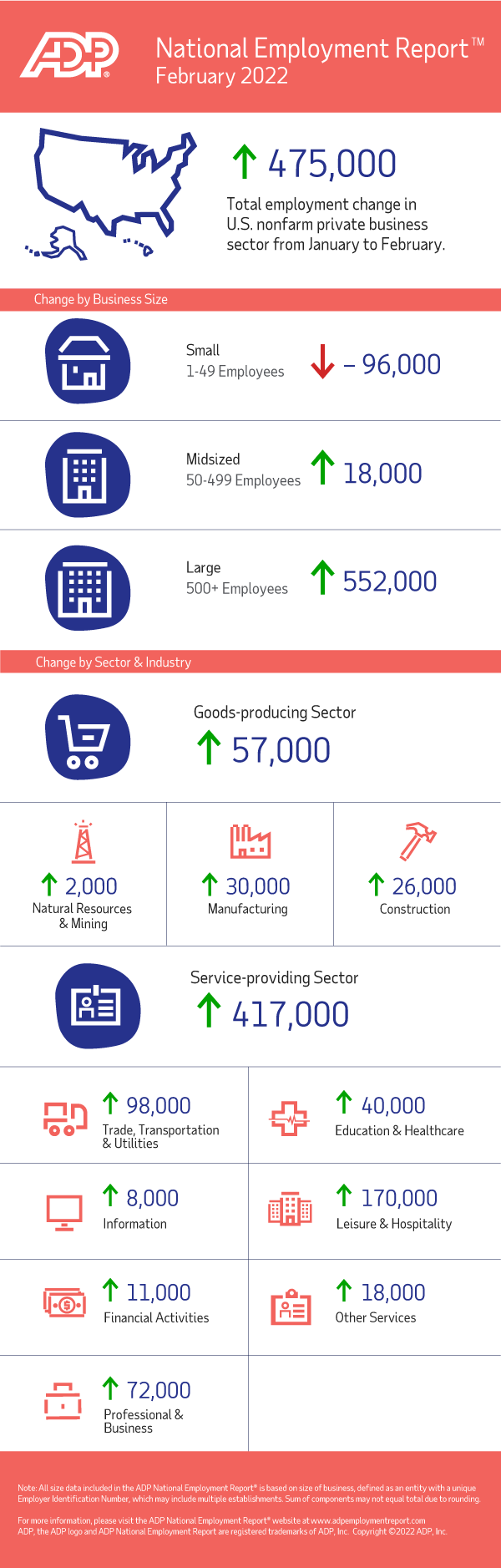
The good news, ADP reports US companies added 475k job in Feb (more than expected); but ADP embarrassed itself greatly with a simply unbelievable revision for January from the -301k initial print to a massive +509k print revised!!

Source: Bloomberg

This is the 14th straight month of job gains (given the revision in Dec), but small businesses saw sizable job losses in February and Services jobs dominated the gains.

“Hiring remains robust but capped by reduced labor supply post-pandemic. Last month large companies showed they are well-poised to compete with higher wages and benefit offerings, and posted the strongest reading since the early days of the pandemic recovery,” said Nela Richardson, chief economist, ADP.

“Small companies lost ground as they continue to struggle to keep pace with the wages and benefits needed to attract a limited pool of qualified workers.”

But we are sure president Biden’s plan to raise minimum wages to $15 will help that right?

Tyler Durden
Wed, 03/02/2022 – 08:26

via ZeroHedge News https://ift.tt/nNq9wzb Tyler Durden

If You’re Suing Just Me, You Can’t Get An Injunction Against My Wife

From yesterday’s decision in Jacoby v. Jacoby (Pa. Super. Ct.), written by Judge Carolyn Nichols and joined by Judges Mary Jane Bowes and James Gardner Colins:

Richard G. Jacoby, Jr. (Father) appeals from the trial court’s order that restricted the speech of his spouse, non-party Brena Jacoby (Stepmother). Father contends that the trial court’s order improperly restricted non-party Stepmother’s speech on a social media site. We vacate the order to the extent the order affects Stepmother….

Mother sought to enforce the court’s modified custody order, remove Child from Stepmother’s home, and place Child with Berks County Children and Youth Services (CYS). The trial court held a telephone hearing on June 17, 2021. At the hearing, Mother’s counsel notified the court for the first time about a post that Stepmother had made on Facebook. Specifically, Mother’s counsel explained: “Your Honor, there was a Facebook post by [Stepmother] basically saying that they’ve complied with all these orders, that this [c]ourt has gone rogue, that she keeps saying ‘our child.’ I mean, this is pure alienation. She should not be involved in this at all.” In contrast, Father’s counsel asserted that the post did not contain any information that was material to the custody dispute.

{We quote the Facebook post as follows:

OK…. I’m going to lay everything out for ppl to know. My husband [Father] is currently in BCP on indirect civil contempt pertaining to child custody. The judge won’t release [Father] until our minor child attends four days of this out of state program with Linda Gottlieb. The judge did not set a monetary value. Our minor child is afraid of her Mother (she lives out of state) and has been fighting not to go to this out-of-state program with her Mother to fix their relationship. There have been many attempts to have our minor child attend this program, to no avail. Her Mother had her attorney request that our child’s Father be incarcerated until our child attends at least 4 days of this out of state program. This happened on Monday. On Monday my husband was incarcerated. On Monday, CYS came to my house, and the State Troopers. Our minor child is still with me as she fought not to go. How much emotionally [sic] and mental abuse can a child go through. I cooperated 100%. This has been going on for years (2016). Our minor child has not been alone with her Mother in over 5 years. She is terrified to go with her. At this point, we have a biased Judge. He basically went rogue. I need help. I have 2 great attorneys, but no matter what we do the judge sides with the other side. They are claiming parental alienation. There is no legal record of parental alienation. Now anyone that knows me or my husband knows we aren’t those ppl. We have encouraged, positive affirmations etc.. [sic] this doesn’t matter to our minor child because the child is in fear. As some know I co-parent with my ex. We don’t have a court order or a child support order. We get along great. This has been a nightmare for us all, but especially for our child who has never been without [Father] in all of our child’s life. We have been accused of interfering with our child going to this program. We aren’t interfering. Our child is fighting it. How much more abuse can we all take, especially our child.

My husband owns a law firm and it is taking a hit because he is incarcerated for no reason.

We need help. We need help immediately.}

[T]he trial court issued an order that granted Mother’s petition and stated, in part, as follows:

… [Father] and [Stepmother] shall NOT use online or web-based communications to discuss this matter…. [Father] or [Stepmother] shall remove the Facebook post which contains information related to [Child] and shall not post any discussion or information regarding [Child’s] custody or other information regarding [Child]….

Father raises one issue on appeal: “May a trial court issue an order censoring speech of non-party Stepmother on social media relating to criticism of the trial court judge in the action[?]” …

[T]he instant trial court sua sponte pulled non-party Stepmother into this court proceeding by issuing an order against her without addressing the absence of original service of process for Stepmother….. Stepmother was not a party to the suit between Father and Mother, she was not served with process, and she had no notice or opportunity to challenge the communications restriction order.

Although personal jurisdiction is a waivable issue, non-party Stepmother did not have notice nor an opportunity to challenge the order, and the parties did not address the trial court’s exercise of personal jurisdiction over her…. [W]e … hold that the instant trial court had no personal jurisdiction over non-party Stepmother and therefore no authority to impose a communications restriction order against her. For these reasons, because the trial court committed legal error, we vacate the order to the extent the order identifies Stepmother, and because Father withdrew all of his other claims as discussed herein, we affirm in all other respects….

The post If You're Suing Just Me, You Can't Get An Injunction Against My Wife appeared first on Reason.com.

from Latest https://ift.tt/F3Voyhi
via IFTTT

The Trials of Rasmea Odeah, Part Four — Prosecution and Defense

This is my fourth post, of five, on The Trials of Rasmea Odeh.

Rasmea Odeh’s trial in the Eastern District of Michigan began on November 5, 2014. The presiding judge was Gershwin Drain, an African American appointed by President Obama, who had tried over 150 cases to verdict during his earlier career as a federal public defender. The defense had been optimistic when Judge Drain replaced Judge Paul Borman, who had recused himself when he discovered that his family held stock in Supersol’s parent company. They were soon disappointed when Judge Drain held that Odeh could not testify about her torture by Israeli interrogators. The only issue in the case was Odeh’s concealment of her conviction and imprisonment, he ruled, not the legitimacy of the Israeli criminal process. Deutsch lamented on Chicago Public Radio that the court had “cut the heart out of our defense.”

The prosecution case was uncomplicated, based almost entirely on digitally presented documents. The prosecution introduced Odeh’s visa and naturalization applications, highlighting the false answers to the questions about criminal convictions and imprisonment. The naturalization officer who conducted Odeh’s citizenship interview could not remember the details of the session in 2005, but she testified that she had always asked the same questions in-person, and that she would have flagged any changed or corrected answers on the form. Finally, the prosecution offered certified copies on the Israeli indictment, conviction, and sentence, along with a set of Odeh’s fingerprints, which had been produced pursuant to a Mutual Legal Assistance Treaty.

Still reeling from Drain’s pretrial ruling, the defense was not without stratagems. Deutsch repeatedly attempted to raise the torture issue in testimony and argument, at times drawing rebukes from the court.

Regarding the actual evidence, Odeh testified that the answers to the visa application had been given to her in English by her brother – who had passed away before trial – and she had simply copied them onto the form without understanding what they said. The cross examiner attempted to undermine her testimony, but Odeh insisted that she had only the barest knowledge of English at the time.

In the course of my research, I discovered evidence that Odeh had been lying, which was evidently unknown to the prosecution. Odeh graduated high school just before the Israeli occupation, and was sufficiently accomplished to be accepted to medical school. Her education had been under the Jordanian curriculum, which required daily English instruction beginning in fifth grade. By the time she graduated, she would have received over 2000 hours of English instruction. She also attended a year of medical school in Lebanon and graduated from law school in Jordan, both of which involved instruction in English. The claim that she could not read or understand the questions on a simple form was ridiculous, but the facts showing her language proficiency were not raised by the prosecution.

Odeh could not claim similar illiteracy regarding the naturalization form, because she had to pass an English proficiency test to obtain citizenship. Instead, her attorneys located a psychologist who put forward the novel theory that Odeh’s PTSD had resulted in a type of “automatic filtering” that caused her to misinterpret the questions.

The form asked these and several similar questions, boldface and capitalization original:

Have you EVER been charged with committing any crime or offense?

Have you EVER been convicted of any crime or offense?

Have you EVER been in jail or prison?

According to the defense psychologist, Odeh’s PTSD filter would have caused her to block her experiences in Israel and answer only about her life in the United States, when she had not gotten so much as a parking ticket. Therefore, although her denials were inaccurate, they were not intentional falsehoods.

I explored this theory myself, interviewing nationally prominent experts on PTSD and memory, again finding powerful evidence that had eluded the prosecution.

How did the filtering theory fare in court? That will be the subject of tomorrow’s post.

The post The Trials of Rasmea Odeah, Part Four — Prosecution and Defense appeared first on Reason.com.

from Latest https://ift.tt/FCS1Wop
via IFTTT

The Trials of Rasmea Odeh, Part Three — Immigration and Indictment

This is the third of five posts on The Trials of Rasmea Odeh.

Rasmea Odeh’s PFLP comrades made numerous attempts to coerce her freedom through hijackings and hostage taking. In 1970, the quadruple airplane hijackings of “Black September” were carried out in the name of “Task Force Rasmea Odeh.” Her freedom was again sought in a foiled hijacking in May 1972, and her name was on the list of prisoners whose release was demanded by the guerrillas who carried out the massacre at the 1972 Munich Olympics. The PFLP was finally successful in March 1979, when the Israelis released 76 prisoners, Odeh among them, in exchange for an IDF soldier captured in Lebanon.

Odeh’s release was celebrated by a full-page poem in the PFLP magazine, which praised her for having joined “the troops of the revolution” with “a prophecy of the gun.” She settled in Amman, Jordan, where she obtained a law degree and worked as a university researcher, calling it “the best period in my life.”

There was no reason for Odeh to deny the Jerusalem bombing while living in Amman. She was admired as among first four Palestinian women to be “an active guerrilla,” and she freely discussed her PFLP “military work” with interviewers from Lebanon and the U.S., as well as on Jordanian television.

Everything changed in 1996 when Odeh’s family asked her to move to the U.S., to help her brother care for their cancer-stricken father, both of whom had become U.S. citizens. Odeh fraudulently obtained a family unification visa by lying on the application. She falsely denied ever having committed a crime, claimed she had never belonged to any organizations, and denied ever having been arrested, convicted, or imprisoned.

Ultimately settling in Chicago, Odeh led a peaceful and admirable life as a community organizer, eventually becoming associate director of the Arab American Action Network. Her writing workshops for immigrant women were funded by a grant from the University of Illinois. The Chicago Cultural Alliance gave her an award as an “Outstanding Community Leader,” unaware of her background as a PFLP bomber. She lied in her naturalization application and interview, denying that she had ever been convicted or imprisoned, and became a U.S. citizen in 2005.

Odeh’s citizenship fraud was discovered by accident during the FBI investigation of one of her coworkers. She was indicted on one count of fraudulently procuring U.S. citizenship in late 2013. Following arraignment in Chicago, her case was set for trial in Detroit, where her naturalization interview had taken place.

Chicago’s Arab and Muslim community reacted almost immediately to Odeh’s arrest. Within days, the AAAN issued a statement signed by over 50 organizations, charging that the indictment was a plot by “Israel and its supporters” to suppress the Palestinian movement in the U.S.

Progressive, leftist, and mainstream organizations, including the Peace and Justice Committee of the Episcopal Diocese of Chicago, also rallied to Odeh’s defense. Either cynically or credulously, they spread false stories about the case. They claimed that Odeh had been arrested in Israel only for anti-occupation “activism,” asserting her innocence of the bombing, and exaggerating the duration and nature of her mistreatment in custody. The AAAN and other leftist groups repeatedly insisted that Odeh’s arrest was part of an Israel-inspired conspiracy to crush the Palestinian movement in the U.S.

Odeh’s representation was undertaken by two veterans of Chicago’s leftist bar, both stalwarts of the National Lawyers Guild. Michael Deutsch, a founder of the legendary Peoples Law Office, had represented Black Panthers, SDS Weathermen, and survivors of the Attica prisoners’ rebellion. His co-counsel James Fennerty got his start representing the American Indian Movement at Wounded Knee.

Together, Deutsch and Fennerty presented a vigorous defense, never straying far from the Israel conspiracy theory, and only loosely tethered to the actual facts, which will be the subject of my final post.

The post The Trials of Rasmea Odeh, Part Three — Immigration and Indictment appeared first on Reason.com.

from Latest https://ift.tt/kqyv1QF
via IFTTT

A Dubious Expediency

If you haven’t checked it out already, please take a look at A Dubious Expediency: How Race Preferences Damage Higher Education (edited by Maimon Schwarzschild and yours truly).

The theme is just what the title suggests—that admissions policies that give preferential treatment to under-represented minorities have not been good for colleges and universities (or indeed for anyone, very much including the policies’ intended beneficiaries). The book contains eight fact-filled essays. Among the authors are John Ellis, Lance Izumi & Rowena Itchon, Peter Kirsanow, Heather Mac Donald, Maimon Schwarzschild, and Peter Wood. I have two essays in it. One is mine alone. The other was co-authored by Carissa Mulder.

The title comes from one of my favorite left-of-center jurists—Stanley Mosk. He wrote the majority opinion in the California Supreme Court’s decision in Bakke v. Regents of the University of California (1976), which (unlike the U.S. Supreme Court’s fractured 1978 decision in the same case) was unequivocal in holding race-preferential admissions to be a violation of the law. As Mosk put it in 1976, To uphold the [argument for race-preferential admissions] would call for the sacrifice of principle for the sake of dubious expediency and would represent a retreat in the struggle to assure that each man and woman shall be judged on the basis of individual merit alone, a struggle which has only lately achieved success in removing legal barriers to racial equality.”

Mosk’s credentials as a liberal and a civil libertarian were impeccable. He’d been an effective advocate for civil rights long before it became fashionable and stuck his neck out for them several times. Yet beginning with the Bakke case, he lost favor with the Left. It’s funny how that works.

With the Supreme Court’s decision to review Students for Fair Admissions v. President and Fellows of Harvard College (No. 20-1199) and Students for Fair Admissions v. University of North Carolina (No. 21-707), the book is getting some additional attention.

Amicus briefs in those cases in support of the petitioner (or in support of neither party) are due in early May. If you are so inclined, there is still plenty of time to write one. And A Dubious Expediency will give you food for thought if you’re not yet sure exactly what you’d like to cover.  Don’t be shy.  What the country needs now is more lawyers with at least half the civil courage that Stanley Mosk had.

The post A Dubious Expediency appeared first on Reason.com.

from Latest https://ift.tt/s0htE7F
via IFTTT

If You’re Suing Just Me, You Can’t Get An Injunction Against My Wife

From yesterday’s decision in Jacoby v. Jacoby (Pa. Super. Ct.), written by Judge Carolyn Nichols and joined by Judges Mary Jane Bowes and James Gardner Colins:

Richard G. Jacoby, Jr. (Father) appeals from the trial court’s order that restricted the speech of his spouse, non-party Brena Jacoby (Stepmother). Father contends that the trial court’s order improperly restricted non-party Stepmother’s speech on a social media site. We vacate the order to the extent the order affects Stepmother….

Mother sought to enforce the court’s modified custody order, remove Child from Stepmother’s home, and place Child with Berks County Children and Youth Services (CYS). The trial court held a telephone hearing on June 17, 2021. At the hearing, Mother’s counsel notified the court for the first time about a post that Stepmother had made on Facebook. Specifically, Mother’s counsel explained: “Your Honor, there was a Facebook post by [Stepmother] basically saying that they’ve complied with all these orders, that this [c]ourt has gone rogue, that she keeps saying ‘our child.’ I mean, this is pure alienation. She should not be involved in this at all.” In contrast, Father’s counsel asserted that the post did not contain any information that was material to the custody dispute.

{We quote the Facebook post as follows:

OK…. I’m going to lay everything out for ppl to know. My husband [Father] is currently in BCP on indirect civil contempt pertaining to child custody. The judge won’t release [Father] until our minor child attends four days of this out of state program with Linda Gottlieb. The judge did not set a monetary value. Our minor child is afraid of her Mother (she lives out of state) and has been fighting not to go to this out-of-state program with her Mother to fix their relationship. There have been many attempts to have our minor child attend this program, to no avail. Her Mother had her attorney request that our child’s Father be incarcerated until our child attends at least 4 days of this out of state program. This happened on Monday. On Monday my husband was incarcerated. On Monday, CYS came to my house, and the State Troopers. Our minor child is still with me as she fought not to go. How much emotionally [sic] and mental abuse can a child go through. I cooperated 100%. This has been going on for years (2016). Our minor child has not been alone with her Mother in over 5 years. She is terrified to go with her. At this point, we have a biased Judge. He basically went rogue. I need help. I have 2 great attorneys, but no matter what we do the judge sides with the other side. They are claiming parental alienation. There is no legal record of parental alienation. Now anyone that knows me or my husband knows we aren’t those ppl. We have encouraged, positive affirmations etc.. [sic] this doesn’t matter to our minor child because the child is in fear. As some know I co-parent with my ex. We don’t have a court order or a child support order. We get along great. This has been a nightmare for us all, but especially for our child who has never been without [Father] in all of our child’s life. We have been accused of interfering with our child going to this program. We aren’t interfering. Our child is fighting it. How much more abuse can we all take, especially our child.

My husband owns a law firm and it is taking a hit because he is incarcerated for no reason.

We need help. We need help immediately.}

[T]he trial court issued an order that granted Mother’s petition and stated, in part, as follows:

… [Father] and [Stepmother] shall NOT use online or web-based communications to discuss this matter…. [Father] or [Stepmother] shall remove the Facebook post which contains information related to [Child] and shall not post any discussion or information regarding [Child’s] custody or other information regarding [Child]….

Father raises one issue on appeal: “May a trial court issue an order censoring speech of non-party Stepmother on social media relating to criticism of the trial court judge in the action[?]” …

[T]he instant trial court sua sponte pulled non-party Stepmother into this court proceeding by issuing an order against her without addressing the absence of original service of process for Stepmother….. Stepmother was not a party to the suit between Father and Mother, she was not served with process, and she had no notice or opportunity to challenge the communications restriction order.

Although personal jurisdiction is a waivable issue, non-party Stepmother did not have notice nor an opportunity to challenge the order, and the parties did not address the trial court’s exercise of personal jurisdiction over her…. [W]e … hold that the instant trial court had no personal jurisdiction over non-party Stepmother and therefore no authority to impose a communications restriction order against her. For these reasons, because the trial court committed legal error, we vacate the order to the extent the order identifies Stepmother, and because Father withdrew all of his other claims as discussed herein, we affirm in all other respects….

The post If You're Suing Just Me, You Can't Get An Injunction Against My Wife appeared first on Reason.com.

from Latest https://ift.tt/F3Voyhi
via IFTTT

The Trials of Rasmea Odeah, Part Four — Prosecution and Defense

This is my fourth post, of five, on The Trials of Rasmea Odeh.

Rasmea Odeh’s trial in the Eastern District of Michigan began on November 5, 2014. The presiding judge was Gershwin Drain, an African American appointed by President Obama, who had tried over 150 cases to verdict during his earlier career as a federal public defender. The defense had been optimistic when Judge Drain replaced Judge Paul Borman, who had recused himself when he discovered that his family held stock in Supersol’s parent company. They were soon disappointed when Judge Drain held that Odeh could not testify about her torture by Israeli interrogators. The only issue in the case was Odeh’s concealment of her conviction and imprisonment, he ruled, not the legitimacy of the Israeli criminal process. Deutsch lamented on Chicago Public Radio that the court had “cut the heart out of our defense.”

The prosecution case was uncomplicated, based almost entirely on digitally presented documents. The prosecution introduced Odeh’s visa and naturalization applications, highlighting the false answers to the questions about criminal convictions and imprisonment. The naturalization officer who conducted Odeh’s citizenship interview could not remember the details of the session in 2005, but she testified that she had always asked the same questions in-person, and that she would have flagged any changed or corrected answers on the form. Finally, the prosecution offered certified copies on the Israeli indictment, conviction, and sentence, along with a set of Odeh’s fingerprints, which had been produced pursuant to a Mutual Legal Assistance Treaty.

Still reeling from Drain’s pretrial ruling, the defense was not without stratagems. Deutsch repeatedly attempted to raise the torture issue in testimony and argument, at times drawing rebukes from the court.

Regarding the actual evidence, Odeh testified that the answers to the visa application had been given to her in English by her brother – who had passed away before trial – and she had simply copied them onto the form without understanding what they said. The cross examiner attempted to undermine her testimony, but Odeh insisted that she had only the barest knowledge of English at the time.

In the course of my research, I discovered evidence that Odeh had been lying, which was evidently unknown to the prosecution. Odeh graduated high school just before the Israeli occupation, and was sufficiently accomplished to be accepted to medical school. Her education had been under the Jordanian curriculum, which required daily English instruction beginning in fifth grade. By the time she graduated, she would have received over 2000 hours of English instruction. She also attended a year of medical school in Lebanon and graduated from law school in Jordan, both of which involved instruction in English. The claim that she could not read or understand the questions on a simple form was ridiculous, but the facts showing her language proficiency were not raised by the prosecution.

Odeh could not claim similar illiteracy regarding the naturalization form, because she had to pass an English proficiency test to obtain citizenship. Instead, her attorneys located a psychologist who put forward the novel theory that Odeh’s PTSD had resulted in a type of “automatic filtering” that caused her to misinterpret the questions.

The form asked these and several similar questions, boldface and capitalization original:

Have you EVER been charged with committing any crime or offense?

Have you EVER been convicted of any crime or offense?

Have you EVER been in jail or prison?

According to the defense psychologist, Odeh’s PTSD filter would have caused her to block her experiences in Israel and answer only about her life in the United States, when she had not gotten so much as a parking ticket. Therefore, although her denials were inaccurate, they were not intentional falsehoods.

I explored this theory myself, interviewing nationally prominent experts on PTSD and memory, again finding powerful evidence that had eluded the prosecution.

How did the filtering theory fare in court? That will be the subject of tomorrow’s post.

The post The Trials of Rasmea Odeah, Part Four — Prosecution and Defense appeared first on Reason.com.

from Latest https://ift.tt/FCS1Wop
via IFTTT

The Trials of Rasmea Odeh, Part Three — Immigration and Indictment

This is the third of five posts on The Trials of Rasmea Odeh.

Rasmea Odeh’s PFLP comrades made numerous attempts to coerce her freedom through hijackings and hostage taking. In 1970, the quadruple airplane hijackings of “Black September” were carried out in the name of “Task Force Rasmea Odeh.” Her freedom was again sought in a foiled hijacking in May 1972, and her name was on the list of prisoners whose release was demanded by the guerrillas who carried out the massacre at the 1972 Munich Olympics. The PFLP was finally successful in March 1979, when the Israelis released 76 prisoners, Odeh among them, in exchange for an IDF soldier captured in Lebanon.

Odeh’s release was celebrated by a full-page poem in the PFLP magazine, which praised her for having joined “the troops of the revolution” with “a prophecy of the gun.” She settled in Amman, Jordan, where she obtained a law degree and worked as a university researcher, calling it “the best period in my life.”

There was no reason for Odeh to deny the Jerusalem bombing while living in Amman. She was admired as among first four Palestinian women to be “an active guerrilla,” and she freely discussed her PFLP “military work” with interviewers from Lebanon and the U.S., as well as on Jordanian television.

Everything changed in 1996 when Odeh’s family asked her to move to the U.S., to help her brother care for their cancer-stricken father, both of whom had become U.S. citizens. Odeh fraudulently obtained a family unification visa by lying on the application. She falsely denied ever having committed a crime, claimed she had never belonged to any organizations, and denied ever having been arrested, convicted, or imprisoned.

Ultimately settling in Chicago, Odeh led a peaceful and admirable life as a community organizer, eventually becoming associate director of the Arab American Action Network. Her writing workshops for immigrant women were funded by a grant from the University of Illinois. The Chicago Cultural Alliance gave her an award as an “Outstanding Community Leader,” unaware of her background as a PFLP bomber. She lied in her naturalization application and interview, denying that she had ever been convicted or imprisoned, and became a U.S. citizen in 2005.

Odeh’s citizenship fraud was discovered by accident during the FBI investigation of one of her coworkers. She was indicted on one count of fraudulently procuring U.S. citizenship in late 2013. Following arraignment in Chicago, her case was set for trial in Detroit, where her naturalization interview had taken place.

Chicago’s Arab and Muslim community reacted almost immediately to Odeh’s arrest. Within days, the AAAN issued a statement signed by over 50 organizations, charging that the indictment was a plot by “Israel and its supporters” to suppress the Palestinian movement in the U.S.

Progressive, leftist, and mainstream organizations, including the Peace and Justice Committee of the Episcopal Diocese of Chicago, also rallied to Odeh’s defense. Either cynically or credulously, they spread false stories about the case. They claimed that Odeh had been arrested in Israel only for anti-occupation “activism,” asserting her innocence of the bombing, and exaggerating the duration and nature of her mistreatment in custody. The AAAN and other leftist groups repeatedly insisted that Odeh’s arrest was part of an Israel-inspired conspiracy to crush the Palestinian movement in the U.S.

Odeh’s representation was undertaken by two veterans of Chicago’s leftist bar, both stalwarts of the National Lawyers Guild. Michael Deutsch, a founder of the legendary Peoples Law Office, had represented Black Panthers, SDS Weathermen, and survivors of the Attica prisoners’ rebellion. His co-counsel James Fennerty got his start representing the American Indian Movement at Wounded Knee.

Together, Deutsch and Fennerty presented a vigorous defense, never straying far from the Israel conspiracy theory, and only loosely tethered to the actual facts, which will be the subject of my final post.

The post The Trials of Rasmea Odeh, Part Three — Immigration and Indictment appeared first on Reason.com.

from Latest https://ift.tt/kqyv1QF
via IFTTT
A Dubious Expediency

If you haven’t checked it out already, please take a look at A Dubious Expediency: How Race Preferences Damage Higher Education (edited by Maimon Schwarzschild and yours truly).

The theme is just what the title suggests—that admissions policies that give preferential treatment to under-represented minorities have not been good for colleges and universities (or indeed for anyone, very much including the policies’ intended beneficiaries). The book contains eight fact-filled essays. Among the authors are John Ellis, Lance Izumi & Rowena Itchon, Peter Kirsanow, Heather Mac Donald, Maimon Schwarzschild, and Peter Wood. I have two essays in it. One is mine alone. The other was co-authored by Carissa Mulder.

The title comes from one of my favorite left-of-center jurists—Stanley Mosk. He wrote the majority opinion in the California Supreme Court’s decision in Bakke v. Regents of the University of California (1976), which (unlike the U.S. Supreme Court’s fractured 1978 decision in the same case) was unequivocal in holding race-preferential admissions to be a violation of the law. As Mosk put it in 1976, To uphold the [argument for race-preferential admissions] would call for the sacrifice of principle for the sake of dubious expediency and would represent a retreat in the struggle to assure that each man and woman shall be judged on the basis of individual merit alone, a struggle which has only lately achieved success in removing legal barriers to racial equality.”

Mosk’s credentials as a liberal and a civil libertarian were impeccable. He’d been an effective advocate for civil rights long before it became fashionable and stuck his neck out for them several times. Yet beginning with the Bakke case, he lost favor with the Left. It’s funny how that works.

With the Supreme Court’s decision to review Students for Fair Admissions v. President and Fellows of Harvard College (No. 20-1199) and Students for Fair Admissions v. University of North Carolina (No. 21-707), the book is getting some additional attention.

Amicus briefs in those cases in support of the petitioner (or in support of neither party) are due in early May. If you are so inclined, there is still plenty of time to write one. And A Dubious Expediency will give you food for thought if you’re not yet sure exactly what you’d like to cover.  Don’t be shy.  What the country needs now is more lawyers with at least half the civil courage that Stanley Mosk had.

The post A Dubious Expediency appeared first on Reason.com.

from Latest https://ift.tt/s0htE7F
via IFTTT

Oil Surges Into ‘Super-Backwardation’ After OPEC+ Sticks To Production Plan, Shuns Biden’s Demands

Oil Surges Into ‘Super-Backwardation’ After OPEC+ Sticks To Production Plan, Shuns Biden’s Demands

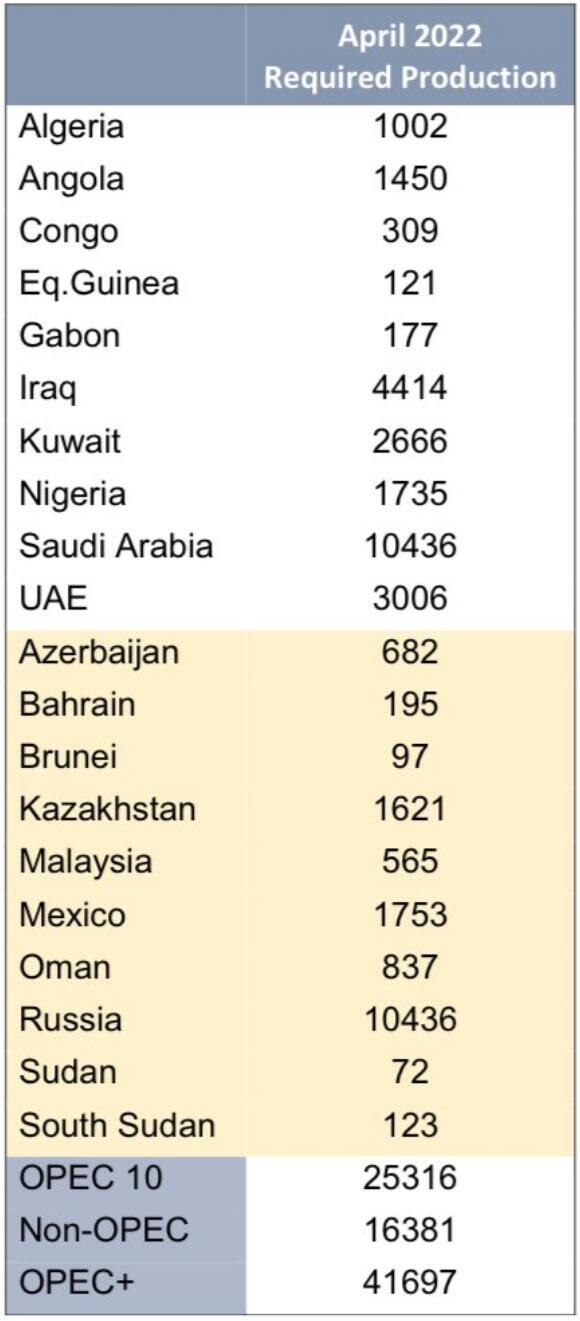
In what one observer called “the fastest one yet” – the meeting lasted just 13 minutes, beating last month’s record for brevity – OPEC+ 23-nation coalition led by Saudi Arabia ratified an increase of 400,000 barrels a day on Wednesday, continuing the gradual restoration of output halted during the pandemic, according to delegate sources.

This was merely ratifying the plan – as expected – and notably gives no deference to President Biden’s urgings for the cartel to raise production to rescue his approval ratings at home.

The quota breakdown is as follows:

Source: @Amena_Bakr

Have tried twice yesterday to send headlines around the world of a 60mm barrel release from global strategic reserves, and now OPEC+ not helping, oil prices are re-extending gains this morning with WTI back above $110…

Additionally, this has all sent WTI and Brent time-spreads into what is being called ‘super-backwardation’ as WTI M1-M6 spreads explode to record highs suggesting the tightness of current oil markets is becoming extreme…

Are you ready for $4 gas at the pump, America?

Get back to work Mr.President.

Tyler Durden
Wed, 03/02/2022 – 08:06

via ZeroHedge News https://ift.tt/3YzZegW Tyler Durden