Brickbat: Gang Squad


avillanueva_1161x653

In a letter to Sheriff Alex Villanueva, Los Angeles County Inspector General Max Hunstman claimed his office has compiled a list of 41 deputies who are members  of “gang-like” organizations, including the Banditos and the Executioners. The letter did not name any of the deputies. In a statement, the sheriff’s department said Huntsman “failed to provide any actual evidence or new information.” “This is another irresponsible attempt from Mr. Huntsman to discredit the organization, through omission and misrepresentation,” the statement said.

The post Brickbat: Gang Squad appeared first on Reason.com.

from Latest https://ift.tt/j2TCfX5
via IFTTT

#GotGoldorRubles? Did Russia Just Break The Back Of The West?

#GotGoldorRubles? Did Russia Just Break The Back Of The West?

Authored by Tom Luongo via Gold, Goats, ‘n Guns blog,

I don’t think everyone has yet caught the significance of Russia announcing they are putting a floor under the price of gold.  

But, to be clear, Russia just broke the paper gold suppression scheme.
On Friday the Bank of Russia announced:

RUB5000 to the ounce at an exchange rate of 100 RUB/USD implies a $1550 per ounce gold price.

For a few days previous to this announcement, which they knew was coming, The West was running around with multiple bits of legislation to try and keep the Russians from selling their gold.

The G7 think the sanctions are hitting so hard that Putin will be forced to sell his gold to evade sanctions to pay for things.  They are literally running a script in their heads that is not actually playing out in the real world.

But, whatever, Neocons never met an ugly stick that they didn’t want to use to beat someone over the head with.  Too bad all they’re doing is hitting a rubber tire.

Boing!

Because here’s the gig, Russia won’t be selling any gold. They’re buying it.

These are supposed to be the architects of the global monetary system and you would think they are the ones that understand it the best.  But, clearly they do not.

What they think they understand is that they still control the flow of commodities around the world through price suppression schemes on the CRIMEX, LBMA and ICE.

They do not.

Ultimately, ‘outside money’ trumps ‘inside money.’  

Austrians, like myself, have always understood that eventually Inside Money [money that exists within the financial system] fails because it is ultimately nothing more than a Ponzi Scheme built on top of Outside Money — money that exists outside the financial system, like commodities and bitcoin.

Money, It’s a Hit!

Let’s start with the basics. Why do we create money? To act as a way to mitigate the time risk between selling what we have and buying what we want. So we sell our labor today to buy gasoline, printer paper or blow jobs tomorrow. In the meantime we hold money.

It is a way to turn thought and personal application of energy and time into a token which can procure for us real goods in the real world.

With that in mind, now think about the current financial system where all inside money is created by first selling a debt instrument to someone willing to hold it for a vig.

Back to the ruble and gold. Because once I lay out the new incentive structure it will be clear as to why the G7 has no friends in this fight anymore.  

Davos’ power rests on the ability to create credit and sell it at a positive interest carry to commodity producers.  Since base commodity production in any kind of efficient market should be a very low margin enterprise, think 1-4% real annual return, selling them debt to extract oil or gold out of the ground at higher rates than that ultimately sucks all the profit out of the venture.

Free markets when allowed to function properly grind out profit through competitive arbitrage. It is both brutal and the spark of new innovations and efficiencies.

It is the desire for higher profits over baseline that does this.

In base commodities that is difficult, at best, to do. Why? Because they aren’t anything more than a second order good. First order would be the ore or timber harvested. Second order would be the ingot or lumber produced. The higher order the good, the more specialized it is and the higher opportunity for profit through product differentiation on something other than price emerges.

That’s most difficult to do in improving resource extraction because, it follows, most of the major gains in efficiency occurred in the past when the economy was less specialized.

Confusion Over ‘The System’

If the banks are on both sides of the trade setting the price of money, then they ultimately control who wins and who loses while this goes on. And let’s not mince words, it’s them. The profit rolls up to those that produce the highest order goods with the most complex supply chains.

The banks plough the profits from getting interest on the original debt into the very companies producing the higher order goods needed to ensure the lower order goods produce no wealth through the grinding out of profit via arbitrage throughout the supply chain.

Don’t believe me? Ask cattle farmers.

In this respect the current financing of these industries is nothing more than a virtualized version of the colonial economic model of the 15th through 19th centuries.

Instead of using physical men to subjugate the locals through superior weaponry and bribes to get them to extract the mineral wealth which the colonialists take back home, today we use the post-WWII institutions to run that same system through debt issuance for capex and the interest payments (in this case pure economic rent – unearned wealth).

The producer countries of all the mineral wealth in the world are nothing but debt slaves to the money masters in Brussels, City of London and New York.  That’s the gig.

Since we’ve reached the point of debt saturation where no more debt can be issued to extract mineral wealth and have the markets believe it could ever be paid back at these real yields, the system has to be reset.

The whole Great Reset is a way to crash the existing system but leave the same colonialists in power legally.

It’s not really more complicated than that.

When you understand that dynamic now you can understand why Russia, in particular, is the vanguard of the Global South’s desire to change the System of the World.
It is also the one country that has the commodity production power to expose the vulnerabilities of this System.

That’s Nice… #GotRubles?

And that’s where pegging the ruble to gold comes in.

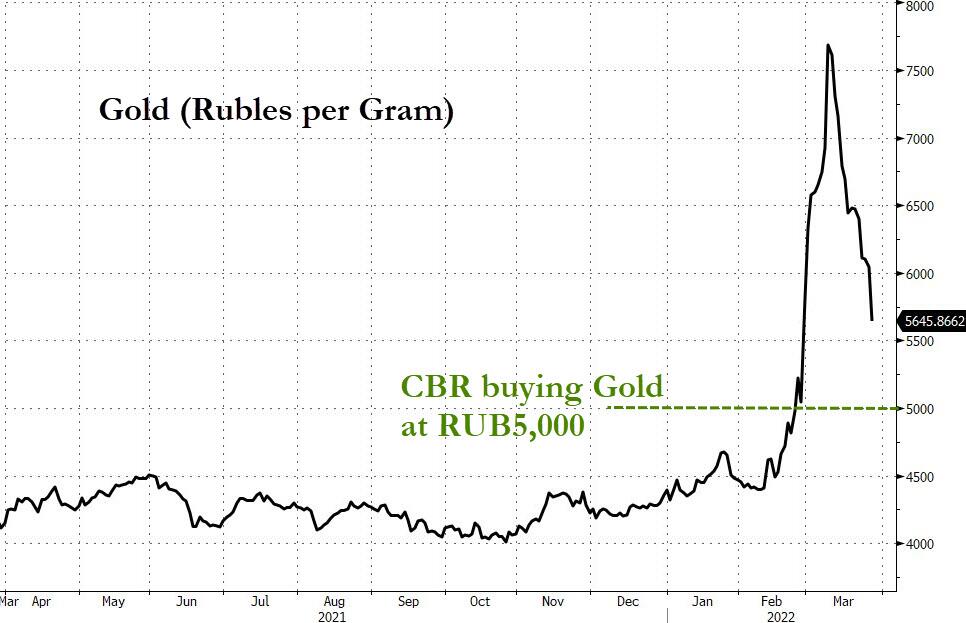
The Bank of Russia is now a buyer of gold at 5000 rubles to the gram, or 155,500 rubles to the troy ounce.  At a Friday March 25th closing price of RUB96.62 vs. the USD that implies a gold price of $1610 per ounce.
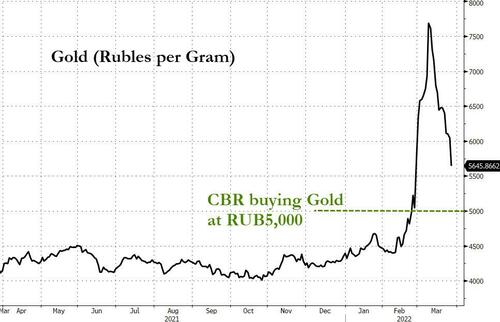
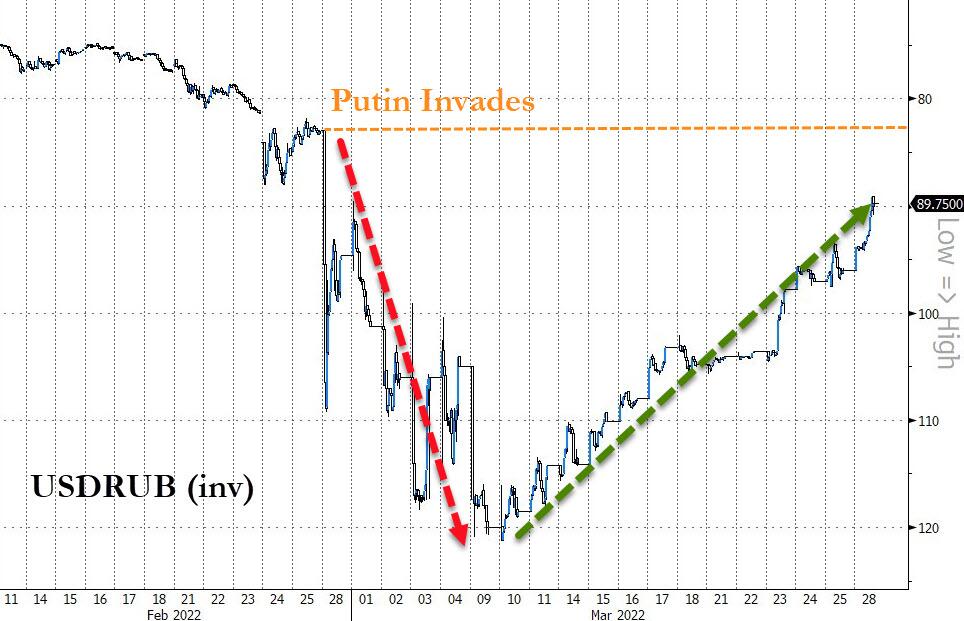
The ruble is now freely strengthening versus the US dollar.
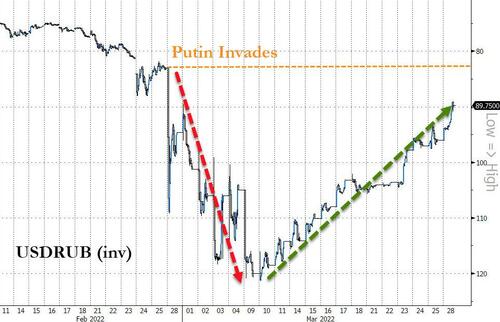
Now, that is not that remarkable on its own. 

As I explained on Twitter that day:

  • 1: At $1550 per ounce the first order effect here is that is implies a RUB/USD rate of around 75. Incentivizing those holding RUB to continue and those needing them to bid up the price from current levels.

  • 2: This creates a positive incentive loop to bring the ruble back to pre-war levels.  Then after that market effects take over as ruble demand becomes structural, based on Russia’s trade balance.

  • 3: Once that happens and the RUB/USD falls below 75, then the USD price of gold rises structurally draining the paper gold markets and collapsing the financial system based on leveraged/hypothecated gold.  Now we’re into the arb. phase @Lukegromen postulated w/ 1000bbls/oz.

So, this scheme incentivizes Russians to hold savings in rubles, because the ruble is undervalued.  It also incentivizes foreign traders to hold rubles because the ruble is undervalued relative to an overvalued open gold price.

Clearly currency speculators in Moscow, Shanghai, Singapore, Mumbai and Hong Kong are having a field day with this.

Coupled with Putin demanding ‘unfriendly countries’ paying for their Russian imports with either gold or the ruble, the natural choice is for them to buy rubles until such time as the price of gold and the ruble are in sync on international markets.

The howls of pain from the G-7 and Germany in particular are equal parts pathetic and hilarious as they complain that Putin is in ‘breach of contract’ for demanding a different payment currency for gas other than the euros stipulated in the contract.

Earlier Monday German Economy Minister Robert Habeck said from Berlin that the Kremlin demand for natural gas contracts to be paid in rubles is a “one-sided and clear breach of contracts” – saying the contracts must be honored under prior conditions, according to Bloomberg“That means that a payment in rubles is not acceptable and we urge the relevant companies not to comply with Putin’s demand,” Habeck said. “Putin’s effort to drive a wedge between us is obvious but you can see that we won’t allow ourselves to be divided and the answer from the G-7 is clear: the contracts will be honored.”

The Kremlin’s quick shooting down of the German economy minister’s comments and the G-7’s stance on the ruble came Monday via a Russian lawmaker to state-run RIA Novosti: “Russian lawmaker Abramov says G7’s refusal to pay in Russian roubles for gas will definitely lead to a halt in supplies.”

Pissed off Russians certainly have a way with words, as a writer, I appreciate this greatly. According to TASS:

Moscow is handling the details of its gas delivery plans to unfriendly countries for payment in rubles, but it won’t engage in charity if Europe refuses to pay in the Russian currency, Kremlin Spokesman Dmitry Peskov told reporters on Monday.

…The Kremlin spokesman remained tight-lipped on what measures Russia might take if Europe refused to pay for gas in rubles, noting that these “issues should be sorted out as they develop.” “But we will definitely not supply gas for free, that’s for sure. It is hardly possible and reasonable to engage in charity in our situation,” he emphasized.

Do you hear that Davos? That’s the sound of the ticking clock.

The Trade’s the Thing…

The reason why this current scheme is already working is that Russia runs a positive trade balance mostly in base commodity exports. Davos doesn’t want them making any money selling those commodities to the world and will continue to put sanctions on to get people to not use rubles.

They are however fighting the invisible hand of Adam Smith’s market. The demand for the ruble will rise above the pre-war exchange rate of around 75:1 vs. the USD.

The price point for gold/ruble implies that exchange rate. Russia will revisit this at the end of Q2.  This also implies they expect the ruble/dollar rate to fall to 75 by the end of Q2, if not earlier.

After that if the ruble strengthens beyond that they can adjust the gold buying price.  

If the ruble/dollar rate dips below their pegged price, buyers are getting oil at a discount when paying in gold. That will force the CRIMEX and LBMA into a supply shortage situation or they will have to end the expansion of paper gold versus real gold and allow real price discovery to the upside.

If the sanctions are successful in scaring everyone into not using rubles gold Russian commodities then the exchange rate will stay stubbornly above 75 and the boycotting world will lose competitive advantage versus those willing to brave the US’s ire by getting Russian commodities on the cheap.

As I talked about in previous articles, this sets up the opportunity to end the suppression of the price of gold through rehypothecation of physical gold in the paper markets which is the basis for the entire financial colonization system I described above.

FYI, this same scenario is going to play out in Bitcoin now that Russia has said ‘friendly countries’ can pay for imports with Bitcoin.  Has anyone noticed the current rally in the World’s Most Hated Cryptocurrency?

We now have a full gold/bitcoin/ruble (and soon Yuan) interconversion system that completely and utterly cuts out Davos and destroys their colonial debt model while also taking away their power to crash economies through hot money in and out flows.

Because the next step in all of this is for Russia to close their capital account and nationalizing the Bank of Russia making the only source of international rubles be the Russian government.  

Internally, the ruble will be de facto backed by gold and can circulate freely.  

The War Without End, Ended

The war is over folks.  Russia, China and the rest of the Global South have already won. As Luke Gromen replied to me., “in the end there’s nothing they can do about it.” 

What scares me is the last thing I tweeted out in that thread: 

“Other than widen the war on the ground.  That’s the part that scares me.”

And that’s exactly what I expect to happen next, sadly.  Biden is in Brussels saying the quiet parts out loud talking with the 82nd Airborne about going into Ukraine and calling for regime change in Moscow.  

These people still believe their own bullshit to the point where they think this becomes a war the Russians can’t win.

Putin let the world down easy with this announcement.  He could have walked right in and said 8000 rubles to the gram or $2575/oz and that would have broken the markets Friday going into the weekend, by selling his oil and gas at a steep discount.

He waited until after OpEx last Friday and the Fed’s interest rate hike plan was announced.

Timing matters guys.

But, by doing this he has very subtly also supported the Fed and it’s plan to withdraw dollars from Europe, because this will keep the price of gold in check for a little while and keeping the ECB from offsetting spiking Eurobond yields with higher gold reserves on its balance sheet.

Putin on the left arm, Powell on the right and Lagarde is about to get pulled apart at the seams if Davos doesn’t play ball and give up.

The problem there is the unquenchable arrogance of these European elites who simply do not believe they could be bested by the “colonies” in the US and the “dirty slavs” in Russia.  I’ve told you for years now that it is their inherent racism that drives their actions. 

So, do not be surprised if they empower the neocons in the UK and US to escalate from here. The signs are piling up that the Pentagon and the White House are at odds over the planned escalations. The State and Treasury Depts. are nests of vipers having usurped Congress to wage war without declaring it.

I can only hope that serious and adult people within the Pentagon will finally end this nonsense before we wind up in a war no one wants except a bunch of inbred Eurotrash well past their ‘use-by’ date.

I always say that spooks start civil wars but militaries end them. Let’s hope that we never get to the point of needing any other military than the Russians’ to end this war.

In the meantime, the message is clear, #GotGoldorRubles?

*  *  *

Join my Patreon if you #GoldGold

BTC: 3GSkAe8PhENyMWQb7orjtnJK9VX8mMf7Zf
BCH: qq9pvwq26d8fjfk0f6k5mmnn09vzkmeh3sffxd6ryt
DCR: DsV2x4kJ4gWCPSpHmS4czbLz2fJNqms78oE
LTC: MWWdCHbMmn1yuyMSZX55ENJnQo8DXCFg5k
DASH: XjWQKXJuxYzaNV6WMC4zhuQ43uBw8mN4Va
WAVES: 3PF58yzAghxPJad5rM44ZpH5fUZJug4kBSa
ETH: 0x1dd2e6cddb02e3839700b33e9dd45859344c9edc
DGB: SXygreEdaAWESbgW6mG15dgfH6qVUE5FSE

Tyler Durden
Tue, 03/29/2022 – 03:30

via ZeroHedge News https://ift.tt/e0KfYTa Tyler Durden

Unsafe Water Kills More People Than Disasters And Conflicts

Unsafe Water Kills More People Than Disasters And Conflicts

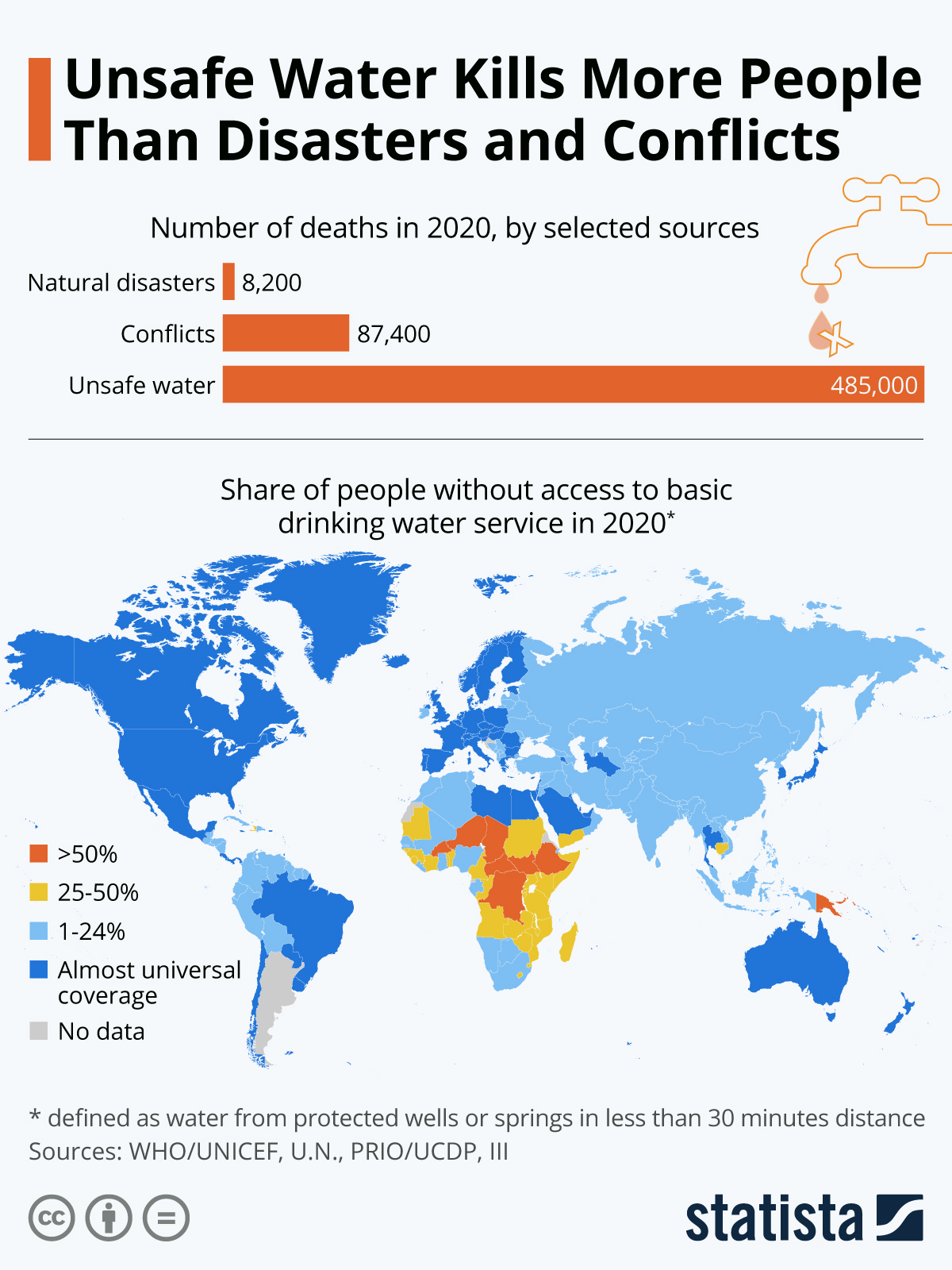
Fewer people around the world lack access to basic drinking water services than when the data was last published in 2015. Yet, as Statista’s Katharina Buchholz explains below, several countries, especially in Africa, still have a way to go to provide their citizens with safe drinking water. 

Infographic: Unsafe Water Kills More People Than Disasters and Conflicts | Statista

You will find more infographics at Statista

772 million people around the world still lack even basic access, according to the United Nations, who declared March 22 World Water Day.

This is despite the fact that unsafe water, causing diseases like cholera, typhoid and hepatitis A, is a bigger cause of human death annually than disasters and conflicts combined. This is according to data by PRIO and the Uppsala Conflict Data Program as well as the International Insurance Institute. 

Children especially are affected by these deadly waterborne diseases.

The UN and WHO joint monitoring program on safe drinking water found that people lacking access to it are currently predominantly located in Africa.

South and Central America, on the other hand, offer basic drinking water services (defined as access to protected wells or springs in less than 30 minutes distance) to at least three quarters of the population in all countries except for Haiti.

The APAC region generally also provides these basic services to at least three quarters of people, except for in Cambodia and Papua New Guinea.

Tyler Durden
Tue, 03/29/2022 – 02:45

via ZeroHedge News https://ift.tt/kSpf8LI Tyler Durden

Ukraine’s Military Intelligence Chief Says “Total Guerrilla Warfare” Coming Next

Ukraine’s Military Intelligence Chief Says “Total Guerrilla Warfare” Coming Next

Authored by Kyle Anzalone via The Libertarian Institute,

The head of Ukraine’s military intelligence, Kyrylo Budanov, threatened total “guerrilla” warfare in Russian-occupied territory. He also warned Moscow was attempting to split his country into a divided state. 

Budanov said that Ukraine was preparing a guerrilla war in any territory Russia continues to control. “The season of a total Ukrainian guerilla safari will soon begin,” he said.

Member of Ukraine’s territorial defense force, via CBC.

The statement from the intel chief comes as the US is dumping billions of insurgency-style weapons into Ukraine. The American weapon’s shipments to Keiv included the shoulder-fired anti-aircraft missile that the CIA provided to the Afghan Mujahideen to use against the Soviet Army. 

There is a long track record of influential foreign policy thinkers who suggested America would benefit from Russia fighting an insurgency in Ukraine.

The latest official to express the benefits of Ukrainian insurgency is US Under Secretary of Defense for Policy Colin Kahl. He believes Russia would be weakened by the war in Ukraine.

I think with a high degree of certainty that Russia will emerge from Ukraine weaker than it went into the conflict. Militarily weaker, economically weaker, politically and geopolitically weaker, and more isolated,” Kahl said on Thursday.

The CIA has also spent several years training Ukrainians in insurgency tactics. The agency believed those it trained would be the leaders of the resistance if Russia invaded. 

Budanov also accused Russia of trying to recreate a Korean split of Ukraine. “In fact, it is an attempt to create North and South Korea in Ukraine,” he said

Russia has demanded that Keiv recognize Moscow’s control over Crimea and the independence of the Donbas before it would end its assault. On Sunday, Zelensky indicated for the first time he may be willing to “compromise” with Russia over control of the Donbas. The two Donbas republics – Donetsk and Luhansk – have been at war with Keiv since 2014.

Tyler Durden
Tue, 03/29/2022 – 02:00

via ZeroHedge News https://ift.tt/MP3Rhbr Tyler Durden

Grim 7th Anniversary: The US-Saudi War On Yemen

Grim 7th Anniversary: The US-Saudi War On Yemen

Authored by Walt Zlotow via AntiWar.com,

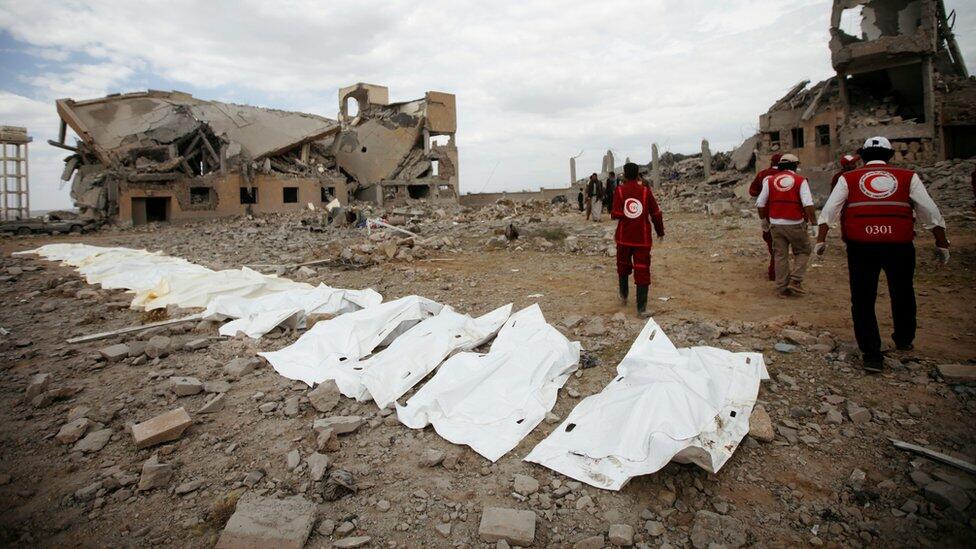
While the U.S. government and mainstream media rightly condemn Russia’s invasion of Ukraine, neither offer one iota of protest against US enabling of Saudi Arabia’s horrific war against neighboring Yemen that has killed over 400,000 and puts millions at risk of starvation.

The Saudis started the war 7 years ago this week by intervening in Yemen’s civil war to prevent an Iranian aligned faction from becoming their neighbor. For America it represents a proxy war against the hated Iranian regime.

America has been all in helping the Saudis with US made planes and bombs; refueling and maintenance help, and logistical support. Without US support the incompetent Saudi war effort would collapse, making America instrumental in the carnage and humanitarian catastrophe called the ‘worst in the world’.

Reuters image: Red Crescent medics next to bags containing the bodies of victims the air strike

A couple of years back Congress voted an end to American war crimes under the War Powers Act. Trump vetoed the measure and had enough friendly votes for more war crimes in Yemen from Congress to prevent an override. Biden came into office vowing to end it. But in a criminal and cowardly move, kept right on killing on in Yemen.

Congress will try again with another War Powers Act measure in the works. On Friday Representative Pramila Jayapal (WA-07) and Representative Peter DeFazio (OR-04), Senator Bernie Sanders (I-VT), and Representative Ro Khanna (CA-17) issued the following statement:

“Seven years ago today, the United States began unauthorized military participation in Saudi Arabia’s devastating war in Yemen. In the time since, Saudi Arabia’s airstrikes and air-and-sea blockade have cost hundreds of thousands of lives and threatened millions more with famine, triggering the worst humanitarian crisis in the world. On this grim anniversary – spanning seven years and three presidential administrations – we are calling for an immediate end to American involvement in the Saudi-led coalition’s brutal military campaign.”

While the US funnels in over a billion dollars in weaponry into Ukraine to keep the war there going on for 31 days now instead of promoting a negotiating settlement. US support for the Saudi slaughter of Yemenis continues into day 2,550.

But turn on mainstream news and it’s all Ukraine 24/7. Not one peep about the Made In USA slaughter in Yemen. Maybe Russia took a cue from the worst when contemplating their criminal war.

Tyler Durden
Mon, 03/28/2022 – 23:40

via ZeroHedge News https://ift.tt/O9hl7ui Tyler Durden

“Sexual Get-Together”: Rep. Cawthorn Says He Was Invited To DC Orgy, Has Witnessed Lawmakers Doing Cocaine

“Sexual Get-Together”: Rep. Cawthorn Says He Was Invited To DC Orgy, Has Witnessed Lawmakers Doing Cocaine

Rep. Madison Cawthorn (R-NC) says that in the 14 months he’s been in Washington DC, he’s been invited to DC orgies and has witnessed lawmakers using cocaine, according to Just the News, citing the freshman lawmaker’s recent appearance on the “Warrior Poet Society” podcast.

“I look at all these people, a lot of them that I’ve looked up to through my life, I’ve always paid attention to politics. Then all of the sudden you get invited to: ‘Well hey we’re going to have kind of a sexual get together at one of our homes, you should come,” said Cawthorn.

“I’m like: ‘What did you just ask me to come to?” he continued. “Then you realize they are asking you to come to an orgy.”

Later, Cawthorn revealed that some of the very lawmakers who are “leading on the movement to try and remove addiction in our country” are on drugs themselves. “You watch them do, you know, a key bump of cocaine right in front of you and it’s like ‘Wow, this is wild.”

Tyler Durden
Mon, 03/28/2022 – 23:20

via ZeroHedge News https://ift.tt/eVBfmrp Tyler Durden

The Impossibility Of Autarchy

The Impossibility Of Autarchy

Op-Ed authored by Daniel Lacalle via The Epoch Times,

The invasion of Ukraine, the spike in inflation, and the risks of supply shortages have made some politicians dust off some of the worst economic ideas in history: autarchy and protectionism.

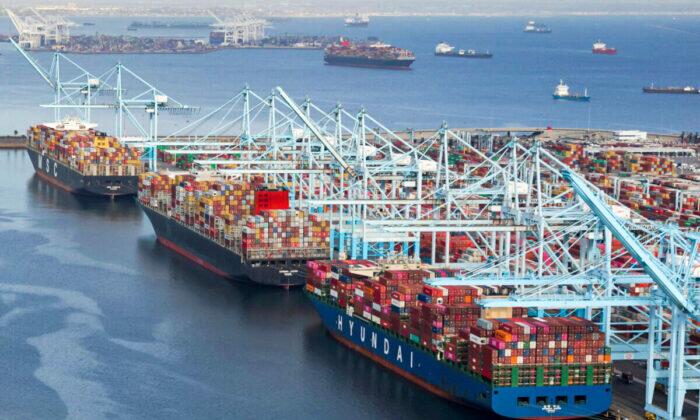
Shipping containers are unloaded from ships at a container terminal at the Port of Long Beach-Port of Los Angeles complex in Los Angeles, Calif., on April 7, 2021. (Lucy Nicholson/Reuters)

Some believe that if our nation produced everything we needed, we would all be better off because we wouldn’t depend on others. The idea comes from a deep lack of understanding of economics. There’s no such thing as autarchy. There’s no such thing as covering all the needs of a population based on the limit of a politically defined border. It makes no sense.

If I told you that I wanted to make my city self-sufficient, you would laugh about it, understanding that it’s impossible and that the reason why my city thrives is because of the interaction and commerce with other cities. However, when a group of politicians defines a nation’s border, we’re immediately led to believe that those limits contain every resource that citizens may need and that everything else is irrelevant.

The other fallacy about autarchy that anyone can understand is that limiting the economy to the confinement of a random area of land is a poor way to develop, grow, and prosper. It’s almost laughable to read from politicians in the eurozone about how they want to achieve full independence and limit imports while at the same time they brag about the bloc’s enormous trade surplus. It’s funny to see how the most autarchic politicians want to increase exports at the same time. Close our borders to evil foreign commerce that destroys our factories! Let’s build more manufacturing capacity so that we can export to them!

We also forget that our progress also comes from the development of the nations we trade with. Our security of supply and our improvement is only a function of everyone else’s growth.

How can autarchy and protectionism be sold to citizens? By selling the false idea of a zero-sum game in the economy. If someone is selling oil to us, they win, and we lose. If someone is selling solar panels to us, they win, and we lose. We would win if we sold everything to ourselves. Really? The math doesn’t work like that. Politicians that sell a zero-sum game in the economy know it’s false, but they also know that protectionism and autarchic aspirations give power to them and make citizens more dependent on political power.

It’s precisely through the development of other nations and making the best out of trade that we can grow faster and have access to more goods and services at better prices.

Productivity, technology, trade, and cooperation are essential factors for prosperity. Autarchy and protectionism are essential drivers of stagnation and poverty.

It may be true that some nations have taken advantage of an open economic system in order to sell more while making it more difficult for others, but the solution isn’t protectionism but more open trade. If a nation decides to harm itself by being protectionist, we’re reaping the benefits, not them, because we benefit from trade growth and prosperity while they end in stagnation. Even large economic giants such as the United States or China can’t survive with closed economies. Who are you going to sell your excess production to if you close your borders?

The current inflation and supply shortage problem hasn’t arrived because of the evils of globalization and the mistakes of free trade, but because of the trend toward interventionism and protectionist measures that has plagued the world for the past 20 years. There’s only one way in which countries can overcome the impact of a war in a country that sells a lot of cereals, oil, and gas to the world: more trade and better diversification of sources of supply, not autarchy and protectionism.

If the current crisis can tell us anything it’s that we need more cooperation and trade with even more countries to avoid hunger, shortages, and lack of access to essential goods. The rise of protectionism in the past 10 years has proven to be a mistake. It’s time to reverse it.

The challenges presented by China or Russia aren’t solved by closing our economies and thinking everything will be good for us while the rest of the world collapses. Our nation would fall with the rest. The solution to the challenge presented by the polarization of the world is to develop even more trade and cooperation agreements with the world. Thankfully, technology and human action are dissolving what once seemed like impenetrable borders.

The world’s supply problems can’t be solved by adding massive overcapacity in every country. That leads to a collapse in productivity and, much worse, real wages. There are plenty of great nations that can cooperate with us to deliver prosperity to everyone. Trade is the blood of the economy. Autarchy only leads to zombification and, ultimately, decay.

Tyler Durden
Mon, 03/28/2022 – 23:00

via ZeroHedge News https://ift.tt/P0OrHYL Tyler Durden

LAPD Offers ‘Gift Cards’ For Ghost Guns In New Buyback Event

LAPD Offers ‘Gift Cards’ For Ghost Guns In New Buyback Event

This past weekend, the Los Angeles Police Department (LAPD) held a gun buyback program, though the guns weren’t your normal ones but rather so-called “ghost guns.” 

Even though L.A. City Council unanimously voted in November on prohibiting the possession, purchase, sale receipt, and transportation of an unserialized gun. They continue their mission to woo ghost-gun owners (mainly ones who own unserialized handguns to AR-15) with $25 to $200 gift cards. 

LAPD held five events across the city on Saturday between 0800 PST to 1300 PST. 

There was no word on the total success of the buyback program. Though LAPD Chief Michel Moore said an hour into the gun buyback program that around “3” ghost guns were turned in. The rest of the other weapons listed were serialized. 

LAPD Captain Lillian Carranca told local news ABC7, “these guns cannot be traced – there is no background check completed on the individuals who want to own it.”

LAPD figures show 813 ghost guns were seized in 2020. By 2021, they seized 1,921, marking a 136% increase in weapon seizures. About 25% of all seizures were ghost guns, and the majority of the illegal weapons confiscated are unserialized pistols. 

“Gun “buybacks” serve mostly as a show for anti-gun politicians and do nothing to reduce gun violence,” Maryland-based gun advocacy group The Machine Gun Nest (TMGN) said. 

“These “buybacks” are, in fact, the clearest example of how misinformed the anti-gun agenda is because criminals do not participate in buybacks,” TMGN continued. 

TMGN cited a National Bureau of Economic Research study and said, “gun buybacks often only exist for gun owners to sell their old junk firearms. The same study found that the actual effect in reducing gun violence was about zero.”

TMGN also notes: “Ironically still, this comes right before Biden’s rule on ghost guns. Maybe the LAPD thinks that criminals pay attention to the intricate web of federal gun laws and want to dispose of their privately made firearms before the rule change. Ultimately, this is a pointless show for anti-gun politicians who care nothing about stopping real gun violence.”

Tyler Durden
Mon, 03/28/2022 – 22:40

via ZeroHedge News https://ift.tt/WIZsFrP Tyler Durden

Rand Report Prescribed US Provocations Against Russia & Predicted Kremlin Retaliation In Ukraine

Rand Report Prescribed US Provocations Against Russia & Predicted Kremlin Retaliation In Ukraine

Authored by Rick Sterling via AntiWar.com,

According to a 2019 Rand report titled “Overextending and Unbalancing Russia”, the US goal is to undermine Russia just as it did the Soviet Union in the cold war. Rather than “trying to stay ahead” or trying to improve the US domestically or in international relations, the emphasis is on efforts and actions to undermine the designated adversary Russia. Rand is a quasi-US governmental think tank that receives three-quarters of its funding from the US military.

The report lists anti-Russia measures divided into the following areas: economic, geopolitical, ideological/informational, and military. They are assessed according to the perceived risks, benefits and “likelihood of success”.

Image: Azov Battalion detachment

The report notes that Russia has “deep seated” anxieties about western interference and potential military attack. These anxieties are deemed to be a vulnerability to exploit. There is no mention of the cause of the Russian anxieties: they have have been invaded multiple times and had 27 million deaths in WW2.

Significance of Ukraine

Ukraine is important to Russia. The two countries share much common heritage and a long common border. One of the most important leaders of the Soviet Union, Nikita Khrushchev, was Ukrainian. During WW2, Ukraine was one of Hitler’s invasion routes and there was a small but active number of Ukrainian collaborators with Nazi Germany. The distance from the capital of Ukraine, Kiev, to Moscow is less than 500 miles.

For these same reasons of geography and history, Ukraine is a major component of a US/NATO effort to undermine Russia. Current Under Secretary for Political Affairs, Victoria Nuland, said that over 20 years the US invested $5 billion in the project to turn Ukraine. The culmination was a violent coup in February 2014. Since 2015, the US has been training ultra nationalist and Neo-Nazi militias. This has been documented in articles such as “U.S. House admits Nazi role in Ukraine” (Robert Parry, 2015), “The US is arming and assisting neo-nazis in Ukraine while the House debates prohibition.”(Max Blumenthal, 2018), “Neo Nazis and the far right are on the march in Ukraine” (Lev Golinken in 2019) and “The CIA may be breeding Nazi terror in Ukraine” (Branko Marcetic Jan. 2022).

Rand suggested provocations

Prior to 2018, the US only provided “defensive” military weaponry to Ukraine. The Rand report assesses that providing lethal (offensive) military aid to Ukraine will have a high risk but also a high benefit. Accordingly, US lethal weaponry skyrocketed from near zero to $250M in 2019, to $303M in 2020, to $350M in 2021. Total military aid is much higher. A few weeks ago, “The Hill” reported, “The US has contributed more than $1 billion to help Ukraine’s military over the past year”.

The Rand report lists many techniques and “measures” to provoke and threaten Russia. Some of the steps include:

  • Repositioning bombers within easy striking range of key Russian strategic targets
  • Deploying additional tactical nuclear weapons to locations in Europe and Asia
  • Increasing US and allied naval force posture and presence in Russia’s operating areas (Black Sea)
  • Holding NATO war exercises on Russia’s borders
  • Withdrawing from the Intermediate Nuclear Forces (INF) Treaty

These and many other provocations suggested by Rand have, in fact, been implemented. For example, NATO conducted massive war exercises dubbed “Defender 2021” right up Russia’s border. NATO has started “patrolling” the Black Sea and engaging in provocative intrusions into Crimean waters. The US has withdrawn from the INF Treaty.

Since 2008, when NATO “welcomed” the membership aspirations of Ukraine and Georgia, Russia has said this would cross a red line and threaten its security. In recent years NATO has provided advisers, training and ever increasing amounts of military hardware. While Ukraine is not a formal member of NATO, it has increasingly been treated like one. The full Rand report says “While NATO’s requirement for unanimity makes it unlikely that Ukraine could gain membership in the foreseeable future, Washington’s pushing this possibility could boost Ukrainian resolve while leading Russia to redouble its efforts to forestall such a development.”

The alternative, which could have prevented or at least forestalled the current Russian intervention in Ukraine, would have been to declare Ukraine ineligible for NATO. But this would have been contrary to the US intention of deliberately stressing, provoking and threatening Russia.

Ukraine as US client

In November 2021, the US and Ukraine signed a Charter on Strategic Partnership. This agreement confirmed Ukrainian aspirations to join NATO and rejection of the Crimean peoples decision to re-unify with Russia following the 2014 Kiev coup. The agreement signaled a consolidation of Washington’s economic, political and military influence.

December 2021 Russia red lines followed by military action

In December 2021, Russia proposed a treaty with the US and NATO. The central Russian proposal was a written agreement that Ukraine would not join the NATO military alliance.

When the proposed treaty was rebuffed by Washington, it seems the die was cast. On February 21, Putin delivered a speech detailing their grievances. On February 24, Putin delivered another speech announcing the justification and objectives of the military intervention to “demilitarize” and “denazify” Ukraine.

As Russian Foreign Minister Lavrov later said, “This is not about Ukraine. This is the end result of a policy that the West has carried out since the early 1990’s.”

Afghanistan again?

As earlier indicated, the Rand report assesses the costs and benefits of various US actions. It is considered a “benefit” if increased US assistance to Ukraine results in the loss of Russian blood and resources. Speculating on the possibility of Russian troop presence in Ukraine, the report suggests that it could become “quite controversial at home, as it did when the Soviets invaded Afghanistan.” (p 99 of full report)

That historical reference is significant. Beginning in 1979, the US and Saudi Arabia funded and trained sectarian foreign fighters to invade and destabilize the Afghan government. The goals were to overthrow the socialist inclined government and lure the Soviet Union into supporting the destabilized government. It achieved these Machiavellian goals at the cost of millions of Afghan citizens whose country has never been the same.

It appears that Ukrainian citizens are similarly being manipulated to serve US goals.

A “disadvantageous peace settlement”

The Rand report says, “Increasing US military aid would certainly drive up the Russian costs, but doing so could also increase the loss of Ukrainian lives and territory or result in a disadvantageous peace settlement.”

But who would a peace settlement be “disadvantageous” for? Ukrainian lives and territory are currently being lost. Over fourteen thousand Ukrainian lives have been lost in the eastern Donbass region since the 2014 coup.

A peace settlement that guaranteed basic rights for all Ukrainians and state neutrality in the rivalry of big powers, would be advantageous to most Ukrainians. It is only the US foreign policy establishment including the US military media industrial complex and Ukrainian ultra-nationalists who would be “disadvantaged”.

Since Ukraine is a multi-ethnic state, it would seem best to accept that reality and find a compromise national solution which facilitates all Ukrainians. Being a client of a distant foreign power is not in Ukraine’s national best interest. The Rand report shows how US policy focuses on actions to hurt Russia and manipulates third party countries (Ukraine) toward that task.

Tyler Durden
Mon, 03/28/2022 – 22:20

via ZeroHedge News https://ift.tt/GbDcM6m Tyler Durden

Here Is What Wall Street Thinks Will Happen To Bond Yields Next

Here Is What Wall Street Thinks Will Happen To Bond Yields Next

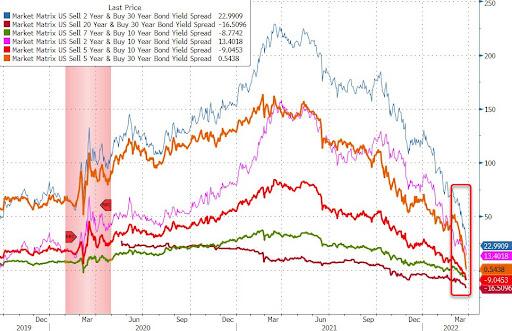
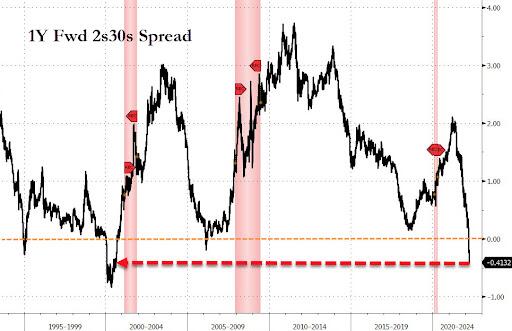
With interest rates marching relentlessly higher both in the US and across the world, even as much of the yield curve pancakes and inverts to pre-recession if not pre-depression levels…

… because the last time the 2s30s 1Y fwd was here, the dot come bubble burst…

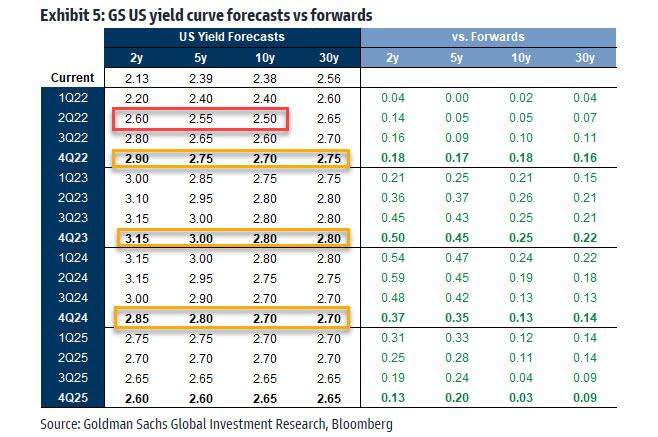
… Wall Street has once again shifted its tune for obvious reasons, and while no longer predicting the yield curve can’t invert – pretty much everyone now acknowledges it’s just a matter of time, with Goldman predicting 2s10s goes negative next quarter..

… the stock market’s cheerleaders are instead trying to convince anyone who cares that the only curve that matters is some transposed version of the 3M10Y, which of course is laughable as explained in “Battle of the Yield curves.

So while their opinions may be largely discredited, strategists still call the shots for better or worse, and here – courtesy of Bloomberg – is a summary of what the top rates strategists write in their weekly research reports, about the potential for Treasury yields to continue to rise and the curve to invert. Several revise year-end yield forecasts or Fed balance-sheet expectations, and flag that pension funds are likely to step up long-end buying during 2Q. 

Bank of America (Mark Cabana, others, March 25 report)

  • Revises year-end rate forecasts higher:
    • 2-year: 3%
    • 10-year: 2.5%
    • 10-year real: 0%
  • Real policy rates don’t reflect restrictive Fed policy, and this “presents an opportunity for investors to trade a flatter real yield curve and express higher near-forward real rates”

BMO (Ian Lyngen, Benjamin Jeffery, March 25 report)

  • With Fed inclined to do half-point rate hikes in May and June, “all roads lead to curve inversion”
  • “The bearish window for Treasuries remains intact as quarter-end approaches,” however “we suspect that Q2 will usher in a round of stability in longer-end Treasuries as front-end yields continue to march higher”

Citi (Jason Williams, March 27 report)

  • Fed 50bp hiking narrative “implies that reserves, and not RRP, are likely to be drained when QT starts,” which “may add further stress to UST liquidity and risk assets”
  • Dislocation between 3m2y Treasury curve (steep) and ED5 vs ED9 curve (inverted) is largest since 1994 hiking cycle, which was followed by cuts in 1995
  • Biggest pension funds are likely to buy more bonds in 2Q, supporting long end, after funded status ratios reach 105% based on higher 30-year yields

Goldman Sachs (Praveen Korapaty, others, March 24 report)

  • Raised Treasury yield forecasts “to reflect more broad- based and persistent price pressures and the accompanying hawkish Fed pivot”
  • More here

JPMorgan (Jay Barry, March 25 report)

  • Sees scope for yields to rise further, creating “upside risk to our 2.5% 10-year yield target” for year-end
  • “Policy rates may need to rise to even more restrictive levels than what’s priced in, forward real rates still point to significantly accommodative policy in 2- to 3-years’ time, and intermediate Treasuries remain rich to fair value”
  • Supply/demand backdrop “is also shifting bearishly, with balance sheet normalization expected to commence in May and bank demand for Treasuries likely to remain light this year”
  • 10s30s curve “no longer appears steep versus the broader curve, suggesting limited room for further near-term flattening, though LDI demand could pressure the curve flatter over the medium term”

Morgan Stanley (Guneet Dhingra, March 25 report)

  • Revises Treasury yield forecasts based on Fed call:
    • 2year: 3%
    • 10-year: 2.60%
  • This month’s rise in yields appears “more durable” than the March 2021 move because a bigger portion has occurred during U.S. trading hours
  • Japan’s fiscal new year is unlikely to drive significant demand for Treasuries, but marginal demand from Japanese insurers and pension “could help the curve bull- or twist-flatten”; higher funding ratios for U.S. pension funds should also keep flattening pressure on the curve
  • 2s10s “hasn’t flattened commensurately with the rise in yields” for three reasons, first and third of which are worth fading
    • Focus on QT, however Treasury is likely to fund shortfall at short end
    • Pricing in a higher long-term neutral rate
    • Decrease in flight-to-quality premium to a degree that appears excessive

NatWest Markets (Jan Nevruzi, March 24 report)

  • “Next major theme for the markets will be rising fears of a recession as the Fed hikes into decelerating growth, potentially supporting a peak in rates into this summer”
  • Revised year-end yield forecasts:
    • 2-year 2%
    • 5-year 2.8%
    • 10-year 2.55%
    • 30-year 2.45%

TD Securities (Priya Misra, others, March 25 report)

  • Expects 50bp rate hikes in May and June, 25bp at each meeting from July to December and in February 2023
  • Expects QT announcement in May with three-month phase-in to caps of $60b and $30b for Treasuries and MBS
  • Revises year-end forecast for 10-year Treasury yield to 2.65% and favors short 5s on 2s5s10s fly
  • “We don’t think the market is fully pricing in the supply implications of balance-sheet runoff of about $1t per year

Source: BBG

Tyler Durden
Mon, 03/28/2022 – 22:00

via ZeroHedge News https://ift.tt/Hc27BGw Tyler Durden