3/29/1937: West Coast Hotel v. Parrish decided.
The post Today in Supreme Court History: March 29, 1937 appeared first on Reason.com.
from Latest https://ift.tt/fri7bYO
via IFTTT
another site
3/29/1937: West Coast Hotel v. Parrish decided.
The post Today in Supreme Court History: March 29, 1937 appeared first on Reason.com.
from Latest https://ift.tt/fri7bYO
via IFTTT
For several years, I have been thinking about the doctrine of severability — what happens when courts conclude that a part of a law is unconstitutional? I have come to believe that this is fundamentally just a question about “say[] what the law is,” as Marbury v. Madison put it. Marbury tells us that a statute does not make law if the Constitution prevents it from doing so. The severability question is simply what is the law, in light of what the law is not?
I finally have a draft article on these questions, Severability First Principles, forthcoming in the Virginia Law Review and available on SSRN. Here is the abstract:
The Supreme Court has decided a number of cases involving severability in the last decade, from NFIB v. Sebelius and Murphy v. NCAA to Seila Law v. CFPB, Barr v. AAPC, United States v. Arthrex, California v. Texas and Collins v. Yellen. The analysis has not been consistent, the Justices have not been able to agree, and the results have not been intuitive. Some of the Justices have proposed a revisionist approach, but they too have been unable to agree on what it requires.
This article proposes a return to first principles. Severability is a question of what the law is. Severability also includes two principles of constitutional law: that judges should enforce the law, and that the Constitution displaces ordinary law that is repugnant to it. And it also includes principles of non-constitutional law: that validly enacted statutes are law if they are not repugnant to the Constitution, that unenacted hopes and dreams are not, and that Congress may legislate for contingencies.
Much of the time, these principles lead to a simple bottom line: effectively complete severability, rebutted only by an inseverability clause or something else with the force of law. There are also harder cases where the bottom line is not so simple, but where the first principles of severability will nonetheless lead the way – the relevance of unconstitutional removal restrictions, the nonconstitutional law that resolves unconstitutional combinations, and the relevance of severability to standing and other procedural questions.
And here is the introduction:
When part of a statute is unconstitutional, the courts engage in severability analysis. According to the cases, this analysis couples a presumption with a possible rebuttal. The presumption is one of severability: “the invalid part may be dropped.” The presumption is rebutted based on either an objective analysis, asking whether “what is left is fully operative law,” or a subjective analysis, asking whether “it is evident that the Legislature would not have enacted those provisions which are within its power, independently of that which is not.” Slightly more controversially, the same seems to be true for a single provision with constitutional and unconstitutional applications.
There have been many calls to abandon or reform severability doctrine. But there is no consensus about what the problem is or what to do instead. At least one problem, though, is methodological: the modern approach to statutory interpretation is heavily influenced by formalism generally and textualism specifically. Such judges have extra reason to be skeptical of current doctrine. They doubt the coherence or the relevance of counterfactual inquiries into legislative intent, and also tend to resist the normative analysis that sometimes lies behind particular severability arguments. And severability can look uncomfortably like “rewriting” a statute, which most judges today know they are not supposed to get caught doing. So we need an account of severability that makes formal sense.
This is a natural occasion for a return to first principles, and some
have tried. Several recent articles make promising contributions, and recent opinions by Justices Thomas and Gorsuch have attempted to synthesize them into a new revisionist account of severability. But their work is incomplete. Justices Thomas and Gorsuch cannot even agree among themselves in several recent cases, and throughout they may be trying to squeeze more certainty out of the literature than it can supply. We still need a clearer account of the first principles that answer the severability problem, and of what those principles do and do not imply.
Returning to first principles also requires us to disentangle how much of severability analysis comes from the Constitution, and how much it comes from statutory interpretation or other non-constitutional law. In truth, severability principles are a combination of both constitutional and non-constitutional law. The Constitution tells us that it displaces ordinary law that is inconsistent with it. It also tells us that judges (among others) are supposed to apply the law. But these constitutional principles are not all there is to severability. We also need to know what is the law, when some part of a statute has been found to be constitutionally repugnant? Ordinary principles of statutory interpretation fill in this answer. Federal law is what has been enacted by Congress, and not otherwise displaced, including any fallback law. And of course any non-federal legal rules also continue to apply.
Much of the time, these principles lead to a simple bottom line: judges should enforce a statute except in the specific cases where its application is unconstitutional. But this simplicity is deceptive. The bottom line becomes more difficult to see in the case of unconstitutional combinations: when two statutory requirements are unconstitutional if taken together, which one should be disregarded? These difficult cases – more widespread than many realize – illuminate an aspect of the Constitution that has been there all along: the Constitution tells us what the law isn’t, but not always what it is. Solving the severability problem in these cases – saying what the law is – requires going beyond the text of statute, whether formalist judges like it or not.
Other difficulties come up in the context of standing and other threshold questions. When can a plaintiff establish standing on the basis of an inseverability argument, and when can a severability argument defeat standing? These questions have proven difficult for the Courts, but this time it is the difficulty that is deceptive. Once we straighten out our severability analysis, it drives to straightforward answers in these cases.
This paper puts forward the first principles of severability and then applies them, first to the easy cases and then to the hard ones. Part I argues that severability is a question of law; that the Constitution displaces repugnant law; and that all non-repugnant law should be enforced, including fallback law such as severability and inseverability clauses. Part II describes how these principles would reframe severability doctrine; how Justices Gorsuch and Thomas have come close to restating these principles; and how the principles also clarify facial challenges and national injunctions. Part III tackles the harder cases, such as unconstitutional combinations and standing.
Since it has come up on the blog before, here are my two discussions of California v. Texas, the attempt to gets courts to declare the complete invalidity of the Affordable Care Act through an inseverability argument.
I defend Texas’s theory of standing:
In California v. Texas, the plaintiffs tried to get the Supreme Court to say that most of the Affordable Care Act was invalid because it was inseverable from the unconstitutional individual mandate. The case thus presented controversial questions of constitutionality (was the $0 mandate unconstitutional?), of severability (was the mandate indeed inseverable from the rest of the Act?), and of standing (could the plaintiffs raise this argument?). The Court resolved the case on standing grounds, but standing might in fact have been the least vulnerability in the plaintiffs’ case.
The best argument for Texas’s standing was “bank-shot” standing—that Texas was entitled to have an injunction against the plausible enforcement of Provision A, if Provision B is invalid and inseverable. This may seem like a strange form of third-party standing, but if inseverability is limited to fallback law it is actually unremarkable first-party standing. The plaintiff is effectively saying that Congress has instructed for Provision A not to be enforced if Condition X obtains, and that Condition X obtains.[3] Such a plaintiff has an orthodox legal injury, an orthodox claim for why that injury is illegal, and an orthodox claim for redress. A Court might be annoyed if the determination of Condition X involves an important or awkward question and the current case feels too unimportant to justifying answering it. But a judge’s duty is to answer the questions necessary to apply the law to decide the cases before him, not the questions he would like to answer.
This is not to say that Texas’s argument should have succeeded. Their bank-shot theory of standing rested on the premise of inseverability, and that premise was false. And because inseverability is a pure question of law, it can be resolved at a very early stage of the litigation – it would even be permissible to resolve it before considering the constitutional merits argument. So even if an inseverability argument can be used to produce standing, using a bad inseverability argument to produce standing has little consequence. A plaintiff who uses a bad inseverability claim to get into court and then lose has gained nothing more than a plaintiff who invents a fictitious cause of action to enforce a fictitious right. Perhaps the plaintiff has standing, but it is simply standing to lose on the merits a few minutes later.
In the course of denying Texas’s claim to standing, the Court did not fully address “bank-shot” standing. It treated the argument partly as waived, and partly as a different kind of causation argument. Perhaps that was for the best. It could well be that the majority was fractured, both on whether to recognize bank-shot standing (which it should) and whether the inseverability arguments were correct (which they were not). But if the Court confronts the question again in cooler air, it should accept this kind of argument if there is inseverability.
But I argue that the statute was not inseverable:
[The dissent] asks the right question – does the Affordable Care Act provide that if the individual mandate is unconstitutional, the reporting requirements and adult-children coverage requirement should not be enforced? But its answer is wrong.
Focusing on the specific statutory requirements first: The individual mandate required people to buy a particular kind of insurance or pay a penalty, and defined what kind. The reporting requirements require employers to say whether they have provided that kind of insurance. If the mandate is now unconstitutional, nobody has to buy it, and nobody has to pay. But that does not mean nobody has to report it. The connection between the reporting requirement and the mandate was that they used the same criteria for what made an insurance plan covered. But the unconstitutionality of the mandate did not make the criteria unconstitutional, or forbid all cross-references to those criteria.
The adult-children coverage requirement has even less explicit connection to the individual mandate. It simply says: “A group health plan and a health insurance issuer offering group or individual health insurance coverage that provides dependent coverage of children shall continue to make such coverage available for an adult child until the child turns 26 years of age. Nothing in this section shall require a health plan or a health insurance issuer described in the preceding sentence to make coverage available for a child of a child receiving dependent coverage.” No word about the mandate, nothing saying that judges should stop enforcing the provision if other economic premises of the law are false.
That leaves only the argument that the Affordable Care Act contained what is effectively an inseverability clause because it repeatedly finds that the individual mandate is “essential,” to the larger regulatory scheme and to creating effective health insurance markets. One response is that this finding applied only to the 2010 mandate but not to the 2017 amended mandate. This response, however, would be unavailing against a true inseverability clause. If Congress enacts a severability or inseverability clause into law, it can amend the subjects of that law just as any other.
The more fundamental problem is that the “essential” finding is not an inseverability instruction. Every time Congress makes such findings to invoke its necessary-and-proper powers, it is stating its view about the importance and relevance of what it is doing. It is not thereby making fallback law. Indeed, nobody seems to have taken the essential = inseverable argument truly seriously: The ACA findings declare the individual mandate “essential” not only to other provisions of the ACA, but to all of the Earned Income Retirement Securities Act and the Public Health Services Act. If the “essential” finding were an inseverability clause, it would condemn these laws as well, which nobody was willing to argue or accept.
At bottom, many aspects of Justice Alito’s dissent could hold up if the Affordable Care Act contained an inseverability clause. So too, Justice Gorsuch might well be able to join such a dissent if there were an inseverability clause. But there was not, and so this was a mistake.
In my view these questions in California v. Texas were actually fairly simple. The far more difficult and interesting question is the one posed in other cases by the problem of “unconstitutional combinations,” which I discuss extensively in Part III of the piece:
It is easy enough to say the Constitution displaces unconstitutional laws, and requires the others to be enforced. But sometimes a law is unconstitutional only because it is combined in a particular situation with another law. In these cases, it is obvious that the easy saying is incomplete. Which law is to be displaced, and why?
Consider, for instance, the two layers of political insulation in Free Enterprise Fund v. PCAOB, where the Supreme Court held that it was unconstitutional for an agency (the PCAOB) to insulated from presidential control by two layers of protection. The PCAOB could be removed for cause by the SEC, whose members could be removed for cause by the President. One such layer, between the President and the SEC, was thought to be fine. One layer between the SEC and the PCAOB would also have been fine. But two layers – from the President and the SEC, then from the SEC to the PCAOB—”contravene[d] the President’s ‘constitutional obligation to ensure the faithful executive of the laws.'” In such a case, the Court must say more to explain which layer will be disregarded as repugnant.
These combinations problems generally take something like this form. There are Statutory Requirement A, Statutory Requirement B, and a Constitutional Requirement. Any two of these can be enforced. Requirements A and B work fine together were it not for the Constitution. The Constitution and A can be enforced, but not B. Or vice versa. Moreover, we know from basic principles of constitutional supremacy that the Constitution must be enforced. So the question remains what to make of A and B.
The problem may seem quirky, but it is a recurring one. In Arthrex, the separation of powers problem was a combination of the way that the administrative patent judges were appointed, the significance of the power they were given, and the lack of control of that power by superior officers. Seila Law and Collins, discussed earlier, are combinations problems too. The statutes there did two things – vest executive power in an appointed official, and tell the President there were limits on his ability to remove that official. Either of these things standing alone are permissible. Vesting executive power in removable officials is okay. Limiting the power to remove non-executive officials is okay. But not both together. The disagreement over severability in those cases can be seen as simply another application of the combinations problem. Some justices thought that it was the removal restriction that must be ignored, allowing the official to exercise enforcement authority if it was. Other justices thought that it was the enforcement authority which must be nullified in light of the removal restriction.
A different setting for the combinations problem came in in Barr v. American Association of Political Consultants, another recent severability case. There the Court concluded that the First Amendment forbade a combination of two rules: a general ban on robocalls, and a permission for robocalls for government-backed debt. Indeed, as AAPC reminded many lawyers, there is a whole class of cases dealing with the question of whether to “level up” or “level down” when there is a constitutionally impermissible discrimination between two classes of persons or activity. All of these level up/down cases are unconstitutional combinations: the higher level rule for one class, and the lower level rule for the other.
Indeed, it is hard to think of a constitutional challenge that is not at least partly a combinations case. Shelby County v. Holder, for instance, dealt with the preclearance requirements of the Voting Rights Act, whose coverage formula was not adequately justified. This might seem like a standalone constitutional problem. But the problem also partly came from adjacent provisions, such as the limited ability to add and remove jurisdictions from coverage based on new developments. The Solicitor General argued that these provisions were enough to save the statute, and even if they weren’t, that suggests that if the Court had instead said that the Constitution required more vigorous “bail in” and “bail out,” the preclearance formula could have been saved. Indeed, we have proof of this: in a previous case the Court had broadened the “bail out” provision to help rescue the statute from unconstitutionality.
Recognizing the ubiquity of the unconstitutional combinations problem is clarifying. But it is also daunting. For at this point the simple model of repugnancy and enforcement seizes up: Courts should disregard the two statutory provisions because they are unconstitutional. But once both provisions are disregarded there is actually no need to disregard one of them, because it is permissible on its own. Or alternatively there is no need to disregard the other, because it is permissible on its own. So on what warrant can courts disregard the first rather than the second, or the second rather than the first?
Thus the problem of combinations points to a way in which simple formalist accounts of severability are incomplete. Unconstitutional combinations, which have always been possible, highlight that when the Constitution tells us what the law isn’t, it does not always tell us enough about what it is. This is most obvious in cases like Arthrex or Free Enterprise Fund, but it is an instance of the general point that what the sub-constitutional law is depends at least in part on the sub-constitutional law. That’s always true, and easier cases involving partial unconstitutionality just obscure the point because it’s so clear what the sub-constitutional law is in those cases. Even seemingly easy cases of severability actually rest on the conclusion (usually implicit) that no separately constitutional rule or application is dependent on a separately unconstitutional rule or application.
With all of the difficulties in mind, let us focus on possible solutions….
I encourage you to read the piece if you are interested in more. And the piece will be in edits over the summer, so suggestions are still welcome!
The post A Draft of "Severability First Principles" is Now Available appeared first on Reason.com.
from Latest https://ift.tt/uR4L7Nq
via IFTTT

Somewhere between the conventional home and the houseboat, there are entire neighborhoods of floating domiciles that are fixed to the shore but rise and fall with the water. “In the Netherlands,” Yale Environment 360 reports, “they are often prefabricated, square-shaped, three-story townhouses built offsite with conventional materials.” These innovations are now being mimicked elsewhere, from Norway to the Maldives, as coastal communities adapt to rising sea levels. Dutch officials, meanwhile, are currently “working to update zoning laws to make the construction of floating homes easier.”
The post A Future for Floating Homes appeared first on Reason.com.
from Latest https://ift.tt/9hHOe4E
via IFTTT
We Are In So Much Trouble
Authored by Michael Snyder via The Economic Collapse blog,
What we are witnessing is truly the beginning of the end.

In recent months I have focused a lot on the economic implosion that is now taking place, but what we are facing is so much broader than that. Our society is literally falling to pieces all around us, and now World War 3 has begun. Many regard the war that has erupted on the other side of the globe as just a conflict between Ukraine and Russia, but the truth is that it is really a proxy war between the United States and Russia. And since neither side seems much interested in diplomacy at this point, this proxy war could eventually become a shooting war between the two greatest nuclear powers on the entire planet.
Before the war started, events were already starting to accelerate substantially. Inflation was out of control, a new energy crisis had flared up, and global food supplies were getting tighter and tighter. But now we are truly in unprecedented territory. If you doubt this, just look at what is happening to the price of fertilizer.
Fertilizer prices 1993-present
The spike in the middle is the 2008 financial crisis
>it’s so over pic.twitter.com/MW0Csb1mXj
— Alexei Arora (@AlexeiArora) March 26, 2022
That chart should chill you to the core, because it clearly tells us that food shortages are coming.
In fact, even Joe Biden is now publicly admitting that food shortages are coming. On his show the other night, Tucker Carlson broke this down in a way that only Tucker Carlson can…
Before the war, some fertilizers had doubled in price and some had tripled in price.
In the video that you just watched, we are told that some fertilizer prices are now four to five times higher than they were a year ago.
Here in the western world, most farmers will simply bite the bullet and pay the higher prices. In turn, we will pay higher prices for food at the grocery store.
But in poorer parts of the globe, many farmers will use a whole lot less fertilizer or none at all. As a result, global food production will be way down in the months ahead.
To turn this crisis around, what we really need is for the proxy war in Ukraine to end. Unfortunately, both sides just continue to escalate matters instead.
For example, on Saturday Joe Biden shocked the entire world when he stated that Vladimir Putin “cannot remain in power”…
President Joe Biden on Saturday said Russian leader Vladimir Putin “cannot remain in power,” ratcheting up international pressure and further uniting NATO allies against Putin over his invasion of Ukraine.
“A dictator, bent on rebuilding an empire, will never erase the people’s love for liberty,” Biden said at the end of a sweeping speech in Poland. “Ukraine will never be a victory for Russia, for free people refuse to live in a world of hopelessness and darkness.”
That was a call for regime change in Russia.
Russian leaders were already paranoid about western intentions before, and now their paranoia is going to be off the charts.
Biden administration officials are trying to walk back Biden’s comments, but the damage has already been done.
Meanwhile, we just learned that U.S. Secretary of State Antony Blinken and Russian Foreign Minister Sergey Lavrov have not spoken at all since February 15th…
Secretary of State Antony Blinken and his Russian counterpart Sergey Lavrov have not spoken since February 15, over a week before Russia launched its invasion of Ukraine on February 24, the State Department told Antiwar.com on Friday.
Earlier this week The Washington Post cited US officials who said Blinken hasn’t attempted to speak with Lavrov since the start of the conflict. When asked to confirm the story, a State Department spokesperson said, “We can confirm that the last time Secretary Blinken and Foreign Minister Lavrov spoke was on February 15.”
Even during the darkest days of the Cuban missile crisis, U.S. officials always kept talking to the Russians.
So this is something that should alarm all of us greatly.
On top of everything else, Joe Biden just told U.S. troops in Poland that they will see what conditions in Ukraine are like “when you’re there”…
According to The Associated Press, Biden’s remarks were given in front of U.S. troops who “had been sent near Poland’s border [with Ukraine] to assist with the humanitarian emergency and to bolster the U.S. military presence on the eastern flank of NATO.” The words, “and you’re gonna see when you’re there,” were spoken right after the president mentioned the bravery of Ukrainian citizens. Later, the White House once again told reporters that U.S. troops would not be deployed to fight in the war in Ukraine.
Every time Biden opens his mouth, he makes things even worse.
If he isn’t careful, he could drag the entire world into a global war. Earlier today, I was horrified to learn that Biden has decided to reaffirm “America’s right to use nukes in a first-strike scenario” at such a tense moment…
President Joe Biden is abandoning a campaign vow to alter longstanding US nuclear doctrine, and will instead embrace existing policy that reserves America’s right to use nukes in a first-strike scenario, according to multiple reports.
As Russian forces continue their bloody assault on Ukraine, Biden is under pressure from NATO allies not to abandon the right to use nuclear weapons to deter conventional attacks.
Many had thought that the war in Ukraine would help to unite America and would provide a boost to Biden’s extremely poor approval ratings.
And in the initial days of the war, that seemed to happen.
But now Biden’s approval ratings are falling once again…
President Joe Biden’s job approval ratings keep falling in his second year in the White House, with just 40% of Americans approving of the job that he is doing, a new NBC News survey finds.
That is the lowest rating Biden has seen in his presidency.
We were warned that 2022 would be a very troubled year, and we are still in the very early chapters.
If the Biden administration continues with all of this insanity, things are going to get a whole lot worse. I really like how Gerald Celente summarized matters during his recent interview with Greg Hunter…
“We are headed for an economic calamity the likes of which we have never seen in our lifetime. They are getting our minds off it with the war in Ukraine. . . . You know, I wrote in the magazine in the beginning of the year, we said that the Covid war would wind down by late March and mid-April. It’s winding down. . . . So, now, as we said in the magazine, we went from the Covid war to the Ukraine war, and now to world war. We are headed to World War III. . . . There is not a peep about a cease-fire. Biden is only bragging about more weapons being sent in. Biden says we are going to defeat the Russians. We are not backing down. No one is talking about a cease-fire, and no one is talking about peace. If we don’t unite for peace, we are all going to die in war.”
A thermonuclear war with Russia would be more horrible than most people could possibly imagine, and our leaders should be doing all that they can to prevent that from happening.
But right now Biden administration officials apparently don’t even see any point in talking with the Russians.
We are steamrolling down a road that leads to nuclear war, and meanwhile the global economy is starting to implode at frightening speed.
If you are still delusional enough to believe that everything will work out “just fine” somehow, then I really feel sorry for you.
* * *
It is finally here! Michael’s new book entitled “7 Year Apocalypse” is now available in paperback and for the Kindle on Amazon.
Tyler Durden
Tue, 03/29/2022 – 06:30
via ZeroHedge News https://ift.tt/UT5Ni0I Tyler Durden

“I too yearn for universal justice,” wrote Zora Neale Hurston in her autobiography, Dust Tracks on a Road, “but how to bring it about is another thing.” The black novelist’s remarks prefaced a passage where she grappled with the historical legacy of slavery in the African-American experience. Perhaps unexpectedly, Hurston informed her readers that she had “no intention of wasting my time beating on old graves with a club.”
Hurston did not aim to bury an ugly past but to search for historical understanding. Her 1927 interview with Cudjoe Lewis, among the last living survivors of the 1860 voyage of the slave ship Clotilda, contains an invaluable eyewitness account of the middle passage as told by one of its victims. Yet Hurston saw only absurdity in trying to find justice by bludgeoning the past for its sins. “While I have a handkerchief over my eyes crying over the landing of the first slaves in 1619,” she continued, “I might miss something swell that is going on in” the present day.
Hurston’s writings present an intriguing foil to The New York Times‘ 1619 Project, which the newspaper recently expanded into a book-length volume. As its subtitle announces, the book aims to cultivate a “new origin story” of the United States where the turmoil and strife of the past are infused into a living present as tools for attaining a particular vision of justice. Indeed, it restores The 1619 Project’s original aim of displacing the “mythology” of 1776 “to reframe the country’s history, understanding 1619 as our true founding.” This passage was quietly deleted from The New York Times‘ website in early 2020 just as the embattled journalistic venture was making a bid for a Pulitzer Prize. After a brief foray into self-revisionism in which she denied ever making such a claim, editor Nikole Hannah-Jones has now apparently brought this objective back to the forefront of The 1619 Project.
Vacillating claims about The 1619 Project’s purpose have come to typify Hannah-Jones’ argumentation. In similar fashion, she selectively describes the project as a work either of journalism or of scholarly history, as needed. Yet as the stealth editing of the “true founding” passage revealed, these pivots are often haphazardly executed. So too is her attempt to claim the mantle of Hurston. In a recent public spat with Andrew Sullivan, Hannah-Jones accused the British political commentator of “ignorance” for suggesting that “Zora Neale Hurston’s work sits in opposition to mine.” She was apparently unaware that Dust Tracks on a Road anticipated and rejected the premise of The 1619 Project eight decades prior to its publication.
On the surface, The 1619 Project: A New Origin Story (One World) expands the short essays from The New York Times print edition into almost 600 pages of text, augmented by additional chapters and authors. The unmistakable subtext is an opportunity to answer the barrage of controversies that surrounded the project after its publication in August 2019. “We wanted to learn from the discussions that surfaced after the project’s publication and address the criticisms some historians offered in good faith,” Hannah-Jones announces in the book’s introduction, before devoting the majority of her ink to denouncing the blusterous critical pronouncements of the Trump administration after it targeted The 1619 Project in the run-up to the 2020 presidential election. Serious scholarly interlocutors of the original project are largely sidestepped, and factual errors in the original text are either glossed over or quietly removed.
While the majority of the public discussion around The 1619 Project has focused on Hannah-Jones’ lead essay, its greatest defects appear in the Princeton sociologist Matthew Desmond’s essay on “Capitalism.” Hannah-Jones’ writings provide the framing for the project, but Desmond supplies its ideological core—a political charge to radically reorient the basic structure of the American economy so as to root out an alleged slavery-infused brutality from capitalism.
Hannah-Jones’ prescriptive call for slavery reparations flows seamlessly from Desmond’s argument, as does her own expanded historical narrative—most recently displayed in a lecture series for MasterClass in which she attempted to explain the causes of the 2008 financial crisis by faulting slavery. “The tendrils of [slavery] can still be seen in modern capitalism,” she declared, where banking companies “were repackaging risky bonds and risky notes…in ways [that] none of us really understood.” The causal mechanism connecting the two events remained imprecise, save for allusions to “risky slave bonds” and a redesignation of the cotton industry as “too big to fail.”
Making what appears to be a muddled reference to the Panic of 1837, she confidently declared that “what happened in 1830 is what happened in 2008.” The claimed connection aimed to prove that the “American capitalist system is defined today by the long legacy and shadow of slavery.” This racist, brutal system “offers the least protections for workers of all races,” she said, and it thus warrants a sweeping overhaul through the political instruments of the state. To this end, Hannah-Jones appends an expanded essay to The 1619 Project book, endorsing a Duke University study’s call for a “vast social transformation produced by the adoption of bold national policies.”
“At the center of those policies,” she declared, “must be reparations.”
What are we to make of The 1619 Project’s anti-capitalism in light of the new book’s expanded treatment? For context, let’s consider how Desmond handles the defects of his original argument.
In his quest to tie modern capitalism to slavery, Desmond began with a genealogical claim. Antebellum plantation owners employed double-entry accounting and record-keeping practices, some of them quite sophisticated. A more careful historian might note that such practices date back to the Italian banking families of the late Middle Ages, or point out that accounting is far from a distinctively capitalist institution. After all, even the central planners of the Soviet Union attempted to meticulously track raw material inputs, labor capacity, and multi-year productivity goals. Does this make the gulags a secret bastion of free market capitalism? Though seemingly absurd, such conclusions are the logical extension of Desmond’s argument. “When an accountant depreciates an asset to save on taxes or when a midlevel manager spends an afternoon filling in rows and columns on an Excel spreadsheet,” he wrote in the original newspaper edition, “they are repeating business procedures whose roots twist back to slave-labor camps.”
Setting aside this unusual leap of logic, the claim rests upon a basic factual error. Desmond attributed this genealogy to the University of California, Berkeley, historian Caitlin Rosenthal’s 2018 book on plantation financial record keeping, Accounting for Slavery. Yet Rosenthal warned against using her work as an “origin story” for modern capitalism. She “did not find a simple path,” she wrote, by which plantation accounting books “evolved into Microsoft Excel.” Desmond, it appears, made a basic reading error.
When I first pointed out this mistake to Jake Silverstein, the editor in chief of The New York Times Magazine, in early 2020, he demurred on making any correction. After consulting with Rosenthal, the Times passed off this inversion of phrasing as an interpretive difference between the two authors. In the new book version of Desmond’s essay, the troublesome Microsoft Excel line disappears without any explanation, although Desmond retains anachronistic references to the plantation owners’ “spreadsheets.” As with other controversies from The 1619 Project, the revisions pair a cover-up of an error with haphazard execution.
This pattern persists and compounds through the meatier parts of Desmond’s expanded thesis. His original essay singles out American capitalism as “peculiarly brutal”—an economy characterized by aggressive price competition, consumerism, diminished labor union power, and soaring inequality. This familiar list of progressive grievances draws on its own array of suspect sources. For example, Desmond leans heavily on the empirical work of the U.C. Berkeley economists Emmanuel Saez and Gabriel Zucman to depict a society plagued by the growing concentration of wealth among the “top 1 percent.” Data from the Federal Reserve suggest that these two authors exaggerate the rise in wealth concentration since 1990 by almost double the actual number. Desmond’s own twist is to causally link this present-day talking point with the economic legacy of slavery.
To do so, he draws upon recent statistical analysis that showed a 400 percent expansion in cotton production from 1800 to 1860. In Desmond’s telling, this growth stems from the capitalistic refinement of violence to extract labor out of human chattel. “Plantation owners used a combination of incentives and punishments to squeeze as much as possible out of enslaved workers,” he declared—a carefully calibrated and systematized enterprise of torture to maximize production levels. In the original essay, Desmond sourced this thesis to Cornell historian Edward E. Baptist, whose book The Half Has Never Been Told essentially revived the old “King Cotton” thesis of American economic development that the Confederacy embraced on the eve of the Civil War. Baptist’s book is a foundational text of the “New History of Capitalism” (NHC) school of historiography. The 1619 Project, in turn, leans almost exclusively on NHC scholars for its economic interpretations.
But Baptist’s thesis fared poorly after its publication in 2014, mainly because he misrepresented the source of his cotton growth statistics. The numbers come from a study by the economists Alan L. Olmstead of the University of California, Davis, and Paul W. Rhode, then with the University of Arizona, who empirically demonstrated the 400 percent production increase before the Civil War but then linked it to a very different cause. Cotton output did not grow because of refinements in the calibrated torture of slaves, but rather as a result of improved seed technology that increased the plant’s yield. In 2018, Olmstead and Rhode published a damning dissection of the NHC literature that both disproved the torture thesis and documented what appear to be intentional misrepresentations of evidence by Baptist, including his treatment of their own numbers. Olmstead and Rhode in no way dispute the horrific brutality of slavery. They simply show that beatings were not the causal mechanism driving cotton’s economic expansion, as the NHC literature claims.
As with Desmond’s other errors, I brought these problems to the attention of Silverstein with a request for a factual correction in late 2019. Almost two years later I finally received an answer: Desmond replied that “Baptist made a causal claim linking violence to productivity on cotton plantations,” whereas his “article did not make such a casual [sic] claim.” I leave the reader to judge the accuracy of this statement against The 1619 Project’s original text, including its explicit attribution of the argument to Baptist.
Even more peculiar is how Desmond handled the “calibrated torture” thesis in the book edition. In the paragraph where he previously named Baptist as his source, he now writes that “Alan Olmstead and Paul Rhode found that improved cotton varieties enabled hands to pick more cotton per day.” But this is far from a correction. Desmond immediately appends this sentence with an unsubstantiated caveat: “But advanced techniques that improved upon ways to manage land and labor surely played their part as well.” In excising Baptist’s name, he simply reinserts Baptist’s erroneous claim without attribution, proceeding as if it has not meaningfully altered his argument.
In these and other examples, we find the defining characteristics of The 1619 Project’s approach to history. Desmond and Hannah-Jones initiate their inquiries by adopting a narrow and heavily ideological narrative about our nation’s past. They then enlist evidence as a weapon to support that narrative, or its modern-day political objectives. When that evidence falters under scrutiny, The 1619 Project’s narrative does not change or adapt to account for a different set of facts. Instead, its authors simply swap out the discredited claim for another and proceed as if nothing has changed—as if no correction is necessary.
We see the same pattern in how Hannah-Jones handles the most controversial claim in the original 1619 Project. Her opening essay there declared that “one of the primary reasons the colonists decided to declare their independence from Britain was because they wanted to protect the institution of slavery.” In early 2020, Silverstein begrudgingly amended the passage online to read “some of the colonists” (emphasis added) after Northwestern University historian Leslie M. Harris revealed that she had cautioned Hannah-Jones against making this claim as one of the newspaper’s fact-checkers, only to be ignored.
The ensuing litigation of this passage across editorial pages and Twitter threads unintentionally revealed an unsettling defect of the Times‘ venture. The 1619 Project was not a heterodox challenge to conventional accounts of American history, as its promotional material insinuated. An endeavor of this sort could be commendable, if executed in a scholarly fashion. Instead, the original essays by Hannah-Jones and Desmond betray a deep and pervasive unfamiliarity with their respective subject matters.
When subject-matter experts pointed out that Hannah-Jones exaggerated her arguments about the Revolution, or that Britain was not, in fact, an existential threat to American slavery in 1776 as she strongly suggested (the British Empire would take another 58 years before it emancipated its West Indian colonies), she unleashed a barrage of personally abusive derision toward the critics. Brown University’s Gordon S. Wood and other Revolutionary War experts were dismissed as “white historians” for questioning her claims. When Princeton’s James M. McPherson, widely considered the dean of living Civil War historians, chimed in, Hannah-Jones lashed out on Twitter: “Who considers him preeminent? I don’t.”
The 1619 Project did not simply disagree with these subject-matter experts. Its editors and writers had failed to conduct a basic literature review of the scholarship around their contentions, and subsequently stumbled their way into unsupported historical arguments. While some academic historians contributed essays on other subjects, none of The 1619 Project’s feature articles on the crucial period from 1776 to 1865 came from experts in American slavery. Journalists such as Hannah-Jones took the lead, while highly specialized topics such as the economics of slavery were assigned to nonexperts like Desmond, whose scholarly résumé contained no prior engagement with that subject.
The book’s revised introduction is less a corrective to the defects of the original than a mad scramble to retroactively paint a scholarly veneer over its weakest claims. Hannah-Jones leans heavily on secondary sources to backfill her own narrative with academic footnotes, but the product is more an exercise in cherry-picking than a historiographical analysis.
Consider the book’s treatment of Somerset v. Stewart, the landmark 1772 British legal case that freed an enslaved captive aboard a ship in the London docks. Hannah-Jones appeals to the University of Virginia historian Alan Taylor, who wrote that “colonial masters felt shocked by the implication” of the case for the future of slavery in North America. Yet Taylor’s elaboration focused narrowly on the case’s negative reception in Virginia, while Hannah-Jones generalizes that into a claim that “the colonists took the ruling as an insult, as signaling that they were of inferior status” and threatening their slave property. Curiously missing from her discussion is the not-insignificant reaction of Benjamin Franklin, who complained to his abolitionist friend Anthony Benezet that Somerset had not gone far enough. Britain, he wrote, had indulged a hypocrisy, and “piqued itself on its virtue, love of liberty, and the equity of its courts, in setting free a single negro” while maintaining a “detestable commerce by laws for promoting the Guinea trade” in slaves.
To sustain her contention that a defense of slavery weighed heavily on the Revolutionary cause, Hannah-Jones now latches her essay to the University of South Carolina historian Woody Holton—a familiar secondary source from graduate school seminars who appears to have crossed her path only after the initial controversy. Since its publication, Holton has united his efforts with The 1619 Project, focusing in particular on Lord Dunmore’s proclamation of 1775 to argue that the document’s promise of emancipation to the slaves of rebellious colonists had a galvanizing effect on the American cause.
Dunmore’s decree—which offered freedom to slaves who fought for the crown—came about as a move of desperation to salvage his already-faltering control over the colony of Virginia. Holton and Hannah-Jones alike exaggerate its purpose beyond recognition. Holton has taken to calling it “Dunmore’s Emancipation Proclamation,” hoping to evoke President Abraham Lincoln’s more famous document, and The 1619 Project book repeats the analogy. But all sense of proportion is lost in the comparison. Lincoln’s measure, though military in nature, reflected his own longstanding antislavery beliefs. It freed 50,000 people almost immediately, and extended its reach to millions as the war progressed. Dunmore, by contrast, was a slaveowner with a particularly brutal reputation of his own. His decree likely freed no more than 2,000 slaves, primarily out of the hope that it would trigger a broader slave revolt, weaken the rebellion, and allow him to reassert British rule with the plantation system intact. Hannah-Jones also haphazardly pushes her evidence beyond even Holton’s misleading claims. “For men like [George] Washington,” she writes, “the Dunmore proclamation ignited the turn to independence.” This is a curious anachronism, given that Washington assumed command of the Continental Army on June 15, 1775—some five months before Dunmore’s order of November 7, 1775.
The same self-defeating pairing of aggressive historical claims and slipshod historical methodology extends into Desmond’s expanded essay. Moving its modern-day political aims to the forefront, Desmond peddles a novel theory about the history of the Internal Revenue Service. “Progressive taxation remains among the best ways to limit economic inequality” and to fund an expansive welfare state, he asserts. Yet in Desmond’s rendering, again invoking debunked statistical claims from Saez and Zucman, “America’s present-day tax system…is regressive and insipid.” The reason? He contends that the IRS is still hobbled by slavery—a historical legacy that allegedly deprives the tax collection agency of “adequate financial backing and administrative support.”
It is true that slavery forced several compromises during the Constitutional Convention, including measures that constrained the allocation of the federal tax burden across the states. Yet Desmond’s rendering of this history borders on incompetence. He declares that the Constitution’s original privileging of import tariffs “stunted the bureaucratic infrastructure of the nation”—apparently oblivious to the fact that Alexander Hamilton’s Treasury Department set up one of the first true national bureaucracies through the federal customs house system. To Desmond, the United States was a relative latecomer to income taxation because of a reactionary constitutional design that impeded democratic pressures for redistribution in the late 19th century. This too is in error. In fact, comparative analyses of historical tax adoption strongly suggest that less democratic countries with lower levels of enfranchisement were the first movers in the international shift toward income taxation. When the U.S. Congress passed the 16th Amendment in 1909 to establish a federal income tax, the first wave of ratifications came from the states of the old Confederacy, who saw it as a means of transferring the federal tax burden onto the Northeast.
At this point, Desmond’s narrative veers from the fringes of academic discourse into ideological crankery. After a misplaced causal attribution of 19th century development to the economic prowess of King Cotton, he turns his attention to what he sees as the true fault of American slavery: It allegedly enabled “capitalists” to leverage race “to divide workers—free from unfree, white from Black—diluting their collective power.” This fracture among an otherwise natural class-based alliance is said to have impeded the emergence of a strong and explicitly socialistic labor movement in the United States, leading to “conditions for worker exploitation and inequality that exist to this day.”
Desmond’s theory makes sense only if one accepts the historical methodology of hardcore Marxist doctrine. History is supposed to progress toward the ascendance of the laboring class; thus, any failure of the proletarian revolution to materialize must arise from some ruling-class imposition. To Desmond, that imposition is slavery: “What should have followed [industrialization], Karl Marx and a long list of other political theorists predicted, was a large-scale labor movement. Factory workers made to log long hours under harsh conditions should have locked arms and risen up against their bosses, gaining political power in the formation of a Labor Party or even ushering in a socialist revolution.”
After waxing about the “democratic socialism” of European welfare states, Desmond thus laments that “socialism never flourished here, and a defining feature of American capitalism is the country’s relatively low level of labor power.” This he considers slavery’s legacy for the present day.
This thesis is bizarre, not to mention historically tone-deaf. The 19th century abolitionist rallying cry of “free soil, free labor, free men” reflected an intellectual alliance between free market theory and emancipation. Nowhere was this more succinctly captured than in the words of pro-slavery theorist George Fitzhugh, who declared in 1854 that the doctrine of laissez faire was “at war with all kinds of slavery.”
Desmond’s historical narrative is not original to The 1619 Project. It revives a line of argument first made in 1906 by the then-Marxist (and later National Socialist) philosopher Werner Sombart. Asking why socialism never took hold in the United States, Sombart offered an answer: “the Negro question has directly removed any class character from each of the two [American political] parties,” causing power to allocate on geographic rather than economic lines. Desmond both credits and expands upon Sombart’s thesis, writing: “As Northern elites were forging an industrial proletariat of factory workers…Southern elites…began creating an agrarian proletariat.” Slavery’s greatest economic fault, in this rendering, was not its horrific violation of individual liberty and dignity but its alleged intrusion upon a unified laboring class consciousness.
The great tragedy of the original 1619 Project was its missed opportunity to add detail, nuance, and reflection to our historical understanding of slavery and its legacy. That opportunity was lost not upon publication but in the aftermath, when The New York Times met its scholarly critics with insult and derision. The ensuing controversies, initially confined to Hannah-Jones’ and Desmond’s essays, came to overshadow the remainder of the project, including its other historical contributions as well as its literary and artistic sections.
The book version continues down this path, obscuring existing errors through textual sleights of hand and compounding them with fringe scholarship. The unifying theme of it all is not historical discovery or retrospection, but the pursuit of political power: less a historical reimagining of slavery’s legacy than an activist manual for taxation and redistribution. Here again, Hurston’s words offer a fitting warning to those who would rectify the injustices of the past with the politics of the present: “There has been no proof in the world so far that you would be less arrogant if you held the lever of power in your hands.”
The post <em>The 1619 Project</em> Unrepentantly Pushes Junk History appeared first on Reason.com.
from Latest https://ift.tt/wbnQfrh
via IFTTT
Somewhere between the conventional home and the houseboat, there are entire neighborhoods of floating domiciles that are fixed to the shore but rise and fall with the water. “In the Netherlands,” Yale Environment 360 reports, “they are often prefabricated, square-shaped, three-story townhouses built offsite with conventional materials.” These innovations are now being mimicked elsewhere, from Norway to the Maldives, as coastal communities adapt to rising sea levels. Dutch officials, meanwhile, are currently “working to update zoning laws to make the construction of floating homes easier.”
The post A Future for Floating Homes appeared first on Reason.com.
from Latest https://ift.tt/9hHOe4E
via IFTTT
US Lawmakers Launch Investigation Of Credit Suisse’s Compliance With Russian Sanctions
US lawmakers are investigating reports that Credit Suisse tried to destroy evidence concerning a secured loan deal secured by yachts and jets belonging to Russian oligarchs to see if these dealings violated US sanctions after reports that the bank asked clients to destroy documents related to the deal aroused suspicion.

According to WSJ, Reps. Carolyn Maloney, chairwoman of the Committee on Oversight and Reform, and Rep. Stephen Lynch, chairman of the Subcommittee on National Security, sent a letter to Credit Suisse CEO Thomas Gottstein asking the bank to hand over information on its financing of yachts and aircraft that may have been owned by Russian citizens on the US sanctions list.
They’re looking into the offering to see if the bank instructed clients to destroy materials related to the deal in an effort to cover its tracks.
The offering, which was first reported last month, reportedly helped CS to reduce some of its exposure to some $2 billion in loans it made to help Russian oligarchs finance the purchase of their yachts and jets.
“This report raises significant concerns about Credit Suisse’s compliance with the severe sanctions imposed by United States and its allies and partners on the architects and enablers of Russia’s brutal and unprovoked invasion of Ukraine, including Russian President Vladimir Putin and oligarchs in his inner circle,” the committee chairs wrote.
According to WSJ, the committee wants to review a list of the investors in the deal, as well as Credit Suisse’s due diligence and its underlying assets in relation to sanctions. The committee requested all communications and documents relating to any instructions to destroy information related to the deal. Lawmakers also are seeking any bank communications with the owners of the underlying assets.
The letter was sent on Monday. Just before WSJ broke the news, Reuters reported that Credit Suisse had drawn up plans to stop pursuing new business in Russia – a report that was interestingly timed, to be sure.
According to the document, Credit Suisse has been striving to reduce its business contacts with Russia, helping clients limit their own exposure to the country and transferring employees to other locations. The bank confirmed roughly 4% of assets under management in its wealth management unit belonged to Russian clients. CS has said it has frozen $5 billion in client assets in 2018 to comply with earlier sanctions imposed over Russia’s aggression in Ukraine. It disclosed up to $1.1 billion in exposure to Russia earlier this month and said exposure to sanctioned individuals was minimal.
A spokesperson for CS said earlier this month that the bank’s request that clients destroy documents related to the deal was in keeping with standard market practices, and definitely wasn’t an attempt to cover up violations of US sanctions.
Tyler Durden
Tue, 03/29/2022 – 05:45
via ZeroHedge News https://ift.tt/dhIQisq Tyler Durden
What You Need To Know About Physical Gold Supply And Demand
Submitted By Gainesville Coins
Much of the confusion regarding the gold price has to do with gold’s dual nature, being both a currency and a commodity. This confusion is removed when you realize that in terms of supply and demand dynamics gold trades more like a currency than a commodity.
The major difference between gold and perishable commodities is their stock-to-flow ratios, measured by the above ground stock divided by annual production. Gold has a very high stock-to-flow ratio, while commodities like wheat have a low stock-to-flow ratio.
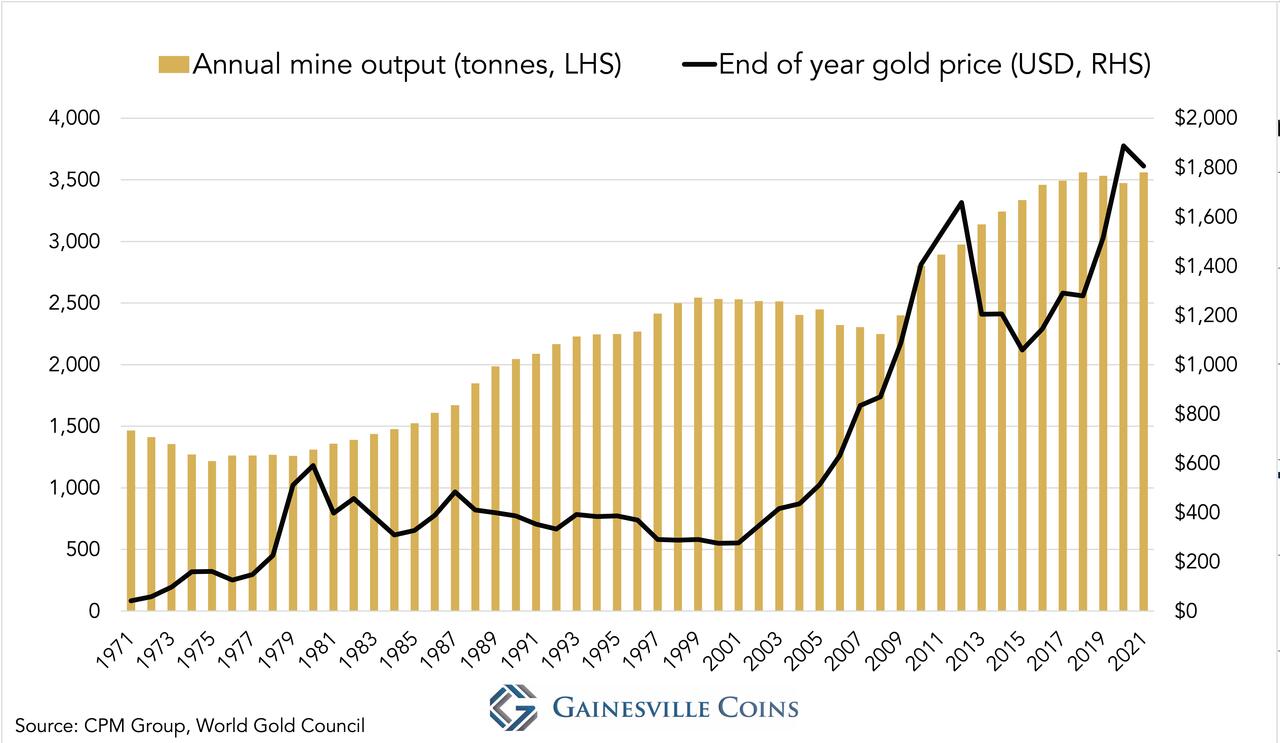
Thousands of years ago people started using gold as money, because gold is immutable, easily divisible, and scarce. Gold is the most marketable commodity. Its long tradition as store of value means extremely little gold has been wasted over history. The vast majority of all the gold ever mined is still with us. Consequently, annual mine production adds about 1.7% to the above ground stock of gold.
At the time of writing the total above ground stock of gold is 205,000 tonnes and global mine output in 2021 accounted for 3,560 tonnes. The stock-to-flow ratio (STFR) is currently 58 (205,000 / 3,560). Gold’s high STFR and the fact that most above ground gold is held for monetary purposes is what makes it trade like a currency.
For a thorough understanding of gold’s price formation, let’s first have a look at supply and demand dynamics of a perishable commodity. Then we will discuss how this differs from the gold market.
Soft Commodity Supply and Demand Basics
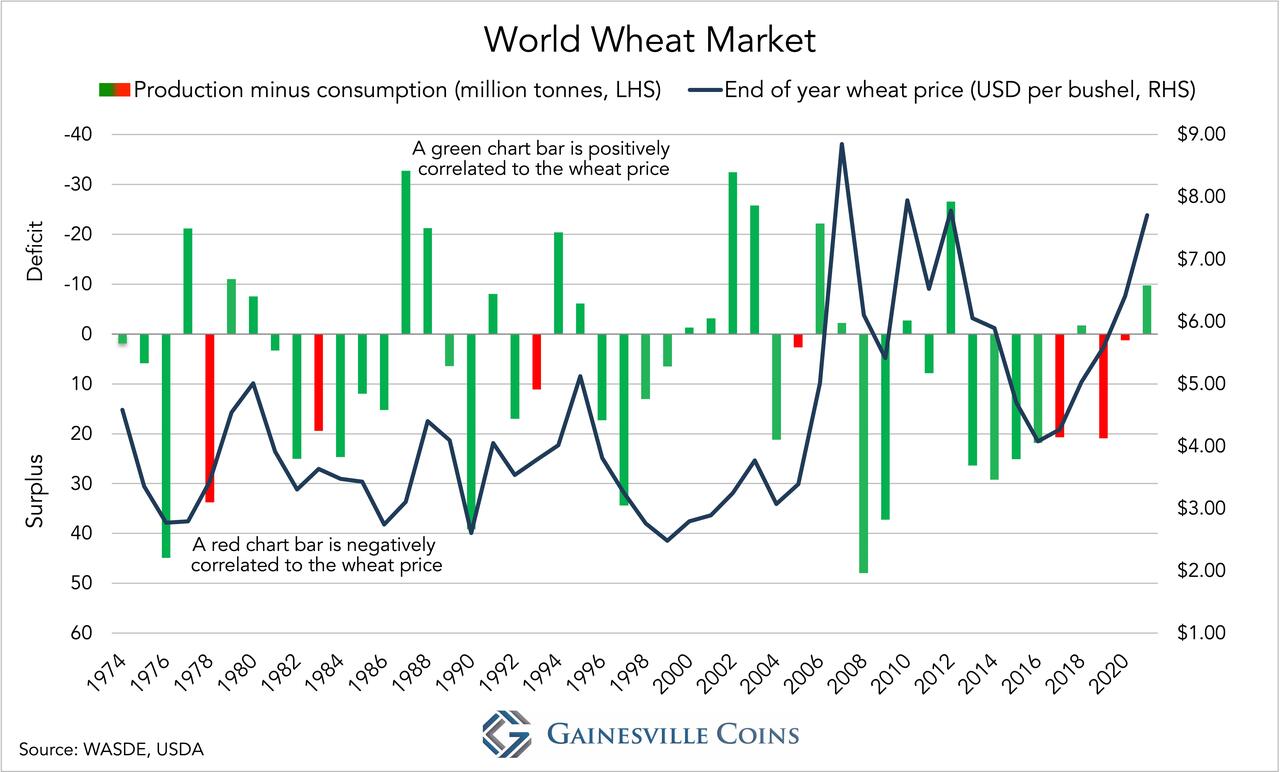
Based on data from the World Agricultural Supply and Demand Estimates (WASDE), the STFR in the wheat market is 0.35 (278 million tonnes in stock divided by 776 million tonnes of production). A low STFR causes the price of wheat mainly to be determined by what is annually produced versus what is used up. Existing stocks can only smooth a surplus or deficit in the market—calculated as production minus consumption—to a certain extent.
Wheat stored in a warehouse starts to rot after several years, so a surplus can’t be entirely absorbed as stock: it must be sold, which lowers the price. Market deficits, in turn, can’t be fully drawn from stock supply, and thus increase the price. In addition, because wheat’s sole application is consumption, for which fixed quantities are needed, the price is set between what is produced versus consumed.
In the chart below you can see that since 1974 a surplus or deficit in the global wheat market was positively correlated to the direction of the wheat price for 85% of the time. Logically, a surplus caused the price to decline, and a deficit caused the price to increase. Note, the left-hand side axis in the chart is inverted to match it to the wheat price.
All wheat market participants rely on wheat supply and demand data and the market balance (surplus or deficit). Farmers look at the balance to decide how much wheat to grow next season. Speculators use it to estimate what the price will be in the future. Producers will consider replacing wheat for another commodity if the price rises, and so forth.
Gold Supply and Demand Dynamics
The gold market is very different. Because gold isn’t be used up and is primarily used as a store of value, the gold price isn’t set between what is produced and consumed.
Due to its high STFR, gold supply mainly consists of inventory. And because virtually everyone buys gold as a store of value, demand consists mainly of inventory as well. The gold market can be seen as all sorts of trades moving metal from one inventory to another (with or without metal being altered in shape, weight or purity). Or the gold stays in the same vault but changes ownership.
Additionally, gold’s use for monetary purposes doesn’t require fixed quantities. People don’t buy gold because they need, for example, five troy ounces to build a house. What they need is “whatever amount of gold” in exchange for how much value they like to invest at the prevailing price. The gold price can be too low or too high, but there can’t be a surplus or deficit. This is what makes gold trade more like a currency than a commodity.
Measuring distinct types of demand, which are simply fragments of total trading volume, can help us gauge the sentiment of specific groups of buyers. But it’s senseless to compare it to annual production. Some consultancy firms, though, do exactly that: publish a gold market balance.
How come the confusion in the gold market?
After the gold standard was abandoned in 1971, the U.S. tried to “demonetize” gold by pushing a narrative that gold is useless, in order to make the dollar to look stronger. Although most central banks held on to their gold, and thus didn’t demonetize it, some people in the West stopped viewing gold as a currency, but purely as a commodity.
In the 1980s, consultancy firms like Gold Fields Mineral Services (GFMS) began publishing reports about gold supply and demand. These reports later included a market balance, supposedly indicating if the price of gold would rise or fall. In other words, they present gold as if it is a perishable commodity that can be in surplus or deficit.
Millions of gold investors have been confused by these reports, thinking that the price of gold is determined by the difference between annual mine production versus newly fabricated products. The latter is what consultancy firms chiefly report as demand.
Let’s have a look at the latest GFMS Gold Survey that is publicly available on their website.

The main items on the supply side of the GFMS market balance are mine output and scrap supply. On the demand side sales of newly fabricated jewelry, industrial parts, and retail bars and coins are recorded. Net central bank (official sector) purchases/sales, net ETF (ETP) purchases/sales, and net exchange inventory increases/decreases are also added to the balance. At the bottom we can see the overall “net balance,” suggesting the market is in a surplus or a deficit. However, not surprisingly, this net balance has no statistical relationship with the price of gold.
In the chart below I have plotted the yearly net balance figures (obtained from Refinitiv, which nowadays owns GFMS) versus the gold price.
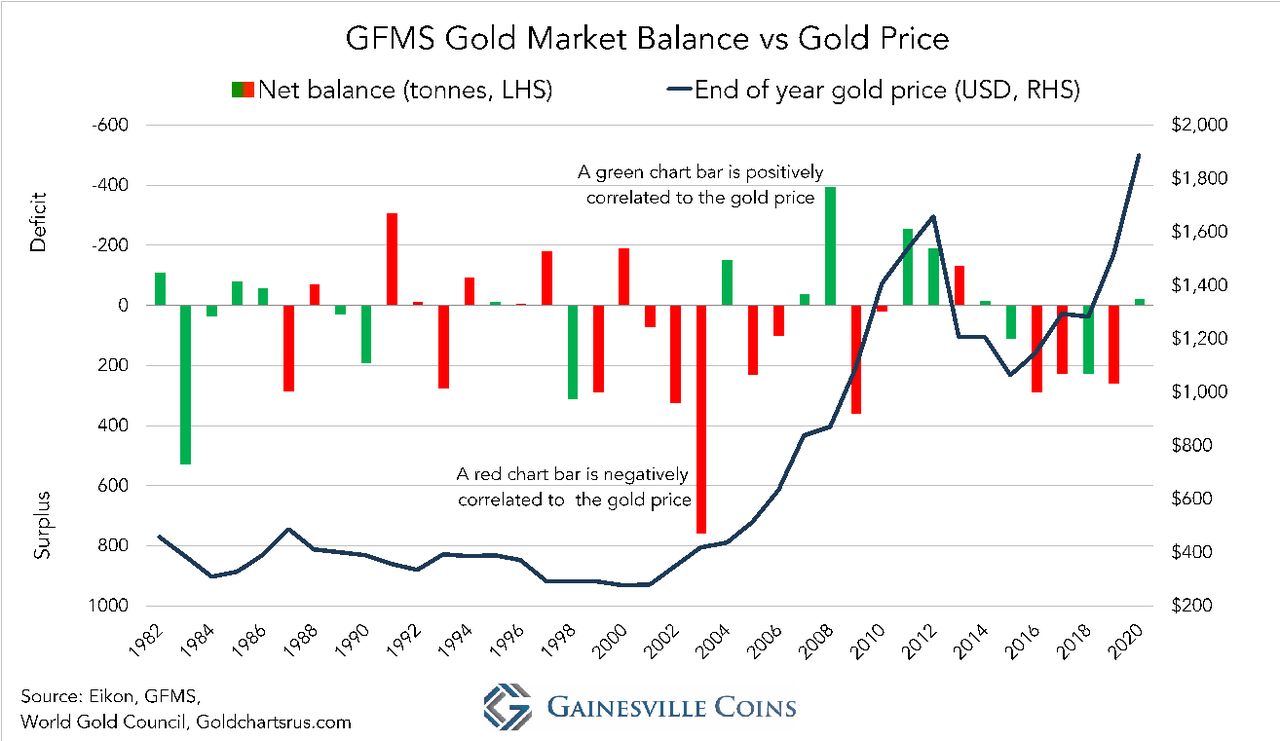
From 1982 until 2020 only 44% of the time a “surplus” or “deficit” in the gold market was positively correlated to the direction of the gold price. Flipping a coin would get a better result—50%. This disappointing score is explained* by the fact that gold is a currency and currencies can’t be in a surplus or deficit.
Moreover, according to GFMS the largest demand category is jewelry demand. Viewed in a chart, though, it shows that jewelry demand moves in the opposite direction of the gold price. Jewelry buyers are price sensitive; they do not drive the price.

Because above ground stocks dwarf annual mine output, neither does mine production drive the price of gold in the short and medium term. Academic research confirms this statement. From Fergal O’Connor, Lecturer In Finance at Cork University Business School (source):
The [high stock to flow ratio] of gold implies low market power of gold mining firms and thus an inability to significantly influence gold prices. . . . [Mine] production thus follows gold prices.Gold miners have low market power and are likely to be price takers rather than price setters. . .
Annual mine output reacts to the gold price, not the other way around. When there is a bull market, new mining projects are initiated. Ten years later these mines start producing and elevate total mine output. Of course, in the long run mine supply does influence the gold price, as it increases the above ground stock over time.
Institutional Supply and Demand Drives the Gold Price
If an investment fund buys an allocated 400-ounce gold bar from a bank in London, this trade doesn’t show up in supply and demand data published by GFMS. Yet, it has the exact same impact on the gold price as the sale of 400 newly minted coins weighing 1 troy ounce.
As 400-ounce bars are traded in massive volumes all day long in the London and Swiss wholesale bullion markets, that’s where the price is set. Fifteen out of the past seventeen years the net flow of gold (import minus export) through the UK has been positively correlated to the price of gold. That’s not a coincidence. Institutional supply and demand in above ground gold drives the price.
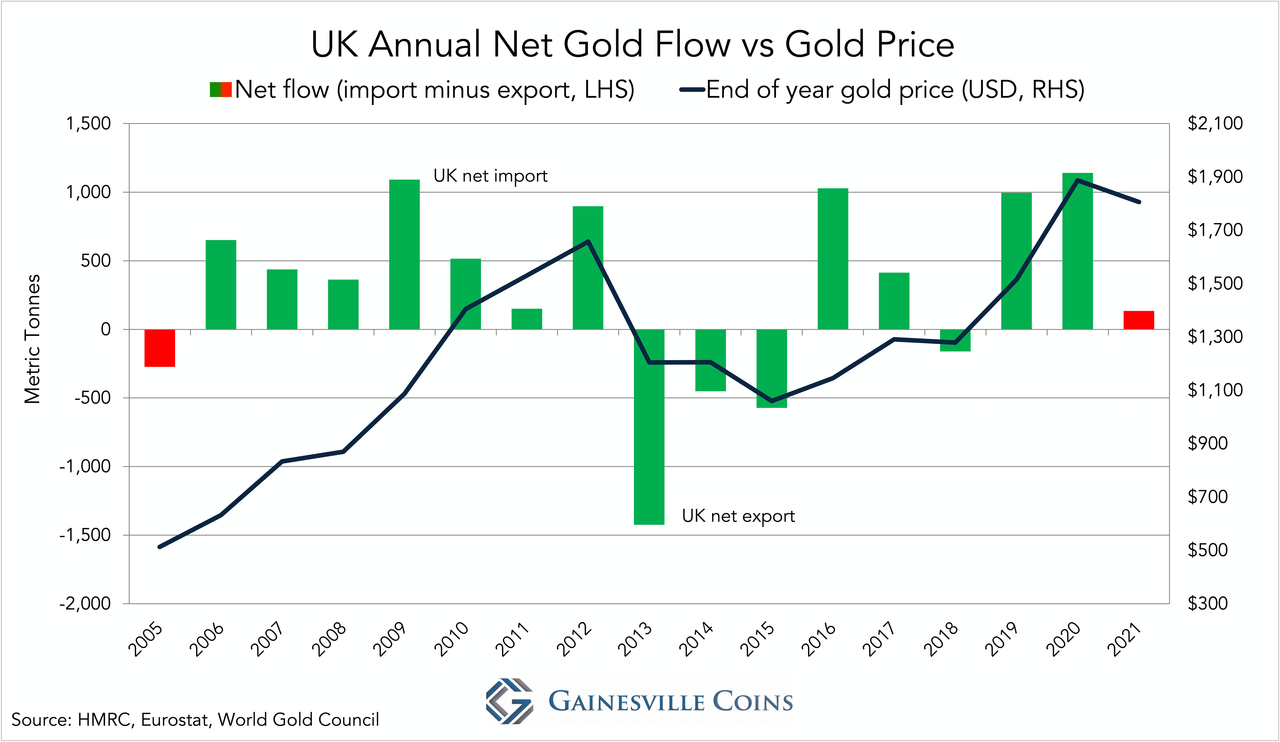
Derivates markets are connected to the London Bullion Market (the most liquid spot market) through arbitrage. The forces from the COMEX futures market in New York are executed on physical supply and demand in London.
The reason why net import and net export in London is often correlated to the gold price is because usually “the East” takes the other side of the trades in the West. If Western institutional investors buy gold, driving up the price, countries in Asia will sell and metal flows from the East into London vaults. When Western institutional investors sell gold, driving down the price, countries in Asia buy and metal flows from the UK toward the East.
An accurate gold supply and demand overview would cover global physical gold trading volume, but it wouldn’t include a net balance. After all, for every buyer there is a seller. There can’t be a surplus or deficit as with soft commodities. That is not to say that all GFMS data is meaningless; much valuable information can be extracted from it. My main objection is their “market balance” approach.
*The fact the net balance is often negatively correlated to the gold price is because GMFS’s largest demand category is jewelry demand. As discussed, jewelry buyers are price sensitive, so when the price goes up jewelry demand goes down, and the net balance flips to a surplus.
Tyler Durden
Tue, 03/29/2022 – 05:00
via ZeroHedge News https://ift.tt/5KOHZXP Tyler Durden

In a letter to Sheriff Alex Villanueva, Los Angeles County Inspector General Max Hunstman claimed his office has compiled a list of 41 deputies who are members of “gang-like” organizations, including the Banditos and the Executioners. The letter did not name any of the deputies. In a statement, the sheriff’s department said Huntsman “failed to provide any actual evidence or new information.” “This is another irresponsible attempt from Mr. Huntsman to discredit the organization, through omission and misrepresentation,” the statement said.
The post Brickbat: Gang Squad appeared first on Reason.com.
from Latest https://ift.tt/j2TCfX5
via IFTTT
“Going Dark” Is How Russian Ships Evade Sanctions
Following Russia’s invasion of Ukraine, Western countries have slapped the energy-rich country with an unprecedented wave of sanctions which are disrupting global commodity markets.
Some countries have outright banned imports of Russian crude, such as the US, the UK, Canada, and Australia. Other countries, such as Italy, Japan, Germany, and France, have committed to reducing energy dependence on Russia. Import bans don’t just stop at energy but are also across the board, including agriculture, petrochemicals, and metals.
As for countries that still trade with Russia, a tactic known as “going dark” has been spotted in Russian waters, according to Bloomberg.
Windward Ltd., an Israeli-based shipping consulting firm, said in the week ending March 25, at least 33 commercial vessels spotted in or around Russia’s exclusive economic zone turned off their automatic identification system, or AIS. That’s more than double the weekly average of 14 over the prior week.
These dark ship-to-ship meetings transfer cargo to other vessels without sanctions. Windward said the ships going dark include ones connected to major corporations and multinational shipping firms.

Going dark has been flagged by the US Treasury as one of several “deceptive practices used to evade sanctions” in the maritime industry. Disabling a ship’s AIS is easy though it can be fraught with danger because other vessels in the area will not be able to see them.
“There’s no reason why they should have their AIS turned off,” said Gur Sender, Windward’s program manager who specializes in compliance and risk issues, unless it’s for illegal activity to evade sanctions.
“Investigating if a vessel is engaged in deceptive shipping practices related to specific regimes is crucial to protect your business from dealing with sanctioned entities,” Sender said.
S&P Global Commodity Insights outlines the latest wave of sanctions on Moscow that cover a wide range of commodities. The goal of sanctions by Western countries is to paralyze and crush the Russian economy for the Ukrainian invasion.
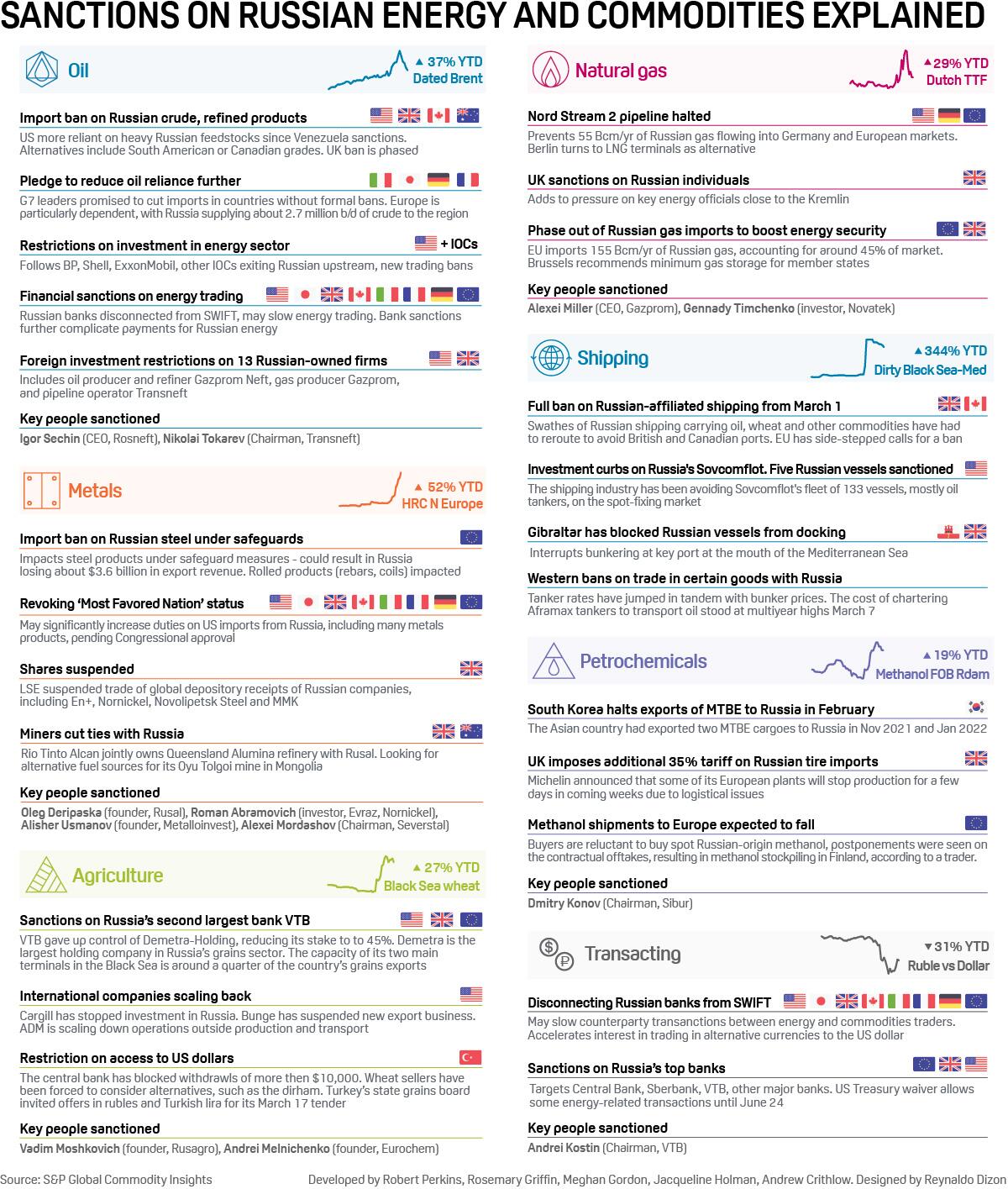
It’s not just sanctions. Major corporations have also shunned commerce with Russia. The international community shames any corporation that continues to do business with Russia unless they go dark:
Ian Ralby, chief executive of I.R. Consilium, a maritime law and security consulting firm that works with governments, said countries and companies not imposing sanctions on Russia are more inclined to conduct dark activities to hide their business dealings.
“Russia has quickly become a pariah state so they are obscuring some of their activities because a lot of people on both ends of a transit don’t want any association with Russia.
“Anywhere that Russia appears in the overall management or operation and ownership of the vessel, there are concerns about dark activity right now. Almost anything that they are going to be doing is gaining scrutiny and legal concerns because of all the various sanctions,” said Ralby.
The sanctions and conflict in Ukraine have disrupted global commodity markets, producing shortages of agriculture, energy, and metals worldwide. Countries will still need Russian commodities as they’re one of the largest exporters, though the very act of how they will obtain it goes dark (for now).
The news follows reports of Russian oligarchs switching off AIS on their superyachts, hiding private jets, and other trophy assets from Western sanctions.
Tyler Durden
Tue, 03/29/2022 – 04:15
via ZeroHedge News https://ift.tt/YrO1L9g Tyler Durden