Russia Signals Intent To Cut Military Operations Around Kiev & Chernihiv After Positive Ceasefire Talks

Russia Signals Intent To Cut Military Operations Around Kiev & Chernihiv After Positive Ceasefire Talks

As the first statements coming off now concluded for the day Russia-Ukraine ceasefire talks trickle out, both Interfax and Reuters are reporting the potential for a major breakthrough, as Russia’s Defense Ministry has said it’s seeking to create conditions for dialogue towards halting military activity around the capital of Kiev and major northern city of Chernihiv.

The New York Times suggests this possible overture comes as Russian forces are facing stiff resistance near the capital, as also yesterday Ukraine said it retook the major Kiev suburb of Irpin. “Diplomats from Ukraine and Russia were discussing a possible cease-fire on Tuesday at talks in Turkey, an effort that comes as a Ukrainian counteroffensive pushed back Russian forces in a hard-fought area near Kyiv, the capital,” NY Times writes.

Tuesday’s Ukraine and Russia delegations hosted in Istanbul, Turkey

The talks were called “constructive” by the Russian top negotiator Vladimir Medinsky, who said he will take Ukraine’s proposals for stopping the war directly to Putin, which crucially is centered on a pledge of ‘neutrality’ vis-a-vis NATO. The meeting, held in Istanbul, lasted four hours.

“The two delegations also discussed international security guarantees for Ukraine, according to Mykhailo Podolyak, an aide to President Volodymyr Zelensky of Ukraine.” Negotiations will likely continue Wednesday, according to NY Times: “The Kremlin’s spokesman, Dmitri S. Peskov, told reporters that the talks, which he said could continue on Wednesday, could be of great consequence, without offering details on the shape of a possible deal.”

Ukraine’s top negotiator said Ukraine is now offering to discuss the Crimea question – and there could be enough substantial agreement on the scope of negotiations to hold a direct Putin-Zelensky meeting, something which Putin has thus far clearly rejected. 

However, for the first time, Medinsky said that such a meeting of presidents is now “possible” – according to statements given to TASS, suggesting that Tuesday’s talks appear to be the most substantive so far since the invasion and conflict began. 

Tyler Durden
Tue, 03/29/2022 – 08:17

via ZeroHedge News https://ift.tt/PNfS7tZ Tyler Durden

There Is No Short Term Solution To Europe’s Oil Addiction

There Is No Short Term Solution To Europe’s Oil Addiction

by Irina Slav of Oilprice.com

One of the hottest topics in the media in the past month has been the possibility of an oil embargo on Russia in response to its invasion of Ukraine. Oil prices have climbed higher on the constant speculation of a broader oil ban, but that speculation appears to be unjustified. The UK banned Russian oil and fuel imports earlier this month, and so did the United States. For both of these countries, Russian oil and fuels are a small portion of total oil imports. Yet the bans had a pronounced negative effect on retail fuel prices in both, even though in the UK, the ban was to take place gradually, by the end of this year. Is it any wonder, then, that the EU, after undoubtedly intense negotiations last week, failed to agree on banning Russian oil and fuel imports?

Russia provides 29 percent of the crude oil that Europe consumes, as well as 51 percent of the oil products that the continent consumes. And Europe consumes a lot of oil and oil products despite its eager energy shift. But that’s not all. Two years ago, the European Union received almost 97 percent of the oil and oil products it consumed from external sources, according to Eurostat. In other words, the EU is more import-dependent than India when it comes to oil.

Obviously, with such a degree of dependence, an oil embargo on the union’s biggest supplier would be a disaster for the continent. This means that the discussions held last week and reported on in abundance by the media were likely nothing more than an exercise in political posturing. It was obvious from day one such an embargo was not happening anytime soon.

An immediate oil embargo on Russian imports “from one day to the next would mean plunging our country and the whole of Europe into a recession,” Germany’s Chancellor Olaf Sholz said last week, as quoted by Reuters’ John Kemp.

On the other hand, “Why should Europe give Putin more time to earn more money from oil and gas? More time to use European ports? More time to use unsanctioned Russian banks in Europe? Time to pull the plug,” the foreign minister of Lithuania, Gabrielius Landsbergis said. Lithuania buys almost all of the oil it consumes from Russia.

What we seem to have here is, once again, politics versus pragmatism, a situation very much similar to the energy transition narrative and plans. In this case, it seems that common sense is winning.

“The question of an oil embargo is not a question of whether we want or don’t want (it), but a question of how much we depend on oil,” Germany’s foreign minister, Annalena Berbock, said last week. “Germany is importing a lot (of Russian oil), but there are also other member states who can’t stop the oil imports from one day to the other.”

What these officials seem to tell us is that the EU, just like India or China – or the rest of Europe, really – has an oil addiction, and kicking it is much easier said than done, despite all the work done by EU governments to stimulate less oil consumption at least in the form of car fuels by encouraging the electrification of transport. No wonder, then, that besides the International Energy Agency’s 10-point plan for cutting oil demand, alternative oil supplies are being considered as a remedy for the current situation.

The president of Ukraine, who has become perhaps the most public personality over the past few weeks, recently urged Middle Eastern oil producers to boost their output to help Europe reduce its dependency on Russia.

“They can do much to restore justice. The future of Europe depends on your effort. I ask you to increase the output of energy to ensure that everyone in Russia understands that no country can use energy as a weapon and blackmail the world,” Volodymyr Zelensky said at the Doha Forum last week, as quoted by Reuters.

So far, the Gulf oil states have demonstrated a clear unwillingness to boost production or condemn Russia’s actions in Ukraine. In fact, the UAE is forging stronger ties with Russia, and Saudi Arabia has reaffirmed its commitment to the OPEC+ agreement with Russia and the Central Asian republics. Unless it gets the security support it wants from the U.S. and Europe, OPEC’s top producer is unlikely to budge on that.

Even with the guarantees, the Middle East is quite unlikely to agree to take Russia’s place in Europe. Reuters’ kemp put it eloquently: “Breaking long-term contracts and giving up Asia’s lucrative growth markets to supply refiners in declining Europe, possibly only for a few months or years, would make little strategic sense.”

Europe, then, is overwhelmingly dependent on foreign oil and gas, and more specifically, Russian oil and gas. Despite its efforts to first diversify and then wean itself off fossil fuels, oil and gas will remain essential for European economies. A 10-point plan will hardly help change that in any meaningful way, and neither would pleas to Middle Eastern producers – what sort of oil exporter wants a market eager to reduce its consumption of oil?

Tyler Durden
Tue, 03/29/2022 – 08:16

via ZeroHedge News https://ift.tt/E8kdNgp Tyler Durden

Stocks Jump, Oil Dumps Over Russia-Ukraine Peace Talks Optimism

Stocks Jump, Oil Dumps Over Russia-Ukraine Peace Talks Optimism

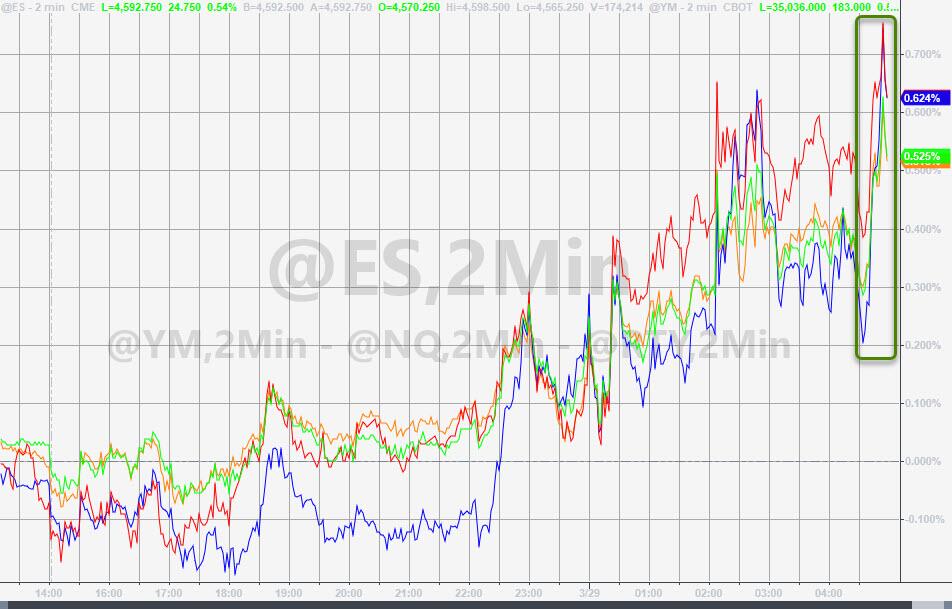
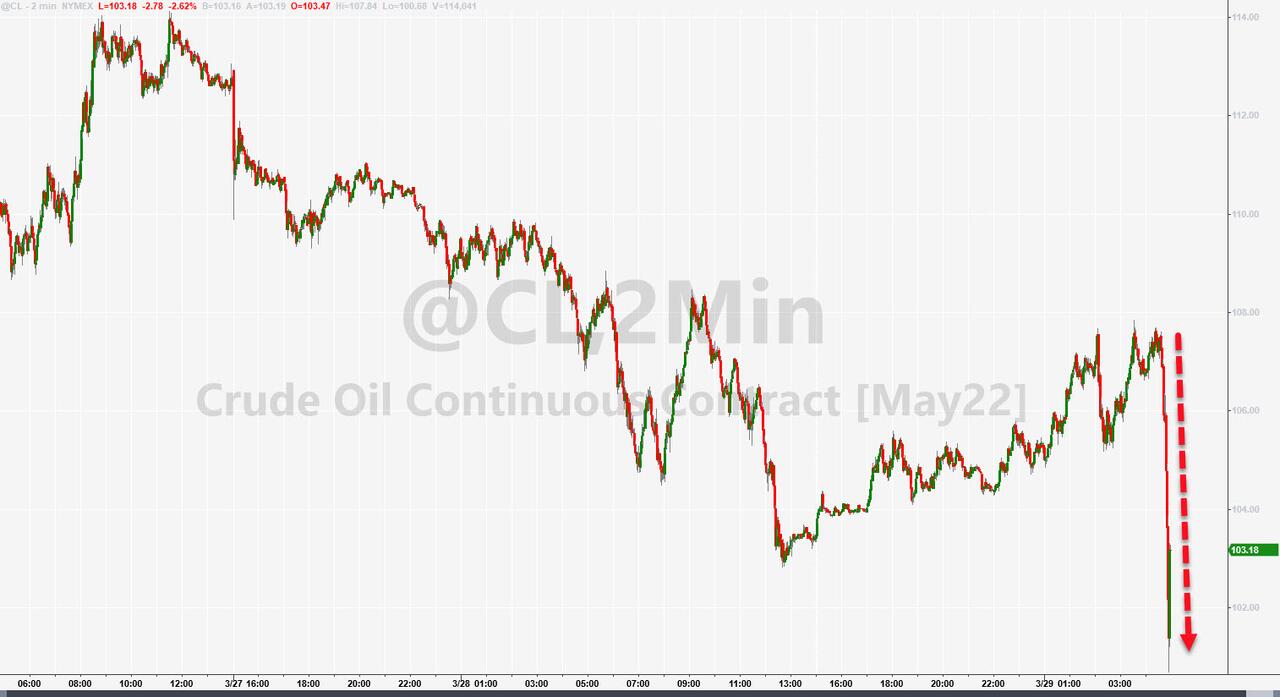
Another day, another avalanche of Russia-Ukraine related headlines and reports. This time reported by Russian media outlets TASS and Interfax, Russia is aid to “radically” reduce military activity near Kiev and Chernigiv and a Putin-Zelenskiy meeting is possible.

The optimistic headlines immediately sent futures higher…

And tanked oil prices, with WTI back to a $100 handle…

Developing…

Tyler Durden
Tue, 03/29/2022 – 08:01

via ZeroHedge News https://ift.tt/cZzvwJn Tyler Durden

Futures, Yields Rise On Ceasefire Hopes As Ukraine-Russia Talks Resume

Futures, Yields Rise On Ceasefire Hopes As Ukraine-Russia Talks Resume

Following yesterday’s surge in stocks following an FT report that Russia has eased on its Ukraine demands and the Russian ceasefire document no longer contains any discussion of three of Russia’s initial core demands – “denazification”, “demilitarisation”, and legal protection for the Russian language in Ukraine – overnight futures have extended their “feel good” rise as peace negotiations which resumed on Tuesday in Turkey between Russia and Ukraine stoked a rally in global equities, and hit session highs after Ukrainian negotiator Podoliak noted that a ceasefire is being discussed with Russia adding a press conference is to be expected later. Ukraine is striving for a cease-fire agreement in talks with Russian negotiators that started Tuesday in Turkey, setting a “minimum” goal of an improvement in the humanitarian situation. Nasdaq 100 futures were up 0.6% while S&P 500 futures gained 0.5% and Dow futures 0.4%. Europe’s Stoxx 600 Index also advanced, with auto and consumer stocks outperforming. Oil fluctuated as investors weighed the impact of China’s mobility curbs against a Covid resurgence on demand; the dollar dropped. Treasuries bear flattened, outperforming bunds and gilts as haven demand continues to be unwound; the 10Y TSY yield rose to 2.50%.

Apple headed higher in premarket trading and was set for its longest winning streak since 2003, in which the iPhone maker has added about $407 billion in market capitalization. A revival in the so-called meme stock rally also set GameStop on course for its 11th straight day of gains as retail traders bid up OTM calls sparking yet another gamma squeeze and proving that the market remains hopelessly broken. Here are some other notable premarket mvoers:

  • Dave & Buster’s (PLAY) shares drop 7.2% after the dining and entertainment venue operator reported earnings per share for the fourth quarter that missed the average analyst estimate. While analysts pointed to the impact of the Omicron variant of the Covid-19 virus on the company’s fourth-quarter, they saw reassuring signs in the firm’s margins and recent improvements.
  • Progenity (PROG US) falls 20% in U.S. premarket trading after the firm late on Monday reported a wider annual loss for 2021 than expected.
  • Small biotech and pharma companies rally in U.S. premarket trading, rebounding from this year’s declines, as investor appetite for riskier assets and so-called meme stocks grows. Brooklyn Immunotherapeutics (BTX US) +8.7%, Alaunos Therapeutics (TCRT US) +6.5%.
  • CVS Health (CVS US) shares drop 1.7% in U.S. premarket trading after Deutsche Bank downgrades the pharmacy health care provider to hold from buy amid rising risks.

U.S. stocks have rebounded in March as the Federal Reserve issued an upbeat outlook on economic growth, with investors also looking past surging inflation and a historic rout in Treasuries. Paradoxically, technology-heavy stocks, which tend to sell off when interest rates are rising, have in fact outperformed the benchmark S&P 500 as traders focused instead on differentiating between profitable and unprofitable firms.  Even more paradoxically as a new cold war rages, the Nasdaq 100 is on track for its biggest monthly gain since October 2021.

“The resilience of global stocks given the cocktail of risks facing the global economy is truly impressive, but this stoicism is likely to face continuing tests as the impact of mounting prices and the actions of central banks continue to feed through, not to mention the ongoing geopolitical concerns,” Russ Mould, investment director at AJ Bell Ltd., said in emailed comments.

Meanwhile, government bond yields rose, with bets on aggressive U.S. monetary tightening hurting shorter maturity Treasuries. Inversions along the curve, where some short-term rates exceed longer tenor yields, point to concerns about a looming economic downturn as the Federal Reserve hikes interest rates to quell high inflation.

Hopes of a cease-fire in Ukraine-Russia talks also bolstered European equities. The Stoxx 600 jumped 1.3%, with automakers, consumer products and services and technology shares leading gains. Here are some of the biggest European movers today:

  • Carlsberg shares advance as much as 4.5% as analysts welcomed the brewer’s decision to exit Russia, with Credit Suisse seeing potential for a re-rating for a stock battered by Russia’s invasion of Ukraine.
  • Adyen shares gain as much as 6% after JPMorgan said the company could boost its outlook for long-term margin to more than 70% from 65%, placing the firm on “positive catalyst watch.”
  • Currys Plc shares rise as much as 12% following a so-called uncooked mention in a Betaville blog post regarding potential takeover interest in the electrical goods retailer.
  • Euromoney shares climb as much as 4.9% after Investec raises its recommendation to buy from hold, citing a disconnect between the share price and the media firm’s operational performance.
  • Schibsted shares rise as much as 6.6%, the most since March 16, after its largest shareholder, Blommenholm Industrier, buys 1 million Class A shares at NOK222.5 each.
  • Nordex shares rise as much as 8.3% after the wind-turbine maker’s new FY22 guidance is ahead of expectations, Jefferies says; wind power peers Vestas and Orsted gain, too.
  • Barclays falls as much as 5.7% in London following news that an unnamed investor sold about 575m shares at a discount. Stock is also downgraded to neutral from overweight at JPMorgan.
  • Maersk, Kuehne + Nagel and Hapag-Lloyd all drop after Deutsche Bank downgrades several logistics and container stocks due to the indirect consequences of the war in Ukraine.
  • Sanofi shares fall as much as 2.5% after the firm provided a new sales forecast for its drug Dupixent, with both Morgan Stanley and Citi noting guidance is slightly behind expectations.

Earlier in the session, Asian stocks advanced after a three-day loss, as a decline in oil prices eased concerns over corporate earnings and Chinese tech stocks extended gains into a second day. The MSCI Asia Pacific Index rose 0.7% with Tencent, Toyota Motor, and Alibaba among the biggest contributors to the advance. Apart from Hong Kong, where gains in tech and health names drove gauges higher, equities in Japan and Australia outperformed, with the former benefiting from a weaker yen and the latter rising ahead of a budget release after markets closed. Investors are waiting to see how the cease-fire talks between Russia and Ukraine proceed, while assessing the repercussions to businesses from the lockdown in Shanghai. The risk of Chinese firms, especially those in the property sector, facing trading halts is weighing on sentiment as a key earnings deadline looms.  Oil Extends Losses on China Demand Concerns Ahead of OPEC+ Meet

“A V-shaped recovery in stock markets looks difficult,” said Kim Kyung Hwan, a strategist at Hana Financial Investment in Seoul.  “The worst is behind in terms of investor sentiment, but issues like Covid lockdowns and the war in Ukraine aren’t resolved, traders are just getting used to them.” Despite Tuesday’s gain, the benchmark Asian measure is poised for a third straight monthly loss. It’s also lagging behind the S&P 500 index in recent performance

Japanese equities rose, powered by exporters after the yen plunged by the most since March 2020 against the U.S. dollar on the Bank of Japan’s easing measures. Electronics and auto makers were the biggest boosts to the Topix, which rose 0.9%. Fast Retailing and SoftBank Group were the largest contributors to a 1.1% gain in the Nikkei 225. The yen was slightly higher after weakening 1.5% against the greenback on Monday. “Makers of export-related products like automobiles should rise with the BOJ’s continuous bond-purchase operations expected to continue weakening the yen,” said Hideyuki Ishiguro, a strategist at Nomura Asset Management. The drop in oil prices is a “relief” for Japan as an importer, and growth stocks should benefit from the slowing rise in long-term U.S. interest rates, he added

Indian stocks rose as a drop in crude prices along with prospects of more cease-fire talks between Russia and Ukraine supported buying sentiment. The S&P BSE Sensex climbed 0.6% to 57,943.65, in Mumbai, a second day of gains, while the NSE Nifty 50 Index also advanced by a similar magnitude. Housing Development Finance Corp. advanced 3.1% and was the biggest boost to the Sensex, which had 20 of the 30 shares trading higher.   Fifteen of 19 sectoral indexes compiled by BSE Ltd. rose, led by a gauge of healthcare stocks. Price of Brent crude, a major import for India, hovered around $113 a barrel, down about 6% this week.  Lower oil is supporting gains across economies as a lockdown in parts of China after a resurgence in Covid cases raised possibilities of lower demand, Mitul Shah, head of research at Reliance Securities, wrote in a note. “The Russia-Ukraine conflict and inflationary pressures continue to keep the market wavered,” he said.   

In rates, Treasuries extended bear-flattening move with yields cheaper by ~5bp across front-end of the curve, following wider losses for bunds and gilts in early European session. U.S. 10-year yields around 2.49%, higher by ~3bp on the day with bunds and gilts trading cheaper by 6bp and 4bp in the sector; Treasury curve-flattening persists with 2s10s spread tighter by 4.5bp as front-end continues to underperform. The week’s auction cycle concludes with $47b 7-year note sale at 1pm ET, following Monday double supply of 2- and 5-year notes; WI 7-year around 2.60% is above auction stops since 2019 and ~69.5bp cheaper than February’s stop-out. IG dollar issuance slate includes two 3Y SOFR deals; two deals priced $4b Monday, and early calls for April are for around $100b of issuance.

In Europe, fixed income trades heavy in the risk-on environment. Bund and Treasury curves bear-flatten with U.S. 5s30s remaining inverted and 2s10s flattening a further ~5bps near 7bps. Germany’s 2y yield trades ~3bps shy of a 0% yield. Gilts bear-steepen, cheapening 7-8bps across the back end. Peripheral spreads tighten modestly.

In FX, Bloomberg dollar spot drops 0.3%, CHF is the weakest in G-10 sending EUR/CHF 0.6% higher on to a 1.03-handle.

  • The Bloomberg Dollar Spot Index hovered as the greenback traded mixed versus its Group-of-10 peers; Scandinavian currencies were the best performers while the Swiss franc and the pound were the worst.
  • The yen inched up after posting is biggest drop in over a year Monday; the currency may be heading for its worst monthly performance versus the dollar since November 2016, yet trading in the options space is much more balanced. Super-long Japanese government bonds dropped while benchmark 10-year notes were supported by the central bank’s purchase operations; The Bank of Japan offered to buy an unlimited amount of 5- to 10-year government notes for a second time on Tuesday
  • Cable gave up an early advance to fall to an almost two-week low; gilts fell. London’s Metropolitan Police are set to issue at least 20 fines to government officials close to the prime minister who broke U.K. lockdown rules, although this tranche of fines is unlikely to touch Prime Minister Boris Johnson
  • Australia’s three-year bonds dropped after retail sales beat economists’ estimates, with the gap over 10-year notes narrowing to the least since March 2020

In commodities, crude futures hold in the green, recouping Asia’s weakness. WTI regains a $106-handle, Brent trades near $113. Spot gold extends losses, dropping ~$13 before stalling near $1,910/oz. Base metals trade poorly with LME nickel underperforming

Looking at the day ahead now, and data releases from the US include the FHFA house price index for January, the Case-Shiller home price index for January, the Conference Board’s consumer confidence indicator for March, and the JOLTS job openings for February. Over in Europe there’s also French consumer confidence for March, Germany’s GfK consumer confidence reading for April and UK mortgage approvals for February. Lastly, central bank speakers include the Fed’s Harker.

Market Snapshot

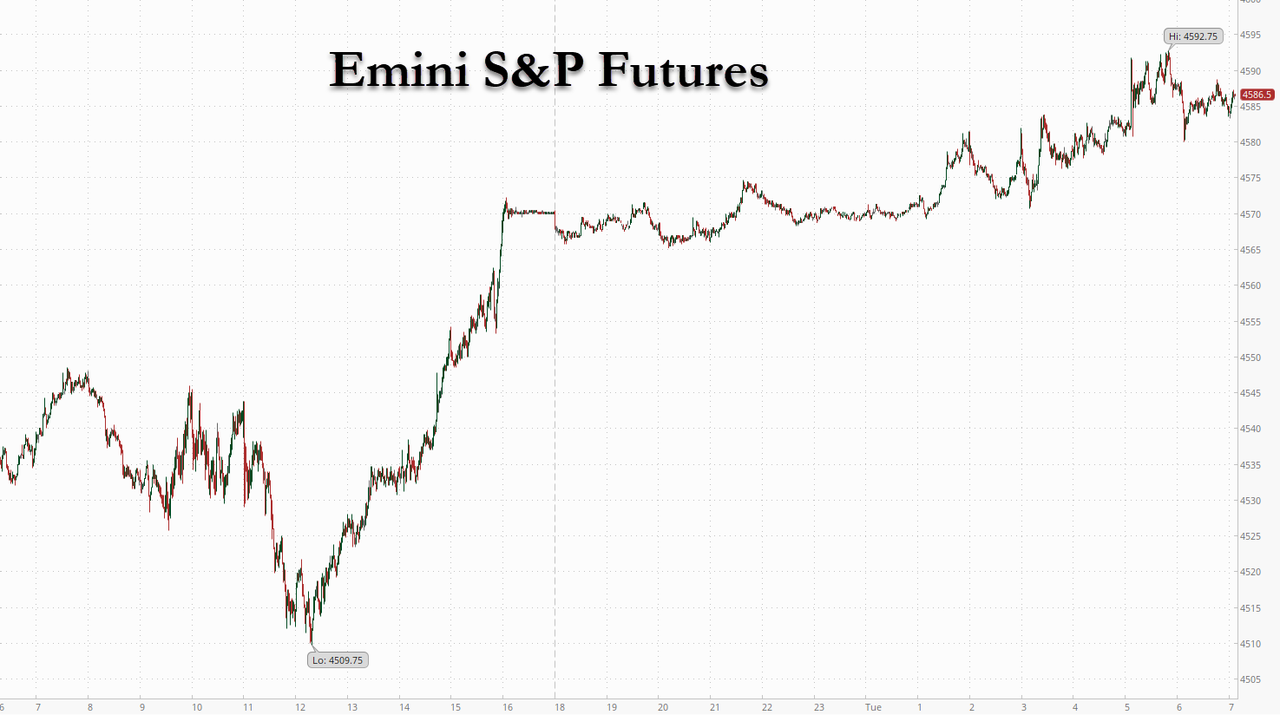
  • S&P 500 futures up 0.5% to 4,590.75
  • STOXX Europe 600 up 1.1% to 459.14
  • MXAP up 0.7% to 179.73
  • MXAPJ up 0.6% to 586.67
  • Nikkei up 1.1% to 28,252.42
  • Topix up 0.9% to 1,991.66
  • Hang Seng Index up 1.1% to 21,927.63
  • Shanghai Composite down 0.3% to 3,203.94
  • Sensex up 0.2% to 57,724.92
  • Australia S&P/ASX 200 up 0.7% to 7,464.26
  • Kospi up 0.4% to 2,741.07
  • German 10Y yield little changed at 0.63%
  • Euro little changed at $1.0995
  • Brent Futures up 1.3% to $113.95/bbl
  • Gold spot down 0.4% to $1,916.02
  • U.S. Dollar Index little changed at 99.04

Top Overnight News from Bloomberg

  • Deputy Treasury Secretary Wally Adeyemo said the U.S. and its allies will tighten the sanction screws on Russia over its invasion of Ukraine, singling out industries integral to Moscow’s war effort
  • As NATO allies discuss the terms of any potential peace deal to be struck between Russia and Ukraine, signs of strategic splits are emerging from within their ranks
  • Policymakers in Japan on Tuesday sought to balance a commitment to ultra-loose monetary policy in a world of rising interest rates without letting the yen tumble further toward a 20-year low
  • Japan’s Finance Minister Shunichi Suzuki highlighted the need to check if a weaker yen is harming the economy, as he indicated heightened government concern over the currency’s recent slide
  • The additional increase in energy prices resulting from the war in Ukraine pushed inflation significantly higher in March, European Central Bank Governing Council member Pablo Hernandez De Cos says
  • Key OPEC members said oil prices would be even more volatile if not for the group’s strategy and that the U.S. must trust what it’s doing, as calls from major importers for higher production grow
  • Russia has made a $102 million interest payment as the world’s biggest energy exporter continues to service its foreign bonds despite financial isolation after the invasion of Ukraine
  • North Korea looks set to detonate its first nuclear bomb in more than four years, as the U.S.’s sanctions disputes with Russia and China make further United Nations penalties against the country unlikely

More detailed look at global markets courtesy of Newsquawk

Asia Pac stocks traded mostly higher following the gains in the US where growth stocks spearheaded a recovery and with a decline in oil prices conducive for risk. ASX 200 was led by strength in tech and consumer stocks heading into the Budget announcement. Nikkei 225 gained with Japan to compile economic measures by the end of next month. Hang Seng and traded mixed with the mainland index faltering amid the ongoing lockdown inShanghai Comp. Shanghai and despite the announcement of supportive measures by the local government.

Top Asian News

  • Australia’s Budget Pitches Cash to Key Voters Ahead of Election
  • Samsung to Offer More Credit in India to Boost Smartphone Sales
  • Modern Land Joins List of Earnings Delays: Evergrande Update
  • Iron Ore Edges Lower in China as Virus Controls Dent Demand

European bourses, Euro Stoxx 50 +2.2%, are firmer across the board in a continuation of the APAC/US handover as Russian-Ukraine talks begin. Upside that has been exacerbated by remarks from both Ukraine and Russian officials. US futures are firmer across the board, ES +0.4%, though magnitudes more contained with Fed speak and supply ahead

Top European News

  • U.K. Consumer Credit Surges at Strongest Pace in Five Years
  • U.K. Faces Crypto Exodus as Firms Sound Off Before FCA Deadline
  • European Banks Could Earn $6.6 Billion a Year Greening Economy
  • Inflation Rose Sharply in March on Energy Shock: ECB’s de Cos

Commodities:

  • Crude benchmarks have experienced an erosion of earlier upside amid multiple, but generally constructive, updates from Ukraine and Russia.
  • Specifically, Ukrainian negotiator Podoliak noted that a ceasefire is being discussed with Russia adding a press conference is to be expected later.
  • Albeit, the morning’s action has not been sufficient to spark a test of the overnight parameters for WTI and Brent.
  • Spot are pressured once more, generally speaking in-fitting with other havens, exacerbated by thegold/silver aforementioned risk-on move.

In FX, Euro elevated as EGB yields ramp up again and hopes rise regarding a Russia-Ukraine peace resolution, EUR /USD above 1.1000 and a series of decent option expiries stretching between 1.0950 and the round number. Buck caught amidst buoyant risk sentiment and hawkish Fed vibe, DXY sub-99.000 after narrowly missing test of 2022 peak on Monday. Yen maintains recovery momentum amidst more MoF verbal intervention and demand for month/fy end, USD /JPY under 124.00 vs 125.00+ peak yesterday. Franc flounders as SNB ponders direct repo indexing to main policy rate, USD/CHF around 0.9360 and EUR /CHF over 1.0300.

US Event Calendar

  • 09:00: Jan. S&P/CS 20 City MoM SA, est. 1.50%, prior 1.46%
  • 09:00: Jan. FHFA House Price Index MoM, est. 1.2%, prior 1.2%
  • 10:00: March Conf. Board Present Situation, prior 145.1
  • 10:00: March Conf. Board Expectations, prior 87.5
  • 10:00: Feb. JOLTs Job Openings, est. 11m, prior 11.3m
  • 10:00: March Conf. Board Consumer Confidenc, est. 107.0, prior 110.5

Central Bank Speakers

  • 09:00: Fed’s Williams Makes Opening Remarks at Bank Culture…
  • 10:45: Fed’s Harker Discusses Economic Outlook
  • 21:30: Fed’s Bostic Discusses Economic Leadership

DB’s Jim Reid concludes the overnight wrap

A mixed medical report from the Reid family today. I have a nerve root block injection and a diagnostic test on my back tomorrow to battle my sciatica. I managed to stretch for an hour before attempting to play golf on Saturday thinking there was no hope. Miraculously it must have helped me get round but I then suffered for the rest of the weekend as I seized up as soon as I stopped. I told my wife I should have just carried on playing. She despaired at me. On the more positive side my 6-yr old Maisie had her latest 3-4 month scan yesterday. Regular readers will remember she’s been in a wheelchair since November after an operation to help her battle a rare hip disorder called Perthes. There are no guarantees as to the long-term outcome with Perthes but the latest scan was encouraging and suggested that while her hip ball is fragmenting (disintegrating), it’s not collapsing and getting out of shape largely due to no weight bearing. That suggests a decent chance that when it regrows (assuming it does) it will regrow relatively normally. The nightmare is if the hip ball gets squashed as it disintegrates. She’ll still need to keep the weight off for most of the rest of the year but there’s hope that by the end of it she can come out of her wheelchair and start the rehab towards a manageable hip. There are some horror stories with this disease in terms of pain and constant discomfort through the entirety of childhood so fingers crossed it’s going in the right direction due to her discipline in spite of missing out on all the running about that she’s desperate to do. Also helping is that she continues to swim 3-4 times a week and is remarkably good now. This has been the one blessing that’s come out of a year and a half where we tried to get her problem diagnosed and then treated. Fingers crossed that the next scan in July will continue to move her in the right direction.

Bond markets continued to be as volatile as my back yesterday with big swings in yields but with the front end sell-off being durable. This helped push a number of yield curves ever closer to inversion, meaning we have multiple recessionary signals starting or continuing to flash. The one we always look most closely at is the 2s10s curve, which has inverted prior to every one of the last 10 US recessions. Yesterday this flattened by -7.3bps to 12.5bps and this morning it’s currently just above 6bps with more flattening plus a new on the run 2yr note to blame. Could we invert today? Regardless it’s likely to happen soon.

A key factor behind this curve flattening has been monetary policy expectations, and over the last 24 hours we’ve seen investors continue to ratchet up their bets on how much tightening we’re likely to see this year. By the close yesterday, Fed Funds futures were pricing in a further 211bps of tightening by the end of 2022, on top of the 25bps a couple of weeks back, which if realised would be the largest move tighter in a calendar year since 1994, back when the Fed raised the target range for the Federal Funds by 250bps. On top of that, it’s clear that investors are also reappraising what the terminal rate is likely to be, and at one point yesterday investors were pricing in a move above 3% by the second half of 2023. We’re not talking much about the terminal rate at the moment, but as we move deeper into the hiking cycle, that’s likely to grab increasing attention, since the destination will have big implications for a wide variety of financial assets.

Whilst the all-important 2s10s curve is still (just about) in positive territory, increasing numbers of curves have been inverting across different maturities, with the 3s30s curve becoming the latest to do so around the time we went to press yesterday, eventually closing down -10.4bps at -2.9bps. Similarly, the 3s10s that had already inverted went even deeper into inversion territory to close at -11.5bps, which is the most inverted it’s been since 2006. The 5s30s was another to invert yesterday, falling as low as -7.1bps at one point before it steepened to close at -0.9bps. Clearly they are all a bit flatter this morning.

If you’re interested in reading more on the yield curve, DB’s US economics team put out a piece last Friday (link here) looking at the value of these various measures for predicting recessions. The Fed have played down the usefulness of the 2s10s curve, and have argued that the Fed forward spread (18-month forward, 3-month yield minus the spot 3-month yield) is more valuable when it comes to explaining recessions risks over the next 12 months. But our economists find that traditional curve slope metrics like the 2s10s provide useful information over a longer horizon, like the next 2 years, and they point out that the 2s10s slope is consistent with a probability greater than 60% of a recession at some point over the next 2 years.

Even with the latest round of flattening though, the truth is that the trend has been nearly all one-way for basically a year now. In fact, it was a year ago tomorrow that the slope of the 2s10s curve saw its intraday peak for this cycle, when it hit 162bps.

Yesterday’s flattening also coincided with a healthy dose of Treasury volatility. 2yr yields ultimately wound up +5.8bps higher at 2.33%, after trading as much as +13.8bps higher during London trading. 10yr yields fell -1.5bps to 2.46%, but were as much as +8.0bps higher during London trading, and -6.1bps lower during the New York morning. This pushed the MOVE index of Treasury volatility +4.0pts higher to 129.3, just below levels realised in early March.

In spite of all the volatility, equities were mostly positive yesterday, with the S&P 500 (+0.71%) staging a steady second half rally to start another week off in the green. The decline in longer-dated yields from their early London peak helped spur tech outperformance, with the NASDAQ gaining +1.31%. Europe also started the week on the front foot, with the STOXX 600 (+0.14%) advancing, alongside the DAX (+0.78%) and the CAC 40 (+0.54%). There were pockets of relative weakness however, with the small-cap Russell 2000 in the US closing flat. Energy stocks were left behind in the otherwise broad rally on both sides of the Atlantic given the large decline in oil discussed below, with the S&P 500 energy sector down -2.56% and the STOXX 600 energy sector down -2.10%.

Indeed, Oil prices did fall back yesterday, with Brent crude down -6.77% to $112.48/bbl, but that reflected the lockdown in Shanghai and the prospect of a further release from the US Strategic Petroleum Reserve rather than more positive developments out of Ukraine. It’s down another -0.8% this morning. On the other hand European natural gas (+1.26%) rose to €102.55/MWh, which occurred as German Economy minister Habeck said that the G7 had rejected the proposal from President Putin that natural gas contracts be paid in Rubles, with Habeck saying it was a “one-sided and clear breach of contracts”.

Back to sovereign bonds, and there were some major moves in European sovereign bonds as well as the US yesterday, with yields on 10yr bunds moving to a fresh high above 0.6% after the open before modestly retreating -0.6bps to 0.58%. That pattern was common across core European sovereigns, with yields on 10yr gilts (-7.9bps) and OATs (-1.2bps) eventually also moving lower following their increases that morning. Similarly to the US, this has come as investor conviction has grown about the chances of tighter ECB policy in the coming months, with 48bps of hikes priced by year-end. Nevertheless, there’s still a wide policy divergence between the Fed’s and the ECB’s trajectory, and we saw this in the widening spread between 2yr US and Germany yields, which closed at 246.1bps yesterday, the most since September 2019.

Asian equity markets are trading higher outside of China this morning with the Nikkei (+0.60%), Hang Seng (+0.40%) and Kospi (+0.31%) up. Stocks in mainland China are wavering with the Shanghai Composite (-0.44%) and CSI (-0.11%) both trading in negative territory as I type. Meanwhile, contracts on the S&P 500 (+0.04%) are fractionally higher while Nasdaq futures are down -0.11%.

Early morning data showed that Japan’s industrial output rebounded +0.5% m/m in February after January’s contraction of -0.8%. Separately, Japan’s jobless rate inched down to 2.7% in February from 2.8% in January while the jobs-to-applicants ratio improved to 1.21 in February from 1.20 in the prior month. Elsewhere, Australia reported retail sales for February, advancing +1.8% m/m and beating market expectations for a +0.9% gain. It followed a downwardly revised +1.6% m/m increase in January.

The Japanese Yen weakened to its lowest level against the US Dollar since 2015, depreciating -1.48% to 123.86 per dollar, and at one point surpassing 125 per dollar. It’s moved nearly 8% in four weeks – a substantial move historically. The latest move came as the Bank of Japan announced they would purchase 10yr JGBs in unlimited quantities over three sessions today, tomorrow and the day after, which followed their move above 0.25% at one point, which we haven’t seen since 2016. The Yen is trading at 123.31 as we go to press so a continued reversal from the close and the lows yesterday morning.

Elsewhere today, there’s set to be another round of in-person talks taking place in Turkey between Russia and Ukraine as the war continues into its second month. Investors have grasped at positive headlines in recent weeks and more sensitive assets such as energy prices have reacted accordingly, but the reality has been few signs of concrete progress towards any ceasefire, even if there has been a moderation in some of the demands from either side as to any potential settlement.

Finally on Europe, we’re now just 12 days away from the first round of the French presidential election, and there are signs the race is tightening up slightly as the official campaign period began yesterday. Politico’s polling average puts President Macron in the lead still, but his 1st round polling has dipped to 28%, having been at 30% a couple of weeks earlier following the bounce he saw after Russia’s invasion of Ukraine. Behind him is Marine Le Pen on 19%, who he also faced in the second round back in 2017, and her average is up from 18% a couple of weeks earlier. The far-left Jean-Luc Mélenchon is also gaining, now in 3rd place with 14% (up from 12% a couple of weeks ago), but he’s still 5 points behind Le Pen, and only the top 2 candidates go through to the run-off two weeks later. Behind them are also the far-right Eric Zemmour (11%), as well as the conservative Valérie Pécresse (11%).

To the day ahead now, and data releases from the US include the FHFA house price index for January, the Case-Shiller home price index for January, the Conference Board’s consumer confidence indicator for March, and the JOLTS job openings for February. Over in Europe there’s also French consumer confidence for March, Germany’s GfK consumer confidence reading for April and UK mortgage approvals for February. Lastly, central bank speakers include the Fed’s Harker.

Tyler Durden
Tue, 03/29/2022 – 07:51

via ZeroHedge News https://ift.tt/8gU7Qya Tyler Durden

Academic Freedom Alliance Letter to Princeton University

The Academic Freedom Alliance released a public letter to Princeton University calling on the university to reaffirm the academic freedom of classics professor Joshua Katz.

On July 8, 2020, Professor Joshua Katz published an opinion piece in an online journal reacting to the July 4th public letter signed by many members of the Princeton faculty. In that piece he criticized a student group that had operated on campus a few year earlier and hyperbolically characterized it as a “small local terrorist group.” This piece generated a series of responses on campus, including the university’s spokesman claim that Professor Katz would be investigated for potential disciplinary action as a result of his extramural speech. More recently, in a university-sponsored freshman orientation event Professor Katz was singled out for criticism by the Carl Fields Center for Equality and Cultural Understanding. On a website of the university and co-sponsored by myriad university administrative units including the Office of the Vice Provost of Institutional Equity and Diversity, Professor Katz is held out as an example of a professor making a racist statement and is shown being denounced by the university president, the Classics department, and the chairs of two academic units for engaging in racist speech.

The AFA has not adopted a position on whether institutional speech by universities on issues of public controversy is ever appropriate, but it is a deeply problematic practice for administrative units on campus to use their institutional resources and programming to engage in ongoing public shaming campaigns directed against individual members of the faculty. It is not clear what, if any, boundary there might be on university deans and vice presidents using their offices to vilify members of the faculty.

As we write in the letter:

It is hard to see the actions of the Carl Fields Center as anything other than ongoing retaliation for Professor Katz’s speech. For university officials in their individual capacities to sharply criticize a professor for his speech is one thing. For the administration to memorialize criticism and to highlight it as the introduction of every student to the university campus is something else. We are not aware of any other example of a university systematically denouncing a sitting member of its own faculty in such a way. It is not an example that should be followed or repeated if universities are to remain vibrant centers of intellectual freedom.

The university climate would quickly become poisonous and intolerable if administrative units on campus made it a practice to hold up dissenting members of the faculty for ritual condemnation and if the precedent now being set were followed in the future.  If the Office of the Vice President for Campus Life uses its administrative position on campus to organize official university programming for the purpose of heaping opprobrium on faculty for expressing disfavored personal political opinions, the risks of chilling speech on campus are severe. The university can hardly create a climate welcoming of heterodox opinions if it creates an administrative apparatus to target the heterodox and stamp them as campus pariahs.

The post Academic Freedom Alliance Letter to Princeton University appeared first on Reason.com.

from Latest https://ift.tt/dsoAGDt
via IFTTT

Academic Freedom Alliance Letter to Princeton University

The Academic Freedom Alliance released a public letter to Princeton University calling on the university to reaffirm the academic freedom of classics professor Joshua Katz.

On July 8, 2020, Professor Joshua Katz published an opinion piece in an online journal reacting to the July 4th public letter signed by many members of the Princeton faculty. In that piece he criticized a student group that had operated on campus a few year earlier and hyperbolically characterized it as a “small local terrorist group.” This piece generated a series of responses on campus, including the university’s spokesman claim that Professor Katz would be investigated for potential disciplinary action as a result of his extramural speech. More recently, in a university-sponsored freshman orientation event Professor Katz was singled out for criticism by the Carl Fields Center for Equality and Cultural Understanding. On a website of the university and co-sponsored by myriad university administrative units including the Office of the Vice Provost of Institutional Equity and Diversity, Professor Katz is held out as an example of a professor making a racist statement and is shown being denounced by the university president, the Classics department, and the chairs of two academic units for engaging in racist speech.

The AFA has not adopted a position on whether institutional speech by universities on issues of public controversy is ever appropriate, but it is a deeply problematic practice for administrative units on campus to use their institutional resources and programming to engage in ongoing public shaming campaigns directed against individual members of the faculty. It is not clear what, if any, boundary there might be on university deans and vice presidents using their offices to vilify members of the faculty.

As we write in the letter:

It is hard to see the actions of the Carl Fields Center as anything other than ongoing retaliation for Professor Katz’s speech. For university officials in their individual capacities to sharply criticize a professor for his speech is one thing. For the administration to memorialize criticism and to highlight it as the introduction of every student to the university campus is something else. We are not aware of any other example of a university systematically denouncing a sitting member of its own faculty in such a way. It is not an example that should be followed or repeated if universities are to remain vibrant centers of intellectual freedom.

The university climate would quickly become poisonous and intolerable if administrative units on campus made it a practice to hold up dissenting members of the faculty for ritual condemnation and if the precedent now being set were followed in the future.  If the Office of the Vice President for Campus Life uses its administrative position on campus to organize official university programming for the purpose of heaping opprobrium on faculty for expressing disfavored personal political opinions, the risks of chilling speech on campus are severe. The university can hardly create a climate welcoming of heterodox opinions if it creates an administrative apparatus to target the heterodox and stamp them as campus pariahs.

The post Academic Freedom Alliance Letter to Princeton University appeared first on Reason.com.

from Latest https://ift.tt/dsoAGDt
via IFTTT

UK Police Issue 20 Fines To ‘Partygate’ Participants

UK Police Issue 20 Fines To ‘Partygate’ Participants

The Metropolitan Police investigation into ‘Partygate’ – the scandal that nearly toppled UK PM Boris Johnson’s government as the public was infuriated by a flurry of leaks and press reports detailing a spate of illegal gatherings held at No. 10 Downing Street during the depths of the COVID pandemic – is finally nearing its end as police have issued 20 fines to individuals close to the PM for violating the UK’s strict COVID lockdown rules.

Police ultimately investigated 12 gatherings held at Downing Street and the Cabinet Office in 2020 and 2021 during the inquiry, and have finally confirmed that the country’s strict COVID lockdown rules were repeatedly broken by the same people who ordered them, according to Reuters.

While recipients of the fines haven’t been identified, police say they will let the public know if the PM receives one. This is only the first round, and it’s still possible that BoJo could receive one of the summonses.

“We will today initially begin to refer 20 fixed penalty notices to be issued for breaches of COVID regulations,” the Metropolitan Police said in a statement. The fines would technically be issued by the ACRO Criminal Records Office.

The opposition Labour Party quickly seized on the news to try and revive public anger over the hypocrisy, which has subsided in recent weeks.

“Boris Johnson’s Downing Street has been found guilty of breaking the law,” said Angela Rayner, deputy leader of the opposition Labour Party.

“The culture is set from the very top. The buck stops with the Prime Minister, who spent months lying to the British public, which is why he has got to go.”

Britons were so infuriated by the news because it appeared that members of the government were indulging in parties while so many Britons were unable to attend the funerals of loved ones, and were barred from visiting dying family members and friends in the hospital.

While BoJo initially insisted that all the pandemic rules were followed, he later apologized to parliament for attending one event.

Police refused to confirm who received penalty notices, and also which events they were tied to. The penalty for participating in a gathering of more than 15 people is an 800 pound ($1,048) fine.

Tyler Durden
Tue, 03/29/2022 – 07:08

via ZeroHedge News https://ift.tt/kO1Z7KC Tyler Durden

A Draft of “Severability First Principles” is Now Available

For several years, I have been thinking about the doctrine of severability — what happens when courts conclude that a part of a law is unconstitutional? I have come to believe that this is fundamentally just a question about “say[] what the law is,” as Marbury v. Madison put it. Marbury tells us that a statute does not make law if the Constitution prevents it from doing so. The severability question is simply what is the law, in light of what the law is not?

I finally have a draft article on these questions, Severability First Principles, forthcoming in the Virginia Law Review and available on SSRN. Here is the abstract:

The Supreme Court has decided a number of cases involving severability in the last decade, from NFIB v. Sebelius and Murphy v. NCAA to Seila Law v. CFPB, Barr v. AAPC, United States v. Arthrex, California v. Texas and Collins v. Yellen. The analysis has not been consistent, the Justices have not been able to agree, and the results have not been intuitive. Some of the Justices have proposed a revisionist approach, but they too have been unable to agree on what it requires.

This article proposes a return to first principles. Severability is a question of what the law is. Severability also includes two principles of constitutional law: that judges should enforce the law, and that the Constitution displaces ordinary law that is repugnant to it. And it also includes principles of non-constitutional law: that validly enacted statutes are law if they are not repugnant to the Constitution, that unenacted hopes and dreams are not, and that Congress may legislate for contingencies.

Much of the time, these principles lead to a simple bottom line: effectively complete severability, rebutted only by an inseverability clause or something else with the force of law. There are also harder cases where the bottom line is not so simple, but where the first principles of severability will nonetheless lead the way – the relevance of unconstitutional removal restrictions, the nonconstitutional law that resolves unconstitutional combinations, and the relevance of severability to standing and other procedural questions.

And here is the introduction:

When part of a statute is unconstitutional, the courts engage in severability analysis. According to the cases, this analysis couples a presumption with a possible rebuttal. The presumption is one of severability: “the invalid part may be dropped.” The presumption is rebutted based on either an objective analysis, asking whether “what is left is fully operative law,” or a subjective analysis, asking whether “it is evident that the Legislature would not have enacted those provisions which are within its power, independently of that which is not.” Slightly more controversially, the same seems to be true for a single provision with constitutional and unconstitutional applications.

There have been many calls to abandon or reform severability doctrine. But there is no consensus about what the problem is or what to do instead. At least one problem, though, is methodological: the modern approach to statutory interpretation is heavily influenced by formalism generally and textualism specifically. Such judges have extra reason to be skeptical of current doctrine. They doubt the coherence or the relevance of counterfactual inquiries into legislative intent, and also tend to resist the normative analysis that sometimes lies behind particular severability arguments. And severability can look uncomfortably like “rewriting” a statute, which most judges today know they are not supposed to get caught doing. So we need an account of severability that makes formal sense.

This is a natural occasion for a return to first principles, and some

have tried. Several recent articles make promising contributions, and recent opinions by Justices Thomas and Gorsuch have attempted to synthesize them into a new revisionist account of severability. But their work is incomplete. Justices Thomas and Gorsuch cannot even agree among themselves in several recent cases, and throughout they may be trying to squeeze more certainty out of the literature than it can supply. We still need a clearer account of the first principles that answer the severability problem, and of what those principles do and do not imply.

Returning to first principles also requires us to disentangle how much of severability analysis comes from the Constitution, and how much it comes from statutory interpretation or other non-constitutional law. In truth, severability principles are a combination of both constitutional and non-constitutional law. The Constitution tells us that it displaces ordinary law that is inconsistent with it. It also tells us that judges (among others) are supposed to apply the law. But these constitutional principles are not all there is to severability. We also need to know what is the law, when some part of a statute has been found to be constitutionally repugnant? Ordinary principles of statutory interpretation fill in this answer. Federal law is what has been enacted by Congress, and not otherwise displaced, including any fallback law. And of course any non-federal legal rules also continue to apply.

Much of the time, these principles lead to a simple bottom line: judges should enforce a statute except in the specific cases where its application is unconstitutional. But this simplicity is deceptive. The bottom line becomes more difficult to see in the case of unconstitutional combinations: when two statutory requirements are unconstitutional if taken together, which one should be disregarded? These difficult cases – more widespread than many realize – illuminate an aspect of the Constitution that has been there all along: the Constitution tells us what the law isn’t, but not always what it is. Solving the severability problem in these cases – saying what the law is – requires going beyond the text of statute, whether formalist judges like it or not.

Other difficulties come up in the context of standing and other threshold questions. When can a plaintiff establish standing on the basis of an inseverability argument, and when can a severability argument defeat standing? These questions have proven difficult for the Courts, but this time it is the difficulty that is deceptive. Once we straighten out our severability analysis, it drives to straightforward answers in these cases.

This paper puts forward the first principles of severability and then applies them, first to the easy cases and then to the hard ones. Part I argues that severability is a question of law; that the Constitution displaces repugnant law; and that all non-repugnant law should be enforced, including fallback law such as severability and inseverability clauses. Part II describes how these principles would reframe severability doctrine; how Justices Gorsuch and Thomas have come close to restating these principles; and how the principles also clarify facial challenges and national injunctions. Part III tackles the harder cases, such as unconstitutional combinations and standing.

Since it has come up on the blog before, here are my two discussions of California v. Texas, the attempt to gets courts to declare the complete invalidity of the Affordable Care Act through an inseverability argument.

I defend Texas’s theory of standing:

In California v. Texas, the plaintiffs tried to get the Supreme Court to say that most of the Affordable Care Act was invalid because it was inseverable from the unconstitutional individual mandate. The case thus presented controversial questions of constitutionality (was the $0 mandate unconstitutional?), of severability (was the mandate indeed inseverable from the rest of the Act?), and of standing (could the plaintiffs raise this argument?). The Court resolved the case on standing grounds, but standing might in fact have been the least vulnerability in the plaintiffs’ case.

The best argument for Texas’s standing was “bank-shot” standing—that Texas was entitled to have an injunction against the plausible enforcement of Provision A, if Provision B is invalid and inseverable. This may seem like a strange form of third-party standing, but if inseverability is limited to fallback law it is actually unremarkable first-party standing. The plaintiff is effectively saying that Congress has instructed for Provision A not to be enforced if Condition X obtains, and that Condition X obtains.[3] Such a plaintiff has an orthodox legal injury, an orthodox claim for why that injury is illegal, and an orthodox claim for redress.  A Court might be annoyed if the determination of Condition X involves an important or awkward question and the current case feels too unimportant to justifying answering it. But a judge’s duty is to answer the questions necessary to apply the law to decide the cases before him, not the questions he would like to answer.

This is not to say that Texas’s argument should have succeeded. Their bank-shot theory of standing rested on the premise of inseverability, and that premise was false. And because inseverability is a pure question of law, it can be resolved at a very early stage of the litigation – it would even be permissible to resolve it before considering the constitutional merits argument. So even if an inseverability argument can be used to produce standing, using a bad inseverability argument to produce standing has little consequence. A plaintiff who uses a bad inseverability claim to get into court and then lose has gained nothing more than a plaintiff who invents a fictitious cause of action to enforce a fictitious right. Perhaps the plaintiff has standing, but it is simply standing to lose on the merits a few minutes later.

In the course of denying Texas’s claim to standing, the Court did not fully address “bank-shot” standing. It treated the argument partly as waived, and partly as a different kind of causation argument. Perhaps that was for the best. It could well be that the majority was fractured, both on whether to recognize bank-shot standing (which it should) and whether the inseverability arguments were correct (which they were not). But if the Court confronts the question again in cooler air, it should accept this kind of argument if there is inseverability.

But I argue that the statute was not inseverable:

[The dissent] asks the right question – does the Affordable Care Act provide that if the individual mandate is unconstitutional, the reporting requirements and adult-children coverage requirement should not be enforced? But its answer is wrong.

Focusing on the specific statutory requirements first: The individual mandate required people to buy a particular kind of insurance or pay a penalty, and defined what kind. The reporting requirements require employers to say whether they have provided that kind of insurance. If the mandate is now unconstitutional, nobody has to buy it, and nobody has to pay. But that does not mean nobody has to report it. The connection between the reporting requirement and the mandate was that they used the same criteria for what made an insurance plan covered. But the unconstitutionality of the mandate did not make the criteria unconstitutional, or forbid all cross-references to those criteria.

The adult-children coverage requirement has even less explicit connection to the individual mandate. It simply says: “A group health plan and a health insurance issuer offering group or individual health insurance coverage that provides dependent coverage of children shall continue to make such coverage available for an adult child until the child turns 26 years of age. Nothing in this section shall require a health plan or a health insurance issuer described in the preceding sentence to make coverage available for a child of a child receiving dependent coverage.” No word about the mandate, nothing saying that judges should stop enforcing the provision if other economic premises of the law are false.

That leaves only the argument that the Affordable Care Act contained what is effectively an inseverability clause because it repeatedly finds that the individual mandate is “essential,” to the larger regulatory scheme and to creating effective health insurance markets. One response is that this finding applied only to the 2010 mandate but not to the 2017 amended mandate. This response, however, would be unavailing against a true inseverability clause. If Congress enacts a severability or inseverability clause into law, it can amend the subjects of that law just as any other.

The more fundamental problem is that the “essential” finding is not an inseverability instruction. Every time Congress makes such findings to invoke its necessary-and-proper powers, it is stating its view about the importance and relevance of what it is doing. It is not thereby making fallback law. Indeed, nobody seems to have taken the essential = inseverable argument truly seriously: The ACA findings declare the individual mandate “essential” not only to other provisions of the ACA, but to all of the Earned Income Retirement Securities Act and the Public Health Services Act. If the “essential” finding were an inseverability clause, it would condemn these laws as well, which nobody was willing to argue or accept.

At bottom, many aspects of Justice Alito’s dissent could hold up if the Affordable Care Act contained an inseverability clause. So too, Justice Gorsuch might well be able to join such a dissent if there were an inseverability clause. But there was not, and so this was a mistake.

In my view these questions in California v. Texas were actually fairly simple. The far more difficult and interesting question is the one posed in other cases by the problem of “unconstitutional combinations,” which I discuss extensively in Part III of the piece:

It is easy enough to say the Constitution displaces unconstitutional laws, and requires the others to be enforced. But sometimes a law is unconstitutional only because it is combined in a particular situation with another law. In these cases, it is obvious that the easy saying is incomplete. Which law is to be displaced, and why?

Consider, for instance, the two layers of political insulation in Free Enterprise Fund v. PCAOB, where the Supreme Court held that it was unconstitutional for an agency (the PCAOB) to insulated from presidential control by two layers of protection. The PCAOB could be removed for cause by the SEC, whose members could be removed for cause by the President. One such layer, between the President and the SEC, was thought to be fine. One layer between the SEC and the PCAOB would also have been fine. But two layers – from the President and the SEC, then from the SEC to the PCAOB—”contravene[d] the President’s ‘constitutional obligation to ensure the faithful executive of the laws.'” In such a case, the Court must say more to explain which layer will be disregarded as repugnant.

These combinations problems generally take something like this form. There are Statutory Requirement A, Statutory Requirement B, and a Constitutional Requirement. Any two of these can be enforced. Requirements A and B work fine together were it not for the Constitution. The Constitution and A can be enforced, but not B. Or vice versa. Moreover, we know from basic principles of constitutional supremacy that the Constitution must be enforced. So the question remains what to make of A and B.

The problem may seem quirky, but it is a recurring one. In Arthrex, the separation of powers problem was a combination of the way that the administrative patent judges were appointed, the significance of the power they were given, and the lack of control of that power by superior officers. Seila Law and Collins, discussed earlier, are combinations problems too. The statutes there did two things – vest executive power in an appointed official, and tell the President there were limits on his ability to remove that official. Either of these things standing alone are permissible. Vesting executive power in removable officials is okay. Limiting the power to remove non-executive officials is okay. But not both together. The disagreement over severability in those cases can be seen as simply another application of the combinations problem. Some justices thought that it was the removal restriction that must be ignored, allowing the official to exercise enforcement authority if it was. Other justices thought that it was the enforcement authority which must be nullified in light of the removal restriction.

A different setting for the combinations problem came in in Barr v. American Association of Political Consultants, another recent severability case. There the Court concluded that the First Amendment forbade a combination of two rules: a general ban on robocalls, and a permission for robocalls for government-backed debt. Indeed, as AAPC reminded many lawyers, there is a whole class of cases dealing with the question of whether to “level up” or “level down” when there is a constitutionally impermissible discrimination between two classes of persons or activity. All of these level up/down cases are unconstitutional combinations: the higher level rule for one class, and the lower level rule for the other.

Indeed, it is hard to think of a constitutional challenge that is not at least partly a combinations case. Shelby County v. Holder, for instance, dealt with the preclearance requirements of the Voting Rights Act, whose coverage formula was not adequately justified. This might seem like a standalone constitutional problem. But the problem also partly came from adjacent provisions, such as the limited ability to add and remove jurisdictions from coverage based on new developments. The Solicitor General argued that these provisions were enough to save the statute, and even if they weren’t, that suggests that if the Court had instead said that the Constitution required more vigorous “bail in” and “bail out,” the preclearance formula could have been saved. Indeed, we have proof of this: in a previous case the Court had broadened the “bail out” provision to help rescue the statute from unconstitutionality.

Recognizing the ubiquity of the unconstitutional combinations problem is clarifying. But it is also daunting. For at this point the simple model of repugnancy and enforcement seizes up: Courts should disregard the two statutory provisions because they are unconstitutional. But once both provisions are disregarded there is actually no need to disregard one of them, because it is permissible on its own. Or alternatively there is no need to disregard the other, because it is permissible on its own. So on what warrant can courts disregard the first rather than the second, or the second rather than the first?

Thus the problem of combinations points to a way in which simple formalist accounts of severability are incomplete. Unconstitutional combinations, which have always been possible, highlight that when the Constitution tells us what the law isn’t, it does not always tell us enough about what it is. This is most obvious in cases like Arthrex or Free Enterprise Fund, but it is an instance of the general point that what the sub-constitutional law is depends at least in part on the sub-constitutional law. That’s always true, and easier cases involving partial unconstitutionality just obscure the point because it’s so clear what the sub-constitutional law is in those cases. Even seemingly easy cases of severability actually rest on the conclusion (usually implicit) that no separately constitutional rule or application is dependent on a separately unconstitutional rule or application.

With all of the difficulties in mind, let us focus on possible solutions….

I encourage you to read the piece if you are interested in more. And the piece will be in edits over the summer, so suggestions are still welcome!

The post A Draft of "Severability First Principles" is Now Available appeared first on Reason.com.

from Latest https://ift.tt/uR4L7Nq
via IFTTT

The 1619 Project Unrepentantly Pushes Junk History


culture-magness

“I too yearn for universal justice,” wrote Zora Neale Hurston in her autobiography, Dust Tracks on a Road, “but how to bring it about is another thing.” The black novelist’s remarks prefaced a passage where she grappled with the historical legacy of slavery in the African-American experience. Perhaps unexpectedly, Hurston informed her readers that she had “no intention of wasting my time beating on old graves with a club.”

Hurston did not aim to bury an ugly past but to search for historical understanding. Her 1927 interview with Cudjoe Lewis, among the last living survivors of the 1860 voyage of the slave ship Clotilda, contains an invaluable eyewitness account of the middle passage as told by one of its victims. Yet Hurston saw only absurdity in trying to find justice by bludgeoning the past for its sins. “While I have a handkerchief over my eyes crying over the landing of the first slaves in 1619,” she continued, “I might miss something swell that is going on in” the present day.

Hurston’s writings present an intriguing foil to The New York Times‘ 1619 Project, which the newspaper recently expanded into a book-length volume. As its subtitle announces, the book aims to cultivate a “new origin story” of the United States where the turmoil and strife of the past are infused into a living present as tools for attaining a particular vision of justice. Indeed, it restores The 1619 Project’s original aim of displacing the “mythology” of 1776 “to reframe the country’s history, understanding 1619 as our true founding.” This passage was quietly deleted from The New York Times‘ website in early 2020 just as the embattled journalistic venture was making a bid for a Pulitzer Prize. After a brief foray into self-revisionism in which she denied ever making such a claim, editor Nikole Hannah-Jones has now apparently brought this objective back to the forefront of The 1619 Project.

Vacillating claims about The 1619 Project’s purpose have come to typify Hannah-Jones’ argumentation. In similar fashion, she selectively describes the project as a work either of journalism or of scholarly history, as needed. Yet as the stealth editing of the “true founding” passage revealed, these pivots are often haphazardly executed. So too is her attempt to claim the mantle of Hurston. In a recent public spat with Andrew Sullivan, Hannah-Jones accused the British political commentator of “ignorance” for suggesting that “Zora Neale Hurston’s work sits in opposition to mine.” She was apparently unaware that Dust Tracks on a Road anticipated and rejected the premise of The 1619 Project eight decades prior to its publication.

On the surface, The 1619 Project: A New Origin Story (One World) expands the short essays from The New York Times print edition into almost 600 pages of text, augmented by additional chapters and authors. The unmistakable subtext is an opportunity to answer the barrage of controversies that surrounded the project after its publication in August 2019. “We wanted to learn from the discussions that surfaced after the project’s publication and address the criticisms some historians offered in good faith,” Hannah-Jones announces in the book’s introduction, before devoting the majority of her ink to denouncing the blusterous critical pronouncements of the Trump administration after it targeted The 1619 Project in the run-up to the 2020 presidential election. Serious scholarly interlocutors of the original project are largely sidestepped, and factual errors in the original text are either glossed over or quietly removed.

While the majority of the public discussion around The 1619 Project has focused on Hannah-Jones’ lead essay, its greatest defects appear in the Princeton sociologist Matthew Desmond’s essay on “Capitalism.” Hannah-Jones’ writings provide the framing for the project, but Desmond supplies its ideological core—a political charge to radically reorient the basic structure of the American economy so as to root out an alleged slavery-infused brutality from capitalism.

Hannah-Jones’ prescriptive call for slavery reparations flows seamlessly from Desmond’s argument, as does her own expanded historical narrative—most recently displayed in a lecture series for MasterClass in which she attempted to explain the causes of the 2008 financial crisis by faulting slavery. “The tendrils of [slavery] can still be seen in modern capitalism,” she declared, where banking companies “were repackaging risky bonds and risky notes…in ways [that] none of us really understood.” The causal mechanism connecting the two events remained imprecise, save for allusions to “risky slave bonds” and a redesignation of the cotton industry as “too big to fail.”

Making what appears to be a muddled reference to the Panic of 1837, she confidently declared that “what happened in 1830 is what happened in 2008.” The claimed connection aimed to prove that the “American capitalist system is defined today by the long legacy and shadow of slavery.” This racist, brutal system “offers the least protections for workers of all races,” she said, and it thus warrants a sweeping overhaul through the political instruments of the state. To this end, Hannah-Jones appends an expanded essay to The 1619 Project book, endorsing a Duke University study’s call for a “vast social transformation produced by the adoption of bold national policies.”

“At the center of those policies,” she declared, “must be reparations.”

Uncorrected Errors

What are we to make of The 1619 Project’s anti-capitalism in light of the new book’s expanded treatment? For context, let’s consider how Desmond handles the defects of his original argument.

In his quest to tie modern capitalism to slavery, Desmond began with a genealogical claim. Antebellum plantation owners employed double-entry accounting and record-keeping practices, some of them quite sophisticated. A more careful historian might note that such practices date back to the Italian banking families of the late Middle Ages, or point out that accounting is far from a distinctively capitalist institution. After all, even the central planners of the Soviet Union attempted to meticulously track raw material inputs, labor capacity, and multi-year productivity goals. Does this make the gulags a secret bastion of free market capitalism? Though seemingly absurd, such conclusions are the logical extension of Desmond’s argument. “When an accountant depreciates an asset to save on taxes or when a midlevel manager spends an afternoon filling in rows and columns on an Excel spreadsheet,” he wrote in the original newspaper edition, “they are repeating business procedures whose roots twist back to slave-labor camps.”

Setting aside this unusual leap of logic, the claim rests upon a basic factual error. Desmond attributed this genealogy to the University of California, Berkeley, historian Caitlin Rosenthal’s 2018 book on plantation financial record keeping, Accounting for Slavery. Yet Rosenthal warned against using her work as an “origin story” for modern capitalism. She “did not find a simple path,” she wrote, by which plantation accounting books “evolved into Microsoft Excel.” Desmond, it appears, made a basic reading error.

When I first pointed out this mistake to Jake Silverstein, the editor in chief of The New York Times Magazine, in early 2020, he demurred on making any correction. After consulting with Rosenthal, the Times passed off this inversion of phrasing as an interpretive difference between the two authors. In the new book version of Desmond’s essay, the troublesome Microsoft Excel line disappears without any explanation, although Desmond retains anachronistic references to the plantation owners’ “spreadsheets.” As with other controversies from The 1619 Project, the revisions pair a cover-up of an error with haphazard execution.

This pattern persists and compounds through the meatier parts of Desmond’s expanded thesis. His original essay singles out American capitalism as “peculiarly brutal”—an economy characterized by aggressive price competition, consumerism, diminished labor union power, and soaring inequality. This familiar list of progressive grievances draws on its own array of suspect sources. For example, Desmond leans heavily on the empirical work of the U.C. Berkeley economists Emmanuel Saez and Gabriel Zucman to depict a society plagued by the growing concentration of wealth among the “top 1 percent.” Data from the Federal Reserve suggest that these two authors exaggerate the rise in wealth concentration since 1990 by almost double the actual number. Desmond’s own twist is to causally link this present-day talking point with the economic legacy of slavery.

To do so, he draws upon recent statistical analysis that showed a 400 percent expansion in cotton production from 1800 to 1860. In Desmond’s telling, this growth stems from the capitalistic refinement of violence to extract labor out of human chattel. “Plantation owners used a combination of incentives and punishments to squeeze as much as possible out of enslaved workers,” he declared—a carefully calibrated and systematized enterprise of torture to maximize production levels. In the original essay, Desmond sourced this thesis to Cornell historian Edward E. Baptist, whose book The Half Has Never Been Told essentially revived the old “King Cotton” thesis of American economic development that the Confederacy embraced on the eve of the Civil War. Baptist’s book is a foundational text of the “New History of Capitalism” (NHC) school of historiography. The 1619 Project, in turn, leans almost exclusively on NHC scholars for its economic interpretations.

But Baptist’s thesis fared poorly after its publication in 2014, mainly because he misrepresented the source of his cotton growth statistics. The numbers come from a study by the economists Alan L. Olmstead of the University of California, Davis, and Paul W. Rhode, then with the University of Arizona, who empirically demonstrated the 400 percent production increase before the Civil War but then linked it to a very different cause. Cotton output did not grow because of refinements in the calibrated torture of slaves, but rather as a result of improved seed technology that increased the plant’s yield. In 2018, Olmstead and Rhode published a damning dissection of the NHC literature that both disproved the torture thesis and documented what appear to be intentional misrepresentations of evidence by Baptist, including his treatment of their own numbers. Olmstead and Rhode in no way dispute the horrific brutality of slavery. They simply show that beatings were not the causal mechanism driving cotton’s economic expansion, as the NHC literature claims.

As with Desmond’s other errors, I brought these problems to the attention of Silverstein with a request for a factual correction in late 2019. Almost two years later I finally received an answer: Desmond replied that “Baptist made a causal claim linking violence to productivity on cotton plantations,” whereas his “article did not make such a casual [sic] claim.” I leave the reader to judge the accuracy of this statement against The 1619 Project’s original text, including its explicit attribution of the argument to Baptist.

Even more peculiar is how Desmond handled the “calibrated torture” thesis in the book edition. In the paragraph where he previously named Baptist as his source, he now writes that “Alan Olmstead and Paul Rhode found that improved cotton varieties enabled hands to pick more cotton per day.” But this is far from a correction. Desmond immediately appends this sentence with an unsubstantiated caveat: “But advanced techniques that improved upon ways to manage land and labor surely played their part as well.” In excising Baptist’s name, he simply reinserts Baptist’s erroneous claim without attribution, proceeding as if it has not meaningfully altered his argument.

In these and other examples, we find the defining characteristics of The 1619 Project’s approach to history. Desmond and Hannah-Jones initiate their inquiries by adopting a narrow and heavily ideological narrative about our nation’s past. They then enlist evidence as a weapon to support that narrative, or its modern-day political objectives. When that evidence falters under scrutiny, The 1619 Project’s narrative does not change or adapt to account for a different set of facts. Instead, its authors simply swap out the discredited claim for another and proceed as if nothing has changed—as if no correction is necessary.

Ignoring the Fact-Checkers

We see the same pattern in how Hannah-Jones handles the most controversial claim in the original 1619 Project. Her opening essay there declared that “one of the primary reasons the colonists decided to declare their independence from Britain was because they wanted to protect the institution of slavery.” In early 2020, Silverstein begrudgingly amended the passage online to read “some of the colonists” (emphasis added) after Northwestern University historian Leslie M. Harris revealed that she had cautioned Hannah-Jones against making this claim as one of the newspaper’s fact-checkers, only to be ignored.

The ensuing litigation of this passage across editorial pages and Twitter threads unintentionally revealed an unsettling defect of the Times‘ venture. The 1619 Project was not a heterodox challenge to conventional accounts of American history, as its promotional material insinuated. An endeavor of this sort could be commendable, if executed in a scholarly fashion. Instead, the original essays by Hannah-Jones and Desmond betray a deep and pervasive unfamiliarity with their respective subject matters.

When subject-matter experts pointed out that Hannah-Jones exaggerated her arguments about the Revolution, or that Britain was not, in fact, an existential threat to American slavery in 1776 as she strongly suggested (the British Empire would take another 58 years before it emancipated its West Indian colonies), she unleashed a barrage of personally abusive derision toward the critics. Brown University’s Gordon S. Wood and other Revolutionary War experts were dismissed as “white historians” for questioning her claims. When Princeton’s James M. McPherson, widely considered the dean of living Civil War historians, chimed in, Hannah-Jones lashed out on Twitter: “Who considers him preeminent? I don’t.”

The 1619 Project did not simply disagree with these subject-matter experts. Its editors and writers had failed to conduct a basic literature review of the scholarship around their contentions, and subsequently stumbled their way into unsupported historical arguments. While some academic historians contributed essays on other subjects, none of The 1619 Project’s feature articles on the crucial period from 1776 to 1865 came from experts in American slavery. Journalists such as Hannah-Jones took the lead, while highly specialized topics such as the economics of slavery were assigned to nonexperts like Desmond, whose scholarly résumé contained no prior engagement with that subject.

The book’s revised introduction is less a corrective to the defects of the original than a mad scramble to retroactively paint a scholarly veneer over its weakest claims. Hannah-Jones leans heavily on secondary sources to backfill her own narrative with academic footnotes, but the product is more an exercise in cherry-picking than a historiographical analysis.

Consider the book’s treatment of Somerset v. Stewart, the landmark 1772 British legal case that freed an enslaved captive aboard a ship in the London docks. Hannah-Jones appeals to the University of Virginia historian Alan Taylor, who wrote that “colonial masters felt shocked by the implication” of the case for the future of slavery in North America. Yet Taylor’s elaboration focused narrowly on the case’s negative reception in Virginia, while Hannah-Jones generalizes that into a claim that “the colonists took the ruling as an insult, as signaling that they were of inferior status” and threatening their slave property. Curiously missing from her discussion is the not-insignificant reaction of Benjamin Franklin, who complained to his abolitionist friend Anthony Benezet that Somerset had not gone far enough. Britain, he wrote, had indulged a hypocrisy, and “piqued itself on its virtue, love of liberty, and the equity of its courts, in setting free a single negro” while maintaining a “detestable commerce by laws for promoting the Guinea trade” in slaves.

To sustain her contention that a defense of slavery weighed heavily on the Revolutionary cause, Hannah-Jones now latches her essay to the University of South Carolina historian Woody Holton—a familiar secondary source from graduate school seminars who appears to have crossed her path only after the initial controversy. Since its publication, Holton has united his efforts with The 1619 Project, focusing in particular on Lord Dunmore’s proclamation of 1775 to argue that the document’s promise of emancipation to the slaves of rebellious colonists had a galvanizing effect on the American cause.

Dunmore’s decree—which offered freedom to slaves who fought for the crown—came about as a move of desperation to salvage his already-faltering control over the colony of Virginia. Holton and Hannah-Jones alike exaggerate its purpose beyond recognition. Holton has taken to calling it “Dunmore’s Emancipation Proclamation,” hoping to evoke President Abraham Lincoln’s more famous document, and The 1619 Project book repeats the analogy. But all sense of proportion is lost in the comparison. Lincoln’s measure, though military in nature, reflected his own longstanding antislavery beliefs. It freed 50,000 people almost immediately, and extended its reach to millions as the war progressed. Dunmore, by contrast, was a slaveowner with a particularly brutal reputation of his own. His decree likely freed no more than 2,000 slaves, primarily out of the hope that it would trigger a broader slave revolt, weaken the rebellion, and allow him to reassert British rule with the plantation system intact. Hannah-Jones also haphazardly pushes her evidence beyond even Holton’s misleading claims. “For men like [George] Washington,” she writes, “the Dunmore proclamation ignited the turn to independence.” This is a curious anachronism, given that Washington assumed command of the Continental Army on June 15, 1775—some five months before Dunmore’s order of November 7, 1775.

Fringe Scholars and Ideological Cranks

The same self-defeating pairing of aggressive historical claims and slipshod historical methodology extends into Desmond’s expanded essay. Moving its modern-day political aims to the forefront, Desmond peddles a novel theory about the history of the Internal Revenue Service. “Progressive taxation remains among the best ways to limit economic inequality” and to fund an expansive welfare state, he asserts. Yet in Desmond’s rendering, again invoking debunked statistical claims from Saez and Zucman, “America’s present-day tax system…is regressive and insipid.” The reason? He contends that the IRS is still hobbled by slavery—a historical legacy that allegedly deprives the tax collection agency of “adequate financial backing and administrative support.”

It is true that slavery forced several compromises during the Constitutional Convention, including measures that constrained the allocation of the federal tax burden across the states. Yet Desmond’s rendering of this history borders on incompetence. He declares that the Constitution’s original privileging of import tariffs “stunted the bureaucratic infrastructure of the nation”—apparently oblivious to the fact that Alexander Hamilton’s Treasury Department set up one of the first true national bureaucracies through the federal customs house system. To Desmond, the United States was a relative latecomer to income taxation because of a reactionary constitutional design that impeded democratic pressures for redistribution in the late 19th century. This too is in error. In fact, comparative analyses of historical tax adoption strongly suggest that less democratic countries with lower levels of enfranchisement were the first movers in the international shift toward income taxation. When the U.S. Congress passed the 16th Amendment in 1909 to establish a federal income tax, the first wave of ratifications came from the states of the old Confederacy, who saw it as a means of transferring the federal tax burden onto the Northeast.

At this point, Desmond’s narrative veers from the fringes of academic discourse into ideological crankery. After a misplaced causal attribution of 19th century development to the economic prowess of King Cotton, he turns his attention to what he sees as the true fault of American slavery: It allegedly enabled “capitalists” to leverage race “to divide workers—free from unfree, white from Black—diluting their collective power.” This fracture among an otherwise natural class-based alliance is said to have impeded the emergence of a strong and explicitly socialistic labor movement in the United States, leading to “conditions for worker exploitation and inequality that exist to this day.”

Desmond’s theory makes sense only if one accepts the historical methodology of hardcore Marxist doctrine. History is supposed to progress toward the ascendance of the laboring class; thus, any failure of the proletarian revolution to materialize must arise from some ruling-class imposition. To Desmond, that imposition is slavery: “What should have followed [industrialization], Karl Marx and a long list of other political theorists predicted, was a large-scale labor movement. Factory workers made to log long hours under harsh conditions should have locked arms and risen up against their bosses, gaining political power in the formation of a Labor Party or even ushering in a socialist revolution.”

After waxing about the “democratic socialism” of European welfare states, Desmond thus laments that “socialism never flourished here, and a defining feature of American capitalism is the country’s relatively low level of labor power.” This he considers slavery’s legacy for the present day.

This thesis is bizarre, not to mention historically tone-deaf. The 19th century abolitionist rallying cry of “free soil, free labor, free men” reflected an intellectual alliance between free market theory and emancipation. Nowhere was this more succinctly captured than in the words of pro-slavery theorist George Fitzhugh, who declared in 1854 that the doctrine of laissez faire was “at war with all kinds of slavery.”

Desmond’s historical narrative is not original to The 1619 Project. It revives a line of argument first made in 1906 by the then-Marxist (and later National Socialist) philosopher Werner Sombart. Asking why socialism never took hold in the United States, Sombart offered an answer: “the Negro question has directly removed any class character from each of the two [American political] parties,” causing power to allocate on geographic rather than economic lines. Desmond both credits and expands upon Sombart’s thesis, writing: “As Northern elites were forging an industrial proletariat of factory workers…Southern elites…began creating an agrarian proletariat.” Slavery’s greatest economic fault, in this rendering, was not its horrific violation of individual liberty and dignity but its alleged intrusion upon a unified laboring class consciousness.

The great tragedy of the original 1619 Project was its missed opportunity to add detail, nuance, and reflection to our historical understanding of slavery and its legacy. That opportunity was lost not upon publication but in the aftermath, when The New York Times met its scholarly critics with insult and derision. The ensuing controversies, initially confined to Hannah-Jones’ and Desmond’s essays, came to overshadow the remainder of the project, including its other historical contributions as well as its literary and artistic sections.

The book version continues down this path, obscuring existing errors through textual sleights of hand and compounding them with fringe scholarship. The unifying theme of it all is not historical discovery or retrospection, but the pursuit of political power: less a historical reimagining of slavery’s legacy than an activist manual for taxation and redistribution. Here again, Hurston’s words offer a fitting warning to those who would rectify the injustices of the past with the politics of the present: “There has been no proof in the world so far that you would be less arrogant if you held the lever of power in your hands.”

The post <em>The 1619 Project</em> Unrepentantly Pushes Junk History appeared first on Reason.com.

from Latest https://ift.tt/wbnQfrh
via IFTTT