Ron Paul: The ‘Twitter Papers’ Reveal The Totalitarians Among Us

Ron Paul: The ‘Twitter Papers’ Reveal The Totalitarians Among Us

Authored by Ron Paul via The Ron Paul Institute,

I admit to being skeptical of Elon Musk as a free speech hero. He has moved from one US government-subsidized business to another on his path to becoming the world’s richest person. But there is no denying that his release of the “Twitter Papers” this past weekend, which blew the lid off government manipulation of social media, has been a huge victory for those of us who value the First Amendment.

The release, in coordination with truly independent journalist Matt Taibbi, demonstrated indisputably how politicians and representatives of “official Washington” pressed the teams that were then in charge of censorship at Twitter to remove Tweets and even ban accounts that were guilty of nothing beyond posting something the power-brokers did not want the general public to read. Let’s not forget that many of those demanding Twitter censorship were US government officials who had taken an oath to the US Constitution and its First Amendment.

It is important to understand that both US political parties were involved in pushing Twitter to censor information they didn’t like. There is plenty of corruption to go around. However, as the Twitter Papers demonstrated, vastly more Tweets were censored at the demand of Democratic Party politicians simply because Twitter employees on the censorship team were overwhelmingly Democratic Party supporters.

Perhaps the most damning piece of evidence released in this first installment of the Twitter Papers was a series of Tweets from the Biden 2020 campaign to its contact inside Twitter asking that the social media censor them. An internal Twitter document shows that the censor team “handled these,” meaning censored them.

Elon Musk himself openly stated before the release that, prior to his taking control of the company and engaging in mass firing, Twitter had been manipulating elections. So all those years we heard lies from the Washington elites that Russia was interfering in our elections when after all it was Twitter. Of course that raises the question about other large social media companies like Facebook. Will Mark Zuckerberg come clean about his own company’s election interference? Will anyone have the courage to demand that he do so?

How did they get away with all of this? As another truly independent journalist, Glenn Greenwald, pointed out on the Tucker Carlson show the night the “Twitter Papers” were released, while it was once controversial for the CIA to attempt to manipulate what Americans consume in the mainstream media, nowadays these outlets openly hire “former” US intelligence leaders and officers as news analysts. CNN, MSNBC, Fox, and the rest of them all bring on “former” members of the intelligence services to tell Americans what to think. “Big tech censorship is a critical tool of the national security state,” Greenwald told Tucker. “Whenever anyone tries to do anything about it these former people from the CIA and the Pentagon and the rest jump up and say ‘we cannot allow you to restore free speech.’”

This is a corruption scandal so massive that it is almost guaranteed to never be properly investigated. Government itself is among the most guilty and we know “government commissions” are really about covering up rather than uncovering the crimes committed. But the truth is powerful. Some 58 years after the Warren Report whitewashed the assassination of President Kennedy, polls show that few Americans believe the “official” narrative.

Truth is powerful and we must always seek it. No amount of lies can withstand the disinfectant of truth. Thanks to Elon Musk for his courage and we encourage him to continue.

Tyler Durden
Mon, 12/05/2022 – 17:40

via ZeroHedge News https://ift.tt/vLn8xX1 Tyler Durden

PepsiCo To Lay Off Hundreds After Price-Hikes As Consumer ‘Strength’ Questioned

PepsiCo To Lay Off Hundreds After Price-Hikes As Consumer ‘Strength’ Questioned

Up until now, the majority of layoffs have been focused in technology firms and banks, as talking heads proclaim ‘the consumer is still strong’.

However, tonight’s news that no lesser staple than PepsiCo is to announce a major belt-tightening suggests the pain is spreading much more broadly across the US economy.

The Wall Street Journal reports, according to people familiar with the matter and documents reviewed, that the giant firm will be cutting hundreds of jobs at its North American snack and beverage headquarters.

As of Dec. 25 last year, PepsiCo employed about 309,000 people worldwide, including about 129,000 people in the U.S.

In a memo sent to staff that was viewed by the Journal, PepsiCo told employees that the layoffs were intended “to simplify the organization so we can operate more efficiently.”

Of course, it’s anyone’s guess when these layoffs appear in the official jobs data…

This decision comes just a few week after the company announced it had raised prices on its snacks and drinks by 17% on average from last year.

“The consumer has very much stuck with our products,” said Hugh Johnston, PepsiCo’s finance chief, in an interview.

“In a world where there are many struggles and stresses, we are kind of an affordable luxury.”

“There may be a point when the revenue growth slows down,” Mr. Johnston said. He added: “We just have to be prepared for it.”

Do the layoffs mean that the consumer is cutting back further? Or have margins been crushed even more by inflation?

Are Doritos now out of reach for the average joe?

Tyler Durden
Mon, 12/05/2022 – 17:20

via ZeroHedge News https://ift.tt/7lTo5jI Tyler Durden

If You Really Wanted To Destroy The United States, Then…

If You Really Wanted To Destroy The United States, Then…

Authored by Victor Davis Hanson,

First, you would surrender our prior energy independence.

Reduce new gas and oil leases on federal lands to the lowest levels of any president in history. Cut back production at precisely the time the world is emerging from a two-year lockdown with pent-up consumer demand.

Make war on coal and nuclear power. Drain the strategic petroleum reserve to make the pain for consumers more bearable for midterm election advantage.

Cancel the Arctic National Wildlife Refuge oil and gas field. Block pipelines like the Keystone oil pipeline and the Constitution natural gas line.

Overregulate and demonize frackers and horizontal drillers. Ensure there is less investment for their exploration and production.

Make use of internal combustible engines or fossil fuel power generation prohibitively expensive. Achieve a green oil-dependency along the lines of contemporary Europe.

Second, print trillions of dollars in new currency as the lockdowns end, demand rises, and consumers are already saturated with COVID-19 subsidies. Keep interest rates low, well below the rate of inflation, as you print more money. Ensure that passbook holders earn no interest at the very time prices skyrocket to the highest per annum level in 40 years.

“Spread the wealth” by sending money to those who already have enough, while making it less valuable for those deemed to have too much. Ensure runaway high prices to wean the middle class off its consumerism and supposedly to inspire them to buy less junk they don’t need. Damn the rich in the open and in the abstract, court them in the concrete and secret of darkness.

Third, end America’s physical boundaries. Render it an amorphous people and anywhere space.

End any vestigial difference between a citizen and resident. Up the current nearly 50 million who were not born in the United States —27 percent of California’s population—to 100 million and more by allowing 3 million illegal aliens to enter per year.

Fourth, destroy the public trust in its elections. Render Election Day irrelevant. Make proper auditing of 110 million mail-in/early ballots impossible. Normalize ballot harvesting and curing.

Urge leftist billionaires to infuse their riches to “absorb” the work of state registrars in key precincts to ensure the correct “turn-out.”

Blast as “election denialists,” “insurrectionists,” and “democracy destroyers” anyone who objects to these radical ballot changes, neither passed by the U.S. Congress nor by state legislators. Weaponize the FBI, CIA, and Department of Justice.

Fifth, redefine crime as one rich man’s crime, another poor man’s necessity.

Let those who need “things” exercise their entitlement to them. Rewrite or ignore laws to exempt the oppressed who take, or do, what they want as atonement for past systemic racism and oppression.

Six, junk the ossified idea of a melting pot and multiracial society united by common American values and ideals. Instead, identify individuals by their superficial appearance. Seek to be a victim and monetize your claims against perceived victimizers. Call anyone a “racist” who resists.

Encourage each tribe, defined by common race, ethnic, gender, or sexual orientation affinities, to band together to oppose the monolithic “white privilege” majority. Encourage social and tribal tensions. Racially discriminate to end discrimination.

Greenlight statue toppling, name changing, boycotting, cancel culturing, ostracizing, and Trotskyizing. Erase the past, control the present, and create a new American person for the future.

Seven, render the United States just one of many nations abroad. Abandon Afghanistan in shame. Leave behind thousands of loyal Afghan allies, billions of dollars in equipment, a billion-dollar embassy, and the largest air base in central Asia. Appease the theocracy to reenter the Iran nuclear deal.

Beg enemies like Venezuela, Russia, and Iran to pump more oil when it is politically expedient for us to have abundant supplies—oil that we have in abundance but won’t produce. Discourage friends like Guinea from producing more energy and cancel allies’ energy projects like the EastMed pipeline.

Trash but then beg Saudi Arabia to pump more oil right before the midterms for domestic political advantage.

Eight, neuter the First Amendment. Enlist Silicon Valley monopolies to silence unwanted free speech while using Big Tech’s mega profits to warp elections.

Declare free expression “hate speech.” Criminalize contrarian social media.

Nine, demonize half the country as semi-fascists, un-Americans, insurrectionists, and even potential domestic terrorists. Try to change inconvenient ancient rules: seek to pack the court, end the filibuster, junk the Electoral College, and bring in two more states.

Twice impeach a president who tried to stand in your way. Try him when he is an emeritus president and private citizen. Raid his home. Seek to indict a future rival to the current president.

Ten, never mention the origins of the COVID virus. Never blame China for the release of SARS-CoV-2 virus.

Exempt investigations of U.S. health officials who subsidized Chinese gain-of-function research. Ignore the Bill of Rights to mandate vaccinations, mask wearing, and quarantines.

We have done all of the above.

It would be hard to imagine any planned agenda to destroy America that would have been as injurious as what we already suffered the last two years.

Tyler Durden
Mon, 12/05/2022 – 17:00

via ZeroHedge News https://ift.tt/1Jpbs8Y Tyler Durden

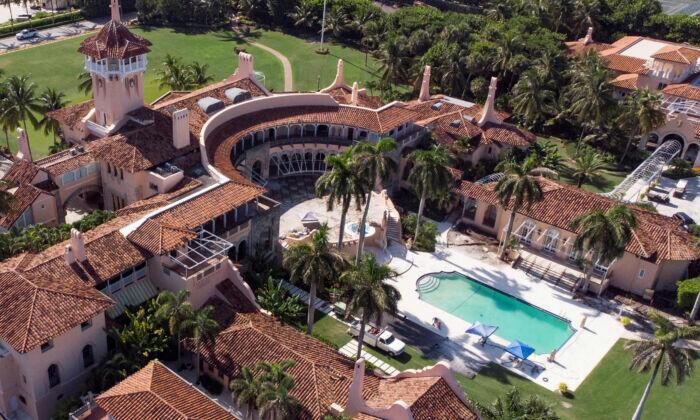
Trump Appeals Court Loss Gives DOJ Full Access To Seized Mar-a-Lago Docs

Trump Appeals Court Loss Gives DOJ Full Access To Seized Mar-a-Lago Docs

The Biden DOJ was handed a huge win last week after the 11th Circuit Court of Appeals struck down a lower court ruling which required a special master to review records seized from Donald Trump’s Mar-a-Lago residence in an August raid.

The decision allows the Justice Department to use the remaining cache of unclassified documents, which had been granted a third-party review. It also allows the DOJ to use 22,000 pages of government records obtained during the seizure – which will allow investigators to review as much evidence as possible as they attempt to build a case against the former president.

“The law is clear. We cannot write a rule that allows any subject of a search warrant to block government investigations after the execution of the warrant. Nor can we write a rule that allows only former presidents to do so,” wrote the three-judge panel.

It’s the latest sign that Trump’s initial success in the case is diminishing, with the three-judge panel for the court rejecting a number of arguments his legal team has offered since the August 9 search and determining even the unclassified records may be used in the department’s investigation.

The Department of Justice has made clear the classified records found at Mar-a-Lago represent the bulk of its potential case, which could include charges under the Espionage Act. –The Hill

“One of the biggest challenges for the prosecutors in this case was always going to be establishing that Trump had personal knowledge of the fact that the classified documents were at Mar-a-Lago, and that he was personally involved in not returning them, which will go to obstruction,” former CIA attorney Brian Greer told The Hill.

“The fact that these classified documents were intermingled with unclassified documents that he was accessing, or would have been accessing, is potentially very valuable evidence demonstrating Trump’s personal knowledge,” he added.

According to previous court filings, the DOJ claims that Trump’s passports were found among the documents seized in the raid, while government records were found in Trump’s personal office.

Greer also says that the alleged commingling of government and personal items may be useful in responding to possible Trump defenses – as this investigation differs from other similar cases because Trump is “a wealthy man who’s not necessarily involved in packing his boxes.”

“If the classified documents were just in a storage room, in a box that wasn’t being accessed, that would be a harder case. But we know some of the documents were found in Trump’s personal office instead, and if DOJ can use the unclassified, intermingled records to show that Trump was accessing the classified documents, its case will be significantly stronger,” he added.

Sifting through the 22,000 pages of evidence shouldn’t take long, according to experts – though the DOJ may take their sweet time (to hit for maximum impact during the 2024 election?), as they have both an institutional and an investigative interest in winning the case.

Former DOJ trial attorney Ankush Khardori said that the lower court ruling for a special master by Judge Aileen Cannon set a “really bad precedent,” because “if they just had this out there, every defendant or prominent defendant would try to do something similar to Trump.”

What is in these documents? How serious was the exposure? How significant was Trump’s retention of this material? What was in the actual documents is key to understanding the seriousness of the underlying conduct,” Khardori added.

Tyler Durden
Mon, 12/05/2022 – 16:40

via ZeroHedge News https://ift.tt/ft3O5Rx Tyler Durden

“A Cautionary Tale For Everyone”: The Media Mob Turns On Taibbi

“A Cautionary Tale For Everyone”: The Media Mob Turns On Taibbi

Authored by Jonathan Turley,

There was a time when the disclosure of a back channel for politically motivated censorship would have generated widespread acclaim and called for awards. This is not that time. Just ask Matt Taibbi.

No one is suggesting that the New York Post should receive a Pulitzer Prize for its long fight to prove the truth about the Hunter Biden laptop. Despite an alliance of most of the media and political establishment arrayed against it, the New York Post fought censorship and unrelenting attacks to bring this massive influence peddling operation to light.  (Of course, the New York Times and Washington Post can keep Pulitzer Prizes for reporting on debunked Russian collusion claims created and pushed by the Clinton campaign).

In the case of journalist Matt Taibbi, his analysis of thousands of documents has met with the standard scorched earth campaign from liberal reporters and pundits.

As discussed in today’s Hill column, the document dump confirmed what had long been suspected: Biden and Democratic party officials succeeded in getting Twitter to block the New York Post story and suspend those who even tried to retweet or link to the story before the election.

I will not repeat the content of those emails on how Twitter “handled” demands from the Biden campaign and the DNC for censorship. Musk gave the material to Taibbi to synthesize the voluminous record.  That is when the familiar media flash mob formed.

NBC Reporter Ben Collins attacked Taibbi on Twitter and said “Imagine throwing it all away to do PR work for the richest person in the world. Humiliating s***.”

New York Times contributor Wajahat Ali also attacked Taibbi:

Matt Taibbi…what sad, disgraceful downfall. I swear, kids, he did good work back in the day. Should be a cautionary tale for everyone. Selling your soul for the richest white nationalist on Earth. Well, he’ll eat well for the rest of his life I guess. But is it worth it?”

So Taibbi’s reported downfall as a writer is due to his role in disclosing a massive censorship system operated at the direction or behest of one political party and one political family. He is “disgraceful” because he is suggesting that the media and social media companies should not have censored a story on a multimillion dollar influence peddling scheme run by the Biden family.

Taibbi is not alone in such disgrace, according to Ali.

He has also attacked former New York Times writer Bari Weiss, including for her statement that she was tired of the pandemic as being somehow racist. (“It reflects America’s cruelty, right?…we have also had cruelty, White supremacy, misogyny. America says go ahead and die, but just don’t die on my lawn.”)

Of course, Ali may be right on what it takes today to be accepted as a journalist. Taibbi is now persona non grata as opposed to Ali, who is routinely invited to write for publications like the New York Times and the Daily Beast despite a litany of controversies.

In one column, Ali suggested white Republican voters would prefer to burn down their own homes then rent to a minority member and compared them to the Al Qaeda terrorists on Flight 93 . He then wrote off most of them as “lost. It’s going to be a long, ugly, violent death rattle of a death cult.”

In today’s world, the New York Times bans Sen. Tom Cotton for his view on the use of the military to quell violent protests, but publishes Ali who told people not to “waste your time reaching out to Trump voters as I did.”

“Reaching out” apparently means calling them virulent racists storming an airplane cockpit. That is the model of real journalism and commentary, not some journalist detailing a politically driven censorship system on social media.

Most critics like MSNBC host Mehdi Hasan attacked Musk or Taibbi while omitting any discussion of the details in these documents. Hasan simply declared that the full transparency ordered by Musk is just one of those “nakedly and cynically right-wing narratives . . . But sure, the laptop! The laptop! The laptop!”

There is a simple reason for this evasion and enmity. The media is too invested in the suppression of this story to now acknowledge that this was a scandal involving both massive influence peddling and massive censorship to cover it up.

I previously wrote a column on the one year anniversary of the Hunter Biden laptop story that marveled at the success of the Biden family in making the scandal vanish before the 2020 election. It was analogized to Houdini making his 10,000-pound elephant Jennie disappear in his act. The Biden trick, however, occurred live before an audience of millions.

The key to the trick was involving the media in the original illusion. Both Twitter and these reporters became invested in the trick. It is like calling audience members to the stage to assist in the performance. Reporters have to insist that there was nothing to see or they have to admit to being part of the original deception. The Bidens were able to make this elephant of a scandal disappear because Twitter and the media wanted it to disappear.

Musk has now pulled away the cover and revealed the elephant. Rather than acknowledge the beast, the media is turning on those who made it visible. The Bidens forced many liberal reporters and pundits to excuse the raw corruption of influence peddling. They are now getting the same figures to dismiss censorship. The alternative is simply too bear, let alone explain. After all, if it is still on the stage, it was there all along . . . and that can only be a “nakedly and cynically right-wing narrative.”

As for Taibbi, it remains (as Ali said) “a cautionary tale for everyone.”

The message is clear: see the elephant at your own peril.

Tyler Durden
Mon, 12/05/2022 – 16:20

via ZeroHedge News https://ift.tt/mRp1OhU Tyler Durden

New York Forces Websites To Monitor ‘Hateful’ Speech. A New Lawsuit Says This Violates the First Amendment.


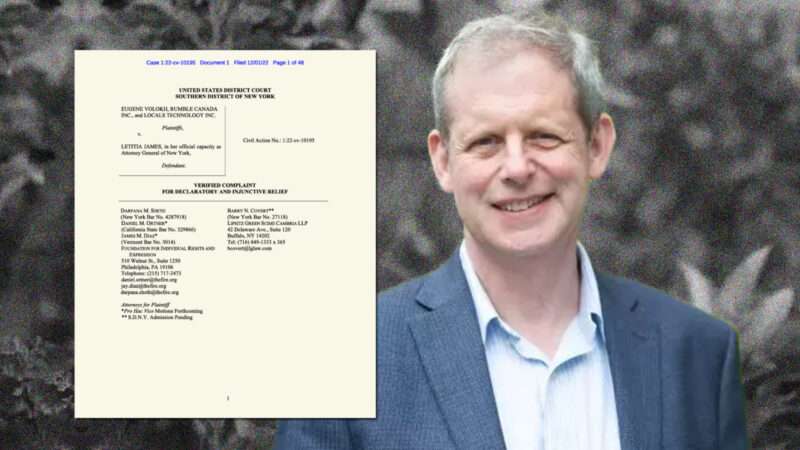
Eugene Volokh with a page from a lawsuit.

In New York, websites and apps are required to have a plan to address “hateful conduct” on their platforms. A new lawsuit is seeking to change that.

On Thursday, the Foundation for Individual Rights and Expression (FIRE) filed a lawsuit on behalf of two online platforms, Rumble and Locals, as well as Eugene Volokh, a UCLA law professor who runs the blog The Volokh Conspiracy (which is hosted by Reason.) FIRE claims that a New York law mandating that online platforms provide mechanisms for reporting “hateful” speech violates the First Amendment.

“The state of New York can’t turn bloggers into Big Brother, but it’s trying to do just that,” said FIRE attorney Daniel Ortner said in a Thursday press release. “The government can’t burden online expression protected by the Constitution, whether it’s doing it in the name of combating hate or any other sentiment.”

In June, Democratic New York Gov. Kathy Hochul signed into law a bill, “Social Media Networks; Hateful Conduct Prohibited,” intended to curb online hateful speech. The law amends existing business regulations to require that broadly defined social media networks provide a mechanism for users to report instances of “hateful conduct” and publish a policy for how it will “respond and address” the reports.

The law defines “hateful conduct” as “the use of a social media network to vilify, humiliate, or incite violence against a group or a class of persons on the basis of race, color, religion, ethnicity, national origin, disability, sex, sexual orientation, gender identity or gender expression.” Platforms that fail to comply with the law can face fines of up to $1000 per day of violation.

FIRE argues that the law violates the First Amendment in four ways. First, it argues that the law compels the speech of social media platforms by requiring that they publish hate speech policies. Second, it argues the law imposes unconstitutional viewpoint discrimination by singling out speech that is “hateful” on the basis of several protected classes for moderation. Third, FIRE claims that the law is overly broad “because it pressures online services to chill, prohibit, or remove a substantial amount of constitutionally protected online speech and compels them to voice the state’s pro-censorship view.”

Further, FIRE argues that the law is vague and that vagueness coupled with an official statement from New York’s governor insisting that the law requires companies to “monitor and report hateful conduct” leads platforms to “reasonably believe that the Online Hate Speech Law will be expansively interpreted and aggressively enforced…unconstitutionally incentivizing them to chill speech on their platform and compelling them to parrot the state’s message in order to avoid investigation and civil penalties.”

However, the law contains a provision that seemingly attempts to protect itself from coming under fire for violating the First Amendment, clarifying that the statute does not order social media networks to violate the “rights or freedoms of any persons, such as exercising the right of free speech pursuant to the first amendment to the United States Constitution.” FIRE is unconvinced by the provision, arguing that the clause is far too vague.

“I don’t think that that savings clause really means anything,” Volokh tells Reason. “Our whole point is that the statute does adversely affect my constitutional rights by mandating that I set up a policy that I don’t want to set up, aimed at certain viewpoints that I don’t want to have to single out in a policy.”

It appears that New York politicians want to try to force social media companies to single out large swaths of disfavored speech for monitoring—and, thus, for regulation. However, such a scheme violates the constitutional rights of platforms to decline to moderate online speech that the state disfavors.

“The First Amendment protects speech regardless of the viewpoint that it expresses,” Volokh says, “and the reason why it protects the speech that each of us values is precisely that it doesn’t let the government say ‘certain kinds of viewpoints can be suppressed.’ So, if you give the government the power to suppress some viewpoints, it’ll end up having the power to suppress other viewpoints, including viewpoints that you might like.”

The post New York Forces Websites To Monitor 'Hateful' Speech. A New Lawsuit Says This Violates the First Amendment. appeared first on Reason.com.

from Latest https://ift.tt/luEHYoz
via IFTTT

Supreme Court Debates Whether Web Designers Can Be Forced To Make Gay Wedding Pages


Online photo album

Whether designing a webpage for customers counts as speech and therefore whether a designer could be compelled by Colorado law to design wedding pages for same-sex couples took center stage before the Supreme Court this morning.

Creative 303 LLC vs. Elenis came before the Court this morning and brought with it a tangled thicket of competing Supreme Court precedents about when the government can compel businesses or institutions to pass along messages or ideas they object to. At the heart of this case, Lorie Smith, owner of Creative 303 LLC, wants to design web pages for weddings. But she has religious objections to same-sex marriage and doesn’t want to design pages to celebrate gay couples. This puts her at odds with the Colorado Anti-Discrimination Act, and so she has gone to federal court to try to get a ruling in her favor.

In a debate surpassing two hours, the justices discussed whether Smith is actually engaged in “expressive speech” if she doesn’t put her own messages on these webpages, the distinctions between rejecting a customer and rejecting a statement, and which Supreme Court precedents should influence this case’s outcome.

Kristen Waggoner, Smith’s attorney and a lawyer for Alliance Defending Freedom, wanted the Court to turn to Hurley v. Irish-American Gay, Lesbian, and Bisexual Group of Boston, a 1995 case where the Supreme Court ruled that the organizers of Boston’s St. Patrick’s Day Parade could not be compelled to allow marchers bearing a banner for the gay organization into the parade, which would have forced them to convey a message of support parade organizers did not agree with.

Colorado was represented by Solicitor General Eric Olson and bolstered by Brian Fletcher, principal deputy solicitor general of the United States. The Justice Department agrees with Colorado that Smith does not have the option to simply turn away all same-sex couples. They asked the Court to use Rumsfeld v. Forum for Academic and Institutional Rights, Inc. as a guiding precedent. That 2006 decision held that colleges could be compelled to provide space for military recruiters despite any moral objections they may have.

Smith has not been accused of turning away anybody as yet. She has asked the Court to rule before she begins turning away same-sex clients as is within her First Amendment rights. So, the debate this morning revolved around several hypothetical situations, since neither side has any actual examples of Smith turning anybody away.

In a fashion similar to those who followed Masterpiece Cakeshop v. Colorado, the justices questioned the boundaries of what actually counted as speech or expression. Throughout the proceedings, Justice Elena Kagan mulled over the difference between a wedding site where a designer simply plugged in information provided to them and a site where the designer was actually expected to craft particular messages celebrating the marriage. She noted that the examples of sites Creative 303 included didn’t appear to state any sort of celebratory messages but did wonder whether Smith could be compelled to add “God bless this union” onto a site against her religious convictions. While there seemed to be an agreement that she could not be compelled to do so, the justices struggled to find where the line between speech and discrimination was drawn. In Masterpiece, the Supreme Court punted that central question. Now, they’re revisiting it.

Waggoner saw the line as pretty easy to determine: Smith’s webpages and their content all count as Smith’s speech. It’s up to Smith to decide what she would and would not allow to be included on the webpages she was designing. Olson and Fletcher argued that Smith’s rejection of same-sex marriages was essentially the equivalent of rejecting same-sex customers (Waggoner and Smith disagree) because it was a case where the conduct and the identity of the customer are “inextricably entwined.”

The more conservative justice seemed inclined toward siding with Smith, concerned about future hypothetical cases where a freelance speechwriter could be forced to write speeches for political candidates or positions he or she found disagreeable. Could a freelance public relations professional be forced to write a release for the Church of Scientology?

Justice Amy Coney Barrett wondered if a site serving the gay community could be required to run heterosexual wedding announcements alongside same-sex ones. Olson responded that the site probably wouldn’t hold itself out as a “public accommodation,” but if it did, it would be required to run them. There was a fairly brief discussion of whether there were limits to what the government classifies a “public accommodation” that perhaps could have been fleshed out more. Colorado appears to have a very broad definition that includes nearly any good or service that is offered “to the public.”

Justice Neil Gorsuch noted the amicus brief by the Cato Institute, joined by UCLA law professor Eugene Volokh (of The Volokh Conspiracy) and Southern Methodist University Dedman School of Law professor Dale Carpenter (also a contributor to The Volokh Conspiracy) in support of Smith. Though Volokh and Carpenter had taken Colorado’s side against wedding cake baker Jack Phillips, they’re supporting Smith in this case, arguing that “forcing her to create websites to which she objects is a speech compulsion.” Gorsuch also incidentally described the anti-discrimination training that Phillips was ordered to undergo (before the Supreme Court ruled in his favor) as “re-education.”

It is very difficult to predict based on today’s debate what exactly the Supreme Court could decide. Because of the intersection of First Amendment protections and public accommodation discrimination protections, the questions were far-ranging and hit many areas. It seems likely that the ruling will be in favor of Creative 303, but it’s also clear that the justices are looking for the right place to put a dividing line between protecting people from compelled speech and the government’s interest in enforcing public accommodation laws. “How do you draw the line?” was a question raised in several contexts by multiple justices. We’ll find out in the spring.

The post Supreme Court Debates Whether Web Designers Can Be Forced To Make Gay Wedding Pages appeared first on Reason.com.

from Latest https://ift.tt/EQfU1cF
via IFTTT

Sex Offender Registry Prevents Dying, Bedridden Man From Spending Final Days at Home


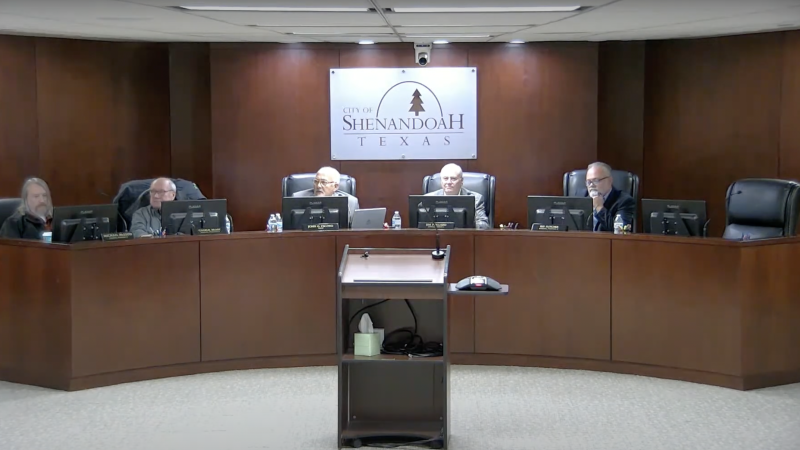
Shenandoah city council meeting

The daughter of a bedridden, dying 79-year-old man asked for permission to care for him at home. This request was denied by the city council of Shenandoah, since the man is on the sex offender registry. Registrants must live at least 1,000 feet from playgrounds.

The daughter’s home is 894 feet from a toddler park.

“The city council voted not to have any exceptions,” City Attorney William Ferebee tells Reason.

A local ordinance adopted in 2018 established the 1,000-feet rule. The council would have to vote to amend it, according to The Courier. At a council meeting last month, the members debated what that would entail: Either they would have to give the chief of police the authority to make exceptions to the registry requirements, or they would have to grant that responsibility to themselves.

While my reading of the Texas bill regarding registries seems to require that towns “establish procedures for a registered sex offender to apply for an exemption from the ordinance,” that option was not provided in Shenandoah. The chief of police, Troye Dunlap, was not eager to take on the exemption-granting role.

“My opinion is no exceptions should be made,” Dunlap tells Reason. “If something were to happen, then it falls on me.”

The possibility of something happening seems remote, since the man in question is confined to his bed and receiving end-of-life care. But Dunlap worries that any exception would create the possibility of future risks.

“It’s like when we barricade off roads during a hurricane and someone wants to go around the barricade,” he says. “If I let you in, then everyone else wants to, and everyone’s going to have their reasons. You’re going to have to reconsider that line for everybody.”

On the other hand, there is a grand total of two people on the registry in Shenandoah.

What’s more, the 1,000-foot buffer zone is itself based on two intuitive but incorrect beliefs about people on the registry: that they reoffend at a high rate, and that they victimize their neighbors. Mountains of research show that both of these beliefs are false.

According Sandy Rozek, communications director of the National Association for Rational Sex Offense Laws (NARSOL), multiple studies find no correlation between residency restrictions and protecting children.

“Here is a man with zero risk of harming a child, who wants to be with those he loves as he prepares to die,” says Rozek. “To deny him this is heartless, cruel, and inhumane.”

During the city council meeting, one of the members explored granting the exception. But then the others spoke about how future decisions could be more fraught. In the end, the vote was unanimous: no exceptions.

Rozek notes that there’s no registry for murderers; other crimes do not result in draconian, permanent restrictions even after the sentence is served.

“Whatever he did to require sex offender registration, whether or not it involved an offense against a child, he has paid his debt for his crime,” says Rozek. “That was supposed to be the end of his punishment, but being on the registry continues his punishment up to the point of death. That is just wrong.”

The post Sex Offender Registry Prevents Dying, Bedridden Man From Spending Final Days at Home appeared first on Reason.com.

from Latest https://ift.tt/d3C1fe6
via IFTTT

11th Circuit Says a Judge Should Not Have Interfered With the FBI’s Review of the Mar-a-Lago Documents


The FBI found these classified documents in former President Donald Trump's office at Mar-a-Lago.

U.S. District Judge Aileen Cannon never should have interfered with the FBI’s investigation of government records that former President Donald Trump retained after leaving office, a federal appeals court ruled last week. The decision, which the U.S. Court of Appeals for the 11th Circuit issued late Thursday, allows the Justice Department to resume its examination of some 13,000 documents that the FBI seized from Mar-a-Lago in August. Special Counsel Jack Smith is considering whether Trump or his underlings committed federal crimes by keeping the records at his Palm Beach resort.

Cannon threw a wrench into that investigation on September 5, when she agreed with Trump that a special master should first review the records to see whether any qualified as personal property, attorney-client communications, or material covered by executive privilege. The 11th Circuit blocked part of that order a few weeks later, restoring the FBI’s access to more than 100 records that were marked as classified. The court noted that Trump “has not identified any reason that he is entitled to them.” Last week’s ruling vacated Cannon’s decision in its entirety and instructed her to dismiss Trump’s lawsuit.

The appeals court did not address the merits of the potential criminal charges against Trump, which include improper retention of government records, mishandling of “national defense information,” and obstruction of a federal investigation. But the 11th Circuit panel—which consisted of three judges appointed by Republicans, including two Trump nominees—unanimously concluded that Cannon had clearly erred in deciding to exercise “equitable jurisdiction” over the case.

“We cannot write a rule that allows any subject of a search warrant to block government investigations after the execution of the warrant,” the unsigned opinion says. “Nor can we write a rule that allows only former presidents to do so. Either approach would be a radical reordering of our caselaw limiting the federal courts’ involvement in criminal investigations. And both would violate bedrock separation-of-powers limitations.”

To comply with those limitations, the 11th Circuit says, courts must “avoid unnecessary interference with the executive branch’s criminal enforcement authority” while “also offering relief in rare instances where a gross constitutional violation would otherwise leave the subject of a search without recourse.” Toward that end, “this Circuit has developed an exacting test for exercising equitable jurisdiction over suits flowing from the seizure of property.”

Under that test, a plaintiff seeking the return of seized property must show 1) that the government displayed a “callous disregard” for his constitutional rights, 2) that he “has an individual interest in and need for the material whose return he seeks,” 3) that he “would be irreparably injured by denial of the return of the property,” and 4) that he otherwise would not have “an adequate remedy at law for the redress of his grievance.” The 11th Circuit found that Trump had failed to meet any of these criteria, let alone all four.

The Mar-a-Lago search was authorized by a warrant from U.S. Magistrate Judge Bruce Reinhart, who agreed that there was probable cause to believe the FBI would find evidence of criminal conduct. The 11th Circuit reviews the chain of events leading to that warrant, including the National Archives and Records Administration’s efforts to recover documents that Trump had stashed at Mar-a-Lago; the discovery of 184 classified records in 15 boxes that Trump surrendered a year after leaving office; and the federal subpoena seeking any remaining documents that were marked as classified, which produced 38 more in early June.

Although Trump’s representatives assured the Justice Department that they had turned over everything covered by the subpoena after a “diligent search,” the appeals court notes, “the FBI developed more evidence that other classified documents remained at Mar-a-Lago,” which turned out to be true: Fifteen of the 33 “boxes, containers, or groups of papers” that the FBI seized during its August 8 search “contained documents with classification markings, including three such documents found in desks in Plaintiff’s office.” The search “uncovered over one hundred documents marked confidential, secret, or top secret.”

Since Reinhart approved the search based on evidence that he thought established probable cause, the 11th Circuit says, “the callous disregard standard has not been met here, and no one argues otherwise.” Trump conceded as much but argued that he did not need to satisfy that part of the test for equitable jurisdiction. Cannon agreed. “That is an incorrect reading of our precedent,” the appeals court says.

To establish that he had a need for the seized documents, Trump said they included his passports and “similar materials.” But “the passports had already been returned before he filed his first motion, and his jurisdictional brief did not explain what ‘similar materials’ were at issue or why he needed them,” the 11th Circuit notes. “The district court was undeterred by this lack of information.”

In concluding that Trump “would be irreparably injured by denial of the return of the property,” Cannon cited three concerns: the potential use of privileged documents, improper disclosure of “sensitive information,” and the “stigma” associated with the threat of criminal prosecution. Defending Cannon’s order in response to the Justice Department’s appeal, Trump adopted the latter two arguments.

“It cannot be that prosecutors reading unprivileged documents seized pursuant to a lawful warrant constitutes an irreparable injury for purposes of asserting equitable jurisdiction,” the appeals court says. “Plaintiff’s argument would apply to nearly every subject of a search warrant. The district court’s unsupported conclusion that government possession of seized evidence creates an ‘unquantifiable’ risk of public disclosure is not enough to show that Plaintiff faces irreparable harm.”

In the 11th Circuit’s view, the “stigma” argument likewise proves too much. “No doubt the threat of prosecution can weigh heavily on the mind of anyone under investigation,” it says. “But without diminishing the seriousness of the burden, that ordinary experience cannot support extraordinary jurisdiction.”

Finally, Trump was supposed to show that he would have no viable alternative remedy unless Cannon intervened. Cannon concluded that Trump “would have no legal means of seeking the return of his property for the time being and no knowledge of when other relief might become available.” But “this is not sufficient justification,” the 11th Circuit says.

“There is no record evidence that the government exceeded the scope of the warrant—which, it bears repeating, was authorized by a magistrate judge’s finding of probable cause,” the appeals court notes. “And yet again, Plaintiff’s argument would apply universally; presumably any subject of a search warrant would like all of his property back before the government has a chance to use it.”

Alternatively, Trump argued that he needed Cannon’s injunction to “protect documents that he designated as personal under the Presidential Records Act.” But “the status of a document as personal or presidential does not alter the authority of the government to seize it under a warrant supported by probable cause,” the 11th Circuit says. “Search warrants authorize the seizure of personal records as a matter of course.”

In any case, the appeals court says, “all these arguments are a sideshow,” since Trump never showed that the government had violated his rights: “If there has been no constitutional violation—much less a serious one—then there is no harm to be remediated in the first place.”

Cannon emphasized the unprecedented nature of the Mar-a-Lago search. “It is indeed extraordinary for a warrant to be executed at the home of a former president—but not in a way that affects our legal analysis or otherwise gives the judiciary license to interfere in an ongoing investigation,” the 11th Circuit says. “To create a special exception here would defy our Nation’s foundational principle that our law applies ‘to all, without regard to numbers, wealth, or rank.'”

The post 11th Circuit Says a Judge Should Not Have Interfered With the FBI's Review of the Mar-a-Lago Documents appeared first on Reason.com.

from Latest https://ift.tt/gVzk4vj
via IFTTT
Ron DeSantis Admin Says in New Lawsuit That the Free Market Won’t Produce Affordable Housing


reason-desantis2

The administration of Florida Gov. Ron DeSantis (R) is suing the city of Gainesville to stop its legalization of new small apartment buildings in all residential areas. Allowing more housing in existing neighborhoods will worsen housing affordability, the state argues, while straining infrastructure and upending established neighborhood character.

“It is simply illogical for the City to argue that by entirely removing the concept of lower density detached residential dwellings…it is doing anything more than helping provide housing to college students and higher income residents,” reads the petition filed last week by the Florida Department of Economic Opportunity (DEO) in the state’s Division of Administrative Hearings.

The DEO’s petition, which was first reported on by The Independent Florida Alligator, contends that creating affordable housing requires Gainesville to adopt “inclusionary zoning” policies, whereby developers are allowed to build denser housing on the condition that they provide some of the new units at below-market rates to low-income renters or buyers.

Just legalizing denser construction without subsidies and restrictions needed to create below-market-rate housing provides no benefit to lower-income residents, argues the department, saying in the petition that “the ‘invisible hand’ of a free market operates simply in this situation—without inclusionary zoning tools, developers will not build affordable housing.”

In October, the Gainesville City Commission narrowly approved a series of ordinances that allow more homes per acre and small four-unit apartments to be built on residential land citywide, including in areas where only detached single-family housing was allowed.

Cities and states around the country have adopted similar “missing middle” zoning reforms on the grounds that allowing new duplexes, triplexes, and more will make residential neighborhoods more affordable, sustainable, and equitable.

The results of these reforms have been pretty modest so far. In places like Minneapolis and Portland, Oregon, they’ve enabled the construction of a few hundred missing middle homes that sell for prices well below that of new single-family homes. One would expect Gainesville’s reforms to have a similar impact.

That hasn’t mollified the fears of activists who formed the group Gainesville Neighborhood Voices (GNV) in June 2022 to oppose single-family zoning abolition.

In written materials, letters to government agencies, rallies, and testimonies to the City Commission, GNV members have argued that Gainesville’s housing problems are not due to a lack of supply per se, but to existing homes costing too much. They warn that there’s no telling what the elimination of single-family zoning will do for affordability but that it “will likely be destructive to stable neighborhoods.”

These complaints didn’t move the City Commission, but they have found a receptive audience at the Florida DEO. In September, the department sent a comment letter to Gainesville Mayor Lauren Poe echoing activists’ concerns about the impacts single-family zoning abolition would have on affordability, infrastructure, and neighborhood stability.

The DEO’s lawsuit comes a few weeks after two GNV activists filed their own petition opposing the city’s zoning reforms. Alachua County, which contains Gainesville, has also filed a petition to stop the city’s zoning reforms.

The Florida state government plays a limited role in local zoning decisions and can typically only step in when state assets are threatened. The DEO is justifying its interventions by claiming that “affordable housing” generally is a state asset that could be damaged by Gainesville’s elimination of single-family zoning.

“That’s a really big leap for DEO,” Thomas Hawkins, a lawyer, planner, and assistant professor at the University of Florida, told Bloomberg CityLab in October. He said a state asset is usually something like a major piece of infrastructure or an environmental resource.

Housing politics is weird. It rarely falls neatly along party lines. Nevertheless, the DEO petition is an exceptionally strange document to come from the nominally free market–supporting DeSantis administration.

Its explicit premise is that a general increase in new housing supply at market rates won’t make housing more affordable and, in fact, will make affordability worse. Instead, the department argues that government regulations, subsidies, and incentives are necessary to ensure truly affordable housing gets built and gets built in the right places.

That’s an incredibly government-centric view of housing affordability. It ignores both the theory and the evidence that when new housing is built, even very expensive housing, it lessens demand on existing housing stock, leading to lower prices and rents.

New missing middle housing typologies also typically sell for much less than a new single-family home. Cities that legalize them are giving homebuilders more property rights and homebuyers more affordable choices.

These improvements are marginal, but they’re improvements nonetheless. DeSantis’ administration is going to great lengths to stop them from happening, including making novel arguments about the expansive powers of state regulators.

The Alligator reports that the lawsuits against Gainesville’s single-family zoning abolition prevent developers from getting permits to build newly legal duplexes, triplexes, and so on. The hope among anti-reform activists is that the ordinance can be delayed long enough until the new City Commission (which is stacked with zoning reform opponents) can reinstate single-family zoning.

The post Ron DeSantis Admin Says in New Lawsuit That the Free Market Won't Produce Affordable Housing appeared first on Reason.com.

from Latest https://ift.tt/woWrN90
via IFTTT