Senate Republicans Demand McConnell Only Accept Short-Term Spending Bill

Senate Republicans Demand McConnell Only Accept Short-Term Spending Bill

Authored by Joseph Lord via The Epoch Times (emphasis ours),

Senate Republicans have vowed to oppose any spending bill that would go on beyond the 117th Congress.

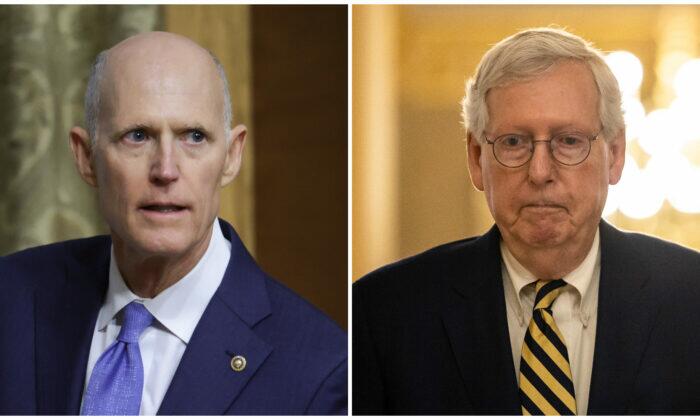
(Left) Sen. Rick Scott (R-Fla.) in Washington on March 30, 2022. (Kevin Dietsch/Getty Images); (Right) Senate Minority Leader Mitch McConnell (R-Ky.) in Washington on Sept. 6, 2022. (Anna Moneymaker/Getty Images)

After a long effort to pass an omnibus spending bill for fiscal year 2023, Democrats were forced to accept a short-term continuing resolution (CR) instead.

CRs, while they prevent the government from shutting down, make no changes to long-term federal spending. Rather, they simply continue to spend at levels set the prior fiscal year.

Earlier this year, Democrats passed a CR that will fund the government through Dec. 16, at which point the government will shut down if lawmakers have not passed a new spending bill.

One of the Democrats’ many agenda items during the lame-duck session is the passage of a more comprehensive omnibus spending bill. In contrast to a CR, an omnibus bill, if passed, would allow Democrats to set appropriations levels for next year even though they’ll be in the House minority.

Because the 118th Congress will sit for the first time on Jan. 3, 2022, allowing a CR to run out before then could give a lame-duck Democrat majority a last-minute chance to fund its policies through all of fiscal year 2023.

This, a group of Republican senators told Senate Minority Leader Mitch McConnell (R-Ky.) in a Nov. 30 letter, is unacceptable.

The letter was written by Sen. Mike Lee (R-Utah) and signed onto by three other Republicans—Sens. Rick Scott (R-Fla.), Ted Cruz (R-Texas), and Mike Braun (R-Ind.).

In it, the coalition demanded that McConnell not allow Democrats to succeed in their efforts to set next year’s spending levels.

“On November 8, 2022, the American people made their voices heard at the ballot box,” the letter opened. “Using the
Democratic process, millions of Americans sent a message—they want divided power in Washington to curb the worst excesses of both parties.”

The four Republicans said they “stand with the voters.”

They wrote, “We believe it would be both imprudent, and a reflection of poor leadership, for Republicans to ignore the will of the American people and rubber stamp an omnibus spending bill that funds ten more months of [President Joe Biden’s] agenda without any check on his reckless policies that have led to a 40-year high in inflation.”

According to the most recent data from the U.S. Bureau of Labor Statistics, inflation has slowed from its peak of over nine percent in June, but it remains high. In October, the value of the dollar dropped by 7.7 percent, a situation that Republicans have blamed on Democrats’ “out of control spending” (pdf).

Since taking unilateral control of the government, Democrats have rushed through trillions in new spending: first with the passage of the $1.9 trillion American Rescue Plan, which received no GOP support, the $1.2 trillion Infrastructure Investment and Jobs Act, and the $740 billion Inflation Reduction Act.

The effect of this spending, the Republicans wrote, has been higher costs for American households. They cited a figure provided by the Committee for a Responsible Federal Budget which estimates that Democrats have authorized $4.8 trillion in new borrowing since Biden took office.

“Since taking office, President Biden has overseen a $4.8 trillion increase in the national deficit, costing the average American household an estimated $753 more a month,” the lawmakers wrote. “It should be up to the new Congress to set spending priorities for the remainder of this fiscal year.”

Concluding the letter the Republicans wrote: “Now is the time for Republicans to get serious about leading America towards a better future.”

They demanded that McConnell not make any deals that would fund the government well into the next fiscal year.

“We must not accept anything other than a short-term Continuing Resolution that funds the federal government until shortly after the 118th Congress is sworn in,” they wrote, demanding that “[no] additional spending, [and] no additional policy priorities should be included.”

Anything more urgent, they added, should be handled as an individual bill rather than as part of an omnibus spending bill.

‘A Lame Duck Spending Blowout’: Roy

This demand, the passage of a short-term “clean” CR with no changes to current spending, has been growing among Republicans.

In the House, Rep. Chip Roy (R-Texas) circulated a letter making similar demands.

In the letter, Roy wrote: “Federal dollars are fueling rampant inflation and funding the Biden administration’s radical agenda. This includes empowering authoritarian bureaucrats at agencies like the IRS and FBI, implementing open-border policies that are threatening our communities, imposing COVID-19 mandates that shut down schools and are forcing our military servicemembers out of their jobs, and advancing self-destructive energy policies.

“As the September 30th federal funding deadline approaches, Republicans must do what is necessary to ensure that not one additional penny will go toward this administration’s radical, inflationary agenda,” he continued. “Any legislation that sets the stage for a ‘lame duck’ fight on government funding gives Democrats one final opportunity to pass that agenda.

“Therefore, we, the undersigned, pledge to the American people to reject any continuing resolution that expires prior to the first day of the 118th Congress, or any appropriations package put forward in the remaining months of this Democrat-led Congress.”

On Dec. 1, Roy re-upped these demands in an op-ed for the Washington Examiner. He described Democrats’ ongoing efforts to pass an omnibus bill as “a lame-duck spending blowout.”

When is $5 trillion still not enough?” Roy quipped. “Answer: When you’re a progressive about to lose your grip on total power.

Later, he wrote: “Taxpayers … deserve better than another rushed backroom deal as lawmakers sprint home for Christmas. Democrats ran all of government for two years but focused on their special spending causes rather than pass individual bills to finance the government. Now with three weeks left in a lame duck, they want to jam the GOP again.”

Roy said that Republicans should not be cowed by Democrats threatening to shut down the government to pass a spending bill.

“The GOP campaigned on a return to regular fiscal order, and why not start now?” Roy wrote. “Democrats can threaten a government shutdown, but they’d own it as the party in control. If Republicans aren’t going to use their power to enforce some fiscal discipline, they might as well stay in the minority.”

What’s Next

Despite opposition to an omnibus bill among both House and Senate Republicans, Democrats could still get what they hope for.

Read more here…

Tyler Durden
Sat, 12/03/2022 – 19:30

via ZeroHedge News https://ift.tt/zpnhsMx Tyler Durden

Not Everyone Is Looking Forward To Christmas

Not Everyone Is Looking Forward To Christmas

There are only a few weeks left until Christmas. That means most people are getting together with their family and spending time with their loved ones. But not everyone can look forward to a peaceful Christmas – for some people, the Christmas season is particularly stressful, as a survey conducted as part of the Statista Global Consumer Survey shows.

Infographic: Not Everyone Is Looking Forward to Christmas | Statista

You will find more infographics at Statista

According to the research, Christmas means pure stress for around 16 percent of the people surveyed in the United States. This even rises to 18 percent of respondents in the UK.

This is seemingly in part because there are too many expectations associated with Christmas; a quarter of respondents from Germany and the United States and 39 percent from the UK confirm this.

Five to nine percent of the survey participants even stated that the family get-together usually ends in arguments.

For them, Christmas is emotionally and psychologically draining rather than energizing, and often requires a great deal of effort to get through.

Tyler Durden
Sat, 12/03/2022 – 19:00

via ZeroHedge News https://ift.tt/waF6lQr Tyler Durden

Andrew Koppelman Responds to Critics of His Book on Libertarianism


Burning Down House

Andrew Koppelman has posted a response to participants in the Balkinization symposium on his recent book Burning Down the House: How Libertarian Philosophy Was Corrupted by Delusion and Greed. I myself was one of the participants (see my contribution here), as were co-blogger Jonathan Adler, Richard EpsteinChristina Mulligan, James Hackney, and others. I thought that Adler and Mulligan developed particularly compelling critiques of key aspects of the book.

Overall, I think Koppelman’s response was not especially successful in rebutting the criticisms. But readers will have to judge that for themselves. In fairness, some of the wide-ranging issues raised cannot easily be addressed in a short essay! Here, I offer a brief rejoinder to the part of Koppelman’s response addressing my own contribution:

Libertarians are typically drawn to the hypothesis that a nongovernmental solution is always better. It is an hypothesis worth testing, and I say that libertarians have made and continue to make important contributions by insisting upon it (pp. 52-53).   Sometimes it is correct. Sometimes it is a disastrous mistake.

Ilya Somin, my old friend and sometime collaborator, falls into that trap. He acknowledges my dissection of the classic libertarian writers, Hayek, Rothbard, Nozick, and Rand, but laments my “neglect of more recent and more sophisticated thinkers….”  At 237 pages, the book is necessarily compressed. I wrote it because there existed no short introduction to libertarianism for the general reader that was not written by enthusiasts. The “missed opportunity” Somin describes would have been a different book than I was attempting….

I will say that contemporary libertarians, including Somin, make the same mistakes as their predecessors whom I do describe, preeminently exaggerated trust in unregulated markets and exaggerated distrust of government. Somin is particularly troubled by my “neglect of modern libertarian critiques of democratic government, particularly those focused on voter ignorance and bias.” Some modern libertarians, prominently including Somin himself, have argued that this fact is a reason to reject legislation in favor of “private-sector solutions to public goods problems and externalities.” I acknowledge the possibility of such solutions…., but I say that “whether this is so in any particular case cannot be resolved without attention to the local evidence…”

The real gap between me and Somin is what I say next: “More fundamentally, the networks of mutual trust that facilitate such cooperation don’t develop in nations where government is distrusted. Across prosperous democratic nations, and over time, trust in government and interpersonal trust are tightly correlated.” Somin is committed to a picture in which government cannot be trusted to do anything right: given the effect on policy of voter ignorance and bias, “the quality of those policies is likely to be greatly reduced.” For reasons I elaborate in the book, that picture is not only destructive to cooperation in markets; it is at some remove from reality. Despite voter ignorance and bias, Congress did manage to enact protections against death in the workplace and foul air, protections that the market was never going to supply, and which the Supreme Court has lately been gutting in the name of liberty.

I agree that “nongovernmental solutions” are not always better than government. However, the points I made about political ignorance as a shortcoming of government relative to foot voting amount to a systematic relative advantages of the private sector that should create a presumption against state control. The problem isn’t limited to one or a few specific areas of government policy. The same goes for the points I raised about property rights.

That presumption becomes stronger when we add in a range of other issues raised by the modern libertarian literature on government, markets, and public goods that Koppelman largely overlooks in his book. At the very least, as noted in my contribution to the symposium, these issues pose a formidable challenge to thinkers –  Koppelman himself—who acknowledge many of the important advantages of the private sector, but believe large-scale government intervention can still be justified so long as it is carefully calibrated to address harm caused market failures, while avoiding creating great new harm of its own. Political ignorance and related issues raised by libertarian scholars (and others) undercut the plausibility of claims that  such careful calibration is even remotely possible. It doesn’t necessarily follow that we should abjure all government regulation. But  it does follow that its scope must be severely limited. Koppelman may have responses to these concerns. But developing them effectively requires grappling with modern libertarian scholarship on these topics.

The issue of trust is one I cannot do justice to here. I will only note that the extent to which trust matters to important social outcomes is highly contested by experts in the field. I summarize some of the literature in chapter 6 of my recent book Free to Move, where I criticize arguments that immigration must be restricted in order to preserve trust. Moreover, it could be that government will be more trustworthy if its powers are strictly limited, and therefore easier for “rationally ignorant” voters to monitor effectively. The immense size and scope of modern government makes political ignorance (and resulting demagoguery and abuses of power) far more dangerous than they would be otherwise. I discuss those dynamics in more detail in Democracy and Political Ignorance: Why Smaller Goverment is Smarter, and in this more recent article.

Finally, workplace safety was improving (largely due to increased societal wealth) for decades before the development of the Occupational Safety and Health Administration and other modern regulatory regimes.  The establishment of OSHA in 1970 does not seem to have increased the pace of change. And, as libertarians often point out, workers should be allowed to decide for themselves whether they wish to accept increased risk in exchange for increased pay or benefits. The  Clean Air Act is a much stronger case for Koppelman’s thesis. But, as Jonathan Adler points out in his contribution to the symposium, it is also likely to be an anomaly.

Much more can be said. But, for now, I will stop here. Despite our many disagreements, Koppelman has performed a valuable service by highlighting some key areas of disagreement between libertarians and their critics, especially those on the political left. I hope and expect we will debate these issues further, in the future.

The post Andrew Koppelman Responds to Critics of His Book on Libertarianism appeared first on Reason.com.

from Latest https://ift.tt/yY5C0lE
via IFTTT

Court Holds That Indiana RFRA Provides Religious Exemptions from Abortion Ban

From Anonymous Plaintiff 1 v. Individual Members of Medical Licensing Bd. of Ind., decided yesterday by Marion County (Indiana) Superior Court Judge Heather Welch; Josh Blackman has just posted on the subject, but I thought I’d put up my post as well, because it quotes at greater length from the decision and offers some thoughts of my own. First, my thinking, which I think echoes what I blogged about in May:

[1.] If someone sincerely believes that she is obligated by her religion, or even motivated by her religion, to get an abortion under certain circumstances (which some of the plaintiffs did indeed assert, citing their understanding of Judaism), then she would indeed have a strong claim under a state Religious Freedom Restoration Act, such as Indiana’s RFRA. By forbidding her from doing what her religion is telling her to do (or by forbidding others from helping her in this task, when their help is necessary), the state abortion ban is substantially burdening her religious exercise. The government therefore has to show that denying the exemption really is narrowly tailored to a compelling government interest. That’s what the statute that the Indiana legislature enacted (RFRA) says, and a court must apply it.

[2.] One way of thinking about this is to consider drug laws. Courts have generally rejected the view that the Constitution includes a right to bodily autonomy that protects the right to use drugs. But when someone feels a sincere religious obligation or motivation to use a particular kind of drug, he can seek an exemption under a RFRA—and might indeed win, if the court concludes that granting the exemption wouldn’t unduly undermine a compelling government interest. And indeed the plaintiffs in Gonzales v. O Centro (2006) did win under the federal RFRA as to the hallucinogen hoasca.

Likewise, the Court in Dobbs rejected the view that the Constitution includes a right to bodily or reproductive autonomy that protects the right to get an abortion. But when some feels a sincere religious obligation or motivation to get an abortion, she can seek an exemption under a RFRA—and might indeed win, if the court concludes that granting the exemption wouldn’t unduly undermine a compelling government interest.

Of course, this requires resolving (among other things) whether there is indeed a compelling government interest in protecting fetal life, and one can debate that question—and, more importantly, the question of how American courts should resolve that question. That’s the very thing that Dobbs sought to keep courts from having to do under some constitutional “substantive due process” or “right to privacy” analysis. But RFRAs do indeed call on courts to answer that question, as to religious exemption claims.

[3.] This having been said, I don’t think it’s enough for courts to conclude that there’s no compelling interest because people disagree on the issue, even on religious grounds.

Here’s one analogy, in case it’s helpful. Say that a person believes his religion requires him or at least motivates him to eat a particular kind of meat for certain religious holidays (e.g., he’s a Jew who believes that he ought to eat lamb for Passover). But say that California, or some town in California, concludes that all mammals have rights, and that eating mammals is therefore improper. (California has indeed banned the sale of horsemeat for human consumption; naturally, it would take a major cultural change to extend that to all mammals, but say it does—or say that the person adheres to some religion, old or new, that does call for consumption of horsemeat.)

Under a RFRA, it’s not enough for the state to say, “we think mammals have the right to life, and there’s a compelling government interest in banning the killing and eating of mammals.” The courts would have to actually agree that there is such a compelling government interest. But I also don’t think it’s enough for courts to say that this is a fundamentally contested moral or spiritual question that turns on people’s subjective beliefs. (To quote a backer of the no-horsemeat law, “It’s a perversion of the human-animal bond.  Eating a horse is morally perverse.”) One can have compelling government interests in protecting what the majority views as important rights (animal rights, fetal rights, human rights not to be discriminated against in employment, etc.) even when there’s a basic moral and spiritual disagreement—which often has religious dimensions—on the issue.

[4.] I also think that, for a showing of substantial burden, it wouldn’t be enough for a claimant to say that she disagrees with the law’s moral or religious underpinnings, for instance because she doesn’t believe that human life starts at conception, or because she doesn’t believe that animals have a right not to be slaughtered for food. Thus, say someone merely says,

My religion tells me that only humans are entitled to a right not to be killed for various reasons, and that it’s permissible to eat all animals, at least so far as they aren’t placed in unnecessary pain.  I reject the blasphemous attempt by the state to redefine who has such rights, and I want to do make my own decision without regard to the state’s position.

I’m inclined to say that can’t be sufficient for a RFRA claim:  The mere fact that one’s religion allows one to do something—and perhaps even counsels one to do whatever one thinks is right—doesn’t strike me as enough to show a substantial burden.  There has to be a religious reason for eating horsemeat, not just a religious reason for disapproving of the state’s ban on horsemeat.

[5.] But there’s also an extra twist here—one of the plaintiffs, Anonymous Plaintiff 2, cited beliefs that weren’t just about abortion, but where about autonomy writ large:

[Anonymous Plaintiff 2] does not belong to a specific religious denomination, but has personal religious and spiritual beliefs that guide her moral and ethical practice and life. She does not believe in a single, theistic god, but believes that there is within the universe a supernatural force or power that connects all humans and is larger than any individual person. Central to her spiritual beliefs is the belief that persons are endowed with bodily autonomy and that the bodily integrity of others should not be infringed upon. To do so constitutes a spiritual and moral wrong and inhibits the full expression of a person’s humanity.

[Anonymous Plaintiff] 2 believes that, at least prior to viability, a fetus is a part of the body of the mother. Central to her religious beliefs is that she maintains spiritual and physical autonomy over her own body, including a fetus, and it is her spiritual obligation to determine whether to remain pregnant.

She believes that if a pregnancy or the birth of another child would not allow her to fully realize her humanity and inherent dignity, she should terminate that pregnancy, and this is so in circumstances which would not be permitted under S.E.A. 1. Anon. 2 has terminated a pregnancy for precisely this reason in the past….

The beliefs appear not to be abortion-specific, and seem just to be “you should do whatever will lead you to realize your humanity and inherent dignity.” It sounds like the beliefs are broad enough that they would presumably give their holder an exemption from any restriction on action that sufficiently involves “her own body,” which would presumably include the right to do things with her own body and not just to her own body.

If this theory is accepted, then it sounds like Anonymous Plaintiff 2 would be living the libertarian dream: Whenever she is motivated to do anything by the belief that it is necessary “to fully realize her humanity and inherent dignity,” the government wouldn’t be able to restrict that unless it can show that denying her an exemption is the least restrictive means of serving a compelling government interest.

Maybe that’s what the Indiana Legislature signed up for by enacting the Indiana RFRA; and of course the legislature could avoid that by specifically exempting certain laws from the RFRA (since RFRA is just a statute). Indeed, that’s what the Indiana Legislature did with regard to antidiscrimination laws, which are expressly excluded from the Indiana RFRA. Still, it would be a remarkable result that gives me pause, entirely apart from its effect on abortion laws—though, again, libertarians who believe that the courts should indeed broadly protect a vast range of liberty, may well cheer loudly for it.

[* * *]

In any event, here are offer some excerpts from the decision:

The Complaint alleges that S.E.A. 1 [the Indiana abortion ban] violates [the Indiana state] RFRA because it “burdens the plaintiffs’ sincere religious beliefs, and those of a putative class of those similarly situated,” by prohibiting abortion in circumstances where Plaintiffs’ religion “direct[s]” them to obtain an abortion…. Plaintiffs argue that S.E.A. 1—which prohibits abortion except where a pregnancy seriously endangers a mother’s health or life, a pregnancy is the result of rape or incest, or the unborn child has a lethal anomaly—violates their rights under Indiana’s RFRA.

The court found the following facts about the plaintiffs’ personal religious beliefs:

[Anonymous Plaintiff 1’s] Jewish beliefs include the belief that life begins for the child at its birth. She also believes, according to Jewish law and teachings, that the life of a pregnant woman, including her physical and mental health and wellbeing, must take precedence over the potential life. Therefore, according to her Jewish beliefs, if her health or wellbeing—physical, mental, or emotional—were endangered by a pregnancy, pregnancy-related condition, or fetal abnormality, she must terminate the pregnancy. [She also has specific conditions that increase such risks, and that would require her, based on her religious beliefs, to get an abortion should any such risks manifest themselves. -EV] [Anonymous Plaintiff 3, who is Muslim, holds similar views, as do Anonymous Plaintiffs 4 and 5, who are Jewish. -EV]

[Anonymous Plaintiff 2] does not belong to a specific religious denomination, but has personal religious and spiritual beliefs that guide her moral and ethical practice and life. She does not believe in a single, theistic god, but believes that there is within the universe a supernatural force or power that connects all humans and is larger than any individual person. Central to her spiritual beliefs is the belief that persons are endowed with bodily autonomy and that the bodily integrity of others should not be infringed upon. To do so constitutes a spiritual and moral wrong and inhibits the full expression of a person’s humanity.

[Anonymous Plaintiff] 2 believes that, at least prior to viability, a fetus is a part of the body of the mother. Central to her religious beliefs is that she maintains spiritual and physical autonomy over her own body, including a fetus, and it is her spiritual obligation to determine whether to remain pregnant.

She believes that if a pregnancy or the birth of another child would not allow her to fully realize her humanity and inherent dignity, she should terminate that pregnancy, and this is so in circumstances which would not be permitted under S.E.A. 1. Anon. 2 has terminated a pregnancy for precisely this reason in the past….

The plaintiffs’ religious beliefs are sincerely held and mandate that they receive abortions in circumstances that are prohibited by S.E.A. 1….

The court also made factual findings about broader beliefs of abortion held by at least some Jews, Muslims, Unitarian Universalists, Pagans, and Episcopalians, and I agree with Josh that some of the conclusions are stated far too categorically: For instance, the court finds that, “Under Jewish law, a fetus attains the status of a living person only at birth, when the greater part emerges from the mother,” citing two rabbis—but secular courts aren’t supposed to decide what “Jewish law” does or does not hold. As the Supreme Court has held, “Plainly, the First Amendment forbids civil courts” from “determine[ing] matters at the very core of a religion,” such as “the interpretation of particular church doctrines.” But, in the material block-quoted above, the court also made findings about what these particular plaintiffs sincerely believe, which is indeed the correct approach.

The court then applied the Indiana Religious Freedom Restoration Act statute, which provides,

  1. Except as provided in subsection (b), a governmental entity may not substantially burden a person’s exercise of religion, even if the burden results from a rule of general applicability.
  2. A governmental entity may substantially burden a person’s exercise of religion only if the governmental entity demonstrates that application of the burden to the person:
    1. is in furtherance of a compelling governmental interest; and
    2. is the least restrictive means of furthering that compelling governmental interest….

“[E]xercise of religion” includes any exercise of religion, whether or not compelled by, or central to, a system of religious belief.

(The Indiana RFRA is based on the federal RFRA, and has been interpreted consistently with the federal RFRA and the Religious Land Use and Institutionalized Persons Act, RLUIPA. And the Indiana RFRA expressly states that it applies to all laws, both enacted before it was enacted and those enacted afterwards.)

The court concluded that the abortion ban substantially burdened the plaintiffs’ religious beliefs:

Religious exercise is substantially burdened if the government “put[s] substantial pressure on an adherent to modify his behavior and to violate his beliefs.” …

The State’s primary argument as to substantial burden is that the Plaintiffs’ religious exercise is not substantially burdened because abortion is not a religious practice, “but a secular means to a religious end.” … This Court finds that the State’s arguments are nearly identical to those already rejected by the U.S. Supreme Court in Hobby Lobby. In that case, the Supreme Court held that requiring closely-held for-profit corporations to pay for employees’ health coverage, which could include payment for contraceptives that the plaintiffs considered to be abortion-inducing, compelled the owners of the company to engage in conduct that violated their religious beliefs. This was so even though the only activity engaged in by the plaintiffs was the payment of money, rejecting the government’s characterization of this behavior as too attenuated to constitute a religious practice.

The Plaintiffs argue that a variety of activities, including those that may be “secular” to some, constitute religious practices, and that the Plaintiffs’ practices are as well. The Supreme Court has detailed many activities that—while they may not have religious significance to some people—are religious practices for those who believe. The same is true for the Plaintiffs in this case. See Holt v. Hobbs (2015) (growth of facial hair); Church of the Lukumi Babalu Aye, Inc. v. City of Hialeah (1993) (ritual slaughter of animals); Wisconsin v. Yoder (1972) (compulsory education beyond the eighth grade).

This Court finds that the Plaintiffs practices regarding abortion are religious in nature: they have established that, under circumstances that would be prohibited by S.E.A. 1, their religious beliefs would compel them to have abortions.

And the court concluded that denying plaintiffs wasn’t the least restrictive means of serving a compelling government interest (the so-called strict scrutiny test). First, it concluded that there was no compelling interest in protecting fetal life. (Again, recall that Hobbs deliberately didn’t resolve this question, because it concluded simply that the U.S. Constitution says nothing about abortion, and therefore doesn’t generally require a showing of compelling interest to justify abortion laws, just as it doesn’t require a showing of compelling interest to justify drug laws, bans on assisted suicide, and a wide range of other laws. Hobbs thus didn’t decide what would happen under some statutory or constitutional provision that does require a compelling interest to restrict religious practices, whether involving abortion or otherwise.)

The government may not simply enunciate a general reason for the statute, as RFRA requires a “more focused inquiry.” RFRA demands that there be a “case-by-case consideration of religious exemptions to generally applicable rules.”

The State first argues that the interest in preventing abortion is compelling. The State argues that abortion at any gestational age beginning at fertilization “ends the life of an innocent human being,” and that it has a compelling interest in protecting this class of “vulnerable human beings” from being killed. The State’s interest is based entirely on the legislative determination that “human physical life” begins when sperm meets egg. The State presents as a statement of fact that “it is a simple scientific observation” that “the human fetus is a human being,” as are zygotes and embryos.

Of course, it is not disputed that human zygotes, embryos, and fetuses are of the human species. In making these factual assertions, the State is therefore attempting to establish as a factual matter when a human comes into being—the “being” part of the phrase “human being.” In so doing, the State seeks to establish (1) that the question of when life begins has been definitively answered by science and medicine, and therefore that any theological opinions regarding this question are either wrong or are rendered irrelevant; and (2) it has a compelling interest in prohibiting the termination of pregnancy from the moment of fertilization forward.

The Supreme Court already recognized in Hobby Lobby that the question of when life begins is a religious one that the State may not answer legislatively or as a factual matter. Hobby Lobby (taking as the starting point that “the [plaintiffs] have a sincere religious belief that life begins at conception”). The nature of this enduring question and the dispute surrounding it are illustrated by the very fact of the competing affidavits filed by both sides.

This Court finds that the question of when life begins is a theological one not a factual question for this Court. The U.S. Supreme Court has held that “the First Amendment forbids an official purpose to disapprove of a particular religion or of religion in general” and government may not act “to benefit religion or particular religions.” “The First Amendment mandates governmental neutrality between religion and religion, and between religion and nonreligion.”

In addition, the State may not dictate the parameters of what constitutes a question of religion. As the Supreme Court made clear in the context of the government’s attempt to define religion as necessarily involving belief in a “Supreme Being,” the State may not construct the confines of religious belief and place some things—such as when life begins—outside of it.

While the State may question the sincerity of a plaintiff’s religious belief, it may not question the belief’s veracity. The State ignores the fact that “courts have no business addressing whether the religious belief asserted in a RFRA case is reasonable.” To do so would place a court as the arbiter of the reasonableness and propriety of religious beliefs and would violate the First Amendment.

This Court finds that Indiana, in its own statutes, does not endow zygotes, embryos, and pre-viability fetuses with the legal status of human being.

Indiana’s health code does not define a “human being,” but it defines a human embryo as “a human egg cell with a full genetic composition capable of differentiating and maturing into a complete human being.”

Indiana’s criminal code defines “human being” as “an individual who has been born and is alive.” For purposes of an action for wrongful death or injury, a “child” is defined as either a child born alive or a fetus after it has attained viability. The Court of Appeals has noted that there is an inherent distinction between a child born alive and a fetus as “the child who has been born has an independent existence outside the mother’s body, and the unborn fetus lives within her body.” In Humphreys v. Clinic for Women, Inc. (Ind. 2003), while the State argued that it had a “valid and compelling” interest in protecting fetal life, the Court concluded that this interest was not strong enough to allow the State to refuse to fund certain abortions….

The undisputed evidence establishes that the Plaintiffs do not share the State’s belief that life begins at fertilization or that abortion constitutes the intentional taking of a human life. To the contrary, they have different religious beliefs about when life begins, and they believe that under certain circumstances not permitted by S.E.A. 1, they would be required to receive abortions. Under the law, the Court finds these are sincere religious beliefs.

The State has not asserted a compelling interest in refusing to provide an exception to the Plaintiffs if the law were otherwise enforceable. Indiana has no interest in violating the sincere religious beliefs and exercise of the Plaintiffs, particularly as the Plaintiffs take no issue with the manner in which their religious exercise was accommodated under Indiana’s prior abortion law….

Second, the court concluded that in any event the government didn’t show that denying a religious exemption “is the least restrictive means” to serve any such government interest:

“The least-restrictive-means standard is exceptionally demanding and it requires the government to show that it lacks other means of achieving its desired goal without imposing a substantial burden on the exercise of religion by the objecting party.” Holt.

The State’s position is that a human life begins at fertilization and that, as a result, it has in interest in preventing the “killing of an innocent human being.”

A statute is not narrowly tailored if it is underinclusive in scope. “Underinclusiveness raises serious doubts about whether the government is in fact pursuing the interest it invokes.” Therefore, “[u]nderinclusiveness can … reveal that a law does not actually advance a compelling interest.”

The Plaintiffs argue that S.E.A. 1 is not narrowly tailored and is underinclusive, in that it provides exceptions for some abortions—though not religious exceptions—in circumstances that directly contravene the State’s purported interest.

The State argues that abortion, regardless of gestational age of the zygote, embryo, or fetus, is the killing of an innocent human being, and its interest is in preventing that killing. However, the statute explicitly allows abortions in circumstances that the State acknowledges constitute the “killing” of an “innocent human being”: for example, where the pregnancy is the result of rape or incest and where the fetus is viable but will not live beyond three months after birth.

The State raises several arguments in response to the Plaintiffs’ claims of underinclusiveness. First, the State contends that “[p]ermitting these Plaintiffs—or anyone else—to abort their children in the future would necessarily require the State to forgo its interest entirely.” The law explicitly allows some persons to seek abortions, as the State itself recognizes, “where there is a compelling interest on the other side.” The State is willing in these instances to “forgo” its interest where it deems the countervailing interest “compelling,” but not where a religious mandate rests on the other side of the balance.

The State’s argues to narrowly tailor a religious exemption for the Plaintiffs would “turn entirely on the subjective preferences of individual women who may wish to choose abortion for a wide variety of reasons connected to physical or mental health or even self-actualization. Such a broad exception has no limiting principle and would blow a hole in Indiana’s abortion prohibition.”

This Court finds that there is a limiting principle, as there is in any case involving religious discrimination: the Plaintiffs’ sincerely held religious beliefs provide the limits. In this case, the State’s arguments unfairly criticize the Plaintiffs’ Religious practices as subjective and minimize the importance of the Plaintiffs’ religious beliefs which are permitted under RFRA. The Plaintiffs’ religious beliefs are no more or less subjective than believing that a human being comes into existence at the moment that a sperm meets an egg or at the moment of birth. In O Centro, in refusing to allow the government to prohibit a religious sect from gaining access to a hallucinogen that was otherwise prohibited as a Schedule I substance by the Controlled Substances Act, the Court did not criticize the “subjective preferences” of the members of this small sect.

Instead, the Court noted that given that there was an exception in the Act for the use of peyote by recognized Indian Tribes, there was no reason to restrict its use to the plaintiffs who had sincere religious needs for the hallucinogen: “if any Schedule I substance is always highly dangerous in any amount no matter how used, what about the unique relationship with the Tribes justifies allowing their use of peyote?” Id. (Court’s emphasis). Similarly, if an abortion always kills a human being, there is no reason not to extend the exceptions in S.E.A. 1 to persons whose sincere religious beliefs compel them to obtain abortions in light of the current exception in S.E.A. 1….

The post Court Holds That Indiana RFRA Provides Religious Exemptions from Abortion Ban appeared first on Reason.com.

from Latest https://ift.tt/UKPGOj1
via IFTTT
“Highly Experimental And Unproven”: Scientist Tells Judge Transgender Treatments For Minors Fraught With Risk

“Highly Experimental And Unproven”: Scientist Tells Judge Transgender Treatments For Minors Fraught With Risk

Authored by Janice Hisle via The Epoch Times (emphasis ours),

When a researcher begins with a conclusion, then looks for data to support that, “it’s a danger to all of science,” Dr. Paul Hruz, a St. Louis physician-scientist told a federal judge.

The Arkansas state flag and U.S. flag fly in front of the State Capitol in Little Rock on Dec. 1, 2022. (Janice Hisle/The Epoch Times)

Yet Hruz said he has seen this disturbing pattern recur in recent years, as he examined studies purporting to prove the benefits of hormones and surgeries as treatments for gender-conflicted youths.

“It is erroneous to say that we identified an effective solution that maximizes benefits and minimizes risk,” Hruz testified Dec. 1 in U.S. District Court for the Eastern District of Arkansas.

Assailing the poor quality of research about gender-transition medical treatments for minors, and raising concerns about the risk of harm, Hruz said: “There are major, major questions that remain.”

Hruz, a pediatric endocrinologist and researcher, also called the procedures “highly experimental” and “unproven.”

He was the final witness to testify during a trial that is testing the nation’s first law banning hormones and surgeries for “gender-transition” of minors.

Judge Faces Big Decision

The American Civil Liberties Union (ACLU) filed a lawsuit seeking to throw out the 2021 Arkansas law, alleging it is unconstitutional.

The ACLU of Arkansas has denounced the law as part of a “hateful attack” on LGBT youths seeking “medically necessary care.”

But the Arkansas Attorney General’s Office is defending the Save Adolescents From Experimentation (SAFE) Act, asserting that the state has a compelling interest to protect vulnerable children from medical interventions that can cause permanent harm, including ongoing health problems and sterility.

No dates have been set for attorneys to file final written briefs—the final pieces of the puzzle for Judge James Moody Jr. to consider before he issues a ruling. His decision could influence the way other states and courts respond to controversies surrounding similar legislation.

Moody will be considering two weeks’ worth of testimony that began with witnesses the ACLU called in mid-October. After a month-long recess, the trial resumed on Nov. 28 with witnesses testifying on behalf of the SAFE Act.

Treatments ‘Disrupt’ Healthy Process

During the last day of testimony on Dec. 1, Dylan Jacobs, deputy solicitor general for the Arkansas Attorney General’s Office, systematically questioned Hruz to share his extensive knowledge about treatment of “gender dysphoria,” or gender-related distress, among adolescents.

Based on his 25 years as a pediatric endocrinologist, along with 10 years of intensely researching gender dysphoria, Hruz said he would never prescribe puberty-blockers or cross-sex hormones without solid scientific studies showing that they do more good than harm.

Endocrinologists are dedicated to “restoring the body to its natural state of health” by correcting hormonal imbalances or deficiencies, he said.

Thus, Hruz objects to using hormones for gender dysphoria, and disrupting a normally functioning, healthy endocrine system.

6,000 Sex-Based Differences

Jacobs pointed out that ACLU witnesses described puberty blockers as a harmless “pause button.” Not so, Hruz said.

Puberty blockers prevent sex-specific changes, including easily observed ones such as breast development in girls and testicle development in boys. But inside the body, many other changes are also occurring during adolescence; the impact of interfering with those changes remains largely unknown, which is troubling, Hruz said.

It is impossible to turn back time. So, once you’ve blocked puberty… you cannot buy back the time when that physical process has been disrupted,” Hruz said.

He also said credible studies show that, if left alone, many transgender-identifying youths will likely revert to their biological sex. But if put on puberty blockers, 98 percent of the youths will go on to take cross-sex hormones.

Flooding a person’s body with hormones of the opposite sex can cause myriad unknown effects, he said, noting that there are more than 6,000 sex-specific genetic differences between males and females.

In addition, it’s unclear how the combined effects of puberty blockers and cross-sex hormones could affect young people in the long run, Hruz said.

Rapid-Fire Answers

In instance after instance, Hruz enumerated specific problems with studies that claim hormones or surgeries benefited youths with gender dysphoria.

“Despite the claims that are made about the efficacy of the affirmative approach, the evidence is insufficient to make that conclusion,” Hruz said.

With near-encyclopedic detail, Hruz fired off answers so quickly that the court stenographer struggled to keep pace. Moody repeatedly asked him to speak more slowly.

At one point, the judge became so frustrated, he threatened to stop the witness from further testimony unless Jacobs found a way to get Hruz to slow down his statements.

Hruz moderated his pace but continued speaking authoritatively as he testified for more than three hours under Jacobs’ questioning.

Generally, when considering medical treatment options, “The higher the risk, the lower the quality of evidence, the more caution that is used,” Hruz said.

Yet, with gender-affirming care, that principle seems not to apply, he said.

He couldn’t remember seeing any other medical treatments so strongly recommended despite such poor-quality evidence.

Another “unique” feature of this debate: The existence of gender dysphoria hinges on the patient’s self-reported identity and desires, Hruz said. There is no way to “test the accuracy of that condition,” he said.

Read more here…

Tyler Durden
Sat, 12/03/2022 – 18:30

via ZeroHedge News https://ift.tt/ETO803z Tyler Durden

1,000 New York Times Employees Threaten To Strike Next Week

1,000 New York Times Employees Threaten To Strike Next Week

More than one thousand New York Times employees could walk off the job late next week if a newsroom union fails to strike a deal with the publisher. 

In a series of tweets, NYTimesGuild, the labor union of more than 1,000 NYTimes employees, complained about pensions, health care, and pay while the progressive newspaper is on track for an annual operating profit of $320 million and splurged $150 million on stock buybacks.  

If you can believe it, NYTimes still pays their base journalist a measly $65,000 yearly, barely enough to live in NYC. 

The lack of pay increases and failed negotiations by the union to solidify a deal appears to have been the last straw:

“Enough. If there is no contract by Dec. 8, we are walking out,” read the email’s subject line containing the letter that was sent to NYTimes publisher A.G. Sulzberger and CEO Meredith Kopit Levien on Friday, according to New York magazine.

The labor union wants negotiations on health care, pension plans, and a pay increase. They threatened to stop working for a full day next Thursday if an agreement wasn’t reached. 

“Labor unrest at the Times is always awkward for the top editor, who gets pinioned between the newsroom they run and the business side to which they must answer. The big walkout would be the first real crisis for new executive editor Joe Kahn,” New York Magazine wrote. 

NYTimes spokesperson said:

“While we are disappointed that the NewsGuild is threatening to strike, we are prepared to ensure The Times continues to serve our readers without disruption. We remain committed to working with the NYT NewsGuild to reach a contract that we can all be proud of.”

Meanwhile, “the paper,” NYTimes television critic James Poniewozik said, “doesn’t write itself.” A labor action and what could result in content disruption wouldn’t necessarily be a terrible thing, as it would force readers to search for news elsewhere. 

Tyler Durden
Sat, 12/03/2022 – 18:00

via ZeroHedge News https://ift.tt/tQTED60 Tyler Durden

Uvalde Survivors File $27 Billion Lawsuit Against Texas Officials, Officers Over Response To Mass Shooting

Uvalde Survivors File $27 Billion Lawsuit Against Texas Officials, Officers Over Response To Mass Shooting

Authored by Katabella Roberts via The Epoch Times (emphasis ours),

Survivors of the mass shooting at Robb Elementary school in Uvalde, Texas, have filed a $27 billion class-action lawsuit against multiple law enforcement officials in the state.

Investigators search for evidence outside Robb Elementary School in Uvalde, Texas, on May 25, 2022, after an 18-year-old gunman killed 19 students and two teachers. (Jae C. Hong/AP Photo)

This comes six months after the killings, which were the deadliest U.S. school shooting in almost a decade. Nineteen children and two teachers we killed by the gunman in May.

The lawsuit was filed on Tuesday in the U.S. District Court for the Western District of Texas. It names the city of Uvalde, its police department, the school district, the state Department of Public Safety, and several police and school officials as defendants.

The plaintiffs, which include parents, teachers, and staff members, are alleging that the officials failed to follow protocols for an active shooter, despite having received active shooter training and that they did not neutralize the shooter immediately, leading to further trauma and injuries.

“Law enforcement took seventy-seven minutes to accomplish what they were duty bound to expeditiously perform,” the lawsuit states.

“Not only had CISD-PD undertaken a state-sponsored and mandated active shooter response training, but CISD had additionally promulgated its own required protocols and standards to employ in the event of an active shooter on one of its campuses.

“Despite such preparedness, the CISD police department, along with similarly trained law enforcement agencies including the City of Uvalde’s police department, the Texas Department of Public Safety, San Antonio Police Department’s SWAT unit, Uvalde’s Sheriff’s office, and the United States Department of Homeland Security fundamentally strayed from conducting themselves in conformity with what they knew to be the well-established protocols and standards for responding to an active shooter,” the lawsuit added.

In this photo from surveillance video provided by the Uvalde Consolidated Independent School District via the Austin American-Statesman, authorities respond to the shooting at Robb Elementary School in Uvalde, Texas, on May 24, 2022. (Uvalde Consolidated Independent School District/Austin American-Statesman via AP)

Officers Waited Over an Hour

Nearly 400 law enforcement officials arrived at the school on May 24 but opted to wait over 70 minutes to enter the fourth-grade classroom where gunman Salvador Ramos had locked himself in and take him down.

77-page report published in July by the Texas state House of Representatives found that there were multiple “shortcomings and failures” across the board by both law enforcement and UCISD in its response.

Plaintiffs are seeking damages for the survivors of the shooting, including parents whose children were killed and those who witnessed the deadly incident.

According to the lawsuit, plaintiffs “sustained emotional and psychological damages as a result of Defendants’ conduct” on the day of the shooting, while some of the children are suffering from severe anxiety and nightmares.

A string of lawsuits have been filed against the Uvalde school district and law enforcement officers since May.

Sandra Torres holds a photo of her daughter Eliahna at her attorney’s office in San Antonio on Nov. 28, 2022. (Eric Gay/AP Photo)

Mother of Victim, 10, Files Lawsuit

Earlier this week, Sandra Torres, the mother of 10-year-old victim Eliahna sued over the response to the shooting.

The lawsuit names the city of Uvalde; the County of Uvalde; the Uvalde Consolidated Independent School District; the Uvalde Police Department; Uvalde CISD Police; Uvalde County Sheriff’s Office; Uvalde Constables, and the Texas Department of Public Safety as defendants.

Tyler Durden
Sat, 12/03/2022 – 17:30

via ZeroHedge News https://ift.tt/hg7LY4l Tyler Durden

Apple Accelerating Supply Chain Retreat From China After iPhone Factory Chaos

Apple Accelerating Supply Chain Retreat From China After iPhone Factory Chaos

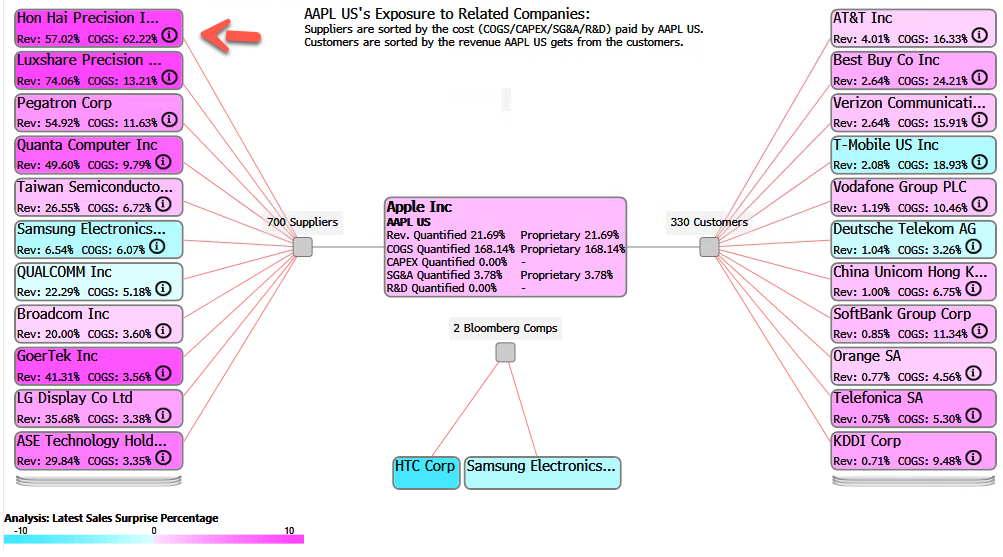
Apple Inc’s massive exposure to Chinese manufacturing has left it with production shortfalls of iPhones due to Beijing’s harsh virus containment policies and unrest at a major factory in central China operated by Foxconn. A new report shows the iPhone maker’s retreat from China is accelerating. 

WSJ said Apple is “telling suppliers to plan more actively for assembling Apple products elsewhere in Asia, particularly India and Vietnam, they say, and looking to reduce dependence on Taiwanese assemblers led by Foxconn.” 

Apple’s supply chain data indicates China is the iPhone maker’s primary location. Market research firm Counterpoint Research recently noted 85% of the Pro lineup of iPhones is made in Foxconn’s giant city-within-a-city factory in Zhengzhou. 

The factory has been hit with Covid-19 restrictions and unrest in recent weeks and months, leading to a production shortfall of 6 million iPhone Pros by the end of the year.

“Apple no longer feels comfortable having so much of its business tied up in one place, according to analysts and people in the Apple supply chain,” WSJ noted. 

“In the past, people didn’t pay attention to concentration risks.

 “Free trade was the norm and things were very predictable. Now we’ve entered a new world,” Alan Yeung, a former US executive for Foxconn, said. 

People familiar with Apple’s supply chain said that not all production would be shifted outside China. However, the remaining production in China will draw on a larger pool of assemblers, not just Foxconn. They said Luxshare Precision Industry Co. and Wingtech Technology Co. are two companies in line to receive more business from Apple. 

As for the shift out of China, people involved in the discussions said Apple is telling manufacturing partners to look at other countries. 

However, Apple has spent decades interweaving its supply chains within China, and change won’t come overnight. 

“Finding all the pieces to build at the scale Apple needs is not easy,” said Kate Whitehead, a former Apple operations manager who now owns her own supply-chain consulting firm.  

Ming-chi Kuo, an analyst at TF International Securities who follows the supply chain, said Apple’s longer-term objective is to ship 40% to 45% of iPhones from India. And suppliers said Vietnam could soon be a significant player in manufacturing other Apple products such as AirPods, smartwatches, and laptops.

The bigger trend is the fracturing of the global supply chain. US firms realize China’s zero Covid policy and shutdowns, along with heightened geopolitical risk across the region, are bad for business and recently outlined in the American Chamber of Commerce in Shanghai’s latest survey of US firms in China found a near doubling of respondents over the past year that are slashing investment.

Tyler Durden
Sat, 12/03/2022 – 17:00

via ZeroHedge News https://ift.tt/nhOIt8J Tyler Durden

Indiana RFRA and Abortion

Flash-back to March 2015. At the time, Mike Pence was the Governor of Indiana. And the Hoosier State enacted a version of the Religious Freedom Restoration Act. This move was highly controversial. Progressive groups feared this bill would provide a license to discriminate in the name of religion. I wrote an essay in National Review explaining that the state RFRA was modeled after the venerable federal standard.

Seven years later, that same RFRA which progressives excoriated, is now being used to stop post-Dobbs abortion laws. And a superior court in Marion County has enjoined the law based on the state RFRA.

Readers of this blog will likely be familiar with some of my writings on religion and abortion (see here, here, here, and here). Indeed, there are two law review articles that engage my views at some length. (I have some quibbles with how the former article characterized my article, and have been in touch with the authors; I think the latter article treats my work fairly.)

There is much to write about the trial court’s ruling. Here, I will focus on five primary issues.

First, the court makes a categorical error, and asserts that there is only one view on Jewish law with regard to abortion. For example, the court said “In order to protect the woman, Jewish law recognizes that there are circumstances in which abortion should occur and is mandated even if there is not a physical health risk that is likely to cause death or the substantial and irreversible physical impairment to a woman’s major bodily function.” And the court said, “Judaism allows for and requires that an abortion be provided if the pregnancy threatens the woman’s mental health, for instance if the pregnancy would aggravate psychological problems or cause such problems.” To support these claims, the court cited declarations from a few rabbis. But these rabbis do not, and indeed cannot, speak to what Jewish law “mandates” or “requires.” A court cannot state, as a matter of fact, what “Jewish law” obligates. (And query whether making these absolute statements amounts to an establishment of what the Jewish faith requires?). These sorts of statements are extremely problematic. I made this point in June:

There is no Jewish equivalent of a Pope. We often speak of “Orthodox,” “Conservative,” and “Reform” Jews, but even within these categories, there is no official or standardized set of teachings. Every Congregation, indeed, every Rabbi, may follow the teachings in different fashions. Moreover, every Jew can look to faith in his own fashion. And there is no obligation to be consistent. A Jew could hold one opinion in the morning, and then change his mind over lunch, and go back to the original position after dinner. The old saw, Two Jews, Three Opinions, is apt.

What’s paradoxical is that the court recognized that another faith, Islam, has different perspectives on the abortion issue. No one spiritual leader can speak for al Muslims. The court wrote:

Although, as in any religion, there are different Islamic schools and views, some Muslim scholars take the position that the fetus does not possess a soul until 120 days after conception.

There are many different schools of thought within Judaism on abortion. The declarations from the rabbis do not speak for all Jews. My colleagues Howard Slugh and Tal Fortgang explain a different Jewish perspective on abortion.

Second, in any event, the specific contours of the Jewish faith are not dispositive for this case. Indeed, Anonymous Plaintiff 2 does “not belong to a specific religious denomination.” Rather, her “personal religious and spiritual beliefs that guide her moral and ethical practice and life.” What are those beliefs? “She does not believe in a single, theistic god, but believes that there is within the universe a supernatural force or power that connects all humans and is larger than any individual person.” Moreover, she has a “spiritual obligation to determine whether to remain pregnant.” Anonymous Plaintiff 2 claims that her “religious beliefs are sincerely held.”

RFRA defines the “exercise of religion” as “any exercise of religion, whether or not compelled by, or central to, a system of religious belief.” If we assume the beliefs of this anonymous plaintiff are in fact sincerely held, I predict that a future ground of dispute is whether her system of beliefs are religious at all, or rather are based on something other than “religion.” Calling something “religious” does not necessarily make it “religious.” Justice Scalia’s concern in Smith that “each conscience [can be] a law unto itself” would ring true. Given that we are defining a term in a statute, and not in the Constitution, it would be useful to know how the phrase “system of religious belief” was understood when the statute was enacted, and in prior caselaw.

Third, the trial court found that the state lacks a compelling interest to prohibit abortion in this context. Specifically, the court ruled that “the question of when life begins is a theological one not a factual question for this Court.” In other words, the Court cannot accept the state’s contention that there is a compelling interest to protect fetal life from conception, because that is a religious and not legal question. Dobbs was able to avoid this question, but at that moment, I realized that RFRA would force the court to grapple with defining the compelling interest.

Right here is the trial court’s most vulnerable point. I don’t expect this part of the ruling to survive on appeal. States can be afforded some latitude to define compelling interests, especially concerning the police power. And the Supreme Court is no doubt toiling with these issues now: Students for Fair Admission and 303 Creative may have to tackle the compelling interest issue. (I address that issue in an amicus brief for 303 Creative.) Justice Scalia in Smith objected to Sherbert due to the difficulty of defining a compelling interest. (Somewhere, Justice Barrett is wiping sweat off her brow for not overruling Smith in Fulton.)

By contrast, the analysis of “least restrictive means” is trickier, since there are exceptions for rape and incest, but not for religious exercise. Do those exceptions, in light of Fulton and the most-favored nation approach, undermine the state’s compelling interest?

Fourth, if we take these arguments to their logical conclusion, then RFRA would provide greater protections than Roe and Casey. A person’s sincerely-held religious belief, however defined, may require an abortion through the ninth month. Indeed, any burden–even if not undue–would violate those rights. For example, requirements to obtain a sonogram, which were upheld under the Casey regime, would violate a woman’s free exercise. Who needed substantive due process when RFRA was here all along?

Fifth, I am not certain about the scope of the court’s remedy. Usually, RFRA exemptions are granted to named plaintiffs, who articular specific objections to a government practice. And the injunction here seems limited to the named plaintiffs. One of the groups, Hoosier Jews for Choice, presumably would probably accept as a member any Jewish woman who seeks to obtain an abortion. (It’s not clear if every member of that organization needs to share the same religious beliefs, or if non-Jews could join?) How would other Indianans avail themselves of this ruling? Could a person in urgent need of an abortion suddenly find their faith, and profess a sincerely held belief? A class was not yet certified. And, as I wrote in May, certifying such a religious class would be difficult, as individual beliefs are so personal. And proving sincerity based on class representatives cannot work.

***

I wrote about this issue before Dobbs was decided because I recognized it would have legs. Those who historically have favored a broad reading of RFRA, and seek to overrule Smith, need to contend with these arguments. Doing so will not be pleasant, as the barrage of responses to my posts illustrate.  Abortion and religion are the third and fourth rails in our polity. (I lost count of how many times I was called an anti-semite.) Going forward, it is not enough for states to rely on the “compelling interest” prong. I think there needs to be a more careful discussion of “least restrictive means,” and whether there is in fact a “substantial burden” of a religious exercise.

The post Indiana RFRA and Abortion appeared first on Reason.com.

from Latest https://ift.tt/6CXRSeA
via IFTTT

Midterms No Mandate For Another Biden Run

Midterms No Mandate For Another Biden Run

Authored by A.B. Stoddard via RealClear Wire,

Democrats face an inflection point, though they are trying not to face up to it. Surprising results in the November elections, producing a cloudy picture for both parties, have quieted a push to get President Biden to forgo a second term. But the liabilities of the GOP do not make Biden more popular; nor do they make him younger.

A split decision at the ballot box has Democrats cheering, but they have lost control of the House, and Biden’s job approval ratings are still nothing to crow about. Republicans underperformed because of the Dobbs ruling by the Supreme Court, and because of the extreme candidates backed by Donald Trump, when they should have won big. Democrats were not saved from a red wave because voters liked all the bipartisan bills they passed or that gasoline prices went down here and there. Record high inflation, a crisis at the border, and rising crime remain resonant issues with voters and still pose problems for the Democratic Party.

Yet Democrats seem to have backed down from the urgency of finding a new presidential nominee for their party in 2024. Talk of who could replace Biden – and when and how – had consumed Democrats throughout the summer and fall. They were not only anticipating a bad election, and a pivot point for the party, but whether House Speaker Nancy Pelosi would relinquish power as well, and support a new general of leadership for House Democrats. She did. And as I wrote in July, Biden should soon tell the country he will leave office in January of 2025.

The purple wave that helped Democrats mitigate their losses seems to have weakened Trump and strengthened Biden – the opposite of what was expected, particularly had Trump’s senate candidates prevailed. Trump announced his third presidential campaign anyway, but his diminished standing with GOP elites – combined with the midterm results – seems to have stiffened Biden’s spine about facing off against Trump once again in 2024.

Another campaign for Biden may even be a sure thing. “Those close to the White House say that, at this point, they expect only a family emergency or a personal health issue would change Biden’s mind about seeking re-election,” NBC reported, adding that Biden plans travel to potential battleground states and that advisors are reaching out to supporters “all in advance of a campaign launch early next year.”

Right on cue Democrats are talking comfortably again, even publicly, about a second Biden campaign. Before the election, Democrats believed Biden could face a primary challenge, but now some potential contenders are swearing off running against him. California Gov. Gavin Newsom and Illinois Gov. JB Pritzker have both said they won’t run if Biden does. “I think the president is running for re-election. So I think you’ll see Democrats supporting the president,” Pritzker told the New York Times. Newsom, who most Democrats assumed has been building a campaign-in-waiting, told Politico he assured the president, as well as his wife, that he wasn’t running if Biden ran or if he chose not to.

“He not only beat Trump once, I think he can beat him again,” Newsom said. “I hope he runs, I’ll enthusiastically support him.”

Biden himself is reportedly having conversations with his family, which started over Thanksgiving, about whether to run again. He has said running is his “intention” but has also said he wasn’t certain and would make an announcement early next year.

At 80, Biden is already America’s oldest president. The office has visibly aged him. He and Democrats aren’t talking about him launching a campaign for an election to serve two more years, but to serve another six years. Biden is not even halfway through his term. The worst thing for the party is for Biden to pretend that a visibly fatigued 82-year-old man, even if his stamina was not further degraded whatsoever by the next two years, can promise to lead the free world in the most grueling job on the planet until his 86th birthday. Biden running and having to quit, or serving and having to quit, because of his health is a foreseeable, avoidable problem for Democrats. The risk this poses is not worth the advantages Biden’s incumbency would afford him in a reelection campaign. Moreover, if Biden runs and appears physically weaker late next year it is likely someone could jump in to challenge him. That is a bad scenario for the Democrats, no matter who that is or how it turns out.

Polls show that rank-and-file Democrats don’t want Biden to run for a second term. Overall, strong majorities of Americans across the political spectrum don’t want Biden or Trump to run again.

Plus, there was no blue wave, either. The 2022 elections did not affirm support for Democrats, their policies, or the president. Frustrated voters unhappy with Biden and Democrats retained a near status quo in Washington, angry over abortion and afraid of some freaky Republican candidates they couldn’t trust in office.

In an interview, pollster Stanley Greenberg told the New York Times that his surveys show continued vulnerabilities for Democrats, and he thinks “we need a new voice to address huge challenges but also huge opportunities.”

The sooner the next crop of Democrats capable of leading their party can begin to campaign openly for the 2024 nomination, the better off the party will be. Dragging that process out, and risking an emergency, is not a position a strong leader would leave his party in. Pelosi likes to say that power is not given, it is taken. But last month she gave hers away. If it wasn’t the best thing for her, it was still the best decision for her party. Biden should do the same.

Tyler Durden
Sat, 12/03/2022 – 16:30

via ZeroHedge News https://ift.tt/tfFqk96 Tyler Durden