Faced With New Round Of Demonetization Indians Turn To Gold

Faced With New Round Of Demonetization Indians Turn To Gold

Authored by Michael Maharrey via SchiffGold.com,

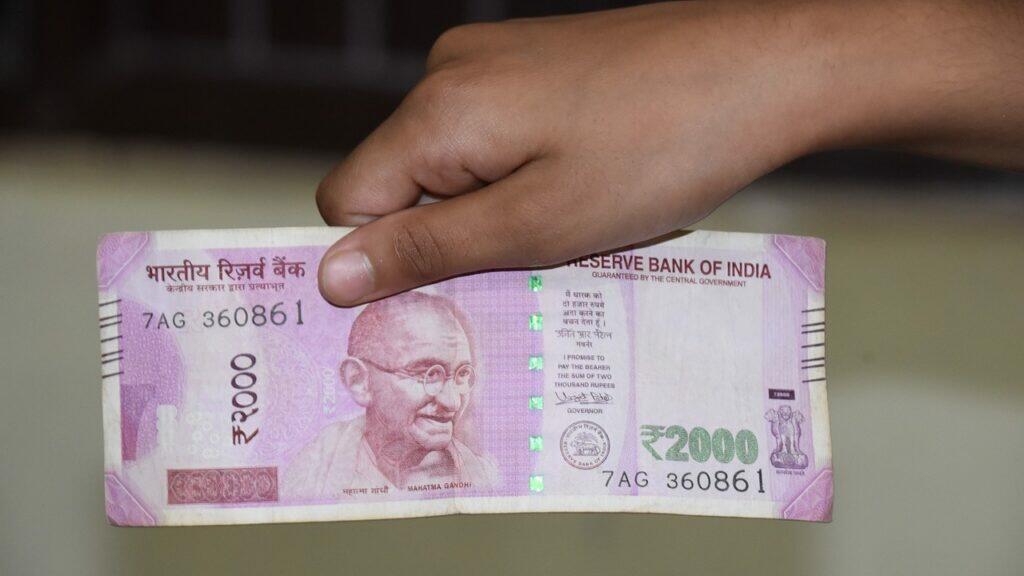
The Indian central bank has announced another round of demonetization with a plan to withdraw 2,000-rupee notes from circulation.
The announcement led to a big jump in gold bullion sales.

The 2,000-rupee note will remain legal tender, but they will have to be deposited or exchanged for smaller denominations by Sept. 30.

The 2,000 rupee note ($24.19) is the largest currency denomination in India. According to Reuters, they make up about 10.8% of the currency in circulation.

T.V Somanathan, the top official at the Indian Finance Ministry, said confiscation of the 2,000 rupee notes wouldn’t cause any disruptions “either in normal life or in the economy.”

His assurances fall flat given history.

We’ve seen this play before. The Indian government announced a surprise demonetization policy in the fall of 2016 meant to drive so-called black money out of the shadows and declared that all of the 1,000 and 500-rupee notes then in circulation would no longer be valid. The suddenly worthless notes made up 86% of the currency in circulation in the country at the time. The move made virtually all of the cash in India valueless.

The government produced new 500 and 2,000-rupee notes to replace the old currency.

Now the government is pulling those 2,000-rupee notes out of circulation.

The government policy announced in 2016 was meant to force Indians to trade in the old notes for new ones. But there was a catch. The government placed limits on the amount of currency Indians could exchange, but no limits on bank deposits until the end of the year. The idea was to push Indians into putting their hoarded cash in the bank – thus bringing it “out of the shadows.” The demonetization policy resulted in severe cash shortages. As many as 90% of ATMs in some regions of the country completely ran out of currency.

With more time to exchange notes this time around, the latest round of demonetization is not expected to be as disruptive.

War on Cash

The Indian government’s move was part of the broader war on cash. The goal was to bring “black money” out of the shadows so it can be tracked and taxed. The vast majority of transactions in India are in cash. It is an overwhelmingly cash economy and virtually every Indian has currency stashed away in their home.

Transactions using black money mean no taxes are collected. Government estimates show that only 1% of the Indian population pays any taxes at all. By making the 1,000 and 500 rupee notes valueless, government officials hoped to force the black money into the light so they could get their cut.

Reserve Bank of India (RBI) justified eliminating the 2,000-rupee note, saying they are at the end of their useful life and citing evidence showing 2,000 rupee notes aren’t typically used in transactions. But the real motivation for this latest round of demonetization is likely the same as the first – to better track and tax transactions.

This war on cash isn’t isolated to India. The European Central Bank stopped producing and issuing 500-euro notes in 2018, and officials in the US have floated the idea of eliminating the $100 bill.

More recently, governments have experimented with central bank digital currency (CBDC) as a cash replacement.

There are also political motives for getting the 2,000-rupee notes out of circulation now.

The move comes ahead of elections in four Indian states and a national election next spring. According to Reuters, “Most of India’s political parties are believed to hoard cash in high denomination bills to fund election campaign expenses to get around tough spending limits imposed by the Election Commission.”

Forcing people to deposit the notes will also help boost bank deposits. Indian banks have struggled to maintain deposit levels large enough to support the country’s massive credit expansion.

Gold to the Rescue

When the government pulled 1,000 and 500-rupee notes out of circulation in 2016, Indians turned their “black money” into gold.

Tax officials attempting to track black money say gold jewelry sales spiked the night of Nov. 8, 2016, after the government announced the demonetization policy.

“Jewelers offered a platform to convert unreported cash into gold,” one official said.

To avoid reporting the transactions, sellers simply split single transactions into multiple sales in order to keep them below the Rs 2 lakh threshold that triggers reporting requirements in India.

After the RBI announced the elimination of 2,000-rupee notes earlier this month, local newspapers reported a similar rush to jewelry shops to exchange the notes for gold. The Hindustan Times reported a 10 to 20% increase in gold sales after the announcement.

People scrambled to buy gold and silver in bulk in bullion markets, leading to increase in prices, dealers in several states said.”

Gold was also a lifeline for Indians pummeled by the economic storm caused by the government response to the coronavirus pandemic.

Indians understand that gold tends to store value and that in the end gold is money. If they have gold, they know they will be able to get the goods and services they need – even in the event of an economic meltdown or a cash crunch.

Gold is not just a luxury in India. Even poor people buy gold in the Asian nation. According to an ICE 360 survey in 2018, one in every two households in India purchased gold within the last five years. Overall, 87% of households in the country own some amount of the yellow metal. Even households at the lowest income levels in India own some gold. According to the survey, more than 75% of families in the bottom 10% had managed to buy gold.

It’s no surprise that when faced with the possibility of another disruption to the cash system, Indians have turned to gold.

Tyler Durden
Tue, 05/30/2023 – 19:00

via ZeroHedge News https://ift.tt/rWkPaID Tyler Durden

My New Brennan Center Article on Tyler v. Hennepin County and the Cross-Ideological Case for Stronger Judicial Protection for Constitutional Property Rights


Geraldine Tyler is seen next to the Supreme Court
Geraldine Tyler, the winning plaintiff in Tyler v. Hennepin.


The Brennan Center for Justice State Court Report (NYU) has published my new article on the Supreme Court’s recent important takings decision in Tyler v. Hennepin County. Here’s an excerpt:

Last week, the Supreme Court issued its decision in an important Takings Clause case that increased protections for property rights. Tyler v. Hennepin County addressed “home equity theft,” a legal regime under which local governments can seize the entire value of a property in order to pay off a smaller delinquent property tax debt. The ruling has substantial implications for the relationship between state law and constitutional property rights. While states are free to protect property rights — and other rights — more than the federal Constitution requires, the latter sets a vital floor below which states must not fall.

Geraldine Tyler, the plaintiff in the case, is a 94-year-old African American widow whose home was seized by Hennepin County, Minnesota, in 2015 after she couldn’t pay off $15,000 in taxes, penalties, interest, and fees. After selling the home for $40,000, the county then kept the entire $40,000 for itself, as Minnesota law allows. Geraldine Tyler sued the county, arguing that the seizure of the surplus funds is a taking of private property requiring the payment of “just compensation” under the Takings Clause of the Fifth Amendment. While takings cases often split the Court along ideological lines, Tyler was unanimous….

Tyler… decisively repudiated the idea that states can avoid takings liability simply by redefining property rights through legislation. Chief Justice John Roberts’s opinion for the Court holds that “state law is one important source [of property rights]. But state law cannot be the only source….”

The theory of state supremacy over the definition of property rights is one longstanding argument for judicial deference to states in takings cases. The Court was right to reject it…

Another standard rationale for deference to states on takings issues is the claim that state and local governments are best able to consider diverse local conditions affecting land-use issues. But this “diversity” rationale would justify gutting federal judicial protection for a wide range of constitutional rights….

Judicial protection for property rights actually promotes diversity and decentralization, rather than undermining it. By giving individual property owners greater control over their own land, judicial review allows a broader range of land uses and more local diversity than if states and localities retain unconstrained power to impose one-size-fits-all restrictions over large areas….

While the cross-ideological coalition in Tyler was unusual, home equity theft is just the tip of a much larger iceberg of situations where stronger judicial enforcement of property rights could help protect the poor, the politically weak, and minorities. The best example is exclusionary zoning, as regulatory restrictions on housing construction price millions of lower-income people out of areas where they could otherwise find greater opportunity….

The same applies to the cases like Berman v. Parker (1954), and Kelo v. City of New London (2005), which ruled that almost anything — including privately owned “economic development” — can qualify as a “public use” under the Fifth Amendment, allowing the government to seize property through the use of eminent domain. This ultra-broad definition of “public use” is at odds with the original meaning of the Fifth Amendment, and has enabled state and local governments to forcibly displace many thousands of primarily poor and minority residents….

Zoning and public use are far from the only issues where there is a compelling cross-ideological case for strengthening federal judicial protection for property rights. Others include asset forfeitures, inadequate compensation for owners of condemned property, and more…..

As with other constitutional rights, states remain free to provide greater protection for property rights than the federal Constitution requires…..

But states’ ability to rise above the federal floor is not a justification for letting them fall below it. A variety of political pathologies often incentivize states and localities to under-protect constitutional rights — including property rights — especially those of the poor, minorities, and the politically weak. In such situations, federal judicial protection is vital. That’s especially true where strong judicial review actually enhances the federalist virtues of decentralization and diversity.

NOTE: Geraldine Tyler is represented by the Pacific Legal Foundation, which is also my wife’s employer. She, however, is not one of the attorneys working on the case.

The post My New Brennan Center Article on Tyler v. Hennepin County and the Cross-Ideological Case for Stronger Judicial Protection for Constitutional Property Rights appeared first on Reason.com.

from Latest https://ift.tt/R7nMCke
via IFTTT

“Strangers on the Internet” Podcast Episode 32: Exclusive Interview with “Ex-Wives Undercover” Amber & Athena

The thirty-second episode (Apple Podcasts link here and Spotify link here) of Strangers on the Internet with co-host and psychologist Michelle Lange features an exclusive interview with the top 1% podcast (over a million downloads!) “Ex-Wives Undercover: Liars, Cheaters & Love Cons” hosts Amber Rasmussen and Athena Klingerman about how their ex-husband Brandon continued freely harming women and children despite seventeen protective orders in three states against him. After law enforcement in the state of Washington and elsewhere didn’t stop him, it is only his eventual near-murderous attack on a woman in California that put him in jail for ten years.

Criminal law scholar and Villanova University professor Brenner Fissell provides expert commentary on what went wrong and what the difficulties are in changing the system. We take listeners through a journey involving not only criminal matters but also the family court framework and the misunderstanding of conditions such as narcissistic personality disorder.

Strap on your seatbelts for a wild ride with TikTok sensations Amber and Athena that covers Brandon’s repeat manipulation of police officers and judges, a myriad of falsified documents, and ankle monitor escapes!

For those interested in Michelle’s and my previous conversation with Amber about how to (safely) navigate online dating, the YouTube video is here.

The post "Strangers on the Internet" Podcast Episode 32: Exclusive Interview with "Ex-Wives Undercover" Amber & Athena appeared first on Reason.com.

from Latest https://ift.tt/P4zhRVQ
via IFTTT

Chicago Sees Deadliest Memorial Day Weekend In 8 Years Despite Hundreds Of Yellow-Vested ‘Peacekeepers’ In Streets

Chicago Sees Deadliest Memorial Day Weekend In 8 Years Despite Hundreds Of Yellow-Vested ‘Peacekeepers’ In Streets

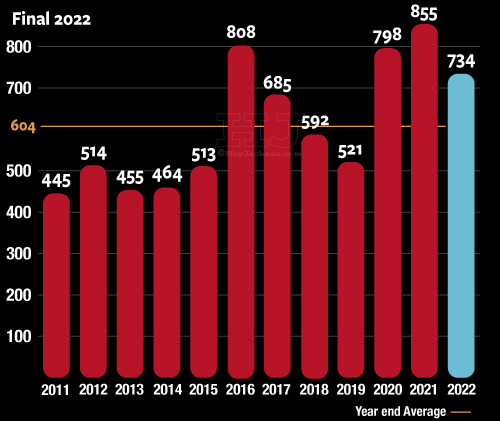
This Memorial Day weekend in Chicago was the deadliest the Democrat-run and crime-plagued city has seen in eight years, the Chicago Sun-Times has reported Tuesday.

One killing even happened close to Mayor Brandon Johnson’s own residence. Going back to Friday evening, “at least 11 people had been killed and another 46 wounded since early Friday evening” resulting in a death toll that was the “highest since 2015, when 12 people were killed,” according to the report. This marks 57 total casualties across the city from either shootings or knifings.

Image: Fox61

The newspaper records that the prior high came in 2016: “The total number shot, however, was still far below the 71 people wounded by gunfire over the 2016 holiday weekend,” it notes.

Last year’s Memorial Day weekend had marked a 5-year high. For the 2022 holiday weekend, 51 people total had ben reported shot, including 9 killed.

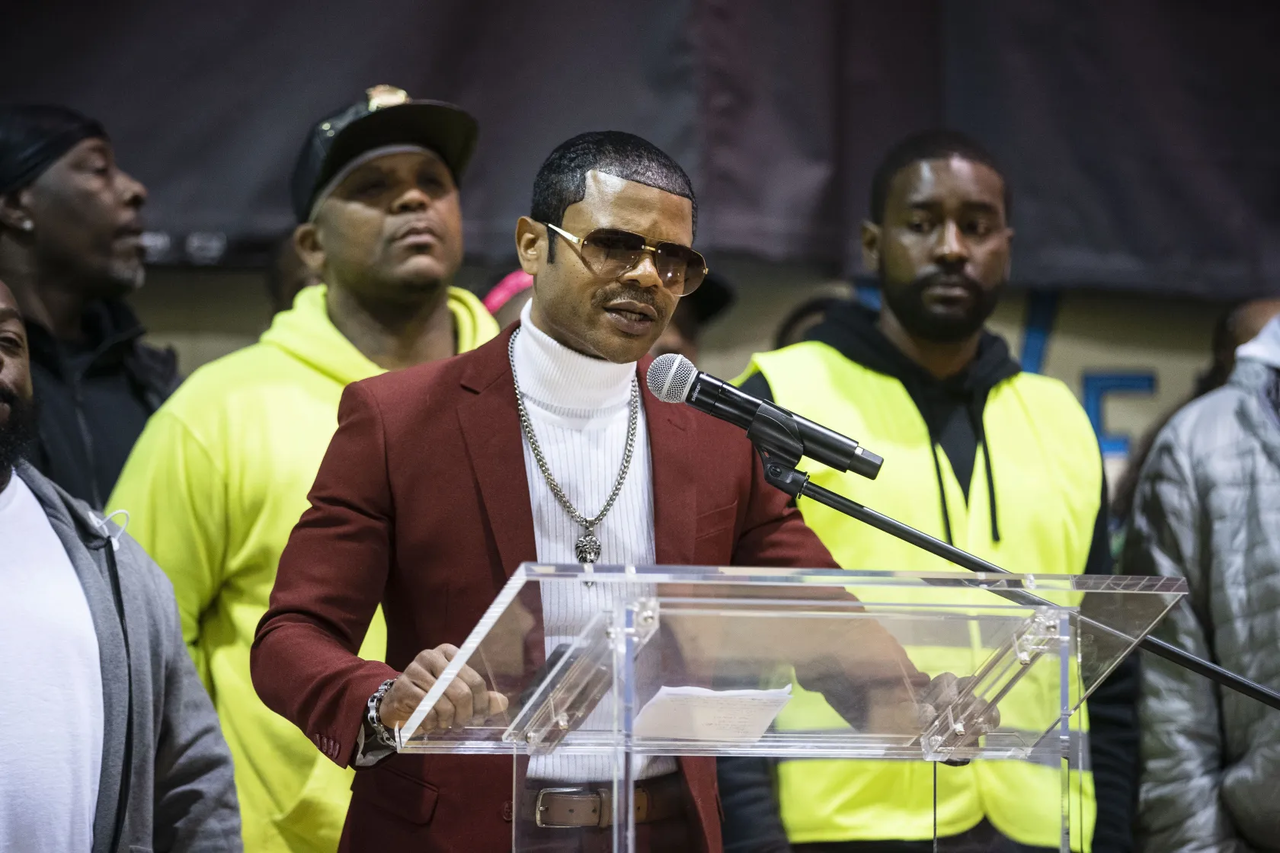
The eight-year high in deaths occurred despite that ahead of the weekend community activists had planned peace marches. The idea was that yellow-vested ‘peacekeepers’ would fan out and have a prominent presence in “hot spots” where violence is frequent in the south and west sides of the city. The marches and activism appeared to have little effect.

 Illinois’ Peacekeepers program, via Sun-Times

The initial Friday homicides reportedly happened within a few hours of each other, and included shootings and stabbings.

As for violent incidents which happened near the mayor’s home, the Sun-Times details

The homicide near the mayor’s Austin neighborhood home was discovered just after midnight Saturday in the 5700 block of West Chicago Avenue. A female, whose age was unknown, was stabbed to death and left in a nearby alley. And Monday evening, a shooting was reported about five blocks from the mayor’s home. A man, 36, was shot near the street around 7 p.m. in the 700 block of North Pine Avenue. He was hospitalized in good condition.

As for the peacekeeping initiative, it is actually part of a formal initiative which has state funding, and has included 500 people having been hired and undergone training in conflict de-escalation. Last week into the weekend they had a presence in 102 “hot spots” in 14 Chicago communities.

However, judging by the tragic weekend statistics – which not only matched but surpassed similar deadly weekends – there appears to have been a somewhat fruitless exercise in optics, at least for the warm holiday weekend. But other metrics suggest and the program leaders themselves say that in some locales the program has been effective.

Below: Total Chicago Homicides per year, via heyjackass.com

Tyler Durden
Tue, 05/30/2023 – 18:40

via ZeroHedge News https://ift.tt/aFRvNmb Tyler Durden

“Safe Harbor”: New Evidence Offers Insight Into Hunter Biden & His Collapsing World Of Corruption

“Safe Harbor”: New Evidence Offers Insight Into Hunter Biden & His Collapsing World Of Corruption

Authored by Jonathan Turley,

Below is my column in the New York Post on newly discovered exchanges within the Biden family over the collapsing fortunes of Hunter Biden in 2018.

As one of the primary conduits for influence peddling in the Biden family, Hunter appeared to be in a free fall and his Uncle Jim appeared to offer him a “safe harbor” and to guarantee “all the deals are still alive.”

Here is the column:

In 2018, Hunter Biden’s world was collapsing.

The New York Times had run a story on one of his shady deals with the Chinese and his father, then vice president, was pulled into the vortex.

It appears that Hunter was in a free fall and his uncle Jim Biden reached out in newly discovered messages to offer him a “safe harbor.”

The exchange is an insight into a train wreck of a life of the scion of one of the most powerful families in the country.

However, it is also insight into a world of influence peddling where millions simply evaporated in the coffers of the Biden family.

On their face, the messages seem to contradict public statements from President Biden on the foreign-influence peddling that used to fund Hunter’s drug-infused, self-destructive lifestyle.

The Times story caused a panic in the Biden family.

Despite a largely supportive media, the Bidens have long been known for influence peddling.

Jim Biden has been repeatedly criticized for marketing his access to his brother in pitches to clients.

Hunter knew that the Times story was only the tip of an iceberg.

There were deals all over the world with foreign figures worth millions and some of these figures had close ties to foreign intelligence or regimes.

As revealed recently by the House Oversight Committee, the Bidens constructed a labyrinth of corporations and accounts to transfer millions from these deals to a variety of Biden family members, including grandchildren.

Free fall

Nevertheless, Joe Biden repeatedly claimed as a presidential candidate and as president that he had no knowledge of any foreign dealings of his son.

Those denials now appear patently false.

The laptop includes pictures and appointments of Hunter’s foreign business associates with Joe Biden.

It also includes a recording concerning a Times report on Dec. 12, 2018, detailing Hunter’s dealings with Ye Jianming, the head of CEFC China Energy Company.

Ye would later be arrested for corruption.

As Biden associates pushed the Times to change aspects of the story, Joe Biden called to report on the results.

In his message, Biden ends his call to Hunter with the statement “I think you’re clear. And anyway if you get a chance, give me a call, I love you.”

The new messages indicate that the Bidens were worried that Hunter was in a free fall as these dealings were becoming known and revenue was declining.

Jim Biden appears to be rushing to get Hunter to work the problem with the family.

He assures him that they can find him “a safe harbor” and that “I can work with you[r] father alone!”

The messages may refer to the fact that Hunter’s past complaint that he was giving as much as half of his proceeds to his father and was now facing towering financial demands.

He appears to have cut off the family.

That is a dangerous development for a man who had a long struggle with drugs and alcohol.

Hunter blew through a fortune on narcotics and women, including allegations that he may have used a shared credit card with his father to pay off prostitutes.

Both Joe and Jim Biden were reaching out to Hunter to assure him that he was in the “clear” and that there is a “safe harbor.”

However, Jim pushed him to remain in contact and in the fold: “I cannot find you, believe it or not I have been looking. I [have] driven by Hallie’s, you fathers. Called texted you. . . . I want to help all the deals are still alive.”

Putting aside the genuine desire to protect a family member with a history of drug abuse, the unpredictable Hunter also represented a threat to the entire family.

A panicked Hunter threatened more than family harmony. There were millions that were being generated in countries like Ukraine, Romania, Russia and China.

The messages show that the Hunter was spinning out of control and needed money fast — a lot of money. He told Jim Biden that he could not even afford “food and gas,” including his monthly alimony to his ex-wife Kathleen Buhle.

He relays how President Biden was told that he “was in a real danger zone.”

Classic corruption

These messages highlight another inconvenient fact: Hunter was hardly a figure who generated confidence or cash.

In 2018, he was an utter mess at the very time that foreign figures were funneling money to him.

He was clearly noncommunicative with his family and still gushing money.

He had previously complained that the Russians had blackmail material on him. He was a danger not just to himself.

In his later book, Hunter admits that he was a crack addict and alcoholic: “drinking a quart of vodka a day by yourself in a room is absolutely, completely debilitating” as well as “smoking crack around the clock.”

Given these admissions, why were so many foreign figures rushing to give this human wrecking ball millions?

He not only lacked expertise in areas like energy or mining, but he was barely able to function, according to his own account.

The answer seems abundantly clear.

This was classic corruption. Indeed, influence peddling has long been the favorite form of corruption in Washington.

Yet, these latest messages add a particularly sad element to this scandal.

Joe and Jim Biden were propping up a man who was barely able to function.

However, Hunter was still the conduit for allegedly millions in foreign money.

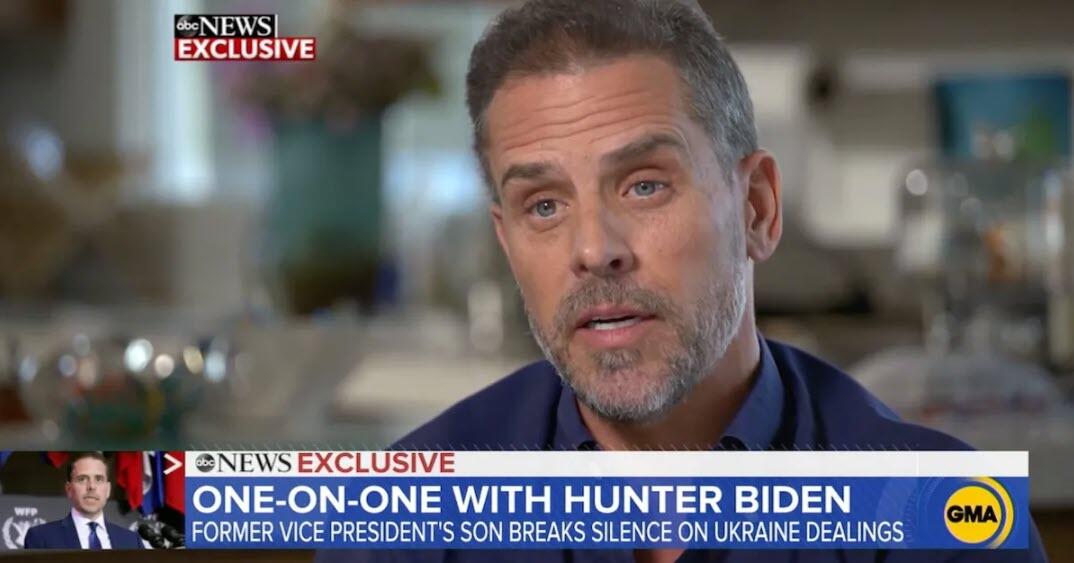
He was the firebreak between the money and any scandal.This was made evident in a recent and rare sit-down interview; MSNBC’s Stephanie Ruhle delicately broached the scandals involving Hunter by emphasizing that it is a “personal” matter and assuring the president (and the viewers) that the still unknown charges involve “no ties to you.”

Hunter increasingly looks like the designated defendant of the Bidens; the sin-eater who may have to take one for the team in the form of a couple tax charges.

Yet, even now, to use Jim Biden’s words, “This can work.”

Hunter’s new “safe harbor” may be a limited indictment that conspicuously avoided charges as an unregistered agent.

Likewise, Attorney General Merrick Garland has seen to that by steadfastly refusing to appoint a special counsel despite references to the president getting a proposed cut of these deals and instructions to use code names for him like the “Big Guy” to conceal his role.

Most recently, an IRS whistleblower came forward to accuse the Justice Department of interfering with the tax investigation of Hunter by “slow walking” the investigation and making a series of decisions that worked to his advantage.

As made clear by Jim Biden, there is always a plan in the Biden family. Back in 2018, he assured his nephew that “as usual just need several months of [your father’s] help for this to work. Let’s talk about it. It makes perfect sense to me.” In the meantime, the message from Uncle Jim likely remains “stay calm and carry on.”

Tyler Durden
Tue, 05/30/2023 – 18:20

via ZeroHedge News https://ift.tt/zftpQJr Tyler Durden

The Great Student Loan Nonpayment Boondoggle Is Over And Household Spending Is About To Collapse

The Great Student Loan Nonpayment Boondoggle Is Over And Household Spending Is About To Collapse

In the small print detailing the end of the debt ceiling melodrama which, as we explained, is a farce as it boosts inflation-adjusted there was some actual news: the great student loan boondoggle is about to come to a screeching halt, after a three year “emergency pause” which redirected tens of billions in dollars away from mandatory student loan repayment to other forms of discretionary spending.

According to Goldman, the agreement announced on Saturday between uniparty leaders Joe Biden and Kevin McCarthy titled hilariously the “Fiscal Responsibility Act”, prohibits the Biden Administration from extending the pause on student loan repayments in place since March 2020, even if it does not block the Administration’s student loan forgiveness plan, which would wipe out up to $20,000 in federal loans per borrower and is currently being weighed by the Supreme Court (the plan was announced last year but has not yet implemented).

Here are the details: late last year, Biden extended the repayment pause, which postpones roughly $5bn per month in student loan repayments, until 60 days after the Supreme Court ruled on the separate $400bn loan forgiveness plan the – the Supreme Court is likely to rule on loan forgiveness in June, so this likely would mean a restart of payments after August 2023.

And now, the debt limit agreement prohibits further extension of the payment pause, but remains silent on the student loan forgiveness plan which however will be nixed by SCOTUS much to the chagrin of screaming libs and lifelong members of the “free $hit” army. Prior to the announced debt limit deal Goldman had already assumed the repayment pause would end on schedule, though there was clearly a chance the White House might have extended it once again. The debt limit agreement eliminates that possibility (“except as expressly authorized by an act of Congress”) and should result in a restart of student loan payments in September 2023.

What happens then?

Well, according to Jefferies, the return of monthly loan payments presents risks similar to the effects of the 2013 fiscal cliff, when tax increases led to reduced consumer spending. And in a note released Monday (available to pro subscribers), JPMorgan’s chief US economist Michael Feroli said that the end of the payment moratorium will reduce annual disposable personal income by $38 billion, which will reduce consumer spending.

Separately, a March analysis by FreightWaves found that federal government programs boosted personal income by an estimated $2.3 trillion from March 2020 to December 2022. According to The Motley Fool, consumers received an average of $3,450 in stimulus during the COVID economy. This included direct payments into bank accounts, an expanded Child Tax Credit and an expanded Earned Income Tax Credit. But one of the biggest COVID-related stimulus programs was not factored into the s numbers: student loan forbearance.

As noted above, Education Secretary Miguel Cardona said the student loan deferment program will end no later than June 30, 2023, and payments are expected to resume by Sept. 1, 2023: “The amount of money we are talking about, in excess of a trillion dollars, is staggering. Student loans represent 7% of U.S. GDP” according to FrightWaves.

Putting these numbers in context, 64% of the $1.7 trillion in student loan debt have been in forbearance for the past three years, amounting to $1.1 trillion. Many of the 25 million Americans who have deferred payments for student debt are aged 18-44 years old, one of the most important demographic groups that drive consumer spending. 

Some more math: according to a New York Fed study, the average student loan payment is $393 per month.

For consumers taking advantage of the program, they have deferred 39 months worth of payments, resulting in more than $15,327 in additional discretionary income during the period, much larger than the amount most consumers received from other COVID stimulus programs. 

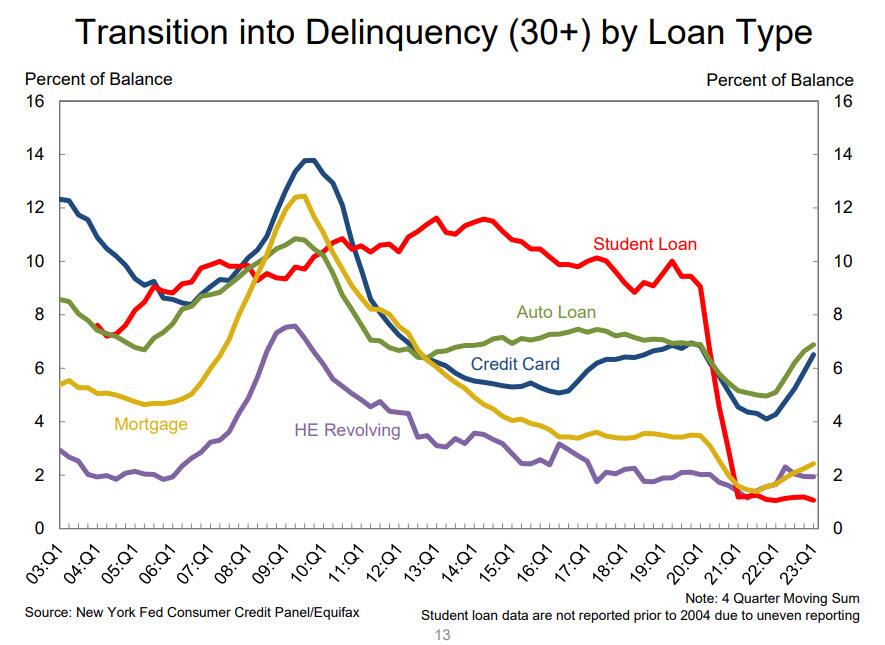
The forbearance program, when originally conceived, was intended to be a short-term program to protect consumers from the COVID black swan event. But many consumers made financial decisions based on this short-term cash flow boost, treating the cash as permanent. In fact, as the latest NY Fed household debt study showed, delinquency on student loans – until 2020 the highest among all types of credit – collapsed to near zero courtesy of the repayment moratorium. Expect the red line to soar higher in coming quarters.

A sudden increase of $393 per month in “new” – but really old – loan repayments will force prime-age consumers (those aged 18-44 years) old to cut back on discretionary spending. Since portions of this demographic have a tendency to prioritize experiences over goods consumption, we can expect this will have a much bigger impact on services demand and spending, which as discussed previously, has been the only pillar supporting the US economy now that  goods spending has fallen off a cliff.

Tyler Durden
Tue, 05/30/2023 – 18:00

via ZeroHedge News https://ift.tt/zv1d2Kf Tyler Durden

Three Years Later, No Justice For BLM Insurrection In D.C.

Three Years Later, No Justice For BLM Insurrection In D.C.

Authored by Julie Kelly via American Greatness,

D.C.’s lead prosecutor has turned a blind eye to a six-month campaign of terror in the nation’s capital in 2020 so he could keep his sights on the mostly nonviolent protesters of January 6, 2021…

“Our office prosecutes all acts of violence, regardless of political motivation, the same.”

So said U.S. Attorney for the District of Columbia Matthew Graves—under oath, mind you, and with a straight face – during a hearing of the House Oversight Committee earlier this month. 

Representative Paul Gosar (R-Ariz.) questioned Graves’ disparate treatment of Black Lives Matters rioters who terrorized Washington, D.C., in 2020 versus Trump supporters involved in the events of January 6, 2021.

Although the start of both incidents was a mere seven months apart, they are a world away in terms of accountability.

In what Graves calls the “Capitol Siege” investigation, more than 1,000 Trump supporters have been criminally charged.

Graves, a Biden appointee, has promised to double that caseload before he’s finished. His office announces new arrests every week.

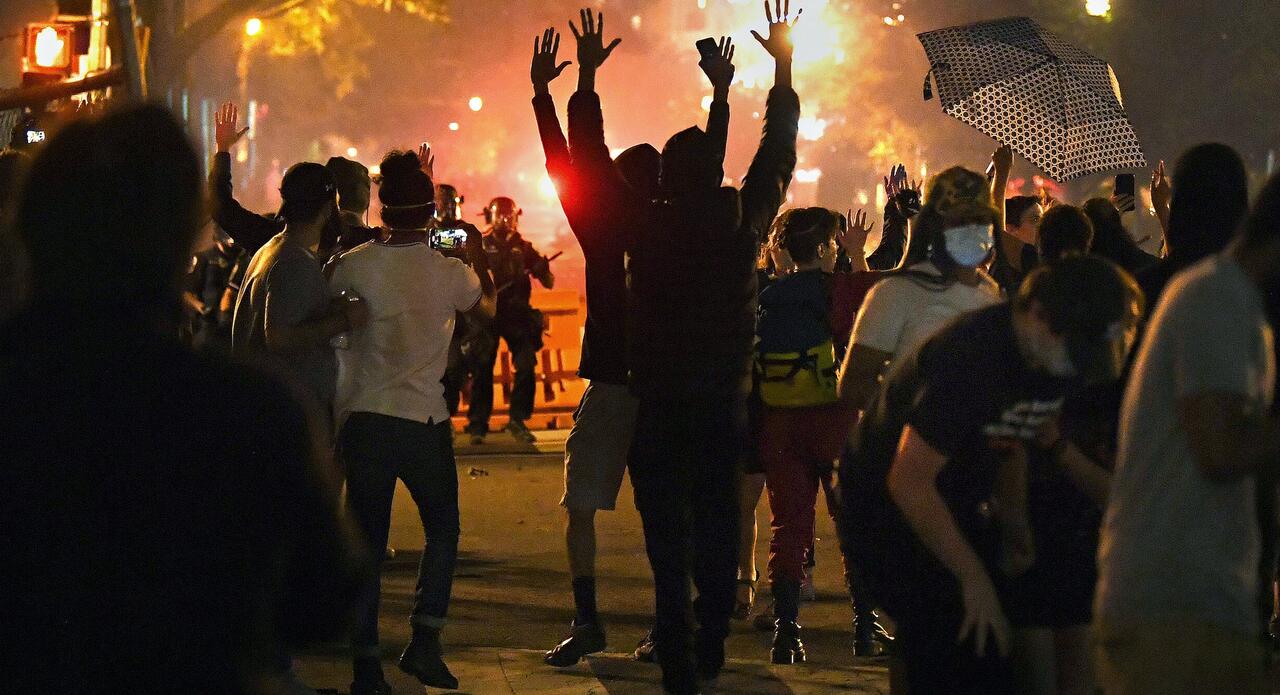
That, however, is not the case for rioters who caused far more violence and inflicted far more damage in the nation’s capital in 2020. The rioting that began on May 29, 2020 at Lafayette Square prompted the lockdown of the White House; Donald Trump, his wife, and teenage son were ushered to an underground bunker for their safety as looters and arsonists repeatedly tried to scale the fence and break through police barricades erected outside the White House.

And what started that night in 2020 didn’t just last a few hours, as was the case with the Capitol protest. On June 1, rioters burned part of St. John’s Church, an historical landmark across from the White House, and set ablaze other areas of the public park.

Chaos continued throughout the summer with the president, his family, and White House staff under constant threat. Police arrested 11 people at Lafayette Square in July 2020 for various offenses including assault of a police officer. “The Tuesday night incidents that stretched over hours are the latest confrontations to transpire near the White House, where protesters have been gathering daily for more than a month to protest for racial justice after the killing of George Floyd in the custody of Minneapolis police,” the Washington Post reported on July 8, 2020.

After Trump accepted the GOP nomination for president on White House grounds in August 2020, rioters chased Republican lawmakers, including Senator Rand Paul (R-Ky.) and his wife, leaving the event. Some assaulted police in an attempt to get near members of Congress; Rep. Brian Mast (R-Fla.), who lost both legs and a finger in Afghanistan, was surrounded and shouted down by Black Lives Matter protesters as he tried to get home.

Elected officials weren’t the only targets of rage-filled activists occupying the heart of the nation’s capital that year. Trump supporters, including young families with children, were attacked by BLM and Antifa rioters during pro-Trump rallies in November and December 2020.

But the violent demonstrations at Lafayette Square represent the closest comparison to January 6: clashes between federal police and protesters on federal property. An Interior Department inspector general report detailed the turbulent situation at Lafayette Square that endangered police and the president for days 

[The] Treasury Annex building was vandalized; officers were assaulted with projectiles, such as bottles and bricks; and a brick struck a [U.S. Park Police] officer in the head, resulting in the officer’s hospitalization. USPP officers reported that some protesters threw projectiles, such as bricks, rocks, caustic liquids, frozen water bottles, glass bottles, lit flares, rental scooters, and fireworks, at law enforcement officials. Overall, 49 USPP officers were injured during the protests from May 29 to May 31, including one who underwent surgery for his injuries. The Secret Service—also reported injuries to their personnel during this time. On the evening of May 30, individuals at the protests threw projectiles at the officers and ultimately breached the first row of bike-rack fencing, thereby eliminating the buffer between the protesters and law enforcement officers.

Dozens of people were arrested, including a man who jumped over two barriers in an attempt to enter the White House. Yet only a handful of protesters faced federal charges—in sharp contrast to January 6 protesters who all face federal counts even for low-level offenses such as “parading” in the Capitol. Nearly all the charges initially filed by the D.C. U.S. Attorney’s office were dropped. (Graves did not take over the office until November 2021.)Despite his claim his office is “prosecuting a number of individuals in connection with the incidents of the summer of 2020,” that simply does not appear to be the case, particularly since Graves further confirmed to Gosar that the office “declined a number of arrests presented to it under the leadership of the prior administration.”

But a change in political leadership does not absolve Graves from failing to bring federal charges against violent criminals who tried to destroy the nation’s capital in 2020. If Graves can indict nonviolent individuals for “seditious conspiracy” who did little more than make travel plans to attend political rallies on January 6, he could easily find more damning evidence against deep-pocketed organizers who encouraged thousands of rioters to occupy D.C. for months, threaten the president, traumatize residents and businesses, assault federal police, and intimidate Republican lawmakers and voters in the seat of American government—a legitimate “insurrection.”

Not only has Graves not charged any suspects involved in the 2020 riots under his watch, but his office also helped negotiate a settlement between the Justice Department and Lafayette Square rioters, who sued the government for violating their civil rights during what Graves called “racial justice demonstrations in Lafayette Square.” The settlement with Black Lives Matter D.C. required Park Police and Secret Service to update their policies to protect those who “peacefully exercise their First Amendment rights.”

First Amendment rights these days are in the eye of the beholder—or in this case, the lead government prosecutor who decided to turn a blind eye to a six-month campaign of terror in the nation’s capital in 2020 so he could keep his sights on people who participated in a mostly nonviolent, comparatively brief protest on January 6.

Clearly, all “sieges” are not created equal.

Tyler Durden
Tue, 05/30/2023 – 17:40

via ZeroHedge News https://ift.tt/Jydq1MQ Tyler Durden

Groom And Doom: Target Shares Mark Longest Losing Streak In Almost 5 Years

Groom And Doom: Target Shares Mark Longest Losing Streak In Almost 5 Years

12.8 billion (and counting) reasons to re-think hiring and marketing practices?

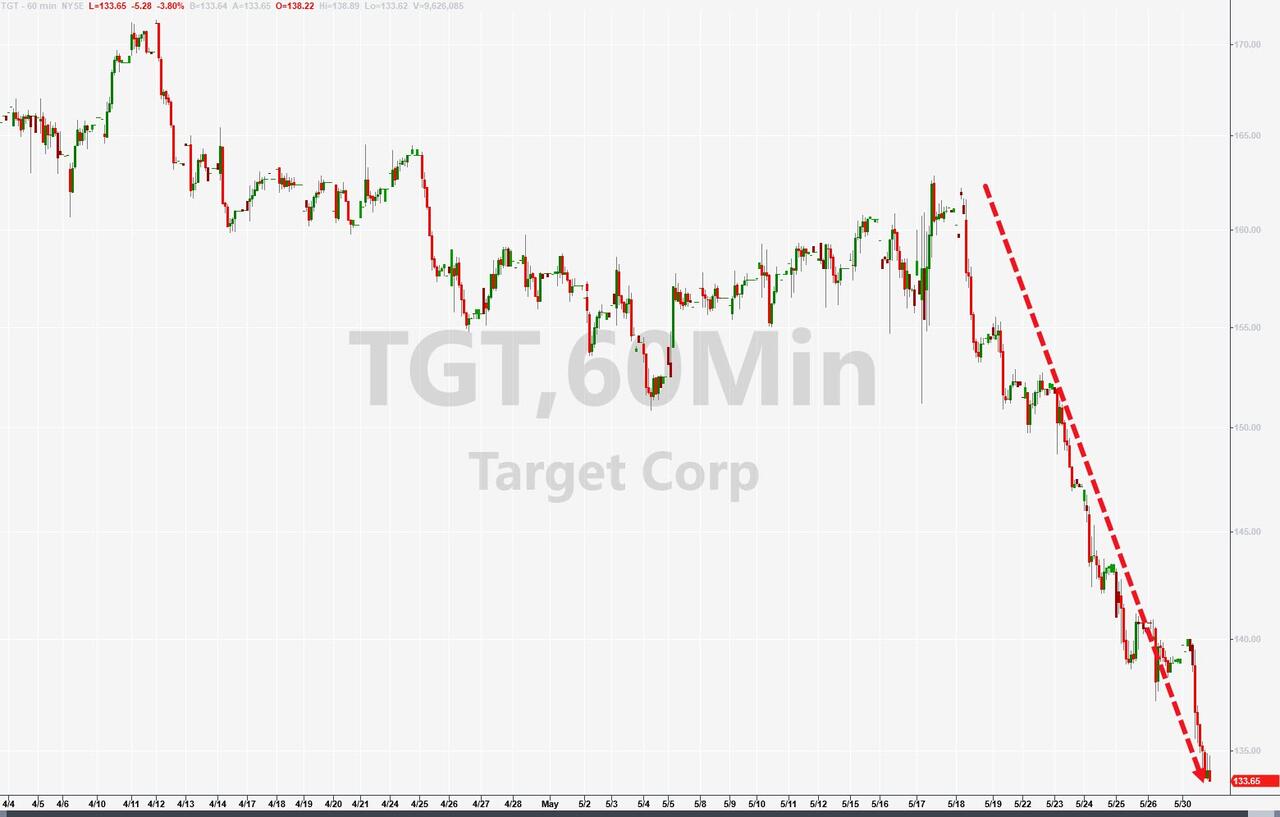
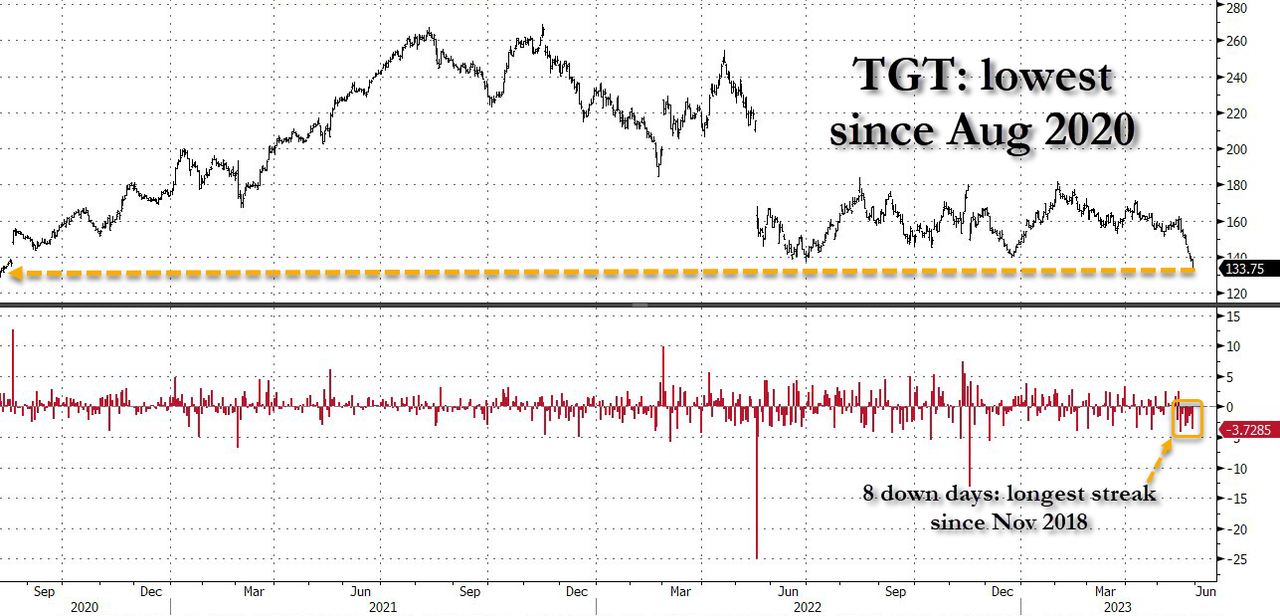
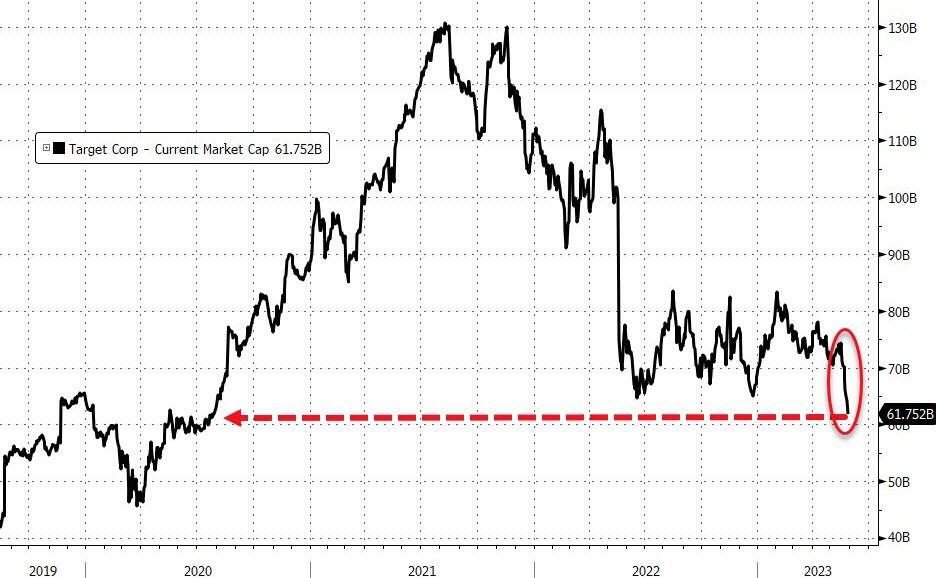
Shares of retailer Target fell as much a 3.8% on Tuesday, extending losses to an eighth session which brought the company’s share price to its lowest intraday level since August 2020.

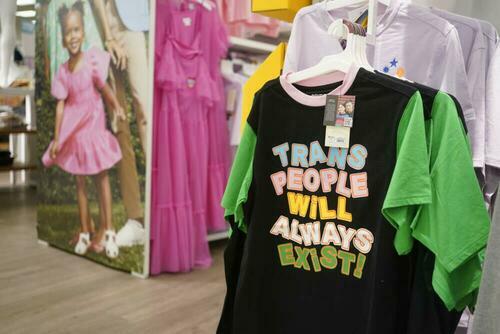
Shares had gotten a brief respite following earnings on May 17, only to decline each session since as controversy continued to mount over the company’s transgender-themed clothing for children.

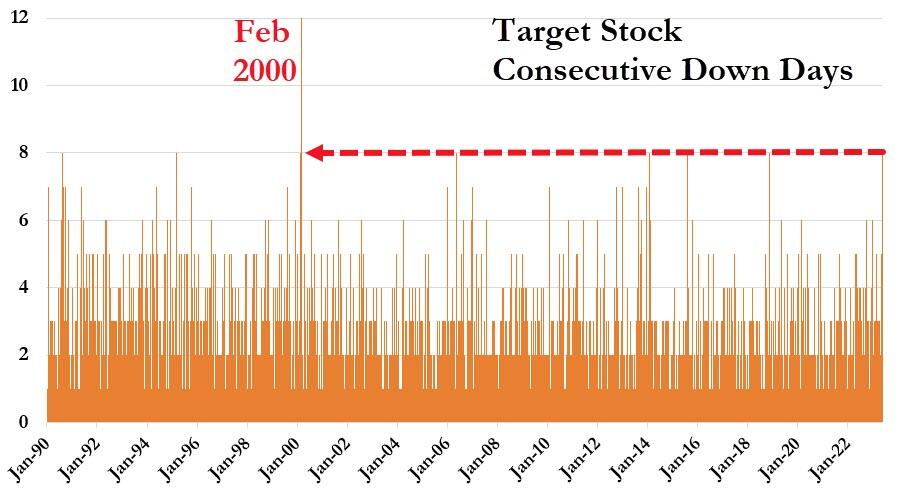
The fall marks the company’s longest losing streak since November 2018.

And in fact, if Target is down again tomorrow, this will be the longest losing streak since the DotCom collapse…

Target’s Market Cap, meanwhile, has dropped by $12.5 billion in the last 8 days – the biggest plunge since COVID lockdowns in Q2, 2020.

In response to the backlash, Target reportedly removed controversial LGBT-themed products at some stores across the South and rural America ahead of June Pride month to avoid further backlash. Some products ranged from “tuck-friendly” swimsuits for transgender people to gender-fluid coffee mugs. The insider said the reasoning behind such an abrupt move is “to avoid the kind of backlash Bud Light has received in recent weeks.”

More recently, Fox News reported that Target’s VP of marketing, Carlos Saavedra, is a treasurer for an organization pushing a transgender agenda in schools.

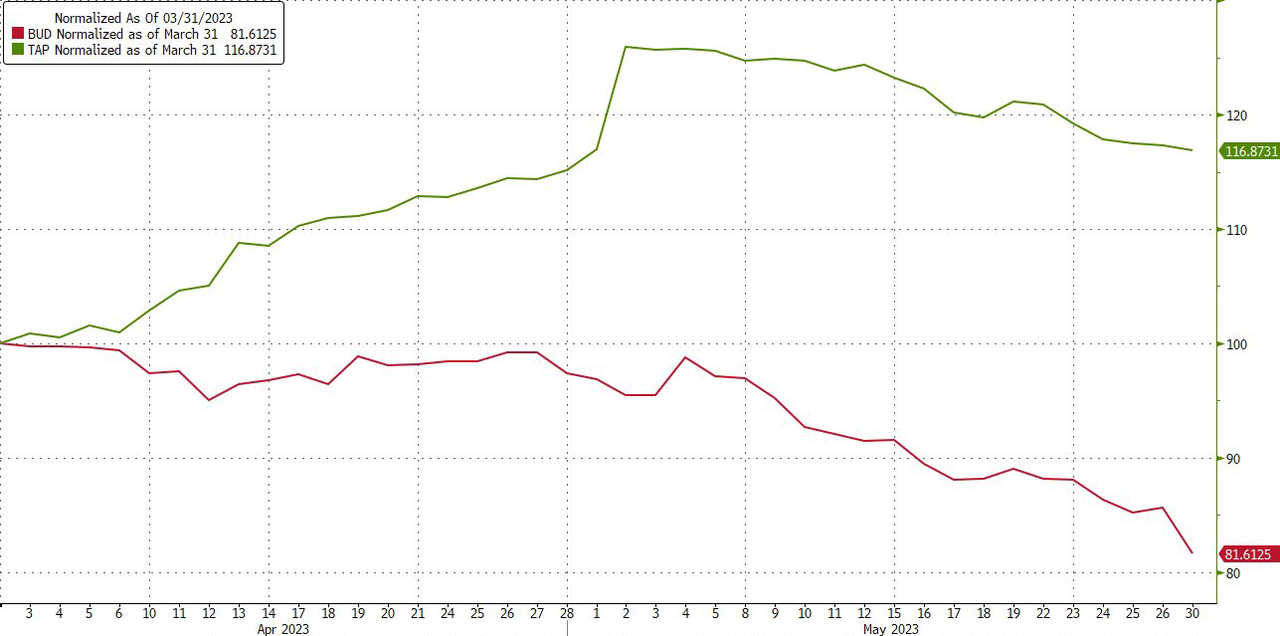
Finally, given BUD’s dramatic underperformance of TAP since “the Mulvaney incident”, we wonder how long before corporates learn that profits (and their jobs) trump virtue-signaling to a tiny minority of America.

At some point the pendulum swings back.

Tyler Durden
Tue, 05/30/2023 – 17:20

via ZeroHedge News https://ift.tt/0KOzfi5 Tyler Durden

Teaching Kids To Swim Is a Great Way To Protect Them From Actual Danger


Little girl wearing sunglasses leans against side of the pool

Are you a parent who wants to keep your kids safe this summer? The best thing you can do is teach them to swim.

I say this as a nonalarmist mom dedicated to actual safety, instead of security theater and moral panic. For example, I frequently encourage parents not to fret too much about stranger danger—especially since the vast majority of crimes against children are committed by people they already know. Instead, parents should focus on mitigating drowning risks.

The Centers for Disease Control and Prevention (CDC) report that drowning is the most common cause of death for kids ages one to four. Even when those kids get a little older, it remains a significant risk, right after car accidents.

Most child drownings happen in swimming pools. Terrifyingly, they often happen when a child is not expected to be near water—for instance, when they somehow gain access to a pool without anyone realizing it.

David Aguilar, child injury prevention czar for the Texas Department of Family and Protective Services, recently appeared on CBS News to remind parents that until their kids know how to swim, they should always practice “active supervision” of children near water.

I would add that all parents should teach their kids to swim, whether they have a pool or not.

“Learning to swim is about staying alive when you end up in the water,” says Brad Bargmeyer, a certified safety professional in California. “I remember when my nephew at age six confidently strode out onto a dock with no railings to get a closer look at a seal swimming in Puget Sound. I had a moment of concern that he was so far ahead of me around all that water. Then I remembered that he had learned to swim as a toddler. Even if he fell in, he would be okay until I was close enough to fish him out.”

Bargmeyer says the experts endorse “safety through skill,” the principle that equipping kids to survive is a better plan than expecting them to never wander out of sight.

But Joseph Brier, a psychology graduate student at Long Island University, points out another reason for teaching kids to swim (as if not drowning was insufficient). He’s been giving swimming lessons for five years and now runs a small company of swimming teachers.

“Parents have told me that once their children learn to swim they have more confidence and self-esteem,” he says. “It seems to leak into other areas of their life.”

Children can learn to swim starting at age two and a half or three, says Brier. In fact, he loves when kids start early, because they’re not afraid of the water.

Are there some kids who can’t learn? There must be. But Brier says he has taught a child with cerebral palsy, and quite a few with autism, as well as “many large, many skinny, many athletic, and many non-athletic” kids.

Jewish law (my tradition) states there are three things every parent must do: teach their kids the holy books, teach them a trade, and teach them how to swim.

The sages debated this, of course. What’s with the swimming? It seems to be both practical advice—Jews are exhorted to do almost anything to save a life—but also metaphorical advice I wholeheartedly endorse: Endeavor to make your kids self-sufficient enough that you don’t have to rescue them every time they land in the deep end.

The post Teaching Kids To Swim Is a Great Way To Protect Them From Actual Danger appeared first on Reason.com.

from Latest https://ift.tt/JmZjUtL
via IFTTT

Federal Judge Requires All Lawyers to File Certificates Related to Use of Generative AI

From Judge Brantley Starr (N.D. Tex.), posted today, a standing order on Mandatory Certification Regarding Generative Artificial Intelligence (paragraph breaks added, as is commonly done in quotes on this blog):

All attorneys appearing before the Court must file on the docket a certificate attesting either that no portion of the filing was drafted by generative artificial intelligence (such as ChatGPT, Harvey.AI, or Google Bard) or that any language drafted by generative artificial intelligence was checked for accuracy, using print reporters or traditional legal databases, by a human being.

These platforms are incredibly powerful and have many uses in the law: form divorces, discovery requests, suggested errors in documents, anticipated questions at oral argument. But legal briefing is not one of them. Here’s why. These platforms in their current states are prone to hallucinations and bias. On hallucinations, they make stuff up—even quotes and citations.

Another issue is reliability or bias. While attorneys swear an oath to set aside their personal prejudices, biases, and beliefs to faithfully uphold the law and represent their clients, generative artificial intelligence is the product of programming devised by humans who did not have to swear such an oath. As such, these systems hold no allegiance to any client, the rule of law, or the laws and Constitution of the United States (or, as addressed above, the truth). Unbound by any sense of duty, honor, or justice, such programs act according to computer code rather than conviction, based on programming rather than principle. Any party believing a platform has the requisite accuracy and reliability for legal briefing may move for leave and explain why.

Accordingly, the Court will strike any filing from an attorney who fails to file a certificate on the docket attesting that the attorney has read the Court’s judge-specific requirements and understands that he or she will be held responsible under Rule 11 for the contents of any filing that he or she signs and submits to the Court, regardless of whether generative artificial intelligence drafted any portion of that filing. A template Certificate Regarding Judge-Specific Requirements is provided here.

Note that federal judges routinely have their own standing orders for lawyers practicing in their courtrooms. These are in addition to the local district rules, and to the normal Federal Rules of Civil and Criminal Procedure.

The post Federal Judge Requires All Lawyers to File Certificates Related to Use of Generative AI appeared first on Reason.com.

from Latest https://ift.tt/SAzOx2M
via IFTTT