“Too Favored To Fail” – Taxpayers Bailout Biden’s Green Friends

“Too Favored To Fail” – Taxpayers Bailout Biden’s Green Friends

Authored by Larry Behrens via RealClear Wire,

While America struggles to buy groceries, President Joe Biden has a green slush fund worth billions of dollars, and he’s not afraid to use it.

Recent revelations uncovered that the CEO and lobbyists of Rivian, an electric vehicle manufacturer, held a quiet meeting at the White House with Biden’s Climate Czar, John Podesta. That’s right, the same John Podesta who served as chairman of Hillary Clinton’s ill-fated 2016 presidential campaign before being pulled from the ranks of profitable green consulting to oversee distribution of $369 billion from the Inflation Reduction Act (IRA).  Biden selected a political operative with green company ties to dole out the goodies from one of the largest slush funds in history. Now green CEOs who are hemorrhaging cash are beating a path to his White House office, presumedly with hat in hand.

According to media reports, Rivian is deep in the red. Last year, they lost $6.8 billion. In 2021, it was $4.7 billion, which is in addition to the $1 billion lost in 2020. These massive losses happened as EV manufacturers enjoyed large subsidies both to build and sell their vehicles. In fact, President Biden went out of his way to praise Rivian in early 2022, even though their stock had already lost half its value on its way to losing 87% of its value since 2021. Losing over $12 billion in less than three years would normally be a problem in the business world, but in the upside-down reality of Biden’s green agenda, that gets you a meeting at the White House.

Tax dollars are flowing from the IRA so quickly that the Department of Energy’s Inspector General (IG) may be running out of adjectives. Earlier this month in testimony before the Senate, the IG said, “the current situation brings tremendous risk to the taxpayers.” Red flags about American dollars flowing to foreign companies or just being wasted here at home are going up, yet according to budget watchdogs, their concerns are met with deaf ears by senior Biden Administration officials. The IG notes there were “billions and billions of dollars lost or stolen” from federal Covid funds, and Biden’s slush fund is even bigger. To put it bluntly, the green vault is wide open and the grifters are lining up.

Here’s a particular galling example. One little known aspect of the IRA are so-called “green banks.” For greenies, the scheme is simple: regular banks will not fund their boondoggles, so they need a taxpayer backed entity to dole out cash. Unlike regular banks, these green banks do not need to make a profit to stay afloat because the government is their funder.

New Mexico Governor Michelle Lujan Grisham was caught trying to set up a green bank without the trouble of going through the elected legislature. The board of the bank will be green non-profits who will be in charge because as the New Mexico climate czar put it, “We’re talking about hundreds of millions of dollars…This greenhouse gas reduction fund is a remarkable little beast.” Recently, Grisham  announced the green bank anyway. The slush fund is open for business, and everyone has their hand out.

Congress is watching the “green bank” scheme because they know it is ripe for abuse. The problem is clear: The White House put a political operative in charge of what is nothing more than a political fund. For Barack Obama, they were too big to fail, but Joe Biden is taking it further. When it comes to his failed agenda, his green boondoggles are “too favored to fail.”

Larry Behrens is the Communications Director for Power The Future and is the author of the book, “Sabotage: How Joe Biden Surrendered American Energy Independence.” He’s also appeared on Fox News, Newsmax and One America News. You can find him on Twitter at @larrybehrens or email at larry@powerthefuture.com.

Tyler Durden
Wed, 11/08/2023 – 09:15

via ZeroHedge News https://ift.tt/RYNCrnf Tyler Durden

Watch Live: Fed Chair Powell Does Not Comment On Outlook Or Policy In Prepared Remarks

Watch Live: Fed Chair Powell Does Not Comment On Outlook Or Policy In Prepared Remarks

Update (9:18am ET). As is usually the case, Powell’s prepared remarks which were just released, did not comment on the outlook for Fed policy or economy so soon after the FOMC meeting. Instead, the Fed chair focused on the Fed’s forecasting voodoo and said the central bank must be willing to think beyond the complex mathematical simulations it traditionally uses to forecast the economy.

“Intellectual rigor has to be combined with flexibility and agility,” Powell said in opening remarks at a conference celebrating the 100th anniversary of the Fed board’s Division of Research and Statistics.

“Even with state-of-the-art models and even in relatively calm times, the economy frequently surprises us,” Powell said. “But our economy is flexible and dynamic, and subject at times to unpredictable shocks, such as a global financial crisis or a pandemic. At those times, forecasters have to think outside the models.”

R&S, as the division is known, provides the Federal Open Market Committee — the Fed panel that sets interest rates — with an economic forecast eight times a year, as well as updates on current data and research on policy and economic topics. The division is currently headed by Stacey Tevlin, the first woman to lead the unit, which employs dozens of PhDs.

Forecasting has been a difficult exercise for the Fed in the post-pandemic economy. Fed staff continued to call the burst of inflation “transitory” for most of 2021, before it kept accelerating in 2022 and reached a peak annual rate of 7.1% in June of that year.

In general, the Fed has been dead wrong about pretty much everything in its 110 year history, and that will never change since it is the crises that allow the Fed to inject trillions into the economy and make the rich richer. 

Below is his full prepared speech:

Thank you, Stacey, for the chance to be part of this celebration. It is great to be here to honor the Division of Research and Statistics (R&S) and humbling to see so many Fed people who served the institution over long and distinguished careers and have returned for this great occasion. The Fed is one of those places where you can work for a decade or so and still feel like a newbie.

For those listening outside this room, I will briefly outline R&S’s responsibilities. A large part of the division, along with other divisions at the Board, is engaged in producing the Tealbook, which contains the staff’s forecast for the U.S. economy, as well as a great deal of data and analysis on financial and economic issues, and which is delivered to the Federal Open Market Committee (FOMC) before our meetings.

Outside of the FOMC meeting cycle, R&S deploys its experts wherever they are needed across the Board, providing crucial inputs to work on financial stability, bank merger analysis, and many other topics. R&S is also an ongoing source of specialized information for policymakers. If Board members have questions about even the most arcane workings of some aspect of the economy, they can send an email and, in no time, be sitting down with some of the best-informed experts on that subject. Much of the time, these are R&S economists. During the pandemic, when questions arose about how the computer chip shortage was affecting auto production or how businesses were responding to the backlog at U.S. ports, R&S gave detailed briefings on these topics. Among its other activities, the Board of Governors is one of the world’s most productive economic research institutions, and a large share of that work takes place inside R&S, supporting our mission of promoting a healthy economy and a strong and stable financial system.

I’ve spoken about research—now let me turn to statistics. In addition to the gathering of data from many sources outside the Federal Reserve, R&S is itself the source for some of the most important data on the economy and the financial system. Our consumer credit data provide financial markets and the public with a vital indicator of the strength of household spending and balance sheets. Each month, the Industrial Production report gives us insights into how well certain sectors of the economy, especially in the manufacturing realm, are operating. R&S is also responsible for the Financial Accounts of the United States, a quarterly compendium of assets, liabilities, and transactions for different segments of the economy. And every three years, R&S conducts the Survey of Consumer Finances, a premier source of detail and insights about how households are faring in the economy. The latest survey was published just last month. These and other data series produced by R&S are a significant public service.

I want to focus in more detail on the forecast, perhaps the most important of R&S’s roles. The U.S. economy baseline forecast produced by R&S, along with the simulation of a half-dozen plausible alternative paths, constitutes the largest part of the essential bedrock that enables our pursuit of our dual-mandate goals.

Some people are attracted to extremely challenging tasks. The people of R&S are those people, having chosen such a task in forecasting the path of the U.S. economy, eight times a year for FOMC meetings, with ongoing updates between meetings. They do this work on the biggest stage and with the highest stakes, knowing that the economy very often surprises us.

Several qualities are required to do this work well.

I will start with an intense commitment. The work requires everything you have to give. You have to love this work to do it well.

The job also requires integrity—policymakers count on R&S to give us their best thinking, not shading the results for any reason.

Regular forecasting also demands a systematic approach and a high degree of intellectual rigor. Ask Stacey and her colleagues to explain a certain aspect of the forecast, and you will find that they have a clear explanation grounded in a rigorous framework.

That intellectual rigor has to be combined with flexibility and agility. Economic models can do a reasonably good job of capturing the working of the economy over past decades. Of course, even with state-of-the-art models and even in relatively calm times, the economy frequently surprises us. But our economy is flexible and dynamic, and subject at times to unpredictable shocks, such as a global financial crisis or a pandemic. At those times, forecasters have to think outside the models.

This work also takes large doses of courage and humility. And, finally, judgment. To complement this rigorous process, there has to be good judgment, based on knowledge and experience.

Perhaps the most important legacy of the past century for the Division of Research and Statistics is the resilience, the creativity, the energy, the rigor, and the commitment with which R&S has risen to the many challenges it and our country have faced in that span of history. On behalf of the Board and the FOMC, thank you for that, and hearty congratulations on your first 100 years of service to the public.

* * *

Fed Chair Powell is due to deliver opening remarks at The Fed’s Division of Research and Statistics Centennial Conference this morning.

His ‘FedSpeak’ follows Cook this morning, who warned that “persistent inflationary pressures… are among risks to the global financial system”, and six ‘hawkish’ Fed speakers yesterday who all toed the same line: data-dependent, job not done, inflation still too high, rates high(er) for long(er), no cuts on the agenda.

Williams, Barr, & Jefferson are also due to speak later on today.

So, it should be clear by the time all that is done exactly what The Fed’s path forward is.

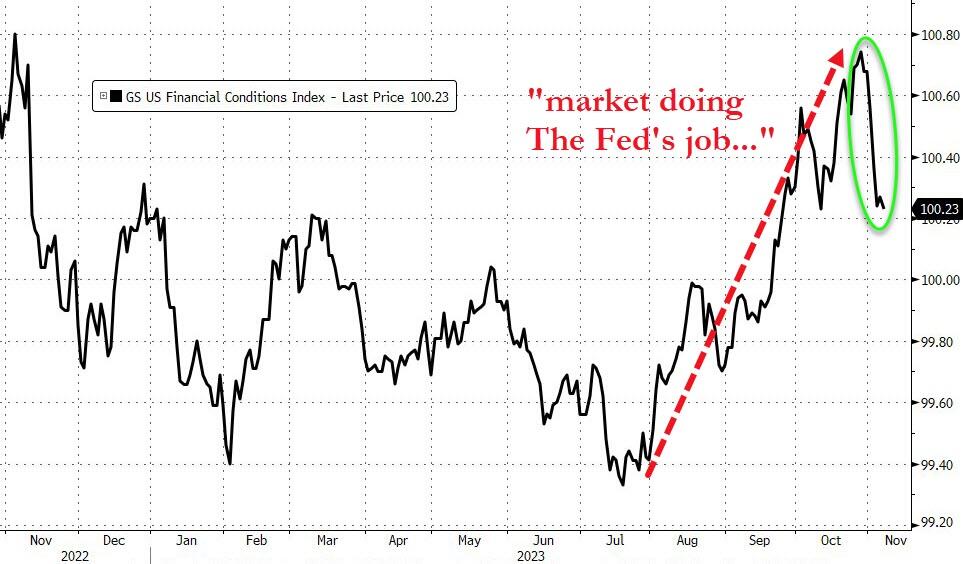
The question is – will Powell inch back his rhetoric having seen stocks soaring higher since the FOMC statement (and press conference), since financial conditions are now loosening extremely fast… just as The Fed crowd about how ‘the market was doing their tightening job for them’…

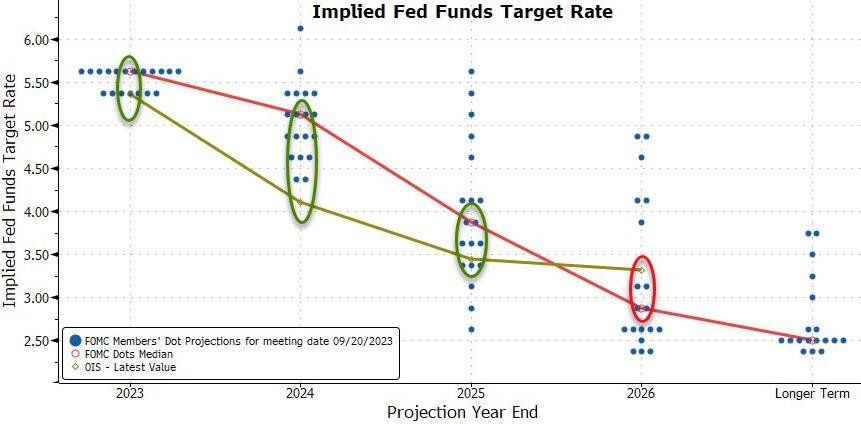
The market remains dramatically more dovish than The Fed’s “dots” – more so since the FOMC meeting…

“Fed speakers will attempt to jawbone and cool market expectations for rate cuts,” said Todd Schubert, a Dubai-based senior fixed-income strategist at Bank of Singapore.

“The market is underestimating the Fed’s resolve in bringing down inflation to 2% and we would not expect a sustained rally in risk assets until there is clearer evidence of a pronounced downward trajectory in inflation.”

Simply put, Powell is widely expected to follow other policymakers in downplaying the likelihood of policy easing. Additionally, given that recent US labor market stats signaled a softer labor market environment, Powell could indicate whether labor market conditions weakened enough for the Fed to end its rate hike cycle.

Watch live (due to start at 0915ET):

Tyler Durden
Wed, 11/08/2023 – 09:05

via ZeroHedge News https://ift.tt/svxehcw Tyler Durden

2020 Vs 2023: Are Economists Making The Same Mistake?

2020 Vs 2023: Are Economists Making The Same Mistake?

Authored by Michael Lebowitz via RealInvestmentAdvice.com,

The following headline from a July 2020 CNBC article is stunning: Here’s why economists don’t expect trillions of dollars in economic stimulus to create inflation.

In hindsight, so many economists could not have been more wrong in 2020 about the path of inflation. Today, despite their spurious track record, scores of economists exude confidence in their forecasts for a sustained rate of higher-than-average inflation and a soft economic landing.

Because of their terrible forecasting errors in 2020, let’s review the CNBC article and find the flaw in their logic. The value of this exercise is not to put economists down. Instead, it helps us better appreciate their current logic and how much credence we should put into their projections.

Background July 2020

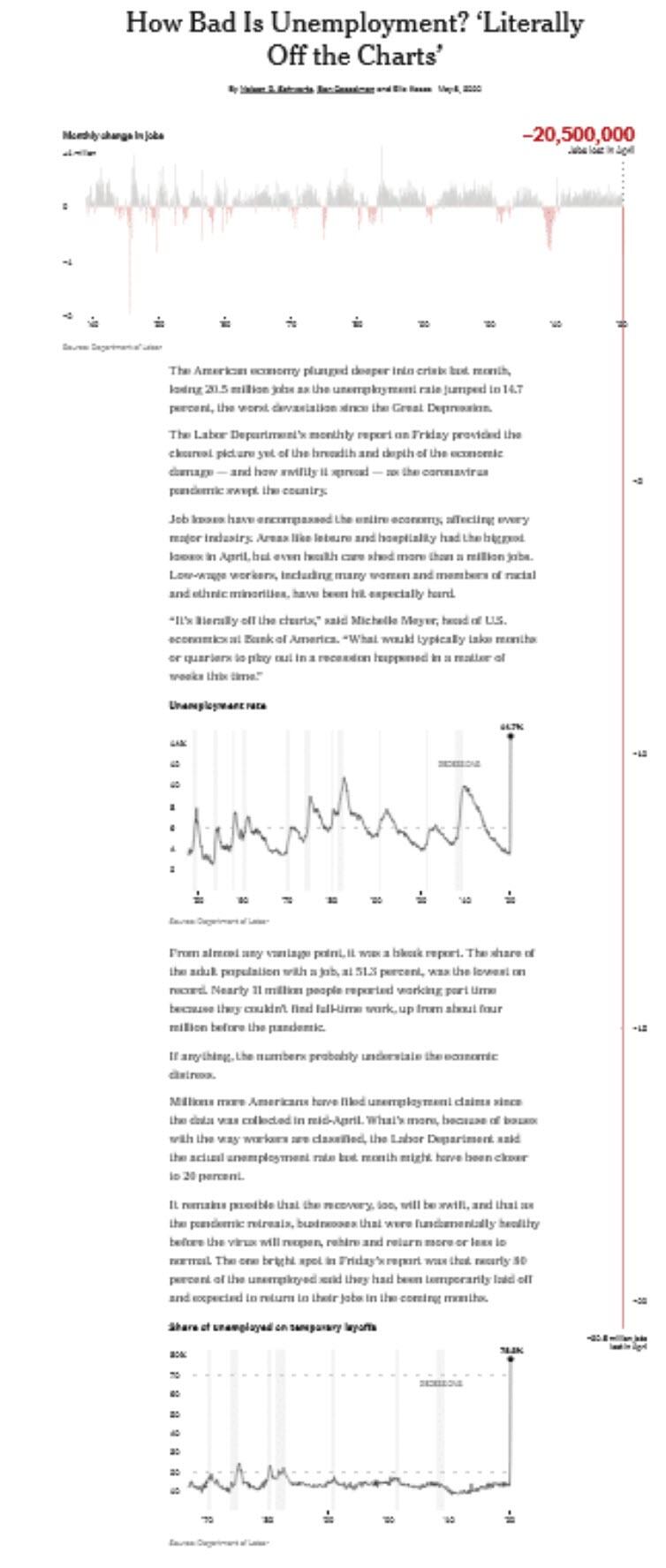
The fiscal and monetary responses to the COVID pandemic were enormous. The economy was essentially shut down and collapsing at a speed unwitnessed in American history. Even three and half years removed from the onset of COVID, the New York Times headline and graphic below, detailing the unprecedented loss of jobs, is still remarkable.

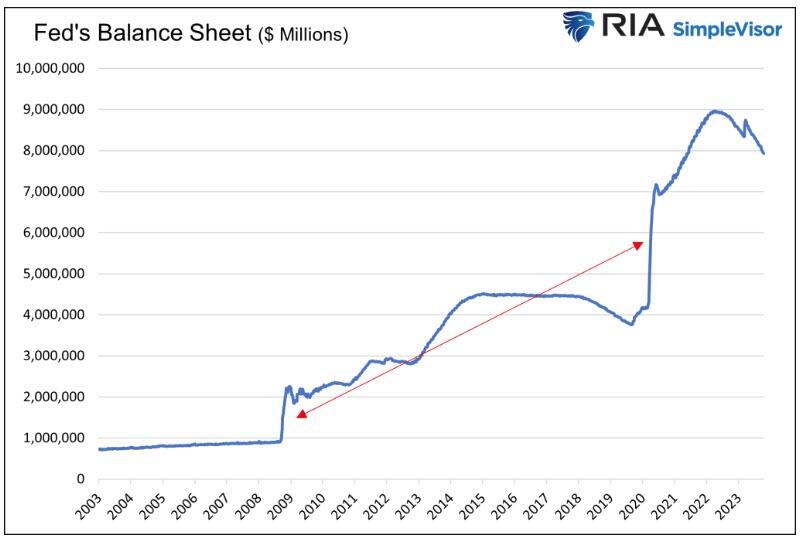
Within six months of the pandemic’s start, the Federal Reserve grew its balance sheet by $2.8 trillion and cut the Fed Funds rate from 1.50% to 0%. For context, the Fed’s balance sheet growth in the first half of 2020 was $1.6 trillion more than the emergency QE1 conducted in 2008.

The Fed’s actions were meant to support failing financial markets but even more so to allow the government to borrow as much money as it wanted and at meager interest rates.

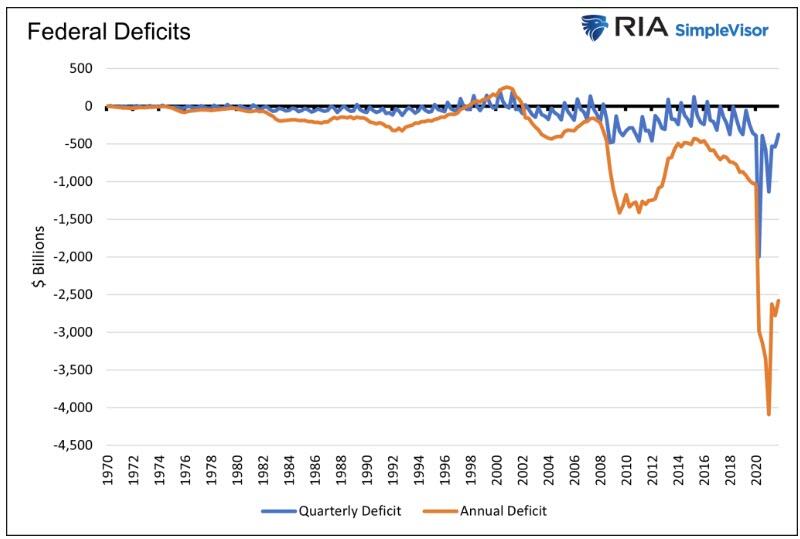
As shown below, the second quarter 2020 deficit was $2 trillion, or over $500 billion more than the annual deficit used to combat the financial crisis. All other quarterly deficits pale in comparison. 

Despite the massive fiscal and monetary onslaught and a severe breakdown in supply lines and the production of most goods, many Wall Street economists were sanguine about inflation prospects.

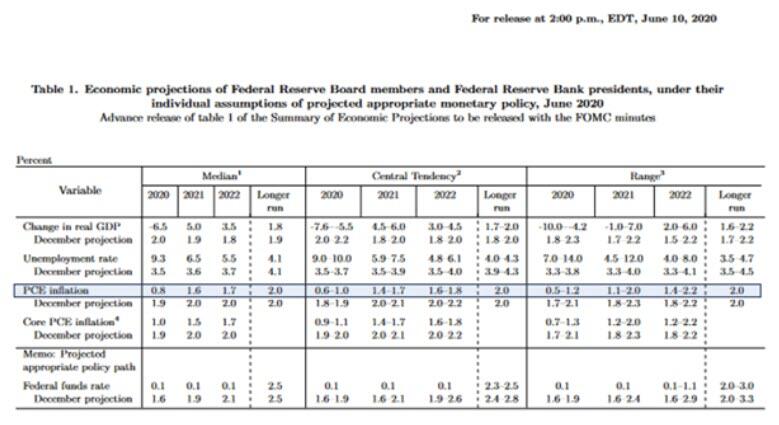
The Fed was not worried either. As a result, on June 10, 2020, the Fed’s outlook for inflation was 0.8% for the remainder of the year, 1.6% for 2021, and 1.7% for 2022. Over the longer run, they expected inflation to settle in at 2%. As we highlight below, of the 16 FOMC members surveyed, the highest estimate for inflation over multiple future periods was 2.20%. Unfortunately, PCE inflation ultimately peaked at 7.11%!

2020 Logic

The following comes from the article:

Supply shocks have driven up prices for some goods in recent months. Yet many economists expect consumer prices will stay low despite trillions of dollars in government stimulus.

“While there certainly is quite a lot of disruption to the supply side of the economy, that’s likely to be dominated by the huge hit to aggregate demand,” said Evercore ISI Vice Chairman Krishna Guha.

Krishna Guha sums up a popular opinion among economists at the time and one on which the Fed based monetary policy. Despite the sizeable stimulus and enormous supply-side disruptions, price increases would apparently be muted due to the “huge hit to aggregate demand.”

Economists chose to ignore everything except demand. They feared the velocity of money was declining at such a rapid pace it would offset the stimulus, supply line problems, and the unprecedented increase in the money supply.

Monetary velocity measures how often money circulates in an economy. Therefore, the more velocity, the more demand for goods and services.

To expect little inflation, they must have assumed consumers would save the stimulus money for a long time.  

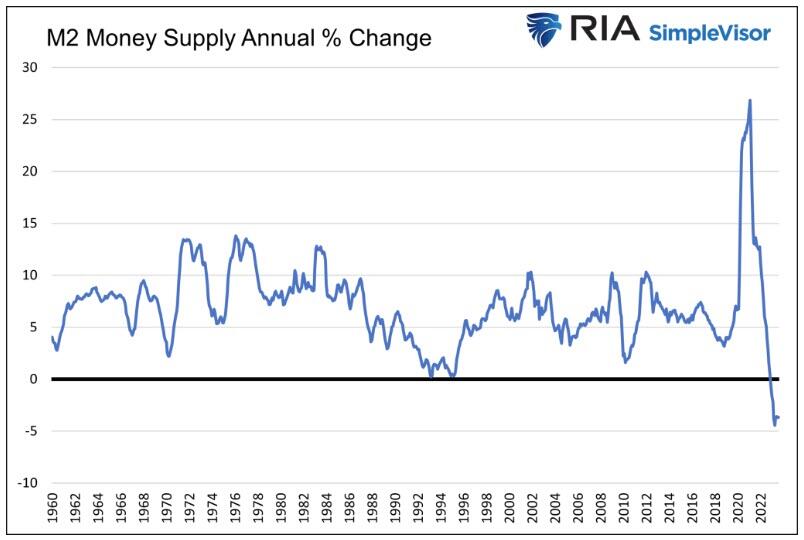
The graph below shows the massive surge in the money supply and the recent decline. The increase was unprecedented, as is the current decline.

Velocity Was Misjudged

Per the article:

At this stage, even with the Fed doing as much as it can, it’s still not leading to an enormous increase in demand,” Olivier Blanchard, a senior fellow at the Peterson Institute for International Economics- CNBC.

Blanchard goes on to say that the $1,200 stimulus checks from the federal government were not extensive enough to stoke inflation.

Despite limitations on what they could spend on, consumers ramped up their spending.

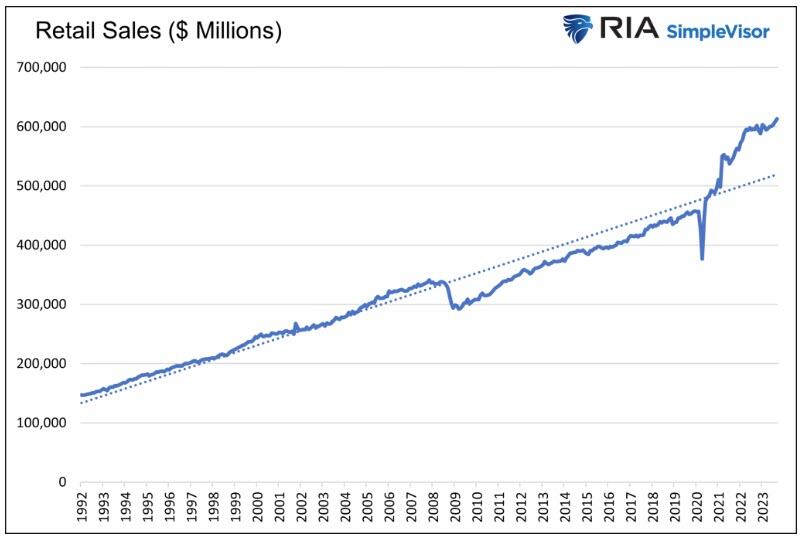
The graph below shows the initial COVID-induced plummet in retail sales. However, a rapid catch-up quickly followed. More importantly, spending continued much faster than the pre-pandemic trend.

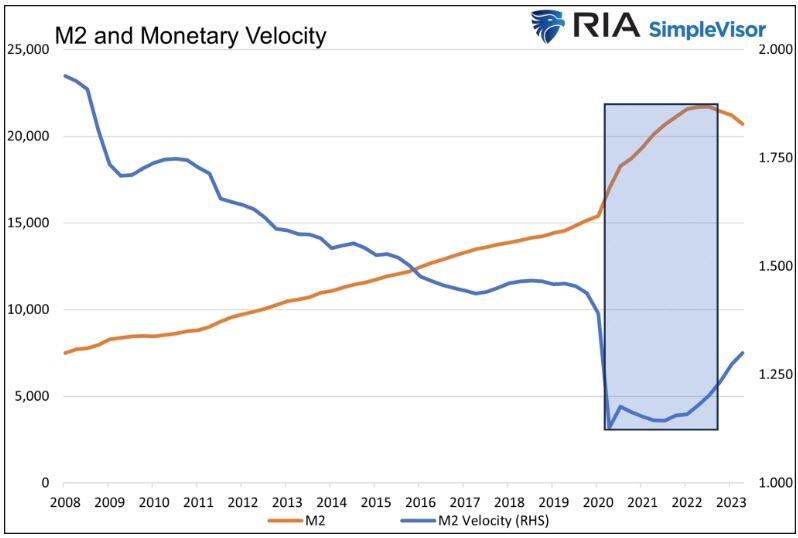
Economists ignored tremendous amounts of data pointing to growing inflationary pressures and wrongly predicted a continued decline in monetary velocity. Hence, the colossal underestimate of inflation in mid-2020. The highlighted box in the following graph shows that velocity initially tumbled but quickly stabilized and slowly started rising. Its recovery occurred as the money supply was still increasing. 

Review 2020’s Inflation Factors

Before considering today’s situation, let’s summarize the environment of July 2020

  • Money supply up 20% year to date – Inflationary

  • Monetary velocity down 18% year to date – Disinflationary/Deflationary

  • Fed Balance Sheet up 66% year to date – Inflationary

  • Fed Funds down from 1.50% to 0.00% – Inflationary

  • Government deficit January through July $2.45 Trillion – Inflationary

  • Supply lines and means of production broken – Inflationary

  • Personal Savings rate rose 468% – Inflationary

  • Crude oil fell below $0 in April – Inflationary (prices could only rise)

Monetary Velocity, a proxy for aggregate demand, was weak for a short period, but virtually everything else happening in the economy was inflationary. Once it stabilized, inflation took off.

Current Situation

Let’s start by bringing the inflationary factors above up to date (October 2023).

  • Money supply down 2.25% year to date – Disinflationary/Deflationary

  • Monetary velocity up 5% year to date – Inflationary

  • Fed Balance Sheet down 7% year to date – Disinflationary/Deflationary

  • Fed Funds at 5.33% – Disinflationary/Deflationary

  • Government deficit Jan. through July $1.20 Trillion – Less inflationary

  • Supply lines and means of production fully healed – No marginal effect

  • Personal Savings fell 9% year to date – Disinflationary/Deflationary

  • Crude oil hovering around $85, $20 above the 5-year average – Disinflationary/Deflationary (prices more likely to revert to average)

It is now three and half years after the pandemic shock, and almost all the factors above have become disinflationary or deflationary. However, there is one outlier- monetary velocity. It is currently inflationary.

Velocity Is Not All That Matters

Once again, the sole focus of economists and the Federal Reserve continues to be on aggregate demand. This time, however, they think it continues to stay red hot.

Can it continue? The base case for inflation to remain higher than the Fed’s 2% objective and a soft landing is to assume it does.

The problem with such a hypothesis is that the U.S. economy’s growth and the financial system’s health depend highly on debt growth. Credit drives our economy, and the health of the economy drives consumer spending.  

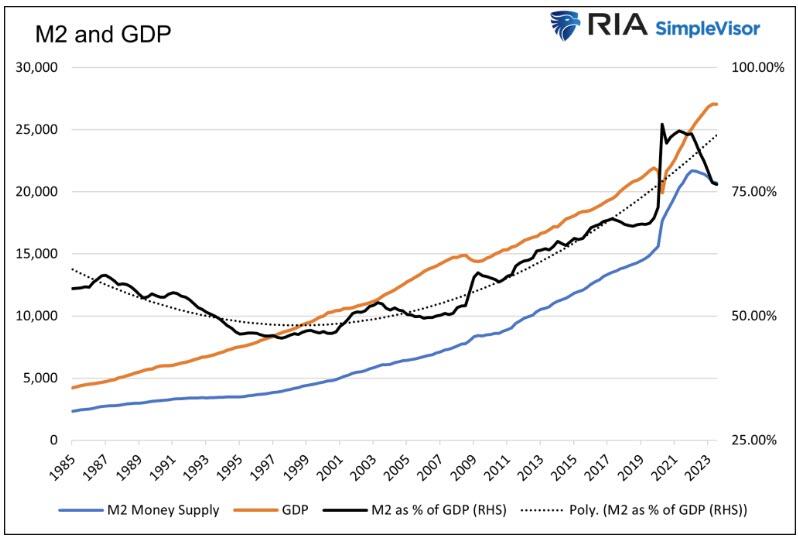
While the money supply has fallen for ten consecutive months, a feat not accomplished since the Depression, it is still moderately above pre-pandemic levels. For the economy to grow over extended periods, money supply growth must keep up with economic growth.

That aspect makes the graph below concerning. The solid black line is the ratio of M2 to nominal GDP. The dotted line shows its trend. While the ratio is above pre-pandemic levels, it’s well below the trend. Since 2000, when the ratio was below trend, a recession ultimately occurred.

Barring renewed growth in M2, which entails lower rates, a steeper yield curve, and the cessation of QT, a recession is likely.

With a recession, unemployment will rise, wage growth will falter, and consumers will cut back on spending.

The only question in our mind is when.

Summary

Might economists and the Fed be making the same mistake as in 2020: too heavy of a reliance on demand and insufficient consideration for other price factors?

In July of 2020, it was hard to imagine that consumers would spend at the rates they ultimately did. Today, consumers seem to continue to spend despite whatever the Fed does to slow the economy.

It’s easy to get caught up in recent trends and believe they can continue for long periods. Consequently, it’s hard to imagine how they end.

Given the likelihood that economists are again myopic in their inflation forecasts and bond traders are betting on such projections, we see a day soon when a disinflationary or deflationary reality hits the bond market and bond yields plummet.

Tyler Durden
Wed, 11/08/2023 – 08:45

via ZeroHedge News https://ift.tt/imhjyKg Tyler Durden

Netanyahu Rejects Biden Phone Request For 3-Day Pause In Gaza War As IDF “Tightens The Noose”

Netanyahu Rejects Biden Phone Request For 3-Day Pause In Gaza War As IDF “Tightens The Noose”

President Biden in a phone call this week urged Israeli Prime Minister Benjamin Netanyahu to implement a three-day pause in fighting. This was revealed by multiple sources to Axios Tuesday, and Biden’s request appears to have been rejected, given the call took place Monday and Israel has since reaffirmed there will be no truce until the hostages held by Hamas are released.

“According to a proposal that is being discussed between the U.S., Israel and Qatar, Hamas would release 10-15 hostages and use the three-day pause to verify the identities of all the hostages and deliver a list of names of the people it is holding, the U.S. official said,” according to the report. 

AFP via Getty Images

But Netanyahu on Tuesday gave a speech declaring that his forces were “reaching deeper than Hamas ever imagined” a hailed the killing of thousands of Hamas terrorists and commanders. “There will not be a ceasefire without the return of our kidnapped,” he emphasized in a message “to our enemies and our friends alike.”

Israel’s Defense Minister Yoav Gallant had at the same time declared that the IDF is fighting “in the heart” of Gaza City and is “tightening the noose” around Hamas.

Concerning the Monday phone call, Axios revealed further, “The two U.S. and Israeli officials said Netanyahu told Biden he doesn’t trust Hamas’ intentions and doesn’t believe they are ready to agree to a deal regarding the hostages.”

The Israeli leader “also said that Israel could lose the current international support it has for the operation if the fighting stops for three days, the officials said.” Netanyahu further voiced to Biden that in 2014 Hamas took advantage of a humanitarian pause to kidnap an Israeli soldier and kidnap others.

The official White House call readout from the Biden-Netanyahu meeting only said the two leaders “discussed ongoing efforts to secure the release of hostages held by Hamas” – but without offering further details.

Of the estimated total 240 captives, Hamas has so far released four hostages, reportedly in large part through Qatar’s mediation, but lately US officials have said progress has stalled since then.

Israel says it was able to free a female soldier during the initial phase of ground operations, while reports have said that in some cases deceased hostages have been found, possibly due to airstrikes.

Hamas has meanwhile continued to publish short videos of what the group says are successful ambush attacks on tanks and armored convoy units, also showing close urban combat, but typically with IDF ground troops nowhere to be seen. The IDF appears to be advancing into Gaza City purely with armor, and presumably with ground infantry troops staying in the rear until a city area is initially prepared through tank, artillery, and airstrikes.

On Wednesday Secretary of State Antony Blinken said the US stands by Israel in rejecting calls for a full ceasefire. “Israel has repeatedly told us that there is no going back to October (7) before the barbaric attacks by Hamas — we fully agree,” he said. He then said of G7 counterparts, “We all agreed humanitarian pauses would advance key objectives.”

Tyler Durden
Wed, 11/08/2023 – 08:25

via ZeroHedge News https://ift.tt/api8mKv Tyler Durden

Futures Flat Ahead Of Closely Watched Powell Speech

Futures Flat Ahead Of Closely Watched Powell Speech

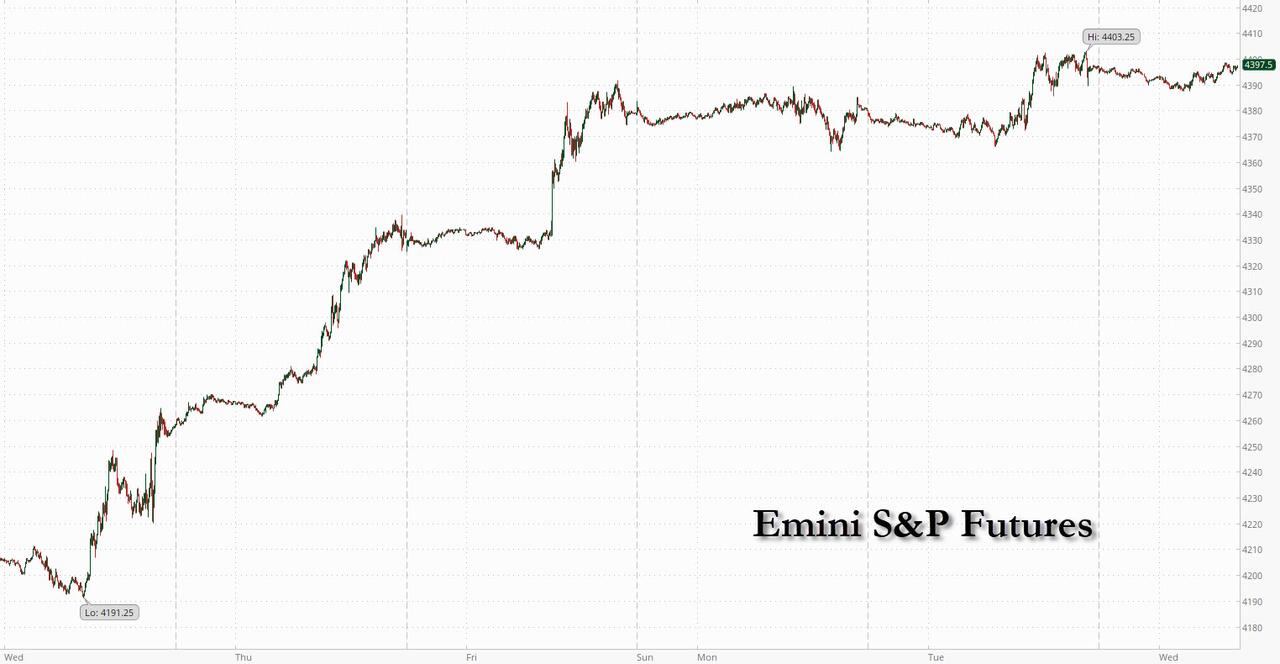
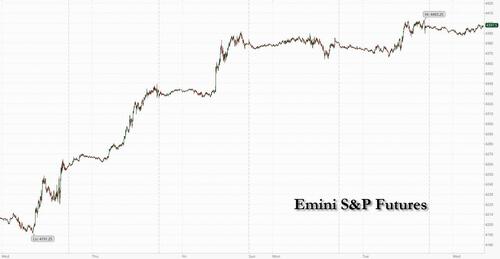
US equity futures are flat following a torrid 7-day rally, the longest since 2021, and global markets faltered as central bank officials in Europe pushed back against the prospect of speedy interest rate cuts, while investors were looking ahead to comments from Fed Chair Jerome Powell later in the day which could move markets. As of 7:45am  US equity futures were unchanged at 4,397, erasing losses earlier in the session, while Europe’s Stoxx 600 traded near flat and yields on 10-year Treasuries climbed one basis point to 4.58%. The decline in oil prices also gained momentum, sending West Texas Intermediate crude futures below $77, near a three-month low. The dollar firmed for the third straight day.
In premarket trading, electric vehicle maker Rivian Automotive climbed 8.8% after raising its full-year production forecast, while smaller rival Lucid Group fell 5.8% after trimming its production forecast. Take-Two Interactive Software rose 9.1% on a report stating its Rockstar Games unit plans to announce the next “Grand Theft Auto” game as early as this week; ebay shares dropped after a lower-than-expected earnings forecast and another online retailer Coupang slid on weak quarterly profits. Here are the other notable premarket movers:

  • Array shares fall 11% as the maker of renewable energy equipment cut its revenue guidance for the full year. Analysts note that order delays overshadowed otherwise strong Ebitda and margin.
  • Datadog falls 1.1% as Mizuho Securities cut the recommendation on the cloud software company’s stock to neutral from buy. The broker said additional upside looks modest, following the company’s blowout report that propelled its stock up 28% on Tuesday.
  • EBay shares fall 7.3% after the online auction company gave a fourth-quarter forecast that was lower than expected. Analysts attributed the weak guide to macro pressures.
  • Lucid shares fall 4.9% after the electric-vehicle startup lowered its full-year production forecast to 8,000 to 8,500 vehicles, down from previous view of above 10,000 units. Third-quarter deliveries missed estimates as well.
  • Nerdy shares tumble 25% after the online learning company widened its forecast for adjusted Ebitda loss for the full year and cut its projection for revenue.
  • Rivian shares rise 7.0% after the electric-vehicle startup boosted its production guidance for the full year and also ended an exclusivity agreement to sell battery-electric vans to Amazon.com.
  • Robinhood shares drop 7.9% after the online brokerage’s results fell short of estimates, with analysts pointing to slower-than-expected trading volumes in September, while Piper Sandler said that fourth-quarter guidance for net interest revenue was disappointing.
  • Sleep Number shares plummet 33%, set to hit the lowest level since March 2011, after the air bed mattress manufacturer cut its outlook for the full year. It now sees a loss per share and plans to close stores in a restructuring effort. Analysts said that the moves show weakness in industry demand.
  • Take-Two shares rise 8.5% after Bloomberg News reported that Rockstar Games, a division of the video game publisher, plans to announce the next highly anticipated Grand Theft Auto game as early as this week.
  • Toast shares fall 19% after the restaurant-software company reported its third-quarter results and gave an outlook seen as disappointing.
  • Upstart shares fall 23% after the AI lending marketplace firm reported third-quarter results that missed expectations and gave an outlook that was below the consensus estimate.
  • Upwork shares jump 20% as the online-recruitment company boosted its revenue guidance for the full year. Analysts were positive about the execution amid continued macro headwinds.
  • Under Armour added 1.9% on raising the annual gross margin forecast as the sports apparel maker benefited from cost cuts.

All eyes will be on Powell’s opening remarks before the Federal Reserve Division of Research and Statistics Centennial Conference at 9:15 a.m. ET for more clues on how long U.S. monetary policy could stay restrictive. The Fed Chair is also due to speak at another conference on Thursday; his is widely expected to follow other policymakers in downplaying the likelihood of policy easing.

“Stocks may well pause for breath as investors balance the hope for rate cuts with building financial stresses in the economy,” Derren Nathan, head of equity research at Hargreaves Lansdown, wrote in a note. “And it wouldn’t be the first time … that the market has been wrong about the timing of the Fed pivot.”

Traders have been trying to gauge how hard global central bankers will push back against the drop in government bond yields, which potentially hinders efforts to keep a handle on inflation. Bank of England Governor Andrew Bailey warned Wednesday it is too early to discuss rate cuts, while three euro zone rate-setters also hinted policy would stay tight. Fed Governor Lisa Cook meanwhile said geopolitical tensions could trigger negative spillovers, including higher inflation.

“Fed speakers will attempt to jawbone and cool market expectations for rate cuts,” said Todd Schubert, Dubai-based senior fixed-income strategist at Bank of Singapore. “The market is underestimating the Fed’s resolve in bringing down inflation to 2% and we would not expect a sustained rally in risk assets until there is clearer evidence of a pronounced downward trajectory in inflation.”

Analysts have mixed views about the outlook for equities towards the end of the year, with some cautiously optimistic about the prospects of a rally, while others have highlighted the likelihood of economic growth concerns and tepid earnings forecasts keeping sentiment subdued.

European stocks also traded lower; the Stoxx 600 fell 0.1% with utilities, personal care and chemical names leading declines. Among individual stock movers on Wednesday, Britain’s Marks & Spencer was among the top gainers in Europe, surging 10% after the retailer posted robust profits and reinstated a dividend. ABN Amro fell as much as 8.9% to reach the lowest level since 2022, after the Dutch bank’s third quarter net interest income missed estimates, which analysts said was likely to disappoint despite an overall profit beat. Here are some other notable European movers:

  • Vestas shares rise as much as 9.8%, most in a year as Ebit beat estimates. Analysts see 3Q results as an encouraging step in the right direction for the Danish wind turbine manufacturer
  • Deutsche Post rises as much as 5.1% after the German courier services firm’s results were in line with expectations and show stock is well-positioned, according to Deutsche Bank
  • Genmab shares climb as much as 8.9%, the most in three years, after the Danish biotechnology firm reported 3Q results that beat expectations
  • Marks & Spencer rises as much as 10% following a strong first-half beat by the retailer, with analysts expecting significant upgrades to full-year consensus estimates
  • Siemens Healthineers shares advance as much as 2.9% after the German medical technology firm reported sales and earnings for the fourth quarter that beat expectations
  • Sampo advances as much as 3.5%, the most since August, after the Finnish insurance group reported better-than-expected third-quarter figures and a reassuring fall to claims inflation, analysts say
  • Ahold Delhaize shares fall as much as 8.6%, dropping to the lowest level since October 2022, after the Amsterdam-listed grocer’s third-quarter margins and earnings missed estimates
  • Legrand falls as much as 7.6%, the most in a year, after the maker of electrical devices like switches and plug sockets reports quarterly sales in North America that disappoint analysts
  • E.On shares fall as much as 2.1% as investors are disappointed by the lack of a guidance upgrade. While the German utility reaffirmed its adjusted Ebitda forecast for the full year
  • Adidas declines as much as 2%, after the company reported 3Q results in line with the pre-released figures from October. Despite the lack of surprises in the print, analysts highlighted the importance of Terrace-style sneakers to the company’s performance during the period
  • ITV slumps as much as 7.2%, to the lowest intraday price since October 2022, after flagging a challenging advertising market. JPMorgan cut its full-year Ebit estimate for the broadcaster by 7%

Asian stocks fell ahead of a crucial speech by Fed Chairman Jerome Powell this week that could indicate how long US interest rates will remain elevated. The MSCI Asia Pacific Index fell as much as 0.4%, with financials the biggest drag. Key gauges in Japan and Singapore were among the biggest decliners. Korean stocks extended Tuesday’s decline further paring the big gain after a full ban on short-selling was reimposed. Asian stocks are trying to regain a foothold this month after the MSCI regional benchmark slid nearly 12% in the previous three months. Investors will parse a speech from Powell on Thursday after several of the central bank’s other policymakers on Tuesday signaled that tightening since July could hurt the economy.

  • Hang Seng and Shanghai Comp moved between modest gains and losses with little action seen despite a slew of comments from the PBoC governor, while markets braced for next week’s Biden-Xi meeting in San Francisco, although no major breakthrough is expected.
  • Australia’s ASX 200 saw the tech sector leading the gains following a similar yield-driven sectoral performance on Wall Street.
  • Japan’s Nikkei 225 was initially supported by the Electronics sector with Nintendo shares rising over 6% post-earnings, whilst the Oil sector limited gains and the index eventually fell into losses as BoJ governor Ueda said the Bank doesn’t necessarily need to wait until real wages actually turn positive in exiting YCC and negative rates, and if the BoJ thinks there is a strong chance real wages will turn positive in the future, that may be sufficient in making a decision on whether to continue with YCC and negative rate.

In FX, the greenback rose for a third day, with the Bloomberg Dollar Spot Index up 0.2% and back around levels seen before last Friday’s jobs report. The pound sits at the bottom of the G-10 table, falling 0.4% versus the dollar, despite BOE Governor Bailey arguing that it is too early to talk about rate cuts.

In rates, treasuries are mixed with the yield curve flatter for third straight day;  the 10Y yield rose by 1 basis point to 4.58% and the 5s30s spread touched 14.4bp, lowest since Oct. 25. US yields are cheaper by 1bp-2bp on the day across front-end and belly of the curve with long-end yields little changed to lower on the day, flattening 2s10s by 1bp, 5s30s by more than 3bp. Sharper curve-flattening in bunds was spurred by IMF economic projections and comments by ECB’s Martins Kazaks. US curve-flattening complicates 10-year note auction at 1pm New York time. Likewise, Fed Chair Powell is slated to speak at 9:15am. The Treasury auction cycle resumes with $40BN 10-year note sale at 1pm, following good reception for 3-year note Tuesday; WI 10-year yield around 4.57% is ~4bp richer than October result, which had 1.8bp tail. Dollar IG issuance slate includes five names; eight borrowers priced $7.1b on Tuesday, taking weekly volume to $31b

In commodities, crude futures decline, with WTI falling 0.7% to trade near $76.80, the lowest since July as a forecast drop in US gasoline consumption added to a growing array of indicators suggesting the demand outlook is worsening. China, the world’s biggest importer, is also seeing dimming oil demand as winter approaches. Spot gold falls 0.5%.

Looking to the day ahead now, there is an array of central bank speakers, including Fed Chair Powell, Vice Chair Jefferson, Vice Chair for Supervision Barr, along with the Fed’s Cook and Williams. We’ll also hear from BoE Governor Bailey, and the ECB’s Lane, Kazaks, Wunsch, Makhlouf, Nagel, De Cos and Vujcic. Data releases include Euro Area retail sales for September, and we’ll also get the ECB’s Consumer Expectations Survey for September. Earnings releases include Walt Disney. And lastly, there’s a 10yr Treasury auction taking place.
Market Snapshot

  • S&P 500 futures down 0.1% to 4,391.50
  • MXAP down 0.6% to 156.62
  • MXAPJ down 0.3% to 492.12
  • Nikkei down 0.3% to 32,166.48
  • Topix down 1.2% to 2,305.95
  • Hang Seng Index down 0.6% to 17,568.46
  • Shanghai Composite down 0.2% to 3,052.37
  • Sensex little changed at 64,995.63
  • Australia S&P/ASX 200 up 0.3% to 6,995.45
  • Kospi down 0.9% to 2,421.62
  • STOXX Europe 600 down 0.3% to 441.69
  • German 10Y yield little changed at 2.65%
  • Euro down 0.3% to $1.0665
  • Brent Futures up 0.1% to $81.73/bbl
  • Gold spot down 0.1% to $1,966.51
  • U.S. Dollar Index up 0.27% to 105.83

Top Overnight News

  • BOJ’s Ueda says there is “still some distance” toward the 2% inflation target, which is “why we are continuing with massive easing”, but he added that policy could be tightened before real wages rise. RTRS  
  • Recent high-level meetings have helped improve the China-US relationship, a top Beijing official said before an expected meeting between Xi Jinping and Joe Biden next week. The sitdowns “have sent out positive signals and raised the expectations of the international community on the improvement of China-US relations,” Vice President Han Zheng said. BBG
  • Chinese authorities have asked Ping An Insurance Group to take a controlling stake in embattled Country Garden (2007.HK), the nation’s biggest private property developer, four people family. China’s State Council, which is headed by Premier Li Qiang, has instructed the local government of Guangdong province, where both companies are based, to help arrange a rescue of Country Garden by Ping An. RTRS
  • Eurozone inflation expectations rise according to the latest ECB survey, creating a headache for Lagarde and her colleagues (median expectations for inflation over the next 12 months increased noticeably to 4.0%, from 3.5% in August and 3.4% in July, while those for inflation three years ahead remained unchanged at 2.5%). ECB
  • Retail sales in the eurozone fell for the third consecutive month in September as consumers continued to rein in spending in response to rising interest rates, high inflation and stagnant economic growth. The 0.3 percent drop was slightly bigger than the 0.2 percent forecast by economists in a Reuters poll. Eurostat, the EU’s statistics arm, said the latest monthly decline took the year-on-year fall in retail goods sales to 2.9 percent. FT
  • UBS is looking to raise its first additional tier 1 bond since $17bn worth of the risky debt instruments were wiped out when it took over rival lender Credit Suisse. The Swiss bank launched a deal to raise new dollar AT1 bonds on Wednesday, split between debt that can be redeemed in five years and 10 years. AT1 bonds have a perpetual maturity and are designed to take losses in times of crisis. FT
  • Israeli troops stormed the “heart” of Gaza City, the country’s defense chief said. Saudi Arabia’s investment minister said talks toward a normalization of diplomatic ties with Israel will continue but are “contingent on a pathway to a peaceful resolution of the Palestinian question.” BBG
  • Virginia Democrats won majorities in the state’s two legislative chambers, in a setback for Republican Governor Glenn Youngkin. The party also had success in Kentucky, Pennsylvania and Ohio, where voters approved a measure to enshrine abortion rights in the state’s constitution. Miami hosts the third GOP presidential debate tonight; Donald Trump will skip it. BBG
  • Congress still hasn’t settled on a strategy for avoiding a gov’t shutdown on 11/17 amid ongoing divisions over spending, immigration, and funding for Israel/Ukraine. NYT
  • A stubborn lack of growth and escalating political tensions with the U.S. are making investors rethink their China-oriented investments. They have pulled $1.6 billion from China-focused mutual and exchange-traded funds so far this year. WSJ

A more detailed look at global markets courtesy of Newsquawk

Asia-Pac stocks traded mixed following a similar lead from Wall Street, with the breadth of the markets in early APAC hours particularly narrow. ASX 200 saw the tech sector leading the gains following a similar yield-driven sectoral performance on Wall Street. Nikkei 225 was initially supported by the Electronics sector with Nintendo shares rising over 6% post-earnings, whilst the Oil sector limited gains and the index eventually fell into losses as BoJ governor Ueda said the Bank doesn’t necessarily need to wait until real wages actually turn positive in exiting YCC and negative rates, and if the BoJ thinks there is a strong chance real wages will turn positive in the future, that may be sufficient in making a decision on whether to continue with YCC and negative rate. Hang Seng and Shanghai Comp moved between modest gains and losses with little action seen despite a slew of comments from the PBoC governor, while markets braced for next week’s Biden-Xi meeting in San Francisco, although no major breakthrough is expected.

Top Asian News

  • Chinese Vice Premier reiterated that the domestic economy is rebounding and improving as a whole, according to Bloomberg.
  • PBoC Governor said PBoC will resolutely guard against overshooting risks of yuan exchange rate, and will resolutely deal with behaviours that disrupt market order, whilst preventing the formation of one-sided and self-reinforced mark, according to a Central Bank publication;
  • PBoC Governor said shifting economic growth model is more important than pursuing high growth rate, via Securities Times. He added China’s economy continues to improve, with the 5% growth target expected to be successfully achieved, and economic growth momentum has improved recently in China, production and consumption have recovered steadily, and employment and consumer prices are stable. He said monetary policy will pay more attention to cross-cyclical and counter-cyclical adjustments in the next stage, and the PBoC will always keep prudent monetary policy, and support stable growth of the real economy. He said they will strictly control new government-invested projects in areas with high debt burdens and will guide financial institutions to resolve debt risks through debt extension and replacement.
  • China’s top securities regulator vows to prevent excessive leverage, via state media.
  • PBoC injected CNY 474bln via 7-day reverse repos with the rate at 1.80% for a CNY 83bln net daily injection.
  • BoJ Governor Ueda said the BoJ doesn’t necessarily need to wait until real wages actually turn positive in exiting YCC and negative rates, and if BoJ thinks there is a strong chance real wages will turn positive in the future, that may be sufficient in making a decision on whether to continue with YCC and negative rate, according to Reuters. Governor Ueda said it is desirable for FX to move stably reflecting fundamentals, according to Reuters. Governor Ueda says BoJ is continuing to buy huge amounts of govt bonds via market operations. Ueda said there is no statistical evidence that interest rate levels have a direct correlation with wage moves. BoJ Governor Ueda says the fact the central bank stands ready to step in to buy ETFs in times of market turbulence could be underpinning recent stock prices, and it may be possible to end ETF buying when there’s no concern over the risk of a sharp rise in risk premia, according to Reuters.
  • Japanese Finance Minister Suzuki sees June next year as the critical point where Japan can see inflation-adjusted real wages turn positive, according to Reuters.
  • Japan is to reportedly include JPY 1.9tln in chip subsidies in its draft budget, according to NHK.
  • Moody’s affirms Japan’s sovereign rating at A1; outlook stable, according to Reuters.
  • Magnitude 6.8 earthquake strikes Banda Sea region near Indonesia; no tsunami warning, according to EMSC and PTWC.

European bourses are in the red, Euro Stoxx 50 -0.1%, in what has been a relatively choppy but ultimately contained session thus far with the focus firmly on earnings and upcoming speakers. Sectors are similarly mixed with Retail outperforming post-M&S while Banking is torn between Commerzbank and ABN AMRO; to the downside, Personal Care, Drug & Grocery lags after Ahold Delhaize’s Q3 numbers. Stateside, futures are slightly softer with very modest underperformance in the RTY -0.2%, but with overall action similarly contained pre-Powell and others, ES -0.1%.

Top European News

  • BoE’s Bailey says the big shocks of last year and a bit before the unwinding; expects next inflation read to be quite a bit lower; expect it to be quite a bit lower by year-end, not down to 2%. We think policy is now restrictive and economic growth is very subdued. Basic message is that we believe policy will need to be restrictive for extended periods and there are upside risks.
  • Norges Bank FSR: The financial system is marked by higher interest rates; Households draw on savings; Households draw on savings; Norwegian banks are well equipped to absorb higher losses.

FX

  • Greenback continues to grind higher and claw back losses, DXY edged closer to 106.00 within firmer 105.51-87 range.
  • Pound extends post-Pill declines as Cable probes 1.2250 and EUR/GBP pops back above 0.8700.
  • Euro and Yen unable to evade Dollar recovery, with EUR/USD down towards base of 1.0660-1.0700 range and USD/JPY closer to 151.00 than 150.00.
  • Loonie undermined by the ongoing plunge in oil as USD/CAD approaches 1.3800 head of Canadian building permits and BoC minutes.
  • PBoC set USD/CNY mid-point at 7.1773 vs exp. 7.2839 (prev. 7.1776)
    • Brazilian government will not ask Congress to alter fiscal target for now, according to Reuters sources.

Fixed Income

  • Bonds mixed after a broad-based bounce on Tuesday, Bunds and Gilts remain above par within 130.73-25 and 95.96-42 respective ranges.
  • T-note lags between 107-26+/108-06 + bounds awaiting Fed Chair Powell at a panel discussion and USD 40bln 10 year auction.
  • 2033 German supply snapped up and PGBs regain some poise after PM resignation.
  • Japan gov’t bond issuance to total circa. JPY 44.5tln in FY23/24, via Reuters citing a draft; 9tln in second supplementary budget for FY23/24. Additionally, to maintain calendar-based annual JGBs to market unchanged at JPY 190.3tln following the FY23/24 second extra budget.

Commodities

  • Crude benchmarks have recently slumped further into the red, in a continuation of the price action that was in play during yesterday’s session; slumping to current session troughs of USD 76.51/bbl and USD 80.87/bbl with fresh fundamentals limited but the move occurring alongside a further bout of USD upside.
  • Most recently, it is worth pointing out that a magnitude 5 earthquake has occurred in western Texas, according to the EMSC. We are yet to see any updates as to what, if any, commodity activity in the region has been affected, but it is worth highlighting that the crude futures lifted slightly from the mentioned session lows on this update.
  • Spot gold has similarly slipped to fresh lows, occurring alongside a fresh bout of USD upside with the DXY at session bests and moving ever closer to 106.00.
  • Finally, base metals are slightly mixed but for the most part have not strayed significantly from relatively contained levels.
  • US Private Energy Inventories (bbls): Crude +11.9mln (exp. -0.3mln), Gasoline -360k (exp. -0.8mln), Distillates +980k (exp. -1.5mln), Cushing +1.1mln.
  • Nornickel says some clients who previously rejected purchasing from us are discussing metals purchases in 2024, via Ifx.

Geopolitics

  • US President Biden told Israeli PM Netanyahu that a 3-day fighting pause could help secure the release of some hostages, according to Axios.
  • Saudi Arabian investment minister says that discussions aimed at normalising ties with Israel will continue despite KSA’s criticism of Israeli military actions in Gaza, according to Bloomberg. Adds will be contingent on a peaceful resolution to the Palestinian conflict.

US Event Calendar

  • 07:00: Nov. MBA Mortgage Applications, prior -2.1%
  • 10:00: Sept. Wholesale Trade Sales MoM, est. 0.9%, prior 1.8%
  • 10:00: Sept. Wholesale Inventories MoM, est. 0%, prior 0%

Central Bank Speakers

  • 05:15: Fed’s Cook Speaks on Financial Stability in Dublin
  • 09:15: Fed’s Powell Delivers Opening Remarks
  • 13:40: Fed’s Williams Delivers Keynote At Fed Research Conference
  • 14:00: Fed’s Barr Speaks on Community Reinvestment Act
  • 16:45: Fed’s Jefferson Delivers Closing Remarks

DB’s Jim Reid concludes the overnight wrap

We’re dealing with a suspected case of the nits at home, with all the required smelly shampoo. Rest assured if you have a meeting with me today, I’m highly unlikely to be a carrier. This is one of the advantages of being bald. In fact, this meant I was the one who had to go on the front line to administer the treatment.

Hopefully it’ll go away as quickly as the bond sell-off did this week. Indeed yesterday saw Monday’s bond moves pretty much reversed at the longer-end yesterday with equities and fixed income both rallying together again. That saw the S&P 500 (+0.28%) post a 7th consecutive gain for the first time since late-2021, whilst the bond rally was helped by some dovish remarks from central bankers. Alongside that, we even saw oil prices fall to their lowest level since July, with Brent Crude (-4.19%) closing at $81.61/bbl, which added further support to the bond rally as inflation expectations moved lower.

When it came to bonds, the day had already got off to a strong start thanks to the “dovish hike” from the Reserve Bank of Australia. But we then heard from the Bank of England’s chief economist, who said that what financial markets were anticipating for rates “doesn’t seem totally unreasonable”, which were pricing in cuts later in 2024. That led investors to dial up the likelihood of rate cuts from the BoE next year, and it meant that gilts were the main outperformer yesterday, with the 2yr yield (-8.7bps) falling to its lowest level since June, whilst the 10yr yield was down -10.3bps .

Over at the Fed, we also heard from several speakers yesterday who held a broad range of views. Minneapolis Fed President Kashkari said that “I’m not seeing a lot of evidence that the economy is weakening”. But Chicago Fed President Goolsbee remained cautious, saying that he didn’t like “pre-committing what the rates are going to be at the next meeting when we still have weeks to go and a lot of information to gather”. Dallas Fed President Logan said that there’s been some “important cooling” in the labour market, but that “it still looks like we’re trending to 3% instead of 2%” on inflation with continued tight financial conditions needed to bring inflation down. The generally hawkish Fed Governor Bowman was the only one to explicitly speak of additional hikes, as she continued “to expect that we will need to increase the federal funds rate further to bring inflation down to our 2% target in a timely way” .

Overall, the Fed commentary did little to derail the rates rally. Treasuries rallied across the curve, and the 10yr yield fell -7.6bps to 4.57%, with the 2yr yield down -1.7bps to 4.92%. The bond rally got some support from an auction of 3yr notes, which saw solid investor demand with the primary dealer takedown (16.3%) slightly below its 1-year average (17.0%). Today we have a 10yr auction which is the first big “proper duration” bond auction since last week’s QRA. This morning in Asia, 10yr USTs (+1.3 bps) have edged back higher again.

Yesterday’s rally was echoed in Europe too, where yields on 10yr bunds (-8.0bps), OATs (-8.5bps) and BTPs (-9.5bps) all moved lower as well. In part that was driven by a fresh move downwards for inflation expectations, with the German 10yr breakeven (-3.5bps) falling to its lowest level since February, at 2.15%. In addition, the 5y5y forward inflation swap for the Euro Area (-3.0bps) was also at its lowest level since May, at 2.44%, so there were growing signs that investors were becoming more confident about the inflation outlook.

One factor supporting that move in inflation expectations was a fresh decline in oil prices. Brent Crude fell by -4.19% to $81.61/bbl and WTI by -4.27% to $77.37/bbl. That’s the first time that Brent Crude has closed beneath its level prior to Hamas’ attack on Israel, having closed at $84.58/bbl on Friday October 6, with both Brent and WTI at their lowest levels since July. We’ve dipped another half percent in Asia. So despite the initial fears that oil markets would be disrupted by a broader escalation, it’s clear that investors remain relatively unconcerned by that risk for now. Amid the bearish catalysts for oil was the latest monthly EIA report, which now foresees an annual decline in US oil consumption this year.

This favourable backdrop proved supportive to other risk assets, which helped the S&P 500 (+0.28%) advance for a 7th consecutive day. Tech stocks led the advance, which meant the NASDAQ (+0.90%) and the FANG+ (+1.94%) both recorded an 8th consecutive advance for the first time since 2021, so lots of milestones for several indices. That said, the small-cap Russell 2000 (-0.28%) struggled for a second day, and there was also more weakness in Europe, where the STOXX 600 fell -0.16%. Portuguese stocks had a particularly bad day amidst the resignation of Prime Minister Costa, and the PSI 20 index fell -2.54%.

Risk appetite in Europe took a further hit from some fairly weak economic data from Germany. For instance, industrial production contracted by -1.4% in September (vs. -0.1% expected), whilst the construction PMI for October fell back to 38.3. For the construction PMI, the only month lower than that in the last decade was in April 2020, at the height of the Covid-19 pandemic, so this adds to the negative data surprises we’ve seen out of Europe in recent months.

As I check my screens in Asia, Chinese stocks are pretty flat with the Nikkei (-0.38%) and KOSPI (-0.39%) edging lower. In overnight trading, S&P 500 (-0.09%) and NASDAQ 100 (-0.12%) futures are trading slightly lower.

The Japanese yen (-0.11%) is edging lower again, trading at 150.53 against the dollar following some dovish signals from the BOJ. Looking ahead in the region, attention will turn to China’s inflation data tomorrow.

To the day ahead now, there is an array of central bank speakers, including Fed Chair Powell, Vice Chair Jefferson, Vice Chair for Supervision Barr, along with the Fed’s Cook and Williams. We’ll also hear from BoE Governor Bailey, and the ECB’s Lane, Kazaks, Wunsch, Makhlouf, Nagel, De Cos and Vujcic. Data releases include Euro Area retail sales for September, and we’ll also get the ECB’s Consumer Expectations Survey for September. Earnings releases include Walt Disney. And lastly, there’s a 10yr Treasury auction taking place.
Tyler Durden
Wed, 11/08/2023 – 08:10

via ZeroHedge News https://ift.tt/DmFbwnU Tyler Durden

Let Us Kill Your Dog or Go to Jail for a Year

From State v. Richards, decided yesterday by the Washington Court of Appeals (Chief Judge Rebecca Glasgow, joined by Judges Bradley Maxa & Erik Price):

Jennifer Richards’ dog, Thor, twice bit another dog unprovoked. As a result, Wahkiakum County determined that Thor was a dangerous dog under chapter 16.08 of the Revised Code of Wahkiakum County (RCWC). One evening, Richards left Thor alone and unsecured on her property.

{[A] deputy sheriff responded to a report of a dangerous dog “running loose.” The deputy saw Thor unsecured on Richards’ property while Richards was away getting medication her daughter urgently needed that evening. The deputy called Richards, and she asked if the deputy “could attempt to secure Thor in her residence.” The deputy tried unsuccessfully to calm Thor, who had been barking continuously. Thor then lunged at the deputy’s waist, “mouth open” and “snapping his jaws.” After Thor ran behind Richards’ home, the deputy called for backup and watched Thor from afar until Richards returned. The deputy did not impound Thor, instead leaving him in Richards’ care as authorized under the county code.}

The county charged Richards with violating RCWC 16.08.050(F), an ordinance that makes it unlawful for a dangerous dog to be outside a proper enclosure unless the dog is muzzled and restrained by a substantial leash or physically restrained by a responsible person. Neither state statute nor the county code authorizes destruction of the dog without an opportunity to cure a violation like this one.

After a bench trial on stipulated facts, the district court found Richards guilty and imposed the maximum jail time of 364 days. However, the district court told Richards that it would suspend the sentence if Richards were to turn Thor over to animal control the next day. {Although the district court did not explicitly say Thor would be destroyed upon surrender, it appears that the judge, attorneys, and Richards all understood that Thor would be destroyed.}

Richards appealed her conviction and sentence to the superior court, and the superior court affirmed. The superior court granted a stay pending appeal.

The court affirmed the conviction, but “reverse[d] the sentence and remand[ed] for resentencing”:

After stating that it prohibits unrestrained dangerous dogs, RCW 16.08.100(1) provides that the “owner must pay the costs” of confiscation. The statute then describes the animal control authority’s responsibility to notify the owner “that the dog will be destroyed” if the owner does not correct “the deficiencies for which the dog was confiscated … within twenty days,” authorizing that destruction only if there is no correction.

RCWC 16.08.110(A)(1) states that any dangerous dog that is not in compliance with RCWC 16.08.050’s requirements is “subject to impoundment and confiscation.” “If the dog’s owner is identified,” the animal control authority has to “promptly serve an impoundment notice” stating “what the owner must do to redeem the dog,” the deadline for compliance, and “what will happen to the impounded dog if the owner does not redeem the dog.” An owner may redeem any impounded dog after paying applicable fees and providing evidence that they have corrected the violation.

The county code allows destruction of a dangerous dog under specific circumstances. It allows destruction when an owner does not redeem an impounded dog within 96 hours. And it allows immediate destruction when “a dog is suffering from a serious injury or disease, and destroying the dog is in the interest of public health and safety, or in the interest of the dog.” The code does not authorize destroying a dog in any other instance….

While a district court’s sentencing discretion is broad, it is not limitless…. Both RCW 16.08.100(1) and RCWC 16.08.110(F) require certain events to take place before a dog can be destroyed, including an opportunity to cure the violation. The district court’s condition on the suspended sentence is untethered from these limitations that the legislature and county legislative body adopted….

[N]either the [state] statute nor the county code permitted the animal control authority to destroy Thor without Richards’ permission unless it gave Richards a chance to cure the violation of RCWC 16.08.050(F). The record does not show that the animal control authority confiscated Thor, gave Richards notice of the reasons for the confiscation, and then gave Richards 20 days to correct the deficiencies, as RCW 16.08.100(1) requires. Nor does the record show that Thor was confiscated and Richards failed to redeem him by paying fees and providing evidence of compliance with the county code within 96 hours under RCWC 116.08.110(D) and (E). And the record does not show that Thor was “suffering from a serious injury or disease” and that destroying Thor immediately was “in the interest of public health and safety,” as RCWC 16.08.110(F) requires.

While the crime of dangerous dog at large is a gross misdemeanor, under the plain language of RCW 16.08.100(1) and RCWC 16.08.110, Thor is not subject to destruction as a direct punishment for Richards’ violation of the ordinance until the express prerequisites have been met. The district court acted outside the scope of its discretion by imposing a condition for achieving a suspended sentence that was untethered from these state and county laws. The district court, therefore, abused its discretion when it imposed Richards’ sentence.

Because there is no evidence in the record that the district court would have imposed the 364-day term of confinement without the condition allowing suspension of a sentence, we reverse and remand for a new sentencing hearing. Given that we remand, we need not reach Richards’ constitutional argument that the punishment was cruel and unusual….

The post Let Us Kill Your Dog or Go to Jail for a Year appeared first on Reason.com.

from Latest https://ift.tt/x4bkYn7
via IFTTT

Black Moms in Texas Want Vouchers for Microschools


Black children learning in classroom | Photo: Santi Vedrí on Unsplash

Who benefits from choice in education? The answer, of course, is everybody—at least, everybody can benefit if they’re allowed to choose schooling options that work best for them and their children. That opportunity is perfectly captured by a recent article about black families in Texas who hope to use school vouchers to launch microschools that do a better job than the public school at teaching their children.

When Public Schools Don’t Suit Your Kids

Sneha Dey writes in a Texas Tribune article about a push in that state for school choice:

Here in the eastern suburbs of Dallas, three mothers are home-schooling to reimagine education for their daughters. During school days, the girls get in about two hours of core instruction like reading and math, but they also draw, go on nature walks and build fairy villages with the rocks they find. 

The mothers say their public schools were not equipped to create a learning space that’s wholly safe for Black kids or embraces their culture and identity. Together they create lesson plans to meet each girl’s learning needs and adapt their pace when a child is struggling….

The mothers already have spoken with other parents ready to pull their kids out of private and public schools to participate in their collective. But to grow, they say they need the Legislature to create education savings accounts, a voucher-style program through which families could access state funds and pay for private school or alternative education settings.

The model the Dallas mothers want to emulate is that of Arizona’s Black Mothers Forum, whose efforts I covered last year in a piece on microschools. The Black Mothers Forum dedicates itself to “tear down barriers to academic excellence due to low expectations, and break the cycle of the school-to-prison pipeline.” Like the mothers in Dallas, its founders were motivated by doubts about public schools that are common to many families, as well as concerns specific to their experiences as African Americans.

A Surge in Tailored Education Options

As Dey’s piece suggests, microschools span a continuum of education efforts between homeschooling co-ops, private schools, and learning pods. If that sounds a little amorphous, it’s because such arrangements are structured to meet the needs of their participants, not to match institutional definitions. In whatever form they take, microschools are increasingly popular across the United States.

“Currently approximately 125,000 microschools exist across the country, reflecting an increase since the pandemic,” The Wall Street Journal‘s Megan Tagami reported in August. “Across the U.S., microschools likely serve between one to two million students.”

Dey and Tagami both emphasize that growth in microschools and other DIY education approaches is spurred by programs that make education funding portable so that it follows students rather than being dedicated to government-run schools. That’s because many families find it financially difficult to shoulder the costs of education choices on top of the taxes they pay to support public schools they consider inadequate. And no, they wouldn’t be satisfied with increased funding of public institutions—they see that as throwing good money after bad.

“I didn’t just remove my daughter from a building in a school. I removed her from the consciousness that was there that was creating the symptoms of what I was seeing with her in her learning,” Chantel Jones-Bigby, one of the Dallas moms, told the Texas Tribune. “Even if [schools] have more money, if you still have the same culture and consciousness, but new technology, what does that change?”

Funding Students, Not Schools

The usual approach for linking funding to students rather than buildings comes in the form of vouchers, which pay all or part of private school tuition. But flexible education approaches require equally flexible support, which is increasingly provided by Education Savings Accounts (ESA). Adopted so far by 13 states, ESAs put per-student education funding in an account to be drawn down by parents for tuition, homeschooling materials, and other related expenses. In Arizona, ESAs provide 90 percent of the money that would have been spent on each student in public school to be used by families for other approaches. As of this month, over 70,000 students in the state are taking advantage of the program. The Dallas parents want the same opportunity.

“Education savings accounts would allow families to exit the public education system and use taxpayer dollars to pay for alternative learning settings like a microschool,” notes Dey. “The three mothers would welcome those funds to scale up and pay for instructional materials and a dedicated learning space.”

Texas lawmakers are debating whether to add their state to the list of those offering ESAs. Opposition comes not just from Democrats allied with public school teachers unions, but also from rural Republicans who fear diverting resources from traditional district schools. But as the example of the Dallas (and Arizona) moms makes clear, attaching funds to students instead of schools is likely to create more education opportunities as supply increases to meet demand.

A 2022 report from Florida, which offers ESAs, found that “in 2021-22, 16.7 percent of students in Florida’s 30 rural counties attended something other than a district school, whether a private school, charter school, or home education. That’s up from 10.6 percent a decade prior.” According to the report, the number of private schools in rural Florida almost doubled from 69 to 120 between 2001 and 2021.

Public Schools Can’t Serve Everybody

Fueled by ESAs and vouchers, flexible approaches like microschools serve a wide variety of needs and preferences. That’s important at a time when, as The Washington Post recently reported, the ranks of homeschoolers have swelled by 51 percent during a period of declining public school enrollment with participants who are “more racially and ideologically diverse” than in the past. The Dallas moms are part of a wide spectrum of families who aren’t well-served by one-size-fits-some government-run institutions staffed by government-employed teachers using government-developed curricula.

“If there’s been anything that’s been highlighted in a postpandemic world, it’s how necessary being attuned to the individual needs of the student is,” the head of a New York City microschool told The Wall Street Journal.

“As much as I would love the public school system to work for my child, it doesn’t,” Jones-Bigby told the Texas Tribune. “Am I responsible to the system or am I responsible to my child?”

Millions of other American families have faced the same conflict and understandably chosen the needs of their children over sacrificing those needs to keep the system going. Lawmakers who want to help could best do so by getting out of the way of families’ education choices.

The post Black Moms in Texas Want Vouchers for Microschools appeared first on Reason.com.

from Latest https://ift.tt/hbGnEB7
via IFTTT

NYC Struggles With Post-COVID Recovery As Foot Traffic Falls 33%

NYC Struggles With Post-COVID Recovery As Foot Traffic Falls 33%

Sidewalks lined with office workers, especially in lower Manhattan’s financial hub around Wall Street and the Midtown area, home to Times Square, was a pre-Covid phenomenon as remote work trends hamper New York City’s economic recovery. 

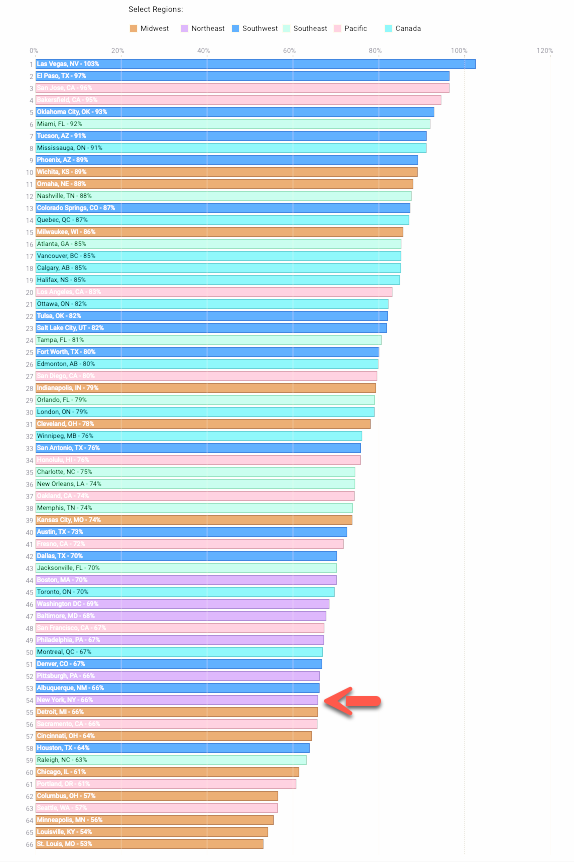
First reported by the New York Post, the University of Toronto has published new recovery metrics showing foot traffic in crime-ridden NYC is down 33% compared with 2019, before the pandemic, indicating a souring economic recovery. 

Researchers used location-based mobility data derived from smartphones to reveal foot traffic trends in metro areas. They explain that a recovery metric greater than 100% means the city’s downtown foot traffic has recovered from pre-Covid levels and vice versa. 

NYC’s recovery rate of 66% is ranked 54th out of 66 cities – this is embarrassing for the imploding metro area controlled by radical leftists. 

While researchers did not explain the cause for the decline, we have outlined remote and hybrid work trends are partially responsible for the fall of office workers in the metro area. 

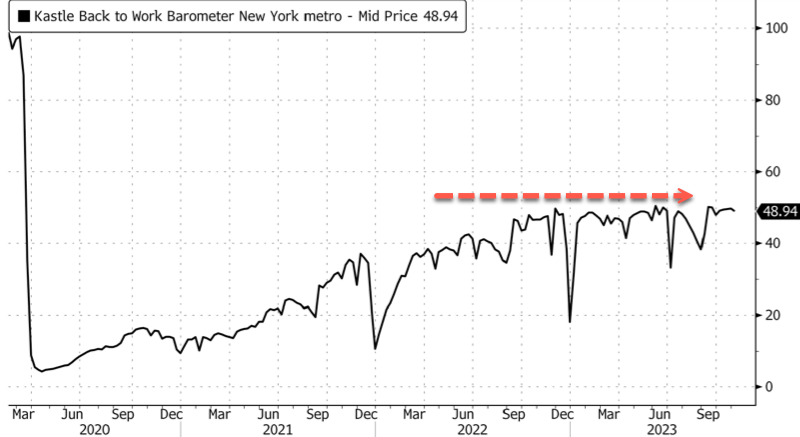
Kastle Systems, the gold-standard measure of office occupancy trends via card-swipe data, shows NYC stands at 48.94% but is still far from the nearly 100% occupancy level before the pandemic.

Without office workers spending their disposable incomes, the local economy will suffer, resulting in a slow and painful recovery. 

Besides remote work trends, office workers have fled the progressive hellhole because of high taxes and out-of-control violent crime. Now, the migrant crisis has made things even worse. 

NYC’s dismal recovery bodes well for bustling city streets in Miami – also known as the ‘Wall Street of the South.’ 

Tyler Durden
Wed, 11/08/2023 – 07:45

via ZeroHedge News https://ift.tt/EBd19OQ Tyler Durden

Stockman: Uncle Sam Doesn’t Have One Thin Dime For Biden’s $106 Billion War Package

Stockman: Uncle Sam Doesn’t Have One Thin Dime For Biden’s $106 Billion War Package

Via David Stockman’s Contra Corner

When you are faced with an existential threat to your very national survival, this is what you do. You mobilize your economy for all-out struggle and impose heavy-duty “War Taxes” to pay for a dramatic build-up of military capabilities.

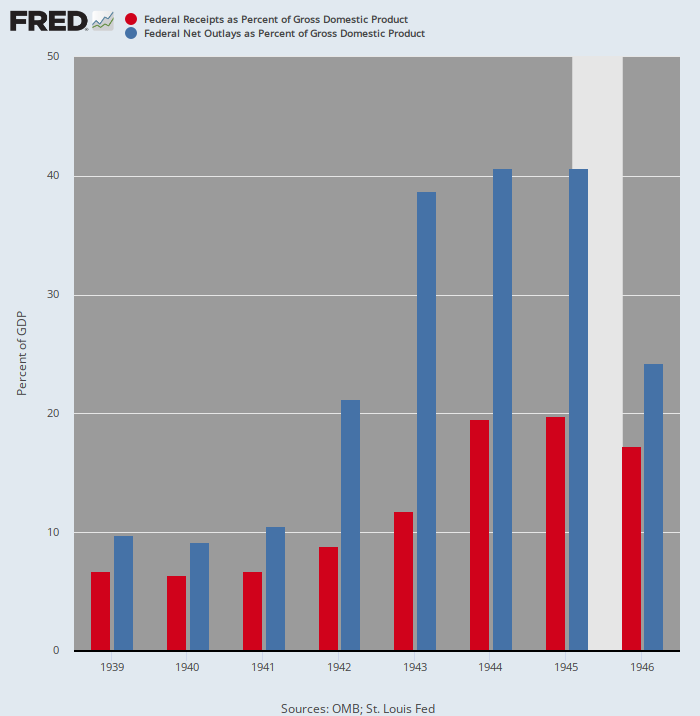
For instance, between 1939 and 1945 Federal government receipts rose nearly seven-fold—from $6 billion to $42 billion per year, owing to across-the-board tax increases that took the average income tax rate from 4% to 24% and the top rate to upwards of 90%. Relative to the national economy, Federal receipts (red bars) rose from 6% of GDP to a peak of nearly 20% in 1945.

Surge In Federal Outlays and Receipts As % Of GDP During WWII

On top of that came a huge amount of war bonds and borrowing. Accordingly, outlays from taxes and borrowing (blue bars), mostly for military mobilization, rose from less than 10% of GDP in 1940 to a war-time peak of 40% in 1944-1945.

Call that America’s national mobilization triggered by Pearl Harbor. It’s what a self-respecting democracy does when its very existence is called into question.

Alas, to a man and woman Israel’s leadership has likened the barbaric Hamas attacks of October 7th to Pearl Harbor. And Netanyahu in particular has insisted that Israel’s withering bombardment of Gaza must not give way to a “pause” or ceasefire just as Washington did not stand down after Pearl Harbor, either.

Fine. But then again, where is Netanyahu’s powerful “budget speech” to the Knesset akin to FDR’s famous call to arms and economic sacrifice before the Congress in January 1942? Where is Netanyahu’s lobbying campaign for an all-out Israeli economic mobilization and stiff War Taxes that would dramatically increase the government’s claim on the nation’s economic resources?

Where is the plan for a true Garrison State with the vastly expanded military budget and armed forces that would be needed in the future to protect Israel’s citizens from being caught flat-footed again? Where are the plans for the hundreds of thousands of additional soldiers that would be required to ensure that the several thousand Hamas barbarians who inhabit the open-air prison on Israel’s southern border never again break through a properly sealed-off, militarized barrier on the perimeter of the Gaza Strip?

Of course, there is no such thing in the works. There is a whole lot of lobbying going on—but it’s not in the Knesset. Instead, it’s on behalf of a largely symbolic $14 billion Israel aid package from the war finance capital of the world on the Potomac.

But in the great scheme of things that’s a false comfort to the Israelis and an unaffordable virtue signal for the Washington pols. The fact is, Uncle Sam is flat-out broke. Washington cannot afford a single dime of the $106 billion package that Biden is trying to shove down the collective throats of America’s hapless legislators. That especially includes the utter waste of another $61 billion for Washington’s insane proxy war against Russia in Ukraine and the $14 billion for Israel, as well.

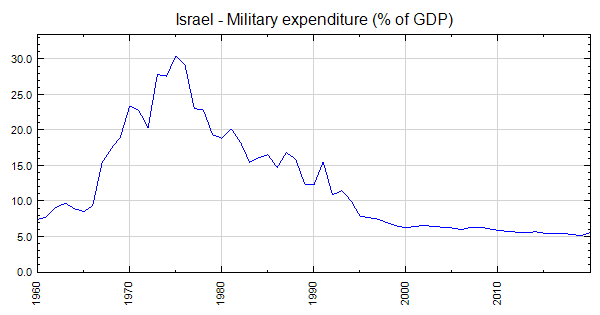
In truth, Israel has not yet even begun to tighten its own economic belt to pay for the war policy that its militaristic and religious extremist government insists upon. Indeed, the pending US aid package amounts to only 2.5% of Israel’s GDP and comes on the back of Netanyahu’s ceaseless decades-long campaign for a Garrison State national security policy, but one funded on the cheap via a quasi-pacifist defense spending level.

That’s right. Israel’s military expenditures had plunged from more than 20% of GDP at the time of the last existential crisis during the Yom Kippur War of 1973 to just 5% of GDP on the eve of the October 7 attacks. In effect, Netanyahu falsely told Israeli voters that they didn’t have to take the risks and make the territorial concessions implicit in a two-state and diplomatically-based solution to the Palestine problem. But at the same time, they could also avoid having to be taxed to the gills to pay for the alternative—a costly, heavily militarized Garrison State.

The wink and nod underlying this false solution, of course, was a pitiless willingness to keep Hamas in check by “mowing the grass” every few years in Gaza, as a desperate Israeli government is now doing once again to the horror of much of the civilized world.

So even more than the failure of Israel’s vaunted intelligence operations in the run-up to the October 7th massacres, the real deep policy failure is the flaccid blue line below, slouching toward 5.0% of GDP defense spending after the Netanyahu coalition came to dominate policy in the 1990s. You simply can’t have a Garrison State policy—no negotiations with the Palestinians, no two-state solution, no continuation of the Oslo or other international negotiations process and the quarantine of 2.3 million largely destitute Palestinians in a congested dysfunctional strip of land cheek-by-jowl with the Mediterranean Sea—on a 5% of GDP war budget.

Israel - Military expenditure (% of GDP)

As we recently pointed out, Israel’s $25 billion defense budget is a pittance compared to its booming, technologically advanced and robust $550 billion national economy. The latter, in turn, is 20X larger than what had been the $28 billion that passes for an economy in the shambles of Gaza—a whisp of GDP mainly funded by foreign philanthropists and malign actors alike. And even that will soon virtually cease to exist.

Even if you count the aid from the so-called malign actors—a few hundred million per year from Iran and others—that flows through Qatar to Hamas, there is simply no contest. Israel is an economic Goliath relative to the thin resources of the Hamas terrorist apparatus and does not need any virtue signaling hand-outs from the politicians of the bankrupt state domiciled on the Potomac in order to handle its own security. They just need to either—

  • return to the international negotiating table for a two-state solution based on the pre-1967 borders and the re-unification of Gaza and the West Bank under an internationally accountable and guaranteed authority.

  • or, in the alternative, shackle their voters with heavy-duty War Taxes to fund the full military might their current rejectionist policies require.

Needless to say, Bibi Netanyahu and his coalition of rightwing religious parties would have likely never stayed in power with their “rejectionist front” against an internationally brokered and superintended two-state arrangement had they leveled with the public about the immense increase in military spending and taxes these policies required.

But even that is not the half of it. The truth is, Netanyahu is a megalomaniacal madman who has had the reckless audacity to pursue an utterly dangerous Machiavellian strategy of promoting and funding Hamas in order to kill dead as a doornail any prospect whatever of a two-state arrangement.

The public record makes absolutely clear that this is what Netanyahu clearly has done, even as he failed to tell the Israel’s public that this policy, in turn, necessitated a full-bodied Garrison State with crushing taxes to keep his Frankenstein monster contained inside the Gaza prison walls.

And we do mean crushing. To spend another $25 billion or even $50 billion on a Garrison State approach to national security, as would be needed, would amount to 5% to 10% of GDP in higher taxes. Yet according to the World Bank, the Israeli tax burden has been falling since the turn of the century when Netanyahu’s one-state policy came to dominate Israel’s national security posture.

Israel Tax Revenue As % Of GDP, 1995 to 2021 

For want of doubt, the facts are these. Between 2012 and 2018 Netanyahu gave Qatar approval to transfer a cumulative sum of nearly one billion dollars to Gaza in the form of suitcases full of cash. And at least half of that is estimated to have reached Hamas, including its military wing.

According to the Jerusalem Post,

……in a private meeting with members of his Likud party on March 11, 2019, Netanyahu explained the reckless step as follows: The money transfer is part of the strategy to divide the Palestinians in Gaza and the West Bank. Anyone who opposes the establishment of a Palestinian state needs to support the transfer of the money from Qatar to Hamas. In that way, we will foil the establishment of a Palestinian state (as reported in former cabinet member Haim Ramon’s Hebrew-language book “Neged Haruach”, p. 417).

In an interview with the Ynet news website on May 5, 2019, Netanyahu associate Gershon Hacohen, a major general in reserves, said, “We need to tell the truth. Netanyahu’s strategy is to prevent the option of two states, so he is turning Hamas into his closest partner. Openly Hamas is an enemy. Covertly, it’s an ally.”

Indeed, earlier that spring Netanyahu himself was widely quoted as saying during the aforementioned meeting of Likud MKs that,

“Whoever opposes a Palestinian state must support delivery of funds to Gaza (cash in suitcases from Qatar) because maintaining separation between the PA in the West Bank and Hamas in Gaza will prevent the establishment of a Palestinian state.”

So Israel’s governing faction of religious extremists, militarists, messianic settlers and Eretz Yisrael ideologues have chosen, instead, to live in a Garrison State and to be periodically compelled to “mow the grass” in the Gaza outdoor prison. Yet if its rightwing governments want to operate a modern-day Sparta, they need to tap their own taxpayers first.

In the meanwhile, Washington needs to truly sober up. Uncle Sam’s checking account is massively overdrawn. Now is not the time to fund wars which do nothing for America’s homeland security (Ukraine) or to provide purely symbolic aid to an ally that has more than enough resources to fund the unwise war policies it insists on pursuing.

David Stockman’s Contra Corner is the place where mainstream delusions and cant about the warfare state, the bailout state, bubble finance and Beltway banditry are ripped, refuted and rebuked. 

Tyler Durden
Wed, 11/08/2023 – 07:20

via ZeroHedge News https://ift.tt/purBKIm Tyler Durden