Zelensky Complains War In Gaza Is “Taking Away The Focus” From Ukraine
He really spoke the words out loud… Ukraine’s President Volodymyr Zelensky said Saturday that the war in the Middle East between Israel and Hamas is “taking away the focus” from the Ukraine conflict.
He made the remarks in a press conference in Kiev while standing alongside EU Commission chief Ursula von der Leyen, at a moment headlines have turned negative on the prospect of ever being able to beat back the Russians. “Of course, it’s clear that the war in the Middle East, this conflict, is taking away the focus,” Zelensky said in the surprisingly blunt admission.
He began his remarks by commenting on the front line situation, which hasn’t changed significantly in many months. “Time has passed, people are tired… But this is not a stalemate,” he said.
“No one among our partners is pressuring us to sit down with Russia, talk to it, and give it something,” he added, after reports have in the last days emerged that Washington is exploring possible concessions to the Russians behind the scenes.
Zelensky claimed that it’s “Russia’s goal” to take global focus away from the Ukraine war. “We have already been in very difficult situations when there was almost no focus on Ukraine,” he said, before adding, “I am absolutely sure we will overcome this challenge.”
Now nearly one month after the horrific Hamas Oct.7 terror attack on southern Israel, the crisis in Gaza is completely dominating headlines. In recent weeks, news of Ukraine-Russia has actually slipped from the front page of major American newspapers.
In Saturday’s press conference he also tried to push back against the slew of recent pessimistic headlines, per Bloomberg:
President Volodymyr Zelenskiy pushed back on an NBC report that US and European officials have begun pressuring Kyiv toward possible peace negotiations with Moscow. “I do not know who is publishing this and for what,” Zelenskiy said
As we explained earlier, in the wake of Ukraine’s costly and futile counteroffensive, Washington’s proxy war with Russia is facing strong headwinds at home:
The war between Hamas and Israel has diverted public attention and sapped the war state’s ability to propagandize voters. Indeed, Biden’s Oval Office address appealing for aid for Ukraine and Israel was originally planned to focus solely on Ukraine, NBC reports.
The US public’s pro-Ukraine fervor has cooled: A new Gallup poll found 41% say the US is doing too much for Ukraine — a big leap from the 29% who said that in June. Many Americans think that money should be used to improve conditions at home.
A growing number of congressional Republicans have put away their rubber stamp for Ukraine aid, and have thus far thwarted Biden’s request for $61 billion in additional funding for the war. Biden’s ploy of a joint funding request that combines controversial Ukraine aid with Israel aid is in grave jeopardy, as House Republicans demand separate votes.
Even before Hamas attacked Israel, an increasingly severe shortage of conventional shells for the artillery-heavy war in Ukraine led Biden to give Zelensky toxic, depleted uranium shells, stirring an international outcry.
Gold has traditionally played the role of a conservative and uncorrelated investment vehicle, but that is starting to be seriously challenged by Bitcoin…
Gold has played a vital role in economics and politics, influencing much of human financial activity through shifts in economic systems. It has proven versatile and stable across upheavals and social changes. It even became a vital tool in global trade and currency exchange as we know it today.
In the 19th century, gold was the backbone of the global monetary system. Nations relied on the gold standard until the Great Depression and World War I. These events were significant inflationary catalysts, and economies, in a decades-long transition, abandoned the gold standard.
This process culminated in 1971 when the Federal Exchange could no longer exchange US dollars for gold. In 1976, the gold standard was abandoned entirely, and gold became a free asset.
Today, it is still considered a reliable store of value with a well-established market. After all, it has had the luxury of centuries—through various cycles of prosperity and economic upheavals—to prove its reputation. Gold boasts high liquidity and can be easily traded or sold in multiple forms: bars, coins, jewelry, or other representative instruments.
GOLD VS BITCOIN: THE BATTLE OF UNCORRELATED ASSETS
In retirement investments, gold is an uncorrelated asset, showing an average annual return that has reliably kept pace with inflation. In times of economic uncertainty, investors move to gold because of its reputation as a store of value and its non-correlation with stocks, which makes it ideal during market downturns.
However, today’s evolving monetary technology has provided investors with a new option: Bitcoin. Although it is a relatively new asset whose economic impact is still unfolding, Bitcoin has already been called “digital gold.” It shares many characteristics with gold, including its capped supply and its potential as a store of value.
In addition, Bitcoin offers a new type of value in the age of connectivity. It can be transferred digitally, something that physical gold cannot do. It is the world’s first digital bearer asset, a remarkable feat achieved through the convergence of economic design, cryptography, and decentralized networks.
For investors, the perfect portfolio—a balance of assets that echoes an individual’s risk preference and fits the economic climate of the times—is an ever-evolving target. All investors and professional fund managers seek new ways to add growth and diversification.
Retirees seek investments that provide diversification, preservation of wealth, and stability. On top of these, many retirees seek continued income that can only arise from growth—investments that capitalize on the opportunities of the times.
Finding the right mix of less risky, stable, and higher-risk growth assets has always been challenging for even the most experienced financial planners. Some believe Bitcoin fits into the new retirement portfolio as an added diversifier. Like gold, it can work as an uncorrelated asset and hedge against systemic risks.
BITCOIN IRAS: EXPOSURE TO THE BEST PERFORMING ASSET OF 2023
Another way to replicate current investment products is the creation of Bitcoin IRAs. The IRS considers Bitcoin and other crypto investments in retirement accounts as property. Government rules prevent Roth IRAs from holding “coins” and “collectibles,” but these do not appear to cover Bitcoin.
According to NYDIG’s most recent reports, Bitcoin tops its 2023 returns list based on asset class. As of October 6, 2023, it boasts a 63.3% increase YTD, besting US large caps (28.2%), commodities (6%), cash (3.8%), and gold (1.1%). On a countdown to its next halving—around April 2024—many investors are eyeing Bitcoin as a possible addition to their retirement accounts.
Some IRA providers are already offering crypto investments in the form of cryptocurrency IRAs—specifically Bitcoin IRAs. A Bitcoin IRA works like any traditional self-directed IRA (SDIRA) and carries the same benefits. Instead of investing in Bitcoin directly and taking charge of one’s custody, Bitcoin IRAs provide the investor convenience, security, and ease.
A Bitcoin IRA lets you buy and sell Bitcoin in a tax-advantaged retirement account. A Bitcoin IRA allows retirees to maintain traditional retirement accounts while having a separate account that invests in novel currencies like Bitcoin.
WHY ADD IT TO YOUR PORTFOLIO?
Many Bitcoin advocates promote Bitcoin as “digital gold.” This simplified view has been held and promoted by those who believe Bitcoin can serve as a reliable store of value in digital form.
Based on this view, Bitcoin investments analogous to gold products are already being created. Just as gold ETFs hold physical gold as their underlying asset, Bitcoin products are structured similarly to these ETFs and provide exposure through funds traded on stock exchanges.
The first applications of Bitcoin ETFs have been lodged in recent years, with multi-trillion asset managers like BlackRock and Fidelity providing optimism about their future. The recent verdict of a DC court on Grayscale’s bitcoin ETF application invalidating the SEC’s argument for denying its Bitcoin investment product has been interpreted as a turning point for the industry.
Proponents of Bitcoin ETFs remain vigilant as efforts to gain approval for a spot Bitcoin ETF persist from prominent asset managers. Depending on how the SEC reacts, Bitcoin ETF approvals may follow, opening the floodgates for increased demand.
MAKE RETIREMENT PLANNING LESS COMPLEX WITH A BITCOIN IRA
Despite its status as a new asset, Bitcoin’s performance in 2023 stood out for its ability to keep a narrow trading range despite intense external pressures. It’s been trading sideways around the $25,000 to $31,000 range, resisting volatility and breakouts in either direction.
Retirees or those planning for retirement interested in adding riskier assets to their portfolios, moving with the times, and seeking avenues for future growth can add Bitcoin to their retirement investments without learning the technical nuances of keeping their Bitcoin safe.
They can set up Bitcoin IRAs either as traditional or Roth accounts. A Roth Bitcoin IRA permits tax-free withdrawals in retirement. A traditional Bitcoin IRA offers tax-deferred growth. Retirees in higher tax brackets can take advantage of this feature.
Why consider Bitcoin IRAs over purchasing and storing Bitcoin directly? Bitcoin IRAs extend to estate planning easily, providing a new advantage compared to traditional retirement accounts. Swan Bitcoin IRA, for example, offers enterprise-grade custody with insurance coverage. It provides a layer of protection essential for retirees who may not be well-versed in crypto security.
Moreover, Bitcoin IRAs provide a legal framework for individual investors, protecting them from tax issues, legal uncertainties, and non-compliance risks. Investors are assured that their investments are fully compliant with existing financial regulations.
Despite being a novel instrument, Bitcoin IRAs may provide a path for continued wealth-building during retirement. They offer the potential for growth, diversification, and tax advantages in one package within the framework of a familiar and regulated environment. They are one way to benefit from Bitcoin’s uncorrelated nature and future potential.
As with any investment, retirees should consult a financial advisor to confirm whether a Bitcoin IRA investment conforms with their resources, risk tolerance, time horizon, and financial goals. In a brave new world of retirement planning, Bitcoin IRAs offer an alternative, innovative, and compelling proposition to explore the rewards of Bitcoin investments, even for those not delving into the technological complexities of crypto.
Berkshire Cash Pile Hits All-Time High $157 Billion, As Buffett Sells A Record $38BN In Stock In Past Year
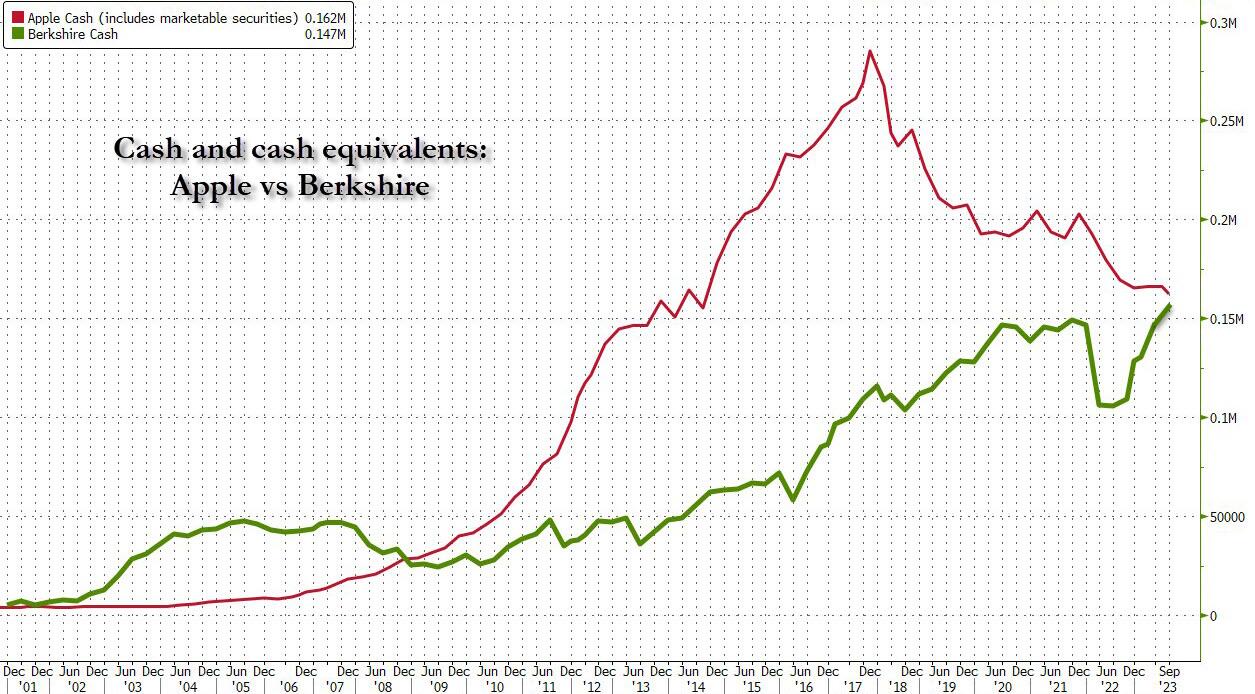
Over the years, Warren Buffett has been opportunistic and “fluid” with his ideals and political opinions – he describes himself as a “democrat” yet without batting an eyelid will demand government bailouts for his portfolio of companies – but he has been steadfast about one thing: he refuses to spend money on stock purchases or corporate acquisitions unless there is significant value to be exploited. In which case, one can probably conclude that the market is still woefully overvalued because earlier today Buffett’s conglomerate Berkshire Hathaway reported solid Q3 earnings but more importantly, revealed a cash pile that had grown by $10 billion in the third quarter to a record $157.2 billion (consisting of $30.8 billion in cash and $126.4 billion in investments in T-Bills, up from $93 billion at the end of last year), and set to overtake Apple’s own cash hoard (which as we noted earlier this week has been declining) of $162 billion as soon as this quarter.
“Cash deployment is definitely slowing,” said Jim Shanahan, an analyst with Edward Jones. “Ultimately Berkshire’s going to start feeling some pressure to put cash to work.”
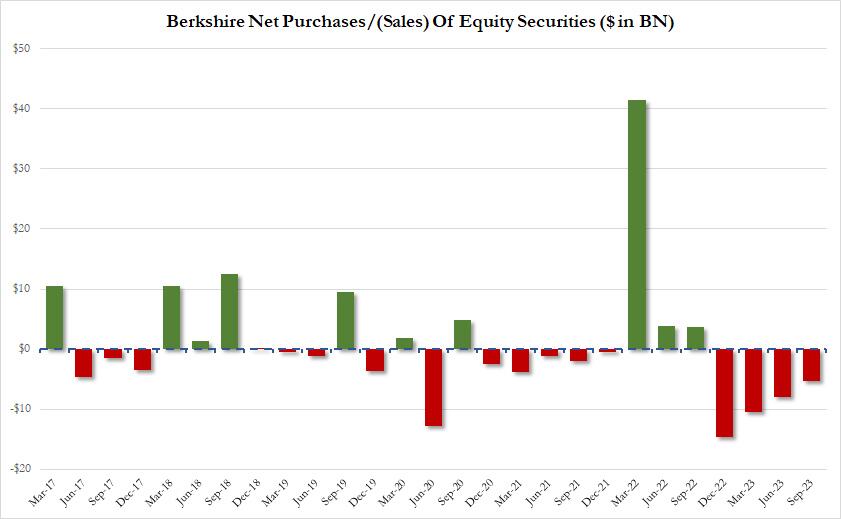
Perhaps… but not yet; in fact in the third quarter, Berkshire was a net seller of stock for the fourth quarter, liquidating another $5.3 billion in shares and bringing the total sales over the past 12 months to a record $38.3 billion.
Despite ramping up Berkshire’s acquisition machine in recent years, the company has still struggled to find many of the big-ticket deals that galvanized Buffett’s renown, leaving him with more cash than he and his investing deputies could quickly deploy. After hanging back during the pandemic, he’s since snapped up shares in Occidental Petroleum (despite owning 26% of the company, Buffett has said he has no plans to acquire the company outright) and struck a $11.6 billion deal to buy Alleghany. Buffett has also leaned heavily on share repurchases amid the dearth of appealing alternatives, saying the measures benefit shareholders.
Separately, the conglomerate also reported operating earnings of $10.76 billion, a jump on the prior year, as it benefited from the impact of elevated interest rates on the cash pile and gains at its insurance businesses. However, including investment and derivatives losses, Berkshire posted a loss for the quarter of almost $12.8 billion, well above last year’s $2.8 billion loss, which largely came from a decline in its big Apple stake. Shares of the iPhone maker fell 11.7% during the quarter but have rebounded over 3% since.
Strength in Berkshire’s insurance unit, plus the inclusion of Pilot Flying J earnings which Berkshire did not include in results last year, helped drive profitability. Berkshire said its insurance businesses posted a profit of $2.42 billion versus a loss in the prior-year period, when the insurance industry was being pummeled by catastrophes.
Geico, the crown jewel of Berkshire’s insurance empire and Buffett’s “favorite child,” reported another profitable quarter as it curtailed advertising expenses by 54% year-to-date; total underwriting earnings at the unit were $1.1 billion. The auto insurer is in the middle of a turnaround after losing market share to competitor Progressive. The improvement follows efforts by the division to overhaul underwriting after struggling with higher costs for replacing or repairing damaged vehicles. The effort cost it market share — raising the question if it will seek to reclaim that ground.
Berkshire’s railroad, BNSF, however, saw a 15% decline in earnings as the railroad division grappled with lower volumes and higher costs.
Berkshire posted stronger operating earnings despite Buffett cautioning at its annual meeting in Omaha in May that earnings at the majority of its operating units could fall this year as an “incredible period” for the US economy draws to the end. Still, the Fed’s rapid rate hikes helped the firm reap huge returns on the cash it stockpiles mostly in short-dated US Treasuries.
That said, those higher rates also created headaches for some of Berkshire’s industrial businesses: the conglomerate’s building products businesses saw revenue slip 11% due to the run-up in mortgage rates.
“The effects of significant increases in home mortgage interest rates in the US over the past year has slowed demand for our home building businesses and our other building products businesses,” Berkshire said in a report detailing results. “We continue to anticipate certain of our businesses will experience weakening demand and declines in revenues and earnings into 2024.”
The jump in profits has been rewarded by the market, which pushed Berkshire’s Class B shares to a record high in September as investors sought out its diversified range of businesses as a hedge against deteriorating economic conditions. And while the shares pared some of those gains, the stock is still up almost 14% for the full year, in line with the S&P500.
A part of that boost to BRK’s stock came from the company itself: the firm spent $1.1 billion on buybacks in Q3, bringing the total for the first nine months of the year to about $7 billion. The conglomerate trimmed its overall equities portfolio in the quarter, making almost $15.7 billion on sales net of purchases.
As usual, Berkshire Hathaway asked investors to look past the quarterly fluctuations in Berkshire’s equity portfolio.
“The amount of investment gains/losses in any given quarter is usually meaningless and delivers figures for net earnings (losses) per share that can be extremely misleading to investors who have little or no knowledge of accounting rules,” the company said in a statement.
Berkshire also acknowledged the negative economic impact from the pandemic, as well as geopolitical risks and inflation pressures.
“To varying degrees, our operating businesses have been impacted by government and private sector actions to mitigate the adverse economic effects of the COVID-19 virus and its variants as well as by the development of geopolitical conflicts, supply chain disruptions and government actions to slow inflation,” Berkshire said. “The economic effects from these events over longer terms cannot be reasonably estimated at this time.”
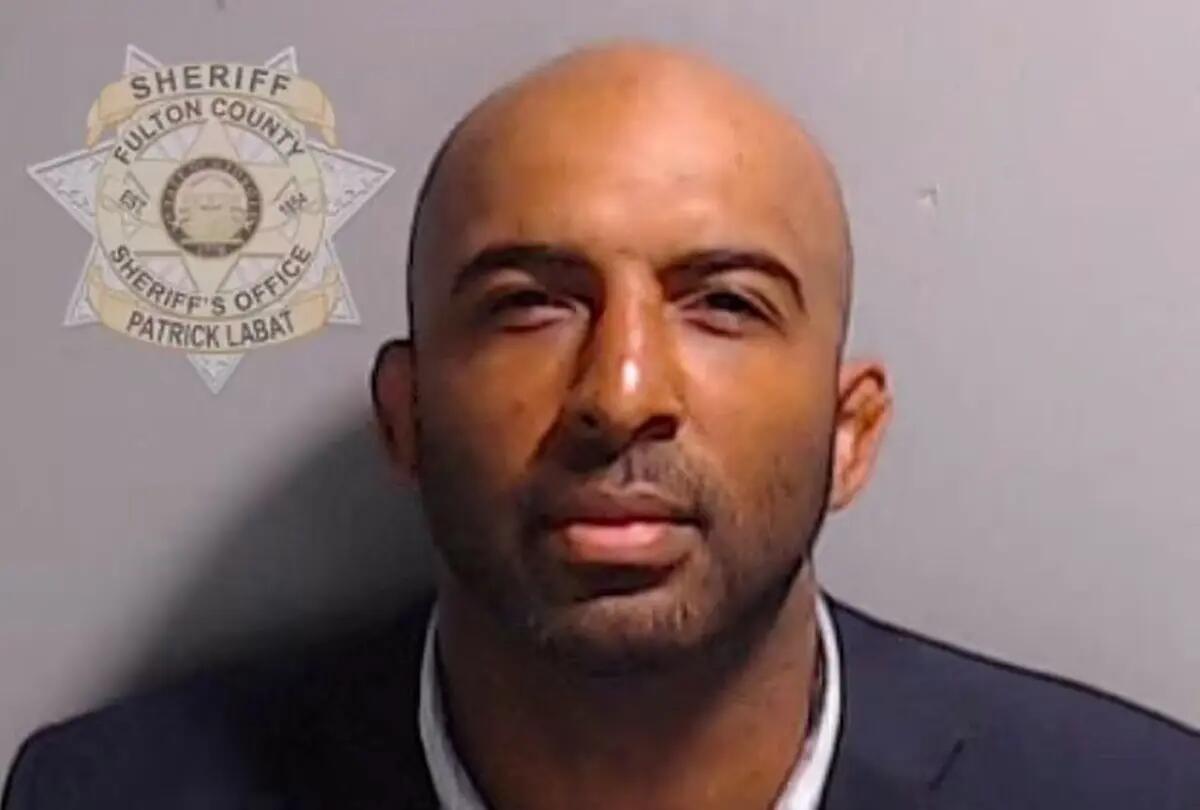
Former Black Voices for Trump leader Harrison Floyd’s legal team intends to prove his innocence of claims he unlawfully participated in an election subversion plot in Fulton County, Georgia, by showing that former President Donald Trump won the state’s 2020 presidential election.
Mr. Floyd was charged on Aug. 14 alongside the 45th president and 17 other co-defendants with violating Georgia’s Racketeer Influenced and Corrupt Organizations (RICO) Act, conspiracy to commit solicitation of false statements and writings, and influencing witnesses.
He was the only defendant to spend time in jail due to the indictment before he was released on bond on Aug. 30.
“Your Honor, this case isn’t about whether you or I think that Donald Trump lost the election. It’s about what Mr. Floyd believed at the time,” noted Chris Kachouroff, one of Mr. Floyd’s defense attorneys, at a Nov. 3 hearing before Judge Scott McAfee.
“It’s also [about] what the false statements are alleged to have been, and indeed, are they really false,” he said.
Opening the Door
The judge ordered the hearing in response to motions to quash three sweeping subpoenas Mr. Floyd’s legal team served to the office of Georgia Secretary of State Brad Raffensperger, the Fulton County Clerk of Courts, and the Fulton County Board of Elections.
Materials the attorneys requested included the ballot images and envelopes for all absentee ballots cast in the 2020 general election, all absentee ballot application forms, reports from the Dominion voting machines used, and all laptops and poll pads used by election workers, along with other documents, files, and drives.
Attorneys also requested all documents and recordings concerning the secretary of state’s post-election investigation into allegations of election fraud.
“The state chose to open this door,” Mr. Kachouroff said. “It is a broad and sweeping complaint. They opened the door wide open for us to walk in and ask for these things.”
The attorney noted that the 98-page indictment repeatedly asserts as fact that President Trump lost the 2020 election in Georgia, and the charges against Mr. Floyd are predicated on that claim. But if Fulton County District Attorney Fani Willis is wrong and President Trump actually won the election, then Mr. Floyd cannot be guilty of soliciting “false statements and writings” that conveyed as much.
The indictment also maintains that Mr. Floyd and the other co-defendants were aware that President Trump lost the election and that their actions constituted an unlawful conspiracy to change the results in his favor.
That assertion, Mr. Kachouroff said, would also be undermined by proof that the former president won or even just proof that the election’s outcome is uncertain. And the subpoenaed materials, he argued, are likely to contain that proof.
“We could make that argument that he’s innocent no matter what happened,” he noted. “And, of course, we would. We’re defense attorneys; that’s what we do.
“But at the end of the day, those are the possible options down the road that could arise. Right now, we believe we’re at Option 1, that President Trump indeed won the election, and we can prove it—with respect to Fulton County.”
Pushback
Mr. Raffensperger’s office, represented by Attorney Jackson Sharmon III, has argued that the broad scope of materials requested by the defense would place an “undue burden” on an entity that is not even a party in the case.
Contesting the subpoena before the judge, Mr. Sharmon said the requested documents contain “little, if anything,” relevant to Mr. Floyd’s defense.
“If the purpose is state of mind, his intent, the documents we would produce—which he didn’t know about, he didn’t have—are not going to have any effect on the determination of his intent at the time he allegedly undertook the acts that are in the indictment.”
Mr. Sharmon also challenged the defense’s argument that proving President Trump won the election would necessarily erase the possibility that Mr. Floyd had criminal intent.
“With all due respect, I don’t think that’s the case,” he said. “That’s not the way intent, in a criminal case, is adjudicated.”
Meanwhile, attorneys for Fulton County said it could take months to produce the requested materials. And in terms of relevance, they pointed to Mr. Kachouroff’s admission that he could argue his client’s innocence even without the requested materials as evidence they weren’t needed.
But for Mr. Kachouroff, the state’s arguments didn’t negate his client’s right to those materials.
“Harrison Floyd is looking at between eight and 33 years. That’s his liberty interest. Courts take liberty interest very seriously so that liberty interest overcomes any burden the state has to be set back by a month or two or three.”
By the end of the hearing, the three subpoenas were reduced to two as it was revealed that the Board of Elections did not possess any of the requested materials, which are held by the Clerk of Courts.
The judge, expressing concern over the potential disclosure of voters’ personally identifiable information, said more information was needed to determine what exactly was being requested, the extent of the state’s burden in producing it, and whether a protective order was needed.
Does “FBI” now stand for “Following Biden’s Instructions”? The FBI is doing backflips to boost Joe Biden’s re-election campaign. Unfortunately, federal courts don’t recognize law enforcement shenanigans as a violation of the Voting Rights Act.
The FBI is categorizing Donald Trump’s supporters as terrorist suspects, according to a new report in Newsweek. The FBI created “a new category of extremists that it seeks to track and counter: Donald Trump’s army of MAGA followers,” Newsweek revealed. The FBI is relying on the same counterterrorism methods honed to fight al Qaeda to go after the incumbent president’s political opponents.
Naturally, the latest Washington crusade against extremism has more malarkey than a White House summit. Federal bureaucrats heaved together a bunch of letters to contrive an ominous new acronym for the latest peril to domestic tranquility. The result: AGAAVE—“anti-government, anti-authority violent extremism”—which looks like a typo for a sugar substitute.
Recently, the FBI vastly expanded the supposed AGAAVE peril by broadening suspicion from “furtherance of ideological agendas” to “furtherance of political and/or social agendas.” Anyone who has an agenda different from Team Biden’s could be AGAAVE’d for his own good. The great majority of the FBI’s “current ‘anti-government’ investigations are of Trump supporters,” William Arkin, a highly respected investigative journalist, reported in Newsweek.
The FBI crackdown is following some of the most overheated political rhetoric of our era. Biden has denounced Trump supporters for “semi-fascism.” Biden tweeted last November, “Donald Trump and MAGA Republicans are a threat to the very soul of this country.”
Biden’s Homeland Security Advisor Liz Sherwood-Randall declared, “The use of violence to pursue political ends is a profound threat to our public safety and national security…it is a threat to our national identity, our values, our norms, our rule of law—our democracy.” And since Team Biden says that Trump supporters could be violent, suppressing them is the only way to protect “the will of the people” or whatever honorific is used for rigged election results.
In June, the FBI and Department of Homeland Security issued a warning: “Sociopolitical developments—such as narratives of fraud in the recent general election, the emboldening impact of the violent breach of the U.S. Capitol, conditions related to the COVID-19 pandemic, and conspiracy theories promoting violence—will almost certainly spur some domestic terrorists to try to engage in violence.” In other words, alleging that there was election fraud in past elections can qualify a person as a terrorist suspect—and justify suppressing their political activity in subsequent elections.
Biden’s FBI views Trump supporters as a deadly threat to democracy, thereby justifying subverting or crippling Trump supporters’ ability to oppose Biden and other Democrats.
The FBI is required to have (or claim to have) solid information before launching a criminal investigation. But the bureau needs almost zero information to open an “assessment.” The FBI conducted more than 5,500 domestic-terrorism “assessments” in 2021, a 10-fold increase since 2017 and a 50-fold increase since 2013. “Assessments are the closest thing to domestic spying that exists in America and generally not talked about by the Bureau,” Arkin noted. The House Weaponization Subcommittee warned that “the FBI appears to be complicit in artificially supporting the Administration’s political narrative” that domestic violent extremism is “the ‘greatest threat’ facing the United States.”
Those assessments could prove perilous because the official demand for terrorists far exceeds the domestic supply. A top federal official told Newsweek last year, “We’ve become too prone to labeling anything we don’t like as extremism, and then any extremist as a terrorist.” “Trespassing plus thought crimes equals terrorism” is the Biden standard for prosecuting January 6 defendants.
FBI whistleblower Steve Friend complained of current FBI leadership, “There is this belief that half the country are domestic terrorists and we can’t have a conversation with them. There is a fundamental belief that unless you are voicing what we agree…you are the enemy.”
Did the Biden administration secretly want Newsweek to vindicate the fears of legions of Trump supporters? Perhaps those “assessments” are repeating a tactic used against Vietnam War protesters: FBI agents were encouraged to conduct frequent interviews with antiwar activists to “enhance the paranoia endemic in such circles” and “get the point across that there is an FBI agent behind every mailbox,” according to an FBI memo from that era.
The more abusive the FBI becomes, the more outraged that Trump supporters sound, thereby justifying further FBI repression. That also makes it easier for Team Biden to portray Trump supporters as public menaces.
Biden’s war on extremism could become a self-fulfilling prophecy that destroys American political legitimacy. An official in the Office of Director of National Intelligence lamented, “So we have the president increasing his own inflammatory rhetoric which leads Donald Trump and the Republicans to do the same”—and the media follow suit. Biden is exempt from official suspicion even when he denounced Republicans as fascists who want to destroy democracy. Yet if Republicans sound equally overheated, Biden’s FBI has pretexts to unleash the hounds.
Is there any limit to the federal entrapment operations designed to spur headlines that make politicians applaud? The latest FBI crackdown echoes a DHS campaign that was leaked to the press in 2021. Federal policymakers launched a “legal work-around” to spy on and potentially entrap Americans who are “perpetuating the ‘narratives’ of concern,” CNN reported. The DHS plan would “allow the department to circumvent [constitutional and legal] limits” on surveillance of private citizens and groups. Federal agencies are prohibited from targeting individuals solely for First Amendment-protected speech and activities. But federal hirelings would be under no such restraint.
Will the FBI’s interventions in the 2024 presidential election be even more brazen than its 2016 and 2020 stunts? Will the agency exploit its “assessments” to recruit knuckleheads to engage in another pre-election Keystone Kops plot to kidnap a governor, as it did in Michigan in 2020?
The FBI has a sordid history of intervening in presidential elections since 1948—if not before. A 1976 Senate report on FBI abuses warned, “The American people need to be assured that never again will an agency of the government be permitted to conduct a secret war against those citizens it considers threats to the established order.” Unfortunately, Americans may not learn the damning details of another FBI “secret war” until long after the next election.
Ironically, the Biden administration is vilifying anti-government opinions at the same time judges are exposing federal crimes. Federal court decisions in July and September condemned the Biden censorship regime—and those rulings were preceded by Supreme Court decisions striking down President Joe Biden’s student-loan-forgiveness scheme and vaccine mandates.
But Team Biden still presumes anyone who suspects the feds are violating the Constitution is up to no good. In the same way that Biden based his 2020 election campaign on vilifying Charlottesville 2017 protests, so the Biden re-election campaign will vilify anyone who distrusts the feds. Regardless of the outcome, the 2024 election will be another boomtime for cynics.
In the weeks since 2,500 Hamas militants went on a murder and kidnapping rampage in southern Israel, a wave of pro-Palestinian demonstrations has erupted across the United States and around the world. These displays have only grown in size and number as Israel’s military responds by punishing the entire, densely-packed population of Gaza with a blockade on food, water and medicine, a devastating bombing campaign and now a ground invasion.
While no mass protest is free of people with bigotry and amoral stances, proponents of Israel have been far too quick to accuse pro-Palestinian protesters of antisemitism. One of the most common of such false accusations rests on a false premise — namely, that it’s inherently antisemitic or genocidal to question Israel’s “right to exist.”
That premise is false for a number of reasons, the most salient of which is this: No country has a “right to exist.”
After all, what is a country — or, in more precise terminology, a state — other than a political arrangement? And why would any political arrangement be deemed as having “rights,” much less a supposed right to never be altered or cancelled?
While definitions vary, Murray Rothbard best distilled the state in his classic long essay, “Anatomy of the State.” Rothbard wrote: “The state is that organization in society which attempts to maintain a monopoly of the use of force and violence in a given territorial area.”
Whether the associated flag of the state in question has a Star of David, stars and stripes, or a hammer and sickle, the suggestion that it’s immoral to propose that such a monopoly be rearranged or replaced is preposterous on its face. Over the broad sweep of history, the norm is not states existing in perpetuity. Rather, history is the story of never-ending rearrangements of these many monopolies on the use of force and violence.
Did the Soviet Union have a “right to exist”? What about Yugoslavia, Czechoslovakia or the Ottoman Empire? Are we all culpably-silent bystanders to some kind of ongoing injustice as long as those bygone states are not reconstituted?
Rather than having a right to exist, each state — from Israel to Ukraine to the United States — must have permission to exist. As expressed in the Declaration of Independence, “Governments are instituted among men, deriving their just powers from the consent of the governed.”
To embrace that fundamental principle is to acknowledge that the State of Israel — a political entity — can only justly continue imposing its monopoly on the use of force and violence if it has the consent of those it governs.
And who does Israel govern? For all the talk of a two-state solution, and maps depicting the West Bank and Gaza as something somehow separate, the fact is that the State of Israel rules everything “between the river and the sea,” to invoke a contentious phrase we’ll revisit shortly.
“Between the Mediterranean Sea and the Jordan River, one state controls the entry and exit of people and goods, oversees security, and has the capacity to impose its decisions, laws, and policies on millions of people without their consent,” wrote Michael Barnett, Nathan Brown, Marc Lynch and Shibley Telhami in Foreign Affairs. Their April essay presciently warned that “a storm is gathering in Israel and Palestine that demands an urgent response.”
West Bank Palestinians endure restrictions on their movements, from checkpoints to segregated highways. The State of Israel frequently demolishes Palestinian homes and businesses for lack of permits that are extraordinarily difficult to secure. Palestinians endure ongoing harassment and under-reported acts of vandalism, agricultural destruction and violence perpetrated by settlers who operate under the protection of the Israel Defense Forces (IDF).
In neighborhoods such as East Jerusalem’s Sheikh Jarrah, Palestinians are frequently evicted from their homes under a complex law that perversely declares them to be “absentees” even if they’ve lived in their house for decades. In one infamous video of such an eviction, an obese Jewish settler tells a distraught Palestinian homeowner, “If I don’t steal it, someone else is gonna steal it.”
Meanwhile, Gaza is rightly labelled “the world’s largest open-air prison.” Though Israel withdrew forces and settlers from the 25-mile long strip in 2005, it’s continued to control the territory from the outside, in a way that creates a miserable existence for 2 million inhabitants in one of the world’s most dense population centers.
Controlling Gaza’s air, sea and land borders, the State of Israel imposes an ongoing, economic blockade that fluctuates in intensity. Individuals are only granted travel permits under narrow circumstances. Israel does not allow Gaza to operate an airport or seaport, and imports and exports via road are tightly restricted. Egypt has compounded the situation with its own restrictions and periodic border closures.
The result is economic devastation: The pre-Oct 7 unemployment rate was over 46%, per capita income only about 25% of the West Bank’s level, and 65% of Gaza residents were below the poverty line.
Given the reality of life for Palestinians in this de facto single state that includes Gaza and the West Bank, it’s understandable that many would call for an entirely new system of government between the river and the sea. As the Declaration of Independence asserts, when “any form of government becomes destructive” of the rights of life, liberty and the pursuit of happiness, “it is the right of the people to alter or abolish it, and to institute new government.”
Intentionally using inflammatory language, Israel’s defenders often say that those who call for a new government are advocating the “destruction” of Israel.
“Dissolution” would be more precise when discussing a government, but “destruction” serves their public relations goal of demonizing the opposition by connoting they’re bent on physical destruction.
Israel supporters employ similarly flawed characterizations of an often-used Palestinian slogan that’s ubiquitous in the ongoing protests: “From the river to the sea, Palestine will be free.” It’s reasonable to interpret that as a call for the dissolution of the State of Israel, but those pushing back against pro-Palestinian voices regularly declare the slogan is nothing less than a call for genocide.
While any slogan will mean different things to different people, this one has been used for decades by Palestinians seeking the same liberties as Israeli Jews throughout the entire territory ruled by the State of Israel.
“From the river to the sea, Palestine will be free” – a call for Israel’s destruction – was chanted by thousands at a demonstration in Amsterdam today. https://t.co/fDShR0EvnG
Chief among their wishes is for the freedom of Palestinian refugees in Lebanon, Jordan, the West Bank and Gaza to return to what is now considered Israel proper. Some 700,000 Palestinians were either expelled or forced to flee that land when the State of Israel was instituted in 1948.
Any intellectually honest appraisal of the situation in Israel must center on an acknowledgement that the two-state solution’s ship sailed long ago, thanks to relentless Jewish settlement of the West Bank having eliminated any possibility of a contiguous Palestinian state.
Given the facts on the ground, a growing number of advocates inside and outside greater Israel are calling for a different one-state arrangement — one with a secular government securing equal rights for all it serves.
Belying assertions that calling for the State of Israel to be replaced is antisemitic, those advocates include many Jews.
To take one prominent example, abandoning his long-running defense of Israel, prominent American Jewish intellectual Peter Beinart embraced the idea in a milestone 2020 New York Times essay, “I No Longer Believe in a Jewish State.”
Thanks to a cultivated mythology that falsely depicts Arab-Jew conflict as something intrinsic and eternal rather than something that largely bloomed in the 20th century, many Westerners can’t conceive of Jews and Muslims living peacefully in the same country.
Western Governments Weaponize False Premises to Limit Speech
It would be bad enough if references to a nonexistent “right to exist” and false accusations of genocidal intent were only used as intellectually bankrupt talking points. However, in a variety of countries, these falsehoods are alarmingly being hard-wired into government policies and used to curtail speech and the exchange of ideas.
In Switzerland, police this month banned a planned protest simply because promotional messaging included “from the river to the sea, Palestine will be free,” which authorities declared an incitement to violence.
Berlin police went further, declaring it illegal to speak the slogan and already arresting at least one man for doing so.
Europe has long held the lead in the West’s race to authoritarian dystopia, but politicians like 2024 Republican presidential candidate Nikki Haley are doing their best to help the United States catch up.
Haley recently promised to “change the official federal definition of antisemitism to include denying Israel’s right to exist,” and to use that warped definition to cancel the federal tax exemption of any college that allows students or professors to freely argue for a different political order in what is now greater Israel.
Those who support the State of Israel are free to present a case that it’s a just arrangement for the 7.5 million Jews and 7.5 million Palestinians “between the river and the sea.” However, painting those who demand a new arrangement as inherently immoral, genocidal or antisemitic is ignorant at best and maliciously misleading at worst.
* * *
Stark Realities undermines official narratives, demolishes conventional wisdom and exposes fundamental myths across the political spectrum. Read more and subscribe at starkrealities.substack.com
Showtime: World’s Largest Rocket Ready For ‘Mid-November’ Launch
Elon Musk’s SpaceX announced on Friday that the most powerful rocket ever built, Starship, currently under review by the US Fish & Wildlife Service, could be ready for the second launch as soon as mid-November.
“The second flight test of a fully integrated Starship could launch as soon as mid-November, pending regulatory approval,” SpaceX wrote in a statement on its website.
This comes several days after the Federal Aviation Administration concluded a safety review focused on potential impacts on public health and property. The FAA’s report is part of a more comprehensive assessment required before the next launch. Currently, the Fish & Wildlife Service is still conducting an Endangered Species Act of 1973 review of the launch and has upwards of 135 days to issue an opinion.
“The consultation is still underway, so we don’t have any timeline updates,” Aubry Buzek, public affairs for the Fish and Wildlife Service in Texas, told Bloomberg via email.
There have been mounting concerns the US government under the Biden administration has weaponized federal agencies against the billionaire for his ‘free speech’ social media platform X.
“…there does seem to be some significant increase in the weaponization of government and really sort of misuse of prosecutorial discretion in many areas… I think this is really a dangerous thing for there to be partisan politics with government agencies.”
Musk continued:
“I don’t think the whole administration has it out for me,” he added.
“But I think there’s probably aspects of the administration… or aspects of interests aligned with President Biden who probably do not wish good things for me.”
On Sept. 5, Musk said Starship was ready for launch.
“Starship is ready to launch, awaiting FAA license approval,” Musk wrote on X, sharing a video of world’s largest rocket at the SpaceX Starbase launch facility in south Texas.
Musk was somewhat optimistic in a recent interview where he said, “We think it will work, but we aren’t sure if it will work.”
The Atlantic, one of the most prestigious and reliably liberal publications in America, has a new article semi-frankly acknowledging the downsides of the last half century of unrestricted immigration.
Author David Leonhardt, a regular columnist for the New York Times, confronts – or rather, politely circumambulates – the “unintended” consequences of the landmark 1965 Immigration and Nationality Act, which fundamentally remade America’s immigration process by opening the floodgates to the Third World.
Leonhardt focuses chiefly on the economic impact of mass immigration on working class wages and rising inequality between the poor and the middle class. There is nothing groundbreaking here, as any disciple of Patrick Buchanan (or anyone with a working understanding of supply and demand) could tell you. But it is always a little surprising to see common sense in the pages of a magazine like The Atlantic, even if it comes in the usual milquetoast packaging. Leonhardt even takes apart the quietly elitist “jobs Americans won’t do” talking point that liberals love: “Immigrants typically work in jobs that native-born Americans do not want at the wages that employers are offering. One reason that employers can offer such wages….is the availability of so many immigrant workers.”
But one can only expect a respectable liberal writer to take things so far. Leonhardt tempers “the hard truth about immigration” with the usual sentimental mush about its intangible benefits. To quote Mary Poppins, a “spoonful of sugar makes the medicine go down.”
According to Leonhardt, the 1965 Act was flawed but nevertheless a “monumental achievement.” For who? For millions of newcomers, it undoubtedly changed life for the better.
What about the American people? For them, it was a swindle of historic proportions.
The 1965 immigration revolution was sold to the American people as a modest shift, as Leonhardt points out. But he omits a striking quote from famous liberal Ted Kennedy, who pledged the bill “will not upset the ethnic mix of our society.”
In the end, the reform was a strike at the heart of democracy. The people were misled on the most political of questions – who gets to be part of our community? America entered the late 20th century as a prospering, majority-white country. In the span of a few generations, whites would become an untouchable minority. They now face the prospect of spending the remainder of their natural lives under hostile, one-party rule. The majority party, the Democrats, grows stronger, and more hostile to the nation’s historic majority, with each wave of foreigners. Under President Biden, this process of demographic replacement and marginalization has accelerated like never before.
It was Kennedy’s brother John Kennedy who stamped the nation’s conscience with pablum about America being a “nation of immigrants.” President Johnson made that sappy vision into a reality. If the America of 1965 could see the effects that mass immigration would have in the ensuing decades, it is doubtful Johnson’s reform would have passed at all. At the time, a bare majority favored scrapping country quotas, and only 7 percent wanted immigration to increase, a preference that remains to this day (not that it appears to have influenced policymakers).
Many Americans who grew up during the Kennedy years look back on the post-war boom as an idyllic dream. Their yearnings can’t be written off as mere nostalgia bias. Compared to the present, the early ‘60s must have been like paradise: the single breadwinner was the standard, the country had a real sense of identity, and people trusted their neighbors enough to leave doors unlocked. That’s all gone now. As a result of the monumental demographic change unleashed over the past half century, America is more divided than it has ever been since its greatest crisis in 1865. The country is Balkanizing, and politics have become radical and violent.
Leonhardt is more concerned with how diversity can be exploited by the right than its actual disintegrating effects on society. To liberals, immigration can only be conceived as a problem (if ever) when framed in terms of class. But immigration is not only an economic question, as current events have shown. With the war in Israel, reality has come crashing into the daydream of multiracial utopia. America’s rapidly browning youth is sympathetic to Hamas. It is likely that some Atlantic readers are having doubts about immigration for the first time in their lives. The issue can be avoided for a while longer, but not forever.
Mark Meadows Sued By Book Publisher After Testimony “Squarely Contradicts” 2020 Election Fraud Claims
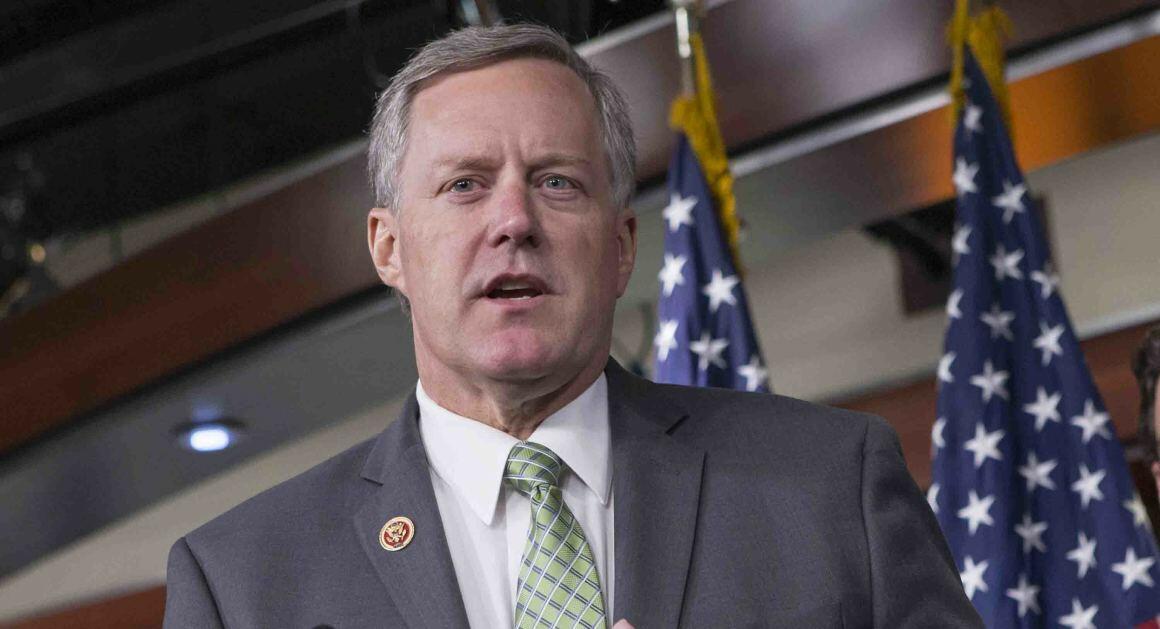
Former Trump Chief-of-Staff Mark Meadows is being sued by his book publisher, after his testimony before Congress contradicted claims made in his 2021 book, “The Chief’s Chief” – which he attested were true at the time he wrote them.
“Meadows, the former White House Chief of Staff under President Donald J. Trump, promised and represented that ‘all statements contained in the Work are true and based on reasonable research for accuracy’ and that he ‘has not made any misrepresentations to the Publisher about the Work,’” alleged All Seasons Press in their suit against Meadows.
In his book, Meadows insisted that President Trump was the true winner of the 2020 Presidential Election – which he said was “stolen” and “rigged” with assistance from “allies in the liberal media” who ignored “actual evidence of fraud,” according to the lawsuit.
Meadows also says in the opening sentence to one chapter: “I KNEW HE DIDN’T LOSE.”
Yet, Meadows testified to Special Counsel Jack Smith’s grand jury that Trump was being “dishonest” with voters when he claimed victory on election night. According to ABC News, Meadows admitted that Trump lost the election when questioned by prosecutors.
“Meadows’ reported statements to the Special Prosecutor and/or his staff and his reported grand jury testimony squarely contradict the statements in his Book, one central theme of which is that President Trump was the true winner of the 2020 Presidential Election and that election was ‘stolen’ and ‘rigged’ with the help from ‘allies in the liberal media,’ who ignored ‘actual evidence of fraud,’” alleges All Seasons Press.
The publisher is seeking a $350,000 clawback of Meadows’ advance, $600,000 in out-of-pocket damages, and at least $1 million for reputational damage suffered by the company (plus another $1 million for loss of expected profits) on sales of the book, which they claim have plummeted given Meadows’ involvement in several Jan. 6 investigations.
The suit reveals a long and tense relationship between Meadows and his publisher, which has published a suite of books from conservative figures.
In December 2021, All Seasons Press sent a letter to Meadows saying it would withhold the final of three $116,666 advance payments over concerns his book may contain false information. The suit also notes it planned to continue with publication “pending an investigation.”
A few days later the company got a letter from attorney Blake Meadows, whom the suit says is Meadows’s son, demanding the final installment. –The Hill
“Mr. Meadows is aware of the specious allegations that were published regarding a portion of the book which was taken out of context, and which have already been addressed by both Mr. Meadows and former President Trump in multiple press releases,” wrote Meadows’ son, Blake, to the company (according to the complaint).
According to the publisher, they decided to move forward with the book “after conducting the appropriate due diligence and based upon repeated assurances from Meadows that facts in the Book were true,” and that “rumors circulated in the media” that Meadows might have flipped on Trump harmed their bottom line.
“As a result, public interest in the Book, the truth of which was increasingly in doubt, precipitously declined, and ASP sold only approximately 60,000 of the 200,000 first printing of the Book,” the suit states.
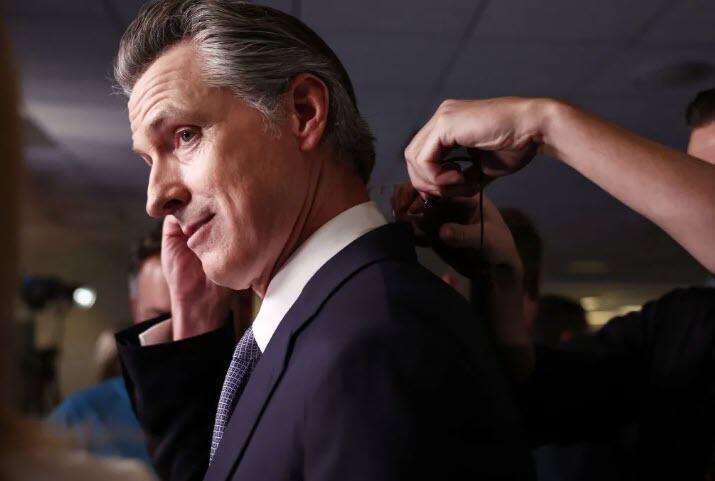
This week California Governor Gavin Newsom blatantly lied about his record on Covid-19.
“I’m not consumed by what we did wrong,”Newsom said to Fox Los Angeles’ Elex Michaelson.
“I’m consumed a little bit more by what we did right… There’s no large state that outperformed California, one of the top performing states, in terms of health, wealth, and education.”
Newsom went on to say that California’s per capita Covid mortality was “substantially lower than places like Texas and Florida,” that the state’s economy fared better than that of other states, and that we saw less learning loss than Florida. All these statements are misleading at best. Newsom’s claims about California’s economy have already been debunked, and in age-adjusted Covid mortality, as many have pointed out, California and Florida fared about the same. What’s more, cumulative age-adjusted all-cause excess deaths have been higher in California than Florida since early 2020.
As for why schools were closed for so long, Newsom said it was because he gave school districts “local control.” Evidently, Newsom wants to claim both that he is not responsible for his own school policies, and that these policies were effective. Yet both of these claims are completely untrue, and Newsom’s failure on schools is a scandal of colossal proportions.
In 2020, Newsom’s Department of Health created color coded tiers that effectively prevented California schools from reopening. In 2021, statewide guidelines continued to shape restrictions. These guidelines were based on pseudoscience like a six foot rule that created a major barrier to reopening and was not proven to prevent Covid transmission.
While allowing private and charter schools to open and sending his own kids to in-person private school, Newsom never challenged the California teacher’s union to push for full public reopening. Only in March 2021, when the state was facing a lawsuit, and after basically every other state had reopened, did Newsom call for public schools to resume limited in-person classes.
To this day, Newsom insists that school closures and the state’s catastrophic learning loss were no big deal. Florida, he told Michaelson, “had more learning loss in every single category… These are facts.” But are they really?
Newsom appears to be relying on a single 2022 test, the National Assessment of Educational Progress (NAEP), to make this assertion, despite a mountain of evidence that contradicts it. Only a small sample of students in the country take the NAEP. In contrast, all students in grades 3 through 8 and 11 take California’s official state test, the Smarter Balanced Assessment Consortium (SBAC).
While the 2022 NAEP, which only about 4,000 kids in the state took, made it appear that California’s learning loss was not so bad, the dismally low SBAC scores from 2022 showed that school closures had likely wiped out years of educational progress. This disparity strongly suggests there may have been a significant sampling bias in the NAEP, which is probable given that California’s chronic absence rate tripled statewide in the 2021-2022 school year.
Although the Los Angeles Unified School District (LAUSD) touted its supposed success on the NAEP, the district’s test results were essentially manipulated. In 2019, high-performing charter schools did not participate in LAUSD’s test, but in 2022 they did. Additionally, demographic changes between 2019 and 2022 may have been a factor, since the district’s enrollment fell by an alarming 10%.
Newsom and other California officials are cherry-picking the data and intentionally neglecting to analyze and address the complete picture of student learning loss. To avoid political repercussions, they are deliberately ignoring the majority of testing results as well as the manystudies which show that remote instruction had a severe impact on learning.
Andrew Dean Ho, psychometrician and professor at Harvard Graduate School of Education, reviewed California’s test results as an expert witness in an ongoing lawsuit against the state.
Wrote Ho in his testimony, “In my review of transcripts from depositions of state officials, I find numerous responses that indicate to me a lack of awareness of or interest in data that could enable accurate estimates of academic learning loss.”
The state has abandoned its duty to assess all relevant data and may be concealing it.
“Data currently exist in state repositories to answer questions about the magnitude of academic learning loss for jurisdictions and subgroups in the state of California, untapped,” wrote Ho.
Ho’s revealing testimony is corroborated by the fact that the Department of Education threatened to muzzle and retaliate against California researchers who planned to testify against the state.
As Newsom increasingly seems to be pursuing presidential ambitions, his Covid mistakes should come under greater scrutiny, especially as he remains intent on never admitting to them.
In Newsom’s view, the only reason he’s had any criticism at all is because hindsight is 20/20.
“We should acknowledge at the time we didn’t know what we didn’t know,” he told Michaelson.
“And we’re experts, we’re geniuses in hindsight.”
But California’s education failure is not just about 2020 and 2021 – it’s about the state’s refusal to examine the learning loss data to this day, and Newsom’s clear choice to prioritize his own political ambitions over his accountability to the children and families of his state.