Queers For Palestine: Identity Politics At Its Most Absurd

Queers For Palestine: Identity Politics At Its Most Absurd

Authored by Armin Navabi via Quillette.com,

On the morning of 7 October 2023, the militant Palestinian group Hamas orchestrated a multi-pronged assault against Israel from the Gaza Strip. Their fighters breached the heavily fortified border and murdered more than 1,400 Israeli civilians, including young children. Here in the West, the political discourse surrounding these brutal events and the war that has come in their wake has been coloured by a misguided transposition of Western identity politics onto the Middle East, which collapses all nuance and reduces a complex situation into a simple binary of oppressor versus oppressed.

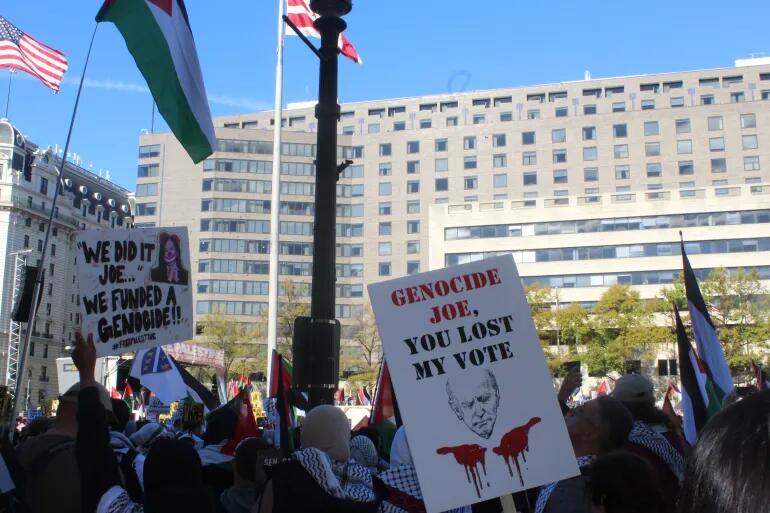
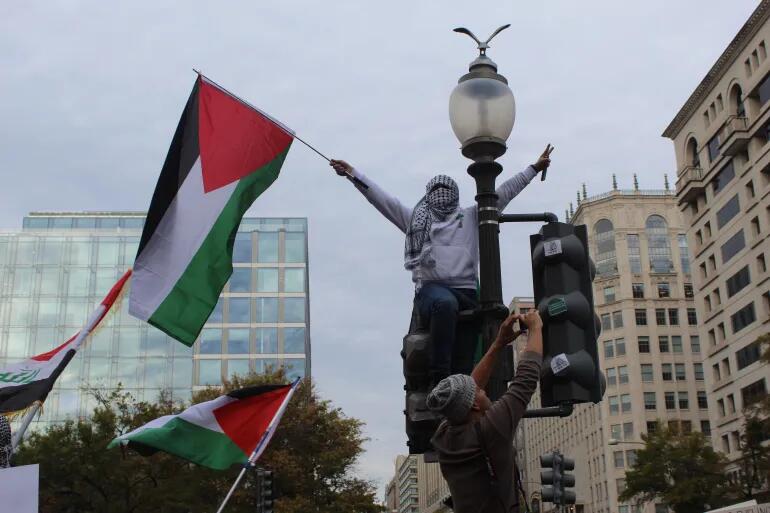
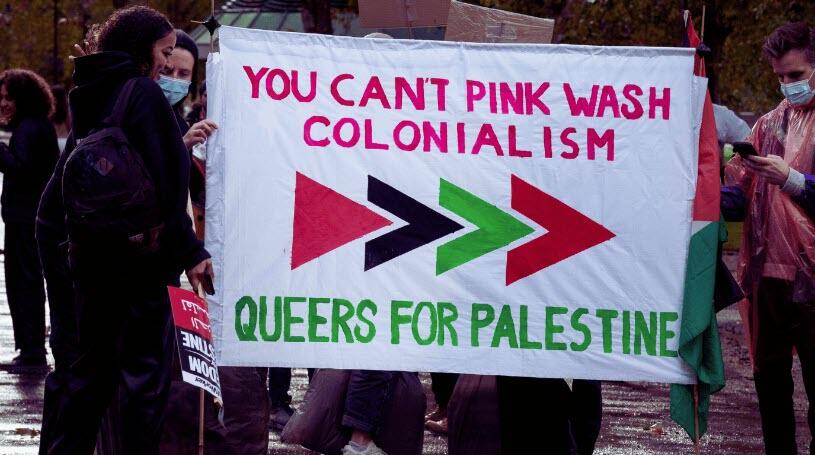
Leftists in English-speaking nations tend to see Palestinians (including Hamas) as an oppressed, brown victim class, whose freedom-fighting “resistance” against their oppressive, white, US-backed colonizers in Israel is a righteous cause with which to stand in solidarity. This facile view of the long-standing conflict in the Middle East leads to confused and contradictory thinking, as seen in the incoherent slogan (and now meme) “Queers for Palestine,” emblazoned on banners brandished at anti-Israel rallies.

“Queers for Palestine” attempts to meld LGBT advocacy with Palestinian liberation, a juxtaposition that has precipitated a whirlwind of criticism and ridicule, since LGBT rights scarcely exist within the Muslim world; and the Palestinian territories are no exception. The slogan has been widely satirized. Variations like “Chickens for KFC” and “Blacks for the KKK” highlight its proponents’ basic lack of awareness of just how incompatible the values of the Western left are with those of the Islamic right they so readily champion.

The reality of the situation could not be starker.

Though there is room for improvement in Israeli attitudes towards these issues, Israel is at the forefront of LGBT rights in the Middle East.

In Israel, LGBT people are visible members of society with legal protections and civil rights, and are accepted by a plurality of its citizens.

Palestine is quite a different story. A 2021 report on LGBT acceptance by UCLA’s Williams Institute rated Israel 44th out of the 175 countries/territories they examined. Palestine came in at number 130, behind Russia, Saudi Arabia, and the Democratic Republic of the Congo. Georgetown University likewise placed Palestine 160th out of 170 countries on their women’s peace and security index, in company with most of the countries in that region. Amnesty International’s 2020 report on human rights highlights the fact that, in Gaza, male same-sex relationships are punishable by up to 10 years’ imprisonment and points out the conspicuous absence of legal protections against anti-LGBT discrimination and harassment. This lack of civil rights has led hundreds of gay and bisexual Palestinians to flee to Israel to escape persecution. One such refugee, Ahmad Abu Marhia, a 25-year-old gay Palestinian man, was living under asylum in Israel when, in 2022, he was kidnapped and beheaded in the West Bank city of Hebron. His murderers uploaded footage of the killing to social media.

Every time these disparities are mentioned, critics are quick to lob accusations of “pinkwashing”—a concept invented to frame any discussion of Israel’s progressive stance on LGBT issues as a distraction from their mistreatment of Palestinians. But the fact remains that these “Queers for Palestine” could march in Pride parades in Israel if they wanted to. In Palestine, they’d be killed.

Another disconcerting element of “Queers for Palestine” is that the slogan popped up in prominent left-wing anti-Israel/pro-Palestine rallies in the immediate aftermath of Hamas’s terrorist attacks, before Israel had even had the chance to respond. There is no way to interpret this slogan and the surrounding leftist fervor except as a signal of support not merely for Palestine, but specifically for Hamas, a jihadist movement with the explicit aim of eradicating the state of Israel. It’s imperative to understand that Hamas, as detailed in its 1988 Covenant, is propelled by a fundamentalist Islamist ideology whose goal is not only to eliminate all Jews but to conquer the world—just like ISIS. Senior Hamas official Mahmoud al-Zahar has stated on record, “The entire planet will be under our law, there will be no more Jews or Christian traitors.”

Western support for Hamas, under the guise of support for Palestinian liberation, betrays an ignorance of the deep-seated radical Islamist ethos driving that organization, which, if left unchecked, would jeopardize the very freedoms cherished by LGBT people across the developed world. Anyone who doubts this should try being gay, bi, or trans in most of the Middle East and North Africa’s (MENA) Muslim-majority countries. Almost all these nations have laws that criminalize both homosexuality and transsexuality, some of which carry the death penalty. Human Rights Watch’s report “Everyone Wants Me Dead” succinctly encapsulates in its title alone the perilous environment faced by LGBT individuals in these regions.

Many on the Western left, including the LGBT left, have become enamored with Critical Social Justice, through whose warped lens they perceive all of humanity as fitting into two classes: oppressors and oppressed. Armed with this simplistic, binary worldview, leftists gravitate toward perceived liberation movements for other so-called oppressed groups. This narrow prism obscures the universalist ideology of Islamism espoused by groups like Hamas, which under a facade of anti-imperialist rhetoric, harbors a brutal dogma that is antithetical to the liberties and rights championed by LGBT activists. No matter how much they complain about “pinkwashing,” they can’t conceal the absurd irony of this situation, in which folks who believe in LGBT liberation are cheerleading ideological movements from which they would flee as refugees were they to live under such regimes.

To be sure, the Palestinian people have endured more than their fair share of suffering, and it’s easy to see how the Palestinian resistance narrative can carry the allure of righteous rebellion, especially for those factions of the hard left that aspire to dismantle liberal society. The vicarious thrill of romanticized revolution leads some to go far beyond simply advocating for the Palestinian people to express solidarity with Hamas, ignoring the jihadist ideology at the core of that organization.

The followers of this ideology are oppressing LGBT Palestinians at this very moment. Given half a chance, they would oppress the very leftists now voicing support for the Palestinian cause. And, indeed, this has happened before.

The aftermath of the 1979 Islamic Revolution in Iran is a harrowing tale. Leftists were tortured and executed en masse by the very Islamic regime they supported for the sake of their anti-imperialist goals; many Iranians who aligned with leftist organizations supported the revolution only to find themselves persecuted by Islamists they helped put in power.

Immediately following the revolution, the new regime led by Ayatollah Khomeini began systematically oppressing LGBT people and publicly executing them by the thousands. These atrocities were justified as a means of “eliminating corruption” and preventing the “contamination” of society. Between 4,000 and 6,000 gay, lesbian, and bisexual people have been executed since the 1979 Islamic Revolution. Iran’s legal system, rooted in Islamic law, criminalizes consensual sexual relations between same-sex individuals, with penalties ranging from lashes to death. Iranian law does not distinguish between consensual and non-consensual same-sex intercourse; allowing authorities to prosecute both perpetrators and victims of sexual assault.

Images of gay and bi men hanged from cranes so that they slowly suffocate to death serve as grim reminders for anyone interested in human rights: align with Islamic fundamentalists at your peril.

The phenomenon of “Queers for Palestine,” and the realities it glosses over, underscore the need for a more informed and discerning discourse—a discourse that transcends catchy slogans and moral binaries and delves into the complex, often discordant ideologies at play in the Israel-Palestine conflict. That way, we can advocate for a better future without bolstering forces antithetical to liberal values, and without betraying LGBT people by undermining their very rights and freedoms. We can’t do that if we overwrite the complicated dynamics of a 75-year foreign conflict with our own provincial identity politics.

*  *  *

The original version of this piece appeared in Queer Majority, a publication that champions the sexual rights and freedoms of consenting adults, while eschewing identity politics and retaining a firm commitment to liberal values. You can find more articles from that unique perspective here 

Tyler Durden
Sun, 11/05/2023 – 08:40

via ZeroHedge News https://ift.tt/laksdqm Tyler Durden

Armed Man Storms Hamburg Airport With ‘Possible Explosives’ As Hostage Situation On Tarmac Ongoing

Armed Man Storms Hamburg Airport With ‘Possible Explosives’ As Hostage Situation On Tarmac Ongoing

Air traffic at Hamburg Airport in Germany was halted after an armed man breached a security barrier and drove onto the tarmac. BBC News reports that the man is believed to have taken one person hostage in a vehicle. 

The armed man, 35, is holding his four-year-old daughter hostage in a vehicle underneath a plane. He is demanding a direct flight to Turkey with his daughter. 

A spokeswoman for the Hamburg police said the incident began around 20:00 local time on Saturday. They described the situation as “tense” and said the man was communicating with authorities. 

“We have to consider that he has a gun with him and we also have to consider that he possibly has some explosive devices with him,” police spokeswoman Sandra Levgruen said. 

Videos posted on ‘free speech’ social media platform X show the man throwing two incendiary devices onto the runway. There have also been reports the man has discharged his firearm multiple times. 

Flights at the airport have been canceled. Bloomberg noted a total of 139 departures and 147 arrivals with 34,500 passengers were planned for the airport today. 

Tyler Durden
Sun, 11/05/2023 – 08:05

via ZeroHedge News https://ift.tt/b2Lamun Tyler Durden

The Dutch Are The Most Likely To ‘Borrow’ Their Neighbor’s WiFi

The Dutch Are The Most Likely To ‘Borrow’ Their Neighbor’s WiFi

According to data collected by Statista’s Global Consumer Survey, 18 percent of Dutch online respondents said that they mainly access their internet at home via their neighbor or landlord’s wireless connection.

As Statista’s Anna Fleck notes, this is more than double the rate of people in the other selected countries, with neighboring Germany and France both at seven percent.

According to the survey, only 38 percent of respondents in the Netherlands had access to broadband and an additional 16 percent a mobile connection via smartphone or tablet in 2023.

Infographic: The People Most Likely to

You will find more infographics at Statista

Meanwhile, the United States and the United Kingdom had lower rates of adults using their neighbors WiFi, at four percent and two percent, respectively. The U.S. also had a relatively low share of people with broadband, at 38 percent, while the UK’s was higher at 68 percent.

While the reasons for this discrepancy are not fully clear from the data alone, it’s interesting to note that breaking into an encrypted WiFi is not a criminal offense in the Netherlands, even though it is in other countries. Breaking into a computer, however, is.

Tyler Durden
Sun, 11/05/2023 – 07:35

via ZeroHedge News https://ift.tt/zdMG1Cg Tyler Durden

Majority Support For Muslim Migration Ban As 3 In 4 Germans Say Newcomers Hate Western Society

Majority Support For Muslim Migration Ban As 3 In 4 Germans Say Newcomers Hate Western Society

Authored by Thomas Brooke via Remix News,

Some 61 percent of Germans no longer want any migration from Islamic nations, new polling shows…

Nearly two-thirds of all German citizens want the country’s federal government to impose a ban on migration from predominantly Muslim nations, a damning survey has revealed.

Polling conducted by INSA on behalf of the Bild tabloid newspaper showed that 61 percent of respondents now advocate refusing any more migrants from Islamic countries with many explaining they no longer feel safe in their own country and believe an increasing number of new arrivals despise German society.

A majority of voters from every political party except for the German Green Party supported a ban on Muslim immigration.

The survey was conducted amid the ongoing pro-Palestine demonstrations witnessed in several German cities following the Hamas terror attack in Israel on Oct. 7 and the retaliatory measures carried out in Gaza by the Israel Defense Forces (IDF).

A total of 60 percent of respondents admitted the ongoing protests, attended by large numbers of foreign nationals sympathetic to the Hamas cause, concern them, while 77 percent of Germans believe that a growing contingent of the country’s migrant population resents German society and Western values.

In a damning indictment of the federal government’s longstanding liberal migration policy adopted by both the current coalition government and the previous administration led by Angela Merkel’s Christian Democratic Union (CDU), a total of 72 percent of respondents said they no longer agreed with the former chancellor’s remarks from 2015 when she told the nation, “We can do it!” in relation to taking in an unprecedented number of refugees.

Hermann Binkert, INSA’s founder and managing director, told Bild:

“The clear stance documents the Germans’ farewell to Angela Merkel’s migration policy.

“Citizens expect a noticeable turnaround. These numbers should shake up politicians,” he added.

Read more here…

Tyler Durden
Sun, 11/05/2023 – 07:00

via ZeroHedge News https://ift.tt/4MzSnfm Tyler Durden

Dobbs Is Reshaping American Politics


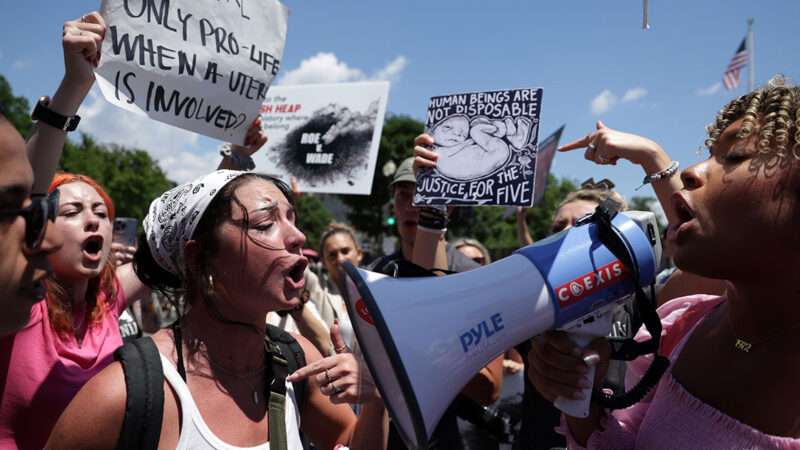
Pro-life and pro-choice protesters yelling at a protest | Alex Wong/Getty

When the Supreme Court ruled in Dobbs v. Jackson Women’s Health Organization, everyone knew the fallout—for women, for doctors, for U.S. politics—would be profound. “The Constitution makes no reference to abortion, and no such right is implicitly protected by any constitutional provision,” wrote Justice Samuel Alito in the majority opinion. With that, nearly 50 years of status quo surrounding abortion was ended. Dobbs torched the legal paradigm that had governed access across the nation since the Court’s infamous 1973 ruling in Roe v. Wade and its 1992 decision in Planned Parenthood v. Casey.

Unsurprisingly, American abortion laws and access have been radically transformed since the Dobbs decision was released. As of September, in more U.S. states than not, abortion access is now reduced, threatened, or barely existent.

In the wake of the Dobbs decision, some red states rushed to pass new restrictions on abortion while others revived long-dormant statutes from a pre-Roe era or “trigger laws” passed more recently but only effective after Roe‘s demise. As a result, abortion is now banned or severely restricted at all stages of pregnancy in 15 states. In addition, four states now ban abortion at some point within the first trimester, and three states ban it at some point between 15 and 18 weeks of pregnancy.

None of these bans would have been constitutional under Roe, which said abortion must be allowed until the point of fetal viability (around 24 weeks).

Other states have attempted abortion bans but have been thwarted by legal challenges. New or additional bans have been enacted but blocked—at least temporarily—in seven states.

Abortion remains legal until at least the point of fetal viability—and sometimes after—in 23 states, largely in the Northeast, mid-Atlantic, and West.

But the new restrictions have meant some women have had to travel out-of-state—sometimes quite far—to get an abortion. Some who would previously have gotten an abortion did not do so. An analysis by the Society of Family Planning suggests that between July 2022 and March 2023 alone, “there were 25,640 cumulative fewer abortions” than there would have been otherwise.

In addition, new restrictions have made obstetric care more difficult for doctors and women dealing with nonviable pregnancies or health-threatening pregnancy complications. While all bans so far contain exceptions for cases where a mother’s life is at risk, these exceptions don’t always encompass cases where continuing a pregnancy is incredibly risky. That means some women who may eventually need to terminate a pregnancy are being told they can’t do so until their condition gets worse.

Risk aversion by medical professionals here is understandable. Most of the laws banning abortion carry criminal penalties for doctors or other medical professionals who perform them. This may include jail time—life in prison is on the table in Alabama and Texas—as well as fines or the loss of a medical license. Some states also permit authorities to seek civil penalties for violations. In Texas, the attorney general can seek a civil penalty of $100,000 per illegal abortion.

Some bans can be enforced not by the state but through lawsuits filed by private citizens. Texas started this trend in 2021 with S.B. 8, a law allowing “any person” to sue someone who performs an abortion after fetal cardiac activity is detected and authorizing at least $10,000 payouts for successful plaintiffs in such suits. Opponents dubbed it the abortion “bounty hunter” law, and since then, similar laws have been introduced and sometimes passed in other states.

Meanwhile, conservative lawmakers continue to push new restrictions on reproductive freedom—including banning the procedure even earlier in pregnancy, limiting the methods that can be used, and restricting the types of facilities where abortions can be performed. Some show interest in adding more rules around advertising, record keeping, or patient notices—for instance, mandating that women prescribed abortion pills be told the procedure can be “reversed” after the first pill (a claim many medical professionals say is unfounded). Other proposals seek to expand categories of criminal liability, creating new crimes like aiding and abetting abortionfacilitating an unlawful death from abortion (a law meant to be used against abortion pill manufacturers and distributors), and “abortion trafficking” (helping a minor obtain an abortion without parental permission). Some would even establish that personhood starts at fertilization—opening up abortion-seeking women to attempted murder or homicide charges.

Suffice it to say, the legal status of abortion in many states has shifted—and continues to shift—quickly. For many Americans, things seem to be changing too fast and going too far. For others, however, the Dobbs world is proving frustratingly resistant to change.

But one thing is certain: Dobbs‘ effect on U.S. policy and politics is going way beyond shaping where abortion is and isn’t legal. It’s wreaking electoral havoc, shifting partisan calculations, and calling into question balances of federal and state power. It’s also ushering in a new level of representative democracy in determining the limits of reproductive freedom—along with a backlash to the process that could reach far past policies surrounding abortion.

In many ways, the Roe and Casey era was simpler. But the new world could better reflect the underlying political reality that American opinions about abortion are complex, nuanced, and not terribly extreme.

The Moderate Majority Strikes Back

During the Roe era, it could be easy to forget most Americans are abortion moderates and don’t fall easily into a “pro-choice” or “pro-life” binary. Now this fact could be swaying elections—and causing major problems for Republicans.

Poll after poll has shown that relatively few people think abortion should always or never be legal. For most, it matters when and under what circumstances—and they want laws and policies to reflect that.

For decades, politicians could pretend this wasn’t the case. Abortion was a convenient frame for criticizing opponents, demonizing them as either killers who wanted to abort babies even as they were being born or troglodytes who wanted to keep all women barefoot, pregnant, and under men’s control. But because of Roe and the way courts continually interpreted it, abortion was not something where there was room for a radical departure from existing policies or risk of fallout from taking a stand at odds with popular opinion.

This gave Republicans little to lose by pandering to the more extreme anti-abortion constituents among their base. The policies they pushed—and sometimes passed—wouldn’t actually take effect, and no one had to live with the personal, political, or criminal consequences. If conservatives or conservative-leaning independents had some qualms about them, they could rest assured—and still vote GOP—knowing there was the Republican rhetoric, and then there was the Roe-mandated reality. Meanwhile, pro-choice folks could be somewhat complacent, knowing that courts would keep striking down any extreme restrictions on abortion access.

In short, abortion just wasn’t something most people needed to have extremely specific views on or considered a political priority. But without Roe, abortion actually matters to voters in a way it didn’t before. There are signs this won’t work out well for Republicans stuck in the old paradigm.

A wealth of polling since the Dobbs decision suggests Americans are increasingly in favor of at least some legal abortion. “FiveThirtyEight gathered every poll that asked a standard question about abortion — whether it should be legal in all cases, legal in some cases, illegal in some cases, or illegal in all cases — since September 2021, and found that the share of American adults who want abortion to be legal in at least some cases is rising, and the share of Americans who want abortion to be illegal in all cases is falling,” the polling analysis website reported in June.

This makes abortion a political boon for Democrats. There’s strong evidence that the issue of abortion swayed some results in the 2022 midterms. Democrats credit it with helping them stanch losses in the U.S. House and keep control of the Senate. And Democrats are counting on the issue to give them another boost in 2024 too.

It’s a much thornier issue for Republicans, caught between trying to appease constituents and donors who still expect them to take an aggressive anti-abortion stance and the large swath of more moderate conservatives and swing voters with less radical abortion views.

Evidence of this conundrum can be seen in all sorts of places, from the way former president and 2024 candidate Donald Trump has handled the issue to the way some Republicans have reacted to national ban legislation. Far from taking a big victory lap for appointing the judges that struck down Roe, Trump has focused relatively little on the issue and privately opined that Republicans are “getting killed on abortion.” When Sen. Lindsey Graham (R–S.C.) introduced a bill in September 2022 that would have made performing an abortion after 15 weeks of pregnancy a federal crime, a number of prominent GOP strategists and lawmakers made it clear they wished he wasn’t pushing it near election time.

As questions like the issue of a national ban become more salient—it was a big point of contention between candidates in the first 2024 GOP presidential debate—and state laws continue to come into focus, abortion will likely only become more important in upcoming elections. It could continue to drive Republican electoral losses unless GOP candidates start changing their tune.

A Republican Party in which pro-life politics are less of a focus may have to adapt in other ways too, adopting new strategies to drive religious conservative voter turnout or to appeal to moderates and independents. This could ultimately reshape the conservative coalition and/or conservative priorities.

But whether the GOP can get away with refocusing is another question. Even if some want to avoid talking about abortion, it will be difficult, since Democrats have every incentive to keep focus on the issue. “We should put the right to choose on every ballot across the country in 2024—not just with the candidates we choose, but with referendum efforts to enshrine reproductive rights in states where right-wing politicians are stripping those rights away,” Illinois Gov. J.B. Pritzker, a Democrat, told CNN in April.

Putting Abortion Up for a Vote

Asking voters to weigh in directly on questions surrounding reproductive freedom helps reveal what Americans really want and will really stand for when it comes to abortion. The result could be the start of a much more democratic abortion paradigm than we’ve seen in decades—and the ticket to protecting at least some modicum of abortion access in many states.

“Deep in the American DNA is the belief that we should have as little government and as much liberty as possible,” writes Elaine Kamarck at the Brookings Institution. “The law’s intrusion into the complex medical and moral issues surrounding as personal a decision as abortion strikes at the heart of American’s [sic] desires to control their own destiny. All indications are that by the end of the decade the Supreme Court’s decision to return abortion rights to states will reinstate abortion across the land.”

That may overstate the case a bit. But ballot initiatives related to reproductive freedom have been up for votes in six states since Dobbs was decided in June 2022, and all have come back with positive results for the pro-choice side. Notably, a number of these votes have taken place in largely red states, including Montana, Kentucky, and Kansas.

After the Dobbs decision, Kansas was the first state to vote on an abortion ballot initiative, in summer 2022. Voters resoundingly rejected a proposed amendment stating that the state constitution did “not create or secure a right to abortion,” with 59 percent against. Conservatives had put the issue up for a vote as part of a primary election, which trend toward smaller and more Republican voter turnout in Kansas. But voters across the board turned out in droves, with around 47 percent of registered voters casting ballots, compared to 20 percent to 34 percent in primaries generally since 2010.

The 2022 midterm elections saw five states voting on abortion. The more pro-choice position won in all five.

In November 2023, Ohioans will vote on a proposed constitutional amendment to protect abortion access. Measures protecting abortion are already slated for New York and Maryland ballots in 2024, while activists in a number of other states have been preparing or circulating petitions to get measures on their 2024 ballots.

Many of these are being pushed as efforts to “restore Roe.” They would institute a similar scheme to what was previously allowed nationwide, with abortion broadly legal in early to mid-pregnancy and bans allowed after a certain point. For instance, the proposed Ohio amendment states: “Abortion may be prohibited after fetal viability.”

Pro-lifers in some states, including Colorado, are also working on getting initiatives on ballots. But with the way ballot measures—and abortion poll results—have been trending, the strategy is seen as much more friendly to the pro-abortion side.

The pro-choice tenor of public opinion so far is creating a backlash from conservatives. If this backlash succeeds, it could thwart not just the flourishing of ballot initiatives about abortion but also broader by-the-people lawmaking.

Ballot Backlash

A certain strain of Republicans long insisted that without Roe, abortion could become what it was meant to be: a state-by-state issue. But it’s becoming clear—if it wasn’t already—that many in the pro-life movement won’t be satisfied with this arrangement if it doesn’t lead to abortion being outlawed, or at least severely restricted, in their own states and perhaps nationwide. Some are even willing to make democratic processes more exclusionary if it will help get us there.

Whether conservatives were never serious about actually leaving abortion up to individual states or were only serious about it because they imagined that most Americans would support bans is unclear. But in light of the fact that voters keep embracing abortion rights and rejecting restrictions on reproductive freedom, some GOP politicians are responding with attempts to make it more difficult for voters to have a direct say in the issue.

Some of these attempts target the process for getting initiatives on the ballot in the first place, by requiring more signatures, restricting who can collect signatures, requiring a broader geographic distribution for signatories, or raising filing fees. In Arkansas, lawmakers passed a bill that requires signatures from 50 counties instead of 15 to get an initiative on the ballot.

Others target the vote threshold required to amend the state constitution. For instance, Ohio Issue 1 would have raised the threshold for passing constitutional amendments from a simple majority to 60 percent.

After enacting a law earlier this year to end special August elections, Ohio Republicans turned around and approved one for Issue 1—ensuring that if it passed, it would take effect before November’s vote on an abortion initiative. But voters flocked to the polls and issued Issue 1 a resounding defeat, with 57 percent opposed—even some counties that went for Trump in 2020 voted against.

More battles like this are likely coming. According to the Ballot Initiative Strategy Center, 14 states have been considering “measures that would impact or weaken the ballot initiative process.” And while stopping abortion amendments may not be the sole motivation behind such attempts, it’s definitely one, and sometimes the main, driver.

In Mississippi, where a court order froze all ballot initiatives in 2021, a (now-dead) GOP-led bill would have again allowed them—except for abortion-related measures. “The state of Mississippi is pro-life,” asserted Mississippi state Rep. Nick Bain on the House floor, while arguing against giving residents the chance to prove it at the polls.

Ohio Secretary of State Frank LaRose publicly denied that Issue 1 was about thwarting a reproductive rights amendment. He was later caught on video admitting this was his calculation. “Some people say this is all about abortion. Well, you know what? It’s 100 percent about keeping a radical pro-abortion amendment out of our constitution,” he said in a video shared by News 5 Cleveland and the Ohio Capital Journal.

Pro-life politicians are also finding other tactics to keep abortion initiatives off the ballot or stack the deck against them. For instance, LaRose’s office has loaded Ohio’s ballot language about the abortion amendment with biased phrasing, substituting “unborn child” for “fetus” and describing post-viability exceptions for a mother’s life or health as “always allow[ing] an unborn child to be aborted at any stage of pregnancy” if a doctor signs off on it.

Missouri Attorney General Andrew Bailey tried to substitute his own fiscal analysis for that of State Auditor Scott Fitzpatrick’s fiscal note summaries for 11 reproductive rights initiatives, saying the auditor had failed to take into account the lost revenue from Medicaid funding and future taxpayers being aborted. This left the petitions in limbo, with the secretary of state unable to certify ballot language and groups unable to start collecting signatures. In July, the Missouri Supreme Court ordered Bailey to approve Fitzpatrick’s fiscal notes, writing that the matter is “not about the substance of…proposed initiatives petitions” but rather about the limits of the attorney general’s authority. State Rep. Hannah Kelly (R–Mountain Grove) and state Sen. Mary Elizabeth Coleman (R–Arnold) then filed a lawsuit challenging the auditor’s cost analysis.

The ballot process may not be the only thing under attack in order to stave off pro-choice policies. Some state officials—including those in Oklahoma and West Virginia—have started amending religious freedom statutes to prevent them from being used in legal challenges against abortion bans.

Abortion and the Administrative State

Republican lawmakers and officials aren’t the only ones trying to buck the trend of more direct democratic influence and state-by-state differences on abortion policies. We’re also seeing some intervention—and overreach—from the federal government, along with attempts to expand or curb abortion access by challenging administrative procedure.

At the heart of these actions is the issue of how much control the feds should have over abortion policy and how much should be left up to the states.

In July 2022, the Department of Health and Human Services (HHS) said that the federal Emergency Medical Treatment and Active Labor Act (EMTALA) requires hospitals that accept Medicare patients to provide “stabilizing treatment” that may at times include abortion. “If a state law prohibits abortion and does not include an exception for the health or life of the pregnant person — or draws the exception more narrowly than EMTALA’s emergency medical condition definition — that state law is preempted,” HHS advised. As part of this standoff, the Biden administration is investigating a pair of hospitals that refused to perform an abortion on a Missouri woman with pregnancy complications.

The Department of Justice told Postal Service workers last December they should continue delivering abortion pills even to people in states where abortion is banned.

But by far the biggest legal drama surrounding federal agencies and reproductive rights involves the abortion-inducing drug mifepristone (and its generic equivalents). Interestingly, the matter is playing out as a debate about the Food and Drug Administration (FDA) approval and regulatory process, not individual rights.

So far, one federal court has preliminarily enjoined the federal government from taking any action to make mifepristone less available in states that brought a lawsuit about its status. The case is about mifepristone being singled out “for excessive regulation,” said the office of the Oregon attorney general. “Despite evidence that the drug is safer than Tylenol, burdensome restrictions on prescribing and dispensing mifepristone…expose patients to needless anguish and confusion” and “subject providers to bureaucratic oversight that makes providing care much more complicated than necessary.”

Meanwhile, another federal court decision would suspend mifepristone approval entirely. That decision comes in a case brought by the Alliance for Hippocratic Medicine, which challenged the FDA’s 2000 approval of mifepristone along with its later generic approval and loosening of restrictions on abortion pill prescriptions. In April 2023, U.S. District Judge Matthew J. Kacsmaryk held that the FDA erred in approving mifepristone originally and erred in its later challenged actions too; he ordered access to the drug suspended. The Biden administration appealed Kacsmaryk’s ruling, and that same month, the U.S. Supreme Court granted the government’s request for a stay “pending disposition of the appeal.”

In August, the 5th Circuit held 2–1 that parts of Kacsmaryk’s ruling should stand and parts should not. “We vacate the component of the order that stayed the effective date of the 2000 Approval and the 2019 Generic Approval,” wrote Judge Jennifer Walker Elrod for the majority. However, the court upheld the parts of Kacsmaryk’s ruling related to later FDA directives (including the FDA’s actions allowing abortion pills to be prescribed virtually and shipped by mail and its 2016 guidance saying lower doses could be prescribed).

For now, nothing will change as the Supreme Court reviews the matter and decides whether to take up the case. The Biden administration and pharmaceutical company Danco Laboratories have both asked the Court to hear the case.

Even as the battle over abortion pill approval and prescribing plays out in the courts, the FDA has continued to loosen prescribing restrictions around abortion drugs and around birth control—proving that the Dobbs world will spur some opportunities for federal deregulation too.

In January, the FDA paved the way for retail pharmacies to dispense abortion pills. (Until 2021, they had to be prescribed and dispensed at a specially certified doctor’s office and after that, only through mail-order pharmacies, since the FDA had failed to put in place a system for certifying retail pharmacies to dispense them.) The FDA also recently approved the first hormonal birth control pill for over-the-counter sale.

New Laws, New Lawsuits

While some challenges to abortion laws are playing out at the federal level, more of them are taking place in state courts. Lawsuits out of at least eight states have challenged abortion bans on religious freedom grounds. Another common tack is arguing that abortion bans violate privacy rights enshrined in state constitutions. Still others have asserted that bans violate women’s right to self-preservation.

These challenges highlight one way the Dobbs landscape around abortion looks much like the pre-Dobbs landscape: It involves a lot of bills—of varying degrees of constitutionality—being introduced by state legislatures and, when passed, swiftly battled out in state courts.

But while lawsuits over abortion laws have long been common, the legal onus is now different, with more burden on abortion access advocates to prove that laws should not be allowed than on anti-abortion advocates to prove that they should be. Even as some of these laws are challenged in court and put on hold by judges, they can create a chilling effect on the provision of abortion in states that enact them.

So far, state supreme court rulings on abortion bans have been mixed. North Dakota’s Supreme Court ruled in March that the state constitution implicitly protects the “right to obtain an abortion to preserve the woman’s life or health.” Oklahoma’s Supreme Court struck down its bounty hunter laws in May, holding that they were unconstitutional because they conflicted with a decision saying that the state constitution protects an “inherent right of a pregnant woman to terminate a pregnancy when necessary to preserve her life.” Meanwhile, the Idaho Supreme Court said in January that its state constitution does not protect abortion. And in Indiana—the first state to pass tighter restrictions on abortion after the Dobbs decision was handed down—the state Supreme Court said in June that its constitution permitted a law banning abortion in almost all cases.

In South Carolina, Supreme Court rulings have been mixed. In January, the court struck down a six-week abortion ban, saying it placed an “unreasonable restriction upon a woman’s right to privacy.” But the state’s legislature tried again in May, passing a similar ban with small tweaks. That measure returned to a South Carolina Supreme Court in which the author of the January ruling—Justice Kaye Hearn, previously the only woman on the court—had since retired. This time around, the court upheld the ban.

A lot of legal battles have been playing out over so-called “heartbeat laws,” which ban abortion as soon as fetal cardiac activity can be detected (around six weeks of pregnancy—which means four weeks after conception and about two weeks after a woman would miss her first period). The vast majority of U.S. abortions take place within the first trimester—under 8 percent occur after 13 weeks of gestation, according to the Centers for Disease Control and Prevention (CDC)—but most of these do take place after six weeks. CDC data show that between 2010 and 2019, some 62.5 percent to 66 percent of abortions took place after six weeks.

State court rulings on heartbeat laws so far have been varied, with some allowed to take effect as legal challenges play out and others halted for the time being.

For instance, Florida Gov. Ron DeSantis signed a six-week ban into law in his state in April. But it will only take effect if a 15-week ban currently being challenged is upheld. That case turns on whether the Florida Constitution’s privacy clause protects the right to an abortion.

An Opportunity in Disguise

In the Dobbs world, the future of abortion will almost certainly continue as a multifront battle—playing out in statehouses and courthouses, electoral politics, citizen-led initiatives, backlash to these initiatives, and attempts by federal agencies to set nationwide policy by novel means. Which of these avenues becomes the most influential remains to be seen.

For now, however, it’s a world in which voters are starting to gain unprecedented power to determine abortion policy, both through the candidates they vote for and via direct referendums on questions related to reproductive rights.

Dissatisfaction with how voters use this power threatens to undermine it—along with democratic processes more broadly.

But if that can be avoided, we might start to see American abortion politics and policies better reflect the reality that most people in the U.S. aren’t extremely pro-life or extremely pro-choice. They recognize the moral questions surrounding abortion aren’t one and the same with the legal questions. They overwhelmingly differentiate between abortions that occur early and later in pregnancy. They support limits but also want to avoid substituting the judgment of politicians for the judgment of doctors and families in tough situations. They’re wary of giving the state too much power to pry into people’s reproductive lives.

The paradigm laid out in the Roe ruling attempted to grapple with some of this. But it also left citizens and their elected officials with little control over what is, no matter where you come down on it, a very serious and salient issue. In many ways, the Roe regime was simpler than where we find ourselves now. It was also less democratic.

The Dobbs decision was widely portrayed as a death knell for reproductive freedom in this country, and the past year has certainly offered up all sorts of incursions on this freedom. But it’s also opening up new opportunities for supporters of legal abortion—who make up the majority of Americans—to turn their policy preferences and moral intuitions into political reality. This new reality has the chance to more accurately reflect American beliefs—if officials let it.

The post <em>Dobbs</em> Is Reshaping American Politics appeared first on Reason.com.

from Latest https://ift.tt/yFnahH6
via IFTTT
The Great Reset, Part 1: The Four Horsemen Of The Apocalypse

The Great Reset, Part 1: The Four Horsemen Of The Apocalypse

Authored by Simon Elmer via Off-Guardian.org,

‘The technologies at the heart of the Fourth Industrial Revolution are connected in many ways — in the way they extend digital capabilities; in the way they scale, emerge and embed themselves in our lives; in their combinatorial power; and in their potential to concentrate privilege and challenge existing governance systems.’

– Klaus Schwab, Shaping the Future of the Fourth Industrial Revolution, 2018

The Wikipedia entry for the Great Reset, the first part of which is quoted in a blue panel as a corrective to any mention or discussion of this term on YouTube, reads as follows:

The Great Reset Initiative is an economic recovery plan drawn up by the World Economic Forum (WEF) in response to the COVID-19 pandemic. The project was launched in June 2020, with a video featuring the then Prince of Wales Charles released to mark its launch. The initiative’s stated aim is to facilitate rebuilding from the global COVID-19 crisis in a way that prioritizes sustainable development.

The initiative triggered a range of diverse conspiracy theories spread by American far-right and conservative commentators on social media such as Facebook and Twitter. Such theories include that the COVID-19 pandemic was created by a secret group in order to seize control of the global economy, that lockdown restrictions were deliberately designed to induce economic meltdown, or that a global elite was attempting to abolish private property while using COVID-19 to enslave humanity with vaccines.

I am not an American, have never belonged to any far-right organisation, my views are not conservative with either a big or a little ‘c’, and I have published a number of articles arguing against the conspiracy theory of history; but I have also argued that a virus with the infection fatality rate of seasonal influenza never constituted anything approaching a ‘pandemic’; that lockdown restrictions were imposed not to induce the ‘meltdown’ of the economy but, to the contrary, to insulate the real economy from the $12 trillion of quantitative easing created to bail out the collapsing financial sector between September 2019 and April 2022; and that, far from attempting to ‘abolish’ private property, the stakeholder model of capitalism promoted by the World Economic Forum and implemented by its corporate partners under the umbrella of ‘sustainable development goals’ is designed to privatise national assets, natural resources and, ultimately — as Klaus Schwab openly advocates — the existing system of governance in the West.

In this respect, the Wikipedia entry is exemplary of how the accusation of ‘conspiracy theory’, illustrated with extreme or inaccurate or just plain ridiculous examples (‘enslave humanity with vaccines’) to which very few people subscribe, works to discredit and dismiss by association any and more rational criticisms of the global technocracies, international companies and national governments that, in the wake of multiple manufactured ‘crises’, have taken into their control the institutions, procedures and platforms by which a political, scientific and media consensus is reached.

Strange as it may seem, however, this grudging concession of the existence of a global economic plan, its origins in a corporate think-tank and its support by the now Head of State of the UK is an age away from the vociferous denials and mocking denunciations of being a ‘conspiracy theorist’ that were hurled at anyone who dared even to refer to the ‘Great Reset’ in the first year of lockdown. These only gradually diminished when someone pointed out that the term was openly used on the website of the World Economic Forum and had provided the title of the book published by its founder and Executive Chairman, Klaus Schwab, in July 2020, barely 4 months since the ‘pandemic’ was declared by the World Health Organization.

And while the accusation of conspiracy theory is still used to silence anyone who attributes anything other than purely beneficent motives to the 1,200 banks, asset managers, information technology conglomerates, media corporations, energy utilities, industrial manufacturers and other companies that, on the same day the ‘pandemic’ was declared, formed themselves into a ‘COVID-19 Action Platform’, the term itself is now more or less openly used by politicians, civil servants, corporate CEOs, marketing executives, digital engineers, journalists, activists and other promoters of what the World Economic Forum calls ‘stakeholder capitalism’.

It’s hard to say which term is more likely to attract censure and censorship when used by those not authorised to do so, but the most accurate description of the Great Reset — and the one most suppressed by those overseeing its implementation — is that it is the historical shift from the economic, political and social paradigm by which the West has been governed for the past forty years into stakeholder capitalism. As the emerging political economy of the West, this seeks to merge the separation of powers between executive, legislature and judiciary on which Western democracy has been founded into a technocratic form of governance that will signal the end of politics, properly speaking, insofar as politics designates — at least in principle — a space of debate, contestation, representation and accountability.

For Schwab, whose latest book is titled Stakeholder Capitalism, this merger represents a revolution from shareholder capitalism, in which individual economies overseen by national governments were run for the benefit of company shareholders, into a global economy governed by the same companies, but ostensibly for the benefit of all, inclusively, sustainably, profitably. The investment in which these multinational companies hold a stake, therefore, is the world itself. ‘A global economy that works for progress, people and the planet’ is the subtitle of Schwab’s book, which like those preceding it doesn’t lack in ambition, hubris and a complete disregard for anything one could call democratic process, accountability or a mandate from those it claims to benefit.

If we were to pick a starting date for this revolution in Western capitalism, whose economic forces lie in the neoliberal revolution of the late 1970s and the rise of finance capitalism as the dominant economic model of the West, it began in September 2019 with the spike in interest rates in the US repurchase agreement market that triggered the latest Global Financial Crisis, and to which the lockdown of the real economies of global capitalism in March 2020 was the concerted response. My two collections of essays, Virtue and Terror and The New Normal, written between March 2020 and October 2021 when the UK was still ruled by emergency powers under lockdown restrictions, sought to describe this first phase of the Great Reset, its legislative frameworks and economic motivations.

My argument in this book is that we have now moved out of the first phase of this revolution, whose trajectory and precedents I described in The Road to Fascism: For a Critique of the Global Biosecurity State, and into the second phase. In its sequel, The Great Reset: Biopolitics for Stakeholder Capitalism, I try to articulate what this new phase is and what it means for us. Hopefully — and what hope we have is one of the questions this book tries to address — by understanding this new phase of the Great Reset better, we will be able to offer more resistance to its enforcement than we managed in its first phase, which was met with almost universal credulity, compliance and collaboration.

FROM LEGISLATION TO BIOPOWER

A lot of things have changed in the UK and across the Western World since, in March 2022, the coronavirus-justified restrictions on our human rights and civil liberties began to be lifted; but that doesn’t mean, as too many opposed to lockdown initially thought, that the Great Reset of Western capitalism for which those restrictions laid the ground is over. Far from it. To emphasise how far from over the Great Reset is, I have referred to this new phase as the ‘Four Horsemen of the Apocalypse’. This is not only for dramatic effect but also because it gravitates around four apparatuses of biopower, not all of which are new, but which are being implemented simultaneously and are, indeed, dependent on each other for their implementation. Much of this book is about this interdependence, which Schwab refers to as their ‘combinatorial power’.

But what is ‘biopower’?

It’s a term I’ve been using since we were first locked in our homes on the justification of stopping the spread of the coronavirus, and I’ve made many attempts to describe it — which I shall continue to do, no doubt, because it is under its paradigm that the world is now governed and will be for the foreseeable future. The term was first introduced into political discourse by the French philosopher and historian, Michel Foucault, who died in 1984. As Professor of the History of Systems of Thought at the Collège de France, Foucault explored its genesis in his lecture series of 1975-1979. But he first used the term in his published work in The Will to Knowledge, where, in the pages titled ‘Right of Death and Power over Life’, Foucault described the movement from a juridical to a biopolitical paradigm of governance:

Another consequence of this development of bio-power was the growing importance assumed by the action of the norm, at the expense of the juridical system of the law. Law cannot help but be armed, and its arm, par excellence, is death; to those who transgress it, it replies, at least as a last resort, with that absolute menace. The law always refers to the sword. But a power whose task is to take charge of life needs continuous regulatory and corrective mechanisms. Such a power has to qualify, measure, appraise and hierarchise, rather than display itself in its murderous splendour; it does not have to draw the line that separates the enemies of the sovereign from his obedient subjects; it effects distributions around the norm. I do not mean to say that the law fades into the background or that the institutions of justice tend to disappear, but rather that the judicial institution is increasingly incorporated into a continuum of apparatuses (medical, administrative, and so on) whose functions are for the most part regulatory. A normalising society is the historical outcome of a technology of power centred on life.

Foucault viewed the rise of biopower and the technologies of its implementation within a historical context that began around the time of the French Revolution of 1788, and which he associated with the First Republic’s formulation of human rights. It was through these rights that the state first assumed its duty and its right to defend, but also to control, not only the life but also the quality of life of its citizens: our health, our bodies, our needs, our happiness — which have most recently been condensed into the new category of our ‘well-being’. For Foucault, this represented a historical shift from the legislative power by which the sovereign and his government had authority over the life and death of his subjects, and within which laws have a purely punitive function that sets restrictions and obligations which, if broken, have penalties up to and including death, into a biopolitical paradigm, within which the technologies of power qualify, measure, appraise and hierarchise the life of the citizen.

This shift has parallels with what is happening now largely in the West under the banner of the Fourth Industrial Revolution, by which the new apparatuses of biopower and the technologies of which they dispose will qualify our access to what were previously the universal, indivisible and inalienable rights of citizenship; measure our levels of compliance with regulatory and corrective mechanisms that have not been written into any laws; appraise us through a system of surveillance and monitoring justified by ‘crises’ whose very existence it prohibits us from questioning; and, by doing so, will produce a new hierarchy of Social Credit rated according to our levels of obedience not only to the by-now familiar regulations of the Global Biosecurity State but also to new actions of the norm extending into every aspect of our lives.

It’s important to bear in mind that the shift Foucault described is an historical one that happened over several hundred years; but history does not move at an even pace, and at times of social and political revolution — such as the one the West entered in March 2020 — what might otherwise have taken a century to unfold can be implemented in a decade or less. We’ve seen this demonstrated most materially in the succession of industrial revolutions that the People’s Republic of China has undergone in the space of 70 years, but which took the UK, by contrast, 250 years or more. Moreover, the shift from a juridical to a biopolitical paradigm does not happen all at once and definitively. Just as there are emergent social, political, legal and technological forces in any given society, so too there are residual elements formed under earlier economic models that continue to play a role.

Under lockdown, for example, Western capitalism was governed — if we can use this word to describe the vast levels of theft of the future wealth of its populations — under a State of Emergency whose legal precedents can be traced back to the French Revolution. But now, as we have emerged out of lockdown to be plunged into a biopolitical paradigm of governance, that juridical framework of human rights, legislative oversight, judicial appeal, media scrutiny of government and democratic accountability to the electorate — all of which utterly failed to defend what democracy we had — is being replaced — again, not completely but to a further and greatly expanded degree — by the technologies of biopower.

To recall, briefly, the juridical framework by which we were ruled for two years in the UK, and which continues to implement the biopolitical framework within which the apparatuses of biopower are being implemented, since March 2020 the following Acts and Statutes have been made into UK law:

  • The Coronavirus Act 2020, whose 384 pages, 102 provisions and 29 schedules went through just one week of reading and three days of debate in Parliament before, according to a convention agreed to by Her Majesty’s Opposition, being ‘nodded through’ by MPs rather than approved by a democratic vote.

  • 580 coronavirus-justified Statutory Instruments made into law at a rate of 6 per week, 537 of which were only laid before Parliament after they came into force.

  • The Health and Care Act 2022, which furthered the privatisation and outsourcing of the National Health Service while granting the Secretary of State authority over its procurement.

  • The Police, Crime, Sentencing and Courts Act 2022, which empowers the police to impose conditions on demonstrations, effectively banning protest in the UK. It also permits the police to have access to our private education and health records, and criminalises trespass on privately-owned land.

  • The Judicial Review and Courts Act 2022, which empowered the law courts to suspend and limit challenges by UK citizens to the legality of, and redress for, the decisions and actions of the UK Government and other public bodies.

  • The Nationality and Borders Act 2022, which empowers the Home Secretary to revoke, without prior notification, the British citizenship of anyone who is not born in the UK, who is of dual nationality, who is judged to be a threat to national security, or whose behaviour is deemed to be ‘unacceptable’.

  • The Elections Act 2022, which made voter ID a requirement for voting, setting another precedent for the implementation of a system of Digital Identity in the UK.

  • The Public Order Act 2023, which further increases the powers of police to criminalise protest through extending stop and search powers to allow police to search for and seize objects that may be used in the commission of a protest-related offence; as well as issuing Serious Disruption Prevention Orders.

  • The Online Safety Act 2023, whose title, like that of most UK legislation, means the opposite of the powers it makes into law, and which in this case requires the providers of online platforms to censor and impose restrictions on what we can and cannot say, write, watch, read and hear online in compliance with the dictates of Ofcom, the UK Government and, ultimately, the transnational technocracies in which it has membership. Fines for non-compliance are set at up to £18 million or 10 per cent of global turnover.

  • The Energy Bill 2023, when made into law, will amend existing legislation to empower the Government to regulate and fine those responsible for the supply, transport, storage, safety, performance, consumption and disposal of energy for failing to comply with the restrictions consequent upon the drive to Net Zero carbon emissions by 2050. This include the installation of smart meters in all homes and businesses by the end of 2025, with non-compliance incurring a fine up to £15,000 or imprisonment for 1 year.

Significantly, the bulk of these Parliamentary Acts, as distinct from the Statutory Instruments under which we lived during lockdown, were made as the regulations for the latter were revoked, with the remainder made into law this year. We haven’t, therefore, moved out of a juridical framework — ‘incorporated’ is the word Foucault uses to describe this transition — and which is not, moreover, limited to the legislation I’ve listed here.

But what I want to focus on in this book is the incorporation of the judicial institution, which this legislation is clearing the legal barriers to, into what Foucault called the regulatory apparatuses of biopower.

These — my Four Horsemen of the Apocalypse — are:

Most citizens of the UK — if we can still call ourselves that — will have heard of some or all of these. It’s safe to say that, after two years of lockdown and the threat of what were called ‘vaccine passports’, everyone in the UK will know something about Digital Identity. But few, perhaps, will be aware of the programme of eco-austerity imposed by the UN’s Agenda 2030 and 2050, even though all will be familiar with the claims of the environmental activists that receive promotion in our media that only the world’s richest individuals and institutions can buy. Fewer still will have heard of the World Health Organization’s Pandemic Prevention, Preparedness and Response Treaty, or of the Bank of England’s plans for a Central Bank Digital Currency. But the problem, as it was under lockdown, is that as soon as the plans and intentions of the so-called global elite become sufficiently public for opposition to them to gain critical mass, the media — both mainstream and social — first dismisses that knowledge as a conspiracy theory and then — as we saw with the leaked text messages of Matt Hancock about the Government’s use of terror to enforce compliance from the British people — the actual import of those plans are displaced onto mundane concerns.

As examples of which — and which I discuss in greater detail in my book — what concerns there have been around the Pandemic Treaty and Central Bank Digital Currency have been about the UK’s loss of national sovereignty, or elderly people who don’t have a bank account or smartphone being excluded, or not being able to give spare change to beggars. Time and again we are told that CBDC is merely another form of digital payment and not appreciably different from existing bank cards; or that the WHO Treaty will simply make us more prepared for the next pandemic and therefore must be a good thing — except to those who denied the existence of the last one. Similarly, what concerns have been expressed about Agenda 2030 is that the corporate influence on the UN might be inhibiting its implementation of Net Zero rather than, as is the case, driving it to their own ends.

To use a word that is as abused as any other these days, this is ‘disinformation’, created and disseminated to inform the public just enough to allow us to inform ourselves no further, and to comfortably dismiss anyone who does as a conspiracy theorist. The truth, which this book sets out to demonstrate, is that these four regulatory apparatuses of biopower are going to fundamentally, and in certain aspects irreversibly, change the social contract between the British people and the state.

Crucially, in this book I show how all four of these regulatory apparatuses — the discourses justifying them, the institutions formulating them, the programmes implementing them, the legislation imposing them, the agendas requiring them, the treaties agreeing to them and the technologies enforcing them — are all interdependent on each other. Indeed, as instruments of the new totalitarianism I discussed in The Road to Fascism, they couldn’t be other than part of a totalising system of surveillance, control and domination.

The Book of Revelation was written around 90 A.D., almost two thousand years ago, and the Four Horsemen of the Apocalypse it announced appeared, respectively, wearing a crown, wielding a sword, carrying a scales and bearing the name of death. The emblems and technologies of power have changed since then, but the means by which the powerful seek to control us remain the same today: by conquest of a people, by waging war, by economic destitution, and by causing plagues and famine. The difference is, now it’s being done, under the beneficent hand of stakeholder capitalism, ‘for our own good’.

In Part 2 of this article, I will look at the consequences of incorporating the legal framework within which the rights of citizenship have been written into law into regulatory apparatuses through which the obligations of biosecurity are enforced by the state.

Tyler Durden
Sat, 11/04/2023 – 23:55

via ZeroHedge News https://ift.tt/HD70Whk Tyler Durden

Seattle Limits Cops From ‘Knowingly Lying’ After Suspect Commits Suicide

Seattle Limits Cops From ‘Knowingly Lying’ After Suspect Commits Suicide

The city of Seattle has implemented a new policy that prevents police officers from knowingly lying to influence suspects, after incidents in 2018 and 2020 may have contributed to a suicide, and incited chaos during the George Floyd protests, MYNorthwest reports.

Seattle Police Department vehicle (KIRO 7)

Following the two incidents, the Office of Inspector General for Public Safety and City Councilmember Lisa Herbold pushed for the policy change, which Mayor Bruce Harrell (D) announced on Oct. 30.

In the 2018 case, a suspect in a Seattle automobile accident committed suicide after an SPD officer lied in a ruse, falsely telling the man’s friend that a woman was in critical condition from the crash.

The man — who has since been identified as Porter Feller — had fled from the scene of a multi-vehicle accident in May of 2018. Two officers followed up at the home his car was registered to, telling his friend, Maggie Parks, that a victim in the hit-and-run was near death, despite the fact that there no actual injuries reported from the crash. One of the officers remarked to his partner, “it’s a lie, but it’s fun.” -MYNorthwest

“Effective public safety requires community buy-in, and this new policy is an important step to build understanding with the public, demonstrating that for SPD operations to be successful, they must be paired with a commitment to unbiased, constitutional policing,” said Harrell in a statement. “This innovative new policy will lead to better police work thanks to the voices of many, including the media who brought attention to this tactic, community members who called for guidelines to match our values, and Seattle accountability and police leaders who developed a plan to make that vision real.”

According to Seattle PD Chief Adrian Diaz, the policy is the first of its kind in the US, and continues SPD’s “long tradition of public safety innovation rooted in accountability and a commitment to building public confidence.”

Remember kids, cops are allowed to lie…

Tyler Durden
Sat, 11/04/2023 – 23:20

via ZeroHedge News https://ift.tt/u0gpUHr Tyler Durden

The World’s Largest Biometric Digital ID System, India’s Aadhaar, Just Suffered Its Biggest Ever Data Breach

The World’s Largest Biometric Digital ID System, India’s Aadhaar, Just Suffered Its Biggest Ever Data Breach

Authored by Nick Corbishley via NakedCapitalism.com,

In one fell swoop, roughly 10% of the global population appears to have had some of their most valuable personal identifiable information (PII) compromised. Yet Aadhaar continues to receive plaudits from Silicon Valley. 

An anonymous hacker claims to have breached the digital ID numbers, as well as other sensitive personal data, of around 815 million Indian citizens.

To put that number in perspective, it is more than 60% of the 1.3 billion Indian people enrolled in the government’s Aadhaar biometric digital identity program, and roughly 10% of the entire global population. Thanks to the breach — the largest single one in the country’s history, according to the Hindustan Times — the personal data of hundreds of millions of Indians are now up for grabs on the dark web, for as little as $80,000.

To register for an Aadhaar card, Indian residents have to provide basic demographic information, including name, date of birth, age, address and gender, as well as biometric information, including ten fingerprints, two eyeball scans and a facial photograph. Much of that data has apparently been compromised.

Media reports suggest that the source of the leak was the Covid-19 test data of the Indian Council of Medical Research (ICMR), which is linked to each individual’s Aadhaar number.

The alarm was first raised by Resecurity, a Los Angeles-based cyber security company, which on Oct 15 included the following in a blogpost on its corporate website:

On October 9th, a threat actor going by the alias ‘pwn0001’ posted a thread on Breach Forums brokering access to 815 million “Indian Citizen Aadhaar & Passport” records. To put this victim group in perspective, India’s entire population is just over 1.486 billion people.

HUNTER investigators established contact with the threat actor and learned they were willing to sell the entire Aadhaar and Indian passport dataset for $80,000.

The data set offered by pwn0001 contains multiple fields related to the PII of Indian citizens, including but not limited to:

– name
– father’s Name
– phone Number
– other Number
– passport Number
– aadhar Number
– age
– gender
– address
– district
– pincode
– state…

One of the leaked samples contains 100,000 records of personal identifiable information (PII) related to Indian residents. In this sample leak, HUNTER analysts identified valid Aadhaar Card IDs, which were corroborated via a government portal that provides a “Verify Aadhaar” feature. This feature allows people to validate the authenticity of Aadhaar credentials,” Resecurity said…

Resecurity acquired… 400,000 records and contacted multiple victims to validate the information, as well as used the “Verify Aadhaar” feature available via official government WEB-resource in India.

The contacted victims from the acquired data set confirmed the validity of their data, and stated they have never been notified about [the breach] before.

Digital Identity Theft

A leak of such highly sensitive personal identifiable information (PII) creates a significant risk of digital identity theft, warns Security Affairs:

Threat actors leverage stolen identity information to commit online banking theft, tax refund fraud, and other cyber-enabled financial crimes. Nation-state actors are also hunting for Aadhaar data with the goal of espionage and influence campaigns that leverage detailed insights on the Indian population. Resecurity observed a spike in incidents involving Aadhaar IDs and their leakage on underground cybercriminal forums by threat actors who look to harm Indian nationals and residents.

Aadhaar (Hindi for “foundation”) is a 12-digit unique identity (UID) number issued by the government after confirming a person’s biometric and demographic information. Launched in 2012 as part of an initiative to give each Indian resident with a unique identification number, it is the largest digital identity system on the planet, with 1.3 billion UIDs issued by 2021, covering a staggering 92% of India’s population.

It was ostensibly created to provide people without identification a formal government ID as well as crack down on duplicate, fake or stolen IDs used to benefit from government programs and welfare schemes.

And it quickly drew interest and praise from elite quarters around the world, including Silicon Valley.

In a 2019 entry of his “Gates Notes” blog, Bill Gates lauded Aadhaar for making “India’s invisible people visible.” Three years earlier, in a lecture on Technology for Transformation, Gates had said that Aadhaar is something that had never been done before by any government, not even in a rich country. He also claimed it does not pose any privacy risks; try telling that to the 815 million people whose personal data is now up for grabs on the Dark Web!

Together with Nandan Nilekani, one of the co-founders of Indian tech giant Infosys who is widely recognised as Aadhaar’s chief architect, Gates went on to play a key role in exporting Aadhaar to other parts of the so-called Global South, much of it financed by the World Bank. The two tech billionaires also reportedly helped persuade the Modi government to embark on the disastrous path of demonetisation in order to expand cashless payment alternatives. Demonetisation is believed to have caused a 2% drop in India’s GDP growth in 2016/17 alone — the equivalent of $52 billion, according to the Sunday Guardian.

Even today, Aadhaar continues to receive plaudits from Silicon Valley, despite all of its security flaws, privacy concerns and other issues. Worldcoin, the controversial cryptocurrency project set up by OpenAI CEO Sam Altman that uses an eye-scanning “orb” to give users a unique digital identity to verify whether they are human, recently said it seeks to emulate India’s Aadhaar system in its own creation of a global identity and financial network.

Ironically, both Aadhaar and World Coin were featured in a recent report by Moody’s Investor Services as examples of how not to develop a digital identity system. As I noted at the time, it is not clear whether Moody’s criticisms were merely poorly timed, given the geopolitical backdrop, or form part of a broader campaign in the Anglosphere against India’s interests. The Modi government and Indian tech businesses are desperately keen to export the so-called “Indian Stack” — the Jan Dhan Yojana, a financial inclusion program; UPI, an instant payments system launched in 2016, just six months before the government yanked 84% of India’s cash notes out of circulation in its infamous demonetisation campaign; and Aadhaar.

Mission Creep on Steroids

Aadhaar was first introduced as a voluntary way of improving welfare service delivery. But the Modi government rapidly expanded its scope by making it mandatory for welfare programs and state benefits.

The mission creep didn’t end there. Aadhaar has become all but necessary to access a growing list of private sector services, including medical records, bank accounts and pension payments. According to Security Affairs, it is the security weaknesses of many of these third parties, including utility companies, independent service providers, mobile and telecommunication operators, and lending and fintech services, that are behind many of the data breeches.

Plans are also afoot to link voter registration to Aadhaar, despite the system’s glaring security flaws. Besides the vulnerability of its data storage, India’s Aadhaar system has many other downsides, as I noted in my book Scanned:

For a start, it tracks users’ movements between cities, their employment status and purchasing records. It is a de facto social credit system that serves as the key entry point for accessing services in India. While the system has helped to speed and clean up India’s bureaucracy, it has also massively increased the Indian government’s surveillance powers and excluded over 100 million people from welfare programs as well as basic services.

The public body in charge of Aadhaar, the Unique Identification Authority of India (UIDAI), is yet to comment on the latest breach. But if past form is any guide, when it does it will deny all charges. It has so far refuted all accusations of data breaches, since the Aadhaar system went fully live seven years ago, including claims from Wikileaks that the CIA might have access to the database and allegations in the World Economic Forum’s Global Risks Report 2019 that Aadhaar had “suffered multiple breaches that potentially compromised the records of all 1.1 billion registered citizens.”

Given the sheer number of breaches Aadhaar has suffered, this level of denialism is becoming untenable. Even Biometric Update, the most important trade publication for the biometrics industry, has warned that India is “bleeding biometric data.” And biometric data is our most valuable personal identifiable information. If it is hacked there is no way of undoing the damage. You cannot change or cancel your iris or fingerprint like you can change a password or cancel a credit card.

The chances of that data being hacked are significant given how pourous most databases are, notes Professor Sandra Watcher, a data ethics professor at the Oxford Internet Institute:

“The idea of a data breach is not a question of if, it’s a question of when. Welcome to the internet: everything is hackable.

Given the sheer number and scale of recent breaches,  the “Indian govt’s insistence that Aadhaar is secure rings hollow,” concludes Biometric Update:

A piece in Security Affairs reports that earlier this month, the cybersecurity firm Resecurity found hundreds of millions of records containing personally identifiable information (PII) for sale on the dark web. Aadhaar cards were among the data on offer.

Also in October, the PII of applicants to a program for young filmmakers at the International Film Festival of India was exposed on a government website for the event. The Deccan Herald reports that the Times of India was able to access a parent directory that contained the Aadhaar IDs, PAN cards and other PII of more than 100 people who applied through the National Film Development Corporation (NFDC).

Furthermore, as reported in The Hindu, a police raid on a brothel in Bengaluru found that sex workers had been given fake Aadhaar cards, and prompted an investigation into wider production of fake government IDs, voter cards and other documents.

And finally, there is the now-resolved case of fingerprint biometrics, digital ID numbers, identity documents, photographs and images submitted to Aadhaar being exposed by the West Bengal state government website.

The latter case is particularly pertinent since it reveals how fragile biometric identifiers can be, especially when it comes to finance. In recent years, a consortium of public and private sector players, including the Reserve Bank of India, UIDAI, the National Payments Corporation of India (NPCI) and the Institute for Development and Research in Banking Technology, has developed a cardless banking system called the Aadhaar-enabled Payment System, or AePS. To avail of the service, all customers need is a bank name, an Aadhaar number and the biometric identifiers captured during their Aadhaar enrolment. It’s quick, easy but not remotely safe.

A recent criminal case in Bengal has revealed that a purely biometric-enabled payment system, involving no cards and no PIN numbers, is not secure, particularly when the biometric identifiers in question and Aadhaar numbers are easily accessible on the World Wide Web. As always in these cases, enterprising fraudsters are leagues ahead of the authorities. From Business Standard:

The latest scam alert came to light after Kolkata Police uncovered cases where fraudsters are stealing data, including thumbprints, from land registries off the West Bengal Government’s land records website. Two individuals were reportedly arrested for their involvement in fraudulent transactions using the Aadhaar Enabled Payment System (AePS).

“These accused developed fake fingerprints that were used to withdraw money from the complainant’s bank account. Primarily. It has been found that the electronic data are gathered from different public domains/websites,” a senior officer of Kolkata Police told the Indian Express.

Subsequently, Kolkata Police requested the state Finance Department to conceal biometric data, including fingerprints, and Aadhaar card numbers extracted from property deeds or any other documents uploaded to the state government’s property registration website.

The response from certain banks and law enforcement agencies is revealing: they are telling bank customers to lock their biometrics at m-Aadhaar app/UIDAI portal and start using a four-digit pin to authenticate payments and prevent unauthorized access to their bank accounts. It is an open admission that biometric identifiers, on their own, are not safe enough for transaction purposes. Nor are they being stored securely by public or private entities. This should (but probably won’t) serve as a cautionary tale for all the other governments and companies around the world seeking to harness the power of biometric identifiers and digital identity.

Tyler Durden
Sat, 11/04/2023 – 22:45

via ZeroHedge News https://ift.tt/Yo7VGA5 Tyler Durden

“Allahu Akbar, Fu*k Joe Biden!”: Enraged Pro-Palestinian Protesters Gather Outside White House

“Allahu Akbar, Fu*k Joe Biden!”: Enraged Pro-Palestinian Protesters Gather Outside White House

Tens of thousands of pro-Palestinian protesters marched across Washington DC on Saturday to protest US involvement in the Israel-Hamas war, stopping outside the White House to shout “Allahu Akbar” , “Fuck Joe Biden,” and “Biden, Biden, you can’t hide! We charge you with genocide!” –  while smearing red paint and pushing on the gate.

They also defaced and vandalized historic monuments across DC.

Earlier Saturday, rapper Macklemore spoke at a pro-Palestinian rally in DC, in which he told the crowd that “They told me to be quiet, they told me to do my research, to go back, that it’s too complex to say something, to be silent in this moment,” referring to the pro-Israel camp.

“In the last three weeks, I’ve gone back and I have done some research, I’m teachable,” he told the crowd. “I don’t know everything, but I know enough to know that this is a genocide.”

Macklemore first offered Palestinians his support two weeks ago on Instagram, where he said he couldn’t “stay silent any longer.”

The rapper said he was “deeply hurt for the Israelis that lost loved ones,” but didn’t believe in “killing innocent humans in retaliation.”

“This is why I am supporting the people around the world who are calling for a ceasefire. We are witnessing an unfolding genocide in Palestine at this very moment.”

At the DC event, many speakers took hits at the President, especially his pledge to send $14 billion in aid to Israel. -NY Post

Some pro-Palestinian voters in the US say they will no longer vote for US President Joe Biden due to his support for Israel [Ali Harb/Al Jazeera]
Thousands of protesters have rallied in support of Palestinians in Washington, DC [Ali Harb/Al Jazeera]

Sen. Bernie Sanders (I-VT) also spoke out, posting a video in which he condemned Israel’s “indiscriminate bombing” for “hitting hospitals, refugee camps, and killing thousands of innocent people.”

The anti-Biden backlash to US support of Israel is a serious issue for Democrats, whose support they rely on.

The leftists at The Hill panicked, framing the situation as “Sure – American Muslims might be pissed, but Trump’s worse!

…which comes on the heels of the White House’s ham-fisted ‘strategy to combat Islamophobia,” which the DC protesters immediately saw right through.

Oh, and Kamala Harris’s stepdaughter (whose father is Jewish) just raised $8 million for Gaza. Let’s see if that’s enough to convince protesters that $14.3 billion to Israel right now isn’t ‘funding genocide,’ as they say.

Bonus footage:


Tyler Durden
Sat, 11/04/2023 – 22:13

via ZeroHedge News https://ift.tt/B4KaXqV Tyler Durden